Introduction
This paper is concerned with the issue of substitution between formal and informal care in Britain between 1985 and 2000. The period of the late 1980s and early 1990s in Britain provides the conditions for a ‘natural experiment’ in social policy. During the 1980s and early 1990s, there was a rapid increase in long-stay residential care for older people, which came to an end in the mid-1990s. The key issues examined here are whether this increase in formal services led to a decline in the provision of informal care, and whether this was subsequently reversed.
The issue of substitution of formal for informal care is a key question in the current debate over long-term care for older people in England. Fear of the costs of substitution is an important policy influence, constraining improvements in access to publicly funded long-term care. The outgoing Labour Government's social care Green Paper argued in favour of a ‘partnership’ approach to long-term care funding, in which the state would fund only around a quarter to a third of the costs of social care (Her Majesty's Government (HMG) 2009: 19). This approach seemed partly founded on a fear of substitution, with the Green Paper arguing that, ‘We do not believe that, in the current economic climate, it would be affordable to have a system that completely replaced family care with state-funded care and support’ (HMG 2009: 119). The subsequent social care White Paper advocated a National Care Service, free at the point of need, but made no recommendations about its funding (HMG 2010a). Arguments in favour of a partnership approach to long-term care are particularly relevant at the present time, since the new coalition government's commission on long-term care, chaired by Andrew Dilnot, is examining precisely this option (HMG 2010b; The Commission on Funding of Care and Support 2010).
Not all analysts in this country, however, share a fear of substitution. Indeed, there is increasing interest in replacing certain types of unpaid care with formal services. In particular, the Wanless social care review argued that, where the care recipient's children are the primary care-givers, that is, for ‘filial’ carers, there is a ‘case for possible substitution of informal care by formal services for the care recipient’ (Wanless Reference Wanless2006: 151). The reason why substitution is regarded as relevant for this type of care is because there is a potential conflict between unpaid care and paid work for filial carers (Wanless Reference Wanless2006: 149, 150, 201). Proposals for the substitution of formal services for filial care are, however, not developed further in the Wanless report, which merely recommends that ‘a range of options’ should be considered for filial carers and that ‘additional work is undertaken to ascertain the best approaches’ (Wanless Reference Wanless2006: 288). Part of the reason for the failure to develop proposals for the substitution of filial care is that Wanless did not believe that substitution actually occurs, arguing that ‘levels of informal care do not diminish much, if at all, when formal services are provided’ (Wanless Reference Wanless2006: 188).
Underlying the policy debate, therefore, there are widely divergent views on whether substitution between formal and informal care occurs at all and, if so, to what extent. It therefore seems useful to have better evidence about the nature and extent of substitution. There is a great deal of evidence relating to substitution between informal and formal care internationally, particularly from the United States of America (USA), but much less evidence relating to Britain. The international evidence suggests that the relationship between informal and formal care varies with a number of factors, including the type of service (long-stay residential versus domiciliary care) and the direction of the relationship.
There is considerable evidence that informal care substitutes for formal care, whether residential or domiciliary. The US literature shows that increased provision of informal care reduces the use of long-stay residential care (Hanley et al. Reference Hanley, Alecxih, Wiener and Kennell1990; Jette, Tennstedt and Crawford Reference Jette, Tennstedt and Crawford1995; Lo Sasso and Johnson Reference Lo Sasso and Johnson2002; Van Houtven and Norton Reference Van Houtven and Norton2004, Reference Van Houtven and Norton2008). There is also evidence from studies in Europe, including Britain, showing that, as public provision of welfare for older people has been reduced in recent years, so informal care has increased (Johansson, Sundstrom and Hassing Reference Johansson, Sundstrom and Hassing2003; Patsios Reference Patsios2008). The evidence suggests that this has led, in particular, to an increase in care provided by the children, especially daughters, of older people (Johansson, Sundstrom and Hassing Reference Johansson, Sundstrom and Hassing2003).
However, when the direction of the relationship is changed and the impact of formal services on informal care is examined, the weight of evidence suggests that there is only limited substitution of formal for informal care. Studies suggesting only limited substitution of formal for informal care have, however, tended to look only at domiciliary care. Thus, there is a large body of literature in North America showing that formal domiciliary services do not reduce, or substitute for, informal care to any great extent (Hanley, Wiener and Harries Reference Hanley, Wiener and Harries1991; Penning Reference Penning2002; Pezzin, Kemper and Reschovsky Reference Pezzin, Kemper and Reschovsky1996; Tennstedt, Harrow and Crawford Reference Tennstedt, Harrow and Crawford1996). Similar results have been obtained in Europe (Daatland and Herlofson Reference Daatland and Herlofson2003; Motel Klingebiel, Tesch-Roemer and von Kondratowitz Reference Motel Klingebiel, Tesch-Roemer and von Kondratowitz2005) and in Britain (Davies, Fernandez and Saunders Reference Davies, Fernandez and Saunders1998). Evidence from Scotland has now also been examined to ascertain whether the rise in formal services, associated with the introduction of free personal care in 2002, has led to a substitution of informal care, with the evidence suggesting that so far it has not (Bell and Bowes Reference Bell and Bowes2006). However, the effect of free personal care in Scotland has primarily been to increase the use of home-based rather than residential care (Dickinson and Glasby Reference Dickinson, Glasby and Wanless2006; McNamee Reference McNamee and Wanless2006) which suggests that the evidence from Scotland is consistent with the international literature, showing that increases in formal domiciliary services appear to have relatively little impact on provision of informal care.
The international evidence relating to the effects of formal on informal care has, therefore, primarily been concerned with the effects of domiciliary rather than residential care. The impact of changes in residential care on informal care has received much less attention (Lingsom Reference Lingsom1997: 251). It is here, however, that the experience of Britain in the 1980s and 1990s is of such importance in providing a ‘natural social policy experiment’.
During the 1980s and early 1990s in Britain, as noted earlier, there was a marked expansion in long-stay residential care for older people. It has been suggested that the increased availability of long-stay residential care may have promoted ‘the substitution of institutional for family care’ (Grundy Reference Grundy1996: 81). Grundy and colleagues, using data from the Office for National Statistics longitudinal study, found that transitions to residential care by older people, particularly those aged 75 or more, were substantially higher in 1981–91 than they had been in 1971–81 (Grundy and Glaser Reference Grundy and Glaser1997). At the same time, transitions by older people to other supported environments, such as the households of relatives, became less common. As Grundy observed, ‘for the older old, residence in institutions for the first time became more common than living with relatives or friends’ (Grundy Reference Grundy1996: 81). This evidence indicated that there may have been some substitution of ‘institutional’ for family care.
Not all analysts in this country agree that the growth of long-stay residential care in the 1980s might have affected patterns of informal care in private households. Parker, for example, uses 1981 and 1991 Census data to suggest that the number of older people in some form of long-stay care only grew by around 135,000 during the 1980s (Parker Reference Parker and Rowlands1998). Parker argues that this number would have been insufficient to affect demand for care in the older population in private households. Moreover, Grundy does not find evidence of a ‘reverse substitution’ in the 1990s, when the chances of moving to an ‘institution’ fell, following the community care changes of the early 1990s, but there seemed to be no corresponding increase in living with relatives (Grundy Reference Grundy2008).
The purpose of the present paper is to examine the relationship between long-stay residential care and informal care in Britain between 1985 and 2000, using data on provision of informal care from the 1985, 1990, 1995 and 2000 General Household Survey (GHS) datasets. The GHS data offer advantages over the data used in previous studies in Britain. In particular, the GHS data allow for informal care to be measured directly, rather than being implied from proxy variables, such as living arrangements (cf. Jette, Tennstedt and Crawford Reference Jette, Tennstedt and Crawford1995: S4). Moreover, the GHS offers advantages over other surveys of informal care provision, such as the British Household Panel Survey (BHPS), because the GHS data on informal care was first collected in 1985, whereas the BHPS relates only to the period since 1991 (Hirst Reference Hirst2001).
The focus of the present study is on intergenerational care for older people, that is, care by adult children provided to older parents.Footnote 1 The focus is on intergenerational care because the literature suggests that substitution relationships are particularly likely to involve this form of care. Recent US literature suggests that there is a relationship between the care provided specifically by adult children and older people's admissions to nursing homes (Lo Sasso and Johnson Reference Lo Sasso and Johnson2002; Van Houtven and Norton Reference Van Houtven and Norton2004, Reference Van Houtven and Norton2008). Moreover, the decline in family care, which Grundy suggests may have occurred during the 1980s in Britain, relates to a decline in transitions to ‘complex’ households, which include those in which older people co-reside with their adult children, whereas there was no such decline in ‘simple’ households, which include households made up of spouse couples only (Grundy Reference Grundy1996; Grundy and Glaser Reference Grundy and Glaser1997).
In summary, two key questions are examined in this paper. The paper examines, first, whether the increase in long-stay residential care for older people in Britain in the late 1980s and early 1990s led to a decline in the provision of intergenerational care for older people and, second, whether this was subsequently reversed.
Methods
The present study takes into account two factors that are likely to affect the relationship between long-stay residential care and intergenerational care. First, the study controls for age by focusing primarily on the older old, defined here as those aged 80 and over. Second, the study controls for disability, by focusing on more severely disabled older people. Disability is defined here in terms of the personal care disability dimension of the World Health Organisation protocol, as those unable to perform unaided one or more activities of daily living (ADLs) or personal care tasks, including bathing, feeding, transferring and getting to the toilet (cf. Bajekal Reference Bajekal2002). The reason for focusing on age and disability in the present context is that both these factors are major drivers of admissions to long-stay residential care in the period under study (Grundy and Jitlal Reference Grundy and Jitlal2007). Moreover, older age and severe disability are also, under certain circumstances, key characteristics of older people cared for by their children (Pickard forthcoming). The methods for identifying trends in long-stay residential care and trends in intergenerational care for older people, taking into account these two characteristics, are described below.
Methods used to identify trends in long-stay residential care, Britain, 1985–2000
Laing and Buisson's market surveys are a frequently used source of information on trends in long-stay residential care in this country (Laing and Buisson 2002). However, information published by Laing and Buisson relates to provision, not just for older people, but also for younger chronically ill and physically disabled people, and relates to the United Kingdom as a whole and not just to Britain. The first stage of the analysis for the present study is, therefore, to identify trends in long-stay residential care for older people in Britain between 1985 and 2000.
Trends in long-stay residential care for the present study are primarily derived from information collected by government departments in England, Wales and Scotland.Footnote 2 They relate to three types of long-stay residential care: residential care homes (including local authority, private and voluntary homes), nursing homes (including private and voluntary nursing homes) and long-stay hospitals.Footnote 3 Census data on numbers in long-stay hospitals in Britain are used in the absence of consistent time-series data on long-stay patients covering the whole period under study (cf. Laing and Buisson 2002). Information from the 1991 Census on numbers of older people in long-stay hospitals is used for 1990, and 2001 Census data for 2000, while estimates are made for 1985 and 1995, based on trends between 1981 and 1991, and between 1991 and 2001, respectively.
The percentages of older people in long-stay residential care in Britain in different age-groups are derived from the 1991 and 2001 Census and these percentages are used to calculate the numbers of people in long-stay residential care who are aged 80 and over.Footnote 4 The underlying total population of older people in Britain, by age, is derived from Office for National Statistics (ONS) mid-year population estimates and is used to calculate the proportions of older people in long-stay residential care over time.
The type of care offered by different forms of long-stay residential care varies. The three types of long-stay residential care, already identified, can be broadly divided into two different service sectors (Darton and Wright Reference Darton, Wright, Laczko and Victor1992). The first consists of residential care homes, while the second is comprised of facilities that offer ‘nursing care’, including nursing homes and long-stay hospitals. Facilities providing nursing care offer higher levels of care and accommodate people with greater levels of disability (Darton and Wright Reference Darton, Wright, Laczko and Victor1992). Nursing homes and hospitals are considered together here because, as explained below, nursing homes were increasingly used as an alternative to long-stay hospitals in the 1980s and 1990s. It can be theorised that the relationship between long-stay residential care and provision of intergenerational care is likely to vary by type of residential care sector.
The analysis of substitution initially focuses on the older old population as a whole and then focuses on disabled older people. Using the definition of disability given earlier, numbers of ADL-disabled people in long-stay residential care are derived from the application of disability rates, by gender and sector,Footnote 5 from the 2000 Health Survey for England (HSE) (Bajekal Reference Bajekal2002) to the long-stay residential care population aged 80 and over in Britain.Footnote 6 The 2000 HSE, which includes a supplementary sample of residents aged 65 and over in residential care and nursing homes, shows that approximately 50 per cent of men and 60 per cent of women in all forms of long-stay residential care were ADL-disabled (Bajekal Reference Bajekal2002: 49). Consistent with previous analyses of long-stay residential care over time in Britain (e.g. Bebbington and Darton Reference Bebbington and Darton1996: 10–11), the assumption is made here that disability rates in long-stay residential care remained unchanged over time. Data from the 2000 HSE, rather than data from earlier years, are utilised because published analyses from the 2000 HSE provide information on long-term residential care residents by both ADL-disability and type of long-stay residential care establishment (Bajekal Reference Bajekal2002: 24, 49). Other published data on disability rates for the long-stay residential care population in the 1980s and 1990s do not use a comparable definition of disability (Challis et al. Reference Challis, Godlove Mozley, Sutcliffe, Bagley, Price, Burns, Huxley and Cordingley2000; Darton and Wright Reference Darton, Wright, Laczko and Victor1992; Martin, Meltzer and Elliot Reference Martin, Meltzer and Elliot1988), do not provide information on different types of long-stay care establishment (Bebbington and Darton Reference Bebbington and Darton1996) or provide information on a sub-set of the residential care population (Netten et al. Reference Netten, Darton, Bebbington and Brown2001).
Methods used to identify trends in intergenerational care, Britain, 1985–2000
The analysis of informal care in this paper is based on secondary analysis of the GHS. The GHS (now known as the General Lifestyle Survey) is a multipurpose continuous survey based each year on a large sample of the general population resident in private (non-institutional) households in Great Britain. Questions on the provision of informal care were included in 1985, 1990, 1995 and 2000. The analysis reported here uses data from all four GHS datasets on informal care. No GHS data on informal care were collected in 2005 and, although a new survey is now being undertaken, the data are not yet available (Information Centre 2010). The analysis focuses on the population aged 30–74, since nearly all those who provided intergenerational care were in this broad age-band (cf. Pickard Reference Pickard2008). The sample sizes of people aged 30–74 in the four GHS datasets were, respectively, 12,387 in 1985, 11,854 in 1990, 12,002 in 1995 and 10,162 in 2000.
Respondents in all four GHS datasets on the provision of informal care were asked similar questions (Evandrou and Glaser Reference Evandrou and Glaser2002: 20). They were asked whether they look after someone who is sick, disabled or elderly. In the survey, ‘looking after’ someone is defined as giving special help to them or providing some regular service or help to them. There has been concern that small changes in the wording of the questions in different years may have affected the comparability of the GHS data on informal care over time (Parker Reference Parker and Rowlands1998). However, analysis of the first three GHS datasets for the ONS by Parker concluded that consistent trends in the more intensive forms of caring could be identified in all three surveys (Parker Reference Parker and Rowlands1998).
It is with intense forms of caring that this paper is concerned. The paper focuses on intense care provided for 20 or more hours per week and is concerned, in particular, with co-resident care, that is, care provided to someone living in the same household as the carer. The international literature suggests that the type of care most likely to be negatively related to long-stay residential care is co-resident care (Jette, Tennstedt and Crawford Reference Jette, Tennstedt and Crawford1995; Hanley et al. Reference Hanley, Alecxih, Wiener and Kennell1990). Co-resident care tends to be more intense than care provided to someone outside the household and in particular is associated with very long hours of care. The analysis presented here uses two measures of intensity: care provided for 20 or more hours per week and care provided for 50 or more hours per week. These measures of intensity are often used in the informal care literature in Britain (Evandrou and Glaser Reference Evandrou and Glaser2002; Hirst Reference Hirst2001).
The present analysis begins with the provision of intense and very intense co-resident care to older parents aged 65 and over, and older old parents aged 80 and over, using the GHS. Using the same GHS data, the analysis then moves from the provision of intense co-resident care to older parents to the receipt of care by older people from their co-resident children. This transition in the analysis uses an original methodology developed by the author, details of which are reported elsewhere (Pickard forthcoming). The structure of the GHS allows for the analysis to move from the person providing care to the person receiving care, where the carer and the cared-for share a household, and can be used in the present context because the study is concerned specifically with co-resident care. By moving from the carer to the cared-for, the present paper is able to turn its focus from, on the one hand, people providing co-resident care to older parents to, on the other hand, older people receiving intense and very intense care from co-resident children.
The proportions of older people receiving care from co-resident children are derived from the GHS. The sample sizes of people aged 65 and over in the GHS were, respectively, 4,156 in 1985, 4,226 in 1990, 3,580 in 1995 and 3,016 in 2000, while the sample sizes of people aged 80 and over were, respectively, 732 in 1985, 880 in 1990, 748 in 1995 and 635 in 2000. The percentages of people receiving care from children were then multiplied by the household population in each year to generate estimated numbers of older people receiving intergenerational care. These numbers are then expressed as a percentage of the total older population, both household and non-household. The percentages of older people receiving intense co-resident intergenerational care and long-stay residential care are then compared.
A key advantage of the methodology used here is that it allows for the identification of the characteristics of the older people receiving care from co-resident children (Pickard forthcoming). This means that it is possible, using the GHS, to identify the level of disability of the older people cared for by their children. Information on the disability of older people cared for on a co-resident basis by their children is obtained from the 1985 GHS, which is the only year in which the GHS collected data on both provision of informal care and the disability of older people. The analysis shows that, in 1985, approximately 60 per cent of older people receiving intense co-resident care from children, and nearly 65 per cent of those receiving very intense care, were ADL-disabled (Pickard forthcoming). The 1985 disability rate of people cared for by co-resident children is applied to the numbers receiving co-resident care, by intensity, to obtain the numbers of disabled people receiving intense and very intense co-resident care from children.
Results
The presentation of the results is in four sections, all of which are concerned with trends in Britain between 1985 and 2000. The first three sections focus on formal and informal care among the population aged 80 and over, looking first at trends in long-stay residential care and, second, at trends in intergenerational care and then, third, making a comparison between these two sets of trends. The fourth section compares long-stay residential care and intergenerational care among the disabled population aged 80 and over. Throughout the paper, close attention is paid to the timing of any changes identified, with the time periods determined by the information available on informal care. The GHS data on informal care generate three five-year time-periods: 1985–90, 1990–95 and 1995–2000.
Trends in long-stay residential care for people aged 80 and over, 1985–2000
An account of the changes in long-stay residential care that often appears in the literature identifies a sharp increase in long-stay residential care during the 1980s, leading to the introduction of the National Health Service (NHS) and Community Care Act in 1990, which subsequently leads to a fall in the number of places in long-stay residential care during the 1990s (e.g. Grundy Reference Grundy2008). There is widespread agreement in the literature about the increase in long-stay residential care during the 1980s. However, for the purposes of the present study, it is important to identify as precisely as possible when, during the 1990s, the decline in long-stay residential care occurred.
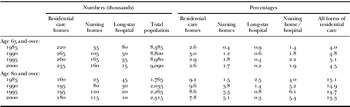
Table 1 shows the numbers and percentages of people aged 65 and over and aged 80 and over in long-stay residential care in Britain between 1985 and 2000. The table shows that the proportion of older people aged 65 and over in all forms of long-stay residential care increased between 1985 and 1995, and then declined between 1995 and 2000. Trends differed by age. The percentage of people aged 80 and over in long-stay residential care rose between 1985 and 1990 and then fell during the 1990s. There were also variations by sector. The proportion of people aged 65 and over and aged 80 and over in residential care homes rose between 1985 and 1990 and then fell in the following decade. However, the proportion of people aged 65 and over and aged 80 and over in nursing homes rose not just between 1985 and 1990 and also between 1990 and 1995, before falling in the 1995–2000 period. The proportion of older people in long-stay hospitals fell throughout the period under study. Trends in the nursing home/hospital sector were dominated by trends in nursing homes, and the proportion of older people in either nursing homes or hospitals rose between 1985 and 1995 and did not begin to fall until the late 1990s.
Numbers (in thousands) and percentages of the population in residential care homes, nursing homes and long-stay hospitals, aged 65 and over and aged 80 and over, Britain, 1985–2000

Sources: See text.
Notes: Numbers are rounded to nearest 5,000. Rates are based on un-rounded numbers. No data were collected on older people in nursing homes in Scotland in 1985. However, there were comparatively few people in nursing homes at this time and the absence of these data for one country is unlikely to have had an important effect on the trends shown.
The trends in long-stay residential care were the result primarily of changes in social policy in Britain at this time. The rise in residential care homes and nursing homes during the 1980s was a largely unintended consequence of an increase in the availability of social security benefits to fund places in private care homes (Audit Commission 1997; Estrin and Pérotin Reference Estrin and Pérotin1988; House of Commons Health Committee 1995; Lewis and Glennerster Reference Lewis and Glennerster1996). Between 1985 and 1990, the sharp increase in numbers in private residential care homes and nursing homes more than compensated for the decline in long-stay hospital places, so that the proportion of older people in all forms of long-stay residential care increased (Darton and Wright Reference Darton and Wright1993; House of Commons Health Committee 1995; Parker Reference Parker and Rowlands1998).
The second period between 1990 and 1995 was a transitional period. Legislation to curb the increase in public spending on long-stay residential care, the NHS and Community Care Act, was introduced in 1990. However, the Act was not implemented until April 1993 and, even then, until the mid-1990s, the community care changes were buffered by transitional arrangements. These arrangements introduced further ‘perverse incentives’ to place people in long-stay residential care, particularly nursing homes (Audit Commission 1997; Darton and Wright Reference Darton, Wright, Laczko and Victor1992). In particular, between 1993 and 1996, local authorities received a ‘Special Transitional Grant’ (STG) from central government, 85 per cent of which had to be spent on care provided in the ‘independent’ sector. However, the ‘85 per cent rule’ forced authorities to continue spending more on long-stay residential care because that was where most independent provision lay (Lewis and Glennerster Reference Lewis and Glennerster1996). The STG also contained additional mechanisms that facilitated the decline of NHS continuing care in long-stay hospitals and the increase in independent-sector nursing homes (Lewis and Glennerster Reference Lewis and Glennerster1996: 168) and nursing homes were increasingly used as an alternative to long-stay hospitals (House of Commons Health Committee 1995). Between 1990 and 1995, however, the increase in nursing homes more than compensated for the decline in long-stay hospitals, so that the percentage of older people in either nursing homes or hospitals increased (Audit Commission 1997).
Finally, between 1995 and 2000, the transitional arrangements ended, the community care reforms were fully implemented and, with local authority means-testing now controlling entry, numbers in long-stay residential care began to decline. The NHS continued to shed long-stay hospital places for older people, but now there were also declines in both private residential care homes and nursing homes, so that the percentage of older people in long-stay residential care fell (Lafortune et al. Reference Lafortune and Balestat2007: 44).
In summary, the trends in long-stay residential care for people aged 80 and over in Britain between 1985 and 2000 varied by sector. There was a rise in the percentage entering residential care homes between 1985 and 1990, followed by a decline between 1990 and 2000. There was a rise in the percentage entering either nursing homes or hospitals between 1985 and 1995, followed by a decline between 1995 and 2000.
Trends in intense intergenerational care for people aged 80 and over, 1985–2000
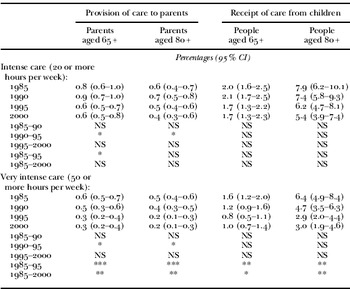
Trends in provision of intense co-resident care to older parents aged 65 and over, and older old parents aged 80 and over, in Britain between 1985 and 2000 are shown in the first two columns of Table 2. The trends use GHS data and, as stated earlier, relate to the provision of care by people aged 30–74. The table shows trends in provision of intense care, provided for 20 or more hours per week, and very intense care, provided for 50 or more hours per week.
Provision of co-resident care to parents aged 65 and over and aged 80 and over and receipt of co-resident care from adult children by people aged 65 and aged 80 and over, by intensity, Britain, 1985–2000

Notes: CI: confidence interval. ‘Provision of care’ refers to people aged 30–74 providing care to parents for 20 or 50 or more hours per week. ‘Receipt of care’ refers to older people receiving care that was provided for 20 or 50 or more hours per week by a co-resident child.
Source: General Household Surveys of 1985, 1990, 1995 and 2000 (author's analysis).
Significance levels of changes over time: * 5%, ** 1%, *** <1%, NS: no significant change.
Table 2 shows that there was a decline in provision of intense and very intense co-resident care for older parents and older old parents between 1985 and 2000. This decline occurred primarily between 1985 and 1995, particularly in the 1990–95 period. The decline in co-resident care for parents was greatest for very intense care. Between 1985 and 2000, there was a significant decline in the percentage of people providing co-resident care for 50 or more hours per week to older and older old parents, concentrated particularly in the 1985–95 period. These results are similar to those reported by the author in an earlier paper, which covered the period between 1985 and 1995 (Pickard Reference Pickard2002). However, the present results now also show that the decline in provision of very intense care for parents largely came to an end in the period between 1995 and 2000. The trends in provision of care to older and older old parents were similar, primarily because most care for older parents was in fact care for older old parents (Pickard forthcoming).
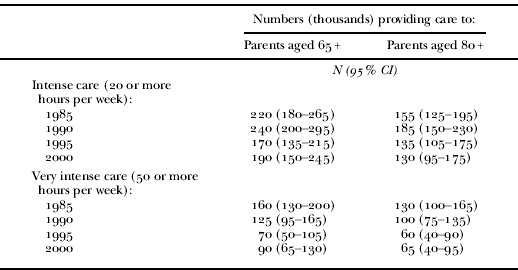
The estimated numbers of people providing intense or very intense co-resident care to older parents in Britain declined between 1985 and 1995, before rising slightly between 1995 and 2000 (Table 3). The fall in the numbers providing very intense care was particularly striking. The numbers providing care for 50 or more hours per week to parents aged 80 and over more than halved during one decade, falling from approximately 130,000 in 1985 to approximately 60,000 in 1995.
Estimated numbers (in thousands) of people aged 30–74 providing co-resident care to parents aged 65 and over and aged 80 and over, by intensity, Britain, 1985–2000
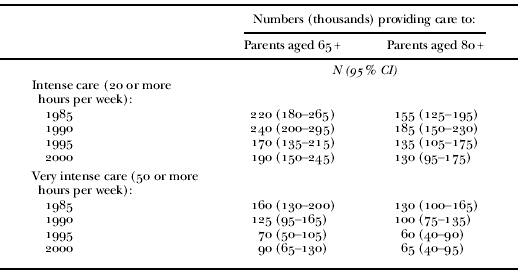
Notes: CI: confidence interval. Estimated numbers are based on sample percentages (given in Table 2) multiplied by the population aged 30–74 in private households. Population in private households is based on Office for National Statistics official population data and 1991 and 2001 Census data.
Source: General Household Surveys of 1985, 1990, 1995 and 2000 (author's analysis).
The GHS sample data on provision of co-resident care from children were utilised to derive information on receipt of care by older people from their children sharing the same household, using the approach described earlier. The numbers of cared-for older people in the GHS samples were expressed as a percentage of the total sample population of people aged 65 and aged 80 and over and the results are shown in the last two columns of Table 2.
The most striking change in receipt of care by people aged 80 and over from co-resident children was the decline in receipt of very intense care (Table 2). Receipt of very intense care for 50 or more hours per week by people aged 80 and over from their co-resident children declined significantly between 1985 and 2000. This decline was concentrated entirely in the period between 1985 and 1995 and came to an end in the 1995–2000 period, when there was a slight (non-significant) increase in receipt of care. Unlike the trends in provision of care, the changes in receipt of very intense care were not statistically significant in any of the five-year periods between 1985 and 2000. This difference in significance between the trends in provision and receipt of care over relatively short time-periods can be attributed primarily to the smaller underlying sample base of the older population, compared to the sample base of the population providing care. The effect was that the decline in receipt of care between 1985 and 1995 was ‘smoother’ than the decline in provision of care. The smoother trends in receipt, compared to provision, of care are particularly noticeable in relation to intense care for 20 or more hours per week. There was a continuous, gradual decline in receipt of intense care by people aged 80 and over between 1985 and 2000.
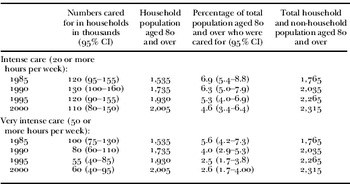
The estimated numbers of people aged 80 and over receiving intense co-resident care from children over time are shown in Table 4. The GHS data relate to the household population and the percentage of people receiving care, given in Table 2, were therefore multiplied by the numbers of people in private households, given in Table 1. The results show that there was comparatively little change in numbers of older old people receiving intense care, but that there was a marked decline in numbers receiving very intense care (Table 4). Between 1985 and 1995, the numbers of people aged 80 and over, who received care for 50 or more hours per week provided by a co-resident child, fell by around half, from approximately 100,000 to approximately 55,000.
Estimated numbers (in thousands) and percentages of people aged 80 and over cared for by adult children on co-resident basis, by intensity, Britain, 1985–2000

The estimated numbers receiving intense co-resident care from children were then expressed as a percentage of the total (household and non-household) population aged 80 and over (Table 4). The results show two distinct trends in receipt of care by intensity, between 1985 and 2000. First, there was a consistent downward trend in the proportion of older old people receiving intense co-resident care from children throughout the 15-year period between 1985 and 2000. Second, there was a sharp fall in receipt of very intense care from co-resident children between 1985 and 1995, which reversed slightly in 1995–2000. The proportion of people aged 80 and over receiving very intense care from co-resident children fell from 5.6 per cent in 1985 to 2.5 per cent in 1995, before rising slightly to 2.6 per cent between 1995 and 2000. It is these changes that will now be compared to trends in long-stay residential care.
Long-stay residential care and intergenerational care for people aged 80 and over, Britain, 1985–2000
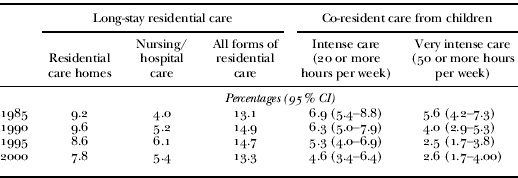
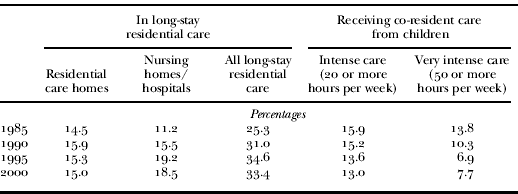
This section explores how far there was a negative relationship between use of different types of long-stay residential care and receipt of intense or very intense co-resident intergenerational care by people aged 80 and over in Britain between 1985 and 2000. Table 5 shows the proportions of people aged 80 and over in long-stay residential care, by sector, and in receipt of co-resident care from their children, by intensity.
Looking first at the relationship between long-stay residential care and receipt of intense care for 20 or more hours per week, the trend in receipt of intense co-resident care was consistently downwards between 1985 and 2000 (Table 5). However, this corresponds negatively neither with the trends in residential care homes nor with the trends in nursing homes/hospitals. There was no consistent increase in the percentages in either residential care homes or nursing homes/hospitals between 1985 and 2000. The percentage of people in residential care homes increased between 1985 and 1990 and then fell between 1990 and 2000, while the percentage of people in nursing homes/hospitals increased between 1985 and 1995 and then fell between 1995 and 2000. Thus, there is little evidence of a negative relationship between the rate for residential care homes and intense co-resident care, except during the five-year period between 1985 and 1990. There is some evidence of a negative relationship between nursing home/hospital care and intense co-resident care between 1985 and 1995, but this did not hold for the period between 1995 and 2000.
Looking now at the relationship between long-stay residential care and receipt of care for 50 or more hours per week, there is some negative relationship between the rate for residential care homes and the rate for very intense co-resident care between 1985 and 1990 and between 1995 and 2000, but the relationship does not hold for the period between 1990 and 1995 (Table 5). During the 1990–95 period, there were declines in both the percentages of older old people in residential care homes and the percentages receiving very intense co-resident care.
However, there is a strong negative relationship between nursing home/hospital care and very intense care in the 80-plus population (Table 5). The percentage receiving very intense co-resident care falls from around 5.5 per cent to around 2.5 per cent between 1985 and 1995, while the percentage receiving nursing home or hospital care rises from around 4 per cent to around 6 per cent. Between 1995 and 2000, the percentage receiving very intense co-resident care rises slightly while the percentage receiving nursing home/hospital care falls.
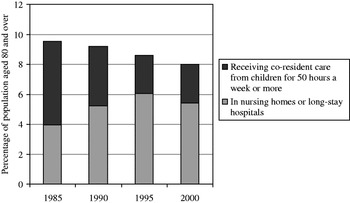
The negative relationship between very intense intergenerational care and nursing home/hospital care among the population aged 80 and over suggests that there is some substitution between them. In order to illustrate this, the results are displayed as a bar chart (Figure 1). The chart shows that, taken together, the probability of being cared for on a very intense co-resident basis and of being cared for in a nursing home/hospital, is around 9.5 per cent in 1985, but that this percentage gradually slopes downwards, so that, by 2000, it is only around 8 per cent. Within this gradually declining probability of being cared for on a very intense basis, whether by children in the same household or in a nursing home/hospital, the balance between the two forms of care changes in a way compatible with the substitution hypothesis. Thus, in 1985, the majority of very intense care is co-resident intergenerational care, whereas in 1995, the opposite is the case, and the majority of very intense care is nursing home/hospital care. Between 1995 and 2000, there is some evidence of a reversal of these trends.
Percentage of population aged 80 and over in nursing homes or long-stay hospitals and receiving very intense co-resident care from children for 50 or more hours per week, Britain, 1985–2000.

However, the fact that there was a gradual decline in the probability of people aged 80 and over receiving very intense care, whether at home or in long-stay residential care, suggests that some other factor is also operating. This is pertinent here because it suggests that the substitution of long-stay residential care for co-resident care was taking place in the context of an overall decline in receipt of very intense care, whether formal or informal (Figure 1). Whatever caused this gradual decline, therefore, may also have contributed to the decline in very intense co-resident care.
Long-stay residential care and intergenerational care for disabled people aged 80 and over, Britain, 1985–2000
As already noted, in addition to age, serious disability is regarded as a major driver of ‘institutional’ admissions (Grundy and Jitlal Reference Grundy and Jitlal2007). Trends in disability in the older old population suggest that the prevalence of more severe disability in Britain declined during the 1980s and 1990s (Academy of Medical Sciences 2009; Bebbington and Darton Reference Bebbington and Darton1996). Analysis based on the GHS shows that, for example, in 1985, 33 per cent of women aged 85 and over in private households had an ADL-disability in England and Wales, but by 1994–95 this had declined to 25 per cent (Bebbington and Darton Reference Bebbington and Darton1996: 26).
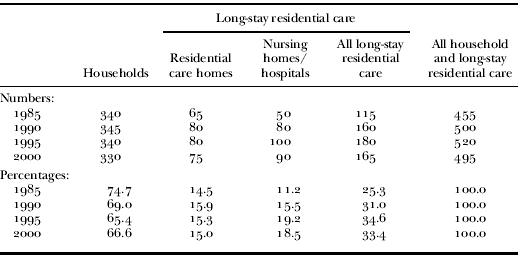
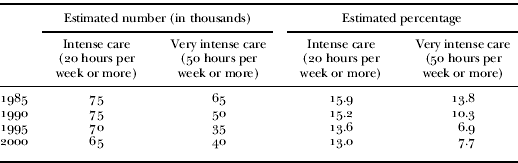
Given these trends, it was hypothesised that the gradual decline in receipt of very intense forms of care, whether by co-resident children or in nursing homes/hospitals, might have been related to the decline in the prevalence of more severe disability in the older old population in the 1980s and 1990s. In order to investigate this, the numbers of disabled people aged 80 and over were estimated and the results are shown in Table 6 (top part of table). The numbers of disabled people in long-stay residential care are estimated using the methods described earlier. The numbers of disabled people in households are derived from the application of disability rates in England and Wales, by age and gender, primarily from Bebbington and Darton (Reference Bell and Bowes1996), to the household population aged 80 and over in Britain.Footnote 7 The numbers in different types of long-stay residential care are then expressed as a proportion of the total (household and non-household) disabled population (lower part of Table 6). The numbers of disabled people aged 80 and over receiving intense and very intense co-resident care from children are then estimated, using methods described earlier, and these numbers are expressed as a percentage of the total disabled population aged 80 and over (Table 7).
Estimated numbers (in thousands) and percentages of disabled people aged 80 and over in private households and in long-stay residential care, Britain, 1985–2000
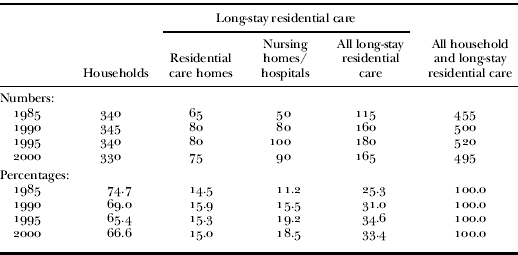
Notes: Disabled in households in 1990 derives from trends between 1985 and 1994/5. Disabled in residential care homes derive from mid-point of observed disability rates for local authority, voluntary and private homes; disabled in nursing homes/hospitals derive from mid-point of rates for dual-registered and nursing homes. Numbers are rounded to nearest 5,000. Percentages are based on unrounded figures. Figures may not add exactly due to rounding.
Sources: Bebbington and Darton (Reference Bebbington and Darton1996: 26); Bajekal (Reference Bajekal2002: 49); General Household Survey of 2001–02 (author's analysis).
Estimated numbers (in thousands) and percentages of disabled people aged 80 and over receiving intense or very intense co-resident care from children, Britain, 1985–2000
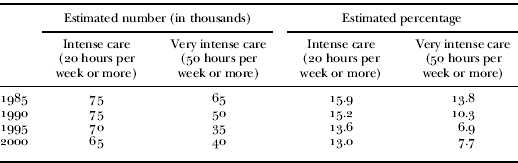
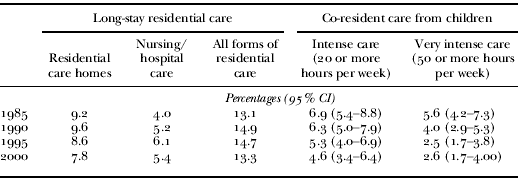
Table 8 shows the estimated rates of receipt of both long-stay residential care and co-resident care from children by disabled people aged 80 and over in Britain between 1985 and 2000. The table shows that there was an increase in the proportion of the disabled population in any form of long-stay residential care between 1985 and 2000. The greatest increase was in nursing home/hospital care, with the proportion of disabled people in either nursing homes or long-stay hospitals nearly doubling between 1985 and 1995. At the same time, the proportion of disabled people receiving very intense co-resident care fell by around a half.
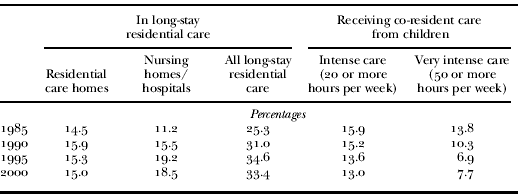
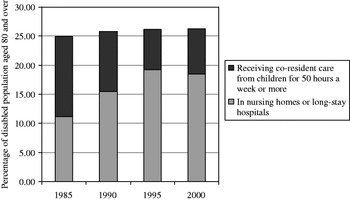
Figure 2 compares receipt of very intense co-resident care by children and nursing home/hospital care among disabled people aged 80 and over. The figure shows that the probability of a disabled older old person being cared for on a very intense co-resident basis or being cared for in a nursing home/hospital was around 25 per cent (25.0–26.2 per cent) between 1985 and 2000. Therefore, controlling for disability in the population, there was little change between 1985 and 2000 in the percentage of older old people receiving very intense forms of care, either at home or in long-stay residential care.
Percentage of disabled population aged 80 and over receiving care in nursing homes or long-stay hospitals and receiving very intense co-resident care from children for 50 or more hours per week, Britain, 1985–2000.

However, during the period between 1985 and 2000, the balance between very intense co-resident care and nursing home/hospital care for the disabled population changed in a manner consistent with the substitution hypothesis (Figure 2). In 1985, the proportion cared for very intensely by co-resident children exceeded the proportion cared for in nursing homes and hospitals. However, over the next decade, these proportions changed and, by 1995, the proportion cared for in nursing homes and hospitals exceeded the proportion cared for very intensely by children living in the same household. After 1995, there were signs that these trends were reversing.
While there was evidence of substitution between very intense co-resident care from children and nursing home/hospital care among people aged 80 and over, this relationship did not seem to apply to intense co-resident care provide for 20 or more hours per week. Table 8 shows that the proportions of disabled people aged 80 and over cared for intensely on a co-resident basis fell consistently between 1985 and 2000. This persistent decline in intense care continued into the late 1990s and therefore coincided with declines in both long-stay residential care and nursing home/hospital care. This suggests that there was no consistent negative relationship between receipt of co-resident care for 20 or more hours per week and either long-stay residential care or nursing home/hospital care.
Discussion and conclusions
This paper has found evidence of substitution of formal for informal care. The evidence suggests that in Britain, during the 1980s and 1990s, care in nursing homes/long-stay hospitals substituted for very intense co-resident care by children. As the numbers of people aged 80 and over in nursing homes or hospitals rose in Britain between 1985 and 1990, so there was a fall in very intense co-resident care provided for 50 or more hours per week by adult children. Between 1985 and 1995, the numbers of people aged 80 and over in nursing homes or hospitals rose from approximately 70,000 to 140,000. At the same time, the numbers of people aged 80 and over receiving very intense co-resident care from their children fell by around a half, from approximately 100,000 in 1985 to 55,000 in 1995. Correspondingly, the numbers of people providing very intense co-resident care for parents aged 80 and over fell by over half between 1985 and 1995, reducing from approximately 130,000 in 1985 to approximately 60,000 in 1995.
The paper has also found evidence of ‘reverse substitution’ of informal for formal care in Britain during the late 1990s. Specifically, the paper has found that, when numbers in nursing homes/hospitals began to fall in the late 1990s, very intense co-resident care by adult children began to rise. Between 1995 and 2000, the numbers of people aged 80 and over in nursing homes/hospitals fell from approximately 140,000 to approximately 125,000. At the same time, the numbers of people aged 80 and over receiving very intense co-resident care from their children began to rise, increasing from approximately 55,000 in 1995 to 60,000 in 2000. Correspondingly, the numbers of people providing very intense co-resident care for parents aged 80 and over increased in the late 1990s, from approximately 60,000 to approximately 65,000.
The substitution relationships, identified in this paper, varied by service sector. Facilities offering greater amounts of care substituted for intergenerational care of greater intensity, and it was nursing homes/hospitals that substituted for co-resident care for 50 or more hours per week. In addition, a key factor affecting the substitution relationship between nursing home/hospital care and very intense co-resident care from children was the severity of disability of the older people. The majority of those in nursing homes or long-stay hospitals and the majority of those receiving very intense co-resident care from children were ADL-disabled in that they were unable to perform one or more personal care tasks unaided. The substitution relationship between those in nursing homes/hospitals and those receiving very intense co-resident care from children was therefore also affected by the decline in the prevalence of ADL-disability among older people during the 1980s and 1990s.
It seems likely that the changes in the numbers of older people cared for very intensely by co-resident children fell because of the changes in numbers in nursing homes/hospitals. The direction of causality is likely to have been from the changes in nursing home/hospital care to the changes in very intense co-resident care. This is because, as described earlier, the changes in nursing home/hospital care can be attributed primarily to changes in social policy during the 1985–2000 period.
The evidence of this paper that there was substitution of long-stay residential care for informal care differs from the existing international literature. Previous research, reviewed at the start of the paper, has found little evidence of substitution of formal for informal care. The main reason for the difference between the results of the present study and those of previous studies, however, is likely to be the form of the services that have been examined. The present study has examined the impact of long-stay residential care on informal care, whereas the existing literature on substitution has tended to focus almost exclusively on the impact of domiciliary services on informal care.
The further finding of the present study that the decrease in long-stay residential care in the late 1990s in Britain led to an increase in informal care seems consistent with wider international evidence (Johansson, Sundstrom and Hassing Reference Johansson, Sundstrom and Hassing2003; Patsios Reference Patsios2008), but also represents an important new departure from it. The existing studies showing a reverse substitution have been concerned with domiciliary care. To the author's knowledge, the present paper is the first to demonstrate that a decline in long-stay residential care for older people has resulted in an increase in informal care.
There are some important limitations to the substitution relationships observed in the present study. In particular, the substitution effects relate specifically to the most intense forms of informal care, that is, care provided on a co-resident basis for 50 or more hours per week. There is little evidence of substitution effects in relation to intense co-resident care provided for 20 or more hours per week to older parents. The absence of substitution effects between intense co-resident care and long-stay residential care may have been due to the greater availability of alternative sources of care at relatively lower levels of intensity. In particular, the increased availability of more intense home care services to the most disabled older people during the late 1990s in Britain (Department of Health 2002) may have enabled some disabled older people to retain their residential independence for longer and this may have reduced their need for intense co-resident care from children.
The substitution effects, identified in this paper, have implications for social policy. The capacity of informal care to substitute for long-stay residential care, which has been observed both here and in previous studies, has led some analysts to suggest that it might be a cost-effective policy to replace paid formal care with informal care (Van Houtven and Norton Reference Van Houtven and Norton2008: 154). However, the present study has suggested that the decline in nursing homes and long-stay hospitals in the late 1990s in Britain led to an increase in very intense unpaid care, provided for 50 or more hours per week. It could be argued that such extensive provision of informal care is ‘unacceptable’ because of the demands placed on the carer (cf. Keith and Morris Reference Keith, Morris and Morris1996; Twigg Reference Twigg1996). Indeed, the social care Green Paper, prepared by the outgoing Labour Government, acknowledged the serious effects on the health and employment opportunities of ‘carers in England who care for more than 50 hours per week’ and put this together with a statement from a carers’ organisation to the effect that families should be protected from ‘unmanageable and dangerous levels of caring’ (HMG 2009: 119). The implication is that more progressive social policies are likely to reject as unacceptable ‘deinstitutionalisation’ polices that replace formal with informal care since, on the evidence presented in this paper, this would risk an increase in ‘unacceptable’ levels of unpaid care. A further implication is that, if ‘deinstitutionalisation’ policies are to be pursued, then long-stay residential care needs to be replaced by alternative very intense formal services, of the type developed in Denmark (Stuart and Weinrich Reference Stuart and Weinrich2001).
The evidence from the present study also addresses some of the fears about substitution that constrain the development of social care policy in England. As noted at the beginning of this paper, fear of substitution has led policy makers to restrict access to publicly funded long-term care for older people, due to concerns that this might lead to the complete replacement of family care. The lack of much academic evidence about the nature and extent of substitution in Britain may have fuelled these concerns. The present study provides evidence about the substitution of family care during a period in British social policy when there was an increase in access to publicly funded long-term care services. It shows that this increase in access did lead to some substitution, but that this was confined to the most intense types of informal care, that is, care provided on a co-resident basis for 50 or more hours per week. The evidence presented here suggests that substitution does not occur at lower levels of intensity, so that increased access to publicly funded social care would not be an ‘open door’ policy, likely to lead to a massive increase in demand. Indeed, a more universal publicly funded care system would certainly not lead to the complete replacement of family care for older people.Footnote 8 It might, however, serve to replace the most intense types of informal care, which are increasingly regarded as ‘unacceptable’ in this country.
A final conclusion, with particular relevance for the Dilnot Commission on long-term care funding in England, follows from this analysis. The government has asked the Commission to consider two funding options, a ‘partnership scheme’ and a ‘voluntary insurance scheme’ (HMG 2010b). However, it is also important for the Commission to consider wider options, including tax-funded options. The present paper has traced how provision of very intense formal services for frail older people has shifted from NHS long-stay hospitals, funded out of taxation and free at the point of use, to provision in private nursing homes, initially funded out of social security payments, but then subject to local authority means-testing. It has further shown that, between 1995 and 2000, provision began to shift from nursing homes to very intense intergenerational care. A universal long-term care system, such as that described by the social care White Paper (HMG 2010a), could potentially move some of the care of frail older people from the sphere of the family back into the public domain. Given that the care of frail older people has in the past been funded out of taxation as part of the NHS, the present paper raises the question: why should a universal social care system not be funded out of taxation?
Acknowledgements
Material from the General Household Survey (GHS) is Crown Copyright and is made available by the Office for National Statistics via the UK Data Archive. Permission to use the GHS datasets has been granted by the UK Data Archive. All responsibility for the analysis and views expressed in this study rests with the author. The author would particularly like to thank John Hills, Professor of Social Policy in the Department of Social Policy at the London School of Economics and Political Science, for his help and advice. The author is also grateful to two anonymous referees for helpful comments.