


Introduction
It has been suggested that a good therapeutic relationship is often more difficult to establish with psychotic clients, due to the nature of their clinical presentation and their past experiences. For example, clients may distrust or hold delusional beliefs about their therapist, and therapists may find it difficult to empathize with clients’ unusual experiences. However, a good therapeutic relationship is crucial to the work of Cognitive Behaviour Therapy for psychosis (CBTp), where therapist and client work collaboratively to reduce the negative impact of the client's beliefs on their everyday life (Fowler, Garety and Kuipers, Reference Fowler, Garety and Kuipers1995). Recent studies suggest that the quality of the therapeutic relationship predicts outcome in CBTp, although there is no agreement on whether the client's or therapist's rating does so better (Bentall et al., Reference Bentall, Lewis, Tarrier, Haddock, Drake and Day2003, Frank and Gunderson, Reference Frank and Gunderson1990, Gehrs and Goering, Reference Gehrs and Goering1994; Hammond, Reference Hammond2004; Svensson and Hanson, Reference Svensson and Hansson1999). To date, only a few studies have investigated the specific correlates of the therapeutic relationship in CBTp, such as client, therapist and therapy factors (Dow, Reference Dow2003; Hammond, Reference Hammond2004).
A pantheoretical model developed by Bordin (Reference Bordin1979) divides the therapeutic relationship into three factors – goals, tasks and bond. A mutual understanding and agreement about the goals of therapy and the tasks required to meet those goals is mediated by the presence of an interpersonal bond between patient and therapist to maintain the work. Bordin's tripartite model of the therapeutic relationship is widely accepted in the literature, although additions have been suggested recently, such as the therapist's and client's experiences of past relationships (Hardy, Cahill and Barkham, Reference Hardy, Cahill, Barkham, Gilbert and Leahy2007). The majority of research has been carried out with non-psychotic clients and has found a moderate relationship between the quality of the therapeutic relationship and outcome in therapy (Martin, Gaske and Davis, Reference Martin, Garske and Davis2000; Zuroff and Blatt, Reference Zuroff and Blatt2006) with the early, rather than the later, therapeutic relationship being a stronger predictor (Mohl, Martinez, Ticknor, Huang and Cordell, Reference Mohl, Martinez, Ticknor, Huang and Cordell1991). Evidence suggests that this association cannot be accounted for by the effect of symptom change early on in therapy (e.g. Klein et al., Reference Klein, Schwartz, Santiago, Vivian, Vocisano, Costonguay, Arnow, Blalock, Markowitz, Rothbaum and McCullough2003; Zuroff and Blatt, Reference Zuroff and Blatt2006).
Other studies have examined which therapist, client and therapy factors are predictive of the quality of the therapeutic relationship. Predictive factors have included therapist empathy, experience and confidence (Ackerman and Hilsenroth, Reference Ackerman and Hilsenroth2003); expertness, attractiveness and trustworthiness (Strong, Reference Strong1968); the severity of client symptoms (Clarkin and Crilly, Reference Clarkin and Crilly1987); client and therapist matches on age, gender and ethnicity (Beutler, Clarkin, Crago and Bergan, Reference Beutler, Clarkin, Crago, Bergan, Snyder and Forsyth1991; Fiorentine and Hillhouse, Reference Fiorentine and Hillhouse1999); and different therapeutic interventions, such as presentation of a case formulation, and the depth of the session (Ackerman and Hillsenroth, Reference Ackerman and Hilsenroth2003). Newer cognitive-behavioural approaches have suggested further characteristics that may be necessary for the formation of a good therapeutic relationship, such as acceptance (Pierson and Hayes, Reference Pierson, Hayes, Gilbert and Leahy2007) and compassion (Gilbert, Reference Gilbert, Gilbert and Leahy2007) by the therapist, but there is as yet little research carried out linking these factors to the quality of the therapeutic relationship.
With psychotic clients, early studies suggested engagement may be more difficult and take longer than with non-psychotic clients (Frank and Gunderson, Reference Frank and Gunderson1990), whereas more recent research has found good levels of therapeutic relationship comparable to non-psychotic populations (Dow, Reference Dow2003; Hammond, Reference Hammond2004; Svensson and Hansson, Reference Svensson and Hansson1999). Two studies have suggested correlates of a good therapeutic relationship in CBTp to be: (1) clients who present with more problems, (2) more severe symptoms, (3) more social relationships, (4) in work, (5) and fewer days spent in psychiatric hospital in the last 18 months (Svensson and Hansson, Reference Svensson and Hansson1999), and no history of violence (Dow, Reference Dow2003). Most client factors were not found to correlate with the therapeutic relationship in these two studies, including demographic factors (age, gender, and marital status); illness variables (length of illness, age of onset, number of previous inpatient admissions and suicide attempts); current presentation (global functioning, quality of life, anxiety, depression, positive and negative symptoms); or forensic history (sexual offences and prison sentences). Therapist age, gender, marital status and years qualified (Dow, Reference Dow2003) and, surprisingly, presentation of a case formulation (Chadwick, Williams and Mackenzie, Reference Chadwick, Williams and Mackenzie2003) have also been found to be unrelated to the therapeutic relationship.
To date research has mainly concentrated on the therapeutic relationship with non-psychotic clients, and only a handful of studies have begun to investigate which client, therapist and therapy factors may be important in developing a good therapeutic relationship in CBTp specifically. Factors such as client's reaction to hypothetical contradiction (RTHC) and cognitive insight, which are potential good predictors of outcome in CBTp (Chadwick and Lowe, Reference Chadwick and Lowe1990; Kuipers et al., Reference Kuipers, Garety, Fowler, Dunn, Bebbington, Freeman and Hadley1997; Granholm, McQuaid, McClure, Pedrelli and Beck, Reference Granholm, McQuaid, McClure, Pedrelli and Beck2002), have not been explored in relation to the therapeutic relationship. This study set out to examine the relationship between a wide range of client, therapist and therapy factors and the therapeutic relationship in CBTp in routine outpatient clinical practice. Bordin's (Reference Bordin1979) model of the working alliance, as operationalized by the Working Alliance Inventory (Horvath and Greenberg, Reference Horvath and Greenberg1989), was used because it is pantheoretical and is widely used in the therapeutic relationship literature, allowing direct comparisons between findings. This study focused on the early stages of the therapeutic relationship since previous studies have shown that it is the early therapeutic relationship that best predicts outcome (Mohl et al., Reference Mohl, Martinez, Ticknor, Huang and Cordell1991; Plotnicov, Reference Plotnicov1990; Tracey, Reference Tracey and Dorn1986).
The main research questions were: (1) what is the quality of the initial therapeutic relationship between therapists and psychotic clients, and how much do clients and therapists agree on the alliance components of tasks, bond and goals? (2) to what extent is the quality of the therapeutic relationship correlated with each of the following factors: (a) client factors, including demographic, clinical, and illness variables, as well as cognitive insight and RTHC; (b) therapist factors, such as experience, confidence, and empathy; (c) matching clients and therapists on demographic variables such as ethnicity; and (d) therapy factors, such as the presentation of a case formulation?
Method
Overview
The study was a cross-sectional, correlational design with measures taken when clients were between sessions two to nine of CBTp (on average, after the sixth session). Clients and therapists completed questionnaires concerning clients’ psychological problems, clients’ view of their therapist and the therapeutic relationship, therapists’ views of themselves and the therapeutic relationship, and interventions carried out in therapy thus far.
Participants
Twenty-four client-therapist dyads were recruited from three sites: the Psychological Interventions Clinical for oUtpatients With Psychosis (PICuP; South London and Maudsley NHS Foundation Trust), an inner London specialist CBTp clinic (14 participants, 58%), three Community Mental Health Teams within inner city London boroughs (6 participants, 25%), and a London Psychology Service for clients with long-term needs (4 participants, 17%).
Therapists were approached first and all agreed to take part. They were sent questionnaires and completed them at the same time-point in therapy as their client. Of the forty-seven therapists approached, 24 (51%) worked with clients who met the inclusion criteria during the course of the study. Out of these 24 therapists, 17 (36%) worked with clients who agreed to take part. Five therapists worked with more than one participating client (three with two clients and two with three clients). Of those therapists who participated, 5 (29%) were male and 12 (71%) were female; the average age was 31.1 (SD = 3.3, range = 25–38); and all described their ethnicity as White. In terms of profession there were eight (47%) clinical psychologists, one (6%) counselling psychologist, seven (41%) trainee clinical psychologists and one (6%) consultant psychiatrist. The average number of years qualified was 1.6 (trainee clinical psychologists were rated as being −3 to 0 years qualified depending on how many years they had been training; SD = 3.3, range = −2.75 to 10 years); therapists had seen on average 9.5 (SD = 8.7, range = 0–30) clients previously for CBTp; felt on average that their confidence in carrying out CBT for psychosis was 3.7, i.e. “somewhat confident”, out of a possible seven (SD = 1.3, range = 2–6).
Therapists gave the research information sheet to suitable clients. If clients agreed to participate, an interview with the researcher was arranged. Testing procedures lasted between 20–50 minutes, which patients did not find unduly onerous. There were no problems with concentration, and no participant requested a break or was unable to complete the questionnaires. During this interview questionnaires were either completed independently by clients or by the researcher asking questions of the clients. Clients were interviewed once when they were between sessions two and nine of therapy and were reimbursed £10 for their time.
Inclusion criteria for clients were: (1) a schizophrenia spectrum diagnosis (F20–29; ICD-10); (2) aged between 18 to 65 years old; (3) receiving CBTp; and (4) sufficient knowledge of the English language to allow understanding and completion of the questionnaires.
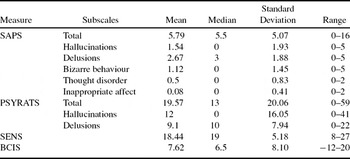
Fifty-six clients met the inclusion criteria. Seven (12%) dropped out of treatment before they were approached to take part, and 25 (45%) declined to take part. Apart from the above inclusion criteria, no further data are available for those clients. Twenty-four (43%) agreed to participate. Of those who participated, the clinical diagnoses (based on ICD-10 criteria) were: 17 (71%) schizophrenia, 3 (12.5%) schizoaffective disorder, 3 (12.5%) psychotic illness, and 1 (4%) delusional disorder. Seventeen (70%) were male and 7 (30%) were female; the average age was 39.5 (SD = 8.4, range = 20–53); the average length of illness was 16.8 years (SD = 9.3, range = 2–36); 15 (63%) described their ethnicity as White, 7 (29%) as Black, 1 (4%) as Asian, and 1 (4%) as Mixed. The clinical characteristics of the clients are presented in Table 1.
Client clinical characteristics

SAPS: Scale for the Assessment of Positive Symptoms (Andreasen, Reference Andreasen1984)
PSYRATS: Psychotic Symptoms Rating Scales (Haddock, McCarron, Tarrier and Faragher, Reference Haddock, McCarron, Tarrier and Faragher1999)
SENS: Subjective Experience of Negative Symptoms (Selten, Sijben, van den Bosch, Omloo-Visse and Warmerdam, Reference Selten, Sijben, Van Den Bosch, Omloo-Visser and Warnerdam1993)
BCIS: Beck Cognitive Insight Scale (Beck, Baruch, Balter, Steer and Warman, Reference Beck, Baruch, Balter, Steer and Warman2004)
Measures completed by clients
Client demographics. Items asked about the client's age, gender, ethnicity, diagnosis, current medication, number of psychiatric hospitalizations in the last year and last 5 years, and age at onset of illness.
Working Alliance Inventory – Client Version (WAIc; Horvath and Greenberg, Reference Horvath and Greenberg1989). The WAI measures three components of the therapeutic relationship according to Bordin's (Reference Bordin1979) model of the working alliance: bond, goals, and tasks. Thirty-six items (12 for each component) are rated according to frequency where one equals “never” and seven equals “always”. Examples of items include “I believe (therapist) is genuinely concerned for my welfare” (bond), “(therapist) and I collaborate on setting goals for therapy” (goals). An average score of between one and seven is obtained for the three components of bond, goals and tasks, as well as the overall quality of the working alliance. The WAI has good content validity since the items were initially generated by a content analysis of Bordin's theoretical model of the working alliance. A number of independent investigations provide support for the WAI's convergent and divergent validity, e.g. Safran and Wallner (Reference Safran and Wallner1991). Reliability estimates for both client and therapist versions range from.93 to.84, with most reported coefficients in the upper range (Horvath, Reference Horvath, Horvath and Greenberg1994).
Subjective Experience of Negative Symptoms (SENS; Selten, Sijben, van den Bosch, Omloo-Visser and Warmerdam, Reference Selten, Sijben, Van Den Bosch, Omloo-Visser and Warnerdam1993). The SENS is based on the Scale for the Assessment of Negative Symptoms (SANS, Andreasen, Reference Andreasen1989) and measures the severity and related distress of negative symptoms as perceived by the psychotic client. Overall scores from 7 to 35 for the severity and related distress of negative symptoms are calculated. The SENS has shown high internal consistency and acceptable test-retest reliability, e.g. a Kuder-Richardson coefficient of 0.76 (Selten et al., Reference Selten, Sijben, Van Den Bosch, Omloo-Visser and Warnerdam1993).
Beck Cognitive Insight Scale (BCIS; Beck, Baruch, Balter, Steer and Warman, Reference Beck, Baruch, Balter, Steer and Warman2004). The BCIS was developed to evaluate patients’ self-reflectiveness and their overconfidence in their interpretations of their experiences. A composite index of the BCIS reflecting cognitive insight is calculated by subtracting the score for the self-certainty scale from that of the self-reflectiveness scale. This allows for a range of scores from -15 to 30. The scale demonstrated good convergent, discriminant, and construct validity (Beck et al., Reference Beck, Baruch, Balter, Steer and Warman2004). Reliability estimates range from 0.61 to 0.82 (Engh et al., Reference Engh, Friis, Birkenaes, Jónsdóttir, Ringen, Ruud, Sundet, Opjordsmoen and Andreassen2007; Favrod, Zimmerman, Raffard, Pomini and Khazaal, Reference Favrod, Zimmerman, Raffard, Pomini and Khazaal2008; Mak and Wu, Reference Mak and Wu2006).
Counselor Rating Form (CRF; Barak and LaCrosse, Reference Barak and LaCrosse1975). The CRF measures three attributes of the therapist as viewed by the client: attractiveness, competence, and trustworthiness. Thirty-five items are rated on a 7-point bipolar scale of word pairs of opposing adjectives, e.g. dependable-undependable, sincere-insincere. It has been found to be reliable and valid, e.g. split-half correlation coefficients of between 0.85 and 0.91 for each scale (LaCrosse and Barak, Reference LaCrosse and Barak1976; Barak and Dell, Reference Barak and Dell1977).
Relationship Inventory – Empathy Scale (RI; Barrett-Lennard, Reference Barrett-Lennard, Greenberg and Pinsof1986). The empathy scale of the RI measures both client and therapist views of therapist empathy. The total score ranges from 24 to -24. Eight statements are rated on a 6-point Likert scale according to how strongly they believe them, e.g. “(She/he) appreciates exactly how the things I experience feel to me”; “(She/he) realises what I mean even when I have difficulty saying it”. Gurman (Reference Gurman, Gurman and Razin1977) found the empathy scale to have good validity and the alpha coefficients to exceed 0.80 for the 16-item scale.
Measures completed by the researcher in the client interview
Scale for Assessment of Positive Symptoms (SAPS; Andreasen, Reference Andreasen1984). The SAPS measures positive symptoms that occur in schizophrenia. Scores are calculated for individual psychotic symptoms as well as overall ratings of severity of hallucinations, delusions, bizarre behaviour, positive formal thought disorder, and inappropriate affect. The time set covers the month prior to assessment. Items are rated on a 6-point Likert scale from zero to five with anchored points, where a rating of zero indicates the symptom is not present and a rating of five indicates the symptom is severe. Scores are calculated for individual psychotic symptoms as well as overall ratings of severity of hallucinations (0–5), delusions (0–5), bizarre behaviour (0–5), positive formal thought disorder (0–5), and inappropriate affect (0–5). The SAPS has been found to have good to excellent levels of inter-rater reliability, moderate test-retest reliability, high internal consistency (e.g. an average alpha coefficient of 0.78), and high predictive validity (e.g. Andreasen et al., Reference Andreasen, Arndt, Alliger, Miller and Flaum1995a, Reference Andreasen, Arndt, Miller, Flaum and Nopoulosb; Malla, Norman and Williamson, Reference Malla, Norman and Williamson1993).
The Psychotic Symptom Rating Scales (PSYRATS; Haddock, McCarron, Tarrier and Faragher, Reference Haddock, McCarron, Tarrier and Faragher1999). The PSYRATS consists of two scales designed to rate auditory hallucinations and delusions along variables such as frequency, duration, severity and disruption. The auditory hallucinations subscale (AH) has 11 items and is rated on a 5-point ordinal scale (zero to four), resulting in a possible range of scores from 0–44. The delusions subscale (DS) has six items and is also rated on a 5-point ordinal scale (zero to four), resulting in a possible range of scores from 0–24. A combined score can therefore range from 0–68. The scale demonstrated good inter-rater reliability. All AH items except two were found to have an unbiased estimate of reliability about 0.9 and all DS items except disruption had estimates of reliability above 0.9. In terms of validity, there were specific associations between some items on the PSYRATS and the modified Psychiatric Scale (KGV: Krawiecka, Goldberg and Vaughn, Reference Krawiecka, Goldberg and Vaughn1977), which is a standardized assessment scale for psychotic patients.
Pre-Admission Functioning (PAF; Strauss and Carpenter, Reference Strauss and Carpenter1972). The PAF measures patients’ functioning prior to assessment. The previous month is assessed with regard to social contacts and psychiatric symptoms, and the previous year with regard to employment and use of psychiatric in-patient services. There are no data for its reliability or validity.
Reaction to Hypothetical Contradiction (RTHC; Brett-Jones, Garety and Hemsley, Reference Brett-Jones, Garety and Hemsley1987). The RTHC measures whether clients are able to consider and assimilate evidence that contradicts their delusional belief(s). The measure of accommodation considers the awareness that the subject has of actual occurrences that contradict their belief, and how these affect their belief. Responses are categorized according to changes in conviction, content, preoccupation, and interference. The RTHC has been found to be independent from other measures of delusional ideation, e.g. insight, level of conviction, and to be easy to use (Hurn, Gray and Hughes, Reference Hurn, Gray and Hughes2002).
Measures completed by therapists
Therapist demographics. The therapists reported their age, gender, ethnicity, number of years as a qualified clinician, and number of clients seen for CBTp. They also rated their confidence in using CBTp on a 7-point Likert scale with anchored points where one equals not confident at all and seven equals extremely confident.
Working Alliance Inventory – Therapist Version (WAIt; Horvath and Greenberg, Reference Horvath and Greenberg1989). The therapist version of the WAI is parallel to the client version. The 36 items yield the same three components of bonds, goals and tasks, and the overall score of quality of the working alliance. Reliability estimates for both client and therapist versions range from.93 to.84, with most reported coefficients in the upper range (Horvath, Reference Horvath, Horvath and Greenberg1994).
Relationship Inventory – Empathy Scale (RI; Barrett-Lennard, Reference Barrett-Lennard, Greenberg and Pinsof1986). Similarly, the therapist version of the RI measures how empathic therapists believe themselves to have been with their client. It yields a total score of between 24 and -24. Eight items are rated on a 6-point Likert scale with anchor points. It also has good reliability and validity, i.e. alpha coefficients above 0.80.
Presentation of a Case Formulation Checklist (PCFC; after Chadwick et al., Reference Chadwick, Williams and Mackenzie2003). The PCFC measures whether a therapist has presented a case formulation to a client, what components have been included, and which model of psychosis has been used. The items relate to the components of a case formulation for CBTp considered important by Chadwick et al. (Reference Chadwick, Williams and Mackenzie2003). These are triggers, maintaining factors, targets for therapy, the onset to the problem, the idea that beliefs are not facts, core beliefs, rules for living, key formative experiences and possible risks to the therapeutic relationship.
Cognitive-Behavioural Therapy for Psychosis Checklist (as used by Jolley et al., Reference Jolley, Garety, Craig, Dunn, White and Aitken2003). The CBTp checklist assesses what interventions therapists have carried out in therapy to date. The 15 interventions suggested are based on Fowler et al.'s (Reference Fowler, Garety and Kuipers1995) CBTp treatment manual. These are: building rapport, a collaborative understanding of the most recent psychotic episode, a case formulation, assessment and cognitive therapy for psychotic symptoms, the meaning of psychosis for the self, discussion of the future likely course of the psychosis, assessment and cognitive therapy for self-esteem, anxiety and depression, assessment and intervention for relapse, assessment of goals, assessment of negative symptoms, interventions to promote graded social contact and activity, behaviour therapy for anxiety or depression, establishing contact with other agencies, and assessment and interventions for families.
Results
Checks were carried out to ensure that the distributions were consistent with the assumptions of parametric analysis. Variables that were not normally distributed were transformed using square root or logarithmic transformations. Transformed variables included: PSYRATS Disruption, number of psychiatric hospital admissions in past 5 years, PAF – Employment Status, CRF – Expertness, Attractiveness, and Trustworthiness, number of previous CBTp cases, and number of years qualified. All of the transformed variables were found to be normally distributed. WAI scores were normally distributed with no outliers (i.e. no data points were more than 2.5 standard deviations from the mean).
Due to the large number of tests carried out in this investigation a more stringent value of p<.01 was used to minimize Type I errors. Findings with p values greater than .01 but less than .05 are described as trends. No tests were carried out on the variable of therapist gender due to low number of male therapists.
On average 6.6 types of CBTp interventions were reported by therapists to have been undertaken out of a possible 15 (SD = 2.5, Range = 2–12) on the CBTp checklist. Building rapport was the only intervention that all therapists reported having carried out. Out of the 12 (50% of total) cases where a case formulation had been presented, on average this occurred in session four (SD = 1.7, Range = 2–8) and 5.6 components had been included out of a possible 9 (SD = 2.1, Range = 3–9).
What is the quality of the initial therapeutic relationship between clients and therapists, and how much do clients and therapists agree on the quality of the working alliance and its components of tasks, bond and goals?
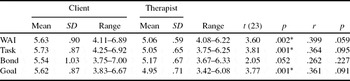
Table 2 presents client and therapist WAI scores. The overall scores indicate that, on average, both clients and therapists reported that a good therapeutic relationship was present “often”. Client ratings on the WAI components of Tasks and Goals were on average higher than those of the therapists, but did not reach significance for ratings of Bond. There were no statistically significant correlations between client and therapist ratings on any of the WAI components or overall WAI total, indicating that, whilst on average clients and therapists both thought that a good therapeutic relationship was often present, they did not agree on the quality of the therapeutic relationship within each therapist-client dyad.
Client and therapist WAI scores and analyses (N = 24)

*p<.01
Scores on the WAI and its components are rated as 1 = never, 2 = rarely, 3 = occasionally, 4 = sometimes, 5 = often, 6 = very often, 7 = always
To what extent is the therapeutic relationship correlated with client factors?
No statistically significant correlations were found between client ratings of the working alliance and any of the continuously distributed client factors (severity of overall psychotic symptoms, hallucinations, delusions, negative symptoms, disruption to life and distress about negative symptoms, length of illness, number of inpatient admissions, social contacts, employment level and cognitive insight). There was a trend towards a difference in client ratings of the working alliance for client gender (t (23) = 2.52, p = .02) with female clients’ ratings of the working alliance (M = 6.29, SD = .36) being higher than male clients’ (M = 5.37, SD = .93), but no other differences on any of the other dichotomized variables (the presence of current psychotic symptoms and reaction to hypothetical contradiction) were found. No client factors correlated with therapist ratings of the working alliance.
To what extent is the therapeutic relationship correlated with therapist factors?
Client and therapist ratings of therapist empathy were not correlated but were significantly different (t (23) = 3.12, p = .005), with client ratings (M = 12.5, SD = 7.6) being higher than therapist ratings (M = 7.6, SD = 5.4).
Clients’ ratings of the working alliance were correlated with their ratings of therapist empathy (r = .640, p = .001), expertness (r = .714, p = .001), attractiveness (r = .652, p = .001), and trustworthiness (r = .786, p = .001). There were trends towards therapists rating the working alliance higher when their self-ratings of empathy were higher (r = .475, p = .019), and when they had seen more clients previously for CBTp (r = .464, p = .030).
Neither the number of years a therapist had been qualified nor their confidence in carrying out CBTp correlated significantly with either client or therapist ratings of the WAI.
To what extent is the therapeutic relationship correlated with matching client and therapist demographic variables?
There were no statistically significant results for any analyses matching client and therapist demographic variables (age, gender and ethnicity) and client and therapist ratings on the WAI.
To what extent is the therapeutic relationship correlated with therapy factors?
There were trends towards client ratings of the working alliance being higher when there had been more types of CBTp interventions (r = .468, p = .02) and towards therapist ratings of the working alliance being higher when there had been more sessions (r = .470, p = .021).
There was a trend towards client ratings of the working alliance being higher when a formulation had been presented (M = 6.01, SD = .88) than when it had not (M = 5.25, SD = .79: t (22) = -2.23, p = .036). There were no significant differences in therapist ratings of the working alliance for whether a formulation was presented (t (22) = -.764, p = .453).
Discussion
Both clients and therapists, on average, rated a good therapeutic relationship as “often” present, with the lowest rating given by any therapist or client suggesting that a good therapeutic relationship was, at minimum, “sometimes” present. These results support findings from three recent studies (Dow, Reference Dow2003; Hammond, Reference Hammond2004; Svensson and Hansson, Reference Svensson and Hansson1999) and, taken together, suggest it is possible to establish a good therapeutic relationship with psychotic clients after only a few sessions. Clients’ ratings were higher than those of therapists in a number of domains, with no significant correlations being found between the two sets of ratings. Overall, none of the client factors assessed correlated significantly with the therapeutic relationship, with all of the significant correlations and trends pertaining to therapist and therapy factors. These results suggest that therapists and their interventions may have a larger role to play than clients in determining the quality of the therapeutic relationship in CBTp.
Clients rated the overall therapeutic relationship and its components of tasks and goals higher than therapists. It has been hypothesized (Horvath, Reference Horvath2000) that both clients and therapists compare the therapeutic relationship to their previous experiences of relationships, although therapists also make more theory-based judgements. Because of the collaborative approach taken in CBTp, the relationship clients have with their therapist may be more empathic, accepting and collaborative compared to previous relationships, potentially including those in other types of interactions with services. In contrast, therapists may find the development of the therapeutic relationship to be more challenging with psychotic clients compared to other clients, for instance finding it more difficult to empathize with psychotic experiences than with emotional problems.
A number of the current findings concur with previous research (Ackerman and Hilsenroth, Reference Ackerman and Hilsenroth2003; Strong, Reference Strong1968) in suggesting which therapist qualities may be important for clients in developing a good therapeutic relationship: i.e. empathy, expertness, attractiveness and trustworthiness. These qualities were all associated with a better therapeutic relationship, as rated by clients. With regards to therapists, there was also a trend towards an association between their ratings of the level of their empathy and the quality of the therapeutic relationship, suggesting that they may also view empathy as important for the development of a good therapeutic relationship. There was a further trend towards therapists who had seen more clients previously for CBTp providing higher ratings. However, neither therapists’ ratings of their confidence in carrying out CBTp, nor the number of years they had been qualified for, correlated with either client or therapist ratings of the therapeutic relationship. Taken together with previous research (Ackerman and Hilsenroth, Reference Ackerman and Hilsenroth2003; Dow, Reference Dow2003), these findings suggest that it may be clients’ and not therapists’ perceptions of therapist confidence and experience that affect the therapeutic relationship as perceived by clients. Less experienced therapists may therefore still be able to develop a good therapeutic relationship with psychotic clients.
Therapists reported that they were carrying out the expected CBTp interventions and including the necessary components of case formulations. There was a trend for clients, but not therapists, to be more likely to report better levels of the therapeutic relationship when more types of CBTp interventions had been carried out, and when a case formulation had been presented. It is possible that the failure to reach significance for these relationships may have been due to lack of power. The current findings are similar to the body of research carried out with non-psychotic clients (Ackerman and Hilsenroth, Reference Ackerman and Hilsenroth2003), and concur with the qualitative (but not the quantitative) data from the one previous CBT study with psychotic clients that looked at the presentation of a formulation (Chadwick et al., Reference Chadwick, Williams and Mackenzie2003). It has been hypothesized that those interventions that improve the quality of the therapeutic relationship do so by helping to convey support, to increase the client's understanding of their problems, and to increase the level of connection between client and therapist (Ackerman and Hillsenroth, Reference Ackerman and Hilsenroth2003). In the present study the presentation of a case formulation may have achieved this, although it is not known which other specific CBTp interventions might also have been involved. These findings overall suggest that the basic tenets of CBTp may be part of the development of a good therapeutic relationship. However, non CBTp specific factors were not assessed in this study, and it is therefore possible that more general therapy factors may also contribute to the therapeutic alliance.
Similarly to Dow's (Reference Dow2003) findings, none of the variables in this study that might be used to infer severity of illness correlated with reports of the therapeutic relationship. These variables included client factors that have previously been suggested to be good predictors of outcome in CBTp, such as cognitive insight and reaction to hypothetical contradiction. Gender was the only client demographic factor to be related, at trend level only, with client ratings of the therapeutic relationship, with females having higher ratings. None of the therapists and client pairings on age, gender and ethnicity was related to either client or therapist reports of their alliance. It is possible that the clinical variables measured in this study were too broad, and masked the potential effects of more specific factors such as type of delusions (e.g. grandiose or paranoid). However, overall the results suggest that clinical presentation is not as important to the development of a good therapeutic relationship in CBTp as therapy and therapist factors.
Interpretation of the current findings must be done tentatively in view of the limitations of this study. The correlational design, the large number of tests done, and low sample size, mean that the study is prone to both Type I and Type II errors, and that no causal claims can be made. There were a number of selection gates for participants to go through, i.e. their therapist had to identify them as being suitable, and they had to agree to participate, resulting in a highly selected group. It is therefore possible that the current findings may only apply to those clients already engaged in CBTp. Since none of our sample reported a poor alliance, some of our non-significant findings may have been due to our lack of a full range of relationships, rather than truly indicating that non-significant variables do not affect the therapeutic alliance. For instance, it is plausible that the lack of agreement between client and therapist ratings may have been due to this methodological limitation. Nevertheless, many of the findings from the present study are similar to those in the literature about both non-psychotic and psychotic clients.. Future research would benefit from measuring a wider range of experiences of the therapeutic relationship, e.g. by including clients who have not completed therapy and may potentially experience the therapeutic relationship as less positive. The client factors included in the present study were mostly demographic and clinical variables relevant to psychosis (i.e. symptoms, illness severity, belief flexibility and cognitive insight), and therefore the contribution of a wide range of general psychopathology factors (such as motivation, levels of depression, anxiety and shame) to the therapeutic relationship also needs to be examined. More objective analyses of therapy factors could be obtained, for instance through the use of recorded therapy sessions. A longitudinal design and measures of outcome would allow causal analyses to be performed between the different factors.
In summary, the results of the current and previous studies (Dow, Reference Dow2003; Hammond, Reference Hammond2004; Svensson and Hansson, Reference Svensson and Hansson1999) suggest that even inexperienced therapists can develop a good therapeutic relationship early on in therapy with clients with psychosis, regardless of the presence or severity of psychotic symptoms, lack of cognitive insight and belief flexibility, or length of illness of the client. Furthermore, they suggest that the basic tenets of CBTp, such as empathy and collaborative goals, may be important factors necessary for the development of the therapeutic relationship.




Comments
No Comments have been published for this article.