Introduction
Compounds originating from plant secondary metabolism are considered one of the main reasons for plant rejection by leaf-cutting ants in the field (Hubbell & Wiemer, Reference Hubbell, Wiemer and Jaisson1983). This fact is of special interest since these insects are one of the dominant herbivores in the Neotropical Region (Hölldobler & Wilson, Reference Hölldobler and Wilson1990). Several references on the determination of the substances present in plants that are avoided or rejected by ants can be found in literature (Hubbell & Wiemer, Reference Hubbell, Wiemer and Jaisson1983; Hubbell et al., Reference Hubbell, Wiemer and Adejare1983; Bigi et al., Reference Bigi, Torkomian, Groote, Hebling, Bueno, Pagnocca, Fernandes, Vieira and Silva2004; Marsaro et al., Reference Marsaro, Souza, Della Lucia, Fernandes, Silva and Vieira2004; Morini et al., Reference Morini, Bueno, Bueno, Leite, Hebling, Pagnocca, Fernandes, Vieira and Silva2005 among others). Eucalyptus maculata (Myrtacea) is avoided by A. sexdens rubropilosa and A. laevigata in reforestation areas (Santana & Anjos, Reference Santana and Anjos1989). In a laboratory study with colonies of these ants, Anjos & Santana (Reference Anjos and Santana1994) reported that leaves of this eucalypt offered to the ants at the foraging arena elicited a behavioral modification among nestmates characterized by aggression, mutilation and death. Marsaro et al. (Reference Marsaro, Souza, Della Lucia, Fernandes, Silva and Vieira2004) determined that natural β-eudesmol, extracted from the eucalypt leaves, was the main substance responsible for the aggression in workers of A. sexdens rubropilosa and suggested that it interfered in nestmate recognition of this leaf-cutting ant species, although no tests were performed to determine the process.
Marinho et al. (Reference Marinho, Della Lucia, Guedes, Ribeiro and Lima2005) evaluated the effect of synthetic β-eudesmol and found similar results to those of the natural compound using the same subspecies of leaf-cutter ant. However, Marinho et al. (Reference Marinho, Ribeiro, Della Lucia and Guedes2006) also verified a lack of aggressive reaction in colonies of the leaf-cutter ants Acromyrmex subterraneus molestans and Ac. subterraneus subterraneus and of the fire ant Solenopsis invicta. They demonstrated that the compound has a specific action on the genus Atta, since the authors also found the same aggressive behavior, even though in lower intensity, among nestmates of A. bisphaerica and A. laevigata.
Similar aggressive behavior was exhibited by workers of A. sexdens rubropilosa when in contact with caryophyllene extracted from Hymenaea courbaril leaves (North et al., Reference North, House and Jackson2000). These authors could not explain how the substance acted on the ant workers and suggested interference either on the recognition system or on the alarm system of the ants.
The objective of this work was to investigate the mode of action of β-eudesmol in triggering aggression among nestmates of A. sexdens rubropilosa. Two hypotheses were tested. The first was that β-eudesmol interferes in the alarm pheromone system, increasing its effect on the colony. The second was that β-eudesmol interferes in the recognition system through the modification of the cuticular hydrocarbons of workers such that they are no longer recognized by nestmates.
Materials and methods
Colony collection and maintenance
A total of five colonies of A. sexdens rubropilosa were used in the bioassays. They were approximately eight years old and each had 27 l of fungus garden. They were maintained at 25±5°C, 75±10 R.H. and L12:D12 photoperiod in the laboratory, following Della Lucia et al. (Reference Della Lucia, Vilela, Anjos, Moreira and Della Lucia1993). They were supplied daily with water, leaves of several plant species such as Ligustrum japonicum, Tecoma stans, Acalipha wilkesiana, Rosa sp. and cereals.
Bioassays
It was assumed that workers prevented from releasing alarm pheromone when in contact with β-eudesmol would elicit less aggressiveness than those releasing alarm pheromone. The effect of the alarm pheromone extracted from the mandibular glands of the workers was also tested. Thus, the following bioassays were conducted.
Workers allowed to release alarm pheromone
All the leaves were removed from the foraging arena six hours before the tests to avoid interfering with the results. Eighty media workers (head capsule width between 3.2 and 3.8 mm, ten from each colony) were used; 40 (the treatment) were marked in the gaster with yellow ink (Testors®) and 40 (the control) with orange ink. They were allowed to dry for 15 min after marking.
A total of 100 μl of solution, containing 500 μg of β-eudesmol ml−1 in hexane, were applied to a 6 cm2 filter paper fragment. The control was similar, but received 100 μl of hexane (the solvent) only. Three minutes after solvent evaporation each of the paper fragments was placed in a 500 ml plastic cup (7.5 cm height×11 cm diameter). The workers painted yellow were placed for 15 min in the container with the β-eudesmol impregnated filter paper and those marked orange were placed in another container, containing the solvent impregnated filter paper. During this time, the ants were allowed to walk on and explore these β-eudesmol impregnated or solvent-impregnated filter paper fragments. Following the contact with either β-eudesmol or solvent alone, two workers (one from the treatment and the other from the control) were simultaneously put in the foraging arena of the parent colony.
For a period of three minutes, the number of ants attacking the painted workers was recorded, as well as the number of bites inflicted. The maximum bioassay duration was three hours, as established in preliminary tests that showed that the workers did not respond when the period was longer than this. A total of 40 replicates were planned and carried out in 2 h and 50 min.
Workers prevented from releasing alarm pheromone
A total of 80 workers (40 for the treatment and 40 for control) were used. After they were removed from the colonies, they were ink-marked, left to dry for 15 min and had their mouth parts glued with an entomological glue (stick). They were then placed in contact with the filter paper fragments with either β-eudesmol or the solvent for 15 min. The same procedure was followed here as in the tests with ants releasing pheromones.
Bioassay using natural alarm pheromone
To see if the alarm pheromone could trigger aggressiveness in the presence of β-eudesmol, we carried out tests with the mandibular gland contents. As a control, a 6 cm2 filter paper fragment impregnated with the secretions of 20 mandibular glands (a number determined in preliminary tests) was offered to each colony. The glands were obtained from major workers (3.9–4.5 mm) from each of five colonies. The treatment consisted of paper fragment impregnated with gland secretion plus β-eudesmol. Exposure time of the impregnated filter paper on the foraging arena was 30 min and the workers' behavior was recorded. Two replicates were performed per colony with a one-week interval between each replicate.
Evaluation of the cuticular composition of ant workers
To test if β-eudesmol altered the cuticular hydrocarbon profiles of workers, the following bioassays were conducted. To determine the chemical composition of the cuticle of ant workers in the presence or absence of β-eudesmol, 80 medium workers were collected from each of the five colonies. Forty of those workers were placed in a container with a fragment of filter paper impregnated with either β-eudesmol or the hexane solvent. These workers were placed for one hour in a vial containing 3 ml of hexane, with slight agitation every 20 minutes, after which the extract was analyzed following Souza et al. (Reference Souza, Della Lucia and Lima2005).
Identification of cuticular components
The collected extracts were analyzed by gas chromatography-mass spectrometry (CG-MS, Shimadzu QP5000) using a 30 m×0.25 μm fused silica capillary column coated with dimethylpolysiloxane with 5% phenyl groups (Equity 5 stationary phase, Equity). The carrier gas was helium, with a linear flow rate of 1.6 ml min−1, at a column pressure of 100 kPa. Both mass spectrometers were scanned from m/k 29–470 for the analyses of hydrocarbons and from m/z 29–600 for the dimethyldisulphide (DMDS) derivates. For all analyses, the transfer line temperature was maintained at 270°C. For GC-MS analyses, the initial oven temperature of 60°C was held for 3 min and then raised to 270°C and held at that temperature for 30 min. Data for DMDS derivates were obtained on the same DB-5 column with the GC oven temperature programmed from 100–270°C at 10°C min−1 and maintained for 40 min. Samples of 1 μl were introduced by splitless injection, as in Attygalle et al. (Reference Attygalle, Gulab and Morgan2006) but slightly modified. DMDS derivates were formed as previously described (Buser et al., Reference Buser, Arn, Guerin and Rauscher1983; Attygalle et al., Reference Attygalle, Jham, Svatos, Frighetto, Meinwald, Vilela and Ferrara1996). To a glandular extract of workers in hexane (300 μl), a solution of iodine in freshly distilled diethyl ether (10 μl, 5%) and dimethyldisulfide (200 μl, Aldrich Chemical) was added. After allowing the mixture to react under darkness at room temperature for 18 h, two or three drops of Na2S2O3 (5%) were added until the brown color disappeared.
The organic phase products were extracted in 200 μl of hexane; this was repeated twice with 300 μl. The hexane layers were combined and evaporated to dryness under a gentle stream of N2; the residue dissolved in 600 μl of hexane. The saturated compounds were identified by comparison of their retention times to those of the standards (C8–C25, C26, C28–C30, C32, C34 and C36). The unsaturated hydrocarbons (monoalkenes) were identified by mass spectra of their DMDS derivatives (Francis & Veland, Reference Francis and Veland1981). Other compounds were identified by comparison with adequate tables based on the Kovat's Index, calculated for each substance detected (Adams, Reference Adams1995). The compounds that could not be identified by this index were determined by comparisons of their spectra with those mass spectra of the Willey 229 library of the GC/EM.
The Kovat's (I) index was calculated using the following formula:

where:
I=hypothetical number which is equal to the number of carbons atoms of a saturated alkane, which has normal chain and the same adjusted retention time (t′R) that the compound whose index is being determined;
Z=number of carbons of a normal saturated alkane;
t′RX=adjusted retention time of the X compound;
t′RZ and t′R(Z+1)=adjusted retention times of alkanes of normal chain, located at the t′RX interval.
Results
Workers allowed to release alarm pheromone
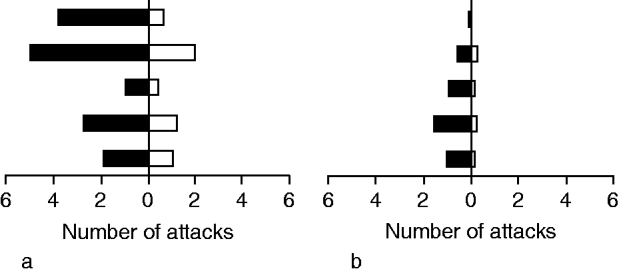
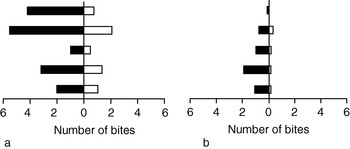
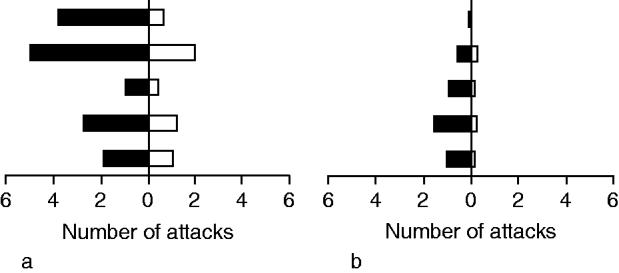
The results indicated that ants contaminated with β-eudesmol and exposed to their original colonies in the foraging arena elicitated agonistic behavior from nestmates. The contaminated ant received higher numbers of attacks, followed by higher numbers of bites than the controls (figs 1a and 2a). The aggressive behavior was characterized by initial antennal inspection, followed by abrupt movements, biting of several body parts and mutilation; some workers were transported to the waste deposit.
(a) The number of ants that attacked an ant contaminated by β-eudesmol (treatment) and a non-contaminated ant (control) in colonies of A. sexdens rubropilosa (Mann-Whitney U test; U=9890.50, P<0.001, df=199) both with ‘free’ mandibles; and (b) the number of ants that attacked a worker contaminated by β-eudesmol (treatment) and a non-contaminated worker (control) in colonies of A. sexdens rubropilosa (Mann-Whitney U test; U=13479.50, P<0.001, df=199) both with immobilized mandibles. Each bar in the graph represents one colony (β-eudesmol, ■; Control, □).
(a) The number of bites received by an ant contaminated by β-eudesmol (treatment) and a non-contaminated ant (control) in colonies of A. sexdens rubropilosa (Mann-Whitney U test; U=9129.0, P<0.001, df=199) both with ‘free’ mandibles; and (b) the number of bites received by an ant contaminated by β-eudesmol (treatment) and a non-contaminated ant (control) in colonies of A. sexdens rubropilosa (Mann-Whitney U test; U=13393.50, P<0.001, df=199) both with immobilized mandibles. Each bar in the graph represents one colony (β-eudesmol, ■; Control, □).

Workers not allowed to release alarm pheromone
In this assay, aggressive behavior was also observed among nestmates that had contact with β-eudesmol. Ants that had their mouth glued and had contact with the sesquiterpene were more attacked than those workers that had their mouth glued, but were not exposed to β-eudesmol (figs 1b and 2b).
Workers that could not release alarm pheromone compared to workers that could
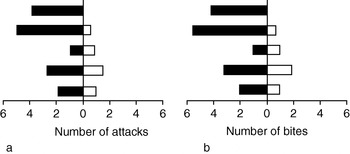
When the results obtained in the first bioassay (workers with ‘free’ mandibles) were double-checked with those from the second bioassay (workers with immobilized mandibles) and that had access to β-eudesmol, the statistical analysis indicated that ants with free mandibles were attacked more than those with immobilized mandibles (fig. 3a, b).
(a) The number of ants of A. sexdens rubropilosa that attacked the ant worker contaminated by β-eudesmol with ‘free’ mandibles or with immobilized mandibles (Mann-Whitney U test; U=7423.0, P<0.001, df=199); and (b) the number of bites received by an ant of A. sexdens rubropilosa contaminated by β-eudesmol with ‘free’ mandibles or with immobilized mandibles (Mann-Whitney U test; U=7901.0, P<0.001, df=199). Each bar in the graph represents one colony (Without glue, ■; With glue, □).

Response of workers to alarm pheromone and β-eudesmol
Workers in laboratory colonies exposed to the filter paper fragment impregnated with alarm pheromone (control) did not show agonistic behavior toward nestmates, as expected. Initially, they exhibited an alarm posture with open mandibles in the vicinities of the paper, but no progress of aggressiveness was observed. This behavior did not last for more than five minutes after exposure. In contrast, when workers had contact with filter paper impregnated with alarm pheromone+β-eudesmol, they initially adopted an alarm position and avoided contact with the filter paper. After two minutes, they began forming aggression groups, in which two or three workers would bite the thorax or the petiole of the target worker, which responded by tucking its legs and head beneath its thorax while the assailants locked onto its body with their jaws, thus producing a ball (group) of fighting ants. A mean number of five aggression groups were observed per colony in both replicates.
Chemical profile of the ant cuticle
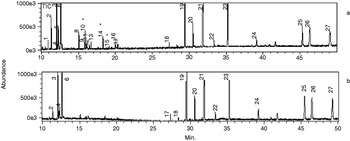
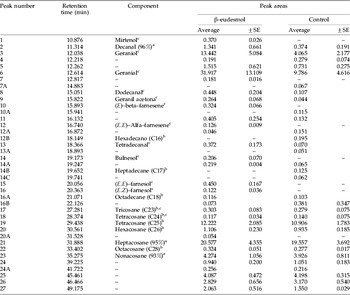
A chemical profile analysis of the cuticle showed that workers that had contact with β-eudesmol exhibited a cuticular composition different from that of workers not in contact with this compound (table 1). Multivariate analysis of variance with the 15 peaks showing the greater differences in table 1 indicated significant difference between the hydrocarbon profile of contaminated versus uncontaminated ants (Wilks's lambda=4.84×10⁻⁴; Fappr.(2,7)=589.87; P=0.002). Subsequent analysis by canonic variables produced a significant canonical axis corresponding to 99% of the variance observed in the experiment. The canonical loadings of this axis indicated that peaks 10, 14 and 15, which occurred only in the cuticle of workers exposed to β-eudesmol, were the main ones accounting for the distinct profile obtained with the exposure to this sesquiterpene. Furthermore, the areas of these peaks were submitted to univariate analyses of variance, thus confirming their significant differences in values for ants exposed or not to β-eudesmol (peak 10: F1,8=6.00; P=0.040; peak 14: F1,8=5.99; P=0.041 and peak 15: F1,8=5.99; P=0.041). These peaks were identified as (E)-β-farnesene (Adams, Reference Adams1995) (peak 10), bulsenol (Adams, Reference Adams1995) (peak 14) and (E, E)-farnesol (Adams, Reference Adams1995) (peak 15) (fig. 4). Double bond hydrocarbons were not found.
(a) Chromatogram of the chemical profiles of A. sexdens rubropilosa workers that had contact with β-eudesmol. (b) Chromatogram of the chemical profiles of A. sexdens rubropilosa workers that had no contact with β-eudesmol. The numbers above the peaks refer to the number listed in table 1. *, Peaks that occurred only in the treatment.

Chemical composition of the cuticle of Atta sexdens rubropilosa workers that had contact (treatment) or not (control) with β-eudesmol, identified by CG–MS.

a Suggested identification based on comparison of mass spectra of the library of CG–MS. b Identified by comparison of retention time of the hydrocarbons standards. c Identified based on the Kovat's Index calculated for each detected substance in comparison with tabled indices (Adams, Reference Adams1995).
A, B and C refer to peaks that occurred in different replicates but did not occur in the replicate used to build the table.
Discussion
The results presented here show that workers of A. sexdens rubropilosa contaminated with β-eudesmol elicited aggressive behavior by their non-contaminated nestmates inside the colonies in the same way as reported by Marsaro et al. (Reference Marsaro, Souza, Della Lucia, Fernandes, Silva and Vieira2004) and Marinho et al. (Reference Marinho, Della Lucia, Guedes, Ribeiro and Lima2005) after exposure to a fragment of filter paper impregnated with that substance. A similar result was obtained when workers had their mandibles immobilized and could not release pheromone. However, in this case, they were less attacked in comparison with those having ‘free’ mandibles, i.e. those releasing alarm pheromone (figs 1–3). According to North et al. (Reference North, House and Jackson2000), this same leaf-cutter ant exhibited aggression toward nestmates when exposed to cariophyllene. These authors suggested that cariophyllene acted as the alarm pheromone in the ants, thus inducing aggression. Blum et al. (Reference Blum1969) reported that the alarm signal in A. sexdens rubropilosa is caused mainly by substances present in the ant mandibular glands, such as the 4-methyl-3-heptanone and the terpene citronelol. Furthermore, citronelol possibly acts in nestmate recognition, according to those authors. On the other hand, Hernández et al. (Reference Hernández, Cabrera and Jaffé1999) reported that 4-methyl-3-heptanone is the main component of the mandibular gland secretion in all castes of Atta laevigata, except for the virgin males. Furthermore, Hughes et al. (Reference Hughes, Howse, Vilela and Goulson2001) verified that in A. capiguara and A. bisphaerica the same compound is predominant in the secretion that elicits alarm behavior. Thus, it seems that there is a consensus that 4-methyl-3-heptanone is the principal component of the alarm pheromone. To our understanding, the role of citronelol is still to be clarified in the recognition system.
It is interesting that caryophyllene and β-eudesmol are all terpenes, which act in the alarm system of these ants together with other substances. They seem to trigger an alarm reaction followed by aggression toward nestmates, disrupting normal colony behavior. This is likely to be an additional reaction caused by the interference of those terpenes with the pheromone alarm system. As expected, the response induced by the alarm pheromone alone did not show any aggressiveness within the colony. Lower aggression occurred when the ants in contact with β-eudesmol had their mandibles immobilized. This suggests that β-eudesmol enhances alarm action, culminating with fights among nestmates. This allows us to argue that less aggression was stimulated by workers unable to release alarm pheromone, although this treatment did not, of course, prevent the release of alarm pheromone by other ants in the bioassay. Also, accordingly, no aggression was stimulated by alarm pheromone alone because aggression requires both alarm and the disruption of nestmate recognition.
Triggering aggressive behavior could also be better explained as a result of modification on the ant cuticle caused by β-eudesmol, thus interfering on nestmate recognition. The nestmate recognition system in Atta was first investigated by Jaffé (Reference Jaffé and Jaisson1983) with A. cephalotes and has been studied in other species by Hughes et al. (Reference Hughes, Howse, Vilela and Goulson2001), Hernández et al. (Reference Hernández, Lopes and Jaffé2002, Reference Hernández, Goitía, Osio, Cabrera, Lopez, Sainz and Jaffé2006) and involves differences between colonies in the alarm pheromone (Francelino et al., Reference Francelino, Mendonça, Do Nascimento and Santana2006). This process in ants involves a comparison of the profile of cuticular hydrocarbons of a target individual with a template derived from their colony's gestalt profile. Presumably, the presence of β-eudesmol on contaminated ants makes their profiles so distinctly different as to cause them to be treated as non-nestmates. Our present work provides support for the contention that the differences observed on the cuticular composition of ants treated with β-eudesmol in comparison to the control group (fig. 4) are possibly responsible for this interference in recognition. Our results showed that ants in contact with β-eudesmol, even for a short period, had cuticular composition distinct from those that had no contact with the substance. The three peaks corresponding to (E)-β-farnesene, bulsenol and the (E, E)-farnesol did not occur in the control ants.
Although the time elapsed for cuticle alteration after β-eudesmol application seems very short, this seems possible. Studies with Linepthema humile demonstrated that ants in previous short contact (about 2 min) with prey induced aggressive behavior among their nestmates. This was followed by chemical analyses of the ant and prey cuticle, thus confirming change in the ant cuticle, so that they were not recognized by their nestmates (Liang et al., Reference Liang, Blomquist and Silverman2001). Although L. humile (a soil or litter dominant dweller, omnivorous; Delabie et al., Reference Delabie, Agosti, Nascimento, Agosti, Majer, Alonso and Schultz2000) does not share many biological and behavioral characteristics with A. sexdens rubropilosa, these explanations for the aggressive behavior may be similar. We also believe that these cuticle changes are temporary.
In this work we verified that the aggressiveness among nestmates due to β-eudesmol exposure is a likely result of the interference with cuticle alteration. This compound seems to disrupt the nestmate recognition process such that ants stimulated into alarm behavior by alarm pheromone fail to recognize β-eudesmol contaminated ants as nestmates and attack them. Thus, it brings about changes in a recognition signal that will trigger the corresponding behaviors. Further details about the mechanism still deserve future investigation. It is a fact that literature elucidating mode of action of similar substances in leaf-cutting ant behavior is scarce. Additionally, another obstacle to this research is the among-colony variation in relation to behavioral responses during the bioassays. This aspect was also mentioned by North et al. (Reference North, House and Jackson2000) with caryophyllene. Colonies maintained under the same conditions can exhibit different responses in the bioassays. This may even bring serious implications for the future use of these substances in leaf-cutting ant management.
In conclusion, β-eudesmol is a substance that, when applied to A. sexdens rubropilosa colonies, disrupts the recognition process, resulting in a behavioral change in the workers, leading to a failure in the recognition system of nestmates as a result of cuticle modification.
Acknowledgements
The authors thank the CAPES Foundation (Brazilian Ministry of Education), the Minas Gerais State Foundation for Research Aid (FAPEMIG), the National Council of Scientific and Tecnological Development (CNPq; Brazilian Ministry of Science and Technology) for scholarships and support. The authors express their gratitude to Dr Eraldo R. Lima, for valuable comments of this manuscript. The thoughtful comments and suggestions provided by the editor and two anonymous referees were also appreciated.