Introduction
The narrow-barred Spanish mackerel, Scomberomorus commerson is an epipelagic, neritic species distributed throughout the tropical-temperate Indo-West Pacific (McPherson, Reference McPherson1992; Lee & Mann, Reference Lee and Mann2017; Roa-Ureta et al., Reference Roa-Ureta, Lin, Rabaoui, Al-Abdulkader and Qurban2019). Often approaching 2 m fork length (FL) and 70 kg, the species is widely sought by subsistence, recreational and commercial fisheries throughout its range, with reported global landings increasing from ~55,000 t in the late 1970s to more than 200,000 t in the last decade (FAO, 2020).
A substantial proportion of the total global catch of S. commerson comes from the south-eastern Arabian Peninsula (including the Persian Gulf, Gulf of Oman, and the Arabian Sea), with some 40,000 t harvested each year (Roa-Ureta et al., Reference Roa-Ureta, Lin, Rabaoui, Al-Abdulkader and Qurban2019). While various hook-and-line gears are used, most of the total catch is harvested using gillnets. This is especially the case in Iran, where artisanal gillnetters target S. commerson for nine months each year during the species’ regional migration from October (autumn) to June (spring/summer), after which fishing effort shifts to other species (Eighani et al., Reference Eighani, Paighambari, Bayse and Broadhurst2020). The sizes of S. commerson caught by Iranian gillnetters typically range from 50 to 120 cm FL and encompass means at 50% maturity of ~67 and 80 cm FL for females and males, respectively, or 1–2-year-old fish (Roa-Ureta et al., Reference Roa-Ureta, Lin, Rabaoui, Al-Abdulkader and Qurban2019; Eighani et al., Reference Eighani, Paighambari, Bayse and Broadhurst2020). Peak catches often coincide with spawning during late spring (May and June) (Claereboudt et al., Reference Claereboudt, McIlwain, Al-Oufi and Ambu-Ali2005; Roa-Ureta et al., Reference Roa-Ureta, Lin, Rabaoui, Al-Abdulkader and Qurban2019).
Historically, Iranian fishers have used variable-length multifilament polyamide (PA) gillnets up to 30 m deep and made from different mesh sizes, but often 130–140 mm stretched mesh opening (SMO; Eighani et al., Reference Eighani, Paighambari, Bayse and Broadhurst2020). While there have been some studies describing the relative catches and selectivities of regional gillnets used to target S. commerson (Hosseini et al., Reference Hosseini, Kaymarm, Behzady, Kamaly and Darvishi2017; Eighani et al., Reference Eighani, Paighambari, Bayse and Broadhurst2020), this work is limited to discrete spatio-temporal scales. Less is known about the effects of longer-term interacting technical, environmental and biological factors implicated to influence the performance of gillnets more broadly (reviewed by Hamley, Reference Hamley1975). Such information is important because even subtle modifications to gillnets can affect their size selection for various species and, therefore, their exploitation rates.
Known technical factors affecting gillnet performance include net length (Rudstam et al., Reference Rudstam, Magnuson and Tonn1984), soak time (Minns & Hurley, Reference Minns and Hurley1988), hanging ratio (Gray et al., Reference Gray, Broadhurst, Johnson and Young2005), twine size and material (Hovgård, Reference Hovgård1996), and especially the size of mesh used (Hamley, Reference Hamley1975). Environmental factors can extend to water visibility (Hansson & Rudstam, Reference Hansson and Rudstam1995) and temperature (Duman & Pala, Reference Duman and Pala2007), seabed type and diel deployment time (Vašek et al., Reference Vašek, Kubečka, Čech, Draštik, Matĕna, Mrkvička, Peterka and Prchalová2009), while biological factors include spatial and temporal variabilities in the vertical and horizontal distributions of fish (Acosta, Reference Acosta1994) and their sizes, morphology, behaviour, and condition (Hay et al., Reference Hay, Cooke and Gissing1986; Poulsen et al., Reference Poulsen, Nielsen, Holst and Stæhr2000).
No work has compared different mesh sizes in gillnets targeting S. commerson across the entire fishing year incorporating various environmental and biological influences, but such data would benefit the finer-scale management of the species’ regional exploitation. Considering the above, the objective here was to investigate relationships between the catches, sizes and condition of S. commerson in gillnets comprising the upper and lower typical mesh sizes (130 and 140 mm SMO) throughout the nine-month fishing season (starting in autumn).
Methods
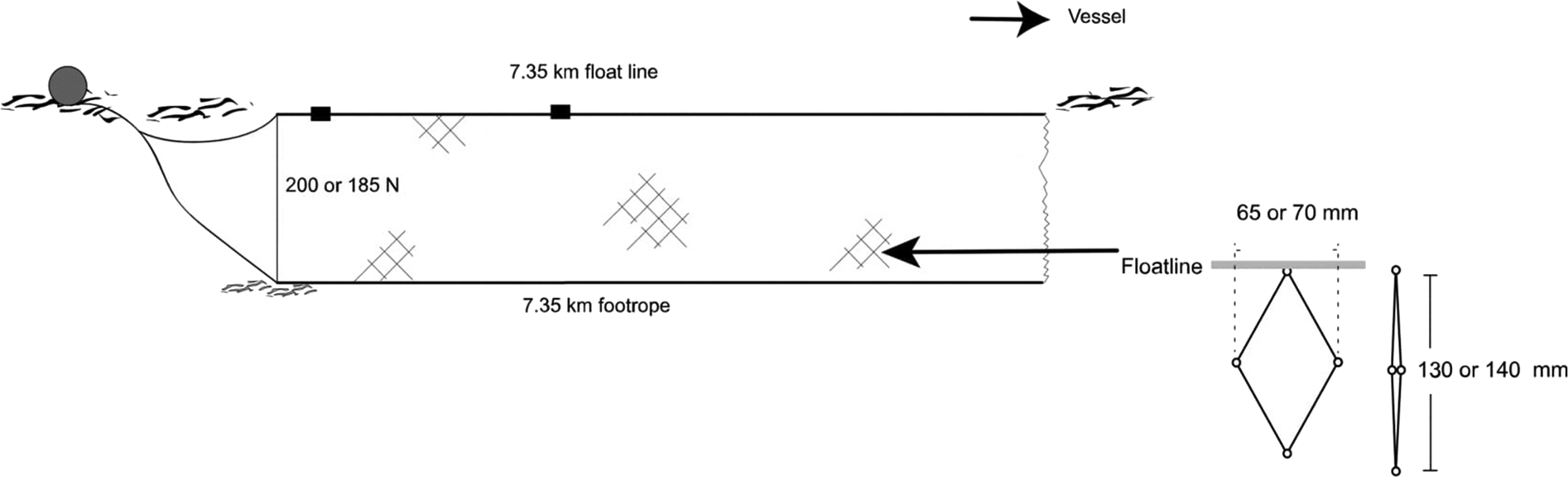
The experiment was completed between 3 October 2018 and 15 June 2019 (encompassing the equinox autumn to spring) using an artisanal vessel (7 m) fishing in the Persian Gulf (at 29°1′N 50°32′E) across depths of ~25 m and within 10 km of the coast. The vessel alternately deployed one of two surface-set multifilament PA gillnets (that fished the entire water column or ~26 m deep) comprising 7.35 km PA float lines (10-mm diameter (Ø) and with 2100 10-mm Ø floats) and foot ropes (with 210 cement or stone sinkers for a total of ~220 kg) (Figure 1). The only difference between gillnets was their nominal mesh sizes: 130 and 140 mm SMO. Both mesh sizes were constructed from 210 denier and 24 ply twine, with a nominal Ø of 1.3 mm.
Diagram of gillnets fished in the Persian Gulf during 2018 and 2019 to target narrow-barred Spanish mackerel, Scomberomorus commerson.

Prior to starting the experiment, 10 replicate meshes in each gillnet were confirmed for SMO (to the nearest 1 mm) using a ruler against the bar length (×2). The gillnets were alternately fished in consecutive blocks during each month. Starting in October 2018, the vessel was rigged with the 130-mm gillnet and put to sea for seven days, during which the gillnet was repeatedly deployed at 18:00 h (with one end fastened to a marker buoy and the other to the vessel; Figure 1) and retrieved at 24:00 h over six nights. Later in the month, the 140-mm gillnet was then rigged to a vessel and the same deployment procedure was followed, providing a total of 54, six-hour deployments (nine months × six nightly sets) of each gillnet during the nine months.
After each deployment, catches were immediately removed. All S. commerson were immediately counted, weighed (nearest 10 g), and measured for total length (FL) to the nearest 1 mm. These data were used to calculate the relative condition factor (CF) for each S. commerson by dividing the observed weight into the weight estimated from a regional length/weight relationship (Weight = aFLb) with a and b parameters of 0.0115 and 2.909 (r 2 = 0.984, N = 1245), respectively (Le Cren, Reference Le Cren1951; Froese & Pauly, Reference Froese and Pauly2000; McIlwain et al., Reference McIlwain, Claereboudt, Al-Oufi, Zaki and Goddard2005). Logistics precluded separating other catches into species, but data on the pooled weights and numbers were collected along with general assemblages.
The numbers of all species and S. commerson per deployment were analysed in Poisson generalized linear mixed models (GLMM), while the approximately Gaussian logged weight of all catches, and logged weights, mean FLs, and mean CFs of S. commerson were analysed in linear mixed models (LMM). In all mixed models for numbers, weights and mean FL, fixed factors included ‘mesh size’ (130 vs 140 mm), ‘season’ (separated into autumn, winter and spring), and their interaction, while ‘months fished’ was classified as random. The GLMMs also included a random ‘day’ effect to allow for extra-Poisson variability (over-dispersion) in the daily catch numbers. Fork length was also included as a factor in the LMM investigating variability among CF. For all models, a backward-selection algorithm was employed with non-significant terms removed until the remaining terms were significant.
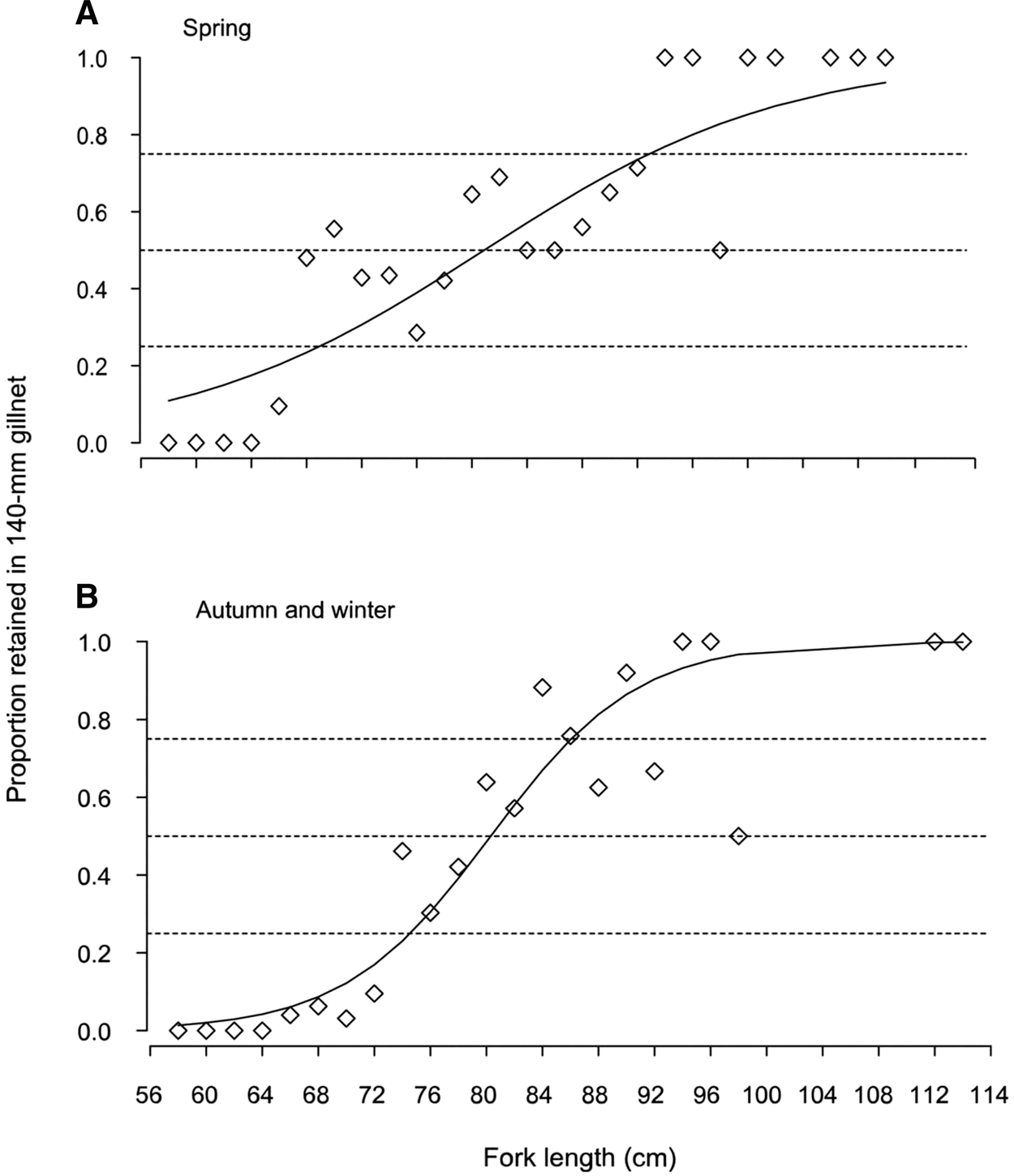
The raw length-frequency data for S. commerson were also analysed for relative selectivity between the gillnets via logistic regressions with a quasibinomial error of the expected proportions per length class for S. commerson in the 140-mm gillnet (i.e. 140-mm mesh/(130 + 140-mm mesh)). The results can be interpreted whereby a proportion of 0.5 indicates no mesh-specific difference in catches for the corresponding FL, while 0.75 indicates 75% of S. commerson at the corresponding FL were caught by the 140-mm gillnet and 25% by the 130-mm gillnet. All models were fitted by maximum likelihood using the glmmTMB function of the glmmTMB package of the freely available R language. Predicted means ± SE of interest were shown graphically.
Results
The two gillnets (made from mean ± SEs SMOs of 130.03 ± 0.04 or 140.05 mm ± 0.05 mm; N = 10) were each deployed 54 times (all 6-h soak durations) over nine months, catching a total of 5132 fish weighing 13.2 t and comprising 24 families and 44 species with Carangidae and Scombridae the most represented families. Between 2 and 24 S. commerson were caught in each deployment and accounted for 16 and 31% of the total number and weight of catches, with 832 individuals and 4.1 t caught (58.5–113.8 cm FL); of which at least 52% (and probably more) were considered adults based on regional estimates of the largest sex-specific size at maturity (80 cm FL for males). Most fish were entangled across their bodies in multiple meshes.
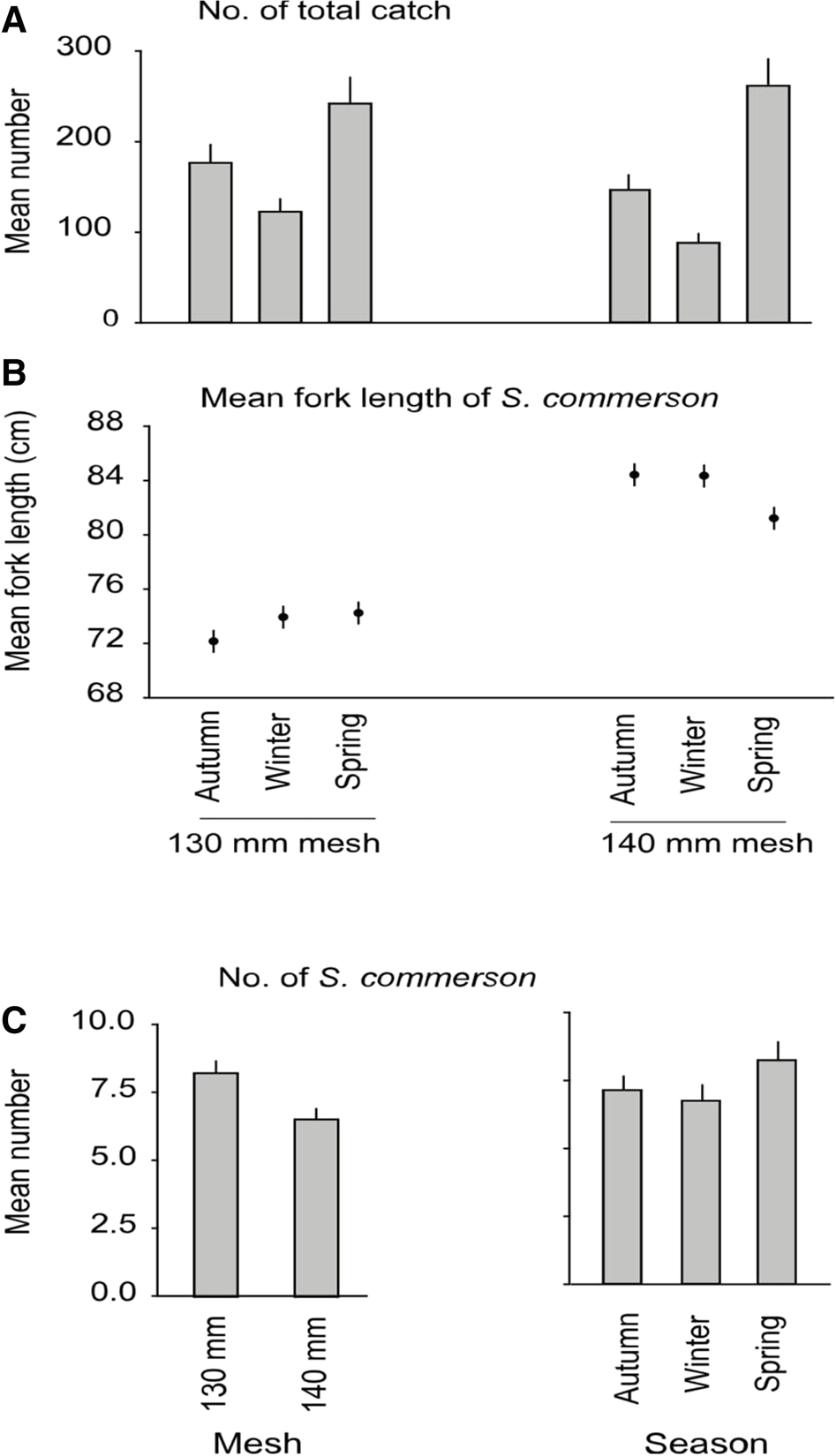
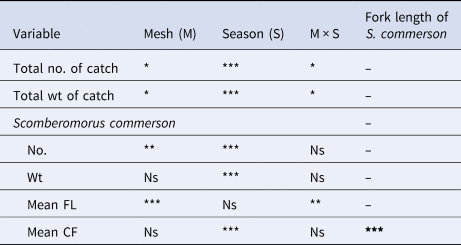
Variability among the total catches (all species combined) was explained by significant main effects of mesh and season and their interaction for both the number and weight (GLMM and LMM, P < 0.05; Table 1, Figure 2A). Specifically, more total fish were caught during spring than either autumn and especially winter, and with a greater difference between seasons for the catches in the 140-mm gillnet (Figure 2A). Catches of S. commerson had divergent trends that manifested as significant main effects of both season and mesh size (but no interaction) for the number, with more fish caught in the 130-mm gillnet and, irrespective of mesh size, during spring (GLMM, P < 0.01; Figure 2C). The weights of S. commerson showed similar variation among seasons, but there was no effect of mesh size because although fewer were caught in the 140-mm gillnet, these were larger (and heavier) (GLMM and LMM, P < 0.01; Table 1).
Predicted (+ SE) (A) number of total catches, and (B) mean fork length and (C) number of narrow-barred Spanish mackerel, Scomberomorus commerson in gillnets comprising either 130 or 140 mm stretched mesh openings and fished during each of three seasons in the Persian Gulf between 2018 and 2019.

Summary of factors (and their significance) tested in generalized linear mixed models (numbers of catches), and linear mixed models (logged weights of catches and the mean fork length (FL) and condition factor (CF) of narrow-barred Spanish mackerel, Scomberomorus commerson) applied to data collected from two gillnets comprising either 130 or 140 mm stretched mesh openings, deployed six days during each of three months over autumn, winter and spring in the Persian Gulf, Iran

***P < 0.001; **P < 0.01; *P < 0.05; Ns, P > 0.05; –, not appropriate for model.
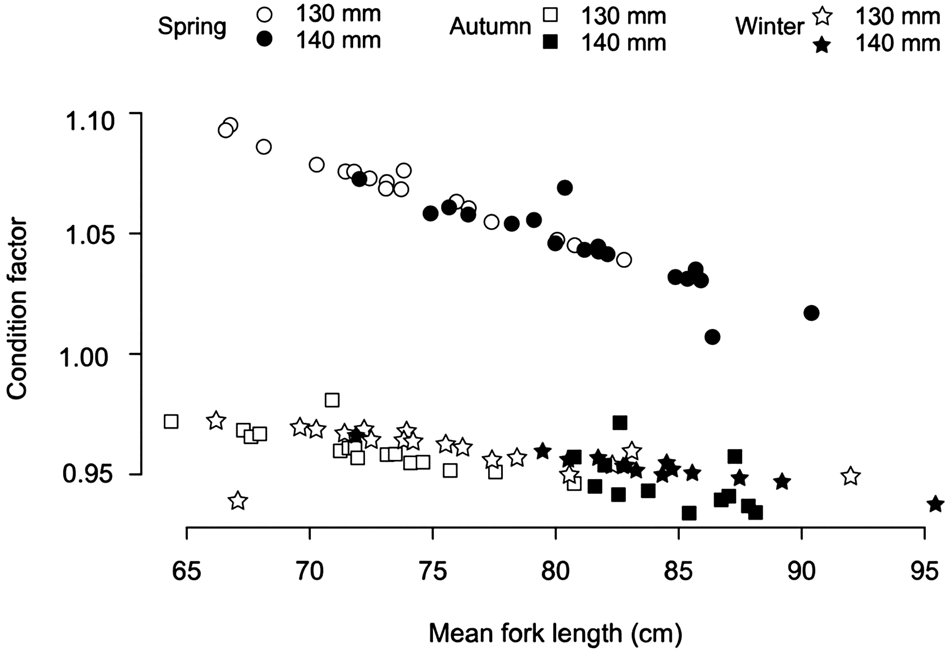
The LMM describing variability among the mean FL of S. commerson revealed a significant interaction between mesh size and season, with a slight increase in mean FL from autumn to spring for the 130-mm gillnet, but a considerable decrease for the 140-mm gillnet (LMM, P < 0.05; Table 1, Figure 2B). The CF of S. commerson had a significant negative relationship with FL and, irrespective of mesh size was similarly lower in autumn and winter than in spring (LMM, P < 0.001; Table 1, Figure 3).
Scatter plots of the relationships between the mean fork length (cm) and condition factor of narrow-barred Spanish mackerel, Scomberomorus commerson in gillnets comprising either 130 or 140 mm stretched mesh openings and fished during each of three seasons in the Persian Gulf between 2018 and 2019.

Considering the significant interaction between mesh size and season on mean FL (Figure 2B), two logistic regressions of relative selectivity were plotted separately for spring and autumn/winter combined (Figure 4). While there was no significant seasonal difference in the length of 50% relative selectivity (L 50s; 80.4 ± 0.6 cm (SE) and 80.3 ± 0.6 cm FL for spring and autumn/winter, respectively), there was a significant difference in selection range (SR), which was wider in spring (16.1 ± 1.2 cm) than in autumn/winter (11.5 ± 1.0 cm) (P < 0.05; Figure 4). This significant difference reiterates that compared with autumn/winter, proportionally fewer of the largest (and more of the smallest) S. commerson were retained in the 140-mm mesh during spring.
Logistic regressions of relative selectivity for narrow-barred Spanish mackerel, Scomberomorus commerson between gillnets comprising either 130 or 140 mm stretched mesh openings for (A) summer and (B) autumn/winter in the Persian Gulf combined with proportions retained (data points are 140-mm mesh/(140-mm + 130-mm mesh)). The bold lines represent the mean curves and dotted horizontal lines mark the 0.75, 0.50 and 0.25 probabilities indicating that 75, 50 and 25% of fish at these lengths were retained by the 140-mm mesh gillnet, while 25, 50 and 75%, respectively were retained by the 130-mm mesh gillnet.

Discussion
This study represents one of the few efforts at assessing the utility of a key technical modification on the gillnet catches of a migratory pelagic species across the entire fishing year, encompassing associated environmental (i.e. three seasons) and biological variables (i.e. fish condition). In doing so, like for other passive gears (Moth-Poulsen, Reference Moth-Poulsen2003; including gillnets: Queirolo & Flores, Reference Queirolo and Flores2017; Ayaz et al., Reference Ayaz, Altinağaç, Öztekink and Özekinci2019) and active methods (e.g. trawls; Özbilgin et al., Reference Özbilgin, Tosunoğlu, Tokaç and Metin2005, Reference Özbilgin, Metin, Tosunoğlu, Tokaç, Kaykaç and Aydin2012), we provide evidence to support the importance of seasonal variation in fish condition for affecting size selection. The clear differences in catches, relative conditions and means sizes of S. commerson throughout the year can be discussed by considering their migration and reproduction, and ultimately used to refine harvesting.
The regional mean length sizes at maturity for S. commerson range from ~67 (females) to 80 cm (males) FL (Roa-Ureta et al., Reference Roa-Ureta, Lin, Rabaoui, Al-Abdulkader and Qurban2019). So, while both mesh sizes assessed here caught large percentages of adults, the 140-mm mesh was perhaps the more appropriate, and especially during autumn and winter. Nevertheless, during spring, and unlike for the 130-mm gillnet, the relative size selection of S. commerson by the 140-mm gillnet significantly decreased – a result that might reflect a key life-history characteristic of S. commerson.
Specifically, spring coincides with increased productivity, greater total catches (all species), and the start of spawning among S. commerson in the Persian Gulf (Claereboudt et al., Reference Claereboudt, McIlwain, Al-Oufi and Ambu-Ali2005; Niamaimandi et al., Reference Niamaimandi, Kaymaram, Hoolihan, Mohammadi and Fatemi2015). Perhaps most importantly, the CFs of S. commerson were greatest during spring, and especially among the smaller conspecifics. For immature specimens, the relatively greater CFs probably reflected larger stomach weights owing to increased feeding (supporting requirements for their growth). But for mature conspecifics, the smaller increases in CF would be affected by their developing gonads (notwithstanding some food to support daily demands). These differences might manifest as variable size-specific increases in girth; changes among which are known to affect the size selection of gillnets (Queirolo & Flores, Reference Queirolo and Flores2017).
Considering the above, and assuming consistent vulnerability of all sizes of S. commerson to capture across the sampled space and time (which is reasonable given the established migration of the species and that the gillnets sampled the entire water column; Claereboudt et al., Reference Claereboudt, McIlwain, Al-Oufi and Ambu-Ali2005), there are at least two possible explanations for the reduction in relative selectivity by the 140-mm gillnet during spring. First, the slightly larger mesh may have had somewhat lower elasticity, precluding elongation to accommodate those larger fish with increased girth due to their CF. However, this is unlikely considering materials were identical (and from the same manufacturer), and the difference between mesh sizes was quite small (i.e. 10 mm in SMO or 8%). Second, and perhaps more likely, some of the largest S. commerson may have had proportionally larger girths than their smaller conspecifics, which precluded their mesh penetration (considering most fish were entangled by their bodies across multiple meshes). While such a hypothesis contradicts the negative relationship between FL and CF, owing to the variable life-history requirements stated above, CF might not accurately describe changes in morphology. More specifically, larger adult fish may have increased their girth at more critical areas for capture in the gillnets, which might have reduced their probability of retention by the 140-mm mesh. Additional data are required to assess the potential for this proposed morphological variation.
Irrespective of the mechanisms contributing to the seasonal variation in selectivity by the 140-mm gillnet, in terms of resource sustainability (and assuming the widespread use of this mesh size), having some of the largest, mature fish avoid capture would be a positive outcome because these fish should have greater fecundity (Beldade et al., Reference Beldade, Holbrook, Schmitt, Planes, Malone and Bernardi2012). But from the fishers’ perspective, not selecting larger fish represents a gear inefficiency.
Possible solutions for maintaining consistent size selectivity throughout the entire fishing year might encompass some of the key technical factors known to affect gillnet catches, including reducing hanging ratio (Gray et al., Reference Gray, Broadhurst, Johnson and Young2005), increasing mesh size (Hamley, Reference Hamley1975), or alternative materials (Eighani et al., Reference Eighani, Paighambari, Bayse and Broadhurst2020). For example, several studies have revealed negative relationships between gillnet hanging ratios and selectivity or efficiency (Gray et al., Reference Gray, Broadhurst, Johnson and Young2005), including for similar-shaped pelagic species (Samaranayka et al., Reference Samaranayka, Engås and Jørgensen1997). Reducing the hanging ratio of the 140-mm gillnet might increase selection for larger S. commerson via improved entangling, although this could concomitantly increase bycatches of other species.
Alternatively, maintaining the existing hanging ratio, but increasing mesh size to 145 or 150 mm in spring might increase catches of larger S. commerson with fewer collateral impacts. However, this would likely reduce the catch rate per deployment. There is a need to determine an appropriate mesh size and/or configuration that reduces the capture of juveniles while retaining adult S. commerson to achieve sustainable utilization of stock. One important consideration is the choice of netting material since Eighani et al. (Reference Eighani, Paighambari, Bayse and Broadhurst2020) noted a lower size selectivity for S. commerson in gillnets with the same mesh size but made from monofilament rather than multifilament twine.
Notwithstanding the need for ongoing assessments, the data presented here reiterate that in addition to technical factors like mesh size, key biological and environmental factors strongly affect gillnet size selection (Queirolo & Flores, Reference Queirolo and Flores2017; Ayaz et al., Reference Ayaz, Altinağaç, Öztekink and Özekinci2019). Clearly, for the studied fishery, any gear-selectivity work restricted to autumn/winter will give considerably different parameter estimates than during spring, and so broad-scale temporal sampling is warranted. The same philosophy might extend to other regional and international fisheries targeting fusiform pelagic species with clear spawning/migration periods (e.g. Euthynnus affinis; Eighani et al., Reference Eighani, Paighambari, Bayse and Broadhurst2020). Understanding the influences of such extrinsic factors on fishing-gear selectivity is important to regulate the exploitation rate, as a precursor to effective fishery management.
Acknowledgements
Thanks are extended to the artisanal fishers who participated in the work and also to the staff at the Gorgan University of Agricultural Sciences and Natural Resources.
Financial support
This research received no specific grant from any funding agency, commercial or not-for-profit sectors.