The magnitude 9.0 earthquake and resulting tsunami off the coast of Tōhoku, Japan, on March 11, 2011 triggered the first nuclear crisis of the 21st century, which involved a series of operational failures, explosions, and partial core meltdowns at Japan's Fukushima Daiichi nuclear power plant. The situation at 3 of the plant's units was severe enough to warrant a level 7 rating on the International Atomic Energy Agency's International Nuclear and Radiological Event Scale, a classification denoting a “major incident” with “major release of radioactive material with widespread health and environmental effects requiring implementation of planned and extended countermeasures.”12
In the United States, worries about exposure to radiation from the 2011 Japanese radiation event were allayed by data from the Environmental Protection Agency's (EPA’s) nationwide radiation monitoring system, RadNet,3 and from radiation monitoring of travelers and goods from Japan that was carried out by the US Department of Homeland Security Customs and Border Protection unit.4 Nonetheless, the crisis, the management of which remained ongoing as of summer 2011, raises questions about planned domestic countermeasures for any large-scale radiological incident occurring on or within easy reach of US soil.Reference Watkins, Perrotta and Stanbury5
The 2006 assassination of Alexander Litvinenko, a former Russian Federal Security Service officer who was granted political asylum in the United Kingdom, is a stark reminder of how quickly a radiation event can escalate and, thus, of the necessity of readiness planning.Reference McFee and Leikin6 Litvinenko experienced lethal exposure to 210Po.Reference Trevelyan7 Although the assassin targeted only Litvinenko, 33 000 individuals were considered to have been potentially exposed. Ultimately, UK authorities tested more than 700 people and ordered the closure of several buildings for the next 5 years because of radioactive contamination. At the time of Litvinenko's assassination, only 2 US laboratories were capable of testing for 210Po, and not much progress has occurred in subsequent years.
It was not until a 2007 hearing of the US House of Representatives' Committee on Science and Technology (now the Committee on Science, Space, and Technology) that lawmakers focused attention on the capacity of the United States to perform ruleout screening and confirmatory testing for radionuclides on a large scale. Witnesses testified that the Centers for Disease Control and Prevention (CDC) were able to quantify the level of exposure to only 6 of the 13 highest-priority radioisotopes. (Since the hearing, the agency has developed methods for 10 radionuclides, and the priority list has expanded to 22 radioisotopes.) Witnesses also noted that given laboratory capacity at the time, it would take more than 4 years to screen 100 000 individuals for radiological exposure. Large-scale environmental sampling and testing was expected to take as long as 6 years to complete (M. Latshaw, PhD, unpublished notes, October 2007).
Although Congress has yet to appropriate significant funding to address these deficiencies, the hearing prompted bipartisan expressions of concern about US preparedness for a radiological event. North Carolina congressman Brad Miller, for example, said, “The federal government was better prepared for [hurricane] Katrina than we are now for the detonation of a dirty bomb.”8
The Association of Public Health Laboratories (APHL) is the national professional association representing the state and local governmental laboratories that is at the forefront of the response to any US radiological disaster. As a member of the steering committee of the National Alliance for Radiation Readiness (NARR), a coalition of organizations working to ensure adequate preparation for radiological emergencies, APHL recognizes that any effort to fill preparedness gaps or assess changes in response capabilities must be based on a clear understanding of present capabilities.Reference Tan, Barnett, Stolz and Links9
BACKGROUND
APHL documented the baseline radiological response capabilities of its member laboratories. Some of the data came from APHL's most recent annual survey of state public health laboratory (SPHL) all-hazards response capabilities, which assesses the contributions SPHLs have made since the establishment of CDC's Public Health Emergency Preparedness (PHEP) Cooperative Agreement. This agreement supports public health preparedness for infectious disease outbreaks, natural disasters, and biological, chemical, nuclear and radiological emergencies.10 Additional data come from a one-time 2011 APHL survey that provides more detailed information about the ability of SPHLs to conduct radiation testing on specific sample types, such as food, air, soil, water, and clinical specimens.
Public health laboratories constitute a first line of defense against a range of public health hazards. Working in collaboration with other public health entities and law enforcement agencies, policy makers, sentinel laboratories, and other stakeholders, they perform clinical diagnostic testing, disease surveillance, environmental and radiological testing, applied research, laboratory training, and other essential services on behalf of the communities they serve.
APHL works to ensure that its member laboratories have the resources and infrastructure needed to carry out their health-critical mission. In 1999, APHL, CDC, and the Federal Bureau of Investigation formed the Laboratory Response Network (LRN)11 to ensure national capability for identifying and characterizing potential agents of biological and chemical terrorism in clinical specimens. In 2002, CDC expanded funding through its PHEP Cooperative Agreement to build additional laboratory capability and capacity for chemical terrorism preparedness, creating the LRN for Chemical Threat Preparedness. Since then, an LRN for radiological preparedness has been proposed but not yet funded.
Networks similar to the LRN connect laboratories outside the clinical realm. Notable examples are the EPA Environmental Response Laboratory Network12 and Water Laboratory Alliance,13 as well as the Food Emergency Response Network,14 run jointly by the Food and Drug Administration (FDA) and the US Department of Agriculture. Collectively, these networks constitute the backbone of the laboratory response to any radiological emergency in the United States.
METHODS
The third annual All-Hazards Laboratory Preparedness Survey was distributed to public health laboratories in the 50 US states, the District of Columbia, and Puerto Rico in autumn 2009 to collect data pertaining to the 12-month period of August 10, 2008–August 9, 2009, CDC PHEP Cooperative Agreement fiscal year (FY) 2008. The survey solicited information on laboratory capability (ie, ability to perform certain activities) and capacity (ie, volume of work that can be performed) to respond to biological, chemical, radiological, and other threats, such as pandemic influenza. Data were collected using mrInterview, a Web-based survey tool and data repository. Results were coded for entry into SPSS for Windows version 15.0 (SPSS Inc, Chicago, IL). Descriptive statistics were gathered for all of the variables. (Reports and briefs from this and other APHL all-hazards, biological, and chemical terrorism laboratory preparedness surveys are available at http://www.aphl.org/aphlprograms/phpr/ahr/pages/default.aspx.)
The Radiation Capabilities Survey, which focused on states' radiological capabilities, was conducted in spring 2011. Data were solicited from environmental, agricultural, and public health laboratories in the 50 US states, the District of Columbia, and Puerto Rico. To lessen the burden on individuals who participated in the first survey, data from that survey were prepopulated into the Radiation Capabilities Survey and respondents were asked to verify that it was still true. Data were collected using Microsoft Office SharePoint Server (Microsoft, Redmond, WA), and Microsoft Excel was used to gather descriptive statistics for all of the variables.
RESULTS
2009 All-Hazards Laboratory Preparedness Survey
The 2009 All-Hazards Laboratory Preparedness Survey generated a 98% response rate, with 51 responses out of 52 invited participants. (Descriptive statistics are available at http://www.aphl.org/aphlprograms/phpr/ahr/Documents/APHLAllHazWhite PaperEPR.pdf.) Fourteen (27%) respondents indicated an ability to measure radionuclides in clinical specimens; 3 (6%) reported that another state agency or department accepts and analyzes these specimens using a radioanalytical method. Respondents reported a range of 0 to 3 full-time radioanalytical chemists, radiochemists, analytical chemists, or other analytical staff working on the analysis or research and development of analytical methods for the measurement of radionuclides in clinical specimens, with both a median and mean response of 0.
Respondents reported accepting 173 environmental samples for radiological testing in FY 2008. Fourteen respondents (27%) reported screening suspicious, unknown samples, such as white powders or the contents of abandoned chemical drums, for radiological agents. Depending on the type of exercise (tabletop, drill, functional, or full-scale), 7 to 8 laboratories reported participating in a preparedness exercise focused on radiological agents in FY 2008. Twenty-three respondents (45%) reported holding a Nuclear Regulatory Commission license; of these, 21 (91%) had a radiation safety officer.
2011 Radiation Capabilities Survey
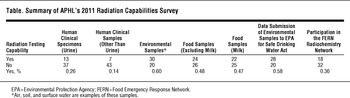
The 2011 Radiation Capabilities Survey generated a 76% response rate, with 50 responses out of 66 potential participants. (The Table summarizes the results and descriptive statistics are available at http://www.aphl.org/aphlprograms/eh/radiological/Documents/RadTestingCapSurveyDescriptives.pdf.) Thirteen (26%) respondents reported the ability to test human urine for radionuclides; 7 (14%) reported the ability to test nonurine clinical specimens for radionuclides. (Having radionuclide testing capability does not necessarily mean, however, that a laboratory is certified in accordance with federal regulations to perform diagnostic testing for radiation exposure.)
Summary of APHL’s 2011 Radiation Capabilities Survey

Thirty (60%) respondents indicated the ability to test environmental samples, such as air, soil, or surface water, for radiation. Twenty-four (48%) reported the ability to test nonmilk food samples, and 22 (47%) reported the ability to test milk for radiation. Eighteen (36%) responding SPHLs are members of the Food Emergency Response Network. Twenty-eight responding SPHLs (56%) reported sending radioanalytical data for drinking water to EPA.
DISCUSSION
A total of 15 responding laboratories reported the ability to test ≥1 types of human specimens for radionuclides. Given federal regulatory restrictions, however, it is likely that many of these laboratories are not certified to perform diagnostic testing for radiation exposure. Thus, in the event of a large-scale incident, such as the 2011 Japan radiation event, at least 70% of states would likely send their clinical specimens to CDC for analysis. Although laboratory throughput of CDC has improved since the 2007 US House of Representatives hearing, it could take years to analyze the thousands of specimens that such an event would likely generate.
The number of public health laboratories reporting the ability to test environmental (60%) or food (48%) samples for radiation was higher than it was for clinical specimens, likely a result of greater federal investment in environmental testing. For example, EPA recently funded laboratories in Connecticut, Kansas, Texas, and Washington to build environmental radioanalytical capability. Similarly, FDA funded state laboratories in Maryland, New York, Texas, Washington, and Wisconsin to build capability to test for radionuclides in food. Finally, RadNet members are often SPHLs.
The Washington Public Health Laboratories (WPHL), which received both EPA and FDA funding to develop radiological testing programs, demonstrate the vital importance of laboratory infrastructure investments. In the aftermath of the 2011 Japanese radiation event and amidst fears of possible radiation exposure on the US West Coast, WPHL tested samples on behalf of SPHLs in Alaska, Hawaii, California, and Oregon. It is fortunate that these states had memoranda of understanding in place to facilitate collaboration. Without WPHL's extensive capability and capacity for radiological testing and without agreements in place, these states would have been forced to send clinical specimens to CDC, environmental samples to EPA, and food samples to FDA. The shipping, tracking, and data reporting would have been much more complex. This said, a large-scale radiological event on or near the US West Coast would exceed the testing capacity of not only WPHL but also the federal government.
Despite receiving thousands of unknown samples each year,15 only 14 All-Hazards Survey respondents reported screening unknown samples for radiological agents. This low number may be because of prescreening of suspicious samples by law enforcement or other first responders before acceptance by the laboratories. Furthermore, laboratories may not have in place the trained personnel, methodologies, or equipment to perform such testing.
It is concerning that laboratories reported on average fewer than 1 employee working on clinical radiochemistry; this is a major gap in preparedness. This situation likely results from 2 trends: substantial government budget cuts stemming from the recent economic downturn and resultant hiring freezes and layoffs, and a severe, ongoing workforce shortage affecting many laboratory disciplines, but especially pronounced among radiochemists. Few new scientists are being trained in radiological analytical methods and several university training programs have been closed.
The present study has at least 2 limitations. First, because radioanalytical capacity often resides outside the member laboratories of APHL, the data presented here do not capture a complete picture of overall state and territorial laboratory capabilities. Future collaboration with the Conference of Radiation Control Program Directors, through NARR, will enable a more comprehensive overview of state and territorial radiation laboratory capability and capacity.
Second, laboratory capacity may be overestimated by asking separate questions about different types of samples, as was done in our survey instruments, rather than asking about total radiological testing capacity for clinical, food, and environmental samples. Overestimation could occur because laboratory resources, such as scientific staff and instrumentation, often are shifted to support different testing needs.
CONCLUSIONS
After a radiological event, there will be myriad questions: How far did the fallout spread? Were crops, livestock, or water supplies affected? Who was exposed, to what substance(s), and to what extent? It is important to note that simply detecting the presence of radioactive beta or gamma particles sheds no light on the source of radiation (eg, 131I, 137Cs) or the internal radiation dose, which directly affects treatment strategies. More advanced laboratory methods are needed to answer many of these questions.16 Despite recognizing radiological testing gaps, Congress has appropriated no new funding to enhance testing capabilities and capacity; in fact, the EPA funding mentioned above was cut in the president's FY 2012 budget.
In an effort to improve SPHL capacity, CDC has proposed adding a radiological component to the LRN, creating the LRN for Radiological Preparedness.17 Under the proposal, 10 SPHLs would provide surge capacity to CDC for the analysis of clinical specimens for priority radionuclides. Such enhanced national radioanalytical laboratory capacity would reduce drastically the time needed to provide local, state, and federal decision makers with high-quality, actionable analytical results in the aftermath of a radiological or nuclear attack and enable swifter medical interventions, ultimately reducing morbidity and mortality.
At a minimum, adequate preparation for a radiological event requires the following:
• Funds to establish the LRN for Radiological Preparedness
• Funds to maintain or expand EPA's and FDA's efforts to build radiological test capability and capacity for environmental and food samples
• Activation of the Integrated Consortium of Laboratory Networks, an alliance of 10 federal departments/agencies promoting common standards of performance across all laboratory response assets, to ensure a coordinated laboratory response during any radiological emergency involving multiple sample types
• Enhanced support for the public health system within which SPHLs function
• Enhanced support for NARR, which is funded by CDC and led by the Association of State and Territorial Health Officials, to facilitate collaboration among radiological responders
Historic incidents and orchestrated emergency response exercises provide ample evidence that the public health community is not ready to address a large-scale radiological event on US soil. In 2007, congressman Brad Miller said during the US House of Representatives hearing mentioned above, “The [radiological] material is out there [for development of a dirty bomb]. It could happen tomorrow, it could happen this afternoon. Potentially being prepared in five years, does not give me a reassuring sense. We need to feel a sense of urgency.”8