Introduction
An underdeveloped embryo is one that must grow inside the seed before the radicle can emerge (Grushvitzky, Reference Grushvitzky and Borris1967; Baskin and Baskin, Reference Baskin and Baskin2005). That is, the embryo completes growth inside the seed between seed maturity and germination (sensu Nikolaeva, Reference Nikolaeva1969). If embryo growth is the only prerequisite for germination, seeds have morphological dormancy. However, if underdeveloped embryos also have physiological dormancy and require a dormancy-breaking pretreatment before or after they grow inside the seeds, then seeds have morphophysiological dormancy (Baskin and Baskin, Reference Baskin and Baskin2004). Embryo growth prior to radicle emergence is known to occur in seeds with rudimentary, small linear and small spatulate embryos; the latter two are referred to as linear-underdeveloped and spatulate-underdeveloped embryos, respectively (Baskin and Baskin, Reference Baskin and Baskin2007).
Seed biologists generally agree that underdeveloped embryos are the primitive condition in seed plants (Martin, Reference Martin1946; Grushvitzky, Reference Grushvitzky and Borris1967; Baskin and Baskin, Reference Baskin and Baskin1998; Nikolaeva, Reference Nikolaeva1999; Forbis et al., Reference Forbis, Floyd and de Querioz2002; Finch-Savage and Leubner-Metzger, Reference Finch-Savage and Leubner-Metzger2006), but it is not known if underdeveloped embryos occur in all of the basal angiosperms. Most molecular phylogeny studies have identified Amborella as the basal angiosperm; Amborella, along with Nymphaeales and Austrobaileyales, which consists of Illiciaceae, Trimeniaceae and Austrobaileyaceae, constitute the ANITA grade, or basal angiosperms (Qiu et al., Reference Qiu, Lee, Bernasconi-Quadroni, Soltis, Soltis, Zanis, Zimmer, Chen, Savolainen and Chase1999). However, some studies retrieved a clade consisting of Amborella plus Nymphaeales as sister to all other angiosperms (see discussion in Qiu et al., Reference Qiu, Dombrovska, Lee, Li, Whitlock, Bernasconi-Quadroni, Rest, Davis, Borsch, Hilu, Renner, Soltis, Soltis, Zanis, Cannone, Gutell, Powell, Savolainen, Chatrou and Chase2005, Reference Qiu, Li, Hendry, Li, Taylor, Issa, Ronen, Vekaria and White2006). Thus, the question of whether Amborella alone or together with Nymphaeales represents the basal-most clade of extant angiosperms is not completely resolved.
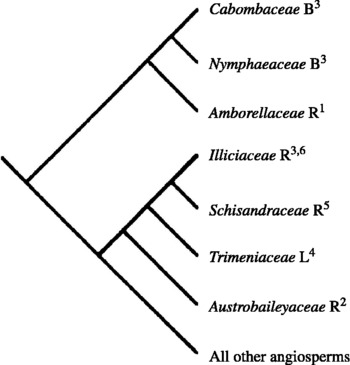
A survey of the kind(s) of embryo(s) in families of the basal angiosperms (Fig. 1) reveals that all families except those in the Nymphaeales (Cabombaceae and Nymphaeaceae) have a small embryo of a type known to grow inside the seed before radicle emergence occurs. The question is: ‘Do the broad embryos in seeds of the Nymphaeales grow inside the seed prior to radicle emergence, i.e. are the broad embryos underdeveloped?’. According to Martin (Reference Martin1946), in dicots a broad embryo is found only in Nymphaeales and Saururaceae (Piperales). Various families of monocots, including Restionaceae (Takhtajan, Reference Takhtajan1985), Eriocaulaceae, Juncaceae, Mayacaceae and Xyridaceae, as well as Eriophorum, Hemicarpha, Lipocarpha and Mariscus in the Cyperaceae and Aneilema in the Commelinaceae (Martin, Reference Martin1946), also have a broad embryo.
Types of embryos in extant basal (ANITA grade) angiosperm families. B, broad; L, small linear; R, rudimentary; 1Bailey and Swamy (Reference Bailey and Swamy1948); 2Endress (Reference Endress1980); 3Martin (Reference Martin1946); 4Morat and MacKee (Reference Morat and MacKee1977); 5Saunders (Reference Saunders1998); 6Takhtajan (Reference Takhtajan1988). Cladogram adapted from Friedman (Reference Friedman2001), reproduced with permission of Elsevier.

A broad embryo is relatively small in relation to the endosperm in the seed, and it is located at the base (lower edge) of the seed (Martin, Reference Martin1946). However, the fact that the embryo is small, i.e. low embryo length :seed length (E : S) ratio, in relation to the endosperm does not necessarily indicate that it is underdeveloped. For example, the E : S ratio in the carnivorous plant Drosera anglica (Droseraceae) seeds is 0.54, but embryos do not grow prior to radicle emergence (Baskin and Baskin, Reference Baskin and Baskin2005). In their survey of underdeveloped embryos in angiosperms, Forbis et al. (Reference Forbis, Floyd and de Querioz2002) assumed that the broad embryo in Nymphaeaceae was underdeveloped. However, we know of no studies that have been done on seeds with broad embryos to determine if they are underdeveloped. The purpose of this research was to determine if embryo growth occurs in seeds of Nymphaea prior to radicle emergence, i.e. is the embryo underdeveloped or fully developed at seed maturity?
Materials and methods
Mature fruits of five taxa of Nymphaea (Table 1) were collected from plants growing at the Nelson Water Garden in Texas (USA), placed in water in plastic bags and immediately shipped to the University of Kentucky. Fruits were placed in pans of water at room temperature, and seeds were allowed to fall from the fruits naturally. After about 1 week, seeds were removed from the pans of water and studies were initiated; seeds were never allowed to dry.
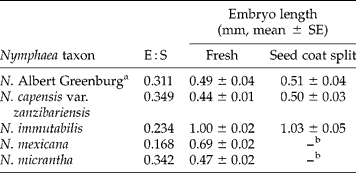
Embryo length : seed length ratio (E : S) in fresh seeds and embryo length in germinating seeds of Nymphaea
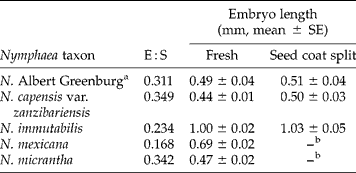
a Cultivar.
b No data.
Embryo length : seed length (E : S) ratio was determined in fresh seeds of the five taxa of Nymphaea. Fifteen fully imbibed seeds of each taxon were cut open lengthwise with a razor blade. The maximum internal length of each seed, which was filled with perisperm, and the excised embryo were measured using a dissecting microscope equipped with a micrometer. To determine the length of the embryo at the time of germination, seeds of each taxon were placed in jars of water under cool white fluorescent light (14 h daily photoperiod) at 12/12 h daily alternating temperature regimes of 28/20°C and 25/15°C in incubators. Seeds in both incubators were examined each day under a dissecting microscope, and any of them with a split seed coat (indicating that the radicle was about to emerge) were removed from the jars. Care was taken not to select any seeds with the radicle protruding from the perisperm. For each taxon, the embryo was removed from 15 seeds with a split seed coat. However, seeds of two of the taxa were dormant, and no seeds with a split seed coat were ever found. It should be noted that after a seed coat split, the radicle emerged within 1–2 d.
Results
There was essentially no embryo growth prior to the time of radicle emergence in seeds of any of the three Nymphaea taxa that germinated (Table 1).
Discussion
Depending on the species, length of rudimentary (Baskin and Baskin, Reference Baskin and Baskin1984, Reference Baskin and Baskin1985, Reference Baskin and Baskin1989), linear-underdeveloped (Baskin et al., Reference Baskin, Baskin and Yoshinaga2005; Kondo et al., Reference Kondo, Okubo, Miura, Baskin and Baskin2005) and spatulate-underdeveloped (Hidayati et al., Reference Hidayati, Baskin and Baskin2000a, Reference Hidayati, Baskin and Baskinb, Reference Hidayati, Baskin and Baskinc) embryos may increase 350 to >1000, 50 to >1000 and 70 to 200%, respectively, before seeds germinate. Thus, the broad embryos in seeds of the three species of Nymphaea are not underdeveloped; consequently, seeds do not have either morphological or morphophysiological dormancy. Further, since the seed coat is water-permeable (i.e. seeds were soft when cut open), fresh seeds of Nymphaea can only be non-dormant or have physiological dormancy (Baskin and Baskin, Reference Baskin and Baskin2004, Reference Baskin and Baskin2006).
From a phylogenetic perspective, the absence of morphological or morphophysiological dormancy in seeds of Nymphaeales is rather surprising, and it means that this is the only member of the ANITA grade with a fully developed embryo. However, a number of other morphological characters differ among members of the grade:
(1) Amborella has a nine-nucleate embryo sac (Friedman, Reference Friedman2006), Nymphaeales and some Austrobaileyales (Illiciaceae and Schisandraceae) have a four-nucleate embryo sac (and diploid endosperm) and other basal angiosperms have an eight-nucleate embryo sac (Williams and Friedman, Reference Williams and Friedman2002; Friedman and Williams, Reference Friedman and Williams2003).
(2) Pollen is somewhat diverse among basal angiosperms, especially in the ANITA grade, but monoaperturate pollen is predominant (Endress, Reference Endress2004). Austrobaileyaceae and Nymphaeales have monoaperturate pollen with special patterns near the aperture (Wiersema, Reference Wiersema1987).
(3) Although most Nymphaeales have whorled floral phyllotaxis (Endress, Reference Endress2004), Nuphar (the basal genus of Nymphaeaceae), Amborella and all Austrobaileyales have spirally arranged sepals (Endress, Reference Endress2001; Schneider et al., Reference Schneider, Tucker and Williamson2003).
The fossil record of angiosperm flowers shows that members of the ANITA grade and Chloranthaceae, as well as other magnoliids, early monocots and early eudicots, had differentiated by the Early Cretaceous (Friis et al., Reference Friis, Pedersen and Crane2006). A fossil flower of a plant thought to be closely related to extant Nymphaeaceae was collected from the Early Cretaceous (Late Aptian or Early Albian) (Friis et al., Reference Friis, Pedersen and Crane2006); thus, the broad embryo probably has been present in dicots since at least the Early Cretaceous. Recently discovered fossil seeds of Susiea newsalemae (Nymphaeaceae) from the Late Palaeocene contained a ‘broad-shaped’ embryo cavity, indicating that they had a broad embryo (Taylor et al., Reference Taylor, DeVore and Pigg2006). The other extant dicot family with a broad embryo is Saururaceae (Martin, Reference Martin1946), which belongs to the Piperales in the magnoliids. The Piperales also have a fossil (flower) record from the Early Cretaceous (Friis et al., Reference Friis, Pedersen and Crane2006).
Finally, if Amborella and Nymphaeales are equally the most basal angiosperms, as some molecular phylogenetic studies indicate (Qiu et al., Reference Qiu, Dombrovska, Lee, Li, Whitlock, Bernasconi-Quadroni, Rest, Davis, Borsch, Hilu, Renner, Soltis, Soltis, Zanis, Cannone, Gutell, Powell, Savolainen, Chatrou and Chase2005, Reference Qiu, Li, Hendry, Li, Taylor, Issa, Ronen, Vekaria and White2006), then we must conclude that the broad and rudimentary embryos are equally primitive.
Acknowledgements
We are grateful to The International Waterlily and Water Gardening Society for funding this research and to Rolf Nelson, Ken Landon, Edward Schneider and Virginia Hayes for help in obtaining seeds of Nymphaea.