


Introduction
The loss of biodiversity is a major challenge for humanity, despite global conservation efforts (Pörtner et al. Reference Pörtner, Scholesr, Agard, Archer, Arneth and Bai2021). Many populations are now very small, and a lack of genetic variability can reduce fecundity and/or survival and constrain the capacity of species to adapt to new threats, such as climate change (DeWoody et al. Reference DeWoody, Harder, Mathur and Willoughby2021; Kardos et al. Reference Kardos, Armstrong, Fitzpatrick, Hauser, Hedrick, Miller, Tallmon and Funk2021). Genetic management is becoming increasingly important and is greatly aided by advances in knowledge on how to maximise retention of genetic variability using approaches like promotion of gene flow between populations and hybridisation between distinct lineages (Ralls et al. Reference Ralls, Ballou, Dudash, Eldridge, Fenster and Lacy2018; Willi et al. Reference Willi, Kristensen, Sgrò, Weeks, Ørsted and Hoffmann2022), genetic engineering and gene drives (Todesco et al. Reference Todesco, Pascual, Owens, Ostevik, Moyers and Hübner2016; Piaggio et al. Reference Piaggio, Segelbacher, Seddon, Alphey, Bennett and Carlson2017; Quilodrán et al. Reference Quilodrán, Montoya-Burgos and Currat2020).
The genetic management of threatened species, however, sets two environmental concerns in opposition: that of species extinction and that of risk to the environment from the unintended consequences of genetic interventions. Concern about the unintended consequences of genetic management of threatened species has been expressed by both experts (Webber et al. Reference Webber, Raghu and Edwards2015) and the public (Kohl et al. Reference Kohl, Brossard, Scheufele and Xenos2019; Zander et al. Reference Zander, St-Laurent, Hogg, Sunnucks, Woinarski and Legge2021). However, there has also been a counter discussion on the value of intended consequences to the conservation of species (Phelan et al. Reference Phelan, Baumgartner, Brand, Brister, Burgiel and Charo2021). This includes the probability that species may become extinct unless there is genetic management. Concern about extinction is apparent from the investment people are willing to make to prevent extinction from happening (Richardson and Loomis Reference Richardson and Loomis2009; Zander et al. Reference Zander, Ainsworth, Meyerhoff and Garnett2014, Subroy et al. Reference Subroy, Gunawardena, Polyakov, Pandit and Pannell2019), the presence of legislation in most countries of the world aspiring to conserve threatened species, and global aspirations to reduce the rate of extinction (CBD 2021).
Currently, opinions about genetic management for conservation purposes appear not to be entrenched (MacDonald et al. Reference MacDonald, Balanovic, Edwards, Abrahamse, Frame, Greenaway and Kannemeyer2020) although a sample of the Australian public was much more cautious about genetic management than other forms of conservation management, including the killing of feral animals to protect threatened species (Zander et al. Reference Zander, St-Laurent, Hogg, Sunnucks, Woinarski and Legge2021). However, given the acrimony of the debate about the genetic engineering of crops (Mallinson et al. Reference Mallinson, Russell, Cameron, Ton, Horton and Barker2018), we feel it imperative to understand and consider seriously whether the approaches being adopted to save threatened species exceed levels of public acceptance of the technologies being applied.
Theoretical context
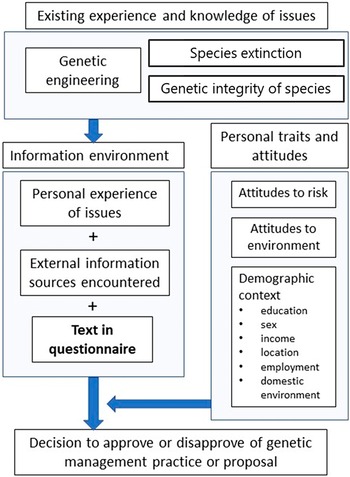
Our overall theoretical framework, visualised in Figure 1 (based on Lundheim et al. Reference Lundheim, Pellegrini-Masini, Klöckner and Geiss2022), assumes that members of the public will have a range of knowledge and experience with issues relating to genetic management, threatened species conservation, and the genetic integrity of species. The questionnaire aimed to augment their knowledge while triggering respondents to recall any specific information they may have encountered, or experiences they may have had relating to the issues and how they interact with each other. The final decision on how to respond to the questionnaire is then expected to be modified by attitudes, world views and their demographic context. Also likely to be particularly important in consideration of technical decisions is the level of trust respondents place in experts to make responsible and necessary decisions, even if they do not know the details (Garnett et al. Reference Garnett, Zander, Hagerman, Satterfield and Meyerhoff2018, Gregory et al. Reference Gregory, Kozak, St-Laurent, Nawaz, Satterfield and Hagerman2021). We expected that many respondents will never have considered the issue in any detail previously. However, a lack of broad public engagement with an issue does not preclude consideration of the social acceptance of the approaches being taken, or which are proposed, or from seeking views on ethical acceptability (Taebi Reference Taebi2017). The combined responses, drawn from across Australia, we take to be broadly reflective of public opinion across the nation, with the strength of the views expressed being taken as a measure of the social acceptance of the genetic management currently under way and the social acceptance of that proposed.
Theoretical framework of the social acceptability of genetic management for conservation of threatened species. Specific experience and knowledge of the issues contributes to the information environment that includes the questionnaire. Information and experience are then modified by a range of personal traits including attitudes and a respondent’s demographic context to shape them as either opposing or accepting the genetic management practice or proposal.
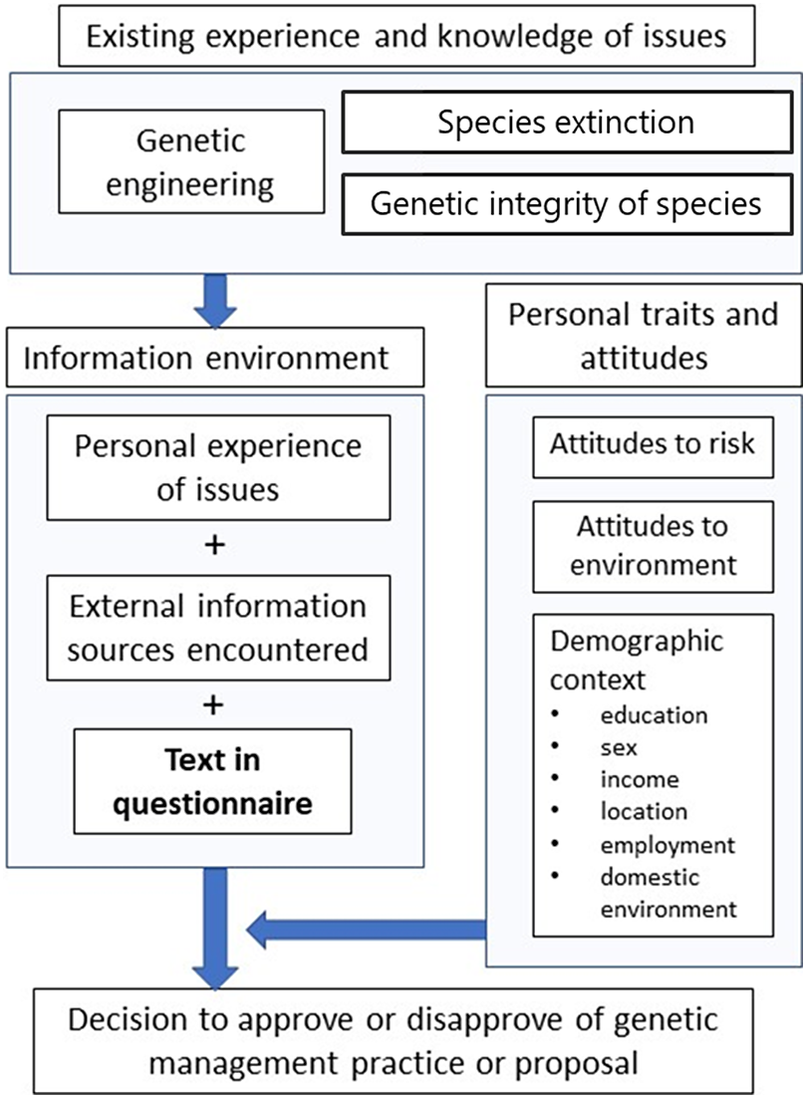
Figure 1. Long description
The flowchart begins at the top with a box labeled Existing experience and knowledge of issues. This box contains three sub-components: Genetic engineering, Species extinction, and Genetic integrity of species.
An arrow points downward from this top section to a left-hand column titled Information environment. This column contains a vertical stack of three boxes connected by plus symbols: Personal experience of issues, followed by External information sources encountered, and finally Text in questionnaire.
To the right of the information column is a separate section titled Personal traits and attitudes. This section contains three stacked boxes: Attitudes to risk, Attitudes to environment, and Demographic context. The Demographic context box includes a bulleted list: education, sex, income, location, employment, and domestic environment.
A downward arrow from the Information environment column and a horizontal arrow from the Personal traits and attitudes section both converge on the final box at the bottom. This terminal box is labeled: Decision to approve or disapprove of genetic management practice or proposal.
Social acceptance and the role of framing
Emotions and attitudes towards public issues depend on what people perceive as the risks, with perceived risk and benefits also depending on how familiar people are with the issues in question (Specht et al. 2019; Lutzke and Arvai Reference Lutzke and Árvai2021). As such, the quality and quantity of information provided, referred to as framing, can substantially affect people’s social acceptance. Framing originates from the field of psychology in the contexts of testing whether the way stimuli are labelled or framed affects how people evaluate them (Levin et al. Reference Levin, Schnittjer and Thee1988). Often, framing includes a particular choice of words to describe a process, product or policy to trigger a desired perception and behaviour. Subtle framing has been used extensively to manipulate how people accept novel but contentious products and processes (e.g. foods; Siegrist and Hartmann Reference Siegrist and Hartmann2020), underpins conservation and advocacy and donation-seeking media campaigns (Jacobson et al. Reference Jacobson, Morales, Chen, Soodeen, Moulton and Jain2019; Kusmanoff et al. Reference Kusmanoff, Fidler, Gordon, Garrard and Bekessy2020), and shapes portrayal of conservation efforts to reverse biodiversity loss (Elliott Reference Elliott2020) and the importance of environmental conservation (Sorensen et al. Reference Sorensen, Clark and Jordan2015).
Usually, framing in conservation aims to nudge people towards a certain behaviour (e.g. donating more money), but in our study, we explicitly endeavoured to minimise implicit approval of values about the use of genetic management in conservation by describing actions in plain language and avoiding words that might be associated with a negative or positive value. While recognising that no framing can be value-free, and that researchers can never fully separate themselves from the matters they are investigating (Colombo et al. Reference Colombo, Bucher and Inbar2016), the material consequences of bias can be minimised (Mattes Reference Mattes2019). Notwithstanding our objective to present information as impartially as possible, several factors are likely to influence the choices made by respondents over which we, as researchers, have influence – the information provided and the nature of the case studies we present.
The role of information in opinion formation
Many respondents surveyed by Zander et al. (Reference Zander, St-Laurent, Hogg, Sunnucks, Woinarski and Legge2021) tempered negative views of genetic management with statements expressing a need for more information. While research on the Information Deficit Model of science communication suggests that additional knowledge may not increase support (Simis et al. Reference Simis, Madden, Cacciatore and Yeo2016), recent work on the public acceptance of genetically modified foods suggests information can increase acceptance (McPhetres et al. Reference McPhetres, Rutjens, Weinstein and Brisson2019). Another effect may be that more information will increase the proportion of people who express an opinion, as found in a recent study of conservation interventions in North America (Hagerman et al. Reference Hagerman, Satterfield, Nawaz, Peterson St‐Laurent, Kozak and Gregory2021). However, provision of additional information also has methodological implications because survey length, which must vary if more information is to be provided, can influence the response, although the issue of survey length has been little studied to date (Peytchev et al. Reference Peytchev, Peytcheva, Conzelmann, Wilson and Wine2020).
We explored the role of information content and survey length using a two-by-two treatment design to test for the role of information, in particular the risk of genetic management and the benefits (see section 2.3). We changed only the amount of information presented, as done in previous information-framing studies using benefits and risks as main information pieces that we assumed will trigger how people accept the use of genetic management in conservation. This can be referred to as outcome framing, one of many approaches of information framing (see Kolandai-Matchett and Armoudian Reference Kolandai-Matchett and Armoudian2020; Wang et al. Reference Wang, Gong, Wang, Li and Sun2021). Outcome framing uses information about potential benefits from conservation or any other environmental improvement versus the losses from non-adoption (e.g. Cheng et al. Reference Cheng, Woon and Lynes2011).
The legitimacy of social acceptance
The results of our survey, we contend, can be used a gauge of social acceptance of the genetic management being undertaken. In democratic societies, inputs to governance, policy and decision-making processes needs to combine expert opinion with public perceptions and sentiment (Jobert et al. Reference Jobert, Laborgne and Mimler2007). To reduce conflict between these two elements, it is important to understand what the public wants and perceives, referred to as public- or social acceptance, prior to starting any major development, planning or policy changes. Social acceptance is more than just a public opinion: it is an important social concept for decision-makers and regulatory bodies in socially sensitive issues, such as renewable energy innovations (Wüstenhagen et al. Reference Wüstenhagen, Wolsink and Bürer2007; Jung et al. Reference Jung, Moula, Fang, Hamdy and Lahdelma2016), mining developments (Moffat and Zhang Reference Moffat and Zhang2014), novel food systems (Specht et al. 2019; Siegrist and Hartmann Reference Siegrist and Hartmann2020) or climate engineering (Mercer et al. Reference Mercer, Keith and Sharp2011; Klaus et al. Reference Klaus, Ernst and Oswald2020). For our study design and analysis, we drew on previous literature to identify factors that have influenced social acceptance of environmental management. These factors (summarised in Supplementary material Table S1) can be grouped into:
-
1) Personal characteristics such as demographic factors (age, gender, education and income), cultural background, attitudes and beliefs, emotions and trust
-
2) Known or perceived risk, concern, uncertainty, damage and negative consequence from the proposed development, strategy or measure
-
3) Known or perceived benefits
-
4) Knowledge and familiarity about the subject for which acceptance is sought
-
5) The amount and quality of information provided to a person to make a decision on their acceptance
Hypotheses on public attitudes to genetic management for conservation of threatened species
This study aims to understand the level of social acceptance for the use of genetic management in the conservation of threatened Australian bird species. While we are using Australian case studies, the relevance of this study is applicable to a wider range of species and countries. We undertook an online survey among the Australian public using examples of six species of birds, each with a different level of genetic management. The species were Lord Howe Woodhen Hypotaenidia sylvestris, Norfolk Island Morepork Ninox novaeseelandiae undulata, Orange-bellied Parrot Neophema chrysogaster, Western Ground Parrot Pezoporus wallicus flaviventris, Eastern Bristlebird Dasyornis brachypterus and Helmeted Honeyeater Lichenostomus melanops cassidix. We build on the earlier work (Zander et al. Reference Zander, St-Laurent, Hogg, Sunnucks, Woinarski and Legge2021) to test four hypotheses:
H1: The public (respondents) will consider genetic management of threatened birds favourably, i.e., that they consider the risks of loss of species greater than the risks from the unintended consequences of genetic management.
H2: The acceptance of genetic management will be higher if more information is provided about the risks
H3: People are more likely to express an opinion if they are provided with more information.
H4: Respondents who express most trust in the managers of threatened species are more likely to accept the necessity of genetic management than those with low trust.
The study also considered whether the acceptance levels for different types of genetic management varied and whether it was influenced by other important determinants of social acceptance, such as age, sex, level of prior knowledge, or the level of trust in experts engaging in the management.
Methods
Data collection and sampling
We commissioned a market research company (Dynata) for data collection. Respondents to our survey were randomly selected from the large pool of the Australian public maintained by the company (about 400,000 people) while ensuring that the final sample was representative of Australian society in terms of gender, age, and geography (i.e., proportional to the population in each Australian state and territory). Each respondent received a link to our online survey and was remunerated according to the company’s rates upon completion of the survey.
The data were collected over two weeks in September 2021. We obtained ethics approval (H19047) from the Charles Darwin University Human Ethics Committee. Respondents were informed that the survey was voluntary, that the information was used only for research purposes and that the collected data were unidentifiable. Respondents were also informed that they could withdraw at any time by closing the browser. Partial data were not recorded. Following standard practice, no information about the survey content was made available before respondents had committed to commence it.
We sampled 3,000 adults (18+ years). The sampling aimed at obtaining a representative share across gender, age groups and locations (States and Territories). Not all responses could be used for further analysis. Of the 3,000, 113 were largely incomplete and 301 were completed in under four minutes, which we considered too quick for respondents to have read thoroughly the text provided and all questions, based on a bimodal distribution of completion time frequencies with a small peak at 3 minutes and a large peak at the median of 10 minutes. This left us with 2,586 valid responses.
Questionnaire and treatment groups
Questionnaire
The questionnaire was designed in Qualtrics and consisted of four parts of which the first part provided only introductory text providing background information about conservation and genetic management. Two different versions of this introductory text were used, a short one (178 words) and a long one (503 words) which differed in the amount of detail they provided about the consequences of inbreeding and how various forms of genetic management can affect the genetic make-up of threatened species.
In the second part of the questionnaire each respondent was presented with six case studies describing approaches to reducing inbreeding in six different Australian threatened bird species (Figure 2 provides pictures of these species for the readers, but no pictures were provided in the survey). The six bird species were chosen because all have very small population sizes so they are currently being managed to reduce inbreeding (three taxa), or such action is proposed (three taxa). For each case study described, we then asked about the social acceptance of the approach described with the question was “Please indicate whether you think the action being taken is an acceptable way to manage inbreeding” or, for those cases in which a measure has been proposed but not yet implemented, “Please indicate whether you think the possible action is an acceptable way to manage inbreeding”. Possible responses included, on a seven point-scale: Completely unacceptable (1), Moderately unacceptable (2), Slightly acceptable (3), No opinion (4) Slightly acceptable (5), Moderately acceptable (6), Completely acceptable (7). The response to these scales were taken as a proxy acceptance by the respondent for the genetic management proposed. We included follow-up questions for those respondents who chose ‘No opinion’ at least once, asking them to choose from one or more of the following options: the text provided too little information to form an opinion, they did not understand the questions, they had no interest in the threatened species presented in the examples, they lacked interest in how threatened species are managed or they found the text too long to follow.
Six Australian birds, the genetic management they need and the correlations between acceptance scores (measured on a scale of 1-7).
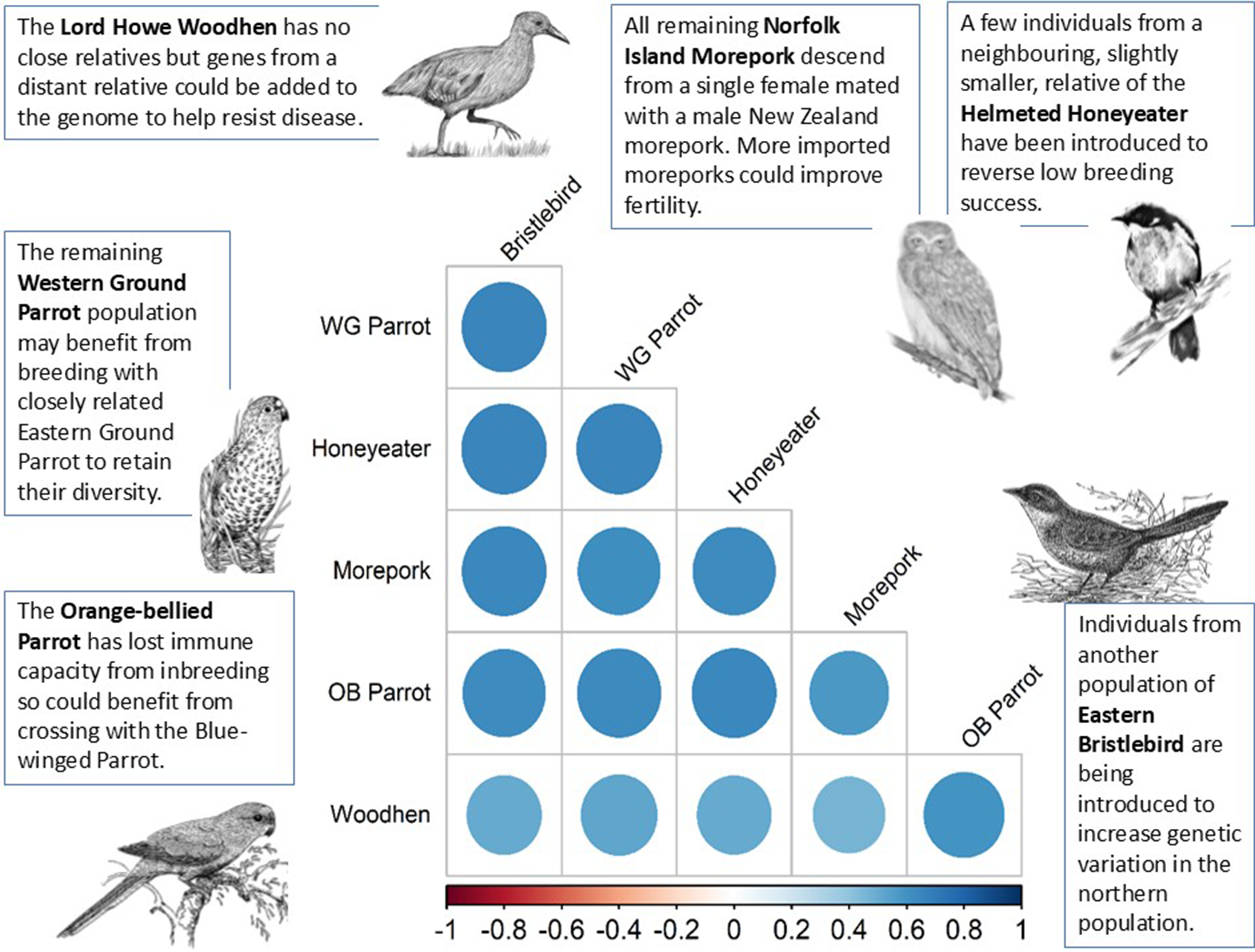
Figure 2. Long description
A central triangular correlation matrix displays blue circles of varying shades representing acceptance scores. The vertical axis labels from top to bottom are W G Parrot, Honeyeater, Morepork, O B Parrot, and Woodhen. The diagonal axis labels from top to bottom are Bristlebird, W G Parrot, Honeyeater, Morepork, and O B Parrot. A color scale at the bottom ranges from dark red at minus 1 to dark blue at 1.
Surrounding the matrix are six bird illustrations with text boxes:
* Top-left: Lord Howe Woodhen. Text states they have no close relatives but genes from a distant relative could help resist disease.
* Top-center: Norfolk Island Morepork. Text explains they descend from a single female and a New Zealand male; more imports could improve fertility.
* Top-right: Helmeted Honeyeater. Text notes individuals from a smaller relative were introduced to reverse low breeding success.
* Middle-left: Western Ground Parrot. Text says the 100 remaining birds may benefit from breeding with eastern ground parrots.
* Bottom-left: Orange-Bellied Parrot. Text describes loss of immune capacity from inbreeding and potential benefits from crossing with blue-winged parrots.
* Bottom-right: Eastern Bristlebird. Text mentions individuals from another population are being introduced to increase genetic variation.
In the third part of the questionnaire, all respondents were asked questions about knowledge, trust in conservation agencies and attitudes. Knowledge about each of the six presented birds were gauged by asking “Have you heard about any of the species described in the introduction text?” with possible responses either ‘Never heard about it’ or four categories assessing different level of knowledge. Trust was assessed by asking about the level of trust with three organisations/agencies (scientists, campaign groups and the government) to provide accurate information about what is needed for conservation. Possible responses included ‘Never’, ‘Rarely’, ‘Usually’ and ‘Always’. Attitudes about conservation were assessed by asking how respondents agreed or disagreed with a range of statements (all on a 4-scale: Strongly agree, Agree, Disagree, Strongly disagree). Statements to be evaluated included “Successful conservation demands the strict enforcement of regulations and laws” and “Species extinction should be prevented regardless of the costs”, “Genetic management of species is a risk worth taking when it can prevent species extinction” and “The best measure of progress is economic growth”. The same 4-scale format was used to elicit responses to two statements related to respondents’ tolerance of risk (“Genetically modified food is inevitable if we want to feed a growing human population” and “Climate engineering is a risk that is worth taking to prevent severe impacts of climate change”).
The fourth and final part of the questionnaire contained questions about key demographics (age, education, gender) and personal attributes. A simple question “Would you describe yourself as a birdwatcher?” (Yes/No) was used to gauge interest in birds in general, as was the question “Do you take part in conservation activities or work in the conservation sector? (Yes/No).
Framing and treatment groups
As part of our experiment on information-framing, we created two versions of the introductory text and of the six bird case studies. With the introductory text on the general principles behind conservation and genetic management, we randomly assigned one of the two versions with an equal distribution of the two. The two versions differed in their details about the species and subspecies definition and the background information on the genetic management being undertaken or proposed (Supplementary material Figure S1).
Similarly, the two versions of the six case studies differed in the level of detail of information provided, with the more detailed version also including information about potential risks from action and risks from no action (Supplementary material Figure S2). Both short and detailed versions included information about the species, its current population size, level of inbreeding, and corrective actions under way or proposed. The detailed version included more information about the species such as its location, relation to other sub-species and habitat. Whether respondents were presented with the short or detailed version was set as random, with each version used an equal number of times. We further asked respondents how useful they found the text about genetic management that we provided at the beginning of the survey for answering the questions about acceptance with four possible answers (‘Very useful’, ‘Quite useful’, ‘Not so useful’ and ‘Not at all useful’).
We applied a two-by-two design, and split the sample into four, i.e. short introduction–short inbreeding description, short introduction–detailed inbreeding description, detailed introduction–short inbreeding description, and detailed introduction–detailed inbreeding description.
Data analysis
Data obtained from the questions on social acceptance were analysed using multinomial logistic regression (MLR) models. We estimated six models with the dependent variables in each model being the acceptance score for each bird. The acceptance score was generated from the seven-point scale survey questions. For the model estimation, we grouped the three ‘accept’ responses (slightly, moderately and completely acceptable) into one outcome, ‘Accept’, and the three ‘oppose’ responses (slightly, moderately and completely unacceptable) into another outcome, ‘Oppose’ and kept the category ‘neutral’ (no opinion) as third outcome. This led to a dependent variable with three levels: Agree, Oppose and Neutral. We used ‘Neutral’ as the reference category and tested whether the explanatory variables have a significant effect on the probability of accepting or opposing genetic management compared to having no opinion about it (see, e.g.Hosmer et al. Reference Hosmer, Lemeshow and Sturdivant2013 for the MLR model specification). We used the software R and the “multinom” function from the “nnet” package to estimate the MLR models.
We estimated one MLR model for each of the six bird species, using the same explanatory variables. As explanatory variables we included a dummy variable for the different treatments with a dummy coded variable for the introductory text (coded 1 for the long version and 0 for the short version) and the inbreeding description (coded 1 for the detailed version and 0 for the short version). Additionally, we included explanatory variables about respondents’ demographic background, their environmental attitudes, their risk perceptions, knowledge about birds and conservation measures and respondents’ level of trust in different stakeholders in conservation science and practice. These variables are presented in Table 1 and Figure 3.
Sample description (n=2,586)
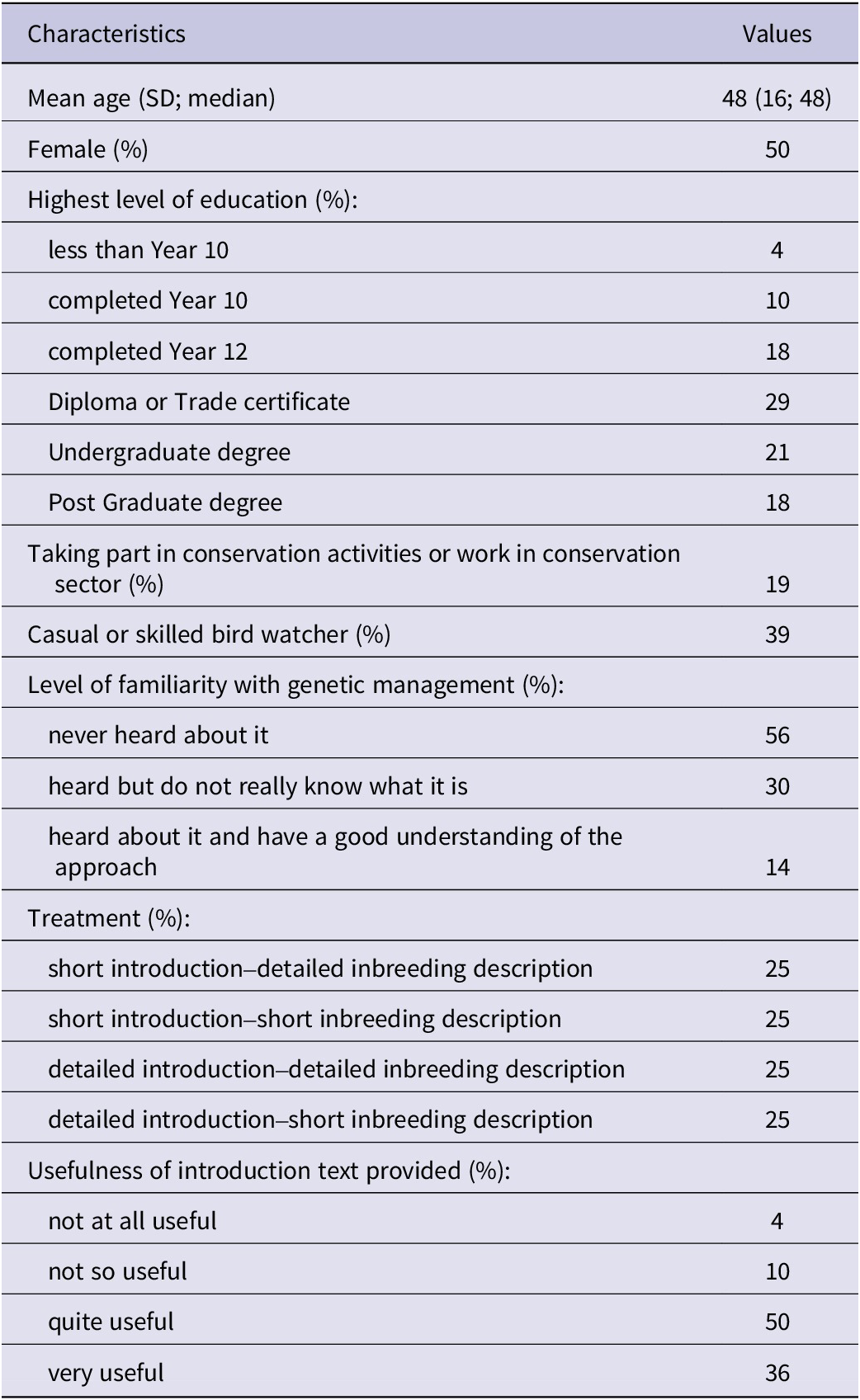
Table 1. Long description
The table presents data for a sample size n = 2,586.
* Mean age (S D; median): 48 (16; 48).
* Female (%): 50.
* Highest level of education (%):
- less than Year 10: 4.
- completed Year 10: 10.
- completed Year 12: 18.
- Diploma or Trade certificate: 29.
- Undergraduate degree: 21.
- Post Graduate degree: 18.
* Taking part in conservation activities or work in conservation sector (%): 19.
* Casual or skilled bird watcher (%): 39.
* Level of familiarity with genetic management (%):
- never heard about it: 56.
- heard but do not really know what it is: 30.
- heard about it and have a good understanding of the approach: 14.
* Treatment (%):
- short introduction–detailed inbreeding description: 25.
- short introduction–short inbreeding description: 25.
- detailed introduction–detailed inbreeding description: 25.
- detailed introduction–detailed inbreeding description: 25.
* Usefulness of introduction text provided (%):
- not at all useful: 4.
- not so useful: 10.
- quite useful: 50.
- very useful: 36.
Attitudes of respondents (n=2,586) to risk about technology and economics as they relate to threatened species.
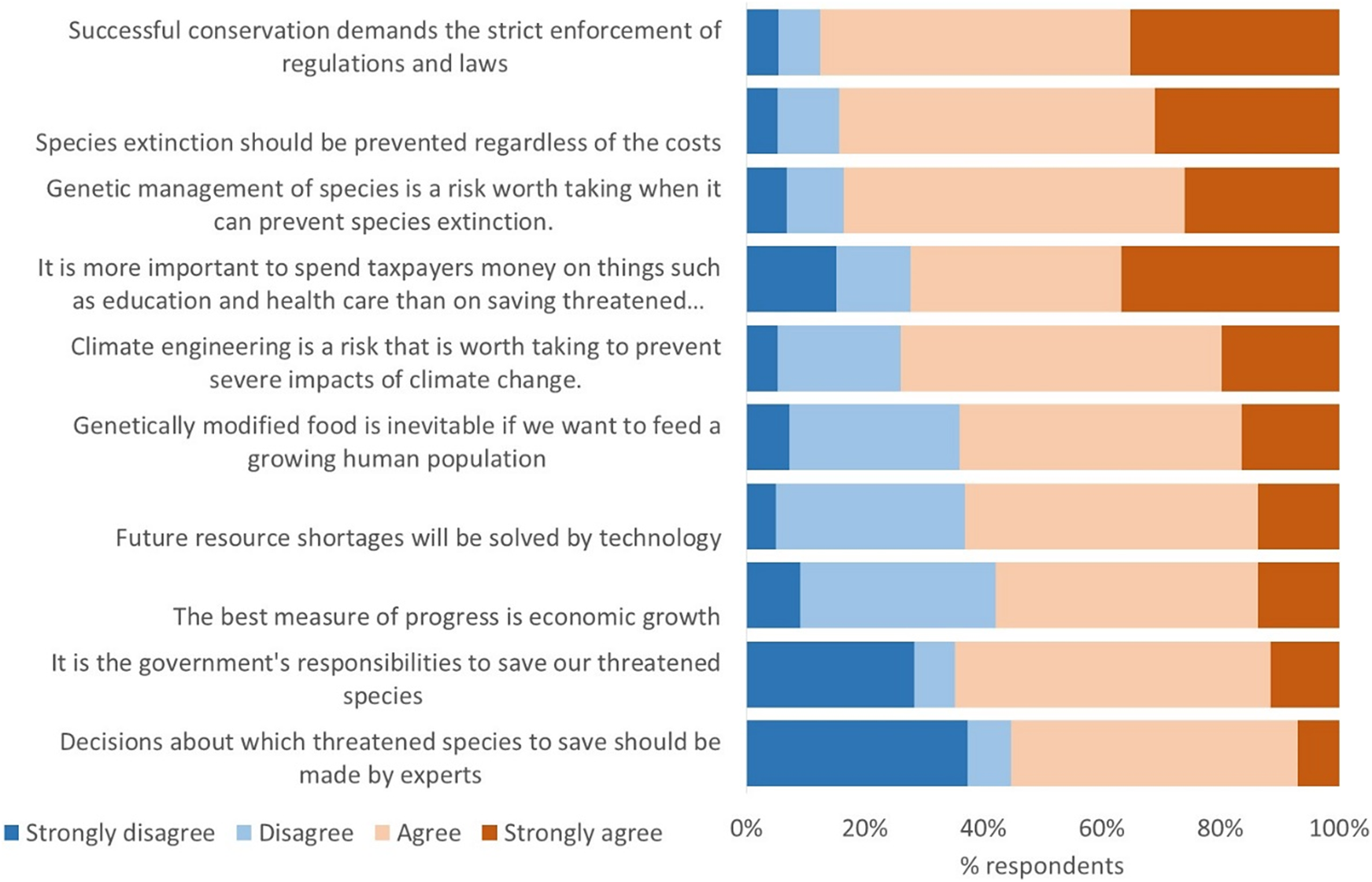
Figure 3. Long description
The chart displays the percentage of respondents across four categories: Strongly disagree (dark blue), Disagree (light blue), Agree (light orange), and Strongly agree (dark orange). The x-axis represents the percentage of respondents from 0 to 100 percent.
From top to bottom, the statements and their approximate distributions are:
* Successful conservation demands the strict enforcement of regulations and laws: 10 percent disagreeing, 90 percent agreeing.
* Species extinction should be prevented regardless of the costs: 15 percent disagreeing, 85 percent agreeing.
* Genetic management of species is a risk worth taking when it can prevent species extinction: 15 percent disagreeing, 85 percent agreeing.
* It is more important to spend taxpayers money on things such as education and health care than on saving threatened species: 30 percent disagreeing, 70 percent agreeing.
* Climate engineering is a risk that is worth taking to prevent severe impacts of climate change: 25 percent disagreeing, 75 percent agreeing.
* Genetically modified food is inevitable if we want to feed a growing human population: 35 percent disagreeing, 65 percent agreeing.
* Future resource shortages will be solved by technology: 35 percent disagreeing, 65 percent agreeing.
* The best measure of progress is economic growth: 40 percent disagreeing, 60 percent agreeing.
* It is the government's responsibilities to save our threatened species: 35 percent disagreeing, 65 percent agreeing.
* Decisions about which threatened species to save should be made by experts: 45 percent disagreeing, 55 percent agreeing.
We also performed a stepwise linear regression model, in which level of acceptance (coded from 1 = no acceptance to 7 = strong acceptance) was calculated as a compound variable for all birds together using factor analysis. We applied factor analysis with varimax rotation (Tabachnick and Fidell Reference Tabachnick and Fidell2013) to group the six acceptance questions into factors. Before, we tested for internal consistency among responses of the six questions by calculating Cronbach’s alpha (α), a commonly used scale reliability measure.
Before estimating the models, we further tested for correlations among the six acceptance questions and among the explanatory variables describing respondents (demographics, attitudes) using Pearson’s product-moment correlation and the R package “corrplot” (Wei and Simko Reference Wei and Simko2017). There was a high positive correlation between the social acceptance of all birds, meaning that a person who accepted genetic management to be used for one bird was also likely to accept it for the other birds, and vice versa (Figure 2). Figure 2 also provides pictures of the six birds, as well as the relevant genetic management. Although there were some positively correlated variables (Supplementary material Figure S5), such as trust in scientists and trust in campaign groups (r = 0.40) and ‘Heard about genetic management in conservation’ and ‘Taking part in conservation activities’ (r = 0.47), the correlation coefficients (r) were less than 0.5 which we took as indicating a strong correlation. We therefore retained all explanatory variables in the data analysis.
Results
Sample description
The sample contained as many responses from male as from female respondents (Table 1). Median age of respondents was 48 years (± 16 SD), slightly higher than the national median (ABS Table Builder: median age: 43 years). About 39% had a university degree. Nearly a fifth (18%) took part in conservation activities or worked in the conservation sector, and 39% said they like to watch birds (Table 1). As per the survey design, each of the four treatments was seen by about a quarter of respondents with half of the 2,586 respondents being presented with the detailed introductory text (n=1,293) and about half with the detailed description of bird case studies (49.6%; n = 1,282).
Knowledge and trust
Knowledge of each bird was similar among the respondents in each of the experimental groups (Supplementary material Figure S3) and strongly correlated; i.e. people who had knowledge of one bird also had it of another. On average, 60% had never heard of each bird but 6% knew them well. The Orange-bellied Parrot was the best known of the six (47% had heard of it and 7% knew it well and had seen it) and the Eastern Bristlebird was the least known (33%, 6%).
About 56% of all respondents had never heard about using genetic management as a conservation method, while another 30% had heard about it but were uncertain about what it involved. Only 14% had not only heard of it but had a good understanding of the approach (Table 1).
Levels of trust to provide accurate information about what is needed for conservation were highest for scientists (91%), lower for campaign groups (79%) and lowest for the Australian Government (58%). Very few respondents “never” trusted scientists (2%), campaign groups (4%) or the Australian Government (8%) (Supplementary material Figure S4).
Conservation and risk tolerance attitudes
Respondents felt most strongly that conservation laws and regulations should be strictly enforced (88% agreed, or strongly agreed), that extinction should be avoided regardless of the cost (84%), and that genetic management is a risk worth taking if it can prevent species extinction (84%), with many more strongly agreeing with the propositions than disagreeing (Figure 3). At the same time, however, a high proportion (72%) considered that it is more important to spend tax-payers’ money on things such as education and health care than on saving threatened species, with 37% agreeing strongly with the statement. In general, a majority of respondents felt optimistic that technology and the economy would have a positive influence on conservation, with most agreeing to statements that climate engineering is a risk that is worth taking to prevent severe impacts of climate change (74%), genetically modified food is inevitable if we want to feed a growing human population (64%) and future resource shortages will be solved by technology (63%) and that the best measure of progress is economic growth (58%). There was also agreement that it is the government’s responsibility to save our threatened species (65%) and that decisions about which threatened species to save should be made by experts (55%), although the number of respondents strongly disagreeing with the statements was much greater than the number strongly agreeing (ratios 2.4 and 5.3 respectively).
Social acceptance of conservation approaches
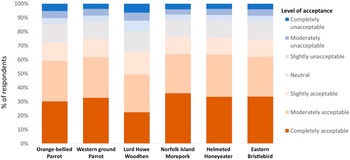
There was a high level of acceptance for genetic management for all six bird species (Figure 4) with an average acceptance of 73% compared to 14% finding it unacceptable, with the remaining 13% having no opinion. Acceptance was highest for genetic management of the Norfolk Island Morepork (76% accept, 12% not accept) and lowest for the woodhen (66%, 20%). Although only half of the respondents consistently accepted genetic management for all six bird species to some degree (50.0%), acceptance levels for each bird species were much higher (Figure 4). Of the respondents who did not choose one of the three levels of acceptance for all six species, 36% had a mixture of responses (12% chose the neutral (‘no opinion’) response at least once across the six bird species), about 9% selected ‘no opinion’ in all six cases and 4% opposed genetic management approaches for all six bird species. We therefore considered there was support for H1: that the public considers the risks of loss of species greater than the risks from the unintended consequences of genetic management.
Respondents’ (n=2,586) acceptance of genetic management strategies to reduce the extinction risk of six threatened Australian bird species.
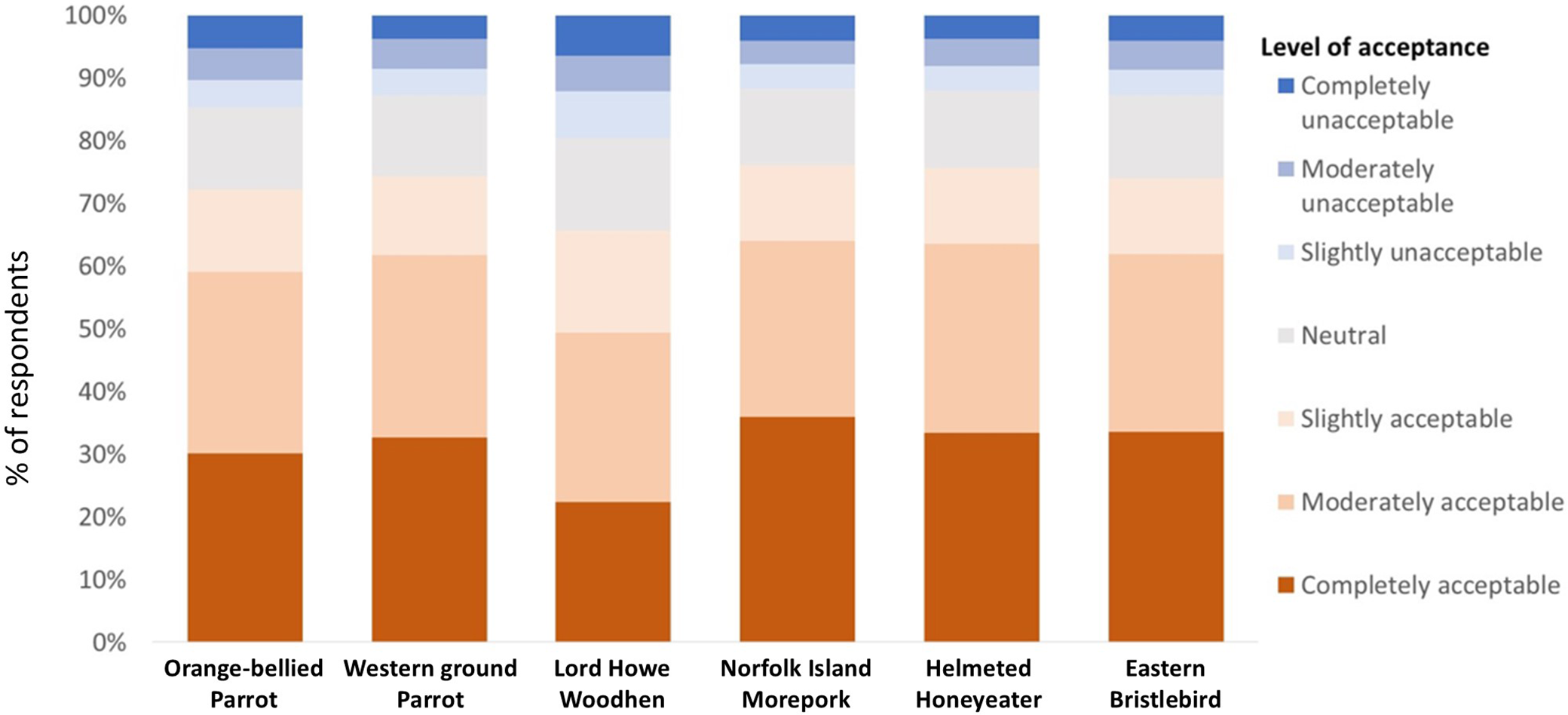
Figure 4. Long description
A stacked bar chart displays the percentage of respondents on the Y-axis, ranging from 0 percent to 100 percent in increments of 10 percent. The X-axis lists six species: Orange-bellied parrot, Western ground parrot, Lord Howe woodhen, Norfolk Island morepork, Helmeted honeyeater, and Eastern bristlebird.
The legend, titled Level of acceptance, uses a color gradient from dark orange at the bottom to dark blue at the top:
* Completely acceptable (dark orange)
* Moderately acceptable (medium orange)
* Slightly acceptable (light orange)
* Neutral (light gray)
* Slightly unacceptable (light blue-gray)
* Moderately unacceptable (medium blue-gray)
* Completely unacceptable (dark blue)
Data trends across species:
* Norfolk Island morepork has the highest ‘Completely acceptable’ rating at approximately 36 percent.
* Lord Howe woodhen has the lowest ‘Completely acceptable’ rating at approximately 22 percent, but the highest ‘Moderately acceptable’ segment, bringing its total acceptance to nearly 50 percent.
* Orange-bellied parrot and Western ground parrot show similar distributions, with total acceptance (sum of all orange shades) exceeding 60 percent.
* Helmeted honeyeater and Eastern bristlebird show nearly identical acceptance profiles, with ‘Completely acceptable’ at approximately 33 percent.
* Across all species, the ‘Completely unacceptable’ (dark blue) and ‘Moderately unacceptable’ (medium blue-gray) segments are the smallest, each typically representing less than 10 percent of the total.
Of the 9% who always chose ‘no opinion’, 40% felt that the text provided did not provide enough information to form an opinion, 24% did not understand the questions, 14% had no interest in the threatened species presented in the examples, 11% lacked interest in how threatened species are managed and 11% found the text too long to follow.
Determinants of acceptance
Information framing
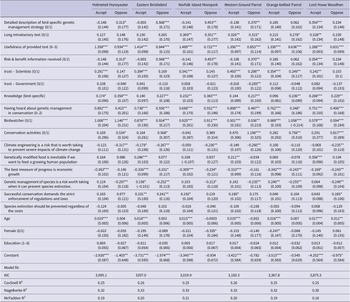
Provision of detailed information about the benefits and risks of genetic management interventions discussed in each case study had a stronger impact on the level of acceptance than did providing more introductory information (Table 2), although there was no statistical difference between the rating of the usefulness and the length of the text (χ2= 5.29, df = 3, P = 0.152). Those who saw the more detailed description of the genetic management strategies of the individual bird were more likely to oppose the approach for honeyeater, bristlebird, morepork and ground parrot and accept it for the woodhen, with the extra information having no effect on acceptance of genetic management of the orange-bellied parrot (Table 2). We concluded, therefore, that H2 was not supported, that the more information presented describing the type and need for genetic management for each bird, the greater the acceptance of the actions described.
Results of six multinomial logit models, one for each of the bird species, testing the acceptance of genetic management to conserve threatened bird species (n=2,586), shown are the coefficients and their standard errors in brackets
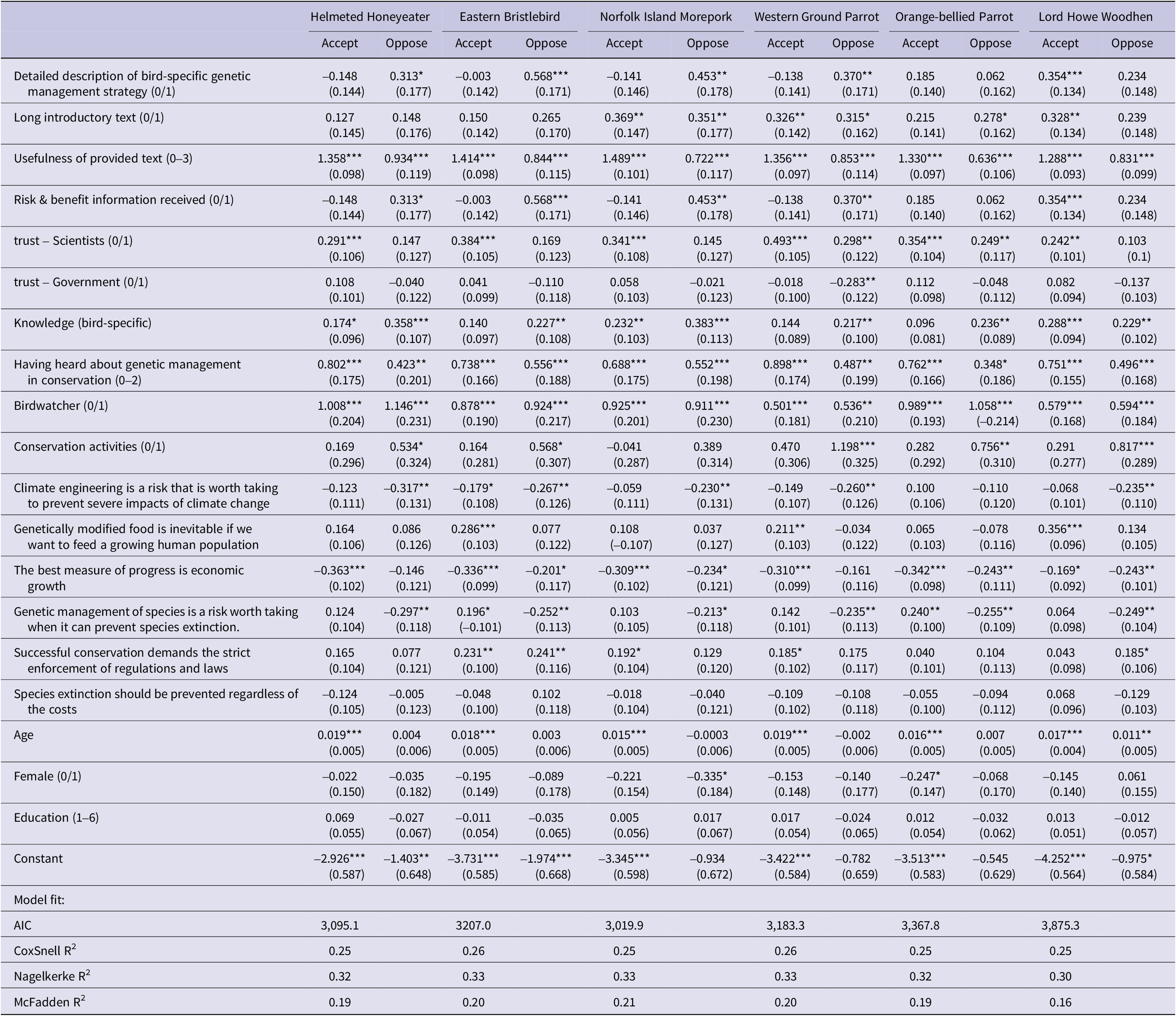
Table 2. Long description
The table presents coefficients and standard errors in brackets for six bird species: Honeyeater, Bristlebird, Morepork, W G parrot, O B parrot, and Woodhen. For each species, two columns represent Accept and Oppose responses.
Key predictor variables include:
* Detailed description of bird-specific genetic management strategy (0/1): Significant positive coefficients for Oppose in Honeyeater (0.313), Bristlebird (0.568), Morepork (0.453), and W G parrot (0.370).
* Usefulness of provided text (0 to 3): Highly significant positive coefficients across all species for both Accept (ranging 1.288 to 1.489) and Oppose (ranging 0.636 to 0.934).
* Trust in Scientists (0/1): Significant positive coefficients for Accept across all species, highest for W G parrot (0.493).
* Having heard about genetic management in conservation (0 to 2): Significant positive coefficients for both Accept and Oppose across all species.
* Birdwatcher (0/1): Significant positive coefficients for both Accept and Oppose across all species.
* Age: Significant positive coefficients for Accept across all species (0.015 to 0.019).
* Constant: Highly significant negative values for Accept across all species (ranging -2.926 to -4.252).
Model fit statistics at the bottom include A I C values ranging from 3,019.9 (Morepork) to 3,875.3 (Woodhen), and Nagelkerke R super 2 values between 0.30 and 0.33. Significance levels are indicated by asterisks: * P < 0.1, ** P < 0.05, *** P < 0.01.
*P < 0.1; **P < 0.05; ***P < 0.01
The amount of information provided in the introductory text about genetic management and the conservation of threatened species had a statistically significant impact on the acceptance levels for four of the six bird species (Table 2). Respondents presented with the long introductory text were more likely to form an opinion about the morepork and the western ground parrot (positive and significant coefficients for both ‘accept’ and ‘oppose’), were more likely to oppose genetic management of the orange-bellied parrot and more likely to accept it for the woodhen. For the bristlebird and honeyeater, the extra information had no effect on acceptance. Overall, therefore, we had support for hypothesis H3, that the more information provided, the greater the proportion of people likely to express an opinion.
Trust
For all bird species, respondents who trusted scientists to make the right decisions when managing threatened species were more likely to accept genetic management. However, respondents who trusted scientists to make the right decisions about the two parrot species were nevertheless more likely than those not trusting scientists to oppose genetic management (Table 2). Trust in the Australian Government in threatened species management had little effect on acceptance except for the ground parrot, for which respondents who trusted the Government were less likely to oppose genetic management. Overall, however, our data supported H4, that those who trust managers to make sensible decisions about threatened species are more likely to accept the necessity of genetic management than those with low levels of trust.
Knowledge
For all six bird species, respondents who knew the birds well or who considered themselves casual or skilled birdwatchers were significantly more likely to accept genetic management and to oppose it; i.e. bird-specific knowledge was associated with having an opinion (Table 2). Those who were active in conservation activities (either employed or volunteering) were more likely than those not involved in conservation to oppose genetic management of all the birds except the morepork, for which conservation engagement had no significant impact on the level of acceptance. Neither having a strong stance on prevention on species extinction nor embracing the need for strong regulations in conservation management was associated with acceptance in any of the six case studies.
Attitudes
A respondent’s attitude to risk had a strong association with acceptance of genetic management (Table 2). For all birds except the Orange-bellied Parrot, respondents who considered climate engineering a risk worth taking were not opposed to genetic management and, for three species, those who also considered genetic engineering of food inevitable for feeding the global population were also more likely to support genetic management. However, those who considered economic growth to be the most important measure of success in our society were likely to reject genetic management for any of the threatened birds.
Demographic variables
Of the demographic control variables, age was positively associated with acceptance for all birds, although for the woodhen, older people were both more likely to accept the conservation approach or to oppose it than were younger people. Level of education had no, and gender very little, effect on acceptance (although women were less likely than were men to oppose genetic management at a 10% significance level for two of the six species).
Combined model
The scale reliability was very high for the six acceptance questions (α=0.90) and a single factor explained 60% of the variation. For each of the six case studies, the variables for the acceptance scores had very high loadings, between 0.65 and 0.81, for this one factor. This was in line with the strong correlations among the scores for each of the six birds (Figure 2) and suggested that respondents assigned the same scores across the six case study bird management strategies. This factor was used as dependent variable for the stepwise linear regression model (Table 3).
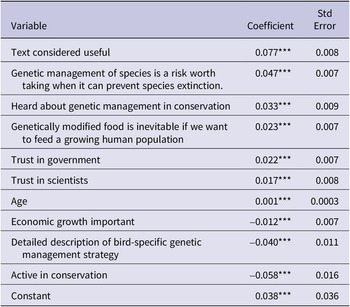
Variables explaining a significant proportion of the variation in a stepwise linear regression model, in which the level of acceptance (coded 1 to 7 with 1 = no acceptance, 7 = strong acceptance) was calculated as a compound variable for all birds together using factor analysis
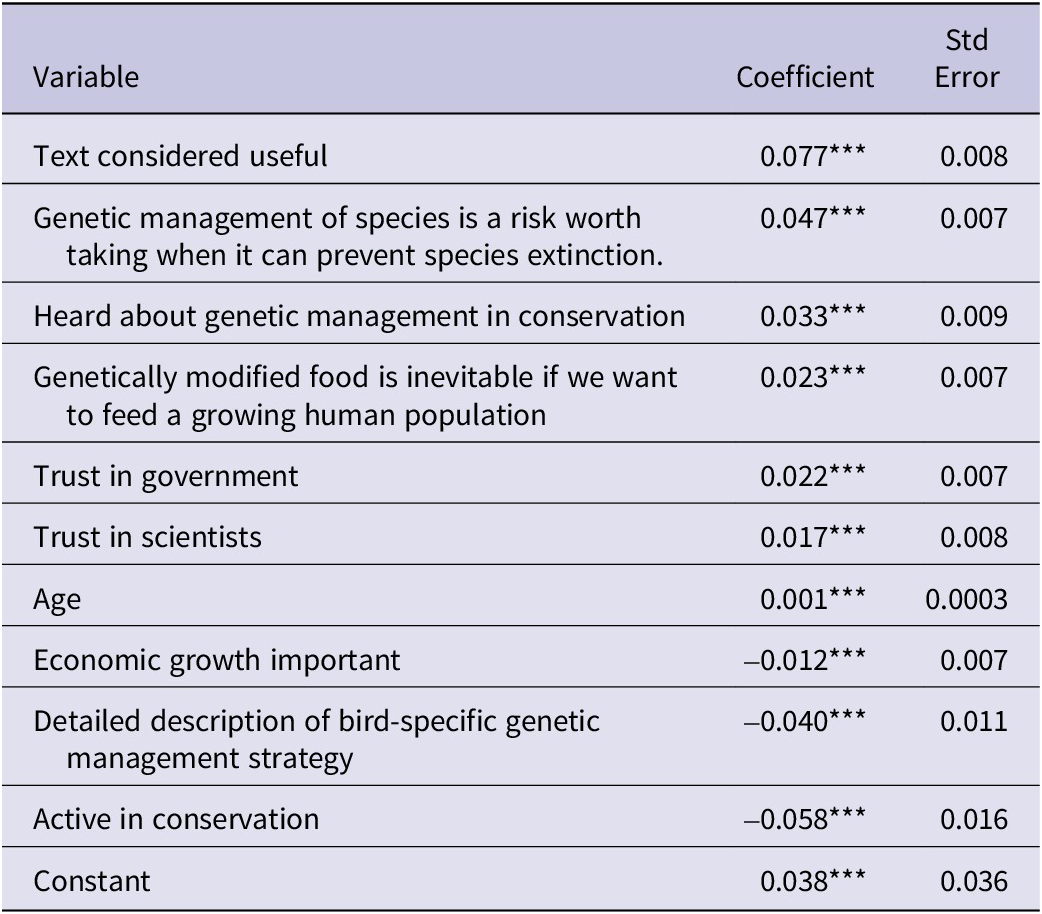
Table 3. Long description
The table consists of three columns: Variable, Coefficient, and Std Error.
* Text considered useful: Coefficient 0.077***, Std Error 0.008.
* Genetic management of species is a risk worth taking when it can prevent species extinction: Coefficient 0.047***, Std Error 0.007.
* Heard about genetic management in conservation: Coefficient 0.033***, Std Error 0.009.
* Genetically modified food is inevitable if we want to feed a growing human population: Coefficient 0.023***, Std Error 0.007.
* Trust in government: Coefficient 0.022***, Std Error 0.007.
* Trust in scientists: Coefficient 0.017***, Std Error 0.008.
* Age: Coefficient 0.001***, Std Error 0.0003.
* Economic growth important: Coefficient minus 0.012***, Std Error 0.007.
* Detailed description of bird-specific genetic management strategy: Coefficient minus 0.040***, Std Error 0.011.
* Active in conservation: Coefficient minus 0.058***, Std Error 0.016.
* Constant: Coefficient 0.038***, Std Error 0.036.
Footnote: *** P < 0.01. R-squared = 0.13.
***P < 0.01; R 2 = 0.13
Nine factors explained a significant amount of variation in the stepwise linear regression model with this newly created factor as the dependent variable (Table 3). The level of acceptance of genetic management was negatively associated with the amount of bird-specific detail about genetic management, belief in economic growth and engagement in conservation activities. Acceptance was positively associated with age, knowledge about the approach, trust in scientists, trust in Government, risk tolerance, and rating the text as useful. The length and information provided in the introduction text had no significant impact in this overall model. This was also reflected in the bird-specific models (Table 2), showing that for two birds (honeyeater and bristlebird) the nature of the introductory text had no significant impact while it did have mixed impacts for the other four birds.
Acceptance across different groups of respondents
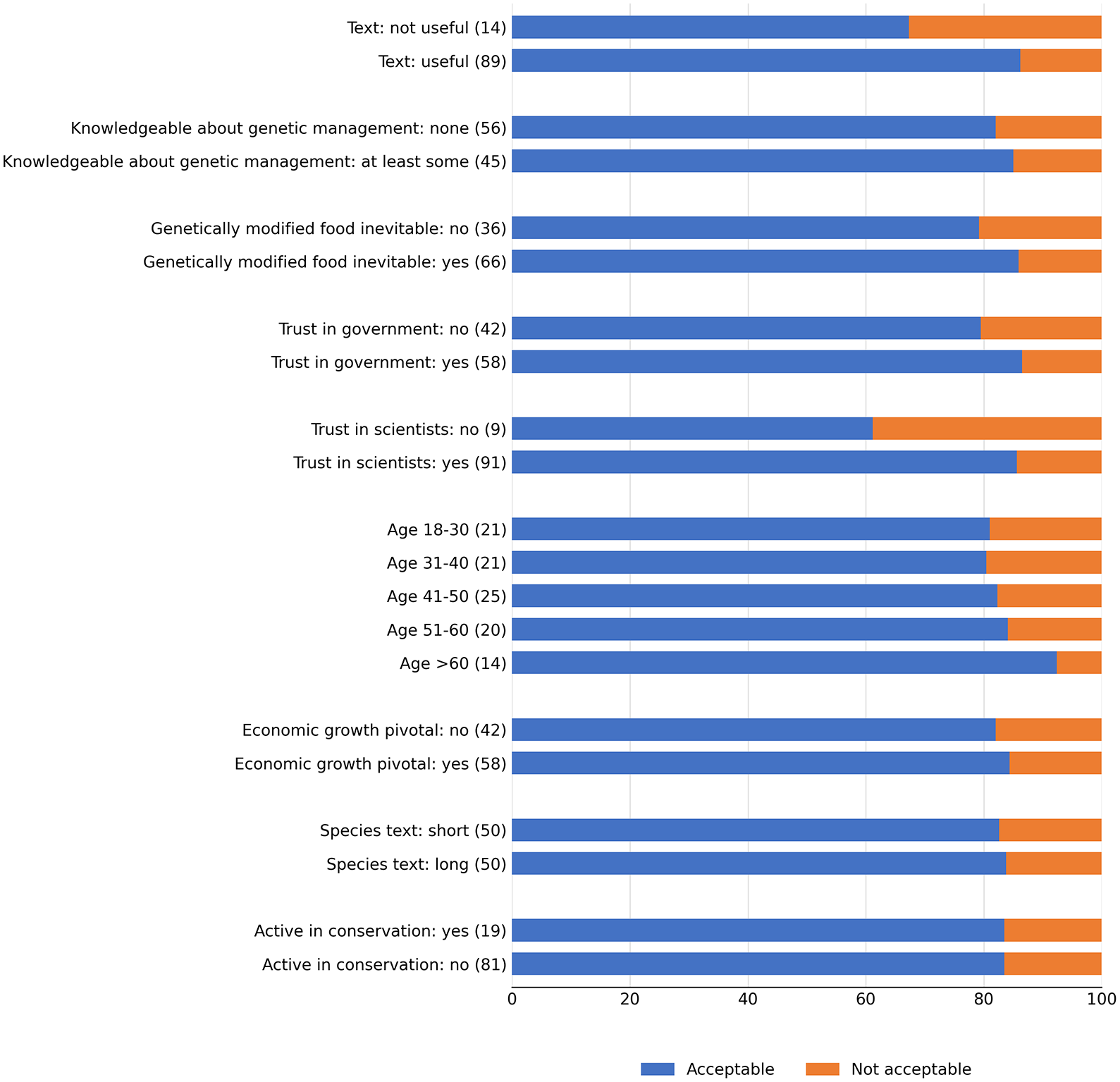
Notwithstanding significant effects, for each of the significant drivers the overwhelming majority of respondents considered “Genetic management of species is a risk worth taking when it can prevent species extinction” to be acceptable to some degree (Figure 5). Only two groups of respondents were below 79% acceptance – those who did not trust scientists (3.6% of respondents, 62% acceptance) and those who did not find the information useful (4.5% of respondents, 68% acceptance). There was substantial overlap in the two groups: 3.1% of respondents neither trusted scientists nor found the information useful.
Acceptance of the proposition “Genetic management of species is a risk worth taking when it can prevent species extinction” for each of the significant drivers of stepwise linear regression model (in percentage of respondents; n=2586). Figures in brackets are the percentage of respondents in each group (n=2,586).
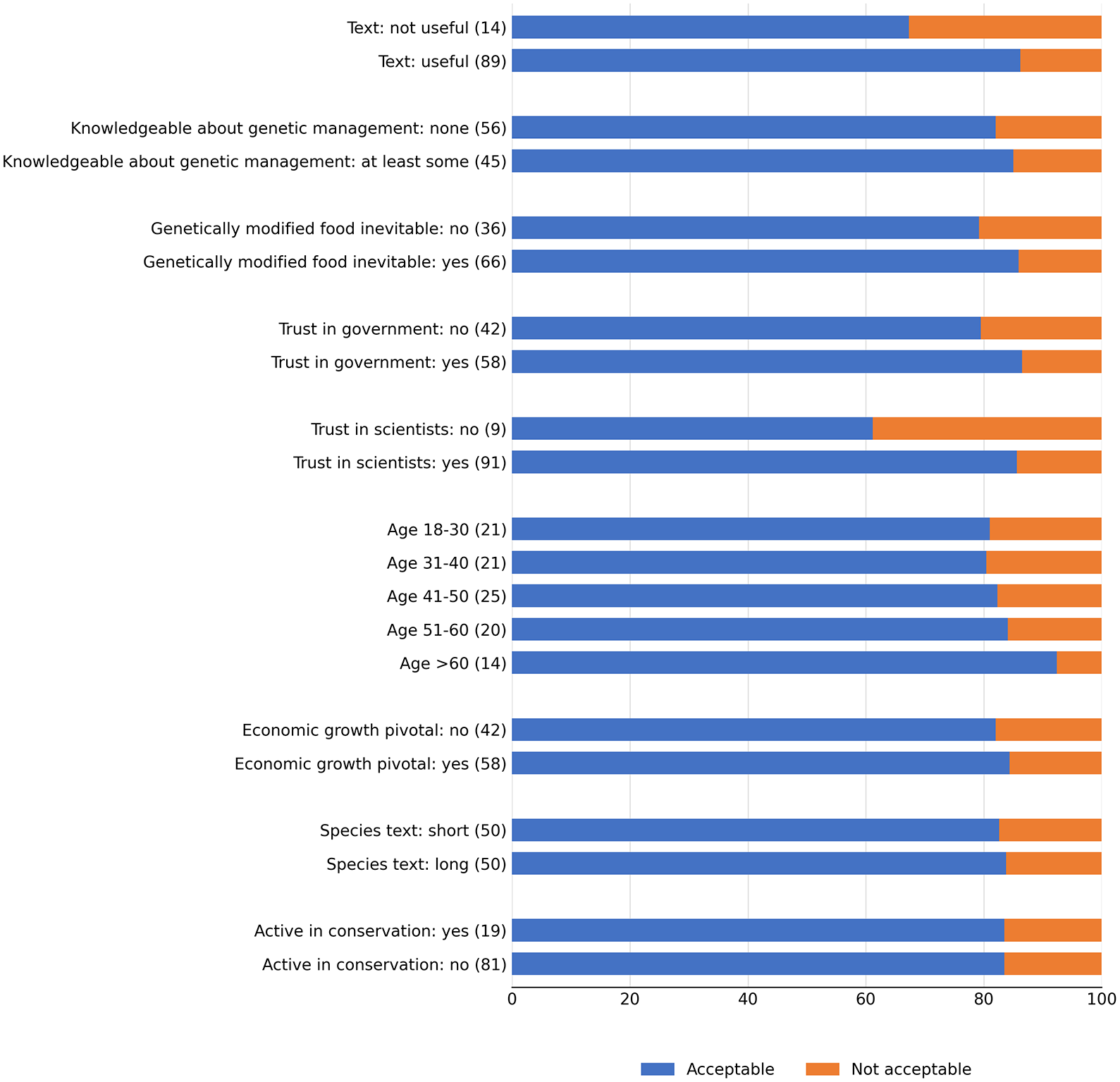
Figure 5. Long description
The chart uses a horizontal axis from 0 to 100 percent. Blue represents Acceptable and orange represents Not acceptable.
* Text: not useful (14) is approximately 68 percent acceptable; useful (89) is approximately 86 percent acceptable.
* Knowledgeable about genetic management: none (56) is approximately 82 percent acceptable; at least some (45) is approximately 85 percent acceptable.
* Genetically modified food inevitable: no (36) is approximately 79 percent acceptable; yes (66) is approximately 86 percent acceptable.
* Trust in government: no (42) is approximately 79 percent acceptable; yes (58) is approximately 86 percent acceptable.
* Trust in scientists: no (9) is approximately 61 percent acceptable; yes (91) is approximately 86 percent acceptable.
* Age 18-30 (21) is 81 percent acceptable; 31-40 (21) is 80 percent acceptable; 41-50 (25) is 82 percent acceptable; 51-60 (20) is 84 percent acceptable; greater than 60 (14) is 92 percent acceptable.
* Economic growth pivotal: no (42) is 82 percent acceptable; yes (58) is 84 percent acceptable.
* Species text: short (50) is 82 percent acceptable; long (50) is 84 percent acceptable.
* Active in conservation: yes (19) is 83 percent acceptable; no (81) is 83 percent acceptable.
Discussion
Public acceptance for genetic management as a conservation strategy
The finding that the majority of respondents consider genetic management of threatened birds favourably, considering that the risks of extinction outweigh any risks they perceive from genetic management, is an important affirmation of public support for genetic management of small populations for conservation purposes. Even among groups for whom support was significantly less than the average acceptance of genetic management (Figure 5), such as among those who mistrust scientists to make decisions and those who did not find the information provided for each scenario useful (<5% respondents), at least 60% considered “genetic management of species a risk worth taking when it can prevent species extinction” to be acceptable. Overall, 84% of respondents accepted this statement.
Such high levels of acceptance contrast with some research that implies greater concern than we found here (Webber et al. Reference Webber, Raghu and Edwards2015; Kohl et al. Reference Kohl, Brossard, Scheufele and Xenos2019; Zander et al. Reference Zander, St-Laurent, Hogg, Sunnucks, Woinarski and Legge2021). These high levels of acceptance can be explained in two ways. First, in this study, genetic management was set in the context of trying to avoid extinction. Studies that show less support for genetic management made less direct connections with this key concern: e.g. they focussed on biocontrol (Webber et al. Reference Webber, Raghu and Edwards2015), conservation generally (Kohl et al. Reference Kohl, Brossard, Scheufele and Xenos2019), or sought to compare different management options (Zander et al. Reference Zander, St-Laurent, Hogg, Sunnucks, Woinarski and Legge2021). By analogy, with the fact that gene editing in humans attracts greater support for more-severe medical conditions (Watson Reference Watson2021), respondents in the present study might have been relatively accepting of genetic management owing to the framing that made explicit the link to the most severe biodiversity outcome – extinction.
Second, there has been almost no public debate on the issue of genetics and threatened species that may have influenced community views on the topic. The scientific literature is generally supportive of intensive genetic management of taxa with small populations, identifying inbreeding as a major, and often underappreciated, threat (e.g. Ralls et al. Reference Ralls, Ballou, Dudash, Eldridge, Fenster and Lacy2018; Frankham et al. Reference Frankham, Ballou, Ralls, Eldridge, Dudash and Fenster2017; Hogg et al. 2021). Also, while there has been a long and concerted campaign to control genetic engineering of food that has led to strict controls around the world (Mallinson et al. Reference Mallinson, Russell, Cameron, Ton, Horton and Barker2018), a substantial proportion of the respondents in the current study (64%) considered “genetically modified food inevitable if we want to feed a growing human population”. Such attitudes are in contrast with the results of older studies that suggested that Australia resembles Europe in its negative attitudes to genetic engineering (Frewer et al. Reference Frewer, van der Lans, Fischer, Reinders, Menozzi and Zhang2013). In one study, genetic transfer between animal species was rejected by 84% of German respondents (Hampel et al. Reference Hampel, Pfenning and Peters2000), and activist groups have portrayed the genetic manipulation of animals as ‘going against nature’ (Pivetti Reference Pivetti2007).
The association between respondents’ opinions and level of information provided
While 86% considered the introductory text to have been useful, regardless of its length, the hypothesis that more information would increase acceptance was not supported, in accord with studies that reject the traditional information deficit model of science education (Simis et al. Reference Simis, Madden, Cacciatore and Yeo2016). While more respondents provided with detailed information (presented in a neutral, informative manner rather than attempting to be persuasive to either acceptance or rejection) had opinions than those provided with short synopses, the direction of the difference was not predictable. This result suggests that most respondents had enough basic understanding of conservation, genetics and threatened species to have the basis of a legitimate opinion, and the extra information modified an existing foundation of knowledge and opinion about genetic management even though over half (56%) had never heard of its application to conservation. While we could have probed levels of pre-existing knowledge in more detail, to do so would have extended an already long questionnaire and potentially distracted the focus from genetic management to the details of knowledge held by a minority of respondents, a respondent characteristic that we were in any case trying to manipulate experimentally.
For the most radical interventions, introducing new genes into Lord Howe Woodhens and hybridising Orange-bellied and Blue-winged Parrots, acceptance was higher among respondents to whom more information was provided. It was only in taxa where genetic management might have seemed relatively insignificant, such as mixing populations or subspecies, that a smaller proportion of those provided with extra information were less likely to accept interventions, perhaps because what seemed trivial with little information was given greater emphasis when more information was provided. Had we been trying to shift opinions, then extra information may have been expressed in a way that nudged opinion, as found with a recent exercise that increased acceptance of genetically modified foods (McPhetres et al. Reference McPhetres, Rutjens, Weinstein and Brisson2019). Instead, we aimed to provide balanced descriptive accounts of risks and benefits of genetic management of threatened species to obtain, as far as feasible, a value-free assessment of societal views.
Our survey compared groups asked the same questions rather than engaged repeatedly with the same individuals. In contrast, McPhetres et al. (Reference McPhetres, Rutjens, Weinstein and Brisson2019) measured change after participants had undertaken three-week online learning modules. Similarly, Hagerman et al. (Reference Hagerman, Satterfield, Nawaz, Peterson St‐Laurent, Kozak and Gregory2021) found that interventions were more acceptable to 22% of their participants after a two-step engagement process with the same individuals. However, for those advocating for increased genetic management of threatened species in Australia, such investment in persuasion does not appear justified given the existing widespread acceptance of the idea. That acceptance was lower when the detailed rather than the general information was provided, and varied among species, suggests that respondents provided with the detail were engaging with the descriptions of how particular birds would be managed rather than the general principles behind genetic management, but the proportion of respondents doing so was small. In our study, we did not accept the hypothesis (H2) that outcome framing would increase acceptance. Other studies have found that outcome framing failed to produce a significant influence on public acceptance altogether (Wang et al. Reference Wang, Gong, Wang, Li and Sun2021).
The third hypothesis, that provision of more information would result in a greater proportion of the population with an opinion about genetic management, both for and against, was supported. However, the average difference in the percentage with an opinion about genetic management between those provided with detailed information and those with a shorter version (3.5%) was much lower than found by Hagerman et al. (Reference Hagerman, Satterfield, Nawaz, Peterson St‐Laurent, Kozak and Gregory2021) who reported that uncertainty about conservation interventions to adapt to climate change fell from 41% to 28% after people had completed an informative survey, but this was partly because, in this survey, a minimum of 87% (for the woodhen) had an opinion regardless of the amount of information provided. Other variables that increased the likelihood of having an opinion included knowledge about the birds, connecting to nature as a bird-watcher and appreciating that genetic management could be a possible conservation approach. Our findings are in contrast to many previous studies have shown a positive relationship between knowledge or familiarity and acceptance (e.g. Ashworth et al. Reference Ashworth, Sun, Ferguson, Witt and She2019; Lutzke and Arvai Reference Lutzke and Árvai2021; Busch et al. Reference Busch, Ryan, von Keyserlingk and Weary2022).
The relationship between trust in information-providers and the acceptance of genetic management
Many studies have demonstrated how trust in decision-makers is critical to the public acceptance of innovative technologies and large developments (e.g.Enevoldsen and Sovacool Reference Enevoldsen and Sovacool2016; Ford and Williams Reference Ford and Williams2016; Klaus et al. Reference Klaus, Ernst and Oswald2020; Gregory et al. Reference Gregory, Kozak, St-Laurent, Nawaz, Satterfield and Hagerman2021). However, the growing knowledge of the public, their affluence and their access to social media make it increasingly easy to influence opinion and trust (Stehr Reference Stehr2015), where once there would have been deference to scientific expertise (Brossard and Nisbet Reference Brossard and Nisbet2007). For some issues, the dominance of experts in debate has been actively rejected by the public, sometimes to their own disbenefit (Fuller Reference Fuller2017). In this study, the trust in conservation decision-makers had a straightforward positive association with acceptance levels, allowing us to accept the fourth hypothesis. Trust of scientists was particularly high (91% always or usually trusted them with conservation management).
However, that leads to a conundrum because, just as we found here, those engaged in conservation actions tend to be more likely to oppose novel conservation interventions (Hagerman et al. 2010; Garnett et al. Reference Garnett, Zander, Hagerman, Satterfield and Meyerhoff2018). Although opinion is shifting rapidly as the urgency of interventions in the face of climate change becomes more apparent (Colloff et al. Reference Colloff, Lavorel, van Kerkhoff, Wyborn, Fazey and Gorddard2017), many scientists considering the risks of genetic management have not also been evaluating the risk from a failure to act (Liddell et al. Reference Liddell, Sunnucks and Cook2021). The trust placed in scientists implies substantial responsibility to deliver appropriate management, but there appears to be a tension between the need to respond to the views of the community, especially for government conservation scientists in democratic societies, and personal views on the way nature ‘ought to be’ (Rose Reference Rose2018). Currently in Australia there is strong support for genetic management of threatened species across all groups suggesting that the public are ready for strong interventions if scientists deem it necessary. The strong opinions expressed about whether it is scientists who should decide which threatened species are saved from extinction suggests that the public is not apathetic about the performance of managers.
Interspecies variation, attitudes to risk, and age
Overall, acceptance levels for genetic management were not only high but varied little among the different bird species. This support extended even to approaches that involved the most invasive of procedures, such as transferring genes artificially into Lord Howe Woodhen from an unrelated species and interbreeding between Orange-bellied and Blue-winged Parrots. The scenario with the woodhen, while hypothetical, may be necessary given loss of historical genetic variability (Major et al. Reference Major, Ewart, Portelli, King, Tsang and O’Dwyer2021); the latter is being given serious consideration as part of Orange-bellied Parrot recovery (Hogg et al. 2021). Traditionally, hybridisation between full species has been considered a radical option for conservation and is running ahead of legal processes that might protect hybrids in the same way that they are designed to protect species (Chan et al. Reference Chan, Hoffmann and van Oppen2019). However, concepts are being developed that will incorporate conservation hybridisation within the broader framework of conservation management (Chan et al. Reference Chan, Hoffmann and van Oppen2019; Quilodrán et al. Reference Quilodrán, Montoya-Burgos and Currat2020; Ottenburghs Reference Ottenburghs2021).
Other important determinants of social acceptance, in addition to trust in experts, were attitudes to risk and, to a lesser extent, the respondent’s age. The positive association between risk acceptance and adoption of novel technologies is heavily influenced by uncertainty (Smith and Ulu Reference Smith and Ulu2017; Specht et al. 2019; Chavas and Nauges Reference Chavas and Nauges2020). In the case of highly threatened species, hesitancy because of uncertainty is likely to lead to extinction so there may be greater acceptance of novel interventions despite uncertainty about the consequences than would have been the case with less threatened species (Ralls et al. Reference Ralls, Ballou, Dudash, Eldridge, Fenster and Lacy2018; Frankham et al. Reference Frankham, Ballou, Ralls, Eldridge, Dudash and Fenster2017). However, the respondents as a group were generally accepting of risk, with 64% accepting the inevitability of genetic engineering to feed the growing human population and 74% considering that technological solutions may be required to manage climate change.
Age was more complicated in that, while acceptance was higher in older people (see Mankad et al. Reference Mankad, Zhang, Carter and Curnock2022), so too was disapproval, meaning that older people tended to be more opinionated about genetic management generally, even though respondents younger than the median were three times more likely to have heard of genetic management for conservation than those in the older age group. While depth of opinion has been linked to gender, no such correlate is expected with age (Volkova and Bachrach Reference Volkova and Bachrach2015). However, as with other sources of variation in acceptance, there was strong acceptance of genetic management in principle among both age cohorts (younger 82%, older 87%).
Implications for policy and practice relating to genetic management for conservation
Widespread acceptance of even quite invasive forms of genetic management to prevent extinction of highly threatened birds was surprising and suggests a level of sophistication in the background knowledge of respondents that may not have been present several decades ago. The widespread acceptance of genetic engineering of foods and climate technology suggests a shift in public opinion, a shift that is also apparent among conservation practitioners (Colloff et al. Reference Colloff, Lavorel, van Kerkhoff, Wyborn, Fazey and Gorddard2017).
It is a fine line to get the right balance in the amount of information provided to gauge an opinion about a potentially controversial topic. While it is possible to shift opinion, if that is desired, with appropriately framed education (McPhetres et al. Reference McPhetres, Rutjens, Weinstein and Brisson2019), exploration of a topic to explore opinions with neutral framing rather than to change views requires the provision of just enough information that people are able to form an opinion based on what is likely to be an average level of background knowledge in the community, but not so much that respondents are overwhelmed. With our survey, there was a high level of satisfaction with the amount of information provided associated with only a small difference to the percentage with an opinion. The extent of the shift suggests that even the small amount of information provided was largely adequate to explore the issues raised here, but that more divisive issues may benefit from longer, detailed text.
The extent to which the views of people with limited knowledge of an issue should be considered in development of policy is a separate but related debate (Ahlstrom-Vij Reference Ahlstrom-Vij2023; López-Guerra Reference López-Guerra2014). Given we are discussing social acceptance not decision-making power, the discussion is to some extent moot – the general public will form opinions, and accept new ideas, based on what they know, however little knowledge that may be. Experience in other fields suggests that, overall, the public will often have greater risk tolerance than experts (Fuller Reference Fuller2017) and often “think they know more than they really do” unless they can be convinced their knowledge is inadequate (Meyers et al. Reference Meyers, Turpin, Białek, Fugelsang and Koehler2020). In the current research, the stated level of knowledge of the issues surrounding genetic management was moderately high given the technical knowledge needed to understand the risks, which may reflect a higher level of understanding of the issues than was actually the case. However, the shift in opinion with more information and the acceptance of expert opinion suggests that policy can still be adjusted to reflect expert perceptions of risk.
Conclusions
This survey suggests that, in Australia, there is currently a strong social acceptance of intensive genetic management of threatened species with very small populations. What might have been considered radical, or indeed impossible, a decade ago has become mainstream in public consciousness. Our results confirm research in North America also suggesting that the public is willing to tolerate risk where extinction is imminent. We showed that information provision is likely to influence a small proportion of community members but that they can form robust opinions based on existing knowledge of general principles; information was appreciated but did not need to be detailed. While fewer than half of the respondents knew about genetic management for conservation or about the specific birds in the case studies, they nevertheless considered that they had sufficient background knowledge to state an opinion, an opinion that was usually positive based on the information provided.
Supplementary material
The supplementary material for this article can be found at http://doi.org/10.1017/S0959270926100604.
Acknowledgements
This research was funded by the Australian Government’s National Environmental Science Program (NESP) Threatened Species Recovery Hub.




 Open access

