A large and frequently meta-analyzed literature documents a consistent association between low resting pulse rate and risk for externalizing disorder, particularly antisocial personality, criminality, and substance abuse (Armstrong, Keller, Franklin, & Macmillan, Reference Armstrong, Keller, Franklin and Macmillan2009; Baker et al., Reference Baker, Tuvblad, Reynolds, Zheng, Lozano and Raine2009; Latvala, Kuja-Halkola, Almqvist, Larsson, & Lichtenstein, Reference Latvala, Kuja-Halkola, Almqvist, Larsson and Lichtenstein2015; Ortiz & Raine, Reference Ortiz and Raine2004; Portnoy & Farrington, Reference Portnoy and Farrington2015; Raine, Reference Raine2002; Raine, Venables, & Mednick, Reference Raine, Venables and Mednick1997). While less well studied, several reports find an association between increased resting pulse and internalizing disorders such as major depression (MD) and anxiety disorders (AD; Cicek et al., Reference Cicek, Durakoglugil, Kocaman, Guveli, Cetin, Erdogan and Canga2012; Kemp et al., Reference Kemp, Brunoni, Santos, Nunes, Dantas, de Carvalho and Lotufo2014a; Kemp, Quintana, Quinn, Hopkinson, & Harris, Reference Kemp, Quintana, Quinn, Hopkinson and Harris2014b; Schiweck, Piette, Berckmans, Claes, & Vrieze, Reference Schiweck, Piette, Berckmans, Claes and Vrieze2019). A number of hypotheses have been proposed to explain these associations (e.g. Kavish et al., Reference Kavish, Vaughn, Cho, Barth, Boutwell, Vaughn and Martinez2017; Raine, Reference Raine2002). However, we are unaware of empirical data that address a fundamental question in this literature needed to inform potential explanations: is low and high resting pulse a direct cause of increased risk for, respectively, externalizing and internalizing disorders, or are differences in pulse an index of physiological and/or psychological traits that in turn impact causally both on pulse and on risk for psychiatric disorder? For example, in a recent detailed meta-analysis of the association between low pulse and risk for antisocial behavior, Portnoy and Farrington, noting the lack of effect of confounding variables in their analyses, write: ‘This allows for the possibility that resting heart rate is a possible causal risk factor for antisocial behavior (Portnoy & Farrington, Reference Portnoy and Farrington2015, p. 42).’ Since resting pulse rate is substantially correlated in relatives due largely or entirely to genetic effects (Snieder, Harshfield, & Treiber, Reference Snieder, Harshfield and Treiber2003), a prospective co-relative design should help clarify the nature of the causal association between pulse and risk for psychiatric disorders.
In this report, we perform such a study using a nation-wide sample of Swedish males where previous analyses (Latvala et al., Reference Latvala, Kuja-Halkola, Ruck, D'Onofrio, Jernberg, Almqvist and Lichtenstein2016) support the observed associations between low and high resting pulse and, respectively, externalizing and internalizing disorders. Resting pulse was measured during a compulsory military conscript examination typically at age 18 after which we were able to follow these individuals for a mean (s.d.) of 29 years (8). We then examine the pulse rates, controlling for the level of physical fitness, in pairs of male relatives of varying degrees of genetic resemblance where one subsequently developed an externalizing or internalizing disorder while the other did not.
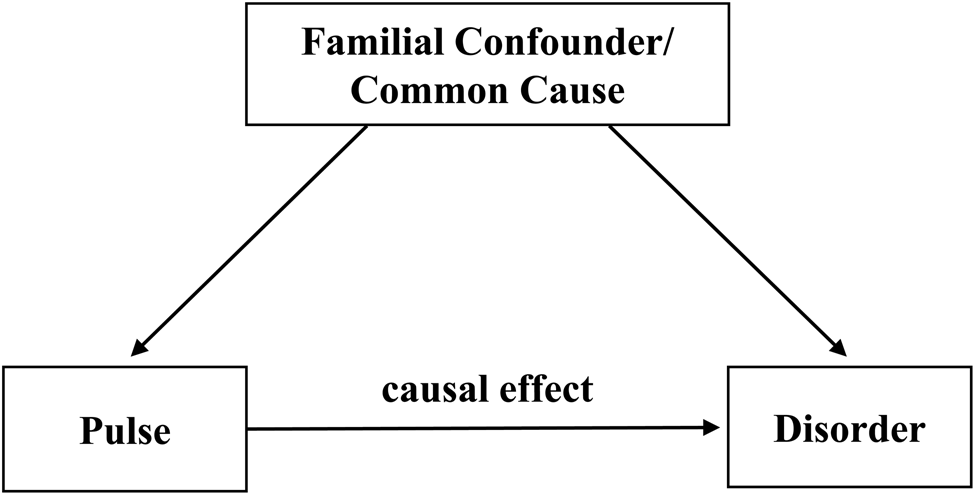
The logic of our method is outlined in Fig. 1. We seek to determine the degree to which the association between pulse and a range of psychiatric disorders is a result of a direct causal relationship v. the result of what epidemiologists would term a familial confounder (and behavioral scientists a ‘common cause’) which directly impacts on both pulse and disorder risk. As outlined in detail elsewhere (Kendler et al., Reference Kendler, Neale, MacLean, Heath, Eaves and Kessler1993; Ohlsson & Kendler, Reference Ohlsson and Kendler2019), our method determines how increasing control for potential familial confounders impacts on the pulse–disorder association. If pulse and disorder are related because they are both influenced by a common set of familial factors, then their association should get progressively weaker as we examine pairs of relatives of increasing genetic and environmental affinity. However, if the pulse–disorder association is entirely causal, then the magnitude of the observed association should be constant across all samples.
A theoretical model for the co-relative design utilized in this study. The goal of this design is to understand the nature of the association between pulse rate and risk for a range of psychiatric disorders by decomposing the pulse–disorder association into two components. The first is that due to a direct causal pathway from pulse to disorder. The second is a result of paths from a set of factors which can alternatively be called familial confounders or familial common causes which impact in on both pulse and risk for disorder. These two paths predict different effects of interventions on pulse. In the direct causal path, interventions on pulse will directly impact on the risk for the disease. In the confounder/common cause paths, interventions on pulse will have no effect on disease risk.

Methods
We linked nationwide Swedish registers via the unique 10-digit identification number assigned at birth or immigration to all Swedish residents. The identification number was replaced by a serial number to ensure anonymity. The following sources were used to create our dataset: Total Population Register, containing information about year of birth, sex, family, and marital status; Multi-Generation Register, linking individuals born after 1932 to their parents; the Hospital Discharge Register, containing hospitalizations for Swedish inhabitants from 1964 to 2015; Prescribed Drug Register, containing all prescriptions in Sweden picked up by patients from 2005 to 2015; Outpatient Care Register, containing information from nearly all outpatient clinics from 2001 to 2015; regional Primary Health Care Registers data from Blekinge (2009–2016), Dalarna (2005–2013), Värmland (2005–2015), Kalmar Län (2007–2016), Sörmland (1992–2017), Uppsala Län (2005–2015), Västernorrland (2008–2015), Norrbotten Län (2001–2014), Gävleborg (2010–2017), Gotland (2011–2018), Halland (2007–2014), Jönköpings Län (2008–2014), Kronoberg (2006–2016), Skåne (1989–2018), Västerbotten (1992–2018), Östergötland (1990–2014), Stockholms Län (2003–2016), and Västra Götaland (2000–2013). The time periods vary due to the regions different timing of digitalizing patient records. First cousins, full- and half-siblings where identified using the information on biological parents from the Multi-generation Register. The Crime Register included national complete data on all convictions in lower court from 1973 to 2015; Swedish Suspicion Register included national data on individuals strongly suspected of crime from 1998 to 2015; the Mortality Register with dates and causes of death from 1952 until 2016, the Conscript Register, with assessments from 1969; and the Twin Register, with information on zygosity based on questionnaire data validated by DNA testing (Lichtenstein et al., Reference Lichtenstein, Sullivan, Cnattingius, Gatz, Johansson, Carlstrom and Pedersen2006). To give time for adequate follow-up for this study, we included men born in Sweden between 1965 and 1980 with an assessment of resting pulse and physical fitness in the Conscription Register.
Measures
We obtained resting pulse and physical fitness from the Conscript Register, with physical fitness defined by maximal workload (W max measured in watts) achieved in an exercise test with a cycle ergometer divided by weight (Latvala et al., Reference Latvala, Kuja-Halkola, Ruck, D'Onofrio, Jernberg, Almqvist and Lichtenstein2016). Criminal behavior (CB) was defined based on convictions in lower court for violent crime, property crime, or white-collar crimes [violent crime was defined as having had one or more of the following criminal convictions (numbers within parentheses are law chapters and paragraphs): (aggravated) assault (3:5, 3:6); illegal threat (4:5); threats and violence against an officer (17:1, 17:2); intimidation (4:7); (Gross) violation of a person's/woman's integrity (4:4a); kidnapping (4:1); illegal confinement or restraint (4:2); (aggravated) robbery (8:5, 8:6); illegal coercion (4:4); (aggravated) arson (13:1, 13:2); murder, manslaughter, or filicide (3:1, 3:2, 3:3); and sexual crimes (excluding prostitution and the buying of sexual services but including child pornography) (6:1–6:10, 6:12, 16:10A)]. The following criminal convictions were considered non-violent: theft of a vehicle (8:1–2, 8:4, 8:7–8); theft (including burglary) (8:1–2, 8:4); vandalism (12:1–4); vandalism causing danger to the public, sabotage, hijacking [13:3–10 (5a–b)]; unlawful entering of a person's home, trespassing (4:6); fraud (9:1–10); embezzlement [10:1–8 (5a–e)]; dishonesty/crime toward a creditor (includes forged book-keeping in companies) (11:1–5); and forgery (14:1–10).
DA and alcohol use disorder (AUD) were based on medical and criminal registrations (DA was identified using codes from ICD-9: 292, 304, and 305C–305I; ICD-10: F11-F16 and F18-F19; in the Suspicion Register by codes 3070, 5010, 5011, and 5012; and in the Crime Register by references to law 1968:64, paragraph 1, point 6 and law 1951:649, paragraph 4, subsection 2 and paragraph 4A, subsection 2). AUD was defined from medical registries by the following ICD codes: ICD-9: 305A, 357F, 571A, 571B, 571C, 571D, 425F, 535D, 291, 303; and ICD-10: E24.4, G31.2, G62.1, G72.1, I42.6, K29.2, K70.0, K70.1, K70.2, K70.3, K70.4, K70.9, K85.2, K86.0, O35.4, F10.1, F10.2, F10.3, F10.4, F10.5, F10.6, F10.7, F10.8, F10.9; and from the Prescribed Drug Register for drugs specifically used in alcohol dependence [Anatomical Therapeutic Chemical (ATC) Classification System N07BB]; disulfiram (N07BB01), acamprosate (N07BB03), naltrexone (N07BB04), or nalmefene (N07BB05). In addition, we identified AUD as convicted for or suspected of at least two alcohol-related crimes according to law 1951:649, paragraph 4 and 4A and law 1994:1009, Chapter 20, paragraph 4 and 5 from the Swedish Crime Register, and code 3005 and 3201 in the Suspicion Register. MD and AD were defined from medical records. (MD was defined from ICD-8; 296,2, 298,0, and 300,4 ICD-9; 296C, 296D, 298A, 300E, and ICD-10; F32 and F33. AD were defined by ICD-9; 300A and ICD-10; F41.)
Statistical analysis
First, we used a structural equation model to estimate how genetic and environmental factors contribute to resting pulse (Neale et al., Reference Neale, Hunter, Pritikin, Zahery, Brick, Kirkpatrick and Boker2016). We included monozygotic and dizygotic twins and full- and half-siblings reared together and born within 2 years of each other. We assumed four sources of variance to resting pulse: additive genetic (A), shared environment (C), shared environment unique to twins (T), and unique environment (E). The model assumes that MZ twins share all their genes, while DZ twins and full-siblings share half, and half-siblings a quarter of their genes identical by descent. Shared environment reflects family and community experiences that render the twins and siblings more similar for the phenotype in question, twin environment the environment unique to twins, and unique environment includes random developmental effects, environmental experiences not shared by siblings, and random error. Analyses were performed using openMx (Neale et al., Reference Neale, Hunter, Pritikin, Zahery, Brick, Kirkpatrick and Boker2016). The models were compared using Akaike's information criterion (AIC; Akaike, Reference Akaike1987).
Second, utilizing Cox regression, we performed a co-relative analysis. For the population and each type of relatives, we estimate the association between resting pulse and CB, DA, AUD, MD and AD within each relative pair. In each analysis, we censored individuals who had an initial registration for the relevant disorder prior to the measurement of their resting pulse at the conscription examination. When each pair is treated as a stratum, we obtain an estimate accounting for all confounding factors shared within that pair. The first step was to construct a model including the population and all relative pairs where the associations were allowed to vary without restrictions between relatives. The HR from this model is referred to as observed. Next, we model the HR as a function of the genetic resemblance between pairs [0 for the general population and +0.125, +0.25, +0.50, and +1.00 for cousins, half-siblings, full-siblings, and monozygotic (MZ) twins, respectively] so that we could obtain more precise estimates also in relative types where data are sparse. The HRs from this latter model are referred to as predicted. Both models were adjusted for physical fitness, and to ease interpretation, we let the HR represent an increase of resting pulse by 10 beats/min. The fit of our genetic model was evaluated by AIC (Akaike, Reference Akaike1987).
Our co-relative analysis assumes that the proportionality assumption is fulfilled, and we evaluated the proportionality assumption in the population sample. We tested whether the HR was modified by the log of follow-up time, both with respect to significance and the change in HR during follow-up. We also observed how censoring after a 10-year follow-up time influenced the estimates.
Results
Structural equation modelling
Before performing our co-relative analyses, we sought to determine the sources of individual differences in resting pulse in our sample. The sample sizes and observed correlations in MZ and DZ twins and reared together full- and maternal half-siblings within 2 years of age of each other are seen in Table 1. The correlation in MZ twins is approximately twice that of DZ twins and siblings which in turn are about twice as high as in half-siblings consistent with expectations if the pulse was largely genetically transmitted in families. However, consistent with a modest twin environment, correlations are slightly higher in DZ than in full-sib pairs. We fitted a full ACTE model and obtained the following estimates (95% CIs): a 2 – 50.2% (38.0–53.0); c 2 – 0% (0, 0), t 2 – 1.6% (0.4–6.8) and e 2 – 48.0% (44.3–52.1) (AIC = 250 284.92). However, when we set the c and t parameters to zero, the fit of the model improved (AIC = 250 281.49) with the following parameter estimates: a 2 – 50.9 (48.6–53.1) and e 2 – 49.1 (46.9–51.4).
Sample size, birth year, mean and tetrachoric correlations for a resting pulse

Co-relative analyses
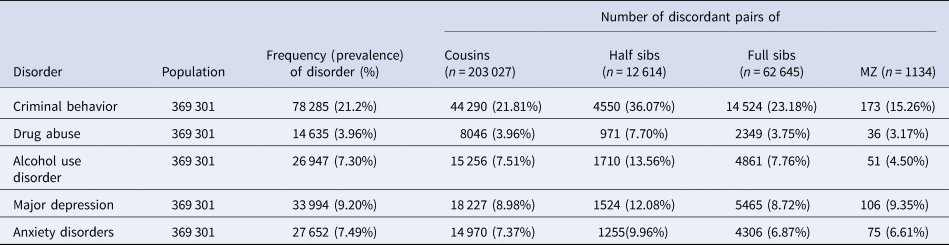
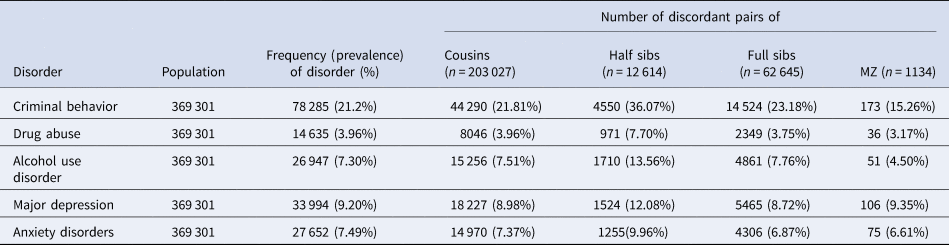
The sample sizes for the co-relative analyses of our three externalizing and two internalizing syndromes are seen in Table 2. Our population cohort contains 369 301 male individuals. CB is by far the most common of our syndromes and drug abuse (DA) the rarest. The differences in the sample size of pairs of relatives discordant for the outcomes are noteworthy. For the rarest of our disorders, we have 8046 discordant cousin pairs and 2349 discordant sib-pairs. However, we have only 971 discordant half-sib and 36 discordant MZ pairs. Thus, the accuracy of our estimated hazard ratios will vary widely across our types of relatives and be particularly poorly known for MZ pairs. The Pearson correlation in our entire sample between resting pulse and level of physical fitness is −0.22.
Sample size, frequency of our externalizing and internalizing disorder, and number of outcome discordant pairs for each disorder
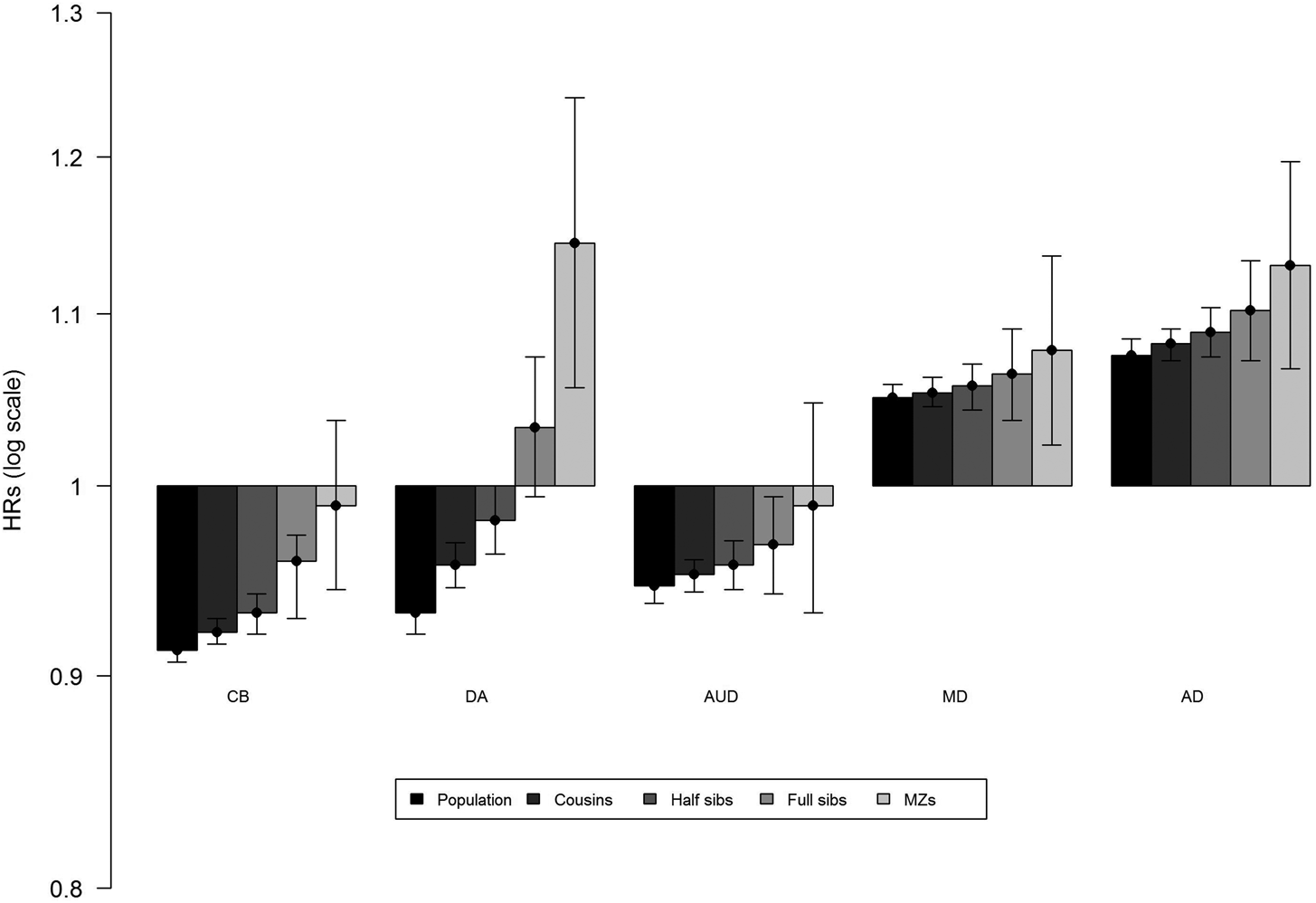
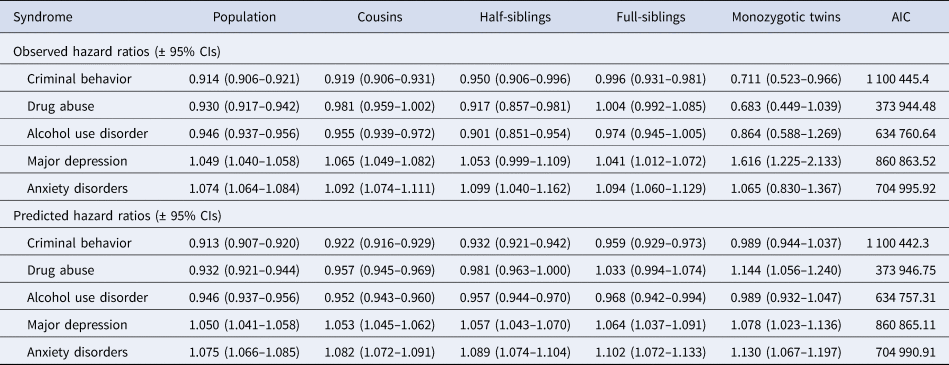
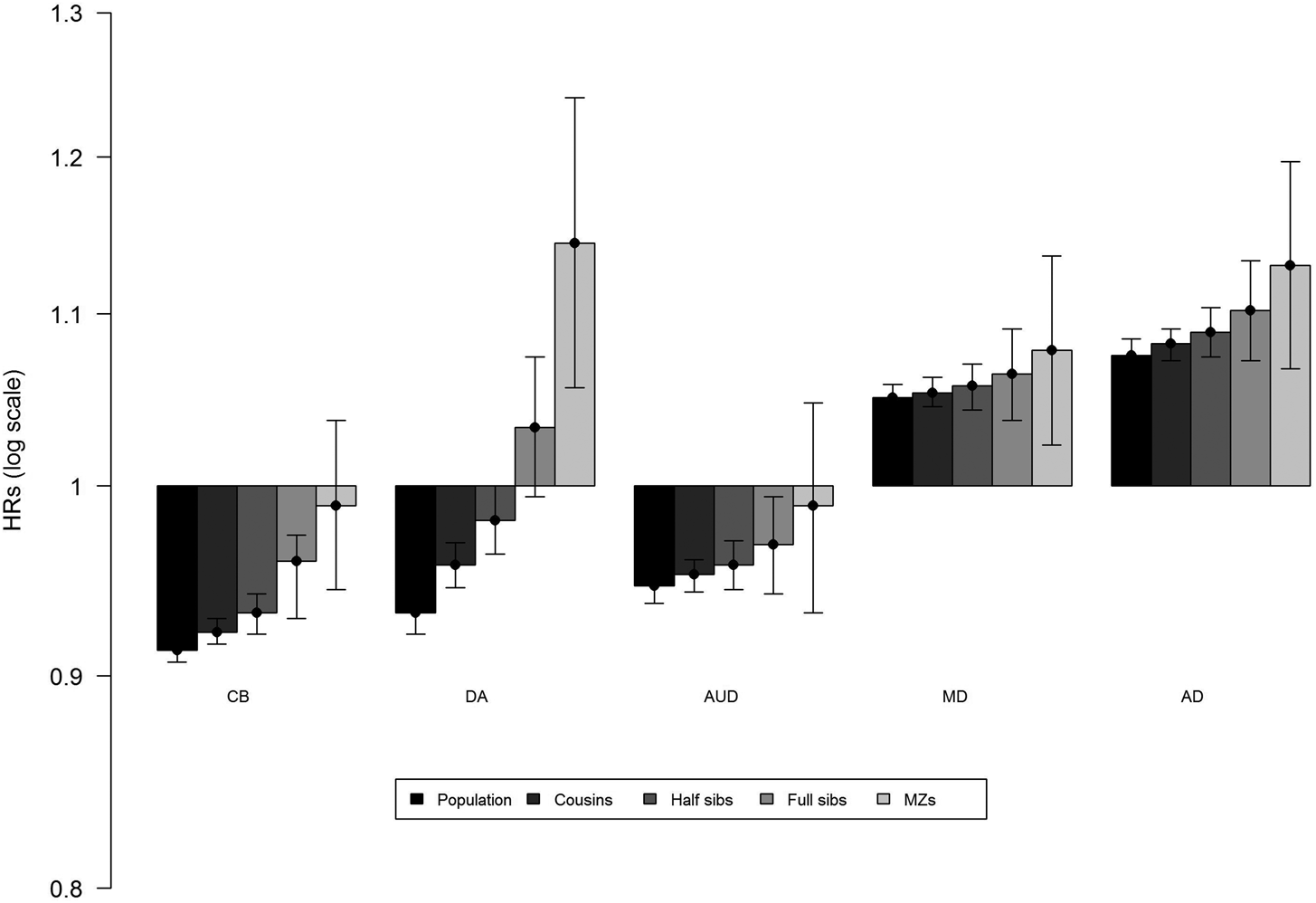
Results of our co-relative analyses are seen in Table 3 where the top half presents the observed results while the bottom half of the table and Fig. 2 present the results predicted under our genetic model. The fit of each model to the data is assessed via AIC (Akaike, Reference Akaike1987). In our entire sample, the mean (s.d.) pulse was 73.0 (12.7).
The predicted hazard ratios between resting pulse and criminal behavior (CB), drug abuse (DA), alcohol use disorder (AUD), major depression (MD), and anxiety disorders (AD) in the general population and in cousins, half-siblings, full siblings, and monozygotic twin pairs discordant for these disorders.
Observed and predicted hazard ratios from Cox models for criminal behavior, drug abuse, alcohol use disorder, major depression, and anxiety disorders from resting pulse adjusted for physical fitness in the general population and in cousins, half-siblings, full-siblings, and monozygotic twin pairs discordant for the disorder
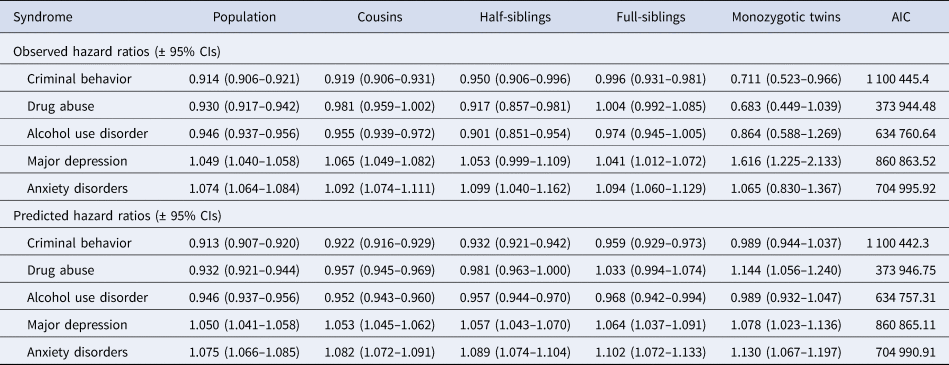
AIC, Akaike's information criterion.
For CB, the observed HR (± CIs) in the population was 0.914 (0.906–0.921), suggesting a moderate protective effect. These results predict that an individual with a pulse rate of 10 beats/min above the mean has a reduction in the risk for CB of 8.6%. The observed HRs increased monotonically from the population estimate to discordant cousins, half-siblings and full-siblings. It then drops substantially in MZ pairs, but the CIs are so wide as to be relatively uninformative. When we fitted our model to these data (bottom half of Table 3), it fit very well (with a lower AIC than with the observed data). Note that the CIs shrank substantially for the HRs from MZ twins and half-siblings (which were inaccurately known due to small samples) and became only modestly tighter for those known relatively accurate due to the large sample (the population, cousins, and sibling-pairs). Most noteworthy, the estimated OR in MZ twin pairs is now not significantly different from unity. The overall results for pulse and CB suggest complete familial confounding, in that some set of familial common factors entirely account for the pulse–CB association. In relatives matched entirely for their genetic and family background, pulse no longer significantly predicts the risk for CB.
For DA, the rarest of our syndromes, the observed HR is 0.930 (0.917–0.942) suggesting a moderate protective effect of a high pulse similar to that seen for CB. However, compared to CB, the estimates for DA across relative groups are more variable. Nevertheless, examining only the three large sample groups – the general population, cousins, and full-siblings – we see a pattern similar to that of CB with the HR increasing monotonically in more closely related pairs. While the estimates from the half-siblings and MZ twins appear discrepant, the predicted results are within the CIs. The predicted results do not fit quite as well as the observed one and they show the expected monotonic trend but with one surprising result. In discordant MZ twin pairs, the estimated HR flips to positive suggesting that a high pulse rate increases the risk. We comment on the plausibility of that finding below.
For AUD, the observed HR (± CIs) in the population was 0.946 (0.937–0.956), suggesting that high pulse has a modest protective effect. Like DA, the results are clear and monotonic in the general population, cousin, and sibling groups, but bounce around quite a bit in the much smaller half-sibling and MZ twin pairs. The predicted results fit better than those observed and produce a pattern very similar to that seen for CB with an estimated HR in discordant MZ pairs of 0.989 (0.932–1.047), consistent with that expected given that the pulse–AUD association in the general population results entirely from familial confounding (aka from a set of familial common factors).
Opposite to what we saw with the externalizing syndromes, the observed HR for MD in the population was 1.049 (1.040–1.058), meaning that a high pulse rate is associated with an increased risk for an MD diagnosis. The pattern of results in the relative pairs is also quite different from that seen with CB, DA, and AUD. Instead of the HRs getting close to unity with the increasing genetic relationship, in cousins, and half- and full-siblings, the HRs change little, all remaining around 1.05. Anomalously, we see a large jump upward in the HR in MZ pairs, but this is known very imprecisely. The predicted model fits slightly worse than the observed model, probably largely due to the high MZ twin HR. The model predicts a slight increase in the HR with increasing genetic resemblance consistent with the hypothesis that all of the pulse–MD association in the population is causal. We can evaluate statistically the possibility of inverse genetic confounding by examining whether there is an interaction between the effect of pulse on MD risk and the samples of increasing genetic affinity. For MD that interaction is not significant (p = 0.34).
Finally, the overall results with ADs were similar to those found for MD although the population association with a high pulse was stronger in the predisposing direction: 1.074 (1.064–1.084). The observed HRs in relative pairs (aside from those of the MZ pairs) were relatively stable at HRs of around 1.09. The prediction model fitted the data very well and like MD was most consistent with a truly causal effect of high pulse on the risk for ADs. We evaluated the evidence for inverse confounding as we did for MD. No significant interaction was seen (p = 0.11) between the predictive effect of pulse on the risk for ADs and the samples of increasing genetic affinity.
Discussion
Consistent with expectations and the prior literature, we found that resting pulse had a significant inverse relationship with future risk for the externalizing syndromes of CB, DA, and AUD and a significant positive relationship with future risk for two internalizing disorders: MD and ADs. The major focus of our work was to evaluate, using an extended co-relative design, the nature of the causal relationship between resting pulse rate and these externalizing and internalizing disorders. We expected to observe one of the three plausible patterns of results. In evaluating these expectations, we focused on the predicted rather than the observed results as the former capture better the overall pattern in all the available data. In pattern # 1, the association between pulse and these disorders could, within sampling error, be the same in the general population and among pairs of relatives of increasing closeness including especially discordant MZ twin pairs. This pattern would be consistent with the hypothesis that the pulse–disorder relationship was an entirely causal one. In pattern # 2, the pulse–disorder association would decline in strength (i.e. the HR would get nearer to unity) from the general population through relative pairs of increasing closeness, but the association would remain significant, especially in discordant MZ twin pairs. This set of findings would be supportive of the hypothesis that the pulse–disorder association in the general population was partly a result of causal factors and partly a result of familial confounders (aka a ‘common cause’). Pattern # 3 would show that the association between pulse rate and the disorder declines in strength from the general population through relatives of increasing affinity and disappears in MZ twins with an OR which does not differ from unity. That is, within individuals with the same genes and rearing environment, no association is seen between pulse and the risk for the disorder. Such results would provide evidence to support the view that the observed pulse–disorder association is not at all causal but instead results from the influences of familial confounding (or a familial ‘common cause’).
With these three patterns in mind, we review the results from our five syndromes. For two of them – CB and AUD – the findings were unambiguous in suggesting pattern # 3 – and therefore were consistent with the hypothesis of complete familial confounding. Each of these disorders demonstrated significant associations with a resting pulse in the general population. However, as seen clearly in the predicted models (Fig. 2), the association attenuated among relative pairs of increasing closeness and disappeared in discordant MZ twins. This is what would be expected if the association between pulse and CB and AUD results entirely from some common familial cause (aka ‘confounder’) and not from a direct causal effect of pulse on disorder risk.
For MD and AD, results were as predicted by pattern #1. As seen in Fig. 2, the association observed in the general population persisted among relatives of increasingly close genetic relationships suggesting the effect of pulse on the risk of illness was causal and not attenuated even among MZ twin pairs who share all of their genes at birth and their rearing and community environment. While the slope in Fig. 2 appears to grow slightly stronger with increasing control for genetic background, these results were not statistically significant. That is, our results are consistent with the model that postulates an identical HR across all our groups – from the general population through MZ twins – which would be expected if the impact of pulse on the risk for MD and AD was causal.
DA, our rarest disorder, had an unanticipated pattern of findings. From the general population through to full-siblings, the results look like pattern # 3 demonstrating an inverse association between resting pulse and the degree of genetic resemblance. However, in the predicted model, the estimated HRs in MZ pairs significantly exceed unity because the steepness of the linear relationship found up to full-siblings. We are not entirely confident about this finding as it is based upon a linear extrapolation that is at odds with the actual MZ twin estimate. The conservative conclusion is that DA like CB and AUD best fits pattern # 1 – complete familial confounding. We remain uncertain about whether, when familial confounding is fully controlled for, a true-positive causal association is revealed between elevated pulse and DA risk.
Our results strongly suggest that, like CB and AUD, no direct causal relationship exists between low pulse rate and DA. Perhaps, we have also found evidence for inverse confounding – that is, background genetic factors which produce an association opposite to that seen in the population, so when they are controlled for, the observed association can flip in sign.
It is of interest to compare our findings with the prior detailed examination of the relationship between pulse and the risk for a range of psychiatric outcomes in Sweden (Latvala et al., Reference Latvala, Kuja-Halkola, Ruck, D'Onofrio, Jernberg, Almqvist and Lichtenstein2016). Our sample size was considerably smaller as we studied an older cohort so as to increase our follow-up so we could capture more of the risk for later onset disorders like MD. To provide adequate power, we did not study rarer outcomes such as schizophrenia or obsessive–compulsive disorder. Our ascertainment for MD and AD included the primary care registry which contained a substantial proportion of such diagnoses in the Swedish population and was not available to Latvala et al. (Reference Latvala, Kuja-Halkola, Ruck, D'Onofrio, Jernberg, Almqvist and Lichtenstein2016). However, qualitatively, our findings were reassuringly similar, finding a positive association of resting pulse and risk for MD and AD, and a negative association with DA, AUD, and CB.
Our results were in part anticipated by a bivariate twin analysis of pulse and adolescent antisocial behavior (Baker et al., Reference Baker, Tuvblad, Reynolds, Zheng, Lozano and Raine2009). While their findings were not framed in the context of causal inference, Baker et al. reported that in their modeling, the association between pulse and antisocial behavior was entirely explained by genetic effects. This result is in accord with our own findings using a co-sibling model with pulse and CB.
The most important impact of our results is on etiologic theorizing about the nature of the association between pulse and risk for internalizing and externalizing disorders. Following the outlines of the James–Lange theory of emotion (Cannon, Reference Cannon1927), chronic exposure to a high pulse rate could, by interoceptive mechanisms, predispose directly to internalizing and, particularly, AD. Alternatively, the causal process might involve stress-sensitivity, with the vulnerable individual responding to the stress of the physical exam during conscription with an elevated pulse. Similarly, life-long exposure to a low basal pulse rate, and/or absent or small pulse increases to stress, could directly cause reduced emotional reactivity and arousal which could itself result in an increased risk for externalizing disorders (Raine, Reference Raine2002). Our results support the plausibility of the James–Lange theory for internalizing disorders but not externalizing disorders.
For externalizing disorders, our results suggest that the pulse–disorder association is likely a result of one or more fundamental psychobiological traits which here act as common causes (or confounders) in that they are associated both with low pulse and to the psychological substrates for externalizing disorder such as impulsivity, risk taking, and reduced empathy. While our study provides no insights into the possible nature of that trait, it is noteworthy that sensation-seeking has been shown, in three studies, to be meaningfully associated both with resting pulse rate and antisocial behaviors (Hammerton et al., Reference Hammerton, Heron, Mahedy, Maughan, Hickman and Murray2018; Portnoy et al., Reference Portnoy, Raine, Chen, Pardini, Loeber and Jennings2014; Sijtsema et al., Reference Sijtsema, Veenstra, Lindenberg, Van Roon, Verhulst, Ormel and Riese2010).
Our findings also have one more implication for etiological theory building for externalizing disorders. Given that the association between pulse and externalizing disorders disappeared when controlling for familial confounders, this suggests that the true causal effects explaining the pulse–disorder association are themselves familial. Furthermore, our evidence that pulse is transmitted in families entirely by genetic effects points even more specifically to genetically transmitted traits as the underlying causal actors. Of note, several twin studies have found important genetic influences on sensation-seeking (Miles et al., Reference Miles, van den Bree, Gupman, Newlin, Glantz and Pickens2001; Stoel, de Geus, & Boomsma, Reference Stoel, de Geus and Boomsma2006).
Limitations
These results should be interpreted in the context of three potential methodological limitations. First, our analyses apply only to males. Second, our assessments for CB, DA, AUD, MD, and AD were based on medical, criminal, and pharmacy records and are not equivalent to diagnoses based on personal interviews. We are studying individuals whose externalizing or internalizing syndromes were of sufficient severity to cause them to seek medical care and/or have legal problems. It is likely that compared to interview-based community samples, we are studying the more severe end of the continuum of these conditions.
Third, Cox models, which we utilized in our analyses, are based on the assumption that the effect of the predictor is constant across the period of follow-up. Those assumptions were not met in our analyses of CB and DA, which were very well powered to detect even quite small deviations from the assumptions. We, therefore, ran a sensitivity analysis where we censored after 10 years follow-up, where the proportionality assumption was fulfilled. The results changed little, suggesting that we introduced no substantial bias into our main results.
Conclusions
Resting pulse rate, controlling for the level of physical fitness, had a negative association with the risk for externalizing syndromes and a positive association with the risk for internalizing disorders. Co-relative analyses, however, indicated that the nature of these associations was quite different. For internalizing disorders, our evidence suggested that elevated pulse rates were direct causal effects as might be predicted by the James–Lange theory of emotion. By contrast, our findings for externalizing disorders suggested that the relationship was not causal, and the association was a result of familial confounding – that a lowered pulse is a risk index for underlying genetically influenced traits that also predispose to externalizing disorders. These results, if replicated, demonstrate the problems with inferences from associations to causal processes. While common sense might suggest that lowered and elevated resting pulse would have a similar causal mechanism of association with, respectively, externalizing and internalizing disorders, our analysis suggests that such an assumption is likely in error.
Acknowledgements
We acknowledge The Swedish Twin Registry for access to data. The Swedish Twin Registry is managed by Karolinska Institutet and receives funding through the Swedish Research Council under the grant no 2017-00641. Paul Lichtenstein PhD provided helpful comments on an earlier version of this manuscript.
Financial support
This project was supported by grants R01DA030005 and R01AA023534 from the National Institutes of Health, NIAAA, grants from the Swedish Research Council (2016-01176), as well as Avtal om Läkarutbildning och Forskning (ALF) funding from Region Skåne.
Conflict of interest
None.
Ethical standards
The authors assert that all procedures contributing to this work comply with the ethical standards of the relevant national and institutional committees on human experimentation and with the Helsinki Declaration of 1975, as revised in 2008. We secured ethical approval for this study from the Regional Ethical Review Board of Lund University (No. 2008/409).
Informed consent
As approved by Swedish ethical authorities in secondary use of data, informed consent was not obtained from individual participants included in this study.
Location of where work was done
Lund University, Virginia Commonwealth University, Karolinska Institute.