



Introduction
Large-scale racial inequalities in the United States, including in wealth (Hamilton and Darity Reference Hamilton and Darity2010), housing, and employment (Pager and Shepherd Reference Pager and Shepherd2008), have long presented a challenge to the assumed objectivity and neutrality of both the law and social science (McNamara Reference McNamara2006; Moran Reference Moran2010). Naomi Murakawa and Katherine Beckett (Reference Murakawa and Beckett2010) term this race neutral approach to the law and social science as the presumption of “racial innocence.” Racial innocence is “the practice of securing blamelessness for the death-dealing realities of racial capitalism” (Murakawa Reference Murakawa2019: 473). Similar to how critical race scholars problematize doctrines of neutral procedures and formal equality (Carbado Reference Carbado2022; Delgado and Stefancic Reference Delgado and Stefancic2023; Forman Reference Forman2010; Powell Reference Powell2024), racial innocence highlights the complacency of the law and social science research in denying racial power through race neutral assumptions and explanations (Van Cleve and Mayes Reference Van Cleve and Mayes2015; Crenshaw et al. Reference Crenshaw, Harris, HoSang and Lipsitz2019; Murakawa Reference Murakawa2019; Murakawa and Beckett Reference Murakawa and Beckett2010).
An area illustrative of racial innocence in social science is the study of sentencing, the predominant process driving mass incarceration. Mass incarceration represents one of the most visible modern-day exemplars of racial subordination in the United States (Alexander Reference Alexander2012; Capers Reference Capers2014). Black people are incarcerated in state prisons at a rate approximately five times as high as WhiteFootnote 1 people (Carson Reference Carson2020), and this inequality is greater than other social measures, including unemployment, infant mortality, and wealth (Western Reference Western2006). Despite these statistics, scholars often only find small or no racial inequalities in quantitative sentencing studies (Baumer Reference Baumer2013; Hagan Reference Hagan1973; Mitchell Reference Mitchell2005; Spohn Reference Spohn2000). While some may attribute incarceration simply as a reflection of racial inequality in arrest and policing outcomes, which have been well documented in the literature (Beckett et al. Reference Beckett, Nyrop and Pfingst2006; Fagan and Davies Reference Fagan and Davies2000; Kim and Kiesel Reference Kim and Kiesel2018; Mitchell and Caudy; Ojmarrh and Caudy Reference Ojmarrh and Caudy2015; Warren et al. Reference Warren, Tomaskovic-Devey, Smith, Zingraff and Mason2006), there may be other explanations that result in empirically minimizing racial inequality in sentencing. Even beyond these empirical findings, racial inequalities are often not attributed to a racist system (Van Cleve and Mayes Reference Van Cleve and Mayes2015), despite other scholarship, including qualitative scholarship, suggesting that racism is practiced by court actors in everyday functions (Barak Reference Barak2023; Clair Reference Clair2020; Dunlea Reference Dunlea2022; Van Cleve Reference Van Cleve2016).
Drawing from empirical critical race theory (eCRT) and sociolegal and sociological studies on race neutrality and methods, this paper explores how racial innocence is maintained in quantitative social science studies. We investigate three potential mechanisms of racial innocence in the case of sentencing by drawing from data on adults arrested for felonies in Miami-Dade County between 2012 and 2015 (N = 86,340). We first examine how treating unequal structural conditions impartially minimizes racial inequality. In sentencing studies, this is achieved by including legal and case characteristics assumed to be similarly situated across racial groups (Stewart Reference Stewart, Zuberi and Bonilla-Silva2008b; Stewart and Sewell Reference Stewart and Sewell2011; Zuberi Reference Zuberi2001). Secondly, we examine how isolating racism occurring in a “single moment” inherently minimizes systemic racial inequalities occurring through multiple stages (Murakawa Reference Murakawa2019). Sentencing studies often draw from conviction-only samples to examine racial inequality in isolated sentencing decisions (Baumer Reference Baumer2013), disregarding racial inequalities in prior decisions, such as charging or plea bargaining. Finally, we examine how individual frameworks and units of analysis might minimize racial inequality, because racism occurs not just at an individual level but also at an organizational and structural level (Bonilla-Silva Reference Bonilla-Silva1997; Carbado and Roithmayr Reference Carbado and Roithmayr2014; Haney López Reference Haney López2000; Ray Reference Ray2019; Siegel Reference Siegel2020). While sentencing research traditionally adopts individual-level frameworks (Ulmer Reference Ulmer2012), macro analyses, such as neighborhood models, draw attention to structural factors and mass incarceration in communities.
Building on the argument that “racial innocence” erases racism in the law and social science (Crenshaw et al. Reference Crenshaw, Harris, HoSang and Lipsitz2019; Murakawa and Beckett Reference Murakawa and Beckett2010), we argue that theoretically and methodologically approaching empirical (and especially quantitative) social science as impartial, occurring in isolated stages, and at the individual level represent three mechanisms enabling this erasure. We explore how empirical studies of race and punishment can disrupt some of these assumptions and better reflect the realities of racism through a race conscious approach. In the tradition of eCRT (Barnes Reference Barnes2016; Obasogie Reference Obasogie2013), we build on sociolegal scholarship on race, as well as the sociology of race (Bonilla-Silva Reference Bonilla-Silva2015; Christian et al. Reference Christian, Seamster and Ray2021) and methods (Zuberi and Bonilla-Silva Reference Zuberi and Bonilla-Silva2008) to unpack how racism is maintained within social science research. A race conscious approach can help researchers highlight how racial power operates rather than erasing it (Murakawa and Beckett Reference Murakawa and Beckett2010). We begin by discussing how sociolegal scholars have located racial innocence within antidiscrimination frameworks as well as eCRT, and then turn to the more specific case of sentencing.
Racial innocence and eCRT
The rise of race neutral or “colorblind”Footnote 2 ideologies emerged in the post-civil rights context in the United States while racism shifted to less overt manifestations (Bonilla-Silva Reference Bonilla-Silva2006). This ideology positions racism as a problem of the past and takes an (ostensibly) race neutral stance by presuming equal treatment. Individuals therefore claim that they were not racist as they do not “see race” (Bonilla-Silva Reference Bonilla-Silva2006) or, in some iterations, that particular identities protect people from being racist (Hernández Reference Hernández2022).Footnote 3 Simultaneously, courts have since generally embraced race neutrality as an approach to equal protection and antidiscrimination law (James Reference James2020; Lawrence Reference Lawrence2008), with the “post-racial deception” that racism would be overcome by disregarding race (Gotanda Reference Gotanda1991; Powell Reference Powell2022, Reference Powell2024). During this shift, legal definitions of racism narrowed such that the burden of proof for demonstrating discrimination became ill-equipped to handle the reality of how racism operates more broadly (Haney López Reference Haney López2012; Lawrence Reference Lawrence1987; Murakawa and Beckett Reference Murakawa and Beckett2010). In this way, the legal system’s race neutral stance has disregarded the impacts of racism (Capers Reference Capers2014), enabling racially unequal outcomes to persist (Carbado Reference Carbado2022; Crenshaw et al. Reference Crenshaw, Harris, HoSang and Lipsitz2019).
Both racial intent and causation are two distinguishing features of racial innocence in both antidiscrimination law and social science (Murakawa and Beckett Reference Murakawa and Beckett2010). Standards of intent are distinct from disparate impact, where disparate impact alone is not enough to demonstrate discrimination (Lawrence Reference Lawrence1987; Obasogie Reference Obasogie2013; Pager and Shepherd Reference Pager and Shepherd2008). As Lawrence (Reference Lawrence1987: 319) notes, proving a racially discriminatory purpose places a “very heavy, and often impossible, burden of persuasion on the wrong side of the dispute [to which] governmental officials will always be able to argue that racially neutral considerations prompted their actions.” For example, Barreto et al. (Reference Barreto, Nuño, Sanchez and Walker2019) find that Black and Latinx voters are disproportionately disenfranchised by recent voter identification laws. They point to practices like those in Texas, where hunting and gun permits (disproportionately held by White people) are acceptable forms of identification, but social service cards (disproportionately held by Black people) are not. Despite an initial successful legal challenge and a minor revision to the legislation, the law was ultimately not found to have discriminatory intent (Malewitz Reference Malewitz2017; Veasey vs. Abbott 2021). Because intent suggests that there is a “specific and identifiable person(s)” culpable (Murakawa and Beckett Reference Murakawa and Beckett2010: 696), this standard becomes nearly impossible when examining broader policies.
The second element that Murakawa and Beckett (2010: 697) note is causation, where antidiscrimination law generally requires the “disaggregation of decision-making points in order to identify ‘biased’ actions occurring in a single moment.” Causation requires a nearly impossible “but-for” standard, where the outcome “would have occurred in the absence of the alleged conduct” (Bavli Reference Bavli2021: 485; Eyer Reference Eyer2021). In the employment context, for example, identifying biased actions leading to someone being hired “but for” their race is nearly impossible because employment decisions, including hiring, firing, and promotion, are often complex (Bavli Reference Bavli2021). This may explain why fewer than one in five employment discrimination complaints filed in the United States are settled in favor of the complainant (US Equal Employment Opportunity Commission, n.d.) and even fewer intersectional claims are successful (Best et al. Reference Best, Edelman, Hamilton Krieger and Eliason2011). Causation, therefore, requires not only isolating the biased action from other potentially related decisions, but also presumes that the other decisions are race neutral unless demonstrated otherwise.
Similar to narrowing legal standards of racial discrimination, sociolegal scholars also highlight social science examples that embrace race neutral frameworks (Van Cleve and Mayes Reference Van Cleve and Mayes2015; Murakawa Reference Murakawa2019; Murakawa and Beckett Reference Murakawa and Beckett2010). For example, algorithmic risk tools represent the “dataficiation” of law (Rothschild-Elyassi Reference Rothschild-Elyassi2022) that classify and predict behavior across many areas, including employment, healthcare, housing, and the criminal legal system (Benjamin Reference Benjamin2019; Van Cleve and Mayes Reference Van Cleve and Mayes2015; Eubanks Reference Eubanks2018; Thacher Reference Thacher2008). These tools are framed as race neutral because the data used to develop the algorithms formally disregard race and are often calibrated equally across racial groups (Eaglin Reference Eaglin2019; Koepke and Robinson Reference Koepke and Robinson2018; Ugwudike Reference Ugwudike2020). While programmers may not be intentionally discriminating in designing risk tools (Benjamin Reference Benjamin2019), these tools are encoded with racial hierarchies predicated on White middle-class standards (Benjamin Reference Benjamin2019; Gwen Reference Gwen2017; Hannah-Moffat Reference Hannah-Moffat2005). Risk tools also ignore structural sources of discrimination (Ugwudike Reference Ugwudike2020) or redefine unequal racialized structural conditions as individualized risks (Tim and Myers Reference Tim and Myers2016). Additionally, they rely on racially unequal inputs, such as prior arrests, that are also a function of biased organizational practices (Harcourt Reference Harcourt2007). As a result, such tools exemplify racial innocence as they perpetuate racial inequalities under a façade of objectivity (Benjamin Reference Benjamin2019).
Other social science research, like social psychology, locates the root causes of discrimination and racial disparities in implicit biases (Carbado and Roithmayr Reference Carbado and Roithmayr2014; Eberhardt Reference Eberhardt2020; Lawrence Reference Lawrence2008). In this formulation, biased decision-making is not necessarily a function of individual “bad apples” (Petersen Reference Petersen2019), but rather that stereotypic race-related beliefs, such as Black men as “criminal,” operate through individual people (Capers Reference Capers2009; Eberhardt Reference Eberhardt2020; Kang et al. Reference Kang, Bennett, Carbado, Casey and Levinson2011; Lawrence Reference Lawrence2008; Richardson and Goff Reference Richardson and Goff2012; Russell-Brown Reference Russell-Brown2018). Operating subconsciously in all humans, and without malicious intent (Hetey and Eberhardt Reference Hetey and Eberhardt2018), implicit biases influence the decision-making of criminal legal system actors (Capers Reference Capers2009; Kang et al. Reference Kang, Bennett, Carbado, Casey and Levinson2011; Richardson and Goff Reference Richardson and Goff2012). Implicit biases, for example, can manifest in predatory policing practices that question the existence of people of color in White spaces (Capers Reference Capers2009), and influence how public defenders triage their work (Richardson and Goff Reference Richardson and Goff2012). While implicit bias is one mechanism that maintains racial inequalities within the criminal legal system and elsewhere, scholars caution that focusing on implicit biases as the only explanatory framework might be limiting (Kang et al. Reference Kang, Bennett, Carbado, Casey and Levinson2011; Russell-Brown Reference Russell-Brown2018). First, it may isolate racial discrimination as only an individual phenomenon instead of also existing as a structural form of bias (James Reference James2020; Kang et al. Reference Kang, Bennett, Carbado, Casey and Levinson2011). Second, implicit bias can create a “rhetoric of blamelessness” (Petersen Reference Petersen2019: 496) that absolves responsibility for discriminatory behavior resulting from bias (James Reference James2020; Lawrence Reference Lawrence2008; Russell-Brown Reference Russell-Brown2018).
Work applying critical race theory frameworks in the social sciences pushes back against frameworks of racial innocence (Crenshaw et al. Reference Crenshaw, Harris, HoSang and Lipsitz2019; Murakawa Reference Murakawa2019; Murakawa and Beckett Reference Murakawa and Beckett2010).Footnote 4 Here, eCRT fills a historical gap between critical race theory and empirical methods in sociolegal scholarship (Barnes Reference Barnes2016; Christian et al. Reference Christian, Seamster and Ray2021; Obasogie Reference Obasogie2013; Paul-Emile Reference Paul-Emile2014). Both eCRT and similar critical quantitative approachesFootnote 5 have pointed out issues underlying different assumptions made in empirical research (Castillo and Babb 2023; Garcia et al. Reference Garcia, López and Vélez2018). Racism is reinforced through the law (Carbado Reference Carbado2022; Gómez Reference Gómez2004, Reference Gómez2012), occurs at multiple intersecting levels (Delgado and Stefancic Reference Delgado and Stefancic2023), and is persistent over time despite changing mechanisms (Bell Reference Bell1992). CRT therefore compels empirical research to conceptualize race and racism “as part of a process” (Gómez Reference Gómez2012: 234) that is dynamic rather than fixed (Burton et al. Reference Burton, Bonilla-Silva, Ray, Buckelew and Hordge Freeman2010; Castillo and Babb 2023; Stewart Reference Stewart and Gallagher2008a) and challenges assumptions of objectivity (Carbado and Roithmayr Reference Carbado and Roithmayr2014; Zuberi and Bonilla-Silva Reference Zuberi and Bonilla-Silva2008).
The case of racial inequality in sentencing research
Although there is large-scale racial inequality in incarceration statistics, quantitative studies often find relatively small, or sometimes no racial disparities in sentencing outcomes (Baumer Reference Baumer2013; Hagan Reference Hagan1973; Mitchell Reference Mitchell2005; Spohn Reference Spohn2000; Ulmer Reference Ulmer2012). This includes the probability of an incarceration sentence and incarceration sentence length. In an early review of sentencing studies, Spohn (Reference Spohn2000) concludes that only about half of the state court studies considered found Black–White racial inequalities in the probability of being sentenced to prison, and a quarter of the studies found Black and White racial disparities in sentence length. Interestingly, these quantitative findings persist despite qualitative research’s demonstrating the scoping range of racial inequalities within federal and state court processes (Lynch Reference Lynch2016; Van Cleve Reference Van Cleve2016).
This finding also contrasts with the large body of literature finding racial inequalities across multiple policing outcomes, including stops (Fagan and Davies Reference Fagan and Davies2000; Warren et al. Reference Warren, Tomaskovic-Devey, Smith, Zingraff and Mason2006) and arrests (Beckett et al. Reference Beckett, Nyrop and Pfingst2006; Kim and Kiesel Reference Kim and Kiesel2018; Neil and Legewie Reference Neil and Legewie2024; Ojmarrh and Caudy Reference Ojmarrh and Caudy2015). Notably, researchers find that racial inequalities in sentencing occur as a function of arrest (Johnson and Larroulet Reference Johnson and Larroulet2019; Kim and Kiesel Reference Kim and Kiesel2018), and draw from race neutral cultural scripts when making decisions to justify racial disparities in courtroom decision-making (Dunlea Reference Dunlea2022). Other researchers find that court actors adjust to correct for over-policing (Meyers Reference Meyers2022). In other words, the possibility exists that racial inequality in incarceration may be simply a function of policing.
In addition to policing, however, these relatively small disparities in sentencing might also be attributed to both the empirical strategies and theoretical frameworks applied by quantitative scholars, which we argue represents a racially innocent approach. Baumer (Reference Baumer2013: 234) suggests that there is a “typical” methodological approach in sentencing, where researchers estimate the probability of incarceration (and/or incarceration length) through regression-based models on a sample of convicted people, observing Black–White racial disparities after controlling for a host of factors, such as prior record and offense seriousness. Researchers often divide variables predicting sentencing into “legal” and “extra-legal” factors. Legal factors are “tacitly understood to be race-neutral” and thus any racial inequalities stemming from these factors are “warranted” (Petersen Reference Petersen2019: 498). Racial inequality in sentencing is detected by including race as an “extra-legal” variable, where it is “the sole result of race…after all legally mandated sentencing factors are taken into account” (Bushway and Morrison Piehl Reference Bushway and Morrison Piehl2001: 734).
In the past decade, empirical sentencing and court scholarship has expanded in some ways departing from the typical approach. Researchers have documented other outcomes such as pretrial detention (Schlesinger Reference Schlesinger2013), charging (Johnson and Larroulet Reference Johnson and Larroulet2019; Kutateladze Reference Kutateladze2018), and plea bargaining (Berdejó Reference Berdejó2018; Johnson and Richardson Reference Johnson and Richardson2019). Research has also expanded to consider other racial and ethnic groups, such as Latinx (Demuth and Steffensmeier Reference Demuth and Steffensmeier2004; Ulmer et al. Reference Ulmer, Painter-Davis and Tinik2016) and Asian (Franklin and Fearn Reference Franklin and Fearn2015; Jawjeong Reference Jawjeong2023) populations. Additionally, researchers have called for more sophisticated and dynamic ways of capturing when and how racial disparities occur (Spohn Reference Spohn2000; Zatz Reference Zatz2000). Despite these developments, many underlying assumptions around legal factors, samples, and units of analysis in quantitative work have not changed.
While some quantitative sentencing scholarship examines contextual factors (Auerhahn et al. Reference Auerhahn, Henderson, McConnell and Lockwood2017; Donnelly Reference Donnelly2021; Johnson Reference Johnson2006; Ulmer and Johnson Reference Ulmer and Johnson2004; Wooldredge Reference Wooldredge2007), this literature still overwhelmingly privileges individual factors and frameworks. Drawing from complementary theories focused on social psychological theories of decision-making (Engen Reference Engen2009), sometimes in an organizational context (Ulmer Reference Ulmer2012), these formulations suggest that attributions result in court actors treating Black defendants more punitively than White defendants. Because the information available to court actors when making decisions is limited, they rely on racial stereotypes to inform their assessments about future risk (Albonetti Reference Albonetti1991). This perspective was further developed in the focal concerns framework, which suggests that court actors assess blameworthiness, protection of the community, and practical constraints in determining punishment decisions (Steffensmeier et al. Reference Steffensmeier, Ulmer and Kramer1998; also see Lynch Reference Lynch2019). Because courtroom actors establish informal norms in courtroom workgroups (James et al. Reference James, Flemming and Nardulli1992; Jeffery and Kramer Reference Jeffery and Kramer1996), shared practices, including disparate decisions based on stereotypes, develop from the ground up (Ulmer Reference Ulmer2019).
Although these theoretical frameworks focus on stereotypes as the mechanism of racial inequality, recent scholarship has taken Zatz’s (Reference Zatz2000) early suggestion to investigate mechanisms of racial inequalities in court processes as they unfold in subtle ways. Scholars have applied the cumulative disadvantage framework to case processing (Kurlychek and Johnson Reference Kurlychek and Johnson2019; Kutateladze et al. Reference Kutateladze, Andiloro, Johnson and Spohn2014; Stolzenberg, D’Alessio; Lisa et al. Reference Lisa, D’Alessio and Eitle2013; Sutton Reference Sutton2013). Studies find that racial inequalities in sentencing occur in indirect ways, such as through bond (John et al. Reference John, Frank, Goulette and Travis III.2015), pretrial detention (Schlesinger Reference Schlesinger2007; Spohn Reference Spohn2009), prior records (Brennan Reference Brennan2006; Omori and Petersen Reference Omori and Petersen2020), charging (Brennan Reference Brennan2006; Lynch Reference Lynch2016; Rehavi and Sonja Reference Rehavi and Sonja2014), or limited representation (Barak Reference Barak2023; Clair Reference Clair2020). Inequalities at multiple decision points can cumulate into larger-scale racial inequalities in prosecution and sentencing outcomes (Kutateladze et al. Reference Kutateladze, Andiloro, Johnson and Spohn2014; Stolzenberg, D’Alessio; Lisa et al. Reference Lisa, D’Alessio and Eitle2013; Sutton Reference Sutton2013).
Although this work suggests that racism operates indirectly and through multiple stages, theorizing the institutional mechanisms of racial inequality is still relatively underdeveloped in quantitative sentencing literature. In contrast, researchers drawing from ethnographic and interview data highlight that racism is often reproduced through ostensibly race neutral practices within the criminal legal system (Barak Reference Barak2023; Clair Reference Clair2020; Dunlea Reference Dunlea2022; Kohler-Hausmann Reference Kohler-Hausmann2018; Lynch Reference Lynch2016; Van Cleve Reference Cleve2016). For example, Clair (Reference Clair2020) finds that racially and economically disadvantaged defendants are often punished for advocating for their legal rights, whereas their privileged counterparts evade similar forms of punishment by deferring authority to their attorneys. Being able to capture organizational practices and how they manifest in data is critical for quantitative research as well (Lynch Reference Lynch2011; Omori and Petersen Reference Omori and Petersen2020; Petersen Reference Petersen2019).
Moving from impartial, isolated, and individual mechanisms of racial innocence to racial consciousness
Integrating quantitative sentencing research with an eCRT framework, we examine how different analytical approaches “tend to either reify or undermine hierarchical group rankings” (Christian et al. Reference Christian, Seamster and Ray2021: 1021). We focus on three mechanisms that enable racial innocence in social science: treating unequal structural conditions impartially, isolating sample choices to reflect narrow stages, and focusing on individual levels of analysis. We also consider how shifting these presumptions enables researchers to move towards a more race conscious approach within the social sciences (Capers Reference Capers2014; Crenshaw et al. Reference Crenshaw, Harris, HoSang and Lipsitz2019; Murakawa Reference Murakawa2019; Murakawa and Beckett Reference Murakawa and Beckett2010). Table 1 summarizes our three racial innocence mechanisms and how we propose shifting to a race conscious approach. Of course, these mechanisms are not the only ways racial innocence might manifest, nor are these racially conscious alternatives the only solution. Instead, we propose these mechanisms to demonstrate ways that quantitative scholars can embrace race conscious theoretical and methodological frameworks.
Three mechanisms of racial innocence and racial conscious alternatives
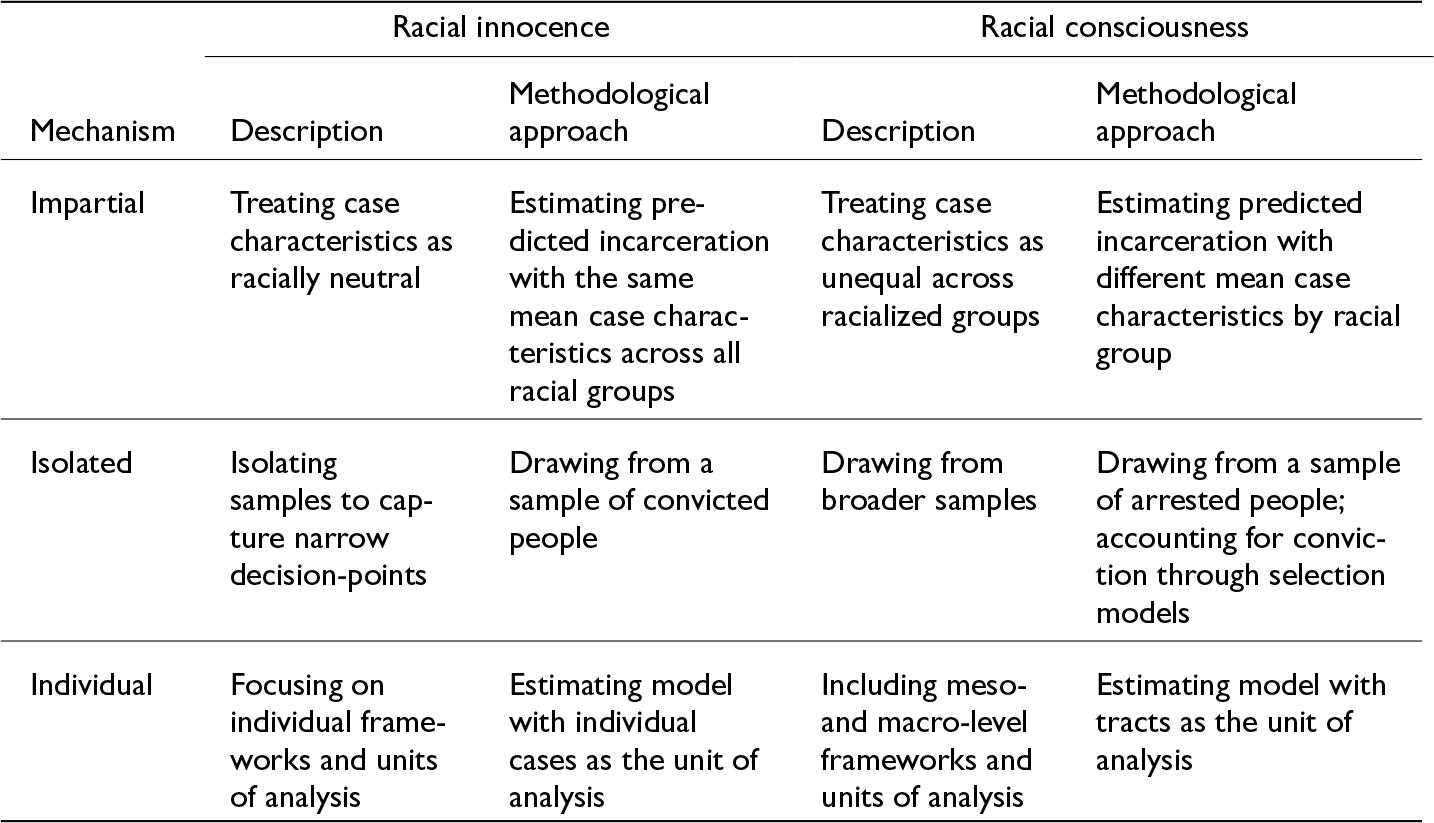
First, Murakawa and Beckett’s (Reference Murakawa and Beckett2010) point around causation in antidiscrimination law is mirrored in how social scientists conceptualize variables as impartial in social science and the consequent explanations for observed racial inequalities (Carbado and Roithmayr Reference Carbado and Roithmayr2014; Van Cleve and Mayes Reference Van Cleve and Mayes2015; Stewart Reference Stewart and Gallagher2008a). Social scientists often take a racially innocent approach by presuming that underlying social processes across racial groups are equal. We test this methodologically by first estimating predicted incarceration in our models where “legal” variables are racially impartial (or neutral) by using the same average across the entire sample for each variable, and then re-estimate predicted incarceration where we allow these variables to have different averages across racial groups. In doing so, we explore a race conscious alternative where legal factors might be racially stratified. In the sentencing context, legal factors such as charging severity may reflect unequal prosecutorial practices (Lynch Reference Lynch2011; Lynch and Omori Reference Lynch and Omori2018; Petersen Reference Petersen2019). Legal factors can also reflect laws “on the books” that produce racially unequal outcomes because they disproportionately impact Black people, such as the use of criminal history in sentencing guidelines (Omori and Petersen Reference Omori and Petersen2020).Footnote 6
Second, the issue of cause suggests that isolating biased actions in a single moment is difficult, if not impossible, given how racism operates. If racism occurs in a “thousand cuts” (Lee and Hicken Reference Lee and Hicken2016), narrowly focusing on one decision point in empirical analyses may reveal very small racial inequalities. Within the criminal legal system, bond, charging, or even sentencing decisions made by the courtroom workgroup may have small racial inequalities alone, but create much larger inequalities when taken together across a system (Kurlychek and Johnson Reference Kurlychek and Johnson2019; Sutton Reference Sutton2013). To examine this empirically, we compare incarceration sentencing based on more expansive (arrest) to more limited (convicted) samples to consider how inequality might be captured in different underlying populations through various stages of the criminal legal system process.Footnote 7 We also estimate selection models for incarceration (Bushway, Johnson, and Slocum Reference Shawn, Johnson and Ann Slocum2007), which account for conviction to reflect how racial inequality operates as a process across multiple stages rather than as a single moment of bias.
Finally, drawing from ideas of intent, focusing solely on individual person “levels of analysis” makes both the law and social science ill-equipped to handle racism within broader systems (Bagenstos Reference Bagenstos2006; Carbado and Roithmayr Reference Carbado and Roithmayr2014; Haney López Reference Haney López2000; Lynch Reference Lynch2011; Pager and Shepherd Reference Pager and Shepherd2008; Siegel Reference Siegel2020). CRT scholars caution against drawing only from individual level models of racism while disregarding its organizational and structural dimensions (Carbado and Roithmayr Reference Carbado and Roithmayr2014; James Reference James2020; Kang et al. Reference Kang, Bennett, Carbado, Casey and Levinson2011; Siegel Reference Siegel2020). As Carbado (Reference Carbado2022) argues, Fourth Amendment law and racial segregation renders Black people vulnerable to systemic police surveillance, contact, and violence, which necessitates a macro and structural approach to understanding police violence. We explore how macro neighborhood level analyses can open a more race conscious approach to examining racism in sentencing. Building on research investigating the spatial concentration of mass incarceration (Pattillo et al. Reference Pattillo, Western and Weiman2004; Roberts Reference Roberts2004; Sampson and Loeffler Reference Sampson and Loeffler2010; Simes Reference Simes2018; Simes et al. Reference Simes, Beck and Eason2023), we examine predicted incarceration rates at the neighborhood level. Doing so enables us to capture structural processes contributing to racialized mass incarceration in neighborhoods, rather than at the individual level.
Methods
Data and sample
We draw from a unique dataset of all adult felony arrests in Miami-Dade County between 2012 and 2015 (N = 86,340).Footnote 8 The data were collected from administrative files from the Clerk of the Court’s office by the American Civil Liberties Union (ACLU) of Florida and its Greater Miami Chapter and the study’s first author. The data captures relevant information from arrest through disposition – arrest, bond, charging, and sentencing – which we then linked together, allowing us to examine how racial inequalities occur within the criminal legal system process. We focus on people who are arrested for felonies because we are interested in racial inequality in incarceration, which is a relatively rare outcome for people who are arrested for less serious crimes (Kohler-Hausmann Reference Kohler-Hausmann2018). Limiting our sample to felonies also better aligns our data with prior sentencing studies which primarily focus on felony cases (Baumer Reference Baumer2013).
To better explore how local practices operate within the criminal legal system in Miami-Dade County, the first author observed court proceedings and had informal conversations with court actors who worked within the system, including current and former prosecutors, public defenders, judges, and police as well as people and families impacted by the criminal legal system, reform advocates, and a civilian oversight panel. These experiences, in addition to our collaboration with the ACLU, a nonprofit dedicated to supporting human rights, shape how we approach this research. Embracing critical race theory’s acknowledgment that research is never value-neutral (Christian et al. Reference Christian, Seamster and Ray2021; Zuberi and Bonilla-Silva Reference Zuberi and Bonilla-Silva2008), we recognize that our identities influence our work. As scholars of color, for example, we are highly attuned to how racialized criminalization can operate under a façade of race neutrality. In this regard, this project underscores our interest in understanding how quantitative methods can challenge current systems of racial (and other types of) domination.Footnote 9 Even though Miami-Dade County is a unique setting for this study, it still has a White-dominated racial structure. Miami draws a large number of immigrants from Latin America and the Caribbean, especially from Cuba (Portes and Stepick Reference Portes and Stepick1994). The county is nearly 60% White HispanicFootnote 10 as identified by the Census (Census 2017), and White Cubans in particular hold substantial political and economic power in comparison to Afro-Latino and other Black people (Hernández Reference Hernández2002). At the time of the study, for example, the county’s Mayor (United States Congressman Carlos Gimenez, n.d.), State Attorney (Office of Miami-Dade State Attorney 2023), and head public defender (Law Offices of the Public Defender 2023) all identified as (White) Cuban-American. This is important because anti-Black racism is pervasive in not just the United States, but also Cuba and other Caribbean and Latin American countries that, in turn, have influenced the United States’ racial order (Bonilla-Silva Reference Bonilla-Silva2004; Hernández Reference Hernández2022). In other words, White Latinos benefit from their Whiteness and by participating in anti-Blackness (Hernández 2002).
Miami is also one of the most racially segregated cities in the United States (Logan and Stults Reference Logan and Stults2011). This is attributable to government decisions and private investment, including the development of Interstate 95 in the 1960s that cut through the once-thriving Black economic center of Overtown (Dluhy et al. Reference Dluhy, Revell and Wong2002), and economic investment in neighboring White communities from people in Latin America in the 1980s and 1990s. As a result, White people, both Hispanic and non-Hispanic, live in relatively more affluent – though different – neighborhoods (Petersen et al. Reference Petersen, Omori, Cancio, Johnson, Lautenschlager and Martinez2018). In comparison, Black Hispanic and non-Hispanic people disproportionately live in more impoverished and largely overlapping neighborhoods characterized by overpolicing and police violence (Brennan and Weston Reference Brennan and Weston2015; Feldman Reference Feldman2011; Petersen et al. Reference Petersen, Omori, Cancio, Johnson, Lautenschlager and Martinez2018). While Black Hispanic people in Miami comprise about 2% of the County population, they are even more overrepresented in Miami’s criminal legal system relative to Black non-Hispanic people (Petersen et al. Reference Petersen, Omori, Cancio, Johnson, Lautenschlager and Martinez2018).
Describing this setting is integral as we are conducting research in a context where racial inequalities in incarceration have already been established (Petersen et al. Reference Petersen, Omori, Cancio, Johnson, Lautenschlager and Martinez2018) and underscores our understanding of the ethno-racial structures and local practices by criminal legal system organizations. These findings have helped us think through our modeling assumptions, variables, and sample choices, such as how criminal records might be racialized due to overpolicing in Black neighborhoods and police stops of Black men; how examining cases from arrest rather than conviction is important because the State Attorney’s Office screens and declines to prosecute cases upfront; and how investigating neighborhood-level racial inequalities in incarceration might be important due to racial segregation in Miami-Dade County.
Variables
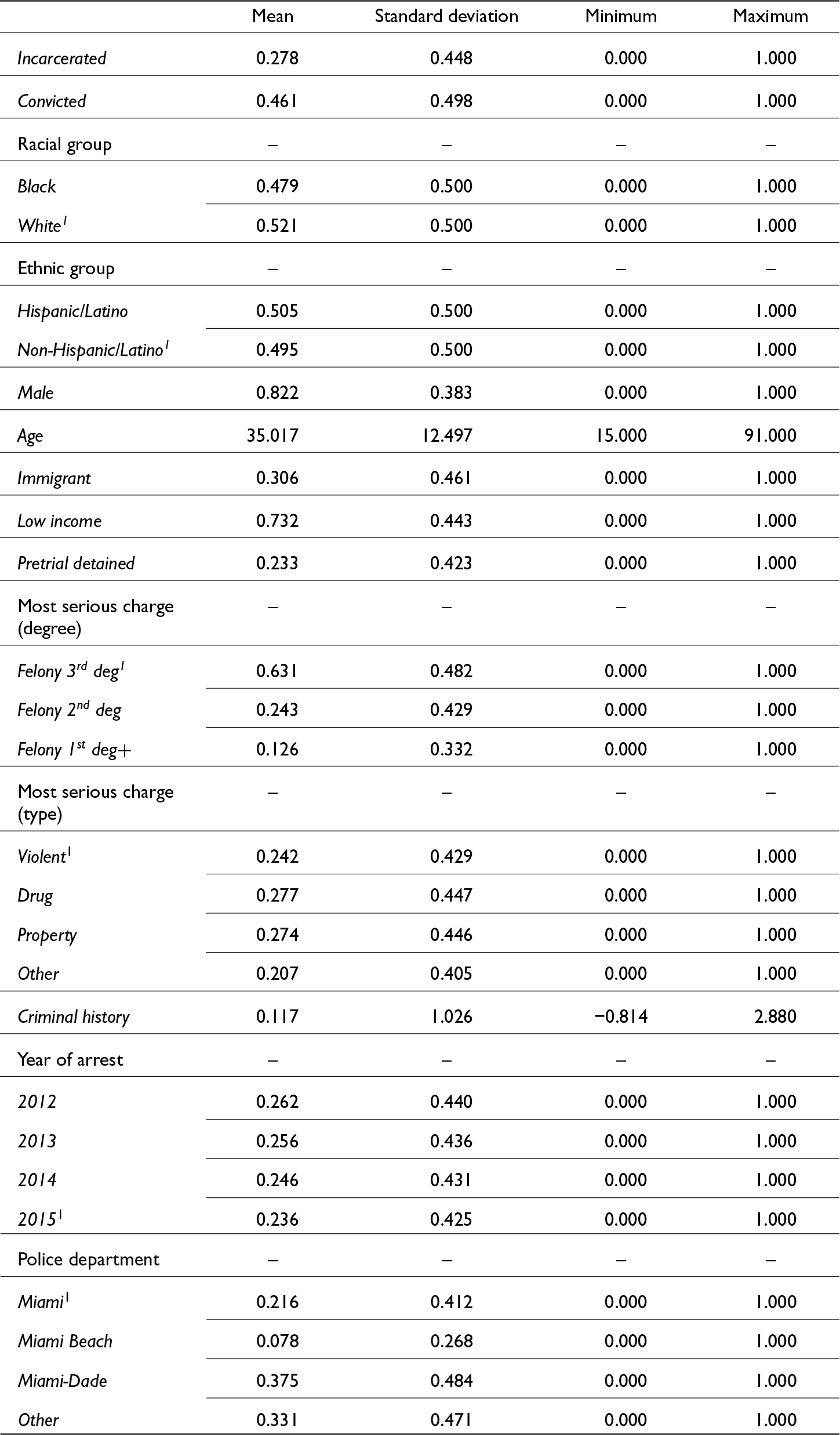
As reflected in Table 2, we include dependent and independent variables consistent with those considered in typical sentencing studies. Our main dependent variable of interest is whether or not a person is sentenced to incarceration (Baumer Reference Baumer2013; Ulmer Reference Ulmer2012). We choose an incarceration sentence due to its direct linkage to understanding mass incarceration and because it is the most common outcome examined in quantitative sentencing scholarship (Baumer Reference Baumer2013). In this instance, a case is coded as “1” if a person is sentenced to a term of incarceration (prison or jail), or a “0” if a non-carceral sentence was imposed, which is most often probation, a fine, time served, or some combination of these. We also have a dummy variable representing convictionFootnote 11 (1 = convicted, 0 = not convicted) because those not convicted cannot be sentenced.
Descriptive statistics of variables (n = 86,340)
Note: 1 = reference category.
Our main independent variable of interest is Black or White racial group (1 = Black and 0 = White), based on data from the arrest form. People are racialized as Black or White in this context likely through a “negotiated settlement” process (Goodman Reference Goodman2008) between the arresting officer and the person arrested, structured by the arrest form itself. The arrest form contains a series of checkboxes for race, including “Black” and “White,” and officers fill out the checkboxes based on their perceptions and interactions with the person arrested.Footnote 12 Because of the demographics of Miami-Dade County, the population of people who do not identify as White or Black people is small (less than 1.0%), and so are excluded from this analysis.Footnote 13
Given Miami’s demographics, we also include a separate dummy variable capturing Hispanic ethnicity (1 = Hispanic, 0 = non-Hispanic). Because the original data and arrest forms do not include ethnicity information, we use the Hispanic surname list (Word et al. Reference Word, Coleman, Nunziata and Kominski2008) to include the probability that a person is Hispanic. This analysis assigns the probability of a person’s surname being associated with Hispanic ethnicity on the Census. We use a 75% threshold, meaning that we code that a person is of Hispanic ethnicity if 75% of the people in the Census who have their surname identify as Hispanic. This method has been validated in other studies (Wei et al. Reference Wei, Virnig, John and Morgan2006). Although an imperfect measure, we believe that including it in this context is important given the demographic population of Miami-Dade County. Because ethnicity is captured as a separate variable from race, people in the sample can be categorized as White non-Hispanic, White Hispanic, Black non-Hispanic, or Black Hispanic.Footnote 14
We also include other demographic information often included in sentencing studies, such as gender, age, immigration status, and whether the person is classified as low-income. Gender and immigrant status are coded as dummy variables (1 = male and 0 = female and 1 = immigrant and 0 = non-immigrant, respectively).Footnote 15 Age at arrest is captured in years. Finally, we use a proxy for low-income classification based on whether the person qualifies for public defender representation regardless of whether they are ultimately represented by public counsel. To qualify for public defender representation in Miami-Dade County, people must have an income that is 200% below the poverty guideline or less.
We also include a host of “legally relevant” factors that are generally included in sentencing research. Consistent with prior sentencing research (Demuth and Steffensmeier Reference Demuth and Steffensmeier2004; Xia and Mears Reference Xia and Mears2010), we develop and include a measure of criminal history as a single factor score. This factor score is calculated using a series of dummy variables (1 = yes; 0 = no) for prior felony arrest, felony conviction, jail sentence, and prison sentence. These individual scores are then added up (resulting in an additive scale ranging from 0 to 4), and then standardized (alpha = 0.70). We also include the degree and type of the most serious arrest charge. The degree of the most serious arrest charge is captured by dummy variables for the following: 3rd degree (reference group), 2nd degree, or 1st degree or capital/life felony. Broad crime categories for the most serious arrest charge are also measured as a series of dummy variables using the following: violent (reference group), drug, property, or other. Pretrial detention is often included as an independent variable for sentencing (Ulmer Reference Ulmer2012), and so we measure it as 0 = not detailed and 1 = detained. Arrest year is used to control variability across years, and we use 2015 as the reference category.
Although uncommon in sentencing research, we also include police departments measured as a series of dummy variables for the following major Miami-Dade police departments: Miami (reference group), Miami Beach, Miami Dade, and others. We use these police departments as exclusion restrictions in our selection models (Shawn et al. Reference Shawn, Johnson and Ann Slocum2007), where we include police agency to predict conviction but not sentencing.
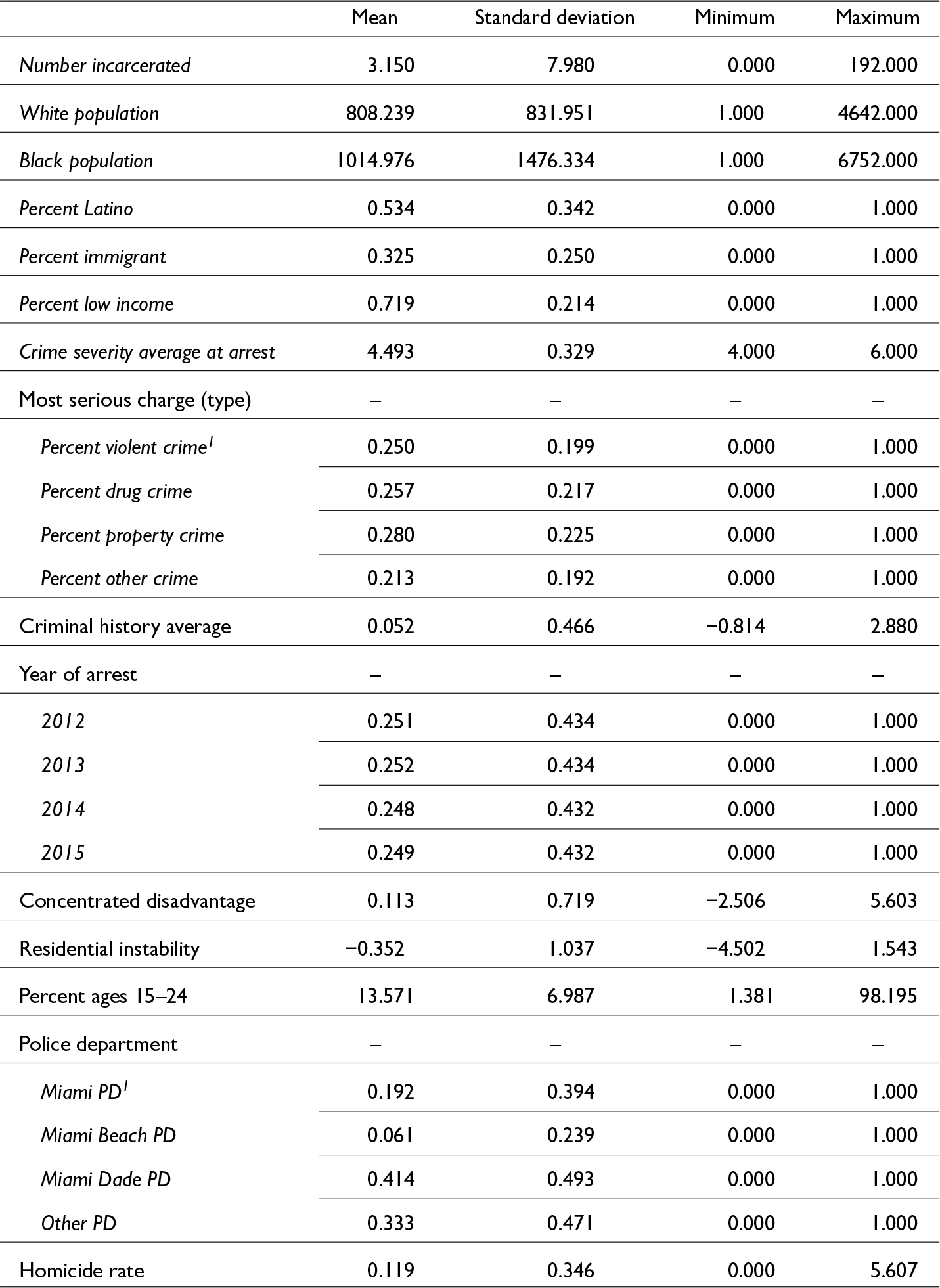
Finally, in our neighborhood models, we aggregate some of the aforementioned case characteristics to the Census tract. This includes the percent of arrested people who were immigrants, and the percent who met our low-income threshold. We also include an average criminal history and the average case severity. We include the percent of cases that were drug, property, and others, using percent violent crime as our reference category. Additionally, we include the police department as a series of dummy variables and year as controls. We aggregate each measure by Black/White racial group based on the arrest location. Descriptive statistics for all neighborhood variables are included in Table 3.
Descriptive statistics of census tract variables (n = 3,382)
Note: 1 = reference category. We include summary statistics for Black (n = 1,593) and White (n = 1,789) tracts.
In the neighborhood models, we additionally include some structural variables that are often used in neighborhoods and crime research.Footnote 16 We calculated the measures at the Census tract level to approximate neighborhoods. Economic disadvantage is a principal components factor analysis comprised of the percent below the poverty line (factor loading = 0.84), median home value, median household income, single parent households, and percent on public assistance (Sampson et al. Reference Sampson, Raudenbush and Earls1997). We consider residential instability, measured as the percentage of homeowners and the percentage of people who did not move in the past 5 years. We also control for the percentage of young people aged 15–24. As a measure of violent crime, we also capture the average homicide rate in the tract from 2010 to 2015.
Analytical plan
To contrast racially innocent to racially conscious approaches in sentencing scholarship, we estimate a series of probit and Poisson regression models. We first estimate what Baumer (Reference Baumer2013) terms the “typical” model in sentencing, which we argue reflects presumptions of racial innocence. This includes estimating a probit model predicting incarceration for Black and White individuals who are convicted, including a series of legal and demographic controls.Footnote 17 For each scenario, we then compare the racially innocent results with alternative racially conscious results, where we make different assumptions and generate the predicted probability of incarceration for Black and White defendants. In our first scenario, we estimate the same racially innocent model, but instead of treating legal and demographic factors impartially by estimating the predicted probabilities of incarceration using the legal and demographic variables for the entire sample averaged together, we estimate the predicted probability of incarceration using legal and demographic factors for Black and White racial groups separately. This allows legal and demographic factors to be unequal across racial groups.
In the second scenario, we compare our results in the racially innocent sample, which is isolated to people who have been convicted, to a more expanded sample of people who have been arrested. Because our sample includes everyone arrested who may or may not be convicted, we estimate a model of incarceration adjusting for conviction. The selection models use maximum likelihood estimation with the heckprobit command in Stata 15 (StataCorp, n.d.), adapted from de Ven et al. (Reference Van de Ven and Van Praag1981). We include police agency dummy variables as our exclusion restriction in the selection model (Shawn et al. Reference Shawn, Johnson and Ann Slocum2007). That is, we include police agencies as predictors in our conviction models, but exclude them from sentencing. We use police agencies to approximate policy differences around evidentiary collection and testifying (Epstein et al. Reference Epstein, Leen and Getter2014; Roberts Reference Roberts2015). While these differences should impact conviction, they should not influence sentencing outcomes.
In the final scenario, we move from a racially innocent individual-level analyses approach and frameworks and consider how racism operates at more macro levels by aggregating our data to the Census tract level based on the arrest location. Specifically, we aggregate the number of Black and White people sentenced to incarceration in a tract in a year. Because these are counts of people, we estimate a series of Poisson models and use Black and White residential populations as the exposure terms to transform these counts into rates. In other words, we estimate a model where we are examining the Black rate of incarceration over the Black residential population in the tract, and the White rate of incarceration over the White residential population in the tract.
Results
A racially innocent approach to sentencing
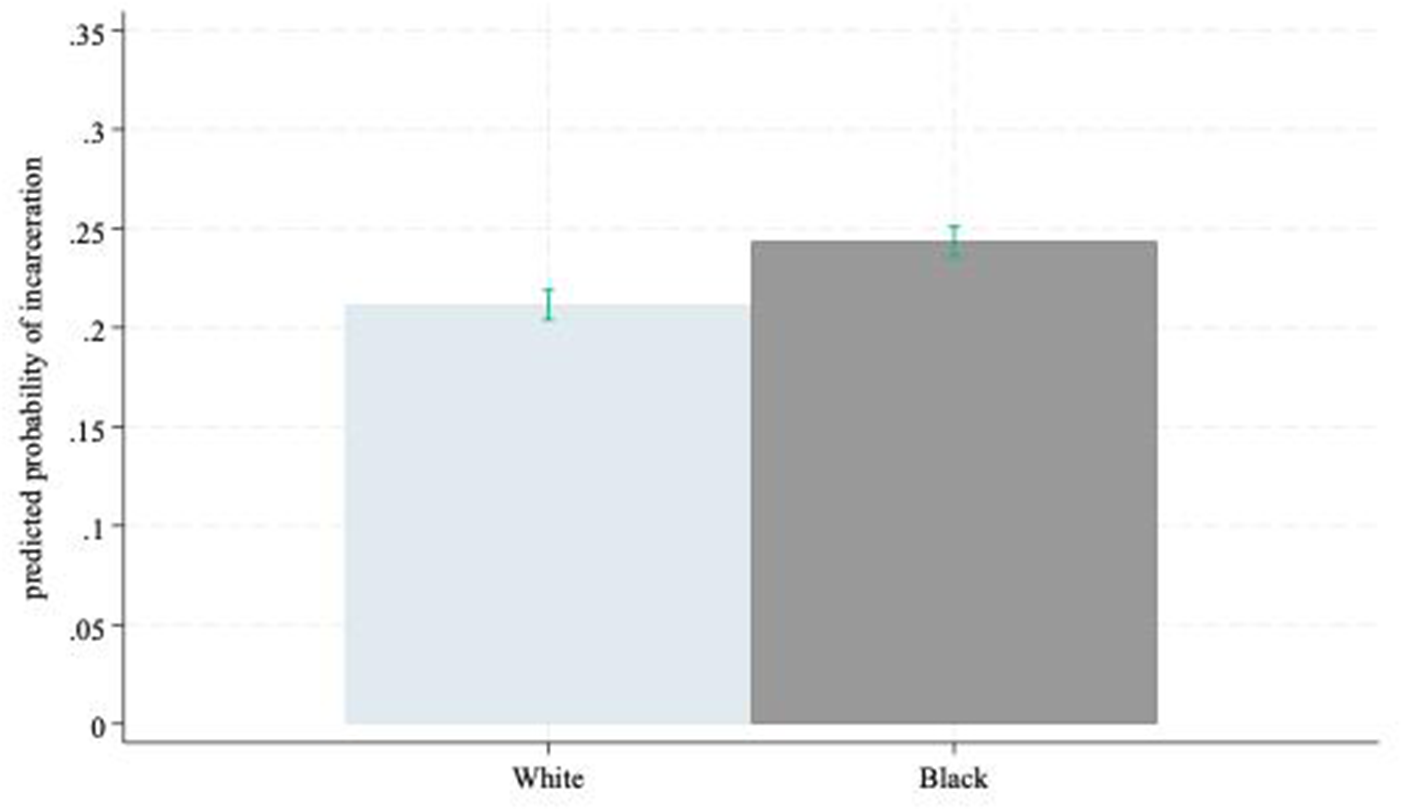
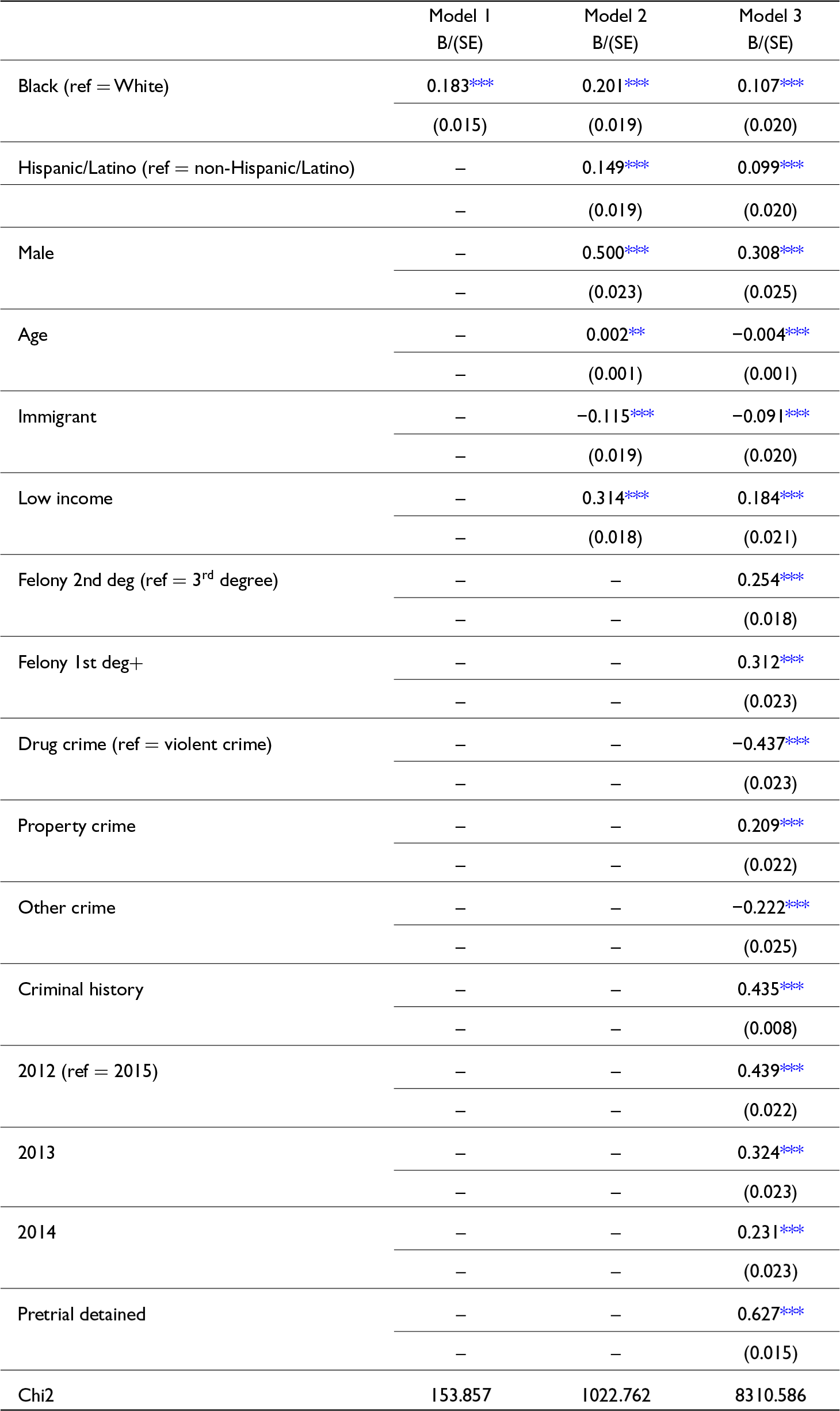
We start with the typical approach, reflecting presumptions of racial innocence in quantitative sentencing studies. This approach includes estimating the probability of incarceration for Black and White people convicted of felonies, net of other demographic and “legally relevant” variables often found in sentencing studies. Table 4, Model 1 includes an estimation for a simple probit model with just Black (relative to White) racial group without other variables. Model 2 then introduces additional demographics, including ethnicity, gender, age, and immigration status, and Model 3 also includes “legally-relevant” variables typically used in quantitative studies of sentencing, such as criminal history, severity and type of current charge, whether the person was pretrial detained, and case year. Figure 1 is based on Model 3 and reflects the result of the racially innocent approach, which is the predicted probability of incarceration for convicted Black and White people after including demographic and “legally relevant” controls.
Predicted probability of incarceration with “typical” model.
“Typical” probit model of incarceration based on convicted sample (n = 39,781)
Notes: B = beta coefficient; SE = standard error.
* p < 0.05, ** p < 0.01, *** p < 0.001.
The results reflect much of the broader literature in sentencing: we find that there are statistically significant, but relatively substantively small, racial inequalities in incarceration. Specifically, when examining a convicted-only sample, we find that there is about a three-percentage point difference in the Black–White probability of incarceration: White defendants have about a 21.1% probability of being sentenced to incarceration relative to 24.4% for Black defendants. These predicted probabilities are based on the binary variable for Black (relative to White) net of other variables that are generally considered “legally relevant” for sentencing, including the severity of the crime, crime type, and criminal history.
Impartial structural conditions: racial inequality holding “all else equal”
We first examine racial innocence through the presumption of structural conditions and legal practices that are impartially applied across racial groups in a race neutral manner. In the case of sentencing, race neutrality is reflected in typical models with the presumption that all “legally relevant” factors and other demographic characteristics are equal across racial groups (Rehavi and Sonja Reference Rehavi and Sonja2014).Footnote 18 This presumption is also reflected by using the average legal and demographic characteristics for the entire sample when estimating the predicted incarceration sentences (Omori and Petersen Reference Omori and Petersen2020). Racial inequalities are reflected in the racial group coefficient(s) only after accounting for these average legal and demographic factors.
In contrast, we then take a racial consciousness approach by relaxing this assumption of similarly situated legal and other demographic factors across racial groups to examine changes in the probability of an incarceration sentence.Footnote 19 The left panel in Figure 2 replicates the predicted incarceration based on the race neutral assumption, where we assume average (pooled) legal, case, and demographic characteristics for the entire sample regardless of race. The second panel (middle panel) in Figure 2 shows the predicted incarceration when assuming differently situated characteristics, taking a race conscious approach where we draw from characteristics averaged for each racial group rather than across the entire sample. While this assumption does not change the “typical” model itself (both figures are based on the model from Model 3 in Table 4), it depicts two different ways to calculate the predicted incarceration across racial groups.
Comparing the probability of incarceration between the typical model, legal factors averaged by racial group, and with the arrested population.
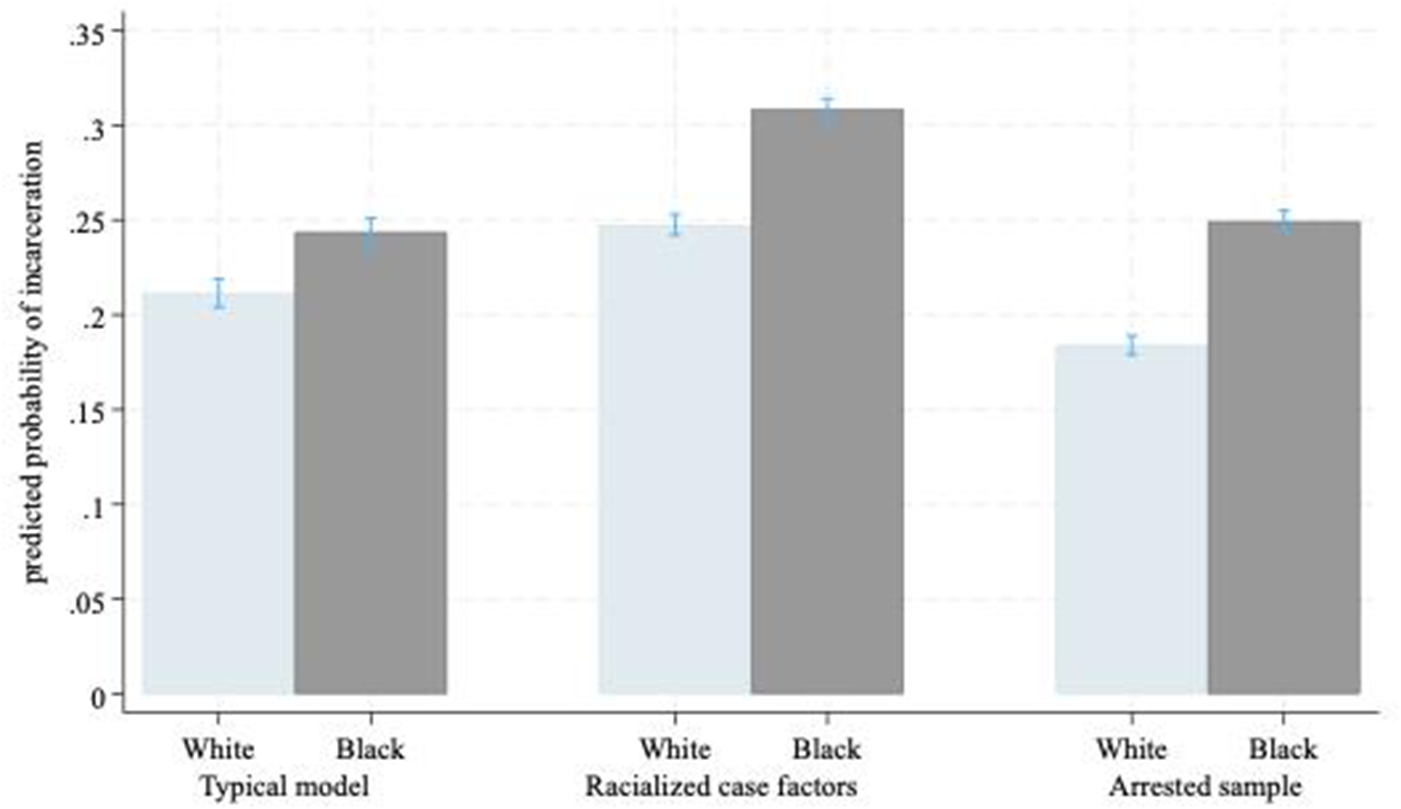
When legal and case characteristics are assumed to be race neutral (racially innocent), estimated models minimize racial disparities relative to models when case characteristics are estimated as race-specific (racially conscious). When we allow legal and case characteristics to be racialized instead of treating them impartially, racial inequality in incarceration doubles. Specifically, when assuming race neutral legal factors and other demographic characteristics, Black people are about 3 percentage points more likely than White people to be sentenced to an incarceration sentence. When assuming that legal factors might be unequal between groups; however, this inequality grows to over 6 percentage points. In other words, the assumption that Black and White people in the sample would have the same average characteristics results in overestimating the probability of White incarceration and underestimating the probability of Black incarceration.
This is because prior legal and other demographic control factors are racialized both “on the books” and in practice. For example, as one measure in the criminal history index, Black people in our sample are more likely to have prior felony arrests (64.5%) relative to White people (51.9%), but these are averaged together in race neutral models (57.9%). Criminal history is often a function of prior criminalization of communities of color through police organizational practices (Farrell and Lynn Swigert Reference Farrell and Lynn Swigert1978; Omori and Petersen Reference Omori and Petersen2020) and is directly built into sentencing scores (Office of the State Courts Administrator 2016). Similarly, prior research suggests that charging practices differ across racial groups (Engen Reference Engen2009). These distinct experiences across racial groups are erased, however, when estimating predicted values with race neutral legal and case characteristics averaged across the entire sample.
Isolating racism to a single moment: racial inequality in limited samples
Another way that racial innocence may inherently minimize racial inequality is by isolating racial inequality to discrete decision points with limited samples. This often occurs through drawing from conviction-only samples in examining sentencing decisions, even though sentencing is better conceptualized as an amalgamation of prior decision points by the courtroom workgroup, including charging decisions and plea bargaining negotiations (Bushway and Morrison Piehl Reference Bushway and Morrison Piehl2001; Lynch and Omori Reference Lynch and Omori2018). Isolating racial inequality to sentencing decisions of only convicted people fails to capture earlier stages in the process that are unlikely to be race neutral.
A sample including those arrested (rather than just those convicted) embraces a more race conscious approach by capturing how racial inequality operates in prior stages. In particular, a broader sample can capture racial inequality in conviction, and how this inequality in conviction matters for incarceration. To compare incarceration outcomes with a convicted-only sample (Table 4), Table 5 shows results with a broader arrested sample. Models 1–3 in Table 5 show probit models with the same independent variables as in the typical model, but with the arrested sample rather than the convicted sample. Model 4 in Table 5 shows an additional model where we account for the probability of conviction by estimating a Heckman selection model. The predicted probabilities of incarceration are in the right panel of Figure 2. As aforementioned, the left panel is from the convicted sample from the typical model (based on Model 3 in Table 4), and the right panel is from the arrested sample (based on Model 4 in Table 5).
Probit model of incarceration based on arrested sample with selection (n = 86,340)

Notes: B = beta coefficient; SE = standard error.
* p < 0.05, ** p < 0.01, *** p < 0.001.
In our sample, we find that racial inequality in incarceration is smaller in samples of people who are convicted (racially innocent) relative to those who are arrested (racially conscious). When we account for racial inequality from arrest, rather than isolating samples to convicted-only populations, racial inequality in incarceration (more than) doubles, from about 3 percentage points to about 6.5 percentage points. As reflected in the right panel in Figure 2, when drawing from the arrested sample, the probability of Black incarceration is 24.9%, compared to the probability of White incarceration of 18.4%. As discussed above, with a convicted sample, the inequality in incarceration is about 3 percentage points. In this case, focusing solely on final sentencing outcomes while drawing from an isolated convicted-only sample minimizes racial inequalities, especially without attention to the racially unequal processes that precede sentencing.
Sentencing is an outcome of prior decisions that are often difficult to capture within the court process, such as plea bargaining, charging, or even initial case screening. In the case of our data, only about 45% of people arrested for felonies are convicted, nearly all through plea bargains. Prosecutors either decline to file or dismiss charges in most other cases, creating an early discretionary decision point.Footnote 20 Including a selection equation for conviction allows for not only capturing racial inequality in conviction, but also accounts for how racial inequalities in conviction emerge in incarceration. Notably, when selection is not considered (Model 3), Black–White racial inequalities in incarceration are smaller and non-significant relative to when considered (Model 4). Drawing from an already-convicted population disregards the highly racially unequal arrest, charging, and plea-bargaining practices that precede it.
Individualizing the unit of analysis: racial inequality in individuals, not institutions
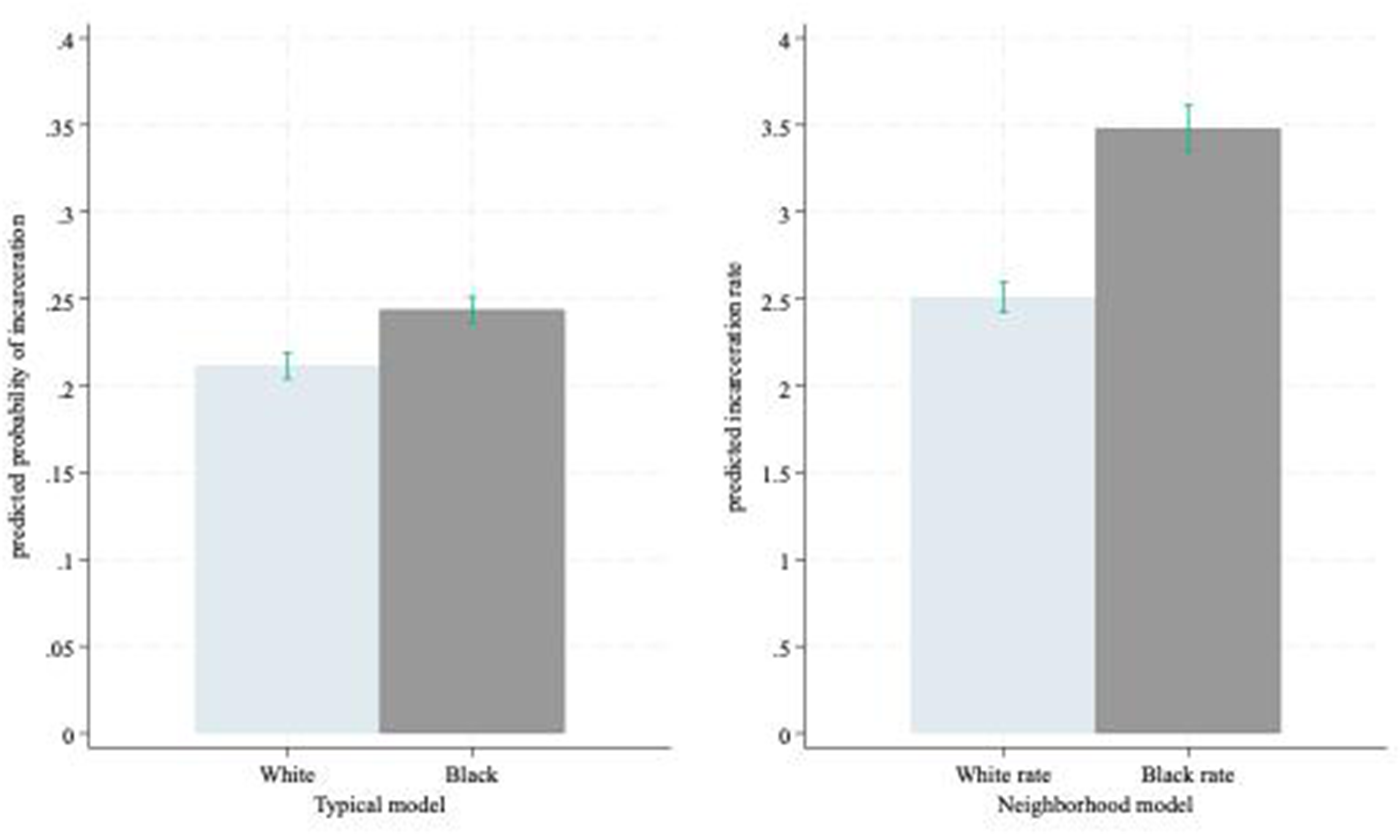
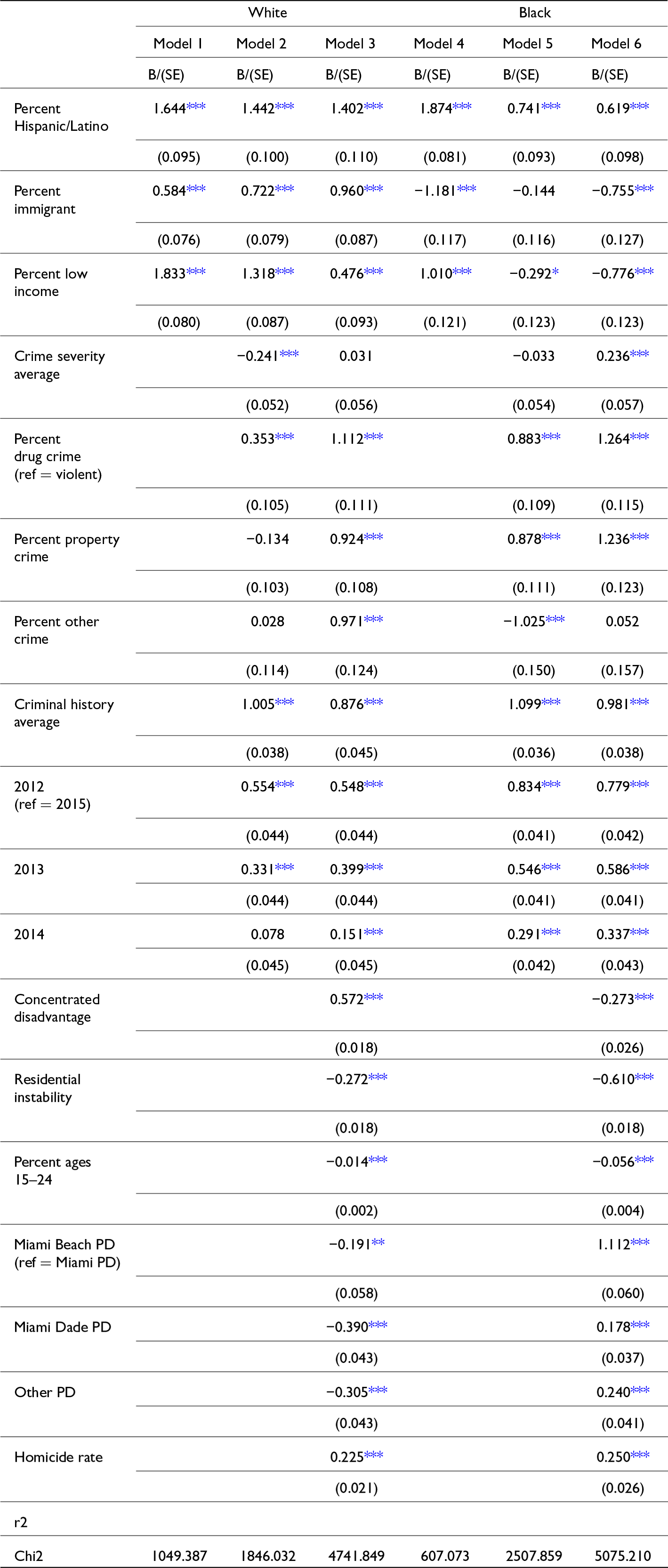
Finally, we examine how racial innocence is reflected when focusing on individual units of analysis, especially because racism also operates at the organizational and structural level. Because incarceration impacts communities, not just individual people (Collins Reference Collins2020; Roberts Reference Roberts2004), we shift the unit of analysis from the individual to the neighborhood level by examining the Black and White incarceration rate within Census tracts. Estimating models and including variables at more macro units, such as the neighborhood or organizational level, can better highlight institutional processes beyond individual-level frameworks (Lynch and Omori Reference Lynch and Omori2018). Accordingly, we include structural characteristics and neighborhood-level predictors aggregated from case-level data. Table 6 shows the estimated Poisson models for the incarceration rate for White (Models 1–3) and Black (Models 4–6) groups. Although they are mapped on separate scales, Figure 3 compares the typical model showing the predicted probability of incarceration (left figure, based on Model 3 in Table 4) to the incarceration rate by race (right panel, based on Models 3 and 6 in Table 6).Footnote 21
Comparing the probability of incarceration in the typical model with the incarceration rate at neighborhood level.
Poisson models of incarceration by racial group in tracts (n = 3,382)
Notes: B = beta coefficient; SE = standard error. We exclude tracts with 0 population, so White n = 1789 and Black n = 1593.
* p < 0.05, ** p < 0.01, *** p < 0.001.
In our sample, racial inequalities are minimized in the individual-level models (racially innocent) relative to neighborhood-level ones (racially conscious). Specifically, we find that racial inequality in incarceration rates is more than twice as high in the neighborhood-level models compared to the individual-level models. As the right panel in Figure 3 shows, White people are incarcerated at a rate of 2.5 per White population, whereas Black people are incarcerated at a rate of 3.5 per Black population. These neighborhood rates represent larger racial inequalities relative to the individual-level models. One way to compare this result to the individual models is to calculate a ratio of Black to White incarceration by dividing the two rates.Footnote 22 When taking the ratio of the two probabilities in the “typical” individual models (left panel), Black people are incarcerated at a probability that is 1.15 (.244/.211 = 1.15) times greater (or 15%) than White people. By comparison, in the neighborhood models (right panel), Black people are incarcerated at a rate that is 1.40 (3.5/2.5 = 1.40) times (or 40%) greater than White people.
In addition to capturing greater racial inequality, these neighborhood models also draw attention to structural and institutional processes that have consequences for mass incarceration across neighborhoods rather than focusing on individual factors. These neighborhood-level models include both structural measures, such as economic disadvantage or violent crime, as well as organizational variables, such as police agency, which shape mass incarceration beyond individual case data. For example, these models suggest that there are practices across police departments that likely function to create racial inequalities in criminalization, as the coefficients are in different directions across White and Black incarceration sentencing rates. While legal, case, and demographic variables included in the “typical” individual sentencing model also represent structural processes such as income and poverty, their interpretations are often reduced to the individual level.
Discussion and conclusion: highlighting racial power in social science research
Traditional approaches make racial discrimination difficult to prove as some law and social science research presumes no racism and “statistical methods often used in this effort yield little insights into intentions and causation” (Murakawa Reference Murakawa2019; Murakawa and Beckett Reference Murakawa and Beckett2010: 696). Notably, scholarship is implicated in producing an illusion of race neutrality that minimizes the impact of racial inequalities (Crenshaw et al. Reference Crenshaw, Harris, HoSang and Lipsitz2019). This is especially important for quantitative work, as quantitative methods are historically rooted in White (male) supremacy (Zuberi and Bonilla-Silva Reference Zuberi and Bonilla-Silva2008). Capturing the complexities of how racism operates in empirical social science research requires unpacking both theoretical and methodological assumptions that are inextricably tied together.
We highlight how racial innocence in normative quantitative approaches to social science is maintained through three mechanisms: treating unequal structural conditions impartially, isolating samples to reflect limited stages, and focusing on individual levels of analysis. In our case, shifting each of these assumptions doubles the racial inequality in incarceration sentencing relative to “typical” models, samples, and assumptions. Although it can be argued that each of these results alone (even doubled) still represent relatively small racial inequalities in sentencing, these findings are perhaps unsurprising given that inequalities exist at many decision points (Van Cleve and Mayes Reference Van Cleve and Mayes2015; Murakawa and Beckett Reference Murakawa and Beckett2010) and incremental stages (Kurlychek and Johnson Reference Kurlychek and Johnson2019; Sutton Reference Sutton2013). Instead, we encourage scholars to consider these mechanisms collectively, reflecting how racism is a broader process occurring through subtle and systemic ways, as CRT scholars suggest (Bell Reference Bell1991; Delgado and Stefancic Reference Delgado and Stefancic2023; Gómez Reference Gómez2012).
This theoretical and methodological mismatch in social science research is important to address because, as sociolegal scholars point out, systems of racial subordination can easily be recast as race neutral. Formally race neutral laws “on the books” create opportunities for racial inequality either through broadness or vagueness (Carbado Reference Carbado2022; Roberts Reference Roberts1998), expanded “legal capacity” through overlapping civil and criminal codes (Anjuli and Sykes Reference Anjuli and Sykes2022; also see Husak Reference Husak2008), or through built-in datafication processes such as sentencing guidelines (Rothschild-Elyassi Reference Rothschild-Elyassi2022). These opportunities then become racially unequal realities in practice when exercised through organizations, so racism operates in systemic ways, rather than through individual bad actors (Carbado Reference Carbado2022). For example, the vagueness of probable cause and broadness of qualified immunity within criminal law enable racially biased police organizational practices (Carbado Reference Carbado2017, Reference Carbado2022; Roberts Reference Roberts1998), and overlapping criminal codes provide opportunities for prosecutors to stack charges (Husak Reference Husak2008). In this setting, multiple minor prior offenses, such as driving with a suspended license or petty theft, can be enhanced to felony charges by prosecutors (Petersen et al. Reference Petersen, Omori, Cancio, Johnson, Lautenschlager and Martinez2018), and sentencing guidelines factor in criminal history into felony sentences (Omori and Petersen Reference Omori and Petersen2020). In this way, formally race-neutral policies contribute to racialized mass criminalization (Schlesinger Reference Schlesinger2011). Law and society scholars therefore need to shift presumptions of race neutrality to race conscious ones by examining how opportunities created through the law, in combination with practices on the ground, reinforce racial hierarchies in local settings.
There are also methodological and conceptual implications for empirical scholarship informed by eCRT that provide directions for future research. For research on racism, scholars might think about moving beyond capturing race as a static variable (Christian et al. Reference Christian, Seamster and Ray2021; Zuberi Reference Zuberi2000).Footnote 23 Similarly, using White as the default group for comparison (Castillo and Babb 2023) without considering racial hierarchies reinforces the idea of Whiteness as the invisible norm (Lipsitz Reference Lipsitz2006). Regression-based analyses also often control for “kitchen sink” variables to reduce the race coefficient and then interpret the residual “race effect,” failing to consider how inequality is an interactive process (Reskin Reference Reskin2012; Stewart Reference Stewart, Zuberi and Bonilla-Silva2008b). Other approaches, such as interactions or decomposition models (Kitagawa Reference Kitagawa1955; Omori and Petersen Reference Omori and Petersen2020; Thaxton Reference Thaxton2018), allow for understanding how much racial inequality is explained through other independent variables and pushes against causal ideas of discrimination. Similarly, sample selection could also be reconceptualized as a process of racial inequality, not just an issue of estimation. As demonstrated, we find that case screening represents a key “selection” point, and while we lack the data, arrest is almost certainly another. To the degree that arrest or court records are generated through racially unequal arrest or case screening processes, analyses using these records will underestimate racial inequality (Knox et al. Reference Knox, Lowe and Mummolo2020). Finally, histories of racial segregation and criminalization of Black communities suggest considering how these processes occur at the neighborhood (Simes Reference Simes2018) and organizational levels (Ray Reference Ray2019). Conceptualizing and modeling racism as a process challenges ideas of locating intent in an individual person or thinking about discrimination in a single moment.
Subverting racial innocence can also inform how researchers can better explain and interpret results. It makes little sense to start from the null hypothesis of no racism in a racialized social structure (Murakawa and Beckett Reference Murakawa and Beckett2010; Reskin Reference Reskin2012).Footnote 24 Similarly, researchers often attribute “race effects” rather than racism when discussing racial inequalities in results (Bonilla-Silva and Baiocchi Reference Bonilla-Silva and Baiocchi2001). The use of race, rather than racism, conveys a passive or neutral system and attributes racial disparities to the racially marginalized groups themselves (Van Cleve and Mayes Reference Van Cleve and Mayes2015). In a similar example, researchers might consider if there are ways that they are misattributing these measures to support false myths of racial progress (Bonilla-Silva and Baiocchi Reference Bonilla-Silva and Baiocchi2001). In the case of sentencing and punishment research, criminal history measures or sentencing scoresheets might also be investigated with a similar critical eye on their role in perpetuating racial inequalities in sentencing while masking their effects.
Perhaps most importantly, many of these features have long been practiced by scholars using qualitative methods (Barak Reference Barak2023; Clair Reference Clair2020; Dunlea Reference Dunlea2022; Kohler-Hausmann Reference Kohler-Hausmann2018; Lynch Reference Lynch2016; Van Cleve Reference Van Cleve2016), and future work should draw from and further build on qualitative projects, story-telling, and other historically excluded forms of knowledge. Qualitative work continues to illuminate the pathways and shared ideologies maintaining racism, which are generally not captured in quantitative data. For example, Van Cleve (Reference Van Cleve2016) highlights how court actors practice racialized labeling of people going through the court system as “monsters” and “mopes.” The dehumanization embedded in routine court processes allows prosecutors to process cases efficiently and maintain the ideology that they are moral warriors despite upholding racial inequalities. In addition to expanding forms of valid knowledge to include qualitative methods, the use of counter-storytelling (Williams Reference Williams1991) could be adopted by quantitative scholars to highlight particular cases, points, or to create new measures to challenge dominant notions (Sablan Reference Sablan2019), or as a counterreading of quantitative results (Petersen Reference Petersen2019). While we focus on race/racism, research should also consider how these forms of scientific knowledge reflect gendered power structures (Milam and Nye Reference Milam and Nye2015; Oakley Reference Oakley1998).
Regardless of the frameworks and methods that challenge the presumption of racial innocence, sociolegal and social science work (especially quantitative work) can and should be race conscious. While we apply this idea to sentencing, a race conscious approach could be integrated in studies at every juncture within the criminal legal system to better identify how race neutrality minimizes racial inequalities, such as police stops, arrests, prosecutorial screening, charging, and plea negotiations, and mass supervision and release. We hope that this paper will add to the eCRT literature that closes the “schism between critical race scholarship and the social sciences” (Obasogie Reference Obasogie2013: 183). ECRT-informed approaches can help push scholars to unpack both theoretical frameworks and methodological choices. This piece applies this framework in one area – sentencing – to explore both how racial innocence operates in practice and how researchers can re-think strategies to take a more race conscious one.
Acknowledgements
We would like to thank the American Civil Liberties Union (ACLU) of Florida and its Greater Miami Chapter, Drs. Mario Barnes and Osagie Obasogie for organizing the special issue on empirical methods and critical race theory, the Law & Society Review editors, the anonymous reviewers of the manuscript, and Dr. Adam Boessen for reading a draft of the paper.
Conflict of interest
None.



