Kawasaki disease is a multi-systemic vasculitis involving both small and medium vessels. Such a disease is considered atypical or incomplete in patients with persistent fever for at least 5 days combined with two or three of the five classical clinical criteriaReference Beiler, Schmidt, von Herbay, Löffler and Daum 1 ; however, unusual presentations are not rare. We report here the case of an infant who presented with an acute small-bowel obstruction revealing an ischaemic mesenteric artery thrombosis that led to the diagnosis of atypical Kawasaki disease combined with coronary artery aneurysms.
Case report
A 7-month-old previously healthy girl was referred to our hospital for persistent fever evolving over 2 weeks and digestive symptoms (diarrhoea and vomiting). On day 3 of illness, she received a combination of amoxicillin and clavulanic acid for otitis media. On day 10, the child was hospitalised for significant asthaenia with anorexia and persistence of the digestive symptoms. The clinical examination revealed cutaneous muqueous pallor and conjunctivitis. No adenopathy, cutaneous rash, or oropharyngeal lesion were noticed. The biological examination revealed: an increased white blood cell count, 26 × 109/L; a low haemoglobin level, 9.3 g/dl; a platelet count of 256 × 109/L; and a C-reactive protein level of 110 mg/L. Abdominal echocardiography did not reveal any abnormalities; the vomiting was attributed to a paralytic ileus and was conservatively treated.
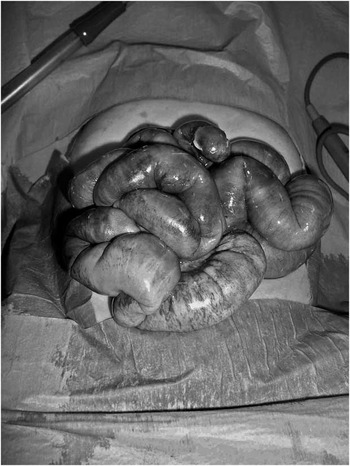
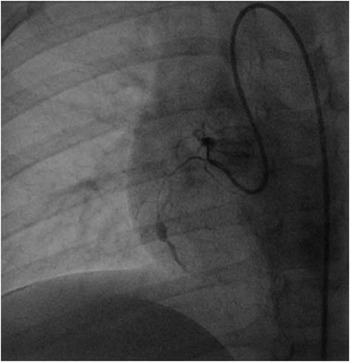
On day 14, the general condition deteriorated with complete abdominal obstruction combined with bilious vomiting. The inflammatory syndrome worsened with an increased C-reactive protein level (262 mg/L), a haemoglobin level of 8.9 g/dl, a white blood cell count of 45 × 109/L, and a platelet count of 863 × 109/L. Blood and urine cultures as well as serum tests for viruses remained negative. Kawasaki disease was suspected and echocardiography revealed an aneurysm with an origin from both coronary arteries – 8 mm for the right and 6.3 mm for the left main coronary artery – in association with pericardial effusion. Treatment with intravenous γ globulin 2 g/kg combined with aspirin (80 mg/kg) was started. Fever disappeared on the second day of treatment but the digestive obstruction persisted. The abdominal radiograph showed air-filled loops of the small-bowel with hydroaeric levels and the computed tomographic scan revealed small-bowel occlusion with superior mesenteric and splenic ischaemias associated with abdominal effusion. Thus, laparotomy was performed and revealed multiple ischaemic lesions of the small-bowel. As a first step, a protective jejunostomy was realised (Fig 1). During the second look, staged resections of the small-bowel combined with gastrostomy, cholecystectomy, and appendicectomy were performed leading to short-bowel syndrome in the residual ileum of 38 cm. Histologically, necrosis of the intestinal mucous and muscular membrane was observed with an inflammatory response. Owing to short-bowel syndrome, long-term total parenteral nutrition was initiated and warfarin introduced for coronary artery dilatation combined with aspirin. Unfortunately, after 2 years, she presented with inferior myocardial infarction following ablation of the central line for parenteral nutrition after replacement of warfarin (7 mg/day) by low-molecular-weight heparin. The infarction was relatively well tolerated, but control coronarography revealed complete occlusion of the right coronary artery (Fig 2). The combination of warfarin and aspirin was then pursued with adjunction of β-blockers and angiotensin-converting-enzyme inhibitors.
Image of the laparotomy findings. Diffuse necrotic lesions were found almost throughout the entire small intestine.

Coronarography showing occlusion of the right coronary artery at the level of the previous aneurysm and a mild aneurysm on the second segment filled from the left coronary artery.

Comment
Atypical Kawasaki disease with intestinal manifestations can be a major presentationReference Yaniv, Jaffe and Shaoul 2 , Reference Zulian, Falcini and Zancan 3 and clearly makes the diagnosis more complex for clinicians. This could probably explain the delay in administration of appropriate therapy, as was noticed in our case. In the report by Zulian combining two paediatric rheumatology centres and 219 patients in Italy, 4.6% of patients presented with an acute surgical abdomen, as was observed in our study.Reference Zulian, Falcini and Zancan 3 Abdominal pain with distension, diarrhoea, vomiting, and jaundice were the most commonly reported symptoms at onset. Hepatomegaly, a paralytic ileus, and hydrops of the gallbladder can also be part of the presentation. Besides bowel obstruction, ischaemic colitis, pancreatitis, appendicitis, obstructive jaundice, hepatitis, haemorrhagic duodenitis, gastrointestinal haemorrhage related to aspirin therapy, intussusceptions, dilatation and stricture of the mesenteric, and liver necrosis have also been shown to be associated with this condition.Reference Zulian, Falcini and Zancan 3 , Reference Mercer and Carpenter 4
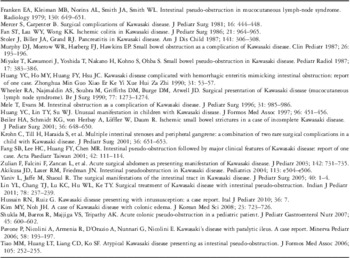
Digestive obstructions may range from a paralytic ileus to a true mechanical obstruction with an ischaemic bowel requiring laparotomy,Reference Beiler, Schmidt, von Herbay, Löffler and Daum 1 – Reference Akikusa, Laxer and Friedman 8 as was seen in our case. The latter is clearly the consequence of vasculitis and thrombosis of the small intestinal arteries and can affect the vital prognosis.Reference Yaniv, Jaffe and Shaoul 2 , Reference Mercer and Carpenter 4 A pathological examination may reveal the true luminal obstructions caused by chronic inflammatory cells and granular tissueReference Mele and Evans 6 as well as thrombosis and focal perivascular lymphocytic infiltration of the small mesenteric arteries.Reference Beiler, Schmidt, von Herbay, Löffler and Daum 1 , Reference Yaniv, Jaffe and Shaoul 2 , Reference Murphy, Morrow, Harberg and Hawkins 5 , Reference Mele and Evans 6 In the group with an acute surgical abdomen reported by Zulian,Reference Zulian, Falcini and Zancan 3 the patients were older with a male to female ratio higher than what is generally observed with classic Kawasaki disease. To the best of our knowledge, update of the initial MEDLINE database research realised by YanivReference Yaniv, Jaffe and Shaoul 2 up to 2002 and actualised here up to October 2012 for Kawasaki disease and intestinal obstruction yielded 22 articles involving a total of 33 patients presenting with digestive obstruction (Table 1). From the available data, the male to female ratio for this population was found to be 3.0. The patient age ranged from 3 to 60 months, with a mean of 22 ± 19 months. Usually, there is a time delay between the onset of the acute febrile illness and the digestive manifestation (mean 13 ± 12 days, range from 2 to 49 days). The majority of patients, 68%, have associated cardiac involvement with coronary artery aneurysms, as was observed in our case. Pseudo-obstruction can be treated conservativelyReference Akikusa, Laxer and Friedman 8 ; however, laparotomy and bowel resection has to be performed in patients with significant peritoneal signs and mechanical obstruction, similar to what was observed in five cases in the literature.Reference Beiler, Schmidt, von Herbay, Löffler and Daum 1 , Reference Mercer and Carpenter 4 – Reference Krohn, Till and Haraida 7 Of these five cases, three received pre-operative immunoglobulins, however, with no modification in the abdominal presentation; one patient died after surgery. Similar to our case, another patient among these five required staged resections during follow-up.Reference Beiler, Schmidt, von Herbay, Löffler and Daum 1
The 22 references citing Kawasaki disease and intestinal obstruction.

In summary, we report the case of a 7-month-old girl with Kawasaki disease in whom acute mechanical small-bowel obstruction developed because of mesenteric ischaemia. This severe complication required multiple digestive resections, leading to short-bowel syndrome and long-term parenteral nutrition. The diagnosis was initially unexpected because the patient had only few signs in favour of Kawasaki disease. Therefore, in young children with fever and an acute surgical abdomen, Kawasaki disease has to be considered in the differential diagnosis.Reference Akikusa, Laxer and Friedman 8 Echocardiography showing a coronary artery aneurysm will help confirm the diagnosis to prompt intravenous immunoglobulin treatment, which however does not seem to change the abdominal prognosis. The combination of both coronary and digestive lesions in Kawasaki disease remains a serious illness, as was confirmed by the initial surgery and the myocardial infarction observed in the mid-term follow-up in our study.