





Introduction
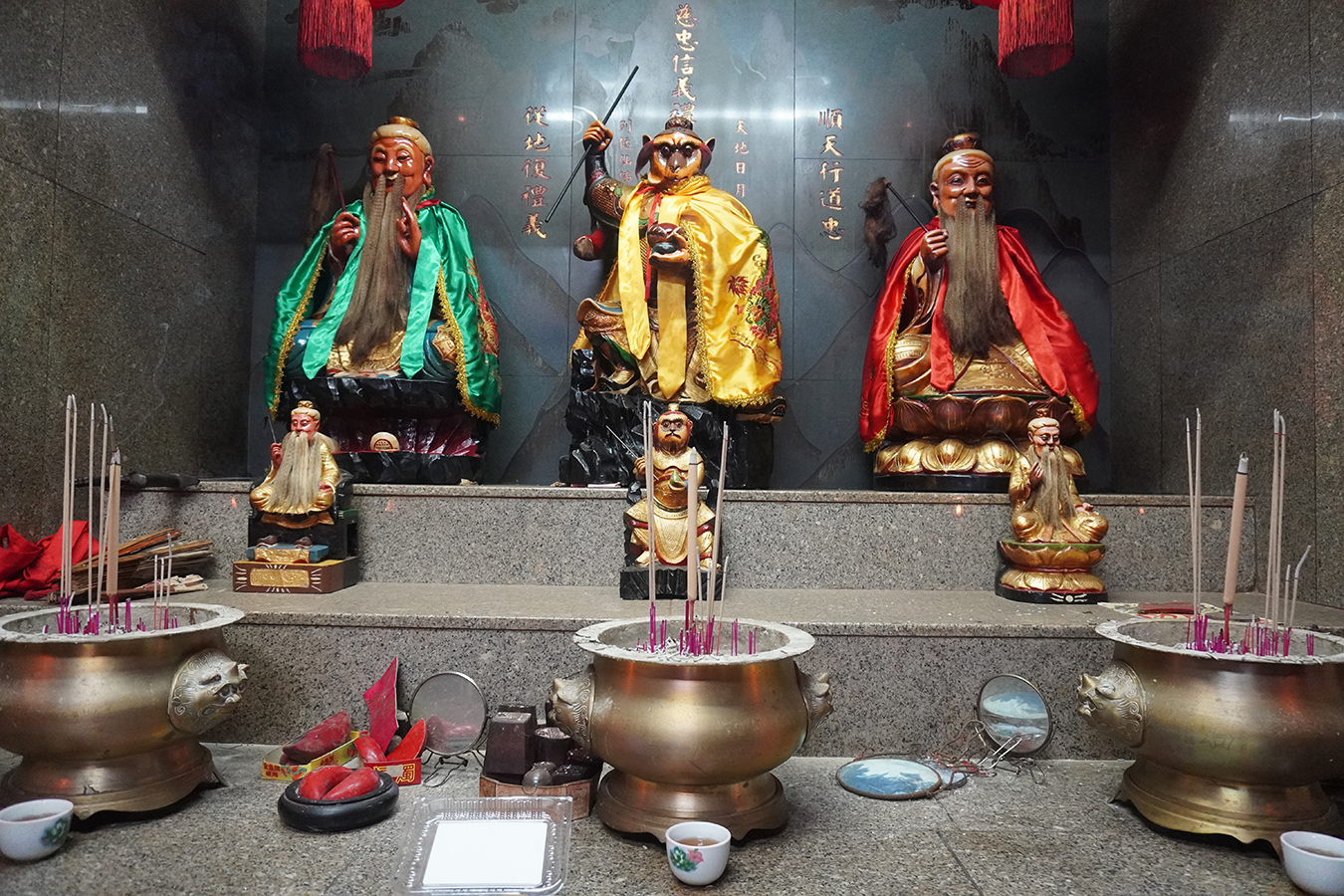
The Cijiao, also known as the Religion of Compassion or the Religion of Huanglao Xianshi, is a Chinese sectarian religion founded in Malaya during the Malayan Emergency (1948–1960).Footnote 1 Like many other Chinese sectarian movements that reshaped Southeast Asia’s socio-religious landscape in the nineteenth century, the Cijiao synthesises the Three Teachings of Confucianism, Daoism and Buddhism. Reflecting this affiliation, Cijiao temples follow a common altar setup, enshrining images of three deities representing Buddhism (the Great Sage Buddha), Daoism (Taishang Laojun), and Confucianism (Huanglao Xianshi) (Figure 1). There are at least 39 Cijiao temples and altars in Malaysia and Singapore today.Footnote 2
A typical Cijiao altar at Chee Teong Tong (Bertam Ulu, Malacca), dedicated to the Great Sage Buddha (Sun Wukong) at the centre, Taishang Laojun (right), and Huanglao Xianshi (from whom the movement derives its namesake, left). Photograph by the author, 11 Jan. 2024

Figure 1 Long description
The altar features three deity statues positioned on a raised platform. The central statue is dressed in gold attire, holding a staff. The statue on the left wears green clothing, while the one on the right is in red. In front of the statues are large incense holders filled with sticks, surrounded by small bowls and offerings. The background is a stone wall with vertical inscriptions. The setup includes additional smaller figures and decorative elements, creating a ceremonial atmosphere.
While the Cijiao’s ethics, rituals and pantheons share roots with Chinese traditions, it differs in two key ways. First, it began with a revelation in a Malayan New Village and lacked any East Asian religious centre until the 1990s. Second, its leaders and initiates stress spirit-medium practice and fa techniques, which involve burning and consuming talismans to produce effects like healing, martial arts ability and personal protection.Footnote 3 Aid-seekers of all backgrounds are welcome, but only initiates who undergo purificatory and initiatory ceremonies can use these techniques.
This article explores the emergence of the Cijiao in postcolonial Malaya, its rapid spread and consolidation across Southeast Asia, and its later expansion to the United States of America (USA) and China in the late twentieth century. It highlights how the movement adapted its doctrines, strategies and outlooks to respond to changing needs across different regions. Central to this process were the migration and mobility of Malaysians and Singaporeans, whose varied travel routes and timelines opened new avenues for the Cijiao’s dissemination while generating unique dynamics and internal tensions. The article argues that the movement’s global reach emerged through prolonged engagement with diverse cultural currents and competing interests across multiple contexts.
Migration, networks and globalisation of Chinese religion in Southeast Asia
The creation, popularisation, and expansion of Chinese religious networks between China and Southeast Asia through a maritime ‘“corridor”—a cultural space that transmits people, wealth, and information in both directions’, has been well established.Footnote 4 From the nineteenth century, institutionalised clergies, including Daoist priests and Buddhist monks, joined the en masse migration of Chinese from Fujian and Guangdong to British and Dutch colonies in Southeast Asia.Footnote 5 Besides offering religious services abroad, they functioned as intermediaries by travelling between sacred sites in East and Southeast Asia, facilitating the flow of resources, knowledge and contacts in both directions.Footnote 6 They also played vital roles in interacting with the postcolonial state in Southeast Asia, and subsequently, affiliated religious organisations in China with the initiation of the Open Door Policy (1978) under Deng Xiaoping.Footnote 7
Similar transregional connections have manifested among sectarian religious movements, whose leadership accompanied the exodus of southeastern Chinese migrants to Southeast Asian colonies (and Thailand) since late imperial China but continued to maintain close connections with religious centres in East Asia. For instance, the Azure Lotus Teachings sustained dynamic exchanges of religious scriptures and leaders between East Asia and Southeast Asia since the Qing dynasty (1644–1911).Footnote 8 This pattern continued with later movements such as the Dejiao and the Zhenkongjiao, which expanded from Chaoshan and Jiangxi to Southeast Asia with the support of well established temples and altars.Footnote 9
This body of research have emphasised the importance of religious actors and their roles in facilitating the transnational circulation of resources between East Asia and their followers among the overseas Chinese communities in Southeast Asia. However, few studies have examined Chinese religious movements that originated entirely from an overseas context.Footnote 10 Although the Cijiao drew on pantheons, ethics and rituals common to Chinese religion, it did not emerge from a defined religious centre in East Asia. Instead, it arose in postcolonial Malaya between 1951 and 1952, well after China’s borders closed in 1949. This case study thus serves to temper conventional historiographies that consider East Asia as the de facto centre of origin for Chinese religious movements.
Several studies on the Cijiao have emerged in the twenty-first century. Xu Liying’s pioneering work offered a comparative analysis of its pantheons and altars in Singapore, while Wang Chenfa situated the Cijiao within the Malayan Emergency, tracing its origins in New Villages and examining internal disputes over rituals and initiation ceremonies.Footnote 11 Often relying upon on rise-and-fall narratives, these studies have pointed to a ‘decline’ in the Cijiao’s recent fortunes.Footnote 12 This was also noted in a recent study, which observed a dilution of the Cijiao’s sectarian identity following its integration into Combined/United Temples due to land management policies in Singapore.Footnote 13
While this article recognises the timelines and ritual systems outlined by previous researchers, it remains cautious of their reliance on rise-and-fall narratives. The Cijiao’s teachings — examined in earlier studies — will be explored in a separate paper on its beliefs, rituals and pantheon.Footnote 14 Instead, this article focuses upon the historical and contemporary social networks of the Cijiao, with a particular emphasis on the crucial roles played by the migration and mobility of the movement’s actors within and across regions.
Outline of study
This article traces the history of the Cijiao across two broad phases: its formation and consolidation in postcolonial Malaya and Singapore from the 1930s to the early 1980s, and its global expansion from the late twentieth century onwards. The first part explores the movement’s origins and its rapid spread under the leadership of its founder and immediate successor, highlighting the critical role of trans- and intra-regional migratory flows and mobilities in shaping its development.Footnote 15 This section situates the Cijiao within broader patterns of travel across British Malaya and Singapore, where movement, mobility, economic subsistence and political mobilisation often intersected. While most existing literature emphasises the socio-political and economic aspects of these activities, this study foregrounds religious travel as an equally significant force of transformation.Footnote 16 It offers a fresh perspective on the formation of Chinese religious movements by examining how the Cijiao mobilised people, ideas and resources across Southeast Asia during a period of intense upheaval and reconstruction.
The second part shifts to the Cijiao’s international expansion beyond Malaysia and Singapore, focusing on a North American branch founded by a Malaysian businessman and a Singaporean temple’s efforts to establish an ancestral temple in Sichuan, China. These developments are examined through cross-regional interactions and the transnational flow of religious ideas, practices and institutions.Footnote 17 In this later phase, migration and travel remained central strategies, but their conditions changed. New opportunities, networks and discourses allowed for the emergence of independent religious centres and significant reformulations of doctrine, ritual and institutional authority. This study proposes that these overseas initiatives were not merely extensions of the original movement but catalysts for its reconfiguration, resulting in a more diffuse and diversified Cijiao that adapted to the distinct cultural and religious environments of its new settings.
To move beyond prescriptive accounts, this study draws upon commemorative volumes published by the Cijiao since the 1970s. As spirit-mediums rarely leave written records, these texts offer rare insight into the movement’s vicissitudes.Footnote 18 While these volumes mainly promoted the Cijiao’s ethics, power and social roles, they also help reconstruct its social history within and beyond Southeast Asia. Many focus on individual temples but include autobiographies that recount founding stories and key figures in other affiliated organisations, offering glimpses into lived experiences beyond doctrinal ideals.
The founding and early development of the Cijiao in British Malaya
The origins of the Cijiao could be traced to Liao Shengjun (1901–1973), a Hakka migrant from Jieyang, Guangdong, who settled in British Malaya. After arriving, he lived with his uncle in Aluo New Village, Malacca, and worked as a rubber tapper. In 1938, before the Japanese Occupation (1942–1945), he moved to Bahau, Negeri Sembilan, to start a tobacco plantation. In Bahau, Liao met 10 men from Haifeng, Guangdong, who practiced divine arts — likely spirit-medium rituals. Initially dismissive, Liao mocked their performances and attire. But when he playfully put on their clothing, he was unexpectedly possessed by Huanglao Xianshi, marking his confirmation as a spirit-medium.Footnote 19
Liao’s early life and migration to British Malaya mirrored the broader colonial political economy, driven by the demand for labour in plantations and tin mines.Footnote 20 Living with his uncle upon arrival reflected the importance of chain migration, where kinship ties with pre-existing settlers provided vital assistance.Footnote 21 Mutual aid from relatives, friends, and religious networks built outside China were crucial in Liao’s settlement and the popularisation of Huanglao Xianshi’s worship abroad. Biographies recounting Liao’s call to serve Huanglao Xianshi highlight both his religious journey and the Cijiao’s informal beginnings. At first, Liao’s role as the deity’s spokesperson resembled a typical spirit-medium following — centred on the bond between clients, medium and patron deity — rather than a formal religious movement.Footnote 22
After the Japanese Occupation, between 1951 and 1952, Liao relocated to a New Village in Tampin, Negeri Sembilan, resuming rubber tapping. One evening, when villagers gathered, Liao was asked to ‘summon the deity of grain to sing mountain songs’, but it was Huanglao Xianshi who manifested. Instead of entertaining them, the deity admonished his audience:
Disaster is imminent, yet you are all still so carefree. Everyone should learn fa to help alleviate suffering and aid those in need. I can teach you.Footnote 23
From that point, Huanglao Xianshi, through Liao, began performing initiation ceremonies and offering martial arts instruction. The following gradually took on the traits of a religious movement, as fa practice gained transcendent significance. This mission soon extended beyond Tampin New Village, with fa and its practitioners crossing geographical and cultural boundaries.
Other miracle tales in Liao’s biography reflect the grim implications of association with Communists in New Villages and the significance of Huanglao Xianshi’s power in protecting his devotees.Footnote 24 In 1952, during a deity’s attendance, an offering plate of oranges broke, with an orange landing atop apples. The deity ominously remarked about the area’s local luck and advised devotees to stay indoors. Within an hour, British troops raided the village, arresting 15 to 16 villagers, including two Cijiao initiates. One initiate, Dai Chengyou, ‘avoided a beating due to the exercise of fa by the old immortal [Huanglao Xianshi]’ during interrogation.Footnote 25 These cryptic prophecies and the benefits of fa in protecting against fears of Communist association and arrest legitimised Liao and Huanglao Xianshi’s power, providing testimonial evidence and momentum to the fledgling movement.Footnote 26
Centralisation, dispersal and dissemination: Mobility as strategy in the Cijiao expanding network
The 1950s was a productive decade for the Cijiao, which expanded beyond Liao’s circle and established temples across Malaya and Singapore. Unusually for a movement rooted in Tampin, Huanglao Xianshi instructed devotees to relocate after the 1952 British arrests, causing Liao to lose contact with many followers. Liao then returned to Renggam, Johor, to resume rubber tapping, while Dai Chengyou moved to Pulau Gadong, Malacca. There, Dai met Lai Gui, a Guanyin devotee. After a Guanyin spirit-medium relayed that Liao had a task from Huanglao Xianshi, Dai and Lai sought him out in Renggam. Persuaded, Liao returned to Malacca and stayed with Lai. Between 1953 and 1954, Liao began formally initiating disciples and conducting ceremonies in Rompin, Bahau.Footnote 27
During this decade, the Cijiao began to institutionalise, with a nascent hierarchy emerging among its worship centres. In 1955, Huanglao Xianshi — likely speaking through Liao — identified a site on Jalan Bachang, Malacca, for a temple. Consecrated in 1957, the Malacca Cizhong Miao (Chee Teong Beow) became the movement’s mother temple. A revelation from the deity emphasised Malacca’s spiritual richness:
Because Malacca is a land of ten thousand Buddhas, many religions spread outward from the state of Malacca.Footnote 28
Malacca’s strategic position within the Straits Settlements and its network of roads reaching into the hinterlands of West Malaysia, including connections to Negeri Sembilan, Bahau and Rompin, facilitated the spread of the movement. The founding of its main temple in Malacca sparked the Cijiao’s growing influence throughout the region.
On the one hand, Huanglao Xianshi temples could be founded through ceremonies of incense division, where new centres were established after incense ashes from an existing Cijiao temple were enshrined.Footnote 29 The Cixin Miao in Batu Kurau, Taiping, for example, was founded by Li Caizhong in 1965, who enshrined incense ashes from the Malacca Terendak Camp Temple.Footnote 30
On the other hand, the founding narratives of several prominent Cijiao temples followed a similar pattern, with several individuals travelling to Malacca, receiving revelations from Huanglao Xianshi during their own initiation ceremonies, and then cultivating a Cijiao following upon returning home. This pattern highlights the importance of the Malaccan Cizhong Miao and Liao Shengjun within the movement. Experiencing in-person initiations and encounters with Huanglao Xianshi at the main temple was clearly a transformative experience, and likely provided the skillset for the newly-initiated to expand the movement’s influence back home.Footnote 31
The Kuala Lumpur Cizhong Miao (Chee Choong Temple), for example, started within a wooden house on Tan Siew Lian Road in 1960, though its origins can be traced back to 1957. Two anonymous forerunners, initiated at the Malacca Cizhong Miao, returned to Kuala Lumpur and began demonstrating martial arts and distributing talismans to cure illnesses. As interest in the Cijiao grew, ‘many people started to gather in groups’. The burgeoning local following invited Liao Shengjun to perform initiation ceremonies. As the following expanded, devotees spearheaded efforts to secure a plot of land for a temple, culminating in the temple’s inauguration in September 1968.Footnote 32
Similarly, the dispersal of visitors from Malacca influenced the establishment of the Cide Miao (Chee Tuck Meow) in Selangor. In 1956, Ye Haiyang from Cheras, Kuala Lumpur, visited the Malaccan Cizhong Miao with a friend’s son who displayed martial arts ‘under the instruction of the immortals’ fa’. Impressed, Ye undertook an initiation ceremony and, upon returning home, taught martial arts to his siblings and others.Footnote 33
Later, Huanglao Xianshi, through an unnamed spirit-medium, decreed the construction of a temple in Kuala Lumpur.Footnote 34 As fundraising efforts progressed, initiation ceremonies took place at the non-Cijiao Shengde Tang temple in Petaling, with a portion of the fees from new initiates reserved for temple construction. Eventually, a site at Cheras, was selected, and the Cide Miao was completed in 1962.Footnote 35 Like the two unnamed individuals who catalysed the founding of the Kuala Lumpur Cizhong Miao, Ye Haiyang played a significant role in promoting veneration for Huanglao Xianshi, fostering interest in communities previously unfamiliar with the Cijiao.
The seeds of inspiration behind the expansion of the Cijiao into new regions could also be sown outside the Malacca Cizhong Miao, as Liao Shengjun was not confined to conducting initiation ceremonies there. In 1956, during an open-air initiation ceremony in Seremban, Huanglao Xianshi instructed Xie Jiuqing to spread the Cijiao in his hometown, Titi. Initially, 50 individuals were initiated, but this number eventually exceeded 300. With no dedicated temple for Huanglao Xianshi, the village temple Guangfu Gong was used temporarily for rituals.Footnote 36
Titi subsequently emerged as a bastion of the Cijiao, as evinced by its contribution towards the successful establishment of the Malacca Cizhong Miao in 1957 during the post-World War period of rising rubber prices.Footnote 37 Titi, known for its susceptibility to Communist infiltration, was under strict British surveillance during the Emergency. The popularity of the Cijiao may have been bolstered by its rituals for self-protection, mirroring Liao’s earlier success in Tampin.Footnote 38 In 1957, an altar for Huanglao Xianshi was established in Titi, becoming a hub for ritual boxing and spiritual guidance. Supported by Malaya’s rubber boom, the community funded a temple’s construction, consecrated by Liao in 1959 and named Ciren Tang (Chee Yin Tong) by Huanglao Xianshi.Footnote 39
The spread of the Cijiao in Singapore, despite its compact geography, involved multiple avenues. One of the earliest efforts was initiated by a small group of Huanglao Xianshi devotees, including siblings Lan Xianrong and Lan Xianzhuo. In early 1958, Liao Shengjun used Wanfu Tang, a vegetarian hall at Bukit Panjang, to conduct initiation ceremonies for about 10 individuals. Due to space limitations, they later used the grounds of the Tiangong Dimu Temple, managed by Jian Ziran, for further ceremonies. Liao’s subsequent return saw participation grow to over 41 individuals, highlighting the Cijiao’s growing popularity.Footnote 40
A second avenue for the Cijiao’s expansion emerged through Jian Ziran herself. She fully embraced the Cijiao later in her life, journeying to Malacca for her initiation. Following orders from Huanglao Xianshi to expand the movement in Singapore during her initiation, Jian established an altar to the deity within a temple known as Jinbao Fomiao.Footnote 41 The shrine’s growing popularity led her to secure a temporary site in Geylang for the Singapore Cizhong Miao, which was consecrated by Liao Shengjun in 1960.Footnote 42 As the three-year lease ended, Jian found a permanent premise for the temple in 1963, where the temple remains to this day.Footnote 43
This sample of accounts demonstrates that the Cijiao’s expansion throughout post-war Malaya heavily relied on travellers and returnees spreading the benefits of venerating Huanglao Xianshi and practising fa. Footnote 44 Local promoters were crucial in extending the movement into communities without established Cijiao temples through three main strategies. Firstly, they used fa and public martial arts demonstrations to introduce the movement to a foreign audience. Secondly, they organised the consolidation and initiation of new devotees by Liao during his visits. Thirdly, in the absence of a dedicated Cijiao temple, they temporarily appropriated other religious sites for initiation ceremonies, providing a gathering point for devotees.
Liao Shengjun played three significant roles in expanding the Cijiao. Firstly, he maintained cohesion within the dispersed community by travelling extensively, performing initiation ceremonies, and using these encounters to exercise his charisma. While his exact means of communication with local constituents remain unknown, it is likely that different nodes of the Cijiao network kept each other informed of his travels. Liao’s journeys were probably undertaken when local agents confirmed significant support and potential conversions.
Secondly, initiation ceremonies served as fundraisers for new temples within the local community. A portion of the ceremony’s costs was earmarked for temple construction. For example, during Liao’s second visit to Singapore in 1958, the cost of rituals was $22, with $6 for ‘miscellaneous fees’ and the remainder for a ‘temple construction fund’.Footnote 45 The size of these ceremonies may have served as barometers for the Cijiao’s popularity, and revelations from Huanglao Xianshi likely reflected realistic assessments of local interest and financial support.
Finally, as Huanglao Xianshi’s spirit-medium, Liao expanded the Cijiao’s physical presence by consecrating new temples. These organisations created important nodes for initiation ceremonies and consolidated the movement’s influence. During the early 1960s, Liao travelled extensively for temple consecrations. In 1961, he consecrated the Cizhong Tan (Chee Tong Temple) in Singapore, which later became a temple. In 1962, he consecrated the Cizhong Miao in Bahau and the Terendak Camp Temple in Malacca. In 1963, he consecrated another shrine in Ama Keng, Choa Chu Kang, Singapore.Footnote 46
Liao Shengjun’s travels from his base at the Malacca Cizhong Miao aligned with the temple’s growing influence within the Cijiao movement since its inception. This temple became an essential hub for spiritual guidance, with leaders from other temples frequently visiting to seek Liao’s counsel. In 1959, for instance, Lan Xianrong from the Singapore Cizhong Association (Chee Chung Huay) consulted with Huanglao Xianshi and Liao at the Malacca Cizhong Miao regarding ritual matters. During this visit, Huanglao Xianshi offered reassurance, promising success if they remained sincere.Footnote 47 These visits significantly bolstered the credibility and legitimacy of the visitors, affirming their interpretation of orthodoxy through direct interactions with the movement’s authority in the Cijiao’s mother temple.
There is also evidence of a monetary support system which connected other Cijiao temples to the Cizhong Miao in Malacca, aiding in its construction and maintenance. During the aforementioned dialogue between Huanglao Xianshi and Lan from Singapore in 1959, Huanglao Xianshi revealed that new initiates were expected to contribute $12 earmarked for temple construction, and a monthly contribution of one dollar for maintenance.Footnote 48 This system of financial contributions underlines the temple’s role in a broader network of resource-sharing among Cijiao temples. The establishment of the Malacca Cizhong Miao was also aided by financial support from areas where the Cijiao had a strong presence, such as Titi and Yong Peng in Johor, which experienced economic prosperity following the post-war rubber price boom.Footnote 49
Further testament to the strong multilateral connections and the Malaccan Cizhong Miao’s significance within the Cijiao network was evident during the 1960 assembly to elect the temple’s 15 committee members. Cijiao representatives from across Malaya, including Singapore, were in attendance. This meeting included two attendees from Singapore, 15 from Johor, 40 from Negeri Sembilan, 12 from Malacca and nine from Selangor, for a total of 78 representatives from 43 constituencies underscored the temple’s role as a centralising force within an extensive religious network spanning Malaya.Footnote 50
This gathering and the logistical efforts to bring together a widely spread religious community indicate a deep commitment among the Cijiao’s followers from Malaysia and Singapore to oversee the well-being of the movement’s main religious centres through a shared governance structure. While the current extent of such collaboration is not fully known, the efforts to convene this dispersed community at that time highlight the significance of the Malacca Cizhong Miao, which fostered a sense of identity within the scattered religious movement during the Cijiao’s early stages.
Routinising initiation: Li Youpu’s leadership (1970s onward)
By the 1970s, initiation practices in the Malaysian Cijiao movement began to shift as Liao Shengjun’s health declined. Before Liao’s passing in 1973, Huanglao Xianshi, speaking through him, appointed Li Youpu (d. 1989) to perform initiation rites on his behalf.Footnote 51 According to his biography, Li did not begin as a devotee of Huanglao Xianshi nor an acquaintance of Liao. During his thirties (ca. 1939–1949), Li was advised by three deities in a dream to ‘search for Liao to receive the techniques of fa’. Following the guidance to look for a man ‘in a straw hat and grey clothing’, Li boarded a train to Tampin Road Station, which bordered Malacca and Negeri Sembilan.Footnote 52 Coincidentally, Liao also received a similar instruction in a dream to wait there. Upon Li’s arrival, and echoing what Franciscus Verellen termed as a trope of ‘encounter as revelation’ in Daoist hagiographies, both men recognised each other from their dream experiences.Footnote 53 After inviting Liao to his home for dinner, Li requested Huanglao Xianshi to transmit the techniques of fa, and he was initiated into the Cijiao.Footnote 54
The meeting between Liao and Li is noteworthy for two reasons. Firstly, the British colonial railway’s penetration into Negeri Sembilan facilitated movement. The West Coast line connected Tampin to Malacca, the Malayan-Thai border, and Singapore, primarily transporting commodities like tin, rubber and lumber. While railways facilitated resource extraction for British benefit, they also enabled travellers and Cijiao promoters like Liao to reach potential converts.Footnote 55 Secondly, the station metaphorically marked a crossroads in Li’s spiritual journey, embarking on a new path guided by his dream revelation and Huanglao Xianshi. After this encounter, Li served as Liao’s travelling companion, visiting Cijiao followings in Yong Peng, Negeri Sembilan and Titi, familiarising himself with his future religious charges.Footnote 56
Li Youpu’s religious career prospered from 1958 onward, when Huanglao Xianshi, through Liao, consecrated the Ciren Miao (Chee Xin Meow) in Seremban. Li was then appointed by Huuanglao Xianshi as the temple’s resident spirit-medium, dispensing medicine and cures. Given Li’s success, numerous aid-seekers from Negeri Sembilan, Selangor, Malacca, Johor and Singapore flocked to the temple.Footnote 57
Li’s growing importance is evidenced by his performance of consecration ceremonies. In 1962, he presided over the Cide Miao’s consecration in Kuala Lumpur.Footnote 58 Reflective of his growing stature, his photograph appears right after Liao’s in commemorative publications.Footnote 59 Li functioned as an effective aide and successor to Liao, solidifying his claim to leadership within the Cijiao through his thaumaturgy. After Liao’s passing in 1973, Li assumed leadership within the Cijiao, taking over ritual affairs at the Malacca Cizhong Miao. He was appointed as the ‘overseer of initiation rituals’, a position he held until his passing in 1989, responsible for initiating new entrants.Footnote 60
Li’s earlier travels with Liao likely acquainted him with the leadership of different temples, preparing him for his responsibilities from the early 1970s onward. Across two decades, he visited Malaysia and Singapore to conduct initiation ceremonies, which extended to the ‘Singapore Cizhong Miao, Yong Peng, Titi, Batu Pahat, as well as to further locations such as Taiping, Kuantan, Mengkarak, Pulau Ketam, Kuala Kurau, Salak South, Termerloh and Lukut’.Footnote 61 Unlike Liao, Li’s initiation ceremonies underwent transformation due to growing demand. At the peak of his career, 28 Cijiao temples were officially registered throughout Malaysia, serving as sites for consolidating prospective entrants.Footnote 62 These organisations allowed Li to conduct mass initiation ceremonies without relying on non-Cijiao premises.
Several temples regularly engaged Li for initiation ceremonies. The Kuala Lumpur Cide Miao noted that Li visited approximately three times a month to oversee these events, which typically included around 10 individuals and started at nine in the evening, lasting about two hours. Participants came from Kuala Lumpur, Kuala Selangor, Tanjung Karong and even Singapore.Footnote 63 Although the duration of such arrangements were not mentioned, such ceremonies highlight the sustained demand for Li’s services and suggests an effective means of communication within the Cijiao network to coordinate Li’s itinerary. Unlike Liao’s ceremonies at makeshift locations, Li insisted on conducting rituals at established Cijiao temples, reflecting the movement’s growing maturity.
Unlike the sparsely documented and presumably spontaneous travel arrangements characteristic of Liao’s time, Li’s excursions were meticulously planned. As the ‘only spirit-medium who could perform initiation ceremonies’, temples seeking his attendance had to request his approval through formal invitation letters. This allowed him to ‘choose a date to go, to avoid excessive fatigue’ from travelling unsystematically throughout Malaysia and Singapore.Footnote 64 In fact, Li ‘solemnly’ emphasised that any requests must be accompanied by a formal letter of invitation, a provision which almost certainly stemmed from the inundation of informal requests he (and possibly Liao Shengjun himself) received, thus prompting him to reject this method of communication.Footnote 65 Proto-bureaucratic communication channels, manifesting in written correspondence, signalled an increasingly mature phase of organising Cijiao’s initiation ceremonies.
Like Liao Shengjun, the Cijiao’s activities, notably the performance of initiation ceremonies into the movement, continued to centre around his successor, Li. However, informed by practical logistics and surging demand, the movement also extended beyond his direct influence by coordinating prospective entrants and their respective temples into a routine for Li to fit into his itinerary, demonstrating a level of transregional organisation and collaboration that was not noticed during Liao’s leadership.Footnote 66
The global spread of the Cijiao from the 1980s onward
This article now explores the Cijiao’s foray into the USA and China from the 1980s. In both locations, efforts to attract more international visitors for business and leisure played a pivotal role in facilitating the establishment of the Cijiao’s presence. This section serves two main purposes. Firstly, it elaborates on the argument made earlier in this study regarding mobility and migration as strategies for the movement’s expansion into new territories.
Secondly, an examination of both overseas initiatives reveals a notable shift in power dynamics within the Cijiao, as the hierarchical structure that once characterised the movement has transitioned towards a heterarchy. By the late twentieth century, Cijiao centres increasingly operated through multiple, overlapping and interconnected levels without a single source of central authority or control.Footnote 67 Previously, we observed the central role of the Malacca Cizhong Miao in the movement’s activities, alongside Liao Shengjun and Li Youpu, who led the movement. However, as the Cijiao’s international network expanded, both the Malacca temple and its key figures became increasingly peripheral.
In this new post-1980s environment characterised by heterarchy, institutions and actors could unilaterally exert greater influence compared to other Cijiao organisations and leaders. They could do this by garnering support for their own overseas initiatives and revelations from Huanglao Xianshi, irrespective of their positions in the old system. The expansion of the Cijiao outside of Southeast Asia, I argue, demonstrates a pattern of shifting centres, where its perceived core is never fixed but constantly redefined in response to local conditions. Further supporting the case for decentralised expansion, its presence in the United States and China evolved in ways that distanced it from a single fixed centre. Throughout both case studies, we see how migration and mobile actors provided the Cijiao with new opportunities to expand its influence into new regions. These activities, as we shall see, were both the cause and consequence of the network’s heterarchy, setting the stage for the emergence of novel discourses and reshaping power dynamics within the Cijiao religious network.
Examining the Cijiao’s expansion into the USA and China highlights its ‘decentralized, heterogeneous and transnational structure’, as the movement adapted and localised in distinct ways across these regions.Footnote 68 In the USA, it shifted towards eco-spiritualism and esoteric teachings, whereas in China, it re-emerged through an ancestral temple that repositioned its origins within the broader landscape of Chinese religious and geographical heritage. These cases illustrate how decentralised expansion enables religious movements to develop divergent trajectories across transnational contexts while maintaining a flexible sense of continuity.
This section begins by examining the popularisation and subsequent creolisation of the movement into Euro-American spiritual systems within the USA, a phenomenon which occurred independently of the movement’s beliefs and rituals in Southeast Asia. It then continues with a discussion of the search for the Cijiao’s ancestral temple in China by a temple in Singapore, despite Huanglao Xianshi’s earlier designation of the Malacca Cizhong Miao as the movement’s mother temple.
Expansion of the Cijiao to the United States
In his lifetime, Li Youpu mentioned that the Cijiao had several footholds overseas, with adherents promoting Huanglao Xianshi’s worship in the USA, Britain, and Brunei.Footnote 69 While little is known about the latter two locations, detailed accounts of the American branch, known as the Chee Hau Center, are found in commemorative magazines published by Cijiao temples in Kuala Lumpur and Singapore.Footnote 70 This section explores how the Cijiao branch was introduced and acculturated into North America, adopting elements familiar to its new context and transforming significantly from its Southeast Asian origins.
Like Liao Shengjun in Malaya, the Chee Hau Center’s establishment in the USA was credited to a Huanglao Xianshi spirit-medium who travelled there, facilitating the deity’s presence. Movement and mobility remained crucial organising principles for the Cijiao’s spread in the USA. However, while the reliance on mobile leaders and routines for expansion persisted, the similarities between the Chee Hau Center and its Southeast Asian counterparts end there.
The inclusion of the Chee Hau Center’s history in Southeast Asian commemorative volumes suggested it was seen as an extension of the movement. However, the American branch underwent significant acculturation, evolving independently to cater to the American audience. While it maintained some traditions, such as initiation ceremonies, these played a marginal role. The Chee Hau Center prioritised New Age beliefs and eco-spirituality, contrasting sharply with the Cijiao’s practice of fa in Malaysia and Singapore.Footnote 71
Unlike other sectarian religions that have gained traction in Europe and America, such as the Yiguandao, which typically maintained continuity with its traditions in foreign settings, the Cijiao in America took an alternative route. It actively sought to appeal to a predominantly Euro-American audience and generated interest beyond a predominantly ethnic Chinese base through a radical reinterpretation of its teachings.Footnote 72 Although no specific numbers are available for the Chee Hau Center, the few commemorative photographs that are published indicate that the majority of its members were Euro-Americans.Footnote 73 This case study of the Cijiao’s appeal to a non-Chinese following offers valuable insights for comparison with other Chinese religious movements attempting to expand into Euro-American societies.
Migration and mobility: Leong Tan and the Cijiao in North America
The spread of the Cijiao to North America mirrored migration patterns of Chinese immigrants seeking business, travel and leisure opportunities in the USA. The Immigration and Nationality Act of 1965 removed nation-specific quotas and abolished discrimination based on national origin, race and ancestry for immigration. This ‘favoured (the arrival of) an Asian cultural elite’, carrying with them ‘literature about Asian spiritual teachings’.Footnote 74 The Cijiao was among many Asian religious practices that benefited from globalisation into North America.
Leong Tan, founder of the Cijiao USA branch, was initiated in Kuala Lumpur in 1973 and served as a spirit-medium for Huanglao Xianshi.Footnote 75 In 1984, after leaving the military, Leong moved to Southern California for business. His background as a soldier aligns with the Cijiao’s rise during the Malayan Emergency, when its techniques were seen as aiding survival.Footnote 76 In Los Angeles, Leong met a Chinese woman who ‘showed an interest’ in the deity and began inviting others to see Huanglao Xianshi.Footnote 77 Leong’s followership grew, and within a year, he hosted ‘a retreat workshop in eastern Tennessee’, which led to more workshop requests nationwide. ‘[A]fter that retreat, many students began to ask that Leong Tan travel to other parts of the country to hold workshops with the Teacher’.Footnote 78 Over time, these workshops and retreats expanded beyond Tennessee to nine cities, including Portland, Boulder, Memphis, Knoxville, Birmingham, Alta, Orlando, and State College, in addition to Los Angeles. Larger retreats were held four times a year in remote locations in Tennessee, North Carolina, Colorado, California and Oregon.Footnote 79
Like Liao Shengjun in Malaysia, Leong’s fame spread through encounters with Huanglao Xianshi, drawing people to him as interest in the deity grew. Despite the distance, word-of-mouth — driven by those who were drawn to Leong — likely fuelled this spread. Devotees gathered in key cities, easing access to the deity’s teachings. As Huanglao Xianshi spoke only through Leong, routinised travel — seen in figures like Li Youpu — became crucial, requiring careful planning as the movement’s reach grew.
Context, change and creolisation: American transformations of the Cijiao
Although Leong Tan followed Liao Shengjun and Li Youpu in leading a mobile life to spread the Cijiao, the Chee Hau Center’s discourses differed from its Southeast Asian counterparts. Due to historical discrimination against Chinese communities in North America, a direct transplant from Malaysia was impractical. The movement had to adapt to a landscape already shaped by existing beliefs. One strand included American New Age beliefs, shaped by post-1965 immigration flows. The inclusion of Eastern religious ideas like the Cijiao’s sparked not religious syncretism but a dynamic process of ‘religious combination and cultural integration’.Footnote 80 This blending of cultural systems often unfolded in unexpected ways, favouring American markets and worldviews. The Cijiao’s adaptation — and partial absorption — into post-1960s spiritual frameworks was not unusual, but reflective of wider transregional cultural encounters.
Considering the Chee Hau Center’s major revisions to align with American preferences, Southeast Asian Cijiao temples had little influence over this branch. Their lack of response likely stemmed from unawareness, distance or both. Yet, the Center’s activities were recorded in commemorative volumes by temples in Singapore and Kuala Lumpur, suggesting a degree of tolerance or tacit endorsement. Its autonomy in adapting teachings highlights its relative independence, marking the rise of a distinct power centre in North America, separate from the Cijiao’s stronghold in Malaysia.
One major adaptation was the apparent reduction of initiation ceremonies to a vestigial role in the American context. In Malaysia and Singapore, initiation into the practice of fa was the key rite of entry, involving extended purification, strict ethical rules, food taboos and the daily consumption of talismans. These practices are well-documented in the Cijiao’s commemorative volumes and prescriptive texts.Footnote 81 The proliferation of such accounts testified to the centrality of initiation ceremonies, the follow-up rituals and the responsibilities that accompanied it in Southeast Asia.
In contrast, initiation and the practice of fa appeared to play a minimal role at the Chee Hau Center. While Huanglao Xianshi did express interest in initiating students — typically in groups of seven from special classes for those ‘interested in deepening their spiritual connection’ — the practice was only briefly mentioned. Despite ‘several hundred initiated students’ across 26 states, initiation remained vaguely referenced and largely undescribed. Nothing else was said about how these events were conducted, or what forms of religious discipline and practice was expected from entrants, aside from a brief mention of how Leong Tan’s own initiation in 1973.Footnote 82
The brief mentions of American initiation ceremonies — in stark contrast to their detailed treatment in Malaysian and Singaporean publications — suggest that such rites, along with the practice of fa, became largely peripheral in the U.S. context. Rather than focusing on martial arts or ritual techniques, the deity reportedly oversaw ‘meditation, spiritual healing, and philosophy’. This shift reflects a move away from the ritual and martial arts emphases of the Southeast Asian Cijiao toward a more philosophical and spiritually oriented discourse tailored to an English-speaking audience.Footnote 83
Most significantly, and indicative of the deity’s adaptation to his new devotees’ language barriers, through his spirit-medium, Huanglao Xianshi, who ‘originally spoke in Chinese’, ‘now spoke in English’.Footnote 84 This was undoubtedly unusual, for Bernard Formoso noted that ‘Chinese (either Mandarin or the Chaozhou dialect) is believed to be the only idiom to render the true commands of the gods, even if messages are sometimes expressed through English, Arabic (in Malaysia), and Thai (in Thailand)’.Footnote 85 Chinese deities, in short, were expected to conform with their ethnicity, and render their revelations in a Sinophone language to generate ‘a unique situation of authoritative transmission’.Footnote 86
Huanglao Xianshi’s use of English in the USA, though unconventional, was a crucial adaptation that enabled the Cijiao to resonate with an English-speaking audience. This break from Chinese norms reflects the deity’s flexibility in navigating new social and religious landscapes, prioritising local appeal over its West Malaysian origins. In short, while there was genuine interest in the Cijiao, its reach in American society depended on radical adjustments to its outlook and rituals. Though Malaysian religious techniques offered inspiration, they had to be rebranded to fit American tastes, where ‘the circulation of religious ideas, practices, and objects is filtered through uniquely American cultural structures and traverses uniquely American organizational channels’.Footnote 87
After gaining traction in the USA, the Cijiao seems to have shifted its discourse from an institutionalised religion to personalised ‘spirituality’.Footnote 88 This is reflected in the Chee Hau Center’s choice of the term center and its emphasis on a sense of belonging and a place of cultivation. The term temple — mentioned only once in Leong’s testimony — appears to have been intentionally avoided.Footnote 89 By presenting itself as a retreat center, the American branch aligned with themes of holistic wellness, esoteric techniques, and spiritual renewal, drawing on Asian traditions. This approach contrasted sharply with the formalised ethical codes and rituals required of Cijiao practitioners in Malaysia.Footnote 90
The Chee Hau Center’s embrace of eco-spirituality further marked its adaptation to American sensibilities, appealing to seekers of ‘ultimate meaning and transformative power in nature’.Footnote 91 Its construction plans highlighted 58 acres of land in central Tennessee, described as ‘very remote’ and ‘in its pristine, natural state’, chosen for its potential to ‘provide a strong connection to nature’. Leong himself also realigned his promotion of the Cijiao with such interests, framing his personal mission as one which offered his followers ‘an earthly connection’ and tantalisingly noted that ‘nature is part of the learning’.Footnote 92
In contrast, such environmental consciousness held little relevance for the Cijiao in urbanised Malaysia and Singapore. The movement emerged amid widespread environmental degradation caused by extractive industries, plantation agriculture and logging during colonial and postcolonial development.Footnote 93 Even during the Communist Emergency — when British concerns about deforestation and soil erosion were high — figures like Liao Shengjun and Cijiao publications made no mention of environmental issues, revealing a general indifference to ecological matters.Footnote 94 The Chee Hau Center’s eco-spiritual turn, though guided by Huanglao Xianshi, demonstrates how the American branch evolved into a distinct phenomenon with little resemblance to its Malaysian origins.
The Cizhong Tan’s quest for an ancestral temple: resituating the cultural core in China
Having charted how the Chee Hau Center creolised independently from its Southeast Asian counterparts, this section turns to the overseas initiative of the Cizhong Tan, a Cijiao temple in Singapore. Consecrated by Liao Shengjun in 1961, the temple sought — under revelations from its Huanglao Xianshi spirit-medium from 1990 onwards — to link the movement’s spiritual origins to an ancestral temple in Sichuan, China. This initiative moved forward despite the Malacca Cizhong Miao, established by Liao, already holding the status of the movement’s mother temple.
The Cizhong Tan’s search for the Cijiao’s ancestral temple stems from a two-part prophecy, the first revealed in the 1960s. At that time, Huanglao Xianshi foretold that the temple ‘will later develop into a very large and grand manner. At the same time, [the temple] will erect a hall in the teacher’s ancestral village’. The deity expressed ‘a deep discontent for remaining homeless for over a thousand years’, but added that the temple must ‘wait until the opportunity was ripe’ before he would give further instructions.Footnote 95
Toward the late 1980s, the Cizhong Tan appeared to fulfil the first part of the deity’s prophecy with the construction of a grand temple in Hougang, Singapore. When the temple relocated there in 1987, Huanglao Xianshi personally advised on its design. While maintaining a consistent altar for the movement’s three deities, the temple adopted a modernist, pyramid-inspired façade with sloping sides — a sharp break from the traditional arched and tiled roofs of Chinese temples. According to the deity, the temple’s form served a pedagogical role, as its ‘design can help visitors to the temple dispel any misconceptions they may have about temples, and allow the entire world to better understand the doctrines of the three masters’.Footnote 96
In June 1990, Huanglao Xianshi expressed his readiness to reveal the second part of his prophecy and guided 33 members of the Cizhong Tan to Sichuan, China, to ‘search for the birthplace of the three masters and sightseeing’. The task was daunting, as the group was ‘still unfamiliar with Sichuan, where everything about the place feels strange, with its myriad threads and countless buildings, and thus did not know from where to start’.Footnote 97
Four aspects of the prophecies from Huanglao Xianshi’s spirit-medium at Cizhong Tan in Singapore merit attention. First, the temple’s pursuit of the overseas project appears to have been autonomous. There is no mention of consultation with other Cijiao temples, suggesting initial support came solely from within Cizhong Tan. Second, the temple’s openness — along with its spirit-medium — to drawing on unconventional sources for its design reflects a willingness to distinguish itself from broader Cijiao or Chinese religious norms. It is therefore unsurprising that Cizhong Tan embarked on a mission to China in search of the Cijiao’s ancestral temple, despite the movement’s historical roots in postcolonial Malaya.
Thirdly, Huanglao Xianshi’s identification of inland Sichuan as the Cijiao’s place of origin was striking and unusual, given that Liao Shengjun and most ethnic Chinese in Malaysia and Singapore trace their roots to southern and coastal China.Footnote 98 The Singapore delegation’s account of hardship underscored both their commitment and the challenges of navigating Sichuan — a region with which they had little kinship, historical connection or linguistic familiarity. Finally, while this study does not examine the responses of individual temples to the ancestral temple search, it is notable that many Cijiao temples omitted the episode from their post-1990s commemorative volumes. This may reflect a lack of awareness or, more likely, limited enthusiasm for the revelation. Still, the project clearly gained support among certain Cijiao circles and devotees, as shown by its coverage in select publications and the participation of some temples in visits to the Sichuan site.
The revelation and establishment of Sichuan as the Cijiao’s birthplace
Let us now return to the detailed circumstances behind the revelation that established Sichuan, specifically Lingyan Mountain, in Dujiangyan, as the Cijiao’s birthplace according to the Cizhong Tan’s spirit-medium. Upon reaching Chengdu, Sichuan, Huanglao Xianshi’s spirit-medium provided specific instructions:
Heading in the east-west direction (sic.), winding into a small path, one must pass through a small stream. Upon reaching a hill, the path becomes difficult, and the ancestral temple and rooftops are no longer visible. The incense censer is broken, but upon arrival, there will naturally be someone to guide you.Footnote 99
As a result, the group arrived in Dujiangyan City. Over lunch, they met Yang Chengxun, the restaurant manager, who recalled a childhood site that matched the deity’s revelation. Yang brought them to a temple ruin: ‘the main hall no longer stood, with only a few stone pillars remaining. In the middle was a lotus seat, surrounded by damaged statues of various Immortals and Buddhas’. Above, the words ‘Compassionate Winds and Dharma Rain’ were inscribed — the first character being the origin of the Cijiao’s name.Footnote 100 Through his spirit-medium, Huanglao Xianshi confirmed that the Cijiao’s place of origin and the deity’s lotus throne in China had been found.Footnote 101
Three months later, a Sichuanese delegation visited Singapore for a sales product exhibition. Its leader, Ding Minchu, learned of the revelation and visited Cizhong Tan to worship Huanglao Xianshi. Subsequently, Ding offered to liaise with the authorities. He connected the temple with the Chinese Consulate General in Singapore and, in turn, with the Sichuan Cultural Relics Bureau. After reviewing Cizhong Tan’s findings, the Bureau confirmed that a temple had once stood on the site, built by the renowned monk Ashiduo during the Tang dynasty (618–907 CE).Footnote 102
By November 1990, Cizhong Tan began working with the Dujiangyan Bureaus of Artifacts and Culture. They sought construction quotations, drafted blueprint, and calculated compensation for relocated communities. Between November 1991 and May 1992, Cizhong Tan members finalised a contract with Dujiangyan authorities and managed the project through multiple trips between Singapore and China. In October 1992, the Lingyan Huanglao Xianshi Memorial Hall officially opened, attended by over 100 devotees from select Cijiao temples in Singapore and Malaysia.Footnote 103
Huanglao Xianshi’s identification of his birthplace in Sichuan — a region with minimal historical ties to Chinese communities in Malaysia and Singapore — and the eventual temple construction there, can be contextualised on three fronts. First, the project was guided entirely by divine revelation and chance meetings, as recorded by the Cizhong Tan. This mirrors what Emily Hertzman describes as ‘informal, spontaneous, and idiosyncratic encounters’ in her study of Indonesian Chinese religious networks, where ‘transnational religious connections’ often began through divine messages, tourism and incidental contact with people or sites in Sichuan.Footnote 104 The temple’s emphasis on spirit-medium revelations and their confirmation through such encounters appears to be the main driving force behind its recognition of the Cijiao’s ancestral temple in Sichuan, having no prior ties with the area.
Secondly, the Cizhong Tan’s acceptance of spirit-medium revelations marks a clear departure from the kinship- and lineage-based practices typically seen in overseas Chinese temple building efforts in China. Kuah Kuhn Eng Pearce, for instance, has shown how Singaporeans helped reconstruct temples in Anxi based on familial ties to ancestral villages.Footnote 105 Similarly, Kenneth Dean and Zheng Zhenman’s study of Putian communities in Fujian demonstrated how diasporic ties and religious networks often reinforced one another in temple construction.Footnote 106 Moreover, unlike another case of temple building in Jinhua, China, by a Taiwanese woman with ‘only business connections, but not kinship links’ with the locality, there is no evidence of prior commercial interests in Sichuan on Cizhong Tan’s part.Footnote 107 As such, the Cizhong Tan’s effort appears as an exception to the rule, where spirit-medium revelations served as the main catalyst for its temple building initiative abroad. Prior affiliations on the temple leadership’s part did not seem to have played a significant role in shaping the discovery of the Cijiao’s ancestral temple in Sichuan.
Finally, mobile actors and agents played a crucial role in the efforts of the Cizhong Tan to create and maintain transnational connections while pursuing its project of constructing an ancestral temple in China. The opening up of China to foreigners during the 1980s provided an opportunity for the temple to search for the birthplace of Huanglao Xianshi, where ‘tourism in the post-Mao era was adopted as a strategy for its open-door policy to eventually achieve economic development’.Footnote 108 Ding Minchu’s arrival in Singapore also mirrored the influx of a new generation of Chinese businessmen and traders who sought economic opportunities abroad amid China’s economic globalisation and liberalisation.Footnote 109
Serving as intermediaries well-placed within Singapore and China, individuals like Ding played a pivotal role as conduits for the Cizhong Tan’s interests, facilitating the advancement of their objectives by connecting them with Chinese bureaucracy agencies. State organisations in Sichuan, drawing on religious records, also sought to retain the interest, and affirm the investment, of its Singaporean tourists by providing a historical basis for their spirit-medium revelations. The subsequent visits of the Cizhong Tan’s leadership between Singapore and China to oversee the logistical aspects and construction of the ancestral temple were equally indispensable for realising the project.Footnote 110
Despite similarities in relying on mobile actors to realise its vision, the Cizhong Tan’s initiative differed from earlier temple building efforts in Southeast Asia in one key respect. In postcolonial Malaya, new temples typically followed rising local interest in the Cijiao, with community-driven efforts forming committees, fundraising and organising initiation ceremonies. By contrast, available sources suggest that local communities in Dujiangyan had little prior exposure to Huanglao Xianshi’s worship before the ancestral temple’s construction. There is no observable evidence that the Cijiao’s thaumaturgical rituals or initiation ceremonies had any significant local impact. Instead, the project was spearheaded by overseas Chinese responding to divine revelation. The Cizhong Tan’s repeated visits to Dujiangyan (1990–1992) drove key milestones — contract signings, image carvings and construction oversight — underscoring their role in steering the initiative.Footnote 111
The few descriptions of local involvement only registered their attendance at key ceremonies.Footnote 112 During the groundbreaking ceremony held in Dujiangyan in 1991, Huanglao Xianshi mentioned that ‘the people in the village were all his friends, and that he was very grateful’ for returning to the site, before conveying his blessings upon the locale. The temple’s official opening in 1992 also witnessed the arrival of ‘thousands of local villagers and elders who came to Lingyan Mountain to participate in this grand event’, where they were joined by select Cijiao temples and devotees from Southeast Asia.Footnote 113 Despite local participation, it is unlikely that the residents of Dujiangyan had any prior or sustained interest in the Cijiao’s religious teachings and rituals.Footnote 114 Unlike earlier instances of temple building in Malaysia and Singapore, the immediate locality of Dujiangyan seems to have played a relatively peripheral role in the temple’s construction, despite it happening within their midst.
Nevertheless, it is important to acknowledge the significant roles played by other actors, particularly Sichuanese individuals and local bureaucracies, in realising this initiative. Authorities involved in regional affairs facilitated the project, seeking to maintain overseas Chinese interest — and secure investment — by supplying historical data that affirmed the temple’s hierophanic revelations.Footnote 115 This information, however, aligned more closely with medieval Buddhism and its monastic history than with the teachings of Huanglao Xianshi.
To what extent the Cizhong Tan’s representatives or Cijiao devotees recognised or addressed these theological differences remains unclear. Still, the superimposition of the Cijiao’s presence and symbols onto Lingyan Mountain’s sacred geography — despite notable differences in belief, pantheon and rituals — may have satisfied its overseas initiators.Footnote 116 Indeed, the historical data provided by the Sichuanese Bureau of Culture appeared crucial to the Cizhong Tan’s substantiation of its spirit-medium revelations. This is evident in their detailed presentation of the findings, which included a site map of the temple complex and the designated memorial hall for Huanglao Xianshi, alongside a three-quarter-page write-up on the site’s sacred geography, Buddhist architecture and Tang dynasty monastics.Footnote 117
At first glance, the Cizhong Tan’s efforts to identify Huanglao Xianshi’s birthplace in Sichuan may be seen as a strategy to elevate its status above other Cijiao temples in Southeast Asia. Kenneth Dean, for instance, noted that pilgrimages from Taiwan to Mazu temples in Fujian helped boost the prestige of temples engaged in ‘intense rivalry’ at home.Footnote 118 Similarly, the Cizhong Tan’s attempt to re-anchor the Cijiao’s origins in East Asia — driven by its leadership and spirit-mediums — may have enhanced the temple’s standing. This move extended the movement’s reach and marked a significant shift, given that most Cijiao temples remained confined to Singapore and Malaysia.
Further signs suggest this relocation of the Cijiao’s spiritual centre was tied to elevating the Cizhong Tan’s authority. The memorial hall in Sichuan mirrored the temple’s pyramid-inspired architecture in Singapore, inscribing its distinct style and organisational identity onto the sacred landscape.Footnote 119 During the 1994 Single Family of Compassion conference held at the ancestral temple, attended by 11 affiliated temples and 26 representatives, Huanglao Xianshi declared that ‘only the Singapore Cizhong Tan was permitted to conduct spirit-medium practice on Lingyan Mountain, while other temples were not allowed’.Footnote 120
This conference and its published revelations problematise the assumption that the Cijiao’s core remained in the Malaccan Cizhong Miao. The Cizhong Tan’s construction of an ancestral temple in Dujiangyan demonstrated that individual temples, through access to Huanglao Xianshi’s spirit-mediums, could initiate independent projects with support from other Cijiao temples — leading to new, decentralised centres of authority. The presence of various Cijiao attendees and temples at the temple opening and the 1994 conference effectively endorsed the Cizhong Tan’s claim — via spirit-medium revelations — that the movement’s source had been found in Sichuan. The conference also introduced a new hierarchy among its attendees, placing the Cizhong Tan at its apex. However these events are interpreted, it is clear that the identification of Sichuan as the Cijiao’s ancestral site — promoted by the Cizhong Tan — gained traction within segments of the movement.
Having said that, while the Cizhong Tan’s initiative may seem to diverge from the Cijiao’s origins as a sectarian religion rooted in Liao Shengjun’s efforts in postcolonial Malaya, it should not be dismissed as arbitrary. Rather, it likely reflects a genuine desire to align the movement with broader trends among Chinese religious practitioners in Southeast Asia, who from the 1980s began tracing their origins and organising return pilgrimages to sacred sites in East Asia.
By identifying Lingyan Mountain as the Cijiao’s ancestral temple, the Cizhong Tan’s leadership and spirit-mediums likely aimed to conform to this pattern, recentring the movement’s core in China through spirit-medium revelation. In this light, Tu Wei-Ming’s claim that the core of ‘Cultural China’ had shifted to the diaspora — Singapore, Southeast Asia, Taiwan and Hong Kong — requires nuance.Footnote 121 The Cizhong Tan’s situation — and construction — of the Cijiao’s ancestral temple in Sichuan, and the support that it had received from several Cijiao temples, was clearly indicative of how the allure of a religious and cultural centre located on the Chinese mainland had proven persistent and powerful, even within a religious movement that emerged entirely from an overseas Chinese setting.
Indeed, the Cizhong Tan’s establishment of an ancestral temple in Sichuan reflected wider developments beyond the Cijiao. Following China’s post-Deng opening, the late 1980s and 1990s saw a ‘recent quest for religious roots’ among many deity followings, as overseas Chinese — mainly businessmen, but also temple groups — began returning to the mainland. The Cizhong Tan’s initiative aligned with this broader trend. Notable examples include the Guangze Zunwang following in Nan’an, Fujian and spirit-mediums from the Putian diaspora reconnecting with their ancestral temples.Footnote 122 Similar attempts were also launched by sectarian religious groups such as the Zhenkongjiao and the Dejiao to restore key religious centres in Jiangxi and Chaoshan respectively.Footnote 123
Given the prevailing zeitgeist from the 1980s onward, it is unsurprising that the Cijiao would seek to establish its own link to a birthplace in East Asia. The Cizhong Tan’s initiative, when viewed alongside other transnational efforts across East and Southeast Asia, reflects a clear desire to position the Cijiao within broader socio-cultural currents of transregional religious exchange — currents that remained largely centred on China. However, unlike many religious groups that returned to already-recognised centres, the Cizhong Tan’s effort began entirely from scratch. In this case, the legitimacy of an ancestral temple in China once again hinged on the mobility of spirit-mediums and promoters, a possibility enabled by the openness brought about by Deng-era reforms.
Conclusion: Mediums, mobility, migration
Established in the shadow of the Malayan Emergency, the Cijiao reflects significant religious transformations among Southeast Asia’s overseas Chinese. Unlike most Chinese religious movements with origins in mainland China, the Cijiao emerged entirely within the diaspora, evolving from a spirit-medium following into a transnational movement spanning Western Malaysia, Singapore, North America and East Asia. This study has traced the Cijiao’s development through intra- and transregional networks, showing how migration and mobility enabled its growth. In the post-war years, figures like Liao Shengjun and Li Youpu travelled to perform initiations and consecrate temples, adapting to changing conditions to extend the movement’s reach. This mobility was key to the Cijiao’s resilience and expansion.
The passage of the U.S. Immigration and Nationality Act of 1965 opened new paths for globalisation. Leong Tan’s success in Southern California marked a shift, as the movement adapted to Western spiritual landscapes by embracing New Age and eco-spiritual themes and using English to reach broader audiences. After 1989, amid China’s reform era, new opportunities emerged. The founding of the Cizhong Tan in Sichuan raised questions about the Cijiao’s spiritual centre — whether it remained in Malacca or could shift with new revelations. These debates reflect the tensions between ancestral reconnection and diasporic autonomy within Chinese religious networks.
Ultimately, the Cijiao’s transformation from a local spirit-medium circle into a global movement illustrates the complex interplay of mobility, adaptation and innovation. Its history reveals how diasporic religious communities negotiate identity and legitimacy across shifting cultural and political terrains. The Cijiao’s evolution was never solely Southeast Asian or East Asian — it was shaped by entanglements across regions, traditions, and historical moments.

 Open access

