Physical activity and healthy lifestyles
Recommendations for physical activity are fairly standard across the world: adults between the ages of 18 and 64 years of age should engage in at least 150 minutes of moderate exercise per week, a number changing slightly for people 65 years and older (World Health Organization (WHO), 2004; Brown et al., Reference Brown, Bauman, Bull and Burton2012). This rather encompassing age group includes very different lifestages, and these may determine some of the enabling factors and barriers for regular exercise. Physical activity is deemed part of a ‘healthy lifestyle’ and particularly important for ‘healthy ageing’ because it also decreases risks of injuries (Hendry et al., Reference Hendry, Solmon, Choate, Autrey and Landry2010). With most people ‘fail[ing] to achieve recommended exercise levels’ (Coombes et al., Reference Coombes, Law, Lancashire and Fassett2015: NP600) they cost the Australian health-care system billions, and therefore ‘truths’ about health need to be communicated to the individual. Government-funded campaigns tend to emphasise health threats stemming from being overweight and physically inactive, juxtaposed with the perceived benefits of an easily achievable ‘healthy lifestyle’ for the individual (Australian Government Department of Health, 2021; Morley et al., Reference Morley, Niven, Dixon, Swanson, Szybiak, Shilton, Pratt, Slevin, Hill and Wakefield2016; Sports Australia, 2018a, 2018b). Lupton (Reference Lupton1993) calls this the ‘risk discourse’ that evolves from the idea of risk as a social construct. Public health messages use risk discourse to blame the victim (Lupton, Reference Lupton1993, Reference Lupton1995; Crawford, Reference Crawford2019) by ‘displacing’ reasons for ill-health upon the individual. Not looking after one's health is deemed morally wrong and socially unacceptable. In turn, taking risks by not being physically active and eating a healthy diet is considered deviant and anti-social.
Women exercise less than men (Eime et al., Reference Eime, Harvey, Brown and Payne2010, Reference Eime, Sawyer, Harvey, Casey, Westerbeek and Payne2015) which puts them at a higher risk of disease, and older women in particular have the lowest rates of physical activity of any demographic group (Caspersen and Merritt, Reference Caspersen and Merritt1995, in Hendry et al., Reference Hendry, Solmon, Choate, Autrey and Landry2010; Australian Institute of Health and Welfare, 2019). Neoliberalism has shaped contemporary health and fitness discourses (Nash, Reference Nash2016), placing exercise and fitness into the centre of a holistic healthy lifestyle. The Australian Government Department of Health (2021) regularly issues behaviour guidelines about healthy eating, how to keep a healthy weight and how to look after one's mental health. This leads to internalisation of the healthism discourse which identifies health as a personal choice, which has been lamented for many years (Lupton, Reference Lupton1993, Reference Lupton2014; Crawford, Reference Crawford2006, Reference Crawford2019; Nash, Reference Nash2016). Being overweight or ‘unfit’ is still framed as a morally unacceptable choice. This paper argues that middle-aged women are exposed to highly gendered discourses of healthism as well as discourses about ageing women and menopause that create additional pressure and leave them struggling with identity, body image, and physical and mental health concerns. They do feel under pressure to improve their body through self-discipline (Foucault, Reference Foucault1977) by accepting that it is their responsibility to ‘fight fat and create fit’. In this article, I will explore two research questions:
(1) What role does physical activity play in the lives of middle-aged women and how do they characterise their experiences with exercise?
(2) How do current discourses around physical activity, ageing and health shape their attitudes towards regular exercise?
The definition of middle age as between no longer young but not yet old is rather arbitrary and depends on the subjective assessment of the person asked, their own age, as well as cultural and social beliefs that attribute meaning. The Encyclopædia Britannica as well as the Collins Dictionary give an age range ‘between 40 and 60’ and Merriam-Webster claims that the term refers to people aged ‘from about 45 to about 64’.Footnote 1 The authors of the Encyclopædia Britannica characterise middle age as a site of change in people over 40:
The physiological and psychological changes experienced by a middle-aged person centre on the gradual decline of physical abilities and the awareness of mortality. In middle age, the relative potencies of past, present, and future are altered as the individual increasingly directs effort to the process of reminiscence and recollection of the past, rather than anticipation of the future.
Though there is no consistent definition, this article uses a broad range between 40 and 65 as middle age descriptor.
Discourses, discourse analysis and feminist relational discourse analysis
Discourse means any type of text within context, a social practice that produces meaning and is then established as a type of knowledge that will not be questioned (Foucault, Reference Foucault1977; Miller, Reference Miller1990; Fairclough, Reference Fairclough1995). As power and knowledge are intrinsically linked, discourses always establish or confirm hierarchy and power. The healthism discourse places responsibility for health on the individual who, in theory, could achieve health and body ideals if they exercised and led ‘healthy lifestyles’ (Crawford, Reference Crawford2019). A ‘healthy lifestyle’ is defined to include a healthy diet and regular exercise, which leads to healthy, happy people who enjoy exercise and are of normal weight. Physical inactivity seems intertwined with the ‘obesity crisis’ (Eime, Reference Eime, Sawyer, Harvey, Casey, Westerbeek and Payne2015), but the idea of inducing behaviour change based on a weight-oriented outlook on health may be unreasonable. Kokkinos (Reference Kokkinos2012: 2) argues that physical inactivity may be stronger than other risk factors for cardiovascular diseases and that increased physical activity may provide an even greater degree of protection in women than men. Both inactivity and excess weight increase risks of cardiovascular disease, but physical inactivity is by far the greater risk factor, regardless of weight (Kokkinos, Reference Kokkinos2012). O'Hara and Taylor (Reference O'Hara and Taylor2018) advocate against a weight-centred health paradigm and consider a wider framework, including political and social justice-focused macro-social population-level interventions. Health inequities are to a large extent rooted in socio-economic differences as well as differences in gender and race (Baum and Fisher, Reference Baum and Fisher2014), consequently behavioural strategies alone will fail if the complex social determinants of health are not considered and addressed.
The appeal of health and fitness, situated within the boundaries of personal control (Crawford, Reference Crawford2006), worked for women of the 1970s to overcome traditional roles and ‘feminine’ passivity (Crawford, Reference Crawford2006: 408). However, the discourse around older, menopausal and post-menopausal women includes the notion that their bodies become less productive and less desirable, and that they are prone to mental and physical health issues. Hvas and Gannik (Reference Hvas and Gannik2008: 163–168) introduce five discourses around menopause (beyond the biomedical discourse that frames menopause as an illness and the feminist discourse that rejects the biomedical discourse):
(1) The ‘eternal youth discourse’ where menopause is a negative symbol of age.
(2) The health-promoting discourse which emphasises the importance of keeping the body fit and free from osteoporosis through exercise and healthy diet.
(3) The consumer discourse where ‘treatment and disease prevention become consumer goods’ and women make informed decisions about their health needs.
(4) The alternative discourse which considers menopause a natural phase in life and offers an alternative, herbal treatment or methods such as acupuncture.
(5) The existential discourse which also sees menopause as a natural part of ageing, carrying possibilities for personal development.
The health-promoting discourse goes hand in hand with the healthism discourse by suggesting that a healthy body is easily achievable and the responsibility of each individual woman. Mishra et al. (Reference Mishra, Mishra and Devanshi2011: 52) advise ‘senior women’ in great detail about ‘menopause friendly’ exercises that ‘reduce the metabolic risks associated with declining estrogen’ and help against middle-age weight gain, loss of bone density and lower back pain. They point out that exercise ‘is proven to help reduce stress and improve the mood’, as well as possibly reducing hot flashes (Mishra et al., Reference Mishra, Mishra and Devanshi2011: 52). Grindler and Santoro (Reference Grindler and Santoro2015) include in their long list of benefits for older women that exercise improves sleep, while Buchanan et al. (Reference Buchanan, Landis, Hohensee, Guthrie, Otte, Paudel, Anderson, Caan, Freeman, Joffe, Lacroix, Newton, Reed and Ensrud2017) could not confirm that aerobic exercise and yoga actually improve sleep.
Eime et al. (Reference Eime, Harvey and Payne2014: 331), as well as Gulland (Reference Gulland2016), cite evidence that women supposedly have less robust mental health than men, but then the effect of physical exercise on mental health remains controversial. Although it is part of the general healthism discourse (Hendry et al., Reference Hendry, Solmon, Choate, Autrey and Landry2010; Coombes et al., Reference Coombes, Law, Lancashire and Fassett2015; Mishra et al., Reference Mishra, Mishra and Devanshi2011; Buchanan et al., Reference Buchanan, Landis, Hohensee, Guthrie, Otte, Paudel, Anderson, Caan, Freeman, Joffe, Lacroix, Newton, Reed and Ensrud2017; WHO, 2019) that physical activity does have a positive effect on mental health, Eime et al. (Reference Eime, Harvey and Payne2014) found that there needs to be more quantitative research on this issue. Their study found associations with mental health improvements, but mainly for those participating in a sports club (tennis, netball) rather than those engaging in Pilates or walking. However, older adults are less inclined to play competitive sports (Eime et al., Reference Eime, Sawyer, Harvey, Casey, Westerbeek and Payne2015) and women are generally less physically active than men (Eime et al., Reference Eime, Harvey, Brown and Payne2010, Reference Eime, Sawyer, Harvey, Casey, Westerbeek and Payne2015; WHO, 2019).
This paper introduces and analyses interviews with nine women aged from their early forties to their early sixties to explore if and how they are affected by these discourses and how they are coping with expectations of themselves and others. The analysis is done in a framework of post-structuralist approaches, in particular feminist relational discourse analysis which understands individuals as not passive in relation to discursive power. Feminist post-structural discourse analysis assumes that people are active and able to position themselves in relation to a variety of discourses (Thompson et al., Reference Thompson, Rickett and Day2018: 96), and feminist post-structuralist epistemologies place emphasis on agency and the notion that meaning and identities are actively produced through the uses of discourse. A close look at the way participants express their motivations and reservations explores the relational and contextual ways in which health beliefs are reproduced and where there is resistance (Griffin and Phoenix, Reference Griffin and Phoenix2016). The women in Wharton's (Reference Wharton2020) study stress the nurturing and supportive environment of their outdoor activity group which enables them to resist stereotypical expectations of older women's exercise behaviours. Like critical discourse analysis, feminist relational discourse analysis describes discourse as social practice and focuses on how, in this case, older women perform their identities. Using feminist relational discourse analysis to deconstruct how healthism and related public discourses shape older women's identities also reveals how they position themselves within these discourses and how they challenge them. It is important to note that discourses are intertwined with each other, thereby interpreting and re-enforcing each other. This intertextuality or rather inter-discursivity makes it more difficult to reflect on and resist one certain discourse. Gavey (Reference Gavey2011) puts emphasis on human experience and locates it in relation to how it constitutes and is constituted by the social and cultural structure that frame individual experiences. Thompson et al. (Reference Thompson, Rickett and Day2018: 98) conclude that ‘discourses and voiced experiences can be understood as complementary rather than oppositional, with experience being inextricably linked to material political conditions’. Phoenix and Griffin (Reference Phoenix and Griffin2013) identify the complexities and contradictions within experiences of ageing as constructive of different identities and physical activity as creating different relationships between body and self. These relationships in turn may challenge social beliefs about ageing bodies. Relational discourse analysis thereby recognises that speakers’ identities are formed by many cultural variables such as gender, ethnicity, class and age.
Method
This project originated from the results of an online questionnaire (N = 119) about exercise and health communication. The project and the link to the questionnaire were advertised via posters in three different studios offering various types of exercise such as Pilates, yoga and barre, as well as in cafés near these studios to also invite participants who are not club members. Participants who filled in the questionnaire have been divided into physically active and less-active groups, regardless of whether they were members in a club or not. Those who indicated three or fewer hours of scheduled, regular exercise per week were allocated to the less-active group. Participants who reported regular exercise of more than three hours per week were allocated to the physically active group. The survey included questions regarding the meaning of exercise to participants, how they feel after exercise, if exercise affects their quality of sleep, and questions about motivations and hindrances to regular exercise. The main results were that both groups shared some aspects of how they feel after exercise, but the active group believed less in exercise resulting in better sleep or maintaining healthy weight than the less-active group. The less-active group shared individual expectations that were not met when they experimented with exercise, such as achieving a ‘runner's high’ or making connections in their club or studio. There seemed to be a pattern in the online questionnaires among answers from female participants over 40 who all seemed to be guided by and at the same time critical of public health communication around exercise.
At the end of the questionnaire participants were asked to indicate if they were available for an additional face-to-face interview about their exercising habits. This article is based on semi-structured interviews with nine Australian women in their forties to sixties who volunteered to participate. Each participant gave written consent to being interviewed and was advised that they could stop participating at any time. The names of the women have been changed and any personal information de-identified.
Procedure
Initial information was taken from the completed online questionnaire (demographics, amount of exercise per week, affiliation with a studio, etc.) and followed by a face-to-face interview which took between 19 and 38 minutes. Questions were kept broad so that the discussion was guided by the participant's answers. Interviews took place in a location and at a time convenient to the participants, mainly close to the studios in a café, but also in a university office. They were voice recorded on a mobile phone, transcribed and individually coded for thematic analysis (Cresswell, Reference Cresswell2003). After familiarising with each interview by listening and reading several times, comparisons were made and links between themes were found that were then joined to broader categories (Corbin and Strauss, Reference Corbin and Strauss2008).
To answer the first research question, what role does physical activity play in the lives of middle-aged women and how do they characterise their experiences with exercise, participants were asked ‘what constitutes a healthy person?’ and subsequently about their motivations and experiences with their chosen forms of exercise. To answer the second question, how do current discourses around physical activity, ageing and health shape their attitudes towards regular exercise, the content and language use in their discussions were analysed. Specific discourse-related words and phrases have been marked in italics within quotes from interviewees to make them visible.
Participants
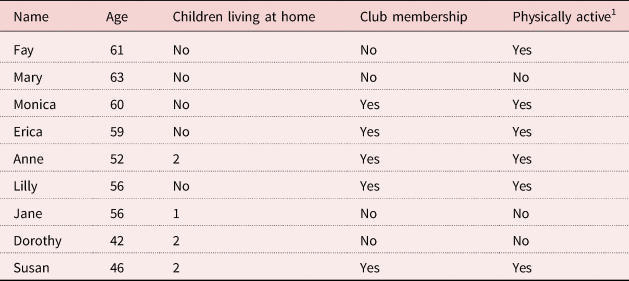
Fay, Mary and Monica are 60 or just over 60 years old; Erica, Anne, Lilly and Jane are in their fifties; Dorothy and Susan are in their forties. Three of the women, Mary, Jane and Dorothy, do not participate in regular exercise and they do not belong to any club. Fay does participate in regular exercise but is not a club member, while Lilly, Anne, Monica, Erica and Susan are members in the same club and one of them has more than one membership (Table 1).
Participant information

Note: 1. Participants who reported regular exercise of more than three hours per week were deemed physically active. This roughly corresponds with the World Health Organization's (WHO) guidelines of regular exercise requirements for adults of at least 150 minutes of moderate exercise per week (Australian Government Department of Health, 2014; WHO, 2018).
All except one participant were recruited via the advertised questionnaire. To include another less-active participant, Jane was recruited via Monica. She also completed the questionnaire before her interview. Monica and Jane share weight-loss experiences with Weight Watchers; Erica and Susan are active exercise and fitness trainers. All women are middle-class and live in affluent communities in Sydney, Australia.
Interview results based on identified themes
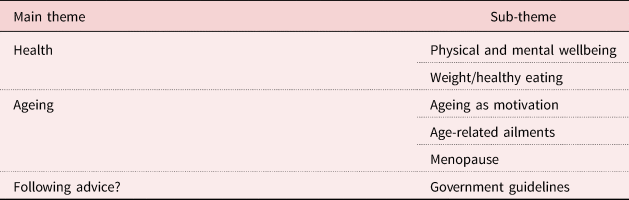
The first main theme, health, was given in the discussion opener: ‘What constitutes a healthy person? The analysis of the interviews revealed a number of sub-themes such as physical and mental wellbeing and weight, as well as another main theme, ageing, with several sub-themes. Table 2 shows the themes discussed in this article.
Themes and sub-themes

The notion of health – physical and mental wellbeing
During the interviews, it became quite clear that all of the women are influenced by current discourses around exercise and health. They all echoed knowledge that is created by media and communication within (work) communities about the advantages of physical activity for weight-loss, and physical and mental wellbeing. Each participant took a moment to think about the question ‘What constitutes a healthy person?’, and all expressed a holistic view about health, referring to their mental, physical and spiritual health.
Healthy mind, body and spirit. Someone who is mindful of their health, who does exercise and tries to eat healthily. (Fay)
This idea of being in charge, of taking care of one's own health, also shines through in the answers of the other participants. It is part of the healthism discourse to view a healthy person as one who takes responsibility for their own wellbeing (Crawford, Reference Crawford2019).
Dorothy's definition is similar to that of Fay, pointing out that physical fitness and mental happiness go hand in hand. She considers good sleep and eating well as signs of a healthy person who is happy in themselves. Anne adds motivation into the equation, healthy also means
Someone who feels energetic and fit, has the energy and motivation to exercise, to feel, get motivation up. Exercise and healthy lifestyle, eating the right thing. (Anne)
Mary's definition focuses on function: ‘A healthy person is one whose body and mind function well.’ Erica believes that ‘any exercise helps with mental health, just to get out and have fresh air, it helps’. Jane opens up about her struggles with mental health. She explains how she was
actually forced to retire from work. I [unintelligible] I have a panic disorder and depression, anxiety. I'm on a lot of medication and maybe, put on a lot of weight and I became very sedentary and I just, and then the doctor forced me to lose some weight and through that process I joined Weight Watchers and that helped me change my whole outlook. So, you know, I'm more conscious about what I eat and trying to exercise. I know I'll never be off the medication, but I am probably healthier than I have been in the last five or six years.
Weight/healthy eating
Monica, Erica and Jane are weight conscious. Monica stresses healthy eating, ‘a healthy person watches what they put into their body as well as does a reasonable amount of exercise, so a combination of that’. When I ask her about her own health in the last few months she pauses, then reiterates what she has done to keep healthy, ‘just what I said to the previous [question], minding the kind of food that I eat, just a moderate amount, eating healthy, exercising, just keeping an active life’. Erica's answer about her own health is almost identical: ‘My health is ah, that I eat a healthy nutritious diet and that I exercise to maintain a good healthy heart, body and mind.’ Monica, who started exercising as part of a weight-loss journey, now sees exercise as
something that I do every day, it has become part of my routine. I get my 30 mins [minutes] walking to my class, I get my one-hour class, then I start the day. If I take a day off, I feel terrible, something is missing. If you don't love what you do, you won't stick with it.
To Jane, who in the past few months lost 8.5 kilograms (kg) of weight, a healthy person is ‘Someone that's not overweight. But not overly skinny either. So, someone that looks healthy, is active, eats well.’ Health is interpreted in representational terms, the appearance of health, achieved by a healthy diet and exercise regime, seems more important than the attainment of health (Nash, Reference Nash2016: 220). These definitions show the interdiscursivity of the healthism discourse which is intertwined with the ‘obesity epidemic’ and discourses about mental health and healthy lifestyles in general. Bagrichevsky and Silva Dos Santos (Reference Bagrichevsky and Silva Dos Santos2018: 761) refer to ‘sedentary lifestyle’ as ‘a kind of postmodern metaphor used to designate indolence, laziness and an unacceptable lack of self-care’. This relates back to the undesirable, anti-social health risk-taking behaviour prevalent in healthism discourses. Participants in this study largely accept the ‘truth’ that being overweight and leading sedentary lifestyles is deliberately taking risks and the individual should be forced to change their behaviour.
All women have clear ideas about healthy eating, such as ‘not overeating’, ‘a good balance of protein and carbs’, ‘cut down on sugar and carbs’ (Anne), ‘fairly balanced diet with emphasis more on grains and vegetables than on meat’ (Mary) which, again, is part of the healthism discourse. However, they all critically assess information they absorb: five of them mentioned the global obesity crisis and an increase in type 2 diabetes linked to inactivity, but they do not simply reproduce knowledge and ‘truths’ around them. Several women criticised recommendations about healthy eating changing all the time and not being trustworthy. Erica describes healthy eating as
using as much fresh, unprocessed food as you can, fresh fruit and vegs [vegetables], high-class proteins, beans, lentils, dairy is important. Western countries don't eat omega 3, even if they eat fish. Organic yeah ok but I don't believe, ehm, it is any better than, if you wash pesticides off it is ok, if it looks a bit irregular then they put that into the organic. People will be fooled.
Susan advocates balanced meals, ‘nutrition is nourishing our bodies, [we need] minerals and vitamins that fulfil our needs’. She believes that extreme diets such as lemon detox or shakes do not lead to sustainable results. ‘It's all about making money.’ As a Weight Watchers coach, Monica defines healthy eating as ‘a balance of moderate eating of all food groups’. Jane, who joined Weight Watchers only a few months prior to her interview, suggests ‘wholefood, things in their natural state’. She is the one preparing food for the family, including her adult children who still live at home. She does not buy much processed food and her family does not eat out a lot. ‘Fresh fruit and veg, fresh protein and the occasional treat, with not too much sugar.’
Fay also has no problem reciting the ABC of a healthy diet:
Fresh fruit and vegetables, not a lot of meat, sugar and fat under control, not that I do that (laughs), limited alcohol, being aware of what you are eating. For me, it would be eating smaller portions. Look, I know exactly what a healthy diet is. From reading, television, everybody knows that you should eat a lot of greens, grains, you need dairy, not much meat, it is sort of ingrained in us what to eat. One of the things that I'm still, I haven't moved with that eggs are healthy, that they don't have high cholesterol. I tend to believe that unprocessed food is the way to go. Margarine I have never eaten, never would, I have my own belief, butter is more natural, it is better to eat butter. I make my own yoghurt and I soak my lentils and I don't eat processed, so I am ahead of the game. (Fay)
Dorothy ‘would like to cut out sugar, not from fruit, but food with added sugar. I never get five portions of veg. It is difficult but I try to cut out processed meats and things. I always work towards it’. Welsh summarises how women, even those who may seem well informed and well adjusted, still control and discipline their bodies:
The self-monitoring required in eating and exercising for health demands a constant reading of one's behavior as good/healthy or bad/unhealthy. In addition, attention to health achieved through behavior modification draws focus away from underlying socioeconomic issues. (Welsh, Reference Welsh2011: 33)
She argues that ‘a feminist position on the war against obesity clearly argues against a focus on weight’ (Welsh, Reference Welsh2011: 34) but the good health imperative prevails and is hiding different agendas.
All of the interviewed women echo the same concerns about not wanting to be overweight and wanting to be a good example for their children. They are also aware of being privileged in terms of their socio-economic backgrounds because it enables them to shop in a health-conscious rather than a price-conscious way, which we will see again in later excerpts.
Ageing
Ageing as motivation to exercise
The women in this study are middle class and well educated, which is in itself an enabling factor in terms of access and affordability. To the question what motivates them to exercise, answers were remarkably similar. Anne turned to exercise when she ran into issues with ageing and her health ‘hasn't been great’ but ‘improved since I started here [health club]’. She realised that
I am getting older and I turned 50 and it just sort of hit me. I need to do something. I dropped in and out going to the gym, but this is with a contract, 18 months, so no getting out of it. It's flexible and you can sign out for five weeks or so for vacation. It's there, you know. I do barre, yoga, Pilates, I have tried everything, and I come here at least twice a week.
To Anne, physical activity means ‘coming here’, just being more aware, taking the steps instead of the elevator, parking the car and walking, ‘it all adds to the fitness’. Booking her classes ahead allows Anne to prioritise, and she believes it benefits her daughters, they ‘see me taking care of myself’. Anne is convinced that she has to exercise regularly ‘for bone density and heart health and overall fitness’. Anne has now reached a stage where she wants to go to her class, she feels a difference ‘physically and mentally’. Exercise has become her ‘me-time’. This has not happened for Dorothy who claims that she is not sleeping enough and also not getting enough exercise. She is trying to eat well and encourages the kids to move, but her own health ‘is last on the list’. Dorothy is just over 40, working in the health industry and raising a family. Interestingly, she feels that she does not get enough exercise because:
Since I had the kids there is still a bit of difficulty to be at the pace I have been before and I think I am getting older, so I don't feel I am physically capable to just go for a run. I think I have to work on my core strength first to feel that I can join a gym. I might pull my back, I was going to go but I ended up hurting my back at the simplest gentle yoga ever! (laughs).
Dorothy has not yet joined a club, but she walks to work and back several times a week, which takes 35 minutes each way. She knows that it is not high-intensity exercise and feels that she needs that too. She does want to be a good example for her children and not just sit on the couch, but she does not feel motivated enough to get up. She explains that
I have never been one of these people who experience a high, it's always a chore. I have been jealous of the people who feel the benefit of it. I would want to lose weight, but it is still, has not motivated me, it would have to be something more immediate.
Jane also does not really feel like she gets anything out of exercising, it is simply a chore and she avoids it if she can:
To me it's like, very heavy type of exercise, like going to the gym (laughs) and running and going to classes and all the things I hate. And weights. I tried about 30 years ago, and I didn't like it. And my husband and I tried yoga a few years ago at the local gym and didn't like it. I also tried yoga at a yoga club but I'm a bit social and I want to interact with people, and I find that at a gym you don't, even at yoga they come, and they do and then leave, and they don't talk to anybody. I would go with someone. I can't convince anyone else to go to yoga and so I don't go. I don't like gyms because they are kind of dirty and smelly and there's a lot of men, I have tried a ladies’ gym but the whole gym experience kind of – I don't like to sweat. I tried to convince a friend to go to Pilates, but I got to be mindful of, all those things cost and not everybody has as much money as I have to spend. It's a restriction, and I want to do proper Pilates on the machines. For core strength, it is very important especially as we get older.
When I asked her why it is more important as we get older, Jane says ‘just for your bone density, for your balance and stuff like that. She gets her information from television (TV), watching Michael MosleyFootnote 2 and Ask the Doctor,Footnote 3 and she reads about diets because she is interested but she does ‘not necessarily adopt’ what she reads. ‘The food, yes, but not the exercise.’
Age-related ailments
Mary enjoys movement once she gets going, she feels better and it ‘cleans my brain a little’, but she complains about her ‘lethargy’, ‘too little movement’. She says that she is walking up to 30 km a week, when she is doing well. She measures this with a Garmin watchband that translates her steps to distance. Her level of activity depends on the weather: ‘I expect less from myself in the winter, in good weather I expect around 28, 30 km.’ She also goes fishing which includes walking ‘in more challenging terrain, like water’. When asked why she thinks she should move more she says: because I need to keep strength, and balance, for bone density and stuff’. If she could increase her motivation, she would do the ‘Canadian aviation thing [The Royal Canadian Air Force Exercise Plans] a couple of times a week. ‘It's stretching and knee lifting and some push ups but only 15–20 minutes a day’. Susan, on the other hand, does not have any difficulty with lethargy or lack of commitment, although she mentions that she also makes excuses, such as ‘I have kids’ or ‘it is cold today’. She claims that ‘medically [sic] hinders me, but commitment – no problem’. Susan had shoulder and hip injuries as well as problems with arthritis:
If I could have a super body I would, six pack, but I have tight hips and the aches and pains of a 46 year old. [Maybe I could] change my hips with someone who has strong hips (laughs).
Fay and Lilly are fairly happy with the amount they exercise, although Fay mentions that
I am not as fit as I used to be, I think that is part of the ageing process. As you get older you lose strength and flexibility really quickly. I'm not as good at yoga as I used to, but I haven't been ill at all, I'm very healthy. My motivation to exercise is fear, fear of turning into a fat blob.
She then goes on to explain that her main ‘dis-ease’ would be skeletal, she experiences problems with her knee or her back, and she ‘know[s] that exercise will cure that or mitigate it. If your muscles surrounding your skeleton are strong and fit, you won't get injured as often’. In her online questionnaire, Fay said she had no membership in any gym because she was already active. Asked about that she says:
I don't do gym and I don't do classes. I do yoga once a week, I do aqua aerobic, I walk a lot, I swim, and I know that if your muscles are good your brain is healthier, and it keeps away all those ageing things. I eat healthily, I don't eat any vitamins, only glucosamine for my knee, for arthritis.
Lilly explains that she has been very active when she was younger but lost flexibility and confidence. She mentions time as a barrier but then changes her mind ‘it's just an excuse’. Lilly experiments with different forms of exercise and refers to being in a group with women of different ages: ‘I don't have the flexibility [of the younger women] but apart from that I am not doing too badly, and my body still looks pretty good, I have good posture.’ Like Susan, she actually refers to what her body looks like, while the other participants focus on health and how they feel. Erica says she is motivated by the fact that she is almost 60:
I don't want to look like an 80-year-old woman not being able to move around and do anything, so to keep my body moving and supple and strong makes me get off the couch and do something.
A hindrance for her, as for all the other interviewees, is when she has medical issues. She had a knee injury in 2017 and ‘if it flares up it is a damper, but then I tweak the exercise’. At the end of her interview, Erica adds general information:
Older women who go through menopause need to do weight training for bone density. Once they reach 30 that's it, their bone density will not increase. Some people are very fortunate like myself, I breathed through [menopause] but some people really suffer. I suspect that I had an easy run because I was healthy. But I know a friend who is even more active and still has hot flushes.
She is not sure if exercise helps with menopausal symptoms, but she would like to think yes. Menopause has been identified as a sub-theme, even though only Erica explicitly talks about it. All women mention words from menopause discourses, such as bone density, heart health, balance. All women seem to have profound ‘knowledge’ about the benefits of exercise and healthy eating for body and mind, and they all are, on the one hand, fearful of being overweight or unable to move properly, but on the other hand, they dismiss some of the healthism discourse and follow their instincts and knowledge of their own bodies. This becomes even clearer when they comment on health promotion and interventions.
Following advice?
Most of the interviewees said that they were ‘not really’ aware of any government guidelines or recommendations in terms of exercise or healthy eating, but their answers reveal that they do know them in detail. Dorothy says she may have heard something but then, ‘who listens to what the government says (laughs)’. She goes on to explain that she knows about the obesity issue:
Incentives from the government should be financial, especially for people from lower SES [socio-economic status], there is too much rubbish processed food. There should be a sugar tax. We can make choices to buy organic and a lot of people can't do that. At the prevention end it needs to be a financial incentive. A broader approach would be public transport, it would motivate if it were cheaper. It is cheaper to drive and park, should be the other way around. Ads [advertisements] are a difficult thing, people don't watch TV any more, it's all streaming so they spend money on that but there is no impact. Structural things could have an impact. The way GPs [general practitioners] are funded it's all about getting people in and out quickly. They should have time to advise people, it's all systemic.
Though in these critical remarks Dorothy refers to ‘systemic’ issues around physical inactivity, she stops short of addressing the food industry and criticising that it is easier for the government to target individual behaviour rather than issuing policy that would protect the population on a larger scale. Fay is aware of guidelines about exercise, but ‘I don't follow them’:
I'd like to do 10,000 steps a day, but it is not viable. I am sure I do at least half an hour a day if you spread it across the week, on the weekend I do a lot more. And that is the guideline. In the water aerobics I am probably one of the youngest people, they wear bathing caps and I go twice the pace. I know [exercise] affects your mental wellbeing and I know that if I don't do exercise, everything starts falling apart. And I would put on more weight. I'm very mindful … also I work a sedentary job and if I don't do exercise you get pains, and I enjoy it. I love being in the water and I feel so good when I do it.
To encourage movement, she refers to ‘Steptember’ and fundraisers that work well because ‘people are competitive, so at work they have running stuff’. Fay is ‘not a group exerciser, I walk in a group, but I swim on my own, I do aquarobics on my own, and yoga. I'm not a team player, I'm hopeless at sport but exercise I can do on my own’. She also remarks that ‘boys and girls are motivated differently, and men are very tribal, in Australia they are very tribal. Women also play soccer and netball, but it's not the norm’.
Erica says something very similar about when she was young: ‘My brothers were into team sports, but I was not happy with a team relying on me. Then I discovered aerobics and wow, I can just do this.’ As an intervention, Erica is thinking of social media and TV, make it free or cheap. She has heard of exercise in a park, where the council pays for the trainer, ‘that's the only one I heard of’.
Monica ‘by word of mouth’ picked up on free exercise sessions set up to get the community moving. She thinks the government has limited power to fight obesity and physical inactivity:
At the end of the day it's got to be the individual's decision, I think that big brother can't do everything for you and people have to make up their own minds. I think our culture overall is becoming a lot healthier and there is a lot more focus on it, but at the end of the day it's got to happen here (points at her head) and government can't do that.
She goes on to explain that Australians are lucky because they have the great outdoors and opportunity to exercise at any time. When I ask her why Australia still talks about having an ‘obesity problem’, she concludes that
a habitus is difficult to change, it will take a generation, but young people may be more aware of healthy nutrition. At the end of the day, junk food is cheap.
Discussion and conclusions
There were plenty of mentions by each woman about health benefits for physically active people, including ‘mental health’, ‘bone density’, ‘heart health’ and ‘fitness’. Some of the women became physically active to support their weight-loss goal, and they have lost a substantial amount of weight (between 14 and 45 kg), using a mixture of dietary changes and exercise. The main motivation to exercise for these women seems to be coming from the awareness that their bodies are ageing, and that can also be a hindrance as can be seen with Dorothy who does not trust her body to just get out and run, or with Lilly who compares her performance to that of her younger self. Other barriers mentioned were similar to those mentioned by Hendry et al. (Reference Hendry, Solmon, Choate, Autrey and Landry2010) and Grindler and Santoro (Reference Grindler and Santoro2015): lack of time, weather, other commitments, not having someone to exercise with. Grindler and Santoro (Reference Grindler and Santoro2015: 1352) claim that the time factor may be ‘an especially significant barrier for midlife women, given their multiple responsibilities and roles within their households, extended families, and work’, but the women in this study struggle more with confidence in their bodies or with motivation. Jane, in particular, said she would do anything to not have to exercise, so she concentrates on her sewing or other things inside the house. This study indicates that, while barriers to physical activity have not changed dramatically, motivations to include regular exercise into lifestyles may be negatively influenced by current discourses. Behaviourist Segar (Reference Segar2015) observes that ‘better health’ or ‘weight loss’ sound like great incentives, but people look for immediate gratification rather than long-term goals. She points out that those who exercise for a personal reason (e.g. to use it as a tool to reduce stress at work or to feel more centred) feel positive about exercise and develop an actual need to exercise, like participant Monica who feels that something is missing when she does not exercise.
The meaning attributed to physical activity is shaped by communication and discourses. The interviews show that all participants are influenced by current discourses around healthy lifestyles and ageing women, and they all resist some of these discourses. They also all note that mental and spiritual health is as important as physical health. This indicates a shift in attitude and agency: Segar (Reference Segar2015) claims that if the motivation to exercise is negative because it echoes the discourse around physical activity (good for weight loss, to be healthier), people are more likely to see exercise as a chore and fail to achieve a continuous active lifestyle.
It has also become clear that a one-fits-all definition of ‘physically active’, as used by the WHO and governments alike, is rather rigid and needs to change along with discourses around physical activity, ageing and health. Current government guidelines and recommendations around exercise and healthy eating differentiate between children under 5, older children, adults and older adults, but they do not account for different lifestages (between 18 and 64), for challenges due to gender, class, race or age. The results of this qualitative study emphasise that there needs to be more specific focus on social determinants of health and individual circumstances. While self-determined motivation may create lasting effects on exercise regimes, it can also be undermined by social conditions (Dimmock et al., Reference Dimmock, Gagné, Proud, Howle, Rebar and Jackson2016: 573) or a contradiction between feelings around physical activity and general discourse around it (Segar et al., Reference Segar, Taber, Patrick, Thai and Oh2017). The way people experience exercise is key and refers to their initial motivation to engage in exercise (Segar, Reference Segar2015; Kuhl, Reference Kuhl, Boekaerts, Pintrich and Zeidner2000).
The motivations to become more physically active are multi-faceted for middle-aged women because they are coping with life changes while influenced by challenging discourses around their bodies, health and ageing. Their health-related behaviours are complex and embedded in cultural, social and economic contexts of place and time. All interviewees acknowledge how their age affects their views on health and their individual responsibility to look after it, but they also take liberties and reject ‘truths’ in favour of their own opinions and needs. On the one hand, they take pride in their achievements in terms of health and disciplining their own bodies, on the other hand, they choose to resist, e.g. by not trusting the ‘organic’ label or claims about certain foods and their effects on health. So they are not passive in relation to powerful discourses around them. They are also aware of their privileges in terms of SES and their ability to assess knowledge claims critically and look at more systemic reasons for health and illness. In the introduction to Women and Aging, Muhlbauer sums up how some women may have started to dismantle old stereotypes and cultural codes of the devalued lifestyles of older women, but how those less powerful still lag behind:
Today the aging of women over 60 is, at once, a story of success and failure. Gendered age boundaries have become more permeable for large groups of women; however, they are left intact for many, far too many, others. (Muhlbauer, Reference Muhlbauer, Muhlbauer, Chrisler and Denmark2015, p. 4.)
The women portrayed in this article seem well adjusted to their physical routines and well informed about healthy living, but the conversations reveal constant re-evaluation of their lifestyles rooted in various discourses around them in the constant search of maintaining ‘healthy ageing’ and active lifestyles. This is particularly striking because all participating women are middle class, well educated, and able to discuss their relationship with exercise and food from political and social viewpoints. It is important to dismantle these knowledge claims and research how women situate themselves in ongoing discourses around their bodies and overall wellbeing. An awareness of these discourses and how they are constructed empowers women to make their own choices.
Conflict of interest
The author declares no conflicts of interest.
Ethical standards
This study obtained ethical approval from the Human Research Ethics Committee (Humanities and Social Sciences) of Macquarie University, Sydney, Australia (project ID 5486, reference number 5201951688016).