Introduction
In warmer tropical and subtropical countries of Africa, most noctuid stem borers of monocotyledonous plants belong to a group named the ‘Sesamia sensu lato group’ by Holloway (Reference Holloway and Polaszek1998). This group was recently given the status of a subtribe of Apameini, under the name Sesamiina (Zilli et al., Reference Zilli, Ronkay and Fibiger2005). The subtribe includes 158 species in Africa, distributed in 11 genera (Moyal, Reference Moyal2006; Moyal & Le Ru, Reference Moyal2006). Several genera include major pests of cereals, particularly Sesamia Guenée and Busseola Thurau. Minor pests are found in the genus Sciomesa Tams & Bowden: S. biluma Nye, endemic to Madagascar, is a pest of rice, maize and sorghum (Caresche & Breniere, Reference Caresche and Breniere1961; Breniere & Dubois, Reference Breniere and Dubois1965); and S. piscator Fletcher recently was found on maize in Kenya (Ong'amo et al., Reference Ong'amo, Le Ru, Dupas, Moyal, Calatayud and Silvain2006).
The genus Sciomesa, with a distribution limited to sub-Saharan Africa, is one of the most important in the subtribe, with 20 described species (Poole, Reference Poole and Heppner1989). However, its systematics is confused. The initial genus definition by Tams & Bowden (Reference Tams and Bowden1953) was limited to three closely related species only and several species were subsequently included in the genus that did not fit the original description. Some were placed there provisionally, for example, S. piscator, S. argocyma and S. cyclophora (Fletcher, Reference Fletcher, Evans and Fletcher1961), and S. etchecopari (Laporte, Reference Laporte1975). Similarly, Nye (Reference Nye1959), who described S. biluma, observed that it did not conform to the rather rigid generic description but considered that the differences were not sufficiently great to justify the erection of a monotypic genus. Unfortunately, none of these authors attempted to redefine the genus to include the new species. Furthermore, since nearly all the adult specimens were caught in light traps, no information on the described species ecology was available, adding to the confused systematics of this group.
Recent studies to gain a better insight into the systematics, ecology and evolution of the Sesamiina were completed in East and South Africa to remedy these shortcomings (Le Ru et al., Reference Le Ru, Ong'amo, Moyal, Muchungu, Ngala, Musyoka, Abdullah, Kauma Matama, Lada, Pallangyo, Omwega, Schulthess, Calatayud and Silvain2006a,Reference Le Ru, Ong'amo, Moyal, Ngala, Musyoka, Abdullah, Cugala, Defabachew, Haile, Kauma Matama, Lada, Negassi, Pallangyo, Ravololonandrianina, Sidumo, Omwega, Schulthess, Calatayud and Silvainb; Moyal & Le Ru, Reference Moyal2006; Ong'amo et al., Reference Ong'amo, Le Ru, Dupas, Moyal, Calatayud and Silvain2006; Matama-Kauma et al., Reference Matama-Kauma, Schulthess, Le Ru, Mueke, Apenyo Ogwang and Omambia Omwega2008). A first study on systematics and molecular phylogeny was devoted to the genus Manga of the Sesamiina (Moyal & Le Ru, Reference Moyal2006).
In this paper, we present data about two further genera of the subtribe, Sciomesa and Carelis Bowden, the latter a small genus that included until now only two species from West Africa (Poole, Reference Poole and Heppner1989). The systematics of these genera is refined through (i) the definition of new morphologically homogeneous genera demonstrated to be monophyletic through molecular phylogenetic analysis, (ii) the description of new species and (iii) the identification of synonymies of known species. In addition, data are presented on the ecology of the species, and factors are identified that may have influenced their evolution.
Materials and methods
Insect samples
Sampling of visually damaged monocotyledons in East and South Africa was conducted over five years (2003–2007) to collect the larval stages of stem borers within their wild host plants (Le Ru et al., Reference Le Ru, Ong'amo, Moyal, Muchungu, Ngala, Musyoka, Abdullah, Kauma Matama, Lada, Pallangyo, Omwega, Schulthess, Calatayud and Silvain2006a,Reference Le Ru, Ong'amo, Moyal, Ngala, Musyoka, Abdullah, Cugala, Defabachew, Haile, Kauma Matama, Lada, Negassi, Pallangyo, Ravololonandrianina, Sidumo, Omwega, Schulthess, Calatayud and Silvainb). The countries surveyed included Eritrea, Ethiopia, Kenya, Uganda, Rwanda, Tanzania, Mozambique, South Africa and Madagascar.
Larvae were reared on artificial diet (Onyango & Ochieng'Odero, Reference Onyango and Ochieng'Odero1994) until pupation and emergence of adults (Le Ru et al., Reference Le Ru, Ong'amo, Moyal, Muchungu, Ngala, Musyoka, Abdullah, Kauma Matama, Lada, Pallangyo, Omwega, Schulthess, Calatayud and Silvain2006a,Reference Le Ru, Ong'amo, Moyal, Ngala, Musyoka, Abdullah, Cugala, Defabachew, Haile, Kauma Matama, Lada, Negassi, Pallangyo, Ravololonandrianina, Sidumo, Omwega, Schulthess, Calatayud and Silvainb). The study is based on 720 adult specimens belonging to 15 species collected in more than 70 localities. A hundred of them were kept in absolute alcohol for molecular analyses; the others were kept dry and prepared as vouchers for museum collections or also used for molecular studies. In addition, seven adults belonging to the genus Carelis were collected once from a light trap set up in the Republic of Congo. Genitalia were dissected after immersion of the end of the abdomen in a boiling 10% potash bath for a few minutes, then cleaned, immersed in absolute alcohol for a few minutes and mounted on slides in Euparal (after separating the aedeagus from the rest of the genitalia in the male). Types of new species are deposited in the Museum National d'Histoire Naturelle (MNHN) in Paris, France; and, when possible, paratypes were deposited in the Transvaal Museum in Pretoria (TMSA), South Africa, and in the National Museum of Kenya (NMK) in Nairobi, Kenya.
Collected insects were identified by comparison with types housed in the Natural History Museum of London (BMNH), in the MNHN and in the TMSA, or by using the published species description, e.g. Sciomesa renibifida Berio (Berio, Reference Berio1973) and Sciomesa secata Berio (Berio, Reference Berio1975). Plant specimens were identified by Simon Mathenge, Botany Department, University of Nairobi, Kenya.
Molecular study
Sequence data were obtained from fragments of two mitochondrial genes, Cytochrome b (Cyt b) (915 nucleotides) and Cytochrome c Oxidase, subunit 1 (CO1) (890 nucleotides).
Total DNA was extracted using a Qiagen DNeasy tissue kit (Qiagen GmbH, Germany). Cyt b was amplified by Polymerase Chain Reaction (PCR) using the successive steps: initial denaturation for 5 min at 92°C; 39 cycles of denaturation for 1 min at 92°C, annealing for 1.30 min at 46°C, extension for 1.30 min at 72°C; and final extension for 5 min at 72°C. The reaction mixture contained 3 mm MgCl2, 0.4 μm primers, 0.24 μm dNTPs, 2 U of Promega Taq polymerase and 100 ng of DNA per 50 μl of reaction mixture. The primers used were CP1 (5′-GATGATGAAATTTTGGATC-3′) (modified from Harry et al. (Reference Harry, Solignac and Lachaise1998)) and TRs (5′-TCTATCTTATGTTTTCAAAAG-3′) (Simon et al., Reference Simon, Frati, Beckenbach, Crespi, Liu and Flook1994). The PCR product was then purified using the Qiagen QIAquick PCR purification kit (Qiagen GmbH, Germany). Sequencing reactions were carried out using the Sanger dideoxy method (Sanger et al., Reference Sanger, Nicklen and Coulson1977), and, finally, sequences were run and detected on an ABI 377 automated sequencer. The primers used for CO1 were Ron (5′-GGATCACCTGATATAGCATTCCC-3′) and Hobbes (5′-AAATGTTGNGGRAAAAATGTTA-3′) (Monteiro & Pierce, Reference Monteiro and Pierce2001) and the PCR protocol was the same as for Cyt b.
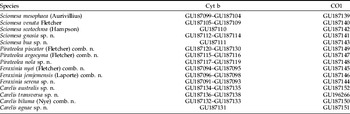
Genbank accession numbers for Cyt b and CO1 are given in table 1.
Genbank accession numbers.

Data analysis
The sequences were aligned with Multalin software (Corpet, Reference Corpet1988). The best substitution model was selected with Modeltest ver 3.7 (Posada & Crandall, Reference Posada and Crandall1998) in combination with Paup 4.0b10 (Swofford, Reference Swofford1998), using the Akaike information criterion (Posada & Buckley, Reference Posada and Buckley2004). The phylogenetic analysis was carried out using a Bayesian inference implemented in MrBayes 3.1 (Ronquist & Huelsenbeck, Reference Ronquist and Huelsenbeck2003). The default settings were used: two runs of four chains, one cold and three heated, and a check of convergence through standard deviation of split frequencies and Potential Scale Reduction Factor. One million generations were enough to get convergence, with sampling every hundred generations. Data were divided into three partitions: two corresponding to the genes, and one to the host plants. To infer the host plant ancestral state, coding from zero to three was done, according to the four families (Poaceae, Cyperaceae, Typhaceae, Juncaceae). The standard discrete model (Lewis, Reference Lewis2001) was used for host plants. For DNA sequences, only the general type of the models suggested by ModelTest was given, the parameters being estimated by MrBayes. Once the phylogeny was inferred and the internal nodes identified, a new analysis was done to infer the host plant ancestral states at these ancestral nodes. Sequences of Cyt b alone were obtained from additional specimens of stem borers, which enabled another Bayesian analysis to be conducted in order to determine the infra-specific fragmentation process in different populations.
Several species belonging to other genera of African stem borers (Sesamia, Busseola, Manga) were included in the analysis, and the species used as the outgroup was Oligia latruncula (Denis & Schiffermüller), a palearctic noctuid stem borer from another subtribe of Apameini, the Apameina (Zilli et al., Reference Zilli, Ronkay and Fibiger2005).
Results
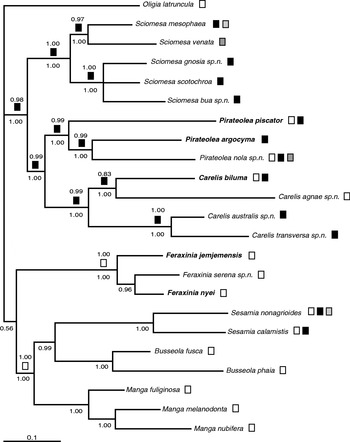
Both studied genes had the same model of evolution of nucleotides, GTR, with a same proportion of invariant sites (0.6) and a gamma distribution shape parameter of 1.13 and 0.63 for Cyt b and CO1, respectively. The estimated parameters in MrBayes were slightly different: a proportion of invariant sites of 0.53 and 0.57 and a gamma distribution shape parameter of 0.74 and 0.47 for Cyt b and CO1, respectively. The phylogenetic tree obtained from the Bayesian inference is presented in fig. 1, where the name of the species is given with the new genus name as defined below, with the species initially placed in the genus Sciomesa in bold type. It shows that the genus Sciomesa was polyphyletic, with its species divided into three monophyletic groups. The first group corresponds to the genus Sciomesa sensu Tams & Bowden and is morphologically very homogeneous. The second group includes species with rather different habitus, such as S. piscator and S. argocyma, but with similarities in genitalia. This group is proposed as the new genus Pirateolea (see below). The third group is morphologically homogeneous, with species such as S. nyei Fletcher and S. jemjemensis Laporte, rather different in their habitus and genitalia from those of the two previous groups; it is erected to the genus level, with the name Feraxinia (see below). Additionally, the molecular phylogeny showed that S. biluma had to be included in the genus Carelis, necessitating an expansion of this generic definition to include the new species. Deeper nodes show that Sciomesa sensu Tams & Bowden, Pirateolea and Carelis had a common ancestor and, therefore, make up a monophyletic clade, whereas Feraxinia had a different origin and is more closely connected to the other stem borer genera (Manga, Busseola and Sesamia) included in the analysis.
Phylogenetic tree resulting from Bayesian analysis of the mixed data set including two mitochondrial genes, Cytochrome b and Cytochrome c oxidase subunit 1, and host plants. Numbers below branches indicate Bayesian posterior probabilities. Numbers above squares indicate the posterior probability of the host plant ancestral state shown in the squares. The new genus names are used. Species in bold cases were included until now in the genus Sciomesa (□, Poaceae; ▪, Cyperaceae;  , Typhaceae;
 , Juncaceae).

Genus Sciomesa Tams & Bowden
Genus description
The original description, by Tams & Bowden (Reference Tams and Bowden1953), of the genus Sciomesa is confirmed by the molecular phylogenetic analysis presented in this paper, as well as a re-examination of the morphological characters. The genus has homogeneous habitus and genitalia. In all known species but one, male antennae are bipectinate. Most species are stout insects but with elongate and narrow, plain-coloured forewings with often a longitudinal median black streak. The forewings present important colour and pattern polymorphism in S. mesophaea (Aurivillius). The most characteristic features of male genitalia are the shelf-like expansion of the costal margin, the absence of a clasper, the plate-like bifid juxta, and the aedeagus with two cornuti, the basal one with several small teeth, and the apical one strong and beak-shaped. However, in contrast to Tams & Bowden (Reference Tams and Bowden1953), we would describe the peniculi as rather large instead of small. The main diagnostic features of the female genitalia are the broad, strongly sclerotised ductus bursae and the large, rounded ostium bursae with weakly sclerotised lips.
Our surveys enabled us to collect five species, two new and three already described (S. mesophaea, S. scotochroa (Hampson) and S. venata Fletcher).
Description of new species
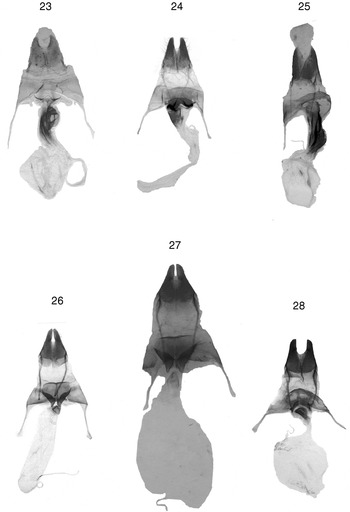
Sciomesa gnosiasp. n. (figs 3, 4, 16, 23)
Type material examined. Holotype: ♂, Kenya, Sigismon Forest (00°01′04″S, 37°10′19″E, 2793 m asl), XI.2005, ex larva (in stem of Cyperus dereilema), B. Le Ru leg., gen. prep. MP3, MNHN, Paris.
Paratypes: 1♂ and 2♀, same data as holotype (one prepared, gen. prep. MP4), 1♂and 2♀, Kenya, Kinangop (00°18′23″S, 36°23′15″E, 2830 m asl), XI.2005, ex larva (in stem of Cyperus dereilema), B. Le Ru leg., MNHN, Paris.
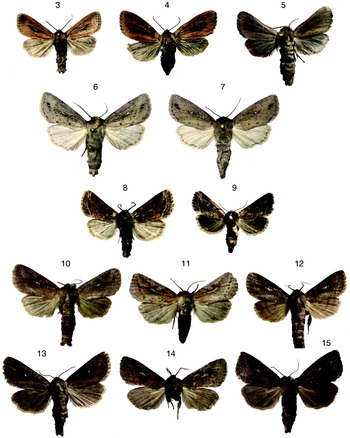
Adult (figs 3, 4). Antennae of male strongly bipectinate, the pectinations about three times the size of the flagellum diameter. Antennae of female filiform. Body colour and wing pattern similar in both sexes. Colour of the body ochrous brown. Forewing of the same colour with a blackish median streak diverging distally in a triangle. A dark triangular spot close to the termen of the costal margin, which in some cases joins the median streak through a curved line. Some small black spots above the median streak in the center of the wing. Hindwing clear grey-brown.
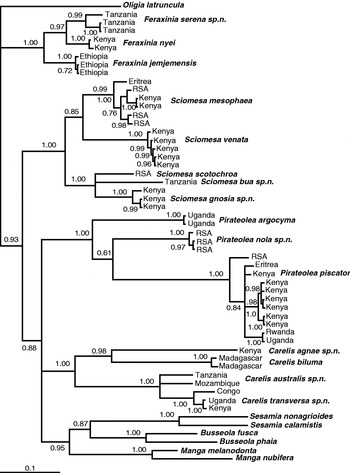
Phylogenetic tree resulting from Bayesian analysis of the Cytochrome b gene alone, with the geographic origin of the specimens. Numbers above branches indicate Bayesian posterior probabilities.

Sciomesa gnosia sp. n. male adult.
Fig. 4.Sciomesa gnosia sp. n. female adult.
Fig. 5. Sciomesa bua sp. n. male adult.
Fig. 6. Pirateolea nola sp. n. male adult.
Fig. 7. Pirateolea nola sp. n. female adult.
Fig. 8. Feraxinia serena sp. n. male adult.
Fig. 9. Feraxinia serena sp. n. female adult.
Fig. 10. Carelis australis sp. n. male adult.
Fig. 11. Carelis australis sp. n. female adult.
Fig. 12. Carelis transversa sp. n. male adult.
Fig. 13. Carelis transversa sp. n. female adult.
Fig. 14. Carelis agnae sp. n. male adult.
Fig. 15. Carelis agnae sp. n. female adult.

Wingspan. 26–31 mm (males) (n=3); 29–30 mm (females) (n=4).
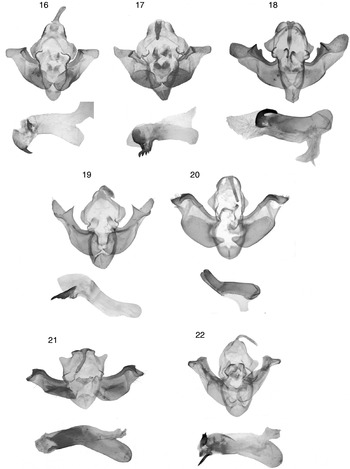
Male genitalia (fig. 16). Uncus simple. Tegumen with large peniculi. Vinculum with a rounded saccus. Valvae roughly parallelepipedal, with a large sclerotized costal margin. The upper part of the costal margin near the shelf-like expansion nearly at a right angle with the cucullus, which is large and of the same width until the tip. Sacculus short and broad. Juxta flat, bifid and shield-like. Aedeagus slightly curved with two cornuti, the apical one a strong beak-shaped spine, the basal one made of a main straight spine and a series of 3–4 tiny spines at its base.
Female genitalia (fig. 23). Corpus bursae globular, with two faint signa. Ductus bursae broad and highly sclerotised. Large rounded antrum with thin lips. Papillae anales with blunt tips curved inwardly.
Sciomesa buasp. n. (figs 5, 17)
Type material examined. Holotype: ♂, Tanzania, Moronga (09°10′18″S, 34°13′42″E, 2246 m asl), III.2007, ex larva (in stem of Cyperus fisherianus), B. Le Ru leg., gen. prep. MP5, MNHN, Paris.
Paratypes: 1♂, same data as holotype. B. Le Ru leg., MNHN, Paris.
Adult male (fig. 5). Antennae bipectinate, the pectinations fairly short, about the size of the flagellum diameter. Colour of the whole body brown. Forewing of the same brownish colour, except for a blackish median longitudinal streak, limited to the first two-thirds of the wing, but the blackish colour may continue along the central veins up to the margin. Some diffuse grey can be observed on each side of the median streak, with in some cases small grey spots. No lines or ordinary macula discernible. Hindwing grey-brown with bronze outer margin.
Wingspan. 35 mm (n=2).
Male genitalia (fig. 17). Uncus narrowed toward apex, with a blunt tip. Tegumen with large peniculi. Vinculum with a triangular saccus. Valvae short and broad. The costal margin ends in the shelf-like expansion and makes a marked angle with the cucullus, which narrows towards the apex. Sacculus short and broad, and highly convex. Juxta flat, bifid and shield-like. Aedeagus straight with two cornuti, the apical one with one straight strong spine, the basal one comb-like, with several aligned teeth.
Synonymies
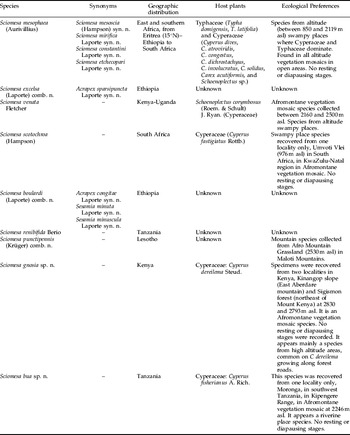
The different species that are to be included in the genus Sciomesa are listed in table 2, with their new synonyms. S. mesophaea and S. mesoscia (Hampson) were considered as different species by Tams & Bowden (Reference Tams and Bowden1953), based on slight differences in genitalia and forewing colour. Their specimens were few, originated from South Africa, and one of each species was from the same locality. We collected many specimens, geographically separated from Eritrea to South Africa, and we observed that wing pattern polymorphism occurred in specimens from the same locality, without any difference in genitalia nor in molecular sequences. The main difference in genitalia mentioned by Tams & Bowden (Reference Tams and Bowden1953) was the greater width of the corpus bursae in females of S. mesoscia, but this was not the case for the two slides we could observe (Natural History Museum, London, N° 1205 for S. mesoscia and 1208 for S. mesophaea). In addition, we found no such difference in all our collected specimens. All these specimens can, thus, be considered conspecific, and S. mesophaea, being first described, has priority. Similarly, other species (S. mirifica, S. constantini and S. etchecopari) described by Laporte (Reference Laporte1975, Reference Laporte and Rougeot1984) from Ethiopia, belong also to this species, as do those we collected in Ethiopia. Examination of Laporte's types at MNHN, Paris, revealed other synonymies indicated in table 2. Several species he placed in the genera Sesamia and Acrapex are in fact Sciomesa species; new combinations, thus, are proposed for Sesamia excelsa (Laporte, Reference Laporte1976) and Acrapex boulardi (Laporte, Reference Laporte and Rougeot1984). Likewise, Sesamia minuscula, Sesamia minuta, Acrapex congitae (synonyms of S. boulardi (table 2)) and Acrapex sparsipuncta (synonym of S. excelsa (table 2)) (Laporte, Reference Laporte and Rougeot1984) are to be included in Sciomesa. In addition, Sesamia punctipennis Krüger (Krüger, Reference Krüger2005) is in fact a Sciomesa species, the only one with serrated antennae in male.
Genus Sciomesa: taxonomic and ecological data.

Ecology and evolution
All the collected and named species, except S. mesophaea, have a restricted geographic distribution and are monophagous on Cyperaceae or Juncaceae, each one with a different host plant species (table 2). S. mesophaea, widespread in East and South Africa, is polyphagous. The inference of the host plant ancestral state (fig. 1) shows that the ancestor of the genus was living on Cyperaceae (posterior probability=1.0). From our data, only S. mesophaea and S. venata succeeded in colonizing host plants belonging to other families, Typhaceae and Juncaceae, respectively.
S. mesophaea was found at various altitudes, from mid to high. With the exception of S. scotochroa, which was collected in a wetland at mid-altitude, all the other species were collected at high altitude, in Afromontane vegetation. This genus is not known from West or Central Africa.
The phylogenetic tree built from Cyt b only (fig. 2) shows that for the only widespread species, S. mesophaea, a first fragmentation occurred between specimens from Eritrea and those from Kenya and South Africa. In the latter group, a further fragmentation resulted in two clades, one with individuals from South Africa only, the other with individuals from South Africa and Kenya. The maximum genetic distance observed between these groups was 2.5%.
Genus Pirateolea gen. n
Genus description
Type species: Pirateolea nola sp. n., by present designation. Gender: feminine.
Adult. Medium-sized to fairly strong insects, antennae serrate or bipectinate in males, filiform in females. Frons smoothly rounded. Adult forewing pattern very diverse. Some species, e.g. P. piscator and P. nola, have an homogeneous pattern, with only a median streak or spot; others, for instance P. argocyma, have a very contrasting pattern, with the orbicular and reniform marks clearly visible, and the presence of bright and dark zones. Such wing-pattern diversity, albeit uncommon in Sesamiina, occurs in other genera of Apameini, for example Photedes (Zilli et al., Reference Zilli, Ronkay and Fibiger2005).
Male genitalia. Uncus simple, tapering apically. Peniculi small or medium-sized. Valva with sclerotised costa ending with a shelf-like expansion. Below this expansion there is, in most species, a small process which is typical of the genus but may be tiny in some individuals, and is absent in P. piscator. Cucullus generally short and stout; sacculus ovoid with a small clavus. No clasper. Juxta within most species ventrally pointing processes. Aedeagus small, stout, straight, with a carina crest bearing several spines and in some species a cornutus.
Female genitalia. Typical long cylindrical corpus bursae without signa, ductus bursae wide and strongly sclerotised; wide antrum with a little opened ostium bursae.
Description of new species
Pirateolea nolasp. n. (figs 6, 7, 18, 24)
Type material examined. Holotype: ♀, South Africa, Karkloof 1 (29°09′39″S, 30°12′58″E, 1454 m asl), II.2006, ex larva (in stem of Paspalum urvillei), B. Le Ru leg., gen. prep. MP6, MNHN, Paris.
Paratypes: MNHN, Paris: 1♂ (gen. prep. MP7) and 2♀, same data as holotype; 3♀ and 1♂ from Ficksburg (28°32′18″S, 27°25′33″E, 1562 m asl), South Africa, I.2007, ex larva (in stem of Cyperus congestus), and 2♂ (one prepared, gen. prep. MP8) from Uvongo River (30°30′13″S, 30°12′54″E, 60 m asl), South Africa, II.2006, ex larva (in stem of Pryonium serratum), B. Le Ru leg. TMSA, Pretoria: 1♂, same data as holotype; 1♂ and 2♀ from Fernsdale (29°13′57″S, 29°33′26″E, 1548 m asl), South Africa, II.2007, ex larva (in stem of Cyperus congestus), B. Le Ru leg.
Adult (figs 6, 7). Antennae of male strongly bipectinate, the pectinations about twice the flagellum diameter. Antennae of female filiform. Body colour and wing pattern similar in both sexes. Colour of the body brownish grey. Forewing brown with a blackish median streak limited to the first two-thirds of the wing and diverging distally in a triangle. The reniform reduced to a small white spot enclosed in the median streak. In the median part of the wing, closer to the termen, several black spots are aligned in a small oblique fascia. Hindwing clear grey-brown.
Wingspan. 26–34 mm (males) (n=6), 29–32 mm (females) (n=8).
Male genitalia (fig. 18). Uncus narrow, spatulate, long-pointed apically. Tegumen with medium-sized triangular peniculi. Vinculum with a roughly quadrangular saccus. Valvae almost equally broad throughout, with a strongly sclerotized costal margin growing larger distally and ending in a shelf-like expansion below which merges a small process, nearly unconspicuous in some individuals. Sacculus little sclerotised. Clavus rounded, little sclerotised. Cucullus large and rounded and of about the same width until the tip. Juxta shield-like pointing ventrally. Aedeagus straight with one thick carina crest strongly curved and sclerotised, with little teeth apically.
Female genitalia (fig. 24). Corpus bursae long and narrow, cylindrical, without signa. Ductus bursae triangular, nearly as broad as the corpus at its apex and larger at its base, sclerotised from ostium to corpus but only on about one half of its width. Antrum wide, twice as wide as long; the superior lip with a thick margin, the inferior lip with two pouches whose strongly sclerotised margins form a V-shaped figure.
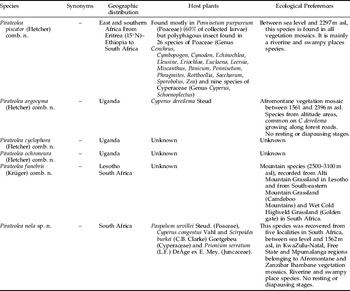
Ecology and evolution
Six species are to be included in the new genus Pirateolea: five new combinations are created for four species placed in Sciomesa by Fletcher (Reference Fletcher, Evans and Fletcher1961) and one species placed in Sesamia by Krüger (Reference Krüger2005) (table 3). The three species collected in the course of this study had very diverse ecological preferences. P. argocyma had a geographic distribution limited to altitude areas of Uganda and was monophagous on Cyperus dereilema (table 3). P. nola was found in South Africa only, at various altitudes, and is regarded as the most polyphagous species of this group because of the number of plant families it infested (Poaceae, Cyperaceae and Juncaceae). P. piscator, in contrast, had a very large distribution area, from north-eastern to southern Africa, and was highly polyphagous, feeding on 26 species of Poaceae and nine species of Cyperaceae. The phylogenetic analysis (fig. 1) shows that the ancestor of the genus was most likely a stem borer of Cyperaceae (posterior probability=0.99). From the analysis of Cyt b alone (fig. 2), P. piscator populations were divided into two main clades (genetically distant by about 4.0%), one localized in southern Africa and the other in east and northeast Africa. The latter clade further divided into three main groups: one western, in Rwanda-Uganda (within distance=0.1%); a Kenyan population (within distance <1%); and a group made of two northern populations, one in Kenya (Kakamega) and one in Eritrea, both not very distant genetically (1.5%). Genetic distances between these three groups varied from 2.5 to 3.5%.
Genus Pirateolea: taxonomic and ecological data.

Genus Feraxinia, gen. n
Genus description
Type species: Feraxinia serena sp. n., by present designation. Gender: feminine.
Adult. Small to medium-sized insects (wingspan 20–30 mm). Antennae of male serrate or shortly bipectinate. Antennae of female filiform. Frons conical. Colour of the body brownish grey. Forewing similar in male and females. Ground colour light to dark brown. Orbicular and reniform spots more or less visible within a blackish zone. Subterminal creamy line with a blackish fascia running alongside its inner border. Just before this black fascia, a transversal oblique strip, clearer than the rest of the forewing, and that ends at the costal termen in a light brown triangular spot that extends above the creamy line. Hindwing pale grey brown in the male, darker in the female. Discal spot clearly visible only on the underside.
Male genitalia. Uncus narrow, spatulate, tapering apically. Tegumen with medium-sized rounded peniculi. Vinculum with a well-developed saccus. Valvae with a strongly sclerotized costal margin growing larger distally and ending dorsally in a shelf-like expansion which extends ventrad in a projecting digitus. Sacculus ellipsoidal. Clavus an inflated crest. Cucullus fairly thin and elongate. Juxta shield-like, little sclerotised. Aedeagus long and little curved. Vesica with a cornutus wider at its base and made of several teeth following each other linearly; but the last one, which is the longest, may make an angle with the previous ones in some species.
Female genitalia. Corpus bursae globular, of about the same length as the ductus, with one or two little sclerotised signa. Ductus like a thin rectangle sclerotised along the whole length, more strongly in its central part. Post-vaginal plates little sclerotised. Ostium bursae roughly ovoid.
Description of new species
Feraxinia serenasp. n. (figs 8, 9, 19, 25)
Type material examined. Holotype: ♂, Tanzania, Mbizi Forest (07°32′56″S, 31°24′35″E, 2147 m asl), III.2007, ex larva (in stem of Pennisetum macrourum), B. Le Ru leg., gen. prep. MP9, MNHN, Paris.
Paratypes: MNHN, Paris: 1♂ and 1♀ (gen. prep. MP10), same data as holotype; 3♂ (one prepared, gen. prep. MP11) and 1♀ (gen. prep. MP12), Tanzania, Kabarara Forest, (08°19′21″S, 35°14′33″E, 2104 m asl), VI-2004 ex larva (in stem of Setaria megaphylla), B. Le Ru leg. TMSA, Pretoria: 1♀, same data as holotype and 1♂, Tanzania, Kabarara Forest, (08°19′21″S, 35°14′33″E, 2104 m asl), VI-2004 ex larva (in stem of Setaria megaphylla), B. Le Ru leg. NMK, Nairobi: 1♂, same data as holotype, 1♂, Tanzania, Kabarara Forest, (08°19′21″S, 35°14′33″E, 2104 m asl), VI-2004 ex larva (in stem of Setaria megaphylla), B. Le Ru leg.
Adult (figs 8, 9). Antennae serrate in the male, filiform in the female. Body colour and wing pattern similar in both sexes but hindwing of females a little darker. Colour of the body brownish grey. Forewing divided into four main zones by the transversal lines. The first inner zone, up to the ante-medial line, light brown, with a basal line limited to the costal half and a small blackish basal dash reduced to the proximity of the thorax. The central zone light brown except the median part, a blackish zone with two conspicuous spots, the orbicular and the reniform both brown with a white border. A brown subterminal zone, limited distally by a creamy line widening at costal termen, and along the inner border of this clear line, an oblique blackish streak that extends up to the enlarged creamy costal zone. The terminal zone dark brown. Hindwing clear grey-brown.
Wingspan. 20–26 mm (males) (n=8); 20–28 mm (females) (n=3).
Male genitalia (fig. 19). Uncus narrow, spatulate, tapering apically. Tegumen with medium-sized rounded peniculi. Vinculum with a roughly triangular saccus. Valvae with a strongly sclerotized costal margin growing larger distally and ending dorsally in a shelf-like expansion which extends ventrad in a projecting digitus. Sacculus stout, fairly sclerotised. Clavus an inflated crest. Cucullus fairly thin and elongate. Juxta shield-like, little sclerotised. Aedeagus long and little curved with a cornutus wider at its base and made of several successive teeth, the longer being the apical one, which emerges from the rest of the cornutus like a pointing finger. The cornutus about one-third the length of the aedeagus.
Female genitalia (fig. 25). Corpus bursae globular, with two long and thin signa. Ductus bursae long, about the same length as the corpus bursae, strongly sclerotised from ostium to corpus. Antrum of half-circle shape.
Synonymies
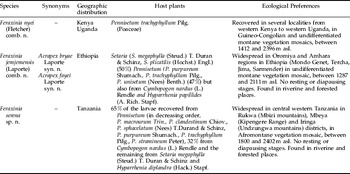
No differences could be detected in the genitalia and habitus of the types of Sciomesa jemjemensis Laporte, Acrapex bryae Laporte and Acrapex fayei Laporte (MNHN). These insects were all trapped in the same place, Kebre-Mengist (Ethiopia). A. bryae and A. fayei were collected at one day intervals, and S. jemjemensis was collected three years earlier, in the same month, November (Laporte, Reference Laporte and Rougeot1984). Laporte (Reference Laporte and Rougeot1984) indicated that A. bryae and A. fayei were very close and could be conspecific. All these specimens belong to the same species, which proved to be widespread in Ethiopia (table 4).
genus Feraxinia: taxonomic and ecological data.

Ecology and evolution
The genus Feraxinia is limited to East Africa, from Tanzania in the south to Ethiopia in the north. The three species comprising the genus (table 4) each occupy a different geographical area: F. nyei was found only in Kenya-Uganda; F. jemjemensis in Ethiopia; and F. serena in Tanzania. All three feed on Poaceae, chiefly on the genus Pennisetum. They had similar altitudinal distribution. This noctuid genus is very homogeneous, not only morphologically, but also in the ecological preferences of the species. The genetic distance between the mitochondrial genes from the three species was low, only about 5% between F. serena and F. nyei and about 6.5% between these species and F. jemjemensis.
The phylogenetic analysis (fig. 1) showed that this genus was quite distant from the other three (Carelis, Pirateolea and Sciomesa) which make up a monophyletic clade. In addition, its ancestor lived on Poaceae, contrary to the ancestors of the other three genera, which fed on Cyperaceae. Feraxinia appears more connected to the genera Manga, Sesamia and Busseola, with which it makes up a separate clade. The node between these, however, is little supported (Posterior probability=0.56), which suggests that Feraxinia could be considered as a distinct clade.
Genus Carelis Bowden
Genus description
The genus Carelis was created by Bowden (Reference Bowden1956) for one species from Ghana, C. albula. Another species was added to the genus by Poole (Reference Poole and Heppner1989) as a new combination, C. ochrivirga (Prout), from Sao Tome. The genus was unknown from East Africa until now. The molecular analysis (fig. 1) showed that S. biluma (endemic to Madagascar) was a sister species of a new species discovered in Kenya and that their clade was related to a clade made up of two new species of Carelis (described in this paper), very close morphologically to the already known species of Carelis. The great morphological similarity of these species, especially in the wing pattern and important characteristics of their genitalia, and their common phylogenetic ancestry, suggest all these species should comprise a separate genus. The pupal cremaster of these species is uniform, in contrast to other Sesamiina, which further supports this amalgamation of the species into a single genus. However, the two clades are separated by differences in male genitalia; and, as such, the clades should be considered different sub-genera. The genus has one autapomorphy, the quadrangular shape of the valva of the male genitalia, which results from the small size of the cucullus and enables the distinction from the other genera of Sesamiina. The description by Bowden (Reference Bowden1956) has to be extended to enable the inclusion of the new species. The sub-genus albula corresponds to his description of the genus Carelis. The sub-genus biluma has the following differences: vesica of the aedeagus with a pair of cornuti; antennae of male serrate or bipectinate; juxta flat and subdivided, U-shaped. Costal margin of the valva with an apical small shelf-like expansion.
Description of new species
Carelis australissp. n. (figs 10, 11, 20, 26) sub-genus albula
Type material examined. Holotype: ♂, Tanzania, Usambara (04°45′59″S, 38°20′51″E, 1761 m asl), II.2004, ex larva (in stem of Cyperus dichrostachyus), B. Le Ru leg., gen. Prep. MP13, MNHN, Paris.
Paratypes: MNHN, Paris: 5♀ (one prepared, gen. prep. MP14) and 1♂, same data as holotype, 1♂ from Mbiri (Mozambique), (18°31′18″S, 32°26′18″E, 871 m asl), IV-2005 ex larva (in stem of Setaria megaphylla), B. Le Ru leg. TMSA, Pretoria: 1♂ and 1♀, same data as holotype, B. Le Ru leg. NMK, Nairobi: 1♀, same data as holotype, 1♀ same data but collected VII.2003, B. Le Ru leg.
Adult (figs 10, 11). Antennae serrate in the male, filiform in the female. Body colour and wing pattern similar in both sexes but hindwing of females a little darker. Colour of the body light brown. Forewing of the same colour, except the terminal zone darker, brownish grey, preceded by a subterminal fascia often reduced to some black spots. A hardly visible antemedial fascia, sometimes reduced to the anterior half of the wing. The costal margin suffused with black. An elliptic or fusiform longitudinal black spot in the center of the wing, with on the inside the characteristic white spot of the genus, like a longitudinal comma; sometimes one or two other small white spots after this longer one. Hindwing grey-brown. Discal spot visible only on inferior side.
Wingspan. 28–30 mm (males) (n=3); 28–35 mm (females) (n=8).
Male genitalia (fig. 20). Uncus narrow, straight with parallel sides, subterminaly slightly dilated and tapering apically. Tegumen with medium-size triangular peniculi pointing transversally. Vinculum with a half-circle-shaped saccus. Valvae with a strongly sclerotized costal margin ending in a ridge-like expansion. Small conical cucullus. Juxta roughly triangular, with small paired dorsal protuberances. Aedeagus short and thin, inflated at base, straight and then making a marked subapical angle. Vesica without cornuti.
Female genitalia (fig. 26). Corpus bursae elongate, ovoid, no signa. Ductus seminalis from the apex of bursa. Ductus bursae short, about one-third the length the corpus bursae, little sclerotised, at about middle. Superior lip of ostium with two lateral parts stongly sclerotised, triangle-shaped. Inferior lip made of two quadrangular plates separated in their middle by an incomplete fissure. Ostium small, deeply located under the superior lip.
Carelis transversasp. n. (figs 12, 13, 21, 27) sub-genus albula
Type material examined. Holotype: ♂, Uganda, Mabira (00°26′29”N, 33°10′26″E, 1194 m asl), II.2005, ex larva (in stem of Scleria racemosa), B. Le Ru leg., gen. Prep. MP15, MNHN, Paris.
Paratypes: MNHN, Paris: 2♀ (one prepared, gen. Prep. MP16) and 1♂, same data as holotype, 2♀ and 2♂ from Kouilou (Congo), (04°21′32″S, 12°07′08″E, 144 m asl), XI-1999 caught in light trap, B. Le Ru leg. TMSA, Pretoria: 1♂ and 1♀, same data as holotype, B. Le Ru leg. NMK, Nairobi: 1♂ and 1♀, same data as holotype, B. Le Ru leg.
Adult (figs 12, 13). This species is very close to C. australis, and the differences between both are quite small. Their habitus is similar. The distinction between both species from the wing pattern is very difficult. The only slight differences observed on our specimens were the fusiform central black spot, which is smaller and less conspicuous in C. transversa, and the white spot, which is generally divided into two parts in C. transversa and, in most cases, in C. australis is whole.
Wingspan. 25–33 mm (males) (n=6); 25–37 mm (females) (n=6).
Male genitalia (fig. 21). Very close to those of the previous species. The main differences observed between C. transversa and C. australis are in the peniculi, which in C. transversa have the shape of a small triangle pointing upwards towards the uncus and, in the uncus, which is not as narrow and straight as in C. australis. Also, the general shape of the genitalia is different, being stouter in C. transversa and much more elongate in C. australis. The average (±standard deviation) ratio of the uncus-saccus length vs. width just under the penniculi is 2.04±0.25 and 1.32±0.10 in C. australis and C. transversa, respectively. Genitalia of C. transversa are both shorter and wider than those of C. australis.
Female genitalia (fig. 27). No differences could be observed in female genitalia between C. transversa and C. australis.
Type material examined. Holotype: ♂, Kenya, Kakamega (00°13′44”N, 34°32′28″E, 1430 m asl), IX.2003, ex larva (in stem of Setaria megaphylla), B. Le Ru leg., gen. prep. MP17, MNHN, Paris.
Paratypes: 1♀, same data as holotype, but collected in V.2007, gen. prep. MP18. 1♀, and 2♂ caught in light trap, same locality, in V.2004, V. 2003 and XI.2003, B. Le Ru leg., MNHN, Paris.
Adult (figs 14, 15). Antennae serrate in the male, filiform in the female. Body colour and wing pattern similar in both sexes but hindwing of females a little darker. Colour of the body dark brown. Forewing of the same colour. A subterminal fascia often reduced to some black spots, along which on the terminal side a light brown line. In the first inner part of the wing, a hardly visible antemedial fascia, and median longitudinal black streak that curves apically under the central white spot. Orbicular spot visible, light brown. The white spot in the center of the forewing L-shaped, the transversal arm of the L being the anterior margin of the reniform spot hardly conspicuous. Hindwing dark grey-brown. Discal spot visible only on inferior side.
Wingspan. 30–32 mm (males) (n=3); 35–37 mm (females) (n=2).
Male genitalia (fig. 22). Uncus narrow, tapering apically. Tegumen with medium-size rounded triangular peniculi pointing transversally. Vinculum with an egg-shaped saccus, the narrower side pointing dorsally under the valvae. Valvae quadrangular with a strongly sclerotized costal margin ending in a reduced shelf-like expansion, apically, below the small cucullus. Juxta U-shaped, with two lateral arms tapering apically. Aedeagus slightly curved. Vesica with two cornuti, one long and thin, pointing sharply, the other one made of a basal plate carrying several small teeth.
Sciomesa gnosia sp. n. male genitalia.
Fig. 17. Sciomesa bua sp. n. male genitalia.
Fig. 18. Pirateolea nola sp. n. male genitalia.
Fig. 19. Feraxinia serena sp. n. male genitalia.
Fig. 20. Carelis australis sp. n. male genitalia.
Fig. 21. Carelis transversa sp. n. male genitalia.
Fig. 22. Carelis agnae sp. n. male genitalia.

Female genitalia (fig. 28). Corpus bursae globular, no signa. Ductus seminalis from the basal part of bursa. Ductus bursae about half the length the corpus bursae, sclerotised at about middle, wide and triangular near the ostium and much thinner after the sclerotised part. Superior lip of ostium made of two transverse, fairly long, rectangle-shaped well sclerotised plates. Inferior lip quadrangular less sclerotised.
Sciomesa gnosia sp. n. female genitalia.
Fig. 24. Pirateolea nola sp. n. female genitalia.
Fig. 25. Feraxinia serena sp. n. female genitalia.
Fig. 26. Carelis australis sp. n.female genitalia.
Fig. 27. Carelis transversa sp. n. female genitalia.
Fig. 28. Carelis agnae sp. n.female genitalia.

Ecology and evolution
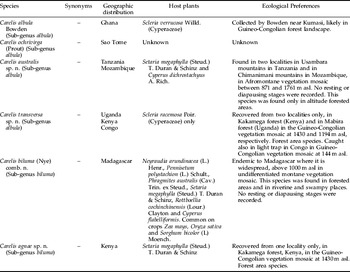
Among the studied genera, Carelis has the widest geographic distribution. It includes now six species and extends from Ghana, Sao Tome and Congo in West Africa to Kenya in the East and Mozambique and Madagascar in the south (table 5). Whereas the subgenus albula was mainly found on Cyperaceae and very rarely on Poaceae, the subgenus biluma fed mainly on Poaceae. The phylogenetic analysis (fig. 1) shows that the ancestor of the genus originated from Cyperaceae (posterior probability=0.99). The probability of the ancestor of the subgenus biluma feeding on Cyperaceae is much lower than in the other genera mostly feeding on this plant family (P=0.83), which suggests that the preference for Poaceae as host plants occurred at this lower level. All species in the Genus Carelis feed on only one or two plant species, with the notable exception of C. biluma, from Madagascar, which is oligophagous mainly on Poaceae and frequently found in cultivated cereals on the island. All species were found at altitude, except in Congo. C. australis and C. transversa had rather large distribution areas, but the other four species of the genus have a limited geographic range, two of them being endemic to islands. The phylogenetic tree obtained from Cyt b (fig. 2) shows the separation into two clades of C. transversa, the Congo population being rather genetically distant from that of East Africa (3.6%). The genetic distance between the two clades of C. australis, from Tanzania and Mozambique, reached 6%, which, in several other stem borer genera, is what is observed between close species, with only slight morphological differences (e.g. in Manga and Feraxinia). In the present case, no clear morphological difference could be determined; and, therefore, although both clades might be different species, they were considered as conspecific.
genus Carelis: taxonomic and ecological data.

Discussion
With seven new species described and ten species sunk as synonyms, the total species number of Sesamiina in Africa is now 155. The genus Sciomesa was split into three genera, Sciomesa, Pirateolea and Feraxinia. The genus Feraxinia is phylogenetically distant from the other three genera studied and, in contrast to them, had ancestors as specialist feeders on Poaceae, rather than Cyperaceae.
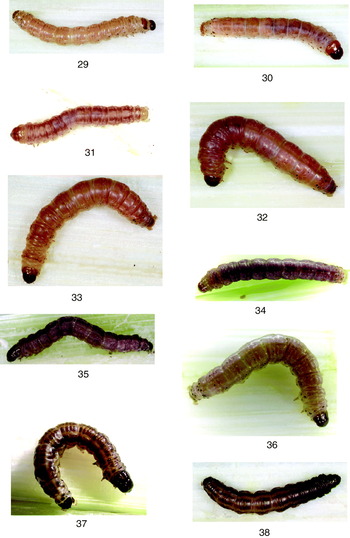
The limitations of morphological taxonomy of only one life stage (such as adult moths) on its own are clearly illustrated in this paper. In the introduction, attention was drawn to the fact that there was some doubt between taxonomists on the placement of some species in the genus Sciomesa. This is further illustrated in the case of F. nyei described by Fletcher (Reference Fletcher, Evans and Fletcher1961), who stated “the pattern and the structure of the genitalia make this a distinctive species in Sciomesa” (The current paper places it in a different genus). This paper shows how complementing morphological studies with molecular data in the Sesamiina provides a much more objective classification, an approach previously suggested by Moyal (Reference Moyal2006). Furthermore, the present study also shows another aspect that must be taken into account for the complete taxonomy of an organism. Larval morphology of Sciomesa species was unknown until now. This study for the first time linked larval to adult morphology in this group. Indeed, the three genera discussed (Sciomesa, Pirateolea and Carelis), which are closely linked by adult morphology, common ancestry shown by the molecular phylogenetic study and specialized larval feeding on Cyperaceae, have ‘Sesamia-like’ larval morphology, with a uniform pinkish body (figs 29–36). The larval morphology of Feraxinia species, in contrast, is quite different and very atypical of the Sesamiina, with the ground colour of the body pearl grey, with several longitudinal brown stripes (figs 37–38).
Larva of Sciomesa mesophaea.
Fig. 30. Larva of Sciomesa gnosia sp. n.
Fig. 31. Larva of Sciomesa scotochroa.
Fig. 32. Larva of Pirateolea piscator comb. n.
Fig. 33. Larva of Pirateolea nola sp. n.
Fig. 34. Larva of Carelis transversa sp. n.
Fig. 35. Larva of Carelis agnae sp. n.
Fig. 36. Larva of Carelis biluma comb. n.
Fig. 37. Larva of Feraxinia nyei comb. n.
Fig. 38. Larva of Feraxinia serena sp. n.

Most species collected had a very restricted distribution range. Many were monophagous or specialized to feed on a limited range of close host plant species. Amongst the continental species, only S. mesophaea and P. piscator had large distribution ranges, from East to South Africa, and in their respective genera were the most polyphagous, suggesting a possible correlation between the ability to feed on numerous host plants and that of colonizing new areas. Despite this aptitude, these two species have apparently not been able to colonize Central and West Africa, as none have been collected from localities surveyed in these regions. In contrast, C. transversa, was collected from only one host plant, but in locations in Congo in West Africa and Uganda-Kenya in East Africa. This could be a relict of historical vegetation distribution, since this species was found only in the Guineo-Congolian vegetation mosaic areas in East Africa, which were, at some periods in the past, parts of the great Guineo-Congolian forest, extending from West to East Africa (White, Reference White1986). The polyphagous species S. mesophaea and P. piscator had not colonised this region so early on, as shown by their molecular phylogeny. The phylogenetic study showed that both species were part of a much larger and widely distributed population when a first fragmentation event occurred that resulted in two populations, one in southern Africa, and the other in East-North-East Africa. Then an extension in distribution occurred, from south to east Africa in the case of S. mesophaea, and only within east Africa for P. piscator.
As was observed in the genus Manga (Moyal & Le Ru, Reference Moyal2006), it is hypothesized that both the specialization on host plants and geographic fragmentation have shaped the evolution of the Sesamiina group. Most species had both a limited geographic distribution and host plant range. These results were based on intensive surveys throughout the region over several years, and, thus, are not likely due to insufficient sampling. When close species shared the same host plants, geographic isolation was the most likely evolutionary force, as shown between the species of Feraxinia and the colonization of Madagascar by C. biluma. When species geographic distributions partly overlapped, the shift to new host plants most likely played the major role in speciation, for example, between S. mesophaea and S. venata.
In several other cases, close species have both geographic and host plant differences, suggesting the joint impact of both on the speciation process. In contrast, although it cannot be ascertained that the geographic distribution remained unchanged since the onset of the speciation process, there is some correlation between the geographic and host plant range, supporting the hypothesis that monophagous species remained limited to the same restricted area.
Above the genus level (although all genera of Sesamiina were not included in the study), there is little doubt that the group made up of the genera Sciomesa, Pirateolea and Carelis is monophyletic, with a common ancestor feeding on Cyperaceae. The shift to Cyperaceae likely resulted in the divergence of this group, since most other Sesamiina genera feed mainly on Poaceae (Le Ru et al., Reference Le Ru, Ong'amo, Moyal, Ngala, Musyoka, Abdullah, Cugala, Defabachew, Haile, Kauma Matama, Lada, Negassi, Pallangyo, Ravololonandrianina, Sidumo, Omwega, Schulthess, Calatayud and Silvain2006b), and had their ancestor specialized on Poaceae (fig. 1). The closeness of the three genera is supported by some morphological traits, e.g. the adult and larval habitus, and features of the genitalia such as the shelf-like process on the valva costa. Pirateolea and Carelis appear to be sister genera at the molecular level, which is also suggested by some morphological apomorphies they share, for instance the reduced size of the cucullus. From these common traits, we propose to name this set of three genera the ‘Sciomesa genus group’, which would be defined as: generally strong insects (or, when medium-sized, with elongate forewings) with the presence of a flat, shelf like expansion at the apex of the costal margin of the valva of the male genitalia, just under the cucullus; this expansion is very reduced in Carelis, and localized at the apex of the valva, which is roughly quadrangular because of the very small cucullus. We propose also to name as the ‘Carelis genus subgroup’ the genera Pirateolea and Carelis, which have in common a reduced or very reduced cucullus and, therefore, a shelf-like expansion rather close to the apex of the valve; or, when the cucullus is not so reduced, there is the presence of a small process on the costal margin under the shelf-like expansion. A ‘Sciomesa genus subgroup’, thus, is also defined, which includes only the genus Sciomesa so far and in which the cucullus is about as long as the costal margin.
This study enabled a better understanding of the systematics of all but four species included in the genus Sciomesa by Poole (Reference Poole and Heppner1989): S. sjoestedti (Aurivillius), a new combination from Conicofrontia (Poole, Reference Poole and Heppner1989), that we could not observe, and that was collected in Duma (RD Congo), which would make it the most western species of the genus; and three species from Madagascar described by Viette, S. betschi (Viette, Reference Viette1967a) and S. janthina and S. oberthueri (Viette, Reference Viette1967b). From their shelf-like expansion and cucullus, these three species fit within the Sciomesa subgroup definition, but they differ from the genus Sciomesa by differences in morphology of the aedeagus, the juxta and antennae. Further studies are necessary to determine whether they are to be included in a new genus, or if they can be considered as part of Sciomesa, which would need an extension of its definition. The only other species not included in the species listed in the new genera is S. secata, which does not belong to any of them and has to be included with some other sister species in a new, rather distant, genus that will be described in a future paper.
Acknowledgements
We are grateful to the Natural History Museum of London (BMNH) (M. Honey and G. Martin), to the Museum National d'Histoire Naturelle of Paris (MNHN) (Dr J. Minet) and to the Transvaal Museum of Pretoria (TMSA) (Dr M. Krüger) for the permission to study and photograph the types. Financial support was provided by the Institut de Recherche pour le Développement (IRD) and by ICIPE, African Insect Science for Food and Health (Kenya), and laboratory facilities by The Laboratory Evolution Génomes Speciation of the Centre National de la Recherche Scientifique (CNRS) in Gif-Sur-Yvette (France).