I. Introduction
Over the past decades, global health policy efforts emerged in response to the challenges posed by new infectious diseases, the majority of which are caused by pathogens that transmit across species. Globalisation – intended as the increased circulation of people, goods, services, finance and capital across the world – has led to the proliferation of endemic diseases. Moreover, the increasing human population and environmental degradation, closer habitation between humans and animal species and the related exacerbating use of antibiotics in both human and animals has increased risk and raised questions about the human–animal–environment health interfaces. Policymakers, practitioners and researchers across governance sectors and levels have attempted to address this challenge through a more integrative approach, known as One Health. Footnote 1
The global challenge posed by the COVID-19 pandemic has awakened the debate over the necessity of a shift towards a more integrated and holistic approach to human, animal and environmental health. At the European Union (EU) level, it emerged as a cross-cutting problem across governance sectors and levels, urging the creation of a European Health Union. There are already a number of integrated European governance strategies – such as the European Energy Union Footnote 2 and the European Green Deal Footnote 3 – designed for overcoming problems of governance fragmentation and the inadequacy of fragmented policy responses to cross-cutting policy challenges and emergencies. The recent EU “From Farm to Fork” strategy (at the heart of the European Green Deal) has been adopted for redesigning the existing food systems to make them fair, healthy and environmentally friendly. The European Commission (EC) called for a common European response to crises affecting food systems in order to ensure food security and safety, reinforce public health and mitigate their socioeconomic impact in the EU. In so doing, it activated a food crisis response mechanism coordinated by the EC and involving Member States. Similarly, the Energy Union and Climate Action Footnote 4 activated an integrated governance mechanism based on national energy and climate plans and EU and national long-term strategies, as well as integrated reporting, monitoring and data publication.
Past policy studies adopted a mechanism-based approach for investigating the interaction between crisis and policy change and the activation of different policy mechanisms to enhance integration and coordination across governance sectors and levels. Footnote 5 Here, I draw upon such a mechanism-based approach to policy integration, which offers a model of causation that uncovers the actions and interactions that are triggered under particular contextual conditions. Footnote 6
Against this background, this article contributes to the debate over the creation of a European Health Union by unpacking the acknowledged dimensions of policy integration – policy frame, subsystem involvement, policy goals and policy instruments Footnote 7 – in order to assess their manifestations in the new European health governance system (established with the EU4Health policy Footnote 8) and to establish what contextual conditions triggered the activation of the integration-enabling mechanisms that led to a more integrated European Health Union. I argue that the global challenge posed by the COVID-19 pandemic can be regarded itself as a favourable contextual condition – and that an approach that accounts for complexity is needed. As a result, I argue in favour of a conjunctural causation perspective that foresees the effects of the contextual conditions in conjunction with each other: institutional, political and policy capacities and contexts.
II. How integrated is the new European health governance system?
Recent academic literature has shown great interest in the challenge of integration, and recent contributions have provided insights into integrated governance strategies and problem-solving in multi-level contexts and suggested a mechanism-based approach for studying integration. Candel and Biesbroek proposed Footnote 9 and applied Footnote 10 a processual and multi-dimensional conceptualisation of policy integration, suggesting a perspective in which integration entails four distinct and observable dimensions: policy frame, subsystem involvement, policy goals and policy instruments. Policy integration can be defined as “an agency-driven process of asynchronous and multi-dimensional policy and institutional change within an existing or newly formed governance system that shapes the system’s and its subsystems’ ability to address a crosscutting policy problem in a more or less holistic manner”. Footnote 11 This framework draws upon the assumption that mutual dependencies and interactions exist between the four dimensions of integration, and their mutual influence may work in various directions and under different mechanisms.
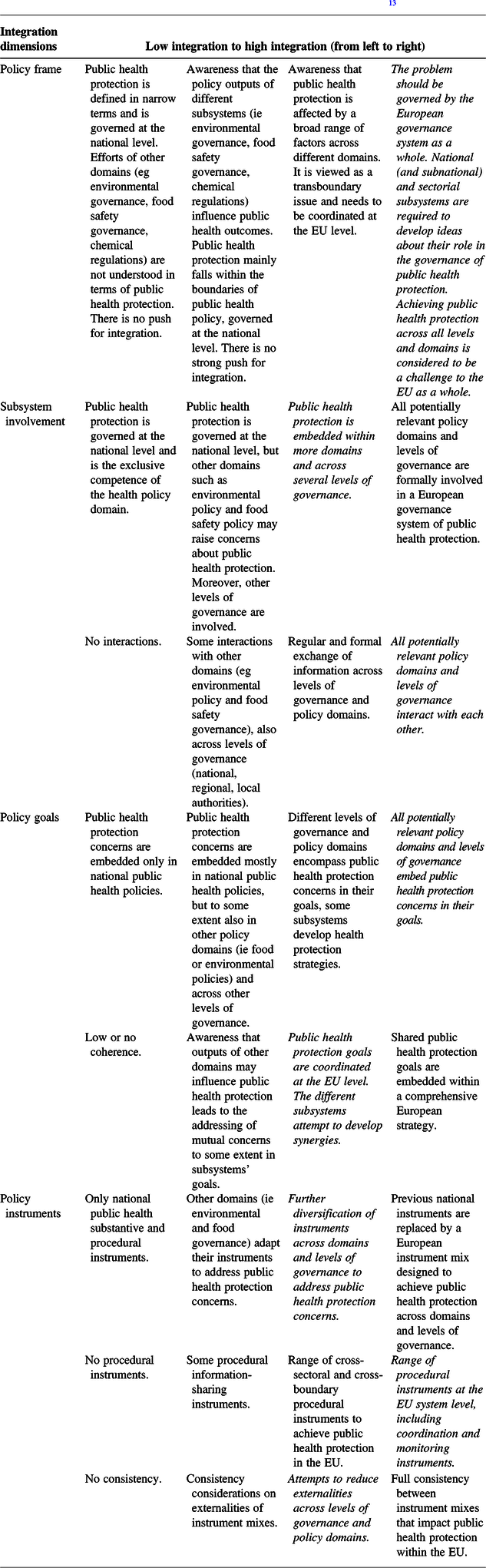
Here, I draw upon the policy integration framework developed by Candel and Biesbroek to illustrate the ideal-typical values of the four integration dimensions with respect to public health protection (see Table 1). In so doing, I discuss the manifestations of policy frame, subsystem involvement, policy goals and policy instruments in the new European health governance system (in italics in Table 1), as set out in the proposal for the establishment of the EU4Health Programme for the period 2021–2027, released by the European Commission on 28 May 2020. Footnote 12
Dimensions of policy integration in the new European health governance system.Footnote 13

The new EU health policy serves to support EU and national policies and priorities, with the aim of increasing the general level of public health, strengthening the national health systems, protecting people in the EU from serious cross-border threats to health and increasing the availability of medicines and medical devices across the Union.
With respect to policy frame, the new EU4Health policy stresses how “a high level of human health protection is to be ensured in the definition and implementation of all Union Footnote policies and activities”. Footnote 14 Drawing upon the principle of Health in All Policies, the problem is therefore governed by the European governance system as a whole. National (and subnational) subsystems are required to define their health policies and organise and deliver health services and medical care. In the areas of national competence, there should be close collaboration between the EC and the Member States in setting priorities. Achieving a high level of human health protection across all levels and domains is considered to be a challenge to the EU as a whole: in line with the goals of the Union’s actions and its competences in the area of public health, the new European health governance system supports coordinated public health measures at the Union level, in keeping with the One Health approach. It also facilitates the setting up of an integrated cross-cutting risk communication framework working at all stages of a health crisis – prevention, preparedness and response. Moreover, the new European health policy supports the Member States in reaching the targets of the third Sustainable Development Goal of the United Nations: to “ensure healthy lives and promote well-being for all at all ages”. Footnote 15
With respect to subsystem involvement, public health protection is embedded within several domains and across several levels of governance: food safety, trade policies, labour policies, consumer protection policies, social inclusion policies, agricultural policies and environmental and climate action policies. Several EU programmes provide support for health policy actions, including the implementation of solutions tailored to specific national and regional contexts, as well as bilateral and interregional initiatives. Footnote 16 All potentially relevant policy domains and levels of governance interact with each other through, among others: the Union Civil Protection Mechanism, Footnote 17 which enables the EU and the Member States to react quickly and flexibly to emergencies; the European Regional Development Fund, Footnote 18 which supports interregional cooperation networks; and the Digital Europe Programme, Footnote 19 which supports the delivery of data-sharing and citizen platform applications.
As to policy goals, all potentially relevant policy domains and levels of governance encompass public health protection concerns in their goals: enhancing measures to strengthen the assessment and management of the environmental risks associated with the production, use and disposal of medicinal products; ensuring a high level of public health and food safety; reducing the impact of animal diseases on animal and public health, animal welfare, economy and society by enhancing disease awareness and preparedness at the national and EU level as specific objectives of the Animal Health Law; Footnote 20 and maintaining well-developed rapid alert systems, which is a major objective in food safety policies. Public health protection goals are coordinated at the EU level, and the new EU4Health policy contributes to the EC’s priorities, including responding to the challenges from migration, the Green Deal, Footnote 21 the From Farm to Fork strategy, Footnote 22 the biodiversity strategy, Footnote 23 the European pharmaceutical and chemical strategies Footnote 24 and the EU Cancer Plan. Footnote 25
As to policy instruments, the EU4Health policy sets out a further diversification of instruments across domains and levels of governance in order to address public health concerns, such as information exchange tools (ie rapid alert systems, notification systems), monitoring and reporting by the Directorate-General for Health and Food Safety and by the Member States, health impact assessments, stakeholder consultations, ex post evaluations, regulations and funding instruments (eg the European Social Fund Plus, Footnote 26 the European Regional Development Fund, Footnote 27 Horizon Europe Footnote 28), the Emergency Support Instrument, Footnote 29 EU external action instruments (eg the Neighbourhood, Development and International Cooperation instrument Footnote 30 and the Instrument for Pre-accession Assistance III Footnote 31) and authorisation procedures (within the food and pharmaceutical sectors). In terms of consistency of policy instruments, attempts to reduce externalities across levels of governance and policy domains have been made, as harmonisation of standards, of data, of regulations and of guidelines has been attempted.
From the illustration of the ideal-typical values of the four integration dimensions, it emerges that the new system of European health governance manifests a medium to high level of integration (ideal-typical values in italics in Table 1), with lower integration in terms of subsystem involvement and consistency of policy mixes.
The next section will discuss what contextual conditions recently triggered the activation of the integration-enabling mechanisms that led to a more integrated European Health Union.
III. Towards a European Health Union: triggering policy mechanisms
During recent decades, the social sciences have given considerable attention to the study of mechanisms, and political scientists and public policy scholars largely agree that mechanisms are crucial for explaining causation at both the macro and micro levels. Here, I draw upon a definition of mechanism as “a theory of a system of interlocking parts that transmits causal forces between a cause (or a set of causes) and an outcome”. Footnote 32 Past policy studies adopted such a mechanistic approach and focused on the interaction between crisis and policy change to investigate the activation of different policy mechanisms that enhance integration and coordination across governance sectors and levels. Footnote 33 Crucial to this approach is to include the contexts under which mechanisms are triggered, Footnote 34 as they determine the conditions under which actions and interactions between the different actors take place. A mechanistic approach seems to be especially appropriate for policy integration, as it enables decision-makers to design appropriate policy responses for shaping integration and, by intervening in the context, decision-makers may create a more conducive environment for the occurrence of mechanisms that result in policy integration outcomes. Footnote 35
Against this background, I discuss what contextual conditions created such a conducive environment for triggering the integration-enabling mechanisms that recently led to a more integrated European health governance system.
First, the global challenge posed by the COVID-19 pandemic can be regarded itself as a favourable contextual condition for shifting towards a more integrated and holistic approach to human, animal and environmental health. This is particularly true for the policy frame and the policy goals dimensions of policy integration, as the current pandemic triggered a political debate on the matter that led to framing public health protection as a challenge to the EU as a whole and to embedding public health protection concerns within a comprehensive European strategy that includes all potentially relevant policy domains and levels of governance. What is more, COVID-19 has demonstrated a significant flaw in the EU’s current policy considerations towards the One Health approach and an integrated European Health Union. Previous studies showed that major health policy integration shifts happened in the aftermath of crises, such as the bovine spongiform encephalopathy (BSE) crisis that led to the reorganisation of the European food safety governance system through the adoption of the General Food Law Footnote 36 and the creation of the European Food Safety Authority (EFSA). Footnote 37
However, I argue in favour of a conjunction of contextual conditions triggering integration, as politics, policy and polity never unfold in isolation. Footnote 38 As highlighted by the environmental policy integration (EPI) literature, Footnote 39 policy integration is a process anchored in a political system, and as such it needs to be decided upon by political majorities, then organised, managed and maintained. As a result, the conjunction of institutions (ie the structure of the prevailing political system), politics (ie the political context) and policy conditions is needed in order to trigger an integration-enabling mechanism.
From an institutional perspective, an integrated European health governance system is a multi-sectoral and multi-level coordination challenge that still needs to overcome the institutional fragmentation of the jurisdictions involved: some domestic political systems feature more or less ministerial independence that reinforces more or less sectoral thinking. Within the EU, the same can be argued regarding the different directorates general and related agencies. Lessons drawn from the EPI literature argue in favour of the Swedish sector responsibility model, which ensures that individual ministries or government agencies take responsibility for including common objectives in their operations. Footnote 40
From a policy perspective, capacity can be regarded as an important contextual condition for triggering an integration-enabling mechanism. Lack of capacity can be highly detrimental to enabling a shift towards a more integrated governance system, particularly with respect to the availability (or unavailability) of adequate resources. Footnote 41 Previous research on policy integration defined governance capacity as “the organization and systemic resources necessary to establish a more coherent policymaking process”, which encompasses three dimensions: analytical, operational and political. Footnote 42 Analytical capacity is fundamental in generating knowledge about the extent of consistency within domains that are to be integrated, thus enabling a shift towards a fully consistent policy mix. Within the context of the European framework, such analytical capacity has been fundamental in triggering an integrative mechanism, manifested by the new EU4Health policy (see Table 1). Operational capacity is about the capability of the agency “to get things done” within the administrative boundaries and is crucial to “bringing together various actors” and therefore triggering a shift towards higher degrees of the subsystem involvement dimension of policy integration. This capacity is related to the institutional dimension, as within the EU institutional framework multiple veto points exist, making the activation of integration-enabling mechanisms more difficult and producing more need for bargaining between the different political actors. This leads us to the political perspective – from which capacity is about setting the agenda for policy integration (ie political will and support regarding the problem at stake, which are crucial to triggering a shift towards the fully integrated policy frame and policy goals dimensions of policy integration). As a result, the political composition of the Commission and the Council (ie leadership) can exert an impact on the attention given to the European Health Union. Focusing on political factors, it is fundamental also to take into account the behaviour of individual political leaders: as Mario Draghi’s famous “whatever it takes” speech was in 2012,Footnote 43 the declaration of President von der Leyen of 26 March 2020 while speaking to the European Parliament that “we will stop at nothing to save lives”Footnote 44 is a manifestation of her political will and support regarding the need to reinforce the EU’s capacity to respond effectively to major health threats, which resulted in the recent EU4Health policy.
IV. Conclusions
Drawing upon a conjunctural causation assumption, I argue that a combination of contextual conditions is needed to trigger the activation of integration-enabling mechanisms and to lead to a more integrated European Health Union. As such, my main claim is that politics, policy and polity conditions can trigger an integration-enabling mechanism only in conjunction instead of in isolation. Indeed, the complexity of the EU framework on the one hand and of the health governance issue on the other calls for an approach that accounts for such complexity. To conclude, the new EU4Health policy has been designed in such conjunctural contexts, and it can be regarded as the result of the creation of a more conducive environment for the occurrence of mechanisms that could, in turn, result in greater policy integration outcomes – particularly with respect to institutional fragmentation and operational capacity – by triggering the shift towards higher degrees of subsystem involvement and a fully consistent policy mix.