1. Introduction
Even if some of them possessed planktonic larval stages facilitating dispersal, adult trilobites were primarily benthic organisms restricted in their habitat to a certain depth-range. Consequently, the palaeobiogeography of trilobites, especially those living on the continental shelf, was strongly influenced by the distribution of continents, which permits, retrospectively, the use of these fossils for inferring past continental configurations. Trilobites have thus proved to be critical in constraining palaeogeographical models in the Lower Palaeozoic (e.g. Fortey & Cocks, Reference Fortey and Cocks2003). In the Permian period, however, their taxonomic diversity (Lerosey-Aubril & Feist, Reference Lerosey-Aubril, Feist and Talent2012) and their abundance are so low that these organisms are almost never considered in reference to the evolution of palaeogeography (the same is true for biostratigraphy). On the one hand, with such a patchy fossil record in the Late Palaeozoic, it may make sense to think that the potential of trilobites for discriminating Permian biochores (i.e. biogeographical units) may be negligible compared with other fossil groups (e.g. brachiopods, fusulinid foraminifera) and therefore that their palaeobiogeographical signal is worthless. However, this would be ignoring the fact that the definition of a biochore, like that of a stratigraphical unit, is all the more precise and robust if it integrates data from different taxa (Westermann, Reference Westermann2000). This approach avoids bias due to particular ecological characteristics of any one given taxon and permits a good assessment of the evolution through time of the geographical range of a biochore.
The Iranian territory represents a particularly complex tectonic context, being composed of a mosaic of more or less well-recognized tectonic units (Zanchi et al. Reference Zanchi, Zanchetta, Garzanti, Balini, Berra, Mattei, Muttoni, Brunet, Wilmsen and Granath2009). Unravelling the evolution through time of these blocks and of their positions relative to one another and to major continents (e.g. Gondwana, Laurentia) is a difficult task, especially in the Permian period when several of these microplates were separated from the northern Gondwana margin and migrated towards the north during the opening of the Neo-Tethys (Zanchi et al. Reference Zanchi, Zanchetta, Garzanti, Balini, Berra, Mattei, Muttoni, Brunet, Wilmsen and Granath2009). Every potential source of a palaeogeographical signal (e.g. palaeontological, sedimentological, palaeomagnetical), even from a minor component of fossil assemblages like trilobites, requires consideration. The objective of this contribution is twofold: (1) to review the Late Palaeozoic record of trilobites in Iran and Armenia and (2) to discuss their palaeobiogeographical affinities with other Permian taxa and their implications with regard to palaeogeographical models of the Iranian region in the Permian period.
2. Materials, localities and structural units
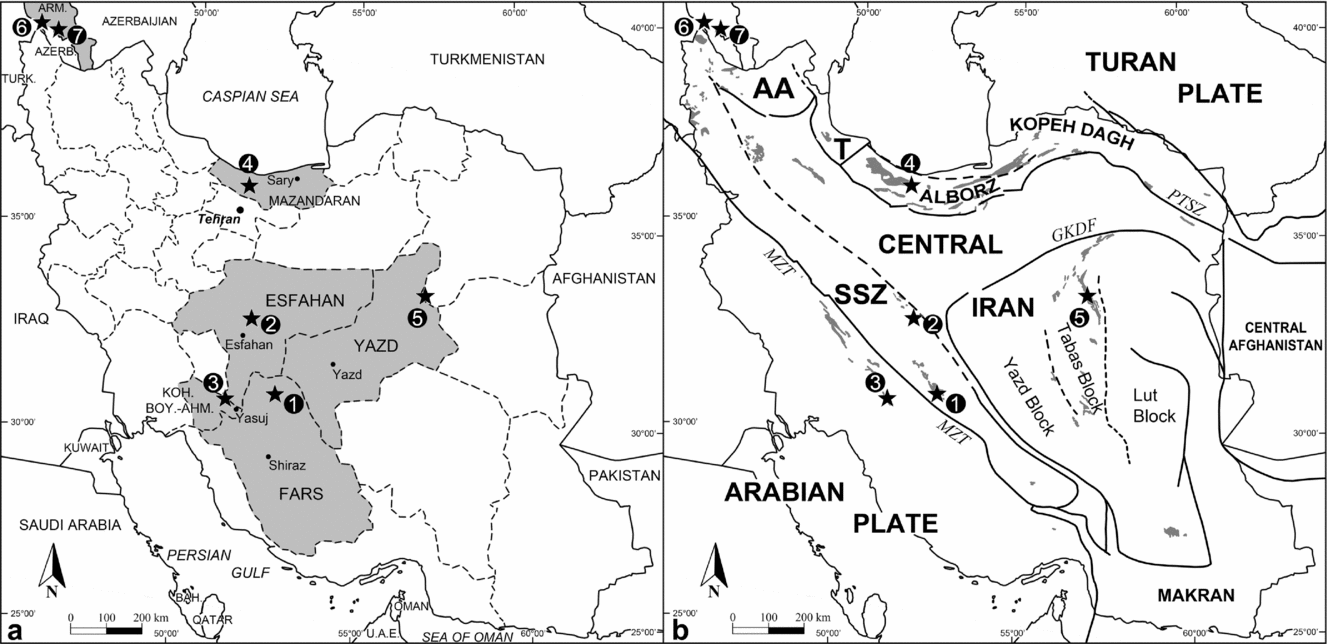
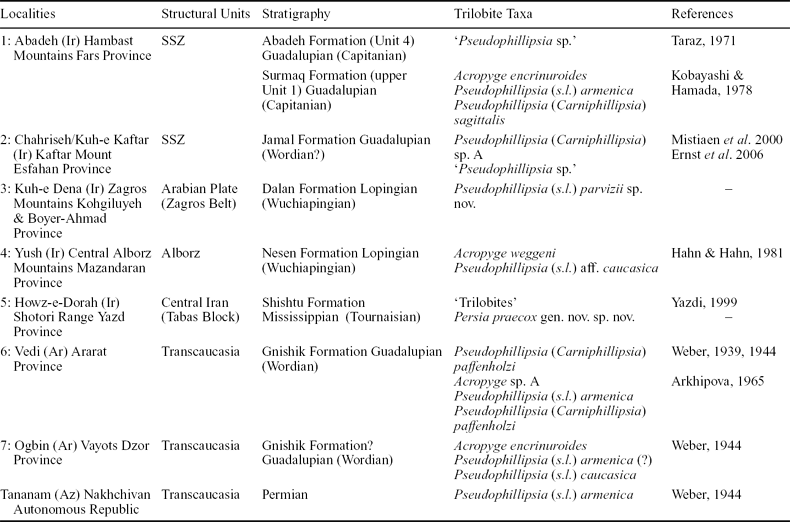
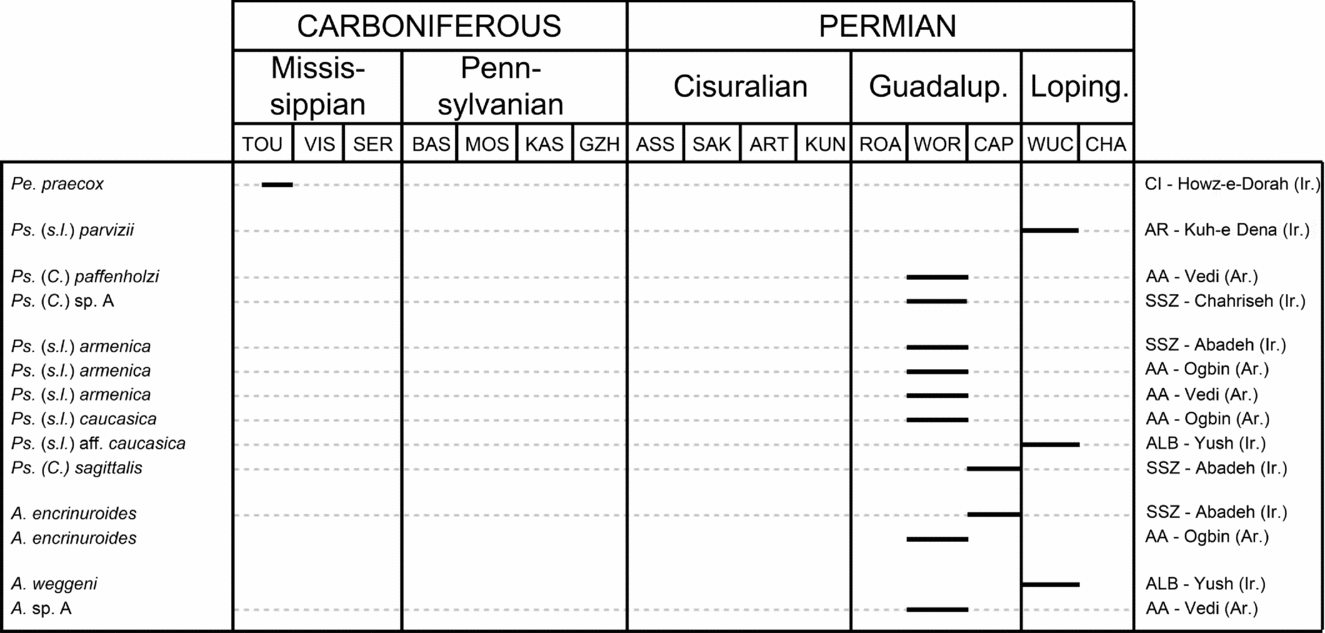
Late Palaeozoic trilobites have been found in five different localities in Iran (1 to 5 on Fig. 1), the distribution of which covers an area of c. 360 000 km2 in the middle third (along a W–E axis) of the country. Although limited in size compared with the whole of Iran (c. 1 650 000 km2), this area includes parts of five distinct tectonic units, four of which have yielded trilobite remains (Fig. 1b). Several of these structural units represent more or less independent microplates (western Cimmerian blocks) during the Permian period, separated from northern Gondwana by the opening of the Neo-Tethys Ocean. In addition to these five Late Palaeozoic outcrops in Iran, two southern Armenian localities (6 and 7 on Fig. 1) are considered in this work because of their proximity to the Iranian border and notable similarities in their trilobite faunules. The geographical and stratigraphical details for all these localities are summarized in Table 1.
Geographical map (a) and simplified tectonic scheme (b) of Iran and neighbouring countries, showing the location of the outcrops that have yielded Late Palaeozoic trilobites. Five tectonic units (Iran: Alborz, Arabian Plate, Sanandaj–Sirjan Belt, Tabas; Armenia: Transcaucasia) are associated with Late Palaeozoic trilobite faunules. Labels: 1 – Abadeh area (Capitanian); 2 – Chahriseh area (Wordian); 3 – Dena Range (Wuchiapingian); 4 – Yush area (Wuchiapingian); 5 – Howz-e-Dorah area (Tournaisian); 6 – Vedi area (Wordian); 7 – Ogbin area (Wordian). Abbreviations: Arm. – Armenia; Azerb. – Azerbaijan; Bah. – Bahrain; Koh. Boy.-Ahm. – Kohgiluyeh and Boyer-Ahmad Province; Turk. – Turkey; U.A.E. – United Arab Emirates; AA – Araxian–Azerbaijanian Zone; GKDF – Great Kavir–Doruneh Fault system; MZT – Main Zagros Thrust; PTSZ – Palaeo-Tethys Suture Zone; SSZ – Sanandaj–Sirjan Zone; T – Talesh. Figure 1b simplified after Zanchi et al. Reference Zanchi, Zanchetta, Garzanti, Balini, Berra, Mattei, Muttoni, Brunet, Wilmsen and Granath2009.

Geographical, structural and stratigraphical details for each Armenian and Iranian locality that has yielded Late Palaeozoic trilobites

Numbers in first column are the same as in Figure 1. Abbreviations: Ar – Armenia, Ir – Iran, SSZ – Sanandaj–Sirjan Belt. A single specimen of P. (s.l.) armenica might have been found in the locality of Tananam (Nakhchivan Autonomous Republic; Weber, Reference Weber1944) but, as it has never been figured, it is not considered further in this work.
This review integrates the most recent stratigraphical data concerning each locality but also, for some of them, new data inferred from the study of thin-sections. Although only two trilobite occurrences are new (from Dena Mountain and Howz-e-Dorah; 3 and 5 on Fig. 1), an effort has been made to figure or refigure all the Late Palaeozoic trilobites discovered in Iran and Armenia in an attempt to facilitate future investigations on this material. Original pictures have been used to illustrate the few specimens that could not be relocated in the collections of their host institutions. Otherwise, new pictures have been taken.
2.a. The Abadeh area (Sanandaj–Sirjan Belt, central Iran)
The first description of post-Devonian trilobites from Iran was made by Kobayashi & Hamada (Reference Kobayashi and Hamada1978) and concerned specimens found in the Permian beds exposed in the vicinity of Abadeh (Fars Province, Central Iran; label 1 on Fig. 1). Initially, this material was described as two new taxa, Acropyge lanceolata and Iranaspidion sagittalis, for which a late Guadalupian age had been proposed (Kobayashi & Hamada, Reference Kobayashi and Hamada1978). Of the nine specimens (four type specimens, five additional ones) initially studied by these authors, only two can still be found in the collections of the University Museum of the University of Tokyo (T. Sasaki, pers. comm. 2010): the holotype of A. lanceolata (PA 16766) and a pygidium of I. sagittalis (PA 16765). The holotype and the two paratypes of the latter species are missing. A. lanceolata is considered herein as a subjective junior synonym for A. encrinuroides (Weber, Reference Weber1944). I. sagittalis is now referred to Pseudophillipsia (Carniphillipsia) sagittalis (Kobayashi & Hamada, Reference Kobayashi and Hamada1978), after Iranaspidion had been itself put in synonymy with Pseudophillipsia (Lerosey-Aubril & Angiolini, Reference Lerosey-Aubril and Angiolini2009), but only the holotype and its two paratypes (Kobayashi & Hamada, Reference Kobayashi and Hamada1978, figs 1, 3a–c) are herein regarded as representatives of this taxon. The isolated pygidium figured by Kobayashi & Hamada (Reference Kobayashi and Hamada1978, fig. 4a–c) and refigured herein (Fig. 4b, d, e) is reassigned to Pseudophillipsia (s.l.) armenica Weber, Reference Weber1944.
According to Kobayashi & Hamada (Reference Kobayashi and Hamada1978), the trilobites were found in the upper part of Unit 1 of the Abadeh section as defined by Taraz (Reference Taraz1971). Taraz's Units 1 to 3 were later considered parts of the Surmaq Formation (Taraz et al. Reference Taraz, Golshani, Nakazawa, Shimizu, Bando, Ishii, Murata, Okimura, Sakagami, Nakamura and Tokuoka1981) and the uppermost part of Unit 1 has been recently dated as Capitanian (Midian; Kobayashi & Ishii, Reference Kobayashi and Ishii2003). Taraz (Reference Taraz1971, p. 1289) also mentioned the presence of trilobites in the basal part of his Unit 4 (‘Pseudophillipsia sp.’), now part of the Abadeh Formation (Taraz et al. Reference Taraz, Golshani, Nakazawa, Shimizu, Bando, Ishii, Murata, Okimura, Sakagami, Nakamura and Tokuoka1981), which is also of Capitanian (Midian) age (Mohtat-Aghai & Vachard, Reference Mohtat-Aghai and Vachard2005). However, he did not provide any description or figure of this material, and accordingly, I do not consider it further in Section 3 below. Structurally, the Abadeh area is part of the Sanandaj–Sirjan structural belt (SSZ; Fig. 1b), a region rich in strongly deformed and metamorphosed rocks sandwiched between Central-North Iran and the Zagros Orogenic Belt (Zanchi et al. Reference Zanchi, Zanchetta, Garzanti, Balini, Berra, Mattei, Muttoni, Brunet, Wilmsen and Granath2009).
2.b. The Chahriseh area (Sanandaj–Sirjan Belt, central Iran)
Another locality belonging to the Sanandaj–Sirjan structural belt has yielded Permian trilobites. Indeed, Feist et al. (in Mistiaen et al. Reference Mistiaen, Gholamalian, Gourvennec, Plusquellec, Bigey, Brice, Feist, Feist, Ghobadi Pour, Kebria-Ee, Milhau, Nicollin, Rohart, Vachard and Yazdi2000) have described a single entire specimen collected from a loose block in Kuh-e Kaftar, a locality near Mount Kaftar and a village called Chahriseh, some 55 km northeast of Esfahan (label 2 on Fig. 1). This specimen, initially assigned to Pseudophillipsia (?Carniphillipsia) sp. is below referred to as Pseudophillipsia (Carniphillipsia) sp. A.
The age of the Permian sequence in this area is not well-constrained, ranging from the Wordian to the Wuchiapingian according to microfossils (middle–late Murghabian to early Dzhulfian; Mistiaen et al. Reference Mistiaen, Gholamalian, Gourvennec, Plusquellec, Bigey, Brice, Feist, Feist, Ghobadi Pour, Kebria-Ee, Milhau, Nicollin, Rohart, Vachard and Yazdi2000). In addition, Permian trilobites (‘Pseudophillipsia sp.’) in a neighbouring section have been reported by Ernst, Senowbari-Daryan & Hamedani (2006). These authors referred to the Permian beds exposed in their section as part of the Jamal Formation (see also Senowbari-Dayan & Hamedani, Reference Senowbari-Daryan and Hamedani2002), a lithographical unit well known in eastern Iran (e.g. Wendt et al. Reference Wendt, Kaufmann, Belka, Farsan and Karimi Bavandpur2002). Unfortunately, a comparison between this Permian sequence and that of the Abadeh area (same structural unit, less than 200 km to the south), and therefore its possible correlation with one of the lithostratigraphical units known in Abadeh (Surmaq, Abadeh or Hambast formations), is nowhere to be found in the contributions of this working group (Senowbari-Daryan & Hamedani, Reference Senowbari-Daryan and Hamedani2002; Rigby, Senowbari-Daryan & Hamedani, Reference Rigby, Senowbari-Daryan and Hamedani2005; Ernst, Senowbari-Daryan & Hamedani, Reference Ernst, Senowbari-Daryan and Hamedani2006). A Wordian age (Murghabian) has been proposed for these trilobite-bearing beds based on their bryozoan content (Ernst, Senowbari-Daryan & Hamedani, Reference Ernst, Senowbari-Daryan and Hamedani2006), because of its great similarity with that of the Gnishik horizon in Transcaucasia (see Section 2.f below for further details about this lithostratigraphical unit). Accordingly, a similar age is tentatively given to the specimen described in Mistiaen et al. (Reference Mistiaen, Gholamalian, Gourvennec, Plusquellec, Bigey, Brice, Feist, Feist, Ghobadi Pour, Kebria-Ee, Milhau, Nicollin, Rohart, Vachard and Yazdi2000). However, the assignment by Ernst, Senowbari-Daryan & Hamedani (2006) of the trilobite remains to the genus ‘Pseudophillipsia’ is purely arbitrary, as they were only observed in thin-sections (B. Senowbari-Daryan, pers. comm. 2010).
2.c. The Dena range (Arabian Plate, southwestern Iran)
Some 120 km west of Abadeh and 40 km northwest of Yasuj, in the Dena Range (Zagros Mountains; label 3 on Fig. 1), is another Permian outcrop where trilobite remains occur. Two pygidia were recently discovered there by M. Parvizi (University of Payam-e Noor) on some loose blocks, which likely came from beds belonging to the Dalan Formation. These specimens are assigned to a new species Pseudophillipsia (s.l.) parvizii sp. nov.
Thin-sections made from the surrounding matrix revealed that this sediment corresponds to a sandy wackestone with gastropods, brachiopods (e.g. productoids), bryozoans (fenestellids), crinoids, ostracods and very rare trilobites (D. Vachard, pers. comm. 2010). The rare foraminifers (1–5 specimens per genus) observed were representatives of Fusulinata (Neoendothyra parva, Retroseptellina ex gr. decrouezae, Codonofusiella ex gr. tenuissima), Miliolata (Pseudovermiporella ex gr. nipponica) and Nodosariata (Pachyphloia ex gr. ovata, Pachyphloia sp., Langella ex gr. perforata). The inferred depositional environment is that of the boundary between the inner- and middle ramp (10–25 m deep). A Wuchiapingian age is indicated by the presence of Codonofusiella ex gr. tenuissima (D. Vachard, pers. comm. 2010). Separated from the Sanandaj–Sirjan structural belt by the main Zagros thrust, the Zagros fold belt is a part of the Arabian Plate (Gaillot & Vachard, Reference Gaillot and Vachard2007; Zanchi et al. Reference Zanchi, Zanchetta, Garzanti, Balini, Berra, Mattei, Muttoni, Brunet, Wilmsen and Granath2009).
2.d. The Yush area (Alborz, northern Iran)
The fourth locality that has yielded Permian trilobites in Iran is in the Central Alborz Mountains, near a small village called Yush (exact location: 36° 13.05′ N, 51° 42.20′ E; label 4 on Fig. 1). Hahn & Hahn (Reference Hahn and Hahn1981) used one of the three specimens discovered there to define a new species, Acropyge weggeni, and referred to the other two as Acropyge? sp. and Iranaspidion? sp. Reinvestigations of this material housed at the Senckenberg Research Institute confirms that two of these specimens belong to the genus Acropyge. It seems overcautious to me not to refer to the very small pygidium assigned to Acropyge? sp. by Hahn & Hahn (Reference Hahn and Hahn1981) as A. weggeni (see Section 3 below). The third specimen is a partial pygidium associated with an external mould of its posterior region. After preparation, the latter was used to create a latex cast, which provides complementary data on the morphology of this specimen. Below, this specimen is referred to as Pseudophillipsia (s.l.) aff. caucasica.
The horizon that has yielded this material belongs to the Nesen Formation, which is of mainly Wuchiapingian age (Gaetani et al. Reference Gaetani, Angiolini, Ueno, Nicora, Stephenson, Sciunnach, Rettori, Price, Sabouri, Brunet, Wilmsen and Granath2009). Three thin-sections made from the associated matrix revealed that it is a wackestone with remains of bivalves, brachiopods, bryozoans, crinoids, gastropods, ostracods and trilobites (D. Vachard, pers. comm. 2010). In addition, it contains the following foraminifera: Codonofusiella cf. tenuissima, Climacammina sp., Dunbarula tumida, Earlandia? sp., Geinitzina cf. taurica, Globivalvulina sp., Midiella sp., Pachyphloia ex gr. ovata and Retroseptellina decrouezae. This association of taxa confirmed the Wuchiapingian age of the trilobite faunule (D. Vachard, pers. comm. 2010). The Alborz region is usually considered a structural unit of its own (e.g. Torsvik & Cocks, Reference Torsvik and Cocks2004; Muttoni et al. Reference Muttoni, Gaetani, Kent, Sciunnach, Angiolini, Berra, Garzanti, Mattei and Zanchi2009a ; Zanchi et al. Reference Zanchi, Zanchetta, Garzanti, Balini, Berra, Mattei, Muttoni, Brunet, Wilmsen and Granath2009).
2.e. Howz-e-Dorah (Tabas Block, eastern Iran)
As far as has been determined, only one Carboniferous trilobite has been found in Iran until now. This specimen was collected by M. Yazdi (University of Esfahan) during a conference excursion at the Howz-e-Dorah section in the Shotori Range (see Yazdi, Reference Yazdi1999 and Wendt et al. Reference Wendt, Kaufmann, Belka, Farsan and Karimi Bavandpur2005 for details about this locality; label 5 on Fig. 1). It is herein assigned to a new taxon, Persia praecox gen. nov. sp. nov.
The trilobite-bearing horizons, already mentioned by Yazdi (Reference Yazdi1999, fig. 5), belong to the Shishtu Formation and are dated as Tournaisian (typicus conodont biozone). Howz-e-Dorah is located near Tabas and therefore on a structural sub-unit of Central Iran, the so-called Tabas Block (Zanchi et al. Reference Zanchi, Zanchetta, Garzanti, Balini, Berra, Mattei, Muttoni, Brunet, Wilmsen and Granath2009).
2.f. Ogbin and Vedi areas (Transcaucasia, southern Armenia)
The occurrence of Permian trilobites in the Vedi area (label 6 on Fig. 1) in southern Armenia was first reported by Weber (Reference Weber and Lisharew1939). A few years later, these specimens were described, along with others discovered in the neighbouring locality of Ogbin (label 7 on Fig. 1) (Weber, Reference Weber1944). However, discrepancies in this work between the text in Russian, his table 2, the text in English and the captions of his figures are confusing, and it requires particular attention to assess correctly the faunal content of each locality. Weber's table 2 (1944, p. 18) obviously contains mistakes and his text in English does not provide all the data mentioned in the Russian part. According to this Russian part and the captions of the figures, the following summary can be given. Two apparently close outcrops along the Vedi River have yielded remains of Cyphinium (?) paffenholzi, a species which is referred to as Pseudophillipsia (Carniphillipsia) paffenholzi below. In another locality near Ogbin village, a pygidium of Pseudophillipsia (Anisopyge) encrinuroides and a pygidium of Pseudophillipsia armenica have been found. In addition, a single pygidium of Pseudophillipsia elegans var. caucasica might have been discovered in the same locality, but Weber does not provide accurate geographical data for this specimen, which is only mentioned in his Russian text. In his table 2, however, the presence of this taxon is mentioned in this locality. Pseudophillipsia (Anisopyge) encrinuroides, Pseudophillipsia armenica and Pseudophillipsia elegans var. caucasica are hereafter referred to as Acropyge encrinuroides, Pseudophillipsia (s.l.) armenica and Pseudophillipsia (s.l.) caucasica. Apparently, a second specimen of P. (s.l.) armenica has been collected in Tananam (‘locality 63’), a third locality between Ogbin and Karabaglyar in the neighbouring Azerbaijan (Nakhchivan Autonomous Republic), but it was not figured by Weber and could not be considered in this work.
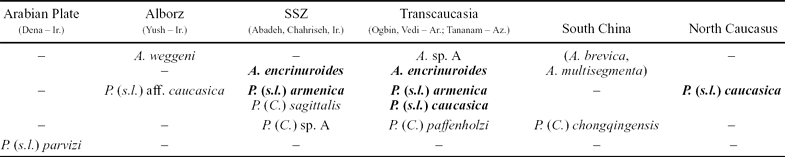
Permian trilobite faunules associated with some Iranian tectonic units and Transcaucasia and their affinities

Representatives of the genus Acropyge suggest special palaeobiogeographical affinities between the Alborz and the SSZ (Iran), Transcaucasia and South China. Faunal relationships between the SSZ, Transcaucasia and South China are also supported by the presence of similar species of Pseudophillipsia (Carniphillipsia) (‘paffenholzi-group’). That the Alborz, the SSZ and Transcaucasia might have been associated with a single biochore is also suggested by the occurrence in the Permian faunules of these areas of another suite of particularly similar species of Pseudophillipsia (‘armenica-group’). Pseudophillipsia parvizi is only known from the Arabian Plate (Dena Mountain) and shows no clear affinities with any representatives of the genus Pseudophillipsia. Abbreviations: A. – Acropyge, C. – Carniphillipsia, P. – Pseudophillipsia; Ar. – Armenia, Az. – Azerbaijan, Ir. – Iran.
More recently, Arkhipova (Reference Arkhipova, Ruzhentsev and Sarycheva1965, pp. 82–3, pl. 45, figs 1–3) figured specimens coming from the Vedi area (‘Vedi 2’, Gnishik horizon; label 6 on Fig. 1): a cephalon and a pygidium that she attributed to Pseudophillipsia armenica and a smaller pygidium she assigned to Pseudophillipsia paffenholzi. The cephalon is hereafter reassigned to P. (C.) paffenholzi and the small pygidium to P. (s.l.) armenica. The larger pygidium, however, has a peculiar morphology that I consider evocative of the genus Acropyge and it is therefore referred to below as Acropyge sp. A. Unfortunately, these three specimens could not be found again in the collections of the Palaeontological Institute in Moscow and it seems likely that they are definitively lost (E. Naimark, pers. comm. 2010).
Weber (Reference Weber1944) only mentioned a vague ‘Permian’ age for the trilobites he described from southern Armenia, while Arkhipova (Reference Arkhipova, Ruzhentsev and Sarycheva1965) suggested a ‘Guadalupian’ age. According to Leven (Reference Leven1998), the fusulinids of the Gnishik Formation are indicative of a Wordian (= late Murghabian) age, and consequently, at least the specimens figured by Arkhipova (Reference Arkhipova, Ruzhentsev and Sarycheva1965) might be of that age. Leven (Reference Leven1998) also stated that similarities in fusulinid assemblages suggest that ‘the Gnishik Formation corresponds approximately to the upper half of Unit 1’ of Taraz (Reference Taraz1971). However, it has been shown recently that the uppermost part of this Unit 1 contains the fusulinid Chusenella abichi, the index species of the Midian in Transcaucasia (Kobayashi & Ishii, Reference Kobayashi and Ishii2003). Moreover, Partoazar (Reference Partoazar2002) affirmed that the microfauna of the ‘Gnishik beds’ in the Jolfa area (Northwestern Iran) indicates an early Wuchiapingian (= early Dzuhlfian) age, but he did not specify which taxa led him to this conclusion. Considering this, and the fact that there is no precise correlation between the Gnishik Formation and the upper part of Unit 1 of the Surmaq Formation, I am more inclined to consider the trilobites figured by Arkhipova (Reference Arkhipova, Ruzhentsev and Sarycheva1965) as Wordian in age, keeping in mind that they might be slightly younger (i.e. Capitanian). Since two of the three species represented by this material were originally described by Weber (Reference Weber1944), it seems reasonable to consider a similar age for the specimens described by this author.
Along with the majority of Azerbaijan and Georgia, Armenia is frequently regarded as part of an independent tectonic unit variously named Transcaucasia (e.g. Leven, Reference Leven1998; Gaillot & Vachard, Reference Gaillot and Vachard2007; Théry, Vachard & Dransart, Reference Gaillot and Vachard2007; Gaetani et al. Reference Gaetani, Angiolini, Ueno, Nicora, Stephenson, Sciunnach, Rettori, Price, Sabouri, Brunet, Wilmsen and Granath2009; herein), Transcaucasus (e.g. Ezaki, Reference Ezaki1993; Kobayashi & Ishii, Reference Kobayashi and Ishii2003), Lesser Caucasus (e.g. Ruban, Reference Ruban2007 a,b; Ruban, Al-Husseini & Iwasaki, Reference Ruban, Al-Husseini and Iwasaki2007) or the Araxian–Azerbaijanian Zone (Angiolini et al. Reference Angiolini, Gaetani, Muttoni, Stephenson and Zanchi2007; Muttoni et al. Reference Muttoni, Mattei, Balini, Zanchi, Gaetani, Berra, Brunet, Wilmsen and Granath2009b ; Zanchi et al. Reference Zanchi, Zanchetta, Garzanti, Balini, Berra, Mattei, Muttoni, Brunet, Wilmsen and Granath2009). In this work, Transcaucasia and the Araxian–Azerbaijanian Zone are used interchangeably in reference to this tectonic unit.
3. Systematic palaeontology
Terminology and repositories. Morphological terms and abbreviations used herein follow those defined by Whittington et al. (Reference Whittington, Chatterton, Speyer, Fortey, Owens, Chang, Dean, Jell, Laurie, Palmer, Repina, Rushton, Shergold, Clarkson, Wilmot, Kelly and Kaesler1997). In addition, ‘main glabellar lobe’ designates the part of the glabella in front of the preoccipital lobes, while ‘anterior glabellar furrows’ refers to glabellar furrows S2 to S4. The term ‘enrollment’ and ‘volvation’ are considered hereafter as interchangeable (for further details about the term ‘volvation’ see Feist, Lerosey-Aubril & Johnson, Reference Feist, Lerosey-Aubril and Johnson2010). The specimens discussed herein are housed in the collections of the ‘A. P. Karpinsky’ Russian Geological Research Institute (Saint Petersburg; VSEGEI), the Esfahan University (EUIT), the Nanjing Institute of Geology and Palaeontology (NIGPAS), the Palaeontological Institute of the Russian Academy of Science (Moscow; PIN), the Senckenberg Research Institute (Frankfurt am Main; SMF) and the University Museum of the University of Tokyo (Tokyo; PA).
Order PROETIDA Fortey & Owens, Reference Fortey and Owens1975
Family Phillipsiidae Oehlert, Reference Oehlert1886
Subfamily Cummingellinae Hahn & Hahn, Reference Hahn and Hahn1967
Genus Persia gen. nov.
Type species. Persia praecox sp. nov.
Assigned species. The type species is the only known representative to date.
Etymology. From the ancient name of the country of origin.
Diagnosis. A genus within the Cummingellinae displaying the following unique combination of characters: glabella hourglass-shaped with anterior and posterior parts of sub-equal width (tr.), long (sag.) and rather slender and flat, anterior border rather wide (sag. and exs.) and not overhung by glabella, S1 broadly curved backwards to meet SO, L1 sub-circular, S2–S4 inconspicuous, anterior fixigena rather wide (tr.), high cephalic border, short (exs.) genal spines, pygidium with 10 + 1 axial rings and 8 pleural ribs devoid of conspicuous inter-pleural furrows.
Discussion. The well-defined cephalic anterior border and the rather slender glabella can be regarded as primitive characters within the Cummingellinae, being observed in Comptonaspis, Liobolina, Moschoglossis or Richterella. On the other hand, the new species also exhibits morphological traits that are more frequent in younger representatives of the group (e.g. Bedicella, many species of Cummingella, Paraphillipsia): an hourglass-shaped glabella with a clear constriction separating the preoccipital glabella into two parts of roughly equal width (tr.), S1 curved backwards to meet SO and delimiting L1 that somewhat encroaches on the occipital ring, S2–S4 barely visible (if present), and to a lesser extent, a rather limited number of axial rings and pleural ribs (10 and 8, respectively) in the pygidium. As a consequence, it does not fit with the description of any of the cummingelline genera known to date as they are presently conceived. All in all, it looks like a derived cummingelline (e.g. most species of Cummingella, Bedicella), which would be devoid of the typically massive glabella. In doing so, it more closely resembles two Carboniferous cummingellines: Xiangzhongella (Liu, Reference Liu1987) and Zhegangula (Hahn, Hahn & Yuan, Reference Hahn, Hahn and Yuan1989). From the Bashkirian of South China (Guangxi Province), Zhegangula exhibits, like the new taxon, an elongate glabella. However, it is much more slender and almost reaches the anterior margin in the Chinese species. In addition, its anterior border is extremely narrow (sag. and exs.), as are its anterior librigenal fields (tr.), and it still displays a pronounced S2. The pygidium of Zhegangula resembles that of Persia in its general aspect and in the number of axial rings (10) and pleural ribs (7 instead of 8) it possesses. However, it has a wider (tr.) axis and, despite the claim of Hahn, Hahn & Ramovš (1990, p. 161), shallow but obvious inter-pleural furrows split its pleural ribs into anterior and posterior bands of sub-equal width (exs.); these furrows are inconspicuous in Persia. Reduced posterior bands of pleural ribs are observed on the pygidium of Xiangzhongella, another Carboniferous (Tournaisian) cummingelline from South China (Hunan Province). Xiangzhongella also has in common with the new taxon a moderately expanding forwards glabella separated by a furrow from an anterior border that it does not or only weakly overhangs, barely visible S2–S3, most genal characters, including the course of the facial suture, and a narrow (at best) pygidial border. However, Xiangzhongella differs from Persia in having a wider (tr.) glabella, a narrower (sag., exs., tr.) and especially lower (in lateral view) cephalic border, no genal spines, thoracic axial rings apparently with pre-annuli, a greater number of axial rings (13 or more) and pleural ribs (9 or more) in the pygidium, and the presence of tubercles on the axial rings of both the thorax and the pygidium.
Persia praecox sp. nov.
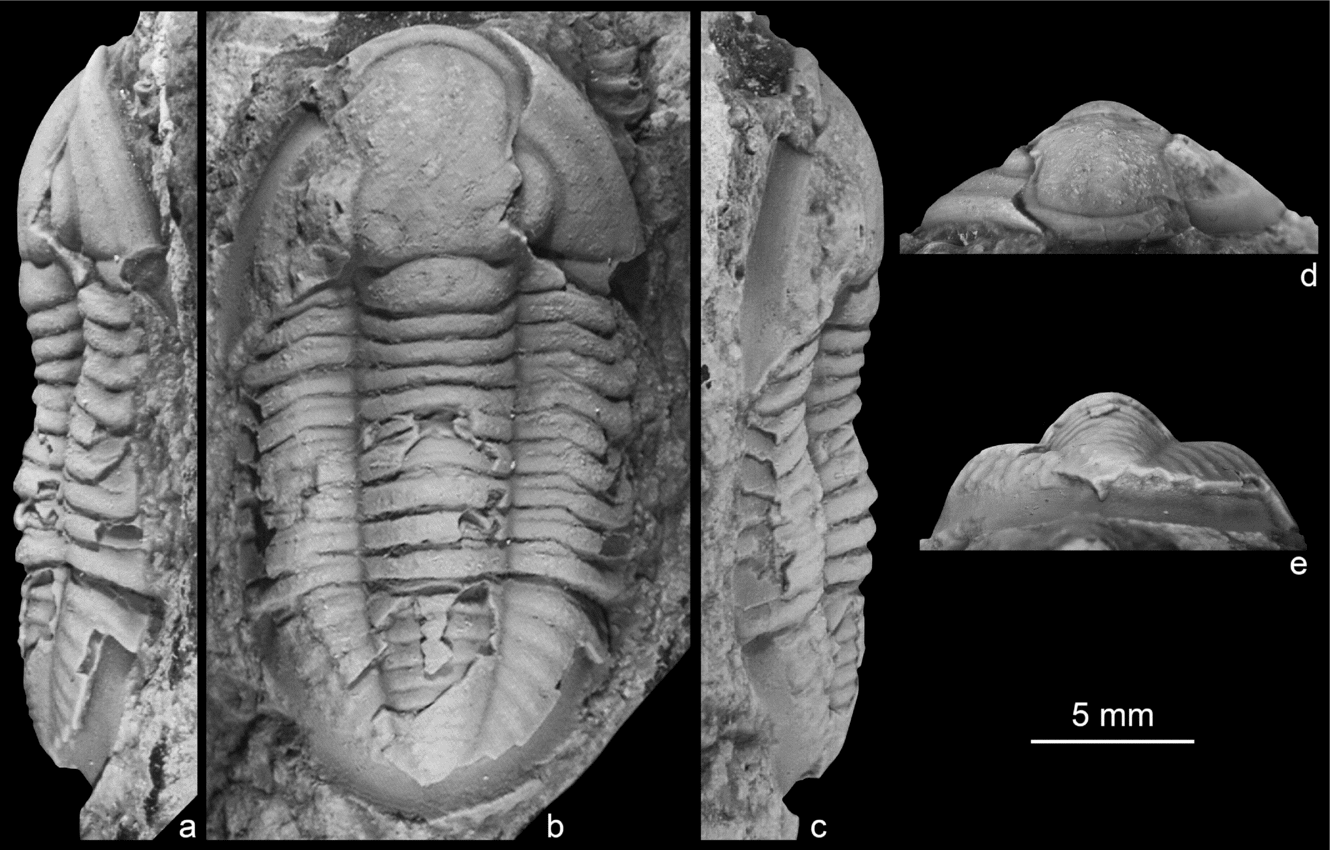
Figure 2a–e
Material, locality and horizon. Holotype, complete and articulated specimen, partially exfoliated (EUIT 7–850; Fig. 2); thick-bedded limestone with solitary corals, brachiopods, crinoids, bivalves and trilobites; Gnathodus typicus conodont biozone (see Yazdi, Reference Yazdi1999), Shishtu Formation, Howz-e-Dorah area, South Shotori Range, Yazd Province, Eastern Iran (label 5 on Fig. 1).
Persia praecox gen. nov. sp. nov.; Tournaisian, Gnathodus typicus conodont biozone, Shishtu Formation, Howz-e-Dorah area, South Shotori Range, Eastern Iran. (a–e) EUIT 7-850, holotype specimen, right lateral, dorsal, left lateral, frontal and posterior views.

Etymology. In reference to the fact it resembles a derived cummingelline but with a rather slender glabella, a trait generally observed in primitive taxa and in juvenile specimens of derived taxa in this subfamily.
Diagnosis. As for the genus.
Description. Cephalon of semi-circular outline (Fig. 2b). Glabella rather long (maximum width/maximum length ratio: 0.6), hourglass in outline due to a strong constriction of the rather shallow and broad dorsal furrows opposite γ adaxially enabling the recognition of two parts of roughly equal width (tr.). Occipital ring wide (sag. and exs.); SO rather well incised and composed of a long median portion curved forwards and short abaxial portions running backwards from axial furrows. Posterior part of preoccipital glabella slightly extending outwards; S1 shallow and evenly curved from axial furrows to SO; L1 sub-circular in outline and only faintly inflated; short and almost inconspicuous S2–S4 possibly present near glabellar constrictions; preglabellar furrow shallow but narrow. Anterior border short (sag. and exs.) all along and curved backwards abaxially. Fixigena composed of a particularly narrow (tr.) posterior field, narrow (tr.) but long (exs.) palpebral lobe and narrow (tr.) anterior field that more than doubles in width forwards. α located opposite glabellar constriction anteriorly; α–γ strongly curved outwards so that β has a position similar to ζ relative to the sagittal line, i.e. the most abaxial position of the suture after ω; γ–ε gently curved outwards with δ being slightly more abaxially positioned than ε, like the latter relative to γ and γ relative to α; ε–ζ almost straight, short and diverging; ζ–ω long and strongly diverging with η barely defined and ω located at the mid-width (tr.) of the pleural lobe. Eye kidney-shaped, long (exs.), narrow (tr.) and surrounded by a broad depressed subocular groove. Librigenal field anterior to the eye rather narrow (tr.), only moderately widening (tr.) posterior to eyes, bounded posteriorly by a rather deep but shallow posterior border furrow and laterally and anteriorly by a very shallow to inconspicuous lateral border furrow. Posterior border of equal width all along representing about two-thirds of the width of the occipital ring. Lateral border rather narrow (tr.) and barely differentiated from librigenal field. Short genal spine. In lateral views (Fig. 2a, c), glabella rather low compared with the genal lobe; occipital ring slightly convex dorsally although culminating at roughly the same height as adjacent part of the preoccipital glabella, which is almost flat-topped in this region, but anteriorly it gently curves downwards until it abuts the slightly inflated anterior border. Eye is low, especially anteriorly, while the lateral border is high. In frontal view (Fig. 2d), cephalon moderately arched (tr.) with glabella only slightly rising above the fixigenal fields (the cephalon is slightly tilted anteriorly on the figure, suggesting erroneously that the occipital ring is higher than the preoccipital glabella). As indicated by an internal cast of the doublure on the left side, it is at least as wide as the cephalic border.
Thorax composed of nine segments. Dorsal furrows gently converging backwards and delimiting an axial lobe slightly wider (tr.) than pleural lobes. Segments are very similar to one another. Axial ring rather narrow (sag. and exs.) all along. Pleura extending abaxially until fulcrum then abaxially and posteriorly, especially in anteriormost segments; rather well-incised pleural furrow running in a straight direction from a short distance from dorsal furrow to fulcrum, then rapidly vanishing; outer portion of pleura apparently modified anteriorly into a smooth articulating facet. In lateral view, pleurae straight and particularly high posteriorly, where they represent almost two-thirds of total height of the thorax, decreasing in height anteriorly while outer portions become increasingly curved forwards. In posterior or frontal views, axial lobe strongly arched dorsally. Fulcrum subdivides pleura into a sub-horizontal inner portion (c. 40% of transversal length of pleura) and a strongly downwards flexing (more than 70°) outer portion.
Pygidium semi-circular in outline (Fig. 2b), slightly wider (tr.) than long (sag.). Axis wide (tr.) anteriorly (c. 40% of the maximal width of the pygidium) but increasingly tapering backwards; apparently 10 + 1 axial rings delimited by broad axial furrows that rapidly shallow posteriorly; no conspicuous post-axial furrow. As far as it can be observed, the pleural field almost reaches the pygidial margin and therefore a border, if present, may be either narrow (tr.) or poorly differentiated from the rest of the pleura; seven, probably eight pleural ribs defined by broad and shallow pleural furrows increasingly curving backwards from front to rear; up to three extremely faint furrows that occur abaxially along the posterior margin of the first three ribs may represent interpleural furrows, suggesting a subdivision of the rib into a broad (exs.) anterior branch and a very narrow (exs.) posterior branch. Laterally (Fig. 2a, c), axis low, gently lowering rearwards until almost merging with the post-axial region (only a small piece of the latter is preserved); anteriormost axial rings are moderately convex dorsally. Pleural region high (c. 80% of total height) and provided with a faceted antero-lateral corner, which probably received the pleural tip of the posteriormost thoracic segment during enrollment. In posterior view (Fig. 2e), axis low and broadly elliptical in profile. Pleural region subdivided into a horizontal inner third and strongly flexed downwards (60°) outer two-thirds. Mould of inner surface of the doublure indicates that it is broad, almost reaching the level of the tip of the axis sagittally.
Sculpture: seven to ten low terrace ridges run sub-parallel to the margin on the cephalic border; at least nine of them also occur on the pygidial doublure. Otherwise, no sculptural features could be observed with confidence; granules of various sizes can be observed here and there (e.g. Fig. 2d), but no clear distribution pattern could be identified, which suggests they may be preservational in origin.
Subfamily Ditomopyginae Hupé, Reference Hupé and Piveteau1953
Genus Acropyge Qian, Reference Qian1977
Type species. Acropyge multisegmenta Qian, Reference Qian1977, from the upper Changhsingian of Guizhou, South China.
Diagnosis. See Owens, Reference Owens1983, p. 28.
Acropyge encrinuroides (Weber, Reference Weber1944)
Figure 3a, d, g, j, m
-
1944 Pseudophillipsia (Anisopyge) (?) encrinuroides Weber, pp. 14, 23, 24, pl. 2, fig. 11a, b.
-
1978 Acropyge lanceolata Kobayashi & Hamada, p. 160, fig. 5a, b.
-
1981 Acropyge lanceolata Kobayashi & Hamada; Hahn & Hahn, pp. 220, 222, table 1.
-
1983 Acropyge encrinuroides (Weber); Owens, p. 29.
-
1983 Acropyge lanceolata Kobayashi & Hamada; Owens, p. 29.
-
1984 Acropyge lanceolata Kobayashi & Hamada; Kobayashi & Hamada, p. 73, pl. 14, fig. 5a, b.
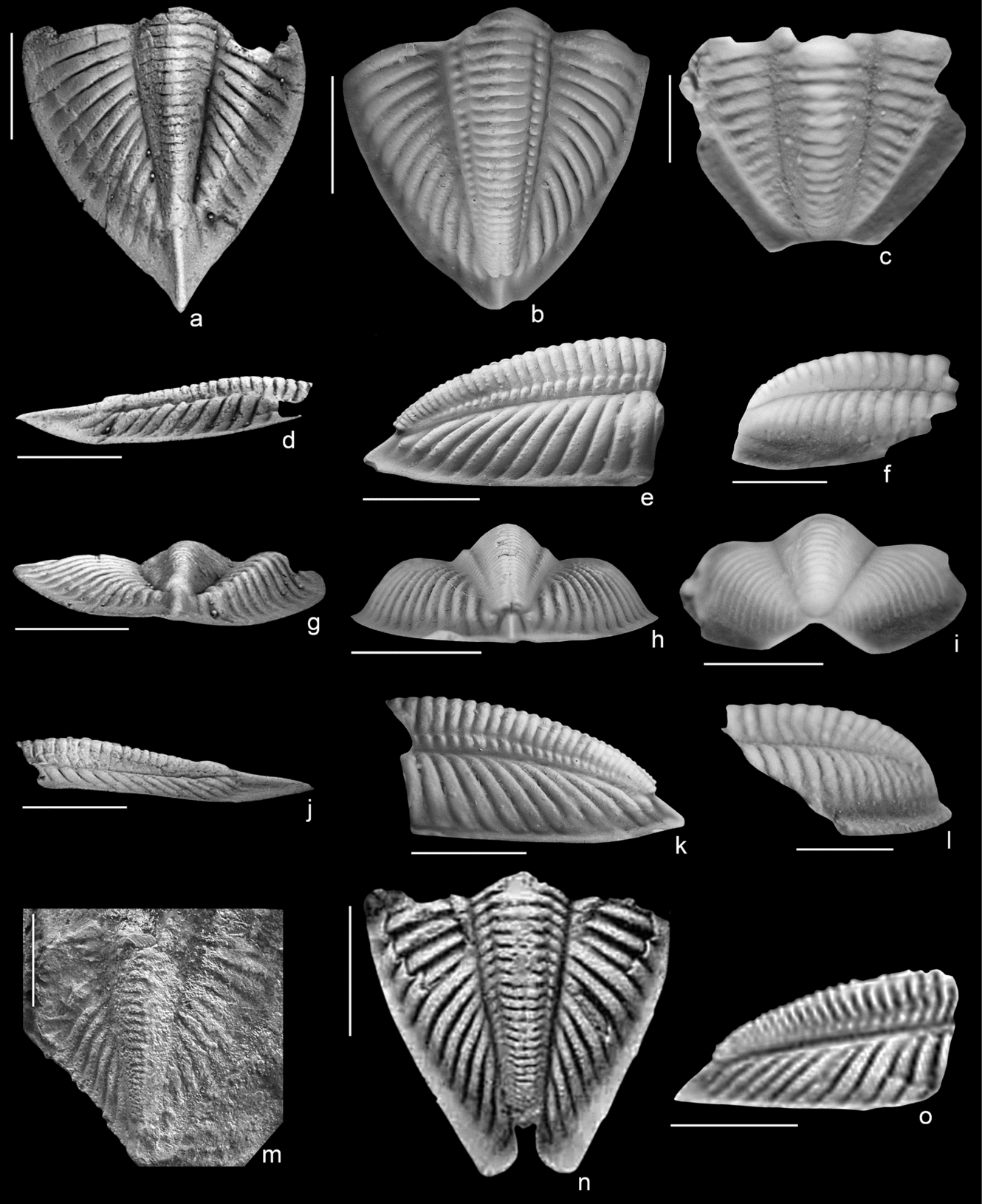
(a, d, g, j, m) Acropyge encrinuroides (Weber, Reference Weber1944). (a, d, g, j) SMF 90658 (gypsum cast; original PA 16766, University of Tokyo), pygidium with deformed right pleura; Capitanian, Surmaq Formation, Abadeh area, Kuh-e-hambast Range, Central Iran. (a) Dorsal, (d) right lateral, (g) posterior, (j) left lateral views. (m) VSEGEI 83-5217, poorly preserved holotype pygidium in dorsal view; Wordian (?), Gnishik Formation (?), vicinity of Ogbin, southern Armenia. (b, c, e, f, h, i, k, l) Acropyge weggeni Hahn & Hahn, Reference Hahn and Hahn1981; Wuchiapingian, Nesen Formation, vicinity of Yush, Central Alborz Mountains, Northern Iran. (b, e, h, k) internal mould (latex) of the holotype pygidium (SMF 282251) in (b) dorsal, (e) right lateral, (h) posterior and (k) left lateral views. (c, f, i, l) SMF 282252, small partially broken pygidium on the same block in (c) dorsal, (f) right lateral, (i) posterior and (l) left lateral views. (n, o) Acropyge sp. A, PIN 2321-19 (specimen missing), reproduced from Arkhipova (Reference Arkhipova, Ruzhentsev and Sarycheva1965, pl. 45, fig. 2) with the permission of the Palaeontological Institute, Moscow, slightly exfoliated pygidium possibly broken behind axis in (n) dorsal and (o) right lateral views; Wordian, Gnishik Formation, Vedi area, southern Armenia. Scale bars = 5 mm, except for (c), (f), (i) and (l), where scale bars = 1 mm.

Materials, localities and horizons. Poorly preserved holotype pygidium (VSEGEI 83–5217, Fig. 3m); probably Wordian, vicinity of Ogbin village, Vyots Dzor Province, southern Armenia (label 7 on Fig. 1). Well-preserved pygidium (PA 16766, Fig. 3a, d, g, j); uppermost part of Unit 1 of Taraz (Reference Taraz1971), Surmaq Formation, Capitanian (Midian; Kobayashi & Ishii, Reference Kobayashi and Ishii2003), southwestern part of the Kuh-e-hambast Range, Abadeh area (Fars Province), Central Iran (label 1 on Fig. 1).
Diagnosis. A species of Acropyge displaying the following combination of characters: pygidium escutcheon-shaped, mucronate, particularly flat; axis strongly and evenly narrowing (tr.) posteriorly, not reaching border, highest at the fifth or sixth-most anterior ring, devoid of muscles scars, with 23 ± 1 axial rings; long and large post-axial ridge; 12 pleural ribs, pleural furrows slightly curved rearwards abaxially and running almost sub-parallel to sagittal axis posteriorly.
Remarks. When they described Acropyge lanceolata from the Capitanian of Central Iran (Fig. 3a, d, g, j), Kobayashi & Hamada (Reference Kobayashi and Hamada1978) compared it to the type species A. multisegmenta, which had just been discovered in the Changhsingian of South China (Qian, Reference Qian1977). However, they did not consider a very similar pygidium of equivalent age that had been found in the neighbouring Armenia and described as Pseudophillipsia (Anisopyge) (?) encrinuroides by Weber (Reference Weber1944; Fig. 3m herein). This specimen was then successively ignored by Yin (Reference Yin1978) and Hahn & Hahn (Reference Hahn and Hahn1981). More surprisingly, it has also been mistreated by Kobayashi & Hamada (Reference Kobayashi and Hamada1984), despite the fact that Owens (Reference Owens1983) had just recognized in this specimen all the characteristics of Acropyge and had accordingly assigned Weber's species to this genus. Actually, the holotypes of A. lanceolata and A. encrinuroides are extremely similar with regards to all the characters that can be observed on both specimens (compare Fig. 3a and 3m). The only noticeable difference is the absence of a border in the holotype of A. encrinuroides but this is owing to bad preservation, the specimen being broken along its left margin, while its right one apparently remains overlain by the surrounding matrix. Accordingly, A. lanceolata is here considered a junior synonym of A. encrinuroides.
Discussion. The escutcheon shape, the particularly flat profile and the thick and long (sag.) post-axial ridge are some traits, among others, that easily enable this species to be distinguished from A. brevica Yin, Reference Yin1978, A. multisegmenta Qian, Reference Qian1977 and A. weggeni Hahn & Hahn, Reference Hahn and Hahn1981.
Acropyge weggeni Hahn & Hahn, Reference Hahn and Hahn1981
Figure 3b, c, e, f, h, i, k, l
-
1981 Acropyge weggeni Hahn & Hahn, pp. 219–22, table 1, pl. 1, fig. 1a–d.
-
1981 Acropyge? sp. indet. Hahn & Hahn, p. 223, pl. 1, fig. 2.
-
1983 Acropyge weggeni Hahn & Hahn; Owens, p. 29.
-
1984 Acropyge weggeni Hahn & Hahn; Kobayashi & Hamada, p. 72.
Material, locality and horizon. The external mould of a large and well-preserved pygidium (holotype, SMF 282251, Fig. 3b, e, h, k) and a small, partially broken pygidium on the same block (SMF 282252, Fig. 3c, f, i, l); Nesen Formation, Wuchiapingian, Central Alborz Mountains, near Yush village (36° 13.05′ N, 51° 42.20′ E; Mazandaran Province), Northern Iran (label 4 on Fig. 1).
Emended diagnosis. A species of Acropyge displaying the following combination of characters: pygidium elongate, ogival but not mucronate; axis with 28 axial rings, bearing two rows of paired muscle scars and a sagittal furrow at its posterior tip; post-axial ridge large but short; 12 pleural ribs; border narrow (tr.) and hardly widening (sag. and exs.) posteriorly; single row of granules along posterior margin of each axial ring and each pleural rib.
Remarks. After comparison with juvenile pygidia of Pseudophillipsia (Carniphillipsia) lipara Goldring, Reference Goldring1957 deposited at the Senckenberg Research Institute, I follow Hahn & Hahn (Reference Hahn and Hahn1981) in assigning the tiny juvenile pygidium found in the Central Alborz (Fig. 3c, f, i, l) to the genus Acropyge. This is justified chiefly by the fact that the specimen, despite its very small size (less than 2.5 mm), already exhibits a high number of axial rings (16/17) and pleural ribs (13) and its general outline tends to be ogival as in the holotype of A. weggeni. However, it seems to me overcautious not to assign this specimen to A. weggeni considering that (1) representatives of Acropyge are extremely rare, (2) this species is the only species of Acropyge known from this locality, and (3) this small pygidium and the holotype of this species are on a single small rock sample.
Discussion. A. weggeni is easily differentiated from the other species of Acropyge by its greater number of axial rings (28). It more closely resembles A. encrinuroides, in particular in having a large post-axial ridge, but this ridge is shorter than in the Guadalupian taxon. Moreover, it has an ogival not escutcheon-like outline and rows of muscle scars on the axis. A. brevica Yin, Reference Yin1978 and A. multisegmenta Qian, Reference Qian1977 exhibit a much narrower (tr.) axis and a very different disposition of the pleural furrows (e.g. posteriormost ones are not sub-parallel to the dorsal furrows), which permits them to be easily distinguished from A. weggeni.
Acropyge sp. A
Figure 3n, o
-
1965 Pseudophillipsia armenica Weber; Arkhipova, pp. 82–3, pl. 45, fig. 2a, b.
Material, locality and horizon. A slightly exfoliated pygidium, possibly broken behind axis (PIN 2321–19, missing specimen; Fig. 3n, o); Gnishik Formation, Wordian, Vedi area (Ararat Province), Southern Armenia (label 6 on Fig. 1).
Description. Pygidium elongate and ogival in outline (Fig. 3n), with a superficially re-entrant (likely to be damaged, see remarks below) posterior margin reaching the axis. Axis rather long (c. 80% of the sagittal length of the pygidium) but possibly slightly broken posteriorly; 23 axial rings discernable, with three to five additional ones probably present in poorly preserved posteriormost portion, all bearing a pair of conspicuous muscle scars forming two rows that subdivide the axis into three lobes; rather deep inter-ring furrows of sigmoidal course from sagittal axis to dorsal furrows. No post-axial region visible (likely broken, see remarks below). Pleural field representing approximately a third of the width (tr.) of the pygidium anteriorly and composed of 11, possibly 12 ribs; pleural furrows particularly deep, faintly curved, running abaxially and increasingly backwards from front to rear. Pygidial border separated from pleural field by a strong break in slope, narrow anteriorly, but gently widening posteriorly. In lateral view (Fig. 3o), axis and pleura are of about the same height; axis gently declining and slightly flexing downwards posteriorly; axial rings rather prominent dorsally, while pleural ribs are flat-topped. Border flat. No posterior or ventral views available. Sculpture: single row of granules apparently occurs along posterior margin of each pleural rib.
Remarks. The pygidium discovered in the Permian outcrop near Vedi fits well with the diagnosis of the genus Acropyge, except in the fact that it lacks ‘a posterior margin extended into point’ (Owens, Reference Owens1983). Actually, the morphology of its post-axial region is peculiar and to my knowledge is unique amongst the Proetida. Only in a few Cambrian trilobites of the family Burlingiidae can a re-entrant posterior margin be observed that merges with the posterior tip of the axis as in this specimen (Ebbestad & Budd, Reference Ebbestad and Budd2003). Moreover, other characteristics of burlingiid pygidia rule out any close phylogenetical relationships with the Permian taxon. This raises the question of whether this unusual morphology might have resulted from a breakage or from some kind of teratological phenomenon. A rapid review of the literature dealing with teratology in trilobites shows that a similar modification of the post-axial region has never been reported to date. I am, therefore, more inclined to believe it has resulted from a breakage, despite the symmetrical and curved margins of the supposedly broken area. This strange morphology might be explained if the breakage lines have followed the margins of a strong post-axial ridge near the tip of the axis and then increasingly diverged posteriorly, probably accommodating the topography of the border in the immediate proximity of the ridge. The fact that the specimen is missing in the collections of the Palaeontological Institute of Moscow has prevented further observations from being made, but the small pygidium from the Alborz Mountains tentatively assigned to Acropyge weggeni exemplifies, to some extent, how a breakage in this region can appear symmetrical (Fig. 3c, i). The presence of a posterior axial ridge in the Armenian specimen is also probable, given its close resemblance to the holotype of A. weggeni (compare Fig. 3b and 3n).
Discussion. The pygidium of Acropyge sp. A is best compared with that of A. weggeni with which it has the following characters in common: an elongate and ogival outline, a similar structure and shape of the axis, comparable shape and orientation of pleural furrows, a flat border, a similar general profile and rows of granules along the posterior margin of each rib (Fig. 3b, n). The Armenian pygidium exhibits only 23 axial rings and 11 pleural ribs, but considering the poor preservation of the posterior portion of the axis and the likely breakage of the post-axial region, it seems possible that in fact this specimen possessed a similar number of axial rings (28) and pleural ribs (12) as the holotype of A. weggeni. However, a few differences between the two pygidia suggest they belong to different, though phylogenetically close, species. Indeed, compared to the holotype of A. weggeni, the Armenian specimen has a slightly narrower (tr.) axis that only moderately flexes downwards posteriorly (Fig. 3o), an apparently wider (tr.) border posteriorly, flat-topped pleural ribs and it is slightly flatter in general profile. It differs more from A. encrinuroides, from which it can be differentiated by its ogival outline and the presence of rows of muscle scars on the axis, and even more from A. brevica and A. multisegmenta, which have a much narrower (tr.) axis and a very different structure of pleural segmentation.
Genus Pseudophillipsia Gemmellaro, Reference Gemmellaro1892
Type species. Phillipsia sumatrensis Roemer, Reference Roemer1880, from the Wordian of the western coast of Sumatra, Indonesia.
Diagnosis. See Owens, Reference Owens1983, p. 28.
Remarks. In the absence of cranidia, it is not possible to discriminate the three subgenera of Pseudophillipsia. Indeed, no diagnostic characters of Pseudophillipsia (Nodiphillipsia) concern the pygidial morphology (Lerosey-Aubril & Angiolini, Reference Lerosey-Aubril and Angiolini2009), and the ranges of the number of axial rings and pleural ribs in Pseudophillipsia (Carniphillipsia) or Pseudophillipsia (Pseudophillipsia) frequently overlap (Hahn & Brauckmann, Reference Hahn and Brauckmann1975). The species concerned are, therefore, attributed to Pseudophillipsia sensu lato (s.l.) hereafter.
Pseudophillipsia (s.l.) armenica (Weber, Reference Weber1944)
Figure 4a–f
-
1944 Pseudophillipsia armenica Weber, pp. 13, 23, pl. 2, fig. 1a, b.
-
1965 Pseudophillipsia paffenholzi Weber; Arkhipova, pp. 82–3, pl. 45, fig. 3a, b.
-
1978 Iranaspidion sagittalis Kobayashi & Hamada, p. 158, fig. 4a–c.
-
1984 Iranaspidion sagittalis Kobayashi & Hamada; Kobayashi & Hamada, pp. 68–9, pl. 14, fig. 4a–c.
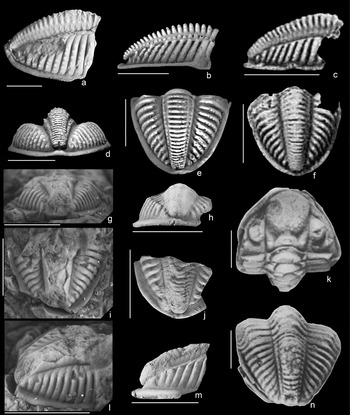
(a–f) Pseudophillipsia (s.l.) armenica Weber, Reference Weber1944. (a) VSEGEI 73–5217, holotype pygidium in right lateral (slightly oblique) view; Wordian (?), Gnishik Formation (?), vicinity of Ogbin, southern Armenia. (b, d, e) SMF 90659 (gypsum cast; original PA 16765, University of Tokyo), pygidium in (b) right lateral, (d) posterior and (e) dorsal views; Capitanian, Surmaq Formation, Abadeh area, Kuh-e-hambast Range, Central Iran. (c, f) PIN 2321–15 (specimen missing), reproduced from Arkhipova (Reference Arkhipova, Ruzhentsev and Sarycheva1965, pl. 45, fig. 3) with the permission of the Palaeontological Institute, Moscow, pygidium partially broken anteriorly in (c) right lateral and (f) dorsal views; Wordian, Gnishik Formation, Vedi area, southern Armenia. (g–j, l, m) Pseudophillipsia (s.l.) aff. caucasica; Wuchiapingian, Nesen Formation, vicinity of Yush, Central Alborz Mountains, Northern Iran. (g, i, l) SMF 28226, partial pygidium in (g) posterior, (i) dorsal and (l) right lateral, slightly oblique views. (h, j, m) latex cast made from external mould (SMF 28227) of specimen SMF 28226 in (h) posterior, (j) dorsal and (m) right lateral views. (k, n) Pseudophillipsia (Carniphillipsia) sagittalis (Kobayashi & Hamada, Reference Kobayashi and Hamada1978), PA 16764 (specimen missing), enrolled holotype specimen, dorsal views of (k) cephalon and (n) pygidium; Capitanian, Surmaq Formation, Abadeh area, Kuh-e-hambast Range, Central Iran. Reproduced from the Proceedings of the Japan Academy, Series B, with the permission of the Japan Academy. Scale bars = 5 mm.

Material, locality and horizon. The holotype pygidium, which has its left side broken (VSEGEI 73–5217; Fig. 4a); probably Wordian, vicinity of Ogbin village (Vyots Dzor Province), southern Armenia (label 7 in Fig. 1). A pygidium with both pleural fields slightly broken anteriorly (PIN 2321–15, missing specimen; Arkhipova, Reference Arkhipova, Ruzhentsev and Sarycheva1965, pl. 45, fig. 3a, b and Fig. 4c, f herein); Gnishik Formation, Wordian, Vedi area (Ararat Province), southern Armenia (label 6 in Fig. 1). A well-preserved pygidium (PA 16765; Fig. 4b, d, e); upper part of the Unit 1 of Taraz (Reference Taraz1971), Surmaq Formation, Capitanian, Abadeh area (Fars Province), Hambast Mountains, Central Iran.
Diagnosis. A species of Pseudophillipsia displaying the following combination of characters: axis downwardly flexed anteriorly and especially posteriorly, 21–22 prominent axial rings, 11 prominent pleural ribs, border narrow and inclined about 30–40° outwards, transverse rows of coarse tubercles on axial rings and abaxial two-thirds of pleural ribs.
Description. Pygidium semi-circular in outline (Fig. 4e, f). Axis long, reaching border furrow; 21–22 axial rings bearing a pair of marked muscle scars, which form two rows subdividing the axis into a wide (tr.) median lobe and two narrow lateral lobes; deep and rather broad inter-ring furrows slightly posteriorly deflected abaxially. Pleural field representing about a third of the width (tr.) of the pygidium anteriorly and composed of 11, possibly 12 ribs; pleural furrows particularly deep, broad and sigmoidal; well-developed antero-lateral extensions with articulating facets (Fig. 4b). Border narrow anteriorly, slightly widening posteriorly. In lateral view (Fig. 4a–c), axis hardly more than a third of pygidial total height, downwardly flexed anteriorly and especially posteriorly; axial rings and pleural ribs particularly prominent. In posterior view (Fig. 4d), axis semi-circular in cross-section, pleural fields composed of a narrow horizontal adaxial part and a wider and strongly sloping (50–60°) downwards abaxial part; border inclined outwards at c. 45°. Sculpture: transverse row of tubercles on each axial ring as well as on the abaxial two-thirds of pleural ribs.
Remarks. Except for the inclination of the border, which could not be verified on the specimen figured by Arkhipova (Reference Arkhipova, Ruzhentsev and Sarycheva1965), all the characters of the diagnosis are exhibited by the two pygidia from southern Armenia and the Iranian specimen from Abadeh, justifying their reassignment to the same species. The original assignment to Pseudophillipsia paffenholzi of the specimen from the Vedi area is difficult to explain, since this species can be easily differentiated from P. (s.l.) armenica by its more elongate general outline, its flat-topped axial rings or its greater number (12) of flat-topped pleural ribs. Even if the two species bear similarly distributed tubercles, these are coarse in P. (s.l.) armenica while they are barely more than small granules in P. paffenholzi.
Our attribution of the isolated pygidium from the Abadeh area to P. (s.l.) armenica instead of P. sagittalis (Kobayashi & Hamada, Reference Kobayashi and Hamada1978) raises the question of a possible synonymy of the two species. As far as the pygidial morphology is concerned, only two of the four specimens figured by Kobayashi & Hamada (Reference Kobayashi and Hamada1978) can be considered: the pygidium here reassigned to P. (s.l.) armenica (Fig. 4b, d, e) and the holotype of P. sagittalis (Fig. 4n). The pygidium of the holotype is damaged along most of its margin, especially posteriorly, but compared with the other, it has a narrower (tr.) border (where visible), and a narrower (tr.) axis with straight and convergent axial furrows instead of increasingly convergent ones. On the other hand, the two specimens share similar pleural furrow courses, and prominent axial rings and pleural ribs, which might indicate they belong to the same species. Unfortunately, the sculpture or lateral profile of the holotype can hardly be appreciated from Kobayashi & Hamada's figures. Until the holotype specimen of P. sagittalis is found again, or its loss confirmed, it seems more reasonable to conserve this taxon as a separate species, but it should be kept in mind that it might prove to be a junior synonym of P. (s.l.) armenica. In that case, the Iranian specimens would then permit the cephalic and thoracic morphology of this species to be known.
Discussion. The partial pygidium of Pseudophillipsia (s.l.) caucasica (Weber, Reference Weber1944) found in the North Caucasus (Weber, Reference Weber1944, pl. 2, fig. 4a–c) somewhat resembles P. (s.l.) armenica in having the following traits: a strongly downwardly flexed axis posteriorly, prominent axial rings bearing a row of tubercles, 11 prominent pleural ribs also bearing tubercles, and a similar curvature of the pleural field in posterior view. However, it has more axial rings (25), a more complex (sigmoidal) course of inter-ring furrows, pleural tubercles restricted to the fulcral region and an inflated border, all characters that demonstrate it is a different species.
Pseudophillipsia (s.l.) caucasica (Weber, Reference Weber1944)
-
1944 Pseudophillipsia elegans var. caucasicus Weber, pp. 12–13, table 2.
Material, locality and horizon. A pygidium of unknown state of preservation; probably Wordian, vicinity of Ogbin village (Vyots Dzor Province), southern Armenia (label 7 in Fig. 1).
Remarks. In the Russian part of his work, Weber (Reference Weber1944, pp. 12–13, table 2) mentioned that a pygidium of P. caucasica has been found in the Ogbin area. This information is completely omitted in the English section of his text dealing with this species. As only the type specimen from the North Caucasus is figured, it is difficult at present to confirm or deny the claimed occurrence of P. (s.l.) caucasica in the Permian of southern Armenia. A rather similar taxon, Pseudophillipsia (s.l.) aff. caucasica, apparently occurred in Central Alborz and therefore it is possible that the specimen mentioned by Weber might in fact belong to this Iranian species.
Pseudophillipsia (s.l.) aff. caucasica (Weber, Reference Weber1944)
Figure 4g–j, l, m
-
1981 Iranaspidion sp. Hahn & Hahn, p. 223, table 1, fig. 3.
Material, locality and horizon. A partial pygidium (SMF 28226; Fig. 4g, i, l) and its external mould (SMF 28227; Fig. 4h, j, m); Nesen Formation, Wuchiapingian, Central Alborz Mountains, near Yush village (36° 13.05′ N, 51° 42.20′ E; Mazandaran Province), Northern Iran (label 4 in Fig. 1).
Description. Pygidium of roughly semi-circular outline (Fig. 4i, j). Axis particularly long, overhanging the border posteriorly and delimited laterally by straight axial furrows evenly converging backwards; 17 axial rings discernable corresponding laterally to the six posteriormost pleural ribs, which permits an estimation of a total of 21–22 axial rings for the whole axis; two rows of faintly impressed muscle scars; inter-ring furrows of strongly sigmoidal course from the sagittal axis to dorsal furrows. Pleural field of about the same width (tr.) as axis anteriorly, but rapidly narrowing (tr.) posteriorly; ten pleural ribs; pleural furrows deep but narrow, with most of them having a particularly well-marked sigmoidal course. Pygidial border separated from pleural field by a strong break in slope, rather narrow anteriorly but significantly widening posteriorly until the pygidial mid-length (sag.), remaining of roughly equal width thereafter. In lateral view (Fig. 4l, m), posterior part of axis strongly flexed downwards; pleural field especially high, composed of prominent pleural ribs, and provided with a smooth antero-lateral projection. Border rather thick but flat dorsally. In posterior view (Fig. 4g, h), axis elliptical in section (tr.), bearing a very short sagittal furrow at its posterior tip. Pleural ribs particularly prominent at fulcrum, which subdivides the pleural field into a roughly horizontal inner third and strongly flexing downwards (more than 60°) outer two-thirds. A slightly inflated area split in two by a broad sagittal furrow occurs behind the axial tip. Ventral morphology unknown. Sculpture: a single row of up to seven low tubercles on the outer two-thirds of the four most posterior pleural ribs; numerous thin terrace ridges along border margin, which are sub-parallel to it posteriorly, while they have a more exsagittal course anteriorly.
Discussion. The specimen is best compared with P. (s.l.) caucasica (Weber, Reference Weber1944, pl. 2, fig. 4a–c), with which it shares similar inter-ring and pleural furrow courses, an axis overhanging the border and bearing a short sagittal furrow at its tip, broad pleural ribs that are prominent at fulcrum and strongly sloping downwards abaxially, and a slightly inflated area on the border behind axis. However, it differs from the North Caucasian (and possibly Armenian) species in having only 10 instead of 11 pleural ribs and a rather wide border posteriorly. This character might be explained by ontogenetic differences, the Iranian specimens being some 30% larger than the pygidium described by Weber (Reference Weber1944). The difference in the number of pleural ribs, however, is more problematic, which explains why I refer to this Iranian specimen as P. (s.l.) aff. caucasica.
As discussed above, P. (s.l.) caucasica and P. (s.l.) armenica are morphologically, and in all likelihood, phylogenetically close species. The similarities described between these two species can also be mentioned for P. (s.l.) aff. caucasica. In this form, however, the small tubercles are not restricted to the fulcrum but borne by the entire outer portion of the pleural ribs. Moreover, this specimen exhibits medially a swollen area on the border split in two by a furrow (Fig. 4h), a feature that can also be observed on the isolated pygidium found in the Abadeh area (Fig. 4d) and herein assigned to P. (s.l.) armenica. However, like P. (s.l.) caucasica, the pygidium from the Nesen Formation has a more complex course of inter-ring and pleural furrows than that of P. (s.l.) armenica, and a thick border that is not as inclined. In addition, the tubercles on the pleurae are small and only visible on the posteriormost pleural ribs, the axis notably overhangs the border posteriorly and the border strongly widens posteriorly, all characters that exclude a possible attribution of this specimen to P. (s.l.) armenica. Neverthess, the similarities between P. (s.l.) aff. caucasica, P. (s.l.) caucasica and P. (s.l.) armenica suggest that all these forms originated from a common ancestor.
Pseudophillipsia (s.l.) parvizii sp. nov.
Figure 5
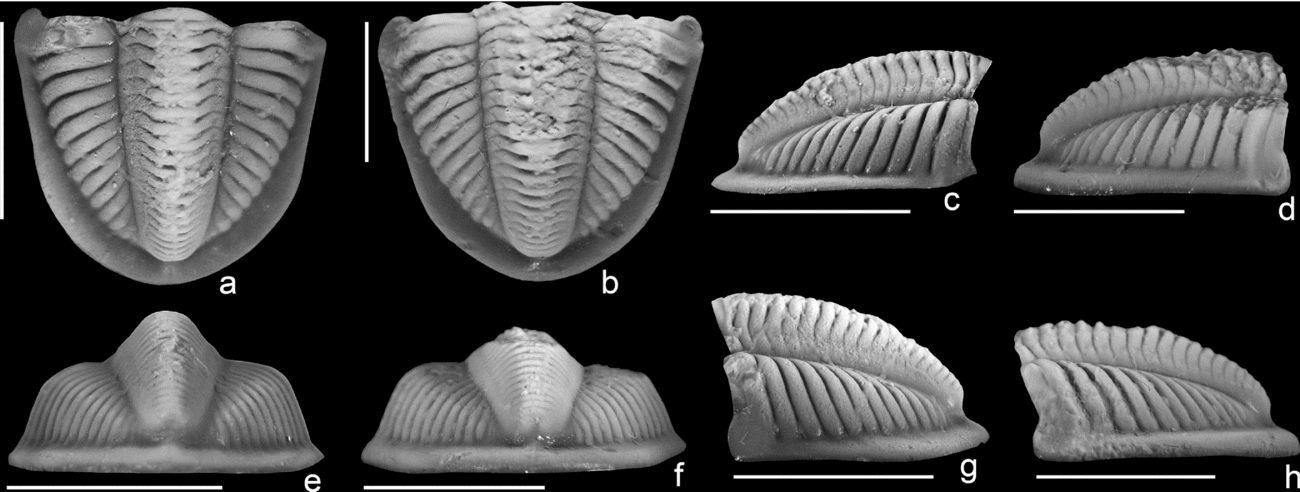
Material, locality and horizon. Well-preserved holotype pygidium (SMF 90686; Fig. 5a, c, e, g) and a well-preserved paratype pygidium (SMF 90687; Fig. 5b, d, f, h); both from a dark-grey sandy wackestone with gastropods, brachiopods (e.g. productoids), bryozoa (fenestellids), crinoids, ostracods, rare trilobites and foraminifers, Dalan Formation, Wuchiapingian (indicated by Codonofusiella ex gr. tenuissima), Dena Mountain, about 58 km northwest of Yasouj (Kohgilouye and Boyrahmad Province), SE Iran (label 3 in Fig. 1).
Pseudophillipsia (s.l.) parvizii sp. nov.; Wuchiapingian, Dalan Formation, Dena Mountain, about 58 km northwest of Yasouj, SE Iran. (a, c, e, g) SMF 90686, holotype pygidium in (a) dorsal, (c) right lateral, (e) posterior and (g) left lateral views. (b, d, f, h) SMF 90687, paratype pygidium in (b) dorsal, (d) right lateral, (f) posterior and (h) left lateral views. Scale bars = 5 mm.

Etymology. In reference to M. Parvizi (University of Payam-e Noor) who collected the two specimens and made them available for study.
Diagnosis. A species of Pseudophillipsia displaying the following combination of characters: anterior half of pygidium almost parallel-sided, 21 axial rings, 13 pleural ribs, pleural field with strongly downwards flexed outer half, presence of antero-lateral projections, pygidial border wide and of equal width in posterior half of pygidium, then strongly narrowing anteriorly.
Description. Pygidium rather high and of strongly parabolic outline, almost parallel-sided anteriorly in dorsal view (Fig. 5a, b). Axis long (c. 90% of the sagittal length of the pygidium), gently narrowing (tr.) backwards, rounded posteriorly, and reaching the posterior border; 21 axial rings delimited by rather deep inter-ring furrows of sigmoidal course from the sagittal axis to dorsal furrows, all but the very last rings bearing a pair of flat and slightly depressed muscle scars, the alignment of which leads to a transversal trilobation of the axis. Pleural field rather narrow (e.g. representing less than a third of the width of the pygidium anteriorly) and composed of 13 ribs, which are delimited by deep pleural furrows; most of these furrows are weakly sigmoidal in shape. Pygidial border separated from pleural field by a strong break in slope, increasing in width posteriorly at the expense of this pleural field until the mid-length (sag.) of the pygidium, then remaining of equal width; faint post-axial ridge bearing an almost inconspicuous sagittal furrow. In lateral view (Fig. 5c, d, g, h), axis rather low compared with pleural field; it is strongly flexed downwards and lowers posteriorly behind axial ring 3, but also to a lesser degree anteriorly in front of this ring (‘sagittally arched’ axis); axial rings prominent dorsally while pleural ribs are flat-topped. Smooth and slightly depressed area occurs on the antero-lateral region of the pleura and it extends anteriorly on a forward projection of the latter. Border rather thick but flat dorsally. In posterior view (Fig. 5e, f), axis elliptical in transverse section. Fulcrum subdivides the pleural field into a roughly horizontal inner half and a strongly downwardly flexing (more than 60°) outer half. Faint sagittal furrow occurs on the posterior tip of the axis. Ventral morphology unknown. Sculpture: numerous thin terrace ridges occur on the outer part of the dorsal side of the pygidial border; they run backwards following an almost exsagittal course, therefore rapidly meeting the border margin, and then they continue their course on the lateral side and possibly further on the doublure.
Discussion. Although only known from pygidia, the new species already exhibits very distinctive characters compared with all the other representatives of Pseudophillipsia. However, with its wide pygidial border, P. (s.l.) parvizii sp. nov. vaguely resembles Pseudophillipsia (Carniphillipsia) rotunda Hahn & Hahn in Hahn, Hahn & Ramovš, 1990 from the Sakmarian of Slovenia. The two taxa also share similar numbers of axial rings (21 v. 20) and pleural ribs (13 in both), strongly downwardly flexed outer pleurae and prominent dorsal axial rings. However, the pygidium of P. (C.) rotunda is semi-circular in outline and devoid of large antero-lateral expansions. It also exhibits a fine granulation on the pleurae and, at least in P. (C.) rotunda noricana, its axis is trapezoidal in transverse section (Hahn et al. Reference Hahn, Hahn, Müller and Ramovš2002), all characters that prevent any possible confusion with the new species from Iran. P. (C.) pocivalensis Hahn et al. Reference Hahn, Hahn, Müller and Ramovš2002, another taxon from the Permian of Slovenia, exhibits a wide pygidial border as in P. (s.l.) parvizii sp. nov. and P. (C.) rotunda, but as in the latter species, it lacks antero-lateral expansions and bears small granules on the axis and the pleurae (Hahn et al. Reference Hahn, Hahn, Müller and Ramovš2002, pl. 1, fig. 11). Compared with the new species, it also has fewer axial rings (c. 18) and pleural ribs (10), an axis that is much more strongly flexed downwards posteriorly and a dorsally concave rather than flat pygidial border. In the Permian of Iran, P. (s.l.) armenica from the Capitanian of the Abadeh region (Fig. 4b, d, e) and P. (C.) sp. A (Fig. 6i, j, l, n, o) from the Guadalupian of Chahriseh have in common with the new species a similarly strongly vaulted pygidium resulting from strongly downwardly flexed outer pleurae, well-incised pleural furrows and antero-lateral expansions. However, the pygidia of these taxa differ from that of P. (s.l.) parvizii sp. nov. by the following traits: a less parabolic outline, a narrower border, a more backwards tapering axis, straight inter-ring furrows, more prominent pleural ribs, and the presence of granules on both the axis and the pleurae.
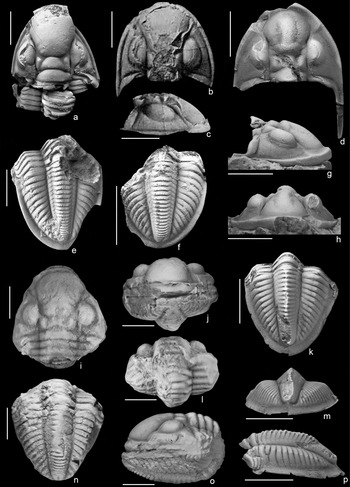
(a–c, e, f) Pseudophillipsia (Carniphillipsia) paffenholzi (Weber, Reference Weber1944). (a, e) Wordian (?), unknown outcrop along the Vedi River, Vedi area, southern Armenia. (a) VSEGEI 49-5217, lectotype cephalo-thorax in dorsal view. (e) VSEGEI 50-5217, paratype thoraco-pygidium probably complementary to VSEGEI 49-5217 in dorsal view. (b, c) PIN 2321-18 (specimen missing), partial cephalon in (b) dorsal and (c) right lateral views, reproduced from Arkhipova (Reference Arkhipova, Ruzhentsev and Sarycheva1965, pl. 45, fig. 1) with the permission of the Palaeontological Institute, Moscow; Wordian, Gnishik Formation, Vedi area, southern Armenia. (f) VSEGEI 51-5217, pygidium in dorsal view; Wordian (?), unknown outcrop along the Vedi River, Vedi area, southern Armenia. (d, g, h, k, m, p) Pseudophillipsia (Carniphillipsia) chongqingensis Lu, Reference Lu1974, Lopingian, SW China. (d, g, h) NIGPAS 21975, broken holotype cephalon in (d) dorsal, (g) right lateral and (h) frontal views. (k, m, p) NIGPAS 21976, partial thoraco-pygidium in (k) dorsal, (m) posterior and (p) left lateral views. (i, j, l, n, o) Pseudophillipsia (Carniphillipsia) sp. A, SMF 90843, strongly weathered, complete enrolled specimen; precise horizon unknown, Wordian to Wuchiapingian, Chahriseh area, Central Iran. (i) cephalon, (j) frontal view, (l) thorax, (n) pygidium and (o) left lateral view. Scale bars = 5 mm.

Two important characteristics of the new species are clear adaptations to enhanced capacities for volvation: the narrow pygidial border anteriorly that abruptly widens at about the mid-length (exs.; Fig. 5a, b) and the antero-lateral expansions of the pygidium (Fig. 5d, g, h). The first feature is known in trilobites such as Ameura missouriensis (e.g. Hahn & Hahn, Reference Hahn and Hahn1987, pl. 5, fig. 1) or Pseudophillipsia (Nodiphillipsia) aff. obtusicauda (Lerosey-Aubril & Angiolini, Reference Lerosey-Aubril and Angiolini2009, fig. 2h). In these forms, it permits the anterior part of the pygidium to be enclosed within the cephalic capsule during enrollment, which prevents lateral shearing (Lerosey-Aubril & Angiolini, Reference Lerosey-Aubril and Angiolini2009), and it seems reasonable to assume that P. (s.l.) parvizii sp. nov. enrolled its body in a comparable way. A similar mode of enrollment has been described in some rare Ordovician pterygometopids (Ludvigsen & Chatterton, Reference Ludvigsen and Chatterton1982) and more recently in the Devonian scutelluid Paralejurus rehamnanus (Feist, Lerosey-Aubril & Johnson, Reference Feist, Lerosey-Aubril and Johnson2010). However, it is within the proetoids, particularly the Late Palaeozoic forms, that it has been most commonly observed (Lerosey-Aubril & Angiolini, Reference Lerosey-Aubril and Angiolini2009). This atypical mode of volvation might have been especially efficient for protective purposes, since it combined the resistance against dorso-ventral pressures of the sphaeroidal mode with the resistance against lateral shearing of the spiral type (Lerosey-Aubril & Angiolini, Reference Lerosey-Aubril and Angiolini2009). The other morphological particularity related to enrollment of the new species is the presence of antero-lateral expansions of the pygidium. Similar features are observed in other Late Palaeozoic proetoids: Anisopyge perannulata (e.g. Brezinski, Reference Brezinski1992, figs 10.13–24), Hentigia bulbops (Haas, Hahn & Hahn, Reference Haas, Hahn and Hahn1980, pl. 3, figs 1–7) and H. planops (Haas, Hahn & Hahn, Reference Haas, Hahn and Hahn1980, pl. 5, figs 7, 8), Pseudophillipsia (s.l.) armenica (e.g. Kobayashi & Hamada, Reference Kobayashi and Hamada1978, fig. 4a–c), P. (C.) paffenholzi (Weber, Reference Weber1944, pl. 2, fig. 6) and possibly also in P. (Pseudophillipsia) binodosa (Kobayashi & Hamada, Reference Kobayashi and Hamada1984, pl. 6, fig. 10). These antero-lateral expansions of the pygidium have also been described recently in the scutelluid Paralejurus rehamnanus (Feist, Lerosey-Aubril & Johnson, Reference Feist, Lerosey-Aubril and Johnson2010). Here, they received dorsally the outer portions of the pleurae of at least the four posterior thoracic segments during volvation and they abutted the cephalic doublure. This probably permitted a reinforcement of the body capsule and a similar role can be hypothesized for the proetoids listed above as well as for P. (s.l.) parvizii sp. nov. These pygidial particularities of the new species exemplify particularly well how important volvation has remained for trilobites in the Late Palaeozoic (Lerosey-Aubril & Angiolini, Reference Lerosey-Aubril and Angiolini2009).
Subgenus Pseudophillipsia (Carniphillipsia) Hahn & Brauckmann,
Reference Hahn and Brauckmann1975
Type species. Pseudophillipsia ogivalis Gauri, Reference Gauri1965, from the Lower Kasimovian (Pennsylvanian) of the Zoellner Ridge near Waidegger-Alm, Carnic Alps, Austria.
Diagnosis. See Hahn & Hahn, Reference Hahn and Hahn1987, p. 588.
Pseudophillipsia (Carniphillipsia) paffenholzi (Weber, Reference Weber1944)
Figure 6a–c, e, f
-
1939 Pseudophillipsia paffenholzi; Weber, p. 199, pl. 46, fig. 16a, b.
-
1944 Cyphinium (?) paffenholzi n. sp.; Weber, pp. 10–11, 21–2, pl. 2, figs 5–7, 10.
-
1965 Pseudophillipsia armenica Weber; Arkhipova, pp. 82–3, pl. 45, fig. 1a, b.
-
1975 Pseudophillipsia (Pseudophillipsia) paffenholzi Weber; Hahn & Brauckmann, p. 119.
-
1978 Pseudophillipsia paffenholzi (Weber); Kobayashi & Hamada, p. 160.
-
1983 Pseudophillipsia paffenholzi (Weber); Owens, p. 28.
-
1984 Pseudophillipsia paffenholzi (Weber); Kobayashi & Hamada, p. 69.
Material, locality and horizon. A cephalo-thorax with anterior border broken, librigenae slightly tilted downwards below the cranidium and only the five anteriormost thoracic segments (VSEGEI 49–5217; Fig. 6a), which I herein designate as the lectotype; a thoraco-pygidium, apparently complementary to the cephalo-thorax, with left half of the five posteriormost thoracic segments and most of the pygidium preserved (VSEGEI 50–5217; Fig. 6e), which should be considered as a paratype; both specimens are from an unknown outcrop of probable Wordian age along the Vedi River, ‘some 2 km above Dagnas village’, Vedi area (Ararat Province), southern Armenia (label 6 in Fig 1). A pygidium (VSEGEI 51–5217; Fig. 6f), slightly broken anteriorly on the left side, and a partial right librigena (VSEGEI 52–5217; not refigured herein); both specimens are from a second unknown outcrop of probable Wordian age along the Vedi River, ‘some 1.5 km above Dagnas village’, Vedi area (Ararat Province), southern Armenia (label 6 in Fig. 1). A cephalon (PIN 2321–18, missing specimen; Arkhipova, Reference Arkhipova, Ruzhentsev and Sarycheva1965, pl. 45, fig. 1a, b; Fig. 6b, c herein), with the medial part of the glabella exfoliated anteriorly and broken posteriorly, is also tentatively assigned to this species; Gnishik Formation, Wordian, Vedi area (Ararat Province), southern Armenia (label 6 in Fig. 1).
Diagnosis. A species of Pseudophillipsia (Carniphillipsia) displaying the following combination of characters: glabella elongate, with narrow (tr.), parallel-sided and flat-topped posterior two-fifths; median preoccipital lobe wide (tr.) and trapezoid; L1 long (exs.); two pairs (S2–S3) of faint and short anterior glabellar furrows; anterior border particularly narrow (sag. and exs.); pygidium with 25 + 1 flat-topped axial rings; 12 flat-topped pleural ribs; pleural furrows sigmoidal; tiny tubercles occur medially along posterior margin of preoccipital lobe, all segments from occipital ring to last pygidial axial ring, and abaxial four-fifths of pleural ribs.
Description. The following description aims to complete Weber's original one (1944) or to emphasize some features that are of interest for the recognition of the species and its affinities with other taxa.
Glabella elongate, narrow (tr.) and parallel-sided along posterior two-fifths, then moderately widening forwards; posterior margin of occipital ring convex (Fig. 6a); SO gently and moderately curved forwards; rather deep S1 defining trapezoid and wide (tr.) median preoccipital lobe and long (exs.), rather narrow and somewhat triangular L1; S2–3 short and faint; anterior border particularly narrow; fixigenal field narrow (tr.) in post-ocular region, not visible in pre-ocular region. Eye kidney-shaped and long (exs.), extending from the mid-length (exs.) of L1 to mid-length (exs.) of glabella; librigenal border rather narrow; posterior border strongly widening owing to abrupt backward deflection of cephalic posterior margin abaxially. In lateral view (Weber, Reference Weber1944, pl. 2, fig. 5b), glabella roughly flat-topped posteriorly, then strongly and increasingly sloping forwards; lateral border rather high. In the thorax, axial ring wide (sag. and exs.), composed of a postannulus of even width all along (sag. and exs.) and a preannulus and an articulating half-ring both about half the length (sag.) of postannulus (Weber, Reference Weber1944, pl. 2, figs 5b, 6b; Fig. 6a, e herein); pleural furrows confined to fulcral region. Pygidium of strongly parabolic outline (Fig. 6e, f), subdivided into axial and pleural lobes of sub-equal width (tr.); axis subdivided into a median part and two abaxial parts about a third width (tr.) of it by two rows of muscle scars; 25 + 1 axial rings delimited by deep inter-ring furrows slightly curved backwards from the sagittal line to muscle scar and then running backwards until the axial furrow; antero-lateral projection on pleura receiving outer portion of two posteriormost thoracic pleurae; 12 flat-topped pleural ribs (not 11 as claimed by Weber); pleural furrows deep and sigmoidal; no interpleural furrows discernible; pygidial border regularly and significantly widening from front to rear. Laterally (Weber, Reference Weber1944, pl. 2, fig. 6b), pygidium rather high mainly owing to the pleural field, which is twice as high as the axis; axis is highest at axial ring 3, then it slightly and gently flexes downwards posteriorly and anteriorly.
Sculpture: tiny granules along posterior margin of median preoccipital lobe, occipital lobe, thoracic and pygidial axial rings, and the abaxial four-fifths of pygidial pleural ribs; thin terrace ridges with exsagittal course occur near lateral margin of pygidial border.
Remarks. I have chosen to follow Kobayashi & Hamada (Reference Kobayashi and Hamada1978, Reference Kobayashi and Hamada1984) and Owens (Reference Owens1983) instead of Hahn & Brauckmann (Reference Hahn and Brauckmann1975) in considering that this species was described by Weber in Reference Weber1944, not 1939. Indeed, even if the name of the species was proposed and two specimens were figured in 1939, it seems Weber himself considered he was describing the taxon for the first time in 1944 as shown by the mention of ‘n. sp.’ after the name of the species in his text and figure captions. Moreover, I did not follow Hahn & Brauckmann (Reference Hahn and Brauckmann1975) in their attribution of the species to the subgenus Pseudophillipsia (Pseudophillipsia), in so far as the cranidium of this species (Fig. 6a) exhibits faint and short glabellar furrows S2 and S3, indicating it belongs to the subgenus Pseudophillipsia (Carniphillipsia).
Discussion. At first sight, the cephalon figured by Arkhipova (Reference Arkhipova, Ruzhentsev and Sarycheva1965, pl. 45, fig. 1a, b; Fig. 6b, c herein) may look rather different to the lectotype in its general proportions (Fig. 6a), but this stems from the fact that in the lectotype the anterior fixigenae are broken and the librigenae are tilted downwards. Moreover, not only were the two specimens discovered in the same geographical area, but they both exhibit a narrow (tr.) and parallel-sided posterior portion of the glabella with elongate L1 (exs.), a particularly narrow anterior border, a similar librigenal morphology and a comparable profile of the anterior portion of the glabella. The only noticeable difference between the two specimens is the slightly greater widening (tr.) anteriorly of the anterior portion of the glabella in Arkhipova's cephalon, which might be simply suggested by the different preservations of the two specimens or related to intra-specific variation.
Otherwise, P. (C.) paffenholzi is best compared with P. (C.) sp. A from the Middle–Late Permian of the Chahriseh area (Fig. 6i, j, l, n, o) and P. (C.) chongqingensis Lu, Reference Lu1974 from the Lopingian of SW China (Fig. 6d, g, h, k, m, p). These three taxa share the following characters: an elongate glabella with parallel-sided posterior portion, a rather wide (tr.) and long (sag. and exs.) median preoccipital lobe, elongate (exs.) L1, a narrow and high cephalic anterior border, and a pygidium provided with flat-topped pleural ribs. This combination of characters may indicate these taxa constitute a distinct clade within the subgenus Pseudophillipsia (Carniphillipsia), which I informally call the ‘paffenholzi-group’. However, P. (C.) paffenholzi differs from these two forms in having a shorter parallel-sided portion of the glabella (posterior two-fifths instead of posterior half), a convex posterior margin of the occipital ring, a gently and moderately curved forwards SO, a slightly triangular L1, only two (S2–3) anterior glabellar furrows discernible, a more complex course of inter-ring and pleural furrows, a significant but regular widening of the pygidial border rearwards, and the particular distribution on each tagmata of the tiny granules.
As this work refigures Lu's original material, it should be mentioned that both the cephalon and the thoraco-pygidium assigned to P. (C.) chongqingensis display unusual features. Indeed, the main glabellar lobe of the holotype cephalon exhibits poorly defined furrows that shallow and meet anteriorly to isolate a slightly inflated median area (Fig. 6d, h). Similarly, poorly defined furrows associated with a somewhat locally deformed cuticle are sometimes observed in asteropygine trilobites (e.g. Morzadec, Reference Morzadec, Morzadec, Paris and Rachebœuf1981, pl. 35, fig. 1a; pers. obs.). The course of these unusual furrows in P. (C.) chongqingensis strikingly recalls the distribution pattern of the frontal auxiliary impressions (FAIs) in Phillipsia (Lerosey-Aubril, Hegna & Olive, Reference Lerosey-Aubril, Hegna and Olive2011). Accordingly, I interpret these furrows as resulting from the attachments of extrinsic muscles of a pouch-like modified portion (‘crop’) of the foregut. If Lerosey-Aubril, Hegna & Olive (2011) are right in suggesting a relationship might have existed between the distribution of FAIs and the shape/size of this putative crop, the latter might have been particularly large in P. (C.) chongqingensis.
The pygidium assigned to P. (C.) chongqingensis is also unique in displaying a malformed pleural rib. Indeed, the second rib of the left pleura is short (tr.) and does not reach the lateral border (Fig. 6k, m). This is compensated by wider (exs.) abaxial parts of ribs 1 and 3 and has apparently no consequence on the general shape of the pleura. As the border is normal in this area, the malformation might correspond to either the result of a developmental dysfunction or to a completely, though imperfectly healed, marginal injury.
Pseudophillipsia (Carniphillipsia) sagittalis (Kobayashi & Hamada, Reference Kobayashi and Hamada1978)
Figure 4k, n
-
1978 Iranaspidion sagittalis Kobayashi & Hamada, pp. 157–60, figs 1–3.
-
1981 Iranaspidion sagittalis Kobayashi & Hamada; Hahn & Hahn, p. 223.
-
1981 Iranaspidion sagittalis Kobayashi & Hamada; Kobayashi & Hamada, p. 56, pl. 1, figs 1–3.
-
1983 Iranaspidion sagittalis Kobayashi & Hamada; Owens, p. 29.
-
1984 Iranaspidion sagittalis Kobayashi & Hamada; Kobayashi & Hamada, pp. 68–9, text-fig. 5k, pl. 14, figs 1–3.
-
2003 Iranaspidion sagittalis Kobayashi & Hamada; Owens, p. 382.
-
2009 Pseudophillipsia (Carniphillipsia) sagittalis (Kobayashi & Hamada); Lerosey-Aubril & Angiolini, p. 438.
Material, locality and horizon. Complete enrolled holotype specimen (PA 16764, specimen missing; Kobayashi & Hamada, Reference Kobayashi and Hamada1978, fig. 3a–c; Fig. 4k, n herein), complete enrolled specimen (PA 16762, specimen missing; Kobayashi & Hamada, Reference Kobayashi and Hamada1978, fig. 1a, b), cephalon (PA 16763, specimen missing; Kobayashi & Hamada, Reference Kobayashi and Hamada1978, fig. 2) and possibly four other specimens (missing) mentioned but not described or figured by Kobayashi & Hamada (Reference Kobayashi and Hamada1978); uppermost part of Unit 1 of Taraz (Reference Taraz1971), Surmaq Formation, Capitanian (Midian; Kobayashi & Ishii, Reference Kobayashi and Ishii2003), southwestern part of the Kuh-e-hambast Range, Abadeh area (Fars Province), Central Iran (label 1 in Fig. 1).
Diagnosis (emended). A species of Pseudophillipsia (Carniphillipsia) displaying the following combination of characters: cranidium particularly vaulted; glabella short (sag.) and almost parallel-sided all along; frontal lobe short (sag.), inflated, covered with coarse tubercles along postero-lateral margin, and bearing faint sagittal sulcus postero-medially; median occipital lobe trapezoid; pygidium with 11 pleural ribs.
Remarks. Following Owens (Reference Owens1983), Lerosey-Aubril & Angiolini (Reference Lerosey-Aubril and Angiolini2009) have considered the genus Iranaspidion to be a junior synonym of Pseudophillipsia. This view was supported by the demonstration that all the diagnostic characters of Iranaspidion could in fact be observed in different representatives of Pseudophillipsia and therefore, that their combination in a taxon could justify its distinction at the species level, but hardly at a generic one. Accordingly, the type (and only) species of Iranaspidion, I. sagittalis, was maintained but reassigned to the subgenus Pseudophillipsia (Carniphillipsia). As mentioned above, I consider that the isolated pygidium described by Kobayashi & Hamada (Reference Kobayashi and Hamada1978; Fig. 4b, d, e herein) belongs to P. (s.l.) armenica instead of P. (C.) sagittalis. Considering this and the remarks of Lerosey-Aubril & Angiolini (Reference Lerosey-Aubril and Angiolini2009) on the characters used in the original diagnosis of Iranaspidion, the diagnosis of P. (C.) sagittalis needed significant emendations. Most characters proposed in this emended diagnosis focus on the main glabellar lobe. The fact that the glabella is almost parallel-sided along its entire length (sag.) is also particularly notable. In fact, the features highlighted in this diagnosis seem so original to me that I believe they could be used for the definition of a new concept of the genus Iranaspidion. However, because the holotype, the two paratypes and the four non-figured specimens mentioned by Kobayashi & Hamada (Reference Kobayashi and Hamada1978) are presently missing, this would be inadvisable. The isolated cephalon figured by the same authors (their fig. 2) does not match perfectly with the diagnosis proposed above (e.g. parallel-sided glabella), but this is likely owing to differences in preservation (or preparation) between the holotype and this specimen. Lastly, as discussed above, the similarities in pygidial morphology between P. (s.l.) armenica and P. (C.) sagittalis, if confirmed by direct observations of the specimens from Abadeh, might ultimately lead to these two species being placed in synonymy.
Pseudophillipsia (Carniphillipsia) sp. A
Figure 6i, j, l, n, o
-
2000 Pseudophillipsia (?Carniphillipsia) sp.; Feist et al. in Mistiaen et al. p. 99, pl. 8, figs 2, 3.
-
2009 Pseudophillipsia (Carniphillipsia) sp.; Lerosey-Aubril & Angiolini, p. 433, table 1.
Material, locality and horizon. Strongly weathered, complete enrolled specimen (SMF 90843; Fig. 6i, j, l, n, o). Precise horizon unknown; Wordian to Wuchiapingian (middle–late Murghabian to early Djulfian, see Mistiaen et al. Reference Mistiaen, Gholamalian, Gourvennec, Plusquellec, Bigey, Brice, Feist, Feist, Ghobadi Pour, Kebria-Ee, Milhau, Nicollin, Rohart, Vachard and Yazdi2000), Chahriseh area (32° 54′ N, 52° 3′ W; Esfahan Province), Central Iran (label 2 in Fig. 1).
Description. Cephalon apparently of parabolic outline (Fig. 6a). Glabella long (maximum width/maximum length ratio: 0.6); dorsal furrows broad and rather shallow, sub-parallel along posterior half of glabella, then gently and moderately diverging forwards (c. 25°), associated with deep fossulae opposite the mid-distance between β and γ abaxially; occipital ring with straight posterior margin, strongly widening (exs. and sag.) medially owing to forward curvature of the median three-fifths of SO; S1 broad and deep near axial furrow, splitting into shallow anterior and posterior branches rearwards; L1 ovoid, long (exs.), rather narrow (tr.) and inflated; median occipital lobe rectangular, wide (tr.) but rather short (exs. and sag.); main glabellar lobe somewhat eroded postero-sagittally, and bearing three short and shallow anterior glabellar furrows (S2–S4). Anterior border mostly broken, but where present rather narrow (exs.) and separated from glabella by a narrow preglabellar furrow. Posterior fixigenal field narrow (tr.); palpebral area rather wide (tr.) but with a narrow (tr.) and rather long (exs.) palpebral lobe; anterior fixigenal field particularly narrow (tr.) posteriorly, progressively doubling in width (tr.) anteriorly. α located opposite the posterior section of the dorsal furrow anteriorly; α–β rather long and divergent (c. 40°); β rather sharp and exceeding δ abaxially; β–γ converging (c. 35°) then sub-parallel near fossulae; γ–δ short and divergent (c. 35°); δ–ε short and convergent (c. 30°); ε–ζ rather long and sub-parallel; ζ–ω rather long, broadly curved anteriorly, thus poorly defining η inflexion point; ω exceeding β abaxially. Eye kidney-shaped, rather broad (tr.), extending from the mid-length (exs.) of L1 to mid-length (exs.) of glabella. Librigenal field apparently narrow (tr.), subdivided into an inner sub-horizontal platform, which is narrow (tr.) antero-laterally but strongly widens posterior to eye, and an outer part, which strongly slopes downwards abaxially and only slightly widens (tr.) posteriorly. Librigenal border broken. Posterior border furrow only slightly curving backwards abaxially. Posterior border rather wide (exs.) adaxially and strongly widening (exs.) abaxially. In lateral view (Fig. 6o), posterior portion of glabella abraded, but main glabellar lobe rather high posteriorly and increasingly sloping forwards although without overhanging the anterior border; L1 rather inflated. Eye rather high and apparently bounded abaxially by a subocular groove. In frontal view (Fig. 6j), cephalon rather strongly arched (tr.) with posterior part of the glabella and palpebral lobe rather high; anterior border particularly high. Doublure unknown.
Thorax composed of nine segments. Dorsal furrows gently converging backwards and delimiting a wide (tr.) axial lobe (c. 40% of maximal width anteriorly). Only the posteriormost segment can be studied entirely, although most characters seem common to the others. Axial ring wide (sag. and exs.) and composed of a postannulus of even width all along (sag. and exs.) and a preannulus and an articulating half-ring both about twice narrower (sag.) than the postannulus (Fig. 6l). Pleura moderately flexed backwards abaxial to fulcrum, where it significantly widens (exs.) and bears a broad (up to two-thirds of maximum width) and petaloid articulating facet; pleural furrow apparently restricted to vicinity of fulcrum. In lateral view (Fig. 6o), axis and pleura of similar heights. In posterior view, axis rather high; pleura strongly flexed downwards (c. 45°) abaxial to fulcrum.
Pygidium apparently of strongly parabolic outline (Fig. 6n), subdivided into axial and pleural lobes of equal width (tr.). Axis delimited by deep axial furrows, increasingly tapering backwards, subdivided into a median part and two abaxial parts about three times narrower (tr.) by two rows of muscle scars, and possibly bearing a faint sagittal sulcus posteriorly; 20 + 1 axial rings delimited by rather deep axial furrows that are straight medially but backwardly curved abaxial to muscle scars. Pleural region provided with antero-lateral projection that receives the outer portion of the two posteriormost thoracic pleurae; 12 pleural ribs defined by broad and rather deep pleural furrows that regularly but increasingly curve backwards abaxially; no interpleural furrows discernible. Pygidial border broken. Laterally (Fig. 6o), pygidium rather high mainly owing to pleural field, which is twice as high as axis. Axis highest at axial ring 3, then it strongly and increasingly flexes downwards posteriorly. According to the partially visible internal mould, doublure was wide and mainly orientated in a sub-vertical plan. In posterior view (Fig. 6j), axis low and broadly elliptical in section. Fulcrum rather abaxially positioned, with outer part of pleural field strongly flexed downwards (45°).
Sculpture: few thin terrace ridges apparently occurred on pygidial doublure as indicated by its internal mould. Otherwise, no sculptural features can be observed owing to the weathering undergone by the specimen.
Discussion. As mentioned above, P. (C.) sp. A belongs to a group of morphologically close taxa, which also includes P. (C.) paffenholzi and P. (C.) chongqingensis. In addition to the characters common to the three species, it resembles P. (C.) paffenholzi (Fig. 6a–c, e, f) in exhibiting a narrow (sag.) anterior border furrow, a posterior cephalic border that strongly widens abaxially, 12 flat pleural ribs and a pygidial pleural field about as twice as high as the axis. However, the parallel-sided portion of its glabella is longer compared with that of the Armenian species, its median preoccipital lobe is rectangular instead of trapezoid and it has fewer axial rings (20 + 1). Like P. (C.) chongqingensis, it also differs from P. (C.) paffenholzi in having a straight posterior margin of the occipital ring, a medially strongly forwardly curved SO, three short anterior glabellar furrows (S2–S4) instead of two and simpler courses of inter-ring and pleural furrows. On the other hand, P. (C.) chongqingensis (Fig. 6d, g, h, k, m, p) displays a trapezoidal (not rectangular) median preoccipital lobe, broad cephalic border furrow, a greater number of axial rings (25 + 1) and pleural ribs (14), and a pygidial axis triangular in section, all traits which cannot be observed in P. (C.) sp. A.
The specimen found in the Middle–Late Permian of the Chahriseh area might represent a new species with close phylogenetic relationships with P. (C.) chongqingensis and P. (C.) paffenholzi. Awaiting the discovery of better preserved specimens, however, it seems more appropriate to leave this taxon in open nomenclature.
4. Affinities of Permian trilobites from Iran: palaeogeographical implications
Although rare, the Permian trilobites of Iran and Armenia are of similar ages (Wordian to Wuchiapingian; Fig. 7) and they have been found in localities representative of three different tectonic units (Alborz, the SSZ, Transcaucasia), the positions of which relative to one another remains poorly known for that time. The trilobite taxa found in the Permian of the two countries can be separated into four groups with regard to their taxonomic affinities (Table 2). The first one comprises the representatives of the genus Acropyge, which strongly suggest the Alborz, Central Iran (SSZ) and Transcaucasia microplates represented a single biochore in late Guadalupian/early Lopingian times. Indeed, Acropyge is a rare but very distinctive taxon and the presence of A. encrinuroides in Abadeh and in Ogbin on the one hand, and of A. weggeni in Yush and a similar form (Acropyge sp. A) in Vedi on the other, should be regarded as indicative of close biogeographical affinities between the three tectonic units. Interestingly, the remaining two species belonging to this genus, A. brevica and A. multisegmenta, are known from the late Lopingian of South China, a continent that is generally located much further to the east on Permian palaeogeographical reconstructions (e.g. Stampfli & Borel, Reference Stampfli and Borel2002; Torsvik & Cocks, Reference Torsvik and Cocks2004; Muttoni et al. Reference Muttoni, Gaetani, Kent, Sciunnach, Angiolini, Berra, Garzanti, Mattei and Zanchi2009 a). Biotic affinities in the Middle and Late Permian between South China, Transcaucasia and Central Iran (SSZ) are also suggested by the occurrence of the three similar forms composing the paffenholzi-group (i.e. P. (C.) chongqingensis, P. (C.) paffenholzi and P. (C.) sp. A). With their flat-topped pleural ribs in the pygidium, these taxa are easily differentiated from the representatives of the armenica-group, which exhibit prominent pleural ribs along with prominent axial rings, a strongly downwardly flexed axis posteriorly and a rather strong curvature of the pleural field in posterior view. Taxa belonging to the armenica-group have been found in Alborz (P. (s.l.) aff. caucasica), Central Iran (SSZ; P. (s.l.) armenica and P. (C.) sagittalis) and Transcaucasia (P. (s.l.) caucasica), confirming that close palaeobiogeographical relationships existed between these three terranes in the Permian period. Outside Iran and Armenia, P. (s.l.) caucasica is also known from the North Caucasus (Weber, Reference Weber1944). Lastly, P. parvizi sp. nov., the only Permian trilobite occurring on the Iranian part of the Arabian Plate (Dena Mountains), is unique within the genus Pseudophillipsia in exhibiting a pygidium with a strongly parabolic outline and a border that significantly, and abruptly, widens rearwards. With its flat-topped pleural ribs, however, it might be regarded rather close morphologically to the paffenholzi-group, but testing this assumption would require the cephalic morphology of this new species to be known. Until then, no particular affinities between the Zagros area and other localities in Iran or on the Arabian Plate can be deduced from Permian trilobites.
Stratigraphical distribution of the Late Palaeozoic trilobites from Iran and Armenia. Abbreviations: A. – Acropyge; C. – Carniphillipsia; Pe. – Persia; Ps. – Pseudophillipsia; AA – Araxian–Azerbaijanian Zone; ALB – Alborz block; AR – Arabian Plate; CI – Central Iran; SSZ – Sanandaj–Sirjan Zone; Ar. – Armenia, Ir. – Iran; Guadalup. – Guadalupian; Loping. – Lopingian; TOU – Tournaisian; VIS – Visean; SER – Serpukhovian; BAS – Bashkirian; MOS – Moscovian; KAS – Kasimovian; GZH – Gzhelian; ASS – Asselian; SAK – Sakmarian; ART – Artinskian; KUN – Kungurian; ROA – Roadian; WOR – Wordian; CAP – Capitanian; WUC – Wuchiapingian; CHA – Changhsingian.

In summary, the comparison of the Permian trilobite faunules from Iran and Armenia with contemporaneous faunas from other regions leads to two main conclusions. Firstly, there were apparently no notable biotic barriers between the Alborz, Central Iran (SSZ) and Transcaucasia microplates in Middle and Late Permian times. In contrast, some typical trilobite taxa are almost restricted in their palaeogeographical distribution to these three terranes, suggesting that they represented a distinct biochore at that time. No obvious relationships between these faunules and contemporaneous trilobite faunas from southern Laurussia (e.g. Slovenia: Hahn, Hahn & Ramovš, Reference Hahn, Hahn and Ramovš1990; Hahn et al. Reference Hahn, Hahn, Müller and Ramovš2002) or northern Gondwana (Oman: Goldring, Reference Goldring1957; Pakistan: Grant, Reference Grant1966) could be demonstrated. Secondly, affinities of several of these Iranian and Armenian taxa point towards faunal exchanges with South China. It is worth noting that the palaeobiogeographical signal extracted from these Permian trilobites from Iran and Armenia is in accordance with other palaeontological and sedimentological data. It has been shown for example that the Alborz and the Central Iran microplates share a similar stratigraphic evolution during Carboniferous and Permian times (Leven, Reference Leven1998; Leven & Gorgij, Reference Leven and Gorgij2006; Gaetani et al. Reference Gaetani, Angiolini, Ueno, Nicora, Stephenson, Sciunnach, Rettori, Price, Sabouri, Brunet, Wilmsen and Granath2009). Sedimentological and stratigraphical data also support the view that the Alborz and Central Iran microplates were close to Transcaucasia during the Permian period (Leven, Reference Leven1998; Gaetani et al. Reference Gaetani, Angiolini, Ueno, Nicora, Stephenson, Sciunnach, Rettori, Price, Sabouri, Brunet, Wilmsen and Granath2009). Likewise, the co-occurrence of many algal (Théry, Vachard & Dransart, Reference Théry, Vachard, Dransart, Álvaro, Aretz, Boulvain, Munnecke, Vachard and Vennin2007), brachiopod (Shen & Shi, Reference Shen and Shi2000), bryozoan (Sakagami, Reference Sakagami1980; Ernst, Senowbari-Daryan & Hamedani, Reference Ernst, Senowbari-Daryan and Hamedani2006), coral (Ezaki, Reference Ezaki1991) and foraminiferal (Leven, Reference Leven1998; Théry, Vachard & Dransart, Reference Théry, Vachard, Dransart, Álvaro, Aretz, Boulvain, Munnecke, Vachard and Vennin2007) taxa in Permian sections of these three terranes suggests they might have constituted a distinct palaeobiogeographical unit. The faunal affinities between the Iranian blocks and Transcaucasia on the one hand and South China on the other (e.g. in corals, see Wu & Zhao, Reference Wu and Zhao1983 and Ezaki, Reference Ezaki1991), herein illustrated by Permian trilobites, have been recently discussed by Gaillot & Vachard (Reference Gaillot and Vachard2007). These latter authors argued that these affinities would be best explained if South China might have had a more western location than the one frequently proposed in palaeogeographical reconstructions (e.g. Stampfli & Borel, Reference Stampfli and Borel2002; Torsvik & Cocks, Reference Torsvik and Cocks2004; Muttoni et al. Reference Muttoni, Gaetani, Kent, Sciunnach, Angiolini, Berra, Garzanti, Mattei and Zanchi2009a ). An alternative view was defended by Shen & Shi (Reference Shen and Shi2000) in their study of brachiopod palaeobiogeography in the Wuchiapingian (early Lopingian) period. This revealed affinities between brachiopod faunas from the South China, Southeast China and Central Thailand terranes and that of Alborz and Transcaucasia (‘Southern Armenia’). Similar Cathaysian affinities for Transcaucasia are also shown by Capitanian (late Guadalupian) brachiopods (Shen & Shi, Reference Shen and Shi2004), while in Changhsingian (late Lopingian) time, brachiopod faunal affinities suggest the inclusion of Iran and southern Armenia into a ‘Western Tethyan Province’ that also comprises Laurussian localities, such as Hungary and Slovenia (Shen, Archibald & Shi, Reference Shen, Archbold and Shi2000). According to Shen & Shi (Reference Shen and Shi2000), these Cathaysian affinities of Iranian/Armenian brachiopod faunas during late Guadalupian and early Lopingian times may be explained by the distribution of the more eastern Cimmerian blocks, which constituted bridges between the Alborz/Central Iran/Transcaucasia assemblage and Cathaysian terranes. In addition to the particular configuration of these continental blocks, they also emphasized the fact that all of them were located at similar palaeolatitudes, which might have facilitated faunal exchanges. The integration of Iran and southern Armenia into a ‘Western Tethyan Province’ in late Lopingian time, not shared with eastern Cimmerian blocks, would have resulted from the proximity of these tectonic units to the southern Laurussian margin. On the other hand, Shen & Shi (Reference Shen and Shi2000) illustrated the palaeobiogeography of Wuchiapingian brachiopods by using a map (modified from Ziegler, Hulver & Roeley, Reference Ziegler, Hulver, Roeley and Martini1997), which shows South China and other Cathaysian blocks located rather close to Iranian microplates and Transcaucasia, compared with other palaeogeographical models of that period (e.g. Stampfli & Borel, Reference Stampfli and Borel2002; Torsvik & Cocks, Reference Torsvik and Cocks2004). Also it might be argued that the palaeobiogeographical affinities between these different tectonic units might have resulted from direct faunal exchanges, instead of requiring that eastern Cimmerian blocks had played the role of migration bridges. The fact that these eastern Cimmerian blocks and Cathaysian terranes also exhibit similarities in faunal contents might have simply been the result of the somewhat central position of the Cathaysian terranes, though more in the north and close to almost all the Cimmerian blocks as illustrated by Shen & Shi's (2000) figure 6. In conclusion, the data presented by these authors do not appear to me to be in conflict with the proposition of Gaillot & Vachard (Reference Gaillot and Vachard2007) that South China (and possibly other Cathaysian terranes) might have occupied a rather eastern location in Lopingian time. To some extent, the particular affinities of Guadalupian to Lopingian trilobites from Iran/Armenia and South China provide support for this assumption.
5. Conclusion
The Late Palaeozoic trilobites of Iran and southern Armenia illustrate that though rare in the Late Palaeozoic, these fossil organisms might still contribute to the recognition of biochores and to the elaboration of proper and robust definitions for them. Of course, with such low diversity and abundance, it would be hazardous to consider the palaeobiogeographical signal extracted from post-Devonian trilobites alone for constraining palaeogeographical models. However, this should not mask the fact that trilobites were once (i.e. in Early–Middle Palaeozoic times) critical to test palaeogeographical reconstructions and that the ability of these fossils to accurately reflect movements of continents relative to one another certainly stemmed from some particular traits of their ecology and their biology. Indeed, trilobites were chiefly benthic and depth-sensitive inhabitants (Fortey & Cocks, Reference Fortey and Cocks2003), the dispersal capacities of which were rather limited for most of them despite the frequent occurrence of planktonic stages in their early ontogeny. Moreover, it is also likely that other as yet unknown biological or ecological characteristics of trilobites might have conferred them a particular sensitivity to geographical and climatic barriers. This has been recently demonstrated by the investigations of Hendricks & Lieberman (Reference Hendricks and Lieberman2007) on the biogeography of Cambrian arachnomorphs. These authors depicted very different palaeobiogeographical patterns for trilobites and non-trilobite arachnomorphs in the Cambrian period. While tectonic events have likely had a strong influence on the palaeogeographical pattern of Cambrian trilobites, non-trilobite arachnomorphs exhibit much more important dispersal abilities, and their geographical distribution and its evolution through time are better explained by environmental changes at a supra-continental scale (their ‘cyclic events’), like sea-level changes. Although the diversity and abundance of trilobites are much less in the Permian period than in the Cambrian period, it seems Permian trilobites still had these intrinsic capacities for diversification when geographically or climatically isolated. This is illustrated by the original trilobite fauna of Japan during Capitanian time, which mirrors the so-called Sino-Mongolian Province defined from other taxonomic groups (Owens & Hahn, Reference Owens and Hahn1993; Lerosey-Aubril, Reference Lerosey-Aubril, Rabano, Gozalo and Garcia-Bellido2008) and probably generated by climatic barriers. Another example is the appearance of a clear separation between trilobite faunas from Western America and the peri-Tethyan regions (i.e. the North American and Tethyan parts of the Palaeo-equatorial Realm of Grunt & Shi, Reference Grunt, Shi, Jin and Dineley1997) during Guadalupian time, which reflects the closure of the Uralian seaway. Thus, even if we cannot reasonably rely on trilobites to the same extent in the Permian period as earlier in the Palaeozoic for constraining palaeogeographical models, it seems they remained sufficiently sensitive to geographical or climatic barriers to permit light to be shed on some specific palaeogeographical issues, such as the Late Palaeozoic evolution of tectonic units of Iran and neighbouring areas.
Acknowledgements
I am particularly grateful to M. Ghobadi Pour (National Museum of Wales), M. Parvizi (University of Payam-e Noor) and M. Yazdi (Esfahan University) who made available for study the specimens of, respectively, Pseudophillipsia (Carniphillipsia) sp. A, Pseudophillipsia (s.l.) parvizii sp. nov. and Persia praecox gen. nov. sp nov. I am also indebted to D. Vachard (University Lille 1) who studied the thin-sections made from the trilobite-bearing rock samples from the Yush area and the Dena Range. E. Naimark (Palaeontological Institute, Moscow) provided me with photographs of the original material of Weber (Reference Weber1944) housed at the ‘A. P. Karpinsky’ Russian Geological Research Institute (Saint Petersburg) and helped me with the Russian part of Weber's work. X.-J. Zhu (Nanjing Institute of Geology and Palaeontology) did the same with the type specimens of Pseudophillipsia (Carniphillipsia) chongqingensis hosted by Zhu's institution. Both of them deserve my sincere gratitude for their help. I am also grateful to K. J. McNamara (University of Cambridge), who patiently corrected an earlier draft of the manuscript and to Raimund Feist (University of Montpellier II) and an anonymous referee for their helpful comments. Finally, the Japan Academy and the Palaeontological Institute (Moscow) are thanked for permitting the reproduction of figures. This research received no specific grant from any funding agency, commercial or not-for-profit sectors.