Introduction and background
Risk prediction aims to quantify a patient's risk of death or morbidity based upon their diagnosis or pathophysiological characteristics.Reference Jones and de Cossart1 In the surgical setting all interventions are associated with risk.Reference Kwok, Lipsitz, Bader and Gawande2 Risk prediction is an essential pre-operative task to inform the decision to operate and to provide information to allow a patient to give informed consent.Reference Sevdalis and Jacklin3 Surgeons and anaesthetists can and do, intuitively assess risk for their patients on a daily basis and it is thought that successful predictions largely rely on the experience of the individual surgeon.Reference Clavien and Dindo4 This could result in differing treatment decisions between surgeons depending on how experienced they are. This subjective approach means that there are a variety of methods for deciding a patient's risk. Risk prediction in the elderly patient undergoing major surgery is especially important because this patient subgroup often have associated co-morbidities, poor nutrition and difficulties with comprehension and competence that can affect peri-operative outcome.5
There are a number of risk prediction scores that are currently being used in general surgery. These include the American Society of Anaesthesiology (ASA) classification system and Physiological and Operative Severity Score for the enumeration of Mortality and Morbidity (POSSUM)-based tools. In an attempt to standardize risk prediction, a number of techniques and tools have been developed or modified for use in the older person. As part of a collaborative approach between specialities, the British Geriatrics Society recommends that the assessment of peri-operative risk should be assessed using established tools such as these,Reference Dhesi6 in conjunction with other objective measures such as Comprehensive Geriatric Assessment (CGA) and frailty assessment.
The objective of this review is to examine the evidence base for the use of surgical risk prediction tools in the older person undergoing general surgery. This is important as risk prediction tools are applied to adult patients of all ages, despite older patients having different characteristics and needs than their younger counterparts. Given the ageing population,Reference Doyle, McKee and Sherriff7 it is expected that the health services will see an increased number of older patients presenting for emergency and elective surgery admission. Therefore conclusions based on the study of younger patients cannot simply be extrapolated to apply to older patients.Reference Bugeja, Kumar and Banerjee8
The ideal risk prediction score for the older patient
It is sensible to consider what would make a good risk prediction tool for the older general surgical patient. Firstly and most importantly, a risk prediction tool should be able to accurately predict outcomes. If reliable predictions can be produced it is reasonable to use the tool to influence management decisions. However, what outcomes should be predicted? Thirty-day mortality is a commonly used outcome for surgical proceduresReference Jacobs, Mavroudis and Jacobs9 and this is easy to classify as the patient is either dead or alive. However, although early post-operative mortality is extremely important to the patient, studies rarely report on longer term surgical outcomes such as at 6 months, 1 year or 5 years. In addition to mortality, some models attempt to predict morbidity. This is a more complex task as there are varying definitions of post-operative morbidity. It is often taken to mean in-hospital complications but as studies tend to define morbidity differently, this makes them harder to compare. However, are these outcomes the most important from the patients’ point of view? Have patients’ opinions been considered when designing these tools? Ultimately they are the people most affected by surgical admissions and procedures.
The role of age in risk prediction
Ageing is a unique process that can be measured either chronologically or physiologically.Reference Ugolini, Rosati and Montroni10 Surgical risk does increase with age,Reference Logeais, Langanay and Roussin11 and it was previously thought that increasing age was an important independent risk factor for post-operative mortality and morbidity.Reference Turrentine, Wang, Simpson and Jones12, Reference Finlayson and Birkmeyer13 However, more recently it has been recognized that chronological age does not capture the wide-range of health states that are often seen in older adults.Reference Hurria14 It is felt that age by itself is not the most important factor of peri-operative riskReference Janssen-Heijnen, Maas, Houterman, Lemmens, Rutten and Coebergh15 as it is not the age of the patient that increases their risk but rather the decline and vulnerability that is seen with increasing age.Reference Rodriguez-Molinero, Lopez-Dieguez, Tabuenca, Cruz and Banegas16 This is referred to as physiological age.Reference Brighi, Balducci and Biasco17 It has been found that age becomes much less strongly associated with mortality after adjusting for other demographic and health characteristics.Reference Fried, Kronmal and Newman18 It is likely that clinicians factor the age of the patient into account when making decisions; however, a patient's chronological age should not be used to deny surgery that is clinically indicated in an older patient.Reference Ozturk and Yilmazlar19 We, therefore, aimed to review the evidence base for the use of general surgical risk prediction tools in older people.
Methods
We searched for risk prediction tools in patients undergoing emergency or elective general surgery. Key search terms included: older patients, surgery, risk prediction, assessment and scoring. Following identification of an individual risk prediction score, we then added that term as a further key search term. A systematic search of the literature was undertaken up until the end of July 2014, without date or language limitations. This included searching electronic bibliographical databases, the Cochrane library, dissertation and theses databases, grey literature databases, conference abstracts, hand searching relevant journals and searching the reference lists of retrieved papers. Two authors (M.M. and J.H.) independently completed the literature search, removed duplicates and screened abstracts from the potentially relevant risk prediction scores. Full text articles were obtained. Following completion of the search a narrative synthesis of the selected articles was performed.
Results
Frailty-based risk prediction scores
The concept of frailty is still relatively new in geriatric medicineReference Fried, Tangen and Walston20 and as yet there is no universally agreed definition. One popular proposed definition considers frailty as a physiological syndrome where there are decreased reserves and less resistance to extrinsic stressors.Reference Rockwood21 Therefore, the concept of frailty could have use in determining a patient's physiological age. It may steer clinicians away from making decisions based on chronological age and encourage them to take a more global approach to the health and fitness of the patient. Frailty is becoming increasingly recognized as an independent risk factor for adverse outcomes, and there is growing familiarity with the concept.Reference Partridge, Harari and Dhesi22 Frailty has been shown to predict adverse outcomes in both elective and emergency general surgery in older people.Reference Partridge, Harari and Dhesi22–Reference Hewitt, Stechman, Moug, Middleton and Chakrabarti24 Recommendations such as those seen in ‘An Age Old Problem’, a report carried out by the National Confidential Enquiry into Patient Outcome and Death, encourage the identification of frail elderly patients.5 In July 2014, the first risk prediction score was published which used frailty as a predictor. Kim and colleaguesReference Kim, Han and Jung25 constructed a multi-dimensional frailty model based on CGA. In those deemed to be frail, they found that their model predicted all-cause mortality with 84.0% sensitivity and 69.2% specificity.
The American Society of Anaesthesiologists (ASA) grading system
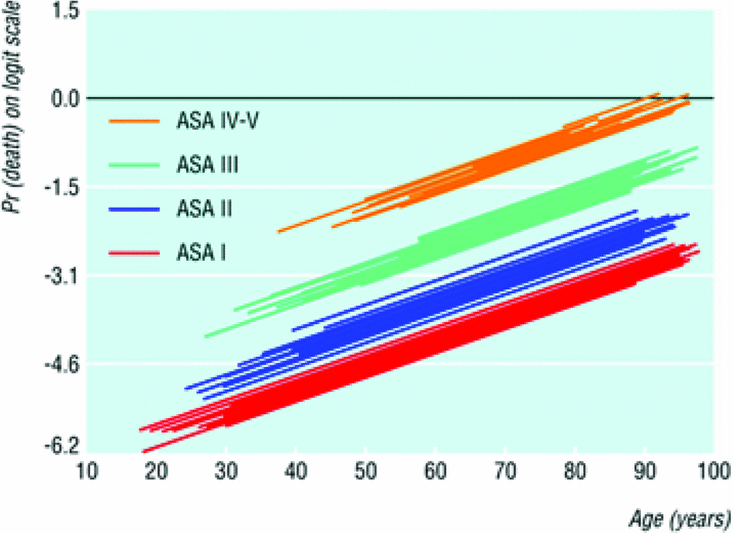
This physical health status classification was originally produced in 1941 as a way of categorizing patients by their systemic disease.Reference Saklad26 It was modified by Dripps et al. to produce the ASA classification used today.Reference Dripps, Lamont and Eckenhoff27 It was not designed as a risk stratification tool but over the past seventy years it has found use as one. A major advantage is that it does not require any specific tests so it can be easily worked out pre-operatively. Post-operative mortality rises with increasing ASA grade; this has been seen in electiveReference Jones and de Cossart1, Reference Klotz, Candinas and Platz28 and emergencyReference Cook and Day29, Reference Tekkis, Poloniecki, Thompson and Stamatakis30 general surgery (Figure 1).
A graph showing 30-day mortality with age across the strata of ASA grade. From: Tekkis PP, Poloniecki JD, Thompson MR, Stamatakis JD. Operative mortality in colorectal cancer: prospective national study. BMJ 2003; 327: 1196–201.

It has also been demonstrated that ASA grade correlates with patient age.Reference Polanczyk, Marcantonio and Goldman31 An observational American study of over 26,000 military veterans ≥80 years who underwent major non-cardiac surgery found that, after adjusting for 33 baseline variables, ASA grade was the strongest predictor of 30-day mortality. There was a 90% increase in 30-day mortality risk for every increase in ASA grade.Reference Hamel, Henderson, Khuri and Daley32 As this was a veteran population the vast majority of these patients were men, over 80 years old, many of whom had a lower socioeconomic status with existing co-morbidities. Whilst these results may not be entirely generalizable to the population of older patients seen in NHS hospitals, it does indicate that ASA grade can be used to give an indication of the likelihood of 30-day post-operative mortality.
Polanczyk et al.Reference Polanczyk, Marcantonio and Goldman31 found that patients classed as ASA III were 2.3 times more likely to develop major post-operative complications, such as myocardial infarction and pulmonary embolism, compared with patients classified as ASA grades I or II. Leung et al. studied 544 patients over 70 years who underwent non-cardiac surgery, the majority of which had general surgery.Reference Leung and Dzankic33 Ninety per cent of patients were classed as ASA II or III. They found that ASA classification, along with having emergency surgery, were the strongest predictors of post-operative adverse outcomes, including death. In the literature there is confusion surrounding the definition of a surgical complicationReference Sokol and Wilson34 and there is no clear, agreed definition.Reference Rampersaud, Moro and Neary35 In the broadest sense it could be considered an undesirable result of a procedure that affects the patient, but this indecision makes it harder to evaluate and compare studies.
A proven further weakness of this system is that is has been shown to be inconsistently applied by anaesthetists.Reference Mak, Campbell and Irwin36 This means the system may not be as objective as initially thought. Further, the majority of patients fall into categories II and III. This indicates that the scale may be too simplistic to be able to discriminate accurately between patients with significant co-morbidities. Furthermore, it does not adjust for any other variables such as age, weight or complexity of surgical procedure.Reference Barnett and Moonesinghe37 Hence the broadness of the ASA system, which facilitates its ease of use, may be a disadvantage that results in the grouping of heterogeneous patients, particularly in the elderly where age can independently affect ASA grade.
Scoring systems based on the ASA system
The predictive value of the ASA grade has been found to be strengthened when used alongside other objective factors. This may circumvent the issue of systematic differences in the way the tool is applied as objective variables will have less intra-observer variation. One study found that an ASA grade of IV or V indicates a patient has an increased likelihood of early mortality when used in patients over 75 who have a non-elective admission.Reference Edwards, Seymour, McCarthy and Crumplin38 Another study echoed this finding and reported that an ASA score of II–V alongside the presence of two associated diseases and a laparotomy remained an indicator of mortality.Reference Bufalari, Ferri, Cao, Cirocchi, Bisacci and Moggi39 The principle of using the ASA score combined with other factors forms the basis of the Surgical Risk Scale and the Reiss Index.
Surgical risk scale (SRS)
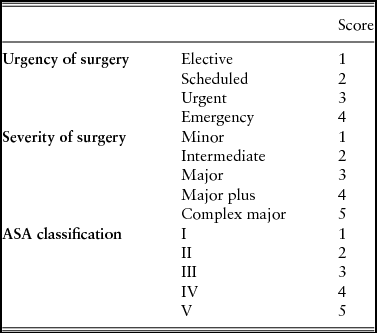
This was devised in 2002 and is currently in use in the general surgery setting. It encompasses readily available patient information including ASA classification, urgency of surgery and BUPA complexity of surgery grading to give a maximum score of 14 (Table 1).Reference Sutton, Bann, Brooks and Sarin40 A benefit is that it can be used pre-operatively provided the likely severity of surgery is known. The original study cohort did not have an upper age limit but did not provide a breakdown of the ages of the patients involved. Because the SRS has yet to be used in a study specifically examining participants over 65 years old, its validity in this age group remains uncertain.
Surgical Risk Scale scoring system

From: Sutton R, Bann S, Brooks M, Sarin S. The Surgical Risk Scale as an improved tool for risk-adjusted analysis in comparative surgical audit. Br J Surg 2002; 89: 763–68.
Reiss Index
The Reiss Index was designed to establish predictive factors of elective and emergency operative mortality in patients over 80 years old.Reference Reiss, Deutsch and Nudelman41 It was based on 1200 elderly patients who underwent a laparotomyReference Reiss, Haddad, Deutsch, Lilos and Fuchs42 and is specifically validated in the older surgical patient. The five most significant factors identified were age, urgency of surgery, presence of malignancy, ASA grade and diagnosis. It has been compared with the ASA classification system in a different group of 210 patients aged over 70 years old that underwent a surgical procedure. It was found that the Reiss Index exhibited significant correlation with the incidence of both post-operative mortality and morbidity, outperforming ASA classification for both measures.Reference Leardi, Santis, Ciuca, Risetti, Pietroletti and Simi43 Despite these encouraging data, this index has not found widespread use over the last twenty years, almost certainly because if the diagnosis is unknown, the index cannot be calculated. In future, the increased use of pre-operative CT abdomen may make this index more useful.
POSSUM scoring based systems
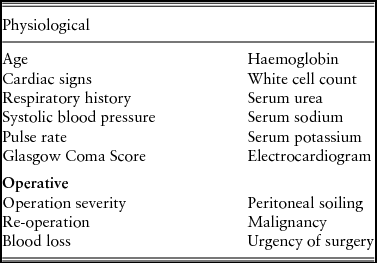
The Physiological and Operative Severity Score for the enUmeration of Mortality and Morbidity (POSSUM) was originally described in 1991 as a tool for surgical audit.Reference Copeland, Jones and Walters44 This is a key point as it was not designed for individual patients. However, it has been validated and widely used across the general surgical specialty. It places twelve physiological variables and six operative variables (Table 2) into a regression equation to calculate the risk of post-operative mortality. It differs from the ASA system in that strictly, it cannot be used pre-operatively to ascertain the risk of mortality and morbidity following an operation. In practice the advent of widespread abdomino-pelvic CT scanning has provided information on diagnosis and hence the likely severity of any operative intervention required, such that the POSSUM score may be calculated in many patients undergoing emergency laparotomy. The original POSSUM was found to over-predict death in all patients, particularly for low-risk patients.Reference Whiteley, Prytherch, Higgins, Weaver and Prout45 Therefore, in 1998, it was modified to form the Portsmouth POSSUM (P-POSSUM).Reference Prytherch, Whiteley, Higgins, Weaver, Prout and Powell46 The same variables are used but the regression equation differs.
Variables required for calculation of a POSSUM or P-POSSUM score
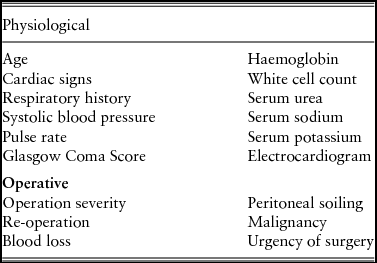
From: Copeland GP, Jones D, Walters M. POSSUM: a scoring system for surgical audit. Br J Surg 1991; 78: 355–60.
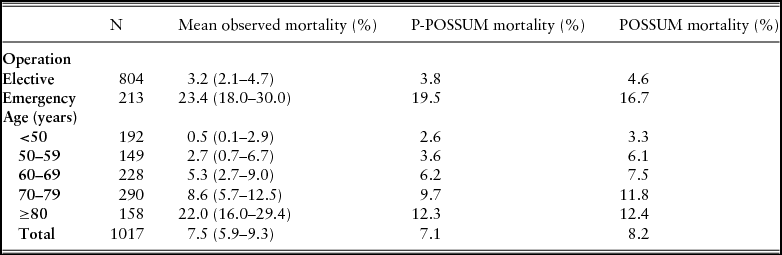
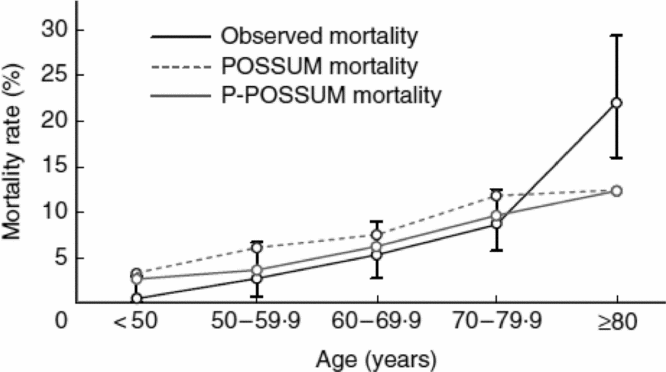
In order to validate the POSSUM scoring systems, Tekkis et al.Reference Tekkis, Kessaris, Kocher, Poloniecki, Lyttle and Windsor47 looked at 1017 adult patients undergoing both emergency and elective colorectal surgery to compare predicted outcomes with actual outcomes (Table 3, Figure 2). Both models over-predicted death for patients ≤79 years old, yet under-predicted death for patients over 80 years old. This illustrates the challenge of risk prediction in older patients. It should also be noted that both tools under-predicted mortality for emergency surgery. Subsequently, Tran Ba Loc et al.Reference Tran Ba Loc, du Montcel and Duron48 assessed the validity of P-POSSUM in a cohort of 1186 older French patients who had an elective or emergency first colorectal operation. Their outcome was death within 30 operative days and they also found that, overall, P-POSSUM under-estimated mortality. It also under-predicted mortality for emergency surgical procedures but tended to over-predict for elective operations.
Observed and expected in-hospital operative mortality rates analysed by age group and mode of operation
From: Tekkis PP, Kessaris N, Kocher HM, Poloniecki JD, Lyttle J, Windsor AC. Evaluation of POSSUM and P-POSSUM scoring systems in patients undergoing colorectal surgery. Br J Surg 2003; 90: 340–45.
A graph showing a comparison of observed mortality and mortality predicted by the POSSUM and P-POSSUM. Ninety-five per cent confidence intervals around the observed outcome are shown. From: Tekkis PP, Kessaris N, Kocher HM, Poloniecki JD, Lyttle J, Windsor AC. Evaluation of POSSUM and P-POSSUM scoring systems in patients undergoing colorectal surgery. Br J Surg 2003; 90: 340–45.
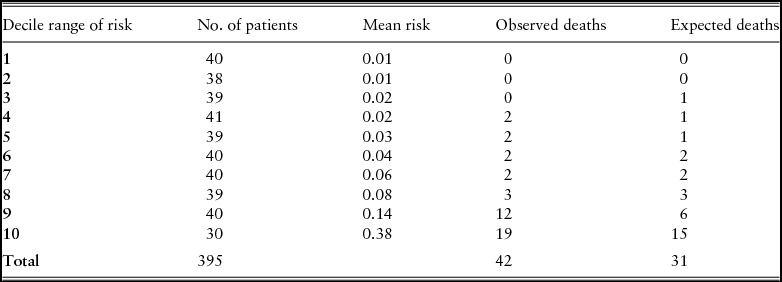
Both POSSUM and P-POSSUM are widely used in general surgery. One of the advantages is they both use objective variables; therefore, the risk of intra-observer variability is low. However, there appears to be doubt as to how well it can predict death in older patients; this is a real limitation of this model. In an attempt to improve predictive ability the Elderly POSSUM was developed for patients undergoing colorectal surgery.Reference Tran Ba Loc, du Montcel and Duron48 It uses the same variables as the other POSSUM derived scores but it alters the equations used to generate mortality and morbidity risks. However, in a validation sample, it was seen that this score still under-predicted the likelihood of mortality in older people (Table 4). This illustrates the complexity and difficulty in designing a score for older patients. The continued inaccurate predictions of POSSUM-based scores for older patients suggest that perhaps an entirely new approach is needed. It is not known if the variables included in the POSSUM-based equations are the most appropriate for older patients; it would be useful to examine the effect of altering the variables.
Calibration of the Elderly POSSUM for predicting mortality in a validation sample
From: Tran Ba Loc P, du Montcel ST, Duron JJ et al. Elderly POSSUM, a dedicated score for prediction of mortality and morbidity after major colorectal surgery in older patients. Br J Surg 2010; 97: 396–403.
Additional scoring systems
Whilst the ASA classification system and POSSUM-based tools are the most widely used risk prediction tools, others are available. Of interest are the Biochemistry and Haematology Outcome Model and the Sickness Assessment (SA); these tools are both used to predict outcomes from admission alone rather than from undergoing a procedure.
Biochemistry and Haematology Outcome Model
Developed in 2003, the Biochemistry and Haematology Outcome Model uses information that is readily available from a hospitalized patient. Parameters include age, sex, BUPA severity of surgery score, mode of admission and physiological data such as urea, haemoglobin, white blood cell count, sodium and potassium. These are much more objective variables than those used in other scores. This model was based on general surgery patients, both operative and non-operative.Reference Prytherch, Sirl, Weaver, Schmidt, Higgins and Sutton49 Therefore this model applies to all general surgical in-patients, not just those who actually have a procedure. The predictive value of this model was assessed in a population of 243 octogenarians who had a general surgery admission.Reference Nichols, Prytherch, Fancourt, Gilkison, Kyle and Mosquera50 Unfortunately the study was underpowered so could not draw firm conclusions. Whilst these results seem interesting and relevant it should be noted that there is some doubt as to the value of routine pre-operative testing of patients’ blood. This is mainly due to low-level evidence that is available to support this approach and the low proportion of results that cause a change in management.Reference Munro, Booth and Nicholl51
More recently, pre-operative C-reactive protein (CRP) and albumin levels have been used to predict surgical outcomes. In a study of 455 patients, Moyes et al. demonstrated that the pre-operative systemic inflammatory response, illustrated by CRP and albumin levels, was independently associated with an increased risk of post-operative infectious complications in patients who underwent potentially curative resection for colorectal cancer.Reference Moyes, Leitch, McKee, Anderson, Horgan and McMillan52 This is a promising area of study as it indicates that there may be a simple, routinely available prognostic score that could be used to identify patients at higher risk of developing infectious post-operative complications.
Sickness Assessment Scoring System
The study which led to the development of the Sickness Assessment included 487 patients over 65 years old who were admitted as an emergency under a general surgeon.Reference Kennedy, al-Mufti, Brewster, Sherry, Magee and Irvin53 Again, this is of benefit as it included non-operative patients. Less than half (48%) of these patients had some form of operation.
The Sickness Assessment is based on three parameters:
(1) a systolic blood pressure less than 100 mmHg at the time of admission under the surgical team;
(2) the presence of ‘severe chronic disease’ or a ‘compromised immune state’; and
(3) that the patient was not independent and self-caring.
Therefore, a maximum score of three can be awarded. This score was shown to be able to identify high-risk patients pre-operatively. A systolic blood pressure less than 100 mmHg is indicative of shockReference Vandromme, Griffin, Weinberg, Rue and Kerby54 and such patients are three times more likely to require some form of emergency surgery and are twice as likely to die during hospitalization.Reference Hasler, Nuesch, Juni, Bouamra, Exadaktylos and Lecky55 Therefore, the low systolic blood pressure alone indicates that the patient is decompensating and likely to be very sick; consequently, it is not a surprise that this assessment can identify high-risk patients. Furthermore, many patients may present prior to this decompensation and have a high risk of complications or death in spite of a normal blood pressure. On this basis it is likely that the Sickness Assessment will under-predict surgical risk. This score does not provide any additional information that a clinician would not be aware of. It also contains points where the definition is not clear cut; for example, what constitutes a self-caring patient and what is the definition of a compromised immune state? This may be why the score has not been widely adopted into clinical practice.
Conclusion
This review has examined a range of risk prediction tools and their application to older surgical patients. This is important because as the population ages, an increased number of older patients will present for surgical opinion. Prediction tools that can accurately assess the risk of admission or surgical procedure could have significant benefits for patients and clinical teams. Predicting risk for older surgical patients is not straightforward; indeed, accurately predicting death for any patient remains difficult. Many of the studies and tools involving older patients and risk prediction tools have sprung up relatively recently. This means there is a time lag for the evidence base to develop and mature.
All the tools considered have both strengths and weaknesses. This illustrates the need for experienced clinicians to be involved in patient care. Risk prediction tools cannot replace the assessment of experienced clinicians responsible for older patients. A risk prediction model cannot be a substitute for clinical opinion; however, they may support the decision-making process and have the potential to enhance predicted outcomes for patients.
Based on the evidence considered it appears that the ASA classification system should be continued to be used. There is a role for P-POSSUM in predicting risk for older patients; however, clinicians using this tool should be aware of the limitations in the evidence base and the tool's consistent under-prediction of mortality for elderly patients. Frailty-based tools look to have some promise in this area; however, there is more work to be done before they can be routinely used for risk prediction in older patients.
Tools that have been specifically designed for older patients, such as Elderly POSSUM, Reiss Index and the Sickness Assessment, illustrate that there is a utility or need for age-specific tools as opposed to disease-specific ones. In the formulation of age-specific tools it should be considered what post-operative and post-admission outcomes are most important for older patients. These risk prediction tools mainly focus on mortality and morbidity but should consideration be given to other outcomes such as discharge destination or quality of life?
Only two tools, the Biochemistry and Haematology Outcomes Model and the Sickness Assessment, gave an indication of risk purely based on surgical admission rather than procedure. In this patient population the majority of emergency surgical admission patients do not actually undergo procedures. A tool that could reliably and accurately demonstrate the negative consequences of emergency admission may support the drive to care for patients in the community rather than exposing them to the risks of hospital admission.
It is clear that there is room for improvement for the existing tools when examining them from the perspective of the older surgical patient; more work needs to be done to be able to accurately predict the risk of death in this age group. There is a need for a tool, specifically designed for risk prediction, which can accurately predict mortality in these patients. Once this has been established it should be widened to be able to predict complications and morbidity associated with operations and hospital stays. This would be a real step forward for geriatric surgical care as it could allow more personalized, tailor-made care to offset the risk for these patients.
Conflicts of interest
None. This research received no specific grant from any funding agency, commercial or not-for-profit sectors.