


Introduction
Meta-analyses have consistently found cognitive behavioural therapy (CBT) to be an effective method of treating anxiety disorders (Christian, Reference Christian2011) and mood disorders (Cuijpers et al. Reference Cuijpers, Berking, Andersson, Quigley, Kleiboer and Dobson2013). However, findings suggest that where anxiety and mood disorders co-exist the outcome of CBT interventions is less pronounced (e.g. Westen et al. Reference Westen, Novotny and Thompson-Brenner2004). The presence of personality pathology with mood and anxiety problems has also been linked to poorer treatment response (Bajaj & Tyrer, Reference Bajaj and Tyrer2005; Fournier et al. Reference Fournier, DeRubeis, Shelton, Gallop, Amsterdam and Hollon2008), although more recent studies have found that those with personality pathology may respond equally well to treatment (Moradveisi et al. Reference Mansell, Harvey, Watkins and Shafran2013).
Findings suggest that disorder-specific CBT can have a beneficial impact on comorbidities (e.g. Norton & Hope, Reference Norton and Hope2008; Allen et al. Reference Allen, White, Barlow, Shear, Gorman and Woods2010; Bauer et al. Reference Bauer, Wilansky-Traynor and Rector2012), especially with CBT for panic disorder (e.g. Tsao et al. Reference Stott, Mansell, Salkovskis, Lavender and Cartwright-Hatton2005). Some evidence suggests that when panic disorder is part of a complex presentation, diagnosis-specific panic treatment can lead to greater therapeutic gains than treating panic concurrently with comorbidities (Craske et al. Reference Craske, Farchione, Allen, Barrios and Stoyanova2007).
However, there is an emerging evidence base that transdiagnostic approaches to CBT (tCBT) are effective at reducing anxiety and depression related comorbidities simultaneously (Craske, Reference Craske2012; Reinholt & Krogh, Reference Reinholt and Krogh2014). tCBT suggests that the common processes (e.g. Wilamowska et al. Reference Wilamowska, Thompson-Hollands, Fairholme, Ellard, Farchione and Barlow2010) involved in psychological disorders should be the focus of therapy, rather than the specific diagnosis (e.g. Mansell et al. Reference Mansell, Harvey, Watkins and Shafran2009). However, only one randomized controlled trial has compared tCBT to diagnosis-specific CBT, which found the outcomes of the interventions to be comparable (Norton & Barrera, Reference Norton and Barrera2012).
Given the simple nature of the cognitive model of panic (Clark, Reference Clark1986) it could be argued that complex cases involving panic would benefit from treatment that starts with panic-specific CBT in order to socialize clients to the cognitive model and facilitate a transdiagnostic approach later on. This paper will explore using panic-specific CBT as a springboard to tCBT using a single-case experimental design.
Method
Design
This case employed an A-B-C single-case design (n = 1). The client's problems were assessed at baseline (A), during panic-specific CBT (B), and during tCBT (C), with one post-treatment follow-up measure. This design was led by collaborative decision making between the therapist and the client in light of the evidence base and the presenting problems.
Participant
This study reports the case of Rachel (anonymized), an 18-year-old Caucasian female living with her family while attending college. Rachel self-referred to a local Improving Access to Psychological Therapies (IAPT) service and was seen for 13 sessions of CBT (including two assessment sessions) with a first-year doctoral trainee, supervised by an experienced BABCP-accredited clinical psychologist. Her case is discussed as an example of engaging with panic-specific CBT as a springboard to develop affinity with the cognitive model before broadening out to address other issues with a transdiagnostic approach to CBT.
Presenting complaints
Rachel presented with panic attacks, social anxiety, depression, uncontrollable worry and problems with interpersonal communication and emotion regulation, including self-harm by cutting. These issues were accompanied by low self-esteem, problems with sleep, and poor motivation. Rachel's problems were having a significant impact on her life: she was retaking a year at college; she was rarely able to leave the house alone; she was afraid of queues and busy places; she found it hard to engage in social activities; she often found it hard to get out of bed; she had attempted suicide by overdose a year previously; she was frequently absent from college; and her family relationships were strained.
History
Rachel was born with medical conditions which meant her parents could not hold her for 3 months after she was born. She then spent several years in and out of hospital until the age of 7 years. At around this time she began to experience panic attacks. Rachel believed they were the sign of a heart condition and visited the doctor several times with her parents to get her heart checked, each time being told her heart was healthy. She reported that her family relationships had always been strained; her mother was seen as very inconsistent, at times being warm and loving and at others cold; her father was described as very stern and Rachel reported being scared of him; her brother was seen as competitive with Rachel and very dismissive of her opinions.
At age 13 Rachel began to feel depressed and noticed an increase in her tendency to worry in general. She started to self-harm by cutting her arms and intermittently restricting her food, which would then result in binge-eating and induced vomiting. Rachel reported that her weight had fluctuated ever since.
Rachel was not clear when her social anxiety became an issue but she recalled several distressing incidences at school between the ages of 13–18 where she felt rejected because she was ‘different’. At age 14 Rachel began experiencing more pronounced agoraphobia, no longer able to leave the house or go out alone without experiencing extreme anxiety; her low mood and lack of motivation intensified. She disclosed being pressured into unwanted sexual experiences by an older boyfriend at around this time. This led her to be uncomfortable with physical contact and increased her social anxieties.
Rachel was referred to Child and Adolescent Mental Health Services at age 15, where she received CBT for depression and family therapy. Rachel reported that she did not find this helpful. Rachel attempted suicide by overdose at age 17. She had started a course of antidepressant medication 2 months before the therapy outlined in this paper commenced; she found this helpful in the first 2 weeks but felt that the effects diminished.
Measures
The following questionnaires were used to address the impact of therapy:
Panic Rating Scale. Administered weekly to assess severity and frequency of panic attacks, and agoraphobic avoidance. This measure has been used in a two-item format in several high-quality research papers to assess panic frequency and severity (e.g. Clark et al. Reference Clark, Salkovskis, Hackmann, Middleton, Anastasiades and Gelder1994). An additional question around agoraphobic avoidance on a 9-point Likert scale was included, with 0 representing ‘no avoidance’ and 8 representing ‘always avoid situations due to fear of panic attacks’.
Patient Health Questionnaire-9 (PHQ-9). Administered weekly to assess depressive symptoms. Research has found this to be a reliable and valid diagnostic measure of depression (e.g. Kroenke et al. Reference Kroenke, Spitzer and Williams2001).
Generalized Anxiety Disorder Assessment-7 (GAD-7). Administered weekly to assess general anxiety symptoms. Research has found this to be a valid tool for screening for GAD and assessing its severity (e.g. Spitzer et al. Reference Spitzer, Kroenke, Williams and Lowe2006).
Social Phobia Weekly Summary Scale. Administered three times near the end of therapy to assess severity of social anxiety. The scale consists of ratings on a scale from 0 to 8 of social anxiety, social avoidance, self-focused versus external attention, anticipatory processing, and post-event rumination; research has found this to have good internal consistency (Clark et al. Reference Clark, Ehlers, Hackmann, McManus and Fennell2006).
Working Alliance Inventory (WAI). Administered 4 weeks into treatment to assess the therapeutic alliance. Research has shown this to be a reliable and valid measure of the therapeutic alliance (e.g. Horvarth & Greenberg, Reference Horvarth and Greenberg1989).
Assessment
An in-depth clinical interview was conducted over two 1-h sessions to extend the brief telephone triage assessment conducted by IAPT. Socratic questioning and empathic listening were used to develop an idea of Rachel's current problems, goals, and strengths. This included a thorough risk assessment. From the referral information it had appeared that Rachel's main issue was social anxiety. However, it became clear that her panic attacks were leading to agoraphobic symptoms, such as fear of leaving the house and of being in certain rooms at college, and were potentially linked to all of her other issues. Her goals included reducing anxiety, being able to socialize more, reducing absences from college, and feeling more ‘normal’.
A survey of the literature relevant to Rachel's case suggested that addressing panic within a disorder-specific CBT framework may have a beneficial impact on her other difficulties; however, there was also evidence that tCBT could be helpful (see above); this information was shared during the second assessment session and a collaborative discussion led to the development of a treatment plan targeting panic alone with a view to addressing comorbid problems with a transdiagnostic approach if appropriate later on. More details are given below.
Formulation
During the first session after assessment Rachel and the therapist developed a collaborative formulation of panic based on a recent example of a panic attack; this matched the model suggested by Clark (Reference Clark1986) (see Fig. 1). It was hypothesized that her other problems with anxiety and depression, along with her frequent trips to hospital as a child, may be part of the reason she was more susceptible to noticing changes in her body.
Diagram of formulation of Rachel's panic attacks used in therapy.

As Rachel became more convinced by the cognitive model of panic the formulation was collaboratively updated to encompass a broader range of Rachel's problems. Due to the complex nature of her presentation it was agreed that a simple model, which gave a general understanding of her issues, would be appropriate. This resulted in a modified version of the cognitive model of anxiety disorders (Butler et al. Reference Butler, Fennell and Hackmann2010). Rachel's formulation was revisited and tweaked numerous times as new information came to light. See Figure 2 for the latest working hypothesis.
Diagram of transdiagnostic formulation of Rachel's problems used in therapy. SSB, Safety-seeking behaviour.

Intervention
Rachel was seen for 11 treatment sessions; seven of these were 1 h long, three were of 1.5 h duration (at locations outside of the clinic), and one was a 30-min reflection session.
Diagnosis-specific CBT for panic
Sessions 1–4. A formulation of panic was developed (Fig. 1) and treatment initially followed the cognitive theory of panic (Clark, Reference Clark1986). Cognitive restructuring began by looking at evidence for and against beliefs that occurred during panic, including some psycho-education about the impact of anxiety on the body. Rachel's beliefs and behaviours were validated as understandable responses.
Using the anxiety equation (Stott et al. Reference Stott, Mansell, Salkovskis, Lavender and Cartwright-Hatton2010, p. 128) Rachel explored the likelihood of her beliefs coming true, the consequences that would follow if they did come true, and her perceived protective and coping factors. Discussions around ‘thought traps’ highlighted biased thinking such as mind-reading, self-criticism, and catastrophizing during panic.
Metaphors were discussed to facilitate Rachel's understanding of safety-seeking behaviours (SSBs) and how they might be problematic (Stott et al. Reference Stott, Mansell, Salkovskis, Lavender and Cartwright-Hatton2010, pp. 137–139). Rachel's personal SSBs were identified and explored. Self-focused attention was highlighted as one of the most problematic SSBs.
The rationale behind behavioural experiments (BEs) was explored (e.g. Bennett-Levy et al. Reference Bennett-Levy, Butler, Fennell, Hackmann, Mueller and Westbrook2004). Some in-session BEs were carried out and instances where Rachel had already been hypothesis-testing were reflected on and written up as BEs (see Table 1). Grounding techniques and attention training were introduced and practised to assist with moving attention away from the self.
Examples of behavioural experiments (BEs) carried out during therapy

SSB, Safety-seeking behaviour.
Rachel's low mood had prevented her doing her homework tasks and she requested some space to explore this. Discussions included advice around behavioural activation and keeping a mood diary. Positive logging and general self-compassion were briefly touched on. Rachel disclosed current self-harming, which she wanted to stop. A brief functional analysis highlighted when self-harm might be more likely and alternatives were explored. Reflection on the sessions so far suggested that several factors in panic were common to Rachel's other issues. It was collaboratively decided that the formulation would be re-developed to cover Rachel's issues more cohesively and a transdiagnostic approach would begin.
Transdiagnostic CBT
Session 5. Additional information that had been shared at assessment or become apparent in later therapy sessions (see history) was incorporated into the formulation of panic to develop a transdiagnostic formulation (see Fig. 2). Interventions were planned to align more with a transdiagnostic model (e.g. Norton, Reference Norton2012).
Sessions 6–8. These sessions were held at large shopping malls. BEs were carried out in-session and as homework. They were often testing processes linked to more than one diagnosis (see Table 1) such as attention (What difference does it make moving attention from an internal to an external focus?), reasoning (Is there another way to look at that evidence?), memory (Is that an objective description of what happened?), and SSBs (What difference does it make if I stop that behaviour?). Catastrophic misinterpretations of physical sensations related to panic and anxiety were also explored using the symptom induction checklist (Barlow, Reference Barlow2002).
Rachel's perceived ability to cope reportedly improved and she began re-appraising some of her core beliefs, for example moving from ‘I am different’, and ‘People don't like me’, to ‘I am different and many people like me because of that’. Mood diaries suggested that certain activities improved Rachel's mood and activity scheduling was developed to reflect this.
Discussions around the decreasing panic, depression and anxiety scores following session 6 (see Fig. 3) elicited Rachel's fear that if she improved she would lose her identity and people might not care for her. These fears were validated as understandable and Rachel was praised for her self-awareness and honesty. Motivational interviewing techniques were employed to explore these worries, such as looking at the pros and cons of change versus no-change. BEs were set up to investigate the effectiveness of new ways of communicating and tolerating emotions.
Graph of Rachel's panic, depression, and anxiety scores over time.

Session 9. Panic was reported to no longer be an issue. Depression scores had increased and Rachel reported feeling ‘dark and heavy’ now that anxiety was reducing; she felt her interpersonal and emotional issues were surfacing. She described pushing her boyfriend away in order to test if he still cared for her and feeling like a ‘psycho’. It was agreed that a BE addressing interpersonal effectiveness, as well as other transdiagnostic processes, would be carried out; Rachel had two conversations with a stranger (a naive colleague of the therapist). In the first conversation she used SSBs as normal and in the second she tried dropping them. Written feedback and video feedback were discussed.
Session 10. Rachel had completed a therapy blueprint as homework. This was discussed to consolidate key learnings from the sessions and develop an action plan of how to take these forward. Potential barriers were highlighted and healthy coping mechanisms explored. Useful ‘tools’ and strengths were recorded.
Rachel's boyfriend had broken up with her but surprisingly her depression scores had reduced. She reported that this had allowed her to reflect on some of the unhelpful ways she tried to deal with interpersonal insecurities.
Rachel reported worrying that the therapist did not like her and that was why therapy was ending; this was discussed as a ‘thought trap’ and the evidence was examined to see if there was a different way of looking at this.
Reflection session
Session 11. A 30-min session explored Rachel's views on the therapy sessions. She highlighted the reciprocal nature of discussions and the shared understanding of her problems as key aspects that had enabled her to make positive changes. She found reflecting on events to see how they linked with the formulation(s) useful to understand why she was struggling and how she might be able to change this. She mentioned that seeing how her problems were interlinked had increased her confidence in overcoming them. She reported feeling nervous that she still suffered with anxiety and depression and that more sessions would have been helpful to fully tackle this; the potential for 12 further sessions at IAPT was discussed.
Results
Rachel's scores on the PHQ-9 reduced from 24/27 to 19/27, indicating a move from severe to moderately severe depression. This score had increased to 21/27, indicating severe depression at 6-week follow-up, which Rachel believed was due to her imminent examinations. Her scores on the GAD-7 reduced from 20/21 to 14/20, indicating a move from severe to moderate anxiety. This was maintained, with a score of 13/21, at follow-up. Panic scores reduced from 17/20 to 3/20, indicating a move from severe panic and agoraphobia to an absence of panic disorder. This had reduced to a score of 1/20 at follow-up.
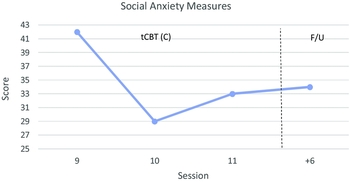
Social anxiety scores reduced from 42/48 in session 9 to 33/48 by session 11, representing a move from severe to moderately severe social anxiety. This was maintained with a score of 34/48 at follow-up (see Fig. 4).
Graph of Rachel's social anxiety scores over time.

The therapeutic relationship was rated highly on the WAI, scoring 71/84.
Incidences of self-harm were happening weekly at the start of treatment but were reported to have been absent for 8 weeks by the end of therapy and 14 weeks at follow-up.
Discussion
This case demonstrated the use of disorder-specific CBT moving to tCBT to treat a complex case involving comorbid anxiety, mood, interpersonal, and emotion regulation problems. The cognitive model of panic was used to guide initial treatment sessions which allowed the client to become familiar with the principles of CBT before moving on to a more transdiagnostic approach, in line with collaborative decision making and an individualized formulation. Ratings of panic reached non-clinical levels and ratings of low mood, worry and social anxiety had begun to reduce. Previous research has investigated using either diagnosis-specific CBT or tCBT; this case shows the potential to use both approaches with diagnosis-specific CBT as a springboard to tCBT – an approach that may occur frequently in clinical practice but is not reflected in the research literature. This case also suggests that features associated with personality pathology, such as emotion regulation difficulties, may be addressed with this approach.
Clinical implications
This study suggests that panic-specific CBT may be a useful springboard to move on to tCBT in the treatment of complex cases. In cases where panic is part of a presentation it is recommended that clinicians consider starting by looking at panic before moving on to look at problems more cohesively.
In this case gains in therapy were seen once tCBT was employed; however, this coincided with the introduction of interpersonal behavioural experiments outside of the clinic, making it hard to discern which specific factors contributed to this decline in problem severity. The fact that all of Rachel's problems started to reduce could be attributed to a combination of both of these factors; carrying out in-vivo experiments caused the strength of her beliefs to change but the breadth of impact was due to common processes being highlighted in the transdiagnostic formulation, allowing outcomes from one experiment to be generalized to several issues. Of course it is entirely possible that the gains seen would have occurred with only a panic-specific approach including out-of-clinic BEs; future research is needed to investigate this, for example introducing interpersonal BEs during the diagnosis-specific stage and broadening out the predictions tested and scope of the BEs in the tCBT phase. The impact of the tCBT in this case is hypothesized to be partly due to the panic-specific work beforehand, allowing a more intuitive grasp of the transdiagnostic formulation but further research is needed to clarify this.
At follow-up Rachel's depression scores had increased slightly; she believed this was due to external pressures but on reflection some more work around rumination and ‘thought traps’, and the roles these played in the transdiagnostic formulation, may have been useful. It is worth noting that only panic scores reduced to non-clinical levels; as social anxiety, anxiety and depression scores did markedly reduce, and had mostly remained reduced at follow-up, it is arguable that the approach outlined in this paper would lead to more significant outcomes for the patient if more sessions were scheduled.
It is recommended that shared decision making alongside a collaborative, individualized formulation is used to guide treatment planning when research is inconclusive. Rachel's reflections supported the idea that collaborative working was a key factor in securing a strong therapeutic alliance and developing a treatment plan that was acceptable and useful. Individualized formulation may be treatment as usual for most clinical psychologists (Division of Clinical Psychology, 2010) but in complex cases it may be even more important given the additional content that is likely to be present and the various ways problems may interact. Measures should be used to assess the progress of treatment and facilitate reflection about successes, barriers, and potential next steps.
Without a larger sample size and a control condition it is impossible to make a definitive conclusion about whether diagnosis-specific CBT, tCBT, or a move from one to the other is most effective when dealing with complex cases. Overall this case found using panic-specific CBT as a stepping stone to tCBT was acceptable to both client and therapist, allowing a shared frame of reference that enabled a broader range of issues to be addressed than might have been typical within treatment based solely on the panic model. It is not clear if the approach impacted positively or negatively on either panic or other outcomes compared to panic formulation alone, but the approach used in this case did lead to panic remission and some indications of more marginal benefit in a broader range of problems. To this extent it suggests that further exploration of the approach is warranted.
Limitations
As with any single-case design it is hard to know how far findings can be generalized. It is unclear whether gains were due to the strength of the diagnosis-specific work enabling a smooth transition to a tCBT approach or whether a tCBT approach would have been best employed from the start. It is also not clear whether this transition would have been so smooth if the primary problem had not been panic. It cannot be ruled out that sticking with a diagnosis-specific formulation throughout treatment would have led to the same gains. Although Rachel reported finding little benefit from her antidepressant medication this may also have played a role in the improvements seen.
It could be argued that an alternative formulation or therapeutic intervention may have improved outcomes. There are different tCBT models as well as different psychological approaches that were not fully considered by the therapist and the client but which may have been useful, such as family therapy to explore some of the systemic issues that appeared to be present.
There are several limitations in the design of the study. It is not clear how distinct the A-B-C phases of the design were. tCBT was mentioned from the second assessment session as a future consideration and it is plausible that this modified how Rachel conceptualized her problems before phase C officially began. Also, as diagnosis-specific CBT as a springboard to tCBT was what was being evaluated this case may have been better assessed as an A-B or A-(B+C) design; this may better reflect the hypothesized impact of panic-specific CBT on later tCBT, but could reduce the distinction between the two approaches. Additionally a small reduction was seen in anxiety and panic ratings after assessment; Rachel rated the therapeutic alliance highly and it is plausible that non-specific therapeutic affects during the assessment sessions could have impacted on outcomes before phase B had started. However, the first two time-points would have been pre-assessment (one from triage and one before the first assessment session started). The strong alliance could have also modified the impact of the intervention.
Furthermore, it was unclear how Rachel's social anxiety reduced over the course of therapy as measures were only introduced towards the end of therapy and no standardized measures were taken of emotion regulation and self-harm issues. Eleven sessions may not have been long enough to bring about significant change in comorbid disorders beyond panic; it may be that a longer treatment course is required to see comorbidities reduce to non-clinical levels.
Reflections
Beginning treatment with a tCBT approach may have been more suitable given Rachel's depression, emotion regulation problems, previous suicide attempts, current self-harm and absences from college. However, treatment planning was guided by collaborative decision making. This case emphasized the value of thorough assessments to better understand an individual's presentation, seeing the client as an expert, and modifying treatment in response to new information. The therapist also saw the importance of having realistic expectations of therapy given personal (i.e. experience) and service (i.e. number of sessions) constraints.
Key points
-
• Evidence suggests that diagnosis-specific CBT and tCBT may be beneficial when addressing complex cases involving both mood and anxiety problems.
-
• CBT for panic is based on a simple model and may be useful to help socialize clients to CBT.
-
• One example of panic-specific CBT being used as a stepping stone to a transdiagnostic approach in a complex case has been presented. The outcomes demonstrate that improvements were made, although many issues still remained at clinical levels. It is proposed that a longer treatment protocol may be necessary in complex cases but that this approach merits further investigation.
-
• Further research could explore whether diagnosis-specific CBT, tCBT, or a combination of both is most effective when addressing complex cases.
-
• Collaborative and ongoing assessment and formulation were seen as key components to engagement and therapeutic progress.
Acknowledgements
The authors thank Rachel (pseudonym) for consenting to the publication of this article, all names used in the report have been changed in order to preserve confidentiality. Furthermore, the comments and suggestions from the review panel at The Cognitive Behaviour Therapist and course staff on the Doctorate of Clinical Psychology programme at the University of Bath were invaluable to informing what conclusions were drawn from this case.
This work was carried out between December 2014 and March 2015 by a trainee clinical psychologist and her supervisor as part of the University of Bath doctorate in Clinical Psychology.
Declaration of Interest
None.
-
(1) To get an overview of the current evidence base regarding CBT for anxiety and mood-related comorbidities.
-
(2) To consider how diagnosis-specific CBT and transdiagnostic CBT might be helpful in such cases.
-
(3) To reflect on a single-case experimental design to see how diagnosis-specific CBT for panic might be used as a stepping-stone to transdiagnostic CBT in complex cases.
-
(4) To appreciate the value of individualized, collaborative formulation as an ongoing therapeutic process.





Comments
No Comments have been published for this article.