Introduction
Sleep-disordered breathing describes a group of disorders characterised by abnormalities of respiratory pattern (i.e. pauses in breathing) and/or quantity of ventilation during sleep. The most common type of sleep-disordered breathing is obstructive sleep apnoea (OSA) syndrome, which is characterised by repetitive episodes of upper airway obstruction during sleep.1 This is usually associated with a reduction in blood oxygen saturation, and may occur more than 20 times per hour.Reference Mitchell and Boss2 Cheyne–Stokes respiration, another type of sleep-disordered breathing, is characterised by a crescendo–decrescendo pattern of respiration and is commonly seen during sleep in patients with congestive heart failure. Primary snoring, in contrast, is characterised by loud upper-airway breathing sounds during sleep, without episodes of apnoea or hypoventilation.1
Obstructive sleep apnoea has been identified in 1–3 per cent of pre-school-aged children,Reference Ali, Pitson and Stradling3 and has a wide array of negative effects. Kwok et al. Reference Kwok, Ng and Chan4 emphasised that OSA was connected to hypertension, and stated that their data pointed to ‘increased sympathetic activation, decreased arterial distensibility and ventricular hypertrophy in children with OSA’.Reference Kwok, Ng and Chan4 Capdevila et al. Reference Capdevila, Crabtree, Kheirandish-Gozal and Gozal5 reported that increased OSA severity was associated with a greater incidence of enuresis. Other studies have linked OSA to both pulmonary hypertension and failure to thrive.Reference Mitchell and Boss2
Obstructive sleep apnoea also appears to have a negative impact on children's neurobehavioural functioning. Suratt et al. Reference Suratt, Barth and Diamond6 identified a significant correlation between OSA degree and cognitive impairment, using tests of general cognition, memory and continuous performance. Similarly, Montgomery-Downs et al. Reference Montgomery-Downs, Crabtree and Gozal7 investigated sleep, respiration and cognitive function in children suffering from OSA, and found that OSA resulted in significantly lower cognitive scores compared with control subjects. BeebeReference Beebe8 reviewed neurobehavioural morbidity associated with sleep-disordered breathing in children, and noted that strong links exist between OSA and ‘behaviour and emotion regulation, scholastic performance and alertness’. GozalReference Gozal9 investigated the impact of sleep-associated gas exchange abnormalities on academic performance in first grade children, and found that OSA adversely affected learning performance, and that an association existed between OSA and attention deficit hyperactivity disorder. Chervin et al. Reference Chervin, Archbold and Dillon10 found that OSA was associated with both inattention and hyperactivity, while de Serres et al. Reference de Serres, Derkay, Astley, Deyo, Rosenfeld and Gates11 reported that OSA could prolong total sleep time and cause irritability and morning headaches.
In light of these negative effects, it is vital to diagnose and treat OSA as quickly and effectively as possible. The major cause of OSA in children is adenotonsillar hypertrophy, accounting for over 70 per cent of cases,Reference Nimubona, Jokic, Moreau, Brouard, Guillois and Lecacheux12 and in such cases the treatment of choice is adenotonsillectomy. Adenotonsillectomy is one of the most frequently performed paediatric surgical procedures, with more than 400 000 adenotonsillectomy procedures being conducted for children under 15 years in the USA per year.Reference Hoban and Friedman13 Approximately 29 000 paediatric tonsillectomies and 7000 adenoidectomies are conducted in England annually.14 Several studies have shown that adenotonsillectomy leads to significant improvements in OSA in children, and usually cures the condition.Reference Hoban and Friedman13, 14
Obstructive sleep apnoea can be objectively differentiated from other sleep disorders using the ‘gold standard’ investigation, polysomnography. However, whilst polysomnography offers an objective measure of improvement of OSA following adenotonsillectomy, it does not provide an assessment of OSA as interpreted by the carer. This is extremely important since such an objective measure can seem irrelevant to the carer, who is understandably more concerned with improvements in their child's quality of life (QoL). Quality of life encompasses aspects such as physical suffering, emotional distress, activity limitations and social well being. These are often the areas of most concern to the carer, who must decide whether they want this procedure for their child. As such, validated questionnaires have been developed to assess change in QoL following adenotonsillectomy as perceived by the care-giver.
Whilst several studies have documented objective improvement in OSA in children undergoing adenotonsillectomy, few have investigated the impact of adenotonsillectomy on the QoL of children with OSA. In particular, to our knowledge no study has investigated the effects of adenotonsillectomy on the QoL of children under three years of age with OSA.
This study aimed to use a validated QoL questionnaire to assess the impact of adenotonsillectomy on the QoL of children under three years of age with OSA. The study questionnaire was designed to be completed by the child's carer via telephone. We hypothesised that the QoL of children under three years of age and suffering from OSA, as measured by a validated QoL questionnaire, improves following adenotonsillectomy.
Materials and methods
Data collection
This study was conducted at an associate university hospital in the UK. We recruited into the study 39 children under 3 years of age who were treated with adenotonsillectomy for OSA. Children underwent adenotonsillectomy between 1 January 2009 and 1 January 2010.
Patients
All patients were under the age of three years, with a mean patient age at the time of operation of 2.05 years (range, 0.10–2.11 years). Seventy-seven per cent of patients were male and 23 per cent female. The mean patient weight at the time of operation was 13.8 kg (range, 8.7–17.9 kg); no patient was obese. The ethnic preponderance was White British. Obstructive sleep apnoea was diagnosed via clinical history and examination, as well as overnight pulse oximetry. A positive result for overnight pulse oximetry was defined by the paediatric sleep study laboratory as transient oxygen desaturation dips of greater than 4 per cent and/or repetitive episodes (with a mean of more than 10 fluctuations per hour) during sleep. These criteria were based upon published work on paediatric OSA using pulse oximetry.Reference Series, Marc, Cormier and La Forge15, Reference Brouillette, Morielli, Leimanis, Waters, Luciano and Ducharme16 There was no minimum weight for inclusion in the study, and no patient was excluded based on the criteria recommended in the UK consensus statement.
Routine pre-operative investigations included full blood cell count, clotting studies, cross-matching (for children weighting less than 15 kg) and sickle cell investigation (if required). All patients had an American Society of Anesthesiology grade of 2. All adenotonsillectomy procedures were carried out under general anaesthesia, using either coblation or dissection tonsillectomy.
Carers were required to speak English sufficiently well to understand the questionnaire and to communicate their answers effectively.
Quality of life questionnaire
The QoL questionnaire used (see Appendix 1) was adapted from the validated, six-item, health-related instrument (termed the Obstructive Sleep Disorder 6 questionnaire or ‘OSD-6’) developed by de Serres et al. Reference de Serres, Derkay, Astley, Deyo, Rosenfeld and Gates11
Carers were telephoned between 11 and 22 months after their child's adenotonsillectomy. A cover letter was read out to carers describing the purpose of the study along with what was entailed, and consent was obtained. The questionnaire was then read out to carers and their answers documented. Each questionnaire was completed in less than five minutes.
The questionnaire contained six questions each assessing the extent of improvement of a specific domain following adenotonsillectomy. Domains comprised: physical suffering, sleep disturbance, speech or swallowing problems, emotional distress, activity limitations, and care-giver concerns. Carers scored improvement on the following point scale: none (0), hardly at all (1), somewhat (2), moderate (3), quite a bit (4), very much (5), and couldn't be more (6).
The questionnaire was adapted from the validated Obstructive Sleep Disorder 6 instrument,Reference de Serres, Derkay, Astley, Deyo, Rosenfeld and Gates11 in that questions were asked to establish the extent of improvement of specific domains following adenotonsillectomy, rather than the extent of suffering within specific domains because of enlarged tonsils and adenoids. This adaptation was made in order to facilitate our data collection with respect to our study aim.
Analysis
All domains were equally weighted, and mean questionnaire scores were determined by adding each questionnaire's domain scores and dividing by six. All mean questionnaire scores were added and the total divided by the number of participants in the study (39) to obtain the overall mean questionnaire score. The higher the mean questionnaire score, the greater the improvement in QoL following adenotonsillectomy. The mean scores of specific domains were calculated using the same method.
Ethical considerations
This study was registered and approved by the audit department at the senior author's base hospital. Data were kept in accordance with the UK Data Protection Act (1998).
Results and analysis
This study included 39 children under 3 years of age who were suffering from OSA and who met the inclusion criteria, and from whose carers consent was obtained. The mean patient age at the time of operation was 2.05 years (range, 0.10–2.11 years). Seventy-seven per cent of patients were male and 23 per cent female. All selected carers were available to complete the telephone questionnaire.
There were no significant post-operative complications recorded (i.e. reactionary or secondary haemorrhage, post-operative ventilatory support, or hospital readmission due to pain or dehydration) for any of our patients.
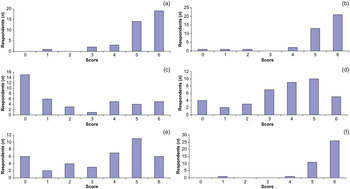
The distribution of improvement scores for each domain is shown in Figure 1. Improvements in physical suffering, sleep disturbance and care-giver concern were most frequently scored as 6. However, improvements in speech or swallowing problems were most frequently scored as 0. Furthermore, carers most frequently scored improvements in emotional distress and activity limitation as 5.
Distribution of improvement scores in each domain: (a) physical suffering; (b) sleep disturbance; (c) speech and swallowing problems; (d) emotional disturbance; (e) activity limitations; and (f) care-giver concern. See main text for point scoring system.

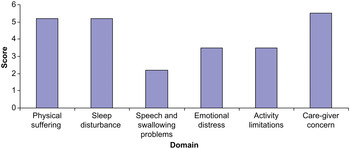
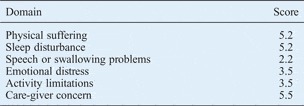
The mean improvement scores for physical suffering, sleep disturbance and care-giver concern were over 5, as shown in Table I and Figure 2. Emotional distress and activity limitations had mean improvement scores of 3.5. Speech or swallowing problems had a mean improvement score of 2.2.
Mean domain improvement scores. See main text for point scoring system.

Mean questionnaire improvement scores

See text for point scoring system.
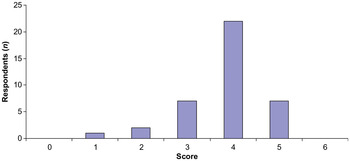
Figure 3 shows that the most frequent mean questionnaire score was 4, followed by 3 and 5 (each with identical frequencies). Mean scores of 1 and 2 had low frequencies. No questionnaire had a mean score of 6. All questionnaires had a mean score of greater than 0.
Distribution of mean questionnaire scores. See main text for point scoring system.

The overall mean questionnaire score was 4.2. The overall mean questionnaire score was 4.2 for boys and 4.3 for girls.
Discussion
Clinical applicability
Whilst several studies have documented an objective improvement in OSA in children undergoing adenotonsillectomy, few have investigated the impact of adenotonsillectomy on the QoL of children with OSA. Particularly, to our knowledge there has been no published research on the effect of adenotonsillectomy on the QoL of children under three years of age with OSA. This study helps fill that gap. Furthermore, this study will provide doctors with information that can be easily interpreted by carers considering the operation for their child, thereby aiding the decision-making process.
Synopsis of key findings
Our key findings concerning the impact of adenotonsillectomy on the QoL of children under three years of age with OSA were: (1) all children's QoL improved following adenotonsillectomy; (2) the greatest mean improvement scores were in the care-giver concern, physical suffering and sleep disturbance domains, all of which were scored as ‘very good’; and (3) the overall mean questionnaire score was 4.2, corresponding to an overall QoL improvement of ‘quite a bit’.
Data interpretation
Carers' responses indicated that the greatest post-adenotonsillectomy improvements were perceived in the domains of care-giver concern, physical suffering and sleep disturbance: the mean improvement in all three of these domains was scored as ‘very much’.
Upper airway obstruction due to adenotonsillar hypertrophy often results in speech and swallowing difficulties.Reference Mitchell, Kelly, Call and Yao17 Thus, it is perhaps surprising that speech and swallowing was only noted to improve ‘somewhat’ following adenotonsillectomy. This may be explained by carers instinctively focussing more on physical suffering and sleep disturbance, since these are generally considered to pose the greatest risk to the child's health and well-being.Reference Mitchell, Kelly, Call and Yao17
The mean questionnaire improvement scores reflect improvements in the child's general QoL. Thus, our results indicate that 92 per cent of carers rated QoL improvement following adenotonsillectomy as ‘moderate’ or better, whilst 74 per cent of carers rated QoL improvement as ‘quite a bit’ or better. Only 5 per cent of carers indicated a post-tonsillectomy QoL improvement of ‘somewhat’, and only 3 per cent indicated hardly any improvement. No carers reported no improvement in QoL; thus, all the children's QoL improved following adenotonsillectomy.
Overall, the mean children's QoL improved ‘quite a bit’ (i.e. a mean overall improvement score of 4.2). Overall male and female mean QoL improvement was almost identical, indicating that gender was not a factor in post-tonsillectomy QoL improvement in this study.
These data clearly indicate that adenotonsillectomy results in considerable improvement in QoL for children under three years of age with OSA. Moreover, our data are in agreement with studies using objective measures to determine the benefits of adenotonsillectomy for children with OSA.Reference Suen, Arnold and Brooks18
Limitations
The children's carers completed the questionnaire between 10 and 22 months after their child's operation. This long interval between operation and questionnaire may have made it difficult for carers to identify whether improvements in QoL were due to their child's adenotonsillectomy or to social, developmental and/or physical factors. However, as noted by de Serres et al.,Reference de Serres, Derkay, Astley, Deyo, Rosenfeld and Gates11 QoL appears to ‘…continue to improve considerably beyond the postoperative period’.Reference de Serres, Derkay, Astley, Deyo, Rosenfeld and Gates11 This corresponds to the typical clinical picture of continued health improvements months after adenotonsillectomy. In light of this, the delay in carers completing our questionnaire may in fact have been of benefit.
• Paediatric obstructive sleep apnoea (OSA) causes a wide array of negative outcomes
• The main cause is adenotonsillar hypertrophy, treated with adenotonsillectomy
• Adenotonsillectomy significantly improves children's obstructive sleep apnoea
• This study assessed the quality of life (QoL) impact of adenotonsillectomy on young children's OSA
• Measurable QoL improvements were seen
We were unable to have a control group of patients with OSA who did not undergo adenotonsillectomy. Thus, we were unable to ascertain whether QoL would simply have improved over time independent of surgical intervention, following the natural history of hypertrophy of Waldeyer's ring.
Conclusion
In this study of children under three years of age with OSA, adenotonsillectomy resulted in improvements in QoL for all patients. The greatest QoL improvements were seen in the care-giver concern, physical suffering and sleep disturbance domains.
Obstructive sleep apnoea is an important condition to address, with documented effects on pulmonary hypertension, growth and cognition. Our study findings clearly indicate that adenotonsillectomy provides symptomatic improvement in patients with documented OSA. These QoL findings are highly relevant to carers considering adenotonsillectomy as treatment for their child's OSA, as they provide appropriate, practical information that can be easily interpreted by both carers and healthcare commissioners.
Acknowledgements
We gratefully acknowledge Jackie Aldridge for her invaluable assistance and perseverance. We also express our gratitude to all the subjects who participated in the study.
Appendix 1. Questionnaire: impact of adenotonsillectomy on quality of life of children with obstructive sleep apnoea
Key:
0 = None
1 = Hardly at all
2 = Somewhat
3 = Moderate
4 = Quite a bit
5 = Very much
6 = Couldn't be more
(1) Physical suffering
For example: sore throat, dry throat, nasal congestion, completely blocked nose, bed-wetting, excessive daytime tiredness, failure to gain weight, bad breath.
Overall, how much has physical suffering improved for your child because of your child's adenotonsillectomy?
0 1 2 3 4 5 6
(2) Sleep disturbance
For example: snoring, choking or gasping for air, stopping breathing for a few seconds, restless sleep, difficult to awaken from sleep, chest caving in with breathing.
Overall, how much has sleep disturbance improved for your child because of your child's adenotonsillectomy?
0 1 2 3 4 5 6
(3) Speech or swallowing problems
For example: difficulty swallowing certain foods, choking on foods, muffled speech, nasal sounding speech, poor pronunciation.
Overall, how much has speech or swallowing improved for your child because of your child's adenotonsillectomy?
0 1 2 3 4 5 6
(4) Emotional distress
For example: irritable, frustrated, sad, restless, poor appetite, can't pay attention, child made fun of because of snoring.
Overall, how much has emotional distress improved for your child because of your child's adenotonsillectomy?
0 1 2 3 4 5 6
(5) Activity limitations
For example: playing, participating or excelling at sports, doing things with friends or family, attending school or day care.
Overall, how much have your child's activities been improved because of your child's adenotonsillectomy?
0 1 2 3 4 5 6
(6) Care-giver concerns
To what extent as a care-giver has your concern or inconvenience due to your child's snoring and difficulty in breathing at night been alleviated because of your child's adenotonsillectomy?
0 1 2 3 4 5 6
Adapted with permission.Reference de Serres, Derkay, Astley, Deyo, Rosenfeld and Gates11