The study of transposition timeliness: Why bother?
Our study contributes to the on-going debate on the extent and relevance of non-compliance that has emerged in the European Union (EU) integration literature over the last fifteen years. This discussion is centred around Community directives, which require explicit transposition into national law while leaving the choice of implementing measure to the member states (Article 249 EC).Footnote 1 Due to the decreasing number of Community decisions and regulations, this legally binding instrument, and thereby compliance with directives’ standards, is becoming an increasingly relevant topic in EU legislative studies.Footnote 2 Recent Commission scoreboards suggest that member states have improved at meeting official transposition goals, but the monthly Commission bulletin reveals that over 47 per cent of Commission referrals to the European Court of Justice between 1992 and 2004 were due to member-state notification failure of transposition efforts related to directives.
In this study, we consider how country-specific factors influence the transposition process and whether preference constellations and process indicators related to EU and domestic politics may explain whether member states comply with the deadline or not. Compared to previous research on transposition that has relied on a more selective design comparing implementation in a few countries, or studying a small set of directives or policy areas, we take a quantitative approach to these questions and make three contributions to the current literature: (i) our sample traces the national transposition efforts related to 1,590 directives in fifteen member states across all policy sectors for the period from 1986 to 2002, and thereby reduces potential selection-bias associated with studies on either specific policy sectors, countries or national implementation measures; (ii) as an alternative to the rather crude measures provided by most veto player indices, we employ sector-specific policy preferences to estimate the maximum ideological distance between actors at both the national and EU levels and thereby avoiding misspecification associated with institutional analyses using structural measures; (iii) we distinguish between notification failure and transposition delay, specify a model that distinguishes between the choice to transpose and the extent of delay, and test respective hypotheses econometrically using an ordered probit model with sample selection.
The EU compliance deficit has received significant attention since the Commission, in accordance with Article 226 EC, began providing the European Parliament with annual reports on the number and quality of member-state infringements in 1984. Early infringement studies had already warned of systematic non-compliance among the member states,Footnote 3 and today – even if we consider the infringement records to be potentially biased by changes in the Commission’s enforcement strategy and regulatory activityFootnote 4 – compliance difficulties are observable at the initial stage of transposition. Mastenbroek has found that 58 per cent of directives adopted between 1995 and 1998 were transposed after the specified deadline in the Netherlands.Footnote 5 Similarly, Borghetto et al. has established that over 75 per cent of Italian transposition measures are delayed, and that this delay averages two years.Footnote 6
The binding nature of directives stipulates that implementation must occur ‘in due time’ and ‘correctly’.Footnote 7 According to Mastenbroek, ‘The Commission and the Court take this obligation very seriously, because of the possible adverse effects of delay: late transposition endangers the uniform application of Community law and implies the continued existence of discriminatory practices’.Footnote 8 As early as 1976, the European Court of Justice (ECJ) had expressed this position on the dangers of delayed transposition in a case against Italy. Transposition delays not only damage reputations at the supranational level, this free-riding also creates a loss of efficiency for all member states; the optimal policy goal cannot be realized, and the policy burden is not equally shared. As free-riding grows more prevalent, policy outcomes become increasingly sub-optimal. Earlier theoretical work has considered compliance with EU law to be a repeated game, since member states have the opportunity continually to re-evaluate their implementation strategy based on the activities of other member states and their estimation of domestic costs and benefits.Footnote 9 In this analogy, the Commission plays a crucial role in the implementation process by providing member states with information on the transposition activities of other member states and charging defectors for their non-compliance.
Because non-compliance is costly for both EU and national-level actors, the aim of this article is to explore potential explanatory factors contributing to member-state defection (failure to notify national transposition measures within the period of study) and transposition delays (notification after the transposition deadline has expired). We begin by discussing several insights from the current implementation and compliance literature. In order to highlight the innovative aspects of our contribution, we also refer to a few of the pitfalls associated with previous transposition studies, before introducing our research approach and data on national transposition efforts. Finally, we evaluate the explanatory power of several factors thought to affect notification and transposition timeliness using an ordered probit model with sample selection.
Explaining (non-)compliance and transposition delay
Research on member state (non-)compliance points to a number of explanatory factors at both the supranational and national levels which contribute to the observed EU compliance patterns. These factors emphasize member-state willingness (or national preferences) and strategic choice, on the one hand, and capacity (or administrative restrictions and resources) or legal complexity and ambiguity, on the other. The enforcement approach sees non-compliance as a result of collective action and free-rider problems, and sanctioning as the only effective method of inducing co-operation when violations of an agreement are detected.Footnote 10 According to this view, states evaluate the costs and benefits associated with defection, and so closer monitoring is expected to increase compliant behaviour. Carrubba conceives of compliance as a repeated Prisoner’s Dilemma, in which member states are motivated to defect, and the Commission encourages co-operation by signalling the threat of infringement proceedings.Footnote 11 Carrubba shows that member states always defect on issues that will bring significant political backlash from constituents and may defect on issues that are less controversial. This literature emphasizes that compliance is clearly related to the preference constellations of national veto players and influenced by the role of the Commission in sanctioning member-state defection.
Related to this strategic view on compliance, some authors have investigated the ‘goodness-of-fit’ hypothesis and shown that the cost of compliance is higher when the EU adaptation pressure increases.Footnote 12 In these studies, existing national administrative structures and policy instruments have been shown to affect both the extent of national implementation and transposition delay. From a quantitative perspective, the policy-orientated view on the goodness-of-fit argument would ask us to consider not only the policy instrument but also how EU policy goals differ from the national status quo. In our terms, the difference between the domestic status quo and the new Community legislation is, however, only relevant in the light of divergent preference constellations between national veto players who affect policy change and thereby the efficiency of transposition.Footnote 13 The empirical evidence for the role of veto players in national compliance efforts is mixed,Footnote 14 but this may be related to a measurement deficit resulting from limited cross-country and longitudinal variance and a lack of direct domestic preference measures.Footnote 15 A second strand of the goodness-of-fit literature focuses on institutional aspects related to national administrative culture.Footnote 16 Although these arguments have become more sophisticated, the empirical evidence in support of these claims is limited to only a few cases, i.e. in transport, road haulage and rail transport. Part of the difficulty in assessing the goodness-of-fit logic quantitatively is the lack of directive-specific proxies for shifts and changes in the national administrative tradition.
Returning to the idea of member-state ‘willingness’, some scholars conceive of compliance preferences in macro-economic terms. Based on the assumption that EU legislation creates an uneven distribution of costs and benefits across the member states, Perkins and Neumayer ask whether membership benefits such as inter-EU trade and fiscal transfers ‘buy’ improved compliance.Footnote 17 Public opinion data have also been used as a proxy for the political costs of compliance,Footnote 18 but due to the bureaucratic nature of transposition and public ignorance about this process, it is hardly convincing to view the general public as an additional political restraint, or informal veto player, in the transposition of Community law.
While the enforcement perspective emphasizes aspects of willingness, or strategic behaviour, the management approach focuses on the domestic administrative capacity to comply. In the case of Community directives, non-compliance may result from tight transposition deadlines, the inability of domestic actors to effect and monitor policy change or vagueness in commitments and ambiguities in the body of the directive.Footnote 19 Proponents of this school argue that only supranational institutions are in a position to clarify existing ambiguities and thereby encourage compliance.Footnote 20 Many qualitative studies have investigated how administrative capacity influences compliance and found the organization of the executive as well as the involvement and independence of national administrative authorities to be of central importance.Footnote 21 Quantitative research has investigated the staff size of the permanent representation in BrusselsFootnote 22 or used indicators such as bureaucratic efficiencyFootnote 23 and membership length or policy style.
Although many of these indicators provide for limited longitudinal variance, it does appear that national structures of interest representation, including the degree of corporatism, affect national transposition efforts.Footnote 24 In the implementation of EU labour policy, Jensen argues that bureaucratic oversight, or the mechanisms used by member-state governments to oversee those implementing the changes domestically and retain centralized authority, can either hinder or facilitate efficient implementation depending on the degree of co-operation with national interest groups.Footnote 25 Jensen also shows that differences in the degree of centralized national legislative authority, or federalism, across the member states affects bureaucratic co-ordination and transposition efforts. But recent studies reveal that concerns about domestic capacity also vary at the level of the individual directive. The complexity (or ambiguity) of Community legislation differs greatly as well as the length of time allocated to transposition and the involvement of many domestic actors.Footnote 26
In summary, previous studies have linked compliance to factors at both the EU and national levels. Since transposition has been related to member-state willingness and capacity, a central question remains whether national transposition activities vary over time and across all member states and policy areas. The literature points almost universally to the impact of member-state preferences on non-compliance, but few have yet provided detailed policy preference indicators, and there exists – to our knowledge – no study that has investigated this factor on member-state transposition efforts over time and across sectors. Our focus is on the strategic considerations related to notification failure and transposition delay, and we offer sector-specific policy preferences to estimate changes in the maximum ideological distance between actors at both the national and EU levels over time. Instead of explaining transposition through one theoretical lens, we also consider factors at both the EU and domestic levels. We distinguish between the European and domestic pressures, considering elements of both willingness and administrative capacity, to explain notification and transposition delay in an integrated econometric framework.
Methodological considerations in the study of national transposition: Completeness and measurement alternatives
The brief literature review reveals a rich collection of different approaches to and diverse conclusions on (non-)compliance. In our view, however, three differences in their research design – the scope, source and measurement of the data employed – mean that the results of these studies can, seldom be objectively compared. The scope of the data used in previous studies spans from detailed case studies of individual implementation results in selected member states to large-N quantitative studies on infringement proceedings. Some scholars have focused on compliance patterns or infringement proceedings against either selected member statesFootnote 27 or within a limited time period.Footnote 28 Others have provided detailed implementation studies for selected policy areas such as environment, transport or social policy.Footnote 29
Previous compliance studies also differ with regard to the source of their data. While some studies rely on official EU and/or national archives on member-state transposition efforts,Footnote 30 others refer to the aggregate number of infringement cases presented in the Annual Reports on the Monitoring of Community Law.Footnote 31 Giuliani also constructed an index detailing four aspects of national adaptation based on these annual reports for the period 1986 to 2000.Footnote 32 Still, we are reminded that infringement proceedings constitute a rather indirect approximation for the member states’ transposition activities, and this generates further questions on the relationship between the Commission’s behaviour and particular member states.Footnote 33
Compliance may be synonymous with successful implementation, but this process is divisible into three stages: transposition, application and enforcement.Footnote 34 Previous studies differ greatly with regard to their measurement of compliance. The major problem with evaluating EU compliance is the lack of any official statement about ‘correct’ and ‘timely’ implementation. If we rely on the Commission’s data on infringement proceedings, we may introduce a selection bias if some cases of delayed notification are not pursued by the Commission. But even if we agree to use data on national transposition measures, we still face two methodological issues: first, determining whether a member state has transposed a directive promptly (on or before the stipulated deadline) requires knowing when the national transposition process is complete. However, when we turn to the CELEX archives on national transposition, we quickly see that the process may span several decades and include a number of measures.Footnote 35 The CELEX Sector 7 data reveal that member states report measures that were in force prior to the directive’s publication (when they are directly applicable to the legislative content included in the new Community legislation), and that they continue to notify the Commission of new and revised legislation related to former and current directives. In other words, although we can identify the exact transposition deadline for almost every directive, and although we have a record of national transposition measures applicable to these directives, there is no official indication for the adequate completion of the transposition process.
The fact that member states use several different measures in the transposition of Community directives poses a second methodological problem: which measure should be used to evaluate complete and timely transposition, and how comparable are the transposition instruments cross-nationally? These instruments certainly reflect the traditions of domestic law making in each country, and only in rare cases has the ECJ decided against the use of any specific domestic instrument for the transposition of directives.Footnote 36 Some authors suggest using the first notified measure, others only refer to primary legislative instruments.Footnote 37 However, in many countries, secondary instruments passed by the executive have a binding and enforceable character similar to that of primary legislation, and sometimes primary legislative acts are simply formal prerequisites for secondary regulation. Since these country-specific and instrument-specific characteristics complicate the comparative study of timely transposition and compliance, we propose to consider the entire spectrum of binding national measures and to identify cross-nationally comparable legislative instruments, in order to avoid a selection bias and more accurately to explain cross-national differences. In order to cope with the problem of having a number of different transposing measures, we propose distinguishing between the different categories of transposition timeliness. In the following, we use all transposition measures and distinguish between measures of primary (e.g. laws) and secondary legislation (e.g. statutory instruments or other regulations) only for classification purposes. With reference to the discussion on bureaucratic politics, we note whether national transposition instruments stem from the legislature and/or executive.
We admit that the analysis of timeliness raises a number of data handling issues that may call our novel research design into question, as we propose taking all national transposition measures into account and distinguishing between missing notification and delayed transposition. In an effort to assess the quality of the CELEX 7 data, our concerns about measures of completion and our approach of referring to all notified national transposition measures, we compared our data with the complete record of infringement proceedings as documented in the monthly Commission bulletin. These data cover the period after 1989 and record all published formal letters, reasoned opinions and Commission referrals to the ECJ. We find that the number of published formal letters referring to missing notification significantly and strongly correlates with the cases of non-notification documented in CELEX Sector 7. This correlation unsurprisingly increases with the stages of the infringement proceedings and indicates that missing notification in CELEX 7 is a reliable indicator for Commission behaviour. Furthermore, when we consider the number of notified instruments, we find that the notification of many national transposition measures significantly decreases the likelihood of the Commission initiating infringement proceedings. In our view, this forcefully attests to both the reliability of the CELEX data as well as the correctness of our research design.
Most scholars agree that EU member states do have difficulty transposing Community law in a timely fashion, and that it is a difficult task to extract information on transposition for the member states and to measure their compliance efforts quantitatively. In the following section, we discuss how we extracted this information from the CELEX internet database and the empirical extent of transposition delays and non-compliance before examining a strategic framework for explaining these trends.
Data on national transposition measures from 1986 to 2002
This approach to explaining the timing of transposition, or timeliness, and its delay does not evaluate implementation in terms of effective goal achievement, although the evaluation of correctness (an evaluation requiring detailed legal expertise for each case, perhaps even a conviction by the ECJ) should be considered a precondition for studying timely implementation. However, since there is no official way of indicating correct or completed implementation by the member states, the Commission and compliance scholars alike are forced to begin with a positivist, legalistic approach – i.e. national transposition instruments are either notified or not.
Independent of their methodology, studies seeking to measure or explain timely transposition must make assumptions on completeness because an objective indicator is not readily available. In order to reduce any potential selection bias, we consider all transposition measures and distinguish between notified measures that existed before the directive was adopted at the EU level, measures that were passed after the adoption of the directive but prior to its deadline, and measures passed after the deadline stipulated in the directive. Moreover, we have identified several directives for which one or more member states have failed to notify any national measures, despite the expiry of the transposition deadline. This sub-sample poses a considerable selection problem, but we attempt to account for this selection within our unified statistical framework.
Our data are based on reported national transposing instruments between 1986 and 2002 (following the accession of Portugal and Spain and prior to the coming into force of the Treaty of Nice in 2002).Footnote 38 We have extracted key characteristics from all EU directives and the respective national transposition measures provided in the CELEX internet database.Footnote 39 We have confirmed carefully the reliability of these statistics using two additional independent sources: PreLex – another official database on the process of legislative decision making – confirms not only the total number of directives in the sample, but it also allows the cross-validation of information on the legislative process, such as the decision rule and the number of actors involved; moreover, the statistics found in the monthly Commission bulletin indicate the number of cases of failed notification.Footnote 40 CELEX contains over 250,000 documents published in the Official Journal of the European Communities and by the ECJ. CELEX documents include primary and secondary legislation, case law, preparatory documents and parliamentary questions.Footnote 41 The CELEX Sector 7 database is designed to reflect the interaction between Community law and national law by providing references to published national provisions enacting Community directives. The information on national implementing measures is communicated by the member states and was updated daily until CELEX was integrated into EUR-Lex in January 2005.Footnote 42
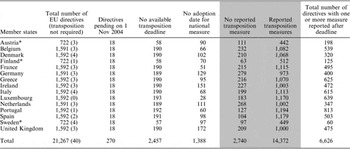
Our data include all reported national transposition measures in the fifteen ‘old’ EU member states for 1,592 directives.Footnote 43 The national transposition records vary significantly with respect to both the non-transposition of EU directives, as well as the number of transposition measures used and the timeliness of the transposed directives. If a member state has failed to notify the Commission on the national transposition measure, the entry ‘No Reference Available’ is displayed in the national implementing measures field of the CELEX database. Table 1 reports the transposition record of all fifteen member states between 1986 and 2002. Although the CELEX data may include a slight negative bias on the transposition records of the member states due to delayed entry into the data bank, Tables 1 and 2 confirm that we need not suspect a systematic bias across the countries or over time. Furthermore, in his study on compliance with EU transport policy, Kaeding finds that CELEX documents roughly 80 per cent of all national transposition measures for five countries.Footnote 44 This suggests that, even though there might be some shortcomings in the CELEX documentation, there is no reason to suspect a systematic bias of missing data.
EU Member States’ Response to EU Directives Between 1986 and 2002

Source: Original data extrapolated from CELEX Sector 7 (downloaded on 1 November 2004). The shaded region indicates the sampleunder study.
*For Austria, Finland and Sweden our data only includes directives enacted during the period of their membership, 1995–2002.
As shown in Table 1, the rate of transposition notification failure varies across the member states. Germany and the Netherlands appear to be the leaders in notification failure with respectively 279 and 268 non-transposed EU directives. At the other extreme, Sweden and Finland share a relatively good notification record with only 97 and 63 notification failures respectively. This result also corresponds to the Commission’s scoreboards where Sweden and Finland have the lead in effective implementation, while Germany and Italy lag behind. Table 1 also reveals the number of EU directives that were pending at the time when the data were last downloaded,Footnote 45 those lacking a recorded deadline in the CELEX database and those lacking a reported date for the national transposition measures.
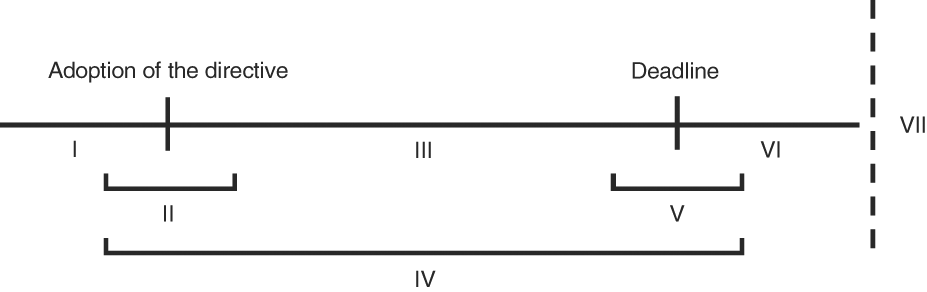
Member-state responses to EU directives also vary significantly with respect to the time taken for transposition. Most of the enacted EU directives specify a deadline by which the member states addressed must transpose the directive, and on average the stipulated deadline is set for two years after the date of adoption by the Council of Ministers.Footnote 46 We define a transposition measure as delayed if it was enacted after the year specified by the respective directive’s deadline.Footnote 47 Accordingly, we can count each individual national provision in the dataset as either delayed or transposed in a timely fashion. We then classified each country’s cumulative response to each directive (1 observation = country × directive) into one of either four primary or three mixed categories. The first primary category (I) refers to country transposition responses in which all national measures notified were enacted prior to the adoption of the respective directive. The second primary category (III) includes directives that were transposed by national measures adopted after the promulgation of the respective directive, but before the specified deadline. The third primary category (VI) includes all directives transposed after the specified deadline. Categories II, IV and V indicate national responses of a mixed nature; in other words, the measures notified fall into more than one primary category. Category VII is a special category including only those directives for which no reference of national transpositions measures was available in the CELEX database. We have chosen to analyse these cases separately rather than counting them with the decidedly late transposition cases in Category VI. Figure 1 provides a visual depiction of this classification.
Classification of directives according to their timeliness

This classification represents the complete picture of national transposition efforts as recorded in November 2004 and can easily be adapted in future analyses. Because national transposition responses may change their type over time, we note that early transposition may later be complemented with additional measures and fall into a mixed category. Thus, we expect some modification over time for selected cases; however, taking a positivist legalistic approach, in much the same fashion as the Commission does in the generation of the implementation scoreboards, we do not attempt to answer questions of completeness. This scheme allows us to refer to categories of transposition timeliness, rather than making the extreme assumption of transposition as measured by one single instrument (as would be the case in a duration analysis of compliance). Furthermore, by including cases of notification failure, we reduce bias in our sample of directives and national responses. Future studies may wish to modify this approach by considering the amount of transposition completed by each additional notified measure; however, this remains a difficult task within the bounds of a quantitative study on our scale.
We believe that this detailed classification scheme allows us to consider cross-national transposition patterns among the member states over a twenty-year period and across all policy sectors in a conveniently comparable fashion. The aggregate country data already reveal a few interesting findings: (1) most of the member states share a common transposition pattern with the majority of responses falling into Category III (on time) or VI (decidedly late), (2) Finland and Sweden have a relatively more efficient transposition record, and (3) Germany appears to lag in notification, but those measures that are notified are more frequently ‘on time’. Recalling that many detailed transposition and infringement studies focus on selected policy sectors, we may ask how Community directives and national transposition responses are distributed. Are the case studies on selected environmental directives representative of the greater body of Community legislation? More importantly, are the implementation patterns observed in sectors such as the environment, transport or social policy reflective of general transposition trends, or do these cases face a negative selection bias? In Tables 2 and 3, we return to our aggregate statistics on transposition timeliness and explore both inter-temporal and cross-sector differences.
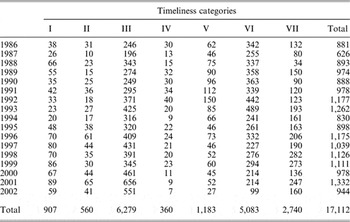
Annual Differences in Transposition Timeliness Across All Member States

Source: Original data extrapolated from CELEX Sector 7. Year refers to the documented publication date of the directive.
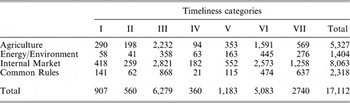
Sector Differences in Transposition Timeliness

Source: Original data extrapolated from CELEX Sector 7.
Table 2 displays annual changes in aggregate member-state transposition. The data are organized according to the publication year of the relevant Community directive. Most importantly, the table reveals that there is no obvious selection bias in the CELEX Sector 7 data. The instance of non-notification is moderately lower for earlier years, as would be expected given the collective nature of the transposition data. However, the aggregate data do not allow us to believe that transposition in either the earliest or most recent years is under-represented or poorly documented in CELEX. The percentage of notification failure is highest for the years 1998 and 1999. It is also interesting to note that the total proportion of national measures falling into Categories V and VI has fallen continuously from over 50 per cent in 1990 to roughly 13 per cent for directives since 2002. By contrast, the proportion of Community directives transposed with one or more previously existant national legislative measures (Categories I and II) remains fairly constant at between 5 and 10 per cent of all notified transposition cases.
Table 3 contains all national responses divided into four policy sectors as defined by the legal basis cited in each directive. The aggregate statistics reveal important patterns in cross-sector variance: first, we still observe a bimodal distribution peaking at Categories III and VI. We also see that environmental directives display a transposition record comparable to directives regulating the internal market, but less than 10 per cent of all national transposition responses are related to environmental directives.Footnote 48 Relative to the other policy areas, the transposition of agricultural directives appears to be timelier.
Because the distributions of national transposition activities are largely bimodal, we are faced with the question of how to classify the mixed national responses included in Categories II, IV and V. One alternative would be to classify the entire transposition process as timely, if any national measure was ‘on-time’, or passed prior to the transposition deadline. Conversely, we could count the country response as delayed if any national measure included in this response was passed after the transposition deadline. We opt for a trichotomous distinction between early responses, those on time and those clearly delayed; however, even this distinction is problematic for unavailable national responses (Category VII). Even though Category VII may only signify delayed transposition responses, we account for this notification failure separately to avoid biasing our estimates of transposition delay. Previous theoretical research on compliance with international regulatory regimes also leads us to believe that this defection, or failure to notify, may reflect a strategic choice on the part of the member states that is primarily guided by signals it receives about the nature of the directive and extent of conflict among other member states.Footnote 49
The tables and figures provided above confirm the presence of inter-temporal, cross-national and cross-sector variance in transposition. We find that the new members such as Finland, Sweden and, to some extent, Austria are countries with the most deviant transposition pattern, and that ignoring cases of failed notification (Category VII) or counting them to delayed transposition might markedly bias our findings. Most transposition activities are observed either after the promulgation of the respective directive, but before the specified deadline, or after the specified deadline. Cross-sector variation also exists, whereby most measures refer to regulation of the internal market, followed by agriculture, common rules and the environment. In the following section, we present potential explanatory factors for this variance before presenting our results.
Research design
Our analyses suggest that timely compliance consists not only of meeting a prescribed transposition deadline, but also of notifying national implementation measures. Rather than simply counting notification failures as cases of delayed transposition, we suggest that notification failure truncates the sample and, accordingly, the subpopulation of transposed directives is not equivalent to a sample chosen randomly from the greater population. By distinguishing between potential explanatory factors for notification failure and transposition delay, we attempt to avoid biasing our results by considering all notified transposition measures and by offering an account for sample truncation due to non-notification.
Our two-stage design asserts that the choice to notify national transposition measures reflects the redistributive potential of Community legislation. In contrast to the claim that most EC legislation is not of a redistributive nature and is hardly controversial among the member states, we approach this question from a quantitative perspective and control for changes in sector-specific conflict among the member states. Instead of reducing the decision for notification to a co-ordinated effort on the part of the member states, we investigate whether member states inherently have an incentive to defect, particularly in cases where this defection is most likely to remain unnoticed. Our selection model would predict non-notification of national transposition in those cases where defection is most likely not to be observed; that is, in cases where member state consensus is particularly small, the number of legislator actors is high and the procedure complex. The second stage considers the delay associated with notification as dependent on the national political arena and legal culture, in particular the number of notified measures (as a proxy for administrative culture), the share of primary legislation, the (federal) organization of the state etc.
Building on current implementation research, we suggest that a number of factors may be conceived as components of a unified two-stage strategic process rather than as exclusive and competing theories. Despite current enforcement mechanisms, member states have some leeway in their compliance strategies. Member states may promptly transpose and notify national measures, or they may hesitate and prolong the implementation process. Because compliance with EU legislation may entail quite different national costs and/or benefits depending on relative macro-specific and sector-specific member-state differences, we propose assuming that member states first evaluate external pressure to comply and that their subsequent transposition efforts are dependent on pressures and institutions within the national arena. In other words, our approach assumes that EU-level factors, including divergent preference constellations within the Council of Ministers and the number of other member states which have not notified transposition, constitute a co-operation problem and change the pressure for notification; whereas multiple (co-ordination) factors at the national level may lead to transposition delays.
Factors Influencing Notification
In the first stage, we suggest that member states decide on whether or not to proceed with national transposition efforts. When confronted with a new or modified directive, the member state may progress with the notification of relevant and related previous national instruments, begin the transposition process with the initiation of new legislation, or wait for the Commission and/or other member states to notice the defection. In our data, we distinguish between member-state transposition notification (1), regardless of delay, and member-state defections, or cases of failed notification (0).
Failed compliance is frequently attributed to institutional process factors at the EU level, such as the Council’s decision rule applied to the directive, the nature of the directive and the amount of time allocated for transposition.Footnote 50 In our view, these indicators express procedural conflict among the member states and between the Council, the Commission and the European Parliament at the EU level. To test this claim we extrapolate the legislative process and Council decision rule applied to each directive from the treaty reference in the cited legal basis.Footnote 51 These categorical variables indicate the number of EU institutional actors involved and the use of qualified majority voting in the Council.Footnote 52 We expect the involvement of the European Parliament or Council decisions to be indicators of more complex, controversial or influential directives.Footnote 53 Complexity has been shown to lead to implementation delays by draining domestic administrative resources. Thus, national implementing actors may bank on the delay of other member states and hesitate with notification of compliance. This hesitation gives implementing actors the opportunity to observe the reaction of other member states first and then to evaluate the best national implementation instrument.
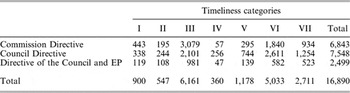
Table 4 illustrates how Council directives are transposed with relatively more delay than are other directives and, conversely, how Commission tertiary legislation (frequently providing only moderate revisions of earlier Community legislation) is transposed with less delay. The additional involvement of the European Parliament does not appear to influence national transposition delay; however, relatively speaking, failure to notify transposition of these directives is markedly higher. Franchino finds that the involvement of the European Parliament leads to a decline in national administrative discretion. This lack of national discretion may further contribute to domestic resistance to compliance.Footnote 54 Secondly, we note that the Commission prepares its own proposals for tertiary Community legislation and extensively discusses them in the preparatory stage (i.e. in Green and White Papers). This suggests that proposals prepared exclusively by the Commission may be less controversial among the member states and less complex, considering that they primarily modify existing legislation. We expect:
Transposition Timeliness According to EU Legislative Process

Source: Original data extrapolated from CELEX Sector 7.
HYPOTHESIS 1: The likelihood of notification decreases with the number of institutional actors involved in the EU legislative process.
Similarly, we expect that the Council’s decision rule applied to each directive is a decisive factor influencing member-state notification. Unanimity voting is used in policy areas protecting vital national interests, whereas qualified majority voting can lead to minority member-state interests being outvoted. Under unanimity voting, the interests of the national executive should be protected. Furthermore, in his study of delegation, Franchino finds that delegation to national administration is more likely under unanimity than under qualified majority voting and that the level of discretion given to national administrations is greater than under qualified majority voting.Footnote 55 Because we expect transposition to be eased by greater domestic discretion, we predict that:
HYPOTHESIS 2: The likelihood of notification increases when Council decision rules applied to the adoption of a directive are more demanding.
Returning again to issues of member-state willingness, we use sector-specific economic expectations. The economic factors are based on Eurostat statistics and the annual OECD Stan indicators. In accordance with Perkins and Neumayer,Footnote 56 we expect net EU receipts to provide one proxy for perceived economic benefit from EU membership. Increasing net funding may encourage notification by ‘buying’ regulatory compliance from beneficiaries.
HYPOTHESIS 3: The likelihood of notification increases with a relative increase in net EU receipts.
Recognizing the promising nature of an actor-centred approach, we also include a detailed preference measure for the European level. We use the data from the Manifesto research group to construct an indicator of conflict (size of core) based on statements made by national parties in their manifestos. This allows us to estimate sector-specific conflict varying across the countries and over time. As indicated in Appendix A, this procedure first assigns a mean national party government position across the four sectors of interest (agriculture, environment/energy, internal market and common rules), varying over the period of study with each change in office. This mean national party government position (unweighted by the number of legislative seats of each coalition party) is used to estimate the length of the EU core as the maximum ideological distance between negotiating member-state governments across each sector.Footnote 57 At the EU level we must consider two voting thresholds, one for unanimity and one for qualified majority voting in the Council of Ministers; however, for decisions passed under qualified majority voting the reference point must be carefully defined because amendments are passed unanimously. Thus, we feel that the maximum ideological distance between any two member-state government positions is a solid indicator of the EU core.Footnote 58
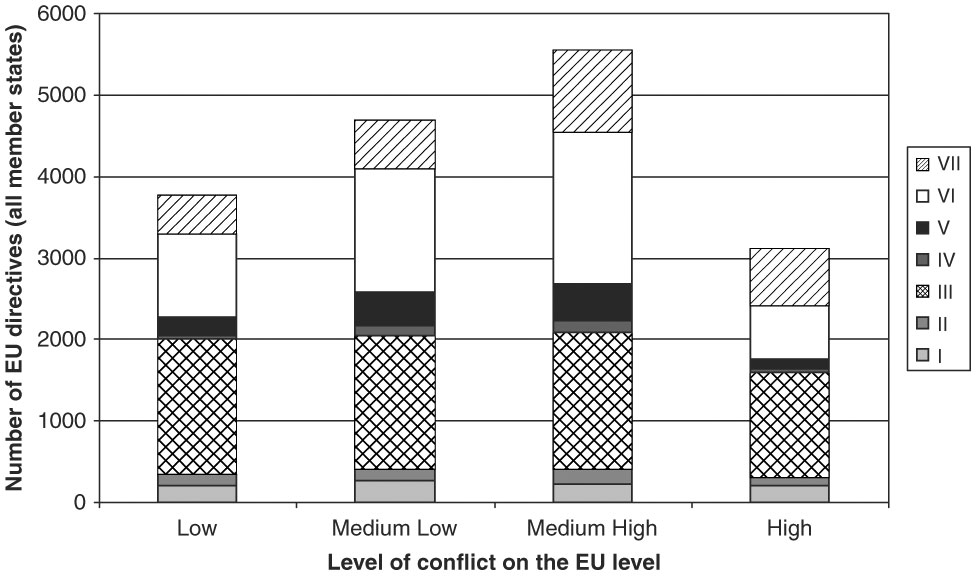
We expect that a larger EU core is indicative of greater potential controversy during the legislative process. The more conflict that existed at the time the directive was adopted, the more likely it is that the interests of some countries were compromised, in particular when qualified majority voting in the Council is applied.Footnote 59 However, as long as member states have different sector-specific preferences, these conflicts may vary across sectors and over time. If we graph national responses against the sector-specific EU core, as shown in Figure 2, we quickly see that the number of purely delayed responses (Category VI) increases moderately with EU conflict. We also see that the level of EU conflict does not affect other categories of national response. Most importantly, it appears that higher conflict is indeed correlated with a higher level of non-compliance (no transposition measures notified), although this trend may be non-linear. These observations lead us to expect that:
Number of transposed directives according to their timeliness (Categories I–VII) and level of EU conflictSource: Original data extrapolated from CELEX Sector 7.
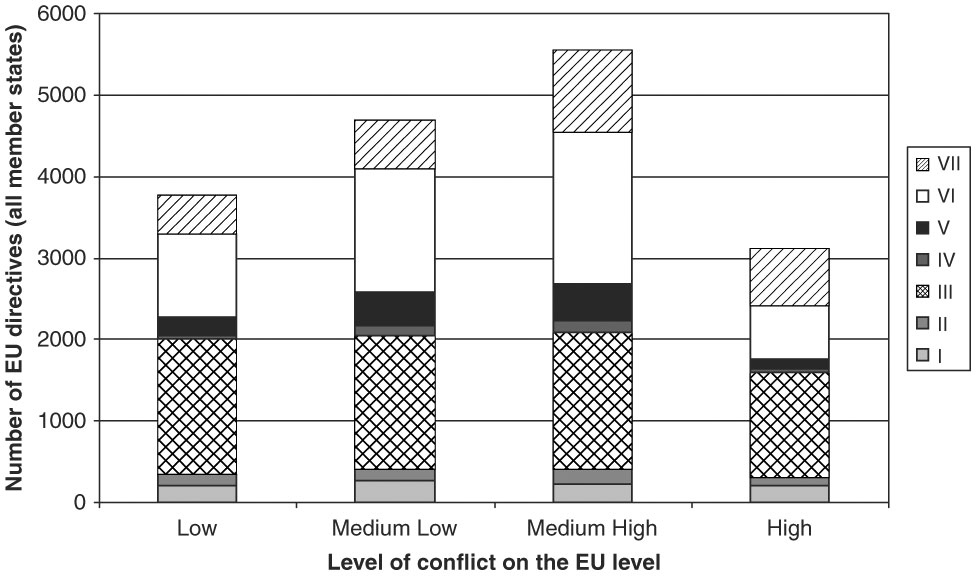
HYPOTHESIS 4: The likelihood of notification decreases with the severity of sector-specific conflict in the Council of Ministers.
Returning to a strategic view of transposition as a repeated Prisoner’s Dilemma, we expect member states to avoid compliance when the intergovernmental pressure to transpose is weak.Footnote 60 We suggest that member states may observe and take cues from the transposition activities of other member states. Because the transposition records are publicly available, member states should have (nearly) perfect information about the activities of others. When the majority of other member states resist prompt transposition, the pressure for compliance should decline. Conversely, when all other member states have transposed EU legislation promptly, the member state in question may feel pressured to notify a national measure and avoid or postpone infringement proceedings. Accordingly, we count the number of late member-state responses to each directive and predict that:
HYPOTHESIS 5: The likelihood of notification decreases with the number of member states not notifying transposition or notifying it after the deadline.
Finally, we control for the transposition efforts in the 1995 accession countries. Because we are particularly interested in post-notification transposition efforts, our data for Austria, Sweden and Finland only include directives passed after their accession. In keeping with current implementation research, we predict that because these member states were required to transpose a large body of Community legislation immediately before joining the European Union, the national notification processes may be particularly efficient. Rather than controlling for membership length, we control for individual country effects. The national notification records further justify this approach: we recall that Finland had an especially strong notification record.
Factors Influencing Transposition Delay
We view transposition response time as the second stage in the national implementation process. After a member state concedes to co-operation with Community legislation, we contend that the national arena influences the pace of the transposition process. Recalling that the national transposition records are bi-modally distributed, peaking at Categories III and VI, we have elected to summarize transposition activities in three groups: ‘(0) Early’ includes Categories I and II, ‘(1) On-Time’ represents Category III, and ‘(2) Late’ refers to Categories IV–VI. In the following, we consider institutionally, preference and economy driven domestic explanations for timely and delayed transposition.
Focusing on the influence of EU institutions and decisions on national policy and political structures, proponents of the ‘goodness-of-fit’ literature contend that implementation is eased the more closely EU policies resemble or correspond to existing national policy.Footnote 61 The empirical investigation of this theory has traditionally been restricted to case studies because of the difficulty associated with measuring compatibility between EU legislation and existing national policies and structures. Measuring ‘fit’ in policy-goal terms is difficult in a large-N sample; however, we return to Mastenbroek’s consideration of complexity at the directive level and employ the number of notified national instruments as an indicator for increased administrative implementing activity and national administrative culture.Footnote 62 This indicator does not capture discrepancies between the EU policy goal and the domestic status quo, but it is related to national political, legal and administrative culture. From a quantitative perspective, this indicator reveals insights in the interaction between the policy-specific demands of a directive and the national administrative tradition of transposing EC law. The implicit assumption here is that formulating multiple transposition measures requires greater bureaucratic co-ordination and more time. Thus, the logic of limited ministerial capacity leads us to expect:
HYPOTHESIS 6: The timing of transposition is increasingly delayed with the number of national measures required for adequate implementation.
A second branch of literature indicates that domestic opposition to a directive among decisive domestic actors contributes to transposition delays and non-compliance.Footnote 63 Steunenberg modelled the transposition process as a co-ordination game between different actors at two hierarchical levels.Footnote 64 His work emphasizes that the context in which directives are transposed may vary greatly from national law making and that national co-ordination of this process can have an impact on transposition progress. This policy-specific approach leads us to expect, that when more actors are involved at a given horizontal level, the legislative process will be more difficult.Footnote 65 Hence, the type of national legal instrument used appears to be a crucial element in explaining transposition delay. We would also expect parliamentary involvement to increase transposition delay,Footnote 66 due to the length of the legislative process and inclusion of several domestic veto players.
HYPOTHESIS 7: The timing of transposition is increasingly delayed with the addition of national parliamentary involvement.
We also recall that national structures of interest representation, most notably the degree of corporatism, have been shown to affect national transposition efforts.Footnote 67 Bureaucratic oversight, or the centralization of implementing authority, can either hinder or facilitate efficient implementation depending on the degree of co-operation with national interest groups. Federalist state structures, or the degree of centralized national legislative authority, similarly affect bureaucratic co-ordination and transposition efforts.Footnote 68 Building on these studies, we include two indices from Lijphart on federalism and interest-group involvement.Footnote 69 We predict that the incorporation of more domestic actors in the transposition process, as is required in federalist and pluralist systems, should increase transposition delays.
HYPOTHESIS 8: The timing of transposition is increasingly delayed in federalist systems.
HYPOTHESIS 9: The timing of transposition is increasingly delayed in pluralist systems.
The empirical work by Mbaye and by Giuliani reminds us of the importance of an actor-centred approach, showing that the number of domestic veto players is inversely correlated with national compliance records.Footnote 70 Their work suggests that an increase in the ideological distance between decisive institutional actors contributes to an increase in transposition delay. We propose more detailed indicators for policy-specific preferences revealing greater variance across national actors over time. We estimate the level of national conflict as the maximum ideological distance between any two parties seated in the national parliament across each sector. The party positions are extrapolated from the party manifestos as described in Appendix A. In the interest of simplicity, we have elected to use preferences unweighted by the distribution of seats in the national parliament. Critics may be concerned with our consideration of non-coalition parties; however, the passage of primary legislation requires a parliamentary majority in most member states (including bicameral systems), and even non-coalition parties often have the right to convene hearings, to mobilize interest groups and the public against a quick transposition of the directive. Although we note that this relationship may be non-linear, veto player theory leads us to expect our national level picture to mirror our predictions for the EU level: In other words,
HYPOTHESIS 10: The timing of transposition is increasingly delayed with the severity of sector-specific partisan conflict at the domestic level.
Referring again to the importance of economic benefits from EU membership in ‘buying’ domestic compliance,Footnote 71 we are interested in sector-specific indicators of domestic economic evolution. Rather than relying on aggregate measures of intra-EU trade dependency or member-state administrative resources, we refer to sector-specific value-added shares as an indication of the relative importance of the policy area for the national economy. We expect the central economic sectors of a domestic economy to be more tightly regulated, have increased interest-group representation and be more resilient to policy change. Because existing national legislation may be more difficult to reform in compliance with new EU legislation, we predict that:
HYPOTHESIS 11: The timing of transposition is increasingly delayed in policy sectors having higher domestic value-added shares.
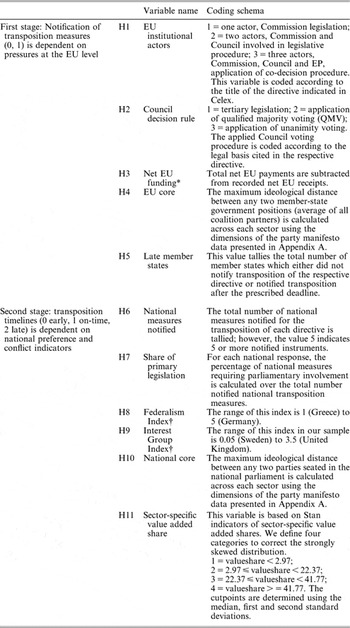
Summarizing the logic of our two-stage model, we include the coding of our variables in Table 5.
Definition of Variables

*Based on data provided by Eurostat (2004).
† Index and scale are taken from Arendt Lijphart, Patterns of Democracy: Government Form and Performance in Thirty-six Countries (New Haven, Conn.: Yale University Press, 1999), p. 313.
Finally, we predict that some country specific variance may not be adequately captured in our explanatory variables; therefore, we control for country effects using dummies for the twelve ‘older’ member states. Although our list is by no means complete, we suggest that factors at the European level contribute to increased notification whereas national-level factors influence transposition timeliness. Our goal is to evaluate the relative impact of each factor for notification failure and transposition delay, providing a test across policy sectors and over time that includes transposition activities in all member states.
Analysis of an ordered probit model with sample selection
We are interested in national transposition patterns, yet the choice to defect, or not notify national measures, truncates our sample. Some previous studies have opted for duration analysis, which by definition requires the identification of one transposition date.Footnote 72 Because we wish to consider the entire sample of national transposing measures rather than limit our sample to the first or last-mentioned measure or to any particular type of instrument, we refer to our previously defined categorization of national transposition efforts. Here we have identified national transposition responses as early, on time or late, whereby we also find a number of cases of notification failure (no reported measure).Footnote 73 If we were to ignore the cases of member-state defection, or notification failure, or count them as delayed efforts, we would risk a severe estimation bias because the sub-population of transposed directives is most likely not randomly chosen. Our comparisons with the monthly Commission bulletin reports on enforcement proceedings confirmed that these cases are frequently acknowledged in formal letters of notice and reasoned opinions as member-state notification failures. Disregarding these selection problems would lead to incorrect inferences, and therefore we turn to the logic of a Heckman sample selection model.Footnote 74
Selection models accounting for truncated data are increasingly accepted by political scientists.Footnote 75 Yet we are warned that sample selection models must be theory driven, adequately specified and tested on a sufficiently large sample.Footnote 76 In our application, we are interested in the national transposition of 1,591 directives (where applicable) in fifteen member states. This yields a sample of 17,431 observations (country × directives) in the first (notification) stage and 14,372 in the second (transposition) stage. In the specification of our model, we have avoided including the same variables in both estimation stages. Although some factors may contribute to both notification failure and transposition delay, we view EU level factors as decisive for transposition activity and the national arena for transposition timeliness. Furthermore, because our dependent variable in the second stage is a trichotomously ordered categorical variable (see our classification of national response above on p. 19), a standard Heckman selection model would be biased and inconsistent. We have chosen an ordered probit model with sample selection to accommodate our consideration of all notified national transposition measures as well as the possibility for notification failure.
Accordingly, the selection equation employs a probit estimator and may be written as: Footnote 77

where notificationi* is assumed to be a latent continuous dependent variable and α′ denotes the vector of independent variables in the first stage.Footnote 78 In Equation
(1), zi denotes the vector of coefficients to be estimated, and μi represents the error term for the selection equation. The observed dependent variable of the probit sample selection equation may be written as:

The specification equation, or second stage of the ordered probit model with sample selection, is defined as:

where delayi* represents the latent continuous dependent variable, β′xi denotes the vector of exogenous variables, and εi represents the error term for the specification equation. We note that:

The observed dependent variable of the specification equation is written:

The sample selection model assumes that

If sample selection occurs, the error terms μi and εi are correlated and the correlation term ρ is not equal to zero:

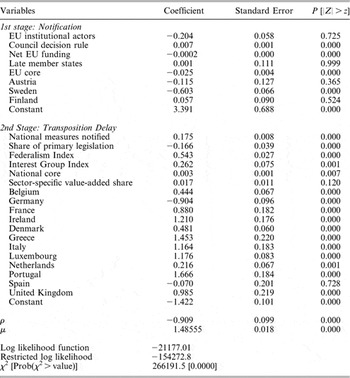
Table 6 presents the results of this model. The test statistics reveal that both the likelihood ratio test in the first stage and the Wald test on the entire model are highly significant: we therefore reject the null-hypothesis that all coefficients are jointly equal to 0. We also note that the estimation errors in the first stage are correlated with those in the second stage: ρ is negative and differs significantly from 0. Furthermore, the χ 2 statistic, describing the fit for the first stage, is highly significant. According to these results and considering the large number of observations included in our sample, we may be confident that a Heckman model provides an efficient and unbiased estimator for our theoretical model.
Results from Ordered Probit Regression with Sample Selection

Note: All calculations were conducted using LIMDEP 8.0, software developed by William Greene. The algorithm used to obtain the maximum likelihood estimates is BFGS (Greene, LIMDEP Version 8.0 Econometric Modelling Guide, p. E18-5).
Most of the estimated coefficients in our two-stage model support our theoretical claims. In keeping with the findings of Franchino, Giuliani and Mastenbroek,Footnote 79 procedural conflict at the EU level influences implementation. In the first stage, we see that an increase in the EU member-state core reduces the likelihood for notification. This supports our view on the redistributive potential and controversial nature of Community legislation and is in keeping with previous empirical results.Footnote 80 As expected, an increase in the use of unanimity voting in the Council appears to mildly increase national transposition activities.Footnote 81 Contrary to Perkins and Neumayer, we find modest evidence that the likelihood of notification failure minimally increases with a relative increase in net EU receipts.Footnote 82 In contrast to the binomial probit results on member-state notification, the first stage of the ordered probit model with sample selection fails to support our claims concerning the effects of compliance pressure from other member states and the number of institutional actors involved.Footnote 83 The country dummy coefficients do not provide evidence for the claim that the three 1995 accession countries Austria, Finland and Sweden are particularly conscientious in their notification efforts.
In the second stage, our results suggest that the number of national transposition measures significantly contributes to transposition delay, which provides evidence for the complexity hypothesis presented by Mastenbroek.Footnote 84 As predicted by Steunenberg’s research, the data also reveal that although the national parliaments are rarely involved in the transposition process, relatively speaking the more the parliament is involved, the more delay is associated with the transposition process.Footnote 85 In accordance with Mbaye and with Giuliani, the modest but positive coefficient on national conflict also comes as little surprise, because we would expect more national conflict to lead to more delay.Footnote 86 We have also evaluated conflict among government coalition parties, but our findings reveal that the lack of coalition governments in Britain, Greece, Spain and Portugal result in an insignificant indicator of national level sector-specific conflict. We therefore opt to retain the maximum distance between parties represented in the national parliament as an indicator of policy sector conflict because the transposition process involves both parliamentary and bureaucratic actors, which may give oppositional parties the opportunity to delay domestic compliance. Lijphart’s federalism and interest group pluralism indices are also significant and positively correlated with delay.Footnote 87 This confirms Jensen’s findings and supports our hypotheses that more federalist and pluralist systems might suffer from slower transposition processes.Footnote 88 We find that the sector-specific value-added shares do not adequately explain variance in transposition delays; however, we acknowledge that this indicator may not sufficiently reflect sector differences in national regulation.Footnote 89 The country dummies reveal that for the measures notified, Germany has a particularly efficient transposition record; whereas Portugal, Greece and (to a lesser extent) Ireland, Luxembourg and Italy are notably later in complying with EU law.Footnote 90
In terms of overall prediction success, the selection model has a sensitivity of 93 per cent indicating that factors at the EU level are solid predictors of transposition notification.Footnote 91 Our two-stage selection model is better at predicting timely and delayed transposition than cases of non-notification; however, this comes as little surprise. The predictive error is particularly high for cases of transposition in Categories I and II, which list national measures passed before publication of the directive. This may be attributed to our research design, which includes the measurement of ex post effects that poorly explain earlier national legislative choice. Still, EU level factors almost perfectly predict the choice to notify national transposition measures and roughly half of the cases of non-notification. Our results also reveal that national level factors correctly predict both timely and delayed transposition in the majority of observations.Footnote 92
Discussion
This study sheds light on transposition patterns in fifteen member states using a cross-sector quantitative perspective over time. While most previous implementation research relies on either indirect measures or selected case studies, we believe that this approach can assist existing transposition case studies and studies on infringement proceedings in assessing the reliability of their findings and providing information on possible sources of selection bias, such as the policy area, the period or country of study. This does not mean that our legalistic quantitative approach is entirely free from selection bias. Accordingly, we have also tried to outline the pros and cons of large-N empirical analyses of timely transposition. Although we find a strong relationship between Commission behaviour in infringement proceedings and our data on non-transposition, we believe that major methodological problems concern the classification of whether a member state has correctly transposed a directive in a timely fashion, and the comparability of the measures employed in the different countries and sectors.
More generally, our analysis suggests distinguishing between factors at the EU and domestic level. While conflict at the EU level is responsible for notification failure, domestic costs determine the timely transposition of directives. We also propose considering all notification measures, because one can hardly identify the principal measure responsible for correct and timely transposition, nor can we rely only on measures of primary legislation. Secondary instruments have a binding and enforceable quality in many countries and, in some cases, primary legislation provides only the preparation for using secondary transposition measures. We also argue that there is a high risk of arriving at biased conclusions when the sample of countries or sectors is reduced. Even countries like Sweden and Finland, which might be classified as advantaged by their late accession, have disparate transposition records. This may support the claim of Falkner et al. that systematic differences occur between member states due to normative views on handling international obligations.Footnote 93 At the same time, we find differences in transposition between the environmental and agricultural sectors. These differences also require sector-specific explanatory indictors, particularly with regard to the preferences of the actors involved.
In addition to these more general insights, the quantitative analysis confirms the following hypotheses on notification: notification becomes more likely with a decrease in sector-specific conflict among member states (Hypothesis 4). The Council decision rule (Hypothesis 2) and the expected gains (Hypothesis 3) also remain significant, but the sign of the small coefficient on net EU funding does not support the anticipated effect. The number of other member states notifying after the deadline (Hypothesis 5) and the number of institutional actors involved in EU decision making are insignificant for notification failure. The results also provide insight into the reasons for transposition delay. Hypotheses on complexity, as expressed by the number of national transposing measures (Hypothesis 6), the number of bureaucrats involved (Hypothesis 8), and the number of interest group actors involved (Hypothesis 9), and on national conflict (Hypothesis 10) are confirmed, while sector-specific value-added shares (Hypothesis 11) are insignificant. The hypothesis on parliamentary involvement (Hypothesis 7) is also not confirmed in this analysis: a higher share of primary legislation in national transposition does not contribute to increased compliance delays.
These results also reveal significant variation in transposition across countries. Sweden as well as Germany, Portugal, Greece, Luxembourg, Ireland and Italy appear to have the most deviant transposition pattern in terms of notification failure (in the former case, Sweden is less likely to notify) and more delayed transposition (in the later cases); in all member states the national transposition response most frequently falls in the categories on time (Hypothesis III) and after the deadline (Hypothesis VI). We find limited evidence for the theory that most EU legislation consolidates existing national law. Cross-sector differences are also visible, making generalizations about transposition timeliness based on sector-specific data potentially problematic: most transposition efforts are related to the regulation of the internal market, followed by agriculture, common rules and environment. It appears that the application of the unanimity rule may mildly encourage compliance through the protection of member states’ national interests. An increase in EU conflict appears to make notification failure more likely. We also find that national patterns of transposition timeliness vary significantly, and that higher levels of domestic conflict and less parliamentary involvement contribute to increased transposition delays. This may indicate that timely transposition is strategically motivated, and that member states avoid prompt compliance when the cumulative supranational pressure is low and/or when national audience costs are high.
Our quantitative results on transposition failure and delay are based on a view that considers only whether and when national transposition measures were notified. While a more accurate evaluation of correct compliance is certainly needed in future research, we have gone to great lengths to confirm the validity of our data source and the reliability of our analysis.Footnote 94 A more detailed evaluation of completeness is an ambitious task because much expertise is required to understand the often complex nature of textual provisions in directives and their implementation in domestic law. In some sense, this complexity seems to make a quantitative study on correct implementation almost impossible. However, our preference indicators suggest that member state and inter-institutional conflict – which is often related to particular issues of directivesFootnote 95 – affects transposition activities. Using this information on controversial issues, future research could solve this problem by reducing the directives’ complexity on this set of issues and examining whether member states correctly implement the compromise solution, or whether the distance between the member-state position and the outcome helps to explain non-compliance or the use of executive instruments for implementation. In this line of future research, the results of our study may also be useful in identifying a sample of representative directives that can be examined more closely with regard to member-state implementation records and the use of specific national instruments.
Appendix A: Coding of domestic and European sector-specific conflict as based on party manifesto data

Sources: For documentation of the data on party preferences, see Ian Budge, Hans-Dieter Klingemann, Andrea Volkens, Judit Bara and Eric Tanenbaum, Mapping Policy Preferences: Estimates for Parties, Electors and Governments 1945–1998 (Oxford: Oxford University Press, 2001). We have grouped selected items into four major policy areas and calculate core estimates across these policy areas, see Thomas König, ‘Controlling the Guardian’ (paper prepared for the Annual Meeting of the Midwest Political Science Association, 2005); Thomas König, Brooke Luetgert and Tanja Dannwolf, ‘Quantifying European Legislative Research: Using CELEX and PRELEX in EU Legislative Studies’, European Union Politics, 7 (2006), 553–74. Because of different document lengths, the number of (quasi-) sentences in each category is standardized taking the total number of (quasi-) sentences in the respective documents as a base. In the dataset, each of these categories is a variable that represents the percentage.
Appendix B: Descriptive statistics