

Over the last 40 years, Democrats and Republicans increasingly express negative feelings toward the opposing major party (Iyengar, Sood and Lelkes Reference Iyengar, Sood and Lelkes2012; Mason Reference Mason2015). This apparent loathing for out-group partisans can bleed into non-political judgments and behaviors (Iyengar and Westwood Reference Iyengar and Westwood2015) and as such is interpreted as harmful to civil society (Mason Reference Mason2018). Furthermore, disdain for the other side is typically thought of as an inevitable outgrowth of partisan identities (Iyengar et al. Reference Iyengar, Lelkes, Levendusky, Malhotra and Westwood2019). Thus, Democrats’ and Republicans’ spite for each other seems to be an unavoidable cost of partisanship’s centrality to political life.
While this interpretation of the evidence is deeply troubling, it is also overstated. The most commonly used metric of dislike toward out-group partisans, a 101-point scale that asks people to mark their feelings toward the Democratic and Republican Parties, measures attitudes toward political parties and their leaders rather than ordinary people belonging to the parties. Because many people have extremely negative views of the opposing party and the politicians who lead them, this measure greatly exaggerates the extent to which people dislike ordinary people on the other side.
Using a survey that posed the feeling thermometer question in reference to the opposing party, ordinary people belonging to the opposing party, and politicians belonging to the opposing party, I find that Democrats’ thermometer scores toward ordinary Republicans are on average 28% higher than their scores toward Republican politicians and 25% higher than their scores toward the Republican Party. Using the same items, I find that Republicans’ thermometer scores toward ordinary Democrats are on average 49% higher than their scores toward Democratic politicians and 43% higher than their scores toward the Democratic Party. These results demonstrate a need to distinguish between evaluations of elites and ordinary citizens analytically and suggest that much previous research overestimates the degree to which partisans dislike ordinary people in the opposing party.
I replicate findings from Druckman and Levendusky (Reference Druckman and Levendusky2019) in this study. Footnote 1 However, there is an important variation in the design used here. I use a within-subject design rather than a between-subjects design, which means each respondent in my study was able to draw direct comparisons between their attitudes toward the parties, politicians, and ordinary partisans. Each respondent in Druckman and Levendusky’s study, by contrast, rated either the parties, politicians, or party voters.
Within-subject designs confer two major advantages when testing hypotheses about the effect of some treatment. First, within-subject designs effectively double sample size compared to between-subjects designs, because each comparison is made between two responses given by the same survey respondent instead of between two respondents. This substantially increases statistical power. In my sample of 1,000 respondents, there were 399 Republicans. Even when conducting analyses on this relatively small sub-sample, statistical power is above 0.95 given a small effect (Cohen’s d = 0.2). Second, in between-subjects studies in political science, imbalances across treatment groups on a host of political variables (e.g., partisan identity strength, ideology, and political interest) can potentially confound findings in addition to imbalances on demographic variables (e.g., race, sex, and age). It would take a very large respondent pool to ensure balance across treatment groups on all plausible confounding variables in a between-subjects design, but within-subject designs inherently control for potential confounds so long as those characteristics do not vary within a single person over the course of the experiment. Because of this feature, we can be more confident that observed differences across conditions are caused by the conditions themselves.
Given these major advantages of using within-subject experiments, why are they not used more frequently? There are two serious potential threats to drawing valid inferences about treatment effects based on within-subject differences. First, when performing paired sample t-tests, one key assumption is that the differences between conditions are normally distributed. In these data, all of the differences are non-normal, breaking this assumption. However, to correct for this, I use bootstrapped estimates, discussed in greater detail in Results and the online Appendix. Another potential threat to inference is the possibility of “learning” causing observed differences across conditions rather than real differences in responses to different stimuli. In this case, learning could entail respondents anchoring their responses to thermometer items based on their responses to previous thermometer items. However, I randomized question order to ensure that learning does not drive the main results. Thus, though there are potential threats to inference when using within-subject experiments, they can often be addressed through good design and appropriate analyses as they are here.
Affective Polarization: Dislike of Whom?
In the original article on the topic, Iyengar, Sood and Lelkes (Reference Iyengar, Sood and Lelkes2012) define affective polarization as Democrats and Republicans disliking each other, theorizing that partisan identities automatically trigger this antipathy toward the out-group. Since this article, several scholars have begun to uncover the origins and consequences of affective polarization in more detail (see Iyengar et al. Reference Iyengar, Lelkes, Levendusky, Malhotra and Westwood2019 for a complete review). In this burgeoning literature, a 101-point thermometer scale asking respondents how they feel about the Republican and Democratic Parties is the workhorse measure of affective polarization. Often, partisans’ feelings toward the out-group party are subtracted from their feelings toward their own party (Iyengar, Sood and Lelkes Reference Iyengar, Sood and Lelkes2012; Mason Reference Mason2015; Mason Reference Mason2018; Lelkes and Westwood Reference Lelkes and Westwood2017), but raw thermometer scores toward the out-group party are also frequently used (Ahler and Sood Reference Ahler and Sood2018; Levendusky and Malhotra Reference Levendusky and Malhotra2016; Webster and Abramowitz Reference Webster and Abramowitz2017).
However, this item is ambiguous. Asking partisans for their attitudes toward the Democratic and Republican Parties likely measures partisans’ attitudes toward politicians belonging to the party, rather than ordinary people belonging to the party, because many people have politicians “at the top of their head” when answering this survey question (Zaller and Feldman Reference Zaller and Feldman1992). This is especially likely when survey respondents are answering this question in the context of the American National Elections Studies (ANES) or other surveys fielded by political scientists, which often ask a multitude of questions about politicians. Thus, there should be no difference between partisans’ feelings toward the opposing party and politicians in the opposing party (H1). But because there is a high degree of antipathy toward the parties and politicians (Klar and Krupnikov Reference Klar and Krupnikov2016), in expectation partisans should have more positive feelings toward ordinary people belonging to the opposing party than they do toward politicians in the opposing party (H2) and the opposing party itself (H3). If these second and third hypotheses are right, it means that ordinary partisans’ disdain for each other is more muted than much previous research claims.
Methods
To evaluate these hypotheses, I fielded a survey on Lucid in April 2019. This yielded a sample that was nationally representative with regard to race, ethnicity, sex, age, and region. Footnote 2 This demographic information, along with political partisanship, was collected in my survey as embedded data from Lucid.
In this study, I am interested in partisans’ feelings toward the opposing “party,” “politicians” in the opposing party, and “ordinary people” belonging to the opposing party. As such, I exclude true Independents. Because there may be key differences in Democrats’ and Republicans’ evaluations of the other side, I analyze Democrats and Republicans separately, including party leaners in each group. Footnote 3 This yields a sample of 460 Democrats and 399 Republicans.
To measure partisans’ feelings toward the opposing party, politicians in the opposing party, and ordinary people belonging to the opposing party, I used three versions of the feeling thermometer scale. I first asked respondents to place the “Democratic Party” and the “Republican Party” on a sliding scale from 0 to 100. This version of the question closely resembles an item that has been on the ANES for years and used frequently in past studies. I placed this item first to ensure it is free from anchoring effects across the three thermometer items, providing a baseline for comparison. After answering this item, respondents answered the following two items to assess their feelings toward politicians and ordinary people belonging to each party, respectively. These items were displayed in random order after the first thermometer question:
Now we would like to get your feelings toward politicians in the two major parties. How do you feel toward…
Democratic politicians?
Republican politicians?
Now we would like to get your feelings toward ordinary members of the two major parties. By ordinary members of the parties, we mean people in the mass public who would call themselves Democrats or Republicans, NOT politicians. How do you feel toward…
ordinary members of the Democratic Party?
ordinary members of the Republican Party?
To assess the hypotheses, I compare scores across the three thermometer questions. Because affective polarization is defined as dislike toward the political out-group, I compare Democrats’ scores toward Republicans and Republicans’ scores toward Democrats, showing mean within-subject differences. However, it is plausible that the order in which the thermometer items are presented changes how people compare these groups to each other. In particular, it seems likely that asking respondents to evaluate in the order party → politicians → ordinary partisans leads to significantly better evaluations of ordinary partisans compared to the other groups than asking in the order party → ordinary partisans → politicians, because in the former order evaluations of ordinary partisans come after evaluations of two groups which I expect respondents to strongly dislike. Put another way, there is a greater chance of a contrast effect if respondents are asked to evaluate both the party and politicians before ordinary partisans. I therefore break apart results for each of these orders below, in addition to presenting overall within-subject differences.
Results
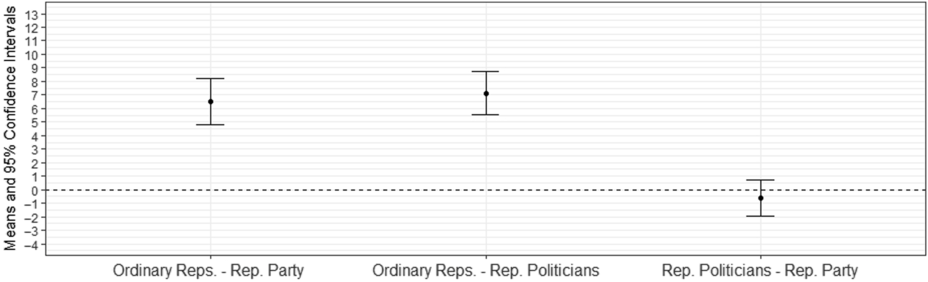
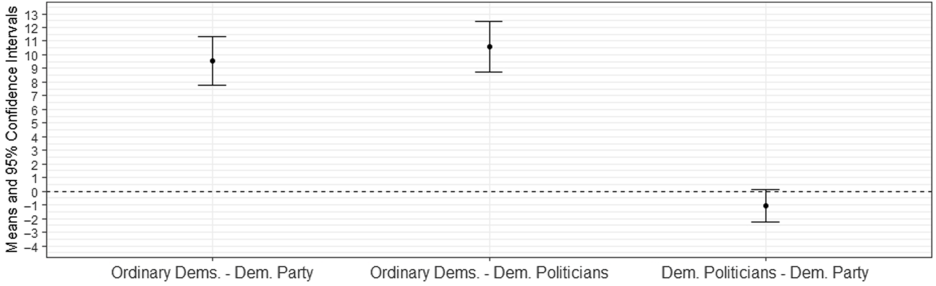
Results demonstrate support for the hypothesis that feelings toward the opposing party are no different than feelings toward politicians in the opposing party. Figure 1 shows that the mean difference in feeling thermometer scores toward the Republican Party and Republican politicians among Democrats is not statistically distinguishable from zero, while Figure 2 shows that there is no statistically significant difference between Republicans’ thermometer scores toward the Democratic Party and Democratic politicians.
Within-subject Differences in Democrats’ Feeling Thermometer Scores in Reference to the Republican Party, Ordinary Republicans, and Republican Politicians.

Within-subject Differences in Republicans’ Feeling Thermometer Scores in Reference to the Democratic Party, Ordinary Democrats, and Democratic Politicians.

These data also demonstrate support for the hypotheses that partisans’ feelings toward ordinary people belonging to the opposing party are more positive than their feelings toward politicians in the opposing party (H2) and the opposing party itself (H3). Democrats’ feeling thermometer scores toward ordinary Republicans are on average 6.5 points higher than their scores toward Republican politicians and 7.1 points higher than their scores toward the Republican Party. These raw average differences correspond to thermometer scores toward ordinary Republicans that are 28% higher than toward Republican politicians and 25% higher than toward the Republican Party, on average. For Republicans, the results are even more dramatic, because Republicans’ feelings toward Democratic politicians and the party are especially negative compared to the corresponding feelings of Democrats toward Republican politicians and the party. Footnote 4 Republicans’ feeling thermometer scores toward ordinary Democrats are on average 9.6 points higher than their scores toward Democratic politicians and 10.6 points higher than their scores toward the Democratic Party. These raw differences correspond to thermometer scores toward ordinary Democrats that are 49% higher than scores toward Democratic politicians and 43% higher than scores toward the Democratic Party, on average. Running paired sample t-tests, each of these results is statistically significant at conventional levels (p < 0.05).
However, paired sample t-tests assume that differences across conditions are normally distributed, an assumption that is not met for any of the differences across thermometer items discussed above. To assuage concerns that this is driving results, I also use a bootstrapping procedure to estimate the differences across conditions and 95% confidence intervals. The results from this process are very similar to those presented here, and none of the main findings change when using bootstrapped estimates. Footnote 5
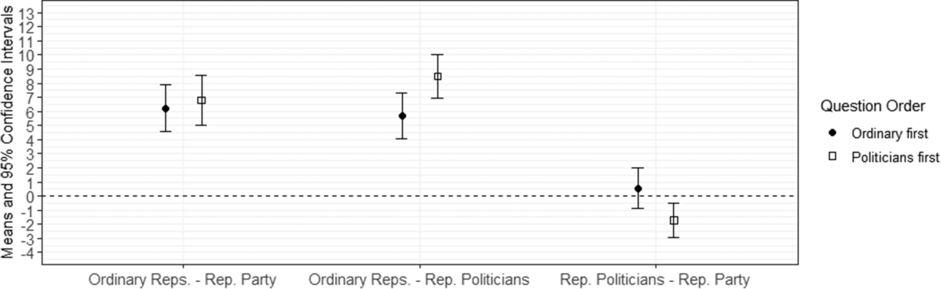
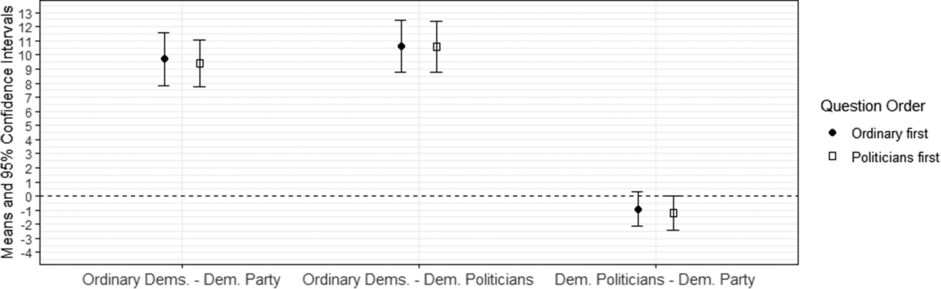
Moreover, Figures 3 and 4 show that these differences are consistent regardless of whether respondents answered the thermometer item in reference to politicians or ordinary partisans first. Though there are slight differences depending on order among Democrats, none of them are significant at the 0.05 level. In this case, these null results are substantively interesting. That the degree of contrast between evaluations of ordinary members of the opposing party and the other two reference groups does not change depending on question order demonstrates that asking about the party and politicians does not administer a stronger dose of negativity than asking about the party alone. This provides even greater evidence that partisans think of out-group politicians when they are asked to evaluate the out-group party.
Within-subject Differences in Democrats’ Feeling Thermometer Scores in Reference to the Republican Party, Ordinary Republicans, and Republican Politicians Dependent on Question Order.

Within-subject Differences in Republicans’ Feeling Thermometer Scores in Reference to the Democratic Party, Ordinary Democrats, and Democratic Politicians Dependent on Question Order.

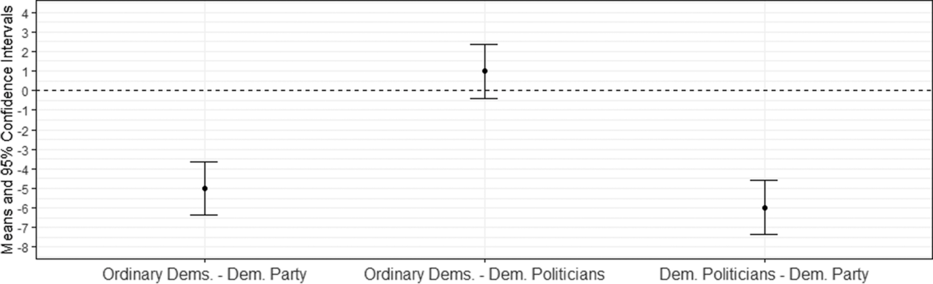
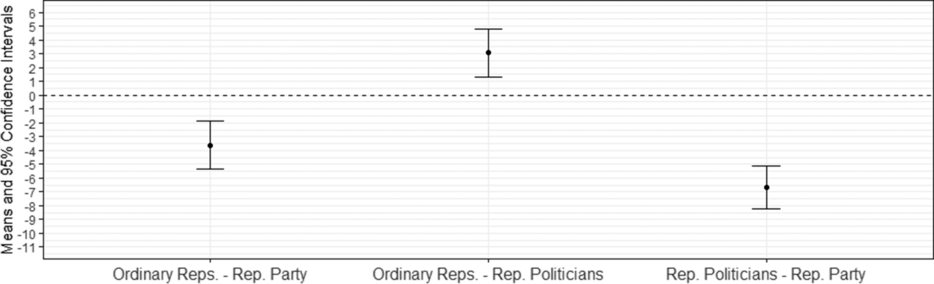
Finally, although I drafted my hypotheses based on the notion that people simply dislike the two major parties and their politicians to an extreme degree compared to ordinary partisans, an examination of respondents’ ratings of their own party reveals greater complexity. When it comes to their own party, Democrats evaluated Democratic politicians and ordinary Democrats significantly lower than the party itself, while there was no significant difference between evaluations of politicians and ordinary partisans. Republicans also evaluated their own politicians and ordinary partisans significantly lower than the party itself but evaluated ordinary Republicans higher than Republican politicians. These relationships are shown in Figures 5 and 6.
Within-subject Differences in Democrats’ Feeling Thermometer Scores in Reference to the Democratic Party, Ordinary Democrats, and Democratic Politicians.

Within-subject Differences in Republicans’ Feeling Thermometer Scores in Reference to the Republican Party, Ordinary Republicans, and Republican Politicians.

I believe these low ratings of fellow partisans relative to the party itself might be related to how survey respondents interpret the phrase “ordinary members of the two major parties.” When it comes to their in-group, they may have a preference for the party itself because they perceive ordinary partisans to somehow be different from themselves in a way that negatively impacts their evaluations of those people. Footnote 6
Discussion
As hypothesized, there is evidence that partisans have more positive feelings toward ordinary citizens in the opposing party than they do toward politicians in the opposing party and the opposing party itself. Moreover, that there is little difference between partisans’ thermometer scores toward the “Party” and toward politicians in the party suggests that when survey respondents confront the feeling thermometer question in reference to the Democratic and Republican Parties, they view this as asking about party elites rather than ordinary partisans.
These findings replicate the main results from Druckman and Levendusky (Reference Druckman and Levendusky2019) using a high-powered, within-subject design. This should give us more certainty that partisans evaluate ordinary members of the opposing party more positively than opposing party politicians and the opposing party itself, and especially bolsters the null finding of no difference between evaluations of the opposing party and its politicians. Even if there was a small difference in evaluations between these two groups, I would expect to find it in my study.
However, the results found here go beyond those presented by Druckman and Levendusky in one crucial respect. I found that while partisans prefer ordinary people in the out-group party to the party itself, these preferences are reversed for their own party, such that they actually prefer their own party to ordinary members of their own party. This implies that measures of affective polarization that use the difference between partisans’ feelings toward their own and opposing party – sometimes called in-group bias – will overestimate levels of affective polarization in the general public for two reasons. They exaggerate the degree to which people dislike ordinary people on the other side and the degree to which people like their co-partisans. In these data, using the thermometers in reference to the parties yields a mean bias score of 51.3 among Democrats and 50.8 among Republicans. Using the thermometers in reference to ordinary partisans, the mean bias score is only 39.8 among Democrats and 37.6 among Republicans.
The most direct implication of these results is that scholars looking to measure how partisans feel about ordinary people belonging to the opposing party should use different items than the standard ANES feeling thermometer questions going forward. One alternative is to use the social distance measures used by Mason (Reference Mason2018) and Ahler and Sood (Reference Ahler and Sood2018), though Druckman and Levendusky (Reference Druckman and Levendusky2019) find that these measures do not correlate highly with other measures of affective polarization. Another alternative is to keep the framework of the feeling thermometer but simply ask partisans how they feel about ordinary partisans instead of the party or politicians.
More broadly, this study demonstrates the need to further clarify the conceptual space of affective polarization. The term is taken to encapsulate a large range of negative attitudes toward the political out-group. Yet varying degrees and flavors of antipathy (e.g., dislike vs. hatred vs. intolerance) toward different parts of the out-group (e.g., elites vs. ordinary citizens) may have different implications. For example, merely disliking the opposing party may foster political participation (Iyengar and Krupenkin Reference Iyengar and Krupenkin2018) without causing high levels of prejudice against ordinary people in the opposing party (Lelkes and Westwood Reference Lelkes and Westwood2017), implying that partisan dislike of the out-group party may be beneficial, at least in some ways, for the political system. But if partisans cannot even tolerate ordinary people belonging to the opposing party, this seems prima facie harmful for civil society. This study highlights one such distinction – the distinction between feelings toward ordinary out-group party members and the out-group party and its leadership. Though it is difficult to determine at which point to sound the alarm in response to partisans’ negative attitudes toward each other, taking greater care to make these sorts of distinctions gives us a clearer picture of the system’s current level of threat.
Supplementary material
To view supplementary material for this article, please visit https://doi.org/10.1017/XPS.2020.9
Acknowledgment
Support for this research was provided by the Ohio State University Department of Political Science. The data, code, and any additional materials required to replicate all analyses in this article are available at the Journal of Experimental Political Science Dataverse, within the Harvard Dataverse Network, at: doi:10.7910/DVN/XLVC6T (e.g. Kingzette Reference Kingzette2020). The author thanks Kevin Arceneaux, William Minozzi, Michael Neblo, Tom Nelson, participants of the Ohio State University American Politics Workshop, and the anonymous reviewers for helpful comments and suggestions. All errors are the fault of the author. The author is not aware of any conflicts of interest, financial or otherwise.