Introduction
Loss of awareness is a frequent symptom of Alzheimer’s disease (AD), with patients not acknowledging reduced cognitive abilities, functional capacity, and consequences of their condition (Mograbi et al., Reference Mograbi2012; Mograbi and Morris, Reference Mograbi and Morris2018; Morris and Hannesdottir, Reference Morris, Hannesdottir, Morris and Becker2004). This can complicate the caregiving process, with reduced awareness being associated with diminished treatment compliance (Patel and Prince, Reference Patel and Prince2001), increased burden for caregivers (Verhülsdonk et al., Reference Verhülsdonk, Quack, Höft, Lange-Asschenfeldt and Supprian2013), greater exposure to dangerous behaviors (by doing activities beyond current ability, such as driving) (Starkstein et al., Reference Starkstein, Jorge, Mizrahi, Adrian and Robinson2007), and earlier institutionalization (Horning et al., Reference Horning, Melrose and Sultzer2014). Studies investigating loss of awareness in dementia in large samples, indicated a high prevalence. Overall, loss of awareness was present in more 30% of the participants, and in more than 50% in moderate stages of the disease (Mograbi et al., Reference Mograbi2012; Starkstein et al., Reference Starkstein, Jorge, Mizrahi, Adrian and Robinson2007; Reference Starkstein, Jorge, Mizrahi and Robinson2006).
Although the contribution of specific cognitive abilities to awareness, such as memory and executive functions, has been highlighted in theoretical models (Morris and Mograbi, Reference Morris and Mograbi2013; Rosen, Reference Rosen2011), the association with dementia severity and general cognitive level has been inconsistent (Ecklund-Johnson and Torres, Reference Ecklund-Johnson and Torres2005; Sunderaraman and Cosentino, Reference Sunderaraman and Cosentino2017), with some studies finding a significant relationship (e.g. Lopez et al., Reference Lopez, Becker, Somsak, Dew and DeKosky1994; Vasterling et al., Reference Vasterling, Seltzer, Foss and Vanderbrook1995; Wilson et al., Reference Wilson2015), but others not (e.g. Reed et al., Reference Reed, Jagust and Coulter1993; Michon et al., Reference Michon, Deweer, Pillon, Agid and Dubois1994; Clare et al., Reference Clare2012a). This may be due to extraneous factors, such as psychosocial variables, exerting an important influence on the expression and therefore measurement of awareness (Clare et al., Reference Clare2012b). Nevertheless, more robust evidence from longitudinal studies or large scale studies (Aalten et al., Reference Aalten, Van Valen, De Vugt, Lousberg, Jolles and Verhey2006; Mograbi et al., Reference Mograbi2012; Starkstein et al., Reference Starkstein, Jorge, Mizrahi and Robinson2006) have found a relationship with dementia severity, with more preserved cognitive functioning related to better awareness.
Another important aspect that can be strongly associated with awareness is mood state. Higher levels of depression are associated with higher levels of awareness in people with dementia (PwD) (Aalten et al., Reference Aalten, Van Valen, De Vugt, Lousberg, Jolles and Verhey2006; Mograbi and Morris, Reference Mograbi and Morris2014). This finding has been reported by many studies, although studies exist which have not found such a link (Arkin and Mahendra, Reference Arkin and Mahendra2001; Cummings et al., Reference Cummings, Ross, Absher, Gornbein and Hadjiaghai1995). A review by Aalten et al. (Reference Aalten, Van Valen, Clare, Kenny and Verhey2005) indicated that higher awareness in PwD may be only related to subsyndromal depression, rather than to severe depressive mood states. In summary, whilst mood state seems to be related to awareness in PwD, the characteristics of this relationship (Aalten et al., Reference Aalten, Van Valen, Clare, Kenny and Verhey2005), as well as the direction of causality, are yet unclear (Mograbi et al., Reference Mograbi2012).
Activities of daily living (ADL) have also been shown to be correlated with unawareness in dementia. Dourado et al. (Reference Dourado, Laks and Mograbi2016) found that functional level predicts unawareness in late onset AD but not in early onset AD. In line with the viewpoint of Starkstein et al. (Reference Starkstein, Jorge, Mizrahi and Robinson2006), the authors conclude that people with early onset AD are more likely to become aware of their deficits, since their routines are still complex and they still have demanding activities, such as working or parenting. Another study investigating awareness across domains showed that unawareness of functional activity deficits was the domain with the biggest difference in discrepancy scores using the Assessment Scale of Psychosocial Impact of the Diagnosis of Dementia (ASPIDD; see method section) between people with AD (PwAD) and caregivers (Lacerda et al., Reference Lacerda, Santos, Neto and Dourado2017). It is possible that impairments in ADL prevent people from engaging in activities, which would prompt them about their deficits. Conversely, unawareness may lead to unrealistic expectations about functional ability. Accurate self-awareness is essential to choose activities according to our abilities and limitations and thus it plays a key role for optimal everyday functioning (Rosen et al., Reference Rosen2010).
Considering the above, although previous evidence has indicated that variables such as cognitive level, mood state and ADL may affect awareness in AD, it is still not clear how these factors interact and if their effects on awareness are direct or indirect. The study was carried out in Brazil, where the number of PwD is growing, but research in this field is still limited. The current paper explores the relationship between mood state, cognitive level, functional abilities and awareness using structural equation modelling (SEM). A large sample of PwAD facilitated this multivariate approach in which key variables were considered together.
Methods
Sample
A consecutive series of 264 PwAD and their family caregivers were recruited from an outpatient unit at the Center of AD at the Institute of Psychiatry at the Federal University of Rio de Janeiro, Brazil. AD was diagnosed by a psychiatrist based on clinical presentation and cranial CT or MRI scans. Participants were diagnosed with probable AD according to DSM-IV-TR (American Psychiatric Association, Reference American Psychiatric Association2000). The study included people with mild to moderate AD, defined according to the Clinical Dementia Rating Scale (CDR; Maia et al., Reference Maia2006) and the Mini-Mental State Examination (MMSE; Bertolucci et al., Reference Bertolucci, Brucki, Campacci and Juliano1994; Folstein et al., Reference Folstein, Folstein and McHugh1975). Exclusion criteria were psychiatric or neurological disorders diagnosed according to the DSM IV-TR criteria, such as alcohol abuse, aphasia, head trauma, epilepsy, and depression. Nevertheless, subsyndromal depressive mood states were present in part of the sample and PwAD varied in mood state.
The primary family caregiver was defined as the individual who was most responsible for the care of the person with AD. Each caregiver resided in the same household as the person with AD and was able to provide detailed information about the person’s life history, cognitive function and ADL. All caregivers had previously been informed about their relatives’ diagnosis by a psychiatrist. The study was approved by the Ethics Committee of the Institute of Psychiatry at the Federal University of Rio de Janeiro. Informed consent was obtained directly from PwAD and their caregivers prior to the interviews.
Instruments
Awareness of Condition was assessed with the ASPIDD. The scale includes 30 items and is based on self- and caregiver reports. It was designed to evaluate awareness of condition through the scoring of discrepant responses across different domains: awareness of cognitive functioning, health condition, instrumental and basic activities of daily living, emotional state, and social functioning and relationships. The caregiver answers the same questions as the person with AD. The score results from the discrepancy between the response of the person with AD and his or her caregiver, with one point being scored for each discrepant response (Dourado et al., Reference Dourado2014).
Cognitive function was tested using the MMSE as a screening tool for global cognition. It assesses orientation, registration, short-term memory, language use, comprehension and basic motor skills. The total score ranges from 0 to 30, with lower scores indicating more impaired cognition (Bertolucci et al., Reference Bertolucci, Brucki, Campacci and Juliano1994; Folstein et al., Reference Folstein, Folstein and McHugh1975).
The Pfeffer Functional Activities Questionnaire (PFAQ) is a caregiver-reported inventory that evaluates basic and instrumental ADL, and was used to evaluate functionality in PwAD. The ratings for each item range from normal (0) to dependent (3), with a total score of 30. Higher scores indicate worse functional status (Pfeffer et al., Reference Pfeffer, Kurosaki, Harrah, Chance and Filos1982).
To evaluate the mood state of PwAD, the Cornell Scale for Depression in Dementia (CSDD) was used. The scale is rated by a clinician and assesses mood symptoms, physical symptoms, circadian functions, and behavioral symptoms related to depression. Each item is rated for severity from absent (0) to severe (2). Scores above 13 indicate the presence of depression (Alexopoulos et al., Reference Alexopoulos, Abrams, Young and Shamoian1988; Portugal et al., Reference Portugal2012).
Each person in the patient-caregiver dyad was interviewed separately by a clinician, whereby PwAD completed ratings of awareness of disease (ASPIDD) and cognitive function (MMSE) and caregivers completed all demographic measurements, as well as informant ratings of functionality (PFAQ), mood state (CSDD) and awareness (ASPIDD). To interview the PwAD, the questionnaire materials were read aloud and shown simultaneously in large typeface.
SEM models and statistical analysis
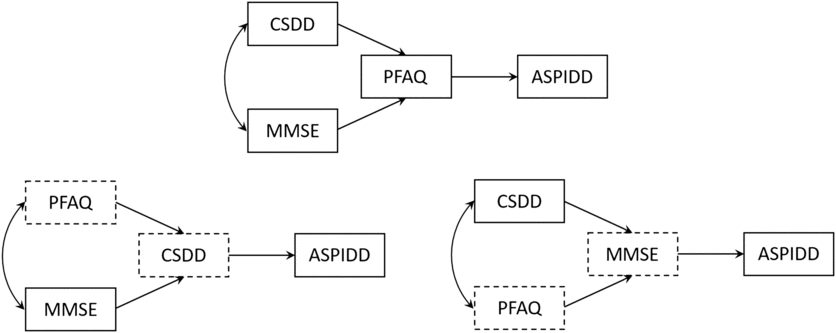
Based on substantive theoretical considerations and the information from the correlation matrix of our data, we hypothesized three competing models. Our first model is based on the assumption that impairments in functionality could lead to higher unawareness by preventing PwAD from engaging in ADL (Dourado et al., Reference Dourado, Laks and Mograbi2016; Starkstein et al., Reference Starkstein, Jorge, Mizrahi and Robinson2006; Mograbi and Morris, Reference Mograbi and Morris2014). Furthermore, there is evidence that ADL are affected negatively by depressed mood state in PwD (Baune et al., Reference Baune, Miller, McAfoose, Johnson, Quirk and Mitchell2010; Mograbi and Morris, Reference Mograbi and Morris2014) as well as by decreases in cognitive function (Mograbi et al., Reference Mograbi2018). Accordingly, in the first model functionality would mediate the relationship between cognitive function, mood state and awareness of condition. Nevertheless, there is considerable evidence suggesting an association between mood state and unawareness (for a review, Mograbi and Morris, Reference Mograbi and Morris2014), across different clinical populations (David, Reference David, Amador and David2004), so it is possible that mood state has a direct relationship with unawareness and mediates the relationship of the latter with functionality and cognitive status (Model II). A final alternative hypothesis is that cognitive impairment is directly linked to unawareness (Mograbi et al., Reference Mograbi2012; Starkstein et al., Reference Starkstein, Jorge, Mizrahi and Robinson2006), mediating the relationship between the latter, functionality and mood state (Model III). A graphic description of the three tested models can be seen in Figure 1.
Schematic representation of Models I, II and III.
Top: Model I. The influence of mood state (CSDD) and cognitive function (MMSE) on awareness of disease (ASPIDD) is mediated by functionality (PFAQ). Bottom left: Model II. The variables PFAQ and CSDD are switched (indicated by the dashed boxes). Here, mood state is the mediating variable. Bottom right: Model III. The variables PFAQ and MMSE are switched (indicated by the dashed boxes). Here, cognitive function is the mediating variable.
CSDD = Cornell Scale for Depression in Dementia; ASPIDD = Assessment Scale of the Psychosocial Impact of the Diagnosis of Dementia; MMSE = Mini-Mental State Examination; PFAQ = Pfeffer Functional Activities Questionnaire.

To test our theoretical models and thus to understand better the relationships between the variables, SEM was used to explore possible causal relationships between observed independent (predictors) and dependent variables (outcomes) in our sample. Data preparation, data cleaning and descriptive statistics were conducted using IBM SPSS version 21. SEM was conducted using IBM AMOS version 24. The estimates were calculated using maximum likelihood estimation. The confidence intervals (CI) for the effects were calculated using bootstrapping. Considering our variables, models and type of analysis, the sample size was adequate for the intended analysis (SEM), fulfilling the recommendations of MacCallum and Austin (Reference MacCallum and Austin2000) of N > 200, as well as the recommended sample-size-to-parameters ratio 20:1 (Jackson, Reference Jackson2003).
The goodness of fit indices were Chi-Square (χ2), relative χ2, standardized root mean square residual (SRMR), root mean square error of approximation (RMSEA), and the comparative fit index (CFI). The χ2 value evaluates the magnitude of discrepancy between the sample and the fitted covariance matrices (Hu and Bentler, Reference Hu and Bentler1999). A good model fit would provide an insignificant result (Barrett, Reference Barrett2007). The relative χ2 (χ2/df; Wheaton et al., Reference Wheaton, Muthen, Alwin and Summers1977) is not sensitive to sample size and therefore reported here. A good model fit is represented by a value smaller than 2.0 (Tabachnick and Fidell, Reference Tabachnick and Fidell2007). The SRMR is the standardized square root of the difference between the residuals of the sample covariance matrix and the hypothesized covariance model. A value less than 0.05 indicates a well-fitting model (Byrne, Reference Byrne1998). The RMSEA is a measure of how well the model would fit the covariance matrix of the population (Byrne, Reference Byrne1998) and favors parsimony. A cut-off value close to .06 provides a very good fit (Hu and Bentler, Reference Hu and Bentler1999). The CFI belongs to the incremental fit indices, which compare the χ2-value to a baseline model (McDonald and Ho, Reference McDonald and Ho2002). A value greater than 0.95 indicates a good fit (Hu and Bentler, Reference Hu and Bentler1999).
Results
Only data of participants who completed all the relevant questionnaires were included in the data set. Analyses for outliers were conducted based on the single variables involved and on the multivariate level. Cases, which differed three standard deviations (SD) or more from the mean were removed from the data set. Furthermore, multivariate outliers were analyzed using Mahalanobi’s distance. Cases with a probability smaller than .001 were removed. The resulting data set contained 257 of the 264 original cases, with data of 257 PwAD (66% female) and 257 caregivers (72% female) included in the following analyses. Analyses for normality and multivariate normality showed no severe deviations, so that maximum likelihood method could be used to calculate the estimates. The data set was furthermore checked for linearity of the relations between the variables and multicollinearity of the predicting variables, revealing linear relationships and no multicollinearity.
Sample characteristics
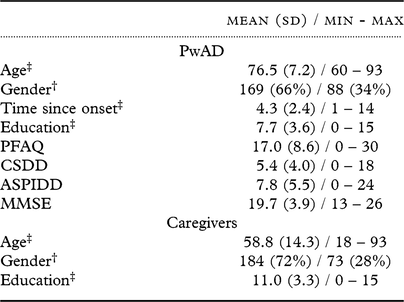
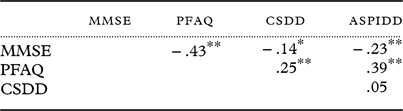
Table 1 shows the characteristics of PwAD and caregivers, as well as the descriptive statistics for all variables included in the models. The correlation matrix (Pearson correlations) is shown in Table 2.
Clinical and demographical characteristics of PwAD and their caregivers (n = 257)

† Female/male; ‡numbers in years.
M = mean; SD = standard deviation; AD = Alzheimer’s disease; PFAQ = Pfeffer Functional Activities Questionnaire; CSDD = Cornell Scale for Depression in Dementia; ASPIDD = Assessment Scale of the Psychosocial Impact of the Diagnosis of Dementia; MMSE = Mini-Mental State Examination.
Correlation matrix

PFAQ = Pfeffer Functional Activities Questionnaire; CSDD = Cornell Scale for Depression in Dementia; ASPIDD = Assessment Scale of the Psychosocial Impact of the Diagnosis of Dementia; MMSE = Mini-Mental State Examination.
* p < .05, **p < .01.
Structural equation modelling
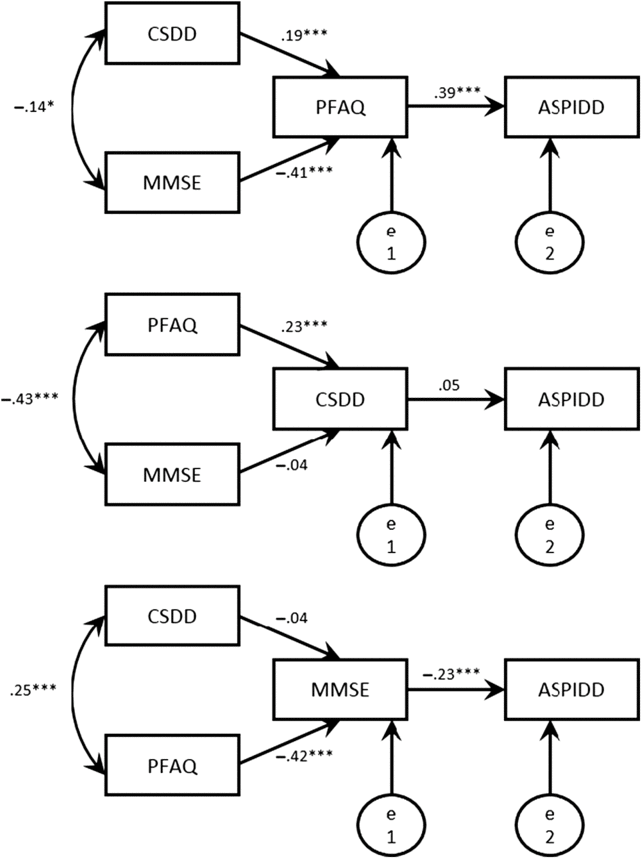
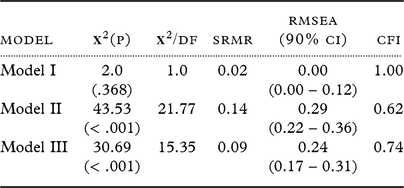
The analyses were based on four manifest variables, i.e. MMSE, PFAQ, CSDD, ASPIDD (see Table 1). Figure 2 shows the models with standardized coefficient estimates and p-values; goodness of fit statistics can be found in Table 3. The fit indices for the first model (Figure 2a) provided a very good fit to the data [χ2 = 2.0, p = .368; χ2/df = 1.0; SRMR = 0.02; RMSEA < 0.01; CFI = 1.00], whereas the fit indices for the second model (Figure 2b; [χ2 = 43.53, p < .001; χ2/df = 21.77; SRMR = 0.14; RMSEA = 0.29; CFI = 0.62]) and the third model (Figure 2c; [χ2 = 30.69, p < .001; χ2/df = 15.35; SRMR = 0.09; RMSEA = 0.24; CFI = 0.74]) suggested a poor model fit (see Table 3).
Model I, II and III with standardized coefficient estimates.
Top: Model I, the influence of mood state and cognitive function on awareness is mediated by functionality. Middle: Model II, the influence of functionality and cognitive function on awareness is mediated by mood state. Bottom: Model III, the influence of functionality and mood state on awareness is mediated by cognitive function.
CSDD = Cornell Scale for Depression in Dementia; ASPIDD = Assessment Scale of the Psychosocial Impact of the Diagnosis of Dementia; MMSE = Mini-Mental State Examination; PFAQ = Pfeffer Functional Activities Questionnaire. *p < .05, ***p < .001.

Goodness of fit and χ2 differences between models

SRMR = standardized root mean square residual; RMSEA = root mean square error of approximation; CFI = comparative fit index.
As shown in Table 3, the fit for the first model was very good and both the direct path coefficient from PFAQ to ASPIDD [β = 0.39, p < .001] as well as the mediated coefficients from CSDD to PFAQ [β = 0.19, p < .001] and from MMSE to PFAQ [β = −0.41, p < .001] were significant, as well as the correlation between MMSE and CSDD [r = −0.14, p < .05; Figure 2a]. Thus, total effects on awareness of condition were β = 0.39 [95% CI = 0.29 – 0.48] for functionality, β = 0.08 [95% CI = 0.03 – 0.12] for mood state, and β = −0.16 [95% CI = −0.22 – −0.10] for cognitive function. Cohen’s f2 was 0.19 for the first model and thus constitutes a medium effect (Cohen, Reference Cohen1988). In the second and third model, respectively, the measures for mood state (CSDD) and functionality (PFAQ), as well as for cognitive function (MMSE) and functionality (PFAQ), were exchanged to test which variable is best suited to mediate the relationship (Figure 2b and c). The better fit statistics gave support for the first model.
Secondary analyses
Relationship between awareness and functionality
To test further our hypotheses, additional analyses were conducted. This included exchanging the position of PFAQ and ASPIDD in Model I. In the resulting fourth path model, the ASPIDD mediated the relationship between CSDD and MMSE with the PFAQ. This model did not fit the data [χ2 = 53.16, p < .001; χ2/df = 26.58; SRMR = 0.13; RMSEA = 0.32; CFI = 0.53]. Path coefficients were β = 0.39 [p < .001] for ASPIDD to PFAQ, β = 0.2 [p = .743] for CSDD to ASPIDD, β = −0.22 [p < .001] for MMSE to ASPIDD, and r = −0.14 [p < .05] for the correlation between CSDD and MMSE.
Dementia severity
To investigate the influence of dementia severity in the relationship between variables, the sample was split into mild and moderate AD using the CDR score (mild AD CDR = 1, N = 136; moderate AD CDR = 2, N = 121). Each model was then tested in both subsamples. For mild AD, the first model (see Figure 1) still had a very good model fit [χ2 = 0.54, p = .762; χ2/df = 0.27; SRMR = 0.02; RMSEA < 0.01 with 90% CI = 0.00 – 0.12; CFI = 1.00] and a medium effect size [Cohen’s f2 = 0.31]. Path coefficients were β = 0.48 [p < .001] for PFAQ to ASPIDD, β = 0.15 [p = .079] for CSDD to PFAQ, β = −0.27 [p < .001] for MMSE to PFAQ, and r = −0.23 [p < .01] for the correlation between CSDD and MMSE. Total effects on awareness of condition were β = 0.48 [95% CI = 0.33 – 0.61] for functionality, β = 0.07 [95% CI = −0.003 – 0.17] for mood state, and β = −0.13 [95% CI = -0.23 – −0.05] for cognitive function. Consistent with results for the whole sample, the second [χ2 = 33.36, p < .001; χ2/df = 16.68; SRMR = 0.15; RMSEA = 0.34; CFI = 0.41], third [χ2 = 34.18, p < .001; χ2/df = 17.09; SRMR = 0.15; RMSEA = 0.35; CFI = 0.40] (see Figure 1), and fourth model [χ2 = 12.73, p < .01; χ2/df = 6.37; SRMR = 0.09; RMSEA < 0.20; CFI = 0.80] presented a poor model fit for the mild AD group.
Regarding the moderate AD group, the first model fit the data [χ2 = 1.68, p = .432; χ2/df = 0.84; SRMR = 0.03; RMSEA < 0.01 with 90% CI = 0.00 – 0.17; CFI = 1.00], whereas all but one path coefficient did not reach significance [β = 0.14, p = .122 for PFAQ to ASPIDD; β = 0.31, p < .001 for CSDD to PFAQ; β = −0.02, p = .845 for MMSE to PFAQ; r = −0.09, p = .320 for MMSE-CSDD]. Model II [χ2 = 3.54, p = .171; χ2/df = 1.77; SRMR = 0.05; RMSEA = 0.08; CFI = 0.87] and III [χ2 = 4.01, p = .134; χ2/df = 2.01; SRMR = 0.05; RMSEA = 0.09; CFI = 0.82] showed an acceptable fit to the data, but again only the relationship between CSDD and PFAQ was significant in both models [Model II: β = 0.31, p < .001 for PFAQ to CSDD; Model III: r = 0.31, p < .001 for PFAQ-CSDD]. Reflecting the preceding results, model four showed a poor model fit [χ2 = 13.4, p < .001; χ2/df = 6.7; SRMR = 0.10; RMSEA = 0.20; CFI = 0.00].
Discussion
The present study investigated the underlying structure of the relationship between cognitive level, mood state, ADL and awareness of condition in a sample of PwAD in a developing country using SEM. We tested three competing models in 257 PwAD. Results indicated the best fit for the first model, in which ADL have a direct, positive effect on awareness, and mediate the relationship between cognitive level and mood state with awareness, both of which having only indirect effects on awareness of disease (see Figure 2a). A second step in the analysis revealed that the goodness of model fit, path coefficients, as well as effect size increased when the model was applied only to the mild AD group. On the contrary, for the moderate AD subsample results were less promising. This pattern suggests that the underlying structure of awareness in AD varies with progression of the disease.
To describe the relationship between ADL and awareness there are two possible hypotheses. First, impairments in ADL could prevent PwAD from engaging in activities, and thus they do not become aware of the dementia-introduced changes of functional level (Mograbi and Morris, Reference Mograbi and Morris2014). Second, unawareness may lead to unrealistic expectations about functional ability and would prevent PwAD from the integration of the “new” functional level (Mograbi et al., Reference Mograbi, Brown and Morris2009). Our model supports the first hypothesis, in which a reduced level of ADL leads to reduced awareness. Moreover, exchanging the position of awareness and functionality in an additional model led to a poor model fit, which suggests that the level of awareness is influenced by the level of functionality, and not the contrary. This is in line with the findings of Dourado et al. (Reference Dourado, Laks and Mograbi2016) as well as Starkstein et al. (Reference Starkstein, Jorge, Mizrahi and Robinson2006) who also assume that a loss of functional ability leads to reduced awareness. However, awareness is a complex and multifactorial construct and most likely the underlying structure of the relationship between awareness and ADL cannot be described simply as a unidirectional influence. It is likely that other variables also affect the relationship. Apathy, for instance, leads to a loss of goal directed activity and thus reduces the activity level, which in turn may lead to unawareness (Mograbi and Morris, Reference Mograbi and Morris2014). Moreover, it has been linked to awareness in AD (Derouesne et al., Reference Derouesne, Thibault, Lagha-Pierucci, Baudouin-Madec, Ancri and Lacomblez1999; Spalletta et al., Reference Spalletta, Girardi, Caltagirone and Orfei2012; Starkstein et al., Reference Starkstein, Petracca, Chemerinski and Kremer2001). The engagement in activities exposes PwAD to their limits and deficits. If apathy prevents people from engaging in activities, then it would be difficult to know their actual abilities and limits. Future studies exploring specifically the role of apathy are needed to test this hypothesis.
General cognition or dementia severity level is typically poorly linked to awareness, with PwAD at the same severity level showing wide variations in the expression of awareness (Reed et al., Reference Reed, Jagust and Coulter1993). Our model suggests an indirect influence of cognitive level on awareness. Preserved cognition is associated with better daily life functioning, which in turn is related to better awareness. Early studies that found an influence from general cognition or dementia severity to awareness investigated specifically loss of awareness for cognitive deficits (Lopez et al., Reference Lopez, Becker, Somsak, Dew and DeKosky1994) or found that the relationship follows a trilinear instead of a linear pattern (Zanetti et al., Reference Zanetti1999). Considering that there is no consensus in the literature about the nature of a possible relationship between awareness and general cognitive function or dementia severity in PwAD, our model proposes a compromise in which that influence is mediated by ADL. This is in line with Mograbi et al. (Reference Mograbi2018), who state that in ADLs with a higher cognitive demand even subtle changes in cognitive performance can lead to impairments. Whereas the PFAQ measures basic and instrumental ADL, the MMSE evaluates basic cognitive performance. In our sample the highest correlation was found between cognitive function (MMSE scores) and functionality (PFAQ scores). Therefore, MMSE and PFAQ share variance related to basic ADL. Based on our results, it can be suggested that instrumental ADL, measured with the PFAQ, have a direct influence on awareness, while basic cognitive functions, measured with the MMSE, only have an indirect influence on awareness via functionality. Future studies should take into account the difference of basic, instrumental and advanced ADLs in predicting awareness in dementia.
Another factor that influences levels of awareness in PwAD is mood disorder (Aalten et al., Reference Aalten, Van Valen, Clare, Kenny and Verhey2005; Bertrand et al., Reference Bertrand, Dourado, Laks, Morris, Landeira-Fernandez and Mograbi2016; Mograbi and Morris, Reference Mograbi and Morris2014; Starkstein, Reference Starkstein2014). Although many studies confirmed this relationship, some studies did not find a relationship between awareness and mood or depression (Arkin and Mahendra, Reference Arkin and Mahendra2001; Cummings et al., Reference Cummings, Ross, Absher, Gornbein and Hadjiaghai1995; Dourado et al., Reference Dourado, Laks and Mograbi2016; Derouesne et al., Reference Derouesne, Thibault, Lagha-Pierucci, Baudouin-Madec, Ancri and Lacomblez1999; Lopez et al., Reference Lopez, Becker, Somsak, Dew and DeKosky1994; Michon et al., Reference Michon, Deweer, Pillon, Agid and Dubois1994; Ott et al., Reference Ott, Lafleche, Whelihan, Buongiorno, Albert and Fogel1996; Reed et al., Reference Reed, Jagust and Coulter1993; Starkstein et al., Reference Starkstein, Vázquez, Migliorelli, Tesón, Sabe and Leiguarda1995; Verhey et al., Reference Verhey, Rozendaal, Ponds and Jolles1993; Zanetti et al., Reference Zanetti1999). Our model does not support a direct relationship between mood state and awareness. One explanation could be that the majority of the PwAD in our sample showed no depressive mood states, with a diagnosis of depression being an exclusion criterion, and a relatively low mean score of 5.4 (SD = 4.0) points on the CSDD. On the other hand, our model does suggest an indirect influence of mood state on awareness which is mediated by ADL. More specifically, higher levels of depressed mood state led to decreased functionality, which was associated with lower levels of awareness. Mograbi et al. (Reference Mograbi2018) also found depression associated with decreased ADL, although this influence was smaller compared to the influence of dementia on ADL and restricted to advanced ADL. Interestingly, the study by Dourado et al. (Reference Dourado, Laks and Mograbi2016) did find that functional status predicts awareness in late onset AD, but also failed to show a direct relationship between depression and awareness, which is in line with our findings. Although the authors did not explicitly exclude PwAD with a depression diagnosis, the level of depression for late onset AD, measured also with the CSDD, was lower than in our sample (M = 4.0, SD = 3.2). Depressed mood state is typically associated with changes in behavioral activities, which affect daily cognitive functioning additionally to the effects of dementia (Mograbi and Morris, Reference Mograbi and Morris2014).
Furthermore, mood state is a multidimensional phenomenon, comprising psychological as well as somatic and behavioral symptoms. Thus, the relationship with awareness could be mediated by the specific factors involved (Mograbi and Morris, Reference Mograbi and Morris2014). Troisi et al. (Reference Troisi, Pasini, Gori, Sorbi, Baroni and Ciani1996) suggested that only the psychological symptoms of depression, like mood or anxiety, are related to awareness in PwAD, whereas somatic symptoms, for instance fatigue or slowness, are not related to awareness. This is in agreement with Cines et al. (Reference Cines2015), who suggest that studies which found a positive relationship between depressive mood state and awareness focused on the psychological and affective factors of depression, instead of somatic symptoms such as changes in sleep or appetite. The measure used to evaluate depressive mood state in this study was the total score of the CSDD, including not only mood symptoms, but also physical and behavioral symptoms of depression. Thus, a different measure, which focuses more on the psychological and affective symptoms of depression, may yield a direct influence on awareness, in addition to the indirect influence that is mediated by ADL. Similarly, the results of a study by Starkstein et al. (Reference Starkstein, Sabe, Chemerinski, Jason and Leiguarda1996) indicated that only awareness of cognitive impairments is associated with depression, whereas awareness of behavioral difficulties was not related to depression, which illustrates that awareness also is a multidimensional construct, that can be assessed for different domains (e.g. awareness of cognitive deficits, behavioral problems, functionality level; Aalten et al., Reference Aalten, Van Valen, Clare, Kenny and Verhey2005). Each domain may have unique and shared relationships with other constructs like mood state, functionality or cognitive level.
Lack of awareness in different types of dementia has been explored in the last decades, with increasing evidence for this phenomenon. Nevertheless, changes in awareness in the course of dementia, as well as its neural correlates, remain not fully resolved (Mondragón et al., Reference Mondragón, Maurits and De Deyn2019). Furthermore, large scale or longitudinal studies are still scarce in the field. Recent studies, using a large sample of PwD, only included a few PwAD, and focused on awareness of memory deficits, and how it varies between dementia forms (Lehrner et al., Reference Lehrner2014). A longitudinal study investigating awareness in mild AD over the course of 36 months found no consistent association between cognitive decline and awareness, but showed a relationship between increasing neuropsychiatric symptoms, like for example depression and apathy, and reduced awareness over time (Vogel et al., Reference Vogel, Boch Waldorff and Waldemar2015). The authors also conclude that awareness is a complex construct, and that its longitudinal course is only little explored. Thus, it is crucial to define influencing and mediating variables using statistical approaches that consider the interconnectedness between involved variables to predict individual trajectories of awareness in PwAD, adjusting home care and interventions accordingly. To the best of our knowledge, our study is the first using a modeling approach in a large sample of PwAD and their caregivers to consider the influence of key variables on awareness together. This way it is an advance in providing deeper insight into the functional structure of awareness in AD, and thus aiming at a better understanding of how awareness can be influenced in PwAD. Current findings on the relationship between awareness, functionality, cognitive level and mood state may ultimately contribute to improve clinical care and quality of life for PwAD and their caregivers.
Some limitations of the study must be considered. We did not assess mood constructs other than depression, like apathy or anxiety. Especially apathy could be interesting to include in the model, since it has been shown to be strongly related to level of awareness in PwAD (Derouesne et al., Reference Derouesne, Thibault, Lagha-Pierucci, Baudouin-Madec, Ancri and Lacomblez1999; Spalletta et al., Reference Spalletta, Girardi, Caltagirone and Orfei2012; Starkstein et al., Reference Starkstein, Petracca, Chemerinski and Kremer2001). Another point is that we only included global measures of awareness without considering awareness in different domains, such as awareness of memory performance or awareness of functionality. In future studies it could be interesting to model the influence of cognitive level, ADLs and mood state on different domains or objects of awareness. Indeed, a more complex model, including different domains of awareness, as well as of ADLs, and further variables, such as apathy and anxiety, would be desirable to obtain a better understanding of the structure underlying awareness in dementia. Another point to mention is the influence of self- vs. caregiver reports. Our study assessed mood state and functionality of PwAD through caregiver reports. This could have an influence on the relationship of the variables in the models, with caregiver burden, as well as their mood state, potentially influencing the perception of mood state and functionality of the person with AD. The influence of caregiver variables should therefore be controlled in future studies. Finally, the study was conducted in an outpatient unit from a university hospital, which may have introduced sampling biases. For instance, participants that did not complete the session typically preferred to withdraw/not take part in the study due to personal constraints, such as limited time or difficulties making travel arrangements. Although there are no data available for them, it is possible these were patients who had slightly less structured social support or lived further away from the hospital. Future studies would benefit from community-based samples to explore unawareness in dementia.
Our study showed that the relationship between different factors and awareness is mediated by functionality and not by depressive mood state or cognitive level. In a population of functionally and cognitively impaired PwAD without a diagnosis of depression, the model that best fit the data supported an indirect effect of both, cognitive function and mood state on awareness of condition, mediated by functionality, which itself showed a moderate relationship with awareness. Awareness is linked to treatment compliance, caregiver burden, dangerous behaviors and earlier institutionalization. On the other side, preserved awareness can lead to depressive mood states. Hence, it is important to know the factors that influence awareness of changes and difficulties in PwD, so that they can be considered for diagnosis and for the development of person-centered interventions that improve awareness without putting patients at higher risk for mood disorders. The proposed model brings us one step further towards an understanding of the underlying structure of awareness in PwD. Thus, it can also serve the development of more detailed models, including for example other mood constructs like apathy and different domains of awareness, to explain the structure and causality of awareness in PwD.
Conflict of interest
None.
Description of authors’ roles
A. Fischer was responsible for carrying out the statistical analysis and wrote the draft of the paper. M. C. N. Dourado designed and conducted the study. J. Laks supervised the data collection. J. Landeira-Fernandez provided study materials. R. G. Morris assisted with writing the article. D. C. Mograbi assisted with the statistical analysis and with writing the article. J. Laks, J. Landeira-Fernandez, R. G. Morris and D. C. Mograbi provided guidance and comments.
Acknowledgements
A. Fischer was supported by the German Academic Exchange Service – DAAD [57314657], D. Mograbi received financial resources from the Conselho Nacional de Desenvolvimento Científico e Tecnológico – CNPq [312370/2017-2], and the Fundação de Amparo à Pesquisa do Estado do Rio de Janeiro – FAPERJ [E-26/203.216/2016]. The sponsors did not have any influence on the conducted research. We would also like to thank all the patients and caregivers; without their participation and cooperation, this research would not have been possible.