Implications
The use of agro-industrial by-products rich in sugar and pectins are interesting alternatives to cereals in ruminant diets, allowing good growth performances. Our results reveal a new insight about the effects of these types of raw materials in ruminant nutrition, minimizing the negative impact of cereals on the lipid nutritional quality of meat and milk. This approach may favour the deposition of healthy fatty acids (FA), as vaccenic and rumenic acids, and reduce the accumulation of other trans FA with probable deleterious effects to consumers.
Introduction
Ruminant fats are the major natural dietary source of vaccenic (t11-18:1) and rumenic (c9,t11-18:2) acids for humans. The potential health benefits of these FA has been extensively researched (Gebauer et al., Reference Gebauer, Chardigny, Jakobsen, Lamarche, Lock, Proctor and Baer2011) as well as the development of practical strategies to increase their concentration in meat and milk (Shingfield and Wallace, Reference Shingfield and Wallace2014). Both t11-18:1 and c9,t11-18:2 are derived directly or indirectly from biohydrogenation (BH) of polyunsaturated FA (PUFA) in the rumen (Bessa et al., Reference Bessa, Alves and Santos-Silva2015). Supplementing ruminants with PUFA usually increases the availability of substrate and reduce the completeness of BH (i.e. yielding higher proportion of BH intermediates) and is the most efficient strategy to increase rumen outflow of t11-18:1. Tannins can also increase the rumen outflow and meat concentration of t11-18:1 (Vasta and Bessa, Reference Vasta and Bessa2012). The simultaneous supplementation with PUFA and tannin sources was successfully used to increase both t11-18:1 and c9,t11-18:2 in meat from lambs fed forage-based diets (Jerónimo et al., Reference Jerónimo, Alves, Dentinho, Martins, Prates, Vasta, Santos-Silva and Bessa2010), but failed when lambs were fed high-starch diets (Francisco et al., Reference Francisco, Dentinho, Alves, Portugal, Fernandes, Sengo, Jerónimo, Oliveira, Costa, Sequeira, Bessa and Santos-Silva2016). High-starch diets induce the establishment of t10-shifted BH pathways in the rumen (t10-shift), resulting in a large accumulation of the t10-18:1 in detriment of t11-18:1 (Bessa et al., Reference Bessa, Alves and Santos-Silva2015). However, starchy diets also increase the availability of gluconeogenic precursors and insuline and up-regulates the gene expression of lipogenic key enzymes like stearoyl-CoA desaturase (SCD) (Bessa et al., Reference Bessa, Alves and Santos-Silva2015). Reducing starch concentration of lamb’s finishing diets might be required to ensure that both PUFA and tannin supplementation increase the t11-18:1 and c9,t11-18:1 in meat. Dehydrated citrus pulp (DCP) has very low starch concentration but is rich in pectin and sugars and can replace cereals in diets with negligible impact on lamb’s growth (Bampidis and Robinson, Reference Bampidis and Robinson2006). Thus, we hypothesized that replacing cereals by DCP in a soybean oil supplemented diet would increase the concentration of t11-18:1 and c9,t11-18:2 in lamb meat and that the inclusion of rockrose, a Mediterranean tanniferous shrub (Cistus ladanifer), would amplify that response.
Material and methods
Experimental design, animals and diets
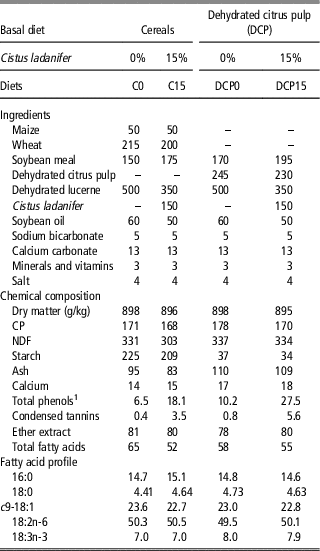
The animal handling followed the European Union legislation concerning the protection of animals used for scientific purposes (EU Directive 2010/63/UE). In total, 32 Merino Branco ram lambs were reared with dams on extensive grazing until weaning with ~60 days of age. At weaning, lambs were transported to INIAV-Fonte Boa and were housed and randomly assigned to 16 pens (two lambs per pen and four pens per treatment) according to a completely randomized experimental design with a 2×2 factorial arrangement of treatments. The first factor was basal diet (BD) with different starch concentration (cereals v. DCP). The second factor was the inclusion of C. ladanifer (CL) (0 v. 150 g/kg dry matter (DM)), partially replacing lucerne. The four diets were: (1) C0 – high starch and 0% C. ladanifer; (2) C15 – high starch with 15% of C. ladanifer; (3) DCP0 – low starch and 0% C. ladanifer; (4) DCP15 – low starch with 15% of C. ladanifer. All diets presented 1 : 1 forage to concentrate ratio and included dehydrated lucerne pellets. Moreover, all diets included soybean oil to attain 80 g/kg DM of ether extract, providing enough PUFA substrate for the ruminal BH. Leaves and soft stems of C. ladanifer were harvested in Portugal (39°30′36″N/8°19′00″W) in April 2013, dried at room temperature, cut in small pieces, and milled to a final particle size of 3 mm. Diets were prepared at INIAV-Fonte Boa. All feed ingredients were ground and mixed to obtain four complete diets, which were presented to the lambs as meal. Chemical composition of the diets are presented in Table 1. During the 7 days of adaptation to the experimental conditions, lambs were dewormed by dosing with Ivomec® (Merial Labs., Sant Cugat del Vallès, Spain) and vaccinated against enterotoxaemia (Miloxan, Merial Labs., Spain). The average initial live weight was 18.8±3.44 kg (mean±SD). The experiment lasted for 6 weeks, with feed offered daily at 0900 h at a rate of 110% of ad libitum intake calculated by weighing-back in each pen the refusals which were daily registered and discarded. The animals were weighed weekly just before feeding.
Ingredients (g/kg), chemical composition (g/kg dry matter) and fatty acid profile (g/kg of total fatty acids) of the experimental diets

1 Tannic acid equivalents.
Slaughter, carcasses evaluation and sampling
At the end of the trial, lambs were weighed and transported to the experimental abattoir, where they were stunned and slaughtered by exsanguination. Slaughtering took place on 3 different days (9, 13 and 17 December 2013). The evaluation of rumen mucosa and parakeratosis was conducted after evisceration, by a visual grading of four scores of parakeratosis intensity (0-normal rumen papillae, 1-weak, 2-moderate and 3-strong) according to Tamate et al. (Reference Tamate, Nagatani, Yoneya, Sakata and Miura1973). Refrigeration conditions, carcass weighing and jointing are described in Francisco et al. (Reference Francisco, Alves, Portugal, Pires, Dentinho, Alfaia, Jerónimo, Prates, Santos-Silva and Bessa2015). Each joint was weighed to estimate the proportion of the higher-priced joints (leg+chump+loin+ribs). Chump and shoulders were vacuum-packed and frozen at −20°C, until dissection.
Left m. longissimus lumborum, were vacuum-packed and frozen at −20°C until shear force determination. M. longissimus thoracis were isolated, and two samples of about 1-cm thickness were collected to evaluate lipid and colour stability after 7 days of storage, according to Jerónimo et al. (Reference Jerónimo, Alfaia, Alves, Dentinho, Prates, Vasta, Santos-Silva and Bessa2012). The remaining portions of the m. longissimus thoracis, were minced with a food processor (3×5 s) after the removal of the epimysium, and then vacuum-packed and stored at −20°C until further analysis for pH and chemical composition. Right loin joints were vacuum-packed and frozen at −20°C, until sensory analysis.
Meat colour, pH, shear force and cooking loss
Meat colour was measured using a Minolta CR-300 Chromometer (Konica Minolta, Lisbon, Portugal) using the CIE L*, a*, b* system, where L* is lightness, a* redness and b*yellowness. Measurements were made using the C illuminant and 2° standard observers. Hue angle (H*) was calculated as tan−1(a*/b*)×(180/π) and colour saturation (Chroma, C*) as (a*2+b*2)0.5. The indexes ΔE(7−0)=((ΔL*(7−0))2+(Δa*(7−0))2+(Δb*(7−0))2)0.5, ΔH(7−0)=(H* day 7)–(H* day 0) and ΔC(7–0)=(C* day7)–(C* day 0) were used for the evaluation of colour changes during storage.
Muscle pH was measured using a pH meter (Metrohm 744) equipped with a combined glass electrode according to ISO 2917 (1999). Shear force was determined on m. longissimus lumborum samples thawed for 24 h at 2°C, according to Francisco et al. (Reference Francisco, Alves, Portugal, Pires, Dentinho, Alfaia, Jerónimo, Prates, Santos-Silva and Bessa2015). Cooking loss was determined as the difference in meat sample weights before and after cooking, expressed as a percentage of initial weight.
Feed and meat chemical analysis
Chemical composition of the diets was analysed as described by Santos-Silva et al. (2016). Fatty acid methyl esters of feed samples were prepared according to Sukhija and Palmquist (Reference Sukhija and Palmquist1988), using nonadecanoic acid as internal standard. The extraction and analysis of phenolic compounds and condensed tannins of the diets were carried out as described by Francisco et al. (Reference Francisco, Alves, Portugal, Pires, Dentinho, Alfaia, Jerónimo, Prates, Santos-Silva and Bessa2015). Meat samples were analysed for DM according to ISO 1442 (1997) and for lipid composition. Intramuscular lipids were extracted using dichloromethane and methanol (2 : 1 v/v) and FA methyl esters were prepared as described by Francisco et al. (Reference Francisco, Alves, Portugal, Pires, Dentinho, Alfaia, Jerónimo, Prates, Santos-Silva and Bessa2015). Methyl esters were analysed using an HP6890A gas chromatograph (Agilent, Avondale, PA, USA), equipped with a flame-ionization detector and fused silica capillary column (SP2560 100 m×0.25 mm internal diameter×0.20-μm film thickness, Supelco Inc., Bellefonte, PA, USA) was used. The chromatographic conditions were described by Francisco et al. (Reference Francisco, Dentinho, Alves, Portugal, Fernandes, Sengo, Jerónimo, Oliveira, Costa, Sequeira, Bessa and Santos-Silva2016). Nonadecanoic acid was used as internal standard for FA quantification. Fatty acid methyl esters were identified by comparison of their retention times with those of commercial standard mixtures (FAME mix 37 components from Supelco Inc.) or with published chromatograms (Alves and Bessa, Reference Alves and Bessa2009; Vahmani et al., Reference Vahmani, Rolland, Gzyl and Dugan2016). Additional identification of the FA methyl esters was achieved by electron impact MS using a Shimadzu GC-MS QP2010 Plus (Shimadzu, Kyoto, Japan). The methyl esters of conjugated linoleic acid isomers were individually separated using three silver-ion HPLC columns in series. The quantification of conjugated linoleic isomers in meat was obtained by a combination of gas chromatography and Ag+-HPLC, as described in Bessa et al. (Reference Bessa, Alves, Jerónimo, Alfaia, Prates and Santos-Silva2007). Lipid oxidation in meat was assessed through the quantification of thiobarbituric acid reactive substances, according to Grau et al. (Reference Grau, Guardiola, Boatella, Barroeta and Codony2000). Total RNA isolation from lamb muscle samples and real-time qPCR analysis was performed as described by da Costa et al. (Reference da Costa, Bessa, Pires, Rolo, Pinto, Fontes and Prates2014), using the specific primers for ribosomal protein P0, β-actin, fatty acid desaturase 1 (FADS1), fatty acid desaturase 2 (FADS2) and SCD and the analytic protocols described by Francisco et al. (Reference Francisco, Dentinho, Alves, Portugal, Fernandes, Sengo, Jerónimo, Oliveira, Costa, Sequeira, Bessa and Santos-Silva2016).
Sensory analysis
A trained sensory panel of INIAV-Fonte Boa with 11 members evaluated meat sensory characteristics in six sessions. For each session, five or six frozen loin joints were randomly selected and were allowed to thaw for 24 h at 2°C. After being deboned, the m. longissimus lumborum were cooked in an electric oven at 170°C, until the internal temperature reached 70°C, which was monitored using an internal thermocouple (Thermometer, Omega RDXL4SD, Manchester, UK). Each muscle was trimmed of external connective tissue and cut into 1×1×1 cm subsamples that were maintained in heated dishes at 40°C, until tasting. Meat was evaluated for odour, off-odour, tenderness, juiciness, flavour, off-flavour and overall acceptability. For sensory analysis a structured scale from 1 to 8 was applied, where the extreme values correspond to: 1 – extremely soft, tough, dry or unacceptable; 8 – extremely intense, tender, juicy or acceptable.
Statistical analysis
Average daily gain (ADG) was estimated using the Proc Mixed of SAS (SAS Institute Inc., Cary, NC, USA) with a random linear regression model, including the diet as categorical independent variable and day of weighing as a continuous independent variable. The animal was included as a subsample within pens and the covariance of repeated weight measurements of the same animal was accounted using an unstructured covariance structure. The results on ADG (i.e. the linear regression coefficients) were contrasted for the main effects using the ‘estimate’ statement of Proc Mixed. Dry matter and nutrient intake, were analysed by a similar random regression model but considering both the linear and quadratic effect of time. The experimental unit was the pen, the intake data were divided by two in order to obtain mean intake values expressed as g/day per lamb.
Carcass and chemical and physical traits of meat quality were analysed as a completely randomized experimental design following a 2×2 factorial treatment arrangement using Proc Mixed. Live slaughter weight and hot carcass weight were adjusted to initial live weight, carcass traits to hot carcass weight and meat FA proportions to intramuscular fat concentration.
The experimental unit was the pen but for most variables the animal was the observational unit, being included in the models as subsample within the pen. The covariance of animals within pens was modelled either as unstructured or compound symmetry structures according to the lowest Akaike information criterion corrected for finite samples. The homogeneity of variances was tested for a level of P<0.01, and when significant, the models were fitted considering the pattern of variance heterogeneity. The main effects and their interaction were included in the models, and interaction was removed, when not significant. As for most variables the interaction was not significant, only the least square means for the main effects are presented. Meat FA proportions are presented in an interaction layout table, as several FA presented significant interactions. Statistically significant difference or a trend were set for P<0.05 and for 0.05<P<0.10, respectively.
For sensorial attributes, the animal was considered as the experimental unit and the model included as fixed effects BD and CL and their interaction, and the effects of the panellist and the session were included as random block. As the interaction was not significant for any trait, it was removed from the data table.
The occurrence of rumen mucosa parakeratosis was analysed using Proc Glimmix of SAS, considering the binary distribution and the logit as link function.
Results
Growth performance and carcass traits
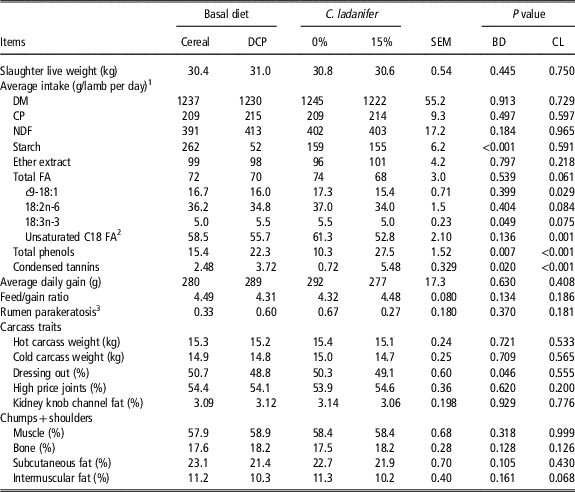
Treatments did not affect the growth performance of lambs (Table 2). Average daily weight gain and average DM intake were 288±48.6 g and 1230±55.2 g/day, respectively. Feed conversion ratio, which was estimated using total intake and total weight gain in each pen, was not affected by treatments, and was on average 4.4±0.24. Diets containing C. ladanifer resulted in lower (P<0.001) intake of C18 unsaturated FA than diets without C. ladanifer, whereas no difference was observed when DCP replaced cereals. In total, 15 lambs presented low intensity of rumen parakeratosis (average score of 0.69±0.559). Neither the general probability of occurrence (Table 2) nor the probability of occurrence of each score (data not shown) were affected by treatments.
Effects of replacement of cereals by dehydrated citrus pulp (DCP) and of Cistus ladanifer (CL) inclusion in the diet on growth performance, feed intake, carcass traits and chump and shoulder composition of lambs

BD=basal diet effect; DM=dry matter; FA=fatty acid.
1 Intake per pen divided by 2 to obtain the averaged intake per lamb.
2 Sum of c9-18:1, c11-18:1, 18:2n-6 and 18:3n-3.
3 Probability of rumen parakeratosis occurrence.
Hot and cold carcass weights were not influenced by treatments with average values of 15.2±2.21 and 14.8±2.18 kg, respectively (Table 2). Replacing cereals by DCP reduced (P=0.046) dressing out percentage, whereas C. ladanifer had no effect. The replacement of cereals by DCP did not influence carcass composition (Table 2). However, the intermuscular fat tended to decrease with C. ladanifer inclusion in diets (P=0.068).
Meat quality traits
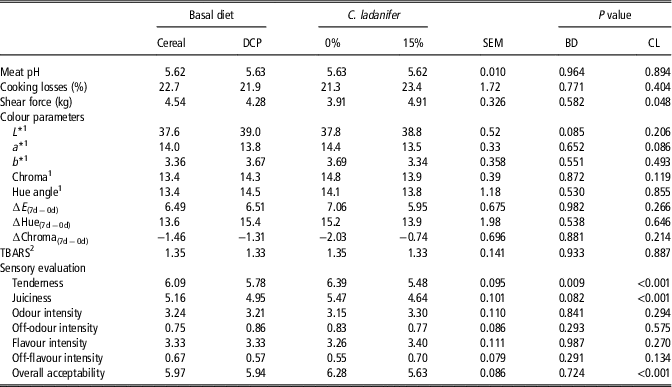
Table 3 presents physical and sensorial attributes of meat. Muscle pH and cooking loss were not affected by treatments, averaging 5.62±0.038% and 22.3±5.16%, respectively. Shear force increased 25.6% with C. ladanifer inclusion (P=0.048). Meat colour parameters were not influenced by treatments, averaging 38.3±2.09 for L*, 13.9±1.34 for a*, 3.5±1.34 for b*, 13.9±4.38 for H* and 14.4±1.54 for C*. Diets did not influence the values of meat colour variation indexes during the 7 days of storage, averaging 6.5±2.01, 14.5±6.07 and −1.4±2.4 for ΔE, ΔH* and ΔC*, respectively. The lipid oxidation of meat after storage was not affected by treatments, averaging 1.34±0.361 mg malonaldehyde per kg of meat. Meat tenderness was 5% and 14% lower for lambs fed DCP (P=0.009) and C. ladanifer (P<0.001) than for those fed cereal BD and without C. ladanifer, respectively. The inclusion of C. ladanifer in the diet reduced (P<0.001) the meat juiciness by 15% and overall acceptability by 10%.
Effects of replacement of cereals by dehydrated citrus pulp (DCP) and of Cistus ladanifer (CL) inclusion in the diet on physical, chemical and sensorial characteristics of lamb meat

BD=basal diet effect.
1 At day 0 of storage.
2 Thiobarbituric acid reactive substances (TBARS) at day 7 of storage, expressed as mg of malonaldehyde per kg of meat.
Meat fatty acid composition
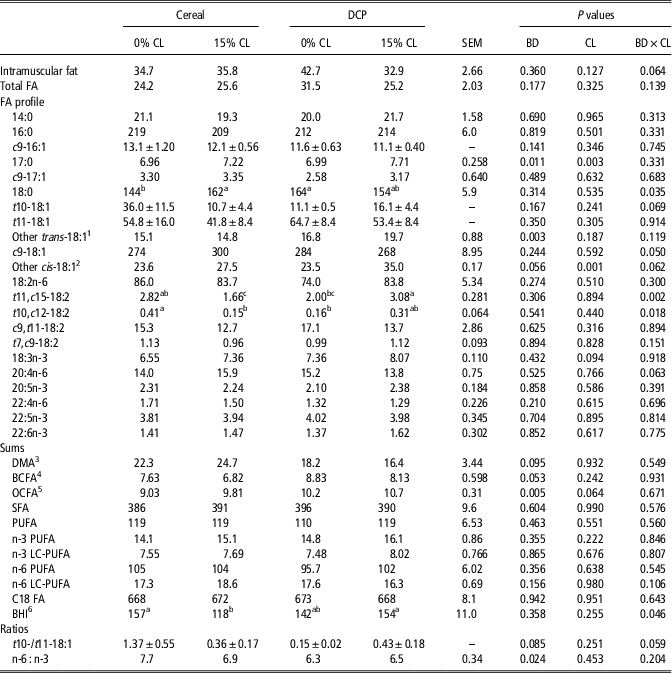
The intramuscular fat and total FA content of meat did not differ significantly among treatments averaging 35.3 and 20.4 mg/g of fresh muscle, respectively (Table 4). The main FA and FA sums (mg/g of total FA) are presented in Table 4 whereas minor FA, including most of the BH intermediates, are presented in Supplementary Table S1. The overall FA profile was not modified by treatments as total saturated FA (SFA) and PUFA, including the long-chain PUFA (LC-PUFA), remained unchanged although the n-6/n-3 ratio decreased (P=0.03) from 7.3 to 6.4 when DCP replaced cereals in the diets. Odd-chain FA increased with DCP (P=0.005) and tended to increase with C. ladanifer (P=0.064). Although the sum of C18 FA remained constant among treatments, several changes within C18 FA were observed including interactions between main effects. The 18:2n-6 and 18:3n-3 levels did not differ among treatments, but inclusion of C. ladanifer in the diets tended (P<0.10) to increase the 18:3n-3 content. There was a trend for the inclusion of C. ladanifer to have an effect on the proportion of c9-18:1 and to depend on the energy source of the diet (P=0.050). Despite the absence of differences between C0 and C15 diets, and between DCP0 and DCP15, the proportion of c9-18:1 tended to be higher for C15 compared with DCP15. C. ladanifer decreased the t10-18:1 (P=0.069), t11,c15-18:2 (P=0.020), t10,c12-18:2 (P=0.018) and the sum of BH intermediates (P=0.046) when combined with cereals, but not with DCP. Replacement of cereals by DCP increased (P<0.05) several minor BH intermediates like the cluster of t6/t7/t8-18:1, t12-18:1, c12-18:1, c9,t13-/t8,c12-18:2, c12,c15-18:2, t11,t13-18:2, t10,t12-18:2 and t11,c13-18:2. Independently of the BD, the C. ladanifer only increased (P<0.05) the c12-18:1, c16-18:1 and c12,c15-18 : 2 (Supplementary Table S1). The 18 : 0 level increased when C. ladanifer was included in the cereal-based diet and when DCP replaced cereal grain in diets without C. ladanifer. However, the simultaneous inclusion of DCP and C. ladanifer did not change the proportion of 18:0 when compared with C0.
Effects of replacement of cereals by dehydrated citrus pulp (DCP) and of Cistus ladanifer (CL) inclusion in the diet on intramuscular fat (g/kg of meat), total fatty acids (FA) (g/kg of meat) and FA profile (mg/g of total FA) in m. longissimus of lambs

a,b,cValues within a row with different superscript letter differ significantly at P<0.05.
BD=basal diet effect; CL=C. ladanifer effect; BD×CL=interaction between BD and CL; FA=fatty acid; SFA=saturated fatty acid; PUFA=polyunsaturated fatty acid; LC-PUFA=long-chain PUFA; BHI=biohydrogenation intermediates.
1 Sum of trans-18:1 isomers excluding the t10-18:1 and t11-18:1.
2 Sum of cis-18:1 isomers excluding the c9-18:1.
3 Dimethylacetals: DMA 16:0; DMA 18:0; DMA 18:1.
4 Branched-chain FA: iso-15:0; anteiso-15:0; iso-16:0; iso-17:0; anteiso-17:0; iso-18:0.
5 Odd chain FA: 15:0; 17:0.
6 Sum of BHI: t6-/t7-/t8-18:1; t9-18:1; t10-18:1; t11-18:1; c11-/t15-18:1; t12-18:1; c12-18:1; c13-18:1; t16-/c14-18:1; c16-18:1; c9,t13-/t8,c12-18:2; t8,c13-/c9,t12-18:2; t9,c12-18:2; t11,c15-/t10,c15-18:2; c12,c15-18:2; t12,t14-18:2; t11,t13-18:2; t10,t12-18:2; t9,t11-18:2; t11,c13-18:2; t10,c12-18:2; c9,t11-18:2; t8,c10-18:2; t7,c9-18:2.
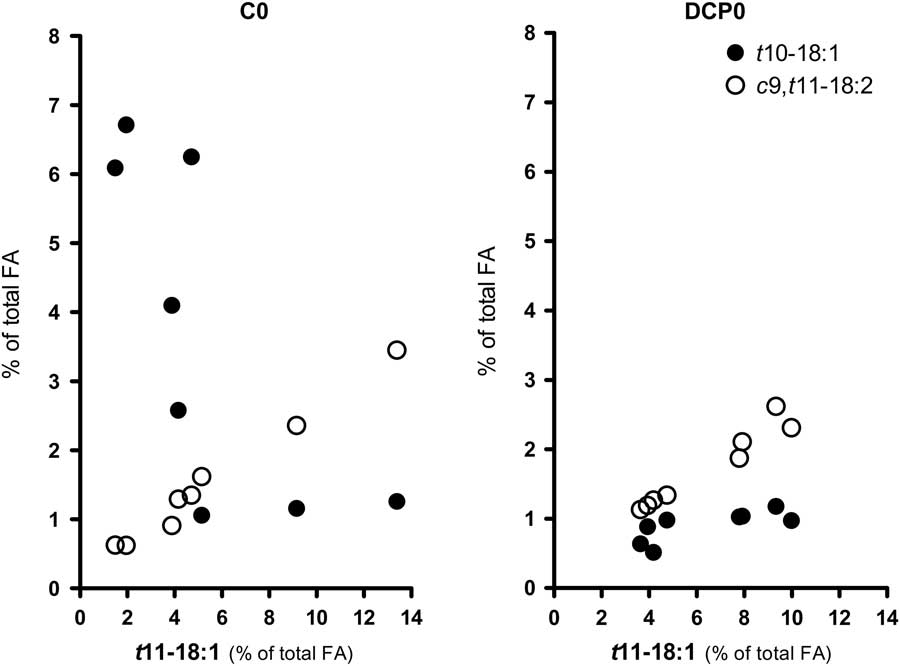
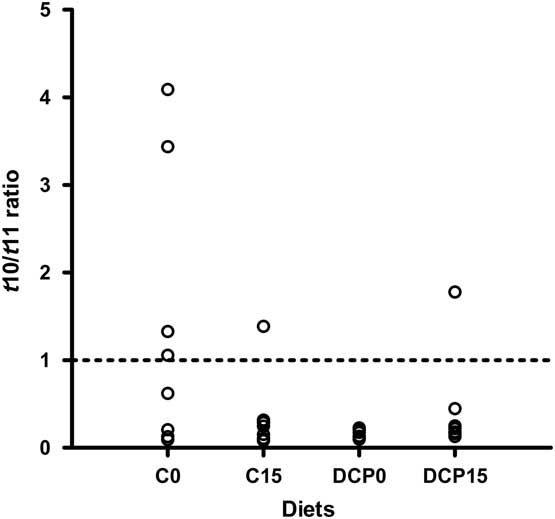
The mean concentration of the t11-18:1 and the c9, t11-18:2 were fairly large and not affected by treatments, averaging 54 and 15 mg/g of total FA, respectively. However, t11-18:1 and t10-18:1 variances were much higher (P<0.01) in C0 than in DCP0 diet. Individual data for t10-18:1, t11-18:1 and c9,t11-18:2 (as % of the total FA in meat) are shown in Figure 1 (for C0 and DCP0 diets) and in Supplementary Figure S1 (for C15 and DCP15 diets). In total, four lambs fed the C0 diet (50%) displayed a clear t10-shift (t10/t11 ratio>1), whereas C15 and DCP15 diets presented only one t10-shifted lamb each and none was observed in DCP0 diet (Figure 2).
Plot of individual data points of t10-18:1 (∙) and c9,t11-18:2 (○) related to t11-18:1 in lamb meat for treatments C0 (cereals and no Cistus ladanifer) and DCP0 (dehydrated citrus pulp and no C. ladanifer). FA=fatty acid.

Individual variability of the t10-/t11-18:1 ratio in lamb meat across the treatments: C0 (cereals and no Cistus ladanifer), C15 (cereals and 15% of C. ladanifer), DCP0 (dehydrated citrus pulp and no C. ladanifer), DCP15 (dehydrated citrus pulp and 15% of C. ladanifer).

Fatty acid desaturase gene expression
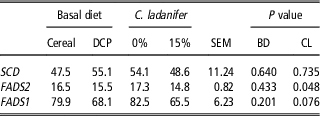
The mRNA of SCD gene in muscle was not affected by treatments but inclusion of C. ladanifer decreased (P=0.048) mRNA expression level of FADS2 and tended to decrease (P=0.076) mRNA expression level of FADS1 in muscle (Table 5). The activity of SCD enzyme, which was estimated computing the substrate to product FA ratios using the c9-16:1/16:0, c9-17:1/17:0, c9-18:1/18:0 and c9,t11-18:2/t11-18:1 product substrate pairs, was not affected by treatments (data not shown).
Effects of replacement of cereals by dehydrated citrus pulp (DCP) and of Cistus ladanifer (CL) inclusion in the diet on desaturase genes mRNA expression (arbitrary units) in m. longissimus of lambs

BD=basal diet effect; SCD=stearoyl-CoA desaturase; FADS2=fatty acid desaturase 2; FADS1=fatty acid desaturase 1.
Discussion
Growth performance, carcass and meat quality traits
Dehydrated citrus pulp can replace cereals in lamb finishing diets without depressing productive performance (Caparra et al., Reference Caparra, Foti, Scerra, Sinatra and Scerra2007; Rodrigues et al., Reference Rodrigues, Susin, Pires, Mendes, Urano and Castillo2008) and our results confirm that. Nevertheless, in spite of DM intake remained unchanged, a reduction on dressing percentage of carcasses was observed in lambs fed DCP diets. This might be due to the larger gastrointestinal volume (not evaluated), probably due to hygroscopic proprieties of DCP (Bampidis and Robinson, Reference Bampidis and Robinson2006). Large incorporation of DCP in low forage-finishing diets was associated to higher risk of rumen parakeratosis (Bampidis and Robinson, Reference Bampidis and Robinson2006). In the present trial, although almost half of the lambs presented some signals of parakeratosis, the intensity of lesions was low and not associated to the diets. The short duration of the trial (6 weeks) may impaired the full expression of a negative impact of the diet on rumen parakeratosis. Replacing cereals with DCP slightly reduced the tenderness of meat, in accordance to Lanza et al. (Reference Lanza, Priolo, Biondi, Bella and Salem2001). Nevertheless, the overall acceptability of the meat was not affected by replacing the cereals by DCP in the diet.
C. ladanifer has a high concentration of condensed tannins and other secondary metabolic compounds and a low nutritive value (Guerreiro et al., Reference Guerreiro, Dentinho, Moreira, Guerra, Ramos, Bessa, Duarte and Jerónimo2016). Despite that, when included in the diet replacing the forage, it did not reduce the productive performance, confirming previous reports (Jerónimo et al., Reference Jerónimo, Alves, Dentinho, Martins, Prates, Vasta, Santos-Silva and Bessa2010; Francisco et al., Reference Francisco, Alves, Portugal, Pires, Dentinho, Alfaia, Jerónimo, Prates, Santos-Silva and Bessa2015). Meat shear force increased 1 kg due to C. ladanifer inclusion, which is in accordance to the reduction of 14% on tenderness score. These results suggest that somehow phenolic compounds derived from CL might interfere in early postmortem proteolysis of meat, eventually by reducing the activity of µ-calpains or increasing the cross-linking of myofibrillar proteins (Lund et al., Reference Lund, Heinonen, Baron and Estevéz2011). The juiciness and overall acceptability of the meat from lambs fed C. ladanifer were also negatively affected. In previous experiments (Jerónimo et al., Reference Jerónimo, Alfaia, Alves, Dentinho, Prates, Vasta, Santos-Silva and Bessa2012; Francisco et al., Reference Francisco, Alves, Portugal, Pires, Dentinho, Alfaia, Jerónimo, Prates, Santos-Silva and Bessa2015), meat acceptability was not affected by the inclusion of C. ladanifer in lamb’s diet.
Dietary phenolic compounds have been reported to increase the oxidative stability of lipids and colour persistence of meat during storage, backing up results reported for DCP (Inserra et al., Reference Inserra, Priolo, Biondi, Lanza, Bognanno, Gravador and Luciano2014) and C. ladanifer (Jerónimo et al., Reference Jerónimo, Alfaia, Alves, Dentinho, Prates, Vasta, Santos-Silva and Bessa2012; Francisco et al., Reference Francisco, Alves, Portugal, Pires, Dentinho, Alfaia, Jerónimo, Prates, Santos-Silva and Bessa2015). However, in the present experiment such effects were not observed, suggesting that they are inconsistent and probably dependent on uncontrolled factors such the balance between pro-oxidant and antioxidant agents.
Meat fatty acid composition
The main hypothesis being tested was that the proportion of t11-18:1 and c9,t11-18:2 in meat can be increased and the t10-shift can be prevented by the reduction of starch and the inclusion of a source of tannins in lambs diet. Contrarily to the expectations t11-18:1 and c9,t11-18:2 concentrations in meat did not increase when DCP replaced cereals. In fact, the least square means of t11-18:1 and c9,t11-18:2 were quite high and similar among treatments. However, with C0 treatment a large individual variability of t10-18:1, t11-18:1 and c9,t11-18:2 was observed contrasting to the lower variability with DCP0 (Figure 1). This is in line with the variance pattern of the t10-18:1 and t10/t11 ratio (Figure 2). The large individual variability in expressing the t10-shift has been described and discussed previously (Bessa et al., Reference Bessa, Alves and Santos-Silva2015). It is clear that despite the 1 : 1 forage to concentrate ratio of the diets, the starch concentration of 22.5 and 20.9 g/kg DM in C0 and C15 diets, respectively, coupled with soybean oil, predisposed to the establishment of t10-shifted rumen BH pathways. Reducing starch, replacing cereals by DCP seems to prevent it. The effects of reducing dietary starch in vivo are confounded with the effects of low rumen pH resulting from the rapid fermentation of starch in the rumen. In vitro studies proved that both low rumen pH (≈6 v. ≈7) (Troegeler-Meynadier et al., Reference Troegeler-Meynadier, Nicot, Bayourthe, Moncoulon and Enjalbert2003) and starch promote the accumulation of t10-18:1 (Maia et al., Reference Maia, Bessa and Wallace2009). Very few bacterial strains able to isomerize 18:2n-6 to t10,c12-18:2 were isolated (Lourenço et al., Reference Lourenço, Ramos-Moralez and Wallace2010) and the bacteria responsible of such extensive shift in rumen BH pathways are probably yet uncultured (Zened et al., Reference Zened, Combes, Cauquil, Mariette, Klopp, Troegeler-Meynadier and Enjalbert2013). The effect of replacing cereals by DCP on mitigation of the rumen t10-shift is scarcely explored in the literature. The replacement of cereals by DCP in oil supplemented diets, reduced the t10-18:1 and increased the t11-18:1 and c9,t11-18:2 in milk from dairy cows (Eifert et al., Reference Eifert, Lana, Lanna, Teixeira, Arcuri, Leao, de Oliveira and Valadares2006) and from dairy ewes (Santos-Silva et al., 2016). Apparently, dietary sugar supplied by DCP might be less effective in inducing the t10-shift in the rumen than starch supplied by cereals (Santos-Silva et al., 2016). Nevertheless, diets for dairy cows or ewes must contain a minimum level of physical effective fibre, whereas common lamb finishing diets do not. As far as we know, this is the first report about the replacement of cereals by DCP in oil supplemented finishing diets for lambs that provides detailed information on trans-18:1 isomers. Recently, Lanza et al. (Reference Lanza, Scerra, Bognanno, Buccioni, Cilione, Biondi, Priolo and Luciano2015) studied the partial replacement of cereals by DCP in lamb finishing diets but not supplemented with PUFA. They reported that all treatments induced a clear t10-shift in the rumen fluid, with t10/t11 ratios ranging from 3.2 with 0% DCP to 1.4 with 35% DCP diets. Simultaneously, they observed an increase of t11-18:1 and c9,t11-18:2 in plasma and meat (the t10-18:1 proportion was not reported), suggesting that the intensity of t10-shift was mitigated by the gradual increase of DCP in the diets.
The effect of including C. ladanifer in the diets on meat FA was not clear. We anticipated that it would increase the deposition of BH intermediates in meat lipids, due to the inhibitory effect of tannins on the stearic acid producers biohydrogenating bacteria, thus on the last reductive step of BH (Khiaosa-Ard et al., Reference Khiaosa-Ard, Bryner, Scheeder, Wettstein, Leiber, Kreuzer and Soliva2009). However, this was not confirmed, as C. ladanifer decreased the BH intermediates and increased the 18:0 when included in cereal diets and had no effect when included in DCP diets. In a previous experiment with lambs fed with cereal-based diets, it was observed that C. ladanifer increased the deposition of t10-18:1 and total BH intermediates in meat (Francisco et al., Reference Francisco, Dentinho, Alves, Portugal, Fernandes, Sengo, Jerónimo, Oliveira, Costa, Sequeira, Bessa and Santos-Silva2016). The opposite trend that was observed now, can be linked to the low condensed tannins proportion in the diets. The level of condensed tannins in the diets with 15% of C. ladanifer was about 5 g/kg DM, which is much lower than the value of 9 g/kg DM reported by Francisco et al. (Reference Francisco, Dentinho, Alves, Portugal, Fernandes, Sengo, Jerónimo, Oliveira, Costa, Sequeira, Bessa and Santos-Silva2016) for a diet with 10% of C. ladanifer. Another possible explanation could be linked to the slightly lower unsaturated C18 FA average intake achieved with the diets containing C. ladanifer. The slight decrease in unsaturated C18 FA intake when C. ladanifer was included in the DCP diet may further explain partially the lack of promotion of deposition of t11-18:1 and c9,t11-18:2 in tissues. Nevertheless, the reduction of unsaturated C18 FA intake was small and was not reflected in the proportion of PUFA in the meat.
In lipid supplemented ruminants the de novo FA synthesis is depressed (Bessa et al., Reference Bessa, Alves and Santos-Silva2015) and a large amount of 18:0 is available through intestinal absorption for incorporation in tissues lipids and subsequent desaturation into c9-18:1. The inclusion of C. ladanifer to cereal diet and the replacement of cereal by DCP increased the BH completeness (i.e. proportion of dietary unsaturated C18 FA that is completely hydrogenated into 18:0). This is suggested by the increased proportion of 18:0 in meat FA, coupled with the absence of effects on the proportion of c9-18:1, when C0 is compared with both C15 and DCP0 treatments. Thus, the replacement of cereals by DCP seems to improve the BH completeness, probably due to mitigation of low pH conditions in the rumen (Troegeler-Meynadier et al., Reference Troegeler-Meynadier, Nicot, Bayourthe, Moncoulon and Enjalbert2003). The inclusion of C. ladanifer to cereal diet might also moderate the fermentation rate and the consequent decrease of rumen pH. Surprisingly, there is no additive effect on 18:0 level between C. ladanifer inclusion and cereal replacement by DCP.
Fatty acid desaturase gene expression
The concentration of c9,t11-18:2 in tissues mostly depends of the availability of t11-18:1 substrate and of the activity of SCD (Bessa et al., Reference Bessa, Alves and Santos-Silva2015). We did not detect any differences among treatments on SCD gene expression or on SCD activity evaluated by substrate and products FA ratios, suggesting that DCP had a similar effect than cereals on SCD.
The expression of the gene FADS2 was reduced and of FADS1 tended to be reduced by the inclusion of C. ladanifer in the diets. These genes codify for the Δ6 and Δ5 desaturases which are responsible for the conversion of C18 PUFA in their LC-PUFA metabolites (Alvarenga et al., Reference Alvarenga, Chen, Furusho-Garcia, Perez and Hopkins2015). These results may explain the apparent contradiction in the effect of CL in 18:3n-3, considering that despite the lower average intake, the proportion in the meat showed a tendency to increase.
In conclusion the replacement of cereals by DCP in high oil finishing diets with 1 : 1 forage to concentrate ratio is compatible with high productive performance and good carcass and meat quality of lambs. Moreover, it allowed a more homogeneous t11-18:1 and c9,t11-18:2 proportions in meat, preventing the occurrence of t10-shift. The inclusion of C. ladanifer reduced the meat tenderness and did not present any clear effect on promoting the t11-18:1 and c9,t11-18:2 concentration in lamb meat.
Acknowledgements
Financial support through the grant numbers PTDC/CVT/103934/2008 and UID/CVT/00276/2013 and individual fellowships to A.F. (SFRH/BD/68773/2010), S.P.A. (SFRH/BPD/76836/2011), E.J. (SFRH/BPD/74527/2010), V.M.R.P. (2013 FCT Investigator–Starting Grant) from Fundação para a Ciência e Tecnologia are acknowledged.
Supplementary material
To view supplementary material for this article, please visit https://doi.org/10.1017/S1751731117002269