1 Introduction and main results
1.1 A brief historical background
For
 $s\in (0,\infty )$
and
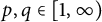 $p,q\in [1,\infty )$
, the homogeneous Besov space
 $\dot \Lambda ^{s}_{p,\,q}({{{\mathbb R}}^n})$
is defined to be the set of all locally integrable functions f on
 ${{{\mathbb R}}^n}$
such that
 $$ \begin{align*}\|f\|_{\dot\Lambda^{s}_{p,\,q}({{{\mathbb R}}^n})}:=\left[\int_{{{{\mathbb R}}^n}}\left(\int_{{{\mathbb R}}^n}\left|\mathrm{D}_h^{\lfloor s\rfloor+1}f(x)\right|{}^p\,dx\right)^{q/p}\,\frac{dh}{|h|^{n+sq}}\right]^{1/q}<\infty,\end{align*} $$
where
 $\lfloor s\rfloor $
denotes the largest integer no more than s and for any
 $k\in {\mathbb N}$
the symbol
 $\mathrm {D}_h^kf$
represents the k-th difference of f, that is,
 $$ \begin{align} \mathrm{D}_h^k f(x):=\sum_{m=0}^k (-1)^{k-m} \binom km f(x+mh). \end{align} $$
The inhomogeneous Besov space
 $\Lambda ^{s}_{p,\,q}({{{\mathbb R}}^n})$
is the intersection of
 $L^p({{{\mathbb R}}^n})$
and
 $\dot \Lambda ^{s}_{p,\,q}({{{\mathbb R}}^n})$
, endowed with the norm
 $$ \begin{align*}\|f\|_{\Lambda^{s}_{p,\,q}({{{\mathbb R}}^n})}:=\|f\|_{L^p({{{\mathbb R}}^n})}+\|f\|_{\dot\Lambda^{s}_{p,\,q}({{{\mathbb R}}^n})}.\end{align*} $$
When
 $p=q$
, the space
 $\Lambda ^s_{p,\,p}({{{\mathbb R}}^n})$
is known as the fractional Sobolev space and also called Aronszajn, Gagliardo, or Slobodeckij spaces in literature. We refer the readers to [Reference Peetre38, Reference Triebel45] and [Reference Di Nezza, Palatucci and Valdinoci14] for detailed expositions of Besov spaces.
Besov spaces arise naturally as the trace of the Bessel potential function spaces. For an integrable function f on
 ${{{\mathbb R}}^n}$
, its Fourier transform
 $\hat {f}$
is defined by setting
 $$ \begin{align*}\hat{f}(\xi):=\int_{{{\mathbb R}}^n} f(x) e^{-2\pi i x\cdot\xi}\, dx\quad\text{for all}\ \ \xi\in{{{\mathbb R}}^n}.\end{align*} $$
Recall that, for
 $s\in (0,\infty )$
and
 $p\in [1,\infty )$
, the Bessel potential space
 $L_{s}^{p}({{{\mathbb R}}^n})$
is defined by
 $$ \begin{align*}L_{s}^{p}({{{\mathbb R}}^n}):=\{G_s \ast f:\ f\in L^p({{{\mathbb R}}^n})\},\end{align*} $$
where
 $G_s$
is the kernel of the Bessel potential whose Fourier transform is
 $$ \begin{align*}\hat{G_s}(x):=(1+|x|^2)^{-\frac s 2}\quad\text{for all}\ \ x\in{{{\mathbb R}}^n}.\end{align*} $$
If
 $u=G_s \ast f$
for some
 $f\in L^p({{{\mathbb R}}^n})$
, then define
 $$ \begin{align*}\|u\|_{L_s^{p}({{{\mathbb R}}^n})}:=\|f\|_{L^p({{{\mathbb R}}^n})}.\end{align*} $$
In particular, if
 $p\in (1,\infty )$
and
 $k\in {\mathbb N}$
, then
 $L_{k}^{p}({{{\mathbb R}}^n})$
coincides to the classical Sobolev space
 $W^{k,\,p}({{{\mathbb R}}^n})$
and
 $$ \begin{align*}\|u\|_{W^{k,\,p}({{{\mathbb R}}^n})}:=\sum_{|\alpha|\le k}\|\partial^\alpha u\|_{L^p({{{\mathbb R}}^n})} \approx\|u\|_{L_{k}^{p}({{{\mathbb R}}^n})}.\end{align*} $$
Note that
 $\Lambda ^{s}_{2,\,2}({{{\mathbb R}}^n})=L_s^2({{{\mathbb R}}^n})$
(see [Reference Stein41]). For
 $p\in (1,\infty )$
, the Besov space
 $\Lambda ^s_{p,\,p}({{{\mathbb R}}^n})$
coincides with the trace (restriction to
 ${{{\mathbb R}}^n}$
) of the Bessel potential function spaces
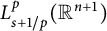 $L_{s+1/p}^p({\mathbb R}^{n+1})$
(see, for example, [Reference Frazier and Jawerth23, Theorem 11.1] or [Reference Triebel45, p. 138, Remark 1]).
The well-known extension-restriction theorem of Stein (see [Reference Stein42] or [Reference Stein43, p. 193]) says that, under
 $s\in (0,\infty )$
,
 $p\in (1,\infty )$
and
 $m>n$
, there exist a bounded linear extension operator
 $$ \begin{align*}\mathcal{E}:\ \Lambda^s_{p,\,p}({{{\mathbb R}}^n})\to L_{s+(m-n)/p}^{p}({\mathbb R}^m)\end{align*} $$
and a bounded linear restriction operator
 $$ \begin{align*}\mathcal{R}:\ L_{s+(m-n)/p}^{p}({\mathbb R}^m)\to\Lambda^s_{p,\,p}({{{\mathbb R}}^n})\end{align*} $$
such that
 $$ \begin{align*}\mathcal{R}\circ\mathcal{E}=id.\end{align*} $$
This extension-restriction result was proved by Gagliardo [Reference Gagliardo25] when
 $s=1$
and
 $p\in (1,\infty )$
, and by Aronszajn–Smith [Reference Aronszajn and Smith4] when
 $s\in (0,\infty )$
and
 $p=2$
.
Adams [Reference Adams1] established an analogous extension-restriction theorem for general Besov spaces by terms of the mixed-Riesz potential spaces. For
 $\beta \in {\mathbb R}$
and
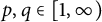 $p,q\in [1,\infty )$
, the mixed-norm Lebesgue space
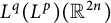 $L^q(L^p)({\mathbb R}^{2n})$
is consisting of all locally integrable functions f on
 ${\mathbb R}^{2n}$
such that
 $$ \begin{align*}\|f\|_{L^q(L^p)({\mathbb R}^{2n})}:= \left[\int_{{{\mathbb R}}^n}\left(\int_{{{\mathbb R}}^n}|f(x,y)|^p\,dx\right)^{q/p}\,dy\right]^{1/q}<\infty,\end{align*} $$
and the mixed-Riesz potential space
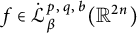
 $\dot {\mathcal {L}}^{p,\,q}_\beta ({\mathbb R}^{2n})$
is defined by
 $$ \begin{align*}\dot{\mathcal{L}}^{p,\,q}_\beta({\mathbb R}^{2n}):=\left\{(-\varDelta_{{{\mathbb R}}^{2n}})^{-\beta/2} f:\ f\in L^q(L^p)({\mathbb R}^{2n})\right\},\end{align*} $$
where
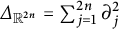 $\varDelta _{{{\mathbb R}}^{2n}}=\sum _{j=1}^{2n}\partial _j^2$
is the Laplace operator on
 ${\mathbb R}^{2n}$
. Adams [Reference Adams1, Theorem 5.2] (see also [Reference Adams and Xiao2, Theorem A]) show that there exist a bounded linear extension operator
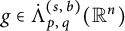
 $$ \begin{align*}\mathcal{E}:\ \dot \Lambda^s_{p,\,q}({{{\mathbb R}}^n})\to \dot{\mathcal{L}}_{s+n/q}^{p,\,q}({\mathbb R}^{2n})\end{align*} $$
and a bounded linear restriction operator
 $$ \begin{align*}\mathcal{R}:\ \dot{\mathcal{L}}_{s+n/q}^{p,\,q}({\mathbb R}^{2n})\to\dot \Lambda^s_{p,\,q}({{{\mathbb R}}^n}) \end{align*} $$
such that
 $$ \begin{align*}\mathcal{R}\circ\mathcal{E}=id.\end{align*} $$
It should be remarked that the study of the mixed-norm Lebesgue spaces can be traced back to [Reference Benedek and Panzone5, Reference Hörmander32] and has attracted lots of attention recently (see [Reference Chen and Sun8–Reference Cleanthous, Georgiadis and Nielsen10, Reference Huang, Liu, Yang and Yuan33]). Moreover, the aforementioned extension-restriction theorem on Besov spaces can further be applied to establish capacitary inequalities and embedding properties of Besov spaces (see [Reference Adams1, Reference Adams and Xiao2]).
Note that functions in the Besov space
 $\dot \Lambda ^s_{p,\,q}({{{\mathbb R}}^n})$
enjoy a polynomial smoothness
 $|h|^s$
, but function spaces with generalized smoothness have also attracted lots of attention since Gol’dman [Reference Gol’dman26, Reference Gol’dman27] and Kalyabin [Reference Kalyabin34, Reference Kalyabin35]. We refer the reader to [Reference Farkas and Leopold22] for a review on the earlier development on this topic. In particular, Edmunds and Haroske [Reference Edmunds and Haroske19, Reference Edmunds and Haroske20, Reference Haroske30, Reference Haroske and Moura31] introduced and investigated the logarithmic Besov spaces with both polynomial smoothness and logarithmic smoothness (see also [Reference Caetano, Gogatishvili and Opic6, Reference Caetano, Gogatishvili and Opic7, Reference Edmunds and Triebel21, Reference Leopold36]). Recently, Cobos–Domínguez–Triebel–Tikhonov [Reference Cobos and Domínguez11–Reference Cobos, Domínguez and Triebel13, Reference Domínguez and Tikhonov16] focus on the limiting case of the logarithmic Besov spaces which has polynomial smoothness zero.
Motivated by the above discussion, our main goal in this article is to extend the extension-restriction theorem of Stein [Reference Stein42] and Adams [Reference Adams1] to Besov type spaces with generalized smoothness. We will consider a general Besov space with a radial weight w acting on the variable
 $|h|$
(see Definition 1.1 below), so that to cover both classical Besov spaces and logarithmic Besov spaces. Upon introducing a weighted mixed-Riesz potential space (see Definition 1.4 below), we are aiming to establish an extension-restriction theorem between homogeneous weighted Besov spaces and weighted mixed-Riesz potential spaces, which can recover Stein [Reference Stein42, Reference Stein43] and Adams [Reference Adams1] (see also Adams and Xiao [Reference Adams and Xiao2]). Such an extension-restriction theorem is supposed to be useful in the further study of capacitary inequalities involving the weighted Besov capacity.
1.2 Weighted Besov spaces and weighted mixed-Riesz potential spaces
A weight is a positive locally integrable function on
 ${{{\mathbb R}}^n}$
. For a weight w and a number
 $p\in (0,\infty )$
, the weighted Lebesgue space
 $L_{w}^{p}({{{\mathbb R}}^n})$
is defined to be the set of all Lebesgue-measurable functions f on
 ${{{\mathbb R}}^n}$
such that
 $$ \begin{align*} \|f\|_{L_{w}^{p}({{{\mathbb R}}^n})} := \left(\int_{{{{\mathbb R}}^n}}\left|f(x)\right|{}^{p}w(x)\, dx\right)^{1/p} < \infty. \end{align*} $$
If
 $w\equiv 1$
, then we simply write
 $L^p({{{\mathbb R}}^n})$
and
 $\|\,\cdot \,\|_{L^p({{{\mathbb R}}^n})}$
. The weighted Besov space is defined as below.
Definition 1.1 Let
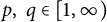 $p,\ q\in [1,\infty )$
,
 $s\in (0,\infty )$
,
 $k\in {\mathbb N}$
and w be a weight on
 ${{{\mathbb R}}^n}$
. For any Lebesgue-measurable function f on
 ${{{\mathbb R}}^n}$
, set
 $$ \begin{align*} \|f\|_{\dot{\Lambda}_{p,\, q,\,w}^{s,\, k}({{{\mathbb R}}^n})} := \left( \int_{ {{{\mathbb R}}^n} } \frac{\|{\mathrm{D}}_{h}^{k}f \|_{L^p({{{\mathbb R}}^n})}^{q}}{|h|^{n+sq}} w(h)\, dh \right)^{1/q}. \end{align*} $$
The inhomogeneous weighted Besov space
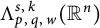 $\Lambda _{p,\, q,\,w}^{s,\,k}({{{\mathbb R}}^n})$
is defined to be the collection of all functions
 $f\in L^p({{{\mathbb R}}^n})$
such that
 $$ \begin{align*} \|f\|_{\Lambda_{p,\, q,\, w}^{s,\,k}({{{\mathbb R}}^n})}:= \|f\|_{L^p({{{\mathbb R}}^n})}+ \|f\|_{\dot{\Lambda}_{p,\, q,\, w}^{s,\,k}({{{\mathbb R}}^n})}<\infty. \end{align*} $$
The homogeneous weighted Besov space
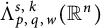 $\dot {\Lambda }_{p,\, q,\, w}^{s,\, k}({{{\mathbb R}}^n})$
is defined to be the completion of
 $C_c^\infty ({{{\mathbb R}}^n})$
under the semi-norm
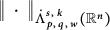
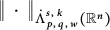 $\|\,\cdot \,\|_{\dot {\Lambda }_{p,\, q,\,w}^{s,\, k}({{{\mathbb R}}^n})}$
, where
 $C_c^\infty ({{{\mathbb R}}^n})$
is the space of all infinitely differentiable functions on
 ${{{\mathbb R}}^n}$
with compact support. In particular, if
 $k= \lfloor s\rfloor +1$
, then we simply write
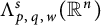 ${\Lambda }_{p,\, q,\, w}^{s}({{{\mathbb R}}^n})$
and
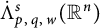 $\dot {\Lambda }_{p,\, q,\, w}^{s}({{{\mathbb R}}^n})$
, respectively.
Remark 1.2 The reasonability of Definition 1.1 can be seen from Lemma 2.2 below. Moreover, we present here a four-fold comment on Definition 1.1:
-
(i) If
 $w\equiv 1$
and
$k= \lfloor s\rfloor +1$
, then Definition 1.1 defines the classical inhomogeneous Besov space
$\Lambda ^s_{p,\,q}({{{\mathbb R}}^n})$
and the homogeneous Besov space
$\dot \Lambda ^s_{p,\,q}({{{\mathbb R}}^n})$
.
-
(ii) If
$w(h)=(\log (e+1/|h|))^{\gamma }$
with
$h\in {{{\mathbb R}}^n}$
and
${\gamma }\in {\mathbb R}$
, then
$\dot {\Lambda }_{p,\, q,\, w}^{s}({{{\mathbb R}}^n})$
is the logarithmic Besov space that has been systematically studied in [Reference Caetano, Gogatishvili and Opic6, Reference Caetano, Gogatishvili and Opic7, Reference Edmunds and Haroske19–Reference Edmunds and Triebel21, Reference Haroske30, Reference Haroske and Moura31, Reference Leopold36]. -
(iii) The spaces
$\dot {\Lambda }_{p,\, q,\, w}^{s}({{{\mathbb R}}^n})$
and
$\Lambda _{p,\, q,\, w}^{s}({{{\mathbb R}}^n})$
are known as Besov spaces of generalized smoothness in literature (see Section 2.3 below for more details). Let
$p,\ q\in [1,\infty )$
,
$k\in {\mathbb N,}$
and
$\lambda :(0,1)\rightarrow [0,\infty )$
be a non-decreasing, continuous function satisfying
$\lim _{t\to 0}\lambda (t)=0$
. Recall that Farkas and Leopold [Reference Farkas and Leopold22] introduced the Besov space
$B^\lambda _{p,\,q}({{{\mathbb R}}^n})$
with generalized soomthness
$\lambda $
, which is defined to be the set of all
$f\in L^p({{{\mathbb R}}^n})$
such that It is worth noting that when
$$ \begin{align*}\left[\int_0^1\left(\frac{\sup_{|h|<t}\|\mathrm{D}_h^kf\|_{L^p({{{\mathbb R}}^n})}}{\lambda(t)}\right)^q \,\frac{d\lambda(t)}{\lambda(t)}\right]^{1/q}<\infty.\end{align*} $$
$\lambda $
is differentiable and then the space
$$ \begin{align*}w(t)=t^{1+sq}\frac{\lambda'(t)}{\lambda(t)^{1+q}}\quad\text{for all}\ \,t\in(0,1),\end{align*} $$
$B^\lambda _{p,\,q}({{{\mathbb R}}^n})$
falls into the scope of Definition 1.1.
-
(iv) Recall that, for
$p,\ q\in [1,\infty ]$
and a weight
$\lambda :{\mathbb R}_+\rightarrow {\mathbb R}_+$
, Ansorena–Blasco [Reference Ansorena and Blasco3] define the space
$\Lambda _\lambda ^{p,\,q}({{{\mathbb R}}^n})$
to be the set of all measurable functions f on
${{{\mathbb R}}^n}$
such that with a usual modification made when
$$ \begin{align*}\|f\|_{\Lambda_\lambda^{p,\,q}({{{\mathbb R}}^n})}^q:=\int_{{{{\mathbb R}}^n}}\frac {\|f(\cdot+h)-f(\cdot)\|_{L^p({{{\mathbb R}}^n})}^q}{\lambda(|h|)^q}\,\frac{dh}{|h|^n}<\infty,\end{align*} $$
$q=\infty $
. Note that if
$s\in (0,1)$
and then
$$ \begin{align*}\lambda(|h|)=\frac{|h|^s}{[w(h)]^{1/q}}\quad{\text{for all}}\ h\in{{{\mathbb R}}^n},\end{align*} $$
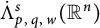
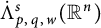
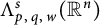
$\Lambda _\lambda ^{p,\,q}({{{\mathbb R}}^n})=\dot {\Lambda }_{p,\, q,\,w}^{s,\, 1}({{{\mathbb R}}^n})$
.














Definition 1.3 Let
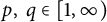
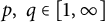
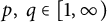 $p,\ q\in [1,\infty )$
and w be a weight on
 $ {{{\mathbb R}}^n} $
. Then, the weighted mixed Lebesgue space
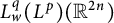 $L_w^q (L^p)({\mathbb R}^{2n})$
is defined to be the collection of all measurable functions f on
 ${\mathbb R}^{2n}$
satisfying
 $$ \begin{align*} \|f\|_{L_w^q (L^p)({\mathbb R}^{2n})} := \left( \int_{ {{{\mathbb R}}^n} } \left( \int_{ {{{\mathbb R}}^n} } |f(x,y)|^{p}\, dx \right)^{q/p} w(y)\, dy \right)^{1/q} < \infty. \end{align*} $$
Let
 ${\mathcal S}({\mathbb R}^{2n})$
be the space of Schwartz functions on
 ${\mathbb R}^{2n}$
, consisting of all functions
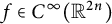 $f\in C^\infty ({\mathbb R}^{2n})$
such that
 $$ \begin{align*}\rho_{M,\alpha}(f):=\sup_{x\in{\mathbb R}^{2n}}(1+|x|)^{M}|\partial^{\alpha}f(x)|<\infty \quad{\text{for any}}\ M\in{\mathbb Z}_+\ \mathrm{and}\ \alpha\in{\mathbb Z}_{+}^{2n}.\end{align*} $$
Denote by
 ${\mathcal S}'({\mathbb R}^{2n})$
the dual space of
 ${\mathcal S}({\mathbb R}^{2n})$
, equipped with the weak-
 $\ast $
topology. Let
 ${\mathcal S}_\infty ({\mathbb R}^{2n})$
be the space of all Schwartz functions
 $\varphi $
with the property
 $$ \begin{align*}\int_{{{\mathbb R}}^{2n}}x^\gamma \varphi(x)\, dx=0\end{align*} $$
for all multi-indices
 $\gamma \in {\mathbb Z}_+^{2n}$
. Denote by
 ${\mathcal S}^{\prime }_\infty ({\mathbb R}^{2n})$
the dual space of
 ${\mathcal S}_\infty ({\mathbb R}^{2n})$
under the topology inherited from
 ${\mathcal S}({\mathbb R}^{2n})$
, and it is known that (see [Reference Sawano39, Section 2.4.1.4] or [Reference Grafakos28, Proposition 1.1.3])
 $$ \begin{align*}{\mathcal S}^{\prime}_\infty({\mathbb R}^{2n})={\mathcal S}'({\mathbb R}^{2n})/\mathcal{P}({\mathbb R}^{2n}),\end{align*} $$
where
 $\mathcal {P}({\mathbb R}^{2n})$
is the polynomial space on
 ${\mathbb R}^{2n}$
.
For the moment, we adopt the notation
 $^\wedge $
and
 $^\vee $
to denote the Fourier transform and its inverse on
 ${\mathbb R}^{2n}$
. Given any
 $\beta \in {\mathbb R}$
, the fractional Laplace operator
 $(-\varDelta _{{{\mathbb R}}^{2n}})^{\beta /2}$
can be defined on
 ${\mathcal S}({\mathbb R}^{2n})$
as follows: for any
 $\phi \in {\mathcal S}({\mathbb R}^{2n})$
,
 $$ \begin{align*}(-\varDelta_{{{\mathbb R}}^{2n}})^{\beta/2}\phi=\Big((2\pi|\cdot|)^{\beta}\,\hat{\phi}(\cdot)\Big)^\vee.\end{align*} $$
Of course,
 $(-\varDelta _{{{\mathbb R}}^{2n}})^{\beta /2}\phi \in {\mathcal S}_\infty ({\mathbb R}^{2n})$
when
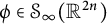 $\phi \in {\mathcal S}_\infty ({\mathbb R}^{2n})$
. Moreover, if
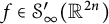 $f\in {\mathcal S}_\infty '({\mathbb R}^{2n})$
, then we have by duality that
 $$ \begin{align} \left\langle(-\varDelta_{{{\mathbb R}}^{2n}})^{\beta/2}f,\ \phi\right\rangle=\left\langle f,\ (-\varDelta_{{{\mathbb R}}^{2n}})^{\beta/2} \phi\right\rangle\quad \text{for all}\ \phi\in {\mathcal S}_\infty({\mathbb R}^{2n}). \end{align} $$
Definition 1.4 Let
 $p\in [1,\, \infty ),\, q \in (1,\, \infty )$
,
 $\beta \in {\mathbb R}$
and w be a weight on
 $ {{{\mathbb R}}^n} $
. Then, the weighted mixed-Riesz potential space is defined by setting
 $$ \begin{align*} \dot{\mathcal{L}}_{\beta}^{p,\, q,\, w}({\mathbb R}^{2n}):= \left\{f:\ f=(-\varDelta_{{{\mathbb R}}^{2n}})^{-\beta/2}\phi\ \ \mathrm{with}\ \ \phi \in L_w^q (L^p)({\mathbb R}^{2n}) \right\}, \end{align*} $$
equipped with the norm
 $$ \begin{align*} \|f\|_{\dot{\mathcal{L}}_{\beta}^{p,\, q,\, w}({\mathbb R}^{2n})} :=\| \phi \|_{L_w^q (L^p)({\mathbb R}^{2n})}. \end{align*} $$
If
 $\beta =0$
, then we take it for granted that
 $\dot {\mathcal {L}}_{0}^{p,\, q,\, w}({\mathbb R}^{2n}) = L_w^q (L^p)({\mathbb R}^{2n})$
.
Remark 1.5 Let
 $p\in [1,\, \infty )$
and
 $q \in (1,\, \infty )$
. For general functions
 $\phi \in L_w^q (L^p)({\mathbb R}^{2n})$
, the element
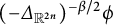 $(-\varDelta _{{{\mathbb R}}^{2n}})^{-\beta /2}\phi $
is understood as in (1.2). This is reasonable because of the continuous embedding
 $L_w^q (L^p)({\mathbb R}^{2n})\hookrightarrow {\mathcal S}'({\mathbb R}^{2n})$
(see Lemma 2.1 below). If
 $\beta \in (0,2n)$
, then
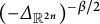 $(-\varDelta _{{{\mathbb R}}^{2n}})^{-\beta /2}$
is known as the Riesz potential operator on
 ${\mathbb R}^{2n}$
and it has an integration kernel (see [Reference Stein43, p. 117])
 $$ \begin{align*} I_\beta^{(2n)}(x):=\left(\frac{\Gamma(\frac{2n-\beta}2)}{2^{\beta}\pi^{n} \Gamma(\frac \beta 2)}\right)|x|^{\beta-2n}, \end{align*} $$
thereby leading to that for all
 $\varphi \in {\mathcal S}({\mathbb R}^{2n})$
and for all
 $x\in {\mathbb R}^{2n}$
,
 $$ \begin{align} \left((-\varDelta_{{{\mathbb R}}^{2n}})^{-\beta/2}\varphi\right)(x)= I_\beta^{(2n)}\ast \varphi(x)= \left(\frac{\Gamma(\frac{2n-\beta}2)}{2^{\beta}\pi^{n} \Gamma(\frac \beta 2)}\right)\int_{{\mathbb R}^{2n}}|x-y|^{\beta-2n}\varphi(y)\,dy. \end{align} $$
Clearly, if
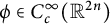 $\phi \in C_c^\infty ({\mathbb R}^{2n})$
, then
 $I_{\beta }^{(2n)} \ast \phi \in \dot {\mathcal {L}}_{\beta }^{p,\, q,\, w}({\mathbb R}^{2n})$
, which induces (see Corollary 2.4 below)
 $$ \begin{align*} \dot{\mathcal{L}}_{\beta}^{p,\, q,\, w}({\mathbb R}^{2n})= \overline{\left\{I_{\beta}^{(2n)} \ast \phi:\ \phi \in C_c^\infty({\mathbb R}^{2n}) \right\}}^{ \|\,\cdot\,\|_{\dot{\mathcal{L}}_{\beta}^{p,\, q,\, w}({\mathbb R}^{2n})}}. \end{align*} $$
To ensure the validity of the integral expression (1.3) for general locally integrable functions
 $\phi $
, one needs to require that
 $$ \begin{align*} \int_{{{\mathbb R}}^{2n}}\int_{{{\mathbb R}}^{2n}}I_\beta^{(2n)}(x-y) |\phi(x)\psi(y)|\,dx\,dy<\infty \end{align*} $$
for all
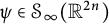 $\psi \in {\mathcal S}_\infty ({\mathbb R}^{2n})$
, so that the Fubini theorem can be applied to derived that
 $$ \begin{align*} \left\langle (-\varDelta_{{{\mathbb R}}^{2n}})^{-\beta/2}\phi,\ \psi\right\rangle&=\left\langle\phi,\ (-\varDelta_{{{\mathbb R}}^{2n}})^{-\beta/2}\psi\right\rangle\\ &=\int_{{{\mathbb R}}^{2n}}\phi(x) \left(\int_{{{\mathbb R}}^{2n}}I_\beta^{(2n)}(x-y)\psi(y)\,dy\right)\,dx\\ &=\int_{{{\mathbb R}}^{2n}} \left(\int_{{{\mathbb R}}^{2n}}I_\beta^{(2n)}(y-x)\phi(x)\,dx\right)\psi(y)\,dy\\ &=\left\langle I_\beta^{(2n)}\ast \phi,\ \psi\right\rangle \end{align*} $$
and, hence, the integral definition of
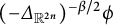 $(-\varDelta _{{{\mathbb R}}^{2n}})^{-\beta /2}\phi $
in (1.3) coincides with the one in (1.2) as a distribution in
 $\mathcal S_\infty '({\mathbb R}^{2n})$
.
1.3 Main results
We, first, recall the classical Muckenhoupt weight class (see [Reference Grafakos28, Chapter 7]). A weight w is said to be an
 $A_{p}$
weight if
 $$ \begin{align*} [w]_{A_{p}} :=\sup_{\text{cube}\, Q\subset {{{\mathbb R}}^n} } \left( \frac{1}{|Q|} \int_{Q} w(x)\, dx\right) \left( \frac{1}{|Q|} \int_{Q} [w(x)]^{- \frac{1}{p-1}}\, dx\right)^{p-1} < \infty\quad\text{as}\ \ p\in(1,\infty) \end{align*} $$
and
 $$ \begin{align*} [w]_{A_1} := \sup_{\text{cube}\, Q\subset {{{\mathbb R}}^n} } \left( \frac{1}{|Q|} \int_{Q} w(x)\, dx\right) \|w^{-1}\|_{L^{\infty}(Q)} < \infty\quad\text{as}\ \ p=1. \end{align*} $$
Denote
 $$ \begin{align*}A_\infty=\bigcup_{p\in[1,\infty)} A_p.\end{align*} $$
Throughout the whole article, for a radial weight w, we simply write
 $w(x)$
as
 $w(t)$
whenever
 $|x|=t$
.
The main result of this article is the following extension-restriction theorem between homogeneous weighted Besov spaces and weighted mixed-Riesz potential spaces.
Theorem 1.6 Let
 $p \in [1, \infty )$
,
 $q\in (1,\infty )$
,
 $s \in (0, \infty )$
,
 $\beta =s+ n/q\in (0,\infty )$
and
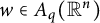 $w\in A_{q}( {{{\mathbb R}}^n} )$
be a radial weight on
 $ {{{\mathbb R}}^n} $
satisfying
 $$ \begin{align} \int_{0}^{1}t^{\sigma q}\, \left(\sup_{\rho \in (0, \infty)} \frac{w(t\rho)}{w(\rho)}\right)\frac{dt}{t} < \infty \quad\text{for some}\ \sigma<\lfloor s\rfloor +1-s \end{align} $$
and
 $$ \begin{align} \int_1^{\infty}t^{\delta q}\, \left(\sup_{\rho \in (0, \infty)} \frac{w(t\rho)}{w(\rho)}\right)\frac{dt}{t} < \infty \quad\text{for some}\ \delta>-s. \end{align} $$
Then, the following hold:
-
(i) there exists a bounded linear extension operator
such that, for any
$$ \begin{align*}\mathcal{E}: \, \dot{\Lambda}_{p,\, q,\, w}^{s}({{{\mathbb R}}^n})\to \dot{\mathcal{L}}_{\beta}^{p,\, q,\, w}({\mathbb R}^{2n}),\end{align*} $$
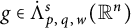
$g \in \dot {\Lambda }_{p,\, q,\,w}^{s}({{{\mathbb R}}^n})$
, where
$$ \begin{align*}\|\mathcal{E}g\|_{\dot{\mathcal{L}}_{\beta}^{p,\, q,\, w} ({\mathbb R}^{2n})}\leq C_1\|g\|_{\dot{\Lambda}_{p,\, q,\, w}^{s}({{{\mathbb R}}^n})},\end{align*} $$
$C_1$
is a positive constant independent of g;
-
(ii) there exists a bounded linear restriction operator
such that, for any
$$ \begin{align*}\mathcal{R}: \, \dot{\mathcal{L}}_{\beta}^{p,\, q,\, w}({\mathbb R}^{2n}) \to \dot{\Lambda}_{p,\, q,\,w}^{s}({{{\mathbb R}}^n}),\end{align*} $$
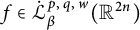
$f \in \dot {\mathcal {L}}_{\beta }^{p,\, q,\, w}({\mathbb R}^{2n})$
, where
$$ \begin{align*}\|\mathcal{R}f\|_{\dot{\Lambda}_{p,\, q,\,w}^{s}({{{\mathbb R}}^n})} \leq C_2\|f\|_{\dot{\mathcal{L}}_{\beta}^{p,\, q,\, w}({\mathbb R}^{2n})},\end{align*} $$
$C_2$
is a positive constant independent of f. Moreover,
$\mathcal {R}\mathcal {E}=id.$





The article is organized as follows. In Section 2, we establish several auxiliary lemmas, including the continuous embeddings of the Schwartz function spaces into the weighted mixed Lebesgue spaces and then into the Schwartz distribution spaces, the density of
 $C_c^\infty ({{{\mathbb R}}^n})$
in both the inhomogeneous weighted Besov spaces and the weighted mixed-Riesz potential spaces, as well as the Fourier analytic equivalent characterizations of the weighted Besov spaces. Section 3 focuses on the proof of Theorem 1.6 by considering the case
 $\beta \in (0, 2n)$
and
 $\beta \in [2n,\infty )$
, respectively. Finally, in Section 4, we consider the homogeneous logarithmic Besov spaces as an example.
Notation. In the previous and forthcoming discussions, we adopt the following notion:
-
• Suppose
${\mathbb N}=\{1,2,\dots \}$
,
${\mathbb Z}=\{0,\pm 1,\pm 2,\dots \},$
and
${\mathbb Z}_+=\{0,1,2,\dots \}$
. -
• For any
$a,b\in {\mathbb R}$
, let
$a \wedge b:=\min \{a,b\}$
and
$a \vee b:=\max \{a,b\}$
. -
• For any
$p\in [1,\infty ]$
, denote by
$p'$
its conjugate index, namely,
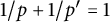
$1/p+1/p'=1$
. -
• The symbol
${0}$
may denote the real number zero, or the origin of the Euclidean space
${{{\mathbb R}}^n}$
, depending on the context in which it is used. -
• If E is a subset of
${{{\mathbb R}}^n}$
, then
$|E|$
denotes the Lebesgue measure of E, and
${\mathbf 1}_E$
is the characteristic function of E. -
• We always use
$|x|$
to denote the Euclidean norm of a vector x, no matter it is in
${{{\mathbb R}}^n}$
or
${\mathbb R}^{2n}$
. The reader can distinguish what it really means from the context. -
• A multi-index
$\alpha $
can be an n-tuple or a
$2n$
-tuple of nonnegative integers. For example, if
$\alpha $
is an n-tuple multi-index, then
$\alpha =(\alpha _1, \dots , \alpha _n)\in {\mathbb Z}_+^n$
and
$\partial ^{\alpha }f:=\partial _1^{\alpha _1}\cdots \partial _{n}^{\alpha _n}f$
, where
$\partial _i=\partial _{x_i}$
for
$i=1,2,\dots ,n$
. -
• For
$m=n$
or
$2n$
, the symbol
$C^{\infty }({\mathbb R}^{m})$
denotes the set of infinitely differentiable functions on
${\mathbb R}^{m}$
, while
$C_c^{\infty }({\mathbb R}^{m})$
denotes the set of
$C^\infty ({\mathbb R}^{m})$
-functions with compact support. -
• The letters C and c are used to denote positive constants that are independent of the variables in question, but may vary at each occurrence. The relation
$u\lesssim v$
(resp.,
$u \gtrsim v$
) between functions u and v means that
$u \le Cv$
(resp.,
$u \ge Cv$
) for a positive constant C and for a specified range of the variables. We write
$u \approx v$
if
$u \lesssim v \lesssim u$
.
















2 Preliminaries
2.1 Embeddings
Now, we establish the following continuous embedding results, so that Definition 1.4 makes sense.
Lemma 2.1 Let
 $p\in [1,\infty )$
,
 $q\in (1,\infty ),$
and
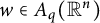 $w\in A_q({{{\mathbb R}}^n})$
. Then,
 ${\mathcal S}({\mathbb R}^{2n})\hookrightarrow L_w^q (L^p)({\mathbb R}^{2n})\hookrightarrow {\mathcal S}'({\mathbb R}^{2n})$
.
Proof We first show
 ${\mathcal S}({\mathbb R}^{2n})\hookrightarrow L_w^q (L^p)({\mathbb R}^{2n})$
. To this end, for any Lebesgue measurable set
 $E \subset {{{\mathbb R}}^n}$
, define
 $$ \begin{align*}w(E):=\int_{E}w\,dx.\end{align*} $$
By [Reference Grafakos28, Proposition 7.1.5(9)], we know that if
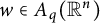 $w\in A_q({{{\mathbb R}}^n})$
then w is doubling and satisfies
 $$ \begin{align} w(\lambda B)\le \lambda^{nq} [w]_{A_q({{{\mathbb R}}^n})} w(B) \end{align} $$
uniformly for all
 $\lambda \in (1,\infty )$
and all balls
 $B\subset {{{\mathbb R}}^n}$
, where
 $\lambda B$
denotes the ball with the same center as that of B but of radius
 $\lambda $
times of B. Then, for any
 $f \in {\mathcal S}({\mathbb R}^{2n})$
, we have
 $$ \begin{align*}|f(x,y)|\leq \left(1+\sqrt{|x|^2+|y|^2}\right)^{-N} \rho_{N,0}(f)\end{align*} $$
for all
 $x,y\in {\mathbb R}^{n}$
and for some large constant N to be determined later. So,
 $$ \begin{align} \|f\|_{L_w^q (L^p)({\mathbb R}^{2n})}&\leq \rho_{N,0}(f) \left(\int_{ {{{\mathbb R}}^n} }\left(\int_{{{\mathbb R}}^n} (1+\sqrt{|x|^2+|y|^2})^{-Np}\, dx\right)^{q/p}w(y)\, dy\right)^{1/q}\\ &\leq \rho_{N,0}(f) \left(\int_{ {{{\mathbb R}}^n} }(1+|x|)^{-Np/2}\, dx\right)^{1/p} \left(\int_{ {{{\mathbb R}}^n} }(1+|y|)^{-Nq/2}w(y)\, dy\right)^{1/q}. \notag \end{align} $$
If
 $N>2n/p$
, then
 $\int _{ {{{\mathbb R}}^n} }(1+|x|)^{-Np/2}\, dx<\infty .$
Moreover, if
 $N>2n$
, then by (2.1), we have
 $$ \begin{align} \int_{ {{{\mathbb R}}^n} }(1+|y|)^{-Nq/2}w(y)\, dy & =\left(\int_{|y|<1}+\sum_{j=1}^{\infty}\int_{2^{j-1}\leq|y|<2^j}\right)(1+|y|)^{-Nq/2}w(y)\, dy\\ &\leq w(B({0},1))+\sum_{j=1}^{\infty}2^{-(j-1)Nq/2}w(B({0},2^j))\notag\\ &\lesssim w(B({0},1))\left(1+\sum_{j=1}^{\infty}2^{-j(N/2-n)q}\right)<\infty. \notag \end{align} $$
Altogether, we obtain
 $f\in L_w^q (L^p)({\mathbb R}^{2n})$
and
 $\|f\|_{L_w^q (L^p)({\mathbb R}^{2n})}\lesssim \rho _{N,0}(f),$
which implies
 $$ \begin{align*}{\mathcal S}({\mathbb R}^{2n})\hookrightarrow L_w^q (L^p)({\mathbb R}^{2n}).\end{align*} $$
Now, we show
 $L_w^q (L^p)({\mathbb R}^{2n})\hookrightarrow {\mathcal S}'({\mathbb R}^{2n})$
. For any
 $f\in L_w^q (L^p)({\mathbb R}^{2n})$
and
 $\varphi \in {\mathcal S}({\mathbb R}^{2n})$
, from the Hölder inequality, we deduce
 $$ \begin{align} |\left\langle f,\, \varphi \right\rangle| &\leq\int_{ {{{\mathbb R}}^n} }\int_{ {{{\mathbb R}}^n} }|f(x,y)\varphi(x,y)|\, dx \, dy\\ &\leq \int_{ {{{\mathbb R}}^n} }\left(\int_{ {{{\mathbb R}}^n} }|f(x,y)|^{p}\, dx\right)^{1/p}w(y)^{1/q} \left(\int_{ {{{\mathbb R}}^n} }|\varphi(x,y)|^{p'}\, dx \right)^{1/p'}w(y)^{-1/q}\, dy \notag\\ &\leq \|f\|_{L_w^q (L^p)({\mathbb R}^{2n})} \left(\int_{ {{{\mathbb R}}^n} }\left(\int_{ {{{\mathbb R}}^n} }|\varphi(x,y)|^{p'}\, dx \right)^{q'/p'}w(y)^{1-q'}\, dy\right)^{1/q'}. \notag \end{align} $$
When
 $q\in (1,\infty )$
, by the fact that
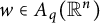 $w\in A_q({{{\mathbb R}}^n})$
if and only if
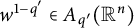 $w^{1-q'}\in A_{q'}({{{\mathbb R}}^n})$
(see, for instance, [Reference Duoandikoetxea17, Proposition 7.2(2)]), and the already obtained result
 ${\mathcal S}({\mathbb R}^{2n})\hookrightarrow L_w^q (L^p)({\mathbb R}^{2n})$
, we find that
 $$ \begin{align*} |\left\langle f,\, \varphi \right\rangle| \leq \|f\|_{L_w^q (L^p)({\mathbb R}^{2n})} \|\varphi\|_{L_{w^{1-q'}}^{q'}(L^{p'})({\mathbb R}^{2n})} \lesssim \|f\|_{L_w^q (L^p)({\mathbb R}^{2n})}\,\rho_{N,0} (\varphi) \end{align*} $$
holds when
 $N\in {\mathbb N}$
is sufficiently large, thereby leading to
 $f\in {\mathcal S}'({\mathbb R}^{2n})$
. Thus, we obtain the continuous embeddingFootnote
1
 $$ \begin{align*}L_w^q (L^p)({\mathbb R}^{2n})\hookrightarrow{\mathcal S}'({\mathbb R}^{2n})\end{align*} $$
and, hence, complete the proof of Lemma 2.1.
2.2 Density lemmas
The forthcoming lemma shows the density of
 $C_c^\infty ({{{\mathbb R}}^n})$
in the inhomogeneous weighted Besov space
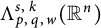 $\Lambda _{p,\, q,\,w}^{s,\,k}({{{\mathbb R}}^n})$
. This explains the reason of defining the homogeneous space
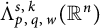 $\dot \Lambda _{p,\, q,\,w}^{s,\,k}({{{\mathbb R}}^n})$
as the completion of
 $C_c^\infty ({{{\mathbb R}}^n})$
under
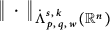 $\|\,\cdot \,\|_{\dot {\Lambda }_{p,\, q,\,w}^{s,\, k}({{{\mathbb R}}^n})}$
.
Lemma 2.2 Let
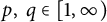 $p,\ q\in [1,\infty )$
,
 $s\in (0,\infty ),$
and
 $k\ge \lfloor s\rfloor +1$
. Assume that w is a radial weight satisfying (1.4) and (1.5). Then, the following hold:
-
(i) any function in
$C_c^\infty ({{{\mathbb R}}^n})$
has finite semi-norm
$\|\,\cdot \,\|_{\dot {\Lambda }_{p,\, q,\,w}^{s,\, k}({{{\mathbb R}}^n})}$
; -
(ii) for any
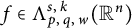
$f\in \Lambda _{p,\, q,\,w}^{s,\,k}({{{\mathbb R}}^n})$
, there exists a sequence
$\{\phi _j\}_{j\in {\mathbb N}}\subset C_c^\infty ({{{\mathbb R}}^n})$
such that (2.5)
$$ \begin{align} \lim_{j\to\infty}\|\phi_j-f\|_{{\Lambda}_{p,\, q,\,w}^{s,\, k}({{{\mathbb R}}^n})} =0.\end{align} $$



Proof We first show (i). Suppose that
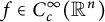 $f\in C_{c}^{\infty }({{{\mathbb R}}^n})$
. From (1.1), it follows that
 $$ \begin{align*} \|\mathrm{D}_{h}^{k}f\|_{L^p({{{\mathbb R}}^n})}\le \sum_{m=0}^k \binom km \|f(\cdot+mh)\|_{L^p({{{\mathbb R}}^n})}=2^k \|f\|_{L^p({{{\mathbb R}}^n})}\lesssim 1. \end{align*} $$
Moreover, by the fact that
 $$ \begin{align} \mathrm{D}_{h}^{k}f(x) &=\int_{[0,1]^k}\sum_{j_{1}=1}^{n}\cdots \sum_{j_{k}=1}^{n} h_{j_{1}} \cdots h_{j_{k}} (\partial_{j_{1}} \cdots \partial_{j_{k}}f)(x +(t_{1}+\cdots+t_{k})h)\, dt_{1} \cdots \,dt_{k} \end{align} $$
and the Minkowski inequality, we have
 $$ \begin{align*}\|\mathrm{D}_{h}^{k}f\|_{L^p({{{\mathbb R}}^n})}\lesssim|h|^k.\end{align*} $$
Therefore,
 $$ \begin{align*} \|f\|_{\dot{\Lambda}_{p,\, q,\,w}^{s,\, k}({{{\mathbb R}}^n})} &\lesssim\left(\int_{{{{\mathbb R}}^n}}\frac{\min\{1, |h|^{kq}\}}{|h|^{n+sq}}w(h)\, dh\right)^{\frac{1}{q}}\\ &\approx \left(\int_0^\infty \min\{1, t^{kq}\} w(t) t^{-sq-1}\, dt\right)^{\frac{1}{q}}\\ &=\left(\int_{0}^{1}t^{(k-s)q-1}w(t)\, dt+ \int_{1}^{\infty}t^{-sq-1}w(t)\, dt\right)^{\frac{1}{q}}. \end{align*} $$
Note that
 $k\ge \lfloor s\rfloor +1$
,
 $\sigma <\lfloor s\rfloor +1-s,$
and
 $\delta>-s$
. On the one hand, condition (1.4) implies
 $$ \begin{align} \int_{0}^{1}t^{(k-s)q-1}w(t)\, dt &\le\int_{0}^{1}t^{(\lfloor s\rfloor +1-s)q-1}w(t)\, dt\\ &\notag=\int_{0}^{1}t^{(\lfloor s\rfloor +1-s)q}\left( \frac{w(t\cdot 1)}{w(1)}\right)w(1)\, \frac{dt}{t}\\ &\notag\lesssim\int_{0}^{1}t^{\sigma q}\, \left(\sup_{\rho \in (0, \infty)} \frac{w(t\rho)}{w(\rho)}\right)\frac{dt}{t} < \infty. \end{align} $$
On the other hand, condition (1.5) yields
 $$ \begin{align} \int_{1}^{\infty}t^{-sq-1}w(t)\, dt &\le \int_{1}^{\infty}t^{\delta q-1}w(t)\, dt\\ &\notag=\int_{1}^{\infty}t^{\delta q}\, \left( \frac{w(t\cdot 1)}{w(1)}\right)w(1)\,\frac{dt}{t}\\ &\notag\lesssim\int_{1}^{\infty}t^{\delta q}\, \left(\sup_{\rho \in (0, \infty)} \frac{w(t\rho)}{w(\rho)}\right)\frac{dt}{t}<\infty. \end{align} $$
This shows that any
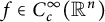 $f\in C_c^\infty ({{{\mathbb R}}^n})$
satisfies
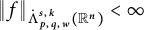 $\|f\|_{\dot {\Lambda }_{p,\, q,\,w}^{s,\, k}({{{\mathbb R}}^n})}<\infty $
.
Next, we show (ii). Fix
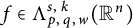 $f\in {\Lambda }_{p,\, q,\,w}^{s,\, k}({{{\mathbb R}}^n})$
. Choose a function
 $0\le \phi \in C_c^\infty ({{{\mathbb R}}^n})$
such that
 $\int _{{{\mathbb R}}^{n}}\phi (x)\, dx=1$
. For any
 $\epsilon \in (0,\infty )$
, set
 $$ \begin{align*}\phi_{\epsilon}(\cdot):=\epsilon^{-n}\phi(\epsilon^{-1}\,\cdot). \end{align*} $$
and
 $$ \begin{align*}f_{\epsilon}:=\phi_{\epsilon} \ast f. \end{align*} $$
Clearly
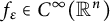 $f_{\epsilon }\in C^{\infty }({{{\mathbb R}}^n})$
. From
 $f \in {\Lambda }_{p,\, q,\,w}^{s,\, k}({{{\mathbb R}}^n})\subset L^p({{{\mathbb R}}^n})$
, it follows that
 $$ \begin{align} \lim_{\epsilon\to0}\|f_{\epsilon}-f\|_{L^p({{{\mathbb R}}^n})} =0. \end{align} $$
From the Young inequality and the fact
 $\int _{{{\mathbb R}}^n}\phi (x)\,dx=1$
, we deduce
 $$ \begin{align*}\left\|{\mathrm{D}}_{h}^{k}f_{\epsilon}\right\|_{L^p({{{\mathbb R}}^n})} =\left\|\phi_{\epsilon} \ast \left( {\mathrm{D}}_{h}^{k}f\right)\right\|_{L^p({{{\mathbb R}}^n})} \leq\left\| {\mathrm{D}}_{h}^{k}f\right\|_{L^p({{{\mathbb R}}^n})}\end{align*} $$
and, hence,
 $$ \begin{align*} \left\|{\mathrm{D}}_{h}^{k}(f_{\epsilon}-f)\right\|_{L^p({{{\mathbb R}}^n})} \leq \left\|{\mathrm{D}}_{h}^{k}f_{\epsilon}\right\|_{L^p({{{\mathbb R}}^n})}+ \left\|{\mathrm{D}}_{h}^{k}f\right\|_{L^p({{{\mathbb R}}^n})} \leq 2\left\|{\mathrm{D}}_{h}^{k}f\right\|_{L^p({{{\mathbb R}}^n})}. \end{align*} $$
Also, note that (2.9) and (1.1) imply
 $$ \begin{align*} \lim_{\epsilon \to 0}\left\|{\mathrm{D}}_{h}^{k}(f_{\epsilon}-f)\right\|_{L^p({{{\mathbb R}}^n})} &\leq \lim_{\epsilon \to 0}\sum_{m=0}^{k}\binom{k}{m}\,\|(f_{\epsilon}-f)(\cdot+mh)\|_{L^p({{{\mathbb R}}^n})}\\ &=\sum_{m=0}^{k}\binom{k}{m}\lim_{\epsilon \to 0}\|f_{\epsilon}-f\|_{L^p({{{\mathbb R}}^n})}\\ &= 0. \end{align*} $$
Thus, by the Lebesgue dominated convergence theorem, we have
 $$ \begin{align*} \lim_{\epsilon \to 0}\left(\int_{{{{\mathbb R}}^n}} \frac{\|{\mathrm{D}}_{h}^{k}(f_{\epsilon}-f) \|_{L^p({{{\mathbb R}}^n})}^{q}}{|h|^{n+sq}} w(h)\, dh \right)^{\frac{1}{q}} & =\left(\int_{{{{\mathbb R}}^n}} \frac{\lim_{\epsilon \to 0}\|{\mathrm{D}}_{h}^{k}(f_{\epsilon}-f) \|_{L^p({{{\mathbb R}}^n})}^{q}}{|h|^{n+sq}} w(h)\, dh \right)^{\frac{1}{q}}=0. \end{align*} $$
This proves
 $$ \begin{align*}\lim_{\epsilon\to0}\|f_\epsilon-f\|_{\dot{\Lambda}_{p,\, q,\,w}^{s,\, k}({{{\mathbb R}}^n})} =0.\end{align*} $$
So, we have find a sequence
 $\{\phi _j\}_{j\in {\mathbb N}}$
in
 $C^\infty ({{{\mathbb R}}^n})$
such that (2.5) holds.
Now, we show that
 $C_c^\infty ({{{\mathbb R}}^n})$
is dense in
 ${\Lambda }_{p,\, q,\,w}^{s,\, k}({{{\mathbb R}}^n})\cap C^\infty ({{{\mathbb R}}^n})$
under
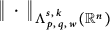 $\|\,\cdot \,\|_{{\Lambda }_{p,\, q,\,w}^{s,\, k}({{{\mathbb R}}^n})}$
. Fix
 $f\in {\Lambda }_{p,\, q,\,w}^{s,\, k}({{{\mathbb R}}^n})\cap C^\infty ({{{\mathbb R}}^n})$
. Let
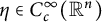 $\eta \in C_{c}^{\infty }({{{\mathbb R}}^n})$
satisfy
 $\eta =1$
on
 $B({0},1)$
,
 ${\mathrm {\,supp\,}} \eta \subset B({0},2),$
and
 $0\leq \eta \leq 1$
. For any
 $N\in (0,\infty )$
, define
 $$ \begin{align*}\eta_{N}(\cdot):=\eta(N^{-1}\cdot)\qquad \text{and}\qquad f_{N}:=\eta_{N}f.\end{align*} $$
It is obvious that
 $f_{N}\in C_{c}^{\infty }({{{\mathbb R}}^n})$
and
 $ f_{N}\to f$
in
 $L^p({{{\mathbb R}}^n})$
as
 $N\to \infty $
. To validate that
 $\{f_{N}\}_{N\in {\mathbb N}}$
converges to f with respect to the semi-norm
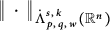 $\|\,\cdot \,\|_{\dot {\Lambda }_{p,\, q,\,w}^{s,\, k}({{{\mathbb R}}^n})}$
, by (1.1), we write that for all
 $x,\ h\in {{{\mathbb R}}^n}$
,
 $$ \begin{align*} &D_h^k(f_{N}-f)(x) \\&\quad= \sum_{m=0}^k(-1)^{k-m} \binom km \left[\eta_N(x+mh)-1\right]f(x+mh)\\ &\quad=\sum_{m=0}^k(-1)^{k-m} \binom km \left[\eta_N(x+mh)-\eta_N(x)\right]f(x+mh)+\left[\eta_N(x)-1\right]D_h^kf(x), \end{align*} $$
which implies
 $$ \begin{align} |D_h^k(f_{N}-f)(x)| &\lesssim\sum_{m=0}^k\min\left\{\frac{|mh|}{N}\|\nabla \eta\|_{L^\infty({{{\mathbb R}}^n})}, \,\| \eta\|_{L^\infty({{{\mathbb R}}^n})}\right\}|f(x+mh)|+|D_h^kf(x)|\\ &\lesssim\min\{|h|,\,1\}\sum_{m=0}^k|f(x+mh)|+|D_h^kf(x)|{\nonumber} \end{align} $$
by terms of the mean value theorem. Note that (1.4) implies that (see (2.7))
 $$ \begin{align*}\int_{0}^{1}t^{(1-s)q-1}w(t)\, dt<\infty.\end{align*} $$
Meanwhile, by the fact that (1.5) leads to (see (2.8))
 $$ \begin{align*}\int_{1}^{\infty}t^{-sq-1}w(t)\, dt<\infty.\end{align*} $$
With these last two estimates and (2.10), we then derive
 $$ \begin{align*} &\left(\int_{{{{\mathbb R}}^n}} \frac{\|\min\{|h|,\,1\}\sum_{m=0}^k|f(\cdot+mh)|+|D_h^kf| \|_{L^p({{{\mathbb R}}^n})}^{q}}{\left|h\right|{}^{n+sq}} w(h)\, dh \right)^{\frac{1}{q}}\\ &\quad\le \left(\int_{|h|\leq 1} \frac{\||h|\sum_{m=0}^k|f(\cdot+mh)| \|_{L^p({{{\mathbb R}}^n})}^{q}}{\left|h\right|{}^{n+sq}} w(h)\, dh \right)^{\frac{1}{q}}\\ &\qquad +\left(\int_{|h|>1} \frac{\|\sum_{m=0}^k|f(\cdot+mh)| \|_{L^p({{{\mathbb R}}^n})}^{q}}{|h|^{n+sq}} w(h)\, dh \right)^{\frac{1}{q}} +\|f\|_{\dot{\Lambda}_{p,\, q,\,w}^{s,\, k}({{{\mathbb R}}^n})}\\ &\quad\lesssim\|f\|_{L^p({{{\mathbb R}}^n})} \left(\int_{|h|\leq 1} |h|^{q-sq-n}w(h)\, dh\right)^{\frac{1}{q}}\\&\qquad+\|f\|_{L^p({{{\mathbb R}}^n})} \left(\int_{|h|>1} |h|^{-sq-n}w(h)\, dh\right)^{\frac{1}{q}} +\|f\|_{\dot{\Lambda}_{p,\, q,\,w}^{s,\, k}({{{\mathbb R}}^n})}\\ &\quad\approx\|f\|_{L^p({{{\mathbb R}}^n})}\left(\int_{0}^{1}t^{(1-s)q-1}w(t)\, dt\right)^{\frac{1}{q}}\\&\qquad+\|f\|_{L^p({{{\mathbb R}}^n})} \left(\int_{1}^{\infty}t^{-sq-1}w(t)\, dt\right)^{\frac{1}{q}}+\|f\|_{\dot{\Lambda}_{p,\, q,\,w}^{s,\, k}({{{\mathbb R}}^n})}\\ &\quad <\infty. \end{align*} $$
Meanwhile, we also know that for all
 $h\in {{{\mathbb R}}^n}$
,
 $$ \begin{align*} \lim_{N\to\infty} \|D_h^k(f_{N}-f)\|_{L^p({{{\mathbb R}}^n})} \le \sum_{m=0}^k \binom km \|[\eta_N(\cdot)-1]f(\cdot)\|_{L^p({{{\mathbb R}}^n})}=0. \end{align*} $$
From these and the Lebesgue dominated convergence theorem, we conclude that
 $$ \begin{align*} \lim_{N\to\infty}\int_{{{\mathbb R}}^n} \frac{\|D_h^k(f_{N}-f) \|_{L^p({{{\mathbb R}}^n})}^{q}}{|h|^{n+sq}} w(h)\, dh=\int_{{{\mathbb R}}^n}\frac{\lim_{N\to\infty}\|D_h^k(f_{N}-f) \|_{L^p({{{\mathbb R}}^n})}^{q}}{|h|^{n+sq}} w(h)\, dh =0, \end{align*} $$
as desired. Altogether, we conclude the proof of Lemma 2.2.
Next, we show the density of
 $C_c^\infty ({\mathbb R}^{2n})$
in weighted mixed-norm Lebesgue spaces.
Lemma 2.3 Let
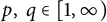 $p,\ q\in [1,\infty )$
and
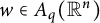 $w\in A_q({{{\mathbb R}}^n})$
. Then,
 $C_c^\infty ({\mathbb R}^{2n})$
is dense in
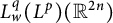 $L_w^q (L^p)({\mathbb R}^{2n})$
.
Proof It is obvious that
 $C_c^\infty ({\mathbb R}^{2n})\subseteq L_w^q (L^p)({\mathbb R}^{2n})$
. Since w is locally integrable, we know that
 $$ \begin{align*}d\mu(x,y):=w(y)\, dx\, dy\end{align*} $$
defines a
 $\sigma $
-finite Radon-measure on
 ${\mathbb R}^{2n}$
. Given any
 $f\in L_w^q (L^p)({\mathbb R}^{2n})$
, we have by [Reference Benedek and Panzone5, p. 313] that, for any
 $\epsilon>0$
, there exists a simple function
 $$ \begin{align*}\varphi(x,y):=\sum_{i=1}^NC_{i}\,\mathbf{1}_{E_i}(x)\,\mathbf{1}_{F_i}(y),\end{align*} $$
where
 $|E_i|<\infty $
and
 $w(F_i)<\infty $
for all
 $i\in \{1,2,\dots , N\}$
, such that
 $$ \begin{align} \|f-\varphi\|_{L_w^q (L^p)({\mathbb R}^{2n})}< \epsilon. \end{align} $$
We claim that there exists a function
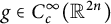 $g\in C_c^\infty ({\mathbb R}^{2n})$
such that
 $$ \begin{align} \|\varphi-g\|_{L_w^q (L^p)({\mathbb R}^{2n})}< \epsilon. \end{align} $$
Once we have (2.12), then applying (2.11) gives
 $$ \begin{align*} \|f-g\|_{L_w^q (L^p)({\mathbb R}^{2n})} \leq\|f-\varphi\|_{L_w^q (L^p)({\mathbb R}^{2n})} +\|\varphi-g\|_{L_w^q (L^p)({\mathbb R}^{2n})} <\epsilon+\epsilon =2\epsilon, \end{align*} $$
which indicates that any
 $f\in L_w^q (L^p)({\mathbb R}^{2n})$
can be approximated by functions in
 $C_c^\infty ({\mathbb R}^{2n})$
.
To show (2.12), it suffices to consider the case when
 $\varphi (x,y)=\mathbf {1}_E(x)\mathbf {1}_F(y)$
, where
 $E, F$
are measurable subsets in
 ${{{\mathbb R}}^n}$
with
 $|E|<\infty $
and
 $w(F)<\infty $
. To see this, by the fact that
 $C_c^\infty ({{{\mathbb R}}^n})$
is dense in
 $L^p({{{\mathbb R}}^n})$
, for any
 $\eta>0$
, there exists a function
 $\psi _1\in C_c^\infty ({{{\mathbb R}}^n})$
such that
 $$ \begin{align*}\|\mathbf{1}_E-\psi_1\|_{L^p({{{\mathbb R}}^n})}<\eta\, w(F)^{-1/q}.\end{align*} $$
Since
 $w(x)\, dx$
is a doubling measure, by an argument similar to the unweighted case, we obtain that if
 $$ \begin{align*}\begin{cases} \phi\in C_c^\infty({{{\mathbb R}}^n});\\ \int_{ {{{\mathbb R}}^n} }\phi(y) w(y)\, dy=1; \\ \phi_{t}(\cdot):=t^{-n}\phi(t^{-1}\ \cdot)\ \text{for all}\ t\in(0,\infty), \end{cases} \end{align*} $$
then any
 $h\in L_w^q ({{{\mathbb R}}^n})$
satisfies that
 $$ \begin{align*}\int_{{{\mathbb R}}^n} \phi_{t}(\cdot-y)h(y) \mathbf{1}_{B({0},\,R)}(y)w(y)\,dy \to h\ \ \text{in}\ \ L_w^q ({{{\mathbb R}}^n})\end{align*} $$
as
 $R\to \infty $
and
 $t\to 0$
. In other words,
 $C_c^\infty ({{{\mathbb R}}^n})$
is dense in
 $L_w^q ({{{\mathbb R}}^n})$
. Consequently, for any
 $\eta>0$
, there exists a function
 $\psi _2\in C_c^\infty ({{{\mathbb R}}^n})$
, such that
 $$ \begin{align*}\|\mathbf{ 1}_F-\psi_2\|_{L_w^q ({{{\mathbb R}}^n})}<\eta\|\psi_1\|_{L^p({{{\mathbb R}}^n})}^{-1}.\end{align*} $$
Let
 $g(x,y):=\psi _1(x)\psi _2(y)$
. Then,
 $$ \begin{align*} \|\mathbf{1}_{E\times F}-g\|_{L_w^q (L^p)({\mathbb R}^{2n})} &=\left( \int_{ {{{\mathbb R}}^n} } \left( \int_{ {{{\mathbb R}}^n} } |\mathbf{1}_E(x)\mathbf{1}_F(y) -\psi_1(x)\psi_2(y)|^{p}\, dx \right)^{q/p} w(y)\, dy \right)^{1/q}\\ &\leq \left( \int_{ {{{\mathbb R}}^n} } \left( \int_{ {{{\mathbb R}}^n} } |\mathbf{1}_E(x)\mathbf{1}_F(y) -\psi_1(x)\mathbf{1}_F(y)|^{p}\, dx \right)^{q/p} w(y)\, dy \right)^{1/q}\\ &\quad + \left( \int_{ {{{\mathbb R}}^n} } \left( \int_{ {{{\mathbb R}}^n} } |\psi_1(x)\mathbf{1}_F(y) -\psi_1(x)\psi_2(y)|^{p}\, dx \right)^{q/p} w(y)\, dy \right)^{1/q}\\ &<2\eta. \end{align*} $$
This proves (2.12).
Corollary 2.4 For any
 $p\in [1,\infty ),\ q\in (1,\infty )$
,
 $\beta \in {\mathbb R}$
and
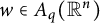 $w\in A_q({{{\mathbb R}}^n})$
, the space
 $$ \begin{align*}\left\{(-\varDelta_{{{\mathbb R}}^{2n}})^{-\beta/2}\phi:\, \phi\in C_c^\infty({\mathbb R}^{2n})\right\}\end{align*} $$
is dense in
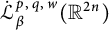 $\dot {\mathcal {L}}_{\beta }^{p,\, q,\, w}({\mathbb R}^{2n})$
.
Proof Let
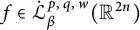 $f \in \dot {\mathcal {L}}_{\beta }^{p,\, q,\,w}({\mathbb R}^{2n})$
. By Definition 1.4, there exists a function
 $\phi _0 \in L_w^q (L^p)({\mathbb R}^{2n})$
such that
 $$ \begin{align*}f=(-\varDelta_{{{\mathbb R}}^{2n}})^{-\beta/2}\phi_0\ \ \mathrm{and}\ \ \|f\|_{\dot{\mathcal{L}}_{\beta}^{p,\, q,\,w}({\mathbb R}^{2n})}=\| \phi_0 \|_{L_w^q (L^p)({\mathbb R}^{2n})}.\end{align*} $$
From Lemma 2.3, for any
 $\epsilon>0$
, we can find a function
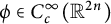 $\phi \in C_c^\infty ({\mathbb R}^{2n})$
such that
 $$ \begin{align*}\| \phi_0-\phi \|_{L_w^q (L^p)({\mathbb R}^{2n})}<\epsilon,\end{align*} $$
which implies
 $$ \begin{align*} \left\|f-(-\varDelta_{{{\mathbb R}}^{2n}})^{-\beta/2}\phi\right\|_{\dot{\mathcal{L}}_{\beta}^{p,\, q,\,w}({\mathbb R}^{2n})} =\| \phi_0-\phi \|_{L_w^q (L^p)({\mathbb R}^{2n})}<\epsilon. \end{align*} $$
This ends the proof.
Now, we are at the point to show the density of
 $C_c^\infty ({\mathbb R}^{2n})$
in weighted mixed-Riesz potential spaces.
Lemma 2.5 Let
 $p\in [1,\infty ),\ q\in (1,\infty )$
,
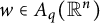 $w\in A_q({{{\mathbb R}}^n})$
and
 $\beta \in (0,\infty )$
. Then,
 $C_c^\infty ({\mathbb R}^{2n})$
is dense in
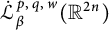 $\dot {\mathcal {L}}_{\beta }^{p,\, q,\, w}({\mathbb R}^{2n})$
.
Proof Let
 $\Phi \in {\mathcal S}({\mathbb R}^{2n})$
satisfy
 ${\mathrm {\,supp\,}} \widehat {\Phi }\subset \{x\in {\mathbb R}^{2n}:\, c^{-1}\leq |x|\leq c\}$
for some constant
 $c>1$
and
 $$ \begin{align*}\sum_{j\in{\mathbb Z}}\widehat{\Phi}(2^{-j}\xi)=1\quad \text{for all}\ \ \xi\neq 0.\end{align*} $$
For any
 $j\in {\mathbb Z}$
and
 $x\in {\mathbb R}^{2n}$
, let
 $\Phi _j(x):= 2^{2jn}\Phi (2^jx)$
. For any
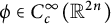 $\phi \in C_c^\infty ({\mathbb R}^{2n})$
and
 $N\in {\mathbb N}$
,
 $$ \begin{align*}\phi_N:=\sum_{|j|\leq N}\Phi_j\ast\phi\in {\mathcal S}_\infty({\mathbb R}^{2n}).\end{align*} $$
Moreover, the sequence
 $\{\phi _N\}_{N\in\mathbb N}$
converges to
 $\phi $
in
 ${\mathcal S}({\mathbb R}^{2n})$
(and, hence, in
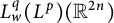 $L_w^q (L^p)({\mathbb R}^{2n})$
by Lemma 2.1) as
 $N\to \infty $
. From this and Corollary 2.4, it follows that
 $\{(-\varDelta _{{{\mathbb R}}^{2n}})^{-\beta /2}\phi :\, \phi \in {\mathcal S}_\infty ({\mathbb R}^{2n})\}$
is dense in
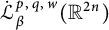 $\dot {\mathcal {L}}_{\beta }^{p,\, q,\, w}({\mathbb R}^{2n})$
. Thus, to show the density of
 $C_c^\infty ({\mathbb R}^{2n})$
in
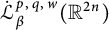 $\dot {\mathcal {L}}_{\beta }^{p,\, q,\, w}({\mathbb R}^{2n})$
, we may as well assume that
 $$ \begin{align*}f=(-\varDelta_{{{\mathbb R}}^{2n}})^{-\beta/2} g\end{align*} $$
for some
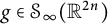 $g\in {\mathcal S}_\infty ({\mathbb R}^{2n})$
, then our aim is to find a sequence
 $\{\varphi _k\}_{k\in {\mathbb Z}}$
in
 $C_c^\infty ({\mathbb R}^{2n})$
such that
 $$ \begin{align} \lim_{k\to\infty}\|\varphi_k-f\|_{\dot{\mathcal{L}}_{\beta}^{p,\, q,\, w}({\mathbb R}^{2n})}=\lim_{k\to\infty}\|(-\varDelta_{{{\mathbb R}}^{2n}})^{\beta/2}\varphi_k-g\|_{L_w^q (L^p)({\mathbb R}^{2n})}=0. \end{align} $$
Choose
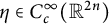 $\eta \in C_c^\infty ({\mathbb R}^{2n})$
satisfying
 $0\leq \eta \leq 1$
,
 $\eta =1$
if
 $|x|\leq 1$
and
 $\eta =0$
if
 $|x|\geq 2$
. For any
 $k\in {\mathbb N}$
, set
 $$ \begin{align*}\varphi_k:=\eta_k(-\varDelta_{{{\mathbb R}}^{2n}})^{-\beta/2}g,\end{align*} $$
where
 $\eta _k(x)=\eta (x/k)$
for all
 $x\in {\mathbb R}^{2n}$
. Clearly, each
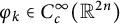 $\varphi _k\in C_c^\infty ({\mathbb R}^{2n})$
. In order to show that such
 $\{\varphi _k\}_{k\in {\mathbb Z}}$
satisfies (2.13), we write
 $\beta =2m+s$
, where
 $m\in {\mathbb N}$
and
 $s\in [0,2)$
. Notice that
 $$ \begin{align*}(-\varDelta_{{{\mathbb R}}^{2n}})^{\beta/2}\varphi_k- g=(-\varDelta_{{{\mathbb R}}^{2n}})^{s/2}(-\varDelta_{{{\mathbb R}}^{2n}})^{m} \left(\eta_k(-\varDelta_{{{\mathbb R}}^{2n}})^{-\beta/2}g\right)-g\end{align*} $$
and, if
 $m\neq 0$
, then
 $$ \begin{align*} (-\varDelta_{{{\mathbb R}}^{2n}})^{m}\left(\eta_k(-\varDelta_{{{\mathbb R}}^{2n}})^{-\beta/2}g\right) &=\left(-\sum_{j=1}^m\partial_{x_j}^2\right)^{m}\left(\eta_k(-\varDelta_{{{\mathbb R}}^{2n}})^{-\beta/2}g\right)\\ &=(-1)^m\sum_{|\alpha|=m}\partial^{2\alpha} \left(\eta_k(-\varDelta_{{{\mathbb R}}^{2n}})^{-\beta/2}g\right)\\ &= \eta_k(-\varDelta_{{{\mathbb R}}^{2n}})^{m}\left((-\varDelta_{{{\mathbb R}}^{2n}})^{-\beta/2}g\right)\\ & \quad+\sum_{\genfrac{}{}{0pt}{}{|\alpha|=m}{0<|\gamma|\le 2m}} c_{m,\alpha,\gamma} \left(\partial^{\gamma}\eta_k\right) \partial^{2\alpha-\gamma}\left((-\varDelta_{{{\mathbb R}}^{2n}})^{-\beta/2}g\right), \end{align*} $$
where
 $\alpha ,\gamma $
are
 $2n$
-tuples of multi-indices and
 $c_{m,\alpha ,\gamma }$
are constants. By the Minkowski inequality, we find that the norm
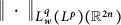 $\|\,\cdot \,\|_{L_w^q (L^p)({\mathbb R}^{2n})}$
in (2.13) can be controlled by the
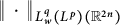 $\|\,\cdot \,\|_{L_w^q (L^p)({\mathbb R}^{2n})}$
-norm of
 $$ \begin{align*}g_k:=(-\varDelta_{{{\mathbb R}}^{2n}})^{s/2}(\eta_k(-\varDelta_{{{\mathbb R}}^{2n}})^{(2m-\beta)/2}g)-g=(-\varDelta_{{{\mathbb R}}^{2n}})^{s/2}(\eta_k(-\varDelta_{{{\mathbb R}}^{2n}})^{-s/2}g)-g\end{align*} $$
and a finite linear combination of the
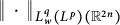 $\|\,\cdot \,\|_{L_w^q (L^p)({\mathbb R}^{2n})}$
-norm of the following type of functions
 $$ \begin{align*}h_k:=(-\varDelta_{{{\mathbb R}}^{2n}})^{s/2}((\partial^{\gamma}\eta_k)h),\end{align*} $$
where
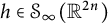 $h\in {\mathcal S}_\infty ({\mathbb R}^{2n})$
is of the form
 $\partial ^{2\alpha -\gamma }((-\varDelta _{{{\mathbb R}}^{2n}})^{-\beta /2}g)$
and
 $\gamma $
is a non-zero multi-index. Thus, to obtain (2.13), we are left to prove that the
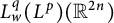 $L_w^q (L^p)({\mathbb R}^{2n})$
-norms of
 $g_k$
and
 $h_k$
tend to
 $0$
as
 $k\to \infty $
.
If
 $s=0$
, then
 $g_k=\eta _k g-g$
and
 $|h_k|\le k^{-|\gamma |} \|\partial ^{\gamma }\eta \|_{L^\infty ({\mathbb R}^{2n})}|h|$
, whose
 $L_w^q (L^p)({\mathbb R}^{2n})$
-norms obviously go to
 $0$
as
 $k\to \infty $
. Next, we consider the case when
 $s\in (0,2)$
.
Part 1: estimate of the
 $L_w^q (L^p)({\mathbb R}^{2n})$
-norm of
 $g_k$
. To simplify the notation, we set
 $$ \begin{align*}u=(-\varDelta_{{{\mathbb R}}^{2n}})^{(2m-\beta)/2}g=(-\varDelta_{{{\mathbb R}}^{2n}})^{-s/2}g,\end{align*} $$
which belongs to
 ${\mathcal S}({\mathbb R}^{2n})$
by using the Fourier transform and the fact that
 $g\in {\mathcal S}({\mathbb R}^{2n})$
. By [Reference Silvestre40, Section 2], we have
 $$ \begin{align*}(-\varDelta_{{\mathbb R}^{2n}})^{s/2} (\eta_k u)=C_{n,s}\, \text{p.v.}\int_{{\mathbb R}^{2n}}\frac{\eta_k(x) u(x)-\eta_k(y) u(y)}{|x-y|^{2n+s}}\, dy,\end{align*} $$
with
 $C_{n,s}$
being a positive constant depending only on n and s. Via writing
 $$ \begin{align*}\eta_k(x) u(x)-\eta_k(y) u(y)&=\eta_k(x)[u(x)- u(y)] \\&\quad+[\eta_k(x)-\eta_k(y)][u(y)-u(x)]+u(x)[\eta_k(x)-\eta_k(y)], \end{align*} $$
we then have
 $$ \begin{align} g_k(x) &=\left(C_{n,s}\eta_k(x)\text{p.v.}\int_{{\mathbb R}^{2n}}\frac{u(x)- u(y)}{|x-y|^{2n+s}}\, dy-g(x)\right)\\ &\quad+C_{n,s}\text{p.v.}\int_{|x-y|<\frac{1+|x|}{2}}\frac{[\eta_k(x)-\eta_k(y)][u(y)-u(x)]}{|x-y|^{2n+s}}\, dy\notag\\ &\quad+C_{n,s}u(x)\text{p.v.}\int_{|x-y|<\frac{1+|x|}{2}}\frac{\eta_k(x)-\eta_k(y)}{|x-y|^{2n+s}}\, dy\notag\\ &\quad+C_{n,s}\text{p.v.}\int_{|x-y|\ge \frac{1+|x|}{2}}\frac{[\eta_k(x)-\eta_k(y)]u(y)}{|x-y|^{2n+s}}\, dy\notag\\ &=:G_k^1(x)+G_k^2(x)+G_k^3(x)+G_k^4(x).\notag \end{align} $$
When
 $k\to \infty $
, it is obvious that
 $$ \begin{align} \|G_k^1\|_{L_w^q (L^p)({\mathbb R}^{2n})}= \|\eta_k (-\varDelta_{{{{\mathbb R}}^n}})^{s/2}u -g\|_{L_w^q (L^p)({\mathbb R}^{2n})} =\|\eta_k g -g\|_{L_w^q (L^p)({\mathbb R}^{2n})}\to 0. \end{align} $$
For
 $G_k^2$
, note that the mean value theorem implies that
 $$ \begin{align*}|\eta_k(x)-\eta_k(y)|\le k^{-1}|x-y| \|\nabla\eta\|_{L^\infty({\mathbb R}^{2n})}\end{align*} $$
and
 $$ \begin{align*}|u(y)-u(x)|\le |x-y||\nabla u(x+\theta(y-x))|\end{align*} $$
hold for some constant
 $\theta \in (0,1)$
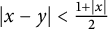
. If
 $|x-y|<\frac {1+|x|}{2}$
, then
 $1+|x+\theta (y-x)|\approx 1+|x|$
, which, along with the fact that
 $u\in {\mathcal S}_\infty $
, implies that
 $$ \begin{align*}|\nabla u(x+\theta(y-x))|\lesssim (1+|x|)^{-(2n+2)}. \end{align*} $$
Thus, we obtain
 $$ \begin{align*} |G_k^{2}(x)| &\le C_{n,s}\int_{|x-y|<\frac{1+|x|}{2}}\frac{|\eta_k(x)-\eta_k(y)||u(y)-u(x)|}{|x-y|^{2n+s}}\, dy\\ &\lesssim k^{-1}(1+|x|)^{-(2n+2)} \int_{|x-y|<\frac{1+|x|}{2}} |x-y|^{2-s-2n}\,dy\notag\\ & \approx k^{-1}(1+|x|)^{-(2n+s)}.\notag \end{align*} $$
According to the arguments in (2.2) and (2.3) (by taking N therein to be
 $2n+s$
), we see that
 $$ \begin{align} \|(1+|\cdot|)^{-(2n+s)}\|_{L_w^q (L^p)({\mathbb R}^{2n})}<\infty \end{align} $$
and, hence,
 $$ \begin{align} \lim_{k\to\infty}\|G_k^{2}\|_{L_w^q (L^p)({\mathbb R}^{2n})}=0. \end{align} $$
Next, we consider
 $G_k^3$
. From the Taylor expansion formula,
 $$ \begin{align*} \eta_k(x)-\eta_k(y)=\left(\frac{x-y}{k}\right)\cdot \nabla \eta\left(\frac{x}{k}\right)+O\left(\left|\frac{x-y}{k}\right|^2\right). \end{align*} $$
Observe that
 $$ \begin{align*}\text{p.v.}\int_{|x-y|<\frac{1+|x|}{2}}\frac{(\frac{x-y}{k})\cdot \nabla \eta(\frac{x}{k})}{|x-y|^{2n+s}}\, dy=0,\end{align*} $$
which induces
 $$ \begin{align*} |G_k^3(x)|\lesssim k^{-2}|u(x)|\int_{|x-y|<\frac{1+|x|}{2}}|x-y|^{2-s-2n}\, dy\lesssim k^{-2}(1+|x|)^{2-s}|u(x)|, \end{align*} $$
thereby leading to
 $$ \begin{align} \lim_{k\to\infty}\|G_k^{3}\|_{L_w^q (L^p)({\mathbb R}^{2n})}\lesssim \lim_{k\to\infty} k^{-2}\|(1+|\cdot|)^{2-s}u(\cdot)\|_{L_w^q (L^p)({\mathbb R}^{2n})}=0. \end{align} $$
Next, observe that the integrand of
 $G_k^4$
can be controlled by
 $\|\eta \|_{L^\infty ({\mathbb R}^{2n})}\|u\|_{L^\infty ({\mathbb R}^{2n})} |x-y|^{-(2n+s)}$
and
 $$ \begin{align*}\int_{|x-y|\ge \frac{1+|x|}{2}}|x-y|^{-(2n+s)}\, dy \lesssim (1+|x|)^{-s}<\infty, \end{align*} $$
which, together with the Lebesgue dominated convergence theorem, shows that
 $$ \begin{align*}\lim_{k\to\infty} G_k^{4}(x) = \int_{|x-y|\ge \frac{1+|x|}{2}}\lim_{k\to\infty}\frac{[\eta_k(x)-\eta_k(y)]u(y)}{|x-y|^{2n+s}}\, dy=0. \end{align*} $$
Moreover, note that
 $$ \begin{align*} \int_{|x-y|\ge \frac{1+|x|}{2}}\frac{|u(y)|}{|x-y|^{2n+s}}\, dy &\lesssim \int_{|x-y|\ge \frac{1+|x|}{2}}\frac{|u(y)|}{(1+|x|)^{2n+s}}\, dy \lesssim (1+|x|)^{-(2n+s)}\|u\|_{L^1({\mathbb R}^{2n})}, \end{align*} $$
which, combined with (2.16) and the Lebesgue dominated convergence theorem, again yields
 $$ \begin{align} \lim_{k\to\infty}\|G_k^{4}\|_{L_w^q (L^p)({\mathbb R}^{2n})}=\left\|\lim_{k\to\infty}G_k^{4}\right\|_{L_w^q (L^p)({\mathbb R}^{2n})}=0. \end{align} $$
Substituting (2.15) and (2.17)–(2.19) into (2.14) yields that
 $\|g_k\|_{L_w^q (L^p)({\mathbb R}^{2n})}\to 0$
as
 $k\to \infty $
.
Part 2: estimate of the
 $L_w^q (L^p)({\mathbb R}^{2n})$
-norm of
 $h_k$
. Just like (2.14), we now write
 $$ \begin{align*} h_k(x) &=C_{n,s}\partial^{\gamma}\eta_k(x)\text{p.v.}\int_{{\mathbb R}^{2n}}\frac{h(x)- h(y)}{|x-y|^{2n+s}}\, dy\\ &\quad+C_{n,s}\text{p.v.}\int_{|x-y|<\frac{1+|x|}{2}}\frac{[\partial^{\gamma}\eta_k(x)-\partial^{\gamma}\eta_k(y)][h(y)-h(x)]}{|x-y|^{2n+s}}\, dy\notag\\ &\quad+C_{n,s}h(x)\text{p.v.}\int_{|x-y|<\frac{1+|x|}{2}}\frac{\partial^{\gamma}\eta_k(x)-\partial^{\gamma}\eta_k(y)}{|x-y|^{2n+s}}\, dy\notag\\ &\quad+C_{n,s}\text{p.v.}\int_{|x-y|\ge \frac{1+|x|}{2}}\frac{[\partial^{\gamma}\eta_k(x)-\partial^{\gamma}\eta_k(y)]h(y)}{|x-y|^{2n+s}}\, dy\notag\\ &=:H_k^1(x)+H_k^2(x)+H_k^3(x)+H_k^4(x).\notag \end{align*} $$
For
 $i=2,3,4$
, the estimate of
 $G_k^i$
also implies that (with
 $\eta _k$
and u therein replaced by
 $\partial ^{\gamma }\eta _k$
and h, respectively)
 $$ \begin{align*}\lim_{k\to\infty}\|H_k^{i}\|_{L_w^q (L^p)({\mathbb R}^{2n})}=0. \end{align*} $$
For
 $H_k^{1}$
, it follows from
 $h\in {\mathcal S}_\infty $
that
 $(-\varDelta _{{{\mathbb R}}^{2n}})^{s/2} h\in {\mathcal S}_\infty $
, thereby leading to
 $$ \begin{align*}\|H_k^{1}\|_{L_w^q (L^p)({\mathbb R}^{2n})} &=\left\|\left(\partial^{\gamma}\eta_k\right)\left((-\varDelta_{{{\mathbb R}}^{2n}})^{s/2} h \right)\right \|_{L_w^q (L^p)({\mathbb R}^{2n})}\\ &\le k^{-|\gamma|} \|\partial^{\gamma}\eta\|_{L^\infty({\mathbb R}^{2n})}\left\|(-\varDelta_{{{\mathbb R}}^{2n}})^{s/2} h \right \|_{L_w^q (L^p)({\mathbb R}^{2n})} \to 0 \end{align*} $$
as
 $k\to \infty $
. This induces that
 $\|h_k\|_{L_w^q (L^p)({\mathbb R}^{2n})}\to 0$
when
 $k\to \infty $
, as desired.
Altogether, we conclude the proof of Lemma 2.5.
2.3 Fourier analytic characterizations
Definition 2.6 Let
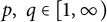 $p,\ q\in [1,\infty )$
,
 $s\in (0,\infty ),$
and w be a radial weight on
 ${{{\mathbb R}}^n}$
. Denote by
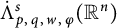 $\dot {\Lambda }_{p,\, q,\,w, \, \varphi }^{s}({{{\mathbb R}}^n})$
the space of all
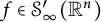 $f\in {\mathcal S}^{\prime }_{\infty }({\mathbb R}^{n})$
satisfying
 $$ \begin{align*} \|f\|_{\dot{\Lambda}_{p,\, q,\, w,\, \varphi}^{s}({{{\mathbb R}}^n})}:=\left(\int_{0}^{\infty}\| \varphi_t \ast f \|_{L^p({{{\mathbb R}}^n})}^{q}t^{-sq-1}w(t)\, dt\right)^{1/q}<\infty, \end{align*} $$
where
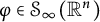 $\varphi \in {\mathcal S}_\infty ({{{\mathbb R}}^n})$
such that
 ${\mathrm {\,supp\,}} \hat {\varphi }\subset \{x\in {{{\mathbb R}}^n}:\ c^{-1}\leq |x|\leq c\}$
for some constant
 $c\in (1,\infty )$
and
 $\varphi _t(\cdot )=t^{-n}\varphi (t^{-1} \cdot )$
for all
 $t\in (0,\infty )$
.
Remark 2.7 Note that
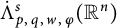 $\dot {\Lambda }_{p,\, q,\, w,\, \varphi }^{s}({{{\mathbb R}}^n})$
contains equivalence classes of tempered distributions modulo all polynomials. If we define
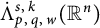 $\dot {\Lambda }_{p,\, q,\,w}^{s,\, k}({{{\mathbb R}}^n})$
as the space of locally integrable functions f satisfying
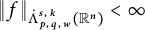 $\|f\|_{\dot {\Lambda }_{p,\, q,\,w}^{s,\, k}({{{\mathbb R}}^n})}<\infty $
, then such homogeneous weighted Besov spaces are equivalence classes of locally integrable functions modulo polynomials of degree at most k. Let us remark that this definition is different from the one we adopted in Definition 1.1, in which the space
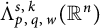 $\dot {\Lambda }_{p,\, q,\,w}^{s,\, k}({{{\mathbb R}}^n})$
is defined to be the completion of
 $C_c^\infty ({{{\mathbb R}}^n})$
under
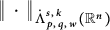 $\|\,\cdot \,\|_{\dot {\Lambda }_{p,\, q,\,w}^{s,\, k}({{{\mathbb R}}^n})}$
. We will take care of this difference in our arguments below.
Lemma 2.8 Let
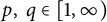 $p,\ q\in [1,\infty )$
,
 $s\in (0,\infty ),$
and
 $\varphi ,\psi \in {\mathcal S}_\infty ({{{\mathbb R}}^n})$
such that
 $$ \begin{align*}\begin{cases} {\mathrm{\,supp\,}} \hat{\varphi}\subset\{x\in{{{\mathbb R}}^n}:\ c_1^{-1}\leq|x|\leq c_1\};\\ {\mathrm{\,supp\,}} \hat{\psi}\subset\{x\in{{{\mathbb R}}^n}:\ c_2^{-1}\leq|x|\leq c_2\}, \end{cases} \end{align*} $$
where
 $c_1,c_2\in (1,\infty )$
. If w is a radial weight satisfying (1.4) and (1.5), then
 $$ \begin{align*}\dot{\Lambda}_{p,\, q,\, w,\, \varphi}^{s}({{{\mathbb R}}^n})=\dot{\Lambda}_{p,\, q,\, w,\, \psi}^{s}({{{\mathbb R}}^n})\end{align*} $$
with equivalent norms.
Proof By symmetry, it suffices to show that
 $$ \begin{align*} \|f\|_{\dot{\Lambda}_{p,\, q,\, w,\, \varphi}^{s}({{{\mathbb R}}^n})}\lesssim\|f\|_{\dot{\Lambda}_{p,\, q,\, w,\, \psi}^{s}({{{\mathbb R}}^n})}. \end{align*} $$
Based on the argument in [Reference Liu, Wu, Yang and Yuan37, Proposition 2.3], there exists a function
 $\phi \in {\mathcal S}({{{\mathbb R}}^n})$
such that
 $$ \begin{align*}{\mathrm{\,supp\,}} \hat{\phi}\subset\{x\in{{{\mathbb R}}^n}:\ c_0^{-1}\leq|x|\leq c_0\}\end{align*} $$
for some constant
 $c_0\in (1,\infty )$
and, moreover,
 $$ \begin{align*} \int_{0}^{\infty}\overline{\hat{\phi}(t\xi)}\ \hat{\psi}(t\xi)\, \frac{dt}{t}=1\ \ {\text{for all}}\ \xi\in {{{\mathbb R}}^n} \setminus\{{0}\}. \end{align*} $$
Consequently, for any
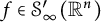 $f\in {\mathcal S}^{\prime }_\infty ({{{\mathbb R}}^n})$
, we know from [Reference Frazier, Jawerth and Weiss24, p.122, Theorem 3] that
 $$ \begin{align} f=\int_{0}^{\infty}\phi_t\ast \psi_t \ast f\, \frac{dt}{t}\quad \text{in}\,\, {\mathcal S}^{\prime}_{\infty}({{{\mathbb R}}^n}). \end{align} $$
Given any
 $r\in (0,\infty )$
, since
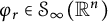 $\varphi _r\in {\mathcal S}_\infty ({{{\mathbb R}}^n})$
, it follows from this last equality that
 $$ \begin{align*}\varphi_r\ast f=\int_{0}^{\infty}\varphi_r \ast \phi_t\ast \psi_t \ast f\, \frac{dt}{t}\end{align*} $$
holds pointwisely. Consequently, by the Young inequality and the Hölder inequality,
 $$ \begin{align*} &\|\varphi_r \ast f \|_{L^p({{{\mathbb R}}^n})}\\&\leq\int_{0}^{\infty}\|\varphi_r \ast \phi_t\ast \psi_t \ast f \|_{L^p({{{\mathbb R}}^n})}\, \frac{dt}{t}\\ &\leq\int_{0}^{\infty}\|\varphi \ast \phi_{t/r} \|_{L^{1}({{{\mathbb R}}^n})}\|\psi_t \ast f \|_{L^p({{{\mathbb R}}^n})}\, \frac{dt}{t}\\ &\leq\left(\int_{0}^{\infty}\|\varphi \ast \phi_{t/r} \|_{L^{1}({{{\mathbb R}}^n})}\, \frac{dt}{t}\right)^{1/{q'}}\left(\int_{0}^{\infty}\|\varphi \ast \phi_{t/r} \|_{L^{1}({{{\mathbb R}}^n})}\|\psi_t \ast f \|_{L^p({{{\mathbb R}}^n})}^q\, \frac{dt}{t}\right)^{1/q}. \end{align*} $$
Given any
 $ K,M\in {\mathbb Z}_+$
, we derive from [Reference Frazier, Jawerth and Weiss24, p.121, Lemma 2; p.122, Lemma 4] that
 $$ \begin{align*}|\varphi \ast \phi_{t/r}(x)| \lesssim \begin{cases} \displaystyle \frac{t}{r}(1+|x|)^{-M},& 0<t\leq r;\\ \displaystyle \left(\frac{r}{t}\right)^{n+1+K}\left(1+\frac{r|x|}{t} \right)^{-M}\lesssim\left(\frac{r}{t}\right)^{N}\left(1+ |x|\right)^{-M},&0<r\leq t, \end{cases}\end{align*} $$
where
 $N=n+1+K-M$
. If we choose
 $M>n$
and
 $K>M-n-1$
, then
 $N>0$
and
 $$ \begin{align} \|\varphi \ast \phi_{t/r} \|_{L^{1}({{{\mathbb R}}^n})}\lesssim \min \left\{\frac{t}{r},\ \left(\frac{r}{t}\right)^N \right\}, \end{align} $$
thereby leading to
 $$ \begin{align*} \int_{0}^{\infty}\|\varphi \ast \phi_{t/r} \|_{L^{1}({{{\mathbb R}}^n})}\, \frac{dt}{t}\lesssim \int_{0}^{r}\frac{t}{r}\, \frac{dt}{t}+\int_{r}^{\infty}\left(\frac{r}{t}\right)^{N}\, \frac{dt}{t}\lesssim 1. \end{align*} $$
Thus, we obtain
 $$ \begin{align*}\|\varphi_r \ast f \|_{L^p({{{\mathbb R}}^n})}\lesssim \left(\int_{0}^{\infty}\|\varphi \ast \phi_{t/r} \|_{L^{1}({{{\mathbb R}}^n})}\|\psi_t \ast f \|_{L^p({{{\mathbb R}}^n})}^q\, \frac{dt}{t}\right)^{1/q},\end{align*} $$
which further implies
 $$ \begin{align*} \|f\|_{\dot{\Lambda}_{p,\, q,\, w,\, \varphi}^{s}({{{\mathbb R}}^n})} &=\left(\int_{0}^{\infty}\| \varphi_r \ast f \|_{L^p({{{\mathbb R}}^n})}^{q}r^{-sq-1}w(r)\, dr\right)^{1/q}\\&\lesssim \left(\int_{0}^{\infty}r^{-sq}\left(\int_{0}^{\infty}\|\varphi \ast \phi_{t/r} \|_{L^{1}({{{\mathbb R}}^n})}\|\psi_t \ast f \|_{L^p({{{\mathbb R}}^n})}^q\, \frac{dt}{t}\right)w(r)\, \frac{dr}{r}\right)^{1/q}\\ &= \left(\int_{0}^{\infty}t^{-sq}\|\psi_t \ast f \|_{L^p({{{\mathbb R}}^n})}^qw(t)\right.\\&\quad\times\left.\left(\int_{0}^{\infty}\left(\frac{r}{t}\right)^{-sq}\|\varphi \ast \phi_{t/r} \|_{L^{1}({{{\mathbb R}}^n})}\frac{w(r)}{w(t)}\, \frac{dr}{r}\right) \frac{dt}{t}\right)^{1/q}. \end{align*} $$
We may choose K sufficiently large such that
 $$ \begin{align*}N=n+1+K-M>(s+1)q.\end{align*} $$
This implies
 $\sigma q<N-sq$
due to
 $\sigma < 1$
. Further, by (2.21), (1.4), and (1.5), together with a change of variables
 $u=r/t$
, we deduce
 $$ \begin{align*} \int_{0}^{t}\left(\frac{r}{t}\right)^{-sq}\|\varphi \ast \phi_{t/r} \|_{L^{1}({{{\mathbb R}}^n})}\frac{w(r)}{w(t)}\, \frac{dr}{r} &\lesssim\int_{0}^{t}\left(\frac{r}{t}\right)^{-sq+N}\frac{w(r)}{w(t)}\ \frac{dr}{r}\\ &\leq \int_{0}^{1} u^{-sq+N} \left(\sup_{\rho \in (0, \infty)}\frac{w(u \rho)}{w(\rho)}\right)\, \frac{du}{u}\\ &\leq\int_{0}^{1}u^{\sigma q}\, \left(\sup_{\rho \in (0, \infty)} \frac{w(u\rho)}{w(\rho)}\right)\frac{du}{u} < \infty \end{align*} $$
and
 $$ \begin{align*} \int_{t}^{\infty}\left(\frac{r}{t}\right)^{-sq}\|\varphi \ast \phi_{t/r} \|_{L^{1}({{{\mathbb R}}^n})}\frac{w(r)}{w(t)}\, \frac{dr}{r} &\lesssim\int_{t}^{\infty}\left(\frac{r}{t}\right)^{-sq-1}\frac{w(r)}{w(t)}\, \frac{dr}{r}\\ &\leq \int_1^{\infty} u^{-sq-1} \left(\sup_{\rho \in (0, \infty)}\frac{w(u \rho)}{w(\rho)}\right)\, \frac{du}{u}\\ &\leq\int_1^{\infty}u^{\delta q}\, \left(\sup_{\rho \in (0, \infty)} \frac{w(u\rho)}{w(\rho)}\right)\frac{du}{u} < \infty, \end{align*} $$
where we used
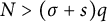 $N>(\sigma +s)q$
and
 $\delta>-s-1/q$
. Altogether, we obtain
 $$ \begin{align*} \|f\|_{\dot{\Lambda}_{p,\, q,\, w,\, \varphi}^{s}({{{\mathbb R}}^n})}\lesssim \left(\int_{0}^{\infty}\| \psi_t \ast f \|_{L^p({{{\mathbb R}}^n})}^{q}t^{-sq-1}w(t)\, dt\right)^{1/q}=\|f\|_{\dot{\Lambda}_{p,\, q,\, w,\, \psi}^{s}({{{\mathbb R}}^n})}, \end{align*} $$
as desired.
Next, we introduce a technical lemma, whose proof is essentially given in [Reference Stein and Weiss44, Lemma (2.1)].
Lemma 2.9 Let
 $q\in [1,\infty )$
, w be a radial weight, and K be a nonnegative function defined on
 $(0,\infty )\times (0,\infty )$
which is homogeneous of degree
 $-n$
and satisfies
 $$ \begin{align} J:=\int_{0}^{\infty}K(1, t)t^{\frac n{q'}-1}\, \left(\sup_{\rho \in (0, \infty)} \frac{w(t^{-1}\rho)}{w(\rho)}\right)^{\frac 1 q }dt < \infty. \end{align} $$
Then, for any
 $f\in L_w^q({{{\mathbb R}}^n})$
, the function
 $$ \begin{align*} Tf(x):=\int_{ {{{\mathbb R}}^n} }K(\left|x\right|, |y|)f(y)\, dy \end{align*} $$
satisfies
 $$ \begin{align*}\|Tf\|_{L_w^q({{{\mathbb R}}^n})}\le J \,\omega_{n-1}\|f\|_{L_w^q({{{\mathbb R}}^n})},\end{align*} $$
where
 $\omega _{n-1}$
denotes the surface area of the unit ball in
 ${{{\mathbb R}}^n}$
.
Proof Observe that
 $Tf$
is radial, which implies
 $$ \begin{align*} \|Tf\|_{L_w^q({{{\mathbb R}}^n})}=\left(\int_{ {{{\mathbb R}}^n} } |Tf(x)|^{q} w(x)\, dx\right)^{1/q} =\omega_{n-1}^{1/q}\left(\int_{0}^{\infty} |Tf(R)|^{q} w(R) R^{n-1}\, dR\right)^{1/q}. \end{align*} $$
Upon writing
 $$ \begin{align*} Tf(R) &= \int_{0}^{\infty} \int_{\mathbb{S}^{n-1}} K(R, r) f(r \eta) r^{n-1}\, d\sigma(\eta) \,dr \\ &= \int_{0}^{\infty} \int_{\mathbb{S}^{n-1}} R^{-n} K(1, t)\, f(tR \eta)\, (tR)^{n-1} R \, d\sigma(\eta) \,dt \\ &= \int_{\mathbb{S}^{n-1}} \left(\int_{0}^{\infty} K(1, t)\, f(tR \eta)\, t^{n-1} \, dt\right) \,d\sigma(\eta)\\ &=: \int_{\mathbb{S}^{n-1}} T_{\eta}f(R) \,d\sigma(\eta), \end{align*} $$
we then apply the Minkowski inequality and deduce
 $$ \begin{align} \|Tf\|_{L_w^q({{{\mathbb R}}^n})} &=\omega_{n-1}^{1/q}\left(\int_0^\infty\left| \int_{\mathbb{S}^{n-1}} T_{\eta}f(R) \,d\sigma(\eta) \right|{}^qw(R)R^{n-1}\,dR\right)^{1/q}\\ &\leq\omega_{n-1}^{1/q}\int_{\mathbb{S}^{n-1}}\left(\int_{0}^{\infty} |T_{\eta}f(R)|^{q}w(R)R^{n-1}\,dR\right)^{1/q} \, d\sigma(\eta).{\nonumber} \end{align} $$
By duality, there exists a function h such that
 $$ \begin{align*}\int_{0}^{\infty} |h(R)|^{q'} w(R) R^{n-1} \, dR=1\end{align*} $$
and
 $$ \begin{align} \left(\int_{0}^{\infty}|T_{\eta}f(R)|^{q}w(R)R^{n-1}\,dR\right)^{1/q} =\int_{0}^{\infty} T_{\eta}f(R) h(R)\, w(R) R^{n-1} \, dR. \end{align} $$
Notice that (2.22), the Fubini theorem and the Hölder inequality imply
 $$ \begin{align*} &\int_{0}^{\infty}T_{\eta}f(R) h(R) w(R) R^{n-1} \, dR\\ &\quad\leq \int_{0}^{\infty} \left(\int_{0}^{\infty} K(1, t)\, |f(tR \eta)|\, t^{n-1} \, dt\right) |h(R)| w(R) R^{n-1} \, dR\\ &\quad= \int_{0}^{\infty} K(1, t)\,t^{n-1} \left(\int_{0}^{\infty} |f(tR \eta)\, h(R)| w(R) R^{n-1} \, dR\right)\, dt\\ &\quad\leq \int_{0}^{\infty} K(1, t)\,t^{n-1} \left(\int_{0}^{\infty} |f(tR \eta)|^{q} w(R) R^{n-1} \, dR\right)^{1/q}\, dt\\ &\quad= \int_{0}^{\infty} K(1, t)\,t^{n-1-\frac{n}{q}} \left(\int_{0}^{\infty} |f(\rho \eta)|^{q} w(t^{-1} \rho) \rho^{n-1} \, d\rho\right)^{1/q}\, dt\\ &\quad\leq \int_{0}^{\infty}K(1, t)t^{\frac{n}{q'}-1}\, \left(\sup_{\rho \in (0, \infty)} \frac{w(t^{-1}\rho)}{w(\rho)}\right)^{1/q}dt \left(\int_{0}^{\infty} |f(\rho \eta)|^{q} w(\rho) \rho^{n-1} \, d\rho\right)^{1/q}\\ &\quad=J \left(\int_{0}^{\infty} |f(\rho \eta)|^{q} w(\rho) \rho^{n-1} \, d\rho\right)^{1/q}. \end{align*} $$
This, together with (2.23), (2.24), and the Hölder inequality, further implies
 $$ \begin{align*} \|Tf\|_{L_w^q({{{\mathbb R}}^n})} &\leq J \,\omega_{n-1}^{1/q} \int_{\mathbb{S}^{n-1}} \left(\int_{0}^{\infty} |f(\rho \eta)|^{q} w(\rho) \rho^{n-1} \, d\rho\right)^{1/q}\, d\sigma(\eta)\\ &\leq J \,\omega_{n-1}^{1/q} \left(\int_{\mathbb{S}^{n-1}} \int_{0}^{\infty} |f(\rho \eta)|^{q} w(\rho) \rho^{n-1} \, d\rho d\sigma(\eta)\right)^{1/q}\omega_{n-1}^{1/q'}\\ &= J \,\omega_{n-1} \|f\|_{L_w^q({{{\mathbb R}}^n})}. \end{align*} $$
Thus, we complete the proof of Lemma 2.9.
Theorem 2.10 Let
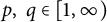 $p,\ q\in [1,\infty )$
,
 $s\in (0,\infty )$
. Suppose that
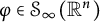 $\varphi \in {\mathcal S}_\infty ({{{\mathbb R}}^n})$
such that
 $$ \begin{align*}{\mathrm{\,supp\,}} \hat{\varphi}\subset\{x: c^{-1}\leq|x|\leq c\}\end{align*} $$
for some constant
 $c\in (1,\infty )$
. Assume that
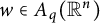 $w\in A_q({{{\mathbb R}}^n})$
is a radial weight satisfying (1.4) and (1.5). Then, there exists a positive constant C such that the following hold:
-
(i) for any
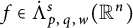
$f\in \dot {\Lambda }_{p,\, q,\, w,\, \varphi }^{s}({{{\mathbb R}}^n})$
, there exists a Lebesgue measurable function
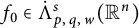
$f_0\in \dot {\Lambda }_{p,\, q,\, w}^{s}({{{\mathbb R}}^n})$
such that
$f_0=f$
in
${\mathcal S}^{\prime }_\infty ({{{\mathbb R}}^n})$
and
$$ \begin{align*} \|f_0\|_{\dot{\Lambda}_{p,\, q,\, w}^{s}({{{\mathbb R}}^n})}\le C\|f\|_{\dot{\Lambda}_{p,\, q,\, w,\, \varphi}^{s}({{{\mathbb R}}^n})}; \end{align*} $$
-
(ii) for any
$f\in \dot {\Lambda }_{p,\, q,\, w}^{s}({{{\mathbb R}}^n})$
,
$$ \begin{align*} \|f\|_{\dot{\Lambda}_{p,\, q,\, w,\, \varphi}^{s}({{{\mathbb R}}^n})}\le C\|f\|_{\dot{\Lambda}_{p,\, q,\, w}^{s}({{{\mathbb R}}^n})}. \end{align*} $$




Proof We first prove (i). As in (2.20), there exists a function
 $\phi \in {\mathcal S}({{{\mathbb R}}^n})$
such that
 $$ \begin{align*}{\mathrm{\,supp\,}} \hat{\phi}\subset \{x\in{{{\mathbb R}}^n}:\ c_0^{-1}\leq |x|\leq c_0\}\end{align*} $$
and
 $$ \begin{align}f=\int_{0}^{\infty}\phi_t\ast \varphi_t \ast f\, \frac{dt}{t}\quad \text{in}\,\, {\mathcal S}^{\prime}_{\infty}({{{\mathbb R}}^n}), \end{align} $$
where
 $c_0\in (1,\infty )$
is a constant. Set
 $$ \begin{align*}f_0:= \int_{0}^{\infty}\phi_t\ast \varphi_t \ast f\, \frac{dt}{t}.\end{align*} $$
Clearly,
 $f_0$
is a Lebesgue measurable function, but may be infinite on a set of positive Lebesgue measure.
Let us calculate the semi-norm
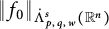 $\|f_0\|_{\dot {\Lambda }_{p,\, q,\, w}^{s}({{{\mathbb R}}^n})}$
. To this end, let
 $k=\lfloor s\rfloor +1$
. Then, we have
 $$ \begin{align*} \mathrm{D}_{h}^{k}f_0=\int_{0}^{\infty}\mathrm{D}_{h}^{k}(\phi_t\ast \varphi_t \ast f)\, \frac{dt}{t}, \end{align*} $$
which implies
 $$ \begin{align} \|\mathrm{D}_{h}^{k}f_0 \|_{L^p({{{\mathbb R}}^n})}\leq\int_{0}^{\infty}\|\mathrm{D}_{h}^{k}(\phi_t\ast \varphi_t \ast f)\|_{L^p({{{\mathbb R}}^n})}\, \frac{dt}{t}. \end{align} $$
On the one hand, by (1.1) and the Young inequality, we obtain
 $$ \begin{align} &\|\mathrm{D}_{h}^{k}(\phi_t\ast \varphi_t \ast f) \|_{L^p({{{\mathbb R}}^n})}\\&\quad=\left\|\sum_{m=0}^{k}(-1)^{k-m}\binom{k}{m}(\phi_t\ast \varphi_t \ast f)(\cdot+mh) \right\|_{L^p({{{\mathbb R}}^n})}\notag\\ &\quad\notag\lesssim \|\phi_t\ast \varphi_t \ast f \|_{L^p({{{\mathbb R}}^n})}\notag\\&\quad\leq \|\phi_t \|_{L^{1}({{{\mathbb R}}^n})} \|\varphi_t \ast f \|_{L^p({{{\mathbb R}}^n})}\notag\\&\quad\lesssim\|\varphi_t \ast f \|_{L^p({{{\mathbb R}}^n})}.\notag \end{align} $$
On the other hand, by
 $$ \begin{align*} \mathrm{D}_{h}^{k}g(x) &=\int_{[0,1]^k}\sum_{j_1=1}^{n}\cdots \sum_{j_{k}=1}^{n} h_{j_1} \cdots h_{j_{k}} (\partial_{j_1} \cdots \partial_{j_{k}}g)(x +(t_1+\cdots+t_{k})h)\, dt_1 \cdots \,dt_{k} \end{align*} $$
and the Minkowski inequality, we have
 $$ \begin{align*} \|\mathrm{D}_{h}^{k}(\phi_t\ast \varphi_t \ast f) \|_{L^p({{{\mathbb R}}^n})}&\lesssim |h|^k \sum_{i_1=1}^{n}\cdots\sum_{i_k=1}^{n} \|\partial_{i_1}\cdots\partial_{i_k}(\phi_t\ast \varphi_t \ast f) \|_{L^p({{{\mathbb R}}^n})}\\ &=|h|^k \sum_{i_1=1}^{n}\cdots\sum_{i_k=1}^{n} \|(\partial_{i_1}\cdots\partial_{i_k}\phi_t)\ast (\varphi_t\ast f) \|_{L^p({{{\mathbb R}}^n})}\\ &\leq|h|^k \sum_{i_1=1}^{n}\cdots\sum_{i_k=1}^{n} \|\partial_{i_1}\cdots\partial_{i_k}\phi_t \|_{L^{1}({{{\mathbb R}}^n})}\| \varphi_t\ast f \|_{L^p({{{\mathbb R}}^n})}. \end{align*} $$
Since
 $$ \begin{align*} \|\partial_{i_1}\cdots\partial_{i_k}\phi_t \|_{L^{1}({{{\mathbb R}}^n})}=t^{-k}\|(\partial_{i_1}\cdots\partial_{i_k}\phi)_{t}(x)\|_{L^1({{{\mathbb R}}^n})} \lesssim t^{-k}, \end{align*} $$
it follows that
 $$ \begin{align} \|\mathrm{D}_{h}^{k}(\phi_t\ast \varphi_t\ast f) \|_{L^p({{{\mathbb R}}^n})}&\lesssim t^{-k}|h|^k\| \varphi_t\ast f \|_{L^p({{{\mathbb R}}^n})}. \end{align} $$
Inserting (2.27) and (2.28) into (2.26) yields
 $$ \begin{align} \|{\mathrm{D}}_{h}^{k}f_0 \|_{L^p({{{\mathbb R}}^n})}&\lesssim\int_{0}^{\infty}\min\left\{1,\frac{|h|}{t}\right\}^k\|\varphi_t\ast f\|_{L^p({{{\mathbb R}}^n})}\, \frac{dt}{t}, \end{align} $$
thereby leading to
 $$ \begin{align*} \|f_0\|_{\dot{\Lambda}_{p,\, q,\,w}^{s}({{{\mathbb R}}^n})} &=\left( \int_{ {{{\mathbb R}}^n} } \frac{\|{\mathrm{D}}_{h}^{k}f_0 \|_{L^p({{{\mathbb R}}^n})}^{q}}{|h|^{n+sq}} w(h)\, dh \right)^{1/q}\\ &\lesssim\left( \int_{ {{{\mathbb R}}^n} } \left(\int_{0}^{\infty}\min\left\{1,\frac{|h|}{t}\right\}^k\|\varphi_t\ast f\|_{L^p({{{\mathbb R}}^n})}\, \frac{dt}{t}\right)^{q} \frac{w(h)}{|h|^{n+sq}} \, dh \right)^{1/q}\\ &=\left(\int_{ {{{\mathbb R}}^n} }\left(\int_{0}^{\infty}\min\left\{1,\frac{|h|}{t}\right\}^k \left(\frac{t}{|h|}\right)^{s+n/q}\frac{\|\varphi_t\ast f\|_{L^p({{{\mathbb R}}^n})}}{t^{s+n/q}}\frac{\, dt}t\right)^q w(h)\, dh\right)^{1/q}. \end{align*} $$
If we set
 $$ \begin{align*}F_1(y):=\frac{\|\varphi_{|y|}\ast f\|_{L^p({{{\mathbb R}}^n})}}{|y|^{s+n/q}}\end{align*} $$
and
 $$ \begin{align*}K_1(|h|,|y|):=\min\left\{1,\frac{|h|}{|y|}\right\}^k \left(\frac{|y|}{|h|}\right)^{s+n/q}|y|^{-n},\end{align*} $$
then
 $$ \begin{align*}\int_{0}^{\infty}\min\left\{1,\frac{|h|}{t}\right\}^k \left(\frac{t}{|h|}\right)^{s+n/q}\frac{\|\varphi_t\ast f\|_{L^p({{{\mathbb R}}^n})}}{t^{s+n/q}}\frac{\, dt}t=\frac{1}{\omega_{n-1}}\int_{ {{{\mathbb R}}^n} }K_1(|h|,|y|)F_1(y)\, dy\end{align*} $$
and, hence,
 $$ \begin{align}\|f_0\|_{\dot{\Lambda}_{p,\, q,\,w}^{s}({{{\mathbb R}}^n})}\lesssim \left(\int_{ {{{\mathbb R}}^n} }\left(\frac{1}{\omega_{n-1}}\int_{ {{{\mathbb R}}^n} }K_1(|h|,|y|)F_1(y)\, dy\right)^q w(h)\, dh\right)^{1/q}. \end{align} $$
Clearly,
 $K_1$
is homogeneous of degree
 $-n$
. Moreover, by (1.4) and (1.5), we have
 $$ \begin{align*} &\int_{0}^{\infty}K_1(1, t)\,t^{\frac n{q'}-1} \left(\sup_{\rho \in (0, \infty)} \frac{w(t^{-1}\rho)}{w(\rho)}\right)^{\frac 1 q }dt\\ &\quad=\int_{0}^{1}t^{s} \left(\sup_{\rho \in (0, \infty)} \frac{w(t^{-1}\rho)}{w(\rho)}\right)^{\frac 1 q }\,\frac{dt}{t}+\int_1^{\infty}t^{s-k} \left(\sup_{\rho \in (0, \infty)} \frac{w(t^{-1}\rho)}{w(\rho)}\right)^{\frac 1 q }\,\frac{dt}{t}\\ &\quad=\int_1^{\infty}t^{-s} \left(\sup_{\rho \in (0, \infty)} \frac{w(t\rho)}{w(\rho)}\right)^{\frac 1 q }\,\frac{dt}{t}+\int_{0}^{1}t^{k-s} \left(\sup_{\rho \in (0, \infty)} \frac{w(t\rho)}{w(\rho)}\right)^{\frac 1 q }\,\frac{dt}{t}\\ &\quad\leq\left(\int_1^{\infty}t^{\delta q} \left(\sup_{\rho \in (0, \infty)} \frac{w(t\rho)}{w(\rho)}\right)\,\frac{dt}{t}\right)^{\frac 1 q }\left(\int_1^{\infty}t^{-(s+\delta) q'}\,\frac{dt}{t}\right)^{\frac{1}{q'}}\\ &\quad\quad+\left(\int_{0}^{1}t^{\sigma q} \left(\sup_{\rho \in (0, \infty)} \frac{w(t\rho)}{w(\rho)}\right)\,\frac{dt}{t}\right)^{\frac 1 q }\left(\int_0^1t^{(k-s-\sigma) q'}\,\frac{dt}{t}\right)^{\frac{1}{q'}}\\ &\quad<\infty, \end{align*} $$
which, together with Lemma 2.9, implies

We still need to show that
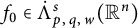 $f_0\in \dot {\Lambda }_{p,\, q,\, w}^{s}({{{\mathbb R}}^n})$
. To achieve this, we only need to validate that
 $f_0$
can be approximated by
 $C_c^\infty ({{{\mathbb R}}^n})$
-functions under
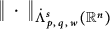 $\|\,\cdot \,\|_{\dot {\Lambda }_{p,\, q,\, w}^{s}({{{\mathbb R}}^n})}$
. Indeed, for any
 $\epsilon \in (0,1)$
, define
 $$ \begin{align*}f_{\epsilon}:= \int_{\epsilon}^{1/\epsilon}\phi_t\ast \varphi_t \ast f\, \frac{dt}{t}.\end{align*} $$
After a revisit of the above proof of
 $\|f_0\|_{\dot {\Lambda }_{p,\, q,\,w}^{s}({{{\mathbb R}}^n})}<\infty $
, we derive from (2.26) and (2.29)–(2.31) that
 $$ \begin{align*}\|f_0\|_{\dot{\Lambda}_{p,\, q,\,w}^{s}({{{\mathbb R}}^n})}^q\le \int_{ {{{\mathbb R}}^n} } \frac{\big(\int_{0}^{\infty}\|\mathrm{D}_{h}^{k}(\phi_t\ast \varphi_t \ast f)\|_{L^p({{{\mathbb R}}^n})}\, \frac{dt}{t}\big)^{q}}{|h|^{n+sq}} w(h)\, dh<\infty, \end{align*} $$
which directly gives
 $$ \begin{align}\|f_\epsilon\|_{\dot{\Lambda}_{p,\, q,\, w}^{s}({{{\mathbb R}}^n})}^q \le \int_{ {{{\mathbb R}}^n} } \frac{\big(\int_{\epsilon}^{1/\epsilon}\|\mathrm{D}_{h}^{k}(\phi_t\ast \varphi_t \ast f)\|_{L^p({{{\mathbb R}}^n})}\, \frac{dt}{t}\big)^{q}}{|h|^{n+sq}} w(h)\, dh <\infty. \end{align} $$
Meanwhile, observing that
 $$ \begin{align*}\|\mathrm{D}^k_h(f_0-f_\epsilon)\|_{L^p({{{\mathbb R}}^n})} \le \left(\int_{0}^{\epsilon} +\int_{1/\epsilon}^{\infty} \right)\|\mathrm{D}^k_h(\phi_t\ast \varphi_t \ast f)\|_{L^p({{{\mathbb R}}^n})}\, \frac{dt}{t},\end{align*} $$
and applying the Lebesgue dominated convergence theorem to
 $$ \begin{align*}\int_{ {{{\mathbb R}}^n} } \frac{\big(\int_{0}^{\epsilon} \|\mathrm{D}_{h}^{k}(\phi_t\ast \varphi_t \ast f)\|_{L^p({{{\mathbb R}}^n})}\, \frac{dt}{t} +\int_{1/\epsilon}^{\infty} \|\mathrm{D}^k_h(\phi_t\ast \varphi_t \ast f)\|_{L^p({{{\mathbb R}}^n})}\, \frac{dt}{t}\big)^{q}}{|h|^{n+sq}} w(h)\, dh, \end{align*} $$
we arrive at
 $$ \begin{align} \lim_{\epsilon\to0}\|f_0-f_\epsilon\|_{\dot{\Lambda}_{p,\, q,\, w}^{s}({{{\mathbb R}}^n})} =0. \end{align} $$
Moreover, by the Young inequality and the Hölder inequality, we have
 $$ \begin{align*} \|f_\epsilon\|_{L^p({{{\mathbb R}}^n})}&\leq \int_{\epsilon}^{1/\epsilon}\|\phi_t\ast \varphi_t \ast f\|_{L^p({{{\mathbb R}}^n})}\, \frac{dt}{t}\\ &\leq \int_{\epsilon}^{1/\epsilon}\|\phi_t\|_{L^{1}({{{\mathbb R}}^n})}\|\varphi_t \ast f\|_{L^p({{{\mathbb R}}^n})}\, \frac{dt}{t}\\ &\leq \left(\int_{\epsilon}^{1/\epsilon}\| \varphi_t \ast f \|_{L^p({{{\mathbb R}}^n})}^{q}t^{-sq}w(t)\, \frac{dt}t\right)^{1/q}\left(\int_{\epsilon}^{1/\epsilon}\|\phi_t\|_{L^{1}({{{\mathbb R}}^n})}^{q'}t^{sq'}w(t)^{1-q'}\, \frac{dt}t\right)^{1/q'}\\ &\leq \|f\|_{\dot{\Lambda}_{p,\, q,\, w,\, \varphi}^{s}({{{\mathbb R}}^n})}\|\phi\|_{L^1({{{\mathbb R}}^n})}\left(\int_{\epsilon}^{1/\epsilon}t^{sq'}w(t)^{1-q'}\, \frac{dt}t\right)^{1/q'}. \end{align*} $$
Note that
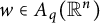 $w\in A_q({{{\mathbb R}}^n})$
means
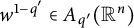 $w^{1-q'}\in A_{q'}({{{\mathbb R}}^n})$
. This, together with the radial property of w, implies
 $$ \begin{align*} \int_{\epsilon}^{1/\epsilon}t^{sq'-1}w(t)^{1-q'}\, dt\approx \int_{\epsilon\leq |x|\leq \frac{1}{\epsilon}}|x|^{sq'-n}w(x)^{1-q'}\, dx<\infty \end{align*} $$
and, hence,
 $$ \begin{align*}f_\epsilon\in L^p({{{\mathbb R}}^n}).\end{align*} $$
By this and (2.32), we see that
 $f_\epsilon \in {\Lambda }_{p,\, q,\, w}^{s}({{{\mathbb R}}^n})$
. Further, it follows from Lemma 2.2 that there exists a sequence
 $\{f_{\epsilon ,j}\}_j\subset C_c^\infty ({{{\mathbb R}}^n})$
such that
 $$ \begin{align} \lim_{j\to\infty}\|f_{\epsilon,j}-f_\epsilon\|_{\dot{\Lambda}_{p,\, q,\, w}^{s}({{{\mathbb R}}^n})}\le\lim_{j\to\infty}\|f_{\epsilon,j}-f_\epsilon\|_{\Lambda_{p,\, q,\, w}^{s}({{{\mathbb R}}^n})}=0. \end{align} $$
Combining (2.33) and (2.34), we deduce that
 $f_0$
can be approximated by
 $C_c^\infty ({{{\mathbb R}}^n})$
-functions
 $\{f_{\epsilon ,j}\}_{\epsilon ,j}$
under the semi-norm
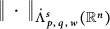 $\|\,\cdot \,\|_{\dot {\Lambda }_{p,\, q,\, w}^{s}({{{\mathbb R}}^n})}$
. This finishes the proof of (i).
Next, we show (ii). To this end, we choose a radial function
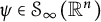 $\psi \in {\mathcal S}_\infty ({{{\mathbb R}}^n})$
satisfying
 ${ \mathrm {\,supp\,}} \hat {\psi }\subset \{x\in {{{\mathbb R}}^n}:\ c_0^{-1}\leq |x|\leq c_0\}$
for some constant
 $c_0\in (1,\infty )$
. For any
 $z\in {{{\mathbb R}}^n}$
, define
 $$ \begin{align*}\Psi(z)=\sum_{m=1}^{k}(-1)^{k-m}\binom{k}{m}m^{-n}\psi\left(\frac{z}{m}\right).\end{align*} $$
Clearly,
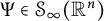 $\Psi \in {\mathcal S}_\infty ({{{\mathbb R}}^n})$
and
 ${ \mathrm {\,supp\,}} \hat {\Psi }\subset \{x\in {{{\mathbb R}}^n}:\ (kc_0)^{-1}\leq |x|\leq c_0\}.$
Due to Lemma 2.8, it suffices to show that for any
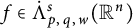 $f\in \dot {\Lambda }_{p,\, q,\, w}^{s}({{{\mathbb R}}^n})$
there is
 $$ \begin{align*}\|f\|_{\dot{\Lambda}_{p,\, q,\, w,\,\Psi}^{s}({{{\mathbb R}}^n})}\lesssim\|f\|_{\dot{\Lambda}_{p,\, q,\, w}^{s}({{{\mathbb R}}^n})}.\end{align*} $$
Indeed, by the cancellation condition of
 $\psi $
, we write
 $$ \begin{align*} \Psi_t\ast f(x)&=\int_{ {{{\mathbb R}}^n} }f(x-z)\Psi_t(z)\ dz\\ &=\int_{ {{{\mathbb R}}^n} }f(x-z)\sum_{m=1}^{k}(-1)^{k-m}\binom{k}{m}m^{-n} \psi_t\left(\frac{z}{m}\right)\ dz\\ &=\int_{ {{{\mathbb R}}^n} }\sum_{m=1}^{k}(-1)^{k-m}\binom{k}{m}f(x+my)\psi_t(y)\ dy\\ &=\int_{ {{{\mathbb R}}^n} }\sum_{m=0}^{k}(-1)^{k-m}\binom{k}{m}f(x+my)\psi_t(y)\ dy\\ &=\int_{ {{{\mathbb R}}^n} }\mathrm{D}_{y}^{k}f(x)\psi_t(y)\ dy, \end{align*} $$
which, together with the Minkowski inequality, further implies
 $$ \begin{align*} \|\Psi_t\ast f \|_{L^p({{{\mathbb R}}^n})}^q&=\left(\int_{ {{{\mathbb R}}^n} }\left|\int_{ {{{\mathbb R}}^n} }\mathrm{D}_{y}^{k}f(x)\psi_t(y)\ dy\right|{}^p\ dx\right)^{q/p}\\ &\leq\left(\int_{ {{{\mathbb R}}^n} }\left(\int_{ {{{\mathbb R}}^n} }|\mathrm{D}_{y}^{k}f(x)|^p|\psi_t(y)|^p\ dx\right)^{1/p}\ dy\right)^{q}\\ &=\left(\int_{ {{{\mathbb R}}^n} }|\psi_t(y)|\, \|\mathrm{D}_{y}^{k}f \|_{L^p({{{\mathbb R}}^n})}\ dy\right)^{q}. \end{align*} $$
Thus,
 $$ \begin{align*} \|f\|_{\dot{\Lambda}_{p,\, q,\, w,\, \Psi}^{s}({{{\mathbb R}}^n})} &=\left(\int_{0}^{\infty}\| \Psi_t \ast f \|_{L^p({{{\mathbb R}}^n})}^{q}t^{-sq-1}w(t)\, dt\right)^{1/q}\\ &\leq\left(\int_{0}^{\infty}\left(\int_{ {{{\mathbb R}}^n} }|\psi_t(y)|\, \|\mathrm{D}_{y}^{k}f \|_{L^p({{{\mathbb R}}^n})}\ dy\right)^{q}t^{-sq-1}w(t)\, dt\right)^{1/q}\\ &=\left(\frac{1}{\omega_{n-1}}\int_{ {{{\mathbb R}}^n} }\left(\int_{ {{{\mathbb R}}^n} }|\psi_{|x|}(y)|\, \|\mathrm{D}_{y}^{k}f \|_{L^p({{{\mathbb R}}^n})}\ dy\right)^{q}|x|^{-sq-n}w(x)\, dx\right)^{1/q}\\ &\approx\left(\int_{ {{{\mathbb R}}^n} }\left(\int_{ {{{\mathbb R}}^n} }|\psi_{|x|}(y)|\left(\frac{|y|}{|x|}\right)^{s+\frac{n}{q}}\,\frac{\|\mathrm{D}_{y}^{k}f \|_{L^p({{{\mathbb R}}^n})}}{|y|^{s+\frac{n}{q}}} \ dy\right)^{q}w(x)\, dx\right)^{1/q}. \end{align*} $$
Since
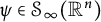 $\psi \in {\mathcal S}_\infty ({{{\mathbb R}}^n})$
, it follows that for all
 $x,y\in {{{\mathbb R}}^n}$
,
 $$ \begin{align*}\left|\psi_{|x|}(y)\right|\left(\frac{|y|}{|x|}\right)^{s+n/q}\lesssim |x|^{-n}\left(\frac{|y|}{|x|}\right)^{s+n/q}\left(1+\frac{|y|}{|x|}\right)^{-N},\end{align*} $$
where
 $N>s+n+\sigma $
. For any
 $x,\,y\in {{{\mathbb R}}^n}$
, upon setting
 $$ \begin{align*}F_2(y):=\frac{\|\mathrm{D}_{y}^{k}f \|_{L^p({{{\mathbb R}}^n})}}{|y|^{s+n/q}}\end{align*} $$
and
 $$ \begin{align*}K_2(|x|,|y|):=|x|^{-n}\left(\frac{|y|}{|x|}\right)^{s+n/q}\left(1+\frac{|y|}{|x|}\right)^{-N},\end{align*} $$
we then arrive at the estimate
 $$ \begin{align*}\|f\|_{\dot{\Lambda}_{p,\, q,\,w}^{s}({{{\mathbb R}}^n})}\lesssim \left(\int_{ {{{\mathbb R}}^n} }\left(\int_{ {{{\mathbb R}}^n} }K_2(|x|,|y|)F_2(y)\, dy\right)^q w(x)\, dx\right)^{1/q}.\end{align*} $$
Clearly,
 $K_2$
is homogeneous of degree
 $-n$
. Moreover, from (1.4) and (1.5), it follows that
 $$ \begin{align*} &\int_{0}^{\infty}K_2(1, t)\,t^{\frac n{q'}-1} \left(\sup_{\rho \in (0, \infty)} \frac{w(t^{-1}\rho)}{w(\rho)}\right)^{\frac 1 q }dt\\ &\quad\leq\int_{0}^{1} t^{s+n}\left(\sup_{\rho \in (0, \infty)}\frac{w(t^{-1}\rho)}{w(\rho)}\right)^{\frac 1 q }\frac{dt}{t} +\int_1^{\infty}t^{s+n-N}\left(\sup_{\rho \in (0, \infty)}\frac{w(t^{-1}\rho)}{w(\rho)}\right)^{\frac 1 q }\frac{dt}{t}\\ &\quad=\int_1^{\infty} t^{-s-n}\left(\sup_{\rho \in (0, \infty)}\frac{w(t\rho)}{w(\rho)}\right)^{\frac 1 q }\frac{dt}{t}+\int_{0}^{1} t^{N-s-n}\left(\sup_{\rho \in (0, \infty)}\frac{w(t\rho)}{w(\rho)}\right)^{\frac 1 q }\frac{dt}{t}\\ &\quad\leq\left(\int_1^{\infty} t^{\delta q}\left(\sup_{\rho \in (0, \infty)}\frac{w(t\rho)}{w(\rho)}\right)\frac{dt}{t}\right)^{\frac 1 q }\left(\int_1^{\infty}t^{-(\delta+s+n)q'}\frac{dt}{t}\right)^{\frac{1}{q'}}\\ &\quad\quad+\left(\int_{0}^{1} t^{\sigma q}\left(\sup_{\rho \in (0, \infty)}\frac{w(t\rho)}{w(\rho)}\right)\frac{dt}{t}\right)^{\frac 1 q }\left(\int_{0}^{1}t^{(N-s-n-\sigma)q'}\frac{dt}{t}\right)^{\frac{1}{q'}}\\ &\quad<\infty, \end{align*} $$
where in the last step we used
 $N>s+n+\sigma $
and
 $\delta>-s$
. We then have by Lemma 2.9 that
 $$ \begin{align*} \|f\|_{\dot{\Lambda}_{p,\, q,\, w,\, \Psi}^{s}({{{\mathbb R}}^n})} \lesssim\left( \int_{ {{{\mathbb R}}^n} } \frac{\|{\mathrm{D}}_{y}^{k}f \|_{L^p({{{\mathbb R}}^n})}^{q}}{|y|^{n+sq}} w(y)\, dy \right)^{\frac 1 q }=\|f\|_{\dot{\Lambda}_{p,\, q,\, w}^{s}({{{\mathbb R}}^n})}. \end{align*} $$
This finishes the proof of (ii) and, hence, Theorem 2.10.
Remark 2.11 In Theorem 2.10(i), if
 $f\in L^r({{{\mathbb R}}^n})$
for some
 $r\in [1,\infty )$
, then we know that the Calderón reproducing formula (2.25) holds almost everywhere on
 ${{{\mathbb R}}^n}$
(see, for example, [Reference Frazier, Jawerth and Weiss24]), so that
 $f_0=f$
almost everywhere on
 ${{{\mathbb R}}^n}$
.
3 Proof of Theorem 1.6
The main goal of this section is to show Theorem 1.6. In Sections 3.1 and 3.2, we restrict
 $\beta $
to
 $(0,2n)$
and deal with the extension and restriction part, respectively. The case
 $\beta \in [2n,\infty )$
is proved in Section 3.3.
3.1 Extension part: the case
$\beta \in (0,2n)$

We begin with the following estimate associated with the Bessel kernel.
Lemma 3.1 For
 $\alpha \in (0,\infty )$
, let
 $G_{\alpha }$
be the Bessel kernel on
 ${{{\mathbb R}}^n}$
, that is, for all
 $x\in {{{\mathbb R}}^n}$
,
 $$ \begin{align*}\hat G_\alpha(x)=(1+|x|^2)^{-\frac{\alpha}{2}}.\end{align*} $$
If
 $k\in {\mathbb N}$
satisfying
 $k>n-\alpha $
, then for all
 $\xi \in {{{\mathbb R}}^n}$
the integral
 $$ \begin{align*}\int_{ {{{\mathbb R}}^n} } G_{\alpha}(|h| \xi) \left(e^{2 \pi i h \cdot \xi}-1\right)^{k} \,\frac{dh}{|h|^n}\end{align*} $$
absolutely converges to the same constant
 $c_{\alpha }$
independent of
 $\xi $
.
Proof Let
 $e_1:=(1,0,\dots ,0)$
be the unit vector in
 ${{{\mathbb R}}^n}$
. After a rotation, we then have
 $$ \begin{align*} \int_{ {{{\mathbb R}}^n} } G_{\alpha}(|h| \xi) \left(e^{2 \pi i h \cdot \xi}-1\right)^{k} \,\frac{dh}{|h|^n} =\int_{ {{{\mathbb R}}^n} } G_{\alpha}(|h| e_1) \left(e^{2 \pi i h\cdot e_1}-1\right)^{k} \,\frac{dh}{|h|^n}, \end{align*} $$
which is independent of
 $\xi $
if the integral converges. For all
 $h\in {{{\mathbb R}}^n}$
, observe that
 $$ \begin{align*}\left|\left(e^{2 \pi i h\cdot e_1}-1\right)^{k}\right|\lesssim \min\{1, |h|^k\}.\end{align*} $$
Note that
 $\hat {G}_{\alpha }$
is radial, so does
 $G_{\alpha }$
. Due to this reason, we may write
 $G_\alpha (x)$
as
 $G_\alpha (r)$
whenever
 $|x|=r$
. Thus,
 $$ \begin{align*} \left|\int_{ {{{\mathbb R}}^n} } G_{\alpha}(|h| e_1) \left(e^{2 \pi i h\cdot e_1}-1\right)^{k} \,\frac{dh}{|h|^n}\right|&\lesssim \int_{ {{{\mathbb R}}^n} } |G_{\alpha}(|h| e_1)|\min\{1, |h|^k\}\,\frac{dh}{|h|^n}\\ &\lesssim \int_{0}^{\infty}G_{\alpha}(r)\min\{1, r^k\}\, \frac{dr}{r}. \end{align*} $$
According to the two formulae (1.2.11) and (1.2.12) in [Reference Grafakos29, Proposition 1.2.5], we know that when
 $|\xi |<1$
,
 $$ \begin{align*} G_{\alpha}(\xi)\approx \begin{cases} \displaystyle |\xi|^{\alpha-n}+1+O(|\xi|^{\alpha-n+2})\approx|\xi|^{\alpha-n}&\quad\mathrm{if}\ \ \alpha\in(0,n);\\ \displaystyle \log{|\xi|^{-1}}+1+O(|\xi|^2)\lesssim\log{|\xi|^{-1}}&\quad\mathrm{if}\ \ \alpha=n;\\ \displaystyle 1+O(|\xi|^{\alpha-n})\lesssim1&\quad\mathrm{if}\ \ \alpha\in(n,\infty), \end{cases} \end{align*} $$
and when
 $|\xi |\ge 1$
,
 $$ \begin{align*}G_{\alpha}(\xi)\lesssim e^{-\pi|\xi|}.\end{align*} $$
From these, we deduce that
 $$ \begin{align*} \int_{0}^{1}G_{\alpha}(r)\min\{1, r^k\}\, \frac{dr}{r}\lesssim \begin{cases} \displaystyle \int_{0}^{1} r^{\alpha-n}\, r^{k-1}\, dr \lesssim 1&\quad\mathrm{if}\ \ \alpha\in(0,n);\\ \displaystyle \int_{0}^{1} \log \frac{1}{r}\, r^{k-1}\, dr \lesssim 1&\quad\mathrm{if}\ \ \alpha=n;\\ \displaystyle \int_{0}^{1} r^{k-1}\, dr\lesssim1&\quad\mathrm{if}\ \ \alpha\in(n,\infty), \end{cases} \end{align*} $$
and
 $$ \begin{align*} \int_1^{\infty}G_{\alpha}(r)\min\{1, r^k\}\, \frac{dr}{r} \lesssim \int_1^{\infty} e^{-\pi r}\, \frac{dr}{r} \lesssim 1. \end{align*} $$
Combining the last two formulae derives that
 $\int _{ {{{\mathbb R}}^n} } G_{\alpha }(|h| \xi ) (e^{2 \pi i h \cdot \xi }-1)^{k} \,\frac {dh}{|h|^n}$
converges to a constant which independent of
 $\xi $
. This constant will be denoted by
 $c_{\alpha }$
.
Next, we prove Theorem 1.6(i) under
 $\beta \in (0,2n)$
.
Proof of Theorem 1.6(i) under
$\beta \in (0,2n)$

Since
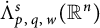 $\dot {\Lambda }_{p,\, q,\,w}^{s}({{{\mathbb R}}^n})$
is defined as the completion of
 $C_c^\infty ({{{\mathbb R}}^n})$
under the semi-norm
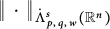 $\|\,\cdot \,\|_{\dot {\Lambda }_{p,\, q,\,w}^{s}({{{\mathbb R}}^n})}$
, we may as well assume that
 $g\in C_c^\infty ({{{\mathbb R}}^n})\cap \dot {\Lambda }_{p,\, q,\,w}^{s}({{{\mathbb R}}^n})$
. Let
 $k:=\lfloor s\rfloor +1$
. For any
 $x,y\in {{{\mathbb R}}^n}$
, define
 $$ \begin{align} f(x, y):=|y|^{-\beta} \mathrm{D}_{y}^{k} g(x) \end{align} $$
and
 $$ \begin{align} F(x,y)&:= \int_{ {{{\mathbb R}}^n} }\int_{ {{{\mathbb R}}^n} } \left(|x-z|^{2}+|y-h|^{2}\right)^{\frac{\beta-2n}{2}} |h|^{-\beta} \mathrm{D}_{h}^{k} g(z)\, dz \, dh. \end{align} $$
Before going further, we are about to show that for all
 $\varphi \in {\mathcal S}({\mathbb R}^{2n})$
,
 $$ \begin{align} \int_{ {{{\mathbb R}}^n} }\int_{ {{{\mathbb R}}^n} }|F(x,y)||\varphi(x,y)|\, dx\, dy<\infty. \end{align} $$
Because
 $\varphi \in {\mathcal S}({\mathbb R}^{2n})$
, the integral in (3.3) is bounded by a constant multiple of
 $$ \begin{align*}{\mathcal J}:=\int_{ {{{\mathbb R}}^n} }\int_{{{{\mathbb R}}^n} }\int_{ {{{\mathbb R}}^n} }\int_{ {{{\mathbb R}}^n} } \frac{\left(|z|+|y-h|\right)^{\beta-2n} |h|^{-\beta} |\mathrm{D}_{h}^{k} g(x-z)|}{(1+|x|)^N(1+|y|)^N}\, dz \, dh\, dx\, dy, \end{align*} $$
where
 $N\in {\mathbb N}$
can be any large integer. To obtain (3.3), it suffices to prove that
 ${\mathcal J}<\infty $
holds for sufficiently large N.
Since
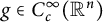 $g\in C_c^\infty ({{{\mathbb R}}^n})$
, we take a large number
 $R\in (1,\infty )$
such that
 ${ \mathrm {\,supp\,}} g\subset B({0},R)$
. Via splitting the integral domain of
 ${\mathcal J}$
into annulus, we find that
 $$ \begin{align*} {\mathcal J} &\le\iint_{|x|+|y|<R}\int_{ {{{\mathbb R}}^n} }\int_{ {{{\mathbb R}}^n} } \frac{\left(|z|+|y-h|\right)^{\beta-2n} |h|^{-\beta} |\mathrm{D}_{h}^{k} g(x-z)|}{(1+|x|)^N(1+|y|)^N}\, dz \, dh\, dx\, dy\\ &\quad +\sum_{j=1}^\infty\iint_{2^{j-1}R\leq|x|+|y|<2^jR}\int_{ {{{\mathbb R}}^n} }\int_{ {{{\mathbb R}}^n} } \frac{\left(|z|+|y-h|\right)^{\beta-2n} |h|^{-\beta} |\mathrm{D}_{h}^{k} g(x-z)|}{(1+|x|)^N(1+|y|)^N}\, dz \, dh\, dx\, dy\\ &=:\mathrm{I}_0+\sum_{j=1}^\infty \mathrm{I}_j. \end{align*} $$
If
 $2^{j-1}R\leq |x|+|y|$
for some
 $j\ge 1$
, then either
 $|x|\ge 2^{j-2}R$
or
 $|y|\ge 2^{j-2}R$
, whatever the cases we always have
 $$ \begin{align*} \mathrm{I}_j &\lesssim(2^{j}R)^{-\frac N2}\iint_{|x|+|y|<2^jR}\int_{{{{\mathbb R}}^n}}\int_{ {{{\mathbb R}}^n} } \frac{\left(|z|+|y-h|\right)^{\beta-2n} |h|^{-\beta} |\mathrm{D}_{h}^{k} g(x-z)|}{(1+|x|)^{N/2}(1+|y|)^{N/2}}\, dz \, dh\, dx\, dy. \end{align*} $$
Fix
 $j\in \{0,1,2,\dots \}$
. We now consider the cases
 $|h|\ge 2^{j+1}R$
and
 $|h|< 2^{j+1}R$
, respectively.
-
• If
$|x|+|y|<2^jR$
and
$|h|\ge 2^{j+1}R$
, then
$|y-h|\approx |h|$
, which, together with (1.1) and
$g\in C_c^\infty ({\mathbb R}^{n})$
, implies that (3.4)
$$ \begin{align} \mathrm{Z}_1&:=\int_{|h| \ge 2^{j+1}R} \int_{{{{\mathbb R}}^n}} \left(|z|+|y-h|\right)^{\beta-2n} |h|^{-\beta} \left|\mathrm{D}_{h}^{k} g(x-z)\right|\, dz \, dh\\ &\lesssim \sum_{m=0}^{k} \binom{k}{m} \int_{|h|\geq 2^{j+1}R}\int_{{{{\mathbb R}}^n}} |h|^{-2n} |g(x-z+mh)|\, dz \, dh \notag\\ &\lesssim \|g\|_{L^1({{{\mathbb R}}^n})} \int_{|h|\geq 2^{j+1}R}|h|^{-2n}\, dh \notag\\ &\lesssim 1. \notag \end{align} $$
-
• If
$|x|+|y|<2^jR$
and
$|h|<2^{j+1}R$
, then by (1.1), we have
${ \mathrm {\,supp\,}} (\mathrm {D}_{h}^{k}g)\subseteq B({0}, k2^{j+2}R)$
, which implies that
$\mathrm {D}_{h}^{k}g(x-z)\neq 0$
only if
$|x-z|<k2^{j+2}R$
, thereby leading to
$|z|<k2^{j+3}R.$
Moreover, by (2.6) and
$g\in C_c^{\infty }({\mathbb R}^{n})$
, we see that holds uniformly in
$$ \begin{align*} \left|\mathrm{D}_{h}^{k}g(x)\right| &\le\sum_{j_1=1}^{n}\cdots\sum_{j_{k}=1}^{n} |h|^k\int_{[0,1]^k} \left|(\partial_{j_1} \cdots \partial_{j_{k}}g)(x +(t_1+\cdots+t_{k})h)\right|\, dt_1 \cdots \,dt_{k}\\ &\lesssim|h|^k{\nonumber} \end{align*} $$
$x\in {{{\mathbb R}}^n}$
. Thus, we obtain Denote these last two double-integrals by
$$ \begin{align*} \mathrm{Z}_2&:=\int_{|h| < 2^{j+1}R} \int_{{{{\mathbb R}}^n}} \left(|z|+|y-h|\right)^{\beta-2n} |h|^{-\beta} \left|\mathrm{D}_{h}^{k} g(x-z)\right|\, dz \, dh\\ &\lesssim\int_{|z| <k2^{j+3}R} \int_{\genfrac{}{}{0pt}{}{|h| < 2^{j+1}R}{|y-h|\ge |h|/2}} (|z|+|h|)^{\beta-2n}|h|^{k-\beta} \, dh\,dz\\&\quad+ \int_{|z| <k2^{j+3}R}\int_{\genfrac{}{}{0pt}{}{|h| < 2^{j+1}R}{|y-h|< |h|/2}} (|z|+|y-h|)^{\beta-2n}|h|^{k-\beta} \, dh \, dz. \end{align*} $$
$\mathrm {Z}_{2,1}$
and
$\mathrm {Z}_{2,2}$
, respectively. Clearly, Considering the integrals over the domain
$$ \begin{align*} \mathrm{Z}_{2,1}\lesssim \int_0^{2^{j+1}R} \left(\int_0^{k2^{j+3}R} (s+t)^{\beta-2n} s^{n-1} t^{k+n-\beta-1}\,ds\right)\,dt. \end{align*} $$
$s\le t$
and
$s>t$
, we then get where for the case
$$ \begin{align*} \mathrm{Z}_{2,1} &\lesssim \int_0^{2^{j+1}R} \left(\int_0^t s^{n-1} t^{k-n-1}\,ds\right)\,dt + \int_0^{2^{j+1}R} \left(\int_t^{k2^{j+3}R} s^{\beta-n-1} t^{k+n-\beta-1}\,ds\right)\,dt\\ &\lesssim \int_0^{2^{j+1}R} t^{k-1}\,dt+\begin{cases} \int_0^{2^{j+1}R} t^{k-1}\,dt &\text{as}\ 0<\beta<n\\ \int_0^{2^{j+1}R} \left(\log\frac{k{2^{j+3}R}}{t}\right)t^{k-1}\,dt &\text{as}\ \beta=n\\ [k2^{j+3}R]^{\beta-n}\int_0^{2^{j+1}R} t^{k+n-\beta-1} \,dt &\text{as}\ n<\beta<2n \end{cases} \\ &\lesssim(2^j R)^k, \end{align*} $$
$n<\beta <2n$
the integral converges because of the fact Concerning
$$ \begin{align*}k+n-\beta=\lfloor s\rfloor+1+n-\left(s+\frac nq\right)>0.\end{align*} $$
$\mathrm {Z}_{2,2}$
, observe that if
$|y-h|< |h|/2$
then
$|y|/2<|h|<2|y|$
, which induces In a way similar to the estimate of
$$ \begin{align*} \mathrm{Z}_{2,2}& \lesssim |y|^{k-\beta} \int_{|z| <k2^{j+3}R} \int_{|y-h|< |y|} (|z|+|y-h|)^{\beta-2n} \, dh \, dz\\ &\approx |y|^{k-\beta} \int_{|z| <k2^{j+3}R} \int_{|w|< |y|} (|z|+|w|)^{\beta-2n} \, dw \, dz\\ &\approx |y|^{k-\beta} \int_0^{2^{j+1}R}\left(\int_0^{k2^{j+3}R} (s+\tau )^{\beta-2n} s^{n-1} \tau^{n-1}\,ds \right)\,d\tau. \end{align*} $$
$\mathrm {Z}_{2,2}$
, it holds that A combination of the estimates of
$$ \begin{align*} \mathrm{Z}_{2,2}& \lesssim |y|^{k-\beta} (2^j R)^\beta. \end{align*} $$
$\mathrm {Z}_{2,1}$
and
$\mathrm {Z}_{2,2}$
gives (3.5)
$$ \begin{align} \mathrm{Z}_{2}\lesssim (2^j R)^k+|y|^{k-\beta} (2^j R)^\beta. \end{align} $$
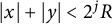


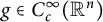

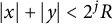


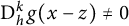

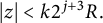
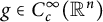






Next, upon taking
 $N>2(n+k+\beta )$
, we utilize (3.4) and (3.5) to derive
 $$ \begin{align*} \mathrm{I}_j&\lesssim (2^{j-2}R)^{-N/2} \int_{|x|<2^j R}\int_{|y|<2^j R} \frac{(2^j R)^k+|y|^{k-\beta} (2^j R)^\beta}{(1+|x|)^{N/2}(1+|y|)^{N/2}}\,dy\,dx\\&\lesssim (2^j R)^{k-N/2}+(2^j R)^{\beta-N/2}. \end{align*} $$
Note that this last estimate is still true when
 $j=0$
. Summing in j, we arrive at the conclusion
 $$ \begin{align*}{\mathcal J} \le \sum_{j=0}^\infty \mathrm{I}_j \lesssim \sum_{j=0}^\infty \left((2^jR)^{k-N/2}+(2^j R)^{\beta-N/2}\right)\lesssim 1.\end{align*} $$
Thus, we obtain the desired estimate in (3.3).
Next, we continue with the proof of Theorem 1.6(i). Observe that the proof of (3.3) (especially the estimate of
 $\mathrm {I}_0$
) also implies that the restricted function
 $F(\cdot , 0)$
is locally integrable on
 ${{{\mathbb R}}^n}$
. Given any
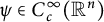 $\psi \in C_c^\infty ({{{\mathbb R}}^n})$
, it follows from the Fubini theorem that
 $$ \begin{align*} \left\langle F(\cdot, 0),\, \psi \right\rangle &=\int_{{{{\mathbb R}}^n}}\left(\int_{ {{{\mathbb R}}^n} }\int_{ {{{\mathbb R}}^n} } \left(|x-z|^{2}+|h|^{2}\right)^{\frac{\beta-2n}{2}} |h|^{-\beta} \mathrm{D}_{h}^{k} g(z)\, dz \, dh\right)\psi(x)\, dx\\ &=\int_{{{{\mathbb R}}^n}}\left(\int_{ {{{\mathbb R}}^n} }\int_{ {{{\mathbb R}}^n} } \left[\left(\frac{|x-z|}{|h|}\right)^{2}+1\right]^{\frac{\beta-2n}{2}}|h|^{-n} \mathrm{D}_{h}^{k} g(z)\,\psi(x)\, dz \, dx\right)\,\frac{dh}{|h|^n}. \end{align*} $$
Let
 $G_{2n-\beta }$
be the kernel of the Bessel potential on
 ${{{\mathbb R}}^n}$
as in Lemma 3.1. For any
 $x\in {{{\mathbb R}}^n}$
, set
 $$ \begin{align*}\phi(x)=\hat{G}_{2n-\beta}(x)=(1+|x|^2)^{-\frac{2n-\beta}{2}}.\end{align*} $$
Via using the dilation
 $\phi _t(x)=t^{-n}\phi (t^{-1}x)$
for all
 $t\in (0,\infty )$
and
 $x\in {{{\mathbb R}}^n}$
, we then have
 $$ \begin{align*}\int_{ {{{\mathbb R}}^n} } \left[\left(\frac{|x-z|}{|h|}\right)^{2}+1\right]^{\frac{\beta-2n}{2}}|h|^{-n} \mathrm{D}_{h}^{k} g(z)\, dz =\left(\phi_{|h|}*\mathrm{D}_{h}^{k}g\right)(x) \end{align*} $$
and, hence,
 $$ \begin{align*} &\int_{ {{{\mathbb R}}^n} }\left(\int_{ {{{\mathbb R}}^n} } \left[\left(\frac{|x-z|}{|h|}\right)^{2}+1\right]^{\frac{\beta-2n}{2}}|h|^{-n} \mathrm{D}_{h}^{k} g(z)\, dz\right)\psi(x) \, dx\\ &\quad= \left\langle \phi_{|h|}*\mathrm{D}_{h}^{k}g,\, \psi \right\rangle\\ &\quad= \left\langle \left(\phi_{|h|}*\mathrm{D}_{h}^{k}g\right)^\wedge,\, \psi^\vee \right\rangle\\ &\quad= \left\langle \widehat{\phi_{|h|}}\widehat{\mathrm{D}_{h}^{k}g},\, \psi^\vee \right\rangle\\ &\quad= \left\langle \widehat{\phi}(|h|\cdot)\left(e^{2 \pi i h \cdot (\cdot)}-1\right)^{k} \,\hat{g}(\cdot),\, \psi^\vee(\cdot) \right\rangle\\ &\quad=\int_{{{{\mathbb R}}^n}} G_{2n-\beta}(|h|\xi)\,\left(e^{2 \pi i h \cdot \xi}-1\right)^{k} \,\hat{g}(\xi)\, \psi^{\vee}(\xi)\,d\xi, \end{align*} $$
where the last step is due to
 $\hat {\phi }(\xi )=G_{2n-\beta }(-\xi )$
so that
 $\hat {\phi }(|h|\xi )=G_{2n-\beta }(-|h|\xi )=G_{2n-\beta }(|h|\xi )$
. Further, an application of Lemma 3.1 yields
 $$ \begin{align*} \left\langle F(\cdot, 0),\, \psi \right\rangle &=\int_{{{{\mathbb R}}^n}}\left(\int_{{{{\mathbb R}}^n}} G_{2n-\beta}(|h|\xi)\,\left(e^{2 \pi i h \cdot \xi}-1\right)^{k} \,\hat{g}(\xi)\, \psi^{\vee}(\xi)\,d\xi\right)\,\frac{dh}{|h|^n}\\ &=\int_{{{{\mathbb R}}^n}}\left(\int_{{{{\mathbb R}}^n}} G_{2n-\beta}(|h|\xi)\,\left(e^{2 \pi i h \cdot \xi}-1\right)^{k} \,\hat{g}(\xi)\, \psi^{\vee}(\xi)\,\frac{dh}{|h|^n}\right)\,d\xi\\ &=c_{2n-\beta}\int_{{{{\mathbb R}}^n}} \hat{g}(\xi)\, \psi^{\vee}(\xi)\,d\xi\\ &=c_{2n-\beta} \left\langle g,\, \psi \right\rangle, \end{align*} $$
where
 $c_{2n-\beta }$
is the constant determined in Lemma 3.1. Thus,

Define the extension operator
 $\mathcal E$
via
 $$ \begin{align} \mathcal{E}(g):=\left(c_{2n-\beta}\right)^{-1}\left(\frac{\Gamma(\frac{2n-\beta}2)}{2^{\beta}\pi^{n} \Gamma(\frac \beta 2)}\right)^{-1} I_{\beta}^{(2n)}\ast f, \end{align} $$
which is an element in
 ${\mathcal S}_\infty '({\mathbb R}^{2n})$
by using (3.3) and (1.3) in Remark 1.5. Applying (3.1),(3.2) and (3.6),(3.7) yields that for a. e.
 $x\in {{{\mathbb R}}^n}$
,
 $$ \begin{align} \mathcal{E}(g)(x,{0})=\left(c_{2n-\beta}\right)^{-1}\left(\frac{\Gamma(\frac{2n-\beta}2)}{2^{\beta}\pi^{n} \Gamma(\frac \beta 2)}\right)^{-1} (I_{\beta}^{(2n)}\ast f)(x,0)=\left(c_{2n-\beta}\right)^{-1} F(x,0)=g(x). \end{align} $$
Since
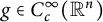 $g \in C_c^\infty ({{{\mathbb R}}^n})$
, it follows that f in (3.1) belongs to
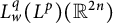 $ L_w^q (L^p)({\mathbb R}^{2n})$
, which implies both
 $$ \begin{align*}\mathcal{E}g\in \dot{\mathcal{L}}_{\beta}^{p,\, q,\,w}({\mathbb R}^{2n})\end{align*} $$
and
 $$ \begin{align*} c_{2n-\beta} \left(\frac{\Gamma(\frac{2n-\beta}2)}{2^{\beta}\pi^{n} \Gamma(\frac \beta 2)}\right)\|\mathcal{E}g\|_{\dot{\mathcal{L}}_{\beta}^{p,\, q,\,w}({\mathbb R}^{2n})} =\|f\|_{L_w^q (L^p)({\mathbb R}^{2n})} =\|g\|_{\dot{\Lambda}_{p,\, q,\,w}^{s}({{{\mathbb R}}^n})}. \end{align*} $$
Summarizing all, we conclude that Theorem 1.6(i) holds under
 $\beta \in (0,2n)$
.
3.2 Restriction part: the case
$\beta \in (0,2n)$

The aim of this subsection is to show Theorem 1.6(ii) under the case
 $\beta \in (0,2n)$
. To this end, we need the following proposition.
Proposition 3.2 Let
 $p\in [1,\, \infty )$
and
 $\beta \in (0,2n)$
. Given any measurable function
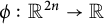 $\phi :\,{\mathbb R}^{2n}\to {\mathbb R}$
, define for all
 $\xi ,x\in {{{\mathbb R}}^n}$
that
 $$ \begin{align*}g_{\xi}(x):=\int_{ {{{\mathbb R}}^n} } \phi(z, \xi) I_{\beta}^{(2n)}(x-z,\xi)\, dz.\end{align*} $$
If
 $k\in {\mathbb N}$
such that
 $k>\beta -n$
, then the following hold:
-
(i) when
$\beta \in (0,n)$
,
$$ \begin{align*} \left\|\mathrm{D}_{h}^{k} g_{\xi}\right\|_{L^p( {{{\mathbb R}}^n} )} \leq C \|\phi(\cdot, \xi)\|_{L^p( {{{\mathbb R}}^n} )} |\xi|^{\beta-n}\min\left\{1,\,\frac{|h|}{|\xi|}\right\}^{k}; \end{align*} $$
-
(ii) when
$\beta =n$
,
$$ \begin{align*} \left\|\mathrm{D}_{h}^{k} g_{\xi}\right\|_{L^p( {{{\mathbb R}}^n} )} \le C \|\phi(\cdot, \xi)\|_{L^p( {{{\mathbb R}}^n} )} \min\left\{\log\left(e+\frac{|h|}{|\xi|}\right),\,\left(\frac{|h|}{|\xi|}\right)^k\right\}; \end{align*} $$
-
(iii) when
$\beta \in (n,2n)$
,
$$ \begin{align*} \left\|\mathrm{D}_{h}^{k} g_{\xi}\right\|_{L^p( {{{\mathbb R}}^n} )} \leq C \|\phi(\cdot, \xi)\|_{L^p( {{{\mathbb R}}^n} )} |h|^{\beta-n}\min\left\{1,\,\frac{|h|}{|\xi|}\right\}^{n+k-\beta}, \end{align*} $$


where C in (i)–(iii) is a positive constant independent of
 $\xi ,h$
and
 $\phi $
.
Proof Assume without loss of generality that the norm
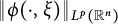 $\|\phi (\cdot , \xi )\|_{L^p( {{{\mathbb R}}^n} )}$
is finite; otherwise items (i)–(iii) hold trivially.
Given a locally integrable function f on
 ${\mathbb R}^{2n}$
, we denote by
 $\widetilde {\mathrm {D}_{h}^{k}}f$
the k-order difference for the first n variables of f, that is, for all
 $x,y,h\in {{{\mathbb R}}^n}$
,
 $$ \begin{align} \widetilde{\mathrm{D}_{h}^{k}} f(x,y):=\sum_{m=0}^k (-1)^{k-m} \binom km f(x+mh,y). \end{align} $$
With this notation, we apply the Minkowski inequality to write
 $$ \begin{align} \left\|\mathrm{D}_{h}^{k} g_{\xi}\right\|_{L^p( {{{\mathbb R}}^n} )} &= \left(\int_{ {{{\mathbb R}}^n} } \left| \int_{ {{{\mathbb R}}^n} } \phi(z, \xi)\, \widetilde{\mathrm{D}_{h}^{k} }(I_{\beta}^{(2n)})(x-z,\xi) \, dz\right|{}^{p}\, dx\right)^{1/p}\\\notag &= \left(\int_{ {{{\mathbb R}}^n} } \left| \int_{ {{{\mathbb R}}^n} } \phi(x-z, \xi)\, \widetilde{\mathrm{D}_{h}^{k} }(I_{\beta}^{(2n)})(z,\xi) \, dz\right|{}^{p}\, dx\right)^{1/p}\\\notag &\le\int_{{{{\mathbb R}}^n}} \left(\int_{{{{\mathbb R}}^n}}|\phi(x-z,\xi)|^p\,dx\right)^{1/p}\left|\widetilde{\mathrm{D}_h^k}(I_\beta^{(2n)})(z,\xi)\right|\,dz\\\notag &=\|\phi(\cdot, \xi)\|_{L^p( {{{\mathbb R}}^n} )}\int_{{{{\mathbb R}}^n}}\left|\widetilde{\mathrm{D}_h^k}(I_\beta^{(2n)})(z,\xi)\right|\, dz. \end{align} $$
In order to obtain the desired estimates in (i)–(iii), we only need to deal with
 $$ \begin{align*}\mathrm{G}:=\int_{{{{\mathbb R}}^n}}\left|\widetilde{\mathrm{D}_h^k}(I_\beta^{(2n)})(z,\xi)\right|\, dz.\end{align*} $$
Before further continuation, observe that for all
 $z,\xi ,h\in {{{\mathbb R}}^n}$
the identities (3.9) and (2.6) imply not only
 $$ \begin{align} \left|\widetilde{\mathrm{D}_{h}^{k}}(I_{\beta}^{(2n)})(z,\xi)\right| &= \left|\sum_{m=0}^{k} (-1)^{k-m}\, \binom{k}{m}\, I_{\beta}^{(2n)}(z+mh,\xi)\right|\lesssim \sum_{m=0}^{k} (|z+mh|+|\xi|)^{\beta-2n}, \end{align} $$
but also
 $$ \begin{align} &\left|\widetilde{\mathrm{D}_{h}^{k}}(I_{\beta}^{(2n)})(z,\xi)\right|\\ &\quad\le |h|^k \sum_{j_1=1}^{n}\cdots\sum_{j_{k}=1}^{n} \int_{[0,1]^k} \left|\left(\partial_{x_{j_1}} \cdots \partial_{x_{j_{k}}}I_{\beta}^{(2n)}\right)(z +(t_1+\cdots+t_{k})h,\xi)\right|\, dt_1 \cdots \,dt_{k}\notag\\ &\quad\lesssim|h|^k\int_{[0,1]^k} (|z+(t_1+\cdots+t_{k})h|+|\xi|)^{\beta-2n-k}\, dt_1 \cdots \,dt_{k}.\notag \end{align} $$
Next, upon utilizing (3.11) and (3.12), we estimate
 $\mathrm {G}$
.
-
• If
$|\xi |>k|h|$
, then the integrand in (3.12) satisfies and, hence,
$$ \begin{align*} (|z+(t_1+\cdots+t_{k})h|+|\xi|)^{\beta-2n-k} &\approx \begin{cases} |\xi|^{\beta-2n-k} &\ \text{as} \ |z|<2|\xi|;\\ |z|^{\beta-2n-k} &\ \text{as} \ |z|\ge 2|\xi|, \end{cases} \end{align*} $$
From this and (3.10), it follows that (i)–(iii) hold when
$$ \begin{align*} \mathrm{G}&\lesssim |h|^{k}\left(\int_{|z|<2|\xi|}|\xi|^{\beta-2n-k} \,dz+ \int_{|z|\ge 2|\xi|} |z|^{\beta-2n-k}\,dz\right)\\ & \approx |h|^{k}|\xi|^{\beta-n-k}\\ &\approx \begin{cases} |\xi|^{\beta-n}\min\left\{1,\,\frac{|h|}{|\xi|}\right\}^{k}&\ \text{as} \ \beta\in(0,n);\\ \min\left\{\log\left(e+\frac{|h|}{|\xi|}\right),\,\left(\frac{|h|}{|\xi|}\right)^k\right\}&\ \text{as} \ \beta=n;\\ |h|^{\beta-n}\min\left\{1,\,\frac{|h|}{|\xi|}\right\}^{n+k-\beta}&\ \text{as} \ \beta\in(n,2n). \end{cases} \end{align*} $$
$|\xi |>k|h|$
.
-
• If
$\beta \in (0,n)$
and
$|\xi |\le k|h|$
, then applying (3.11) yields This, together with (3.10), induces (i) under the situation
$$ \begin{align*} \mathrm{G} &\lesssim \sum_{m=0}^{k} \int_{ {{{\mathbb R}}^n} } (|z+mh|+|\xi|)^{\beta-2n}\, dz{\nonumber}\\ &\lesssim \sum_{m=0}^{k} \left(\int_{|z+mh| \leq |\xi|} |\xi|^{\beta-2n}\, dz +\int_{|z+mh|> |\xi|}|z+mh|^{\beta-2n}\, dz\right){\nonumber}\\ &\approx |\xi|^{\beta-n}\\ &\approx |\xi|^{\beta-n}\min\left\{1,\,\frac{|h|}{|\xi|}\right\}^{k}. \end{align*} $$
$|\xi |\le k|h|$
.
-
• Now, let
$\beta \in [n,2n)$
and
$|\xi |\le k|h|$
. On the one hand, if we assume further that
$|z|\ge 2k|h|$
, then for
$t_1,\dots , t_k\in [0,1]$
, we have which, along with (3.12) and the fact
$$ \begin{align*} |z+(t_1+\cdots+t_{k})h|+|\xi| \approx |z|+|\xi| \approx |z|, \end{align*} $$
$\beta -n-k<0$
, implies (3.13)If
$$ \begin{align} \int_{|z|\ge 2k|h|} \left|\widetilde{\mathrm{D}_h^k}(I_\beta^{(2n)})(z,\xi)\right|\, dz &\lesssim |h|^k \int_{|z|\ge 2k|h|}|z|^{\beta-2n-k} \, dz\\ & \lesssim \begin{cases} |h|^{\beta-n} &\ \text{as}\ \ \beta\in(n,2n);\\ 1 &\ \text{as}\ \ \beta=n. \end{cases}\notag \end{align} $$
$|z|<2k|h|$
, then for all
$m\in \{0,1,\dots , k\}$
we have
$|z+mh|<3k|h|$
, so that applying (3.11) and a change of variables
$u=(z+mh)/|\xi |$
derives (3.14)From (3.13) and (3.14), we deduce that (ii) and (iii) hold when
$$ \begin{align} \int_{|z|< 2k|h|} \left|\widetilde{\mathrm{D}_h^k}(I_\beta^{(2n)})(z,\xi)\right|\, dz &\lesssim \sum_{m=0}^{k} \int_{|z|<2k|h|} \left(|z+mh|+|\xi|\right)^{\beta-2n}\, dz\\ &\lesssim |\xi|^{\beta-n} \int_{|u|< \frac{3k|h|}{|\xi|} } (|u|+1)^{\beta-2n}\, du\notag\\ &\lesssim \begin{cases} |\xi|^{\beta-n} \left(\frac{|h|}{|\xi|}\right)^{\beta-n} &\ \text{as}\ \ \beta\in(n,2n);\\ \log\left(\frac{3k|h|}{|\xi|}\right) &\ \text{as}\ \ \beta=n. \end{cases}\notag \end{align} $$
$|\xi |\le k|h|$
.












Altogether, we conclude the proof of Proposition 3.2.
Proof of Theorem 1.6(ii) under
$\beta \in (0,2n)$

Let
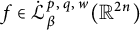 $f \in \dot {\mathcal {L}}_{\beta }^{p,\, q,\,w}({\mathbb R}^{2n})$
, where
 $p\in [1,\infty )$
and
 $q\in (1,\infty )$
. Since
 $\beta \in (0,2n)$
, we consider first the case
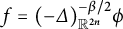 $f=(-\varDelta )_{{{\mathbb R}}^{2n}}^{-\beta /2}\phi $
for some
 $\phi \in L_w^q (L^p)({\mathbb R}^{2n})$
such that
 $$ \begin{align*}I_{\beta}^{(2n)} \ast \phi\in L_{\text{\,loc}}^1({\mathbb R}^{2n})\cap {\mathcal S}_\infty'({\mathbb R}^{2n})\end{align*} $$
and
 $$ \begin{align*}(-\varDelta)_{{{\mathbb R}}^{2n}}^{-\beta/2}\phi=I_{\beta}^{(2n)} \ast \phi\quad \text{in}\ {\mathcal S}_\infty'({\mathbb R}^{2n}). \end{align*} $$
By modifying f at a null set, we may assume that f is pointwisely defined on
 ${\mathbb R}^{2n}$
. In this case, we can write
 $$ \begin{align*}f(x,{0})= I_{\beta}^{(2n)} \ast \phi(x,0) = \int_{ {{{\mathbb R}}^n} } \int_{ {{{\mathbb R}}^n} } \phi(z, \xi) I_{\beta}^{(2n)}(x-z,\xi)\, dz\,d\xi\quad \text{for all}\ x\in{{{\mathbb R}}^n}.\end{align*} $$
Assume for the moment that we have proved
 $$ \begin{align} \|f(\cdot, {0})\|_{\dot{\Lambda}_{p,\, q,\,w}^{s}({{{\mathbb R}}^n})} \lesssim \|f\|_{\dot{\mathcal{L}}_{\beta}^{p,\, q,\,w}({\mathbb R}^{2n})}. \end{align} $$
After we have obtained (3.15), then we immediately have
 $f(\cdot , {0})\in \dot {\Lambda }_{p,\, q,\,w}^{s}({{{\mathbb R}}^n})$
. Indeed, by Lemma 2.5, there exists a sequence
 $\{\varphi _j\}_{j\in {\mathbb N}}$
in
 $ C_c^\infty ({\mathbb R}^{2n})$
such that
 $\varphi _j\to f$
in
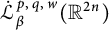 $\dot {\mathcal {L}}_{\beta }^{p,\, q,\,w}({\mathbb R}^{2n})$
, which, together with (3.15), implies that
 $\varphi _j(\cdot ,0)\to f(\cdot ,0)$
in
 $\dot {\Lambda }_{p,\, q,\,w}^{s}({{{\mathbb R}}^n})$
. Then, upon defining the restriction operator
 $\mathcal {R}$
via
 $$ \begin{align} \mathcal{R}f(\cdot) := f(\cdot,{0})= I_{\beta}^{(2n)} \ast \phi(\cdot,0), \end{align} $$
we find that
 $$ \begin{align} \|\mathcal{R}f\|_{\dot{\Lambda}_{p,\, q,\,w}^{s}({{{\mathbb R}}^n})} = \|f(\cdot, {0})\|_{\dot{\Lambda}_{p,\, q,\,w}^{s}({{{\mathbb R}}^n})} \lesssim \|f\|_{\dot{\mathcal{L}}_{\beta}^{p,\, q,\,w}({\mathbb R}^{2n})}. \end{align} $$
For a general
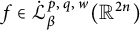 $f\in \dot {\mathcal {L}}_{\beta }^{p,\, q,\,w}({\mathbb R}^{2n})$
, by Corollary 2.4, there exists a sequence
 $\{\phi _j\}_{j\in {\mathbb N}}\subset C_c^\infty ({\mathbb R}^{2n})$
such that
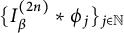 $\{I_{\beta }^{(2n)} \ast \phi _j\}_{j\in {\mathbb N}}$
converges to f in
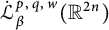 $\dot {\mathcal {L}}_{\beta }^{p,\, q,\,w}({\mathbb R}^{2n})$
. For any
 $j\in {\mathbb N}$
and
 $x\in {{{\mathbb R}}^n}$
, let
 $$ \begin{align*}g_j(x):=(I_{\beta}^{(2n)} \ast \phi_j)(x,0).\end{align*} $$
For any
 $k,j\in {\mathbb N}$
, by (3.16) and (3.17), we have
 $$ \begin{align*} \|g_j-g_k\|_{\dot{\Lambda}_{p,\, q,\,w}^{s}({{{\mathbb R}}^n})} &=\|(I_{\beta}^{(2n)} \ast (\phi_j-\phi_k))(\cdot,0)\|_{\dot{\Lambda}_{p,\, q,\,w}^{s}({{{\mathbb R}}^n})} \\&\lesssim \|I_{\beta}^{(2n)} \ast (\phi_j-\phi_k)\|_{\dot{\mathcal{L}}_{\beta}^{p,\, q,\,w}({\mathbb R}^{2n})}, \end{align*} $$
which tends to
 $0$
as
 $k,j\to \infty $
since
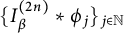 $\{I_{\beta }^{(2n)} \ast \phi _j\}_{j\in {\mathbb N}}$
converges to f in
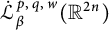 $\dot {\mathcal {L}}_{\beta }^{p,\, q,\,w}({\mathbb R}^{2n})$
. Thus,
 $\{g_j\}_{j\in {\mathbb N}}$
is a Cauchy sequence in
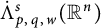 $\dot {\Lambda }_{p,\, q,\,w}^{s}({{{\mathbb R}}^n})$
. So, it is reasonable to define
 $$ \begin{align} \mathcal{R}f:=\lim_{j\to \infty}g_j\quad \text{in}\quad \dot{\Lambda}_{p,\, q,\,w}^{s}({{{\mathbb R}}^n}). \end{align} $$
We need to explain that
 $\mathcal {R}f$
in (3.18) is a uniquely defined element in
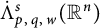 $\dot {\Lambda }_{p,\, q,\,w}^{s}({{{\mathbb R}}^n})$
. Indeed, if
 $\{\psi _j\}_{j\in {\mathbb N}}\subset C_c^\infty ({\mathbb R}^{2n})$
is another sequence such that
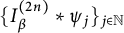 $\{I_{\beta }^{(2n)} \ast \psi _j\}_{j\in {\mathbb N}}$
converges to f in
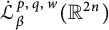 $\dot {\mathcal {L}}_{\beta }^{p,\, q,\,w}({\mathbb R}^{2n})$
, then we use (3.17) to deduce
 $$ \begin{align*} &\lim_{j\to \infty}\|(I_{\beta}^{(2n)} \ast \phi_j)(\cdot,0)-(I_{\beta}^{(2n)} \ast \psi_j)(\cdot,0)\|_{\dot{\Lambda}_{p,\, q,\,w}^{s}({{{\mathbb R}}^n})}\\ &\quad\lesssim \lim_{j\to \infty}\|I_{\beta}^{(2n)} \ast \phi_j-I_{\beta}^{(2n)} \ast \psi_j\|_{\dot{\mathcal{L}}_{\beta}^{p,\, q,\,w}({\mathbb R}^{2n})}\\ &\quad\leq \lim_{j\to \infty}\left(\|I_{\beta}^{(2n)} \ast \phi_j-f\|_{\dot{\mathcal{L}}_{\beta}^{p,\, q,\,w}({\mathbb R}^{2n})}+\|f-I_{\beta}^{(2n)} \ast \psi_j\|_{\dot{\mathcal{L}}_{\beta}^{p,\, q,\,w}({\mathbb R}^{2n})}\right)\\ &\quad =0. \end{align*} $$
Moreover, for
 $\mathcal {R}f$
in (3.18), we have
 $$ \begin{align*} \|\mathcal{R}f\|_{\dot{\Lambda}_{p,\, q,\,w}^{s}({{{\mathbb R}}^n})} = \lim_{j\to \infty}\|g_j\|_{\dot{\Lambda}_{p,\, q,\,w}^{s}({{{\mathbb R}}^n})} &= \lim_{j\to \infty}\|(I_{\beta}^{(2n)} \ast \phi_j)(\cdot, 0)\|_{\dot{\Lambda}_{p,\, q,\,w}^{s}({{{\mathbb R}}^n})}\\ &\lesssim \lim_{j\to \infty}\|I_{\beta}^{(2n)} \ast \phi_j\|_{\dot{\mathcal{L}}_{\beta}^{p,\, q,\,w}({\mathbb R}^{2n})} = \|f\|_{\dot{\mathcal{L}}_{\beta}^{p,\, q,\,w}({\mathbb R}^{2n})}. \end{align*} $$
Further, by (3.2) and (3.8), we see that
 $ \mathcal {R}\mathcal {E}=id $
on
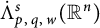 $\dot {\Lambda }_{p,\, q,\,w}^{s}({{{\mathbb R}}^n})$
.
To finish the proof of Theorem 1.6(ii) under
 $\beta \in (0,2n)$
, we still need to validate (3.15). To simplify the notation, for any
 $\xi ,x\in {{{\mathbb R}}^n}$
, set
 $g(x)=f(x,0)$
and
 $$ \begin{align*}g_{\xi}(x):=\int_{ {{{\mathbb R}}^n} } \phi(z, \xi) I_{\beta}^{(2n)}(x-z,\xi)\, dz.\end{align*} $$
Let
 $k:=\lfloor s\rfloor +1$
. Then, for any
 $h\in {{{\mathbb R}}^n}$
, by the expression of g and the Minkowski inequality, we have
 $$ \begin{align*} \left\|\mathrm{D}_{h}^{k}g\right\|_{L^p( {{{\mathbb R}}^n} )} =\left(\int_{ {{{\mathbb R}}^n} } \left|\int_{ {{{\mathbb R}}^n} } \mathrm{D}_{h}^{k}g_{\xi}(x)\, d\xi\right|{}^{p}\, dx \right)^{1/p} \leq\int_{ {{{\mathbb R}}^n} } \left\|\mathrm{D}_{h}^{k}g_{\xi}\right\|_{L^p( {{{\mathbb R}}^n} )}\, d\xi. \end{align*} $$
Consequently,
 $$ \begin{align} \|g\|_{\dot{\Lambda}_{p,\, q,\,w}^{s}({{{\mathbb R}}^n})} &= \left(\int_{ {{{\mathbb R}}^n} } \left\| {\mathrm{D}}_{h}^{k}g \right\|_{L^p( {{{\mathbb R}}^n} )}^{q} |h|^{-n-sq} w(h)\, dh\right)^{1/q}\\ &\leq\left(\int_{ {{{\mathbb R}}^n} }\left(\int_{ {{{\mathbb R}}^n} } \left\|\mathrm{D}_{h}^{k}g_{\xi}\right\|_{L^p( {{{\mathbb R}}^n} )}\, d\xi\right)^{q} |h|^{-n-sq} w(h)\, dh\right)^{1/q}\notag\\ &=\left(\int_{ {{{\mathbb R}}^n} }\left(\int_{ {{{\mathbb R}}^n} } |h|^{-\beta} \left\|\mathrm{D}_{h}^{k}g_{\xi}\right\|_{L^p( {{{\mathbb R}}^n} )}\, d\xi\right)^{q} w(h)\, dh\right)^{1/q},\notag \end{align} $$
where in the last step we used the fact
 $\beta =s+n/q$
. Observe that the integrand
 $|h|^{-\beta }\|\mathrm {D}_{h}^{k}g_{\xi }\|_{L^p( {{{\mathbb R}}^n} )}$
can be estimated by utilizing Proposition 3.2. Indeed, upon setting
 $$ \begin{align*}\begin{cases} K_1(|h|, |\xi|): =|h|^{-n}\left(\frac{|h|}{|\xi|}\right)^{n-\beta}\min\left\{1,\frac{|h|}{|\xi|}\right\}^{k}\quad &\text{as}\ \beta\in(0,n);\\ K_2(|h|, |\xi|): =|h|^{-n}\min\left\{\log\left(e+\frac{|h|}{|\xi|}\right),\,\left(\frac{|h|}{|\xi|}\right)^k\right\}\quad &\text{as}\ \beta=n;\\ K_3(|h|, |\xi|): =|h|^{-n}\min\left\{1,\frac{|h|}{|\xi|}\right\}^{n+k-\beta}\quad &\text{as}\ \beta\in(n, 2n), \end{cases} \end{align*} $$
we apply Proposition 3.2 and find that the last line of (3.19) can be controlled by a constant multiple of
 $$ \begin{align*} \left(\int_{ {{{\mathbb R}}^n} }\left(\int_{ {{{\mathbb R}}^n} }K_i(|h|,|\xi|)\left\|\phi(\cdot, \xi)\right\|_{L^p( {{{\mathbb R}}^n} )}\, d\xi\right)^q w(h)\, dh\right)^{1/q}\quad\text{for}\ i\in\{1,2,3\}. \end{align*} $$
Thus, the proof of (3.15) falls into validating that for
 $i\in \{1,2,3\}$
,
 $$ \begin{align} &\left(\int_{ {{{\mathbb R}}^n} }\left(\int_{ {{{\mathbb R}}^n} }K_i(|h|,|\xi|)\left\|\phi(\cdot, \xi)\right\|_{L^p( {{{\mathbb R}}^n} )}\, d\xi\right)^q w(h)\, dh\right)^{1/q}\\ &\qquad \lesssim \left(\int_{ {{{\mathbb R}}^n} } \|\phi(\cdot, \xi)\|_{L^p( {{{\mathbb R}}^n} )}^{q} w(\xi)\, d\xi\right)^{1/q}=\|\phi\|_{L_w^q (L^p)({\mathbb R}^{2n})}. \notag \end{align} $$
Below, we prove (3.20) for
 $i=1,2,3$
, respectively.
-
• Proof of (3.20) for
$i=1$
. Since
$K_1$
is homogeneous of degree
$-n$
, it follows from Lemma 2.9 that (3.20) holds provided that
$K_1$
satisfies (2.22).Let us show that
$K_1$
satisfies (2.22). Note that
$\beta =s+\frac nq$
. So, after a change of variables
$r=t^{-1}$
, we find that By (1.4) and (1.5), together with
$$ \begin{align*} &\int_{0}^{\infty}K_1(1, t)t^{\frac n{q'}-1}\, \left(\sup_{\rho \in (0, \infty)} \frac{w(t^{-1}\rho)}{w(\rho)}\right)^{\frac 1 q }\,dt\\ &\quad = \int_{0}^{\infty}t^{s} \min\left\{1,t^{-1}\right\}^{k}\, \left(\sup_{\rho \in (0, \infty)} \frac{w(t^{-1}\rho)}{w(\rho)}\right)^{\frac 1 q }\,\frac{dt} t\\ &\quad=\int_{0}^{\infty}r^{-s} \min\left\{1,r\right\}^{k}\, \left(\sup_{\rho \in (0, \infty)} \frac{w(r\rho)}{w(\rho)}\right)^{\frac 1 q }\,\frac{dr} r\\ &\quad =\int_0^1 r^{k-s} \left(\sup_{\rho \in (0, \infty)} \frac{w(r\rho)}{w(\rho)}\right)^{\frac 1 q }\,\frac{dr} r + \int_1^\infty r^{-s} \left(\sup_{\rho \in (0, \infty)} \frac{w(r\rho)}{w(\rho)}\right)^{\frac 1 q }\,\frac{dr} r. \end{align*} $$
$\sigma <\lfloor s\rfloor +1-s=k-s$
and
$\delta>-s$
, we obtain (3.21)and
$$ \begin{align} &\int_0^1 r^{k-s} \left(\sup_{\rho \in (0, \infty)} \frac{w(r\rho)}{w(\rho)}\right)^{\frac 1 q }\,\frac{dr} r\\ &\quad \le \left(\int_{0}^{1}r^{\sigma q}\, \left(\sup_{\rho \in (0, \infty)} \frac{w(r\rho)}{w(\rho)}\right)\frac{dr}{r}\right)^{\frac 1 q} \left(\int_{0}^{1}r^{(k-s-\sigma)q'}\, \frac{dr}{r}\right)^{\frac 1 {q'}} <\infty\notag \end{align} $$
(3.22)This proves that
$$ \begin{align} &\int_1^\infty r^{-s} \left(\sup_{\rho \in (0, \infty)} \frac{w(r\rho)}{w(\rho)}\right)^{\frac 1 q }\,\frac{dr} r\\ &\quad \le \left(\int_1^{\infty}r^{\delta q}\, \left(\sup_{\rho \in (0, \infty)} \frac{w(r\rho)}{w(\rho)}\right)\frac{dr}{r}\right)^{\frac 1q}\left(\int_1^{\infty}r^{-(s+\delta) q'}\, \frac{dr}{r}\right)^{\frac 1 {q'}}<\infty.\notag \end{align} $$
$K_1$
satisfies (2.22) and, hence, (3.20) holds.
-
• Proof of (3.20) for
$i=2$
. The proof is similar to the case
$i=1$
. Indeed, observing that
$K_2$
is homogeneous of degree
$-n$
, we only need to validate that
$K_2$
satisfies (2.22), so that Lemma 2.9 can be applied to show that (3.20) holds. To this end, using
$\beta =n$
and
$\frac n {q'}=\beta -\frac nq=s$
, we then write Clearly, (3.21) remains valid. Instead of (3.22), we now also have
$$ \begin{align*} &\int_{0}^{\infty}K_2(1, t)t^{\frac n{q'}-1}\, \left(\sup_{\rho \in (0, \infty)} \frac{w(t^{-1}\rho)}{w(\rho)}\right)^{\frac 1 q }\,dt\\ &\quad = \int_{0}^{\infty}t^{s} \min\left\{\log(e+t^{-1}),\,t^{-k}\right\}\, \left(\sup_{\rho \in (0, \infty)} \frac{w(t^{-1}\rho)}{w(\rho)}\right)^{\frac 1 q }\,\frac{dt} t\\ &\quad=\int_{0}^{\infty}r^{-s} \min\left\{\log(e+r),\,r^{k}\right\}\, \left(\sup_{\rho \in (0, \infty)} \frac{w(r\rho)}{w(\rho)}\right)^{\frac 1 q }\,\frac{dr} r\\ &\quad \approx \int_0^1 r^{k-s} \left(\sup_{\rho \in (0, \infty)} \frac{w(r\rho)}{w(\rho)}\right)^{\frac 1 q }\,\frac{dr} r + \int_1^\infty r^{-s} \log(e+r) \left(\sup_{\rho \in (0, \infty)} \frac{w(r\rho)}{w(\rho)}\right)^{\frac 1 q }\,\frac{dr} r. \end{align*} $$
by terms of (1.5) and the fact
$$ \begin{align*} &\int_1^\infty r^{-s} \log(e+r)\left(\sup_{\rho \in (0, \infty)} \frac{w(r\rho)}{w(\rho)}\right)^{\frac 1 q }\,\frac{dr} r\\ &\quad \le \left(\int_1^{\infty}r^{\delta q}\, \left(\sup_{\rho \in (0, \infty)} \frac{w(r\rho)}{w(\rho)}\right)\frac{dr}{r}\right)^{\frac 1q}\left(\int_1^{\infty}r^{-(s+\delta) q'} \log(e+r)\, \frac{dr}{r}\right)^{\frac 1 {q'}}<\infty,\notag \end{align*} $$
$\delta>-s$
. Thus,
$K_2$
satisfies (2.22). We obtain (3.20).
-
• Proof of (3.20) for
$i=3$
. In this case, write the left-hand side of (3.20) as
$$ \begin{align*} & \left(\int_{ {{{\mathbb R}}^n} }\left(\frac1{|h|^n}\int_{|\xi|\leq|h|} \|\phi(\cdot, \xi)\|_{L^p( {{{\mathbb R}}^n} )}\, d\xi\right)^q w(h)\, dh\right)^{1/q}\\ &\quad +\left(\int_{ {{{\mathbb R}}^n} }\left(\int_{|\xi|>|h|} |h|^{-n}\left(\frac{|h|}{|\xi|}\right)^{n+k-\beta} \|\phi(\cdot, \xi)\|_{L^p( {{{\mathbb R}}^n} )}\, d\xi\right)^q w(h)\, dh\right)^{1/q} =:\mathrm{I}+\mathrm{II}. \end{align*} $$
Let
$\Phi (\xi ):=\|\phi (\cdot , \xi )\|_{L^p( {{{\mathbb R}}^n} )}$
and
${\mathcal M}$
be the classical Hardy–Littlewood maximal function on
${{{\mathbb R}}^n}$
, that is,
$$ \begin{align*}\mathcal{M}\Phi(z):=\sup_{B\ni z}\frac1{|B|}\int_B|\Phi(x)|\,dx\quad\text{for all}\ z\in{{{\mathbb R}}^n}.\end{align*} $$
Then, using
$q\in (1,\infty )$
,
$w \in A_{q}( {{{\mathbb R}}^n} )$
and the boundedness of
${\mathcal M}$
on
$L^q_w({{{\mathbb R}}^n})$
, we derive
$$ \begin{align*} \mathrm{I} &\lesssim \left( \int_{ {{{\mathbb R}}^n} } [{\mathcal M} \Phi(h)]^{q} w(h)\, dh\right)^{1/q} \lesssim \left(\int_{ {{{\mathbb R}}^n} } [\Phi(h)]^{q} w(h)\, dh\right)^{1/q} =\|\phi\|_{L_w^q (L^p)({\mathbb R}^{2n})}. \end{align*} $$
For
$\mathrm {II}$
, upon setting and using
$$ \begin{align*}K_3^\prime(|h|, |\xi|): =|h|^{-n}\min\left\{1,\frac{|h|}{|\xi|}\right\}^{n+k-\beta}{\mathbf 1}_{|\xi|>|h|}\end{align*} $$
$\beta =s+\frac n q$
, we find that which is finite by terms of (3.21). From this, the fact that
$$ \begin{align*} &\int_{1}^{\infty}K_3^\prime(1, t)t^{\frac n{q'}-1}\, \left(\sup_{\rho \in (0, \infty)} \frac{w(t^{-1}\rho)}{w(\rho)}\right)^{\frac 1 q }\,dt\\ &\quad = \int_1^{\infty} t^{n-\beta+s} t^{-(n+k-\beta)}\, \left(\sup_{\rho \in (0, \infty)} \frac{w(t^{-1}\rho)}{w(\rho)}\right)^{\frac 1 q }\,\frac{dt} t\\ &\quad=\int_{0}^1r^{k-s} \, \left(\sup_{\rho \in (0, \infty)} \frac{w(r\rho)}{w(\rho)}\right)^{\frac 1 q }\,\frac{dr} r, \end{align*} $$
$K_3'$
is homogeneous of degree
$-n$
and Lemma 2.9, it follows that
$$ \begin{align*}\mathrm{II}\lesssim \left(\int_{ {{{\mathbb R}}^n} } \|\phi(\cdot, \xi)\|_{L^p( {{{\mathbb R}}^n} )}^{q} w(\xi)\, d\xi\right)^{1/q}=\|\phi\|_{L_w^q (L^p)({\mathbb R}^{2n})}.\end{align*} $$
Combining the estimates of
$\mathrm {I}$
and
$\mathrm {II}$
shows that (3.20) holds for
$i=3$
.





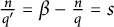





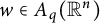


Summarizing all, we conclude the proof of Theorem 1.6(ii) under
 $\beta \in (0,2n)$
.
3.3 The case
$\beta \in [2n,\infty )$

In order to prove Theorem 1.6 under
 $\beta \in [2n,\infty )$
, we need the following two lemmas.
Lemma 3.3 Let
 $p\in [1,\infty ), q \in (1,\, \infty )$
,
 $\beta \in {\mathbb R}$
and w be a weight on
 $ {{{\mathbb R}}^n} $
. Then, for any
 $\gamma \in {\mathbb R}$
,
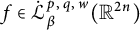 $f \in \dot {\mathcal {L}}_{\beta }^{p,\, q,\,w}({\mathbb R}^{2n})$
if and only if
 $(-\varDelta _{{{\mathbb R}}^{2n}})^{\gamma /2} f \in \dot {\mathcal {L}}_{\beta -\gamma }^{p,\, q,\,w}({\mathbb R}^{2n})$
. Moreover, for any
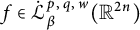 $f \in \dot {\mathcal {L}}_{\beta }^{p,\, q,\,w}({\mathbb R}^{2n})$
,
 $$ \begin{align*} \|f\|_{\dot{\mathcal{L}}_{\beta}^{p,\, q,\,w}({\mathbb R}^{2n})} = \| (-\varDelta_{{{\mathbb R}}^{2n}})^{\gamma/2} f \|_{\dot{\mathcal{L}}_{\beta-\gamma}^{p,\, q,\,w}({\mathbb R}^{2n})}. \end{align*} $$
Proof For any
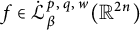 $f \in \dot {\mathcal {L}}_{\beta }^{p,\, q,\,w}({\mathbb R}^{2n})$
, by Definition 1.4, there exists a function
 $\phi \in L_w^q (L^p)({\mathbb R}^{2n})$
such that
 $f=(-\varDelta _{{{\mathbb R}}^{2n}})^{-\beta /2}\phi $
. From this and
 $$ \begin{align*}(-\varDelta_{{{\mathbb R}}^{2n}})^{\gamma/2} f=(-\varDelta_{{{\mathbb R}}^{2n}})^{\gamma/2}\,(-\varDelta_{{{\mathbb R}}^{2n}})^{-\beta/2}\,\phi=(-\varDelta_{{{\mathbb R}}^{2n}})^{-(\beta-\gamma)/2}\phi,\end{align*} $$
we derive
 $$ \begin{align*}(-\varDelta_{{{\mathbb R}}^{2n}})^{\gamma/2} f \in \dot{\mathcal{L}}_{\beta-\gamma}^{p,\, q,\,w}({\mathbb R}^{2n})\end{align*} $$
and
 $$ \begin{align*} \| (-\varDelta_{{{\mathbb R}}^{2n}})^{\gamma/2} f \|_{\dot{\mathcal{L}}_{\beta-\gamma}^{p,\, q,\,w}({\mathbb R}^{2n})}=\| \phi \|_{L_w^q (L^p)({\mathbb R}^{2n})}=\|f\|_{\dot{\mathcal{L}}_{\beta}^{p,\, q,\,w}({\mathbb R}^{2n})}, \end{align*} $$
as desired.
Lemma 3.4 Let
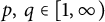 $p,\, q \in [1, \infty )$
,
 $s \in (0, \infty )$
,
 $\gamma \in (0, s)$
and w be a radial weight satisfying (1.4) and (1.5). Suppose that
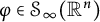 $\varphi \in {\mathcal S}_\infty ({{{\mathbb R}}^n})$
such that
 ${ \mathrm {\,supp\,}} \hat {\varphi }\subset \{x\in {{{\mathbb R}}^n}:\ c^{-1}\leq |x|\leq c\}$
for some constant
 $c\in (1,\infty )$
. Then,
 $g \in \dot {\Lambda }_{p,\, q,\,w,\,\varphi }^{s}({{{\mathbb R}}^n})$
if and only if
 $(-\varDelta _{{{{\mathbb R}}^n}})^{\gamma /2} g \in \dot {\Lambda }_{p,\, q,\,w,\,\varphi }^{s-\gamma }({{{\mathbb R}}^n})$
. Moreover, for all
 $g \in \dot {\Lambda }_{p,\, q,\,w,\,\varphi }^{s}({{{\mathbb R}}^n})$
, it holds that
 $$ \begin{align*} \|g\|_{\dot{\Lambda}_{p,\, q,\,w,\,\varphi}^{s}({{{\mathbb R}}^n})} \approx \| (-\varDelta_{{{{\mathbb R}}^n}})^{\gamma/2} g \|_{\dot{\Lambda}_{p,\, q,\,w,\,\varphi}^{s-\gamma}({{{\mathbb R}}^n})} \end{align*} $$
with implicit constants independent of g.
Proof Associated with the function
 $\varphi $
, define a function
 $\psi $
via
 $$ \begin{align*}\hat{\psi}(\xi):=|2\pi\xi|^{\gamma}\hat{\varphi}(\xi)\quad \text{for all}\ \xi\in{{{\mathbb R}}^n}.\end{align*} $$
Clearly,
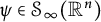 $\psi \in {\mathcal S}_\infty ({{{\mathbb R}}^n})$
and
 ${ \mathrm {\,supp\,}} \hat {\psi }\subset \{x\in {{{\mathbb R}}^n}:\ c^{-1}\leq |x|\leq c\}$
. Note that the Fourier transform gives
 $$ \begin{align*} \left(\varphi_t \ast \left((-\varDelta_{{{{\mathbb R}}^n}})^{\gamma/2} g\right)\right)^{\wedge}(\xi)=\widehat{\varphi_t}(\xi)\,(2\pi |\xi|)^{\gamma}\,\hat{g}(\xi) =t^{-\gamma}\,\widehat{\psi_t}(\xi)\,\hat{g}(\xi)=t^{-\gamma} (\psi_t\ast g)^{\wedge}(\xi), \end{align*} $$
which implies
 $$ \begin{align*}\varphi_t \ast \left((-\varDelta_{{{{\mathbb R}}^n}})^{\gamma/2} g\right)=t^{-\gamma} (\psi_t\ast g).\end{align*} $$
By this and Lemma 2.8, we obtain
 $$ \begin{align*} \| (-\varDelta_{{{{\mathbb R}}^n}})^{\gamma/2} g \|_{\dot{\Lambda}_{p,\, q,\,w, \, \varphi}^{s-\gamma}({{{\mathbb R}}^n})} &= \left(\int_{0}^{\infty}\left\| \varphi_t \ast \left((-\varDelta_{{{{\mathbb R}}^n}})^{\gamma/2} g\right) \right\|_{L^p({{{\mathbb R}}^n})}^{q}t^{-(s-\gamma)q-1}w(t)\, dt\right)^{1/q}\\ &= \left(\int_{0}^{\infty}\|\psi_t\ast g\|_{L^p({{{\mathbb R}}^n})}^{q}t^{-sq-1}w(t)\, dt\right)^{1/q}\\ &= \| g \|_{\dot{\Lambda}_{p,\, q,\,w,\,\psi}^{s}({{{\mathbb R}}^n})}\approx\| g \|_{\dot{\Lambda}_{p,\, q,\,w,\,\varphi}^{s}({{{\mathbb R}}^n})}. \end{align*} $$
This ends the proof.
Now, we prove Theorem 1.6 under
 $\beta \in [2n,\infty )$
.
Proof of Theorem 1.6 under
$\beta \in [2n,\infty )$

If
 $\beta \geq 2n$
, then there exists a unique
 $k\in {\mathbb N}$
such that
 $2n+k-1\leq \beta <2n+k$
, which implies
 $\beta -k\in [2n-1,2n)$
. Moreover, the facts
 $\beta -k\geq 2n-1$
and
 $\beta =s+n/q$
imply that
 $s>k$
.
First, we show (i). Suppose that
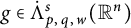 $g\in \dot {\Lambda }_{p,\, q,\,w}^{s}({{{\mathbb R}}^n})$
. By Definiton 1.1, we may as well assume that
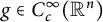 $g\in C_c^\infty ({{{\mathbb R}}^n})$
. From Lemma 3.4 and Theorem 2.10(ii), it follows that
 $$ \begin{align} \| (-\varDelta_{{{{\mathbb R}}^n}})^{k/2} g \|_{\dot{\Lambda}_{p,\, q,\,w,\,\varphi}^{s-k}({{{\mathbb R}}^n})} \approx \|g\|_{\dot{\Lambda}_{p,\, q,\,w,\,\varphi}^{s}({{{\mathbb R}}^n})}\lesssim \|g\|_{\dot{\Lambda}_{p,\, q,\,w}^{s}({{{\mathbb R}}^n})}, \end{align} $$
where
 $\varphi $
is as in Lemma 3.4.
If k is even, say
 $k=2m$
for some
 $m\in {\mathbb N}$
, then, we have,
 $$ \begin{align*}(-\varDelta_{{{{\mathbb R}}^n}})^{k/2} g =(-\varDelta_{{{{\mathbb R}}^n}})^{m} g\in C_c^\infty({{{\mathbb R}}^n}),\end{align*} $$
so that Theorem 2.10(i) and Remark 2.11 imply
 $$ \begin{align} \| (-\varDelta_{{{{\mathbb R}}^n}})^{k/2} g \|_{\dot{\Lambda}_{p,\, q,\,w}^{s-k}({{{\mathbb R}}^n})}\lesssim \| (-\varDelta_{{{{\mathbb R}}^n}})^{k/2} g \|_{\dot{\Lambda}_{p,\, q,\,w,\,\varphi}^{s-k}({{{\mathbb R}}^n})} \end{align} $$
and, hence,
 $(-\varDelta _{{{{\mathbb R}}^n}})^{k/2} g \in {\dot {\Lambda }_{p,\, q,\,w}^{s-k}({{{\mathbb R}}^n})}.$
If k is odd, then we write
 $k=2m+1$
and, hence,
 $$ \begin{align*}(-\varDelta_{{{{\mathbb R}}^n}})^{k/2} g = (-\varDelta_{{{{\mathbb R}}^n}})^{1/2}\left( (-\varDelta_{{{{\mathbb R}}^n}})^{m} g\right)\in (-\varDelta_{{{{\mathbb R}}^n}})^{1/2}\left( C_c^\infty({{{\mathbb R}}^n})\right).\end{align*} $$
For any
 $f\in {\mathcal S}({{{\mathbb R}}^n})$
, it is known that (see [Reference Silvestre40, Section 2]) the function
 $(-\varDelta _{{{{\mathbb R}}^n}})^{1/2} f$
satisfies
 $$ \begin{align*}|(-\varDelta_{{{{\mathbb R}}^n}})^{1/2}f(x)|\lesssim (1+|x|)^{-(n+1)} \end{align*} $$
uniformly in
 $x\in {{{\mathbb R}}^n}$
. This in turn gives that
 $(-\varDelta _{{{{\mathbb R}}^n}})^{k/2} g \in L^p({{{\mathbb R}}^n})$
, which, along with Remark 2.11 and Theorem 2.10(i), again implies
 $$ \begin{align} \| (-\varDelta_{{{{\mathbb R}}^n}})^{k/2} g \|_{\dot{\Lambda}_{p,\, q,\,w}^{s-k}({{{\mathbb R}}^n})}\lesssim \| (-\varDelta_{{{{\mathbb R}}^n}})^{k/2} g \|_{\dot{\Lambda}_{p,\, q,\,w,\,\varphi}^{s-k}({{{\mathbb R}}^n})}. \end{align} $$
From this and Lemma 2.2, we deduce that
 $(-\varDelta _{{{{\mathbb R}}^n}})^{k/2} g $
can be approximated by
 $C_c^\infty ({{{\mathbb R}}^n})$
-functions under the semi-norm
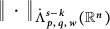 $\|\,\cdot \,\|_{\dot {\Lambda }_{p,\, q,\,w}^{s-k}({{{\mathbb R}}^n})}$
, which induces
 $(-\varDelta _{{{{\mathbb R}}^n}})^{k/2} g \in {\dot {\Lambda }_{p,\, q,\,w}^{s-k}({{{\mathbb R}}^n})}.$
Moreover, since
 $\beta -k\in (0,2n)$
, it follows from the already proved argument of Theorem 1.6 in Section 3.1 that
 $$ \begin{align*}\mathcal{E}\left((-\varDelta_{{{{\mathbb R}}^n}})^{k/2} g\right)\in\dot{\mathcal{L}}_{\beta-k}^{p,\, q,\,w}({\mathbb R}^{2n}),\end{align*} $$
where
 $\mathcal {E}$
is the extension operator defined in Section 3.1. Thus, it makes sense to define the extension operator
 $\widetilde {\mathcal {E}}$
by
 $$ \begin{align*} \widetilde{\mathcal{E}}g:=(-\varDelta_{{{\mathbb R}}^{2n}})^{-k/2} \mathcal{E}\left((-\varDelta_{{{{\mathbb R}}^n}})^{k/2} g\right). \end{align*} $$
By this, together with Lemma 3.3 and (3.23)–(3.25), we derive
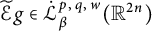 $\widetilde {\mathcal {E}}g\in \dot {\mathcal {L}}_{\beta }^{p,\, q,\,w}({\mathbb R}^{2n})$
with
 $$ \begin{align*} \|\widetilde{\mathcal{E}}g\|_{\dot{\mathcal{L}}_{\beta}^{p,\, q,\,w}({\mathbb R}^{2n})} &=\left\|(-\varDelta_{{{\mathbb R}}^{2n}})^{-k/2}\mathcal{E}\left((-\varDelta_{{{{\mathbb R}}^n}})^{k/2} g\right)\right\|_{\dot{\mathcal{L}}_{\beta}^{p,\, q,\,w}({\mathbb R}^{2n})}\\ &=\left\|\mathcal{E}\left((-\varDelta_{{{{\mathbb R}}^n}})^{k/2} g\right)\right\|_{\dot{\mathcal{L}}_{\beta-k}^{p,\, q,\,w}({\mathbb R}^{2n})}\\&= \left\| (-\varDelta_{{{{\mathbb R}}^n}})^{k/2} g \right\|_{\dot{\Lambda}_{p,\, q,\,w}^{s-k}({{{\mathbb R}}^n})}\lesssim \| g \|_{\dot{\Lambda}_{p,\, q,\,w}^{s}({{{\mathbb R}}^n})}. \end{align*} $$
This proves that (i) holds for
 $\beta \in [2n,\infty )$
.
Now, we show (ii). Let
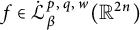 $f \in \dot {\mathcal {L}}_{\beta }^{p,\, q,\,w}({\mathbb R}^{2n})$
. Then,
 $f=(-\varDelta _{{{\mathbb R}}^{2n}})^{-\beta /2}\phi $
for some
 $\phi \in L_w^q (L^p)({\mathbb R}^{2n})$
. Moreover, it follows from Lemma 3.3 that
 $$ \begin{align*}(-\varDelta_{{{\mathbb R}}^{2n}})^{-(\beta-k)/2} \phi=(-\varDelta_{{{\mathbb R}}^{2n}})^{k/2} f \in \dot{\mathcal{L}}_{\beta-k}^{p,\, q,\,w}({\mathbb R}^{2n}).\end{align*} $$
Since
 $\beta -k\in (0,2n)$
, by the already proved argument of Theorem 1.6(ii) in Section 3.2, we obtain
 $$ \begin{align*}\mathcal{R}\left((-\varDelta_{{{\mathbb R}}^{2n}})^{k/2} f\right) =\mathcal{R}\left((-\varDelta_{{{\mathbb R}}^{2n}})^{-(\beta-k)/2} \phi\right)\in\dot{\Lambda}_{p,\, q,\,w}^{s-k}({{{\mathbb R}}^n})\end{align*} $$
and
 $$ \begin{align} \left\|\mathcal{R}\left((-\varDelta_{{{\mathbb R}}^{2n}})^{k/2} f\right)\right\|_{\dot{\Lambda}_{p,\, q,\,w}^{s-k}({{{\mathbb R}}^n})} &=\left\|\mathcal{R}\left((-\varDelta_{{{\mathbb R}}^{2n}})^{-(\beta-k)/2} \phi\right)\right\|_{\dot{\Lambda}_{p,\, q,\,w}^{s-k}({{{\mathbb R}}^n})}\\ &\lesssim \left\|(-\varDelta_{{{\mathbb R}}^{2n}})^{-(\beta-k)/2} \phi\right\|_{\dot{\mathcal{L}}_{\beta-k}^{p,\, q,\,w}({\mathbb R}^{2n})}\notag\\ & = \left\|(-\varDelta_{{{\mathbb R}}^{2n}})^{k/2} f\right\|_{\dot{\mathcal{L}}_{\beta-k}^{p,\, q,\,w}({\mathbb R}^{2n})} \approx \| f\|_{\dot{\mathcal{L}}_{\beta}^{p,\, q,\,w}({\mathbb R}^{2n})}. \notag \end{align} $$
Further, from Lemma 3.4 and Theorem 2.10(ii), we derive
 $$ \begin{align} \left\|(-\varDelta_{{{{\mathbb R}}^n}})^{-k/2}\mathcal{R}\left((-\varDelta_{{{\mathbb R}}^{2n}})^{k/2} f\right)\right\|_{\dot{\Lambda}_{p,\, q,\,w,\, \varphi}^{s}({{{\mathbb R}}^n})} &\lesssim\left\|\mathcal{R}\left((-\varDelta_{{{\mathbb R}}^{2n}})^{k/2} f\right)\right\|_{\dot{\Lambda}_{p,\, q,\,w,\, \varphi}^{s-k}({{{\mathbb R}}^n})}\\ &\lesssim \left\|\mathcal{R}\left((-\varDelta_{{{\mathbb R}}^{2n}})^{k/2} f\right)\right\|_{\dot{\Lambda}_{p,\, q,\,w}^{s-k}({{{\mathbb R}}^n})}{\nonumber} \end{align} $$
and, hence,
 $$ \begin{align*}(-\varDelta_{{{{\mathbb R}}^n}})^{-k/2}\mathcal{R}\left((-\varDelta_{{{\mathbb R}}^{2n}})^{k/2} f\right)\in \dot{\Lambda}_{p,\, q,\,w,\, \varphi}^{s}({{{\mathbb R}}^n}).\end{align*} $$
Next, by Theorem 2.10(i), there exists a Lebesgue measurable function
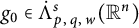 $g_0\in \dot {\Lambda }_{p,\, q,\, w}^{s}({{{\mathbb R}}^n})$
such that
 $$ \begin{align*}g_0=(-\varDelta_{{{{\mathbb R}}^n}})^{-k/2}\mathcal{R}\left((-\varDelta_{{{\mathbb R}}^{2n}})^{k/2} f\right)\ \ \text{in}\ \, {\mathcal S}^{\prime}_\infty({{{\mathbb R}}^n})\end{align*} $$
and
 $$ \begin{align} \|g_0\|_{\dot{\Lambda}_{p,\, q,\,w}^{s}({{{\mathbb R}}^n})} \lesssim \left\|(-\varDelta_{{{{\mathbb R}}^n}})^{-k/2}\mathcal{R}\left((-\varDelta_{{{\mathbb R}}^{2n}})^{k/2} f\right)\right\|_{\dot{\Lambda}_{p,\, q,\,w,\, \varphi}^{s}({{{\mathbb R}}^n})}. \end{align} $$
Thus, when
 $\beta \in [2n+k-1,2n+k)$
, it makes sense to define the restriction operator
 $\widetilde {\mathcal {R}}$
on
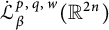 $\dot {\mathcal {L}}_{\beta }^{p,\, q,\,w}({\mathbb R}^{2n})$
by
 $$ \begin{align*} \widetilde{\mathcal{R}}f:=g_0. \end{align*} $$
By (3.26)-(3.27)-(3.28), we know that
 $\widetilde {\mathcal {R}}f\in \dot {\Lambda }_{p,\, q,\,w}^{s}({{{\mathbb R}}^n})$
and
 $$ \begin{align*} \|\widetilde{\mathcal{R}}f\|_{\dot{\Lambda}_{p,\, q,\,w}^{s}({{{\mathbb R}}^n})}\lesssim \| f \|_{\dot{\mathcal{L}}_{\beta}^{p,\, q,\,w}({\mathbb R}^{2n})}. \end{align*} $$
Furthermore, by the fact that
 $\mathcal {R}\mathcal {E}=id$
under
 $\beta \in (0,2n)$
, we deduce that, for any
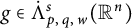 $g\in \dot {\Lambda }_{p,\, q,\,w}^{s}({{{\mathbb R}}^n})$
with
 $2n+k-1\leq \beta <2n+k$
,
 $$ \begin{align*} \widetilde{\mathcal{R}}\widetilde{\mathcal{E}}g= \widetilde{\mathcal{R}} \left( (-\varDelta_{{{\mathbb R}}^{2n}})^{-k/2} \mathcal{E}\left((-\varDelta_{{{{\mathbb R}}^n}})^{k/2} g\right)\right) = (-\varDelta_{{{{\mathbb R}}^n}})^{-k/2}\,\mathcal{R}\,\mathcal{E}\,(-\varDelta_{{{{\mathbb R}}^n}})^{k/2} g=g, \end{align*} $$
where all the equalities hold in
 ${\mathcal S}^{\prime }_\infty ({{{\mathbb R}}^n})$
.
Altogether, we conclude the proof of Theorem 1.6 under
 $\beta \in [2n,\infty )$
.
4 An example: logarithmic Besov space
In this section, we show that logarithmic Besov spaces from [Reference Domínguez, Liu and Xiao15, Reference Edmunds and Haroske19, Reference Edmunds and Haroske20, Reference Haroske30, Reference Haroske and Moura31] (see also [Reference Caetano, Gogatishvili and Opic6, Reference Caetano, Gogatishvili and Opic7, Reference Edmunds and Triebel21, Reference Leopold36]) fall into the scope of weighted Besov spaces in the present article and, hence, the results in Theorem 1.6 are valid for these spaces.
Definition 4.1 Let
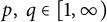 $p,\ q\in [1,\infty )$
,
 $s\in (0,\infty ),$
and
 $b \in {\mathbb R}$
. For any
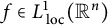 $f\in L_{\text {\,loc}}^1({{{\mathbb R}}^n})$
, set
 $$ \begin{align*} \|f\|_{\dot{\Lambda}_{p,\, q}^{(s,\, b)}( {{{\mathbb R}}^n} )} := \left[ \int_{ {{{\mathbb R}}^n} } \left(\log \frac{e}{|h| \wedge 1}\right)^{bq} \left\| {\mathrm{D}}_{h}^{\lfloor s\rfloor+1}f \right\|_{L^p( {{{\mathbb R}}^n} )}^{q} \, \frac{dh}{|h|^{n+sq}} \right]^{1/q}. \end{align*} $$
The logarithmic Besov space
 $\dot {\Lambda }_{p,\, q}^{(s,\, b)}( {{{\mathbb R}}^n} )$
is defined to be the completion of
 $C_c^\infty ({{{\mathbb R}}^n})$
under the semi-norm
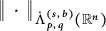 $\|\,\cdot \,\|_{\dot {\Lambda }_{p,\, q}^{(s,\, b)}( {{{\mathbb R}}^n} )}$
.
Lemma 4.2 Suppose that
 $q\in [1,\infty )$
and
 $b\in {\mathbb R}$
. For any
 $ y\in {{{\mathbb R}}^n}$
, let
 $$ \begin{align*}w(y):=\left(\log \frac{e}{|y| \wedge 1}\right)^{bq}.\end{align*} $$
Then,
 $w\in A_r( {{{\mathbb R}}^n} )$
whenever
 $r\in (1,\infty )$
and, moreover, w satisfies (1.4) and (1.5).
Proof For any
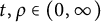 $t,\rho \in (0,\infty )$
, observe that
 $$ \begin{align*} \frac{\log \frac{e}{(t\rho) \wedge 1}}{\log \frac{e}{\rho \wedge 1}} =\frac{\log \frac{e}{\rho \wedge 1}+\log \frac{\rho \wedge 1}{(t\rho) \wedge 1}}{\log \frac{e}{\rho \wedge 1}} \leq 1+\left|\log \frac{\rho \wedge 1}{(t\rho) \wedge 1}\right| \le 1+|\log t|. \end{align*} $$
Since w is a radial function, we write
 $w(y)$
as
 $w(t)$
whenever
 $|y|=t$
. Given any
 $\sigma>0$
, we have
 $$ \begin{align*} \int_{0}^{1}t^{\sigma q}\, \left(\sup_{\rho \in (0, \infty)} \frac{w(t\rho)}{w(\rho)}\right)\frac{dt}{t} \lesssim \int_{0}^{1}t^{\sigma q-1}\left(1+\log\frac{1}{t}\right)^{|b|q}\, dt<\infty, \end{align*} $$
which shows that w satisfies (1.4). Moreover, given any
 $\delta <0$
, we also have
 $$ \begin{align*} \int_1^{\infty}t^{\delta q}\, \left(\sup_{\rho \in (0, \infty)} \frac{w(t\rho)}{w(\rho)}\right)\frac{dt}{t} \lesssim \int_{1}^{\infty}t^{\delta q-1}\left(1+\log t\right)^{|b|q}\, dt<\infty, \end{align*} $$
thereby leading to (1.5).
It remains to validate that
 $w\in A_r( {{{\mathbb R}}^n} )$
, where
 $r\in (1,\infty )$
. To this end, for any ball
 $B\subset {{{\mathbb R}}^n}$
, we need to show that
 $$ \begin{align} \left( \frac1{|B|}\int_B \left(\log \frac{e}{|x| \wedge 1}\right)^{bq}\,d x\right) \left( \frac1{|B|}\int_B \left(\log \frac{e}{|x| \wedge 1}\right)^{-\frac{bq}{r-1}}\,d x \right)^{r-1} \le C \end{align} $$
holds for some positive constant C independent of B.
Suppose that
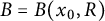 $B=B(x_0, R)$
for some
 $x_0\in {{{\mathbb R}}^n}$
and
 $R\in (0,\infty )$
. Then, we show (4.1) by considering the following two cases.
-
• Case 1:
$|x_0|\ge 2R$
. In this case, for any
$x\in B$
, we have and
$$ \begin{align*}|x|\ge |x_0|-|x_0-x|>|x_0|-R\ge |x_0|/2\end{align*} $$
which in turn gives
$$ \begin{align*}|x|\le |x_0|+|x_0-x|<|x_0|+R<2|x_0|,\end{align*} $$
and, hence, (4.1) holds.
$$ \begin{align*}\log \frac{e}{|x| \wedge 1}\approx \log \frac{e}{|x_0| \wedge 1}\end{align*} $$
-
• Case 2:
$|x_0|< 2R$
. For any
$x\in B$
, we now have so that
$$ \begin{align*}|x|\le |x_0|+|x_0-x|<|x_0|+R<3R,\end{align*} $$
$B\subset B({0}, 3R)$
. Consequently, where the last step follows from a direct calculation (see also [Reference Edmunds, Evans and Operators18, Proposition 3.4.33] and [Reference Domínguez, Liu and Xiao15, Lemma 2.4]). In a similar manner,
$$ \begin{align*} \frac1{|B|}\int_B \left(\log \frac{e}{|x| \wedge 1}\right)^{bq}\,d x &\le \frac1{|B|}\int_{B({0}, 3R)} \left(\log \frac{e}{|x| \wedge 1}\right)^{bq}\,d x \\ &=\frac{n}{R^n} \int_0^{3R} \left(\log \frac{e}{\rho \wedge 1}\right)^{bq}\rho^{n-1}\,d\rho\\ &\approx \left(\log \frac{e}{(3R)\wedge 1}\right)^{bq}, \end{align*} $$
$$ \begin{align*} \frac1{|B|}\int_B \left(\log \frac{e}{|x| \wedge 1}\right)^{-\frac{bq}{r-1}}\,d x &\le \frac1{|B|}\int_{B({0}, 3R)} \left(\log \frac{e}{|x| \wedge 1}\right)^{-\frac{bq}{r-1}}\,d x \\ &=\frac{n}{R^n} \int_0^{3R} \left(\log \frac{e}{\rho \wedge 1}\right)^{-\frac{bq}{r-1}}\rho^{n-1}\,d\rho\\ &\approx \left(\log \frac{e}{(3R)\wedge 1}\right)^{-\frac{bq}{r-1}}. \end{align*} $$
Combining the last two formulae yields (4.1).





Summarizing the arguments in the above two cases, we arrived at the conclusion that
 $w\in A_r({{{\mathbb R}}^n})$
for all
 $r\in (1,\infty )$
.
For
 $p\in [1,\infty ),\ q\in (1,\infty ),$
and
 $b \in {\mathbb R}$
, we denote by
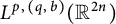 $L^{p,\,(q,\,b)}({\mathbb R}^{2n})$
the collection of all measurable functions f on
 ${\mathbb R}^{2n}$
satisfying
 $$ \begin{align*} \|f\|_{L^{p,\,(q,\,b)}({\mathbb R}^{2n})} := \left( \int_{ {{{\mathbb R}}^n} } \left( \int_{ {{{\mathbb R}}^n} } |f(x,y)|^{p}\, dx \right)^{q/p} \left(\log \frac{e}{|y| \wedge 1}\right)^{bq}\, dy \right)^{1/q} < \infty. \end{align*} $$
The corresponding mixed-Riesz potential space is defined by
 $$ \begin{align*} \dot{\mathcal{L}}_{\beta}^{p,\, q,\, b}({\mathbb R}^{2n}):= \left\{f:\ f=(-\varDelta_{{\mathbb R}^{2n}})^{-\beta/2}\phi\ \ \mathrm{with}\ \ \phi \in L^{p,\,(q,\,b)}({\mathbb R}^{2n}) \right\}. \end{align*} $$
Then, an application of Lemma 4.2 and Theorem 1.6 yields the following result.
Theorem 4.3 Let
 $p\in [1,\infty ),\ q\in (1,\infty ),\, s \in (0, \infty )$
,
 $\beta :=s+ n/q\in (0,\infty )$
and
 $b \in {\mathbb R}$
. Then, the following hold:
-
(i) there exists a bounded linear extension operator
such that, for any
$$ \begin{align*}\mathcal{E}: \, \dot{\Lambda}_{p,\, q}^{(s,\, b)}( {{{\mathbb R}}^n} ) \to \dot{\mathcal{L}}_{\beta}^{p,\, q,\, b}({\mathbb R}^{2n}),\end{align*} $$
$g \in \dot {\Lambda }_{p,\, q}^{(s,\, b)}( {{{\mathbb R}}^n} )$
, where
$$ \begin{align*}\|\mathcal{E}g\|_{\dot{\mathcal{L}}_{\beta}^{p,\, q,\, b} ({\mathbb R}^{2n})}\leq C_1\|g\|_{\dot{\Lambda}_{p,\, q}^{(s,\, b)}( {{{\mathbb R}}^n} )},\end{align*} $$
$C_1$
is a positive constant independent of g;
-
(ii) there exists a bounded linear restriction operator
such that, for any
$$ \begin{align*}\mathcal{R}: \, \dot{\mathcal{L}}_{\beta}^{p,\, q,\, b}({\mathbb R}^{2n}) \to \dot{\Lambda}_{p,\, q}^{(s,\, b)}( {{{\mathbb R}}^n} ),\end{align*} $$
$f \in \dot {\mathcal {L}}_{\beta }^{p,\, q,\, b}({\mathbb R}^{2n})$
, where
$$ \begin{align*}\|\mathcal{R}f\|_{\dot{\Lambda}_{p,\, q}^{(s,\, b)}( {{{\mathbb R}}^n} )} \leq C_2\|f\|_{\dot{\mathcal{L}}_{\beta}^{p,\, q,\, b}({\mathbb R}^{2n})},\end{align*} $$
$C_2$
is a positive constant independent of f. Moreover,
$\mathcal {R}\mathcal {E}=id.$