I. Judicial oversight in times of health crises
Lockdown, quarantine, social distancing, facemask policies and contact tracing protect the right to life and health during the coronavirus crisis. They also drastically limit fundamental rights and freedomsFootnote 1 and come with high social and economic costs. Governments have to use discretion to balance these rights and interests.
Several scholars have emphasised the essential role of courts in controlling governments in the fight against the pandemic. Ginsburg and Versteeg describe how courts worldwide have interfered with governments’ responses to the pandemic.Footnote 2 Not all courts, however, actively scrutinise the government. In France and Belgium, the Council of State was criticised for deferring cases and neglecting its monitoring role.Footnote 3 The central question in this paper is therefore what room there is for the judicial scrutiny of crisis measures.
Scholars have argued that courts should assess whether governments use public health expertise when limiting fundamental rights.Footnote 4 This view seems to reduce governments to the rubber stamping of medical and virological experts. This may have been appropriate in the first stage of the pandemic outbreak. However, in the later stages, fundamental rights concerns and societal and economic costs demand a more nuanced interplay between science and politics.Footnote 5
This paper examines what room there is for judicial supervision of the health crisis measures based on the public’s expectations of how governments should act in the interplay with experts. It does so in light of the current COVID-19 crisis. The paper argues that the reasons for deference, far from justifying an abdication of judicial scrutiny, call for procedural rationality review that, after the initial stage, cannot rely on the consideration of expert advice alone. It holds that the room for legitimate judicial scrutiny is inversely proportional to the government’s discretion defined in terms of public trust, and that within the boundaries of legitimate judicial scrutiny a procedural rationality check overcomes the expertise concern. On this basis, the paper distinguishes between two phases. In the first phase, the assumption is that the public expects the government to firmly respond to the crisis, no matter what, which leaves little room for judicial scrutiny of health crisis measures. In the second phase, when trust starts to wane, the assumption is made that the public expects the government to balance safety against fundamental rights and social needs. The first assumption is based on the well-documented “rally-around-the-flag” effect. This paper therefore concentrates on the second assumption, for which a vignette experiment provides provisional evidence. Moreover, a case study provides anecdotal evidence for the assumption that, as a result, the court’s stance shifts in the second phase.
The paper is organised as follows: Section II explains how trust theory and procedural rationality review help to justify the deference of courts. This leads to a theoretical framework that proposes a hypothesis on the relationship between science and politics in the second phase of the crisis. Next, the assumption that the phases that characterise a crisis affect the courts’ room for legitimate scrutiny is backed by anecdotal evidence using a Belgian case study (Section III). The Belgian case is selected because Belgium was hit hard by the COVID-19 virus and the Council of State showed an unusually high level of deference. Finally, a vignette experiment tests the hypothesis regarding the second phase. Section IV presents the experiment’s research design and discusses the results before the research question is answered in the concluding section.
II. Trust theory and procedural rationality review as aids for judicial oversight
Judicial deference to governments is typically based on democratic legitimacy concerns and the notion of expertise. The legitimacy argument has extra weight when parliamentary acts are at stake, coined as the counter-majoritarian difficulty.Footnote 6 The argument points out that unelected courts lack the legitimacy to second-guess the outcome of balancing exercises that belong to the political sphere. The argument of expertise insulates evidence-based administrative action from judicial review and is used in particular concerning regulatory agencies established to act as expert bodies.Footnote 7 Empirical studies revealed that, for this reason, generalist courts show a higher degree of deference towards regulators’ technical decisions than specialised courts.Footnote 8
Both legitimacy and expert arguments have a specific meaning in the case of the coronavirus crisis. First, responses have mainly relied on executive action but were usually backed by specific statutory empowerments, or at least implicitly endorsed by Parliament.Footnote 9 Second, the reflex for decision-makers to reduce uncertainty through scientific assessment, which is typical for risk regulation, also characterised the global government responses to the coronavirus pandemic.Footnote 10 Moreover, it seems all the more appropriate for courts to take a deferential stance during emergencies because they cannot act with the required speed and flexibility.Footnote 11 Judicial deference enables governments to deal with crises effectively while remaining within legal confines.
Yet the unprecedented impacts of health measures on fundamental rights, on the societal and economic organisation and on state budgets call for judicial monitoring. A counterweight is needed, especially in times when parliamentary oversight is easily reduced.Footnote 12 It is argued here that the notions of trust and procedural rationality review provide avenues to overcome the legitimacy and expertise obstacles.
1. The legitimacy obstacle and the notion of trust
A reply to the counter-majoritarian difficulty relies on an alternative form of democratic legitimacy: the assumption that courts in their own way voice the public’s sentiment, after and in-between elections.Footnote 13 Empirical studies have confirmed positive relationships between aggregate public opinion and courts’ collective decisions.Footnote 14 This is also a matter of strategy: courts depend on both the government and public support for the implementation of their decisions.Footnote 15 Usually, this corresponds to the courts’ bonding with the government. In politically turbulent times with uncertain outcomes of electoral processes, the court may also align with the public.Footnote 16 The question remains as to how courts find out what the public actually expects in times of health crises characterised by extreme uncertainty, and whether the alignment of policy decision and public sentiment can still be assumed when measures affect the public in general rather than specific individuals and minority groups. This is where trust theory comes in.
When facing a crisis or confronting a foreign threat, citizens tend to exhibit greater support for their political leaders. This phenomenon is known as the rally-around-the-flag effect and has been intensively studied in the USA during the Cold WarFootnote 17 and the 9/11 terrorist attacks in 2001,Footnote 18 as well as in Europe in the aftermath of Charlie Hebdo attacks in France,Footnote 19 the 11 March 2004 terrorist attacks in MadridFootnote 20 and in light of growing tensions between Russia and the West.Footnote 21
Recent surveys conducted during the COVID-19 crisis also reveal an increase of citizens’ trust in the governing party, the prime minister or the president in the initial stage of the crisis, as well as an increase in their satisfaction with the country’s democracy and a greater interest in politics.Footnote 22
The trust literature, unrelated to crisis governance, reveals some of the drivers of citizens’ trust in government. In general, governments are deemed trustworthy if they are perceived as competent, fair and having integrity.Footnote 23 The quality of the decision-making process matters, but no agreement is found as to what these standards actually involve, and the perception of fairness depends on whether the outcome fulfils one’s substantial preferences.Footnote 24
In the initial stage, when lockdown measures affected the entire population, the health stakes were higher for at-risk groups. The impact of COVID-19 is asymmetrical, making older people and people with chronic diseases more likely to be severely affected by the symptoms of the virus.Footnote 25 But generally, the whole population suffered from a loss of individual freedom and benefitted from quick and firm actions to contain the spread of the virus. At this stage, survey data indicate that trust in government was high, but trust in experts, who took on a very visible role in decision-making, was even higher.Footnote 26 This strengthens the assumption that, in times of crisis, expertise plays a prominent role as a standard for fair decision-making and that trust in crisis governance relies on the perception that decisions are based on expert advice. This aligns with the theoretical and empirical studies that show that even in ordinary times, expertise, as a token of competence, is a trust-enhancing factor.Footnote 27
All of this indicates that the courts’ reaction to give broad deference to governments when it comes to expert-based safety measures is justified from a legitimacy perspective. With an overly stringent attitude that is not backed by the public, the courts would risk overplaying their hand.
Recent surveys, however, show that after this initial surge of trust, public trust dropped again in later stages of the crisis, even to below the pre-coronavirus level.Footnote 28 This suggests that a crisis comes in different stages, and expectations as to government action and the role of courts shift with every stage. As the crisis develops, the measures begin to reveal a heterogeneous impact. The social and economic effects of lockdown measures are harder on socio-economically vulnerable groups. Exit measures to open up economic and social activities were implemented only gradually, which is easily perceived as unfair. In the Belgian case study, this was the moment when acts were being challenged before the court. From then on, personal needs and preferences played a more important role. This means that standards for fair decision-making no longer relied on expertise alone. Indeed, from other survey data, it appears that, with the drop in trust in government, trust in experts also declined.Footnote 29
On this basis, we argue that the public expects the government to take firm action, which leaves little room for judicial supervision. This is based on the well-documented rally-around-the-flag effect. We further hypothesise that the public does not expect the government to rubber-stamp expert advice in the later stages of a health crisis, but allows some political space to weigh safety against social needs and preferences. In Section IV, this paper presents preliminary evidence for this hypothesis through a vignette experiment. Beforehand, however, in Section III, we seek anecdotal evidence for the distinction between these phases through a case study.
2. The expertise obstacle and procedural rationality review
So far, we argued that the public expects the government to strictly rely on medical and virological expertise in the first stage of a crisis, but that it expects the government to weigh virological safety against social needs in later stages. This, in turn, widens the room for judicial scrutiny of crisis measures. The expertise obstacle further delineates the room for judicial scrutiny, where it questions the courts’ training and knowledge to second-guess the necessity and adequacy of crisis measures. This means that even if courts have the legitimacy to review crisis measures, the expertise obstacle restrains them from using that legitimacy.
Procedural rationality review may allow courts to overcome the expertise obstacle. This is a technique that enables a combination of deference and scrutiny. It entails that courts consider the quality of the decision-making procedure at the legislative or administrative stage to assess whether government interference in fundamental rights was proportional.Footnote 30 In expert-based decision-making, deference is based on the expectation that the decision under review relied on evidence and knowledge rather than mere assumptions.Footnote 31 It is then for the court to test whether the government was indeed better placed to make an informed decision. To this end, the court examines whether safeguards were built into the process to enable informed decision-making.
In the first phase, when trust in experts’ solutions is high and before the public has experienced too many discomforting consequences, “informed decision-making” refers in particular to “expert-based” decision-making. The court’s main task, in this case, is to check whether the decision was indeed based on expert advice. The court will most likely defer from assessing the quality of the scientific evidence that was used, except for if there are strong indications that the evidence is flawed, given the fact that they often lack the capacity to do so.Footnote 32 Especially under the circumstances of the coronavirus crisis, where even experts disagree on important issues,Footnote 33 it is not for the court to take sides.
However, if in later stages the public expects politicians to weigh safety against fundamental rights and social needs, judicial oversight cannot be simply a matter of checking whether decisions were based on medical and virological evidence. This would mean that the government may deviate from expert advice to accommodate opposing rights and interests. It would also mean that medical and virological advice alone can no longer justify crisis measures that heavily impact fundamental rights and societal interests. Instead, procedural rationality review leads the court to investigate whether procedural safeguards were in place to make an informed and balanced decision, taking into account more than virological considerations alone. The implications are that the government is expected to assess the impact of its measures and to identify the groups that are affected. To this end, the government cannot simply refer to medical and virological expert advice, but will have to seek additional information through consultations or mixed panels, including social and human science experts and representatives of affected sectors.
Later stages of the coronavirus crisis saw a shift from expert-based to expert-informed decision-making in crisis management.Footnote 34 More often than not, expertise in itself is contested and uncertain. In the first crisis response, scientists were expected to lead countries out of the crisis. In later stages, uncertainty and the contestation of evidence resurfaced. Virologists were challenged by other virologists and other disciplines. As a result, politicians could no longer solely rely on science to argue for interventions. This justifies a shift in the attitude of the court, implying that expert-informed decision-making is not simply a device for effective crisis management but a legal duty.
3. Theoretical framework
Based on the legitimacy obstacle, the room for judicial supervision of crisis measures depends on the public support for and expectations of the government, measured in terms of trust. Empirical studies show that the level of trust evolves over time. In the first phase of a crisis, trust is unusually high; in the next phases, trust wanes again.
In the first phase, the rally-around-the-flag effect shows that the public expects firm government action. When dealing with health crises, there is high trust in the government, and even higher trust in experts. This suggests that the government has wide discretion, provided that it is guided by expert advice to ensure effective safety measures. At the same time, this means that the room for legitimate judicial scrutiny of crisis measures is very limited. Within these limits, the expertise obstacle allows for a procedural rationality check to make sure that government action is based on (virological) expert advice.
In the next phase, public trust in the government decreases, which gives less room for government discretion and more room for judicial supervision. We hypothesise that from then on the public expects the government to balance safety measures against fundamental rights and social needs. This hypothesis is tested in Section IV. If the hypothesis is confirmed, this implies that it is legitimate for courts to test whether the government lives up to the public’s expectations. In that case, the expertise obstacle requires courts to take a procedural rationality approach by testing whether the decision-making procedure has enabled an informed balancing of safety and other concerns, such as through expert advice, stakeholder advice or consultations.
The problem remains how to distinguish the different phases. The level of trust indicates public support for the government, which in turns determines the room for judicial scrutiny. Therefore, a drop of public trust indicates the passage into a new phase. In practice, this will probably take place in the case of reduced danger, which decreases the level of fear and makes room for exit measures. But even if the danger persists, or if it increases again in later stages, this is still different from the first phase, because the effects of safety measures will take their toll.
III. The Belgian case
In this section, we look for anecdotal evidence that the phases that distinguish the crisis cycle based on the level of trust also impact on the stance that courts take towards crisis measures. For this, the Belgian case is used.
COVID-19 hit Belgium very hard. By mid-April 2020, Belgium was at the top of the coronavirus deaths per capita worldwide, with a death rate of 359 per million residents.Footnote 35 The government, in the middle of a political crisis,Footnote 36 was slow to react. Public concern arose at end of February when the number of infections rose. It took until 13 March, two days after the coronavirus claimed its first fatality in Belgium, before an official health crisis was announced and the first measures were taken. A more drastic nationwide lockdown took effect on 18 March. The infection rates and hospitalisation numbers started to decline after 3 April.
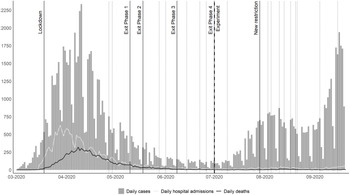
A survey dated 7 April showed that the public’s trust in government was unusually high, and the public trust in experts was even higher. But three weeks later, on 28 April, the public’s trust had dropped to a level that was lower than what was observed in normal times.Footnote 38 This means that the passage from the first to the second phase was situated somewhere towards the end of April. This aligns with the gradual decrease of COVID-19-related infections, hospitalisations and deaths, as shown in Figure 1. Also around this time, the government policy shifted. On 17 April, the first relaxation measure was taken to keep the public motivated. Actual exit measures out of the lockdown were introduced two weeks later, on 30 April, and more followed in quick succession. By the end of July, the government’s advisory committee CELEVAL reported the beginning of the second wave of COVID-19 infections.Footnote 39 Further relaxations measures (eg large public events) were put on hold and new restrictions were introduced, including the mandate to wear facemasks in specific places. This time, room was given to local governments to adopt stricter measures if the epidemiological situation required them. In Antwerp, the requirement to wear facemasks was generalised and a curfew was imposed.
Overview of the Belgian COVID-19 cases with judgment dates. Data frame: 1 March–30 September 2020. Dotted vertical lines represent the dates when court judgments were issued. The dashed vertical line represents the date when the experimental vignette study was launched.Footnote 37

Until October 2020, when a new government was formed, all national measures were decided by the National Security Council, consisting of the Prime Minister, the Vice-Ministers and the relevant federal Ministers, to which the Minister-Presidents of the federated entities were added. The Council was supported by the National Crisis Center with three advisory bodies: the Risk Management Group (RMG), the Risk Assessment Group (RAG) and a Scientific Committee for the Coronavirus. They were mainly composed of representatives of health ministries, epidemiologists of the Belgian Institute for Health (Sciensano) and invited medical scientists. In addition, on 6 April, a group of experts was established to advise on an exit strategy (GEES) consisting of medical, statistical and financial experts, one legal expert and representatives of the economic sector.
The Council of State is the judicial body that is competent to annul administrative acts, including the ministerial decrees and local acts that contained the preventative and exit measures regarding the crisis. Between 13 March, when the first measure was adopted, and 31 October, the Council of State delivered thirty-two judgments on the legality of coronavirus crisis measures and invalidated only one – the Brussels’ mayoral order to prohibit prostitution was deemed ultra vires.Footnote 40
Interestingly, the first ministerial decrees, with the most stringent restrictions, remained unchallenged. The first petition concerned an act, adopted on 17 April, that allowed for the reopening of specific businesses. This suggests that the public did not see a role for the court to act as a guardian of fundamental rights in the middle of the first phase, but only started litigating towards the passage into the second phase.
Most petitions were rejected for a lack of urgent serious harm. With this strict procedural stance, the Council of State missed the opportunity to give the government guidance concerning infringements on fundamental rights. This changed by the end of October: it now more often discussed the arguments of a case instead of rejecting the cases for procedural reasons.Footnote 41 A few examples show how deferential the Council of State was, even where it did assess the merits of the case, and how, based on the precautionary principle,Footnote 42 it prioritised safety concerns based on expert advice.
In the first case brought before the Council of State, the petitioners claimed that the reopening of gardening centres and do-it-yourself (DIY) stores was discriminatory and would lead to unfair competition. As previously mentioned, the timeline situates this in the passage from the first into the second phase. The second phase was not yet established, so we can expect that the Council of State would still be hesitant. The Council of State did not qualify the measure as an exit measure, but emphasised that the reopening had the purpose of motivating the public to respect the lockdown measures by enabling them to work in the house and the garden. This supports the idea that, according to the Council of State, the second phase was in sight, but not yet in effect.
The Council of State was clear about its position regarding crisis government: it gave “the widest possible discretion” to protect the public health and safety in this “unseen and most serious” health crisis.Footnote 43 The court cited CELEVAL’s advice extensively to conclude that the government’s decision was reasonable. The petitioners argued that the exclusion of other retail businesses, especially shops with similar products in their wares, was unnecessary because safety could be secured through social distancing measures. Considering the wide discretion granted to the government, the Council of State refused to examine the availability of less drastic measures. It did, however, emphasise that the measure heavily relied on virological expert advice. This confirms our theoretical assumption that courts, in the first phase of a crisis, find little room for judicial supervision of crisis measures and are mainly concerned with the question of whether preventative health measures rely on expert advice.
Subsequent cases were presented in the second phase. This time, the term “widest possible discretion” was replaced by “wide discretion”. The Council of State stressed that it has jurisdiction to examine whether crisis measures depart from actual and relevant facts, established with care, and are weighed against all interests at stake.Footnote 44 This confirms that the Council of State saw more room for judicial scrutiny in the second phase and that it turned to procedural rationality review to overcome the expertise obstacle discussed in Section II. In this phase, it required informed decision-making taking account of all interests, which implies a balancing of safety and other rights and interests.
However, in practice, the Council of State did not impose additional obligations on the part of the government, but shifted the burden of proof to the petitioners. For example, petitioning fairground stallholders argued that the limitations were disconnected from the capacity of the actual fairground and proposed a solution similar to that which applied to markets. The Council of State reiterated that the government was advised by expert committees. It did not examine the type of expertise included in these committees or notice the absence of representatives of fairground stallholders. Instead, it expected the petitioners to give scientific evidence for their own claims. In other cases, the early closing time – 10 pm – for night shops was challenged. The purpose of this measure was to prevent people from buying alcohol to continue social meetings after the closing of the bars at 1 am. The petitioners argued that alcohol was still available in petrol station shops, and that CELEVAL’s advice did not go as far as to recommend closure three hours before the closing time for bars and restaurants. Although the measure formed part of an exit strategy, putting some sectors in a more advantageous position than others, the Council of State again refused to compare alternative measures and held that it was not unreasonable for the government to take an even stricter position than was recommended by experts.Footnote 45
When measures such as a generalised requirement to wear facemasks or the closure of bars and restaurants were challenged, the Council of State made clear that it would not assess the effectiveness of government measures to contain the spread of the COVID-19 virus, let alone settle scientific controversies as to the usefulness of specific measures, such as the wearing of facemasks, through a court order.Footnote 46
Interestingly, the Council of State referred to consultations to uphold exit measures concerning the resuming of public activities. These measures were challenged because they first excluded religious ceremonies and thereafter made them conditional on the wearing of facemasks. The Council of State pointed out that the planning and scripts for religious ceremonies were developed in consultation with the different religious communities.Footnote 47
This overview shows that the Council of State distinguished between phases. In the first phase, the government gave “the widest possible discretion” and judicial scrutiny was confined to procedural rationality review concentrated on expert advice. In the second phase, it gave “wide” discretion to the government but emphasised a duty of due care, giving room for a more encompassing procedural rationality review. In practice, however, the Council of State still showed extreme reluctance to scrutinise government crisis management measures. For example, expert advice and consultations were invoked, but only as an aid to support the crisis measures. The following sections will examine whether such reluctance was justified from a legitimacy perspective.
IV. Public expectations regarding standards of fair decision-making: an experimental vignette study
We have proposed that, as a health crisis progresses into later stages, the public no longer expects the government to rubber-stamp expert advice. Based on theories of trust and procedural rationality, we theorised that public opinion would favour politics that weigh safety against social needs and preferences. We therefore expect public support for a measure to rise when it is backed up by advisory councils that take general interests into account as well as the recommendations of health experts. When, instead, a proposed measure appears to be deficient in one or the other type of information, additional enticements may be necessary for the measure to gain acceptance.
To test this general hypothesis, we set up a vignette experiment and collected survey data.Footnote 48 The vignette experiment did not examine what the public expects from the judiciary. Instead, the focus was on the respondents’ support of government decisions as the outcome of a balancing exercise. Two reasons explain this choice, of which the second is the most important one. First, we did not expect the respondents to be familiar with the role of courts and with legal analysis, especially if they had not been involved in litigation. Garoupa and Magalhães confirm that courts tend to be less visible or salient for people than elected political institutions.Footnote 49 This is all the more true for the Council of State, which is an administrative court with which the public is not familiar through criminal news reports and television series. More importantly, the purpose of the survey was not to examine whether the respondents expected the court to either support or invalidate the proposed measures. Instead, based on the problem setting in Section II, we tried to delineate the space for legitimate judicial scrutiny of crisis measures by delimiting the discretionary space for the government. It was held that the legitimacy of courts to sanction government behaviour depends on the public’s support of concrete government action. This means that the public’s expectations of how the government should act also determine the extent to which courts have the legitimacy to scrutinise government action. Therefore, the purpose of the vignettes was to reveal whether, and to what extent, the public expects that safety measures are balanced against other interests.
We analysed a number of interrelated indicators. The first and most direct test is to assess citizen self-reported support for the policy, a variable that directly taps attitudes towards citizens’ agreement with a certain policy measure. However, in order to triangulate findings, it is also useful to examine a number of related constructs. We therefore included trust in government as a second variable. This widely used, multi-item measure captures citizens’ beliefs that the government is able to deal with a crisis without violating their interests.Footnote 50 Previous contributions have shown that trust in government and related variables, such as confidence in government, are consistent predictors of levels of policy support and adherence to government policies, which further supports the variable’s relevance in our context.Footnote 51 Third, we also took into account the perceived effectiveness of the measures proposed in addressing the COVID-19 crisis. We reason that the self-reported effectiveness of the government’s COVID-19 measures provides a construct related to but distinct from support for the policy.Footnote 52 Effectiveness in combating the crisis does not necessarily take into account aspects of distributive or procedural fairness and is less likely to encompass affective components of support. Together, support, trust in government and perceived effectiveness will provide a comprehensive test of the degree to which governmental actions in specific policy areas conform to the expectations of citizens.
The vignettes, depicting plausible scenarios for the exit strategy to gradually relax the crisis measures that were in place from 1 July 2020, represented the main independent variable of interest. They varied in the type of information that support(s) the exit measure. We included three types of advisory information, and these were given to three distinct groups of participants (ie the type of information is a between-subjects factor in the experimental design). The first group of participants received only the advice of the health experts (World Health Organization (WHO), GEES and virologists). Vignettes with this type of expert advice served as the reference category. For the second group, this advice was replaced with basic information regarding the social needs of specific economic sectors or those of the broader public. The third group received social needs information combined with health expert information, thereby nudging the respondents to balance both.
1. Methods
Three different vignettes were developed. Each contained an exit measure that was fictional but closely linked with planned schemes. These vignettes were shown to all survey participants (ie the different measures were a within-subjects factor in the experimental design).Footnote 53
The first vignette described demonstrations in the open air, impacting the freedom of assembly and expression. Experts’ recommendation was to limit large-scale outdoor gatherings to 200 persons. Social needs information referred to social organisations’ requests for exceptions to enable peaceful expressions of opinion. The proposed exit measure of the vignette was formulated as a balance between both advisory councils; it was somewhat looser than the expert advice, allowing for demonstration in the open air conditional to a limit of 400 persons, a static course and social distancing.
The second vignette concerned the wearing of facemasks, affecting the right to personal integrity. Information on expert advice referred to the WHO recommendations to wear facemasks in specific situations and places, as well as to the GEES advice to wear them in crowded places and to virologists’ insistence on making this mandatory in shops. Information regarding social needs referred to the prevailing ambiguity: it pointed out that many people voluntarily wear facemasks, but that it can cause discomfort to people who have to spend a long time in public places. The proposed measure entailed the mandatory wearing of facemasks in public places. In this case, the proposed measure of the vignette was stricter than the experts’ advice, but not unrealistic: only a month later, the governor of the Province of Antwerp would introduce a general requirement to wear facemasks in public and publicly available places.
The third vignette described restrictions on cultural events that affected the right to cultural development and the freedom of enterprise. The GEES expert commission recommended allowing concerts with up to 100 seated attendees, conditional on social distancing. It was also pointed out that, in the case of singing, social distancing should be extended from 1.5 to 5.0 m. Social needs information made reference to the requisites of the music sector (including technicians, organisers and caterers) and the public’s longing to enjoy cultural activities. The proposed vignette measure was again somewhat looser than the experts’ advice, allowing for the organisation of concerts for 200 persons indoors and 400 persons outdoors, conditional on the public being seated and everyone’s respect of 1.5 m social distancing.
The vignettes were embedded in the survey and presented in random order. The description of each vignette was followed by a number of questions from which the dependent variables were derived. The first dependent variable, public support, reflected the extent to which respondents agree with the proposed measure. The second dependent variable, perceived effectiveness, assessed agreement with the statement: “I believe the measure to be effective to confine the spread of the COVID-19 virus”. For the third dependent variable, trust in government, we used a validated scale comprising three questions: “I believe the measure has been developed in a professional way”, “I believe the government tried its best to develop a good measure” and “I believe that, with this measure, the government addresses the interests of the entire population”.Footnote 54 All statements were rated on a seven-point Likert scale ranging from “completely disagree” to “completely agree”. Because all three dependent variables were – in all likelihood – highly dependent on an individual’s dispositional trust level, we controlled for this by assessing each individual’s general trust level with a widely used single-item measure: “Do you believe that, in general, other people can be trusted or that you can never be too careful when dealing with others?” Thus, in the analysis, we tested how the type of information affects individuals’ responses to a measure above and beyond their own dispositional level of trust.
We also added COIVD-19-related stress as a potential moderator because, in general, stress levels are bound to be higher during crises. This was assessed with three items scored on a seven-point scale: “How dangerous do you think the coronavirus is to the population at this moment?”, “I worry a lot about the current coronavirus situation, even when I am busy with other things” and “I find the current coronavirus situation very stressful”. Intuitively, we would expect that increased stress would render people more self-centred, focusing on their own safety and disregarding other information, which would lead them to overvalue health experts’ advice. However, there is increasing evidence that stress can also stimulate people’s concern for others and, accordingly, increase their prosocial behaviour,Footnote 55 in which case respondents with high COVID-19-related stress might be more inclined to support measures that also emphasise the social needs of others and/or balance different types of information that affect the self as well as others.
Finally, the survey contained demographic queries, which were included in our analyses as control variables, as they may have independently affected how people supported and perceived the various measures. While random assignment should prevent endogeneity from affecting the variables pertaining to the experimental groups, neglecting to add control variables may still result in endogenous results for our perceptional moderators (ie COVID-19-related stress and generalised trust). We therefore included a number of personal characteristics as controls: age, gender, level of education, news interestFootnote 56 and household composition. As the COVID-19 crisis was still evolving rapidly at the time, we took into account the time of response as a potential source of model misspecification. As the bulk of responses were concentrated in the first two days of the survey (30 June–2 July) and the first days after the reminder (7–9 July), we generated a dummy variable day of response.
The survey was distributed through the University of Antwerp’s “Burgerpanel” (citizen panel) in the period 30 June–18 July using Qualtrics. The survey targeted a respondent group of 2000 citizens, resulting in a response of 1059 (52.95%), of whom 980 respondents completed the survey and 79 respondents submitted an incomplete survey. Item non-response from such incomplete submissions slightly reduced the number of usable responses, with total usable observations for our final analyses ranging from 955 to 975.
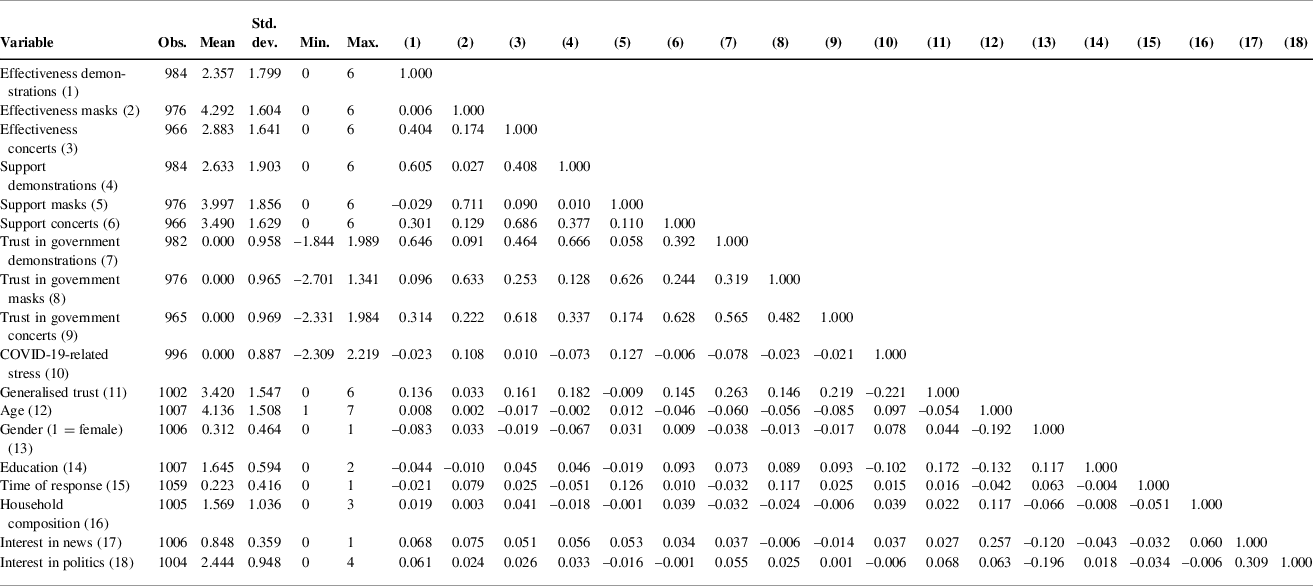
The Burgerpanel uses self-selection as its primary recruitment method, with interested citizens being able to sign up to the panel, after which they receive invitations to participate in surveys several times per year. Thus, the Burgerpanel recruits volunteers who are typically engaged citizens interested in socio-political issues and may therefore not be unbiased. Moreover, once a survey invitation is sent, invitees have the choice to self-select into the survey, which may skew responses towards citizens with an interest in the subject of the survey. Nevertheless, there were sufficient observations in all categories for education, age, gender, household composition and political interest to control for these factors appropriately.Footnote 57 The survey data also showed reasonable variation across the employment sector, with respondents engaged in education, politics, administration, legal and security issues, social and (bio)medical care, arts and entertainment, media, catering and other occupations. Combined with the random assignment process generating exogenous intervention variables, the data obtained from the Burgerpanel allowed for a valid examination of our hypotheses. Demographic information on the age and gender distribution of the population, along with education level, household composition and political interest, can be found in Table 1.
Descriptive statistics and correlation table.

2. Results
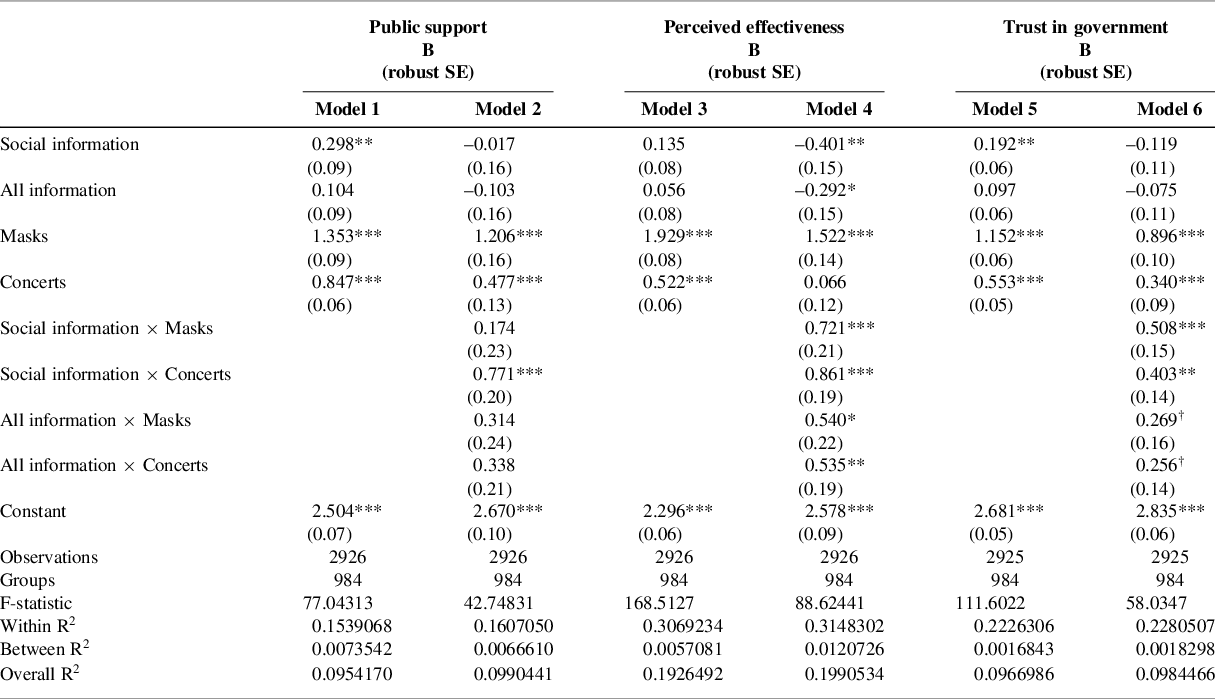
Table 1 shows the descriptive values and correlation coefficients of all of the variables of interests used in subsequent analyses. To assess the effect of the advisory council (or the type of information) on the public response (support, perceived effectiveness and trust in government) to our three fictitious measures, we first conducted regression analyses on panel data, meaning that we analysed the total number of responses (N = 2926) clustered over 984 individuals. We entered the predictors (health experts, social information or the combination of both) as fixed effects in the regression model to control for unobserved heterogeneity across individuals, as a Hausman test indicated that the independent variables were not exogenous. This indicated that their effect on public response may have been influenced by other factors in the model that may not have been randomly distributed among individuals’ responses to the different vignettes. To control for the possibility that the response level may have varied significantly between the three vignettes, we added them as dummy variables in the model, with demonstrations being the reference category. The regression coefficients (B), along with standard errors and significance levels, are summarised in Table 2.
Results of a regression analysis with fixed effects. Reference categories are health experts’ advice and demonstrations.

†p < 0.10, *p < 0.05, **p < 0.01, ***p < 0.001.
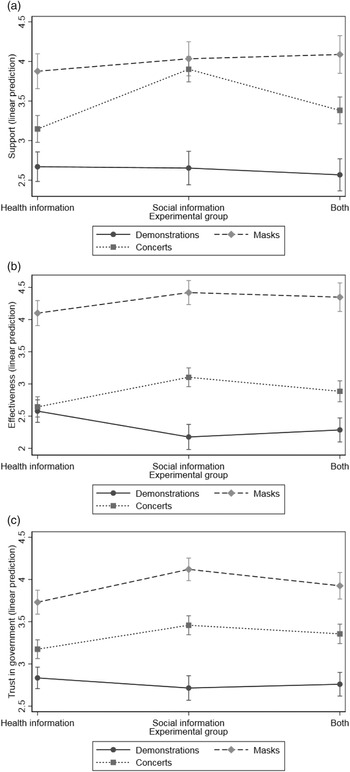
A first inference we can make from Table 2 is that the concerts and facemasks scenarios exerted a significant main effect in the model and that they elicited significantly more public support, perceived effectiveness and trust in government relative to the demonstrations (models 1, 3 and 5). From the B coefficients and Figure 2, it is furthermore apparent that the facemasks consistently elicited more response than the concert measure, which is surprising considering that this fictitious measure was more stringent than the concomitant expert advice, while the concerts and demonstration measures were less so.
The effect of the advisory council (expert advice, social information or both) on public responses to three fictitious vignettes: (a) public support; (b) perceived effectiveness; (c) trust in government.

Second, when examining the main effect of the advisory council, we see that substituting health experts’ advice with social information significantly increased public support (model 1) and trust in government (models 3 and 5). Giving social information (by itself) also influenced the perceived effectiveness, but in opposite directions for the facemasks and concerts on the one hand and demonstrations on the other; again, we see an increase in the perceived effectiveness of the facemasks (model 4) and the concert measures (model 4), but this time there was a significant decrease for the perceived effectiveness of the demonstrations measure (the reference category in model 4). Moreover, the combination of expert advice and social information showed the same trend with respect to perceived effectiveness, exerting a positive influence on the facemasks and concerts measures, but a negative influence on the demonstrations measure (model 4). Unexpectedly, we can observe no effect of combining health experts’ advice and social information on either public support or trust in government (models 1 and 5). These results are graphically illustrated in Figure 2.
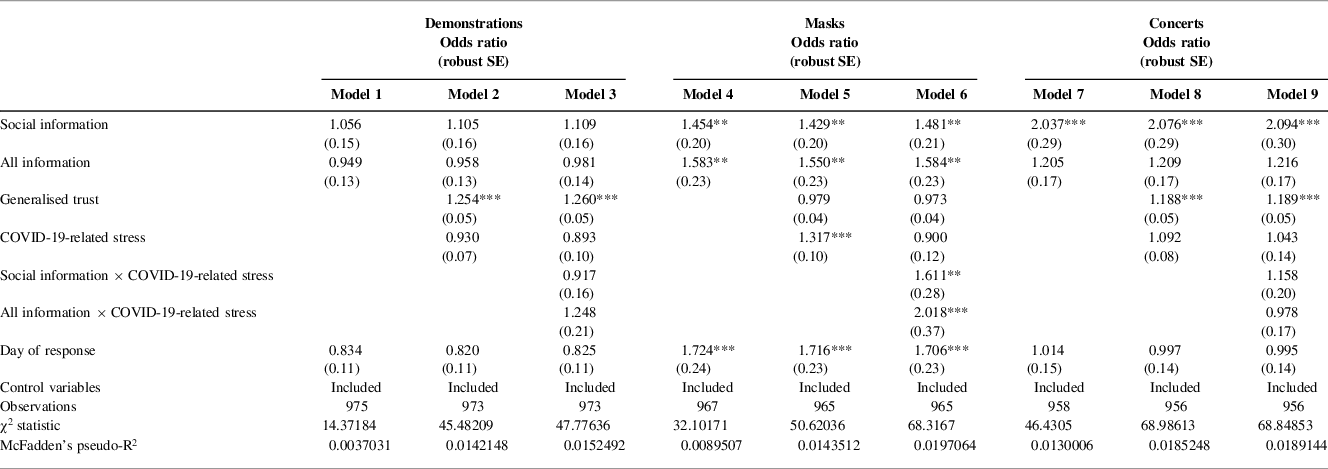
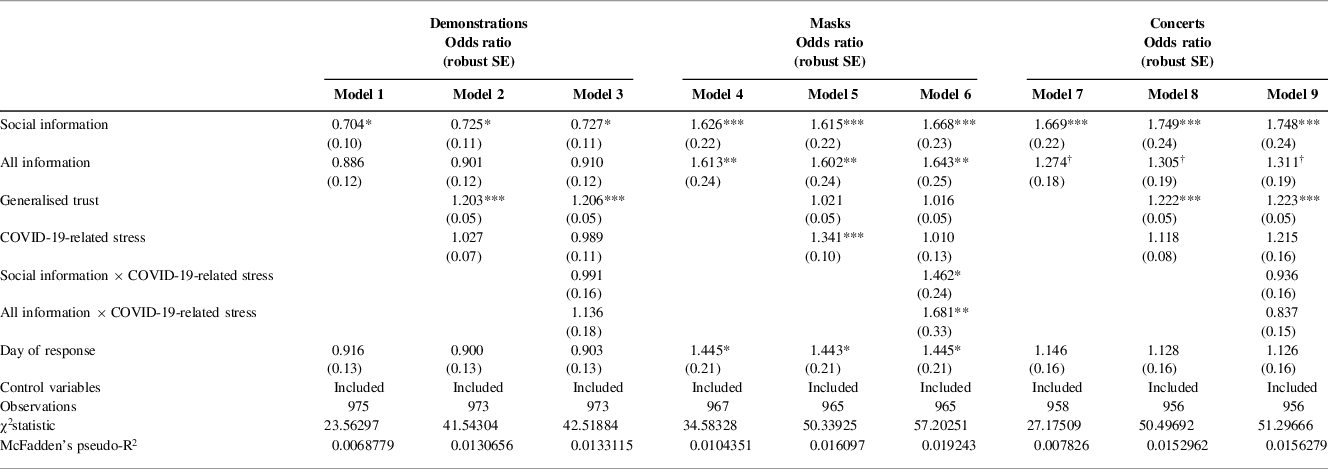
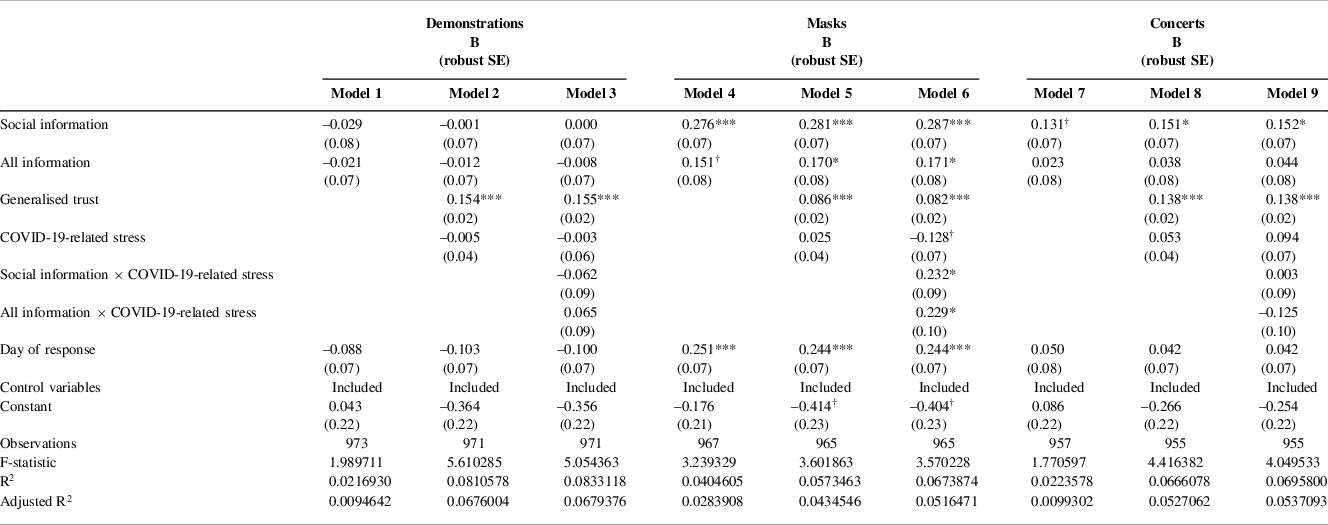
To test whether these findings hold when we take into account participants’ baseline level of generalised trust, COVID-19-related stress and demographic control variables, we next analysed each vignette separately. We conducted ordered logistic regressions on the scalar variables (public support and perceived effectiveness), and we report odds ratios and robust standard errors in Tables 3 and 4.Footnote 58 Because the variable trust in government consists of a continuous variable (the Z-score is computed on the basis of multiple items),Footnote 59 we analysed this model with ordinary least squares regressions (Table 5). Table 3 reports on public support. These results corroborate the results of the fixed-effect analyses, with a main positive effect of adding (for the facemasks measure) or substituting social information (for facemasks and concerts). In addition, we see that generalised trust significantly boosted support for demonstrations (model 2) and concerts (model 8), but not for facemasks. Support for masks, on the other hand, appears to be enhanced by COVID-19-related stress (model 5), and even more so when social information is added or substituted into the descriptive vignette (model 6). This finding is especially relevant to our hypothesis that the general public does not expect the government to rubber-stamp health measures: even during the heat of a crisis that threatens personal well-being, participants in our survey were more likely to endorse a health measure when it took into consideration the needs of others.
Results of regression analyses testing the influence of the advisory council on public response: ordered logistic regressions on public support. Reference category: health experts’ advice.

†p < 0.10, *p < 0.05, **p < 0.01, ***p < 0.001.
Results of regression analyses testing the influence of the advisory council on public response: ordered logistic regressions on perceived effectiveness. Reference category: health experts’ advice.

†p < 0.10, *p < 0.05, **p < 0.01, ***p < 0.001.
Results of regression analyses testing the influence of the advisory council on public response: ordinary least squares regressions on trust in government. Reference category: health experts’ advice.

†p < 0.10, *p < 0.05, **p < 0.01, ***p < 0.001.
Table 4 reports on perceived effectiveness. The pattern for facemasks and concerts is identical to that of public support, including the main and moderating effects of generalised trust and COVID-19-related stress, but with one important difference: substituting expert advice with only social information significantly reduced perceived effectiveness for the demonstrations measure (model 1; note that the odds ratios are less than 1 for the effect of social information as well as for all information, indicating a negative effect). Thus, while our participants supported the demonstration measure regardless of the type of information they received, they tended to perceive the measure to be more effective when it was purely based on expert advice.
Table 5 reports on trust in government. The results corroborate the fixed-effect analysis, showing that substituting expert advice with social information is superior for eliciting trust for the facemasks (model 4) and, to a slightly lesser extent, for the concert measures (model 9). We see again that generalised trust boosted trust in government when confronted with the demonstrations and concerts measures (models 2 and 8), while COVID-19-related stress was more effective at eliciting trust in government with the facemask measure (model 5), especially when the measure was based on social information or all information (model 6).
These results also take into account a number of other control variables whose effects are not reported in Tables 3–5. Some of these effects, however, were significant and are noteworthy. In particular, for the facemasks measure, which was an acutely debated topic during the time in which the survey was conducted, we observe that later responses increased support, effectiveness and trust in government (see the variable “day of response” in Tables 3–5). This is a surprising and interesting result in and of itself, as it suggests that the very announcement of an obligation to wear facemasks in public spaces on 9 July (during the time in which the survey was open) had a significant and sizeable positive effect on citizen’s attitudes towards such an obligation.Footnote 60 Facemasks were furthermore found to be more effective by respondents who indicated an interest in current events (reading the news at least daily; see Table 4, model 4). Finally, women (coded 1 in the regression analysis) perceived the demonstrations measure to be less effective, while household members who have children living with them found it to be more effective.
3. Discussion
The vignette experiment was intended to test the hypothesis that the public expects the government to balance safety against fundamental rights and social needs in the second phase of a crisis and that COVID-19-related measures would therefore receive more endorsement than those based solely on health expert advice. Given the confines of the current population sample, some particular conclusions can be drawn from the dataset.
First, it appears that the three different measures that were presented – limiting participation in demonstrations, restrictions on concert attendance and obligatory facemask protection – elicited substantially different responses. Especially for the demonstrations measure, public support and trust in government were significantly lower than for the other measures, which may possibly reflect that respondents in our sample were less interested in active involvement in demonstrations.
Second, despite the substantial differences between the measures, the data corroborate the importance of providing social information to elicit public support for policy measures (Figure 2a and Table 2, model 1) and to enhance trust in government (Figure 2c and Table 2, models 5 and 3, respectively).
Third, the extent to which people rely on social information to support measures and foster trust in government does not necessarily translate into perceived effectiveness. This suggests that the public accepts that measures should lose some of their effectiveness if necessary to accommodate social needs. We furthermore deduce from Figure 2b and Table 2 (model 4) that social information has a divergent effect on the perceived effectiveness of facemasks and concerts on the one hand and demonstrations on the other. For the latter, effectiveness was perceived to be less when social information was included, which adds to our suspicion that the surveyed sample did not have a personal interest in demonstrations (Figure 2b and Tables 3–5, model 1).
Finally, an unexpected finding is that the combination of both social information and health experts’ advice is no more effective than social information by itself. At first sight, this seems to contradict the dictum that failing to give balanced information about governmental policy would have negative connotations. Then again, it may indicate that the general public implicitly assumes that the measures are backed up by expert advice.
To sum up, in two out of the three vignettes, providing social or balanced information appeared to elicit a more favourable public response than expert advice alone. This supports the hypothesis that the government is not expected to merely rubber-stamp health expert advice, but rather to balance safety against fundamental rights and social needs, the extent of which potentially varying depending on the specific measure, or rather the specific right or interest at stake. Simultaneously, our results also show that deviating substantially from public health advice without providing context regarding the socio-economic reasons for such a deviation may reduce trust, support and perceived effectiveness in the second stage of a pandemic, as was visible in particular in our concerts experiment.
Extending our theoretical argument that courts should take into account public preferences in their evolving review of governmental crisis measures, these results suggest that the second stage of the COVID-19 crisis provided some leeway for courts to strike a more nuanced balance between public health concerns and socio-economic needs. Thus, it appears that the Belgian Council of State had more space for scrutiny then it was prepared to use. These findings have implications for the stages of the COVID-19 crisis in which infections decline considerably, suggesting both a basis and a need for courts to scrutinise the appropriateness of governmental decision-making based on principles that safeguard the socio-economic positions of citizens. These findings are of interest for future macro-level crises as well, suggesting that trust in and support for measures may require a different stance from governments and courts once the dust from the initial crisis response stages settles.
At the same time, these results require further scrutiny through additional research. Our study was limited to three vignette experiments, with the demonstrations experiment showing a different pattern than the two other experiments. We speculate this is likely due to the strong normative aspects concerned with demonstrations during the pandemic. Nevertheless, future research (eg using experiments that incorporate other subject matters, countries and recruitment methods) remains necessary to verify the evidence presented here.
V. Conclusion
The research question for this paper was what room there is for judicial supervision of health crisis measures. The theoretical framework argued that judicial deference is based on legitimacy and expertise concerns. The trust literature and procedural rationality review were invoked to overcome these concerns, arguing for a minimum threshold for judicial supervision. Both strands of scholarship connect where they invoke standards for “fair” or “rational” decision-making. In the interplay between science and politics, the question is what these standards involve exactly.
The normative conclusion is that courts should distinguish between two phases of a crisis. In the initial phase, fear is a significant driver of government support based on expertise, which justifies a deferential stance towards safety measures that drastically limit fundamental rights. Procedural rationality review implies that courts examine whether government measures were based on (medical and virological) expert advice and indulge measures that are stricter than experts recommend if this is motivated by safety concerns. This changes, however, over time. In the next phase, people expect the government to take expert-informed decisions, but at the same time require that the government takes into account societal needs. The Belgian case confirmed that the Council of State indeed shifted the intensity of its scrutiny from one phase to the other. The experimental vignettes confirmed that, for two of the three measures, there is more support if the government is believed to have taken social needs into account.
This means that courts can no longer be satisfied if they establish that crisis measures were based on expert advice. If they shy away from full substantive fundamental rights review, procedural rationality review demands that they at least examine whether the decisions were based on an informed balance of rights and interests, such as by checking whether stakeholders participated in advising expert commissions or were consulted separately. In Belgium, the Council of State took this position in theory, but showed more reluctance to apply it in practice. The results of the vignette study presented in this paper are consistent with the view that the Council of State would have remained within legitimacy bounds were it to have practiced a more intense procedural rationality review.