Anecdotal evidence collected over 2004–2006 indicated high and potential inappropriate use of the wireless capsule for endoscopy (WCE) in Italy since its introduction into the European market (2001).
The WCE is a technique that allows visualization of the entire small bowel to determine the causes of obscure gastrointestinal bleeding (OGIB). The main indication for its use is in OGIB but recently the WCE has been used for the diagnosis of Crohn's disease (CD), celiac disease (COD), and familial polyposis (FP). We included these possible new indications in our literature search, although our analysis focuses on OGIB, because WCE is widely recommended for this syndrome.Footnote 1
Due to its characteristics, visualization of the small bowel is difficult, but seems to be possible using WCE. WCE can be performed in an ambulatory or hospital setting on an outpatient basis. The patient swallows a small capsule containing micro-imaging video technology. While moving through the gastrointestinal tract, images are captured and transmitted to a data recorder worn on a belt outside the patient's body. The capsule is passed in the patient's stools within 24–48 hours. It is not reusable. In the literature, we found WCE compared with many other technologies, both diagnostic and imaging: double balloon enteroscopy (DBE), intraoperative enteroscopy (IE), push enteroscopy (PE), angiography (ANGIO), computer tomography (CT), enteroclysis, magnetic resonance imaging (MRI), small bowel series (SBS), small bowel follow-through (SBFT).
In 2007, the Commission of Biomedical Devices of the Italian Ministry of Health (IMOH) commissioned a health technology assessment (HTA) report on the WCE. The IMOH was interested in the scientific evidence supporting the use of WCE in small bowel disease, and a clearer picture of its use and costs across Italy. Providing decision makers with useful and comprehensive information about a technology suggests widening the concept of evidence to include context specific data on costs, use, and stakeholders' acceptability, in addition to the traditional evidence from clinical studies. Direct survey respondents are actively involved in the HTA production process, by providing data and information. They thus can become vectors of the dissemination of findings, as well as being the main target audience of an HTA report.
Alongside our systematic review, we performed a contextual analysis to define the actual diffusion of WCE in Italy and designed a national survey to collect a set of context-specific data and information from all Italian providers of WCE services.
Our research objectives were to retrieve, assess, and appraise available evidence on diagnostic accuracy, safety, cost-effectiveness of WCE for OGIB, CD, FP, and COD. We also aimed at ascertaining the actual diffusion of WCE in Italy and designed a national survey to collect a set of context-specific data and information from all Italian providers of WCE services.
METHODS
To address our two objectives, we performed a systematic review of the literature and a national survey.
Systematic Review
Material and Methods. We conducted searches of existing HTA documents on the database of the York Centre for Review and Dissemination and the Cochrane Library. We selected reports published in English from January 2001 to July 2007.
We identified three reports from Australia (22), Britain (25), and Belgium (15) for an in-depth analysis of data transferability. We identified the Belgian HTA document as the most up-to-dated (early 2006), and we overlapped the searches to June 2005, to minimize the risk of missing studies. On the basis of our own inclusion criteria, we selected studies dated before 2005 included in the Belgian report.
We conducted searches on the following databases: Embase, PubMed, and Cochrane Library (CL), with the following key words:
EMBASE: #1. ‘capsule endoscopy’/syn OR ‘video *1 capsule’ OR ‘wireless *1 capsule’ AND ([Cochrane review]/lim OR [controlled clinical trial]/lim OR [meta analysis]/lim OR [randomized controlled trial]/lim OR [systematic review]/lim) AND [humans]/lim AND [embase]/lim
PUBMED: #9 Search “Capsule Endoscopy”[Mesh] OR Video capsule * [Title/Abstract] OR “wireless capsule”[Title/Abstract]
Cochrane Library: video next capsule* in All Text; WCE in Title, Abstract or Keywords; “Capsule Endoscopy” in Title, Abstract or Keywords; wireless next capsule * in All Text
We included studies on patients with OGIB, CD, COD, and FAP comparing WCE to different diagnostic techniques (DBE, enteroclysis, IE, PE, ANGIO, CT, MRI, SBFT). Studies with fewer than ten participants and those not carried out on humans were excluded. We extracted data on preconstructed forms and assessed the quality of primary studies using the QUADAS checklist (Reference Whiting, Rutjes, Reitsma, Bossuyt and Kleijnen32) and of systematic reviews using the QUOROM tool (Reference Moher, Cook and Eastwood20).
RESULTS
Primary Studies
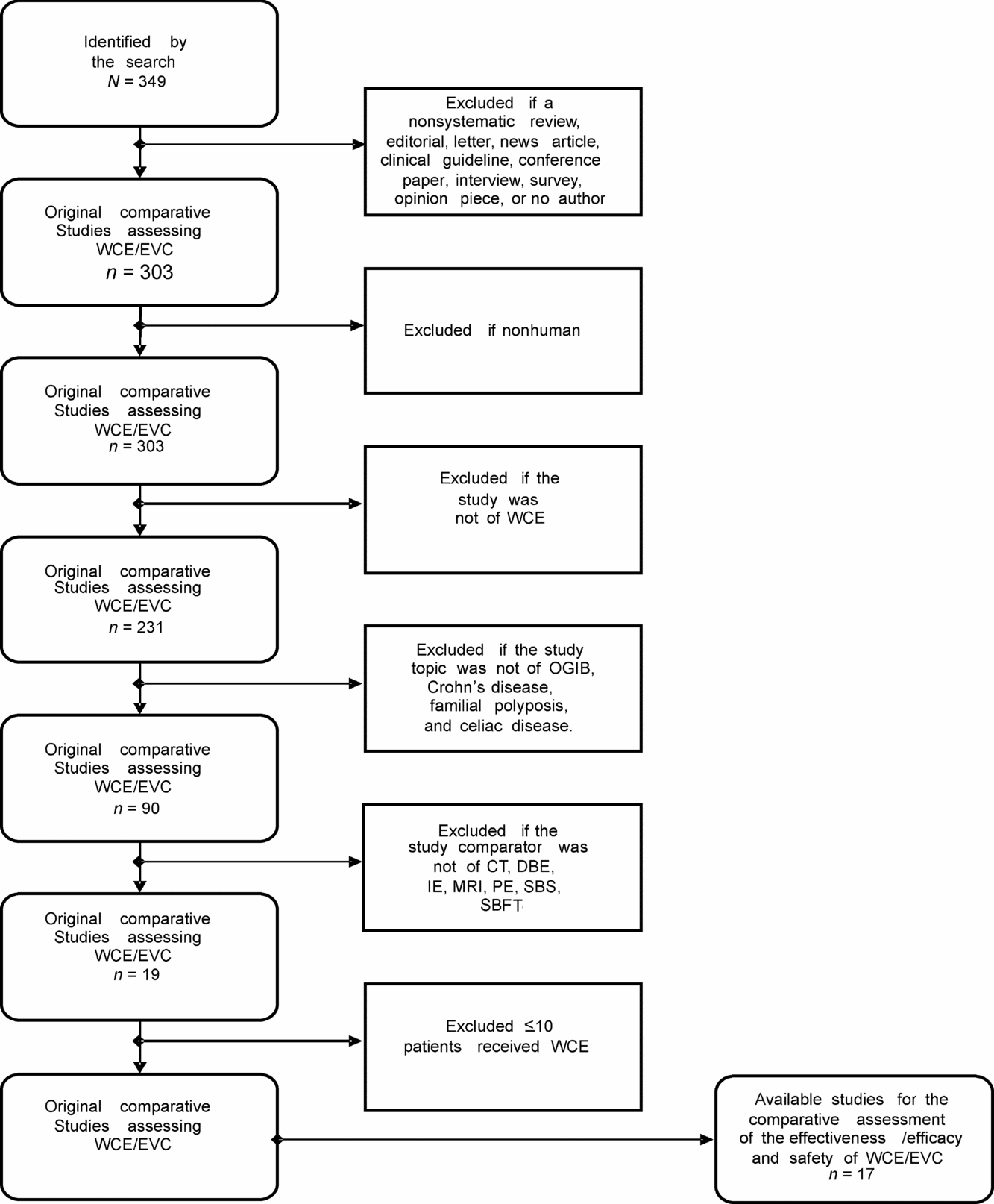
We identified a total of 349 primary studies. The chart in Figure 1 summarizes the flow of studies in the review. Our systematic review ended up by including twenty-seven studies (Reference Adler, Knipschield and Cristopher2–Reference Hartmann, Schmidt and Bolz14;Reference Li, Ge and Dai16–Reference Matsumoto, Esaki and Moriyama19;Reference Mylonaki, Fritscher-Ravens and Swain21;Reference Nakamura, Niwa and Miyahara23;Reference Neu, Ell and May24;Reference Saperas, Dot and Videla26–Reference Voderholzer, Beinhoelzl and Rogalla31;Reference Wong, Tuteja and Haslem33). Seventeen of the twenty-seven selected studies were published after the Belgian report and date from 2005 to 2007.
Flow chart of the systematic review. WCE, wireless capsule for endoscopy; OGIB, obscure gastrointestinal bleeding; FOBT, fecal occult blood test; CT, computed tomography; DBE, double balloon enteroscopy; IE, intraoperative enteroscopy; MRI, magnetic resonance imaging; PE, push enteroscopy; SBS, small bowel series; SBFT, small bowel follow-through.

We divided studies according to the three pathologies being investigated (OGIB, CD, and FP) and then by comparator. No studies on COD fit our selection criteria. We found only one randomized trial by De Leusse et al. (Reference De Leusse, Vahedi and Edery8). Minor shortcomings are related to the generalizability of results due to the low number of patients enrolled. Reasons for patients lost to follow-up are not reported. This trial concludes that WCE is dominant compared with PE in patients with OGIB. At the end of 1 year's follow-up, the strategy based on WCE followed by PE if necessary only, was similar to the alternative path, in which PE was followed by WCE, in terms of diagnostic yields, clinical outcome, therapeutic impact. Nonetheless the authors highlight that the strategy where WCE was provided as first line exploration reduces the percentage of patients needing the alternative and, is better tolerated. They thus concluded that using the WCE first, would be the best option.
Six studies compared WCE with PE for OGIB (Reference Adler, Knipschield and Cristopher2;Reference Mata, Bordas, Feu, Bianco and Cipolletta18;Reference Mylonaki, Fritscher-Ravens and Swain21;Reference Neu, Ell and May24;Reference Saurin, Delvaux and Vahedi27;Reference Whiting, Rutjes, Reitsma, Bossuyt and Kleijnen32). PE does not appear to be a suitable comparator as it cannot visualize the entire small bowel. All people included in the studies had OGIB, and had already undergone upper and lower endoscopic procedures. All patients enrolled served as their own controls, with PE performed within 3–14 days after WCE. The study by Saurin et al. (Reference Saurin, Delvaux and Vahedi27) is a 1-year follow-up study, involving 58 patients already enrolled in a previous prospective study (comparing WCE with PE).
Five studies involving patients with OGIB compared WCE versus DBE (Reference Albert, Martiny and Krummenerl3;Reference Gay, Delvaux and Fassler10;Reference Hadithi, Heine, Jacobs, van Bodegraven and Mulder12;Reference Matsumoto, Esaki and Moriyama19;Reference Nakamura, Niwa and Miyahara23). DBE is probably a fairer comparator than PE, as the use of two balloons should allow the exploration of the entire small bowel as indicated by 67 percent (n = 82) of respondents to a survey among Italian gastroenterologists participating at a conference in 2007.
Seven studies were carried out in people with CD (Reference Albert, Martiny and Krummenerl3;Reference Buchman, Miller and Wallin4;Reference Chong, Taylor and Miller6;Reference Eliakim, Suissa, Yassin, Katz and Fischer9–Reference Gölder, Schreyer and Endlicher11;Reference Voderholzer, Beinhoelzl and Rogalla31) comparing WCE to different imaging diagnostic procedures: SBFT (two studies), CT (one), MRI (two). Gay et al. (Reference Gay, Delvaux and Fassler10) (14 of 160 enrolled patients had CD) compared WCE to both endoscopic and imaging procedures (PE and enteroclysis). Three prospective studies assessed the performance of WCE in FAP (Reference Caspari, Falkenhausen and Krautmacher5;Reference Schulmann, Hollerbach and Kraus28;Reference Wong, Tuteja and Haslem33). Comparators were PE (two studies) and MRI.
All studies, except the one by Matsumoto et al., seem to reach similar conclusions, indicating WCE as the first option in OGIB cases and DBE as the last option given its therapeutic ability and histopathology capacity. Five OGIB studies compared different diagnostic techniques. One of the studies used IE as a comparator, while the other comparisons are all imaging technologies, such as SBFT, CT, magnetic resonance elastography, ANGIO.
Systematic Reviews and Meta-Analyses
We found two poor quality systematic reviews (Reference Marmo, Rotondano and Piscopo17;Reference Triester, Leighton and Leontiadis29) that did not inform our findings, because they synthesized the evidence from studies with design problems without carrying out methodological assessment and, in one case, even pooled the data into a formal meta-analysis.
CONCLUSIONS
The evidence stratified by disease and comparator, is very scattered. In addition most of studies do not compare WCE with a fair comparator which, according to a surveyed group of eighty-seven Italian experts would be DBE.
We could identify only one randomized trial of the twenty-seven assessed studies. Twenty-four primary studies, irrespective of indication and/or comparator, were found to have a study design described by authors as “prospective” or “blinded and prospective” when physicians performing the alternative are blinded to the data from the WCE. In this design, a small number of consecutive patients are enrolled and serve as their own controls. Usually participants undergo both WCE and then the comparator diagnostic intervention (or vice versa) after a variable time: in seven studies the time range was not reported, in six, it went from 1 to 6 days, and in nine, from 7 to 14 days. In two studies, the time range between one procedure and the other was more than 15 days. This sequential design has two major potential linked biases. One is due to the absence of randomization and the other is related to the time range between one intervention and the next. The most frequent recognized cause of OGIB is angiodysplasia (see Figure 3). There is uncertainty about the speed of the morphological changes of angiodyplasia lesions. According to the 62 percent (n = 66) of Italian gastroenterologists participating at a meeting in 2008 these kind of lesions tend to change rapidly and in general there is considerable uncertainty on this point. This suggests that the results of the studies may not be reliable due to the time interval between one procedure and the other. In essence most studies compared what probably is not comparable and few considered current uncertainty as rationale for conducting a clinical trial. The only reliable way to compare diagnostic performance of a technology to identify rapidly changing lesions, is to give a sufficient number of participants the same chance of being assigned to either the index or the reference test. To gather a better understanding of the reasons for these shortcomings in the study design, we sent emails to first or corresponding authors. We asked them to clarify the rationale for their choice of study design and comparator. We received seven answers indicating that the possibility of running a clinical trial was never even considered and comparator interventions were chosen on the basis of current availability.
COLLECTING CONTEXT-SPECIFIC DATA
Material and Methods
The collection of context specific data was important to gain a complete picture of the diffusion and use of the WCE, its costs and appropriateness of use in Italy. The WCE was introduced in Italy with no governance at a regional or national level in 2001 and according to experts it was being used in many centers.
The survey was mainly aimed at collecting data on the actual diffusion of WCE in the year 2006, its direct costs, and appropriateness of use. We identified all Italian centers that could potentially provide WCE diagnostics, and obtained a comprehensive population denominator for the survey. Due to the lack of a central register of gastroenterology departments, we merged three different databases and sources of information. Our final denominator was 116 centers. This inclusive list was drawn from three sources: Ministry of Health Database (gastroenterology and endoscopy centers), a network of product champions, and data from the (then) sole Italian WCE distributor. A structured questionnaire was sent by post to the 116 physicians identified as responsible of the various endoscopic and gastroenterology centers. The collection of data lasted from December 2007 to April 2008. Fifty-six centers responded (48 percent of the total). The questionnaire gathered information on three topic areas: characteristics of the center, clinical information about patients undergoing WCE, costs of WCE procedure in terms of human resources, device, equipment, and consumption material.
Main Results and Conclusions
Characteristics of Responding Centers. Fifty-one of the fifty-six responding centers were publicly funded, four were private accredited providers with a contractual agreement with the Italian NHS (7 percent) and one was a private center. Accredited centers can provide services on behalf of the public health service, and are reimbursed. Completely private centers provide services that are paid directly by patients or private insurance. The majority of responding centers (n = 32; 57 percent) were located in Northern Italy, eight were from Central Italy (14 percent), whereas sixteen (29 percent) were from Southern and insular Italy.
The data provided by the sole distributor show that the highest number of WCE sold per 100,000 inhabitants was in the Liguria (northern) and Marche (central) regions of Italy, where thirteen capsules every 100,000 inhabitants were used. More than ten and eleven capsules per 100,000 inhabitants were used in Emilia Romagna and Piemonte (northern Italy). The Region with the smallest number of WCE per 100,000 population was Calabria (southern Italy) (1/100,000 inhabitants). In some cases, the total number of WCE purchased in 2006 was higher than the total of WCE examinations performed in the same year.
Clinical Information. The fifty-six responding centers performed a total number of 2,457 WCE procedures (63 percent of the total number of WCEs sold by the Italian distributor in 2006). A WCE procedure can be performed on inpatients, outpatients, or in a day hospital basis. Of 2,457 WCE procedures performed in Italy, 43 percent involved admission to hospital (length of stay >1 day), whereas 31 percent were performed in ambulatory care and 26 percent in day hospital.
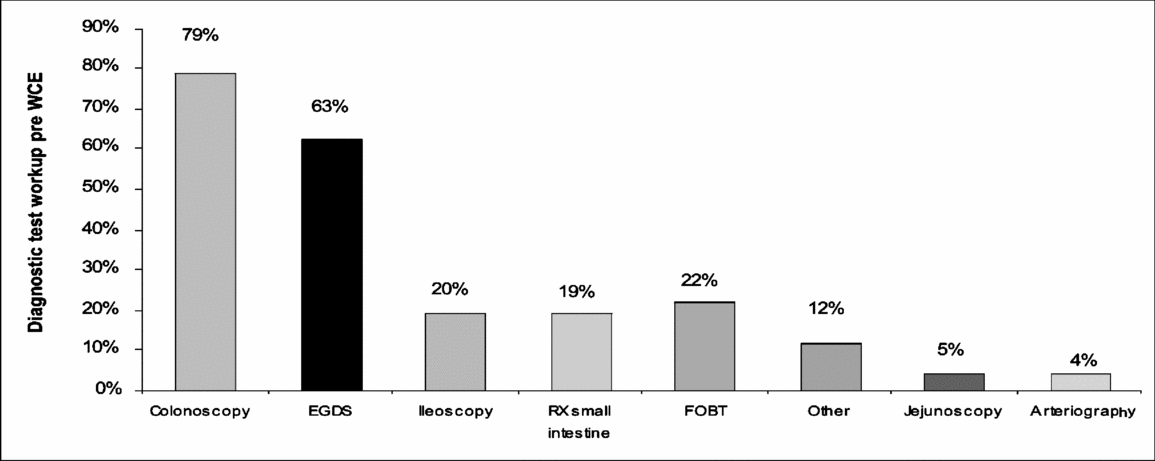
Patient's diagnostic work-up was reported by 93 percent of centers (52/56). The main exams performed before WCE were: colonoscopy (performed on 79 percent of patients), esophagogastroduodenoscopy (EGDS, 63 percent), fecal occult blood test (FOBT, 22 percent), ileoscopy (20 percent), RX of small intestine (19 percent), and other (5 percent) abdominal CT, abdominal MRI, scintigraphy, positron emission tomography, and so on), junoscopy (5 percent), and arteriography (4 percent). Patients underwent an average of 2 diagnostic examinations before the WCE diagnostic procedure (Figure 2).
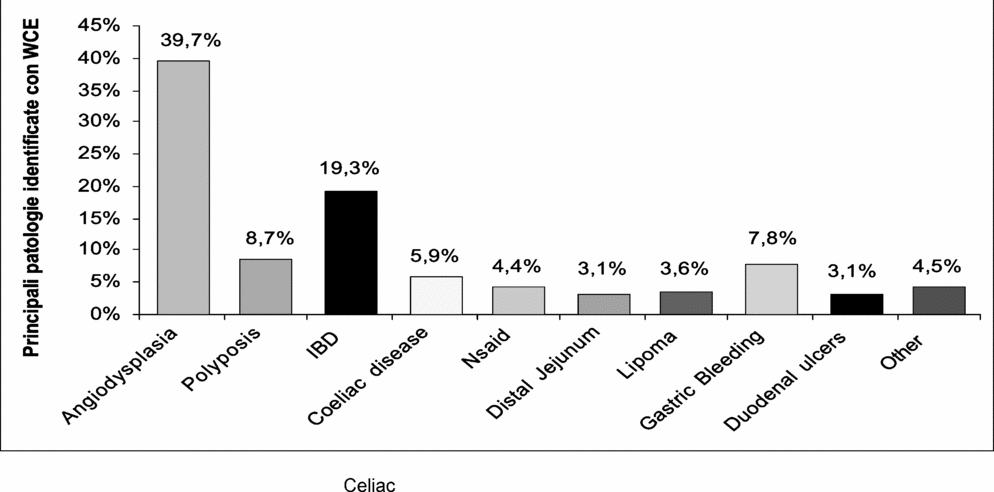
Diagnostic test work-up pre-WCE in Italy (2006). Angiodysplasia was the mostly frequently detected pathology by WCE, followed by IBD and polyposis (see Figure 3). WCE, wireless capsule for endoscopy; EGDS, esophagogastroduedenoscopy; FOBT, fecal occult blood test; IBD, inflammatory bowel disease.

Main pathologies identified by WCE in Italy (2006). WCE, wireless capsule for endoscopy; IBD, inflammatory bowel disease; Nsaid, nonsteroidal anti-inflammatory drugs.

The WCE procedure caused serious harm in 1 percent of cases (seventeen patients): nine patients retained the capsule, six had an intestinal occlusion, and two a delayed clearance and subocclusion. In 375 patients (15 percent), the WCE procedure failed for various reasons.
Costs Related to the Use of the WCE and Budget Analysis. Responding centers were asked to indicate the average time in minutes, spent by physicians, nurses, support operators, and administrative officers. Procedures were divided into three phases, and we asked how much time each professional figure spent in each phase. Fifty-three centers (94.5 percent) returned data on average time spent on a standard WCE procedure. For the assessment of the elements of cost, we used the method of standard costing. The costs attributed to the various resource items used in WCE diagnostics were calculated as an average of the declared values by centers or, when incomplete, were calculated from market prices.
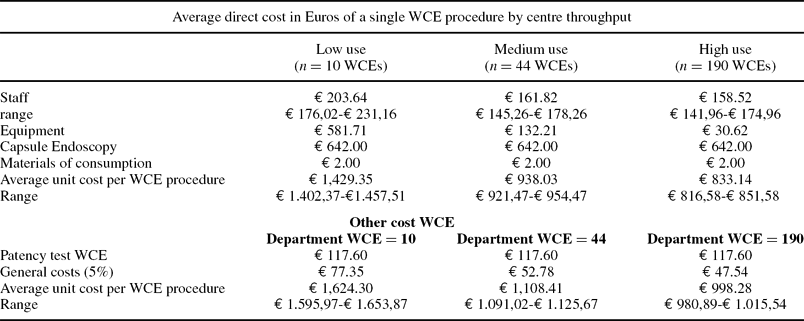
The overall average cost of a single WCE examination is sensitive to the volume of annual examinations carried out by each center. Three different budget impacts were estimated according to the volume of annual examinations carried out in the centers with a high, medium, and low throughput: 1,044 and 190 annual WCE examinations (Table 1).
Average Direct Cost (in 2006 Euros) of a Single WCE Procedure by Center Throughput

WCE, wireless capsule for endoscopy.
In the first case (centers with ten annual WCE examinations), the estimate of economic impact caused by a single WCE examination is €1,624.30, in the second case (44 annual WCE examinations) €1.108,41 and in the third case (190 annual WCE examinations) €998,28. Our analysis included also the costs of WCE Patency test (a dummy capsule to ascertain gut viability), which was used in fourteen centers of the fifty-six respondents. The number of annual examinations undertaken influences the unit costs: the higher the number of annual WCE examinations, the lower the unit cost of the procedure.
CONCLUSIONS
Our enquiries on the use of the WCE in the Italian context paint a varied picture with peaks and troughs of use, probably unrelated to clinical need and some unfair indications for its use. For example, a biopsy is necessary in all cases to make a definitive diagnosis of celiac disease and its ethical use, in situations of high likelihood of intestinal stenosis such as Crohn's disease, is debatable, although we identified a scattered use of a dummy wireless capsule. The WCE in Italy is an expensive procedure, but we cannot say whether it is cost-effective if compared with the alternatives available in 2006 or likely to be cost-effective compared with the current alternatives, as we lack clear evidence to guide indications and unbiased evidence of its comparative performance. Our evidence shows that centers in which the highest numbers of procedures are carried out have the lowest costs. This, however, should not be interpreted as a reason to increase WCE use in the absence of more reliable evidence on diagnostic accuracy.
POLICY IMPLICATIONS
Given the present and future development of the technology a reasonable way forward may be to link reimbursement of the WCE to its use in adequately designed and powered randomized controlled trials, with a potential crossover design similar to that of the trial by De Leusse et al. (Reference De Leusse, Vahedi and Edery8). This is due to the high uncertainty about the morphological change speed of the angiodysplastic lesions. The trial should test the performance of the WCE for present and future indications under the supervision of scientific and ethical committees. We further recommend that this process (coverage with evidence generation), widely adopted abroad, should be adopted in Italy for all promising new technologies.
HTA report writers should consider including a collection of context-specific data, above all in cases of evaluation of existing technologies, because the dimensions to be assessed to provide decision makers with useful information are not only clinical effectiveness or safety. Data on costs, economic, and organizational aspects are missing from traditional medical literature, or too context-specific to be transferred from country to country. This in turn showed great variability of use, indications, and a higher than expected rate of potential harms. Once we had an idea of the situation, our recommendation of continued use only within the regulated context of a randomized controlled satisfied both the requirements of current and ethical use with a scientifically meaningful assessment of the performance of WCE.
CONTACT INFORMATION
Alessandra Lo Scalzo, MPhil, MSc (loscalzo@agenas.it), Researcher, Innovation and Development Department—HTA Unit, Marco Ratti, MSc (ratti@agenas.it), Researcher, Health Economist, Innovation and Development Department—HTA Unit, Tom Jefferson, MD (jefferson@agenas.it), Coordinator, Researcher, Innovation and Development Department—HTA Unit, Fabio Bernardini (bernardini@agenas.it), Librarian, Documentation, Information and Comunication, National Agency for Regional Health Care, Marina Cerbo (cerbo@agenas.it), Chief, Innovation and Development Department—HTA Unit, Agenzia Nazionale per I Servizi Sanitari Regionali–Agenas, Via Puglie 23, Rome, 00187, Italy