Introduction
There has been considerable debate about the significance of the ‘gateway effect’. This describes a progression into polydrug use beginning with tobacco and alcohol use, moving on to cannabis and then ‘harder’ illicit drugs (Kandel & Faust, Reference Kandel and Faust1975; Kandel, Reference Kandel1984; Kandel et al. Reference Kandel, Davies, Karus and Yamaguchi1986, Reference Kandel, Yamaguchi and Chen1992). Debates have typically centred on whether the predictive association between cannabis and other illicit drug use is causal or reflects confounding factors (Kandel & Faust, Reference Kandel and Faust1975; Kandel, Reference Kandel1984; Morral et al. Reference Morral, McCaffrey and Paddock2002; Hall & Lynskey, Reference Hall and Lynskey2005; Fergusson et al. Reference Fergusson, Boden and Horwood2006; Kandel & Yamaguchi, Reference Kandel and Yamaguchi2006; MacCoun, Reference MacCoun2006).
Irrespective of the mechanisms behind the association, the gateway pattern describes the typical sequence of progression to greater polydrug use. Obviously, several factors affect such a sequence, including drug availability and background prevalence. Some illicit drug use is significantly more common among more recent birth cohorts and the available drugs have changed. It is perhaps not surprising, then, that the concept of gateway drugs has been applied to ecstasy (Reid et al. Reference Reid, Elifson and Sterk2007) and oxycodone (Grau et al. Reference Grau, Dasgupta, Harvey, Irwin, Givens, Kinzly and Heimer2007) in the USA, and that a ‘reverse gateway’ has been described for cannabis in Australia (where cannabis use has been linked to increased risk of subsequent initiation to tobacco use and dependence) (Patton et al. Reference Patton, Coffey, Carlin, Sawyer and Lynskey2005).
There have been investigations of the extent and significance of violations of normative patterns. Studies in the USA of problematic drug users (Golub & Johnson, Reference Golub and Johnson1994a, Reference Golub and Johnsonb, Reference Golub and Johnson2002; Mackesy-Amiti et al. Reference Mackesy-Amiti, Fendrich and Goldstein1997) and homeless youths (Ginzler et al. Reference Ginzler, Cochran, Domenech-Rodriguez, Cauce and Whitbeck2003) have found that significant proportions had not progressed through the typical pattern of progression, with many beginning cannabis use before they had first used alcohol, and some starting other illicit drug use before using alcohol or cannabis. In those studies, individuals with ‘atypical’ patterns of progression were found to come from more disadvantaged backgrounds (Mackesy-Amiti et al. Reference Mackesy-Amiti, Fendrich and Goldstein1997), be from different birth cohorts (Golub & Johnson, Reference Golub and Johnson1994a, Reference Golub and Johnsonb; Mackesy-Amiti et al. Reference Mackesy-Amiti, Fendrich and Goldstein1997), and be heavier polydrug users (Mackesy-Amiti et al. Reference Mackesy-Amiti, Fendrich and Goldstein1997; Ginzler et al. Reference Ginzler, Cochran, Domenech-Rodriguez, Cauce and Whitbeck2003) than users who followed the normative progression.
This suggests that violations of normative patterns of progression may be important markers of subsequent risk of progression. The above studies provided interesting data, yet were in most cases limited to unrepresentative samples of heavy drug users; typically presented limited bivariate associations with other characteristics; did not adjust for pre-morbid mental health or demographic factors that might have been related to progression; and did not consider the impact of such atypical progressions for the later development of dependence. In this paper, we consider all of these possibilities using data from a representative sample of the US adult population, from the National Comorbidity Survey Replication (NCS-R).
Method
Participants and study procedures
As described in detail elsewhere (Kessler & Merikangas, Reference Kessler and Merikangas2004), the NCS-R is a nationally representative household survey of English speakers aged ⩾18 years in the contiguous USA. Respondents were selected from a multistage clustered area probability sample of households and face-to-face interviews carried out from February 2001 to April 2003 by professional interviewers from the Institute for Social Research at the University of Michigan (U-M). The response rate was 71%. The survey was administered in two parts. Part 1 included a core diagnostic assessment (n=9282). Part 2 included assessed risk factors, consequences, correlates, and assessments of additional disorders that were administered to all Part 1 respondents who met lifetime criteria for any disorder plus a probability subsample of other respondents (n=5692). Interviewers explained the study and obtained verbal informed consent prior to beginning the survey. Recruitment, consent and field procedures were approved by the Human Subjects Committees of Harvard Medical School and U-M.
Diagnostic assessment
Drug use modules
Drug use modules in the Part II sample were administered following a positive response to screening questions inquiring whether the respondent had ever used (1) tobacco (cigarettes, cigar or pipe); (2) alcohol; (3) cannabis, hashish; (4) cocaine; (5) tranquillizers, stimulants, painkillers or other prescription drugs; or (6) any other illicit drug including heroin, opium, glue, LSD or peyote. Detailed analyses of drug use and associations with demographic variables from this dataset have been reported previously (Degenhardt et al. Reference Degenhardt, Chu, Sampson, Kessler and Anthony2007c).
Assessments of DSM-IV mental and substance use disorders were based on responses to the World Health Organization (WHO) Composite International Diagnostic Interview (CIDI; Kessler & Ustun, Reference Kessler and Ustun2004), a fully structured lay-administered diagnostic interview used to generate DSM-IV diagnoses.
Drug use disorders
Any positive responses to drug use were followed with a detailed assessment of lifetime use of that drug, including age of onset of use, progression, and symptoms of abuse and dependence. Assessment of dependence was conducted separately for tobacco and alcohol. For other drugs, assessment of dependence was carried out with participants responding to dependence symptoms attributed to any of the drugs they reported having used. This is consistent with the DSM category for ‘dependence not otherwise specified’, whereby a person may meet criterion A1 for cannabis, A2 for cocaine and A3–4 for yet another drug, but does not meet full criteria for dependence on any single drug; they would nonetheless be classified as meeting criteria for ‘drug dependence’. Included here are people who meet full criteria for dependence, and where the symptoms are associated with the use of either one particular drug or multiple drugs.
This method of assessment of drug dependence was the same as that used in the Epidemiological Catchment Area (ECA) study and the National Comorbidity Survey (NCS). Good concordance has been reported in an NCS-R clinical reappraisal subsample between diagnoses of substance use disorders based on the CIDI and diagnoses based on blinded clinical reappraisal interviews (Kessler et al. Reference Kessler, Abelson, Demler, Escobar, Gibbon, Guyer, Howes, Jin, Vega, Walters, Wang, Zaslavsky and Zheng2004a) using the Structured Clinical Interview for DSM-IV (SCID; First et al. Reference First, Spitzer, Gibbon and Williams1996).
DSM-IV internalizing disorders
These included specific phobia, social phobia, panic disorder, agoraphobia with panic disorder, generalized anxiety disorder with hierarchy, post-traumatic stress disorder, and major depressive disorder with hierarchy or dysthymia with hierarchy. They were aggregated into a summary variable reflecting the number of internalizing disorders that were reported to have occurred as of the age of 15 (range 0–7).
DSM-IV externalizing disorders
These included bipolar disorder, oppositional-defiant disorder with hierarchy, conduct disorder, attention deficit hyperactivity disorder, and intermittent explosive disorder with hierarchy. They were aggregated to reflect the number that had occurred as of the age of 15 (range 0–5). Assessment of the disorders requiring childhood onset of symptoms (separation anxiety disorder, oppositional-defiant disorder, conduct disorder, attention deficit hyperactivity disorder) was limited to those under 45 years at the time of interview to reduce recall bias.
Order of onset and violations of the ‘typical’ gateway progression
Different onset orders, as determined by retrospective age-of-onset reports, were evaluated separately. The violations were:
(1) the use of cannabis prior to both alcohol and tobacco use;
(2) other illicit drug use prior to both alcohol and tobacco use;
(3) other illicit drug use prior to cannabis use.
Initiation of cannabis and/or other illicit drug use (a) prior to alcohol use (but not tobacco) and (b) prior to tobacco use (but not alcohol) was considered. These were post hoc and, given they are not ‘true’ violations of the gateway sequence, were not considered in further analyses.
Statistical analyses
Weights were used to adjust for variation in Part II probabilities described earlier, as well as within-household probability of selection, non-response, and differences between the sample and the 2000 Census on sociodemographic variables. Further detail has been provided in previous work (Kessler et al. Reference Kessler, Berglund, Chiu, Demler, Heeringa, Hiripi, Jin, Pennell, Walters, Zaslavsky and Zheng2004b).
Cumulative incidence proportions of gateway violations were estimated, with standard errors derived using the Taylor series linearization (TSL) methods implemented in SUDAAN version 9 (SAS Institute, Cary, NC, USA) to adjust for the effects of weighting and clustering on the precision of estimates. Regression coefficients were estimated and then exponentiated for interpretation as odds ratios (ORs). When p values are reported or indicated (by an asterisk), they are from Wald tests obtained from TSL design-based coefficient variance–covariance matrices (α=0.05, two-tailed).
Regression analysis was carried out to examine the association with age, sex and early-onset mental disorders with gateway ‘violations’ among users of each drug type. Predictors of gateway violations among users of each drug were examined using multivariable logistic regression models.
Discrete-time survival models among users of a drug examined predictors of dependence onset. Predictors included sex, age cohort (defined by age at interview: 18–29, 30–44, 45–59, ⩾60 years), number of externalizing and internalizing disorders by age 15, age of onset of use of the drug concerned, years since first onset of use (a time-varying covariate), a variable indicating whether there was a gateway violation (three dummy variables defined as outlined above), tobacco use (a time-varying covariate), alcohol use (a time-varying covariate), and the number of other drugs used (a time-varying covariate). The resulting ORs represent the estimates of risk of first-onset dependence in a given year.
Results
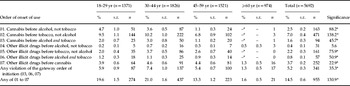
Overall, 5.2% of participants initiated substance use in an order that violated the gateway sequence (Table 1). The most common violation was initiation of other illicit drugs before cannabis (3.7%), followed by cannabis use before alcohol and tobacco use (1.6%). Prevalence differed significantly across birth cohorts. Respondents in the ⩾60 years group were extremely unlikely to report illicit drug use before alcohol and tobacco, whereas the three younger age groups were more likely to do so.
Distribution of each violation of the gateway pattern of drug use initiation by age cohort. Data from the National Comorbidity Survey Replication (NCS-R), 2001–2003

s.e., Standard error.
a A statistically reliable estimate could not be made.
* Significant at 0.01 level, two-tailed test.
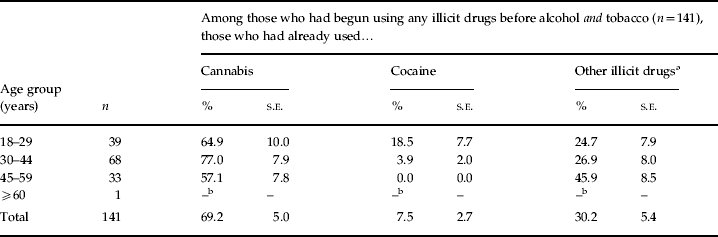
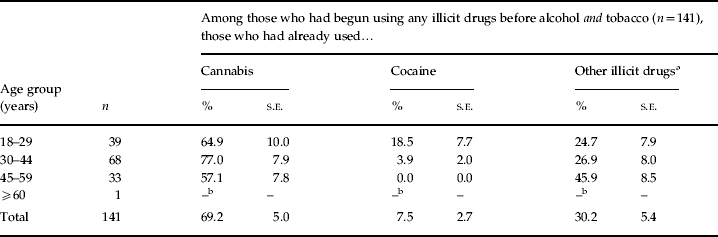
Table 2 specifies the types of illicit drugs used before alcohol and tobacco among those who violated the gateway sequence. Cannabis was the most common drug initiated before that time (69.2% of the group). Cocaine was more commonly initiated prior to alcohol and tobacco for the 18–29 years age group (18.7%) compared to older groups.
Drugs used among those who had used any illicit drugs prior to alcohol and tobacco, by age. Data from the National Comorbidity Survey Replication (NCS-R), 2001–2003
s.e., Standard error.
a Includes sedatives/stimulants/analgesics and any other drugs.
b A statistically reliable estimate could not be made.
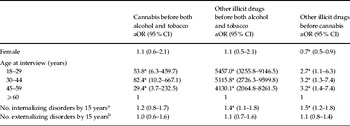
Table 3 presents the results of regressions examining predictors of gateway violations. Sex was not related to the initiation of illicit drug use prior to both alcohol and tobacco, but was related to initiation of other illicit drugs prior to cannabis, with females less likely than males to have done so. Age was strongly related to violations of all three kinds, with younger age groups significantly more likely than the oldest age group to have initiated substance use out of the gateway sequence.
Multivariable predictors of violation of the gateway sequence of drug use initiation. Data from the National Comorbidity Survey Replication (NCS-R), 2001–2003

aOR, Adjusted odds ratio; CI, confidence interval.
Results based upon multivariable logistic regression models.
‘Other illicit drugs’ include cocaine, opioids, analgesics, sedatives, and ‘other drugs’.
a DSM-IV internalizing disorders included: panic disorder, agoraphobia without panic disorder, social phobia, specific phobia, generalized anxiety disorder with hierarchy, post-traumatic stress disorder, and major depressive disorder with hierarchy/dysthymia with hierarchy.
b DSM-IV externalizing disorders included: bipolar disorder, oppositional-defiant disorder with hierarchy, conduct disorder, attention deficit hyperactivity disorder and intermittent explosive disorder with hierarchy.
* OR significant at 0.05 level, two-tailed test. χ2 statistics are available upon request.
Mental disorders by age 15 years were unrelated to the precocious initiation of cannabis use (i.e. before alcohol and tobacco use). Internalizing disorders were related to precocious initiation of other illicits (defined as cocaine, sedatives/stimulants/analgesics or other drugs including heroin). With each additional internalizing disorder, the likelihood of initiating such drug use before alcohol and tobacco increased by 40% on average [OR 1.4, 95% confidence interval (CI) 1.1–1.8], and of initiating such drug use before cannabis use by 50% on average (OR 1.5, 95% CI 1.2–1.8). Externalizing disorders by 15 years were unrelated to initiation order.
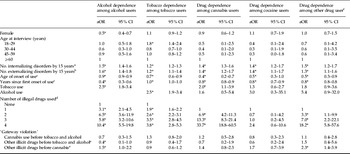
Table 4 shows the results of multivariable survival analyses examining the risk of incident dependence among users of each drug. When other factors were controlled, gateway violations were unrelated to the risk of developing nicotine dependence, or drug dependence among cannabis and cocaine users. Initiation of any other illicit drugs (cocaine, sedatives/stimulants/analgesics or other drugs) before cannabis use was significantly related to the risk of incident alcohol dependence among alcohol users (OR 1.5, 95% CI 1.0–2.2), and drug dependence among sedative/stimulant/analgesic/other drug users (OR 2.3, 95% CI 1.4–3.9).
Multivariable predictors of onset of dependence by drug type. Data from the National Comorbidity Survey Replication (NCS-R), 2001–2003

aOR, Adjusted odds ratio; CI, confidence interval.
Results based upon multivariable discrete time survival models.
‘Onset of dependence’ refers to onset of the full dependence syndrome.
a DSM-IV internalizing disorders included: panic disorder, agoraphobia without panic disorder, social phobia, specific phobia, generalized anxiety disorder with hierarchy, post-traumatic stress disorder, and major depressive disorder with hierarchy/dysthymia with hierarchy.
b DSM-IV externalizing disorders included: bipolar disorder, oppositional-defiant disorder with hierarchy, conduct disorder, attention deficit hyperactivity disorder and intermittent explosive disorder with hierarchy.
c Age of onset, or years since onset, of the drug use concerned.
d This is a time-varying covariate and refers to the number of illicit drugs (grouped as cannabis, cocaine, sedatives/stimulants/analgesics, or ‘other’) the person had used by a given year.
e Other illicit drugs includes any of cocaine, sedatives/stimulants/analgesics, or ‘other’.
f ‘Other drugs’ includes sedatives/stimulants/analgesics and ‘other’.
* OR significant at 0.05 level, two-tailed test. χ2 statistics are available upon request.
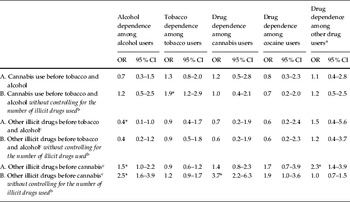
Consistently significant predictors of transitioning to dependent use in a given year were: earlier age of onset of use, recency since onset of use, and the extent of illicit drug use to date. Further analyses were conducted to evaluate the possibility that precocious initiation into illicit drug use might also reflect greater polydrug use, such that gateway violations were related to the number of drug types used. Additional analyses were conducted without controlling for the number of illicit drugs used by that age (see Appendix). In almost all cases, there was no difference in the significance of the observed associations. Two notable exceptions were the risk of incident nicotine dependence among tobacco users, where initiation of cannabis use prior to tobacco/alcohol use predicted incident nicotine dependence, and dependence among cannabis users, where initiation of other illicit drugs prior to cannabis predicted incident dependence. In both cases, inclusion of the number of illicit drugs used made this association non-significant, suggesting that violation of the gateway order of onset in these cases was related to a higher likelihood of using a greater number of illicit drugs, and also related to incident dependence.
Finally, a greater degree of psychiatric co-morbidity by 15 years was associated with risk of incident dependence. The odds of users transitioning to dependent use increased by 20% (nicotine) to 50% (alcohol, other drugs) with each additional internalizing disorder by 15 years; and similarly with each additional externalizing disorder (20% for nicotine to 60% for alcohol). As noted in Table 3, pre-existing internalizing disorders were also significant predictors of gateway violations, meaning that failure to control for these disorders would allow a spuriously positive association between gateway violations and subsequent dependence.
Discussion
This study examined the order of onset of drug use, and considered the possible association between deviations from the normative (gateway) pattern of drug progression with subsequent onset of substance dependence in a representative sample of US adults. Three violations were examined: (a) cannabis use before alcohol and tobacco; (b) other illicit drug use before alcohol and tobacco, and (c) other illicit drug use before cannabis. Importantly, using a person-years framework, this study was able to consider the risk of first developing dependent use across each year of life for the participants in this study. In doing so, we could also control at each year for the age of onset of that drug use; time since initiation of such use; the participant's lifetime-to-date use of other drugs; and co-morbid mental health problems developed by early adolescence. This approach to the analysis of gateway patterns and their predictive associations with subsequent dependent use represents a significant advance, as previous studies of this issue have concentrated on unrepresentative samples of problematic drug users, with insufficient capacity to conduct detailed investigations of risk for problems while controlling for the important confounding variables considered here.
Deviations from the gateway order of onset were found to occur only for a minority of persons (5.2%). The most common violation was other illicit drug use before cannabis (3.7%), and the least common was other illicit drugs before both alcohol and tobacco use (0.8%). There were some strong cohort differences in the likelihood of these violations: they were less common among the oldest age group than the younger ones. These findings are consistent with historical trends in drug use; cannabis use is much more common in more recent birth cohorts (Degenhardt et al. Reference Degenhardt, Lynskey and Hall2000; Johnston et al. Reference Johnston, O'Malley and Bachman2003), so it is not surprising that cannabis is also more likely to occur earlier in the sequence of drug use for some younger people.
Previous studies have found that, among disadvantaged samples of drug users, many of whom had co-morbid mental health problems, violations of the gateway order of initiation involving precocious initiation into illicit drug use (such as cocaine use very early on in their drug use career) were common (Golub & Johnson, Reference Golub and Johnson1994a, Reference Golub and Johnsonb, Reference Golub and Johnson2002; Mackesy-Amiti et al. Reference Mackesy-Amiti, Fendrich and Goldstein1997). The current study demonstrated that one significant predictor of such deviations was the early development of internalizing mental disorders such as depression, post-traumatic stress disorder, social phobia or generalized anxiety disorder. This suggests that pre-morbid mental health problems are related to precocious initiation of illicit drug use.
This same deviation, the use of other illicit drugs (cocaine, sedatives, stimulants, opioids or other drugs) before cannabis use, was the only one significantly associated with the risk of subsequently developing dependent use. Among cocaine and other illicit drug users, risk for dependent use was elevated among those who had initiated use of these drugs before cannabis use and was significant after controlling for important potential mediators of dependence risk and common causes of the violation and dependence. This finding is consistent with the finding in studies of persons who have developed serious illicit drug use problems that high rates of atypical patterns of progression through stages of drug use exist in such samples, usually involving initiation of illicit drugs before cannabis or other drug use (Golub & Johnson, Reference Golub and Johnson1994a, Reference Golub and Johnsonb, Reference Golub and Johnson2002; Mackesy-Amiti et al. Reference Mackesy-Amiti, Fendrich and Goldstein1997).
Why do violations of normative patterns of illicit drug use onset play some part in the development of drug dependence, but others do not? This is the first study that has investigated this issue using a survival analytic framework, so few comparable data exist. One rather obvious possibility is that deviations from normative patterns matter much more for drugs that are infrequently used than for drugs that are in themselves much more normative to use. Thus, alcohol, tobacco and cannabis are by far the most frequently used drugs in the USA; by comparison, cocaine and other illicit drugs are used by far fewer people (Anthony et al. Reference Anthony, Warner and Kessler1994; Johnston et al. Reference Johnston, O'Malley and Bachman2003; Degenhardt et al. Reference Degenhardt, Chu, Sampson, Kessler and Anthony2007c). This supports the view that the significance of a gateway sequence is not related to a particular order of the initiation of particular drugs, but rather to a reflection of relative social or psychiatric deviance, and perhaps a pattern of escalating deviance.
A second possibility is that the violation documented here, the onset of cocaine or other illicit drug use before cannabis use, reflects a greater and earlier prominence of these drugs earlier in the user's drug history, irrespective of the age of onset of use. The multitude of studies examining the risks of early-onset cannabis use have never been able to tease apart the possible contributions of the primacy of this drug in many people's illicit drug use careers. The fact that cannabis typically begins first makes it difficult to know whether associations of early-onset cannabis use with later drug use problems reflect the order of onset or a specific drug effect (Degenhardt et al. Reference Degenhardt, Coffey, Moran, Carlin and Patton2007d). The findings of the current study suggest that both the type and order of onset of drug use may be influential in conferring risk upon the development of dependent use.
Finally, it is very plausible that gateway violations reflect important individual characteristics. Young people who choose to use drugs are more likely to be impulsive and take risks; the gateway violation that was a significant marker of dependence risk here was that which involved premature entry into illicit drug use. The finding that violations reflecting precocious entry into drug use were associated with elevated risks for later dependence would be consistent with the possibility that violation of gateway patterns reflects a broader underlying vulnerability to drug problems. It also suggests that the nature of this gateway sequence does not matter; it is a description of a normative sequence of entry into drug use that differs across countries and time (Patton et al. Reference Patton, Coffey, Carlin, Sawyer and Lynskey2005; Grau et al. Reference Grau, Dasgupta, Harvey, Irwin, Givens, Kinzly and Heimer2007; Reid et al. Reference Reid, Elifson and Sterk2007), violations of which (or adherence to) reflect other factors, including individual characteristics (Shedler & Block, Reference Shedler and Block1990; Morral et al. Reference Morral, McCaffrey and Paddock2002), that may ultimately matter more for the development of dependence.
Mental health appeared to be important for both the order of initiation of illicit drug use and particularly for the development of dependent use once use had begun. In this study, those who had early-onset (by age 15 years) internalizing disorders were more likely to deviate from the normative order of onset of illicit drug use. Early-onset mental disorders, early-onset drug use and more extensive polydrug use were all important moderators of risk for developing dependent use, and were more important risk factors than violations of the ‘normative’ order of onset of drug use.
The finding that adolescents with both externalizing and internalizing disorders were at elevated risk of developing drug use problems later in life if they began using such drugs is consistent with prospective cohort studies, which have found that early-onset drug use and mental health problems are risk factors for later dependent drug use (Toumbourou et al. Reference Toumbourou, Stockwell, Neighbors, Marlatt, Sturge and Rehm2007), and that mental health problems escalate risk of developing dependent use. Detailed investigation of the specific mental disorders related to drug dependence was beyond the scope of the current paper, but further work is under way to investigate in more detail the nature of these co-morbidities, particularly to tease apart possible differences across different internalizing and externalizing disorders in their importance for predicting incident substance dependence.
There are clear public health and clinical implications, nonetheless, of the broad findings documented here. Adolescents with mental health problems are a particular risk group for the development of dependent use should they begin using legal or illegal drugs. Preventive interventions that address multiple areas of risk for both drug use and mental health among young people, including family social disadvantage, early school engagement and social inclusion, are effective (Patel et al. Reference Patel, Fisher, Hetrick and McGorry2007; Toumbourou et al. Reference Toumbourou, Stockwell, Neighbors, Marlatt, Sturge and Rehm2007).
Limitations
Any cross-sectional retrospective survey research has limitations (Wu et al. Reference Wu, Korper, Marsden, Lewis and Bray2003). Some of the observed cohort differences might be traced to higher mortality among individuals in the older cohorts who began drug use at an early age. Nonetheless, we believe that differential mortality is unlikely to explain the fairly large differences in cumulative incidence for illegal drug use across adjacent age groups given that mortality associated with cannabis use is highly unlikely to be substantial (Hall et al. Reference Hall, Degenhardt and Lynskey2001). Conversely, the evidence of tobacco-related premature mortality is substantial, but tobacco use showed the least prominent age-associated variation.
Retrospective reporting of age of first drug use may be subject to error, given that respondents are being asked about events that, for older persons, may have occurred decades ago. Although it is likely that some proportion of participant reports contained an element of recall bias, longitudinal studies of adolescents have found that estimates of the age of first use do tend to increase upon repeat assessment (i.e. as people age), but the rank ordering for different drugs does not change (Henry et al. Reference Henry, Moffitt, Caspi, Langley and Silva1994; Engels et al. Reference Engels, Knibbe and Drop1997; Labouvie et al. Reference Labouvie, Bates and Pandina1997).
One possible limitation of the study relates to potential underestimation of dependence because the NCS-R used a ‘gated’ assessment of dependence, whereby dependence was only assessed among those who met criteria for abuse. We examined the impact of a ‘gated’ assessment approach upon alcohol, cannabis and illicit drug dependence prevalence estimates in the USA (Degenhardt et al. Reference Degenhardt, Bohnert and Anthony2007a, Reference Degenhardt, Cheng and Anthonyb, Reference Degenhardt, Bohnert and Anthony2008). We found a very modest attenuation of the prevalence of past year cannabis dependence (0.26% v. 0.32%), but not for cannabis use disorders (Degenhardt et al. Reference Degenhardt, Cheng and Anthony2007b); the reduction was greater for alcohol dependence (2.5% v. 3.8%) (Degenhardt et al. Reference Degenhardt, Bohnert and Anthony2007a). There was no appreciable reduction of cocaine dependence prevalence estimates, and for other drugs estimates were so low that there was insufficient power to detect any difference at a general population level, even with a sample of over 40 000 persons (Degenhardt et al. Reference Degenhardt, Bohnert and Anthony2008). Relationships with demographic variables of interest remained remarkably consistent across the gated and ungated assessment approaches, suggesting that any attenuation of estimated prevalence was not strongly concentrated within certain subpopulations (Degenhardt et al. Reference Degenhardt, Bohnert and Anthony2007a, Reference Degenhardt, Cheng and Anthonyb, Reference Degenhardt, Bohnert and Anthony2008).
Conclusions
Deviations from normative patterns of drug use initiation that involve the initiation of illicit drug use earlier than usual in the gateway pattern of initiation may carry small risks for dependence, but other factors seem to be more important in the development of drug dependence. Drug use and initiation are clearly nested within a social normative context, yet neither adherence nor deviation from this order signals highly elevated risks of drug problems in and of themselves, although some violations are predicted by pre-existing mental disorders that seem to be more powerful risk factors for subsequent substance dependence. Although a gateway violation might be a marker of such risk factors, their associations with gateway violations are relatively modest. In targeting intervention efforts, it would probably be more productive to screen directly for these factors (i.e. internalizing disorders, early-onset substance use) than to screen for gateway violations.
Acknowledgements
The US National Comorbidity Survey Replication (NCS-R) is supported by the National Institute of Mental Health (NIMH; U01-MH60220) with supplemental support from the National Institute of Drug Abuse (NIDA), the Substance Abuse and Mental Health Services Administration (SAMHSA), the Robert Wood Johnson Foundation (RWJF; Grant 044708), and the John W. Alden Trust. Data analyses and manuscript preparation were undertaken with support from an Intramural Research Program of the National Institutes of Health, NIMH (Kalaydjian, Merikangas), grants K01 DA15454 and R01 DA012058 from the NIDA (Dierker), and an Investigator Award from the Patrick and Catherine Weldon Donaghue Medical Research Foundation (Dierker). The National Drug and Alcohol Research Centre is funded by the Australian Government Department of Health and Ageing (Degenhardt), and Degenhardt is the recipient of an Australian National Health and Medical Research Council (NH&MRC) Senior Research Fellowship. The NCS-R is carried out in conjunction with the World Health Organization World Mental Health (WMH) Survey Initiative. We thank the WMH staff for assistance with instrumentation, fieldwork and data analysis. These activities were supported by the US NIMH (R01MH070884), the John D. and Catherine T. MacArthur Foundation, the Pfizer Foundation, the US Public Health Service (R13-MH066849, R01-MH069864, and R01 DA016558), the Fogarty International Center (FIRCA R01-TW006481), the Pan American Health Organization, Eli Lilly and Company, Ortho-McNeil Pharmaceutical, Inc., GlaxoSmithKline, and Bristol–Myers Squibb. A complete list of WMH publications can be found at www.hcp.med.harvard.edu/wmh/.
Declaration of Interest
Professor Kessler has been a consultant for Astra Zeneca, Bristol–Myers Squibb, Eli Lilly and Co., GlaxoSmithKline, Pfizer, Sanofi-Aventis, and Wyeth and has had research support for his epidemiological studies from Bristol–Myers Squibb, Eli Lilly and Company, Ortho-McNeil, Pfizer, and the Pfizer Foundation. Professor Degenhardt has received an untied educational grant from Reckitt Benckiser to examine the diversion and injection of opioid substitution treatment in Australia.
Appendix
Comparison of the association between gateway violations and incident drug dependence, with and without control for the number of drug types used. Data from the National Comorbidity Survey Replication (NCS-R), 2001–2003

OR, Odds ratio; CI, confidence interval.
Results based upon multivariable discrete time survival models.
Model A presents the coefficients from the model as shown in Table 4. Model B was the same analysis as model A with the exception that the number of illicit drug types used was removed from the model.
‘Onset of dependence’ refers to onset of the full dependence syndrome.
a ‘Other drugs’ includes sedatives/stimulants/analgesics and ‘other’.
b This is a time-varying covariate and refers to the number of illicit drugs (grouped as cannabis, cocaine, sedatives/stimulants/analgesics, or ‘other’) the person had used by a given year.
c Other illicit drugs: includes any of cocaine, sedatives/stimulants/analgesics, or ‘other’.
* OR significant at 0.05 level, two-tailed test. χ2 statistics are available upon request.