





Introduction
In a world deeply marked by social transformations that amplify the growing inequality and cultural diversity present in many Latin American countries (Jiménez et al. Reference Jiménez, Aguirre and Pimentel2009; Benza and Kessler Reference Benza and Kessler2020), as well as profound technological changes that bring with them demands for digital literacy and pedagogical innovation (Istance and Kools Reference Istance and Kools2013), there is a need to promote a holistic education (Cáceres-Mori et al. Reference Cáceres-Mori, Yépez-Salvatierra, Punto-Noriega and Rondón-Morel2025). This need also affects the field of music education, which makes it a relevant space for addressing both cultural diversity and environmental sustainability, given its cross-cutting, expressive and community-based nature (de Araújo et al. Reference de Araújo, Abdo, de Oliveira and Matias2020; de Paula et al. Reference de Paula, de Oliveira, Júnior and de Santana2025). Thus, various authors propose the need to design a broader, more diverse music curriculum for basic education that integrates cross-cutting skills considered crucial for the 21st century (Aróstegui and Castillo-Ferrera Reference Aróstegui and Castillo-Ferreira2025), in order to address the challenges facing society, including: environmental education, creativity, digital competence, entrepreneurship and equal opportunities (Aróstegui and Peñalba Reference Aróstegui and Peñalba2026). In this sense, music education, when intertwined with other areas of knowledge, reveals its potential to develop cross-cutting skills, enabling holistic, meaningful and contextualized learning (Wright Reference Wright1996; Hallam Reference Hallam2010).
Following this approach, soundscape can be developed as an eco-pedagogical and interdisciplinary concept (Pijanowski et al. Reference Pijanowski, Villanueva-Rivera, Dumyahn, Farina, Krause, Napoletano, Gage and Pieretti2011) and is presented as a fruitful paradigm for integrating cultural identity, sound heritage and sustainability into education. This connects with what Fisher (Reference Fisher1999) describes as the innate and likely evolutionary attraction that natural sounds hold for humans. From the specific point of view of music education, soundscape offers significant potential for cross-curricular and interdisciplinary music training (Zamorano-Valenzuela and Blanco-Garcia Reference Zamorano-Valenzuela and Blanco García2025), revealing a critique of obsolete curricula as well as teaching methods that are far removed from an active and reflective sound perspective, both in each classroom and in each environment (Schafer Reference Schafer1976). It is, therefore, a proposal that transcends the limits of technical learning in traditional musical language, moving towards a musical education more connected to other disciplines and more aware of the environment.
This pluralistic vision of musical learning places special value on creativity, improvisation and listening as fundamental skills for forming attentive, reflective citizens who are committed to the world around them (Burtner Reference Burtner2011). Taking into account some of the challenges presented by music education in Latin America, linked to ethnic, cultural and social diversity, access to quality public education and the recognition of identities and heritage resources (Oliveira Reference Oliveira2010), it is pertinent to adopt the notions of soundscape as a conceptual and pedagogical starting point for its application in educational contexts.
Background: soundscape and music education curriculum in Latin America
The concept of soundscape – translated into Spanish as ‘Paisaje Sonoro’ or ‘Entorno Sonoro’ – was extensively developed by R. Murray Schafer from the late 1960s onwards through publications, lectures, educational materials and artistic works in which the Canadian composer expounded his ideas on the importance of sound, listening and the sound environment. The first notions of soundscape were put forward within the framework of the World Soundscape Project (WSP): a group linked to Simon Fraser University, where Schafer, with other collaborators, set out to explore the immediate sound environment of Vancouver and then extend his project to a European and global scale. They sought to counteract the noise pollution that was emerging in cities and, in Schafer’s own thinking, they evolved from an ‘anti-noise discourse’ to a positive approach (Truax Reference Truax2022: 281), focused on the relationship between living beings and their environment (Schafer Reference Schafer2013).
According to Schafer, soundscape transcends a specific area to encompass different disciplines, such as art, by ‘considering the world as a macrocosmic musical composition’ (Schafer Reference Schafer2013: 21). In this sense, it establishes a dialectical relationship between people and their environment, in which the participants’ roles are simultaneous: as audience, performers and creators of the soundscape. This point of view helps to understand the evolution of the soundscape in the composer’s artistic and pedagogical discourse, in which different categories and dimensions of this concept can be observed: ‘[Soundscape is] technically any portion of the sound environment observed as a field of study. The term can be applied to both real environments and constructs, such as musical compositions or tape montages, especially when they are considered as environments’ (Schafer Reference Schafer2013: 370). Following the same idea, Truax and Barret (Reference Truax and Barrett2011) define the soundscape as ‘an environment of sound (or sonic environment) with an emphasis on how it is perceived and understood by the individual or by a society’ (1202–03). One problem with soundscape is its taxonomy, given the term’s polysemy and conceptual breadth.
Schafer’s pedagogical ideas are characterised by their emphasis on innovation and exploration; as such, his approaches have not lost their relevance or influence in contemporary music education and research (Rutherford Reference Rutherford2014). However, in the 1970s, they found fertile ground in Latin America (Hemsy de Gainza Reference Hemsy de Gainza and Murray Schafer1970). The texts compiled in Creative Music Education: A Handbook for the modern music teacher (Schafer Reference Schafer1976) were translated and published in five separate volumes with a clear focus on music teachers at different levels and in different educational contexts in the Spanish-speaking world: The Composer in the Classroom, 1965; Ear cleaning, 1967; The New Soundscape, 1969, When Words Sing, 1970; The Rhinoceros in the Classroom, 1975. Reflecting on the initial impact of his pedagogical approaches, Schafer himself said:
At the time of these thoughts and activities (the 1970s), it seemed that a revolution was just around the corner, but it did not happen. Instead, music education programmes in Canada and the US were pioneers in moving backwards. My own work in music education moved to other countries and cultures: South America and Japan. In South America, there was no money for music, so teachers had to use their imagination. “Tomorrow, I want each of you to bring an interesting sound to class”, I would say, and the next day a flood of sounds and noises would fill the classroom. That became our orchestra, and we could improvise freely or create rondos and fugues with what we had, just as we would with violins and clarinets –better probably, because we didn’t have to worry about the safety of expensive instruments. (Reference Schafer2006: para. 6)
Hemsy de Gainza (Reference Hemsy de Gainza2010: 38) characterizes music education in Latin America during the second half of the 20th century as a ‘true pedagogical spring’, with the spread of active and creative methods. Thus, interest in Schafer’s pedagogical ideas and their reception in Latin America leads us to investigate soundscape within the region’s curricula. There is, however, a lack of research of this question, making it difficult to develop a comprehensive, up-to-date overview of this topic. Indeed, a recent publication by Abril and Abril (Reference Abril and Abril2017) highlights the need for systematic research into the conditions of music education in the region as a key factor driving political action and educational improvement. In this context and with these needs in mind, we have set ourselves the aims of examining the presence and representations of the concept of soundscape in Latin American primary school music education curricula. To accomplish this task, we have outlined three research questions:
RQ1: How are R. Murray Schafer’s pedagogical ideas regarding soundscape present in music education curricula in Latin American countries?
RQ2: How are notions of soundscape projected in Latin American music education curricula?
RQ3: What impact do these ideas have on the development of a music education curriculum adapted to the needs of the 21st century?
Methodology
The present study is conducted from a qualitative perspective, as it seeks to understand, interpret and describe information as representations of knowledge of individuals with specific objectives and audiences (Flick Reference Flick2015). The aim is to interpret the nuances of the theoretical constructs developed by experts, consult documents and identify information related to soundscape. Specifically, an analysis has been carried out of music/music education curricula (or, in some cases, programmes with other names) in primary education in Latin American countries, which could offer a picture of what is planned and expected in formal education (Chrysostomou and Triantafyllaki Reference Chrysostomou, Triantafyllaki, Ziegenmeyer, Grow, Fautley and Devaney2023).
Data collection procedures
The work began with an initial meeting among the researchers to define the topics of interest and the project’s objectives. We then began with the first tasks: (i) locate the curriculum documents for each country in the region (i.e., Latin American countries) and (ii) conduct an exploratory search of the curricula for keywords such as ‘entorno sonoro’ and ‘paisaje sonoro’ (direct Spanish translations of ‘Soundscape’). Thanks to this exploration, at a second meeting, it was decided to broaden the search and use more general words, such as Sonid* or Sonor*, which allowed us to identify other ways of referring to the concept developed by R. M. Schafer, that is, to find new syntactic representations within the semantic field of Soundscape.
During this search, we encountered a lack of accessibility or transparency in locating some curricula. To address this problem, we used the website of the Information System on Educational Trends in Latin America (SITEAL), a regional observatory of UNESCO’s International Institute for Educational Planning (IIEP). This website, which hosts links and documents related to curriculum policies and regulations in the region, allowed us to access these documents and learn their names in each country. However, in some cases, we had to consult academics from Latin American countries to verify the accuracy of the curricula or to obtain updates. Only in the case of Nicaragua’s educational programme were we unable to access the documentation, as it was not available online.
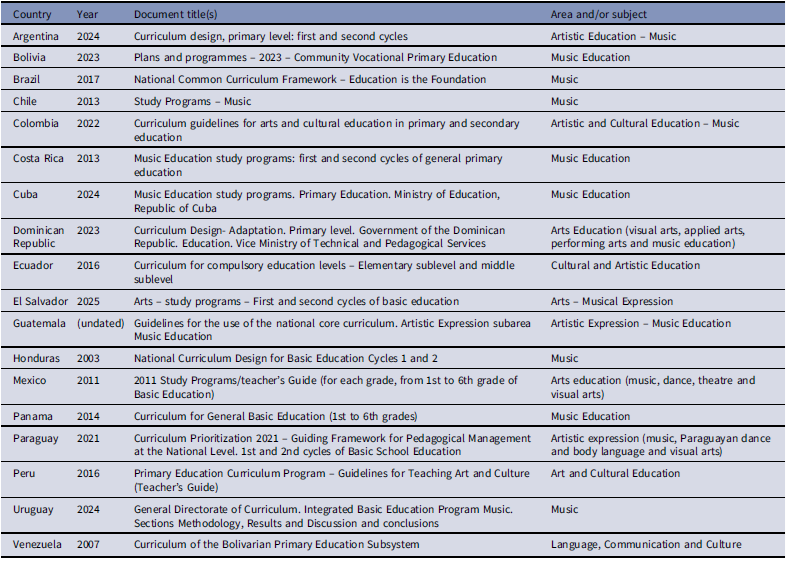
After identifying all the music curricula for the primary education stage, an in-depth review of the documents was conducted using keywords. This allowed us to identify and collect terms and phrases related to the concept of soundscape. All this information was entered into a shared online document with the following columns: Country; Year; Document title; Link; Educational level and age; Information (general, artistic, or music curriculum); Observations (words from the semantic field linked to Soundscape). This allowed us to visualize and organize the data, producing a descriptive overview presented in Table 1.
List of music education programmes analysed

Table 1. Long description
A table with 19 rows and 4 columns. The columns are labeled Country, Year, Document title(s), and Area and/or subject. The table lists various countries and their respective music education programs, including the year of the document, the title of the document, and the specific area or subject of the curriculum. The countries include Argentina, Bolivia, Brazil, Chile, Colombia, Costa Rica, Cuba, Ecuador, El Salvador, Guatemala, Mexico, Honduras, Panama, Paraguay, Peru, Dominican Republic, Uruguay, and Venezuela. Each row provides detailed information about the music education programs in these countries.
Sources
The documentary analysis has focused on the current music curricula for primary or elementary education in Latin American countries (mainly divided into two levels, 1st and 2nd cycle), a stage that covers approximately ages 6 to 12. Table 1 presents a brief overview of the initial curricula, with some details.
Analysis and categorization
The content analysis was conducted initially in an exploratory manner to identify the various areas of the curriculum related to the concept of soundscape. Thus, by recognizing the variations within the semantic field of soundscape and focusing on the examples provided by the creators of the documents (Flick Reference Flick2015), emerging themes of analysis were established, linked to the interpretation of the objectives assigned to the concept and its variations.
Results
Below are the analysis topics derived from the researchers’ joint reflection and interpretation. First, a descriptive analysis of the presence and semantic derivations of soundscape in the study programmes is provided; and second, the representations and objectives linked to soundscape in these programmes are presented. This exposition is presented narratively based on the generalities and nuances derived from the analysis of the documents.
RQ1. Presence and derivations of soundscape in curricula
The concept of soundscape appears and disappears within the Latin American curricula analysed (n = 18). This means that its presence is uneven, ranging from explicit (i.e., ‘soundscape’ or ‘sonic environment’) to implicit (thanks to variations related to it), while both the concept of the soundscape (Schafer Reference Schafer2013) and its possible semantic derivations are absent in some documents.
In a first group of curricula (n = 9), comprising countries, such as Argentina, Brazil, Chile, Colombia, Costa Rica, Cuba, El Salvador, Mexico and Uruguay, the explicit appearance of ‘soundscape’ is observed in Spanish translations as ‘paisaje sonoro’ or ‘entorno sonoro’. It should be noted that within this first group, the curricula of Chile, Colombia, Cuba and El Salvador directly mention Murray Schafer through his ideas and texts, thereby suggesting the Soundscape approach developed by the author. Specifically, the Costa Rican curriculum refers to the Acoustic Ecology Institute website and the Handbook for Acoustic Ecology (Truax 1999), which clarifies the definition and use of this concept in line with the WSP.
In this same group, the term ‘soundscape’ appears alongside its semantic derivatives. In the Chilean curriculum, both in the learning objectives and in the activities (e.g., worksheets and student assessment) and the Glossary, ‘soundscape’ is accompanied by ‘sound environment’ and ‘sound imagery’, which facilitates its conceptualization and pedagogical application. In the Costa Rican curriculum, alongside soundscape, the idea of ‘acoustic ecology’ and ‘sound environment’ appears. The Mexican curriculum uses the terms ‘sound environments’ and ‘landscapes of the surroundings’ interchangeably and promotes activities such as ‘auditory differentiation’, ‘creation of soundscapes’ and ‘discussion about noise pollution’. Similarly, the Cuban curriculum mentions soundscape alongside ‘the sounds that surround us’ and ‘everyday sounds’. In the case of Argentina, the concepts of ‘school soundscape’ and ‘sound environment’ are mentioned, followed by ‘sound stories’, ‘quiet and noisy environments’, ‘environmental sounds’ and ‘noise pollution’. The Brazilian curriculum also mentions ‘various sound sources and materials’, ‘sounds of nature’ and ‘everyday objects’.
In Colombia, although the document does not use the specific term ‘soundscape’, its theoretical essence is transposed through semantic derivations such as ‘sound environment’ or ‘sound universe’, concepts that underpin the study of acoustic ecology in a school context. In the Uruguayan context, Schafer’s influence is visible in the organization of the contents of ‘Perception and Listening’, where the exploration of the environment is guided by ‘acoustic ecology’, ‘auditory awareness’ and ‘soundscape’. Finally, El Salvador’s curriculum describes the concept of ‘soundscape’ and ‘sound environment’ alongside another concept, ‘sound pollution’. This semantic diversity of terminology shows that the music-pedagogical idea of soundscape is approached in different ways and integrated into the general approach of music education programmes, which is also expressed more specifically in the learning objectives of some programmes.
In a second group of countries (n = 7), the term ‘soundscape’ is implicitly present only through semantic derivations, without any specific reference to R. Murray Schafer and his work. These are the cases of the curricula of Bolivia, Ecuador, Guatemala, Honduras, Paraguay, Peru and Venezuela. In the case of Honduras, the music curriculum addresses ‘sound perception of the environment’ and ‘sound expression of the environment’. In Bolivia, however, only a couple of phrases refer to it with the aim of differentiating ‘sounds and noises in nature’. In the Venezuelan curriculum, there is hardly any mention of the ideas of sound and the environment, with only a reference to ‘sonic pollution’. Although Murray Schafer’s pedagogy does not appear directly in Peru’s curriculum, it is integrated through a contemporary approach that links artistic practice with ecological and social awareness: the concept of ‘paisaje sonoro’ (soundscape) is used as a fundamental tool for students to investigate, symbolize and represent their ‘environment’. The Guatemalan curriculum uses the term ‘sound environment’ to describe a space for auditory exploration, adopting Schafer’s pedagogy as an explicit and fundamental reference. Content on ‘auditory sensory perception’, ‘sound awareness’ and ‘acoustic ecology’ is developed from his book Hacia una educación sonora – Towards a Sound Education – (Schafer Reference Schafer2006) to promote ‘ear cleaning’ by contrasting natural and polluted environments. In Ecuador, Schafer’s influence is more conceptual and terminological, manifesting itself through creative derivatives of the concept of soundscape, such as ‘sound portraits’ and ‘sound stories’, which are mentioned as pedagogical tools. Additionally, exploring the ‘natural and artificial environment’ is a central theme, encouraging the creation of ‘sound sculptures’ and the use of technology to record acoustic landscapes.
Finally, in two curricula (n = 2), the concept of soundscape or its derivatives is barely mentioned and without any direct reference to Schafer or his pedagogy. These are the cases of Panama and the Dominican Republic. In Panama’s curriculum, the exploration of the environment is occasionally manifested through the analysis of ‘sound sources in the environment’. This vagueness is also evident in the Dominican curriculum, which refers to the ‘exploration of vocal, bodily, and environmental sounds’ or ‘using various materials from the environment’ but without mentioning the conceptual and pedagogical notions of soundscape.
Figure 1 shows the semantic derivations of soundscape most commonly used in Latin American curricula refer to ‘Sound Environment’ and ‘Soundscape’, followed by ‘Sound Ambience’, ‘Sound Sources’ and ‘Sound Ecology’. In cases where the term ‘soundscape’ or its semantic derivations are accompanied by an argument or based on Murray Schafer’s ideas, the pedagogical application of the concept becomes much more explicit. In summary, this would initially show a diversity of concepts that are related to and make use of the term soundscape, which could be linked to the different representations and objectives attributed to that concept in music education programmes.
Flow chart showing the relationship between concepts and countries.

RQ2. Projections and challenges related to the soundscape
Soundscape in Latin American curricula is used as a vehicle for promoting various educational objectives, ranging from listening for a good aesthetic experience, personal and environmental care, creation based on cultural and natural heritage and recording soundscape through the integration of analogue and digital resources.
Listening to the soundscape: A gateway to aesthetic experience and environmental understanding
The soundscape is established as a key medium and resource that seeks to activate a series of dispositions and attitudes in students in the music classroom. These dispositions are related to attentive listening from an aesthetic perspective, auditory self-care and the relationship that human beings establish with the sound environment.
Listen to the soundscape to enhance the aesthetic experience. Attentive listening to sounds, whether natural, human, technological, industrial or musical, in a school environment with specific sound conditions can enhance students’ sensory and musical experience. In this regard, the Costa Rican curriculum recognizes the importance of listening as part of a more complex musical experience in which the sound environment takes on greater significance: ‘auditory development is the result of participation in processes of awareness of the sound environment, exploration and experimentation with sound elements, the approach to the constituent elements of music, and intentional auditory training’ (Costa Rica, 1st to 6th grade: 25).
On the other hand, although all Latin American curricula address attentive and conscious listening to sounds and musical productions in order to enhance the aesthetic experience, some programmes relate this to a ‘polluted’ acoustic environment and therefore emphasize the need to develop individual and social awareness in this context. An example of this can be seen in the Chilean curriculum, which refers to the concept of ‘noise pollution’ as a basic approach to students’ musical development. Along the same lines, the Argentine curriculum mentions as a learning achievement that students: ‘Reflect on the difference between making music in a quiet or noisy environment. Make lists of annoying noises in different areas of the school’. These achievements are specified in content such as: ‘Impact of the sound environment on musical experiences. Development of the habit of silence to appreciate a musical work’ (Argentina, 1st to 3rd grade: 127). In this way, identifying sounds, noises and silences inside and outside the classroom not only allows for a good musical experience but also develops an awareness of the importance of the natural and artificial sounds that surround us.
Caring for yourself and the environment through listening. Most Latin American curricula recognize the idea of hearing health and environmental education through the appreciation and awareness of the sounds that surround us. The terms ‘acoustic ecology’ and ‘caring for yourself and the environment through listening’ are focused largely on auditory health and noise pollution. For example, this refers to understanding our role as producers of environmental sounds and how these, once they become annoying or ‘noisy’, can damage our own hearing health. For example, Guatemala’s curriculum proposes content on hearing care under the theme ‘Acoustic ecology’: participation in activities to protect the ear from harmful sounds, objects and devices and discovery and contrast between the ‘natural and polluted environment’ (Guatemala, 4th grade: 47). This is also reflected in the Colombian curriculum, which ‘promotes behaviours in children to care for their hearing with the use of technological devices and promotes respect and care for others and the sound environment’ (Colombia, 1st to 3rd grade: 123). These issues are addressed more extensively in the Costa Rican curriculum, which states:
Respect for other people’s right to auditory and mental health. News related to problems caused by noise pollution among people (between neighbours, with family members) and in different environments (roads, bars, institutions) is shared. It is related to solid waste pollution, and the differences and similarities are discussed. Students discuss their reactions and how it affects them in different areas (health, feelings, communication with others). (…) There is a brief, specific discussion of: decibels, how sound is produced, and how it travels. (Costa Rica, 2nd grade: 66)
In this way, the synergies between sound events and their links to material waste, emotional health and communication are revealed, as well as the effect of sound qualities from a physical-acoustic point of view. This emphasizes the importance of the soundscape that surrounds us as a key means of caring for our hearing and preventing effects from the artificial environment that can be harmful to auditory and psychosocial health.
In terms of self-care, most Latin American curricula highlight its relationship with environmental education: linking the concept of soundscape with the development of respect and appreciation for the natural environment and city life. This leads to positioning oneself as a knowledgeable and reflective subject regarding one’s own sound environment and the role we assume in relation to our habitat. It is therefore necessary to know ‘sources of sound and noise that influence sound pollution’. Characteristics of sounds that pollute the sound environment. Exploration of the ‘sounds of the environment and their effects on human beings’ (Costa Rica, 2nd grade: 63). Similarly, the Argentine curriculum points to the need to reflect on sounds and noises as an indicator of achievement, it proposes that students:
Establish relationships between environmental and human health. Conducts school campaigns to reduce noise. Describes changes in the school institution based on the actions carried out. Current sound contexts. Causes and effects of sounds that are harmful to health; use of technology and strategies implemented to reduce them. (In conjunction with Digital Education). A healthy sound environment as a universal right and responsibility. (In conjunction with Environmental Education). (Argentina, 7th grade: 254)
This idea reinforces the concern for self-care and the development of sound and environmental health among students. In this way, Latin American curricula address the need to promote comprehensive environmental awareness through music education programmes in a variety of ways.
Creating from what I hear: That’s how my everyday surroundings and my country sound
Soundscape is established as a diverse and open source for creative exploration by Latin American elementary school students. This refers, first, to the fact that everyday sounds allow access to the creation of imaginary worlds and sound stories; and, second, to promoting the recreation and appreciation of the cultural heritage of nearby territories, whether local, national or regional.
The soundscape as a creative process: imaginaries and sound narratives. The soundscape in Latin American curricula is presented as a space that invites students to explore and create sound. The starting point is an auditory approach to children’s environment as the seed for new sound productions. For example, this idea can be seen in the ‘production and creation skills’ section of the Uruguayan curriculum, with explicit reference to the creation of soundscapes and sound stories:
Produce and create (with teacher scaffolding) simple rhythmic and melodic phrases, songs, soundscapes, and stories, based on exploration and play with different sources and the combination of different variables in the use of formal elements of music and sound qualities. (…) The development of this competency enables the emergence of creative thinking, expanding the limits of what is possible through imagination and exploration. (Uruguay, 1st and 2nd grade: 12)
In this sense, soundscape concepts are translated into specific objectives such as identifying sounds in the environment, distinguishing between sound, noise and silence, collecting everyday sounds for enjoyment, reproduction and sound creation, among other activities. These concepts are also complemented by other curricular areas – geography, history, social sciences, language and visual culture – as a starting point for the development of students’ own creations, as proposed by the Peruvian curriculum: ‘Contemplate nature by analysing its visual (lines, shapes, colours), tactile, sound, and movement qualities and patterns and use it as a starting point for your own creations’ (Peru, Teacher’s Guide: 5). It can be observed, then, that the creative process is framed within a phase of exploration of the sound environment, either through listening to and selecting sounds from nature, everyday life and the cultural environment or as a result of one’s own sensoriality, linked to the sounds of the body and voice. Along the same lines, the Mexican program integrates this process into a multisensory experience oriented toward the exploration and creation of the soundscape: ‘Exploration of sound through onomatopoeia, sounds created with the body, objects, or instruments, using their qualities in the creation of a soundscape’ (Mexico, 1st grade: 190).
These practices highlight a comprehensive approach to creative processes in the classroom: from listening, improvisation, creation, performance and, finally, musical composition accompanied by unconventional notation. Finally, as an example of collective creation, the Costa Rican curriculum proposes activities where:
A notation is collectively created to designate the annoying or uncomfortable sounds worked on (…). Various characteristics are discussed: Where do they occur? How often? How long do they last? Do they move or are they static? What is their pitch, speed, and intensity? What do they do to us, or what can we do with them? Among other questions. In contrast, sounds that are pleasant are discussed and also represented graphically. The sounds and their assessments are compared, and various shapes, colours, or codes are proposed to represent their characteristics. (Costa Rica, 2nd grade: 64–5)
In summary, the curricula promote practices of exploration, improvisation and individual and collective creation based on environments familiar to primary school children and through unconventional notations, which would initially open the door to creative (rather than reproductive) dispositions on their part.
The soundscape to recreate and appreciate the heritage of my country and my region
The soundscape is presented as a concept intrinsically linked to the formulations of local, national and regional identity through the sound representation of natural and cultural heritage. It is in this context that notions of the sound environment take on meaning from a culturally situated perspective, forming part of the sound heritage. For example, the Cuban curriculum considers the soundscape as a space for the recognition of traditions and identity, proposing:
[…] the structuring of a sound combination and description or the sound design of a story, rhyme, or riddle. The teacher only coordinates or offers suggestions or instructions to encourage creativity. This could be a specific rhythm, such as habanera or guajira, or suggestions on how to create the sound of a sunset in the countryside or the school environment, among other proposals. (Cuba, 2nd grade: 23)
In this way, musical genres linked to Cuba’s cultural identity are intertwined with activities involving listening to and ‘soundscaping’ the landscape, considering the school environment itself as a rural landscape, widely referenced in the artistic and cultural imagination of the Caribbean island. Therefore, the soundscape is considered an inherent part of the country’s cultural manifestations. Along these lines, in the case of Argentina, this is expressed in the training of individuals who are active producers and receivers of conventional musical expressions and those more closely linked to the sound environment:
The aim is to train not only a listener and producer of music, but also a person who has an open and receptive attitude towards the plurality of musical expressions, who knows some aspects that determine the distinctive features of these works, who values music as a cultural manifestation and understands the characteristics of the sound environment that surrounds it. (Argentina, 1st to 3rd grade: 121)
These ideas are also reflected in the Ecuadorian curriculum, which proposes ‘making audio or audio-visual recordings of some of the most representative places of cultural and natural heritage in the surrounding area’ (Ecuador, 2nd to 4th grade: 77). However, the Chilean curriculum is more explicit and extensive in this regard, suggesting activities for the sound setting of historical events and the country’s diverse geography. Here is an example of the Chilean music curriculum:
Activity: Soundscapes. The invitation is to travel through Chile’s present and past, through the countryside, coast, desert, snowdrifts, glaciers, and to perceive, perceive, perceive. You will be placed in a location and asked to take in everything… the colours, the landscapes, the conversations, the smells, the atmosphere, the movements, the looks, the sounds… Ah! The sounds. You must convey this experience solely through sounds. How will you do this? With all the sound-producing materials you can find in this place… starting with your voices, your bodies, the cases, the instruments. Can you speak? Yes, but only when necessary. Allow the sounds, the expression of murmurs or interjections to let us feel and understand what you want to convey to us. (Chile, 6th grade: 90)
In proposals such as these, Soundscape allows us to travel and connect with the traditions of each territory, recognizing, imagining and composing particular sounds or sounds based on soundmarks (Schafer Reference Schafer2013). Thus, the curricula reflect that the soundscape is not only a context for musical learning but is also recognized as a vital component of cultural heritage, whose exploration and understanding are fundamental to the comprehensive development of students, fostering their identity, creativity and appreciation for the diverse artistic and cultural expressions of their community.
Recording, performance and distributing my sound pieces: Integrating analogue and digital
The creative approach to soundscape needs resources and allied media for recording and soundscape composition. Analogue and digital technologies and other materials allow these creative processes to be carried out using sounds from the environment, ranging from listening to and identifying sounds, through exploration and recording, to sound creation and artistic interpretation.
Regarding the first step, the Ecuadorian curriculum shows the idea of soundscape as being closely linked to different materials, which allow ‘observing and comparing different representations of the natural and artificial environment (aerial photography, landscape painting, drawings, house plans, building models, maps, recordings and sound maps, videos, etc.)’ (Ecuador, 2nd to 4th grade: 75). Once the meanings of natural and artificial sounds have been observed, or rather heard and interpreted, the next step is sound exploration. This refers both to connecting with the surrounding reality and to the game of sound exploration: ‘Explore a variety of sound sources, such as those found within the body itself (clapping, the voice, body percussion), in nature and in everyday objects, recognising the constituent elements of music and the characteristics of various musical instruments’ (Brazil, 1st to 5th grade: 203).
After that, in a natural ‘post-exploration’ phase, some curricula propose recording sounds from the soundscape. This is explicitly stated in the Ecuadorian program, which encourages ‘making audio or audio-visual recordings of some of the most representative places of cultural and natural heritage in the immediate environment’ (Ecuador, 2nd to 4th grade: 77). Thus, the use of digital media and natural or environmental sources would allow everyday realities to be connected through recording and analysis. Along the same lines, the Argentine curriculum proposes the ‘joint creation of sound stories using sound editing software with a simple interface and pre-existing digital sounds in collections (in conjunction with Digital Education)’ (Argentina, 1st to 3rd grade: 135).
In this way, various technological resources (microphones, cameras, smartphones, recorders, editing software, etc.) coexist in analogue and digital formats and help to record, create and disseminate the different processes of sound creation. This field includes digital competence and environmental education, demonstrating the interdisciplinary nature of the soundscape.
Discussion and conclusions
This paper highlights the presence of soundscape in music education curricula in Latin American countries through the prism of Murray Schafer’s pedagogical ideas. The documentary analysis reflects the diverse treatment of soundscape concepts and interest in this topic in a heterogeneous regional context where it is necessary to develop curricula that are better adapted to the needs of the 21st century.
Music education in Latin America reveals great diversity, despite sharing common origins and trajectories; its evolution has been uneven across different countries (Torres-Santos Reference Torres-Santos2017). This heterogeneity is reflected in the curricula analysed and can be seen in the conceptual representations of soundscape, as well as in the different levels of knowledge and resources linked to this concept: objectives, content, pedagogical-musical proposals and recommendations for teachers differ from one programme to another. However, the outlook is very encouraging: in the vast majority of the programmes analysed – in 11 out of 18 countries – the concept appears to be extensively developed in line with the music-pedagogical dimensions elaborated by Schafer. Nevertheless, in some countries, no reference is made to these ideas, and in other curricula, the notions of soundscape are presented in a superficial manner.
The different derivations of the term soundscape observed in Latin American curricula broaden its original semantic field and reveal a multidimensional approach. Added to this semantic diversity is a series of educational objectives with ‘musical’ content linked to soundscape – which refer to the musical experience itself, from perception to musical creation – as well as multiple dispositions of human beings in relation to sound, themselves and their environment. Soundscape contributes to the thinking and practice of eco-literate music pedagogy and is therefore closely linked to local spaces, identity and eco-education in a context of environmental degradation (Galloway Reference Galloway2020). Music education can be a valuable tool for reconnecting with spaces, not only in rural environments but also in semi-urban areas and large cities, with programmes aimed at all people and habitats (Shevock Reference Shevock2018). In this regard, some curricula offer very encouraging proposals by incorporating music education approaches with an ecological vision through activities and resources linked to soundscape. However, other programmes do not yet seem to have developed approaches related to listening, connecting and interacting with sound environments.
Soundscape is an accessible and inclusive gateway to the musical experience, representing a resource that overcomes the limitations of access to sound and musical language, perception and musical composition (Zamorano-Valenzuela and Blanco-García Reference Zamorano-Valenzuela and Blanco García2025). In programmes that explicitly work with soundscape, these ideas are developed from an early age as an approach that encourages creative listening, a taste for sound, a connection with local spaces and creativity in sound production. This idea reinforces other modes of musical literacy by shifting the historical focus on reading and interpreting codes from the European musical tradition to a more active, participatory role where unconventional notation can be used. Therefore, soundscape provides other avenues for musical participation, that is, for people’s engagement with music (Small Reference Small1998) by promoting active, conscious and transformative listening to environments.
The interdisciplinary nature of soundscape is another contribution highlighted in this work, in line with the concept developed by Schafer. Soundscape as a space for knowledge construction allows us to imagine intersections between the social sciences (e.g., history, geography and environmental studies), language (e.g., Spanish, literature and vernacular languages), arts education and natural sciences, or integration with other types of current literacy, such as digital and/or environmental education. This perspective reinforces the need to overcome the fragmentation of a subject-centred curriculum and move towards true interdisciplinary integration based on collaborative projects, the use of active methodologies and the presentation of realistic situations for students, as observed in the concepts of soundscape. This interdisciplinary approach makes it possible to respond to some of the current needs of education and society, facilitating solid, holistic learning and adaptation to changing situations (Aróstegui and Peñalba Reference Aróstegui and Peñalba2026).
Soundscape promotes ideas and activities that require initiative on the part of students and teachers, the search for and exploration of new sounds in different environments and the development of creative listening and the composition of natural sounds. This means that musical compositions based on sounds (in this case, ambient sounds) could be very accessible to our students (Landy Reference Landy, King, Himonides and Ruthmann2017). Music teachers can find inspiration for projects in the work of Wild Soundscapes (Krause Reference Krause2016), which encourages pupils to explore, record and create using the sounds found in their local environment. However, these creativity-based approaches do not always find a place in the programmes analysed. On the other hand, digital competence is embodied in the notions of soundscape as a living resource to be recorded, recreated and modified. Recorded sound becomes a document, that is, material that tells a story, leaves a mark and acquires memory and identity for each person. This sound document can be manipulated and transformed using different digital music tools (such as sound mixing and editing software) and disseminated in audio-visual networks. In this way, the objectives inherent in soundscape are linked to these cross-curricular skills necessary for development in 21st-century education.
It is recommended that the Latin American programmes analysed place greater emphasis on the pedagogical and creative potential of the soundscape. This would be in accordance with the research findings of Holland and Chapman (Reference Holland and Chapman2019) on the subject of creative educational initiatives incorporating sound-based music (sbm). Although developed in a different context, these initiatives are highly inspiring. They involve workshops and activities such as audio diaries, audio postcards and workshops designed to encourage listening and sound composition (Holland and Chapman Reference Holland and Chapman2019). It is evident that these experiences present certain difficulties, as they involve abstract processes in understanding the codes of sound and its creative possibilities. Another, more recent example from Chile demonstrates how educational practices in the classroom are being transformed through the use of soundscape approaches (Rabello-Mestre et al. Reference Rabello-Mestre, Otondo and Morales2025). This also highlights the challenge that the use of these creative approaches poses to the current curricula and the need to encourage schools to embrace these more experiential forms of learning.
Finally, this documentary work leaves open future lines of inquiry into the potential of Soundscape in music education in Latin America and other countries and regions. Given that educational curricula reflect, to a greater or lesser extent, the essence of each country’s educational policies, it is advisable to apply greater interest in the notions of soundscape in those programmes that still lack these approaches and to consolidate it in countries where it is already integrated. This presence would translate into greater synergy with other regional and global goals such as the Sustainable Development Goals (UNESCO 2015). Schafer´s ideas offer the necessary starting point for this goal, provided they are updated and adapted to each educational context. Adopting soundscape approaches will enable collaboration on the challenge of a more inclusive, creative, ecological, digital and interdisciplinary music education and offers multiple opportunities for a diverse, pluralistic and constantly changing region.
Funding statement
This work was supported by grant PID2021-128645OB-I00 funded by Ministerio de Ciencia, Innovación y Universidades del Gobierno de España/AEI/10.13039/501100011033 and by ERDF, EU, Una manera de hacer Europa. R&D project: Transversality, Creativity and Inclusion in School Music Projects: An Evaluative Research (TCIEM).
Competing interests
No potential conflict of interest was reported by the author(s).


 Open access

