Introduction
Nikander (Reference Nikander2002, Reference Nikander2009) has provided a detailed analysis of how ‘ordinary’ Finnish people talk about age when approaching their 50th birthday. She uncovered some of the ‘active language practices’ that are used to make sense of experiences such as turning 50. Her pioneering research prompts questions about how such practices vary with age and, more particularly, how individual practices change as people grow older. For example, her research reveals how the 50th birthday is viewed by many as ‘a milestone’, which prompts the question: as that particular event becomes part of personal history, how do people rethink and reconstruct their age identities as they face the ever-changing timescape of their future lives?
The 50th birthday is of course widely perceived to be a significant event in the lifecourse, and Nikander comments on the ‘somewhat peculiar and persistent tradition’ in newspapers in Finland to print interviews with various prominent people on its occasion (2009: 867). She includes examples from a series of interviews published in 1997 with celebrities who had been born in 1947. Her focus therefore is on one particular milestone, rather than on the cyclical and thereby routine and more mundane nature of birthdays. It is in dealing with repeated events and habitual activities, as well as the unexpected challenges of life, that people accumulate experience, knowledge and expertise. Everyday practices are learnt in childhood and absorbed into the routines of adulthood. As Alasuutari (Reference Alasuutari2004: 17) reasoned: ‘All the time the human mind and body gather experience from circumstances and the conclusions drawn from them, and such accumulated knowledge is conditioned into habitual information processes that operate inside our conscious mind. Such culturally unconscious routines not only assist our self-conscious mind; they make perception and understanding possible’.
In particular, the annual cycle becomes familiar at an early age: the seasons, the festivals and the annual move to the next class in school, for example, and prominent in this cycle is the individual's birthday. Early in life, many people learn to interpret their birthday as ‘their special day’, a day when they are free to break loose from certain conventions and to indulge in, and be indulged in, non-routine pleasures. It is hardly surprising if in relation to these predictable changes and events, certain expectations and practices develop and, in this respect, the marking or celebration of birthdays is not exceptional.
How does research access the longitudinal evidence that might confirm whether this perspective on the changing course of life persists into later life? In Bytheway (Reference Bytheway1993), I explored the possibility of using published writing in a case study of the published letters and diaries of Bernard and Mary Berenson (McComb Reference McComb1965; Strachey and Samuels Reference Strachey and Samuels1983). Fourteen ways in which the Berensons expressed their understanding of ageing over the course of their long lives were identified. The comparison was hampered, however, by differences in how their respective editors approached the task of selecting material for publication. My conclusion focused on how age was theorised by the Berensons ‘in the course of it being experienced’ (1993: 164), but as the analysis demonstrated, from the original act of writing through selective editing to the marketing of the product, the process of publication entails a degree of self-consciousness, vested interest, profit and fame that undermined the generalisability of the conclusions.
The Mass-Observation Archive
It was in the course of studying accounts of birthdays held by the Mass-Observation Archive (M-O) that I realised it is a unique source of qualitative longitudinal data that can generate insights into the unfolding experience of ageing (Bytheway Reference Bytheway2005: 468). This is because it is possible to read and compare what the same person writes on different occasions, potentially 20 years apart, and to include in the analysis the writings of many ‘ordinary’ people living in all parts of the United Kingdom. The Archive is maintained by the University of Sussex Library. Three times a year its panel of several hundred people receive a ‘directive’, an invitation to comment anonymously on specified current affairs and everyday topics. The invitations began in 1981 and they continue 27 years later. The Archive places a high priority on two aims: to ensure that the panel is as diverse as possible, and to maintain their continuing participation. Inducting new members takes time and those who are not used to writing require encouragement and assistance to develop the necessary skills and confidence. So it makes sense, given limited resources, to retain the participation of those who become experienced contributors, as well as to endeavour to recruit new panel members from under-represented sections of the population. The strength of the Archive is not that the panel is ‘statistically representative’ but rather that it is large and diverse. It is particularly valuable for the study of later life because many members have remained loyal, growing older as the project has continued to flourish.
Sheridan, Street and Bloome (Reference Sheridan, Street and Bloome2000: 124–7) critically examined the relevance of the Archive for social science, and argued that reading and writing should be understood as social and cultural practices. They paid particular attention to the potential differences between those who write for the Archive and those who read what is written. For example, some M-O writers may view knowledge as unproblematic and provide what they consider to be truthful accounts of what they have witnessed or experienced – ‘telling it like it is’ – whereas their readers may be more sceptical, interpreting what they read as the writer's ‘definition of the situation’ (Harrison and McGhee Reference Harrison and McGhee2003: 35). Many of those who have drawn on the M-O Archive have commented on the sense of intimacy that arises when reading what often appear to be the ‘secret’ thoughts of the unknown writer. A critical reader of an early draft of this paper commented, for example, that one story was ‘so sad’ and that another was ‘very poignant’.
The two directives
Towards the end of 1990 and in anticipation of Christmas, the panel was invited to write about celebrations. The directive they received began with three longish paragraphs inquiring into celebrations and how they feature in ‘your year’. Descriptions were sought of recent ‘special occasions’. The third paragraph had a long list of prompts: food, drink, decorations, present-giving, rituals, traditions, music, singing and dancing. In the fourth and last paragraph, there was the first mention of birthdays and age: ‘Your last birthday. How did you spend it? Did you receive presents and cards? Who shared it with you? Was it a typical birthday? What do you recall about your childhood birthdays? (Please mention your age now)’. Nearly 12 years later, in the summer of 2002, the panel was asked to write about the more specific topic of birthdays. This directive was worded without any reference back to the questions posed in 1990. Nevertheless the first paragraph was similarly referenced to ‘your last birthday’ and seven bullet points followed the opening instruction ‘We would first like you to describe as simply as possible what happened at your last birthday’:
• when it was
• how old you were
• what you did that day
• how, if at all, it was celebrated
• how many cards or presents you received
• from whom
• what else do you remember about the day?
Comparing the two directives, some strong similarities in the wording are found but also awkward differences. In regard to other people, the 1990 question is about ‘sharing’ the birthday, whereas the 2002 question is about cards and presents. And then in 1990 the participants were asked how they spent the day, whereas in 2002 about what they did. So although the focus was on the same event, ‘your last birthday’, somewhat different questions were posed. It is important to note, however, that in every M-O directive the panel is instructed to think of the questions as little more than prompts. The M-O website guidance reads: ‘Don't worry about rambling or going off at a tangent. We know that some subjects inspire some people and leave others cold. You must feel free to pick and choose and to write about your own experience’.
Analysis
This paper is based on a systematic analysis of all responses to the 1990 and 2002 directives. Accounts of ‘your last birthday’ were abstracted and, as examples, the responses of five members of the panel are reproduced in Table 1: those of Wendy (born in 1957), Zandra (1946), Ben (1923), Alice (1917) and Hilda (1913). In addition, extracts from other responses are quoted where appropriate. All names are pseudonyms, and extracts are referenced to the year of the directive and to the writer's standard M-O identification number.
The paired stories from five respondents in response to the 1990 and 2002 directives
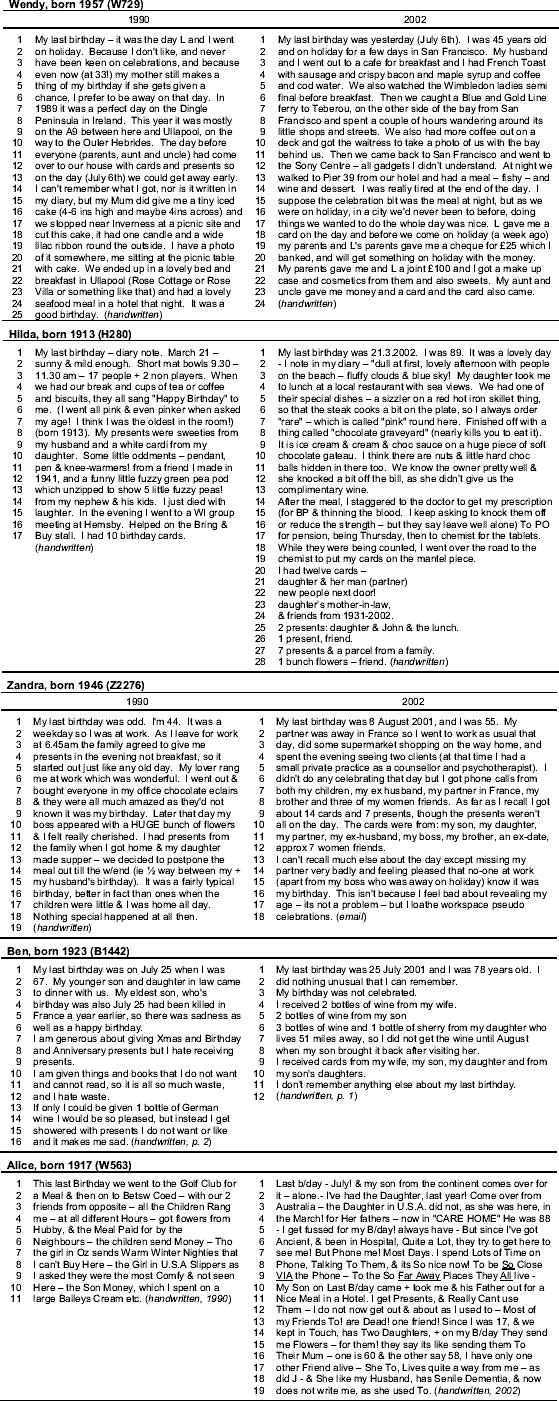
Note: These are literal transcripts, preserving as far as possible all abbreviations, capital letters and punctuation.
When interpreting the responses, it is important to appreciate that the panel members do not respond in controlled settings, as is typically the case in research interviews. They may produce a carefully considered reply, or they may write on impulse. Some write with literary flair, others rather more cryptically (cf. Ben's and Alice's responses in Table 1); some write by hand, others use word processors, and in 2002 several responded by email (e.g. Zandra); some pay no regard to matters of spelling or punctuation, others appear to be much more scrupulous (compare Alice and Wendy). Regarding dates, no deadline is set; some participants reply by return of post, while others leave it for several weeks. In 2002, five writers responded only after their birthday had passed (see Wendy, Line 1, 2002), and 14 others indicated that in writing about their last birthdays they had consulted their diaries (e.g. Hilda, Line 1, 1990; and Line 2, 2002). So an important consideration for readers of the birthday stories are the substantial differences in the writers' practices, and the various challenges that they faced in recalling what happened on their last birthday. Inevitably there is some uncertainty in reading and interpreting the paired stories. When, for example, Zandra refers to both ‘lover’ and ‘husband’ in 1990 (Lines 5 and 15), and to ‘partner’ and ‘ex-husband’ in 2002 (Lines 2 and 7), how sure can we be that these are the same two people? Without personal identifiers (as supplied by Wendy), the reader has to speculate as to who is who, or alternatively decide that the question is unimportant.
Birthdays are a category of clearly defined and comparable annual events. If asked, people are able to talk about their last birthday, recognising that there are certain cultural expectations and associated routines. Indeed there is a ‘technical vocabulary’ – words such as party, card, present, surprise, cake, candles and ‘the big one’ are used in many M-O stories in a way which implies a shared understanding. Many set about the task of describing their last birthday by constructing ‘a story’ around it: a straightforward narrative detailing the day from beginning to end; an account of how it was unusual or exceptional; or of how it was a lovely day or why it all went wrong. In this way, readers can identify with the writer's experience (or so the writers appear to assume) and are able to compare these stories with those of their own birthdays.
Given the questions posed in the two directives, my analysis has addressed the following five specific questions that were the most amenable to comparative analysis:
1. How was the day identified?
2. How was the day spent and the birthday celebrated?
3. Who was mentioned as remembering the birthday or participating in the celebrations?
4. What similarities are there in the stories?
5. To what extent do the differences reflect age-related changes?
A total of 120 panellists submitted replies to both directives and 55 included accounts of their last birthday in response to both directives. In 1990, the majority focused on other kinds of celebration, typically Christmas, and did not mention birthdays. The following analysis is limited to these 55 paired stories. Each pair was written by the same writer about the same annual event, ‘their last birthday’. The key criterion is the use of the past tense: each story is about ‘what happened’. Table 2 presents the age and gender of the writers. The years of birth of the 39 women ranged from 1913 to 1959 (they were aged 31–77 years in 1990), and those of the 16 men from 1916 to 1952 (ages 38–74 years).
Gender and year of birth of the respondents
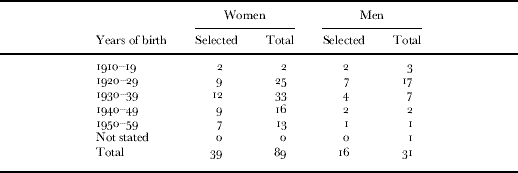
Note: The selected respondents provided accounts of ‘your last birthday’ in both 1990 and 2002.
The day
Birthdays are the anniversary of birth, and the particular numbered day in a specified month is socially designated as marking ‘the anniversary’: it is the day that is celebrated rather than the hour or the week. For most people, possibly because of this precision, the day is special. As a social event it is uniquely identified by the date, the age and the name of the individual. In Bytheway (Reference Bytheway2005), I discussed the relationship between birthdays and age identities. The examples included in this paper confirm that most people have no difficulty in including their chronological age when specifying their last birthday (e.g. Zandra, Line 1, 1990; Line 1, 2002). In 2002, the panel was asked when their birthday was, and 46 of the 55 specified the date. Although there was no equivalent request in 1990, 19 of the 55 specified the date, typically early in their accounts (including Hilda, Line 1, and Ben, Line 1, as well as Zandra). For most people, the date is personally salient: note how Hilda described the weather on the day (Lines 2–3, 2002). Brenda (B1771) included the date and her age in the first sentence of the descriptions written in both 1990 and 2002:
On my birthday (54th) 23rd April, this year I awoke to be handed an envelope with two tickets for Les Miserables. (1990)
My birthday was April 23rd and I was 66 years old. Husband made tea and asked me to be downstairs by 9am if possible. There was a knock at the door at 8.45 so he answered and took the flowers from the florist intended for me. (2002)
Brenda represents well those writers who offer the story of the day from beginning to end. It is as though she is drawing on a template of how such stories should be told: date, age, beginning the day in bed, then a surprise, and so on. Like many others, she ended the 1990 story with an expression of satisfaction: ‘the best I have had in ages … a memorable occasion … that I will treasure’, and in 2002 she reported that the day had been ‘very happy’.
Because the date identifies the day, many of the writers were interested in its coincidence with historical or cultural events or the birthdays of well-known people. Sarah (S2207), for example, commented in 1990 that her birthday fell on April 1st – ‘All Fools' Day’ – adding that it sometimes coincided with Easter, and then, confirming this, she noted in 2002 that her birthday was on Easter Monday. Several described how their birthdays were – and always had been – overshadowed by Christmas. The potential significance given to a coincident event is made evident by Ann (A1706) who, in 2002, commented: ‘At last I feel I have a foothold on history, as my birthday is September 11th. Need I say more?’
Coincidences can be far more personal and poignant. Ben noted that his birthday coincides with that of his deceased eldest son (Lines 3–6, 1990) and, in response to the question posed in 2002 about his ‘most memorable’ birthday, he referred back to the day in 1956 when his son was born. In these different ways, the birthday coincides with other anniversaries, and many of the writers' thoughts on the day are reflections on these seemingly random links. As events come and go, coincidences ‘accumulate’ and, as one ages, celebration of one's birthday is increasingly compromised in these ways. Eighteen respondents named the day of the week, and some writers recollected that they were at work on their birthday (e.g. Zandra, Line 2, 1990). Others, however, wanted to indicate how – for them – their birthday was ‘just another day’. Susan (S1399), for example, began her account in 1990: ‘My birthday is spent as an ordinary day’ and concluded ‘basically the same as any other Saturday’. In 2002 she wrote: ‘just a (relatively) normal Sunday’.
Some birthdays were jointly celebrated with those of partners or friends. Zandra, for example, shared a 1990 birthday celebration half way between her husband's birthday and her own (Lines 14–15). Nevertheless, despite such flexibility, for some the day of a birthday remained a socially charged time: receiving cards or phone calls on the day itself is important. The strength and reciprocity of personal relationships is often tested by the ability to remember birthdays. Some confessed to keeping a book of those they ‘needed’ to remember, and others offered comments on those who failed to mark the day. Thelma (W571, 1990), for example, comments: ‘I didn't get a card or present from my daughter until the following day, when she knew that I was calling to see her during the day, but it spoilt it somewhat, having to wait’. In the same account, she revealed how seemingly inexplicable failures can generate anxiety, particularly when taking account of age: ‘I was surprised when I didn't receive a card from my godmother, who has never, ever, forgotten and, as she is over 80 years old, I was worried that she might be ill’.
Conversely, some expressed confusion over unexpected cards. Brenda (B1771, 2002) had a good birthday but commented: ‘for the first time that I could recall, a friend from the past also sent a card. Don't know why’. Similarly others described how they were puzzled that exchanging birthday cards should sustain otherwise insignificant relationships. Hannah (H1705, 2002), for example, commented:
I also received a card from my late mother's god-daughter who is also the cousin of my cousin. She lives in England and keeps in touch. Her birthday is a week after mine and she is 53. I suppose the proximity of birthdays is why we keep sending each other a card, because we were never that close – I expect neither of us feels we can stop at this stage.
Thus there are strong expectations about how the day itself will be marked by family and friends, but this is complicated by expectations regarding the surprise element. On occasions, this can precipitate a crisis. For example, here is how Mary (W853, 2002) recounted her ‘worst birthday’:
the year absolutely nobody got it right. Not my husband, or sons, and even my mother posted a card and gift late. All day I thought it was a joke, and a big surprise would unfold in the evening. One son was away at university, and I thought he was probably coming home unexpectedly. By late evening, when I realised the bitter truth, I gave in to floods of tears. I felt so rejected.
Celebrations
Despite the differences in wording, both directives inspired detailed narratives of the events of the day. These revealed a high degree of continuity in how some respondents celebrated their birthdays. Wendy, one of the youngest, provided full accounts of both birthdays (see Table 1). Apart from the fact that her holiday location had shifted from the Outer Hebrides to San Francisco, perhaps reflecting increased affluence, it is striking that both birthdays were celebrated in much the same way: on holiday with her husband (Lines 1–2, 1990; 2–3, 2002); her parents, aunt and uncle giving cards and presents in advance (Lines 10–12, 1990; 18–23, 2002); and the day marked by a photograph (Lines 19–21, 1990; 10–11, 2002) and a meal (Lines 23–24, 1990; 13–14, 2002). The two accounts are also similar in the expressions of satisfaction with modest pleasures: in 1990, a ‘good birthday’ (Line 25), a ‘lovely’ bed-and-breakfast (Line 21) and ‘lovely’ seafood (Line 23); in 2002, a ‘nice’ day (Line 17), doing things they wanted to do (Lines 16–17).
Turning to the older respondents, there is evidence of continuity in the two stories of Alice, born in 1917: a meal (Lines 2, 1990; 11, 2002) and daughters, son, husband and flowers (Lines 4, 1990; 15, 2002). But in 2002 a sense of change was clearly associated with her own ageing: she was now ‘ancient’ (Line 6), in hospital (Line 6), receiving superfluous presents (Lines 11–12), and there were friends who had died (Lines 12–13). Hilda, born in 1913, was the oldest respondent, and she similarly provided two positive accounts of her birthday celebrations. In the first, there is evidence of a sensitivity to age (‘the oldest in the room’: Line 7) and distant dates (Lines 8 and 12) that was absent 12 years later. Instead there is a passing but telling reference to the management of routine medication (Lines 14–16). Both accounts tell a similar story of low-level celebrations, however, and both are laced with death-related humour (Lines 14, 1990; 8, 2002).
Ideally, gifts are surprises and some excitement may be shown as they are unwrapped. In 1990, Zandra was delighted with the flowers she received from her boss (Lines 9–11), and similarly Hilda appeared to be pleased with the knee-warmers from her old friend (Line 11, 1990). But some gifts appeared to have been ordered (e.g. Alice's warm winter nighties and slippers, Lines 7–9, 1990), and others were expected (e.g. Ben's wine, Lines 4–6, 2002). It is possible to sense the disappointment in Zandra's comment that not all her 2002 presents arrived on the day (Lines 9–10), and in Ben's revelation that he did not receive a son's present ‘until August’ (Line 7, 2002). Several older respondents indicated unambiguously that they did not want presents (Ben, Lines 10–12, 1990; Alice, Lines 11–12, 2002). Similarly telephone calls appeared to be ‘expected’ surprises (Zandra's phone calls in 2002, Lines 6–8; likewise Alice's in 1990, Lines 3–4; and 2002, Lines 7–9), and the same can be said for Alice's visitors in 2002 (Lines 1–3). It is interesting to contrast Mary's disappointment in not having a surprise celebration (see above) with the evident pleasure of unexpected gestures, such as those given to Hilda at the bowls club (Lines 4–6, 1990). On both occasions – 1990 and 2002 – it appears that most respondents sought to convey the impression that the celebration or marking of their birthdays had a pattern that recurred each year like the seasons and annual festivities. Some respondents also acknowledged, however, that changes affected the celebrations – missing people, health concerns, altered living arrangements – all of which can be interpreted as age-related.
One regrettable complication for this analysis is decadal birthday celebrations, the ‘big ones’. Had the Birthdays directive been issued in 2000, ten years after the Celebrations one, it would have been possible to make a direct comparison of successive decadal birthdays. As it is, 17 of the 55 comparisons are complicated by one or other of the responses describing such an event. Eleven of these respondents were writing retrospectively, and for eight there were special celebrations. Of the six who wrote prior to the forthcoming event, three made no mention of it and just one said she was planning to celebrate ‘in style’.
Participants in the birthday celebrations
For most respondents, the people who participated in their birthday celebrations are a key element in their stories. The panel was specifically asked in both directives about presents and cards. Several conscientiously listed all those received (e.g. Hilda, Lines 20–28, 2002). Others simply enumerated the cards, which varied in number from two to 32. There is no sign of the number falling with time: eight listed more cards in 2002 than in 1990, and only four listed fewer. Birthday cards are an important way of maintaining long-established relationships, representing a symbolic and continuing link with the past: some respondents indicated that they were much valued. Vera, for example, described how she still kept the cards she received from her family and stored them in the attic (H1703, 2002). Even those who avoided celebrations by not revealing the date of their birthday to their friends used cards as a way of sustaining long-established relationships. Edie (E174), for example, claimed in 1990 that ‘none of my neighbours or friends who live near know when my birthday is’ and, in 2002, that ‘I don't think anyone else knows my birth date’. Nevertheless, in 2002 she reported receiving a card from ‘a married woman friend with whom I've been friends since we met at college 50 yrs ago’.
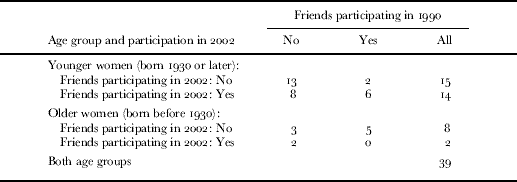
Who participated in the 1990 and 2002 celebrations reflects broad age-related shifts in the writers' social networks in two ways: the changing generational structure of families and a changed balance between family and friends. Table 3 compares the reported participation of the friends of the younger and older women in their birthday celebrations (there were too few men for a similar comparison). Most of the younger women (born in 1930 or more recently) who had friends that participated in 1990 wrote of their participation again in 2002, whereas none of the older women did so. As many as eight younger women with no friends participating in 1990 had friends participating in 2002. This suggests that friends become more significant for women up to the age of 65 years or so (perhaps reflecting freedom from the constraints of dependent children), but thereafter they become less so.
The participation of friends in birthday celebrations: younger and older women
In addition to cards, the descriptions of birthdays included details of who participated in phone calls, meals, visits and parties. The predictable progression of generations through family life is again evident in these details, not only in the more frequent absence of parents in 2002 than in 1990 (note, however, that while no aunts were mentioned in 1990, they were in three 2002 accounts), but also in the increased phone calls and visits from children who have left home, and in the appearance of grandchildren as birthday participants. Although some described birthdays being marked and celebrated ‘in the usual way’, this was always against a backdrop of a constantly shifting set of participants. The impact of deaths and other losses is only occasionally made explicit. Norah is an exception: in 1990, facing her first birthday as a widow, she described how she retreated to her son's home:
I spent my last birthday 6-10-90 trying not to think too much about it by going to my son's house where not many of my friends know his telephone number. It wasn't because of being 56-years-old but because for the last 36 years I have shared my birthday with my husband and this was the first birthday on my own as he died in March 1990. (N399, 1990)
Twelve years later, she was not well and spent the day alone watching the television. She received cards and presents from her children and some friends. The description included the following sad comment: ‘My birthday may have been a lot different if my long-term carer, friend and neighbour had not recently retired and moved to Lincolnshire but all good things come to an end in some way’ (N399, 2002). The contrast in the significance of friendship is revealing: in 1990, Norah deliberately escaped the attentions of well-meaning friends, whereas in 2002 she deeply regretted the loss of one key friend.
Wilma's mother is central to both her birthday stories (W853). In 1990 they met and lunched in a restaurant: ‘The sun shone, making my birthday a golden autumn day – as it usually is’. In contrast in 2002, her mother had dementia and ‘as with them all in recent years, it [Wilma's birthday] was a bitter-sweet occasion’. Friends at the dog-club bought her a birthday cake, and her son and partner took her out for an evening meal:
They were some of the sweet moments but under the shadow of my sense of loss for those who no longer share the day with me, family I've outlived. Above all my mother who is still alive, but can no longer remember my birthday, although she does still know me, thank God. A few years ago when I realised this memory loss had begun, I kept the birthday card she gave me that year, and now, on my birthday I take it from the drawer, and place it on the mantle with the rest. (W853, 2002)
This is a good example of how major life changes ensure that there are very different stories to be told about what is nominally the same annual event. Dementia also affected Carol's birthday in 2002, but she joked that it made no difference: ‘My husband has been hopeless at presents all our married life so, now he has dementia, it makes no difference to (have) no present!’ (C2078). In contrast, her mother and sister died between 1990 and 2002 and she wrote that she missed their cards. Some continuity is implied in the lunch she had with some friends ‘as usual’. Thus, despite major differences in her life situation, at least some of the ways in which her birthday was celebrated remained the same.
Among the stories there are two striking examples of how gaining a new partner, rather than the loss of a regular participant, brought radical changes in how birthdays are celebrated. In addition to Zandra's (see Table 1) there is Nancy's (N1592) who, in 1990, had recently taken up with Jim, a new partner, after 11 years living on her own. Aged 59, Nancy is somewhat older than Zandra, and her 1990 story described at length how, for her, Jim's arrival marked a new start in life. She began by describing how her birthday uncovered major challenges for them both:
It was … very strange for me and not really within my understanding that he did not overtly refer to my birthday at all or give me a card or a present. I think he was probably upset by the cards & presents that had been arriving in dribs and drabs during the week before and felt he couldn't or shouldn't just climb on the bandwagon.
She returned to his discomfort in describing their bonfire at the end of the day:
while we enjoyed this ceremony he still never mentioned the fact that it was my birthday. I know my birthday was painful for him in some way – perhaps because HIS birthday had been so different, perhaps because he couldn't work out whether to give me a card or present & ended up by not doing so – I can't quite tell. I accept that he was upset & couldn't find the words to tell me why.
Twelve years later there was a big celebration for Nancy's 70th birthday. In a long description of the day and the birthday feast, she mentioned how Jim (same first name as in 1990, so we may presume him to be the same person) was moving chairs and chilling the champagne. Much of this story centres, however, not on Jim but on her son and daughter who had both travelled a long distance. In a dramatic age-related end to what had been a successful party, she gave her car to her son and a ‘compensatory cheque’ to her daughter: ‘Yes it was time to quit driving! I have poor sight, and decided to part with the car’. Reflecting the classic rise-and-fall model of the ageing process, she called this a ‘watershed’.
Continuity and change
The analysis of the data addressed two further questions: what similarities are there in the stories? And, to what extent do the differences reflect age-related changes? Proof of continuity or change in the lives of individuals depends upon longitudinal evidence from at least two points in time, so a quantitative approach ideally requires repetition of exactly the same question, of the form ‘How many cards did you receive on your last birthday?’ The M-O Archive stories were triggered by the same prompt, ‘your last birthday’, but addressed differently worded questions. Would the analysis have been any less problematic had the same wording been used? Changes during the 1990s in marketing, packaging and distribution practices altered what is understood by words such as ‘present’ and ‘card’, just as the mobile telephone revolution transformed the practice and costs of making phone calls. So, as ever, disentangling age and period effects proves difficult if not impossible.
The analysis has revealed many striking similarities in the 55 paired stories. It is not difficult, for example, to read Wendy's accounts and recognise not just the similarities in how the two birthdays were celebrated, but also in how she told the stories. Indeed, should the ten stories in Table 1 be detached from their authors and spread randomly on a table, there would be few difficulties in pairing them up again. Each author has a distinctive style, and in their accounts of the same annual event many continuities are apparent: Zandra's work and the relationship she has with her ‘boss’ (Lines 10, 1990; 11, 2002); Ben's appreciation of bottles of wine (Lines 13–14, 1990; 4–6, 2002); Alice's distant daughters (Lines 7–8, 1990; 2–3, 2002); and Hilda's use of her diary (Lines 1, 1990; 2, 2002). Perhaps the most basic and simple continuity is the salience of the date. The analysis has revealed that a birth date is not just part of our bureaucratic identity but also of our social, cultural and personal identities.
What can we learn about age-related change and shifting timescapes from this unique evidence? How do individual perspectives on life shift over time? To what extent are lives dictated by annual routines, and how are they transformed by intervening events? The most obvious changes revealed by the analysis were in the respondents' family and social networks. We all learn to live with, the fact that generations ‘move on’, that mortality assures that one generation succeeds another, but the impact of this experience of ageing has not been satisfactorily documented by social gerontology. Moreover, this process does not unfold in an orderly manner. Whilst age-specific mortality rates in the United Kingdom in the late 20th century were such that people had come to expect a ‘full’ life – three-score-and-ten years and more – the fact remains that Ben had to live with the loss of his eldest son (Lines 3–6, 1990), and Alice had to accept that seemingly through chance most of her friends were dead and only two still alive (Lines 12–18, 2002). Whilst the histories of most families might conform to the normative sequence of births, marriages and deaths, Zandra was not the only M-O correspondent who had broken loose, engaged with a new partner and, in 2002, had a transformed relationship with the man who used to be her husband.
Age-related change is not only evident in the relationships of the family members who participated in celebrations, but also in the durations of friendships and acquaintanceships. The analysis has shown that birthdays provide a periodic opportunity for people to sustain long-term relationships, some of which might otherwise be abandoned through distance or neglect. Conversely, there is also evidence that more recently established friendships are made and consolidated through birthday celebrations (e.g. Hilda's ‘new neighbours’, Line 22, 2002). Although both directives raised issues of age, there were comparatively few comments about age as such. Asides such as Alice's ‘ancient’ (Line 6, 2002) and Hilda's guess that she might be the oldest in the room (Line 7, 1990) are exceptional. Some who recounted a decadal birthday expressed disbelief. Jane (J1890), for example, commented: ‘I can't believe I am seventy and I didn't particularly want to be seventy. I used to think that seventy was really old but now that I have reached that age I realise that it isn't old at all!’ (J1890). The fact that respondents were so ready to declare their chronological age and yet so rarely chose to elaborate, supports Nikander's (Reference Nikander2002: 214) conclusion that ‘(are) quantified and mathematised descriptions of time … used as a means of generalising the importance of age and of downplaying its personal significance’.
Discussion
There are a number of ways of reading the M-O Archive stories. First, they can be read as – and interpreted as being written as – entertainment. Wendy, for example, offers a teasing comment about her mother ‘making a thing’ of her birthday (Lines 4–6, 1990), and Hilda delights in describing the present she received from her nephew (Lines 12–14, 1990). The writers attempted to construct engaging stories by selecting and combining those elements of their birthday experiences that they imagined might produce a knowing smile or laugh on the part of their readers. We can also read these stories as idealisations of family life. Several examples spring to mind. Alice, for example, had phone calls from ‘all the children’ in 1990 (Line 3) and she detailed their presents (Lines 6–11). In 2002 she again described how she ‘got fussed’ and claimed she ‘always’ had (Line 5). In this way, the writers extracted the positives of their birthday experiences, already looking back, perhaps several months, and seeing the celebrations as evidence of what they value in their family lives.
Thirdly, the stories can be read as accounts of the ‘lived world’. By focusing upon unfolding, on-going, lived-through accounts of how people react to and cope with life transformations and the day-to-day, year-by-year management of their personal, domestic and social lives, experience is a concept that can help develop research-based theories of ageing (Bytheway, Reference Bytheway1996). This is echoed in Alasuutari's comment, quoted at the beginning of the paper, that ‘all the time the human mind and body gather experience’. Through the M-O Archive, we are able to compare how people articulated their experience of their last birthday at two points in their lives nearly 12 years apart. Zandra, for example, wrote particularly vivid accounts of the events of the two days.
The aim of this analysis has been to compare equivalent stories told at two points of time. As for any periodically repeated event, with birthdays there are obvious similarities and continuities. At one and the same time, they are the same but different stories. Where the comparison of the two birthdays is not complicated by decadal celebrations or disruptive events, the material supports the conclusion that people tell the same type of story year on year. The analysis has also suggested that whereas some people use birthdays as an opportunity to tease the celebrants over their age, others use them to sustain family life, and in this way to deny, or at least resist, the implications of the celebrant growing even older. In this way we may celebrate collective continuity rather than individual change. As one generation succeeds another, family and social life rolls on, and each year there is a familiar calendar of celebratory events.
Acknowledgements
This paper is based on work undertaken between 2001 and 2004 for ‘The Social and Personal Significance of Birthdays in Adult Life’, a project funded by the UK Economic and Social Research Council (RES-000-22-0566). It has also drawn on ‘The Oldest Generation’, a new project funded by the ESRC as part of ‘Timescapes: Changing Relationships and Identities through the Life Course’ (RES-347-25-0003), a wider programme of qualitative longitudinal research. The source of the data is the Mass-Observation Archive at the University of Sussex (www.massobs.org.uk/), and the quoted extracts are taken from replies to the Winter 1990 directive (Number 33) and the Summer 2002 directive (Number 67). I am particularly grateful to Dorothy Sheridan, the Director of the Archive, and to the Archive staff for their generous advice and assistance. I would also like to acknowledge the contribution of the M-O panel who, anonymously and voluntarily, are creating a unique and invaluable resource for gerontological research.