What is the value of surrogate labor and its many risks, and how does it matter? This article presents novel data on compensation, fee, and risk provisions formalized in surrogacy contracts, and the experiences of actors embedded in exchange relations as they emerge in a contested reproductive market. Feminist legal scholars have long debated the normalization and legality of surrogacy. Critics assert that it commodifies women’s bodies, encourages markets in children, and exacerbates both racial and class inequality (Charo Reference Charo1992; Daar Reference Daar2017; Field Reference Field1990; Goodwin Reference Goodwin2010; Harrison Reference Harrison2016; Radin Reference Radin1987; Roberts Reference Roberts1995; Rothman Reference Rothman1989; Shanley Reference Shanley2001; Spar Reference Spar2006). Other scholars argue it may enhance agency, autonomy, and empower women by assigning value to gestational labor (Crawford 2011; 2012; Reference Crawford2019; Ertman Reference Ertman2015; Reference Ertman2003; Holcomb & Byrn Reference Holcomb and Byrn2010; Jacobson Reference Jacobson2016; Milot Reference Milot2010; Shalev Reference Shalev1989). Further, there is persistent social unease surrounding morally ambiguous or “repugnant” exchanges that commodify the body, along with gendered expectations surrounding the private, “sacred” sphere of family and motherhood (Almeling Reference Almeling2011; Krawiec Reference Krawiec2009; Luker Reference Luker1984; Rudrappa & Collins Reference Rudrappa and Collins2015).
Despite concerns and amidst uncertainty, the baby business is flourishing. Since California divided the legal landscape in 1993 by upholding the validity of a surrogacy contract as “services” (Johnson v. Calvert) rather than “baby bartering” (In Re the Matter of Baby M.), paid pregnancy has proliferated both in the United States and around the globe (Daar Reference Daar2017; Pande Reference Pande2014). A rise in demand is fueled by increases in both biological and social infertility, as well as trends in same-sex parenting (Daar Reference Daar2017; Ertman Reference Ertman2015; Sills Reference Sills2016). In the absence of federal regulation, surrogacy practices have become multijurisdictional to evade law in states where surrogacy is prohibited or where the law is ambiguous and reproductive professionals develop various techniques to manage risk (Berk Reference Berk2015). Both agencies and the internet have made it easy to find gamete donors and surrogates for hire, despite locale or legal restrictions. Parties, lawyers, and matching agents may, or may not ever, meet in person. Since surrogacy remains banned in most countries around the world, a growing number of hopeful international parents hire lawyers to help them create families from “surrogacy friendly” jurisdictions in the United States, which is the top reproductive tourism destination in the world (ibid.; Pande Reference Pande2014).
Though contested, clearly the baby market is “a market, with similarities to, and differences from, other markets,” and is worthy of empirical examination (Krawiec Reference Krawiec2009, 210). However, little sociolegal research has analyzed the content of agreements and the experiences of the participants in the US market across jurisdictions. To illuminate the commodification process “in action,” this article combines a content analysis of a sample of thirty surrogacy contracts along with 115 semi-structured interviews conducted in twenty states across the United States of parties to these agreements, attorneys who draft them, counselors, and agencies that coordinate matches between intended parents and surrogates. It heeds the call for feminist scholars to examine the psychology and sociology of markets, and the economic valuation of the body as a complex, interactive social process (Almeling Reference Almeling2011; Healy & Krawiec Reference Healy and Krawiec2012; Krawiec Reference Krawiec2015; Pande Reference Pande2014; Teman Reference Teman2010; Zelizer Reference Zelizer1988). It adds that contracts are social artifacts ripe for analysis, holding both actual and symbolic power (Suchman Reference Suchman2003). Surrogacy contracting involves the interplay between markets, medicine, and law, as these institutions and the actors within them interact relationally with a variety of cultural norms surrounding gender, work, and family.
The data in this article make visible the value of gestational services and various medical risks, such as loss of the uterus, selective abortion of fetuses, and even “carrier incapacity,” as each are negotiated and encoded into agreements in an unsettled, ambiguous field. Fee and payment clauses reflect valuation of surrogacy by the parties, as well as significant risks involved, and are one of the core elements of the “exchange relationship” (Macaulay Reference Macaulay1963; Keren Reference Keren2006). I find that compensation provisions not only transform pregnancy into a job, but also help participants make sense of the market, given normative flux. Contracts are legitimating, constitutive instruments that enable the sociolegal transformation of reproductive labor into what Pande has coined “womb work” (Reference Pande2014), a specific form of “intimate labor” (Boris and Parrenas Reference Boris and Parrenas2010). But surrogacy contracting is differently experienced by actors in the field across a continuum between empowering and oppressive. Also, contract practices and provisions are diffusing among professionals across multiple jurisdictions with disparate laws on surrogacy, without broadly informed policy reflection. By uncovering the varied experiences of participants in the contracting process, and the content of contracts themselves, I offer insights intended to address potential for stratified reproduction, imbalances of power, and inequality in the market.
To present and unpack the findings, I analyze specific terms and provisions appearing in agreements that reflect a fee for a procedure or loss to be paid by the intended parents to the surrogate under the terms of the contract, and how surrogates, parents, and professionals negotiate and make sense of them in interviews. These fees supplement, and are distinct from, the surrogate’s “base compensation” for gestation. A systematic content coding and analysis of contracts reveals valuation for a number of medical procedures, loss of bodily autonomy, and risks, including fees for abortion, induction, bed rest, ectopic pregnancy, transfers, in vitro fertilization, hysterectomy, mock cycles, and more. Contracts were inconsistent as to the kinds of fees and how many would be paid, in addition to their amounts. The interview data inform how actors in these exchange relations experience the negotiating process and complications during pregnancy, interpret fees and compensation, and enforce contract provisions.
In an unsettled and ambiguous baby market, I find that reproductive lawyers and agencies turn to what they do best: managing risk by commodifying the process and predicting conflict. While some lawyers in less settled jurisdictions take cues from practice areas like torts which assess values for “pain and suffering,” or family law that calculates “pre-birth child support,” others are direct compensation is for “gestational services.” The former are strategies to ease social anxieties by masking what payments are really for: paid pregnancy (Crawford Reference Crawford2019). Contracts make the process meaningful for surrogates, parents, and society at large, given persistent moral repugnance for womb work (Rudrappa and Collins Reference Rudrappa and Collins2015). But compensation and fees also confer value to traditionally uncompensated intimate labor. Sometimes “savvy” surrogates encounter “rock star” parents, and the contracting experience is rewarding. In other cases, surrogates encounter serious medical complications and get “nickel and dimed.”
There are broader social dimensions to these findings. Exchange relations in surrogacy are organized, experienced, and influenced on both the individual and institutional level by gender and other social norms, but also constitute them anew through contracting practices. Who is considered a “mother,” “parent,” and “worker” is thus transformed via contracts and denaturalized. This research offers an opportunity to unmask womb work “in action” as the baby market institutionalizes a variety of contract provisions and practices. This transitional moment of normative flux is an opportunity to enhance agency and reduce potential inequalities through reflective and informed policy intervention.
SCHOLARSHIP ON GENDER, SURROGATE LABOR, AND EXCHANGE RELATIONS
Surrogacy contracting is a quintessentially gendered activity situated ambiguously between the public and private sphere. In separate spheres ideology, the commercial sphere is normatively a male space of public, remunerated activity—but the intimate sphere is relational, female, and private (Fineman Reference Fineman1995; Chamallas Reference Chamallas2003). Debates in the shadow of this ideology typically rival those in favor of compensating reproductive labor as empowering against those who argue it is morally repugnant, harmful to women, and degrading (Almeling Reference Almeling2011; Healy & Krawiec Reference Healy and Krawiec2017; Rudrappa & Collins Reference Rudrappa and Collins2015). Further, feminist analysis of contracting reveals the way myths of gender neutrality and the “objectivity” of the free market are institutionalized, making subordination in exchange relations invisible (Pateman Reference Pateman1988; Okin Reference Okin1991).
However, economic activity and intimate relations are not two separate spheres hostile and in opposition, and in fact, people constantly mingle economic activity with intimate relations (Zelizer Reference Zelizer2000). Economic sociologist Viviana Zelizer has proposed the concept of relational work to move beyond “embeddedness”—individual constraints in structures and networks to determine prices that limit choice—capturing instead the “dynamic interpersonal transactions that make up all forms of economic activity” (Zelizer Reference Zelizer2012, 149). Economic transactions are social interactions like others where people create, maintain, symbolize, and transform “meaningful social relations” (ibid.). This article captures relational work in the surrogacy market by observing participants “negotiating gender identities and relations where gender-blind economic analyses postulate the priority of interests and resources” (ibid., 151).
Managing Relational Work and Intimate Exchange
Recent studies on assisted reproduction demonstrate the ways “markets and social life are inextricably intertwined” and help disrupt the persistence of separate spheres thinking (Almeling Reference Almeling2011, 7). Inspired by Zelizer, Rene Almeling stresses the need for more systematic research on markets for bodily goods to “offer a way out of interminable debates about whether commodification is objectifying or liberating, dehumanizing or empowering” (ibid., 172). Her sociological approach to bodily commodification in the market for eggs and sperm tackles how interactions are organized and experienced, and influenced by gendered norms (ibid.). She finds that there is “deep tension between what is for sale and what is culturally appropriate” based on gendered associations, which is managed by actors through altruistic rhetoric of “donation” or “gift” for women, versus a “job” for men (ibid., 169). Almeling’s research also shows how the market for “sex cells” blurs the distinction between the public and private sphere; it challenges abstract distinctions between “gifts and commodities” or between “family and the market” (ibid., 7).
Similarly, Kimberly Krawiec details the phenomenon of “incomplete commodification” in the context of egg donation markets: the tension between a robust commercial industry and the nonmarket norms that traditionally underlie reproduction (Reference Krawiec2015; Radin Reference Radin1987). As Krawiec explains, a cultural understanding of egg donation can be both a “priceless gift” and “an act worthy of substantial remuneration,” with the same person holding both market, and nonmarket, conceptions of the same activity (Reference Krawiec2009, 161). Organizational actors help “manage repugnance” in the market for “awkward goods” (Healy and Krawiec 2012; Reference Healy and Krawiec2017). By reframing traditionally unacceptable behavior as a more palatable and familiar transaction, society is able to accept a market that is otherwise socially problematic or even repulsive (Krawiec Reference Krawiec2015, 364–65). In my research, lawyers and other reproductive professionals help manage the surrogate’s complex identity as a “carrier” and “mother” through contracts.
Further, Sharmila Rudrappa and Caitlyn Collins argue that when the moral framing of surrogacy casts the market exchange of money for babies as an act of compassion, it allows intended parents to sidestep accusations of racism, classism, and sexism despite exploitation in fact (Reference Rudrappa and Collins2015). Thus, moral frameworks are central to processes of institutionalization of intimate exchanges in surrogacy, allowing actors in the industry to account for their engagement within it (ibid., 938). Market actors rely on moral frames like altruism and empowerment to lessen anxiety, participate in the surrogacy industry of intimate exchange, and justify the inequality inherent in it (ibid., 939, 948). Similarly, I argue that fee and payment provisions in contracts frame, legitimize, and socialize surrogates and intended parents into purchasing and providing pregnancy services, despite cultural squeamishness about the baby market, especially given the conflicted legal environment.
Other recent scholarship on surrogacy pays attention to what Shellee Colen coined “stratified reproduction” in her research on West Indian nannies working as caregivers in New York City (Colen Reference Colen, Ginsburg and Rapp1995). Concerns about the stratification of reproduction include the devaluation of women’s labor, as well as the use and control of bodies that varies by class, race, global positionality, and lack of power (Dasgupta and Dasgupta Reference Dasgupta and Dasgupta2014; Goodwin Reference Goodwin2010; Pande Reference Pande2010; Roberts Reference Roberts1995). In the context of surrogacy, Dorothy Roberts unpacks the legal and social implications of overvaluing the (white) genetic tie at the expense of gestational labor, given the historic use and commodification of black women’s bodies for white slave masters (Reference Roberts1995). However, provision of gestational services may be oppressive or empowering, depending on how the individual surrogate views her other opportunities in the marketplace, her skills, or responsibilities (Mohapatra Reference Mohapatra2012; Pande Reference Pande2014).
Although the dominant assumption holds bodily commodification is inherently and uniformly degrading (Almeling Reference Almeling2011, 13), multiple feminist scholars encourage testing that theory with research on experiences of those who participate in such markets. Teman’s ethnographic work challenges the idea that “normal” and “natural” women bond with the babies they bare, which is culturally constructed (Reference Teman2010). Surrogacy is simply an extension of the kinds of care work and nurturing that women have always performed without compensation, and treated as part of “natural” female emotions and instincts (Anleu Reference Anleu1990, 72; Jacobson Reference Jacobson2016). However, as argued by Sharyn Roach Anleu, surrogacy breaks the myth surrounding maternal instincts, since mothers can give their babies away, but also enter into a contract that rewards them for doing so (1990). Payment for gestational services questions, rather than reinforces, gender norms, which could be good for women (ibid., 72; Ertman Reference Ertman2003).
Surrogacy is a Job
While compensating womb work challenges social norms, scholars have advocated it is empowering in the context of tax policy. As Bridget Crawford boldly asserted, “some pregnancies are and should be taxable” (Reference Crawford and Brooks2011, 95). She argues that taxing surrogacy has social and cultural implications, like conferring privilege and status, that help normalize the practice and promote equality. Additionally, fertility clinics should be required to talk about taxes with egg donors, so that they can appropriately charge for their egg retrieval at an amount sufficient to cover their tax responsibility and to prevent clinics from artificially depressing prices for donors while garnering more of the industry profits (Crawford Reference Crawford2019). “Tax talk” also has broader implications for Crawford: it is a discursive strategy that creates and reflects attitudes about social behaviors and choices and has a legitimating function (ibid., 27). Hiding the taxability of fees from egg donors artificially distances the practice from the “specter of ‘baby buying,’” reinforcing the false narrative of altruism (ibid., 1, 5).
Similarly, Lisa Milot advocates for appropriate tax treatment when human bodies and their materials are used or transferred (Reference Milot2010, 1054). Since surrogacy requires transfers involving a “living intact body” distinct from excised body materials like egg donation or cadaver parts, it should be characterized as a service by a laborer for federal tax purposes (ibid., 1058). For Milot, that would align with laws against baby selling and avoids characterizing a baby as “property” (ibid., 1103). Thus, taxing reproductive material and services empowers women by giving it social status and value within the commercial mainstream. Contracts similarly confer legitimacy.
Others further highlight the financial implications of surrogacy for the surrogates themselves, who typically do not view gestation of a child as a “job,” nor see themselves as “surrogacy professionals” (Holcomb and Byrn Reference Holcomb and Byrn2010, 650). Morgan Holcomb and Mary Byrn advocate for the tax treatment of reproductive services, given it is a trade or business by a woman who seeks to make a profit doing a unique job via complex contracts. In their view, surrogacy expenses should qualify as ordinary and necessary business deductions since “her body is her business,” however personal this type of labor traditionally seems (ibid.). Even though surrogates are not technically categorized as “employees,” this should apply, based on the amount of labor and time it requires, and how surrogates frame their actual responsibilities (Jacobson Reference Jacobson2016). As Healy and Krawiec assert, “[a]lthough egg donation may be a loving and priceless gift in the eyes of exchange participants, from a tax perspective it is simply a risky job, like boxing, football, or fishing,” as confirmed by the court in Perez v. Commissioner (Reference Healy and Krawiec2017, 89).
But is surrogacy just like other kinds of risky jobs? Pande’s study of commercial surrogacy in India asserts it is a new form of labor—what she refers to as both “womb work” and “embodied labor” —where production and reproduction intersect (Reference Pande2014, 9). While this form of labor may create inequality, given limited economic opportunities in the market and unequal power relations between clients and surrogates, surrogates are not mere victims (ibid., 23). Rather than uniformly “dismissing the labor market as inherently oppressive,” Pande seeks to “recognize, validate, and systematically evaluate the choices that women make in order to participate in that market,” (ibid., 9). The industry, through various practices, produces the perfect “mother-worker” for global clientele (ibid., 22). Pande studies the disciplinary tactics used by actors in the industry and strategies surrogates use to negotiate and resist within that structure, like casting themselves as “divine” or “virtuous producers” to challenge stigmatizing cultural labels (ibid.). While the actual labor market conditions demand reform in light of revealed inequalities, instead of a ban, Pande promotes transparency and “fair trade international surrogacy” (ibid., 25). My research is intended to create that transparency by revealing fee and payment provisions in surrogate labor contracts emerging in the US market.
Law, Society, and Gender in Exchange Relations
How do parties derive, understand, and enforce the terms of agreements? In general, contracts manage risk, serving as insurance for the parties in case of breach (Macneil Reference Macneil1974; Crawford Reference Crawford and Brooks2011). However, from a law and society perspective, contracts are not purely instrumental and governed by their contents but viewed as exchange relations, where social, community, and business norms coupled with formal law help structure commercial dealings (ibid.; Bernstein Reference Bernstein1992; Ellickson Reference Ellickson1994; Granovetter Reference Granovetter1985; Macaulay Reference Macaulay1963; Reference Macaulay2005). Contracts do not emerge in isolation but are institutionally situated, organizationally mediated, and individually negotiated within larger systems of social beliefs and power relations embedded in subculture (Healy and Krawiec Reference Healy and Krawiec2012; Suchman Reference Suchman2003). Actors deploy contracts as a technical means of structuring their relations, as symbolic representations, and as cultural displays that inhere particular normative principles and social experiences (Suchman Reference Suchman2003, 100).
In their study of kidney exchange markets, Healy and Krawiec describe the “social imaginary of generalized reciprocity,” where contract “lurks in the background” as the alternative for encouraging commitment between participants (Reference Healy and Krawiec2012, 668). As they explain, “exchange of awkward goods is often accompanied by a considerable amount of practical and symbolic work that signals the transaction’s social meaning and basic principles by which it is governed,” which offers resources to participants and professionals to frame the meaning of the transaction (ibid.). The imagery of gift exchange combines with specific logistics and organizational actors working in the background, and where “the imagery of formal contract may come to structure the social meaning of participation” regardless of contract enforcement (ibid., 669). I view two distinctions in surrogacy exchange relations: the enforceability of contracts has been legally tested in several jurisdictions, and surrogacy contracts are gendered; by definition they can only be performed by women.
From a sociolegal perspective, gender is institutionally constructed through specific processes, discourses, and language legitimated through law (Albiston Reference Albiston2010; Luker Reference Luker1984; Nelson and Bridges Reference Nelson and Bridges1999; Risman Reference Risman1998; Yngvesson Reference Yngvesson1988). The historic devaluation of women’s labor as naturally “less worthy” than men’s, particularly when it is uncompensated in the home and undervalued in care work, persists even in professional workspaces (Abrams Reference Abrams2001; England Reference England2005; Ehrenreich and Hochschild Reference Ehrenreich and Hochschild2002; Fineman Reference Fineman1995). Surrogacy not only challenges the traditional alignment of mother-child bonds but also “nurtures parents-to-be” through interpretive and relational work (Berend Reference Berend2016; Teman Reference Teman2010). A variety of professionals in the reproductive field—from lawyers, to matching agencies, to psychologists—use contract provisions, practices, and emotion management techniques to manage risk and constitute identity, simultaneously legalizing and reconstructing gender and family paradigms (Berk Reference Berk2015).
The findings that follow make visible a complex, relational portrait of contracting as it interfaces with developments in the reproductive market amidst an unsettled and divided legal terrain. The goal is to illuminate how the bodily commodification process in surrogacy takes place through interactive contractual transactions framed as labor as it encounters an incompletely commodified market. Contracting makes the process meaningful for participants in that market to manage risk of breach and social squeamishness about baby selling, instead making it legitimate and a job. Surrogacy is a doubly relational contract: not just as between the promisor and promisee for services and consideration but also because the “product” is human (Radin Reference Radin1987). Contracting is a site where norms for social categories like “mother” and “worker” are constituted and where gestational services become “labor.” The data provide an opportunity to capture, and then develop informed policy to respond to, instances of stratified reproduction in the absence of regulation.
METHODS AND DATA COLLECTION
Until recently, surrogacy contracting was an unmapped sociolegal terrain in the United States, (Berk Reference Berk2015; Harrison Reference Harrison2016; Jacobson Reference Jacobson2016). Thus, two primary research methods were used to collect and analyze data to determine how surrogacy contracting operates, how it is experienced, how it is valued in contract terms, and both how and why feelings are managed through the process.
First, from March 2011 through April 2012 and with Institutional Review Board approval, I conducted 115 in-depth, semi-structured interviews in twenty states across the United States with four primary subject groups: (1) lawyers who draft surrogacy contracts, most of whom specialize in assisted reproductive technology or adoption; (2) agencies that match surrogates together with infertile or otherwise interested singles and couples; (3) women who have been either gestational or traditional surrogates; and (4) intended parents who used a surrogate to gestate their baby. I conducted supplementary interviews with husbands of surrogate mothers and with psychologists and counselors who were affiliated with matching agencies who participate in mental health screening, evaluation, and therapy for parties during the process. The interviews were designed to elicit how parties to surrogacy contracts understand and manage feelings and relationships, either through formalized contract provisions or through informal practices between the parties as facilitated by their lawyers and matching agents. There was variation among the attorneys in this study, not only in terms of years in practice but in their ethical commitments, including several who adhere to the highest standards of practice for their industry and others who were investigated for criminal violations and fraud during my field research.Footnote 1
Since the population of potential respondents was previously unknown, I used a snowball or “niche” sampling technique to identify respondents in states initially selected based on legality of surrogacy (Snow, Morrill, and Anderson Reference Snow, Morrill and Anderson2003). Capturing the unsettled nature of this field, the twenty states in the sample vary along a spectrum of “surrogacy friendliness,” or whether the practice is legal in that jurisdiction, the law is ambiguous, prohibits surrogacy or is simply absent.Footnote 2 Underscoring the legal ambiguity, there is variation even among surrogacy friendly states, for example, that surrogacy is legal for married heterosexual couples only, and by statute (Texas), or that only uncompensated surrogacy agreements are valid (Washington).
My sampling strategy assumed state law variation would be relevant to the research question posed herein. However, legal prohibitions by state do not prevent the practice, and surrogacy contracting has become multijurisdictional (Berk Reference Berk2015). For example, gay intended parents who live in Arizona where commercial surrogacy is prohibited might hire a lawyer licensed in California, whose Wisconsin matching agency found them a surrogate who lives in Nevada. Also, the internet has also made it easy to find gamete donors and surrogates for hire, despite locale or legal restrictions. Parties, lawyers, and agencies that match parents with surrogates may, or may not, ever meet in person. Further, a growing number of international intended parents—who live in Europe, Asia, Australia, South America, or the Middle East where the practice is illegal—hire lawyers to help them create families from surrogacy friendly jurisdictions in the United States in the absence of informed social policy.
The snowball sample of subjects was primarily derived through referrals from within their social network, either by direct professional connections or by reputation, and by an “opt in” recruitment design. I used a non-probability, “purposive sampling” technique that requires the researcher to seek out the relevant social settings, spatial or organizational “niches” that are most likely to uncover the range of actors to surrogacy contracts and the interactions between them (Babbie Reference Babbie2009, 192; Snow, Morrill, and Anderson Reference Snow, Morrill and Anderson2003). It requires that one sample as widely as possible within the “venues,” sites, or contexts until redundancy is reached (Luker Reference Luker2008, 161). This method is appropriate where the researcher cannot construct a classic sampling frame, as in this case, where little is known about the underlying population parameters. Instead, I mapped out the contexts and places where these exchange relations are initiated and performed, which could be anywhere within the United States, though commissioning parents may be international.
Of the twenty states in my sample, fourteen were visited in person; once I returned from an in-person visit to a particular field site, I received emails and/or phone calls from subjects in other states interested in “opting in” to the study upon hearing of it from a colleague or friend. I gained far more access then I originally anticipated and eventually had to turn away willing participants. The interviews were audio recorded with the consent of the participant and average nearly two hours in length. The digitally recorded interviews were professionally transcribed and anonymized to ensure confidentiality and privacy for the participants in the study. Pseudonyms were generated for each individual participant as well as each matching agency. The interview data were then qualitatively analyzed using grounded theory coding to develop categories for interpretation (Charmaz Reference Charmaz2006; Luker Reference Luker2008).
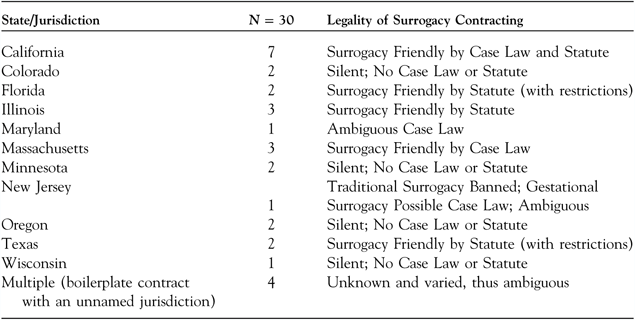
I also conducted an exploratory content analysis on a sample of thirty surrogacy contracts from eleven different jurisdictions to analyze both the nature of terms and provisions in the agreement, and the mechanism whereby specific terms, rules, and provisions seek to manage risk. Those jurisdictions are: California, Colorado, Florida, Illinois, Maryland, Massachusetts, Minnesota, New Jersey, Oregon, Texas, and Wisconsin. A distribution of the sample by state and type of law is depicted in Table 1. The size of the sample was limited by lawyers’ reluctance to share contracts they reportedly spend endless hours drafting and withhold from competitors and by a fear of liability should “their” contract be used without permission in a locale where the provisions are unenforceable or illegal. Given these conditions, the sample size is ample.
Distribution of Surrogacy Contracts by State and Law Type

I qualitatively coded each contract in my sample for content and interpretation using Atlas.ti computer-aided qualitative data analysis software (CAQDAS) (Friese Reference Friese2012; Saldana Reference Saldana2009; Snow, Morrill, and Anderson Reference Snow, Morrill and Anderson2003). Because surrogacy contracting is relatively uncharted, the broader goal of the content analysis was to determine: (1) the types of clauses that are used in agreements, (2) the values for fees, compensation, and risks in various contract provisions, and (3) variation across the sample. I searched for patterns of action and consistencies using descriptive coding, process coding, and in vivo coding (Saldana Reference Saldana2009).
I looked for patterns in the types of terms, rules, and provisions developed and used by lawyers and matching agency representatives to compensate for services, risks, and otherwise govern the relationship between the surrogate and intended parents, and the degree to which language across contracts varies. I searched the text of contracts for coherent meaning structures and identified core consistencies and patterns in the data (Patton Reference Patton2002). I coded twelve major characteristics of surrogacy agreements in my sample, six that broadly capture the risk management content of contracts, which apply to this study. All twelve characteristics have multiple linked subcodes (Friese Reference Friese2012).
Every line of each contract in the sample was reviewed to understand the overall architecture of a surrogacy contract. I then developed six broad coding categories and their subcodes to identify: (1) setting and context, like the state or jurisdiction; (2) the subject and their status; (3) terms of art, processes, or issues reflecting legality; (4) the nature of the exchange or consideration for the accord; (5) the duration of the relationship; and (6) work and employment terms.Footnote 3 Each of these categories is linked to legal risk management. The fact that legal risk management frames the entire agreement makes sense given the purpose of contracting in general: insurance for the parties in case of breach (Macaulay Reference Macaulay1963; Macneil Reference Macneil1974; Suchman Reference Suchman2003). These six broad categories and their subcodes enabled me to map to the major contents of surrogacy agreements.
FINDINGS AND ANALYSIS: THE VALUE OF WOMB WORK
What is the current value of surrogate labor and risks in the United States baby market? Further, how do fees and compensation provisions serve to manage legal and medical risks in a marketplace steeped with both moral ambivalence and disparate laws? While the content analysis reveals what consideration is offered through fees and compensation for surrogacy services, the interview data illuminate the context for those values, how they are experienced, deployed and interpreted by actors embedded in a contested reproductive market. The absence, presence, and variety of compensation clauses, fee, bodily autonomy, and risk provisions were systematically coded to identify categories, values, and degrees of risk for each case, searching for patterns that emerge from all cases (Hsieh and Shannon Reference Hsieh and Shannon2005; J. Lofland, Snow, Anderson and L. Lofland Reference Lofland, Snow, Anderson and Lofland2006). I also used the content analysis of contracts to compare the language between agreements in the sample to identify variation across contracts and analyzed them in light of interview data. Content analysis of the agreement, combined with context from interviews, are ideal methods for uncovering how those agreements capture the value of womb work and risk and make them meaningful in the reproductive market, with transformative impacts.
Compensation and Payment Provisions
Compensation clauses reflect the market value of surrogacy, as well as the significant risks involved, and are one of the core elements of the exchange relationship. They are highly symbolic and convey status within an unsettled and contested sociolegal environment. Contracts have actual legal power while conferring legitimacy to womb work.
The content analysis of the contract sample indicates that base compensation, or what a California agreement calls “main compensation,” ranges from $18,000 to $50,000. However, $50,000 was an outlier and was found in only one contract from Texas. The average for all contracts exempting the outlier was $23,000, and the lowest compensation came from Oregon. Data triangulated from interviews of lawyers, agencies, and their clients confirms the range. One representative lawyer in the study explained:
A first-time surrogate I would say nowadays, the low start fee is probably $20,000, and I’ve seen a first-time go up to $28,000, and that’s the base fee. And then there’s usually an addition for twins that’s usually anywhere from $3,000 to $5,000 if you carry multiples. (Lawyer, CA)
Thus, base compensation increases when gestating multiples, acknowledging the additional risk and effort. In fact, surrogates who have been through one, two, or more prior surrogate pregnancies command the most remuneration uniformly across jurisdictions. Respondents explained that, in addition to medical risks in pregnancies for multiples, there is a relational component: the surrogate has demonstrated she can successfully gestate and hand over the baby in the end, performing the contract. This decreases anxiety in the parents, who report that if she has given up one baby, she is likely to give up another. Perceiving the process as less risky has monetary value.
Note that half the sample could not be included in the calculations for analysis because they had blanks or zeros adjacent to the compensation line. Blanks typically indicate the payment amounts were negotiable. Whether there was a blank, an amount, or a range also varied depending upon the involvement of a matching agency and its practices, since subjects report they set rates, which are now standardizing for gestational services and fees. In those cases, a surrogate accepts what she is offered, and in fact, agency contracts may prevent her from receiving more than a maximum sum. One Wisconsin gestational surrogate who was paid the cap of $25,000 for her services admitted that, “$50,000, in retrospect, would be more fair.” Thus, the Texas outlier from my contract sample paying $50,000 in compensation may be signaling that the going rate is moving in the “more fair” direction and that at least some surrogates in the United States have more agency and bargaining power. How do participants understand these provisions?
During interviews, lawyers emphasized that surrogacy was not a “job,” nor were the intended parents “employers.” Per lawyers in the study, that characterization would have legal ramifications like taxation and worker’s compensation, confirming what Crawford (Reference Crawford and Brooks2011), Milot (Reference Milot2010), Holcomb and Byrn (Reference Holcomb and Byrn2010), and others have advocated for some time.Footnote 4 Resistance to calling gestational services a “job” or “employment,” and strategically avoiding tax consequences, also flags the incomplete commodification of this market (Krawiec Reference Krawiec2015). Notably, my subjects did not report their gestational services as a “gift” if they received compensation, as other scholars have highlighted in the context of egg donation markets (ibid.; Almeling Reference Almeling2011). Perhaps this signals that the surrogacy market in the United States, despite a conflict among state laws, is more completely commodified than other reproductive and bodily goods markets.
Surrogacy contracts frame base compensation to “Carriers” as “service,” “inconvenience,” “pain and suffering,” “assistance,” and reimbursement for “personal discomfort.” Further, contract clauses specifically acknowledge consideration for both medical and psychological risks. Here are notable examples:
As consideration for the risks, responsibilities, inconveniences, and expenses incurred by the Carrier, hereunder, as well as support for the Child(ren) carried, and for so long as Carrier and her husband are not in breach of this Agreement, the Commissioning Couple agree to pay the Carrier compensation in the total amount of $25,000.00. (Contract FL)
The Biological Parents agree to pay the Carrier as compensation for the services provided the sum of Twenty One Thousand Dollars ($21,000.00) (hereinafter the “Main Compensation”) payable to Carrier as full compensation to Carrier for her assistance provided for herein, as well as for time spent, personal discomfort and other personal inconveniences to Carrier, and risks assumed by the Carrier, in connection with her performance pursuant to the terms of this Agreement. (Contract CA)
INTENDED PARENTS hereby agree to reimburse CARRIER for her inconvenience, pain and suffering, and for her assumption of all medical and psychological risks as set forth herein in accordance with the payment schedule attached hereto as Exhibit D. (Contract MA)
The language above aligns with the interview data, which report surrogates are compensated for “gestational services,” “inconvenience,” “pain and suffering,” or as one Texas lawyer characterized it, “wear and tear on the female body.” While some lawyers frame it as a service, others predict torts by formalizing in advance what the consequence of negligence will be, rather than calling it income. Similarly, taking cues from family law, some lawyers frame payments as “pre-birth child support.” When asked to explain the rationale, a Texas attorney said, “because, [the intended parents] are required to support the child,” especially for medical costs, while “in utero” (Lawyer TX).
Thus, some lawyers take sanctioned practices from family law or torts and transpose them to surrogacy in the absence of set norms and rules in the field. After all, as one lawyer explained, “you have to be very careful about any exchange of money to somebody who you’re asking to relinquish parental rights” (Lawyer TX). Given medical and legal risks, as well as social unease, these alternative frames help actors make cultural sense of the market and likely make it more palatable and familiar (Krawiec Reference Krawiec2015). It appears that less completely commodified and legally ambiguous markets cover their bases with language that dilutes the reality of “exchange.”
What else might account for differences between jurisdictions? The variable language and terms for compensation in a surrogacy agreement appears to correspond to the law of the state in which it was drafted. For example, the California contract above specifies payment is “compensation for services,” which comes directly from the language of Johnson v. Calvert (CA 1993) before a statute was enacted. Similarly, Illinois is reported by participants across states as the most “surrogacy friendly” and has regulated paid pregnancy by statute the longest, making contracting practices there less risky, less stigmatized, and more normalized. That statute not only openly frames third-party gestation as a “service” but also acknowledges the effort and risk involved in the process (750 ILCS 47, 2005).Footnote 5 An Illinois contract in my sample makes clear she is being paid “for her effort, risk, and work” related to “her service as a gestational surrogate,” as well as her effort in “nurturing and sustaining the Intended Parent’s child.” By overtly acknowledging, rather than hiding, compensation for reproduction, contract provisions legitimize, elevate, and transform pregnancy into womb work, distancing it from a morally repugnant exchange (Crawford Reference Crawford2019; Healy and Krawiec Reference Healy and Krawiec2012). Since contracts must avoid characterizing surrogacy as “baby selling,” the Illinois contract also plainly affirms compensation is not for “the outcome of the pregnancy.”
Relatedly, a surrogacy agreement cannot be framed as a sales contract, since there are international bans on markets in children and trafficking in women. Therefore, unlike surrogacy-friendly California, Illinois, or Massachusetts, states that have no case law or statutes regulating surrogacy or ambiguous law tend to cover their bases, paying not only for the “service” and “medical risks” but also “as an expression of Intended Parents’ appreciation” for the “pain and suffering, discomfort and inconvenience Gestational Carrier will experience” (Contract CO). Not only does this reflect variation within an incompletely commodified market—that some markets are more completely commodified than others in a disparate legal environment—but demonstrates the complexity of economic life and organizational practices. While not struggling between the language of “gift” and “commodity” as in donor markets (Almeling Reference Almeling2011; Healy and Krawiec Reference Healy and Krawiec2012), participants in surrogacy can hold multiple understandings of the same activity to manage risks, uncertainty, and ambivalence in the practice (Ibid.; Pande Reference Pande2014).
Overall, there was variation in base compensation regardless of what it was termed, excluding from calculations what I call “compassionate contracts.” A compassionate contract—also referred to by study subjects as “gift surrogacy” —is a process for a family member or friend that does not include base pay, but may include payment of expenses. These were still formalized via contract. Most typical were compassionate contracts between siblings and cousins. However, “gift surrogacy” is not the same as casting the practice as an “act of compassion” in order to manage moral repugnance in the market (Rudrappa and Collins Reference Rudrappa and Collins2015). Rather than a rhetorical strategy, it is an instrumental way for lawyers and agencies to distinguish between types of compensated agreements: those that include base compensation, and those that only reimburse for actual costs and fees incurred by a familiar.
While compensation figures partly transferred from adoption law, the range of fees provided in surrogacy contracting go beyond those in adoption. The nature of contracting for costs and fees, in advance of a confirmed pregnancy, is also quite distinct.
Fees for Medical Procedures and More
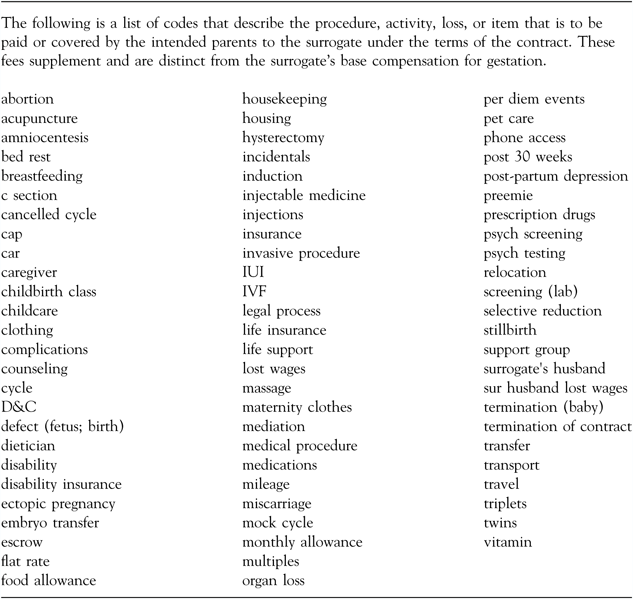
In addition to base compensation, the findings reveal surrogates receive fees for a number of specified items formalized in contracts. A comprehensive list of the seventy-six different fees coded from the content analysis of the contract sample appears on Table 2. Thus, payments are not strictly for the value of the service of gestation but also add a variety of supplemental fees and perks. Some examples of the former include a fee for enduring an amniocentesis, undergoing a caesarean section, and “selective reduction” or abortion of fetuses. Examples of the latter include a bonus to get a massage, housekeeping, and even a pet care allowance. These fees are becoming institutionalized in the reproductive field and were found across the contract sample, but have variation. I next provide a few examples of fee provisions from the content analysis and interviews to show how the legal process of bodily commodification unfolds above the main compensation.
List of 76 Codes for the Types of Fees Paid to Surrogate

To begin, as an Oregon agreement states, “In the event that a cesarean section is ordered to deliver the child(ren), the Gestational Surrogate will be paid an additional $1500.” In California, a c-section is also worth $1,500, which may be a sum standardizing across jurisdictions, at least on the West Coast. In Wisconsin, a more generous agreement reads: “$3,000 if Child is delivered by Caesarian Section.” But in another Oregon contract, the c-section fee is negotiable, indicated by the blank text in another color and font on the draft agreement: “C-section $HOW MUCH? if the child is delivered by Caesarean Section in accordance with the recommendations of GC’s prenatal care providers. Notwithstanding the provisions of subsection 14.4, below, this compensation is payable regardless of when the Caesarean Section occurs and/or whether the child survives.” The fact this figure is open reveals some agency on the part of surrogates and intended parents to negotiate fees they deem appropriate, as well as diversity among practices by lawyers even within the same jurisdiction. It also shows payment is not contingent upon a healthy birth but for enduring the procedure itself.
What about the risk of carrying twins or higher multiples? There is wider variation, ranging from $1,000 to $5,000:
Two Thousand Dollars ($2000.00) in the event of a twin pregnancy, to be paid in four payments of Five Hundred Dollars ($500.00)…. Three Thousand Dollars ($3000.00) in the event of a multiple pregnancy higher than a twin pregnancy, to be paid in four payments of Seven Hundred Fifty Dollars ($750.00) every four weeks. (Contract IL)
$5,000 @@ [for each additional fetus carried] or [if carrier carries twins] beyond 28 weeks gestation. (Contract WI)
An additional Two Thousand and no/100ths Dollars ($2,000.00) for gestational services for a multiple birth. (Contract MN)
If the Carrier is pregnant with triplets, she will receive an additional $1,000.00 for months four through nine of her pregnancy for the additional living expenses that result from carrying multiples. (Contract FL)
There is less variation in supplemental fees to endure the amniocentesis, which appears to be standardizing as worth $500 across jurisdictions, per these two examples:
The Sum of Five Hundred Dollars ($500.00) for an amniocentesis or CVS procedure regardless of the number of fluid draws per individual procedure. (Contract CA)
An additional Five Hundred and no/100ths Dollars ($500.00) per procedure for … D&C, CVS and/or an amniocentesis. (Contract MN)
However, one Maryland contract did not provide any supplemental allowance for enduring the amniocentesis procedure—at least not formally in writing—instead directing the surrogate to “permit monitoring by frequent testing for normalcy of the fetus” and if “deemed medically advisable” have an “amniocentesis or chorionic villi sampling.”
The content coding revealed provisions for a number of medical procedures and risks, including fees for abortion, induction, bed rest, ectopic pregnancy, transfers, in vitro fertilization, hysterectomy, mock cycles, and more. Contracts were inconsistent as to how many and the kinds of fees that would be paid, in addition to their amounts. However, it is clear that, despite social anxieties about womb work, the market is highly active and commodifying body parts, as well as serious medical risks.
What is permanent loss of reproductive function worth? Apparently in both Massachusetts and California, $3,000:
The sum of Three Thousand Dollars ($3,000.00) if the Carrier suffers a loss of any reproductive organ(s) herein that renders the Carrier unable to conceive or carry a child of her own. (CA)
Loss of Reproductive Parts. In the event that CARRIER suffers a loss of any reproductive organ as a result of the IVF process, pregnancy and delivery contemplated under this Agreement, the INTENDED PARENTS shall pay CARRIER $3,000.00. This paragraph shall not apply to any elective medical procedures. (MA)
And what do loss of reproductive function clauses mean to the attorneys in the study? When I interviewed a different California lawyer, she revealed:
It’s ridiculous. It’s anywhere from $1,500 to $5,000 depending. … And I think—it’s funny. The more I talk about this stuff out loud, the more it just does sort of make me kind of feel sick inside because it is—I do feel like it’s being—I view it as much more of a commodification now than I ever did before. I mean it’s like putting a price on these things, and that’s what I have to tell my clients. Like, “We’re going to request a loss of reproductive organs only so that everyone understands it’s a consideration. The money they’re going to give you is never going to compensate you for what you’re going to lose or what you could lose or the hormone therapy or anything else that you’re going to have deal with,” but it’s more or less to get, in my view—to have people understand that there is a risk.
For this lawyer, delineating fees for bodily risks in the formal agreement serves less to place an actual value on a women’s uterus as a body part, but instead, mentally prepare and manage clients for the medical risk via consideration and elicit informed consent.
However, a surrogate in the study who had to haggle during her contract negotiations sees fees for loss of reproductive function differently. She explained, “being a young person, I felt that loss of reproductive organs was important and later down the line, we’ll find out how that was important. So the standard for that is usually $2,500. Mine was put a little bit higher. It was put at $7,500” (Surrogate IL). In fact, she had serious complications following an in vitro fertilization procedure and lost her fallopian tube. Curiously, the lawyers battled over paying out the sum she negotiated; the intended parents only ended up giving her $3,250. Thus, the Illinois surrogate who actually experienced permanent medical complications felt inadequately compensated, endured suffering, and appeared not to have a rigorous legal advocate. In the end, rather than sue to enforce the original bargain, she “lumped it” (Engel Reference Engel2016), even in surrogacy-friendly Illinois.
More importantly, both the California attorney’s and the Illinois surrogate’s perspectives make visible interactions unfolding an incompletely commodified market in flux between industry and nonmarket norms and an unsettled, nascent legal field increasingly using contracts to rationalize and legitimize the exchange. Clearly having trouble talking “about this stuff out loud,” the attorney expresses her moral ambivalence about surrogacy as “much more of a commodification now.” She understands that “open displays of materialism are deemed socially unacceptable,” as Krawiec has theorized (Reference Krawiec2009, 207). Our lawyer admits that “putting a price on these things” “does sort of make me kind of feel sick inside.” These “things” are women’s bodies, doing risky womb work, and outside the norm.
While our attorney manages the social and moral unease of the market, our surrogate manages the actual consequences of this largely unregulated market and some lack of bargaining power to enforce the terms of her agreement. In tears the surrogate recalled, “I just felt like a failure … and I felt like I set out to do something so great, and now it’s ending so wrong. And now here I am putting my health at risk” (Id.). She added that her husband was “sitting in the hospital while his wife has internal bleeding—and now he is worried about his children not having a mother.” This may flag concerns regarding stratified reproduction and evidence support for more uniform, protective policies to balance power in these relations. Note there are provisions in the sample of coded surrogacy contracts that pre-establish claims for intentional infliction of emotional distress in the case of breach, given potential medical and psychological risks. However, that clause typically favors the intended parent(s) in anticipation of the kind of “anguish” and “loss” they would feel if the surrogate refused to cooperate fully in performance of her contract. This too demonstrates more power on the side of parents, rather than surrogates, for contract enforcement.
Still, price tags placed on the inconvenience and risks inherent in surrogacy are arguably empowering, given the historical failure to commercially value women for their domestic labor, let alone, their gestational services (Crawford Reference Crawford2012; Field Reference Field1990; Holcomb and Byrn Reference Holcomb and Byrn2010; Milot Reference Milot2010; Shalev Reference Shalev1989). Other types of payments are applied to nonmedical incidentals such as housekeeping, child care, maternity clothes, special diets, lost wages, and travel expenses, to name a few. Trying to handle a household of your own while pregnant with other people’s children can be stressful, which these fees acknowledge through payment. For example, a “household helper” is offered at “$100 per week (paid monthly in advance) in the case of a multiple pregnancy or high-risk pregnancy” to manage the additional pressures the pregnancy brings (Contract OR). Fees can also be paid to the surrogate’s husband for his lost wages and travel when he supports his wife in performing the contract.
Finally, and to avoid conflicts and similar scenarios, intended parents may support the surrogate’s womb work by paying for the cost of individual psychological counseling or support groups.Footnote 6 Here are two representative provisions from Wisconsin and California
The Intended Parents shall pay for all professional fees and costs associated with the psychological review, evaluation, attendance of support group meetings and/or individual counseling sessions; provided, however, unless otherwise agreed by the Parties in a separate writing executed by the Parties subsequent to the date of this Agreement, the Intended Parents shall only be financially responsible for one (1) session per month, as well as $100.00 per month payable to the Surrogate for her attendance at in person sessions only. … The Surrogate represents that she will attend all monthly support group meetings as may be requested by the Intended Parents or Agency. (WI)
In the event psychological counseling and/or therapy is provided to the Surrogate pursuant to the terms of the Agreement, the Intended Parents shall pay the professional charges of a mental health professional for up to the sum of $1,200 (i) during the term of this Agreement and (ii) up to two months after a delivery or termination of this Agreement (whichever occurs first). (CA)
Agencies and lawyers anticipate the emotional, complex, and ambivalent experiences in surrogacy, and thus, encourage counseling. These provisions account for the cost of therapy, paid by the intended parent(s). However, contracts vary as to the limitations or caps they apply to the counseling fee, such as $100 per month or up to $1,200. All of this affirms what Holcomb and Byrn argue—that however personal and separate from the market society placed reproductive labor in the past, today a surrogate’s “body is her business” (Reference Holcomb and Byrn2010).
However, counseling is not always covered as a fee in surrogacy contracts. A New Jersey agreement contends, “The Genetic Father and the Intended Father shall not be responsible for: (1) Any expenses relating to emotional or mental conditions or problems of the Traditional Surrogate, whether or not usually connected to the Traditional Surrogate’s pregnancy.” In contrast to the provisions above, there is an absence of risk management, unless the surrogate pays for therapy herself. Perhaps examples like these affirm that surrogacy is normalizing in the market as just another kind of risky job like boxing, fishing, or military service which may or may not offer behavioral health coverage (Healy and Krawiec Reference Healy and Krawiec2017). This seems surprising given it is a traditional surrogacy contract, which In Re the Matter of Baby M institutionalized as “fraught with emotion” in that very same state (NJ 1988).
Bodily Autonomy and Risk Provisions
In addition to base compensation and a variety of fees, a series of rules and provisions govern the amount of autonomy a surrogate is asked to give up over her body while pregnant and the level of risk she is willing to assume for a third party when paid to do so. These provisions do not offer additional remuneration but are in consideration of overall contract compensation. The data here vividly reveal how this nascent field is caught in normative flux—a transition between the reality of an active market in bodies and babies and embracing that market as socially acceptable (Krawiec Reference Krawiec2009). They also demonstrate spaces of resistance and emerging norms that reproductive labor is a job and not a “gift,” per other scholarship that views the rhetoric of compassion as a mediating strategy for organizational actors (Almeling Reference Almeling2011; Healy and Krawiec Reference Healy and Krawiec2017; Rudrappa & Collins Reference Rudrappa and Collins2015). The interview data demonstrate the ways in which these provisions are deployed by lawyers on behalf of anxious intended parents who seek veto power over key decisions normally made by a birth mother that impact the ultimate goal of the contract: a healthy baby. Bodily autonomy and medical risk provisions manage the intended parents desire to control not only the quality of the baby but also the quantity of children desired. But do they also provide a window into potential conditions for stratified reproduction and inequality now emerging in the field?
My content analysis of the contract sample revealed three striking areas in which this is the case. The first is the rules surrounding what is called “selective reduction” and “termination,” or choosing which fetuses to abort in the case of (1) abnormalities and defects, (2) gender selection, and (3) multiple unwanted fetuses. The second area is in the case of serious complications, where the surrogate’s body must be maintained on life support equipment in order to incubate the fetus until viable outside of the mother’s womb. The third might be described as the essence of an agreement: assumption of the risk clauses. To the extent conflicts arise over crucial decisions affecting the outcome of the pregnancy, attorneys manage significant legal as well as physical risks in a largely unregulated field.
Even when a surrogacy contract contains strong statements of intent regarding custody of the child in the recitals and representations section, there is typically a separate provision describing in detail who will have legal custody and who will have physical custody of the child. Legal custody includes statements in surrogacy agreements that the intended parents have a right to make medical decisions regarding the fetus prior to and after birth—despite the fact it is in utero—whereas physical custody implies the right to have control of them upon birth. Given political efforts by religious lobbies towards greater “fetal rights” (Freedman and Weitz Reference Freedman and Weitz2012), the emergence of contract provisions that establish rights to parentage while the child is in utero reflect broader market interactions with other sociolegal norms in reproduction. For example:
WAIVER OF GESTATIONAL SURROGATE’S PARENTAL, CUSTODIAL, AND RELATED INTERESTS All Parties agree that the purpose of this Agreement is to establish Intended Parents as the legal and natural parents of the Child from and after the moment of conception, and Intended Parents therefore should be legally recognized as such, and that Gestational Surrogate and Husband do not in fact have any parental rights to the Child, and no such rights should be recognized. (Contract IL)
This contract establishes parentage “from the moment of conception” as a symbolic accord between the parties, and since maternity is attributed by the fact of gestation under the Uniform Parentage Act. Thus, provisions, which vary by jurisdiction, describe how parentage will be legally established. In some states, the surrogacy contract will direct the surrogate and her spouse to cooperate in obtaining a pre-birth order that establishes parentage in the intended parents while the fetus is in utero.Footnote 7 In others, post-birth legal procedures are required, as in adoption. Clearly, the level of control over the surrogate’s body formalized in contracts as establishing legal custody in a fetus implicates multiple concerns voiced by feminists regarding women’s autonomy and fundamental rights.
Perhaps the most complicated provision related to bodily autonomy is a clear and separate one describing intentions for the termination and selective reduction of fetuses, rules for carrying of multiples, abortion when abnormalities are detected following amniocentesis, and what to do in the event of a miscarriage or stillbirth.Footnote 8 Most of the contracts in the sample across jurisdictions contained a statement that despite the intent of the parties to give control over the decision whether to terminate a fetus to the intended parents, Roe v. Wade (US 1973) remains the law of the land. In my sample, 83 percent of the contracts (twenty-five) plainly state that the surrogate retains her fundamental constitutional right to carry, or not carry, a pregnancy to term. In two representative examples, one appearing in all capital letters per the original:
NOTWITHSTANDING THE PROVISIONS OF THE SECTION (ABORTION/ SELECTIVE REDUCTION) ABOVE, OR ANYTHING TO THE CONTRARY, ALL PARTIES UNDERSTAND THAT A COURT MAY DETERMINE THAT A PREGNANT WOMAN HAS THE ABSOLUTE RIGHT TO ABORT OR NOT ABORT ANY FETUS SHE IS CARRYING AND ANY PROMISE TO THE CONTRARY MAY BE UNENFORCEABLE. TO THE EXTENT THAT THE SURROGATE CHOOSES TO EXERCISE HER RIGHT TO ABORT, OR NOT ABORT, IN A MANNER INCONSISTENT WITH THE INSTRUCTIONS OF THE INTENDED PARENTS, IT IS UNDERSTOOD THAT SUCH ACTION MAY BE DETERMINED TO CONSTITUTE A BREACH OF THIS AGREEMENT. (Contract CA)
This provision seems more protective of the surrogate and respectful of her fundamental rights and thus, potentially empowering. This comports with findings from Pande (Reference Pande2014), Rudrappa and Collins (Reference Rudrappa and Collins2015), Teman (Reference Teman2010), and Jacobson (Reference Jacobson2016) that find not all surrogates are victims. But there are degrees of power and agency, and the reproductive market is a complex, interactive terrain (Almeling Reference Almeling2011; Healy and Krawiec Reference Healy and Krawiec2017).
However, other contracts better reflect the incompletely commodified nature of the market, as well as the legal and moral ambiguity of womb work. For example, in Minnesota:
Voluntary Termination of Pregnancy (Abortion) Gestational Carrier and Genetic Parents understand that the United States Supreme Court cases of Roe v. Wade, 410 U.S. 113 (1973) and Planned Parenthood of S.E. Pennsylvania v. Casey, 505 U.S. 833 (1992), grant constitutional protection to a woman’s right to elect an abortion. Notwithstanding the foregoing, it is Gestational Carrier’s express intent to contractually waive, and she does hereby expressly contractually waive, that constitutional right, and Gestational Carrier hereby expressly grants Genetic Parents the exclusive right and sole discretion whether to terminate a pregnancy by abortion or continue a pregnancy. Gestational Carrier expressly agrees to execute any necessary addenda, waivers, consents, or other related documents to reaffirm her contractual waiver of this constitutional right and to make this waiver effective once a pregnancy is confirmed. All parties expressly acknowledge that it is unclear whether this contractual waiver will be enforced as intended by a court of competent jurisdiction. (Contract MN)
While contracts expressly acknowledge that a surrogate retains the ultimate right to control decisions over her body, even as regards termination of a fetus she is carrying for another person by contract when they object, she may be asked to waive that right. Participants in the study said non-waiver may be a “deal breaker.” Whether such a waiver is legally enforceable is a separate issue, demonstrated by cases like that of gestational surrogate Crystal Kelley (Cohen Reference Cohen2013).
Even in the absence of a waiver, exercising that right to abortion in the case of surrogacy may constitute a breach of contract for which there are serious financial consequences that a surrogate cannot likely afford. As described in other research, matching intended parents with surrogate’s views on abortions is an anticipatory emotion management technique intended to avoid conflicts, legal risks, and is key to evaluating their emotional fitness for the process (Berk Reference Berk2015). Selective reduction and termination provisions are carried over from the matching phase by lawyers and crystallized in the formal agreement. Selective reduction and abortion provisions may be an area for legitimate concern by feminist scholars who are concerned about stratified reproduction in this market. Their fears may be warranted, or appeased, depending upon degrees of power individual surrogates have to cede to demands or resist and their options in the marketplace. Abortion provisions reflect the complexity of interactions in the market with other social norms and practices and the quintessentially gendered nature of these exchange relations.
Given the potential for complications during pregnancy, how is the risk of death managed in contracting? As described in the content analysis, “Carrier Incapacity” provisions detail the conditions under which a surrogate will be maintained on life support to gestate the fetus. As a Texas lawyer simplifies, “if the carrier is married, her husband agrees not to pull the plug as long as the baby is viable.” Life support provisions invoke the long-held fear of critics that surrogacy has unique gendered effects: a woman’s body becomes, quite literally, a vessel for reproduction. The surrogate and her husband agree to formally bind themselves to life extension at the request of the intended parents in consideration for her base compensation, which is on average $23,000. But to accept the benefits of surrogacy, the risk of terminal incapacity must be anticipated.
Life support provisions require a rare commitment and appear to be diffusing in the field. Contracts coded from California, Massachusetts, Florida, Wisconsin, and Illinois have “carrier incapacity” provisions that detail the conditions under which a surrogate will be maintained on life support to gestate the fetus. An exemplar California contract reads:
Section 32.01. Surrogate agrees that in the event she suffers a life-threatening injury or illness while pregnant, Surrogate agrees she will be sustained with life-support equipment to protect the fetus(es)’s viability so long as she has reached 25 weeks of gestation at the time of the injury and/or illness. Surrogate’s treating physician in consultation with the Obstetrician shall determine when the optimal time for birth will be. This provision shall supersede any and all other documents prepared for and/or wishes made known by the Surrogate to the contrary; this provision shall only apply during the term of this Agreement.
An incubation period beginning at twenty-five weeks while the surrogate is a “host uterus” will inevitably be an emotionally challenging period for the surrogate’s husband and children. But what do these provisions look like “in action” when negotiated, and how are they experienced by the participants immersed in the contracting process?
Negotiating life support provisions, along with selective reduction and abortion provisions, can be dicey and highlight tensions between commodification of the body and moral repugnance for it within a nascent and unsettled market. In one California attorney’s experience:
Lawyer: You get to know each other a little bit during this meeting as well, but you cover important things like what are your feelings about abortion and reduction and medical emergencies and life support and all the really high, intensely emotional things that could happen and hopefully never do. But you talk about them so that you are on the same page, but you also get to know each other. … Oh, yeah. Those are the bigger issues.
Interviewer: Those are the bigger issues.
Lawyer: Life support is another one. It gets some additional attention during the contract negotiation stage. I’ve never—thankfully [knocks on wood] never had a situation actually arise where life support was necessary. I think it’s extremely rare, but the typical contract provision would say that if the surrogate’s life is so severely threatened that she may need to be—she’s not going to survive unless she goes on life support, if there’s an option medically to save the baby, the contract would say that if the parents wish—if they request it at the time, then you agree to be put on life support, so you and your husband both agree to save the baby and its life—if she’s not going to make it, at least try to save the baby.That’s the general concept, so most people are fine with that, but every once in a while you get somebody very sensitive about the idea of life support, and the surrogate approaches it from the point of view of, “How long am I going to be on life support, and how long will my family have to grieve and not have closure, and I don’t know how I feel about that, and do I have religious viewpoints on this, too.”
Interviewer: So you’re talking about life support for the surrogate, not necessarily a preemie birth where there’s some issue surrounding the—Lawyer: No, yeah, yeah, yeah, yeah.
Interviewer: I see—very interesting.
Lawyer: For the surrogate—a very complicated emotional issue, and we try to handle it in the contract because it is so complicated. We try to give them a roadmap to follow in the event of this extremely unlikely situation. And the people who are paying a lot of attention to the contract and thinking through it carefully that have issues with it will discuss it and we’ll maybe have to work with the language in that provision.
This interview reveals several findings. First, it demonstrates that surrogacy contracts are thoughtfully considered, negotiated, and taken seriously and that surrogates do have some agency, at least some of the time. Second, life support provisions in contracts—and the lawyers who draft them—manage social and moral unease about this market in normative transition, as well as legal ambiguity, uncertainty, and risk. Third, contracts have far more than symbolic force, they have actual formal power.
While he perceives it is “rare,” complications during pregnancy do occur, including several cases of death and serious injury reported during interviews for this research study. Life support provisions are not merely one of the “high, intensely emotional things” lawyers and their clients must handle but also symbolize a level of control and commodification unusual in other “labor” or service contracts. In this way, womb work is distinct from other risky forms of labor, as Pande proposes (Reference Pande2014). Both life support and abortion provisions highlight the space that production and reproduction meet inside a woman’s body and in a uniquely gendered way. On the ground, the lawyer’s strategy as an actor mediating an unsettled sociolegal environment is to meet to inform all parties of the risk, talk through the provisions, broach it again during contract negotiations, and offer a “roadmap” for the parties to “think through it carefully.” Life support provisions show that womb work is not like other risky jobs, which would not have such terms in their contracts.
In addition to life support provisions, 73 percent of contracts (twenty-two) provide the surrogate with life insurance coverage for her spouse and children if she dies from pregnancy-related complications. However, the contracts vary as to the maximum amount the intended parents are required to spend on her behalf. In my sample, the amount of money allotted towards the purchase of a life insurance premium ranged from $250.00 to $500.00 as an annual cap. Those premium costs translate to a policy value that ranges from $100,000 to $350,000 to be paid to the surrogate’s family in the event of her death. Valuation of the surrogate’s life is itself a highly symbolic provision, formalizing an assessment of what gestational labor, exclusively performed by women, is worth. Insurance provisions are also related to “assumption of the risk” provisions, which are universal in surrogacy contracting.
Predictably, “assumption of the risk” provisions also appear in surrogacy agreements, and perhaps carry over from other types of risky service contracts. But the provisions are not generic. These clauses require a surrogate, in the face of grave risks, to assume those risks only upon “careful, unemotional reflection” (Contract MA). I found such phrasing in 33 percent of the sample. Representative provisions include a California contract where, “The Parties to this Agreement represent and warrant that the decision to enter into this Agreement is a fully informed decision, made after careful and unemotional reflection,” and in Minnesota where, “The decision of Gestational Carrier to enter into this Gestational Carrier Agreement is a fully-informed one, made after careful, objective, and unemotional reflection on all aspects of this arrangement.” The call for “unemotional reflection” in surrogacy contracts evidences the persistence of a rational choice, liberal legal model of bargaining and risk management. It also perpetuates a fallacy that “emotion” is separate from “reason,” that objectivity is possible (or desirable), and makes subordination in exchange relations invisible. Rather, all market transactions—including those in baby markets—are interactive social processes made up of individual, organizational, and institutional relations, further mediated by cultural norms.
Agreements in the sample not only require assumption of the risk, but also simultaneously warn that, “the short-term and long-term psychological effects of Surrogacy Arrangements on the Parties or on the Child are not predictable” (Contract IL). Apparently, parties are to calculate unknown psychological risks free from emotion. Perhaps future work can compare the contents of assumption of the risk clauses in surrogacy to other types of risky work, such as for athletes, stunt doubles, and service personnel. Until then, this sample demonstrates there is an active market in womb work, and the sociolegal field is moving beyond debates about the morality of bodily commodification. Bodily autonomy and risk provisions serve a legitimating and normalizing function that further concretizes womb work as a risky job.
“Savvy” Surrogates and “Rock Star” Parents: Negotiations, Agency, and Stratified Reproduction
Given negotiations over compensation, fees, bodily autonomy, and the value of risks in surrogacy contracts, what variation was identified in how this commodified exchange is experienced by participants in the sociolegal market overall? More importantly, are there findings to suggest conditions are ripe for stratified reproduction in US surrogacy markets? Subjects described negotiations that spanned the banal to shameful to contentious. Some surrogates expressed gratitude when connected to more generous intended parents, and may then contract for a second pregnancy. Others come to the bargaining table well-informed and savvy.
Regardless, there are class differences between the parties. Most intended parents are typically older, more educated, and wealthier than the surrogates they hire, which empowers them in a variety of ways, namely, they are the party who pays the lawyer drafting the agreement and rewards the agency who facilitates the match. Still, intended parents not only face their strong desire for a family, which creates co-dependency, but also a possible six-figure price tag. Contract negotiations can be challenging for the intended parent(s) and their lawyers. Sometimes a savvy surrogate will cause stress, anxiety, and anger in the parents, especially those who feel desperate following infertility or miscarriage. In those cases, lawyers and agencies step in to “triage” a contentious situation (Berk Reference Berk2015).
How do parties interpret the overall compensation and their roles in light of these dynamics, as the field takes shape? Describing a recent contract, a lawyer in California illustrates:
I’m in the midst of a case that’s been very difficult to negotiate. I’ve been extremely disappointed and frustrated by the way it’s gone because they’ve got an experienced surrogate on the other side who knows better, and she’s pushing the wrong way. And I’m kind of pissed. And I was very frank with these clients that basically said, “Thank you so much, we appreciate that information so much. We are totally on the same page with you. We feel the same way, but you know what? We’re going to be rock stars. We’re going to swallow it. We’re going to take the high road. We’re going to give her the $2,500 because at the end of the day, I’ve got $110,000 price tag on this. And so if you’re telling me I’m about to lose my fantastic, amazing surrogate over $2,500, yeah, I’m pissed off, too. But thanks for checking, but we’re going to go ahead and swallow that.” And I’m going to try and make them look like heroes because they will, and they deserve that.
This interview uncovers several aspects of the exchange relation in action. First, the lawyer manages the risk of potential conflicts by strategically containing the situation. Without established norms and standards across the field, and in light of persistent social and moral ambivalence about womb work, she reassures her clients that she believes the surrogate is being unreasonable. The intended parents then reframe their identity as “heroes” and “rock stars”—rather than suckers—for being agreeable when it comes to money, diffusing the conflict. Also telling about the state of the baby market: lawyers manage risk by absorbing the feelings and the fight. When “all the love and the support and wanting to help each other sometimes gets broken down,” she explains, “I try and let that roll off my back. If they do go after me, that’s great. What I don’t like to see, obviously, is people going after each other. And better me than them” (Lawyer CA).
More importantly, this exchange demonstrates that some surrogates are not victims, have agency, and assert degrees of power. It empirically challenges assumptions and real fears that all surrogacy is oppressive for women in the United States, should be banned, and may contribute to further inequality, gender, and class stratification. After all, this California surrogate is not only “experienced,” “knows better,” and is “pushing” for better compensation in this negotiation, but also actually received what she advocated for in the end. However, my research informs that outcome is based on another important variable: the intended parents’ lawyer is a cautious, principled advocate, beyond operating within and constrained by a risky sociolegal market. In my research, lawyers like this one with membership in professional organizations who commit to best practices and ethical standards in assisted reproduction tended to be most mindful of their role in better balancing power.Footnote 9 Lawyer approaches and practices varied significantly within each jurisdiction and across twenty jurisdictions sampled for this study.
Other examples make power imbalances and inequality in individual exchange relations more visible. Even when intended parents may be generous with surrogate compensation, they expect to have more control in return. Thus, class, age, and educational disparity may show itself through demands and condescension, triggering conflicts. According to one Virginia lawyer:
Occasionally, during the whole process, there is—there are misunderstandings and there are resentments. That’s where I think the lawyers need to intervene and try to smooth things over … at least in the Washington, D.C. area [there] are couples where both spouses earn good money; they’re well-educated; they have usually reached certain milestones in life. It’s usually people in their late 30s or maybe early 40s would be the typical age range whereas the typical surrogate tends to be younger than that. The typical surrogate might be 25. And so you have an age disparity, and so you have a disparity in life experience. And once in a while, you have an attitude on the part of the intended parents, “Well, we’re footing the bill for all of this, and it’s a damned expensive proposition, so we should get what we want. And therefore, we can impose certain contentions upon the surrogate.” And that’s where, I think, the condescension comes in.
That “attitude” and “condescension” of the intended parents as described by the Virginia attorney was commonly reported by each of the four subjects in this study—including from parents themselves. Several subjects for this study assert power, control, and a sense of entitlement to demand what they “pay” for. The scope of that is still unclear in this market.
Similarly, a couple from California, on one hand joking their surrogate was the “oven” “cooking” their babies, ambivalently struggled that “she was sort of like a commodity or this machine or something,” noting “it took a while for me to be a peace with using a surrogate. … I don’t know how great like surrogacy is to the world.” On the other hand, subjects in each interview category reported that surrogacy is less about the money and more about enjoying the experience of pregnancy and the attention it brings. These examples not only bring a baby market in normative flux to life as participants grapple with bodily commodification and womb work but also show that actors in the field can hold multiple cultural understandings of the same practice at once (Almeling Reference Almeling2011; Healy and Krawiec Reference Healy and Krawiec2012; Pande Reference Pande2014). Even when parents acknowledge the tremendous “gift” the surrogate is giving them—which the interviews suggest they do—they might be simultaneously “respectful, but micromanaging” since they are paying, which are not, according to a lawyer in Oregon, “mutually exclusive.” Surrogacy, and actors’ identities within it, can thus be commodifying, alienating, empowering, and more.
Importantly, some intended parents will ask their surrogate to cut her fees, even though she is most often receiving less compensation than agencies for their matching fees, which average $25,000-$28,000 per match. In fact, of all the “actors” involved in a surrogacy agreement—from reproductive endocrinologists, to hospitals, to lawyers, and matching agencies—it is most often the surrogates who get “nickel and dimed” in the words of a surrogate from South Carolina. Their compensation is the easiest place to “cut the fat” (Surrogate, SC). Of course, there are many parents so thrilled to have a baby that they would never withhold payments, decrease fees, or require—as a Massachusetts lawyer put it—the surrogate submit individual receipts from Whole Foods as a means of controlling the process.
However, for those empowered to make regulatory and policy decisions, these data flag places to address issues of unequal bargaining power, to prevent individual and organizational practices from exacerbating stratification in womb work emerging in a largely unregulated market. Given the flourishing but mostly unregulated baby market, law could have a significant role to play as norms, practices, and structures are constituted and institutionalized. In that spirit, I close with a former adoption lawyer from Maryland who now specializes in surrogacy. She expressed concern that new law school graduates entering the field do not fully appreciate the nature of this highly “commodified” exchange:
I don’t think you can just read the laws and understand what you’re doing. There’s such a personal aspect to it, and there’s really these underlying ethical codes you have to be aware of. We’re dealing with people; we’re dealing with babies; we’re dealing with lives. We’re not dealing with a commodity. “Oh here’s a car. Am I going to sell it for less or more?” or something like that. (Lawyer MD)
Even young lawyers entering this ambiguous field must be schooled on the complex, relational, risky, gendered, and potentially dehumanizing process of contracting for bodily services. This is critical as norms surrounding motherhood and women’s labor recalibrate. Lawyers play a key role in that constitutive endeavor. Only empirical research that captures the experiences of participants as they engage in exchange relations in an active but unsettled surrogacy market can inform best social and organizational practices for women and their womb work in the future.
SOCIAL AND POLICY IMPLICATIONS
What does surrogacy contracting in the United States look like “in action” and what is the current value of womb work? This article has tabled the debate from whether surrogacy is right or wrong to present a complex, relational portrait of contracting as it interfaces with the reproductive field amidst an unsettled sociolegal environment. The goal was to capture the dynamic, interpersonal transactions of participants as they negotiate the value of gestational labor and risks and establish their identities within a nascent surrogacy market. I have attempted to illuminate a particular kind or relational work—surrogacy—as contracting practices uncomfortably adjust to a world that traditionally shuns intimate labor. Despite persistence of separate spheres ideology that questions remunerating women for their reproductive labor and moral ambivalence about it, the surrogacy market is, in fact, a market. And, as the data show, it is both flourishing and varied. Individual women who take on womb work and the parents who pay them to do so incur significant legal and medical risks as the field undergoes normative flux and institutionalization.
I have used the content of agreements across a sample of jurisdictions, as well as interviews from various participants in the process, to systematically analyze compensation, fee, bodily autonomy, and risk provisions as they are deployed in the field. Contracts are powerful, symbolic instruments but also have actual legal force. They formalize the price to be paid for gestational labor, and the value of serious physical risks and a variety of inconveniences. In an unsettled legal terrain, lawyers manage risk by rationalizing and commodifying the process, especially evident when the fee is for loss of a uterus, maintenance on life support, or an insurance policy for surviving children. However, compensation and fee clauses do more than mentally prepare clients for the medical risks, legal uncertainties, and lost bodily autonomy, as they instrumentally elicit informed consent.
Like surrogates and intended parents, lawyers are also embedded social actors, caught between negotiating values for the labor of a typical “risky” job and ambivalence surrounding this particular kind of job, a uniquely gendered form of labor called womb work. Lawyers and other reproductive professionals help the participants, and society more generally, make their experiences meaningful as they perform exchange relations. Despite interview data that asserts it is not labeled as a “job,” contracts de facto compensate for pregnancy services in consideration for a variety of tasks and risks, similar to other types of work, each with a dedicated clause and provision. Participants use the language of labor, services, effort, hard work, discomfort, and more—and place commercial values to those experiences and risks—as they make sense of the commodification process that is made concrete in contracting practices. In so doing, lawyers use contracts as powerful tools to endow status and legitimacy to womb work. New cases that treat compensation in egg donor service contracts as taxable “income” serve the same function and likely apply to surrogacy (Perez v. Commissioner 2015).
The findings revealed variation in amounts for compensation, fees, and specific medical risks, in addition to degrees of power and agency among the parties to surrogacy. According to the “savvy” surrogates, intended parents, and their lawyers, contract provisions and practices are not uniformly degrading or oppressive. In the shadow of a contested market and legal environment, some lawyers encourage their intended parent clients to be more generous, to be “heroes,” and act like “rock stars” in terms and compensation that will favor the surrogate. However, when examining provisions related to bodily autonomy and risk, the data showed significant numbers of surrogates have complications while pregnant and only some have independent legal representation. Further, subjects reported surrogates are more likely the ones who get “nickel and dimed.” Thus, contracting for womb work may be empowering or oppressive, depending on variables like a lawyer’s ethical orientation and risk averseness, a parent’s generosity or “condescension,” and how the individual surrogate views these risks compared to her other opportunities in the marketplace.
However, there are broader individual level and institutional effects that emerge from the data. Law, medicine, and markets are social institutions that interact and mutually constitute new norms for categories like “mother” and “work” via contracting. Technically, the only criterion for a surrogate is a healthy uterus, and the only criterion to create a family is expressing the intention to parent in a contract, along with an ability to pay for the “exchange.” Once technology separates the baby from the pregnancy, a woman is no longer mother of the baby she carried and nurtured to life, but solely “a contractual agreement” (Rothman Reference Rothman, Rothenberg and Thomson1994, 264). In fact, the linchpin of a successful surrogacy is detachment: the ability to gestate then terminate parental rights against normative expectations. However, mothers are normatively expected to feel loving, nurturing, and attached to their fetus in utero and bond with the babies they bear (Glenn Reference Glenn and Glenn1994; Madeira Reference Madeira2012; Sanger Reference Sanger1996; Siegel Reference Siegel2008). Commercial surrogacy, which demands detachment, counters the norm. In this way, contracting practices help constitute and alter conceptions of gender, work, and parenting roles. In surrogacy, pregnancy becomes remunerated work, not motherhood.
Second, in a largely unregulated market, as lawyers and others in the industry draft and deploy contract provisions and practices, they encode the purported market value of gestational labor and what the risks inherent in pregnancy are worth. As these provisions and practices diffuse in a disparate legal environment, they normalize, institutionalize, and legalize standards and values for womb work as individual women perform (or resist) both gender roles and motherhood. Thus, the normalization of fee and risk provisions has societal level implications that go beyond each individual agreement.
But is this necessarily cause for concern? Some feminist scholars strongly advocate for compensation in care work, a decoupling of separate spheres ideology, and promote an understanding of intimate or relational exchanges as “denaturalizing” both motherhood and work, which are themselves socially constructed categories (Almeling Reference Almeling2011; Anleu Reference Anleu1990; Ertman Reference Ertman2015; Teman Reference Teman2010). It is arguably empowering for surrogates and parents to resist the moral repugnance of womb work and reward the reproductive labor, loss of bodily autonomy, and serious medical risks inherent in the job. However, given the history of slavery and the use of raced female bodies to perform reproductive labor in the United States, there is deep potential for stratified reproduction (Harrison Reference Harrison2016; Roberts Reference Roberts1995; Colen Reference Colen, Ginsburg and Rapp1995). How do we square the reality of an active market—one that can be empowering for infertile, homosexual, differently abled, and other individuals with a strong desire to parent—and diffuse conditions that exacerbate racial, class, and gendered inequalities?
The data and analysis presented in this article can inform public policy on surrogacy at the state, national, and global levels. While this study cannot speak to the specific experiences of women contracting for surrogacy outside of the United States, it certainly can inform regulation. I embrace Amrita Pande’s view that, instead of a ban on surrogacy markets to address inequality and concerns regarding commodification, we promote transparency in transactions and “fair trade international surrogacy” (Pande Reference Pande2014, 25). Realistically, the market is unlikely to disappear. Synthesizing key findings surrounding variable provisions and practices in the industry lead to recommendations as to what needs to be addressed, challenged, or embraced. I call for uniformity, transparency, and safety, coupled with the highest levels of ethical practice and oversight. This includes eliminating discriminatory conflicts between even the “surrogacy friendly” jurisdictions regarding access for homosexual intended parents, enforcement for failure to pay surrogates their negotiated fees, mandating each surrogate has competent and independent legal representation, and other protections.
Since paid pregnancy by definition commodifies women’s bodies, the unsettled baby market runs the risk of overvaluing the parents “genetic” tie at the expense of a surrogate’s gestational labor (Roberts Reference Roberts1995). One way to increase the likelihood that gestational labor is equally—if not more valued—than genetic material, is to ensure that contract provisions that facilitate this womb work are transparent, enforceable, and enhance agency and accessibility for all.