It is a hot summer's day at the Sofia Quintero Art and Cultural Center, a Latino institution in Toledo, Ohio,Footnote 1 and Jesse Ponce (b. 1943) is directing a number of musicians from the accordion in a combination of Spanish and English. “Go to segundo of Re there,” he tells Julian Herrera (who is playing the twelve-string bajo sexto)Footnote 2 and me (on guitar), “entonces relativo de D” (A major and then B minor), and we follow accordingly. There is no question who is in charge at this rehearsal of Tejano conjunto (Texas-Mexican working-class ensemble) music.Footnote 3 But, as the polka modulates through various keys, I know that I will have trouble remembering the sequence and will probably disappoint him when we play the entire piece. I also know that the bass player, Jacob Estrada, will have to leave early today, and that the drummer never arrived. These problems are not atypical and will frustrate Ponce, who is set to begin yet another round of dialysis treatments the following day.
An Ohio Heritage Award recipient and Ohio Master Artist, Ponce's musical ambitions in this and other projects include maintaining in northwest Ohio the mid-twentieth-century conjunto style and repertoire of his upbringing in San Antonio, Texas, innovating those traditions as he desires, serving the Latino and greater community, receiving credit for his efforts, and, at least occasionally, making money. He wants commitments from his musicians, but many of them are too busy with work; are alcohol or drug abusers, or recovering addicts with new agendas of their own; or have complicated personal lives (e.g., nonsympathetic wives within this traditionally male musical tradition often associated with cantinas).Footnote 4 Ponce's health problems restrict his mobility and compound these difficulties. I can see that, at this stage of his life, he is not always a happy man. Somehow, he maintains his sense of humor.
This article addresses the life and agency of Jesse Ponce; focuses on his music, musical vocabulary, and repertoire; explores his mobility and interaction within communities in northwest Ohio; defines the particulars of locale and the history of Tejanos in the area; discusses the evolution, changing identities, and class associations of the conjunto style; and reveals how Ponce maintains and represents his Latino ethnicity. In ethnomusicology notions of culture now place greater emphasis “on individual role and agency.”Footnote 5 To avoid the generic, “cultural average” account,Footnote 6 scholars observe the choices of musicians in terms of style, repertoire, and performance, and explore both how that musician positions him- or herself in the greater community and how he or she encapsulates issues within specific music cultures. Ponce's life, for example, closely dovetails with specific stages of conjunto development, and his career mirrors much of its evolution. This study will show how his choices and self-authored identity both reflect and represent much of the local Latino presence in northwest Ohio.
A particular point of interest is what local musical practice means to Ponce and the larger Latino community of Tejano migrants or descendents of migrants. Ponce's efforts have nurtured “authentic” conjunto music in the area,Footnote 7 helping to construct roots tejano (Tex-Mex) contexts.Footnote 8 These contexts, in turn, have been important in retaining identity for the whole community, and particularly for Latino institutions such as the Farm Labor Organizing Committee (FLOC, founded in 1967). Centered in Toledo, FLOC is the second largest migrant worker organization in the country and has advocated for migrant worker rights and the preservation of Latino identity in Ohio and nearby states. Ponce has frequently worked with Baldemar Velasquez, the founder and director of FLOC and a musician as well, who engages Ponce to play the traditional styles that migrant farm workers know from Texas and northern Mexico.Footnote 9 When Ponce performs with Velasquez, he feels the satisfaction of helping the community. Ponce's work with musicians outside FLOC in the Latino community, however, has had a mixed reception because of the emergence of younger bands performing newer repertoires and conjunto styles.
The acknowledgment Ponce has recently received in the greater Ohio, mostly Anglo, community has been somewhat independent of Latinos in the area and has resulted from outside interest in his life and work. The research projects of music educator Barbara O'Hagin, folklorist Lucy Long, and myself have resulted in popularizing Ponce throughout parts of Ohio, enhancing his reputation, and positioning him as a major (perhaps the major) Tejano musician in Ohio to official state media and agencies. Long and I selected Ponce as the primary musician to approach in our projects because of his local status and reputation, his mastery of the repertoire, and his life story, which reflects larger issues and experiences of the community as a whole. The present article explores how this attention and acknowledgment have changed Ponce's notions of music, legacy, and identity, and how he and this team have negotiated insider-outsider interactions.
Life History
Jesús (“Jesse”) Ponce, born the fourth of six sons among ten children in San Antonio in 1943, grew up in a working-class setting surrounded by music, absorbing it from his family, notably his father, Encarnación, and his older brothers Chon and Joe. Ponce started to play before he could even hold the instruments by himself and quickly graduated from the tololoche string bass (for which he had to stand on a chair) to the twelve-string bajo sexto by age seven, when he was already performing with his family band, Conjunto Ponce. As his brothers moved on and joined the military or got married, he continued to play with his father, usually in bars for “nickels and quarters.” Life was hard; he joined his family in picking cotton for a while, took jobs in manual labor and at slaughterhouses for extra income for his family, and started playing with other bands and musicians. He was unable to graduate from high school because he did not have the money to purchase suitable shoes.
In 1964 Ponce joined the band of his childhood friend, the famous Flaco Jiménez, as the bajo sexto player; Jiménez, during his work with rock and folk musicians in the 1970s, helped introduce the three-row button accordion and conjunto and tejano music to mainstream United States audiences. At this time (and in the coming years) Ponce initiated some innovations into bajo sexto playing. The bajo sexto player originally performed the bass part on the lower strings and strummed rhythmic chordal pulses with the higher strings. When first the tololoche and then the electric bass were introduced into conjunto in the 1940s–50s, bajo sexto players stopped playing the bass part, thus rarely using the lower strings and generally strumming chords on off-beats (at least in polkas and rancheras) on the four higher strings.Footnote 10 Ponce reincorporated greater use of the bass strings, developed new countermelodies and moving lines behind the melody, and introduced a wah-wah pedal;Footnote 11 he also experimented with other styles of music and developed a love of Elvis Presley's music.
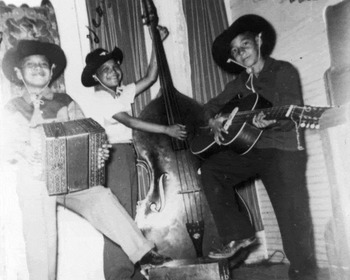
Ponce (with accordion), brother George (with bass), and friend Aurelio (with guitar), 1950, San Antonio, Texas. Photographer unknown. Courtesy of Jesse Ponce.

Ponce worked with a number of other bands in the San Antonio area and recorded several singles with leading artists. Much of the time he was frustrated; he had innovative ideas for bajo sexto playing and new ideas for arrangements, but, despite the fact that artists appreciated his musicianship, he was often asked to play more conventionally. In 1977 Jiménez invited Ponce to audition to join him with innovative American folk-rock guitarist Ry Cooder for a European and U.S. tour of tejano and folk music that later included a performance on the television program Saturday Night Live. (He got the job.) This experience gave Ponce greater freedom and inspired new ideas on innovating traditional conjunto and working with non-Latino musicians.
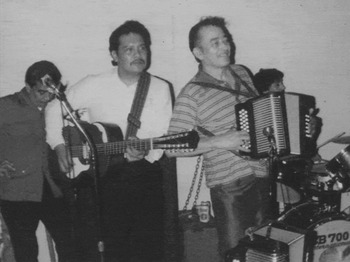
Ponce (with bajo sexto) and Flaco Jiménez (with accordion), 1978, Austin, Texas. Photographer unknown. Courtesy of Jesse Ponce.

Ponce soon became disheartened with the music scene in San Antonio and moved in 1979 to Toledo, Ohio, the home of his new wife, Tila. He found a much smaller, but, in his own experience, less-oppressed Latino communityFootnote 12 and was soon supplementing his income as a plumber by playing bajo sexto with local Latino musicians. One point of frustration was the dearth of quality accordion players; some local players gave him “headaches.” Since he rarely found good, available accordion players, he decided to become one himself and dedicated years to study, often practicing twelve to sixteen hours a day and learning to play in all keys (with multiple instruments) and in forms ranging from the traditional rancheras (sentimental “ranch” songs) and polkas to boleros (originally Cuban song-dance forms), cumbias (originally Columbian folk dances), huapangos (fast-paced folk dances originating from the state of Veracruz), corridos (narrative ballads), cha-cha-chás (Cuban ballroom forms), baladas (ballads), valses (waltzes), and others.Footnote 13 He quickly became so well known as an accordion player that people forgot that he was originally a bajo sexto player. His expertise and mastery over the bajo sexto (and former experience with tololoche) no doubt facilitated his mastery over the accordion, because he could transfer musical knowledge from one instrument to the other; he also had melodies from such master players as Jiménez to guide him. Likewise, his new experience as an accordion player probably made him a better bajo sexto player.
One man Ponce met almost immediately in Toledo was Frank Ibarra, a fellow Tejano (from Laredo) and a musician, who became a fast friend and introduced Ponce to the Latino community and, later, to some of its leaders, such as Baldemar Velasquez and María Rodríquez-Winter, cofounder of the Sofia Quintero Art and Cultural Center. Ponce demonstrated to Ibarra his style of bajo sexto playing, while at the same time working to master the accordion. Over the years Ponce trained and influenced many players and founded several bands. The most successful was Sal y Pimienta (Salt and Pepper), which included one Caucasian (the sal, currently myself) along with Ponce's son and a family friend.Footnote 14 Ponce's health began to deteriorate in the late 1990s, and he soon began dialysis treatments. In 2007 his heart weakened; after falling unconscious following dialysis several times, Ponce agreed to a pacemaker. Although Ponce knows at this point that his health will not improve, he perseveres, hoping to leave his legacy by teaching, performing, and maintaining a loyal, dependable, and skilled band. Occasionally when he returns to San Antonio, people remember him. In a life-circle moment, he was thrilled to record music with Jiménez again during a trip to San Antonio in the summer of 2008.
I first met Ponce in 1999, during a research project on music at migrant camps in northwest Ohio with my former colleague, Barbara O'Hagin, although I did not spend much time with him that year. During that project, which was approved and guided by FLOC, he often played with Velasquez, and our team attended those performances, which were held both to educate the general community in public places about the plight of farm workers and to advocate for and unify workers on the farms. We met again during a second project, this time on Latino music in Toledo, in 2001; colleague Lucy Long joined O'Hagin and me to assist with the ethnography. Long and I initiated a third project specifically on Ponce and his music, which culminated in a compact disc in 2005 and a documentary film in 2006, co-directed by Tony Howard from WBGU PBS. Long spearheaded the application to the Ohio Arts Council (OAC) for an Ohio Heritage Award in 2005, and I arranged a Master-Apprentice grant through OAC for Ponce to formally teach music, repertoire, and instrumental technique to Jacob Estrada and Julian Herrera in 2006.
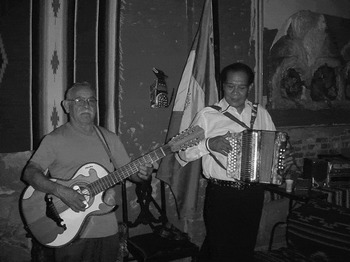
Ponce (with accordion) and Ibarra (with bajo sexto), 2001, Sofia Quintero Art and Culture Center, Toledo, Ohio. Photograph by David Harnish.

During the recording project Ponce became intrigued by our musicianship and soon imagined parts for Long and me to play on his compact disc, which we had intended to produce as “folkloric,” staying completely out of the picture. After Ponce pressed us, I agreed to sit in on one or two pieces, but ended up playing guitar and/or percussion on half of them; Long was coaxed to play fiddle on one piece. It was clear that Ponce was subtly teaching us and experimenting with these new sounds while enjoying our contributions. I became an occasional member of his band at that time (2005) and performed for the concert in honor of the Ohio Heritage Award recipients that year.Footnote 15 I have since played in most of his gigs, and, when time permits, he enjoys having me leave the more standard comping on the guitar (which often simply approximates bajo sexto strumming) to play countermelodies and harmonies in his new arrangements.
Over the last eight years, O'Hagin, Long, and I have mediated Ponce's encounters with Anglo-Ohioans and his recognition at the regional and state levels. Although this exposure has often brought him prestige and occasional performances, it has not necessarily led to increased popularity and opportunities within the Latino community. Ponce's role in that community has been supported and socially maintained via his positions as longtime house musician for the Sofia Quintero Center and as accompanist with Velasquez, but his musical style and repertoire are considered rather conservative by local Latinos; furthermore, his health and problems with musicians have led to constraints in the local market, which is dominated by younger, aggressive musicians with dedicated and stable bands.
Histories of Style and Locale
Conjunto has had the longest history and been the best known of música tejana, the music created at the borderlands of Texas and Mexico by Tejanos; the complementary style on the Mexican side of the border is música norteña. Duos or small bands centered on the accordion had formed by the 1860s, shortly after German and Czech immigrants had introduced the instrument into central and northern Mexico and southern Texas. By the end of the century, European-derived forms—polkas, valses, mazurkas, and schotis (schottisches)—formed the core repertoire; conjunto music, with the German accordion and the Mexican, Spanish-derived, bajo sexto, was always a hybrid, acculturated style.Footnote 16 Polkas dominated the repertoire in the early to mid-twentieth century, vocals became standard in the late 1940s, and rancheras, baladas, and then boleros were added in the 1950s.Footnote 17 The 1950s also saw the introduction of the trap drum set and the electric bass, which replaced the tololoche. This instrumentation and its style, characterized as “traditional conjunto” or “conjunto regional,” have remained standard to this day.
Musical genres are gendered spaces and operate according to codified conventions.Footnote 18 Until recent decades conjunto, particularly instrumental performance, was almost entirely male based and—in terms of function, value, movement, and image—a performance of masculinity. The concept of lo ranchero, the ideology and sentiment of romanticized folk heritage and nationalism, is firmly embodied within traditional conjunto and associated with rural nostalgia and haciendas;Footnote 19 this quality, with its countryside and laborer sentience, further enhances the – folklore of machismo—of performance. Many scholars feel that conjunto reflects traditional gender roles that emphasize husband-father dominance.Footnote 20 Since this attitude often results in women being excluded from musical activity (particularly instrumental performance), participation can create sexual tension, and the lifestyle requires long hours away from families, which discourages female involvement. In addition, conjunto songs often denounce betrayals by women, and women performers are sometimes repelled by, or perhaps restricted by, the style's blue-collar, cantina image.Footnote 21 However, these traditional roles are being challenged today.
As innovations declined in the 1960s–70s, new forms—orquestas, progressive conjuntos, and grupos Tejanos—surpassed traditional conjunto in popularity and record sales, while still maintaining a semblance of lo ranchero. Since the 1980s women have taken advantage of new opportunities to make inroads as performers and have helped to generate a new popularity of tejano music. Manuel Peña claims that as the recording industry pushed to modernize tejano music, conjunto music making shifted from a function of “use value” (with culturally meaningful symbolic power linked to organic social processes and community) to “exchange value” (under the commodifying and culturally weakening influence of the commercial market).Footnote 22 Many of these Texas-based developments within the recording industry, however, were slow to have any impact in peripheral, urbanizing Midwestern areas like northwest Ohio.
Orquestas, larger bands originally consisting of strings and winds, have a complicated history that dates back to the nineteenth century. In the mid-twentieth century, as those Tejanos who did not want to be associated with a lower-class, blue-collar identity grew embarrassed about traditional conjunto,Footnote 23 modified orquestas appropriated a big band sound and line-up and met the aesthetic needs of an emerging, assimilating, bicultural, Tejano middle class.Footnote 24 Many of these people sought to disconnect themselves from their Mexican roots, and the more U.S.-influenced orquesta music—featuring saxophones along with brass, keyboards, guitars, bass, and trap drum sets—resonated, caught hold, and spread through Texas and beyond. Apart from some experiments in the late 1950s and occasional later use, the accordion has been omitted in this newer style. This development created a dyad between roots working-class conjunto, on the one hand, and middle-class and upwardly mobile orquesta, on the other. Tejano migrant workers, wherever they farmed, related to and preferred conjunto largely for the unmediated lo ranchero sentiment; at the same time some Mexican Americans denigrated this style.Footnote 25
Progressive conjunto bands retain accordion and, usually, bajo sexto, but generally add keyboards and wind instruments and enhance their sound with greater professionalism and virtuosity. Grupos Tejanos (Tejano groups) are pop bands that extensively borrow country, rock, and rhythm-and-blues elements. The tejana superstar Selena Quintanilla-Pérez (1971–95) selectively used accordion, bridging the grupos Tejanos sound with conjunto to give her more legitimacy and appeal to different generations. The recording industry took notice and began to shape and control the Latino music market, and many artists sought to mimic Selena's success.
There have been few orquestas and grupos Tejanos in northwest Ohio, largely because of the more popular rural associations of traditional conjunto and the support, folkloric pride, influence, and identity of FLOC. In addition, conjunto ensembles were found not only in cantinas but also at life-cycle rites, dances, and just about any other social gathering; the ensemble was thus never restricted to contexts of carousing and drinking and took on a broader identity and symbolism. A number of progressive conjunto bands have formed, however, and this style has become dominant. They retain the conjunto icons—particularly the accordion—but the aesthetic changes, the music gets louder and more virtuosic, and other instruments (e.g., guitars, keyboards, and horns) may be added. Progressive bands are marketed around the country and internationally. The conjunto bands that tour the area are virtually always progressive; some, such as Los Kumbia Kings, are commercially very successful and have had an impact even in mainstream markets. Conjunto or tejano artists, if able to appeal to two markets, may refer to performing in a progressive, more commercially viable style as “crossover” or “crossing over.”Footnote 26
For most minority groups, music constructs ethnicity as it erects boundaries of identity in representing group ethos and values.Footnote 27 The festivals or cultural events organized and performed by a given group provide opportunities for social maintenance and/or change;Footnote 28 such events, particularly for minorities, reveal that group's negotiations with and responses to the surrounding culture. Ponce's music, identified largely as “traditional conjunto,” has been popular among older Tejanos and Latinos, those who value “tradition” and the connection to Texas-Mexican ethos and migrant workers. For many, the music is nostalgic, although it is also political in that it “reaffirms Chicano identity” and independence.Footnote 29 FLOC and its influence within northwest Ohio have encouraged holding onto these roots to provide both unity and identity to the Latino community as a whole.
The community, however, has fragmented in recent decades. Although FLOC and Latino civic and cultural organizations advocate for retaining identity and bettering the lives of their members, new employment opportunities have encouraged greater mobility, and internationalization via mass media and common gig markets has brought the most recent tejano artists and sounds to the area. At one time northwest Ohio could perhaps have claimed to preserve traditional tejano culture along with many areas of Texas, but today the media and market movements curtail a more localized and insulated Tejano identity and foster a growing pan-Latino identity.
Younger generations and contemporary media have encouraged progressive, modern conjunto bands that play mostly fast, loud, and furious cumbias. Ponce and his music are not part of this modernized Latino world,Footnote 30 which no longer represents the Mexican working class but rather a much broader middle-class culture that provides a contemporary identity for most local Latinos. Other forms—for instance, reggaetón (a Latino form derived from Jamaican reggae and dancehall) and Latino rap—interface smoothly with mainstream U.S. and African American cultures and are important emblems of the contemporary world of Latino youth, which foments new types of dress—more leather and jewelry and fewer cowboy hats, belt buckles, and boots—and social (including sexual) behavior.Footnote 31 Salsa has also had a tremendous impact locally, as its rhythms, sensuality, and acrobatic dancing have encouraged more pan-Latino movements and identity.
Music does not know political borders,Footnote 32 especially in the globalized world where new developments in one area are quickly picked up in another. The dissemination patterns for today's pan-Latino styles such as salsa and reggaetón, as well as traditional national music such as mariachi, find their niche via (mostly corporate) mass media and either embody (in sound, dress, and other areas) a new aesthetic that crosses over to other Latinos or mainstream audiences or takes on symbolic significance, such as national sentience and independence. Although música norteña has penetrated southward into Mexico and northward into tejano, and progressive conjunto has absorbed new influences to spread its appeal, the allure of traditional conjunto regional is somewhat restricted to Tejanos. In this respect it resembles banda, a style based on village Mexican brass bands in Sinaloa that play many of the same forms as conjunto (but also a new repertoire including pop and rock pieces). Banda was equally neglected as a poor person's music and ignored in early scholarship. It is similarly male dominated and connected to romantic nationalism; it has both “use-value” and “exchange-value” forms and, like conjunto, has followed migrants and immigrants into the United States. However, also similar to traditional conjunto, after an initial boom the style was somewhat limited by its “local particularities” and could not transcend its Mexican American boundaries.Footnote 33 Both banda (including technobanda, where electric instruments replace many of the horns) and traditional conjunto were part of the Latino wave of the past ten to fifteen years; yet both are hampered by their regional associations, aesthetics, and performance styles. Newer Mexican styles, such as nortec (combining norteño and techno), follow similar dissemination patterns and may enjoy spurts of popularity and industry support, often followed by regional limitations.Footnote 34 These developments reflect the tensions between cultural assimilation and so-called Hispanization, between regionalism and (trans)nationalism, and between younger and older generations of migrants in the United States.
The audience and contexts for Ponce and traditional Tejano culture are still extant in northwest Ohio but are gradually declining. Such styles as mariachi and traditional conjunto are quaint historic reminders of specific, narrow, folkloric contexts for most Latinos in the area, but are not compelling enough in today's world for widespread consumer support. Younger Latinos, plugged into today's mediascape, are able to operate in a variety of contexts, manipulate shared modern technologies, and move in and out of mainstream U.S. and multicultural situations. Younger Latinos in northwest Ohio are adept at code switching, although they are less likely to be fully fluent in Spanish. The modern tejano music industry, owned and operated by multinational record companies, is quite adept at reaching these consumers, who, like the music, have become more assimilated and internationalized. Their parents had neither the mobility nor the shared points of interface with mainstream U.S. culture.
The pattern of Mexican and Mexican American movement to the Midwest is diverse and complex. Work opportunities—in agriculture, railways, steel, rubber, and other industries—spurred migration to states such as Illinois, Ohio, and Michigan, and to cities such as Chicago, Toledo, and Detroit. Mexicans came to the Midwest “not out of economic necessity but to improve their living standards,”Footnote 35 and many of the workers were recruited in Texas to come north. Wage labor through migration replaced the subsistence farming that had largely been dismantled in Mexico. Although many could earn a living in Texas—Mexican workers are largely credited with the agricultural successes of early-twentieth-century Texas—others sought an alternative to the occasional racism and a better life in the Midwest.Footnote 36
Many Latinos first came to northwest Ohio to work on the railroads in the late nineteenth century.Footnote 37 New families came to the area during the civil wars in Mexico (1910–20) and the displacement of some families in Texas; other families migrated north to meet labor needs in industry and agriculture during World War I and, in the immediate postwar period, to fill a larger shortage exacerbated by limitations on European immigration.Footnote 38 The Mexican/Mexican American population in the Midwest (and particularly Ohio and Michigan) doubled between 1910 and 1920 and then continued to grow rapidly.Footnote 39 Following World War II thousands of new Latinos came to the area mostly for industrial and agricultural work. Within decades some workers or their children transitioned out of farm work to take manufacturing or other jobs in Toledo or nearby towns, whereas others settled permanently but remained in agricultural work for a generation or more. This early community generally enjoyed music and dances in people's homes, because there were few public venues for gatherings.Footnote 40 As the community and the number of clubs, churches, and restaurants grew, the Latino presence became both more prominent and more diffuse. Some older Latinos still talk about having gone to Michigan (some had worked in agriculture there) for major public celebrations or events such as bailes (dances) in the 1950s–80s, and cities such as Detroit with larger Latino populations still occasionally draw local Latinos to major events or concerts. Today, however, the population and culture—with restaurants, clubs, organizations, and multiple annual civic celebrations—are expansive, and most people feel little need to attend Latino events outside northwest Ohio.
Since the 1970s Latinos new to the area have come from Puerto Rico, other parts of the Caribbean, and Central and South America, complicating the local demography. In the late 1980s new groups of Mexicans and Tejanos came to northwest Ohio to live year-round, and their children attended school in one area while they enjoyed a modicum of peace, good wages, and benefits.Footnote 41 Many remained in the lowest socioeconomic strata, however, and had to change work because of mechanization or globalization, and most of those in rural localities encountered racial prejudice. In some areas, such as Toledo, however, Latinos established a strong presence, and numbers grew because of a high birth rate and in-migration from other areas, thus providing a more supportive and tolerant community.Footnote 42 The Latino community in northwest Ohio has become a mixture of older and newer generations originally (and primarily) from Texas or Mexico but also from countries farther south, other U.S. states, and the Caribbean.
The 2000 U.S. census figures indicate that, after a 55.4 percent increase over a decade, 217,123 Latinos lived in Ohio and 17,141 (5.5 percent) lived in the city of Toledo. Seventy-eight percent of the Toledo Latino population identified themselves as “Mexican.” What constitutes “northwest Ohio” often differs, ranging from thirteen to nineteen counties. FLOC officials believe that there are 30,000–50,000 Latinos in the region and that most identify themselves as both “Mexican” and “Tejano.” It is thus not surprising that conjunto, and now progressive conjunto, music have been the most popular styles in the region and that, with the influence of Texas-Mexicans, a process of “Mexicanization” has been underway.Footnote 43 Although many Latinos, including some musicians, have been in the area for one or more generations, a growing number have been neither to Mexico nor to Texas, and few of the younger generation seem to speak Spanish fluently. With the decline of traditional Tejano identity, progressive tejano and pan-Latino rap, salsa, and reggaetón sounds and lifestyles arise as modern replacements.
Cultural Capital and the Construction of Place
Musical knowledge is a form of specialized “cultural capital” that can provide currency in environments both foreign and familiar.Footnote 44 Ponce's relatively easy assimilation into the Latino community in Toledo in 1979 was facilitated by his musical capital and authenticity—he did, of course, come from San Antonio (a center of conjunto music) after years of playing with leading musicians—and by his connections through Frank Ibarra to leaders, who, in turn, soon supported his work and patronized his artistry. His position as representative of the Latino community at the state and media levels was made possible by this capital via three outside agents (O'Hagin, Long, and myself). This respected local position is evidenced by his 2005 Ohio Heritage Award, his 2005 (mostly) folkloric CD, the 2006 PBS documentary, his 2006–2007 OAC Master-Apprenticeship grant, and select performance opportunities, some of which were televised and aired multiple times. Thus, music as cultural capital provided him mobility and recognition both within and outside the local Latino community. Ponce is often invited by his family in San Antonio to return to play music and retire in Texas. He has thus far declined. “I would just be another Mexican there,” he says.Footnote 45 In contrast, “Ohio has given me a lot of recognition.” There he has been able to forge his own identity.
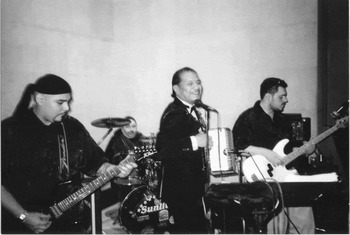
Sal y Pimienta, Ponce (with accordion), his son Bruce (with guitar), and Jacob Estrada (with bass), 2001, Toledo Art Museum. Photograph by David Harnish.

Ponce's musical authenticity helps to construct Texas, or even “Mexico” (broadly understood), in Ohio. Despite his innovations in the traditional style and his love of Caribbean forms, his music is acknowledged as unadulterated, in contrast to younger progressive conjunto bands and their modern tejano aesthetic. With his mastery over the older rancheras and polkas, he reconstructs a Tejano culture of the 1950s–60s, when conjunto had reemerged from its folksy and primarily instrumental duo form into a dynamic ensemble with drums, bass, and an established repertoire. He and his music are largely symbols of that time; indeed, his preservation of so many polkas, which are declining generally in conjunto performance, marks him as “old school.”Footnote 46 His decisions to work with Velasquez and FLOC cohere with those values and identify and position him as realizing and socially maintaining traditional Mexican working-class roots; this work, along with his occasional performances with Ibarra at the county jail for Latino inmates, show his dedication to giving back to the community, of being a good “Tejano” and “Mexican.” One Latino newspaper editor went so far as to bestow on him the moniker “St. Jesse.”
Conjunto as sound and symbol made a comeback nationally in the 1970s, as Chicanos and Latinos began to take pride in their heritage. Progressive conjunto bands soon dominated the scene by taking the repertoire (particularly the cumbia form) and adding rock, country, rhythm and blues, and new Caribbean elements. Although this movement was slow to come to Ohio, by the 1990s the social position of conjunto had largely transitioned from working-class identity to prideful-roots identity somewhat liberated from class association, and the modernized sound became distinct from the earlier, more folkloric performance. Urban and younger audiences, in particular, are drawn to the new sounds; indeed, these sounds, featuring hybrid elements and greater professionalism, are crafted by young, bicultural, bimusical urbanites.
Ponce matured as a musician long before the modern style emerged. The stylistic grounds for what became known as traditional conjunto were established in the 1950s, and were not subjected to musical innovation for decades partly because of audience expectations.Footnote 47 In northwest Ohio, Ponce, who was an active learner in the 1950s–60s, represents this early period. His status, authenticity, and performance construct or invent a traditional Tejano homeland delineated by music for those individuals who recognize his character, expertise, repertoire, and sound. This homeland exists primarily in the minds of older Latinos, particularly those who are actually Tejanos, and the constructed culture works to represent the roots of the transplanted population. Younger Latinos, especially those who do not have Tejano origins, are not familiar with Ponce or his repertoire and are more inspired by salsa, Latin pop, and/or modern tejano music and are more bicultural and fluent in English and modern American lifestyles. Ponce's age, appearance, sound, and much of his repertoire work against making inroads with this generation. Of course, he still has a place in northwest Ohio. During such events as festivals celebrating migrant workers, Mexican American holidays, and Mexico itself—where reinventing Tejano culture is required for the local legitimacy of those contexts—Ponce is still one of the principal musicians to be engaged.Footnote 48
In Rehearsals, on Stage, and in the Studio
Ponce uses Tejano/Latino terminology to discuss and transmit music; for example, do for the key of C (progressing similarly through other major keys), segundo for the dominant, tres for the subdominant, and so forth. Although many Latinos in the United States are familiar with such terminology—which developed out of accordion playing—from my observations, in northwest Ohio only musicians from Texas or those who have studied with Texas-Mexicans use these terms. Younger players understand what these terms mean, but cannot quickly apply them to their playing; these players more frequently call out the key and chord progressions in the manner of American rockers. Everyone who works with Ponce has to know and quickly respond to the Latino vocabulary.Footnote 49
This ability is crucial in performance situations because Ponce often changes his mind on the spot. He typically calls out the repertoire on the stage, despite any song lists that I (or anyone else, including Ponce himself) might have compiled. On more than a few occasions, he has called out pieces that only one of the other musicians knows. Ponce then gives the form (e.g., polka or ranchera [these two are structurally similar], bolero, cumbia, huapango) and then the key (do, re, fa, etc.), and musicians are then expected to perform accordingly. Thus, a degree of spontaneity, competence, and sobriety is required for his musicians to perform successfully.
Although the calling out of songs on stage might suggest confusion, it shows that Ponce is attuned to the audience ethos. For example, while performing at the end of a major Latino award ceremony in which many people were talking and congratulating each other, he turned to a heart-wrenching love ballad, “Por un amor,” that he knew would entice many in the audience to stop talking and turn their attention toward the music. He knew that the audience was familiar with this song and that its sentimental, emotional content (“It would be better for me to die than to suffer so much for love”) would move them, make them listen, and encourage them to participate. After he had attracted the crowd's attention, Ponce followed with Ramón Ayala's rollicking ranchera “Rinconcito en el Cielo,” which got people out of their seats and dancing.
Ponce has a preference for polkas and rancheras; when he told me that he feels obligated “to keep alive” what is “in my heart” and never “to lose” where he started, he was speaking specifically about these forms. He also loves boleros (and other Caribbean-derived forms) and huapangos, although these forms require sophisticated rhythmic skills, and he dislikes playing them with inexperienced musicians. When he performs with Ibarra, they tend to play many huapangos because Ibarra has mastered the compound stroking required to provide the right polymetric (duple against triple) feel. Like many bands and older musicians, Ponce plays relatively fewer cumbias, the form that has dominated the repertoire of many younger groups since the 1990s. Cumbias are a site of distinction between the traditional conjunto and modern tejano music: in the former, they are played occasionally; in the latter, they are played frequently and often with rock and rhythm and blues elements.
Ponce is not an accomplished songwriter and has rarely written lyrics. Most of his original compositions are instrumentals and include many polkas and boleros.Footnote 50 He has stronger skills envisioning and arranging traditional repertoire in new ways. One exceptional example is the standard “Danzón Juárez,” found on his 2005 CD Playing from the Heart.Footnote 51 He arranged a lengthy seven-minute instrumental section leading up to the two sole lines of text that includes two tempi, a section in mixolydian mode, an Arabic-like part in phrygian mode, and the sound of an atomic bomb exploding.Footnote 52
By 2004 Long and I, already familiar with Ponce and his work, secured grants for the production of the above-mentioned CD. In my role as assistant and coordinator of the project, I worked with Ponce in the studio for approximately two hundred hours over the course of a year (mid-2004 to mid-2005).Footnote 53 To my surprise, he aimed not for folkloric presentation but for perfection and often experimented with a number of elements before settling into a format that he felt would work for each song. Our original intention was for Ponce to use a live band to record the tracks and then overdub only as needed in fashioning a folkloric disc of recordings representing old school conjunto and the music of his family. We estimated that the recording would require a few months to complete. Ponce, in contrast, wanted a high-quality, professional production with no mistakes, a painstaking mix, and multiple tracks to the point that he himself sometimes played many parts (bass, bajo sexto, accordion, guitar), overdubbed a few tracks played originally by invited musicians, and added other tracks of live and electronic percussion. These additional tracks often stretched the capacity of our studio. “Danzón Juárez,” for example, required forty-seven tracks (not all of which appear in the final mix) before Ponce was satisfied with the sound, and, even then, he wanted to add more. This selection, as well as one or two others on the disc, is a form of sound art that obviously could never be replicated in live performance. Although the CD's music is not “live” as one would hear it in performance—perhaps raising the thorny issue of “authenticity,” as conjunto is generally held to be folkloric and unadulterated—it retains the traditional genre's aesthetic, and listeners with whom I have spoken have not noticed the degree of electronic manipulation.
The degree of attention Ponce brought to the realization of such pieces as “Danzón Juárez” on the CD is reflected in the rigorous attitude he exacts during rehearsals. As bandleader, most musicians find Ponce very demanding. Many of those with whom I have spoken do not see a need for many rehearsals; Ponce, on the other hand, insists on regular rehearsals to heighten professional standards and master his arrangements. Ponce has thus had a hard time keeping musicians who are not ready or willing to commit to unpaid rehearsals. With his health problems, he also has not been able to garner the number of gigs to keep skilled musicians steadily employed. Furthermore, apart from free community service performances, those for friends or families, and those in new communities, he generally asks for a hefty fee, up to $1,000, partially as a result of having had similar-paying events in Anglo communities. Not many families holding quinceañeras (celebrations of a girl's fifteenth birthday) or weddings are willing to pay that much; consequently, he plays fewer dates.
For personnel Ponce depends on a small number of musicians to come through when needed. Besides Ibarra (with whom he prefers to play in a duo setting) and Velasquez (with whom Ponce plays traditional conjunto and Velasquez's roots, protest and socially oriented music), these musicians include Jacob Estrada, Julian Herrera, and myself. Ponce's son, Bruce, recently returned to the group after an extended hiatus, although Estrada is now pursuing his own Christian Latino music. Drummers, for some reason, are a source of constant problems; my observations show that they are the most undependable musicians (in this context at least). One reason that drummers are reluctant to play with Ponce is that he insists on using an electronic drum machine in select pieces (particularly Caribbean-derived forms). Several drummers consider his use of a machine to supplement their own playing insulting or even emasculating. Some of the other band members have thus had to fill in on drums; when Estrada is absent, I have also sometimes played bass. Herrera can also play bass, but Ponce prefers him on accordion (when Ponce wants to play bajo sexto) or on bajo sexto (when the accordion part is too challenging for Herrera), and, recently, Ponce has asked Herrera to play drums. Almost every event requires juggling musicians.
Ponce's work with the socially conscious Velasquez may be influencing new ideas for repertoire. He recently added two Woody Guthrie songs to the mix: “This Land Is Your Land” and “Do Re Mi.” For the former, he added a polka prelude; for the latter, he remembered a polka-like arrangement by Jiménez and Cooder and then arranged a guitar- and accordion-harmonized melody to uniquely bridge the verse and polka sections. These songs are meant primarily for an Anglo crowd, and they take on a ranchera form, including the characteristic fast descending line initiating from and concluding on primary tones (tonic, third, or, more rarely, fifth) at cadences. The image and activism of Guthrie seem to resonate with Ponce, who appreciates creating rapport with the audience. He senses that these songs can link performers with the audience and leave those present feeling good about both themselves and the concert. On a larger scale, the songs help to bridge and unify Latino performers with Anglo audiences.
Another song that he may call out for both Anglos and Latinos (if the crowd is not dancing or if they are younger) is the famous son jarocho (traditional musical style from the state of Veracruz), “La Bamba.” Through this song Ponce presents something familiar, again turning the audience's attention to the performers.Footnote 54 Because he likes to improvise on the “La Bamba” vocal melody (making set vocal harmony tricky), Ponce often uses an electronic harmonizer to provide harmony to his lead vocal. If he is playing bajo sexto, and he often is for “La Bamba,” he likes to take several solos. He also likes soloing on bajo sexto in cha-cha-chás and boleros. This practice distinguishes Ponce from bajo sexto players in other bands, who rarely, if ever, solo in any tejano music form. He prefers playing bajo sexto over accordion for boleros, sometimes because other bajo sexto players cannot perform the jazzlike harmony or use the full range of the instrument that he likes to exploit in such pieces. He has enjoyed Herrera's recent participation in the band because he can teach Herrera the accordion part, which then frees him to play bajo sexto on select pieces.
Between his harmonizer and drum machine, occasional electronic mediation is found in many of Ponce's performances. To Ponce these additions are inspiring and innovative and not at all inauthentic. Stylistically the mediation retains old school formula, although repackaged in Ponce's unique arrangements.
Interpretations on Style, Adaptation, and Agency
Ponce's position, reception, and incorporation into the Toledo Latino community has been conditioned by the histories of Latinos and Latino music, particularly conjunto, within the region. Although it is unclear when the first conjuntos took up residence in the area, Latinos in Toledo and the nearby urbanizing townships of northwest Ohio did not experience feelings of embarrassment over the conjunto style in the mid-twentieth century as did those in Texas, perhaps because the community did not have a viable middle class that would turn against Tejano roots identity. Conjunto was always the preferred music, and early alternatives, such as orquesta, never had much of an impact or challenged the prevailing class order; in fact, there are reports of only two orquestas in the area over a period of several decades. The conjunto style, of course, has not been static; dynamic changes occurred throughout much of its history, and those changes, like the ensemble itself, began in Texas.
By the end of the 1950s, conjunto had emerged as a quartet of accordion, bajo sexto, bass, and drums and with a repertoire of primarily polkas, rancheras, and boleros. It was this traditional conjunto that, when performed with authority and authenticity, brought forth ethnic pride and the lo ranchero sentiment and allowed la Raza (the people) to claim their rights, identity, and public space.Footnote 55 The progressive conjunto and grupos Tejanos styles emerged in the 1970s and gained currency in the following decade. These latter developments, however, did not immediately come to northwest Ohio because of the more conservative environment, the scarcity of urbanized Latinos and the large numbers of migrant workers, the sheer distance between Texas and Ohio, and the presence of FLOC and the associated pride in traditional culture. The modern tejano sounds came in force from Texas via the powerful music industry in the 1990s, and a younger generation of urbanizing Latinos seems to have been ready for change to both embrace more pan-Latino identity and resonate with their own greater assimilation into modern American life.
Mark Slobin asserts that music is not just a reflection of social life, but also constitutive of culture, change, and personality.Footnote 56 As the Latino communities urbanized and Latinos became part of the media generation, local preferences gradually switched from traditional conjunto—which retained a 1950s–60s Tejano identity—to modern tejano music and pan-Latino styles such as salsa, Latin rap, and reggaetón. The change of preference corresponds to a younger generation's larger cultural change and reflects both greater biculturalism and integration, the embrace of and mastery over the mediascape, and the formation of a repertoire of malleable identities that come into play in specific, distinct sociocultural contexts.
Steven Loza proposes that a process of “enculturation,” as defined by Wilbert,Footnote 57 can explicate the lives of select Latino musicians in Los Angeles.Footnote 58 Enculturation here refers to musicians as “learners” and to “music” as that which “arises from the processes of maintenance, change, and adaptation as expressed through behavior, tradition, and worldview. . . . Through the process of enculturation, the development of particular musical styles can be juxtaposed with particular attitudes in relation to musical preference.” The enculturative “process dimension” includes three stages—skill training, socialization, and moral education of the individual—throughout three stages of life—infancy, childhood, and adulthood.Footnote 59
These ideas can clearly apply to Jesse Ponce. Ponce's skill training, socialization (transmission/integration), and moral education (correct behavior) began very early in life. His family—particularly his father and older brothers—were his main teachers, music and musicians surrounded him, and he acquired sufficient knowledge to perform by age seven. His advancement as a “learner” in the 1950s–60s paralleled the innovations occurring within conjunto; his work with leading musicians, such as Jiménez, propelled his learning and experience; and this learning organized the music preferences that he retains to this day. His growing expertise over the forms, and his later mastery over all the instruments, constructs a hermeneutical arc of music experience, which, in turn, generates greater knowledge, learning, and self-identity.Footnote 60 After he entered into adulthood and developed his own ideas for music and performance (symbolized by the conclusion of work with Jiménez and Ry Cooder), he moved from San Antonio to Toledo, taking with him the skills, moral authority, and authenticity of Tejano culture and the lo ranchero ideology and sentiment. Then, as a teacher—his primary role—Ponce passed on the skill training, socialization, and correct behavior to musicians in various life stages in northwest Ohio.
Ponce came from a center of conjunto, with a rich familial and cultural environment steeped in tradition, to Toledo, a city and urbanizing area (northwest Ohio) that resonated with traditional values and a Latino population that was overwhelmingly Tejano but separated from its roots. Although he had to find his way in this new territory, Ponce was soon embraced for his mastery of the roots style and all that it represented. His experience, vocabulary, history, and knowledge denoted him as quintessentially authentic; he took advantage of that acknowledgment and the accompanying capital to shape his career and identity and maneuver through the social formations of local Latino culture. The honored recognition by such established cultural institutions as the Sofia Quintero Center and FLOC legitimates the identity he has constructed.Footnote 61
Ponce has now moved beyond adulthood into older age. With the decline of his health and the ascent of modern tejano music, his performance opportunities have diminished. Further, his approach to the music—training musicians in proper technique and repertoire and requiring rehearsals—has often been rejected by local musicians, some of whom have agendas of their own. Consequently he has felt frustration, and the roots style has continued to slowly fade in the area; his decline mirrors that of traditional conjunto.
Nevertheless, Ponce still performs for Anglo and other communities, and those of us interested in his work have mediated this interaction while explaining what he represents to state agencies. Today Ponce has learned to negotiate those forces directly, and the state and media recognition helped to revalidate his identity and reshape his fee scale.
Final Thoughts
I have identified Ponce's music in this article as “traditional conjunto,” a phrase meant to capture his skill set, socialization, and moral education. The label, however, implies stasis and in this case is oversimplified, because both the style and the performer were always dynamic. Ponce brought his own ideas to bear on the music as early as the 1960s, when he exploited the range of the bajo sexto, utilized a wah-wah pedal, mastered Caribbean-derived forms (e.g., cha-cha-chás), and learned to solo on the instrument. He has developed similar innovations for accordion playing, and added and trained guitarists (including a few non-Latinos). Furthermore, his sensitivity to audience ethos has inspired him to seek out and utilize the music of such notable non-Latinos as Elvis Presley and Woody Guthrie. These developments mark Ponce as relatively progressive in comparison to other artists who came of age in the 1960s, such as Jiménez and the extraordinary El Conjunto Bernal. Nevertheless, his music retains the elements and aesthetics—the moodiness, the lo ranchero—of the traditional sound, and he, in terms of identity and experience, is firmly rooted in that male-ordered world. He is one of the few individuals credited with bringing and transmitting conjunto and its rustic sentience directly from its homeland of Texas to northwest Ohio, and he and his music's authenticity have become part of the fabric of such institutions as FLOC, the Sofia Quintero Center, and local Latino culture.
Northwest Ohio provided a home where Ponce could negotiate, construct the roots of, and build on nostalgia for authentic Tejano culture, the romantic folk heritage desired by the diaspora community. Through his cultural capital and inside and outside agents, he has been able to establish and shape his identity. Because of his recent recognition and the resulting privileged status, he prefers to remain in Ohio rather than return to San Antonio. The three-part journey of his life can be seen as (1) birth, learning, socializing, and development (1943–64); (2) working with Jiménez and other leading artists, refining his musicianship, and touring with Jiménez and Ry Cooder until moving to Toledo in 1979; and (3) the Toledo period, mastering the accordion, constructing his identity and agency, and representing traditional conjunto in the area (1979 to the present). It has been a unique journey, one of his own conscious and deliberate authorship requiring a myriad of compromises and filled with successes and setbacks—a journey that is, unfortunately, nearing its conclusion.