


Introduction
Clinicians use diagnostic labels to classify individuals for both treatment and research purposes. Diagnostic labels should allow clinicians to assume that all members of a group are generally homogenous and allow patient groups to be distinguished by a set of definable boundaries (APA, 2013). As such, diagnostic labels should represent an efficient way for clinicians to understand and communicate with others (Frances, First, Pincus, Widiger and Davis, Reference Frances, First, Pincus, Widiger and Davis1990). They provide clinicians with a means of describing a patient's presentation of symptoms and may imply the expected course and prognosis (Garand, Lingler, Conner and Dew, Reference Garand, Lingler, Conner and Dew2009). Furthermore, specific diagnostic labels may suggest specific interventions, with the aim of treating the symptoms of the condition (Corrigan, Reference Corrigan2007). The importance of diagnosis in relation to care planning has taken on even greater significance recently in the United Kingdom with the implementation of the Health and Social Care Act 2012 in which patients are clustered according to diagnosis, thus enabling them access to aligned care packages.
The introduction of diagnostic systems such as DSM-V (APA, 2013) and ICD-10 (World Health Organization, 2010) have undoubtedly allowed the adoption of operational definitions, which have both benefited research and improved the reliability of routine psychiatric diagnosis. However, despite their clear benefits, it has been suggested that diagnostic labels can serve as cues that activate stigma, stereotypes and discrimination (Garand et al., Reference Garand, Lingler, Conner and Dew2009). It has long been understood that labelling can mislead as well as inform, and that labelling can and does lead to stigmatization and misunderstanding (Corrigan and Watson, Reference Corrigan and Watson2002). In psychology, the history of labelling in learning disability (“idiot”, “moron”, “mentally handicapped” and “mental subnormality”) provides a particularly vivid example of such problems. Although mental illness stigma existed long before psychiatry, it has been argued that in many instances mental health professionals have not helped to reduce stereotyping or discriminatory practices, and there is a dearth of research in this area (Byrne, Reference Byrne2000).
The adoption of diagnostic criteria based on operational definitions (as in DSM III onwards; APA, 1994) was intended to diminish stigma. This was particularly welcome in personality disorder (axis II) as, historically, personality disorder as a diagnosis tended to be attached to those patients the clinician disliked or considered odd or “different” to themselves. Realization of this potential for abuse of diagnosis had tended to reduce the perceived value (and use) of personality disorder as a category, particularly in behaviour therapy and cognitive-behavioural therapy work. The adoption of “axis II” reversed this trend as clear and (relatively) reliable criteria were introduced. Sadly, however, the solution may well have become the problem, as “personality disorder” can be used by professionals as a label for those who fail to respond to psychological treatment and by the mass media and the public as a term denoting difficult to understand and possibly even dangerous. Labels that may initially have highly specific meanings can become over-inclusive in usage, carrying implications far beyond the usually rather limited evidence that led to their initial adoption. A striking example can sometimes be found in psychological reports for courts of law; a diagnosis of a particular personality disorder is followed by a statement along the lines of “persons with this disorder tend to show. . . . .”, followed by an over-inclusive, textbook based statement of the presumed extent and nature of that particular diagnosis. This is an example of how a person who is thought to exhibit a specific pattern of behaviour inappropriately acquires further characteristics in the minds of others as a consequence of the diagnostic label. Similarly, the criteria for applying a label can become loose to the point of abuse, returning to the bad old days of “I don't like this patient so they must have a personality disorder”, or labels such as “borderline tendencies”.
Everyday use of diagnostic terms and labels by the general public and mass media tends to follow their use by professionals. Although the general population appears to have become more positive in its outlook towards psychiatric disorders over the last few decades (Schomerus et al., Reference Schomerus, Schwahn, Holzinger, Corrigan, Grabe, Carta and Angermeyer2012), evidence also demonstrates that stigmatizing attitudes have not diminished; in fact, they have remained stable or even increased (Angermeyer, Holzinger and Matschinger, Reference Angermeyer, Holzinger and Matschinger2009; Silton, Flannelly, Milstein and Vaaler, Reference Silton, Flannelly, Milstein and Vaaler2011). In an attempt to reduce the burden of psychiatric illness on our society, researchers have attempted to better understand the factors that influence the development and maintenance of stigmatizing attitudes (Mukolo, Heflinger and Wallston, Reference Mukolo, Heflinger and Wallston2010; Pescosolido, Martin, Lang and Olafsdottir, Reference Pescosolido, Martin, Lang and Olafsdottir2008). It has been argued that the difference between a normal and a stigmatized person is a question of perspective, not reality (Goffman, Reference Goffman1963). Stereotypes represent selective perceptions that place people in categories, exaggerating differences between groups (“them and us”) in order to obscure differences within groups (Townsend, Reference Townsend1979). There is a growing body of evidence that supports the concept of stereotypes arising from psychiatric labels in mental illness (Townsend, Reference Townsend1979; Philo, Reference Philo1996; Byrne, Reference Byrne1997). Psychiatric labels can evoke negative feelings of danger and unpredictability, which ultimately lead to more stigma and increases in social distance (Martin, Pescosolido and Tuch, Reference Martin, Pescosolido and Tuch2000). For example, there is a stereotype of criminality or violence in the mentally ill, even though the vast majority of people who experience a psychiatric disorder are not dangerous. However, the mass media tends to perpetuate stigma, giving the public narrowly focused stories based around stereotypes.
Research on the stigma of mental health problems has found that people from around the world have negative attitudes towards people with such difficulties (Szeto, Dobson and Luong, Reference Szeto, Dobson and Luong2013). The use of psychiatric labels, or diagnosis, has been extensively researched and implicated in the process of stigmatizing psychiatric disorders (Link and Phelan, Reference Link and Phelan2001). Studies have also examined the impact of psychiatric labels from the perspective of a service user (Rose and Thornicroft, Reference Rose and Thornicroft2010). The impact of psychiatric labels on clinicians’ perceptions of their patients has not in itself been the subject of much research, however, and remains controversial. Studies examining the attitudes of mental health professionals toward individuals with a diagnosis of personality disorder are most consistent with a continuing stigma-related problem. For example, Glen (Reference Glen2005) states that mental health practitioners are uncomfortable about or reluctant to work with individuals diagnosed with personality disorder because they perceive them as dangerous and unresponsive to mental health services. Mental health professionals’ attitudes towards people with personality disorder diagnoses are more negative and less optimistic about treatment than their attitudes towards people with diagnoses of depression and schizophrenia (Markham, Reference Markham2003; Markham and Trower, Reference Markham and Trower2003).
However, Ruscio (Reference Ruscio2004) has comprehensively reviewed experimental studies on labelling, concluding that many of the most cited studies are so seriously flawed that it was not possible to conclude that any effects of labelling have been demonstrated. Ruscio (Reference Ruscio2004) points out that previous research that examines the effects of psychiatric labels has failed to differentiate the labels from the behaviours they supposedly reflect. Ruscio further suggests that studies that use behavioural descriptions have stronger and more consistent results, and that diagnostic labels may merely serve as imperfect ways of communicating behavioural information. Furthermore, Sansone and Sansone (Reference Sansone and Sansone2013) conducted a comprehensive literature review examining the perceptions and reactions of mental health clinicians toward patients with BPD. Sansone and Sansone (Reference Sansone and Sansone2013) found that for studies in the literature, sample sizes were generally small and the methodologies used were varied and flawed. The majority of the research studies examined by Sansone and Sansone (Reference Sansone and Sansone2013), however, do indicate negative perceptions of, and emotional responses towards, patients with BPD. The authors of this literature review interpret the findings as suggesting that mental health clinicians are more judgmental or prejudicial towards patients with BPD than they are towards patients with other types of mental health problems. Sansone and Sansone (Reference Sansone and Sansone2013) go on to further suggest that these findings simply reflect a very human reaction to the complex and pathological behaviours of patients with BPD.
In a closely related, previous experimental study (Lam, Salkovskis and Hogg, in press) it was found that clinicians’ judgements about a patient with panic disorder seen on a videotape were adversely affected by an inappropriately suggested diagnostic label of co-morbid BPD. (Note that the presence or absence of BPD is probably unrelated to outcome in panic disorder in general (Massion et al., Reference Massion, Dyck, Shea, Phillips, Warshaw and Keller2002) and the outcome of CBT in particular (Arntz, Reference Arntz1999)). In the Lam, Salkovskis and Hogg study, the BPD label was associated with more negative ratings of the patient and their prognosis and likely course of treatment. The diagnostic label negatively influenced clinicians’ judgements of the person's panic disorder significantly more than a behavioural description corresponding to the same diagnosis. Thus, when clinicians were told about the BPD diagnosis prior to watching the video, the patient was perceived as significantly less likely to comply with homework assignments and be less motivated to change. The BPD diagnosis was also associated with significantly lower clinician ratings of ease of establishing and maintaining a rapport with the patient and patient engagement in therapeutic sessions. It was also judged by clinicians in this condition that there was a higher probability of the patient missing some of their therapeutic sessions.
In order to further understand the likely mechanisms of the effects of psychiatric labelling on clinicians, the present study aims to examine clinicians’ reactions to diagnostic labelling. The study will examine clinicians’ reactions to the label borderline personality disorder (BPD) in terms of positive and negative factors relating to the individual and their treatment outcome. The study aims to differentiate the effects of the psychiatric label from the behaviours that the label is thought to reflect in response to critiques of other research. By doing so, we aim to more effectively examine the effect of the label itself on the perception and judgement of clinicians. It is hypothesized that the diagnostic label will negatively affect clinicians’ perceptions and judgements of a patient being assessed for treatment of panic disorder.
Method
Design
Two hundred and sixty-five mental health professionals were randomly allocated to one of three background information experimental conditions. The control condition consisted of background clinical and family details of the patient. The “no label” condition was the same as that of the control, but with the addition of historical behavioural information that is consistent with borderline personality. The “label” condition was the same as that of the “no label” one, but with the addition of a historical diagnosis of borderline personality disorder (the information offered in this respect was incorrect as the patient had never had detectable axis II problems). Participants were asked to base their clinical judgements exclusively on the section of video that they watched. Note that all participants saw an identical tape, so any differences are likely to be due to the experimental manipulation.
Participants
Participants for this study were recruited through Community Mental Health Teams (CMHT) in London and South West areas, from an education establishment, and through a workshop provided for psychologists and psychiatrists. The sample comprised 30 psychiatrists, 69 psychologists (clinical and counselling), 55 social workers, 65 community psychiatric nurses, and 46 mental health students on their final year of a BSc/Diploma programme.
Participant ages ranged from 20 to 60 (mean = 38.8); 95 were male and 170 were female. Participants’ professional qualifications were categorized into three groups: below degree, at degree level, and above degree level. Participants with over seven years of professional experience were classified as very experienced; over two and less than seven years were experienced; and less than two years were inexperienced.
Procedure
The aim of the study was briefly explained in a covering letter. The purpose was described as being to examine factors that influenced clinicians’ assessment of a patient with panic disorder and their prediction of the outcome of treatments. Participants were randomly assigned to one of three experimental background information conditions for a patient in a video; randomization was carried out on the basis of sampling without replacement, resulting in 86, 91 and 88 participants allocated to control, no label and label conditions respectively. Participants first read general instructions on the task, then background information about the patient before watching the video and completing ratings concerning the patient's assessment and likely course of treatment. They were then asked to write down reasons for being “optimistic” and “pessimistic” about the patient in the video. The video was a 10.5 minute extract from the assessment of an actual patient with panic disorder with agoraphobia. The patient on the video in fact had no axis II pathology, and in the tape was highly responsive to questions about (a) the history of the development of her panic attacks, and (b) a recent panic attack. She is mildly emotional and anxious when touching on her feared consequences. It is clear from the video that she is co-operative and well motivated to work with the therapist. To check if the participants had worked out the experimenters’ intentions, they were asked at the end of the experimental session to state what they believed the main purposes of the study were.
Experimental manipulation
The experimental manipulation was embedded in the background information given prior to watching the video. Three types of background information were introduced in the written preamble to the video. In the control condition participants were provided with a brief and accurate description of the patient's experiences with panic attacks and agoraphobia and a brief narrative of her family background:
Susan, aged 37, is a divorced woman with a girl and a boy, aged ten and seven respectively. Both her children are living with her. Her ex-husband has since remarried but has been in regular contact with his children. He takes them on holiday once a year.
Since the divorce five years ago, Susan has been living with her two children. She has a restricted social life because of her anxiety and panic attacks. She is reluctant to go out alone and would often stay at home most of the time because of frequent panic attacks. Prior to most attacks, she experiences intense fear and anxiety. Her thoughts at that moment are that she is going to faint and pass out. She knows that these thoughts are irrational but finds it difficult to control her anxiety and thoughts. During attacks, she has very unpleasant bodily sensations. Some of the sensations are: breathing very fast; feeling short of breath, as if she cannot get enough air; heart beating very fast; chest pain; shaking and trembling; and feeling faint and dizzy.
Her latest panic attack happened in a supermarket last Sunday. She felt dizzy and was having difficulty breathing. When the bodily sensations became intense, she grasped a chair to sit down. She felt relieved to be able to sit down just in time, believing that her action had just prevented her from fainting and passing out. Even with the support and company of a friend or a relative, she still experiences a high level of anxiety whenever she is in places such as supermarkets, parks and restaurants, etc. The condition has affected her life and daily functioning to the extent that she is now effectively disabled by her problem.
Susan is an attractive and intelligent person, who did well at Further Education College. However, she describes herself as a shy, sensitive and anxious person. She married soon after leaving college and this lasted five years before her husband left her.
Although her childhood was generally happy, she appears to have been a sensitive child. Her father was occasionally violent towards her mother at times, especially after drinking too much. Her parents divorced when she was ten years old. She has had no contact with her father since the divorce, but her relationship with her mother is described as good. She is the eldest in the family and sees both her brother and sister regularly.
Because of her recurrent panic attacks, her General Practitioner recommended her referral to a community psychiatric team for her emotional problems and avoidance behaviour. Neither exposure nor pharmacotherapy was previously effective. She has a long history of contact with psychiatric services for outpatient psychiatric treatment.
In the “no label” condition the same information as that in the control condition was used, but with the addition of the following (false) information (as the second last paragraph):
In addition to her anxiety and panic, her General Practitioner said that she complains of feeling vague, dysphoria, insomnia, and confusion about life and her own goals. Previous psychiatric reports commented that she is notably deficient in the skills of symptom management, interpersonal effectiveness, and self-management of affect regulation and impulse control. The skills deficit in mood regulation and impulse control are noted as accounting for her mood lability: from inappropriate, intense anger to anxiety, usually lasting for a few hours and sometimes more than a few days.
In the label condition the same information as that in the “no label” condition was used, but with the addition of the following (false) information (text below indicates placement of additional material):
At this stage early signs of borderline personality disorder were beginning to be evident (Paragraph 4, after “further education college. However”) . . . Susan's history is typical of someone who suffers from panic disorder with a comorbid borderline personality disorder (Paragraph 5, before “although her childhood”) . . . A formal diagnosis of borderline personality disorder was made when she was referred for psychiatric treatment (Paragraph 6, before “in addition to her anxiety and panic”) . . . her General Practitioner's referral indicated that she is suffering from symptoms characteristic of borderline personality disorder (paragraph 6, after “in addition to her anxiety and panic”).
Measures
Participants were asked to respond to two questions by writing down what they recalled from the video that made them (a) feel optimistic about the patient's treatment and (b) feel pessimistic about her treatment.
Development of a category system
Participants’ responses were analysed using a coding system developed for the study. Following examination of a selection of the verbatim responses, definitions of possible categories were generated by the investigators. Using these working definitions as a guide, two raters independently examined the first 10 participants’ reasons to be optimistic and pessimistic (taking two examples from each of the five professional groups) and coded each of them according to a category definition. These were then compared across raters to establish how closely they matched. Mismatches were dealt with by a discussion between the raters, with the purpose of clarifying and further refining the definitions for the categories involved in the category system. This process was repeated three times. Different examples were used in the first two comparisons. The third comparison was based on the samples of data from the first two comparisons. The levels of agreement on the coded categories of optimism and pessimism were good (ranging from 60%-100% in the first analysis, rising to 100% on the third iteration). The final category system consisted of 9 optimistic and 13 pessimistic categories. Definitions for each of the categories were refined and agreed.
Using the refined category system as a guide for an inter-rater reliability test, one rater independently coded each of the 20 participants’ optimistic reasons with an optimistic category (four participants from each of the five professionals’ groups). This process of coding was repeated with the pessimistic reasons, taken from 20 different participants (four participants from each of the five professionals’ groups). In total, the first rater coded a total of 40 participants’ answers. The second rater coded all the participants’ answers (n = 265) for optimism and pessimism categories. The results were subjected to inter-rater reliability tests using Cohen's Kappa coefficient.
Treatment of data
The primary analysis was for the total number of optimistic and pessimistic items noted; these data were analysed using a mixed model ANOVA, with experimental group being the within subjects factor, and optimistic vs pessimistic totals as within subjects. As a secondary analysis, the scores for each category were examined using Chi square, on the basis that total scores may mask more subtle effects.
Results
Inter-rater reliability of the category system
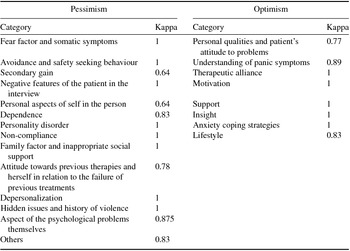
The reliability of the category system was tested using Cohen's Kappa coefficient. This test examined the degree of agreement in the optimistic and pessimistic categories between the two raters. The inter-rater agreement for the category system was high. Table 1 shows the Cohen's Kappa values for each of the categories in the system.
Kappa values of optimistic and pessimistic categories

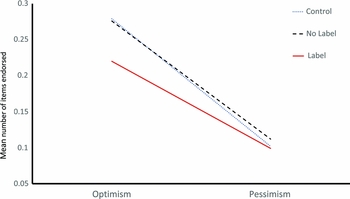
A 2 (optimistic vs pessimistic) x 3 (experimental group) mixed model analysis of variance was used to analyse the number of items endorsed for the optimistic and pessimistic categories. There was a significant main effect of the optimistic versus pessimistic categories, F [1, 262] = 85.9, p < .0001. There was also a significant main effect of experimental group, F [2, 262] = 3.28, p < .05. These effects were modified by an interaction between measured categories of the optimism and pessimism and experimental conditions, F [2, 262] = 3.9; p < 0.05. To identify the source of this interaction, simple main effects analyses of variance for the grouping variable were conducted separately for optimistic and pessimistic totals, with post-hoc comparisons (Tukey LSD) used where the group effect was significant. The main effect of experimental group was significant for the optimistic (F [2, 262] = 5.17, p < .006) but not the pessimistic total (F < 1). Multiple comparisons on the optimistic totals using Tukey LSD indicated that the mean in the label condition was significantly lower than both the “no label” and control conditions. There were no differences between the “no label” and control conditions. These results are shown in Figure 1.
Label effects on optimism and pessimism

Detailed analysis of the optimistic and pessimistic categories
The chi-square test was used to evaluate the association between the experimental condition and each of the optimistic and pessimistic categories. As many comparisons were conducted, Bonferroni corrections were applied. This meant that for “optimistic” subcategories, the alpha level was set to 0.00625, and for pessimistic categories, to 0.0038. Within the optimistic categories, significant associations were found between experimental condition and the “signs of positive efforts towards self-help” category, χ2 [2df] = 11.3; p = .004; analysis of pessimistic items showed a further significant effect; “signs of personality disorder”, χ2 [2df] = 33.7; p < .0001. Partitioning indicates that, in both cases, the “label” condition accounted for the effects in terms of fewer positive and more negative observations being noted.
Discussion
Inappropriate prior application of a label of borderline personality disorder to a video showing a patient describing their uncomplicated panic disorder had a negative impact on clinicians’ perception of the patient viewed in that video. A comparison group, where a behavioural description corresponding to diagnostic criteria for borderline personality disorder was applied without the use of the diagnostic label, was not affected in this way, suggesting that the effects observed came from the use of the label rather than the behaviours it is deemed to denote. Surprisingly, the overall impact of the diagnostic label was to reduce the extent to which clinicians identified positive factors in the tape that they had viewed, and did not increase the identification of negative characteristics overall. However, there was a specific increase in the labelling group in terms of the extent to which “signs of personality disorder” were reported as having been present in the video. There was also specific evidence of a significant reduction in the label group only of “signs of positive efforts towards self-help”. Thus, it appears that the application of the diagnostic label was associated with a tendency to frame behaviours observed in the video in terms of that label, and to overlook positive signs that clinicians who were not primed with the label reported.
It is possible that the uncomplicated nature of the problem experienced by the person on the video may have affected the results, in that the relatively small amount of negative information on the videotape may have made it less likely that negative biases would have been observed. Replication of the present study with a tape involving a more complex presentation in the person assessed (e.g. more negative affect and information about interpersonal problems) would clarify this issue. It seems unlikely that the present results solely arise from some kind of actuarial rule applied by the clinicians (e.g. that panic patients with comorbid BPD do worse in therapy) as the measures reported here represent the clinicians’ indication of what they observed on the tape rather than their predictions of clinical outcome as in Lam et al. (in press). In fact, the present findings suggest that a bias either in perception or recall may be operating when a diagnostic label is offered, and that this may constitute at least part of the mechanism involved in the negative labelling effect of a BPD diagnostic label.
A common problem in experimental research into “stigma” is what Hayward and Bright (Reference Hayward and Bright1997) described as the “empty seat” phenomenon. They point out that most people would tend to have at least moderately negative expectations if told that the seat next to them on a long haul flight was to be occupied by a person about whom they had only one piece of information (e.g. this person has a mental illness) without further contextual information. The present study sought to avoid this issue in two ways. First, the rater had a range of information about the person to be rated including a section of videotape of them describing their problems and written background, making the BPD diagnosis one small part of the information available. Second, the comparison between a behavioural description corresponding to BPD and that same information supplemented by the supposed diagnostic label showed similar differences to those noted in the comparison between the label condition and the minimal information condition.
What then are the implications of these findings? First, that great care should be exercised in the accurate use of BPD as a diagnostic label. Clinicians should be aware that they may be prejudiced in how they perceive individuals to whom such labels are applied. Psychiatric labels do have a clear utility for clinicians (Garand et al., Reference Garand, Lingler, Conner and Dew2009); however, given the current findings, we must consider the accuracy and utility of such labels and the negative consequences they may have for the patient. BPD and anxiety is an interesting case in this respect, with older publications tending to suggest an association with poor outcome (Nurnberg et al., Reference Nurnberg, Raskin, Levine, Pollack, Prince and Siegel1989), and more recent findings suggesting no such effects (Arntz, Reference Arntz1999; Dreessen and Arntz, Reference Dreessen and Arntz1998, Reference Dreessen and Arntz1999; Dreessen, Arntz, Luttels and Sallaerts, Reference Dreessen, Arntz, Luttels and Sallaerts1994; Sanderson, Beck and McGinn, Reference Sanderson, Beck, McGinn, Leahy and Dowd2002). Even if the BPD diagnosis does predict poorer outcomes for the anxiety (which, in our opinion, the balance of the evidence indicates that it does not), the present study concerned an inappropriately applied label: the patient on the video did not actually have BPD. It can therefore be considered from the present study that mistaken or carelessly worded psychiatric diagnosis and labelling in relation to borderline personality disorder can have a negative effect on clinicians’ perceptions and assessment of patients. This in turn is likely to impact on their attitudes towards the patient, their therapeutic approach and their expectations of success, all of which are likely to affect clinical outcomes.
These findings can be considered in relation to the wider debate about the general usefulness of dimensional versus categorical classification within mental health. In relation to this, it is worth noting that Arntz et al. (Reference Arntz, Bernstein, Gielen, van Nieuwenhuyzen, Penders and Haslam2009) found evidence from taxometric analyses of criterion scores on DSM IV for various personality disorders, including borderline, to support a latent dimensional structure rather than categorical. It is therefore imperative that as clinicians, we continue to question the utility of diagnostic labels in mental health. Also, that we are mindful of the impact of diagnostic labels on our own perceptions and judgements of patients. Further, as a collective we must strive towards reducing the stigma, stereotypes and discrimination associated with labels used in the field of mental health in order to improve clinical outcomes for individuals with mental health difficulties.
Acknowledgements
Conflict of interest: The authors have no conflicts of interest with respect to this publication.



Comments
No Comments have been published for this article.