Dagong 打工Footnote 1 as a way of life gives rise to many abuses and rights violations against China's 200 million plus migrant workers. Pushed to the limits, many have taken part in protest actions to seek redress and assert their rights. Such stories are legion in newspapers and magazines both inside and outside China, and the plight of migrant workers is well known.Footnote 2 The litany of woes include arduous work with low pay, long hours, wage default, unsafe work settings, denial of labour contracts, exclusion from public health care, social insurance and social assistance, poor educational chances for children, exorbitant fees and fines, and discrimination from urban residents and officials. The world financial crisis spotlighted domestic and overseas attention on this group yet again: since late 2008, 20 million migrant workers were said to have lost their jobs.Footnote 3 Idle people running short of money are prone to cause trouble. The Chinese government hence faces the challenge of finding jobs for returnees to the countryside and people who go to the cities again after their annual family holiday.Footnote 4 Increase in crime and social disorder has been reported as well as a rise in collective protest action.Footnote 5
This article analyses the intricate issues of rights deprivation, rights consciousness and personal strategies of Chinese migrant workers with the research findings from a large sample survey completed at the end of 2005. The data confirm the occurrence of many types of rights abuses, significant levels of rights consciousness, and preference for legal and institutionalized means for rights defence besides the use of private resources. Furthermore, the findings reveal that the experience of discrimination, consciousness of rights and choice of personal strategies are affected by personal backgrounds like age, gender, education and occupational status before migration. The role of these factors suggests that migrant workers are far from being a homogenous group. Cohort differences will have implications for policy. The article comments on the ongoing debate about “rights consciousness” versus “rules consciousness” in contentious Chinese politics, as inspired by Elizabeth Perry and others.Footnote 6 From the perspective of migrant workers themselves, a distinction between the pursuit for rules and the quest for rights is not possible. What is clear is that migrants, when asked about the extent to which they enjoyed employment and social rights, responded spontaneously to such questions. Both their subjective perceptions and action preferences reveal the strong influence of rights consciousness as well as demands to uphold the rules of the game. Hence the notion of rights is a powerful tool of expression for China's new working class.
Extending the Rights of Migrants
Chinese migrants were openly recognized as a vulnerable group (ruoshi tuanti 弱势团体) in society early in the current decade.Footnote 7 Since the start of the new century, the state has been actively engaged in rights discourse, including promoting legal institutions and legal education (pufa 普法) campaigns.Footnote 8 It has also taken measures to remove some of the most flagrant abuses against migrant workers and extend their rights. The central government, in particular, has taken the role of umpire and protector. In 2001, it relaxed residency in small towns and townships for rural migrants who could demonstrate legal employment and residence. In 2002, migrants were given the political status of being a part of the working class.Footnote 9 In 2003, the State Council issued “Suggestions for advancing the reform of the hukou 户口 administration system in small cities and towns,” This document calls for a holistic approach to improving the treatment of migrants, including the removal of employment restrictions, an end to the certificate regime (except the temporary resident permit), protection under the Labour Law, access to work injury insurance and local health insurance, admission of migrant children to local schools, and requiring local states to include the costs of migrant management in their budget. In the same year, the furore that followed the beating to death in detention of Sun Zhigang 孙志刚, a university graduate migrant working as a designer in Guangzhou, prompted the government to abolish the much hated custody and repatriation programme. Local police lost the power to detain and repatriate migrants at will, ending a major abuse of their civil rights and liberty.Footnote 10
In 2006, the State Council issued “Certain opinions of the State Council on solving the problems of peasant workers.” Based on the 2003 document, the new decree spells out the principles and strategies in greater detail: “fair treatment and equality, strengthening services and perfecting management, co-ordinated planning and rational direction, adapting guidelines to suit local conditions and subject matter, grasping present needs while paying heed to the future.” Seven action targets are included: solving the problem of low pay, wage arrears and defaults; regulating labour management; providing employment services and vocational training; extending social security; providing public services; improving the legal mechanism for better protection of rights and interests; and promoting the transfer of rural labour in or near their native place. Local governments are required to adopt concrete measures to implement the policy.
In recent years, since the passing of the Labour Law in 1994, the use of laws in the labour arena has gained prominence. Legislation includes the Trade Union Law (2002), Labour Contract Law (2007), Law on the Mediation and Arbitration of Employment Disputes (2007), and Employment Promotion Law (2007). The replacement of policy by law is meant to give teeth to implementation. Meanwhile, NGOs and labour advocacy groups have become more assertive. Their activities include documenting abuses, educating workers about their rights, providing legal counselling and legal aid, promoting corporate social responsibility, and generally keeping up the pressure on enterprises and the state.Footnote 11
Migrant Rights Consciousness and Rights Defence
McCann defines rights consciousness as “the dynamic process of constructing one's understanding of, and relationship to, the social world through the use of legal conventions and discourses.”Footnote 12 Rights conscious individuals are familiar with the laws and legal norms and can deploy such tools to contest parties who infringe on their rights. As the new century unfolds, researchers like Kevin O'Brien and Li Lianjiang, David Zweig, and Pei Minxin believe that the Chinese have become more rights conscious and prone to take individual and collective action.Footnote 13 Merle Goldman even regards this as marking the beginning of a genuine change in the relationship between state and civil society, and calls the process a conversion from comrade to citizen, characterized by a growing consciousness of citizenship and organized efforts to assert political rights.Footnote 14 In the last decade, many social groups including farmers, laid-off workers from state-owned enterprises, migrants, property owners, pensioners and householders displaced by land resumption and urban development have become more practised in rights talk and resistance action through legal and non-legal means. Their tactics include petitioning, protests, legal contest and even collective rebellion.Footnote 15 In the labour arena, the number of arbitration cases has mushroomed as a result of the deterioration in labour relations throughout the 1990s.Footnote 16The Blue Book of Chinese Society 2000 reported a total of 55,244 cases accepted for labour arbitration in the first half of 1999.Footnote 17 In Shenzhen alone, mediated and arbitrated labour disputes rose from 54 in 1986 to 13,280 in 1999.Footnote 18 In the 2009 issue of the same book, the surge in such cases is even more alarming. In Shenzhen, 23,785 cases were accepted for labour arbitration during the first half of 2008 (an increase of 243 per cent over the previous year) and the total for the whole year is likely to be three times that of 2007. For Guangdong as a whole, there were 175,000 labour dispute cases between January and August 2008, about a quarter of all cases in the country and a 2.6-fold rise over the previous year. A similar trend is occurring in Shanghai.Footnote 19
Elizabeth Perry, on the other hand, is sceptical of the notion of a growing sense of rights consciousness. Although present-day protesters may routinely invoke the language of “rights” in voicing their grievances, their assertions are similar to Maoist masses' use of state-coined slogans of “revolution” and “class struggle” and their forebears' tactic of “waving the red flag to defy the red flag” when engaging the state. Ultimately both sides know that “rights” are largely state conferred and transgression beyond the accepted norms is forbidden. The use of “rights” in protesters' discourse is largely limited at restoring what is proper (enforcing policies, dismissing unqualified officials, giving compensation) rather than questioning the regime's legitimacy and ruling ideology. Seen in this light, societal outbursts seek to return things to a “business as usual” and are conducive to maintaining Chinese authoritarianism, once disputes are settled, rather than destabilizing.Footnote 20
Other researchers take issue with Perry's thesis. Drawing on their research on contentious politics in the countryside, O'Brien and Li attribute the popularization of rural protests to the emergence of “rightful resistance” as:
A form of popular contention that operates near the boundary of authorized channels, employs the rhetoric and commitments of the powerful to curb the exercise of power, hinges on locating and exploiting divisions within the state, and relies on mobilizing support from the wider public. In particular, rightful resistance entails the innovative use of laws, policies, and other officially promoted values to … apply pressure on those in power who failed to live up to a professed ideal or who have not implemented some beneficial measure.Footnote 21
Thus influenced, peasants embrace its tactics and ideology to make claims based on their promised rights and using lawful means. Their protests address the failure of the local state to enforce central policies, exploiting the fissures between the centre and the local state as the institutional basis for contention. Similarly, Ching Kwan Lee locates the origin of industrial conflict in the decentralized authority structure and commodification of labour in the post-reform capitalist political economy. In particular, labour protests exploit the contradiction between local state obsession with accumulation (economic development) and central state concern for maintaining legitimacy (protecting labour, extending social protection, raising living standards). Whereas in Rustbelt regions protest actions are driven by former state workers' loss of the socialist contract, in the Sunbelt, migrant workers, who make up the bulk of the workforce, protest against legal and social discrimination. In theory, industrial relations in the Sunbelt are supposed to be regulated through legal contracts and the Labour Law. In practice, frustrated workers are pushed to staging their contention in public spaces when institutionalized systems of labour arbitration and litigation systems fail. Under the circumstances, “protests against discrimination” stemming from their second-class citizenship became the driver to redress such violations as unpaid wages, injury compensation and unacceptable working conditions.Footnote 22
Empirically, signs of rights consciousness are reflected by a rising trend of collective protests since the mid-1990s. In 1994, there were 10,000 protests, according to the Ministry of Public Security; by 2003, the number swelled to 58,000; and in 2004, there were 74,000 incidents involving 3.8 million people. Cohen estimated that in 2005 there may have been 150,000 protests.Footnote 23 This explained why Public Security Minister Zhou Yongkang 周永康 said that in July 2005 “mass incidents have become a major problem for social stability … Their number is on the increase and their scale is constantly expanding … the trend towards greater organization is clear.”Footnote 24 Cohen attributed the trend to a sense of rights consciousness, which turns people into activists in a more open society.Footnote 25 Judging from the nature of the demands, the struggles are sparked off by a crisis of survival: layoffs, wage arrears, nonpayment of pensions and benefits, and denial of legal compensation.Footnote 26 In terms of tactics, labour insurgency is typically short-lived, issue-based, directed at the firm or local government, and does not escalate into class movement or cross-boundary struggle. Insurgent actions rarely exceed the limits of the law, and are never directed at the overthrow of the party-state.Footnote 27
Migrants Rights Deficits, Consciousness and Defence Strategies: Evidence from Research
In April 2006, the State Council released the “Research report on Chinese peasant workers” after more than ten months of investigation during 2005. The report shows a broad profile of ill treatment against migrant workers: average wages were low (780 yuan per month in 2004); only 53.7 per cent had signed a labour contract with their employer, and 15.7 per cent did not know what a labour contract is; only 13.7 per cent worked an eight-hour day (40 per cent worked eight to nine hours, 46 per cent worked nine hours or longer); only 47.8 per cent were paid on time; 76 per cent did not get overtime pay; and only 20 per cent received brief on-the-job training.Footnote 28 Under the Labour Law, failure to sign a labour contract, working hours of over eight hours per day, denial of overtime pay and late payment are clear infringements of legal rights.
Between July and November 2005, Wong and Zheng completed a stratified proportional sample survey of 2,617 peasant workers in four cities: Shenzhen (626 respondents), Suzhou (623), Chengdu (624) and Beijing (744). These locations were chosen to reflect migrant experiences in the southern, eastern, western and northern regions. The study explores many areas of migrant life.Footnote 29 In this article only those findings related to rights deficit, rights consciousness, and personal strategies and expectations are summarized. More details about the sampling and methodology are given in the Appendix.
Personal profile
There were more males than females (63.4 per cent versus 36.6 per cent) in our sample. The average age was young: 28.6 years, with 78.4 per cent aged between 18 and 34 and 15.8 per cent between 36 and 45. Married persons outnumbered single persons (52.7 per cent versus 46.2 per cent). In education, 48.6 per cent had junior high schooling, 35.9 per cent had senior high or vocational school education, and 11.6 per cent had primary standard. Gender did not have much impact on education level but age difference was noticeable. For example, among the young respondents (18–35), only 7.6 per cent were of the standard of primary school or below; this jumped to 42.9 per cent among the 45–65 age group.
Pre-migration occupational backgrounds were diverse. Farmers (34.2 per cent) came second to students (36.7 per cent), both more numerous than people doing temporary work outside their home area (13.4 per cent), non-farm work (5.1 per cent), and township and village enterprise employment (4.9 per cent). Among the youngest emigrants (15–17), 79.4 per cent were students, while among older respondents (36–45 and 46–65), farm work was dominant (60.9 per cent, 71.3 per cent). Hence, it is no longer true to regard peasant workers as erstwhile farm labourers. As far as workplace ownership is concerned, more respondents came from private enterprises (40.4 per cent), individual enterprises (22.9 per cent) and san-zi qiqe 三资企业 (foreign-local joint capital, foreign-local co-operation, foreign-owned enterprises, 15.5 per cent). The proportions in state-owned, collective-owned and shareholding firms were low (7.9 per cent, 4.1 per cent and 9.1 per cent).
Rights deficit
Migrants were generally excluded from bureaucratic resources in their host cities. When looking for a job, our respondents had to fall back on private resources: 47.2 per cent got help from relatives and friends and 36.3 per cent used their own efforts. Very few people (6.3 per cent) used institutional channels (government agencies or schools) to find work. This is no surprise: in the cities, state labour agencies only serve people with an urban hukou.
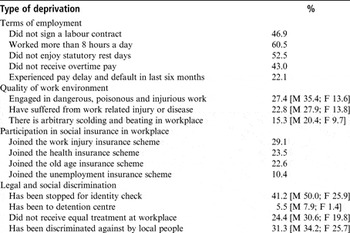
A labour contract is the basis of employment protection and is mandatory under the Labour Law. In our sample, only 53.1 per cent had signed a contract with their employer. Contract coverage varied according to ownership type. In descending order, the rate was highest in san-zi qiye (86.2 per cent) and state-owned enterprises (76 per cent), followed by 68 per cent in collective-owned enterprises and 66.8 per cent in share-holding enterprises. In private and individual enterprises where nearly two-thirds of our respondents worked, the rate dropped to less than 40 per cent. Without contracts, labourers could not prove their employment status as the basis of claims and compensation.
The Labour Law stipulates an eight-hour working day. In our sample, only 39.5 per cent enjoyed this right. The majority put in much longer hours: 30.2 per cent worked nine to ten hours per day, 14 per cent worked 11 to 12 hours, 10 per cent worked longer than 12 hours and 6.3 per cent had unfixed hours. Long working hours were especially common in individual, private and san-zi enterprises and also more characteristic of men than women. The law also provides for one rest day per week. In our survey, 52.7 per cent had fewer than four rest days in the previous month, 22.5 per cent did not enjoy any rest day at all and 23.4 per cent had one to two days.
Moreover, the quality of the work environment did not comply with state requirements. Some 27.4 per cent of respondents considered they were doing work that was dangerous, poisonous and injurious. The proportion was higher among men (35.4 per cent) than women (13.6 per cent). Before they started work, many (43.4 per cent) were not given instruction on safety and hygiene; 40 per cent were not provided with protective or safety gear. There was no work or welfare protection during pregnancy in 51.7 per cent of the workplaces.
The incidence of occupational injury and disease was another cause for concern. In our sample, 22.8 per cent reported they had been injured at work or suffered a work-related sickness, which affected males more than females (27.9 per cent of males, 13.8 per cent of females). Again, the males were more vulnerable; they were often engaged in construction work and jobs requiring hard physical labour.
All in all, the above conditions of employment indicate an important curtailment of labour rights. Statutory protection is more promised than delivered. It comes as no surprise that a significant proportion of migrants feel negatively about their experience. When asked whether they were given equal treatment at work, about a quarter (24.4 per cent) said no. This may not seem high, particularly when we do not know the extent to which non-migrant workers experience unequal treatment. More problematic is the occurrence of verbal and physical abuse: 15.3 per cent reported there was arbitrary scolding or beating (renyi dama 任意打骂) in their workplace. Yet even this small number is unacceptable. According to Article 96 of the Labour Law, the use of violence, threat, insult and corporal punishment by employers is unlawful. Furthermore, 31.1 per cent felt they were discriminated against by local people.
Economic marginalization is the common lot among our respondents. Their incomes were low: 11.6 per cent earned less than 500 yuan per month, 31 per cent made 500–800 yuan, 31.9 per cent made 800–1,200 yuan, 13.6 per cent earned 1,200–1,500 yuan and 11.9 per cent earned 1,500 yuan or more. Considering the high living costs in the sample cities, such earnings suggest living standards at or near poverty (below 500 yuan) or lower than average incomes (500–1,200 yuan). Higher incomes were more prevalent among male migrants, those with better education and those who found work through institutional channels. Contrary to common logic, longer working hours did not bring higher pay. Half of the respondents had to work overtime regularly. Among them, 43 per cent did not receive extra pay.
On the issue of wage arrears and defaults, our data show that the problems are far from extinct: 22.1 per cent of respondents experienced wage delays and defaults (tuoqian gongzi 拖欠工资) in the preceding six months (27 per cent among males, 14.8 per cent among females) and the incidences of being owed wages once, twice and thrice affected 11.5 per cent, 4.3 per cent and 6.4 per cent of migrants respectively. In the most recent episode, the sum was considerable: 46.1 per cent below 500 yuan, 31.3 per cent at 501–1,000 yuan, 12.8 per cent at 1,001–2,000 yuan and 9.8 per cent at 2,001 yuan and above.
Migrants had very poor access to social security although in theory they were eligible to enrol. Very few had joined the state-run social insurance schemes in their work units. The take-up rate was 29.1 per cent for work injury insurance, 23.5 per cent for health insurance, 22.6 per cent for old age insurance and a mere 10.4 per cent for unemployment insurance. Thus the urban social security system offered very limited support to Chinese migrants. The lack of institutional safeguards means that personal contingencies escalate into social risks and create sources of instability for society.Footnote 30
In addition, our respondents had to endure a high level of harassment and interference with their personal freedom because of their semi-legal residence status. In terms of compliance with the certification regime, there seemed to be definite improvements in recent years. For the vast majority (91 per cent), obtaining a work permit was no longer required. However, most (67.9 per cent) still had to secure a temporary residence permit. Even walking in the street could be risky. In our sample, half of the men ran into identity checks. Among the women, this was less common (25.9 per cent). Similarly, more men than women had the misfortune of being taken into detention (7.9 per cent, 1.4 per cent). Not unexpectedly, migrants felt victimized by the authorities. Impression of the police as “bad” (25.4 per cent) and “very bad” (23.9 per cent) was much higher among those who had been detained than among those who did not have the experience (10.5 per cent, 6 per cent).
Table 1 summarizes the types of deprivation and discrimination experienced by migrant workers. The first group includes violations of rights as stipulated by labour laws, especially pertaining to terms of employment and working conditions, while low social insurance coverage may indicate unenforced rules, following Perry's logic. In the second group, while breach of entitlement is not involved, migrants clearly perceived them as unfair treatment indicative of their inferiority in legal and social standing. In both types, rights are in deficit, involving gaps between formal and actual enjoyment and between desired and experienced outcomes.
Rights Deficits and Discrimination Experienced by Migrant Workers

Rights consciousness
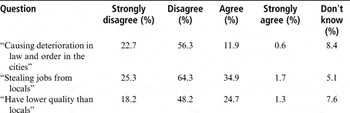
The questions on rights consciousness explore migrants' self-identity and identity by repute. Respondents were asked whether they minded being called a peasant worker (nongmingong 农民工). We did not provide any explanation of the term but left it to respondents to interpret the meaning and state their feelings. Interestingly, 67.8 per cent said they did not mind identifying themselves as such. In China, the term is widely known as an administrative label for people with rural hukou who work and live in the cities. In itself, the self-identity was rather neutral. But when asked to react to common stereotypes associated with migrant labour, feelings were more strident. The three stereotypes were “causing deterioration in law and order in the cities” (Q1), “stealing jobs from local people” (Q2) and “migrants have lower quality (di suzhi 低素质) than local people” (Q3). Not surprisingly, the majority chose “strongly disagree” or “disagree” answers (Table 2). Grouping these two together, 79 per cent objected to being blamed for urban crime, 56.3 per cent objected to the job-snatching charge, and 66.4 per cent objected to being branded as having “lower quality.” These perceptions suggest that while migrants accept their social identity as member of a paralegal and sociological category, they reject the negative labelling and stigmatization. Under the American Declaration of the Rights and Duties of Man (1948), every person has the right to the protection of the law against abusive attacks upon his honour and his reputation (Article V).Footnote 31 In China, protection of the personal dignity of citizens and prohibition against insult, libel, false charge or frame-up is listed as a fundamental right of citizens.Footnote 32 Goffman's classic work on stigma as spoiled identity which results in status loss and discrimination for stigmatized individuals is pertinent in throwing light on migrant perceptions.Footnote 33 More recently, in a rare study on social stigma and mental health among rural-to-urban migrants in China, a team of psychologists suggest that the migrant population is strongly stigmatized.Footnote 34 Interestingly, over a third and a quarter of respondents respectively conceded to there being some job competition with the locals and that their personal quality was somewhat inferior. Notwithstanding these concessions to reality, migrants' rejection of hurtful stereotypes has to be taken seriously as a form of defence of their social identity. Perry reminds us of the importance of people's rights to subsistence and development under Chinese state discourse on rights.Footnote 35 This is valid. One must also acknowledge people's need for respect and personal dignity.
Migrants' Reaction to Common Stereotypes

Statistical tests were performed to find out whether reactions were associated with age, gender, marital status, education level and pre-migration vocational status.Footnote 36 The findings were interesting. Respondents who minded being called nongmingong were more likely to be younger, female, single, better educated and students before migration. The differences are all statistically significant at 1 per cent level.
The five variables were correlated with each negative attribution. On the question of causing deterioration in public security, migrants who disagreed with the slur (strongly disagree and disagree) were found to be younger (1 per cent statistical significance), female (5 per cent statistical significance), single (1 per cent significance), better educated (1 per cent significance) and students before their migration (1 per cent significance). On the question of taking jobs from locals, more migrants who were younger (1 per cent), single (5 per cent), better educated (1 per cent) and students before migration (1 per cent) objected to the accusation while gender had no influence. Relating to the third question, being denigrated as of lower quality, fewer respondents who were younger, female, unmarried, better educated, and were students before migration agreed with the stereotype (the 1 per cent level).
In summary then, on the scores of self identity and reaction to negative stereotypes, there is strong evidence of rights consciousness. Education, youth and student status before migration in particular underpinned migrants' demand for a good self and public image. The gender difference is also notable. Women were more sensitive to having their reputation tarnished. Men had higher tolerance despite the fact that more men than women suffered abuses at their work place, like dangerous work, occupational injury, beating and scolding, and discrimination by locals. In addition, twice as many men had the experience of identity checks and detention than women. Their grin-and-bear-it attitude is quite striking. On the relevance of marital status, it is difficult to explain the statistical correlation. A possible explanation is that marital status is age related: older people are less likely to remain single. Taken together these five attributes suggest the salience of cohort differences that arouse varying degrees of emotions to how migrants perceive themselves and how they want to be regarded by society at large.
Legal awareness
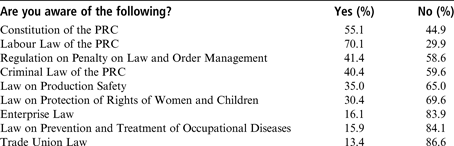
Migrants were asked whether they were aware of a number of laws and regulations that were pertinent to their rights and interests. Their level of legal awareness varied a great deal (Table 3). Only two laws, the Labour Law and the Constitution, were known to more than half of them (70.1 per cent, 55.1 per cent respectively). Laws that were known to 30–40 per cent of respondents included the Regulation on the Penalty on Management of Law and Order (41.4 per cent), Criminal Law (40.4 per cent), Law on Production Safety (35 per cent) and PRC Law on the Protection of Rights of Women and Children (30.4 per cent). Three laws were known to fewer than 20 per cent of respondents: Trade Union Law (13.4 per cent), Law on Prevention and Treatment of Occupational Diseases (15.9 per cent) and Enterprise Law (16.1 per cent).
Migrants' Awareness of Laws and Regulations
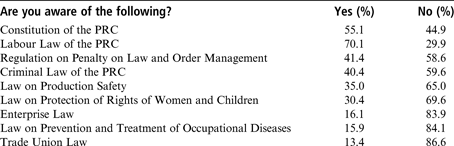
Five laws were chosen to test the significance of the variables of age, gender, marital status, education level and pre-migration status. They are the Constitution, Labour Law, Trade Union Law, Law on Protection of Rights of Women and Children, and Law on Production Safety.
The tests revealed that age did not have any effect on migrants' awareness of the Constitution, Law on Protection of Women and Children, and Law on Production Safety. On the Labour Law, younger respondents were more aware (statistically significant at 5 per cent) whereas older respondents were more aware of the Trade Union Law (with 1 per cent significance).
Gender did not have any statistically significant effect on two laws (Trade Union Law, Law on Production Safety) but was significant to the other three (all at 1 per cent). The type of law was relevant, however. More men than women were aware of the Constitution, and, as would be expected, more women knew about the Law on the Protection of the Rights of Women and Children.
Marital status did not affect people's awareness of the Labour Law and Law on Production Safety. On the other three, a 1 per cent statistical significance was found. But no uniform conclusion can be drawn. Single respondents were more aware of the Constitution than married people. However, more married respondents were aware of the Trade Union Law and Law on the Protection of the Rights of Women and Children than single people.
Among the five variables, education level and pre-migration status were statistically related to legal awareness (at 99 per cent significance). On all five laws, the better educated respondents had more awareness than those who were less well educated. Except for the Trade Union Law, respondents who were students before they migrated were more aware of the laws than erstwhile farmers.
As a short summary, education level and pre-migration status appeared to be more important in shaping migrants' awareness of laws, while age did not seem to be relevant. The effect of gender and marital status appeared to be contingent on the particular law in question.
Rights defence strategies
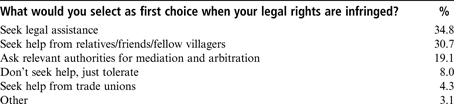
The respondents' answer to the question “what would you select as first choice when your legal rights are infringed?” provided clues to their choice of rights defence strategies (see Table 4).
First Choice for Rights Redress
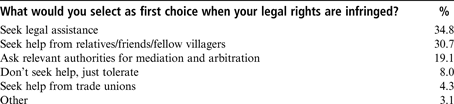
Among all the strategies, seeking legal assistance emerged as the most preferred strategy (34.8 per cent), followed by getting help from relatives, friends and fellow villagers (30.7 per cent), and mediation and arbitration (19.1 per cent). A small proportion (8 per cent) chose tolerance and non-action. If those who opted for institutionalized strategies for rights redress (legal action, mediation/arbitration and trade union assistance) were grouped together, the proportion came to 58.2 per cent, much larger than those who settled for personalized strategies (kin and close associates, 30.7 per cent). This stress on legal and bureaucratic intervention indicates a high level of rights consciousness and legal consciousness among the migrants.
When the importance of age, gender, marital status, educational level and pre-migration status were tested, gender and pre-migration status were found to have no impact. On age, respondents who chose personalized strategies were younger than those who turned to institutionalized methods (1 per cent significance level). Relating to education level, the group who trusted personal networks was less well educated than those who chose institutionalized strategies. As far as marital status was concerned, more single than married people chose the use of private capital. Hence the tentative conclusion is that younger, unmarried and less educated people preferred private strategies for rights redress; older, married and better educated people favoured institutionalized methods.
Rights defence is not confined to the use of legal action or help from significant others. Joining social organizations is another means of self protection. Group membership also provides mutual support in facing a hostile environment. In recent years the state has ordered trade unions to recruit migrants. Organizations like migrant associations (nongmingong xiehui 农民工协会) and home-town associations (tongxianghui 同乡会) have flourished as well (see Table 5).
Willingness to Join Various Types of Associations

Willingness to join labour unions and migrant associations was affected by gender, marital status and education level. Willing migrants were dominated by respondents who were male, married and better educated (all at 1 per cent significance level, except for willingness to join migrant associations which was at 5 per cent level). Where age was concerned, younger persons preferred trade unions whereas older ones opted for migrant associations. Pre-migration status had no effect on desire to join trade unions whereas more farmers than students were willing to join a migrant association. With reference to home-town association membership, gender, education level and pre-migration status had no effect. However younger and married respondents were more willing to join home-town associations.
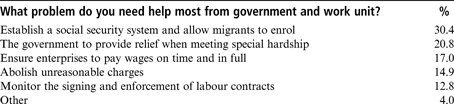
The government and work unit are powerful actors in the life of working persons in China. To people employed in state-owned enterprises, the danwei 单位 and the state are omnipotent. Compared with local employees, migrants get less service and fewer benefits from the state. In the Sunbelt, remuneration rarely goes beyond the cash wage. But it is still important to identify what migrants expect from the state and their employers. Access to services is important to deliver employment and social rights, to make good current deficits, and to gain hitherto denied rights. The question was framed in this way: what was the key problem for which migrants needed help from the state and work unit (Table 6).
What Problem Migrants Need Help Most from Government and Work Unit
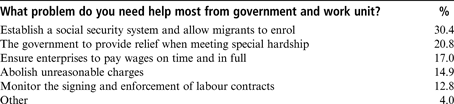
The top two concerns indicated migrants' need for social protection, namely creating an appropriate social security system (30.4 per cent) and a safety net to counter special hardship (20.8 per cent), the latter reserved for residents with urban registration. The nature of the strategies is conducive to enabling migrants to cope with life risks in a market economy. The other problem areas are ensuring timely and full payment (17 per cent), ending unreasonable charges (14.9 per cent) and policing labour contracts (12.8 per cent). Tackling these problems is conducive to preventing potential harm.
The personal backgrounds of respondents who chose “preventing potential harm strategies” and “enabling strategies” were then analysed. Age and marital status were found to have no influence. Significantly more males, the less educated and former farmers chose preventative strategies while more women, the better educated and former students favoured enabling strategies (all at 1 per cent significance level).
Legal knowledge, rights consciousness and personal strategies
Is there any relationship between legal knowledge, rights consciousness and rights defence strategies? Does having more legal knowledge increase people's readiness to make use of institutionalized strategies (legal action, mediation/arbitration, trade union assistance) for rights defence? What personal characteristics are linked to the penchant for institutionalized remedies in rights protection?
To explore the link between legal knowledge and rights defence strategies, two groups of respondents were isolated: migrants who would first go to their relatives/friends/fellow villagers, and migrants who preferred institutionalized intervention. The two groups' awareness of the Constitution and Labour Law was analysed and it was found that the latter group had better knowledge of them (significant at 1 per cent level). This suggests that knowing one's legal rights increases one's faith in bureaucratic solutions to rights violation.
Objection to common stereotypes was a key ingredient of rights consciousness. Taking offence over negative stereotypes was significantly stronger among the group who trusted institutionalized intervention than the group who favoured private solutions (statistically significant at 1 per cent level). On the other hand, a larger proportion of people who favoured private networks took offence at being called a peasant worker (at 5 per cent level). But bearing in mind that two-thirds of the respondents did not mind being called a peasant worker, this correlation may not be meaningful.
What are the determinants in using institutionalized strategies for rights protection? Regressing this on gender, age, education level and legal knowledge, only legal knowledge was found to have a statistically significant impact on the choice of institutionalized intervention. Gender, age and education level had no significant impact.
In summary, there is a positive link between legal awareness and preference for institutionalized or bureaucratic intervention. Rights consciousness in terms of objection to negative stereotypes is also linked to the institutionalized action strategy. Having a better knowledge of the law and a higher level of rights consciousness increases the demand for institutionalized protection.
Discussion
Migrant workers experience substantial discrimination and infringement of their rights during their stay in Chinese cities. The Labour Law in theory grants them vocational rights as members of the working class. In reality these rights are often not honoured. Male migrants, in particular, encounter significant abuses. When these occur, the existing social security system offers little protection. Fewer than 30 per cent of the respondents were enrolled in urban pension, medical and work injury insurance schemes. The experience of discrimination is repeated in their daily life. A significant proportion reported they were not treated equally at work and face discrimination from local residents. Civil rights harassment like identity check and detention is less common but affects a number of especially male migrants. These difficulties undermine migrants' chances of assimilation in the cities.
Migrants' feelings about their urban experience are marked by a distinct sense of self and rights consciousness. Although the majority did not mind being called a peasant worker, most resented the common stereotypes which hurt their self esteem and social reputation. Resentment is clearly linked to gender, education and pre-migration status, in particular the last two. Legal awareness, barring the Constitution and Labour Law, is underdeveloped on the whole.
Migrant workers' rights defence strategies tend to fall into two camps. The younger, less educated and erstwhile farmers lean towards private resources. Those who are older, better educated and former students are supportive of institutionalized strategies. Better legal knowledge is associated with preference for institutionalized protection. These contrasting responses should be of interest to the authorities. In the 1980s and 1990s, the first generation of migrants who were farmers before they migrated tended to be more tolerant in putting up with hardship and abuse. Now they have been joined by better-educated school-leavers who are more rights conscious, legally aware and supportive of institutionalized intervention, an increase in migrant activism and higher demands for social justice are apparent. They are also less willing to return to the farm and want to settle in the cities.Footnote 37
The key role of institutionalized safeguards is reflected by migrant expectations of the state and employers. Enabling measures were valued by half of the respondents, exceeding those who stressed measures to avert potential harm. Another strategy is to expand social capital through membership of social organizations, including labour unions, migrant organizations and home-town associations. Only the first type is encouraged by the state while the other two have no legal standing. To the extent that official unions fail to meet migrant expectations, there is a ready market for extra-legal affiliations. Outlawing these bodies will only drive them underground, which is conducive neither to enhancing legitimacy nor to effective governance.
The wide-ranging rights deficits highlight the gap between implementation and intent that often mars policy-making in China. Despite state efforts to enhance the rule of law, curtail abuses and improve the situation of vulnerable groups, the record is rather poor. Many institutional factors hinder policy effectiveness. These include inadequate resources and commitment by the central government, the resistance of city authorities to implementing protective measures, the powerlessness of migrant workers, and general discrimination by the urban population.
Failure to provide justice for migrant workers is also affected by the state's narrow conception of human rights. Perry reminds us that the Chinese state sees human rights primarily as “legal rights and interests” (quanyi 权益) and that people are prone to regard rights as state-conferred.Footnote 38 Whereas the Western notion of human rights emphasizes civil, political and social-economic rights, state discourse is dominated by concerns for subsistence and development. This divergence in emphasis is seen as the major difference between Chinese and Western approaches to human rights.Footnote 39 Hence migrant protests are driven by rule enforcement concerns; in response, the state takes action to remove abuses, extend protection and improve treatment. From this perspective, the controversial Labour Contract Law of 2007 marks the latest attempt to protect the working class, including migrant labourers, from insecure employment and discriminatory treatment. Its introduction is an admission that the measures adopted so far have had little effect in ending abuses, and stern penalties are needed to give teeth to policy enforcement. The new law has met with opposition and resistance from business, economists and local governments. The dire economic situation under the world financial crisis has stiffened corporate demands to delay implementation, with some local states taking measures to regulate layoffs, adjust social insurance contributions, extend payment deadlines and enhance staff training.Footnote 40
On the question of whether migrants subscribe to rights talk and are willing to take legal action to defend their rights, the answer from this survey is affirmative. Migrant workers take readily to the rights discourse. They have a high sense of rights and legal consciousness. They care about issues of their livelihood and righting wrongs to uphold the system of rules, policy and law. Their anger at social smearing suggests they are equally concerned to uphold their personal dignity. More importantly, there is unequivocal endorsement of legal and bureaucratic strategies, which are slightly more popular than using personal resources when rights infringements occur. Migrants' expectations of public agencies stem from their powerlessness to face urban risks unaided and their need for institutional protection. Naturally they turn to the state to defend their rights. This is in line with cultural attitudes in Chinese society that sees the state as the arbiter and protector, as fu mu guan 父母官, and benign ruler. Authoritarian socialism maximizes the role of the state. Chinese masses who suffer injustice and bad treatment are used to asking the government for a view (you ge shuofa 有个说法). Thus Cultural Revolution victims and survivors press the authorities for a verdict on their cases. Even in death, political rehabilitation can give better life chances to their family members. Chinese people may not yet enjoy full political and civil rights, but this does not stop them from demanding such rights and expecting the state to play its part.
Is “rules consciousness” rather than “rights consciousness” more appropriate in explaining citizen demands on the Chinese state? In the majority of issue-related claims, individuals and social groups seem to be motivated by concerns for rule compliance and stop short of challenging state authority. Protesters are particularly careful to frame their public demands within legal limits. In liberal democracies, citizens sue the government for maladministration or rights violation, and to overturn unconstitutional decisions, though even there citizen action to overthrow the state is rare. In the Chinese context, overthrowing the CCP and the state is unconstitutional. Very few civil actions, apart from so-called acts of sedition, independence movements and terrorism, are directed against the state. The Chinese state may have shifted from totalitarianism to authoritarianismFootnote 41 but it remains extremely powerful. At the same time, it has proved to be flexible and resilient in adapting institutions to manage conflict and preserve its rule.Footnote 42
Popular concern for rules compliance should not be taken as denying rights consciousness. A decade into the new millennium, collective protests have become more vociferous and numerous. Public anger at state failure and worsening corruption often lead to the accidental flaring up of violence and spontaneous incidents. Nowadays officials often complain about the difficulty in dealing with stubborn and unreasonable people (diaomin 刁民) who refuse to obey state orders and use extreme tactics to get what they want. In March 2010, 13 Chinese newspapers issued a joint editorial to call for abolition of the hated hukou system. Such daring action by the state-controlled media is unprecedented.Footnote 43 How can one make sense of this and countless other acts of defiance?
In a forthcoming article, Li Lianjiang distinguishes between reactive and proactive claims, and claim making against local rule enforcement and central decision making authorities. A claim is reactive if the claim entitlement is based on existing rules and proactive if it requires fundamental rule changes or new rules. Claims made against local states are essentially rule based while challenges on central policies and leaders are suggestive of rights consciousness. The farmers he studied made use of both sorts of claims and directed their action at and beyond the local level.Footnote 44 Studies on other disgruntled groups identify popular demands to deliver promised rights, punish officials and actors who disobey the law, and repeal unjust policies and laws.Footnote 45 When only the central state is perceived to have the authority to adjudicate on the denial of rights at the local level, migrants naturally turn to the centre for arbitration and redress. Both Lianjiang Li and Ching Kwan Lee identify the contradictory imperatives and conflicts of interests between the central government and local states as the institutional source of popular contention. Lee, in addition, points out that among insurgent workers, their subjectivity cannot be reduced to material interests. “Equally important are workers' sense of dignity, justice, and their need for recognition.”Footnote 46 This point finds support from my survey findings. More importantly, the current survey suggest that the experiences of discrimination, consciousness of rights and choice of personal strategies are affected by personal backgrounds like age, gender, education, occupational status before migration and knowledge of the law. The influence of these factors reveals that migrant workers are a heterogeneous group and that cohort effects are definitely relevant in shaping migrant politics. The so-called post-1980s and post-1990s generation of migrants are likely to be more knowledgeable, determined and skilled in asserting their rights as citizens in a more open and rule-based society.
Appendix: Survey on Social Protection for Chinese Peasant Workers: Plugging a Policy Vacuum
General description
The survey was conducted by Linda Wong of City University of Hong Kong and Zheng Gongcheng of Renmin University, China. It commenced in January 2005 and was completed in June 2007. Major funding was granted by the Research Grants Council of the Hong Kong Special Administrative Region (Competitive Earmark Grant Project 9040948) supplemented by funding from City University of Hong Kong.
Objectives
(1) Investigate the origin, mobility pattern and characteristics of peasant workers in selected Chinese cities;
(2) Explore peasant workers' eligibility for social protection and the effects of their exclusion;
(3) Unravel coping strategies in resolving livelihood issues;
(4) Identify perceived needs, problems and expectations;
(5) Examine the feasibility of granting social protection to peasant workers and its implications for a unified labour market, national social security system, urbanization and growth of civil society;
(6) Assess the role of government, trade unions, local communities and social organizations in empowering peasant workers.
Methodology
The main research method was personal interviews with 2,617 migrant workers using a stratified proportional sample. Fieldwork took place in July to November 2005. Four cities – Shenzhen 深圳, Suzhou 苏州, Chengdu 成都 and Beijing 北京– were chosen as sites for the interviews. In each city, four types of samples were selected to ensure broadly representative groups of the migrant population. These are: (1) migrant workers from enterprises recommended by local labour and social security departments (four to six interviewees in each enterprise); (2) migrant workers randomly approached in industrial zones; (3) migrant workers living in residential districts; (4) migrant workers randomly approached in public spaces like street corners, markets, bus stations, construction sites, restaurants and shops. Each respondent was interviewed for about 40 minutes. The interviewers were postgraduate students enrolled in the School of Labour and Human Resources of Renmin University, China.
Distribution of samples
The 2,617 completed interviews are distributed as follows: Shenzhen – 626; Suzhou – 623; Chengdu – 624; Beijing – 744.
In Shenzhen, the completed interviews came from Bao-an District Shajing Town 宝安区沙井镇, Longgang District Buji Town 龙岗区布吉镇, Nanshan District Shekou Industrial Zone 南山区蛇口工业园, Shekou Industrial Zone Sihai Community 蛇口工业区四海社区, Luohu District Caiwuwei Community 罗湖区蔡坞围社区 and randomly approached persons in public spaces.
In Suzhou, the completed interviews came from Wujiangshi Miaogang Town 吴江市庙港镇, Wuzhongqu Yongzhi Town 吴中区用直镇, Jinchangqu Shilu Jiedao 金阊区石路街道, Pingjiangqu Chengbei Jiedao 平江区城北街道, Gongyequ 工业区 and randomly approached persons in public spaces.
In Chengdu, the completed interviews came from Shuangliuxian Huayang Town 双流县华阳镇, Wenjiangqu Liucheng Town 温江区柳城镇, Jinjiangqu Liujiang Jiedao 锦江区柳江街道, Wuhouqu Jinhuaqiao Jiedao 武侯区金花桥街道, Chengdushi Diyichengqu 成都市第一城区 and randomly approached persons in public spaces.
In Beijing, the completed interviews came from Changping Zhongguancun Kejiyuanqu Changpingyuan 昌平中关村科技园区昌平院, Shunyi Konggang Gongyeyuan 顺义空港工业园, Chaoyang Haixianqiao Jiedao 朝阳海仙桥街道, Haidian Shangdi Jiedao 海淀上地街道, and randomly approached persons in Xicheng Xizhimen Jiedao 西城西直门街道, Chongwen Tianqiao Jiedao 崇文天桥街道, Fengtai Dahongmen 丰台大红门 and Fengtai Xiaohongmen 丰台小红门.