Introduction
Investigations concerning potential environmental influences on health and activity participation have been increasing worldwide in the past two decades. Comparatively few studies, however, have examined this issue in relation to the older adult cohort, which is often characterised by heterogeneity and extremes in vulnerability and resilience. For vulnerable older people, in particular, environmental attributes can present many barriers to an active engagement with life, which may ultimately affect health outcomes. Potential influences on health and activity participation are considered in concert within this review as there is an increasing global focus on active ageing and its correlates. Active ageing is a World Health Organisation concept, which suggests that by maintaining participation in a range of activity domains in later life, older adults are able to sustain health and wellbeing (World Health Organisation 2002). Theory and research evidence suggest that when increased participation in healthful activities is attained at a population level, a compression of morbidity may be achievable in some societies (Fries Reference Fries2003). Cohort-level reductions in time spent in ill health or infirmity prior to natural death have obvious consequences for the provision of health-care resources and utilisation of health systems in ageing societies. This paper summarises a systematic review of published evidence from the last 25 years concerning the potential influence of environmental conditions on health and activity participation in later life.
A systematic review is an examination of research evidence based on formulated questions that uses systematic and explicit methods to identify, select and critically appraise relevant primary research (NHS Centre for Reviews and Dissemination 2001). In this review, older adults are the population under investigation and are defined as individuals aged 50 years or older to account for international and cultural variations. Environment is broadly defined in the literature and includes both physical (built and natural) and social conditions that may be relevant to older adults. The activities of interest in this review include those outlined by the World Health Organisation (2002) in its active ageing policy framework and include physical, social, cultural, civic, spiritual and economic activities (World Health Organisation 2002). The definition of health employed in this research also follows existing and holistic World Health Organisation definitions and includes physical, mental and social wellbeing as outlined in the Ottawa Charter for Health Promotion (World Health Organisation 1986). When a holistic definition of health is considered, it is plausible that any association between environment and health may be mediated or moderated by the influence of environmental conditions on the everyday activities of older adults.
The health-related gerontological literature, including review articles, has historically focused on the physical aspects of activity and health, with relatively little consideration for the known diversity of experiences with ageing (Bowling and Grundy Reference Bowling and Grundy1998; Humpel, Owen and Leslie Reference Humpel, Owen and Leslie2002). Research into the possible relationship between physical activity and environmental conditions has received the most attention from researchers, possibly due to the well-established health benefits associated with regular physical activity participation (Chodzko-Zajko et al. Reference Chodzko-Zajko, Proctor, Singh, Minson, Nigg, Salem and Skinner2009). The prevailing literature has also prioritised the assessment of quantitative research and empirical research outcomes, with comparatively little consideration of valuable qualitative outcomes.
Consistent with the established criteria for systematic review procedures, this paper poses a number of questions: what research currently exists that explores potential environmental correlates of health and activity participation among older adult populations? How, if at all, does the environment affect older adult health and activity participation? What research approaches have been used to investigate potential associations between ageing, environment, health and activity participation? What are the existing gaps and limitations in the current body of evidence? What further research is required to address the potential limitations and knowledge gaps concerning environmental influences on older adults' health and activity participation?
Methods
The systematic review process presented in this paper follows the general framework established by the Cochrane Collaboration (Higgins and Green Reference Higgins and Green2011). A Cochrane-type review procedure was used in order to provide a familiar and systematic process for identifying studies of potential environmental influences on older adults' health and activity from within a large and diverse body of literature. This review has been modified from a standard Cochrane review procedure in a number of ways: (a) the review incorporates both qualitative and quantitative research in a mixed-methods review, which is uncommon among Cochrane studies; (b) the review does not specifically evaluate the effectiveness of an intervention or clinical trial, but rather explores the diverse evidence in fields related to ageing, environment, health and activity participation; (c) a pragmatic, narrative approach has been used to report the findings of the review, rather than conducting a statistical meta-analysis that is common among empirically geared Cochrane reviews; (d) the review sought to identify knowledge gaps and limitations in the current body of research as a prelude to a subsequent study of the environmental influences on active ageing. It could be argued that a scoping review may have also been appropriate for the aims of the present research, which include the assessment and integration of both qualitative and quantitative data. However, scoping reviews are primarily employed as reconnaissance tools in new areas of enquiry, rather than as a way of consolidating high-quality research within a heavily populated field (Levac, Colquhoun and O'Brien Reference Levac, Colquhoun and O'Brien2010). Scoping reviews also tend to be highly variable in their methods and often lack a systematic or standardised approach to study identification and assessment (Davis, Drey and Gould Reference Davis, Drey and Gould2009).
Search strategy
Initially, we sought existing reviews undertaken in the past ten years that had assessed the evidence for interrelationships between ageing, activity, health and environment. A small number of relevant review articles were located. Once the extent of previous literature reviews into the topic under investigation had been gauged, this information was used to inform the development and scope of the present review. Among the existing review articles identified, investigations were confined to studies of physical environment, physical health and physical activity, and there was no broader environmental or activity focus. Few reviews focused exclusively on older adults and there was a noticeable absence of consideration of qualitative or mixed-methods studies.
Databases accessed for the systematic review included Proquest Health and Medical Complete, ISI Web of Knowledge, Ovid (including Medline, PsychINFO, NURSING and EMBASE), Scopus and EBSCO (including CINAHL). These databases were chosen to provide a balance between multi-disciplinary and specialist sources of information, which were likely to lead to the identification of diverse research articles concerning the interactions between ageing, activity, health and environment. These databases also provided broad access to a range of public health, medical, sociological and geographical literature. Searches were undertaken within the databases specified above and included combinations of the following search terms: environment, context, place or ecological; morbidity, mortality, health, quality of life or wellbeing; older adult, age, elder or senior; and behaviour, activity, participation or engagement. Search terms were formulated using synonyms related to the original research problem and followed the assessment procedures used in existing literature reviews that have previously assessed interactions between health, activity, ageing and environment (Bowling and Grundy Reference Bowling and Grundy1998; Humpel, Owen and Leslie Reference Humpel, Owen and Leslie2002; Yen, Michael and Perdue Reference Yen, Michael and Perdue2009).
Searches of the so-called grey literature (reference lists from relevant review papers, books and other articles) were also employed to identify further relevant studies not located during the database searches. Academic colleagues were consulted to identify further items outside the bounds of the present review of relevance to the research. Once all potentially relevant studies were identified, they were assessed against inclusion criteria. The methodological quality of articles was then assessed using a quality assessment tool developed by the researchers.
Inclusion/exclusion criteria and quality assessment
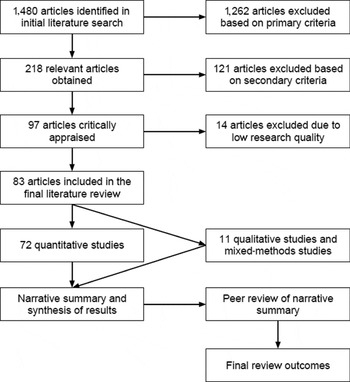
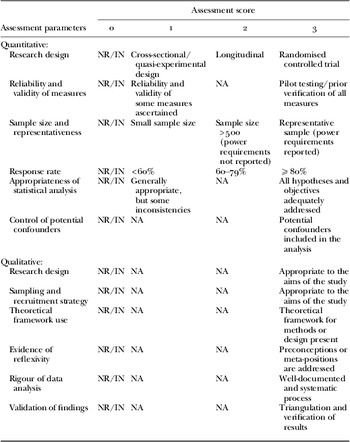
The initial search of the five databases yielded 1,428 potentially relevant articles. Searches of the grey literature identified a further 52 articles of interest. Two sets of inclusion criteria were applied to the results. Primary inclusion and exclusion criteria included the stipulation that studies to be included in the review should be peer-reviewed journal articles from 1985 and onwards constituting an assessment of over 25 years of recent gerontological research, published in English, and represent primary research. After reviewing title, keyword and abstract information in relation to these criteria, the pool of potential articles was significantly reduced to 218. Secondary inclusion and exclusion criteria were then applied to make the final selection of articles for the review. Selection criteria included the stipulation that only studies meeting the following criteria would be reviewed: sampling of community-dwelling older adults aged 50 years or older; assessments of health-related issues or component behaviours of the World Health Organisation's active ageing concept; studies that considered the environment or related concept as a potential correlate of health or activity; and studies that adopted qualitative, quantitative or mixed-methods approaches. Once the secondary inclusion and exclusion criteria were applied, the pool of articles was further reduced to 97 (Figure 1). Relevant articles located as a result of the search strategy and application of the inclusion and exclusion criteria were then sent to two reviewers (who also contributed to this paper) to determine whether selection had been consistent with the pre-defined criteria. Once all relevant studies had been identified and the selection process peer reviewed, remaining articles were assessed against a further set of criteria, which identified articles that were of high quality to provide a sound basis for the review. Studies that were identified as having a lower level of quality were omitted. Two sets of quality assessment criteria were utilised: one for quantitative studies and another for qualitative and mixed-methods studies. Rating systems were adapted from existing review procedures (Catalani and Minkler Reference Catalani and Minkler2010; Stevenson et al. Reference Stevenson, Pearce, Blakely, Ivory and Witten2009; Yen, Michael and Perdue Reference Yen, Michael and Perdue2009). Six parameters were used to assess overall quality of quantitative and qualitative articles, and studies were assigned a score from zero to three based on the level of scientific rigour applied. A score of three was assigned for the highest levels of rigour (e.g. use of randomised controlled trials or an appropriate theoretical framework justifying research design). A score of zero was given when parameters were not reported. Studies earning a total score of nine or more were included in the research. Quantitative and qualitative studies with a score less than nine were excluded from final review. During the abstraction and quality evaluation period, 14 articles were identified as either having a lower level of quality or not meeting inclusion criteria. The final systematic review, therefore, concerns 83 of the most relevant articles identified during the systematic review process (Table 1).
Overview of article selection process.

Quantitative and qualitative assessment parameters

Notes: NR: not reported. IN: inappropriate in the context of the study.
This review examined both qualitative and quantitative evidence concerning potential environmental influences on older adult health and activity participation. A pragmatic, narrative approach was employed to integrate the data in response to a lack of focus in the international literature on the qualitative evidence (Harden and Thomas Reference Harden and Thomas2010; Petticrew and Roberts Reference Petticrew and Roberts2006). The narrative approach, which refers to the subjective and literary interpretation of findings from varying philosophical and methodological traditions, is arguably a useful approach to assessing and integrating diverse results within a relatively new field of academic endeavour. Previous reviews in the area of ageing, environment and health have successfully applied a narrative approach to synthesise diverse research findings (Yen, Michael and Perdue Reference Yen, Michael and Perdue2009).
Results
Research participants
Of the 83 studies examined in this research, ten studies were conducted solely with older women and the remaining 73 studies were undertaken with mixed samples. With regard to the age of participants and the implicit definitions of old age, 32 studies used a minimum age limit of 65 years for inclusion in the research, 31 studies used an age of inclusion of 60 years or younger, while 20 studies included adults aged 70 years or older. Seventy-two per cent of all studies utilised a chronological age between 60 and 70 years as the starting point for participation in studies of older adult health and activity participation. All of the studies assessed in this review employed a chronological marker of older age to delineate their research subjects.
Research locations
Research from North America (predominantly Canada and the United States of America (USA)) and Western Europe dominated the review results. Out of 83 studies, 49 were undertaken in North America and 20 were undertaken in Europe. Limited numbers of research articles from other areas were identified, including eight studies undertaken in Australasia, four in Asia and two in South America. No studies were identified from either Africa or the Middle East. Comparatively limited results from Asia, Africa and South America may be related, in part, to the exclusion of non-English language journal articles from the review process.
Research design and methods
Quantitative approaches dominated the reviewed research articles. There were few examples of qualitative or mixed-methods studies located via the search procedure. Of the 83 studies analysed, 72 were quantitative and only 11 were qualitative or mixed-methods approaches. The prevailing research design among the assessed quantitative studies was cross-sectional (N = 48), with smaller numbers of longitudinal or cohort studies (N = 21) and a few randomised controlled trials (N = 3). The prevalence of cross-sectional research appeared to be associated with the large number of exploratory objectives and hypotheses, which is consistent with the relative youth of the field of environmental gerontology. Strategies for selecting study participants in the assessed literature included simple random sampling, systematic sampling, convenience and purposive sampling approaches. Probability sampling techniques were the most common approach, which is congruent with an empirical design focus. Surveys using questionnaires and interviews (face-to-face or via telephone) dominated research concerning environmental influences on older adults' health and activity participation. Interview surveys were employed as a primary method in 37 studies; questionnaires were employed in 36 studies. Only eight empirical studies employed direct measures of environment, health or activity participation. Where qualitative research methods were employed, either independently or in combination with other methods, in-depth interviewing was used most frequently (N = 7) followed by focus group discussions (N = 5) and field observation (N = 3). A small number of studies utilised novel research methods such as participant role-playing and photovoice procedures (Connell and Wolf Reference Connell and Wolf1997; Gallagher et al. Reference Gallagher, Gretebeck, Robinson, Torres, Murphy and Martyn2010).
Measurement of environmental variables
While the majority of the assessed studies were exploratory in nature, they were also predominantly empirical, which meant that many of the potentially influential environmental variables were defined by the investigators in advance of research commencement with little input from research participants. Environmental variables that were commonly assessed as potential influences on health and activity participation included measures of land use characteristics, area deprivation or poverty, neighbourhood degradation, accessibility of services and facilities, accessibility of public green space, social environment and networks, perceived crime and anti-social behaviour, walkability or pedestrian friendliness, traffic conditions, aesthetics and architecture, trip hazards in the home and neighbourhood, home and environmental adaptations, climate and topography, and the presence of animals. The conceptualisation of environments as units of analysis in the assessed literature included government-defined administrative areas (census tracts or postal codes), home or residential care settings, land use typologies (urban versus rural), subjective definitions of neighbourhood proposed by local residents, distinctions based on population density, time- or distance-based definitions of areas, and researcher-defined areas. A common feature of most of the assessed studies was the use of researcher-defined definitions of environment.
Main outcome measures and covariates
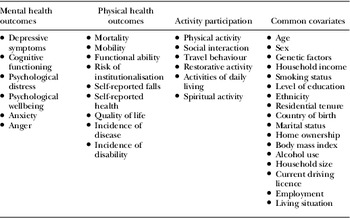
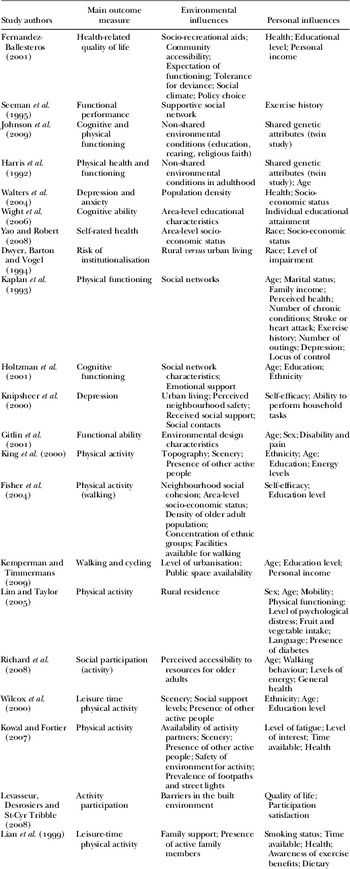
The main outcome measures identified in the assessment of the literature included mortality and longevity (N = 5), mental health outcomes (N = 13), morbidity and functional ability (N = 32) and activity participation (N = 33). Potential confounding variables (or covariates) were also assessed in conjunction with potential environmental influences on health or activity participation. The inclusion of such variables was necessary for conceptualising potentially important relationships between personal-level factors and older adult health and behaviour (Table 2).
Main outcome measures among assessed research studies

Key findings
Of the 83 studies assessed in this review, a majority (N = 46) reported significant, independent relationships between environmental conditions and older adults' health and activity participation. A further seven studies identified either no relationship or an alternative relationship between environmental conditions and older adult health and activity participation, contradictory to the established evidence. Eight studies identified both significant and non-significant associations between environmental conditions and activity participation and health. That is, some environmental conditions matter for health and activity participation, while others do not. Finally, 22 studies identified a combination of personal and environmental influences on older adult health and activity participation.
Environmental influences on physical health
The systematic review process identified a large number of studies that reported significant and independent relationships between environmental conditions and the health and mortality of older adults. The physical environment, including natural and man-made elements, has been identified as an important influence on the health and wellbeing of older adults across the developed world. In particular, residence in lower-quality environments has been correlated with a loss of physical function and disability, reduced health-related quality of life, poorer self-reported health, increased incidence of degenerative disease, increased incidence of falls, cardiovascular mortality and reductions in longevity (Balfour and Kaplan Reference Balfour and Kaplan2002; Bowling et al. Reference Bowling, Barber, Morris and Ebrahim2006; Breeze et al. Reference Breeze, Jones, Wilkinson, Bulpitt, Latif and Fletcher2005; Connell and Wolf Reference Connell and Wolf1997; Diez Roux et al. Reference Diez Roux, Borrell, Haan, Jackson and Schultz2004; Kobetz, Daniel and Earp Reference Kobetz, Daniel and Earp2003; Merkin et al. Reference Merkin, Roux, Ana, Coresh, Fried, Jackson and Powe2007; Takano, Nakamura and Watanabe Reference Takano, Nakamura and Watanabe2002; Zeng et al. Reference Zeng, Gu, Purser, Hoenig and Christakis2010). Characteristics of the physical environment that have been associated with poor health among older populations and reported in the literature include excessive noise, inadequate lighting, heavy traffic, temporary hazards, poor walking surface conditions, poor air quality, the presence of rubbish, environmental barriers in and around the home, extreme temperatures (both high and low) and excessive environmental demands (Balfour and Kaplan Reference Balfour and Kaplan2002; Connell and Wolf Reference Connell and Wolf1997; Parra et al. Reference Parra, Gomez, Sarmiento, Buchner, Brownson, Schimd, Gomez and Lobelo2010; Zeng et al. Reference Zeng, Gu, Purser, Hoenig and Christakis2010). Environmental features which have been correlated with improved health among older adults included the proximity to and density of public open space and recreational facilities, high-quality facilities (social and leisure facilities, age-appropriate facilities), peacefulness, cleanliness, safety of public areas and street crossings, frequent rubbish collection, access to health services, transport availability, closeness to shops and places for walking, living in a retirement village, living in a hillside area, living in an area with high rainfall and living in a rural environment (Bowling et al. Reference Bowling, Barber, Morris and Ebrahim2006; Day Reference Day2008; Grant Reference Grant2007; Lee Reference Lee1993; Parra et al. Reference Parra, Gomez, Sarmiento, Buchner, Brownson, Schimd, Gomez and Lobelo2010; Takano, Nakamura and Watanabe Reference Takano, Nakamura and Watanabe2002; Zeng et al. Reference Zeng, Gu, Purser, Hoenig and Christakis2010). These data suggest that environmental conditions of residential areas can either promote or impair physical health among older adult populations.
In addition to studies of the associations between proximate physical environmental conditions and the health of older people, an increasing number of researchers have also considered the role played by the social environment, including proximate social networks, social capital (norms of reciprocity and trust) and incidental social interactions. Researchers have reported independent associations between the social environment and disability, functional decline, morbidity and mortality (Avlund et al. Reference Avlund, Lund, Holstein and Due2004; Beckett et al. Reference Beckett, Goldman, Weinstein, Lin and Chuang2002; Eschbach et al. Reference Eschbach, Ostir, Patel, Markides and Goodwin2004; Unger, Johnson and Marks Reference Unger, Johnson and Marks1997). Aspects of the social environment reportedly associated with improved health and reduced rates of mortality include diversity of social contacts, high levels of social participation, large social network size, presence of living children, ethnic homogeneity of an area, high levels of perceived neighbourliness, high levels of community literacy, higher area-level socio-economic status, high levels of workforce participation, spending time in the company of friends and living in an age-specific community (Avlund et al. Reference Avlund, Lund, Holstein and Due2004; Beckett et al. Reference Beckett, Goldman, Weinstein, Lin and Chuang2002; Bowling et al. Reference Bowling, Barber, Morris and Ebrahim2006; Day Reference Day2008; Eschbach et al. Reference Eschbach, Ostir, Patel, Markides and Goodwin2004; Grant Reference Grant2007; Kobetz, Daniel and Earp Reference Kobetz, Daniel and Earp2003; Maier and Klumb Reference Maier and Klumb2005; Patel et al. Reference Patel, Eschbach, Rudkin, Peek and Markides2003; Walsh and O'Shea Reference Walsh and O'Shea2008; Zeng et al. Reference Zeng, Gu, Purser, Hoenig and Christakis2010). Some features of social environments, however, can place demands on older people and may lead to reduced health and functioning. Social variables that have been identified as having a deleterious influence on health and mortality include financial problems within the family, excessive demands placed on an individual by family and friends, having a spouse or partner in poor health, lower socio-economic status of an area, perceptions of crime and the presence of graffiti (Beckett et al. Reference Beckett, Goldman, Weinstein, Lin and Chuang2002; Bowling et al. Reference Bowling, Barber, Morris and Ebrahim2006; Parra et al. Reference Parra, Gomez, Sarmiento, Buchner, Brownson, Schimd, Gomez and Lobelo2010; Patel et al. Reference Patel, Eschbach, Rudkin, Peek and Markides2003). Across all studies assessed in this review, it was noted that being part of a strong and supportive social network was positively associated with health and longevity among older adults. The composition of a supportive network varied, however.
Environmental influences on mental health and cognition
In addition to the impacts of environmental conditions on the physical health of older adults, research has also been undertaken in relation to mental health and cognitive ability. Mental health and cognition components that have been assessed in the literature include depression, anxiety, anger, psychological wellbeing and cognitive functioning (mental processing, speed and working memory) (Berke et al. Reference Berke, Gottlieb, Moudon and Larson2007a; Brown et al. Reference Brown, Mason, Lombard, Martinez, Plater-Zyberk, Spokane, Newman and Pantin2009; Dean et al. Reference Dean, Kolody, Wood and Matt1992; Jansen and von Sadovszky Reference Jansen and von Sadovszky2004; Schieman and Meersman Reference Schieman and Meersman2004; Smits et al. Reference Smits, Van Rijsselt, Jonker and Deeg1995). Aspects of the physical environment that have been identified as positively associated with desirable mental health outcomes include neighbourhood walkability (local features that facilitate walking behaviour), architectural features that promote visibility (such as housing oriented to provide visual oversight of public areas) and long-term residence in a stable urban environment (Berke et al. Reference Berke, Gottlieb, Moudon and Larson2007a; Brown et al. Reference Brown, Mason, Lombard, Martinez, Plater-Zyberk, Spokane, Newman and Pantin2009; Wiles et al. Reference Wiles, Allen, Palmer, Hayman, Keeling and Kerse2009). Elements of the physical environment that have been associated with deleterious mental health outcomes include the presence of heavy traffic, excessive noise, dilapidated housing, the presence of litter or rubbish, and a rapid pace of change in urban neighbourhoods (Schieman and Meersman Reference Schieman and Meersman2004; Wiles et al. Reference Wiles, Allen, Palmer, Hayman, Keeling and Kerse2009).
The social environment has also been identified as both a facilitator of, and constraint to, older adults' mental health. Aspects of the social environment that have been identified as a positive influence in the literature include access to networks of support and social participation (Schieman and Meersman Reference Schieman and Meersman2004; Smits et al. Reference Smits, Van Rijsselt, Jonker and Deeg1995; Walsh and O'Shea Reference Walsh and O'Shea2008; Zunzunegui et al. Reference Zunzunegui, Alvarado, Del Ser and Otero2003). Contrasting this, aspects of the social environment that have been identified as a deleterious influence on older adult mental health include evidence of neighbourhood vandalism, perceptions of crime, people loitering on the street, evidence of alcohol and drug use, living alone, social disengagement, infrequent social activities and a small social network (Dean et al. Reference Dean, Kolody, Wood and Matt1992; Schieman and Meersman Reference Schieman and Meersman2004; Zunzunegui et al. Reference Zunzunegui, Alvarado, Del Ser and Otero2003). In an interesting link between mental health and activity participation, researchers noted that exercising or being physically active in the presence of others appears to enhance activity performance and confer a boost to physical and mental health in randomised controlled trials (Helbostad, Sletvold and Moe-Nilssen Reference Helbostad, Sletvold and Moe-Nilssen2004; McAuley et al. Reference McAuley, Blissmer, Katula and Duncan2000).
Environmental influences on physical activity
Physical activity is broadly defined in the literature and generally describes activities that result in significant energy expenditure during leisure, work or active travel (Chodzko-Zajko et al. Reference Chodzko-Zajko, Proctor, Singh, Minson, Nigg, Salem and Skinner2009). Environmental attributes that have been associated with physical activity participation among the older adult cohort are diverse and include living in more affluent areas, the presence of attractive and pedestrian-friendly conditions, safe and smooth footpaths and tracks for walking, protection from traffic, reliable transportation options (including public transportation), opportunities to express one's cultural traditions, accessibility of the home environment, safety from crime, accessible facilities for physical activity and other everyday activities, perceptions of trustworthy and responsible residents, access to local networks of social support, seeing other people being active in one's neighbourhood, clean air and a favourable climate (Annear, Cushman and Gidlow Reference Annear, Cushman and Gidlow2009; Berke et al. Reference Berke, Koepsell, Moudon, Hoskins and Larson2007b; Booth et al. Reference Booth, Owen, Bauman, Clavisi and Leslie2000; Gallagher et al. Reference Gallagher, Gretebeck, Robinson, Torres, Murphy and Martyn2010; Haak et al. Reference Haak, Fange, Horstmann and Iwarsson2008; King et al. Reference King, Belle, Brach, Simkin-Silverman, Soska and Kriska2005; Li et al. Reference Li, Harmer, Cardinal, Bosworth, Johnson-Shelton, Moore, Acock and Vongjaturapat2009; Michael, Green and Farquhar Reference Michael, Green and Farquhar2006; Niva and Skar Reference Niva and Skar2006; Salvador et al. Reference Salvador, Florindo, Reis and Costa2009). Environmental attributes that have been identified as barriers to activity participation include living in high poverty areas, inappropriate provision and infrastructure for physical activity, evidence of neighbourhood decline, unattractive environmental conditions, lack of street lighting, perceptions of crime and antisocial behaviour, unrestrained dogs, bad weather, poor-quality footpaths and heavy traffic (Annear, Cushman and Gidlow Reference Annear, Cushman and Gidlow2009; Gallagher et al. Reference Gallagher, Gretebeck, Robinson, Torres, Murphy and Martyn2010). Deprivation or poverty level is an often-reported influence on physical activity participation. Some researchers, however, have reported that lower socio-economic status of an area is actually associated with increased physical activity participation, but the authors have surmised that this may be necessitated by work or transport needs of low socio-economic status individuals (King et al. Reference King, Belle, Brach, Simkin-Silverman, Soska and Kriska2005).
Social, cultural, civic, spiritual, economic and general activity participation
There have been comparatively few studies that have examined the relationship between environmental conditions and the broader concept of active ageing, including social, cultural, civic, spiritual and economic elements, which potentially contribute to health and wellbeing in later life (World Health Organisation 2002). A small number of studies were located in the context of this review, which explored the influence of environmental variables on a general concept of activity. This was not associated with the comprehensive active ageing concept, however, and was mainly concerned with social and spiritual endeavours (Barnett et al. Reference Barnett, Buys, Lovie-Kitchin, Boulton-Lewis, Smith and Heffernan2007; Jansen and von Sadovszky Reference Jansen and von Sadovszky2004; Marcellini et al. Reference Marcellini, Giuli, Gagliardi and Papa2007; Raina, Rogers and Holm Reference Raina, Rogers and Holm2007; Walker and Hiller Reference Walker and Hiller2007). In a qualitative study involving adults aged 65 years and older, Jansen and von Sadovszky (Reference Jansen and von Sadovszky2004) reported that physical and social environmental conditions were associated with participation in a spectrum of restorative activities (pursuits that promote recovery from directed attention fatigue). Environmental characteristics associated with restorative experiences included spending time in natural settings, social network participation and spiritual fellowship (Jansen and von Sadovszky Reference Jansen and von Sadovszky2004). Other environmental facilitators of general activity participation that were reported in the literature included living in an urban area, proximity to services, positive perceptions of the local environment, feelings of attachment to home and neighbourhood, trusting and reciprocal relationships with neighbours, security in home and neighbourhood, and proximity to social networks (Marcellini et al. Reference Marcellini, Giuli, Gagliardi and Papa2007; Walker and Hiller Reference Walker and Hiller2007). Barriers to general activity participation in later life included fear of violence within the local environment, social disconnection, unfamiliar environments, air pollution and traffic noise (Barnett et al. Reference Barnett, Buys, Lovie-Kitchin, Boulton-Lewis, Smith and Heffernan2007; Raina, Rogers and Holm Reference Raina, Rogers and Holm2007; Walker and Hiller Reference Walker and Hiller2007). A longitudinal study of older adults' spiritual activity undertaken in the USA identified positive associations between poorer self-reported health and living in a dilapidated neighbourhood environment. It reported that religious participation provided a protective influence on health for older adults living in such areas (Krause Reference Krause1998). Research addressing the interaction between older adult activity participation and environmental conditions remains relatively scarce and few studies have examined all of the component behaviours of the active ageing concept.
Non-significant and contradictory findings
Only seven articles were located which identified either a non-significant relationship or alternative evidence concerning the relationship between environmental conditions and the health and activity participation of older adults. While these studies represent a minority within the context of the review, it is important to consider the potential implications of these studies and how they may differ from the affirmative or mixed findings.
Non-significant and contradictory findings: health
Only two studies were located which identified non-significant or contradictory findings for an interaction between environment and health in later life. In 1996, a US-based study assessed the relationship between social network characteristics and the onset of activities of daily living disability (Seeman, Bruce and McAvay Reference Seeman, Bruce and McAvay1996). The study employed a longitudinal design, recruited a random sample of 1,189 men and women aged 70–79 years, and used an interview survey to assess physical and cognitive performance, health status, and social and psychological characteristics. The authors reported no protective effects associated with network or structural support characteristics over a two-year follow-up period. In contrast to evidence reported in the previous section, the study also found that greater levels of social network support was a significant predictor of increased risk of disability among older men and women (Seeman, Bruce and McAvay Reference Seeman, Bruce and McAvay1996). While noting the potential limitations of the social environment as a precursor of health outcomes, the authors suggested that more research was required to verify and explain the findings. More recently, a 2007 study undertaken in the USA explored whether depressive symptoms varied across urban neighbourhoods among the older adult population (Aneshensel et al. Reference Aneshensel, Wight, Miller-Martinez, Botticello, Karlamangla and Seeman2007). A cross-sectional survey design was employed with a probability sample of 3,442 adults aged 65 years or older who were living in an urban area. The authors found significant variation in depressive symptoms across census tracts, but this variation was accounted for by the characteristics of residents rather than by environmental conditions (Aneshensel et al. Reference Aneshensel, Wight, Miller-Martinez, Botticello, Karlamangla and Seeman2007). The authors also reported that the variation in depressive symptoms was significantly associated with socio-economic disadvantage of areas and concentrations of ethnic minorities. However, these associations were not significant once personal characteristics were controlled for (Aneshensel et al. Reference Aneshensel, Wight, Miller-Martinez, Botticello, Karlamangla and Seeman2007). The researchers argued that the study findings suggested that neighbourhood differences in health among older adults are compositional (pertaining to the characteristics of individuals) rather than contextual. Personal correlates of depression identified in the study included lower levels of education, religious faith, marital status and length of residential tenancy. The above studies suggest that the social environment and urban living conditions may have little impact upon disability rates and mental health outcomes among older adults in more developed societies.
Non-significant and contradictory findings: activity participation
Several studies were also identified, which found no relationship or an unanticipated relationship between environmental influences and activity participation. In 2009, an Australian survey explored the facilitators and barriers to physical activity among 333 adults aged 60 years or older who were from culturally diverse and lower socio-economic status areas (Bird et al. Reference Bird, Radermachers, Feldmans, Sims, Kurowski, Brownings and Thomas2009). Compositional, rather than contextual, influences on activity were noted among study participants. Personal barriers to physical activity included poor health, particular cultural backgrounds, lack of energy or motivation, fear of injury, and perceptions of having no safe place to exercise. In contrast with other findings, neighbourhood walkability was found to be inversely associated with physical activity in this study (Bird et al. Reference Bird, Radermachers, Feldmans, Sims, Kurowski, Brownings and Thomas2009). Similar findings were also reported in a recent Canadian study, which explored personal and environmental correlates of daily activities and social roles among 200 adults aged 65 years and older who had diagnosed chronic health problems (Anaby et al. Reference Anaby, Miller, Eng, Jarus, Noreau and Group2009). The authors found that mobility, balance confidence and sex were the prevailing determinants of activity participation (Anaby et al. Reference Anaby, Miller, Eng, Jarus, Noreau and Group2009). While highlighting the importance of personal factors in determining activity participation, the study authors also commented that further investigation into potential environmental barriers would be warranted and surmised that environmental influences may be more important for older adults who do not have chronic health conditions. Unexpected findings concerning the influence of environmental factors on activity participation were not limited to empirical studies. A Norwegian study explored how environmental conditions may influence participation among 14 adults over 65 years of age who had undergone community-based rehabilitation following accident or illness (Vik, Lilja and Nygard Reference Vik, Lilja and Nygard2007). Using analytic techniques from grounded theory, the study authors identified that aspects of the social environment acted as a barrier to activity participation during the rehabilitation process. In particular, pressures to focus on activities of daily living, rather than on more strenuous or time-consuming activities, from those in the proximate social environment and negative attitudes of decision makers and the media to those with a disability were seen as major deterrents to meaningful activity among study participants. Similar findings were also reported in a North American study concerning the relationship between received social support and late-life transitions (within the community, to institutions, and finally to illness and death) (Wilmoth Reference Wilmoth2000). In this study, a representative sample of 2,303 adults aged 60 years and older participated in a longitudinal survey conducted in the USA over a six-year follow-up period. The study assessed support received and given, major life transitions, health status and demographic characteristics (Wilmoth Reference Wilmoth2000). The authors found that received social support was independently associated with life transitions among older adults, but that certain forms of social support encouraged participation and independence, while others hastened dependence and decline. In particular, the researchers found that a high level of social support from close family was positively associated with a higher probability of transitions to institutions and death (an inference of this finding is that those receiving more support may be closer to death). Interestingly, the researchers also found that received social support from friends was independently associated with transitions within the community, which suggests that some forms of social network support encourage maintenance of independence and health, while other relationships act as a negative influence (Wilmoth Reference Wilmoth2000). In 2008, Nagel and associates examined the relationship between objectively measured aspects of the local environment and walking activity. An interview survey was undertaken with a representative sample of 546 men and women aged 65 years and older who were living in one of 56 neighbourhoods in Portland, USA. The researchers found no significant relationship between walking behaviour and aspects of the built environment among the total sample of participants. When the population of participants who walked regularly was considered in isolation, however, there was a significant association between average walking time, amount of traffic and number of commercial establishments (proximity of walking destinations) in the local environment. The authors concluded, ‘for older adults who are not already active, approaches to reduce inactivity should focus on physical or psychological concerns' (Nagel et al. Reference Nagel, Carlson, Bosworth and Michael2008: 7). These results suggest that those who are already active may be encouraged to continue or increase their participation in favourable environmental circumstances, while there is little contextual influence for those who choose to be inactive.
Significant and non-significant findings for environmental influence
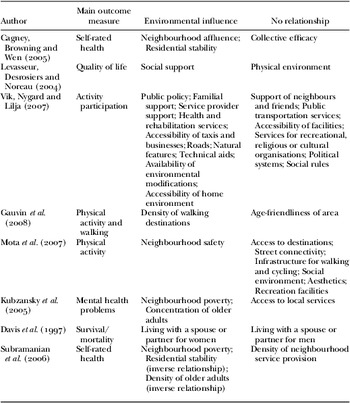
During the review process, eight studies were identified that reported both significant and non-significant environmental influences on health and activity participation within the same study. These findings suggest that environmental demands vary based on such factors as level of disability and presence of chronic health conditions. Many of the studies presented below involved older participants who were disabled, convalescing, or recovering from injury or operation (Vik, Nygard and Lilja Reference Vik, Lilja and Nygard2007). Authors of these studies often noted that they appeared to contradict other findings, which indicated a greater role for environmental variables in the relationship between older age, health and activity participation (Mota et al. Reference Mota, Lacerda, Santos, Ribeiro and Carvalho2007). In congruence with the non-significant and contradictory findings reported above, it is possible that environmental influences may be more relevant for healthy and active older adults (Table 3).
Significant and non-significant findings

Studies that have highlighted both significant and non-significant associations between environmental conditions and the health and activity participation of older people reveal the complexity of environmental influences on these outcomes. The message to take from such findings is that environmental conditions do not affect older adults in a uniform manner and may vary in relation to type of outcome, research setting, or personal attributes and circumstances. Environmental conditions that have been reported as an influence on older adult participation with some consistency across a number of studies include area-level socio-economic status and perceived safety.
Interactions between environmental and personal factors
Among the 83 studies assessed in this review, 22 reported that older adults' health and activity participation was significantly influenced by a combination of both personal and environmental characteristics. Some of the most reliable evidence for a mixed influence of personal and environmental variables comes from twin studies, which are able to distinguish between genetic, intrapersonal and environmental influences on activities over time. It is acknowledged that there is a large body of research concerning the health and ageing of adult twins, and it was not the intention of the present research to scope this diverse field. In a large-scale study undertaken in Denmark, researchers found that a complex mix of shared genetics, non-shared environmental conditions and lifestyle choices influenced cognitive and physical functioning among 1,053 pairs of older twins (Johnson et al. Reference Johnson, Deary, McGue and Christensen2009). Similar results were also reported in a Swedish study, which explored the sources of genetic and environmental variation in physical health and functioning among 758 pairs of older twins (Harris et al. Reference Harris, Pedersen, McClearn, Plomin and Nesselroade1992). The researchers found that the health of individual twins became more varied with increasing age, which suggested that environment becomes a greater influence on health over time.
In Table 4, potential environmental and personal influences on health and activity participation are identified from the assessed literature. These influences reflect a relatively wide interpretation of the concept of environment, including elements of built, natural and social settings. Built environment influences include land use, accessibility of services and facilities, availability of public space and environmental design characteristics. Natural environmental influences include topography and scenery. Social environmental influences include socio-economic conditions of areas, population density, educational characteristics of populations in particular areas, perceived safety, presence of active people and social networks. Personal influences on health and activity were also identified and included health, age, shared genetic attributes, educational level, personal socio-economic status, ethnicity, self-efficacy and exercise history.
Personal and environmental correlates of health and activity participation

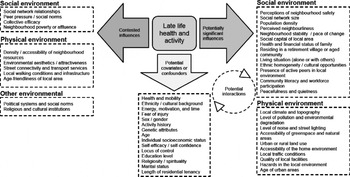
There is a growing body of research attesting to a combination of personal and environmental influences on the health and activity participation of older adults. The role played by the environment, therefore, is likely to be a complex one. Certain environmental conditions may be associated with particular health states or types of activities, but not others. For example, it has previously been shown that higher urban density is associated with increased walking, but decreased cycling among older adults (Kemperman and Timmermans Reference Kemperman and Timmermans2009). In other studies, activity participation has been shown to have a close association with conditions in the physical environment, but not the social environment (Levasseur, Desrosiers and St-Cyr Tribble Reference Levasseur, Desrosiers and St-Cyr Tribble2008) (Figure 2).
Overview of potential influences on activity participation.

Discussion and recommendations
Within the context of the systematic review, a large number of studies have identified that environmental conditions play an important role in influencing the health outcomes and activity participation of older adults. Some environmental conditions appear to constrain health and activity participation among older adults, while others appear to promote wellbeing and participation. Additionally, environmental influences appear to vary widely in their reported effects depending on the measurement parameter, the particular health outcome or activity domain being analysed, and characteristics and location of the sample group. A number of studies evaluated in this review also suggest that certain environmental conditions have no relationship to health and activity participation or have a counter-intuitive relationship. The contradictions and inconsistencies that exist between studies may reflect the relative youth of research in the area of environmental gerontology, the use of rather limited survey tools in research, or the lack of diverse theorising about the potential mix of influences likely to affect health and activity participation in later life. Many personal influences on the health and activity participation of older adults were also identified, which suggest a mixed-model of influences may be a fruitful area for investigation. Several limitations and gaps were identified during the review and data abstraction process. These provide opportunities for future research as discussed below.
Gaps, limitations and recommendations
More research into the interactions between ageing and environment is required in such regions as Asia, Africa and Australasia, where comparatively few studies have been undertaken in the field of environmental gerontology. In particular, further research from the English-speaking countries of Australia and New Zealand is warranted as these areas represent approximately 30 million people and a fast-growing older adult cohort as well as diverse environmental conditions. Contributions from more developed countries in the South Pacific would also benefit the wider Asia-Pacific region and provide greater insight into the experience of ageing in traditional and multicultural communities. The current paucity of articles from the regions mentioned above is not necessarily a limitation. It may simply reflect differing research priorities, a lower volume of research outputs, or a publication bias. Publication bias describes the tendency for journals to publish strong, positive results instead of negative or weak findings (The Cochrane Collaboration 2011). These results should nevertheless be viewed with care as they are generally reflective of the conditions in Western Europe and North America.
More qualitative and mixed-methods research is required to explore the complex pathways and processes through which environmental conditions may influence the health and activity participation of older adults. There is an overwhelming focus in the current body of literature on identifying potential correlates of health and activity participation among older adults. Such approaches, however, do little to advance our understanding of the pathways leading from environment to action. Moreover, considering the myriad potential environmental influences on health and activity participation, it makes little sense to attempt to conceptualise environmental influence based on a relatively small number of survey items. Qualitative and mixed-methods studies would assist the development of new ecological models and theories concerning ageing and environment. Throughout the assessed literature, there were few examples of novel or alternative research approaches that might shed new light on the interactions between ageing, environment, activity participation and health. Survey and interview methods dominated the research. There is scope for the use of alternative approaches that may lead to unanticipated and beneficial research outcomes.
There was also a noticeable absence of older adult participation in the research processes described in the existing literature, which is possibly commensurate with a focus on quantitative, researcher-driven survey methods. In particular, older adults had no involvement in setting the research agenda, defining key research concepts and identifying potential confounding variables, selecting and pilot testing methods, or in the analysis and interpretation of study results. Studies that focus on the local environmental influences on ageing, activity and health would benefit from closer collaboration with community residents as part of action research processes. Moreover, as most gerontological researchers sit outside their study cohort (due to their placement within the working-age cohort), a closer collaboration with participants would help to achieve a degree of generational relativism.
More research is required which explores environmental influences on activity participation as a contributor to the health and wellbeing of older adults. While investigations into the potential relationships between health outcomes and environmental conditions are important for identifying the salient effects of living in diverse areas, relatively little work has been undertaken that considers the environmental influences on activities undertaken in later life and which have a potentially cumulative influence on individual health. Moreover, components of activity participation, other than physical activity, need to be considered in the research literature. In particular, research is required that focuses on social, cultural, civic, spiritual and economic activities, which potentially influence older adult health and wellbeing. Notably, none of the studies assessed in this review examined the active ageing concept in its totality. This is a significant omission as active ageing, a World Health Organisation concept, describes a holistic approach to successful and healthy ageing. Publication bias may also offer a rationale for the dominance of physical activity-related studies. Future studies could examine the environmental influences on active ageing and include more domains of activity participation.
Further research is required to explore the potential influence of environmental conditions beyond the physical and social domains. In particular, a greater focus on the influence of access to knowledge and information, policy settings affecting environmental conditions, and the role of institutions would all be warranted. While the regulatory and institutional environments are somewhat at arms length from the day-to-day concerns of many older adults in the community, the knowledge or information environment is a setting that sits adjacent to both the physical and social environment and has a significant potential impact on older adult health and activity participation. This is becoming increasingly apparent in the information technology age where there are often intergenerational gaps in relation to accessing new sources of information and the use of communications technology.
Investigations into area or neighbourhood influences on health and activity participation often rely on arbitrary definitions of areas based on Census-related variables or postal codes. While such an approach is useful for delineating the boundaries between areas for the purposes of analysis, it provides little descriptive information about the areas that could help to build a more in-depth profile or typology of areas that affect health or wellbeing. The diverse characteristics of places are often left out of analyses concerning the relationship between environments and health or activity participation. It is recommended, therefore, that studies intending to explore the influence of neighbourhoods or areas on health and activity participation develop a more holistic conceptualisation of areas under investigation, which takes into account such factors as existing population composition, quality and character of the transportation network, availability of community services, and access to places for leisure and recreation. Such an approach could be facilitated by including participant definitions of areas, using systematic observations, or accessing objective spatial data in the analysis of areas.
It is recommended that models of older adult health and activity participation consider both environmental conditions and personal factors as significant influences. It appears beyond conjecture that health and activity participation are the result of a complex interaction of intrinsic and extrinsic factors. It is important, therefore, that ecological models of health and ageing come to the fore to recognise the important interplay between personal and environmental factors that either constrain or facilitate health or behaviour in later life. In addition to the need for further hypothesis testing concerning existing ecological models, work is also required to develop new theories of the interplay between ageing and environment based on the growing body of international research. Development of new models of ageing and environment would be assisted greatly by the use of qualitative and mixed-methods studies, which would help researchers to move beyond the mere identification of potential correlates to a broad understanding about how factors at multiple levels of influence work to affect health and behaviour in old age.
Potential limitations of the systematic review process
While measures were undertaken in the present review to ensure that results were obtained and analysed systematically and without bias, there were a number of limitations associated with the approach. There is a shortage of accepted frameworks for undertaking a systematic review incorporating quantitative, qualitative and mixed-methods studies. The present review is based primarily on the Cochrane review process, which is usually undertaken to assess quantitative research evidence. As a consequence, the review represents a pragmatic approach, which comprises different sets of criteria for assessing the quantitative and qualitative evidence. It is possible that some readers will disagree with the approach taken believing, perhaps, that findings from quantitative and qualitative studies are not directly comparable. It was necessary, however, to include both the qualitative and quantitative evidence in the present review to provide a full account of the existing knowledge relating to the interactions between environment, ageing, health and activity participation. The different criteria used to assess both the qualitative and quantitative studies addressed obvious philosophical and methodological discrepancies between approaches.
An additional limitation in the review process relates to the use of keyword, subject heading and abstract searches, which were a feature of this research. This approach is commonly used in literature searches, but is generally unable to identify complex concepts or ideas. For example, such searches may not detect studies that employ novel or unorthodox research approaches or employ more creative or literary naming conventions.
As a consequence of these limitations, no guarantee can be given that the present review represents the totality of relevant articles produced between 1985 and 2010. It is also possible that some relevant studies were overlooked in this review as a consequence of the databases selected. Databases such as PubMed and Family Studies Abstracts, for example, were not consulted during the search procedures, which is a potential limitation. Databases were specifically chosen to provide a balance between canvassing a diversity of health-related and psycho-social studies and conducting an economical search procedure as part of a larger investigation of the potential environmental influences on active ageing.
Despite these limitations, a large body of literature has been identified and assessed as part of this review (including over 1,400 primary research articles in the preliminary searches), which represents a significant diversity of research addressing potential environmental influences on active ageing over the last 25 years. Sources included diverse perspectives from sociology and gerontology, medicine and geriatrics, gender studies, psychology, transport studies, health education and human geography.
Conclusion
There is substantial evidence in the assessed literature that both environmental and personal attributes contribute significantly to older adult health and activity participation. Most of the studies identified via a systematic review process reported that environmental conditions (including built, natural and social contexts) were an important influence on older adult health and activity participation. While a small number of results suggested there was no discernible relationship between environment and health or activity participation, these studies represented only a minority of cases. Such results, however, highlight the need to consider the role of the environment among an ocean of potential influences. It is likely that strength, direction and experience of environmental influence varies significantly across individuals, communities and health-related outcomes in later life. Environmental conditions that show promise as potential influences on the health and activity participation of older adults include perceptions of local safety and security, traffic conditions, pollution and environmental hazards, noise and lighting levels, access to natural areas and public green space, neighbourhood stability, social capital or neighbourliness, local climate and others. Further work is required within the diverse field of environmental gerontology to understand the nature of the relationships between environment, ageing, health and activity participation. Areas of future research endeavour could include a greater focus on qualitative or mixed-methods approaches to aid exploration; greater research outputs from Australasia; increased collaboration with older adult stakeholders in the research process, more attention to domains of activity participation beyond the physical; development of new ecological models and theories to explicate the personal and environmental influences on health and activity participation; and greater recognition of the active ageing concept and the links between the major domains of activity participation.