Intelligent and resilient disaster risk management can be done by understanding disaster risks. Disasters have continued to exact a heavy price between 2005 and 2015, and the well-being and safety of both developed and developing communities and countries, as a result, have been disrupted worldwide.Reference Nations1 Some of these disasters led to perturbation in life support systems. Over 700 thousand people have lost their lives, 1.4 million have been injured, and approximately 23 million have been made homeless as a result of disasters. Overall, more than 1.5 billion people have been affected by disasters in various ways, among whom, women and children have been excessively affected by vulnerable situations. The total economic loss was more than US$1.3 trillion. Moreover, estimations of disaster consequences revealed that between 2008 and 2012, 144 million people were displaced by disasters, which can lead to several economical and socio-cultural consequences.Reference Nations1 Disasters not only cause disruption in support life systems or premature deaths, but also can lead to economic crises in societies. Economic estimations, as an illustration, reported more than US$1.3 trillion economic loss by disasters. For example, the estimated gross domestic product (GDP) loss due to road traffic crashes was reported at 6.0% in Iran in 2014.2 It is also observed that almost 45% of all disasters occurred in Asia, accounting for 85% of all casualties and almost 75% of total economic damages. It is estimated that 2011 has been the costliest year ever at a staggering US$380 billion.Reference Nicogossian, Kloiber and Zimmerman3 Equally important, health, economic, and social impacts of disease outbreaks are persistent and manifold. A year after the onset of Ebola, the estimated GDP loss for the 3 countries in 2015 totaled US$2.2 billion (US$240 million for Liberia, US$535 million for Guinea, and US$1.4 billion for Sierra Leone). This is the result of the severe impact of the epidemic, which has been exacerbated by the large decline in the international price of iron ore and severe corporate governance issues in mining in Sierra Leone.4 Economic loss threatened macroeconomic stability, food security, human capital development, and private sector growth across the region.Reference Osewe5
Five priorities fraction have been focused on Hyogo Framework for Action (HFA), in which knowledge-based actions, innovation, training and education for establishment and improvement of the safety, and induced social resilience at all levels are necessary.Reference Haigh, Amaratunga and Thayaparan6 Implementing HFA can lead to enhanced incorporation of all-hazard, prevention-driven, and evidence-based approaches with multi-sectoral and multidisciplinary dimensions that are strongly advocated by the first priority of Sendai Framework For Disaster Risk Reduction (SFDRR), 2015–2030.Reference Nations1, Reference Aitsi-Selmi, Murray and Heymann7, Reference Kim, Sawe and Wallis8 Training and education of communities coupled with universities’ partnership have critical roles in comprehensive management tool, which, if implemented appropriately, will lead to the best understanding of disaster risk and policies and practices for disaster risk managementReference Seyedin, Zaboli and Ravaghi9 in all dimensions. These kinds of systematic training, consequently, result in upgrading disaster literacy and communities’ understanding of pre-disaster risk assessment, prevention, mitigation, preparedness, and effective response.Reference Nations1, Reference Berariu, Fikar, Gronalt and Hirsch10, Reference Jafari, Seifi and Heidari11 The disaster literacy is defined as an ability to read, understand, and use information to make informed decisions and follow instructions in the context of mitigating, preparing, responding to, and recovering from a disaster.Reference Brown, Haun and Peterson12 The main purpose of disaster literacy is to promote common efforts in partnership with the scientific and technological institutions, academia, and the private sector that can establish, disseminate, and share good practices.Reference Nations1 Based on the disaster management cycle, the disaster literacy can have several parts with specific performance and different potential. Hence, it can be considered as a comprehensive platform in disaster risk management. Because the Disaster Prevention Literacy’s (DPL) goal is to promote communities’ skills, this platform can have 3 dimensions: knowledge, attitude, and skills.Reference Chung and Yen13−Reference Soellnera, Lenartzb and Rudinger16
Building upon valuable documents, including HFA and SFDRR, the initial priority of disaster risk management is using opportunities for strengthening communities’ resilience.Reference Nomura, Parsons and Hirabayashi17, Reference Anwarul Abedin and Shaw18 Thus, to meet this goal, it is essential to establish an effective and efficient disaster risk reduction (DRR) plan in which the key stakeholders, including the central and local governments, academia/universities, relevant national and international agencies, and communities integrate to work together and are aware of their respective roles and responsibilities.Reference Anwarul Abedin and Shaw18
The first principle of the Rio Declaration on environment and development emphasized that human beings are at the center of concerns for sustainable developmentReference English19 and entitled to a healthy and productive life in harmony with the environment, where communities’ health was formed or lost. Disasters are phenomena in which the progress of this principle is significantly blocked by the disruption in human health and life support systems. Thus, providing a promising process for risk management based on academic partnership at local and community levels, considering economical, social, health-related, cultural, and environmental impacts in the short, medium, and long term, is important.Reference Nations1, Reference Van der Keur, Van Bers and Henriksen20−Reference GHanizadeh, Heidari and Seifi22 Training programs of academic institutions, including colleges, universities, and schools, are vital for physicians, public health, and nursing students as human resources who have significant roles in policy-making for communities’ support based on human skills.Reference Dunlop, Logue, Vaidyanathan and Isakov23−25Academic institutions in partnership with public health management are well positioned to make contributions toward preparedness.Reference Isakov, O’Neal and Prescott26, Reference Coppola27 The academia can make or destroy the lives of people in certain situations. This big responsibility is a challenge of how they can become agents of change in the community.Reference Contreras28, Reference Mullins29
Although the fundamental objective of universities is to provide people and society with education, they must also have a contribution in DRR.Reference Baytiyeh and Naja30, Reference Malul and DafnaBar-El31 They can describe the program on disaster management at undergraduate, masters, and postgraduate levels in various faculties.Reference Anwarul Abedin and Shaw18 Nevertheless, universities sometimes lack disaster risk curricula.Reference Baytiyeh and Naja30, Reference Chou, Yang and Ren32, Reference Ratnadeep Suri, Majid, Chang and Foo33
To name a few, training, facilities, equipment, medical needs, communication, personnel, human services and geographical information, reinforcement of the public health workforce, serving as distribution points and sites of medical access, sheltering, fatality management, and provision of special or technical skills were identified as important resources that can be provided by academic institutions in disasters. The achievement of national health safety and security requires the commitment of a broad range of stakeholders to include all potential of government, individuals, families, community organizations, and academic institutions.Reference Isakov, O’Neal and Prescott26, Reference Dunlop, Logue and Isakov34, Reference Yusoff, Rahim and Pa35
Building on what was said earlier about the contribution of universities, education and training allow students of medical sciences to have the opportunity to support the safety and health, because their input and experience are vital to emergency preparedness. Perhaps they would be leaders at the forefront of emergency preparedness.Reference Tanner and Doberstein36, Reference Flaherty37 The Community–Academic Partnerships (CAPs), which link the academic institution and community agencies, are not as well-known or defined. Mutual decision-making, shared goals, reciprocity, along with meeting agency and community needs have been identified as defining parameters of healthy CAPs.Reference Voss, Mathews and Fossen38, Reference Spiekermann, Kienberger and Norton39
Academic health centers, which consist of a medical school and 1 or more other health-related profession schools or programs (eg, schools of health, pharmacy, public health, nursing), in combination with an associated educational medical center, students, and residents perform research and provide patient care, often serving as safety net providers for the vulnerable people.Reference Dunlop, Logue, Beltran and Isakov24, Reference Abbasi Dolatabadi, Seyedin and Aryankhesal40 Universities are the center of excellence in regard to research and disseminating research outputs to users.Reference Anwarul Abedin and Shaw18, Reference Yusoff, Rahim and Pa35 For these reasons, the development and implementation of more effective and efficient risk reduction approaches and policies, close collaboration, coordination, and knowledge exchange among decision makers, scientific community, private sector, civil society, and frontline victims are vital.Reference Anwarul Abedin and Shaw18
Academic or public health department collaborations provide academic institutions with a broad range of opportunities for service, training, education, and research.Reference Dunlop, Logue and Isakov34, Reference Coppola41−Reference Garima43 A lack of familiarity with the resources and expertise offered by local academic institutions and the key faculty and institutional officials who can authorize access to required resources was noted as an important barrier to collaborations. Public health and emergency management agencies recognize the incredible potential of academic institutions of higher education to contribute in disaster risk management.Reference Dunlop, Logue, Vaidyanathan and Isakov23 Identifying the contextual factors, including information characteristics, environment, and relationships,Reference Cheung, Davey and St John44, Reference Cai and Song45 and understanding decision-making structure and coordination of logistics processes and planning, are important, too.Reference Comes, Van de Walle, Laguna and Lauras46
This study attempts to bring together representatives of various interventional roles from the university to disaster risk management. Our main research question is to identify university intervention and collaboration roles in disaster risk management and to review particular resources that can be provided by academic institutions. We try to define academic partnership dimensions and point out that universities should be used for disaster risk management. The inadequate knowledge of the role of universities and the low level of intervention of universities are among the most important reasons for repetition or replication in the organizations. Insufficient sharing of information and protocols, incomplete collaborative efforts to coordinate the risk management between universities and stakeholders, government organizations, and nongovernmental organizations (NGOs) have limited roles of universities. Therefore, researchers decided to review the role of academic partnership in disaster risk management to have a better understanding of the role of universities and their different dimensions.
METHODS
This study was a systematic review of publication and documents related to the roles of academic partnership in disaster risk management. The review was conducted based on the Preferred Reporting Items for Systematic Reviews and Meta-Analyses (PRISMA) checklist.Reference Moher, Liberati, Tetzlaff and Altman47
Search Strategy
This systematic review research was conducted to review all articles, documents, reports, and working papers from March 2000 to September 2017 about the role of the university in disaster risk management. This period was chosen because the participation of academic institutions in disaster risk management has more contributed to the achievement of preparedness since September 11, 2001. We reviewed databases, including Google Scholar (Google Inc., Mountain View, CA), ISI Web of Science (Thomson Reuters, New York, NY), Science Direct (Elsevier, Amsterdam, Netherlands), PubMed (National Library of Medicine, Bethesda, MD), Scopus (Elsevier), Ovid (New York, NY), ProQuest (Ann Arbor, MI), and CINAHL and Wiley (Hoboken, NJ) from January 1, 2000, to September 18, 2017. Most of the studies were to be found in Google Scholar and Science Direct. A comprehensive literature search was also conducted in Springer Online Journals (http://link.springer.com/). Gray literature, as well as key journals, were searched for additional studies. The search key words included “disasters,” “disaster risk management,” “disaster risk reduction,” “understanding disaster risk,” “disaster health literacy,” “risk literacy,” and “Disaster Prevention Literacy.” Using MeSH (Medical Subject Headings; National Library of Medicine), synonyms of these keywords were also extracted. They include “risk management,” “risk reduction,” “health literacy,” and “knowledge management.” Using OR and AND, key words were combined and entered in the search box of the databases as follows: (“Academ*” OR “University” OR “Institute” OR “College” OR “Campus”) AND (“Disaster” OR “Risk” OR “Crises” OR “Emergency”) AND (“Academic Intervention model” OR “Academic Partnership model” OR “Academic Collaboration model”).
Selection of Articles
In the beginning, reviews were evaluated by reviewers based on their titles and later based on their abstracts for eligibility, and the articles and documents that did not meet the inclusion criteria were eliminated. The related studies were reviewed completely and the articles without the inclusion criteria were put aside. The summary of the results, study design, and conclusions were reviewed. Because one of our aims was to determine what had been written about the role of academia intervention in disaster risk management and to improve the understanding of disaster risk and also how academic partnership in disaster was modeled in the literature, the primary search plan was to encompass literature as widely as possible. To this end, text searches using the terms “disaster risk management,” “disaster health literacy concepts,” and “disaster risk reduction meanings” were conducted in a variety of the mentioned data banks. Text searches are appropriate approaches used when the term is firsthand and perhaps has not yet been added to a dictionary. The quality of all papers that met the inclusion criteria was assessed and appraised using the PRISMA guidelines by peer review. The selection of relevant publications was done independently by authors. They assessed the potential relevance of all publications and identified them during the database search, based on the information provided in the titles and abstracts of extracted articles and documents. Duplicates were also excluded. Then reviewers screened relevant articles, and the selected publications were read in full. When they disagreed about excluding an article, a discussion was held to reach a consensus. After screening titles and abstracts, the full texts of the remaining articles were then obtained and critically reviewed by the reviewer, and data were extracted from the final selected references. All data extraction was performed by a reviewer and cross-checked by another. Any errors identified were corrected through discussion among all authors. If there was a disagreement between reviewers, the reasons were identified, and a final decision was made on the basis of agreement by a third reviewer.
Evaluation of Selected Publications: Inclusion and Exclusion Criteria
Inclusion Criteria
The following are the criteria for the inclusion of articles in this systematic review:
(1) Consideration of at least 1 of the components of disaster risk
(2) Articles that described the role of academic partnership in disaster risk management, DRR, understanding disaster risk, disaster health literacy, the academic-community partnerships in disaster preparedness, and models regarding the community in different contexts
(3) The studies that included peer-reviewed original, case study, review articles, and editorial study that were available in full text
(4) Studies published after 2000 that met the eligibility criteria
Exclusion Criteria
Research articles in languages other than English were excluded due to translation issues and inaccessibility, but the search strategy did not impose any language limitations.
Data Extraction and Management
Data on authors, year of publication, method, study design, setting, and study focus were extracted by the reviewers. Results from the selected papers were extracted and gathered in a summary. Included papers were grouped by subject, and fields were determined after the data were completely collected. All papers were appraised using the PRISMA guidelines by peer review.
RESULTS
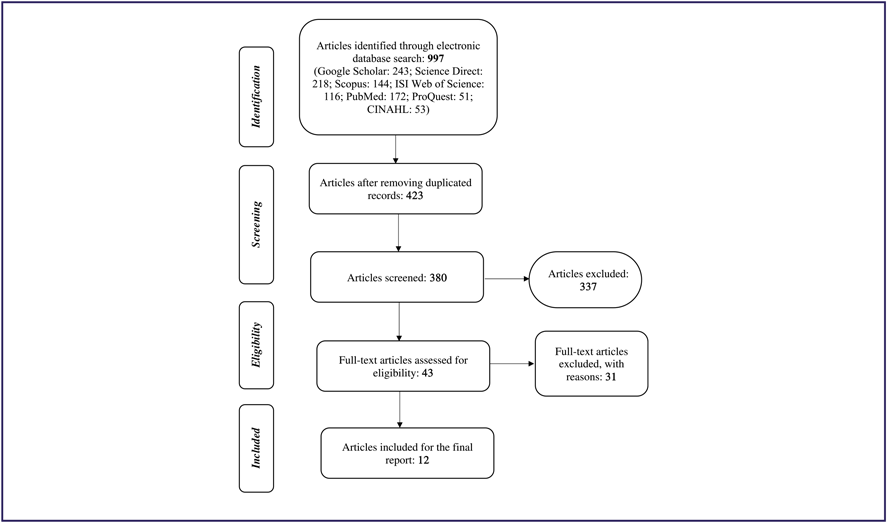
A total of 997 relevant articles and documents were identified through the electronic database search strategy. After further review of papers and abstracts, duplicate articles were eliminated and the number of articles decreased to 574. Then, using systematic screening, we reviewed the titles to find the ones related to partnership of academia and selected 380 articles. In the next step, abstracts of the articles were studied and 43 articles were selected to be fully reviewed. For quality assessment, full texts of articles were read and checked with the PRISMA checklist by 2 reviewers.
Many articles had other approaches or were not focused on the subject. Then, 31 articles of 43 papers were put aside after data extraction because they were either not available in full text or not directly related to academic partnership in disaster risk management. In the last stage, all of the selected articles were completely read, and on the basis of the inclusion criteria, only 12 unique articles were selected. These articles were classified by the importance of the article for disaster health and categorized by type (review, original research, case study, editorial, and comparative).
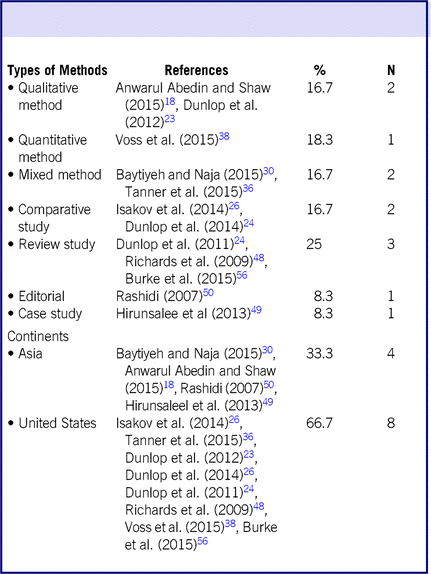
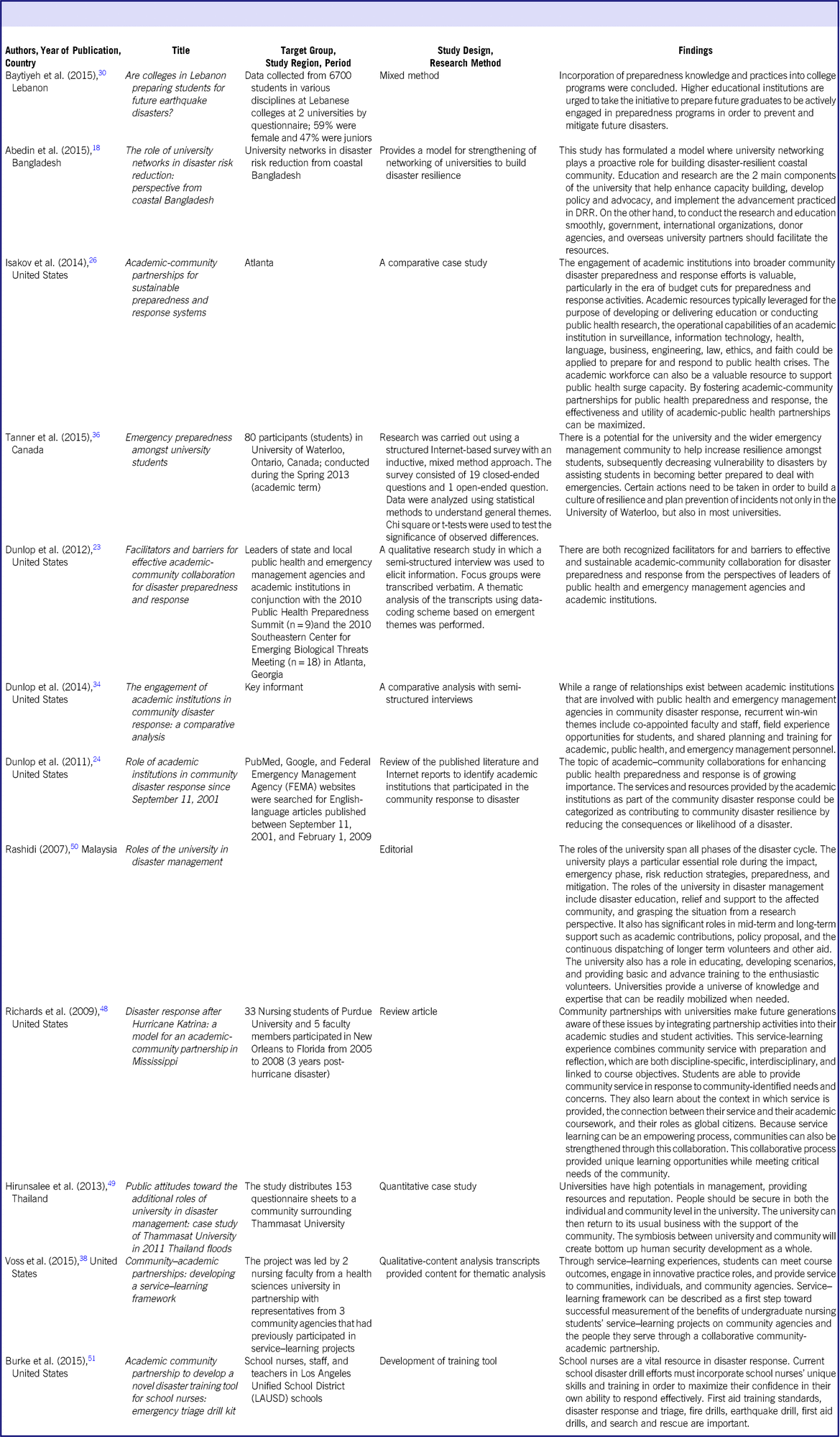
Table 1 shows a summary of the features of the papers involved. Then, assessment and data synthesis were performed to obtain the key results presented and summarized in Table 2. From 12 selected articles, 2 (16.7%) documents used quantitative methods, 1 (8.3%) article conducted a qualitative study, 2 (16.7%) papers applied mixed methods, 2 (16.7%) papers carried out a comparative study, 1 (8.3%) paper was a case study, 1 (8.3%) paper was an editorial, and 3 (25%) papers were review studies. In total, 8 (66.7%) of the 12 studies were conducted in the United States, and 4 (33.3%) of the 12 papers were carried out in Asian countries (see Table 2). After a full reading of the papers, the descriptive analysis was designated in Table 3 to deliver a summary of the characteristics of the studies involved. The articles scheduled for the systematic review were verified by the authors, year of publication, title, research source, methods, the summary of results, and the conclusion (see Table 3). Finally, a review of the literature revealed that there are gaps in academic intervention for improving disaster risk management, especially in the first priority of the Sendai Framework, which is understanding disaster risk.Reference Nations1 It also showed that the university had an interventional role in preparedness,Reference Dunlop, Logue, Vaidyanathan and Isakov23, Reference Isakov, O’Neal and Prescott26, Reference Baytiyeh and Naja30, Reference Tanner and Doberstein36 response,Reference Dunlop, Logue, Vaidyanathan and Isakov23, Reference Dunlop, Logue, Beltran and Isakov24, Reference Isakov, O’Neal and Prescott26, Reference Dunlop, Logue and Isakov34, Reference Richards, Novak and Davis48 risk management,Reference Hirunsalee, Denpaiboon and Kanegae49, Reference Rashidi50 risk reduction,Reference Anwarul Abedin and Shaw18 and probably in understanding risk and disaster literacyReference English19, 25 for stakeholders. Universities can play a role not only in education and research, but also in the promotion of disaster health literacy. The partnership of universities with various stakeholders, such as research centers, government, and community, should provide a global support system for individuals through access to information, data, programs, technical assistance, and advisory services. It may also contribute to an improved capacity of individuals to offer high quality professional education in disaster risk management based on standards commonly accepted. These principles should be accepted and used in various partnerships around the world.
PRISMA Flowchart of the Screening and Selection Process of the Articles

Types of Methods and Research Sources

Summary of Data Extraction of the Selected Articles to Investigate the Role of Academic Partnership in Disaster Risk Management (2000–2017)

DISCUSSION
The main focus of this systematic review is to identify the role of academic partnership in disaster risk management. This assessment was carried out by means of a thorough review and summary of the studies, which provided considerable background and highlighted the gaps in knowledge about the role of academia partnership in disaster risk management. The systematic review of the 12 publications demonstrates that academia plays a role in the disaster risk management, preparedness, and response.
Universities play a major role in planning and implementation in government, NGOs, other partner universities, and community to assist in identifying DRR policies and measures, including prevention, mitigation and preparedness; coordinating global support initiatives; developing guidance information; and promoting the development and strengthening of regional, national, and local levels. The university can channel the disaster education, relieve, and support the affected community and grasp the situation from a research perspective through dialogue, consultancy, and advisory. The university has been improved with the support and contribution from all of the primary stakeholders. The role of universities in developing countries is even more important, because it is a crucial tool for overcoming underdevelopment. Thus, a strong local knowledge base needs to be created and nurtured through research and development.Reference Anwarul Abedin and Shaw18
While a range of relationships exists between academic institutions that engage with public health and emergency management agencies, recurrent win–win themes include co-appointed faculty and staff, field experience opportunities for students, and shared planning and training for academic, public health, and emergency management personnel.Reference Dunlop, Logue and Isakov34 The involvement of academic institutions in order to increase disaster preparedness and response, and establishment of procedures is valuable.Reference Rosa, Abbo and Kapur51 The academic resources are typically enough for the purpose of developing or delivering education or conducting research. The operational capabilities of an academic institution in surge capacity, surveillance health system, research, ethics, and faith could be applied to disaster mitigation.Reference Isakov, O’Neal and Prescott26, Reference Dunlop, Logue and Isakov34 Academic medical institutions can provide a major reservoir of highly qualified volunteer medical personnel who meet the needs of NGOs in disasters for a sustainable medical response. Support of such collaborative initiatives is required to ensure generalizability and sustainability.Reference Babcock, Baer and Bayram52
The roles of the university in disaster risk management include education, relief and support for the affected community, and understanding of the situation from a research perspective. The university also has a role in developing scenariosReference Cordero-Reyes, Palacios and Ramia53 and providing basic and advance training to volunteers. The university can offer assistance through research and education on disasters, policy proposals, involvement in the recovery phase as a member of the local community, commitment of a public role as an established NGO, and dispatch of volunteers and other aids.Reference Anwarul Abedin and Shaw18, Reference Rashidi50, Reference Bristol and Marcozzi54 Disaster education and training should be encouraged among the staff. There are few training courses such as health in emergencies and disasters. Therefore, comprehensive fellowship training programs for medical officers that are based on valid scientific evidence should be developed. Organized educational programs covering the basic principles of disaster medicine should be integrated into the training of all health care providers and volunteers.Reference Koenig and Schultz55 Although universities play a major role in the planning and implementation efforts, all of these efforts require a major scientific base whereby the proper information and the uncertainties associated with disaster impact can be fully understood before the preparedness plan is translated into policy and regulatory measures. If these potential assets are combined with strong management skills, then academia can make major and permanent contributions. Public training and disaster preparation are important. The university, as an academic institution, may need to develop and organize a comprehensive educational disaster program for the community. Universities and other agencies should collaborate in order to consider and improve disaster risk management.Reference Rashidi50
Disaster risk management has methods to deliver suitable and reliable approaches to risk reduction. It was mentioned earlier that informing disaster education in a community college helped not only the local community get better employment and consistent livelihood, but also enhanced their resilience. The programs should be conducted by those stakeholders who are actively involved in institutions, organizations, and communities in order to provide valid training regarding disasters. The university is a way to share knowledge and experiences, too. It made requisite among various stakeholders such as government, NGOs, and community-based organizations (CBOs) to reduce the disaster effects. In order to minimize the disaster effects and loss of lives, the synergy among disaster literacy, research, and implementation is essential. It has been noticed that disaster health education has been incorporated in primary, secondary, and tertiary level of preventions, which was mainly related to preparedness and response issues. However, the involvement of government, NGOs and civil society through the university can improve literacy and awareness by applying programs and policies developed at the national level to disaster-affected communities.Reference Anwarul Abedin and Shaw18
Community partnerships with universities play a major role in addressing local problems and energizing the people. The collaborative process provides unique learning opportunities while meeting critical needs of the community.Reference Richards, Novak and Davis48
The important facilitators in partnership of academic institutions are the availability of faculty expertise special training programs and availability of personnel such as academic staff present in disaster health and emergency management meetings or in an emergency operations center (EOC) or in planning boards and faculty contracts.Reference Isakov, O’Neal and Prescott26, Reference Dunlop, Logue and Isakov34 The other facilitators include students’ practice in public health agencies, Incident Command System (ICS) or emergency operations training of academic staff, and the existence of mutual aid or memoranda of agreements.Reference Isakov, O’Neal and Prescott26, Reference Dunlop, Logue and Isakov34 College disaster drill efforts must be combined with college unique skills and training in order to maximize their confidence in capabilities.Reference Burke, Goodhue and Berg56
Academic medical centers should also use the strength of their human resources in relief and rescue efforts. Preparation for an academic center service mission to disasters includes logistics, counseling, administrative and financial support, identification of a partner with field experience, volunteer training, and rescue and relief provisions to populations affected by disaster.Reference Ripp, Bork, Koncicki and Asgary57
Education and research are the 2 main components of the university that help improve capacity building, preparedness, response, develop policy and advocacy, and implement the advancement practiced. On the other hand, to conduct the research and education easily, government, international organizations, donor agencies, and overseas university partners should facilitate the resources. This is because universities act to optimize position, prestige, and authority by following external research support from industry and government organizations. Eventually, universities are the facilities that have high potential in management, resources, and reputation and could channel the disaster education, relief, rescue, and support to the affected community and provide a research opportunity.Reference Anwarul Abedin and Shaw18, Reference Isakov, O’Neal and Prescott26, Reference Dunlop, Logue and Isakov34
Managing resources, enabling and sustaining a public health response, and managing information capacity are dimensions that are addressed by academic institutions.Reference Isakov, O’Neal and Prescott26 Their activities include Shelter-in-Place, Evacuation Information Center, and Student Volunteer Centre.Reference Dunlop, Logue, Vaidyanathan and Isakov23
A multidisciplinary response team that addresses medical needs, mental health, education, food, nutrition, and sanitation is highly effective in contributing to timely and effective relief efforts.Reference Cordero-Reyes, Palacios and Ramia53 However, the university can work in its own working dimension and can be improved by such modes as university to government, university to NGOs, university to other partner universities, and university to community.
University to Government
In this partnership (the linkage between university and government), the government can support the university by providing funds through a number of funding programs for the development and implementation of these activities toward disaster risk.
University to NGOs
If the university can manage disaster reduction activities (pre-, during, and post), it is important to create and/or establish partnerships with NGOs at the local level to make the program effective and sustainable.
University to Other Partner Universities
University partnership with other universities works as a public forum on transdisciplinary education for DRR. Their interconnectedness requires a holistic transdisciplinary approach that brings all stakeholders together, including academia, local government units, NGOs, and communities, to foster rapid feedback and effective exchange of knowledge, experiences, and reduce replication that will enable rapid formulation of sustainable solutions. It will help other partners commit to the development and implementation of locally based, multi-stakeholder projects in disaster risk management.
University to Community
Communities are the front lines of any kind of disaster and are the real experts on how to cope with impacts. Therefore, it is essential to address communities first in working or implementing disaster management activities. University intervention builds a bridge between the community leader and the university’s researcher. For example, it is recommended that disaster awareness programs such as drill, public awareness campaign, and volunteer training integrate into community activities to mitigate the effect of disaster.Reference Anwarul Abedin and Shaw18, Reference Hirunsalee, Denpaiboon and Kanegae49
The results of the study show that there are currently no academic interventional models for enhancing disaster health literacy. Based on the articles archived and selected, a few models are established and used in some countries, where there is little evidence regarding understanding risk and disaster health literacy. Consequently, universities need a valid model that is established and confirmed through the procedure of evaluation. Disaster health services and DPL should be developed so that there will be a community disaster health structure that can provide support and be a part of the routine health care system. The disaster health field can develop a true learning health system in order to save lives and prevent the health impacts of disasters.Reference Strauss-Riggs, Yeskey and Miller58
Regarding the improvement in education, training, and informational resources, it is important to involve all organizations, agencies, and individuals. This has to be considered due to increasing manmade and natural disasters, especially in Asian countries. Therefore, having evidence of the review of academic intervention on the promoting disaster health literacy is important. Further studies are required to document the effectiveness of the university to develop DPL, as well as disaster preparedness.
ICS training for academic institutional administrators is responsible and provides training to key academic personnel. An emergency management familiarization process must also be developed and presented by local and national public health and emergency management agencies. Also necessary are volunteer trainings, the establishment of institutional agreements that specify the nature and scope of faculty engagement in disaster, requisite ICS training students in faculty of nursing or health, and institutional officials’ presence in local and state EOC and establishment of system for providing academic credit for student voluntary service.
Finally, qualitative studies and mixed methods are desirable to explore and clarify the concepts of disaster health literacy or academic partnership model for enhancing disaster literacy. Furthermore, developing comprehensive context-bound models based on a concept of definition and analysis are desired. These models will facilitate the role of the functional features of disaster risk management. Based on the previous discussion, to make the process more effective, this study has formulated a model where the university plays an active role for disaster risk management.
CONCLUSION
Through the assessment of the gaps across research investigations, some overall themes have appeared. We note an absence of policy and planning for academic partnership to promote the first priority of the Sendai Framework, which is understanding disaster risk. Policies and practices for disaster risk management should be based on an understanding of disaster risk in all of its dimensions. Such knowledge can be leveraged for the purpose of prevention, mitigation, and the development and implementation of preparedness and effective response to disasters. To achieve the promotion of common efforts in partnership with the scientific community, academia and the private sector should establish, disseminate, and share good practices nationally and internationally.
In summary, our review of the literature reveals that academic institutions have made a sizable contribution in enhancing the understanding of disaster risk and dimensions of DRR. Therefore, the topic of academic partnership for enhancing disaster health literacy is of growing importance. It is highly recommended that the university implement additional roles because it is the university that is able to provide social responsibilities in the society and, in return, can change public attitude toward itself, which leads to widespread enhancing of its reputation. The university can then be back to its business with the support of community in disasters. Therefore, we recommend doing more research on enhancing academic partnerships locally, regionally, and broadly, as well as education and training on disaster risk management. The proper context-bound models of development based on community’s skills and universities potential should receive more attention.
Acknowledgments
This study was a part of a PhD thesis supported by Iran University of Medical Sciences, Tehran, Iran (Grant No: IUMS/SHMIS_ 1396.9323567001).
Conflict of Interest Statement
The authors declare no conflicts of interest.