


Introduction
Reviews of the current evidence base have found that post-traumatic stress disorder (PTSD) in adolescents is positively associated with a variety of difficulties including suicidality, substance abuse, poor social support, academic problems, poor physical health and neurological factors linked to emotion and behaviour regulation problems (Nooner et al., Reference Nooner, Linares, Batinjane, Kramer, Silva and Cloitre2012; Panagioti et al., Reference Panagioti, Gooding, Triantafyllou and Tarrier2015). PTSD can involve long-lasting effects, with exposure to trauma and adverse events in early life conferring greater risk for physical and psychiatric illnesses in adulthood (Lanius et al., Reference Lanius, Vermetten and Pain2010).
Despite the association of PTSD in adolescents with a myriad of difficulties and consequently with reduced quality of life (Clark and Kirisci, Reference Clark and Kirisci1996), PTSD often remains undetected and untreated, as has been found in the adult population (Zimmerman and Mattia, Reference Zimmerman and Mattia1999). A diagnosis of PTSD, or recognition of other responses to trauma that lead an individual's life to be impaired, could help adolescents to access services and support. With the right treatment, adolescents have been found to overcome PTSD and the damaging effect it can have on their lives (Wethington et al., Reference Wethington, Hahn, Fuqua-Whitley, Sipe, Crosby and Johnson2008).
Assessment of PTSD in adolescents
As traumatized adolescents may be unlikely to offer up information about the impact of trauma it is important to ask all adolescents coming into mental health services about traumatic events (Gerson and Rappaport, Reference Gerson and Rappaport2013). However, there can be challenges in assessing PTSD in young people, some of which are similar to adult populations and some of which are distinct. Cohen and Scheeringa (Reference Cohen and Scheeringa2009) highlight some of these difficulties, which include: making a differential diagnosis given the overlap between experiences associated with PTSD and experiences associated with mood and anxiety disorders; failure of young people to meet diagnostic criteria, even when significantly impaired, because they do not have the required number of symptoms from each category; and service-user avoidance of traumatic stimuli being interpreted by the clinician as a sign they are not being affected.
Completing a semi-idiographic assessment that includes both standardized measures to assess diagnostic criteria, and clinical interviews to probe further into PTSD-related experiences and what they mean to the service-user can help to overcome some of these issues (e.g. Hales et al., Reference Hales, Blackwell, Di Simplicio, Iyadurai, Young, Holmes, Brown and Clark2015). Young and Grey (Reference Young, Grey, Corrie, Townend and Cockx2016) give examples of the types of questions that can be used to investigate symptoms of PTSD during assessment with adults and how the service-user's responses, along with self-report measures, can be used to inform formulation and intervention. Repeated use of outcome measures is recommended to allow the clinician and service-user to identify changes in PTSD-related experiences and to ensure all difficulties are being acknowledged and addressed (Bickman et al., Reference Bickman, Kelley, Breda, de Andrade and Riemer2011). Many young people with PTSD experience co-morbid problems, such as affective disorders or substance abuse, which are important to assess (Kilpatrick et al., Reference Kilpatrick, Ruggiero, Acierno, Saunders, Resnick and Best2003).
Assessing PTSD in response to multiple events
Where multiple traumatic events have been experienced, adolescents may not be clear which symptom is related to which trauma (Cohen and Scheeringa, Reference Cohen and Scheeringa2009); indeed, it may be the cumulative effect of the traumas that has led to the trauma-response (Suliman et al., Reference Suliman, Mkabile, Fincham, Ahmed, Stein and Seedat2009). For this reason it is recommended that all traumatic events are assessed, and questionnaires or interviews worded to elicit whether the target symptoms are present in response to any trauma, rather than a particular event.
Researchers have suggested that people exposed to multiple and/or chronic traumatic events, usually in their early life, interpersonal in nature and based in the caregiving system, will be affected in distinct ways to those who have experienced an isolated traumatic event; the terms ‘complex trauma’ (usually in adults) or ‘developmental trauma disorder’ (usually in young people) are used to describe these presentations (Herman, Reference Herman1992; van der Kolk, Reference van der Kolk2009). The debate continues as to whether complex trauma is an empirically based, differential diagnosis to PTSD, or PTSD plus borderline personality disorder, with compelling arguments on each side (for an overview, see Friedman, Reference Friedman2014). The ICD-11 currently defines complex trauma as PTSD plus significant problems with emotion regulation, self-concept and interpersonal relationships (World Health Organization, 2016).
Regardless of the diagnostic label applied, it is important to comprehensively assess the distressing consequences of trauma for an individual. Where PTSD is present in response to multiple interpersonal traumas it may be particularly relevant to further assess affect regulation, attachment, behavioural problems, self-concept and physical co-morbidities, which are touched on by a PTSD diagnosis but may need to be explored in more depth (e.g. Wamser-Nanney and Vandenberg, Reference Wamser-Nanney and Vandenberg2013).
Treatment of PTSD in young people
Reviews of the current evidence base have found that trauma-focused psychological approaches, specifically trauma-focused cognitive behavioural therapy (TF-CBT) and eye movement desensitization and reprocessing (EMDR), have the strongest evidence for efficacy in treating chronic PTSD in children and adolescents (Gillies et al., Reference Gillies, Taylor, Gray, O'Brien and D'Abrew2012; de Arellano et al., Reference de Arellano, Lyman, Jobe-Shields, George, Dougherty and Daniels2014). Currently national guidelines recommend that young people be offered age-appropriate TF-CBT as a first-line treatment for PTSD (NICE, 2005).
Treating PTSD in response to multiple events
Preliminary evidence suggests that TF-CBT can be effective at treating PTSD when young people are experiencing PTSD (or complex PTSD) in response to multiple traumas (Weiner et al., Reference Weiner, Schneider and Lyons2009; Cohen and Mannarino, Reference Cohen and Mannarino2011).
Proponents of TF-CBT suggest that therapy for PTSD in response to multiple traumas should be based on largely the same components as TF-CBT for less complex PTSD with some alterations. The recommendations for modifying both manualized and non-manualized TF-CBT to address PTSD in response to multiple traumas are similar and include: further developing safety, grounding and distress-tolerance skills; collecting more information about formative experiences; introducing exposure to traumatic events at a rate suitable to the service-user; incorporating trauma themes throughout therapy; and extending the number of sessions (Cohen et al., Reference Cohen, Mannarino and Deblinger2006; Smith et al., Reference Smith, Perrin, Yule and Clark2009; Stallworthy, Reference Stallworthy and Grey2013). There is also recognition that additional work may be needed after TF-CBT to address residual problems and that treatment protocols will need to be tailored to the individual, including the possibility of multiple modalities being used (for example Lawson & Hight, Reference Lawson and Hight2015).
Aims of this paper
This paper will present the case of an adolescent female presenting at a Child and Adolescent Mental Health Service (CAMHS) with depression, social anxiety, panic, and chronic fatigue syndrome (CFS). The case will be used to detail an example of recognizing and assessing PTSD in a previously undiagnosed adolescent, and using individualized TF-CBT to address PTSD in response to multiple traumas.
Method
Design
This case employed an A-B single-case quasi-experimental design (Tate et al., Reference Tate, Perdices, Rosenkoetter, McDonald, Togher and Shadish2016a,Reference Tate, Perdices, Rosenkoetter, Shadish, Vohra and Barlowb). The client's problems were assessed pre-treatment (A), during TF-CBT for PTSD (B), and 3 months following the end of therapy. The approach used was individualized TF-CBT.
Participant
This study reports the case of Lucy (pseudonym), a 16-year-old Caucasian female living with her mother and older brother (aged 18 years) whilst attending college. Lucy was referred to CAMHS by a CBT practitioner in primary CAMHS (tier 2) and was seen for 15 sessions of TF-CBT (plus two assessment sessions). Lucy gave signed consent for this case study to be written.
Case history
Lucy's parents separated when she was four years old. She continued to live with her mother and older brother in a somewhat difficult family environment; her mother suffered with anxiety and depression, linked to trauma in her own childhood, and her brother had problems controlling his anger, which included sporadic violence towards Lucy. Lucy reported having a close relationship with her father and paternal grandmother when she was younger. Lucy reported that her father used alcohol excessively and that from a very young age she had helped to care for him; at times he would become angry and shout at Lucy and her brother until they were scared he would hurt them. Lucy remembered several occasions of being in the car when her father was intoxicated and feeling terrified at the speed at which he was driving, and that he would crash the car and they would all die. When Lucy was aged 7 she witnessed her father being stabbed by his partner; she reported feeling completely helpless and guilty that she did not call the police. At age 11, Lucy reported witnessing her father hit her brother in the face. At around this time her mother was the victim of domestic abuse from her live-in boyfriend, which Lucy frequently witnessed. At age 12, Lucy and her brother had a fight with their father whilst he was intoxicated, which culminated in Lucy's father verbally and physically attacking her in a situation from which she could not immediately escape; his new partner also threatened to hurt Lucy. When Lucy looked to her paternal grandmother for support, she was rejected. Further complications from this event occurred over the following months. Lucy declined to see her father or grandmother again.
Lucy had received a diagnosis of CFS when she was 13, shortly after her father attacked her, and by age 14 Lucy was no longer attending school. At the time of therapy she was enrolled for two hours a week at college to complete one AS level, but was rarely able to attend these lessons. She reported that she and her mother were arguing frequently and that she did not get on with her mother's new partner; Lucy had a stable relationship with her brother but had lost touch or fallen out with all of her friends. Lucy reported feeling overwhelmed by her emotions, which she tried to manage with self-harming by burning and cutting. Lucy had previously engaged with 16 sessions of CBT for CFS and low mood, and six sessions of CBT for low mood and anxiety; she reported that, whilst she enjoyed the sessions, they did not help to alleviate her problems. Lucy had been using Citalopram for 10 months prior to the therapy sessions outlined in this paper; she noted that her mood had improved noticeably in the first two months of using this medication, but that she had not seen any further improvements.
Measures
The Child PTSD Symptom Scale (CPSS)
The CPSS was administered weekly to assess PTSD symptom severity. This 24-item self-report scale presents 17 items related to DSM-IV PTSD symptomology, rated from 0 to 3 with a possible total of 51, and seven items about the impact of symptoms on daily functioning, rated as either absent or present with a possible total of seven. This scale uses modified questions from the PTSD Symptom Scale (Foa et al., Reference Foa, Riggs, Dancu and Rothbaum1993), which is not validated in children and adolescents, to create a measure that is more relevant to young people. The CPSS has shown good internal consistency (α = .89), good test–retest reliability (.84) and convergent validity in a child and adolescent sample (Foa et al., Reference Foa, Johnson, Feeny and Treadwell2001). In a treatment-seeking sample a cut-off score of ≥16 was found to be the best balance of discrimination of, and sensitivity to, PTSD in young people (Nixon et al., Reference Nixon, Meiser-Stedman, Dalgleish, Yule, Clark, Perrin and Smith2013). Given the age of the young person in this case (16), the CPSS was deemed to be more suitable than the PSS.
Revised Children's Anxiety and Depression Scale (RCADS)
The RCADS was administered pre-treatment on three occasions, mid-treatment, at the end of treatment and at 3-month follow-up to assess levels of anxiety and depression. This 47-item self-report scale is comprised of six subscales: separation anxiety; panic; social anxiety; generalized anxiety; obsessions and compulsions; and depression. There is also a total anxiety, and a total anxiety plus depression score. The RCADS has shown good psychometric properties (Chorpita et al., Reference Chorpita, Moffitt and Gray2005).
Assessment
An in-depth clinical interview was conducted in 2.5 hours over two sessions. Socratic questioning and empathic listening were used to develop an idea of Lucy's current difficulties, goals and strengths. This included a thorough risk assessment, which indicated suicidal ideation with no plan or intention to act but frequent self-harm. A safety plan around managing self-harm, including the introduction of some initial relaxation and grounding techniques, was agreed. From the referral information it had appeared that Lucy's main issues were panic, low mood and social anxiety. During the first assessment session, the therapist (M.C.) and Lucy constructed a genogram, which highlighted that Lucy did not want to discuss her father. When assessing Lucy's sleep and the difficulties she associated with her CFS, it became apparent that she was suffering from frequent and extremely distressing nightmares. With further enquiry, Lucy reported that the content of these dreams was always focused on her father. The end of the first session was used to discuss goals, strengths and coping skills in an attempt to engender hope and build a positive foundation on which to continue the assessment and therapeutic relationship. Her goals included reducing anxiety, being able to socialize more, reducing absences from college, and feeling more ‘normal’.
During the second assessment session, the therapist shared with Lucy that often recurrent nightmares happened after an upsetting event. This led Lucy to begin disclosing some of the traumatic events outlined above. After reassuring Lucy that she would not have to go into any more detail about the traumas, but that it would be useful to understand the impact they were having on her, Lucy filled in the CPSS; this indicated that she was experiencing all 17 items on the measure and would meet criteria for PTSD. A semi-structured interview, based on the Clinician-Administered PTSD Scale for Children and Adolescents (Nader et al., Reference Nader, Newman, Weathers, Kaloupek, Kriegler and Blake2004), was carried out to probe further into the type, frequency and intensity of Lucy's experiences. A brief ‘life-review’ format was used to help Lucy recall significant events, both positive and negative, that stood out for her; this also helped the therapist to understand some of the situational factors that influenced what Lucy's experiences meant for her. Lucy believed that her panic attacks, CFS, social anxiety, low mood, self-harm, low self-esteem, withdrawal and poor peer relationships were all linked to her traumatic childhood and had only become significantly impairing problems since the attack by her father at age 12. Given the number of potentially traumatic events that had occurred, Lucy was asked to highlight those that were the most significant for her and place these in a hierarchy; this resulted in five traumas being listed, all of which Lucy was re-experiencing in nightmares, intrusive thoughts and dissociative flashbacks.
Treatment-planning based on assessment
Despite having a difficult relationship with her mother, it was agreed by both Lucy and the therapist that this was overall a protective factor. Although Lucy had experienced a turbulent childhood with disrupted caregiver relationships she had some sense of stability and positive regard. Lucy reported having issues with emotion regulation, including frequent dissociation, as well as low self-esteem and interpersonal problems. However, she did report some occasions when she could feel relatively positive about herself (although these were rare and quickly refuted) and some coping skills, such as talking to her mother. This resulted in a somewhat more stable foundation than has been discussed in much of the complex trauma literature, which often focuses on service-users who have had severe, enduring and pervasive abuse, neglect and victimization. However, the nature of Lucy's traumatic experiences had led to a number of severe symptoms and co-morbid problems that were taken into account when conceptualizing Lucy's PTSD presentation.
The therapist discussed the treatment options based on the current literature with Lucy, sharing that TF-CBT and EMDR had the strongest evidence base (Gillies et al., Reference Gillies, Taylor, Gray, O'Brien and D'Abrew2012; de Arellano et al., Reference de Arellano, Lyman, Jobe-Shields, George, Dougherty and Daniels2014). The therapist was also careful to highlight that addressing the traumas would be a difficult process that may at times lead to an escalation of current problems. Lucy felt that she was in a good place to begin the trauma work and opted to use a CBT-based approach (the alternative was to go on a waiting list for EMDR). Although she stated that her previous therapy had not alleviated her problems, the positive relationships and spaces that these therapists had shared with Lucy were likely to be part of the reason that she felt ready to engage with trauma-focused work. Lucy wanted to address the worst event first (the attack by her father) despite the therapist suggesting a hierarchical approach, as she felt this was overtaking her life and had triggered the other traumas being re-experienced.
When Lucy's mother was involved in the assessment sessions, passionate disputes that interfered with therapeutic progress would quickly erupt between them. This was raised at the end of the second assessment session and it was agreed that Lucy would meet with the therapist individually, with Lucy updating her mother after each session. It is also important to note that although TF-CBT in young people usually recommends involving caregivers in sessions (Smith et al., Reference Smith, Perrin, Yule and Clark2009; Cohen et al., Reference Cohen, Mannarino, Kliethermes and Murray2012), it is not uncommon for 16-year-olds to prefer to be seen individually. Lucy's mother was able to call the therapist when needed and was given some preparatory information (both verbal and written) about PTSD.
Formulation
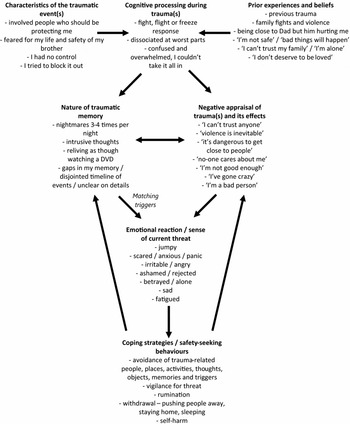
During the first session after assessment the therapist used Ehlers and Clark's (Reference Ehlers and Clark2000) cognitive model of PTSD to structure a discussion with Lucy about how and why PTSD can develop in response to trauma. Based on Lucy's decision to address the worst trauma first, the formulation was based loosely on this event, with recognition of themes and wider issues. Lucy and the therapist noted that Lucy's co-morbid difficulties could be largely described by the appraisals, emotions and coping strategies sections of the formulation. This helped Lucy to see her problems as interlinked and less overwhelming than they had previously appeared.
Lucy reflected that the formulation helped her to see just how much the traumatic events had affected her, but also gave her hope that she could begin to move forward. She shared that using a pre-existing model to understand her problems was reassuring as it allowed her to recognize that she was not ‘mad’ but rather that this was a normal reaction to abnormal circumstances. The formulation was placed on the table at the start of each therapy session and used to help both Lucy and the therapist make sense of what was being discussed (see Fig. 1). New information was integrated and the formulation developed as sessions progressed.
Diagram of formulation of Lucy's presenting problems used in therapy.

Intervention
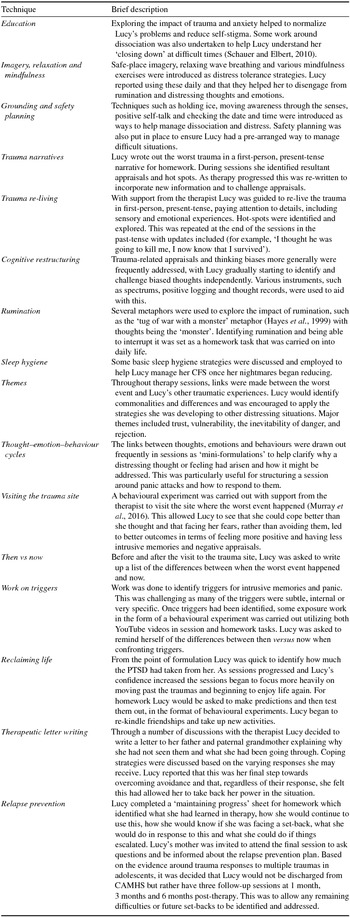
Based on the considerations outlined above, Lucy's parents were not directly involved in sessions. Lucy also chose to focus on the worst event first; the therapist planned to address other events sequentially but outcome measures and feedback from Lucy demonstrated that discussing common themes and cognitions, whilst working on one specific event, reduced trauma-related experiences globally. This resulted in an intervention closely aligned to the form of TF-CBT referred to as cognitive therapy for PTSD with young people (Smith et al., Reference Smith, Perrin, Yule and Clark2009). Key elements of the intervention are outlined in Table 1.
Key elements of the intervention used with Lucy

Results
Lucy's trauma-related experiences fluctuated throughout therapy, intensifying after sessions where long-avoided elements of the traumas had been addressed; this was particularly notable after sessions 6, 8 and 9. In session 6, cognitive restructuring of core beliefs was explored, which was particularly challenging for Lucy who struggled to generate and believe evidence that challenged her beliefs. In session 8, the therapist supported Lucy to re-visit the site of the trauma and spent a considerable amount of time working on noticing differences between then versus now. In session 9, cognitive restructuring and exposure to long-avoided triggers was carried out. Lucy reported that her trust in the formulation and the relationship she had with the therapist had helped her to persevere with the therapy through these difficult sessions.
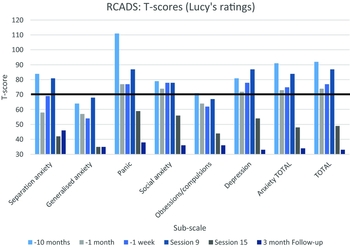
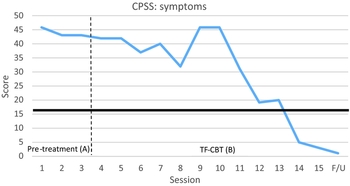
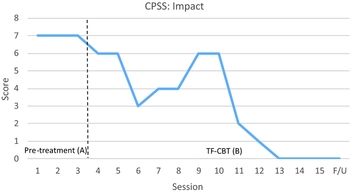
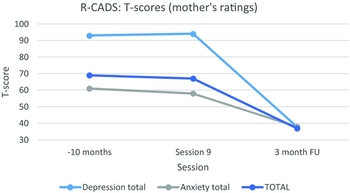
Outcome measures were analysed using descriptive statistics (see Figs 2–5). All subscales and total scores on the RCADS had reduced to normal range by the end of therapy (see Fig. 2), in line with Lucy's reports that she was no longer being significantly impaired by her problems. Scores on the symptom scale of the CPSS had reduced from 46/53 at the start of therapy to 3/53 at the end of therapy (see Fig. 3), indicating that Lucy was no longer suffering with clinical PTSD. Scores on the impact scale of the CPSS had reduced from 7/7 at the start of therapy to 0/7 at the end of therapy (see Fig. 4), in line with Lucy's reports that PTSD-experiences were no longer affecting her life.
Graph of Lucy's RCADS T-scores over time. Pre-treatment phase (A) is depicted by bars for 10 months, 1 month and 1 week prior to treatment. Treatment phase (B) is depicted by bars for sessions 9 and 15. The 3-month follow-up ratings are depicted by the final bar. Scores ≥70 are above the clinical threshold, depicted by a continuous black line.

Graph of Lucy's CPSS symptom scores over time. Scores ≥16 are above the clinical threshold, depicted by a continuous black line.

Graph of Lucy's CPSS impact scores over time.

Graph of Lucy's mother's RCADS rating T-scores over time.

Most notably for Lucy, by the end of therapy she had a positive relationship with her mother, her mother's partner and her brother and had begun seeing her friends again. Nightmares were no longer an issue and Lucy had not self-harmed for 12 weeks by the time of follow-up, which was particularly meaningful for Lucy as she had faced extreme distress during some of the therapy process. Lucy and her mother also noted that Lucy's CFS was being better managed. Lucy's mother's ratings on the RCADS before, during and after therapy reflect her reports that the changes in Lucy were noticable to those around her (see Fig. 5).
Two weeks after therapy had ended, Lucy's mother urgently contacted the therapist to report that Lucy's symptoms had been triggered by an unhelpful session with her psychiatrist. Lucy reported that at this time her symptoms were nearly as bad as when she first started treatment; she was encouraged via telephone to implement the strategies she had learned in therapy. By the time Lucy attended her scheduled 1-month follow-up session, she reported that she had succesfully addressed this ‘blip’ and she did not feel the need to attend the further two sessions that had been scheduled. At three months post-therapy Lucy reported via email that she had maintained the gains made in therapy, as reflected in her follow-up measures (see Figs 2–5), and reported feeling very different from before therapy:
‘I still do a lot of behaviour challenging when I feel my anxiety is appearing and I talk to my friends or my mum about my problems a LOT now, whereas before I spoke to no-one about anything. I'm really open and honest about everything now and it's a huge change that I like. I am able to talk to new people my age really easily now without feeling anxious too. Before I used to just sleep and lay in bed all day but now I'm really active, I'm always doing something and barely ever in my room’ (‘Lucy’, June 2016)
Discussion
This case offers one illustration of how to assess and treat PTSD in response to multiple traumas in adolescence. The presence of both nightmares and avoidance, as well as family issues highlighted by the completion of a genogram, led to a comprehensive assessment being carried out to further explore all trauma-related experiences; this was undertaken with both standardized measures and a clinical interview based on previous recommendations (Hales et al., Reference Hales, Blackwell, Di Simplicio, Iyadurai, Young, Holmes, Brown and Clark2015; Young and Grey, Reference Young, Grey, Corrie, Townend and Cockx2016). It is likely that the service-user's PTSD had not been detected earlier due to a number of the barriers outlined by Cohen and Scheeringa (Reference Cohen and Scheeringa2009), including the overlap between PTSD and other problems that the service-user was presenting with, and the service-user's avoidance of the traumatic stimuli. The assessment and formulation also covered additional elements that the service-user felt were linked to the traumas, including physical illness (CFS), affect regulation (dissociation and self-harm), poor self-concept and difficulties with relationships; previous literature has highlighted these as important areas to consider when working with complex PTSD (Wamser-Nanney and Vandenberg, Reference Wamser-Nanney and Vandenberg2013).
An individualized TF-CBT intervention was used based on the literature, the service-user's views and the details of her case. This was focused largely on previous descriptions of TF-CBT (Smith et al., Reference Smith, Perrin, Yule and Clark2009) with elements of CBT for complex PTSD, such as extended grounding and relaxation work, addressing trauma themes, assessing and addressing broader issues and having more sessions (Cohen et al., Reference Cohen, Mannarino and Deblinger2006; Stallworthy, Reference Stallworthy and Grey2013). The sessions focused on the worst event for much of the work, although this was generalized to have relevance to all of the traumas and beyond. Results suggest that this approach was not only successful in reducing PTSD from severe to non-clinical levels, but also led to non-clinical ratings of panic, social anxiety and depression by the end of therapy and at follow-up; all of these difficulties had been rated as clinically significant at all baseline measurement points. Additionally, self-harm was no longer a problem, CFS was being well managed and the service-user was reclaiming her life with new activities and relationships. The service-user was also able to use what she had learned in her sessions to address later set-backs.
Clinical implications
Including questions about potentially traumatic experiences as part of generic assessments of adolescents in CAMHS can help alert the therapist to any previous trauma exposure, which may otherwise be avoided by the service-user. Any disclosure of poor sleep or nightmares should be explored further to see if this may be part of a trauma response. If an adolescent discloses trauma exposure they should be assessed for additional traumatic events and global PTSD, using both standardized measures validated in adolescent populations and clinical interviews that gently but directly probe for more detail about trauma-related experiences. Where multiple traumas have been experienced it may be particularly important to allow more time for a detailed assessment, bearing in mind that the sequelae of traumatic stress can be varied and may include substance use, behavioural problems, physical ailments, affect regulation problems, attachment difficulties, poor self-concept and other mental health problems (Wamser-Nanney and Vandenberg, Reference Wamser-Nanney and Vandenberg2013). These suggestions for improving identification of PTSD in adolescents may involve implementing new protocols in CAMHS and having brief training sessions for staff. Recommendations have been made elsewhere about introducing trauma screening into primary care and other medical settings (Gerson and Rappaport, Reference Gerson and Rappaport2013; Donlon-Ramsdell et al., Reference Donlon-Ramsdell, Smith, Hildenbrand and Marsac2015).
Although most TF-CBT protocols recommend involving parents in treatment sessions, this may not always be possible for various reasons. When this is the case it is recommended that parents are kept informed and included, where this is appropriate. Alternatively, other professionals or acquaintances involved in the adolescent's care could be included where this is deemed to be beneficial. Ultimately, informed clinical judgement will need to be used to assess whether an adolescent is able to manage therapy sessions independently.
Treatment should involve a trauma-focused approach. Where multiple traumas exist it may be necessary to offer more sessions, to address additional problems, and to extend grounding and safety sessions (Smith et al., Reference Smith, Perrin, Yule and Clark2009; Cohen et al., Reference Cohen, Mannarino, Kliethermes and Murray2012; Stallworthy, Reference Stallworthy and Grey2013). Previous literature has recommended working through a hierarchy starting with the least upsetting trauma first (Stallworthy, Reference Stallworthy and Grey2013); however, where the service-user has some stability and coping skills, it is advisable to discuss with the client their preferred sequence of addressing traumas. Identifying which traumas are being re-experienced in the service-user's intrusions, flashbacks or nightmares can offer a good clue as to which traumas may need to be addressed. In this case only one trauma was fully addressed, with others being briefly discussed and then addressed by exploring common themes. Addressing trauma themes and core beliefs can be helpful to broaden the application of what is being learned and possibly minimize the number of traumas it is necessary to re-live. People may present with a number of problems when they have experienced complicated trauma and it can be overwhelming for therapists to know how to begin formulating and addressing these issues. This case suggests that using the Ehlers and Clark (Reference Ehlers and Clark2000) model for PTSD can be a useful way to guide formulation and focus the intervention, even in the face of complexity.
Considerations and limitations
As with any single-case design it is hard to know how far the findings can be generalized and, as there is no control condition, the internal validity is limited; although it seems plausible that the gains seen were a result of the intervention, this cannot be demonstrated with the design employed. There are factors which may have influenced the outcomes; this included Lucy's motivation to engage as well as a strong therapeutic alliance. The pre-treatment phase for the CPSS was delineated as measures taken at sessions 1, 2 and 3; the first two sessions covered formulation and psycho-education, and as measures were taken at the start of each session, the rating from session 3 would have been prior to the content of the third session, where narrative work began to take place. However, it could be argued that formulation and psycho-education count as part of the intervention, especially given the importance of re-visiting the formulation to this case. Despite this, the scores on the CPSS were stable until after session 3 and the pre-assessment RCADS measures suggest that anxiety and depression had been in the clinical range for quite some time. Given the hypothesized link between Lucy's PTSD, depression and anxiety, as detailed in the formulation (see Fig. 1), it is plausible that the early RCADS scores are also indicators of Lucy's baseline trauma response.
Alternative indicated approaches, such as EMDR and narrative exposure therapy, could have proven equally useful. However, where an adolescent has PTSD in response to multiple events but does not clearly fit a complex PTSD presentation, this case offers an illustration of the processes, considerations and approaches that might be useful when it comes to assessment and intervention. With additional sessions it may have been beneficial to further explore the systemic issues that were touched on in the sessions, for example with family therapy. Future research would benefit from further investigating and defining the clinically relevant differences between trauma presentations and which treatments are most effective for addressing them. Additionally, explorations of how to implement trauma screening and improve staff confidence and competence at responding to trauma disclosure would be extremely valuable.
Reflections
It felt important not to dwell on the stabilization phase; once it was clear that Lucy was willing and able to use affect regulation techniques the sessions quickly moved on to addressing the trauma(s), which prevented the therapist being drawn in to trauma avoidance. As reflected by the outcome measures, the presenting problems were initially exacerbated by the therapy process, which was worrying for Lucy, her mother and other professionals involved in Lucy's care. It was likely the psycho-education, collaborative formulation and repetitive re-visiting of the formulation plus some early therapy gains that enabled both Lucy and the therapist to have faith in the treatment plan. It was important that the therapist stayed calm and confident at times when the problems seemed to be rapidly escalating, for example when Lucy dissociated in sessions or disclosed violent outbursts and self-harm. Dissociation can be particularly challenging for therapists, often evoking anxiety or even mutual dissociation (Strait, Reference Strait2013). Confidence in the approach used, including education and formulation of dissociation, along with seeking to help ground the client can be helpful to manage this (Kennerley, Reference Kennerley1996).
Key points
-
• PTSD often goes undetected and untreated. There may be particular challenges in assessing PTSD in children and adolescents.
-
• Evidence suggests that trauma-focused approaches are the most effective for addressing PTSD in adolescents.
-
• Where PTSD in adolescents presents in response to multiple traumas it may be necessary to make some modifications to treatment protocols. This may include offering more sessions, extending the stabilization period, addressing common trauma themes, and tackling additional issues that may arise beyond a simple PTSD presentation.
-
• One example of identifying previous trauma, assessing for PTSD and treating PTSD in response to multiple traumas using an individualized trauma-focused CBT approach has been presented. The outcomes demonstrate that the initial presenting problems were resolved by the end of treatment and that these gains were maintained at 3-month follow-up.
-
• This case suggests that including trauma screeners at assessment in CAMHS may be beneficial and that trauma-focused CBT with individualized modifications can be efficacious at treating PTSD in response to multiple traumas in adolescents.
Ethical statement
The authors assert that all procedures contributing to this work comply with the ethical standards of the relevant national and institutional committees on human experimentation and with the Helsinki Declaration of 1975, and its most recent revision.
Acknowledgements
The authors thank Lucy (pseudonym) for her consent to the publication of this article; all names used in the report have been changed in order to preserve confidentiality. The authors would also like to thank the reviewers at the Cognitive Behaviour Therapist, who contributed significantly to improving the quality and clarity of this paper. This work was carried out between October 2015 and March 2016 (follow-up measures in June 2016) by a trainee clinical psychologist and her supervisor as part of the University of Bath Doctorate in Clinical Psychology.
Declaration of interest
The authors have no conflicts of interest with respect to this publication.
-
(1) To get an overview of the current evidence base for assessing and treating PTSD in adolescents.
-
(2) To consider how treatments may need to be modified for PTSD in response to multiple events or chronic traumas.
-
(3) To reflect on a clinical case report to see how traumatic experiences and responses might be identified and assessed, and how individualized TF-CBT, guided by the evidence base and service-user choice, might be an effective therapeutic approach to alleviate such problems.
-
(4) To consider the importance of identifying and treating PTSD in CAMHS.



Comments
No Comments have been published for this article.