Introduction
Modern alloy design has evolved significantly from its historical roots as an Edisonian approach. Today, alloy development increasingly exploits the integration of sophisticated multimodal structural and chemical characterization, predictive computational modeling tools, and the acceleration of prototype sample processing. These developments have been described generally in reports covering the Integrated Computational Materials Engineering (ICME) framework and the Materials Genome Initiative.1–Reference Pollock, Allison, Backman, Boyce, Gersh, Holm, Lesar, Long, Powell, Schirra, Whitis and Woodward4 In alloy design, the approach enables the development of an advanced scientific understanding of the mechanisms underlying microstructure formation during processing, and the links between chemistry, structure, and the properties that are ultimately targeted for a specific engineering application. An essential ingredient is the integration of a hierarchy of computational tools facilitating development of comprehensive databases, furthering understanding, and guiding experimental efforts.Reference Xiong and Olson5
Within this context, this article highlights the emergence of a novel tool for accelerated alloy design, high-throughput computing, broadly defined as robust workflows and software for interfacing computational tools to autonomously perform materials properties calculations on modern high-performance computers.Reference Curtarolo, Hart, Nardelli, Mingo, Sanvito and Levy6 The approach has had a significant impact in enabling combinatorial searches and the development of property databasesReference Jain, Ong, Hautier, Chen, Richards, Dacek, Cholia, Gunter, Skinner, Ceder and Persson7–Reference Ghiringhelli, Carbogno, Levchenko, Mohamed, Huhs, Luders, Oliveira and Scheffler11 that can feed machine-learning models in materials discovery efforts.
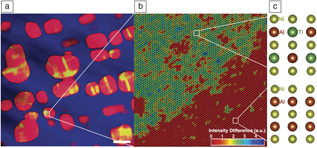
To date, most applications efforts have focused on properties of single-crystal, defect-free compounds. In contrast, the mechanical properties of engineering alloys are typically intimately tied to their defects and microstructures. As illustrated in Figure 1 for a ferritic superalloy,Reference Liebscher, Radmilovic, Dahmen, Vo, Dunand, Asta and Ghosh12 hierarchies of geometric and compositional variations across multiple length scales, featuring numerous multicomponent phases, with varying degrees of short- and long-range order can be involved. Control over these morphologies is required to achieve desired properties. An essential ingredient in this endeavor is the knowledge of the thermodynamic driving forces for structural evolution and phase stability. In this article, we describe recent progress in utilizing high-throughput computing to determine thermodynamic properties related to phase equilibria and transformations in alloys. We conclude with an outlook on opportunities to merge these approaches with state-of-the-art modeling of kinetic and interfacial properties that are essential for simulating microstructure evolution dynamics.
Microstructure of a ferritic superalloy. (a) Compositional variations derived from core-loss energy-filtered transmission electron microscopy with the Fe elemental map in blue, Ni in red, and Ti in green. Scale bar = 100 nm. (b) Aberration-corrected high-angle annular dark field-scanning transmission electron microscopy showing atomic columns colored to indicate the local degree of atomic ordering consistent with the L21 (green) and B2 (red) phases. (c) Crystal structures associated with L21 and B2 ordering are illustrated on top and bottom, respectively.Reference Liebscher, Radmilovic, Dahmen, Vo, Dunand, Asta and Ghosh12

Overview of the CALculation of PHAse Diagram framework
The CALculation of PHAse Diagram (CALPHAD) framework is a successful marriage of computational and experimental methods for the purpose of determining and encoding thermodynamic information.Reference Kaufman13–Reference Kattner15 This framework uses a compact representation of a phase’s Gibbs excess free energy (i.e., deviation from ideal solution free energy) in terms of a polynomial expansion in composition space, with coefficients that may be functions of temperature. This framework encompasses not only conventional solutions, but also ordered phases, which are modeled within the compound energy formalismReference Andersson, Guillermet, Hillert, Jansson and Sundman16 (CEF) using multiple sublattices, each with their own individual composition.
Numerous software packages have been developed to generate such thermodynamic databases, solve for general phase equilibria, and graph phase diagrams.Reference Bale, Bélisle, Chartrand, Decterov, Eriksson, Gheribi, Hack, Jung, Kang, Melançon, Pelton, Petersen, Robelin, Sangster, Spencer and Van Ende17–Reference Otis and Liu21 But the generation step is a complex inverse problem that remains a significant bottleneck. Experimental data do not come directly in the form of Gibbs free energies, but instead provide indirect constraints on the latter.Reference Saunders and Miodownik22 Diffraction and microprobe measurements on samples synthesized under known conditions can provide the crystal structure and composition of a stable phase. These data help ensure that the model reproduces the phase diagram, but pinning down free energies themselves requires either calorimetric measurements, providing heat capacities and heats of formation, or chemical potential measurements via electrochemical or partial pressure measurements. An increasingly important data source aimed at reducing free-energy uncertainties is quantum mechanical (or ab initio) calculations,Reference Liu23 which can provide formation energies or even free energies directly, accounting for configurational, vibrational, and electronic contributions. As a result of such efforts in the community, a large library of thermodynamic models is available both from commercialReference Bale, Bélisle, Chartrand, Decterov, Eriksson, Gheribi, Hack, Jung, Kang, Melançon, Pelton, Petersen, Robelin, Sangster, Spencer and Van Ende17–Reference Cao, Chen, Zhang, Wu, Yang, Chang, Schmid-Fetzer and Oates19 and academicReference Campbell, Kattner and Liu14,Reference van de Walle, Nataraj and Liu24–Reference Otis and Liu26 sources.
Beyond thermodynamics, the CALPHAD formalism offers the ability to parametrize any composition-dependent material property, a capability which could prove helpful in the development of a “materials genome.” An important and mature application is the construction of diffusion properties databases, as will be described shortly.
High-throughput calculations for thermodynamic properties and phase boundaries
High-throughput exploration of ordered phases for the purpose of materials discovery and screening has been demonstrated by numerous groups.Reference Jain, Ong, Hautier, Chen, Richards, Dacek, Cholia, Gunter, Skinner, Ceder and Persson7–Reference Ghiringhelli, Carbogno, Levchenko, Mohamed, Huhs, Luders, Oliveira and Scheffler11 Yet, most engineering alloys are not stoichiometric and often owe their remarkable properties to controlled solute additions. The need for modeling multicomponent disordered solid solutions has recently become even more clear, in light of the current intense interest in multiprincipal component (or “high-entropy”) alloys.Reference Senkov, Miller, Miracle and Woodward27,Reference Abu-Odeh, Arroyave, Galvan, Kirk, Malak, Mao, Chen and Mason28 However, methodologies aimed at handling nonstoichiometric phases in high-throughput methods remain underused. One promising approach consists of embedding traditional CALPHAD models in a high-throughput loop by using ab initio calculations to determine the thermodynamic parameters of the model. Using some amount of ab initio input (especially for ordered phases) has a long tradition in the CALPHAD community,Reference Liu23 but using such input more comprehensively, in particular to model partial site occupancies, remains rare. Partial atomic site occupancies arise whenever a given phase can accommodate deviations from stoichiometry via entropy-driven point defects formation.
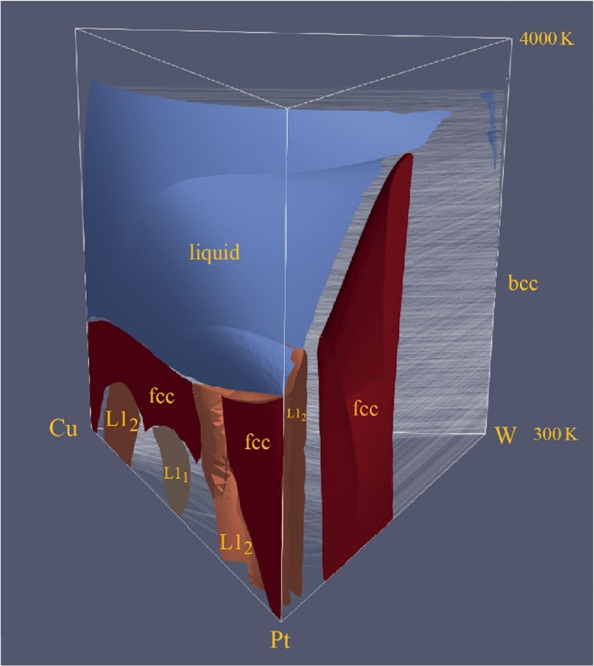
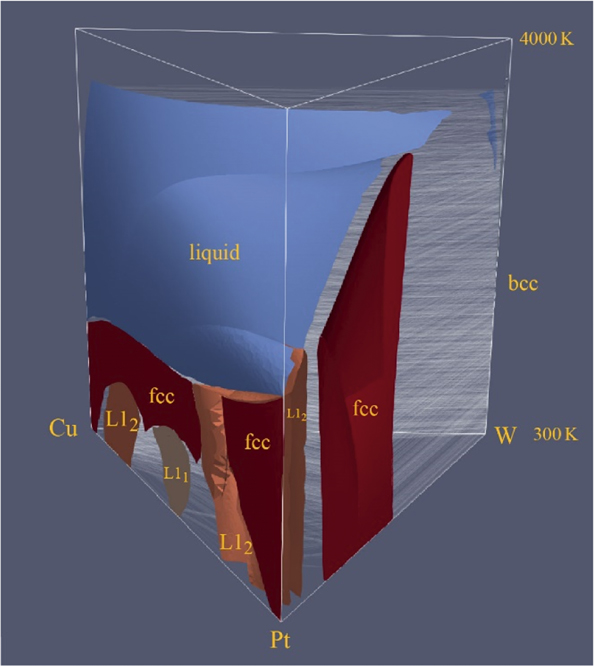
A number of key innovations are now making this a possibility. First, the development of well-automated software toolsReference van de Walle, Sun, Hong and Kadkhodaei29,Reference Crivello, Souques, Breidi, Bourgeois and Joubert30 to build CALPHAD models from ab initio input expedites the process, which could involve launching hundreds of calculations. Another key component is the concept of special quasi-random structures (SQSs),Reference Zunger, Wei, Ferreira and Bernard31 which are small-cell approximations to a disordered system that are optimized to mimic random local atomic environments. Efficient stochastic generation methods have been developedReference van de Walle, Tiwary, de Jong, Olmsted, Asta, Dick, Shin, Wang, Chen and Liu32 and have enabled the creation of databases of pregenerated SQSsReference van de Walle, Sun, Hong and Kadkhodaei29 for common crystal structures. SQS formation enthalpies are sufficient to build simple regular solution models, but fail to account for short-range order. Fortunately, simple analytic modelsReference van de Walle, Sun, Hong and Kadkhodaei29 can address this (via a low-order cluster variation methodReference Kikuchi33), solely from SQS input data, because these reveal clues to the systems’ ordering tendencies that can be used to build a perturbative short-range-order model. Figure 2 shows an example of a multicomponent phase diagram generated by the synergy of these high-throughput CALPHAD techniques (invoking ∼80 individual ab initio calculations involving SQSs of ∼30 atoms). Another important capability is the inclusion of lattice vibrations (and their coupling with configurational effects),Reference van de Walle and Ceder34 which drive most allotropic transformations. Finally, melting transitions are also being targeted within a high-throughput frameworkReference Hong and van de Walle35 and such techniques have even recently identified HfC0.51N0.38 as a candidate material that may have the highest melting pointReference Hong and van de Walle36 known to date.
Cu-Pt-W phase diagram computed via high-throughput ab initio CALPHAD methods. Phase boundaries are marked by colored surfaces while tie lines are indicated by gray lines.Reference van de Walle, Sun, Hong and Kadkhodaei29 Note: bcc, body-centered cubic; fcc, face-centered cubic.
Consistency between ab initio-based CALPHAD models and the large existing source of predominantly experimental thermodynamic assessments is important to ensure that progress in one field can be leveraged in the other. While agreement is generally good for stable phases,Reference Wang, Curtarolo, Jiang, Arroyave, Wang, Ceder, Chen and Liu37 the CALPHAD framework also demands well-defined free energies for mechanically unstable “virtual” phases, for which the lack of agreement is a long-standing problem that has prompted a lengthy search for solutions.Reference Hickel, Kattner and Fries38–Reference Craievich, Sanchez, Watson and Weinert40 The disagreement arises because experimental values employ extrapolations from stable phases while computational techniques proceed by artificially constraining the crystal’s geometry, and the two constructions need not agree. Recently, a theoretically justified definition of the free energy of a mechanically unstable phase, based on partitioning of phase space via a local stability criterion, was proposed.Reference van de Walle, Hong, Kadkhodaei and Sun41 This approach is computationally simple to implementReference van de Walle, Kadkhodaei, Sun and Hong42 and yields enthalpies that agree wellReference van de Walle43 with accepted CALPHAD SGTE (Scientific Group Thermodata Europe) values.Reference Dinsdale44
The integration of the vast data resources consisting of existing CALPHAD assessments with novel ab initio high-throughput computational methods via data-based approaches offer considerable opportunities for expanding our ability to discover and design novel materials.
Kinetic modeling
For the purpose of microstructure design, it is essential that information for phase equilibria be augmented by kinetic properties, namely diffusivities and excess free energies, and mobilities of interfaces. When combined with knowledge of the chemical potentials embodied in the equilibrium free energies, these properties enable modeling of interdiffusion processes and phase-transformation kinetics.Reference Borgenstam, Engstrom, Hoglund and Agren45,Reference Silva, Agren, Clavaguera-Mora, Djurovic, Gomez-Acebo, Lee, Liu, Miodownik and Seifert46
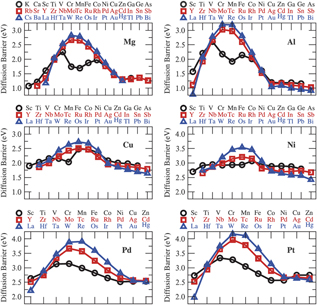
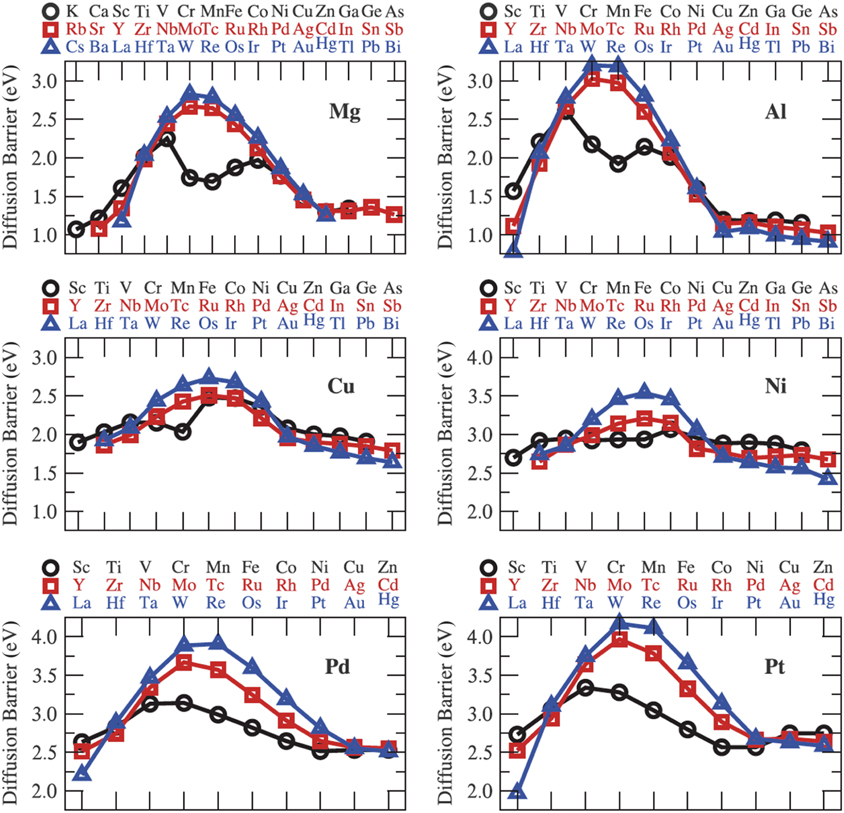
Within the CALPHAD framework, modeling of diffusion relies on the development of databases of atomic mobilities, which relate atomic fluxes to chemical potential gradients. Such databases can be constructed from composition profile data obtained from diffusion couple experiments, but there is growing interest in the use of ab initio calculations to accelerate the process. In the dilute limit, mobility is directly proportional to the diffusivity of an isolated solute impurity in a host matrix, which can be computed directly by first-principles methods. A high-throughput workflow involving all requisite calculation steps (extracting solute-vacancy binding energies, migration energies for vacancy exchange, and phonon frequencies in binding and saddlepoint sites) was recently demonstrated, leading to the development of the largest database to date of computed impurity diffusivities (Figure 3).Reference Wu, Mayeshiba and Morgan47 Although first-principles approaches handling nondilute diffusivities have been developed,Reference Van der Ven and Ceder48–Reference Bhattacharya and Van der Ven52 embedding these approaches into high-throughput tools represents a future area of research that could significantly impact mobility database development in regimes that are difficult to access directly by experiment.
Activation energies for diffusion of various impurities (abscissa) in Mg, Al, Cu, Ni, Pd and Pt hosts, obtained through high-throughput calculations. Reprinted with permission from Reference Wu, Mayeshiba and MorganReference 47. © 2016 Nature Publishing Group.
For the purpose of modeling phase transformations and microstructure dynamics, additional kinetic properties of importanceReference Silva, Agren, Clavaguera-Mora, Djurovic, Gomez-Acebo, Lee, Liu, Miodownik and Seifert46 are the excess free energies and mobilities of heterophase interfaces and grain boundaries, which are notoriously difficult to derive directly from experimental measurements. Computational approaches for obtaining these properties have been reviewed,Reference Mishin, Asta and Li53,Reference Lu, Agren and Vitos54 and in the most complex cases require the use of classical interatomic potentials and thus remain out of the reach of direct quantum mechanical calculations. The evolution of this area to one that can be undertaken in a high-throughput framework is ongoing, with efforts to automate the process of generating interface structural modelsReference Sangghaleh and Demkowicz55–Reference Cheng, Luo and Yang57 and machine-learning approaches to interatomic potentials being important ingredients.
Summary
The CALPHAD framework for modeling of phase equilibria and phase transformation kinetics has found widespread application in accelerating the process of alloy design. For “mature” alloy systems, the availability of validated databases of thermodynamic and kinetic properties is key to the successes realized. For applications to systems with radically different compositions, a bottleneck is hence the need for extensive experimentation for traditional database development efforts. In this context, high-throughput quantum mechanical calculations have emerged as an important tool. The framework is already demonstrating impact in phase-equilibria studies, and it can be expected that further developments will lead to expanding impact also for the kinetic properties required to model phase transformations and microstructure dynamics.
Acknowledgments
The authors acknowledge support in computational alloy design from the Office of Naval Research through Program Nos. N00014–11–1-0886 (A.vdW. and M.A.) and N00014–17–1-2202 (A.vdW.). A.vdW. acknowledges support from Brown University through the use of the facilities at its Center for Computation and Visualization and from the Extreme Science and Engineering Discovery Environment, which is supported by National Science Foundation Grant No. ACI-1053575. M.A. also acknowledges support in this area from the US Department of Energy, Office of Science, Office of Basic Energy Sciences, Materials Sciences and Engineering Division, through the Materials Project (KC23MP), under Contract No. DE-AC02–05CH11231.

Axel van de Walle is a professor in the School of Engineering at Brown University. He received his PhD degree in materials science and engineering from the Massachusetts Institute of Technology in 2000. His research focuses on developing atomistic modeling software tools for the materials science community, such as the Alloy Theoretic Automated Toolkit. Van de Walle can be reached by email at Axel_van_de_Walle@brown.edu.

Mark Asta is the director of the Materials Sciences Division at Lawrence Berkeley National Laboratory, and the Arthur C. and Phyllis G. Oppenheimer Professor of Advanced Materials Analysis in the Department of Materials Science and Engineering at the University of California, Berkeley (UC Berkeley), where he served as department chair from 2012 to 2017. He received his PhD degree at UC Berkeley in 1993. He has published more than 280 articles in the field of computational materials science. Asta was awarded ASM International’s Materials Research Silver Medal Award in 2002, Fellow of the American Physical Society in 2010, and the 2019 TMS Hume-Rothery Award. Asta can be reached by email at mdasta@berkeley.edu.