In contemporary western societies, explicit forms of racial prejudice – which supposes beliefs in the inferiority of the discriminated group and a rejection of intimate contact with the members of this group – are being replaced by more subtle forms. As several studies have shown, this has assumed new forms of expression, as for example, ambivalent prejudice (Kats & Hass, 1988), aversive prejudice (Gaertner & Dovidio, Reference Gaertner, Dovidio, Dovidio and Gaertner1986), symbolic prejudice (McConahay & Hough, Reference McConahay and Hough1976; Sears, Reference Sears, Katz and Taylor1988), subtle prejudice (Pettigrew & Meertens, Reference Pettigrew and Meertens1995; see Brown, Reference Brown2010, for an extensive review) etc. Taken together, these studies share the idea that nowadays there is a social norm that prohibits all forms of explicit prejudice and discrimination. One of the subtle forms that these phenomena can assume, for example, is when the explanations for social inequalities are made in terms of economic progress, and not based on hierarchies between races, as was openly accepted until the early twentieth century (see Pereira & Vala, Reference Pereira, Vala, Techio and Lima2011; Pereira, Vala, & Costa-Lopes, Reference Pereira, Vala and Costa-Lopes2010; Pereira, Vala, & Leyens, Reference Pereira, Vala and Leyens2009). The present study investigates the arguments used by university students in order to explain social differences between social minorities and majorities. In Brazil, the issues investigated refer to White and Black people. In Spain, the reference is to native Spaniards and Moroccan immigrants.
These groups were chosen because in both countries, the official statistics have shown the existence of important socio-economic differences between them. In Spain, Moroccans face a greater risk of social exclusion than other groups of immigrants. For example, 57% of Moroccans have only a primary education, compared with 29% of the remainder of immigrants from outside the European Community. The unemployment rate is 62.5% for those under 25 years, and 40% for those over that age. Finally, Moroccans’ wages are significantly below the overall immigrant population’s wages: almost half of the Moroccan immigrants receive less than 60% of the national average income of Spaniards (IIEAMM, 2010). In Brazil, Blacks and Whites do not have the same access to education, according to the Summary of Social Indicators, 2010 (IBGE, 2010). In 2009, 62.6% of White students between 18 and 24 years were in college, compared with 28.2% of Blacks. Inequality is also reflected in lower levels of education. The proportion of illiterates in the Black population is 13.3%, while the proportion of illiterate Whites is 5.9%. These differences in levels of education are reflected in the salaries received by Blacks and Whites. According to the IBGE (2011), the average monthly income of Whites is close to double the figure for Blacks.
These socioeconomic inequalities co-exist with different forms of racial prejudice and xenophobia. In several investigations dedicated to studying new forms that racial prejudice is assuming in Brazil (Camino, da Silva, Machado, & Pereira, Reference Camino, da Silva, Machado and Pereira2001; Camino, da Silva, & Machado, Reference Camino, da Silva, Machado, Lima and Pereira2004; Camino, Reference Camino and de Psicologia2004), it has been observed that practically all the people who were interviewed say that there is prejudice in Brazil, but most of these same people do not consider themselves prejudiced. People seem to be conscious of racial discrimination (Bailey, Reference Bailey2009; Mitchell, Reference Mitchell2010), but they do not accept responsibility for this situation. In those investigations, it was observed that participants used more adjectives related to kindness and less adjectives associated with antipathy to describe Black people than to describe White people. However, they also felt that Brazilians would do the opposite: assign more adjectives of antipathy and less adjectives of kindness to refer to Black people. From these results, we conclude that Brazilians, in public, refer to Black people in more positive terms than when they refer to White people. But when they are safely distanced through the question, asked in terms of “what do Brazilian people think,” they say the opposite, speaking badly of Black people and well of Whites.
In fact, it seems that people would conform to the anti-discriminatory norm, but would not internalize it. Their prejudice would only show up when it could be expressed in socially acceptable forms. Affirming that “other” Brazilians are racist, people do not just recognize a single case, but create a double standard that guides their everyday life.
Differently from what happens in Brazil, racial, ethnic, and cultural minorities who live in Spain are not members of the autochthonous population, but are immigrants from other countries, the Spanish gypsies being the only exception in this sense. Thus, the manifestation of racial prejudice in Spain is indissolubly linked to attitudes on immigration and xenophobia.
Research carried out in Spain on attitudes towards immigration has shown that, according to the participants, Spanish society is warm and only slightly xenophobic. According to several studies on immigration, which have been carried out periodically since the 1990s (Díez Nicolás, 2005; Pérez & Desrues, Reference Pérez and Desrues2006; Cea D’Ancona & Valles Martínez, 2009), the Spanish population welcomes the fact that society is composed of people of different racial, religious, or cultural origins, and most Spanish people say they are willing to have different kinds of relationships with those people, such as have them as neighbors, as their children’s colleagues at school, etc. But this position of the majority of the population in favor of immigration refers more to an intent to conform to anti-discriminatory norms than to an inner lack of rejection.
When racial prejudice and xenophobia are measured by indirect questions referring to the Spanish population, evidence of prejudice increases. Similarly to what happens in Brazil, Spanish people do not consider themselves xenophobic or racist, but they do see manifestations of xenophobia and racism around them. Several studies indicate that, although a minority admits to behaving in a discriminatory way with immigrants or to treating them with disdain or distrust, the majority realizes that this kind of behavior is common in the Spanish population (Díez Nicolás, 2005; Morales, Reference Morales, Morales and Huici2003).
Because the predominant anti-discriminatory norm condemns the explicit expression of prejudice, new forms of subtle and symbolic prejudice have emerged (Gutiérrez-Cruz, Agulló-Tomás, Rodíguez-Suárez, & Agulló-Tomás, Reference Gutiérrez-Cruz, Agulló-Tomás, Rodríguez-Suárez and Agulló-Tomás2004; Moya & Puertas, Reference Moya and Puertas2005; Retortillo & Rodríguez, Reference Retortillo and Rodríguez2008). A clear example of these new forms of expression of racial prejudice and xenophobia is found in the ways the Spanish people see the social rights of immigrants. For example, although the majority of the population recognizes the health rights of immigrants, about half the population thinks that immigrants receive more assistance than do native Spaniards, that they abuse health services, and that their presence leads to a decrease in the quality of those services (Centro de Investigaciones Sociológicas CIS, 2008). It is interesting to note how the perceived risk of losing one’s rights is used to explain the social exclusion of immigrants from health care and education (see Figgou, & Condor, Reference Figgou and Condor2006).
This study sets out with the assumption that this ambivalence in the expression of prejudiced attitudes should also be reflected in some of the arguments used to explain social inequalities. In the case of Brazil, based on the prevailing high level of miscegenation, arguments on racial equality evolve around the idea that since the population is so racially mixed, it would be hard to classify people as Black or White, thus obscuring racial differences. So, existing economic differences between Black and White people would be explained by economic differences between social classes or by the past exploitation of Black people but not by referring either to actual prejudice or discrimination towards the Black community.
On the other hand, it is expected that in Spain, while recognizing the objective social inequalities Moroccan immigrants may suffer, this situation will not be attributed to any explicit discrimination but to their condition as a culturally homogeneous group. This type of discourse denies exploitation and prejudice and implies the idea that the symbolic barriers between social ethnic groups explain the lack of social adaptation of Moroccan immigrants to the Spanish culture and thus their economic and social situation.
Thus, there is the expectation of finding, in both Brazil and Spain, arguments that interconnect to make sense of discrimination and make it, somehow, more palatable to politically correct societies, where anti-discriminatory norms are hegemonic. Specifically, in this work, the focuses are the prejudice in Brazil and the xenophobia in Spain.
The aim of this study is to investigate the arguments used by university students in order to explain social differences between social minorities and majorities. In Brazil, the issues investigated refer to White and Black people. In Spain, the reference is to native Spaniards and Moroccan immigrants.
Method
Participants
The Brazilian sample included 144 students from a public university in Paraíba, composed of 63 men (43.8 per cent) and 81 women (56.3 per cent), from 18 to 58 years of age (M = 24.01; SD = 6.93). The Spanish sample included 93 students from a university in Madrid composed of 26 men (28 per cent) and 67 women (72 per cent), from 21 to 50 years of age (M = 23.96; SD = 4.68). The questionnaires were answered individually and applied collectively in a classroom with the professor’s approval previously established.
Instruments
The Brazilian questionnaire was composed, first, of questions about socio-demographic characteristics (age and gender). The second part posed the open question: “A number of research studies show that Black people in Brazilian society have, in general, worse living conditions than White people do. In your opinion, why do Blacks have worse living conditions than Whites?”, to which the participants were to answer in composition form.
The Spanish questionnaire was the same, except for the open question, which was: “Several studies indicate that in Spain, the Moroccan population has, in general, worse living conditions than the native Spanish population does. In your opinion, why do Moroccans have worse living conditions than native Spaniards?” The reason for using Moroccans as a reference group is that it is the group most often called to mind when speaking of immigration (CIS, 2008). Furthermore, this group is considered as having less value, and, at the same time, is viewed with more suspicion (CIS, 2008; Díez Nicolás, 2005; Pérez & Desrues, Reference Pérez and Desrues2006).
Data analysis
The first step of the data analysis was the literal transcription of participants’ answers, in order to format the material for ALCESTE software (Analyse Lexicale par Context d´um Ensemble de Segments de Texte, 2002). This software categorizes and classifies sets of words related to discourses or texts resulting in a logical discursive structure. This approach is founded on the idea that the discourse’s logical structure reflects the logical structure of thought. Thus, the discourse structure informs us of the representations associated with a material or symbolic object (Reinert ,1990).
In analyzing the data, ALCESTE first counts up the most frequent words in the whole corpus. In this study, the corpus was the participants’ answers to the open question of the questionnaire. Then it proceeds to the calculation of corpus segments, which are called Elementary Contextual Units (ECU). An ECU is composed of a regular occurrence of words in the corpus. Words are grouped in a textual segment according to their semantic and temporal proximity in the discourse. ECUs are grouped together to form a “lexical class.” Each lexical class has its own semantic field. The researcher then has to analyze the meaning of each lexical class.
For a better comprehension of the results encountered, it was chosen to first present the tables composed of the most representative words of the Classes proposed by ALCESTE, in descending order according to chi-square (χ²) significance, which evaluates the degree of association of each word with its respective class. Presented next are the correspondence analyses that show, in a two dimensional space, the relations among the discursive classes. Correspondence analysis is more a geometrical technique than a statistical one. It allows for a graphical representation of categorical data of the type normally examined by means of a contingency table. Each row (or column) in a contingency table typically includes within-row or within-column percentages in each cell. In correspondence analysis theses percentages are used to construct a profile for each row or column. These profiles are used as vectors to describe co-ordinates in an n-dimensional space, where n is the number of categories in the row or column variable that makes up the profile.
Results
Lexical analysis of the Discourses
Brazilian results
After vocabulary reduction, ALCESTE found 202 words and 159 ECUs. The results indicated the existence of four different classes composed of groups of representative terms. Class 1 corresponds to 31.18 per cent (29 ECUs) of the repertoires analyzed, followed by Class 4 with 29.03 per cent (27 ECUs). Next, Class 2 represents 22.58 per cent (21 ECUs), and finally Class 3 formed 17.20 per cent (16 ECUs) of the total discourses.
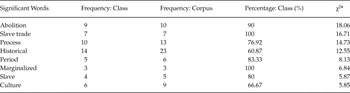
The semantic analysis of content of Class 1, which was called “Slavery”, shows the existence of an axis centered around the idea that the inequalities between Black and White people are due to slavery, which was officially abolished in Brazil in 1888. The most frequent words in this Class are abolition, which refers to the beginning of the social inequality in Brazil caused by slavery imposed on Black people in the early XVI century, and its resultant historical process that leads the Black population to live in marginal conditions in the present (Table 1).
Most relevant words to analyze the lexical discourse content of the Class “Slavery” (29 ECUs – 31.18 %)

*p < .001
In the Class 1 ECU examples (Table 2), it is observed that, for the participants, the origins of current problems of relations between Black and White people in Brazil go back to the period of slavery.
Examples of lexical discourse about the worse conditions of Black people in Brazil from the “Slavery” Class

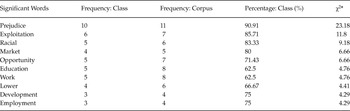
The semantic content of Class 4, called “Prejudice,” suggests that the explanation used by the participants to explain poorer living conditions of Blacks compared with Whites in Brazil is the existent prejudice against Black people in the country. Table 3 shows the frequency of words found in the discourses, where exploitation is considered the cause of the racial problem and prejudice is used as an explanation for the inequalities of opportunity in education, market, work, and employment.
Most relevant words to analyze the lexical discourse content of the Class “Prejudice” (27 ECUs – 29.03%)

*p < .001
In discourses shown in Table 4, it can be observed how prejudice appears as the reason for the limited social mobility and poorer conditions of Black people.
Examples of lexical discourse about the worse conditions of Black people in Brazil from the “Prejudice” Class

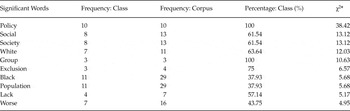
Class 2, called “Lack of Public Policy,” represents 22.58 per cent of the variability of the discursive repertoires, and demonstrates, through the frequency of terms, that the explanation used is based on the lack of public policy aimed at ensuring Black people access to their social rights, indicating that they have a worse situation in relation to White people, which is reflected in the exclusion process. Table 5 contains all the frequencies of the terms found in the discourses.
Most relevant words to analyze the lexical discourse content of the Class “Lack of Public Policy” (21 ECUs – 22.58%)

*p < .001
In this case, the discourses of this Class (Table 6) evoked the lack of effective public policy as responsible for the social differences between Blacks and Whites. This lack, according to the participants, caused the segregation and social exclusion, as explained in the following discourses.
Examples of lexical discourse about the worse conditions of Black people in Brazil from the “Lack of Public Policy” Class

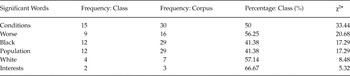
Class 3, called “Social, not racial issue,” was responsible for 17.20 per cent of the Corpus. Here it is emphasized that the differences are social, and thus, between rich and poor, moving away from explanations that emphasize race as an explanatory factor for social inequalities between Black and White people. Table 7 presents the results of the terms found.
Most relevant words to analyze the lexical discourse content of the Class “Social, Not Racial Issue” (16 ECUs – 17.20%)

*p < .001
The extracts of the discursive repertoires of this Class show that the social inequalities of Black people are not seen as a racial problem, since there are also poor White people. Thus, the existence of racial prejudice is denied which implies the impossibility of explaining Black people’s poorer conditions (Table 8).
Examples of lexical discourse about the worse conditions of Black people in Brazil from the “Social, not racial issue” Class

Summarizing those results, it is observed that only one discursive Class (Class 4 – 29.03 per cent) directly mentions prejudice to explain the socioeconomic differences experienced by Black people in present-day Brazil. There are also explanations for understanding this phenomenon as a natural consequence of the historical process of slavery (Class 1 – 31.18 per cent). Moreover, there are explanations that comprehend the issue as not being a racial problem, but a social one, between rich and poor (Class 3 – 17.20 per cent), and consequently, the responsibility to change this situation lies with government agencies, through the implementation of public policies that aim to include poor people in general and not just Black people (Class 2 – 22.58 per cent).
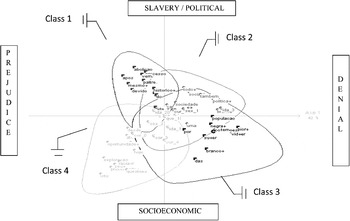
The spatial relations of the four resulting discursive Classes found are analyzed through correspondence analysis (Figure 1), which shows the latent dimensions that organize these Classes. It is assumed that the relations of approach and retraction of these Classes can be understood from the organizing axes, which would explain the contradictions of socially constructed explanations for existing inequalities between social majorities and minorities. This notion of organizing axes is very close to Doise’s (Reference Doise, Ghiglione, Bonnet and Richard1990) definition of the organizing principles of social representations.
Representations in coordinates of the Correspondence Factorial Analysis Subtitle: Class 1 (Slavery), Class 2 (Lack of public policy), Class 3 (Social, not racial issues) and Class 4 (Prejudice).

In order to analyze the way the four Classes that organize the discursive repertoires that explain the inequalities between Black and White people in Brazil interrelate (Figure 1), we begin by discussing the horizontal axis of the correspondence analysis. On the left-hand side of the figure are the two Classes that say racial prejudice existed (Class 1) or exists nowadays (Class 4). On the right hand side there are the two classes that either explicitly deny racial prejudice or consider it as a more general problem that has to be tackled by the State. Thus, Class 2 declares that the problem is the lack of public policies, meaning that, if there were a set of policies aimed at inclusion of the poor, the discrimination against Black people would end. And Class 3, which asserts that discrimination is against the poor, not against Black people. So, from this content, it is possible to affirm that the horizontal axis is organized in a continuum in which, at one end the existence of racial prejudice in Brazil is recognized, and at the other end it is denied or considered as a broader social issue.
With regard to the organization of the vertical axis, at the top of Figure 1 are the Classes that maintain that the problem lies at the abstract level of “public policies”: Class 2 (lack of public policies) and Class 1 (slavery) emphasize that inequalities started in the past. It is an historical problem, an outcome of slavery, but the government never took action to solve the discrimination problem which is reflected in socioeconomic differences, whereas the implementation of these policies of inclusion would be a possible solution to the problem. Taken together, these classes establish a continuity between past and present social inequalities, since past inequalities based on racial prejudice and discrimination are the roots of the present situation.
Both Classes at the bottom of Figure 1 talk about present-day prejudice, although with different emphases. Thus, Class 4 says the problem is racial, and Class 3 says the problem is against poor people in general. Analyzing the logic that organizes the vertical relations of these Classes, it is observed that, at one end are the discursive repertoires that attribute the inequalities between social majorities and minorities to the historical-political sphere, and, at the other end, are the repertoires that point out that the inequalities would be the result of the conflict itself between the social majorities and minorities. Simply, sometimes this conflict would be based on racial issues and sometimes it would be based on class struggle, denominated here as a struggle between rich and poor.
Taken together, these data demonstrated that only one of the discursive Classes explicitly assumes the existence of racial prejudice in contemporary Brazil. On the other hand, only one class explicitly denies its existence. This class is in accord with the theoretical assumptions of modern racism as seen before, which appeared in the form of a denial of racism. The other two classes, although recognizing racial prejudice, consider it either as an historical problem or as an institutional one. It is important to note that it does not mean that the participants of these four classes recognize that they are prejudiced themselves. It just means that the existence of racial prejudice in Brazilian society is not denied by the vast majority of the participants.
Spanish Results
After the reduction of vocabulary, 175 terms and 139 ECUs were found. The results show a Corpus having four Classes. Class 4 corresponds to 40 per cent (36 ECUs) of the analyzed repertoires, alongside Class 1 with 35.56 per cent (32 ECUs). Next, Class 2 presents 13.33 per cent (12 ECUs), and finally, Class 3 formed 11.11 per cent (10 ECUs) of the total discourses.
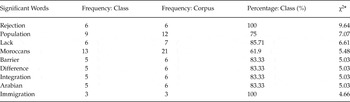
Analysis of the terms in Class 4, called “Reaction to the culture”, shows that the existence of the idea that Moroccans have worse living conditions than Spaniards occurs both because of the barriers that the Moroccan immigrant people face due to the difference of their customs and because of their lack of integration into Spanish society. Moreover, they also suffer rejection because of their Arab origin (Table 9).
Most relevant words to analyze the lexical discourse content of the Class “Reaction To The Culture” (36 ECUs - 40%)

*p < .001
Therefore, the discursive explanations for the worse situation of Moroccans in this Class are due to the barriers imposed by the different culture and by the lack of integration of the Moroccans in relation to Spanish culture. Summing up, in this class, the main idea is that the Moroccans themselves are blamed for their own disadvantage because of the non-integration of their different culture (Table 10).
Examples of lexical discourse about the worse conditions of Moroccan immigrants in Spain from the “Reaction to the culture” Class

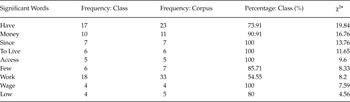
Class 1 (Table 11), called “Economic exploitation,” is responsible for 35.56 per cent of the Corpus. It shows that the explanation used by the participants to explain the worse living conditions of Moroccans in comparison to the Spanish population, overall, emphasizes the occurrence of a vigorous economic exploitation of this group. Thus, they are placed lower-skilled work, and because of this they receive lower salaries.
Most relevant words to analyze the lexical discourse content of the Class “Economic Exploitation” (32 ECUs - 35.56%)

*p < .001
In the discourses shown in Table 12 it is observed that, for the participants, the source of the poorer living conditions of Moroccan immigrants is owing to economic exploitation, which results in poorer employment opportunities and lower salaries. It is important to note, however, the ambiguous character of this exploitation, because on the one hand it is recognized that Moroccan labor is used in less skilled and lower paid jobs, but on the other hand, there is reference to the Moroccans’ own responsibility because of their low level of socio-cultural integration and lower level of qualification.
Examples of lexical discourse about the worse conditions of Moroccan immigrants in Spain from the “Economic exploitation” Class

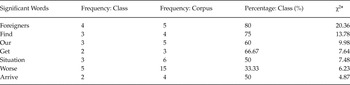
Class 2, called “Immigration”, represents 13.33 per cent of the variability of the Corpus and shows that the explanation used to explain the situation of Moroccan immigrants is due to the fact that, beginning in their homeland, they have already lived in worse conditions and so, as foreigners, cannot change the situation, as is observed in Table 13.
Most relevant words to analyze the lexical discourse content of the Class “Immigration” (12 ECUs -13.33%)

*p < .001
Thus, the discourses of this Class, presented in Table 14, deal with the condition of being a foreigner and with the economic migration process, which eventually leads immigrants to live in conditions often more precarious than their previous one.
Examples of lexical discourse about the worse conditions of Moroccan immigrants in Spain from the “Immigration” Class

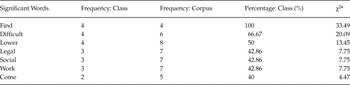
Finally, Class 3, called “Legal problems”, which represents 11.11 per cent of the variability of the Corpus, shows that legal problems are the explanation used by the participants to explain the Moroccan’s worse living conditions. For legal reasons, it is more difficult for them to get decent work, and so they live vulnerably. The most frequent terms in this Class are: to work, legal, and difficult. They are presented in Table 15.
Most relevant words to analyze the lexical discourse content of the Class “Legal Problems” (10 ECUs - 11.11%)

*p < .001
In this case, the discourses of this Class (Table 16) evoke legal problems, such as the illegal situation lived by some immigrants, to explain their conditions.
Examples of lexical discourse about the worse conditions of Moroccan immigrants in Spain from the “Legal Problems” Class

Summing up, in Spain only one discursive Class (Class 1 – 35.56 per cent) directly mentions society’s responsibility in relation to the prejudice suffered by immigrants, in recognizing that the explanations used by the participants to explain the worse Moroccan living conditions compared to the Spanish population, in general, are due to vigorous economic exploitation. However, this recognition is ambiguous because of the immigrant’s lower qualifications and the cultural distance that exists between them and the Spanish population.
The other explanations given for the Moroccan immigrant’s living conditions in Spain are based on the idea that the responsibility lies within the immigrants themselves and with the immigration process (Class 2 – 13.33 per cent). They immigrate looking for better conditions, most of the time in illegal situations, and because of this they face legal problems (Class 3 – 11.11 per cent). However, they do not integrate/adapt to the local culture and customs (Class 4 – 40 per cent), and because of this they submit to unfavorable working conditions and lower salaries. And the precarious situation they experience would be, according to the Spanish participants, a repetition of the conditions experienced in the immigrant’s homeland.
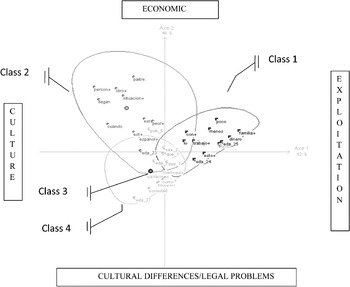
Looking at Figure 2, starting with the horizontal axis, it can be seen that in the correspondence analysis, Classes 2, 3, and 4 are on the left-hand side, and share the idea that the Moroccan immigrants’ impoverished conditions are, somehow, their own responsibility because they either fail to integrate into the new culture, or they “inherit” the same poor conditions of their home country, or live in clandestine and illegal situations, none of which help their social mobility. Thus, the discursive repertoires indicate that the reason for the existence of economic inequality is due to three issues that relate to immigrants themselves, either because they were already poor in their homeland (Class 2), or because they have not integrated into the Spanish culture (Class 4), or because they do not have the documentation to be legalized in the country (Class 3). So, it can be said that these discourses affirm the existence of discrimination, but deny the existence of xenophobia. It should be noted that the legal problem mentioned in Class 3 pervades both Classes 2 and 4: this is merely an intersection point among the three Classes. Class 1, on the right-hand side of the figure, is in opposition to these three classes, as it is the only one that asserts that the problem of inequality exists because Spanish society exploits Moroccan labor due to their low skills and cultural distance. That is, it lays the responsibility both on Spanish society and also on the Moroccans themselves. Thus, it appears that on the horizontal axis the organization of the discursive Classes places in opposition, on one side, classes that blame immigrants for their poverty, and on the other, the classes that blame Spaniards as much Moroccan immigrants for the poverty they face.
Representations in coordinates of the Correspondence Factorial Analysis Subtitles: Class 1 (Economic Exploitation), Class 2 (Immigration), Class 3 (Legal problems), and Class 4 (Reaction to the Culture).

On the vertical axis, in the upper part of Figure 2, Class 2 (immigration) and Class 1 (economic exploitation) are in opposition to Classes 4 (cultural reaction) and 3 (legal problems). Classes 1 and 2 share the idea that the origins of inequalities are economic, either because Moroccan immigrants are already poor and unskilled in their country of origin, or because they are exploited when they arrive in Spain. While Classes 4 and 3 share the idea that these origins are to be found in a more symbolic dimension, that is, the problem would lie in cultural differences or in the legal realm of citizenship, which are fundamentally, closely related items, as will be discussed later. Therefore, the organization of the vertical axis is based on the idea of conflict between the Moroccan immigrants and the native Spanish population: sometimes this conflict would be concrete, that is, occur on the economic plane, sometimes it would be a more symbolic conflict, as it would occur in terms of perceived cultural differences.
All in all, in Brazil the results give only partial support to our main assumptions, as only Class 3 explains racial inequalities in terms of economic differences between social classes. However, in the case of the Spanish sample, only in Class 4 is xenophobia mentioned, and a partial recognition of the rejection of Moroccans based on social discrimination appears, giving support to our main assumption that the differences would be generally explained in terms of symbolic and economic barriers between ethnic groups.
Discussion
The aim of this study was to investigate the role of racial prejudice and xenophobia in the discursive and interpretative repertories that are used to explain social and economic inequalities between social majorities and minorities in both Brazil and Spain.
Although the study presented here was conducted in two countries, the perspective adopted in this work does not fall under cross-cultural studies in the strict sense, inasmuch as its goal was not to compare the arguments used by participants in order to explain social inequality in each of the countries studied. But, instead, its aim was to understand how these discourses are set in each society, building contextual ways of dealing with their own issues of racism, xenophobia, and discrimination in a general way. However, this perspective does not preclude the possibility, for the purpose of trying to achieve a better understanding of the subject investigated here, of comparative analysis of the discursive processes that are similar and different in both countries.
For example, in the two samples, there are four classes of discursive repertoires that explain inequalities between social majorities and minorities. In Spain, the discursive Class that carries a greater number of explanations is the one that explicitly refers to the perception of cultural differences between Spaniards and Moroccans to explain the social inequalities between them. These differences are presented as originating from the negative social stereotypes held about the immigrant population of Moroccan origin, and on the other hand, they also appear to be explained by the lack of integration of Moroccan immigrants. The perception of cultural distance and lack of integration would lead to rejection of the Spanish population. Thus, the Moroccan immigrant is perceived as a threat for Spain’s cultural uniformity. Immigrants are accepted only if they renounce their culture - customs, religion, language - and adopt the official culture as their own. It would thus present a type of racism in contemporary Europe, contrary to the genetic racism that prevailed in the first half of the twentieth century, called cultural racism (Cea D’Ancona, 2009; Bralo & Morrison, Reference Bralo, Morrison, Guild and Van Selm2005). This would occur when the immigrant’s cultural identity is contrary to the identity of the native population, as is the case of the Moroccan immigrant in Spain, for example. This concept of cultural racism would approach the concept of subtle prejudice, proposed by Pettigrew and Meertens (Reference Pettigrew and Meertens1995).
In Brazil, the most important class is the one that refers to the historical roots of the exploitation of Black people by the White population (Class 1 – 31.18 per cent of the Corpus). On the other hand, among the Brazilian discursive repertoires, the explicit mention of prejudice appears in the second most important class (29.03 per cent). This case deals with a type of discourse that takes racial prejudice as the basis for the economic status of Black people, and would thus be the basis for social differences. Unlike what happens in Spain, this is a very clear and unambiguous discursive repertoire, not only about the role of prejudice in legitimizing inequalities, but also about the origin of its own ambivalence, since its creation is attributed to the White social majority.
Another aspect of the results that draws attention is that in Brazil the discourse that blames the social minority for its own status did not appear, while in Spain it appears in two forms: inequality is due to the poverty and the lack of formal education of the Moroccans (Class 2 – 13.33 per cent), and to the lack of documents that would make them legal workers (Class 3 – 11.11 per cent). Only in Brazil, however, does the denial of the existence of racial prejudice appear as a source of inequality. In this class (Class 3), inequality is explicitly explained by prejudice against the poor, without any racial connotation. This does not mean that there is no recognition whatsoever of racial prejudice in classes 1 and 2, but that it is done in an implicit way by recognizing the link between slavery and exploitation and the actual situation of Black people or the lack of public policies aimed at their social inclusion.
From all these results, an explanatory model that integrates the aspects that are common to both countries, and at the same time, highlights the differences between them, can be proposed. Thus, in the horizontal dimension of this model, there is a continuum that on one side pulls together the lexical repertoires that deny both racial prejudice in Brazil and xenophobia in Spain. At the other extreme of this continuum are the discursive contents that somehow recognize that racial prejudice and xenophobia currently exist. In the vertical dimension, the polarization is organized in terms of the perception of conflicts between social majorities and minorities. In Spain, this opposition ranges from a concrete and economic conflict to a more symbolic conflict, based on the perception of cultural differences. In Brazil, this dimension ranges from the conflict that emphasizes the disinterest of the political class and policy makers, to the conflict between social majorities and minorities, although, sometimes these minorities are racial ones, other times they are almost an abstraction, identified by the general term, “poor people”, without, however, distinguishing clearly who these poor would be. In short, social inequalities are explained based on arguments that do not consider racial prejudice nor xenophobia, but blur into a social conflict between rich and poor, as in the case of Brazil, or are based on perceptions of socio-cultural differences and lack of integration, as is the case of Moroccan immigrants in Spain.
Finally, this research about racial differences in the relations between social minorities and majorities widens the view adopted in traditional studies about attitudes, by pointing out that different and even contradictory explanations can be activated in response to perceived economic or cultural threats. In summary, this type of approach can offer us the possibility of investigating the principles that organize the lexical repertoires related to racial prejudice and xenophobia in different social and cultural contexts.