Introduction
The poultry industry is an important aspect of the livestock subsector in Nigeria. It is a veritable source of livelihood to the people that are engaged in egg production, incubation and hatchery services. Other people are involved in the production, distribution and installation of poultry equipment, sales of day-old chicks, broilers, layers and chicken parts. Additionally, some are merchants who sell poultry manure for arable crop production as well as those involved in poultry feed production and distribution. Although only about 10% of Nigerians are involved in poultry production, even at a predominantly subsistent level, poultry birds still outnumber all other forms of livestock in Nigeria and they are found in every human settlement throughout the country.
Recently there was a decline in the global poultry population from over 24 billion in 2003 to about 19 billion in 2011. In Nigeria, with a human population of well over 140 million people, poultry population has been estimated at 166 million, out of which only 13 million is under commercial production. Others are either on extensive or semi-intensive management system. The extensive system however predominates with few farmers adopting semi-intensive system in most of the rural areas. However, Institutional Poultry Farms and the relatively few operational commercial farms adopt intensive systems where provision of shelter, medication/vaccination, record keeping, proper feeding regimen and water supply are paramount (RIM, Reference RIM1992; FAO, Reference FAO2008).
Essentially, the success of poultry production depends on adequate feeding of quality feeds. Consequently, there are several registered commercial poultry feed manufacturers in Nigeria that are expected to meet the demands of prospective poultry farmers (Idahor and Adua, Reference IDAHOR and ADUA2010). Unfortunately, they are being accused of non compliance with the recommendations for different growth phases of poultry birds (Ayo, Reference AYO1997; Nweze, Reference NWEZE2008). Ultimately the purpose of poultry production is to convert feeds not edible by humans or surplus food resources into table eggs, chicken-meat and other by-products. Surprisingly, the so-called surplus foods are inadequate thus feed ingredients become unavailable or increasingly so expensive that most poultry farmers in Nigeria cannot afford them, resulting in low poultry productivity. This phenomenon will obviously lead to continuous competition for feed/food ingredients between the poultry industry and the human population. Therefore to drastically reduce this problem, several researchers have suggested the utilisation of alternative feedstuffs in poultry nutrition (Agiang et al., Reference AGIANG, AYUK, NWELLE and UZEGBU2004; Aletor, Reference ALETOR2007; Idahor et al., Reference IDAHOR, YAKUBU, GWAZA, AYDEN, ADEBAYO and ADAGYO2011a; Olomu, Reference OLOMU2011).
Even with this suggestion there seems to be much more information about conventional poultry feed ingredients than the suggested alternative feed resources in Nigeria. Against this backdrop, the present review was targeted at the potentials, problems and prospects of alternative feedstuff utilisation in the Nigerian poultry industry.
Conventional feedstuffs utilised in poultry nutrition
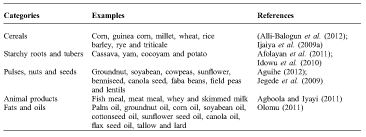
According to Olomu (Reference OLOMU2011), conventional feedstuffs can conveniently be classified into the following categories shown in Table 1.
Conventional feedstuff classes utilized in the Nigerian poultry industry.
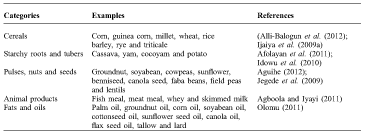
Aduku (Reference ADUKU1993) determined the chemical composition of these feedstuffs and discovered that the values were within the nutritional requirements reported for all categories of poultry and thus recommended their utilisation in poultry nutrition. Meanwhile these categories of feedstuffs being utilised in the poultry industry are supposedly human foods but are diverted to poultry feed especially during bumper harvests in Nigeria (Abubakar et al., Reference ABUBAKAR, BASHAR and EGUKE2006; Ojewola et al., Reference OJEWOLA, UMOZURIKE and AKINMUTIMI2007; Mosobalaje and Tewe, Reference MOSOBALAJE and TEWE2009). This has come about because of lack of storage and processing facilities in Nigeria. Otherwise, these food commodities would have been processed, preserved and made available for the human population all-year-round with value-addition.
Alternative feedstuff utilisation in poultry nutrition
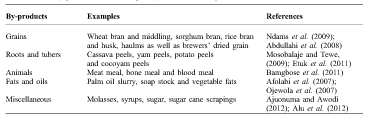
The effect of this food diversion was not likely felt in Nigeria until the population explosion in recent times, coupled with worldwide climate change. To mitigate this threat to food crises in the recent past, the following alternative feedstuffs presented in Table 2 were utilised in the Nigerian poultry industry.
Food by-products utilized in poultry nutrition in Nigeria.
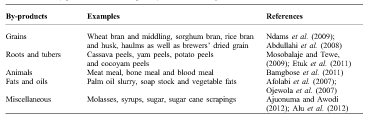
The chemical compositions of these by-products were reported to be adequate for poultry production, but only as supplements (Lawal et al., Reference LAWAL, IYAYI, ADENIYI, ADARAMOYE, ADEREM and ALABI2007; Ndams et al., Reference NDAMS, TEGBE and OGUNDIPE2009). However, some of these alternative feedstuffs have since been discovered to be unsuitable due to the levels of anti-nutritional constituents they contain, their risk of rancidity and mycotoxin contamination. Physical processing techniques have been reported not to be feasible in removing these toxic factors (Obun and Anyanwale, Reference OBUN and AYANWALE2007; Idahor et al., Reference IDAHOR, YAKUBU, EGAHI and AYA2011b).
Novel alternative feedstuffs utilised in poultry nutrition
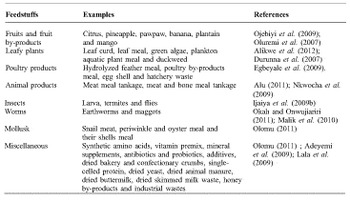
While finding solutions more recently to the threats of poultry toxicity and residual health hazards in humans, some researchers have discovered novel feed resources (Table 3) that could be utilised in poultry production with little or no risk of toxicities (FAO, Reference FAO1988; Reference FAO1999).
Novel alternative feed resources in poultry nutrition in Nigeria.

Inclusion levels of alternative feedstuffs in poultry nutrition
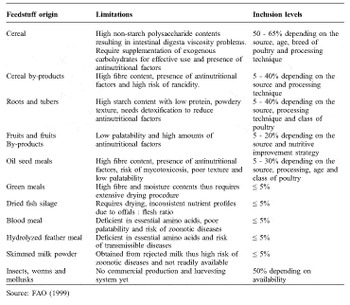
With the discoveries of alternative feedstuffs and their possible safe utilisation in poultry production, researchers and other stakeholders have hope to solve the issue of food- and feed- competition between man and livestock. High inclusion levels of about 65% as reported by FAO (Reference FAO1999) further strengthen the hope for successful utilisation. However there are limitations primarily attributed to the high amount of anti-nutritional constituents and physicochemical factors, that could limit their efficient utilisation as shown in Table 4 which has been reported.
Limitations to the utilisation of alternative feedstuffs in poultry nutrition.

Source: FAO (Reference FAO1999)
Potential of alternative feedstuffs in poultry production
Despite the seemingly high amount of anti-nutritional constituents, unwholesomeness, and physicochemical characteristics of some of these alternative feedstuffs, particularly the novel resources, they have been reported to be invaluable sources of high quality nutrients, pigments, vitamins and minerals (FAO Reference FAO1999; Abdullahi et al., Reference ABDULLAHI, OYAWOYE and DOMA2008; Olomu, Reference OLOMU2011). Subsequently their utilisation in poultry nutrition may not cause deleterious effects on the optimal physiological performances of poultry birds. More importantly, they may not require further extensive processing before feeding, thus cutting down the total cost of production. Additionally they are relatively inexpensive and seem to be readily available in most populated regions, particularly in industrialised areas (Muhammad et al., Reference MUHAMMAD, MAIGANDI, HASSAN and DANEJI2007; Onigemo et al., Reference ONIGEMO, AGBALAYA, TIJANI, ASAFA, ANJOLA, F.P., SHABI and AKINTUNDE2012). As a result, the poultry industry may no longer need to compete with the human population for foodstuffs. For example, fruits and fruit by-products are available all-year-round particularly in the middle zone of Nigeria. In addition, every region is covered with different strata of vegetative canopies and most of the water bodies have huge populations of plankton and aquatic plants (Oluremi et al., Reference OLUREMI, NGI and ANDREW2007; Olomu, Reference OLOMU2011).
According to Ravindran and Blair (Reference RAVINDRAN and BLAIR1993), the edible flesh of most types of fish represents only 40% of their total weight hence 60% would be available for use as poultry feed resources. Therefore, in the Niger, Delta and other areas with rivers where there are fishing operations, unsold fish, fish wastes and offal would be readily available for poultry feeding. More importantly, there are poultry farms, hatcheries and abattoirs well distributed all over the country. This would make available many metric tons of poultry feed ingredients from animal waste turnover all-year-round (Aduku and Olukosi, Reference ADUKU and OLUKOSI1990). Additionally, insects, which could be a cheaper protein source, are already part of the natural diets for scavenging indigenous breeds of fowl. They are very rich in crude protein ranging from 40–75% (Sonaiya, Reference SONAIYA2009). Worms, especially earthworms, are abundant in the rainforest areas of Nigeria and the FAO (Reference FAO1988) reported that they are easy to produce and harvest using animal manure. Molluscan species, such as the African giant snail, periwinkle and oyster, are common in Nigeria. In fact, the African snail, which is most abundant during the wet season, is often regarded as a major garden pest in some areas (Bright Reference BRIGHT1996; Hamzat, Reference HAMZAT2004).
Nigerian industries and factories now produce synthetic amino acids, vitamin and mineral premixes, antibiotics, probiotics, bakery and confectionary crumbs as well as milk products (Olomu, Reference OLOMU2011; Amakiri et al., Reference AMAKIRI, OWEN and ONWUMERE2012; Ogunwole et al., Reference OGUNWOLE, KOLADE, OLUMIDE and OIKEH2012). Interestingly, many agriculturally allied companies authorised to process grains, root crops and tubers produced in large tonnages, are now domiciled in every farm settlement in Nigeria. More recently, a number of milk, fat, edible oil processors and other cottage industries have been licensed to operate at full capacity following thorough assessment. Above all, there is potential for employment, self-reliance and economic growth that may facilitate the achievement of vision 20: 2020 in Nigeria if alternative feedstuffs are adopted in poultry productivity.
Problems of alternative feedstuff utilisation in poultry
Irrespective of the seemingly potential suitability of alternative feedstuff utilisation in poultry, there are some problems that can be classified into nutritional, technical and socio-economic issues.
nutritional problems
There are little or no analyses of nutrient availability for feed alternatives, and where there are, the values are not consistent. This may limit their use or cause inadequate inclusion levels. Additionally, the fibre contents may be so high that birds may not be able to optimally utilise them. Of greater concern is the presence of anti-nutritional factors which may warrant the need for extensive processing and nutrient supplementation resulting in an added cost of production (Bruneton, Reference BRUNETON1999; D'Mello, Reference D'MELLO2000).
technical problems
Some of these alternative feedstuffs may not be available all-year-round, resulting in an inconsistent supply that may force farmers to resort to conventional feedstuffs. Since some of these alternative feedstuffs are bulky with peculiar physical features, they may require extensive processing procedures which some farmers may not be able to conduct, resulting in limited utilisation (Sogunle et al., Reference SOGUNLE, OWOLABI, OLANIYI and FANIMO2010).
socio-economic problems
In some cases, ignorance of the potentials of these alternative feedstuffs has limited their utilisation in poultry nutrition. Where there is awareness, the poor prices relative to other arable crops could discourage the involvement of most people in producing such feed ingredients. Worse still, where processing is required, more costs are incurred which may not commensurate with the cost per gram of energy, protein or other nutrients sources in conventional feedstuffs (Sonaiya, Reference SONAIYA2009).
Prospects of alternative feedstuff utilisation in poultry
Besides the numerous limitations to the utilisation of alternative feedstuffs in poultry nutrition, there is future hope of their benefits. Firstly, there seems to be more recent and useful information on their nutritional composition (Aduku, Reference ADUKU1993; FAO, Reference FAO1999; Aletor, Reference ALETOR2007; Oluremi et al., Reference OLUREMI, NGI and ANDREW2007; Olomu, Reference OLOMU2011). In addition, the Nigerian Tertiary Education Trust Fund (TETFUND) now supports scientific research and journal publications. This will undoubtedly help to standardise local poultry research and the documentation of findings. More importantly, there is an increased hope that, with the use of enzymes to improve their nutritional quality, most of the anti-nutritional factors present are below threshold levels (Idahor et al., Reference IDAHOR, YAKUBU and AYA2010; Olomu, Reference OLOMU2011). The abundant sunshine in Nigeria could facilitate prompt drying with minimal cost, since sun drying has been reported to drastically reduce some of the anti-nutritional factors below threshold levels that cause problems in poultry nutrition (Tewe et al., Reference TEWE, JOB, LOOSLI and OYENUGA1976; D'Mello, Reference D'MELLO2000).
Secondly, some of these alternative feedstuffs could be processed and preserved with little or no extra cost during bumper harvest to ensure all-year-round supply. Essentially, during processing the physical features are modified to reduce bulkiness and moisture content which will improve palatability resulting in more value being added at little or no extra cost.
Finally, the efforts of the Animal Science Association of Nigeria, Nigerian Institute of Animal Scientists and other stakeholders are used to create awareness by organising orientation programs. It is hoped there will be more engagement of business minded citizens to produce these very important feedstuffs that will fast-track animal agriculture in a challenged economy. Additionally, this may be possible through the help of the government, with the present ministry's efforts to transform the poultry subsector through:
• government/private partnerships to provide funds for strategic breeding programs involving grandparent stocks and parent stocks, where more poultry hybrids will be developed
• exploitation of the indigenous Nigerian layer hybrids (Shika strains) for more hatchable and table eggs to meet demand
• increased local production of alternative nutrient sources from unconventional feed ingredients to eradicate competition for feed- and food-stuff between the poultry industry and the human population
• effective disease control and biosecurity intervention programs to reduce mortality rate
• introduction of small-scale processing, storage and market outlets to ensure products availability with little or no wastage and through the exportation of domestic day-old-chicks, hatchable (fertilised) eggs, table (unfertilised) eggs, frozen chickens and other processed chicken products that will boost the Gross National Product (Adeyemo and Onikoyi, Reference ADEYEMO and ONIKOYI2012).
Conclusions
The poultry industry remains a veritable source of livelihood in Nigeria, but poor availability of feed ingredients is a major factor contributing to the low productivity. Hence, the need for alternative feed resource utilisation in poultry production is required to end the competition with the human population for foodstuffs. Fortunately, the scientific community has provided useful work on the availability and safe utilisation of these feed resources, especially novel materials. Consequently, the adoption of alternative feed resources in poultry nutrition will be a sure way to achieve the strategic plans on sustainable animal production for national food security and poverty alleviation.