Introduction
Congenital Heart Defect (CHD) is a broad term for a diverse group of structural abnormalities of the heart and great vessels, affecting normal gross cardiac function and circulation. They are present since birth and are amongst the leading causes of infant morbidity and mortality worldwide. Reference Varela-Chinchilla, Sánchez-Mejía and Trinidad-Calderón1 CHDs range from simple to moderate to complex forms affecting the patient’s survival, childhood complications, and prognosis. Reference Mullen, Zhang, Lui, Romfh, Rhee and Wu2 In India, the birth prevalence of CHD is 9/1000 live births, with approximately 2,40,000 children annually born with this. Out of these, one-fifth of serious defects require intervention in the first year of life. Reference Saxena3
The heart is the first organ to form in the developing embryo, and a recognisable heart structure emerges by the 3rd week of gestation. This is followed by complex morphological restructuring to establish a four-chambered heart by the 7th week post conception Reference Combémorel, Cavell and Tyser4 . CHD has a complex aetiology, with intricate gene–environment interactions playing a major role in its development. Reference Joshi, Chellappan and Kukshal5 Several prenatal maternal conditions or exposures are associated with an augmented risk of CHD in the offspring. Reference Mullen, Zhang, Lui, Romfh, Rhee and Wu2 Multiple risk factors resulting in abnormal heart development in early embryonic life include lack of adequate dietary supplements, maternal ill health, exposure to environmental pollutants, substance abuse, consanguinity, rising use of artificial reproductive technology (ART) due to increased age for conception and genetics Reference Abqari, Gupta and Shahab6–Reference Boyd, McMullen, Beqaj and Kalfa8 (Figure 1a).
(a ) Aetiological factors in CHD. ( b ) Socioeconomic Stressors impacting life and health.

Socioeconomic status, indicating social class or position of individuals and families, invariably influences the health outcome, with low socioeconomic status linked with decreased life expectancy Reference Barakat and Konstantinidis9 . Socioeconomic status is a crucial indicator of a family’s wellbeing. Individuals’ physiological well-being and health-related quality of life independently determine their socioeconomic status. Reference Saleem and Jan10 Socioeconomic status is determined mainly based on the education, occupation, and income of the individual. Reference Barakat and Konstantinidis9 Low socioeconomic status has been shown to be associated with growing multimorbidity and the coexistence of two or more disease states. Reference Kivimäki, Batty and Pentti11 Several factors which grossly determine the distribution and availability of resources are invariably linked with the overall quality of life of the individual and families (Figure 1b). Early detection of CHD is crucial for optimal clinical outcomes, yet socioeconomic disparities contribute to significant delays in diagnosis. India is progressing to alleviate poverty, as reflected in the World Bank’s Poverty and Equity Brief, indicating India’s extreme poverty rate (measured at $2.15 per person per day) decreased from 16.2% in 2011–12 to 2.3% in 2022–23. Yet, there is a large proportion of the population in India that resides in rural areas. In developing economies like India, where a significant proportion of the population remains underprivileged, these families experience delays in detection of CHD due to financial and geographic barriers. Reference Saxena3
Several studies have indicated a strong correlation between congenital anomalies, particularly CHD, and socioeconomic status. Socioeconomic status influences maternal health, prenatal care, nutrition, and exposure to environmental risk factors, all of which contribute to fetal development. Reference Fung, Manlhiot and Naik12,Reference Agha, Glazier, Moineddin, Moore and Guttmann13 Children from lower socioeconomic status backgrounds often face higher CHD-related morbidity and mortality due to delayed diagnosis and limited access to healthcare facilities. Reference Xiang, Su and Liu14 Additionally, several adverse maternal lifestyle factors are more prevalent in socioeconomically disadvantaged populations, further elevating the risk of CHD. Reference Miao, Dunn and Wen15 In low-income families, limited maternal education and financial constraints hinder prenatal check-ups, leading to missed opportunities for early CHD detection. Reference Yu, Feng and Yang16 A meta-analysis of 33 studies concluded that lower maternal socioeconomic status is modestly associated with an increased risk of CHD in offspring. Maternal education also plays a crucial role in health awareness and healthcare utilisation. Research indicates that lower maternal educational attainment is associated with an increased risk of CHD. For instance, a study found that maternal educational attainment was negatively associated with an 11% increased risk of CHD. Reference Yu, Feng and Yang16
Many experts and scholars from India have made multiple attempts to make a universal socioeconomic status measure for rural, urban, and semi-urban areas in Indian geographies. Different socioeconomic status scales include scales from Rahudkar (1960), BG Prasad (1961), Udai Pareek (1964), Jalota (1970), Kulshrestha (1972), Kuppuswamy (1976), and Bharadwaj (2001). The Kuppuswamy scale and BG Prasad scale are living measures to assess socioeconomic condition. Reference Majumder17
The Kuppuswamy scale is based on three parameters—education, occupation, and income of the head of the family—all of which are key determinants of quality of life. It was extensively used to calculate socioeconomic status in India, Reference Javalkar, H., B.Davalagi and G.S.18 and we have used the same in the presented analysis.
While studying the multifactorial aetiology of CHD, it is crucial to understand the socioeconomic status of the CHD cohort. There is limited knowledge about the association of socioeconomic status and CHD in children. Towards this, this study aims to explore any potential association between socioeconomic status and CHD, thereby contributing to a more holistic understanding of the factors influencing its occurrence.
Materials and methods
This is an observational retrospective study conducted at Sri Sathya Sai Sanjeevani Research Foundation, Kharghar, Navi Mumbai. The hospital is a tertiary paediatric cardiac care centre providing complete healthcare totally free of cost to patients affected with CHD. The study included analysis on n = 2409 patient health records from the OutPatient Department (OPD) at Sri Sathya Sai Sanjeevani Centre for Child Heart Care & Training in Pediatric Cardiac Skills.
This study was approved by the Institutional Ethics Committee-Sri Sathya Sai Sanjeevani Centre, Kharghar IEC, and consent waiver was granted by IEC for this retrospective analysis.
Detailed multifactorial patient information was collected in OPD for each patient as a part of case history, and self-reported data from families was stored in the institutional database. The Study data were collected and managed using REDCap electronic data capture tools hosted at Sri Sathya Sai Sanjeevani Research Foundation, Kharghar, Navi Mumbai. Reference Harris, Taylor, Thielke, Payne, Gonzalez and Conde19,Reference Harris, Taylor and Minor20 REDCap (Research Electronic Data Capture) is a secure, web-based software platform designed to support data capture for research studies, providing an intuitive interface for validated data capture, audit trails for tracking data manipulation and export procedures, automated export procedures for seamless data downloads to common statistical packages and procedures for data integration and interoperability with external sources. Reference Harris, Taylor, Thielke, Payne, Gonzalez and Conde19, Reference Harris, Taylor and Minor20 CHD evaluation and classification were based on reports of physical examination and echocardiography (ECHO) in the OPD preoperatively. Project-specific data available for this analysis included parental education, income, occupation, and family circumstances—encompassing background (rural/urban) and family structure (joint or nuclear). Health records of patients in the OPD in the period June 2022–May 2023 were considered for this study.
Statistical analysis
Data analysis and visualisation were performed using Microsoft Excel and Python. Socioeconomic class was calculated using the Modified Kuppuswamy socioeconomic scale. This scale uses three index parameters, namely occupation, income, and education. Each of these parameters has subgroups with a score. Based on the overall score, 3–29 families are divided into five categories: upper, upper-middle, lower-middle, upper-lower, and lower socioeconomic classes.
The association between various demographic and socioeconomic factors (e.g., categorical variables like socioeconomic status, geographic location, maternal education level) and CHD was assessed using Pearson’s chi-Square test, Fisher’s test and odds ratios (OR). Counts of sociodemographic variables were summarised proportions. P-value < 0.05 was considered statistically significant.
Results
The study included health records from N = 2409 participants. After removing incomplete or missing records, final analysis was performed on n = 2064, with 1760 CHD cases and 304 controls, which were the patients diagnosed to have structurally normal hearts, hence no CHD.
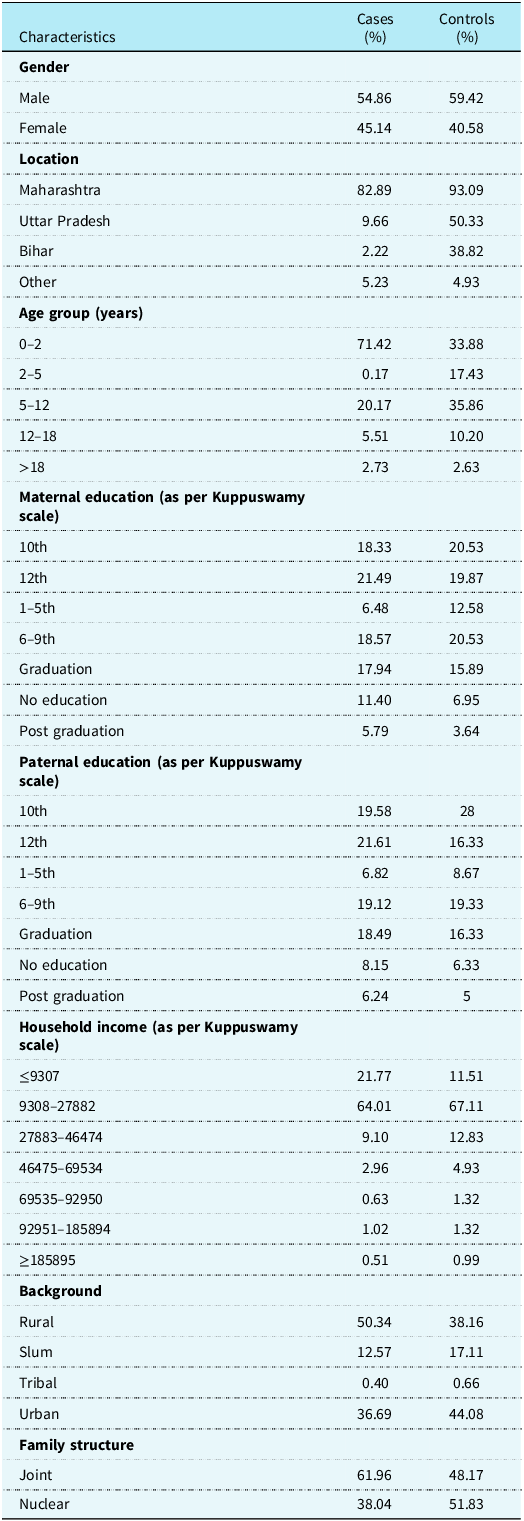
Age and gender distribution and other demographic features of patients are summerised in Table 1. In both cases and controls, the proportion of males and females was comparable, as confirmed by the chi-square test (χ2 = 2.6, p = 0.11).
Sociodemographic features of the subjects

Cases were further divided into cyanotic and acyanotic CHDs based on clinical reports (Figure 2a–2c). The majority of cases (50.34%) belonged to rural backgrounds, whereas the majority of controls belonged to urban setups (44.08%). A total of 61.96% of cases resided in joint families, whereas the majority of controls (51.83%) were from nuclear family backgrounds. Education was classified into six categories: illiterate, 1st–5th grade, 6th–9th grade, up to 10th, up to 12th, graduation, and post-graduation. For the analysis of maternal education, these were further grouped into four categories—no education, primary (1st–5th grade), secondary (6th–9th grade), and higher education—in accordance with education patterns in India. Illiteracy in mothers (11.4%) was more than in fathers (8.15%) among CHD cases (Z = 3.23, p = 0.0012), but not in controls (Z = 0.31, p = 0.76).
Case classification and SES distribution.

Analysis of socioeconomic status using the Kuppuswamy scale showed that, in both cases and controls, the majority (55.83% and 50.33%, respectively) belonged to the upper lower class, followed by the lower middle class (36.73% and 38.82%, respectively) (Figure 2d). There was no significant difference between socioeconomic status and CHD (p = 0.18).
More number of CHD cases were found in patients with rural backgrounds (χ2 = 16.09, p = 0.0011). It was observed that children from rural areas have higher odds compared to slum (OR = 1.8) and urban (OR = 1.59) areas.
There was a significant association between maternal education and CHD status (χ2 = 20.9, p = 0.0001). The OR = 3.18 suggests that mothers with no education are more likely to have children with CHD compared to mothers who have received primary education. Also, the chi-square test revealed a significant association between family type (joint vs. nuclear) and CHD status (χ2 = 19.75, p < 0.001). The odds ratio (OR = 1.75) indicates that individuals in the Joint group had higher odds of being CHD cases compared to those in the Nuclear group.
Discussion
The presented analysis mainly focused on socioeconomic status in the CHD cohort from India while exploring factors like maternal education, geographical location or background, and family type. The findings curiously disprove the role of socioeconomic status in the occurrence of CHD but emphasise the importance of educational disparities in CHD outcomes and the contribution of family structure in shaping the birth outcome. The burden and timely management of CHD are influenced not only by clinical factors but also by socioeconomic determinants. As a major determinant of health outcomes, socioeconomic status represents the individual’s or group’s position or social class within the societal hierarchy. Reference Peyvandi and Rollins21 It is measured based on income, education and occupation. Reference Arpey, Gaglioti and Rosenbaum22 Few reports state that socioeconomic status affects the health conditions and accessibility to services.
The observed lack of association between the upper lower class and CHD may be attributed to some key factors. This analysis is based on health records available at a completely free tertiary paediatric cardiac centre which inherently reduced financial barriers to healthcare. While free healthcare services facilitate equitable access to diagnosis and treatment across socioeconomic strata, it is speculated that they are more likely to attract individuals from lower socioeconomic backgrounds, as those from higher socioeconomic status groups may afford or have access to alternative healthcare facilities. Given the referral nature of our tertiary care centre, the majority of patients—primarily from the lower socioeconomic strata—have been directed here after initial consultations from medical professionals at peripheral or local healthcare facilities. But this also entails that both cases and controls in our dataset are drawn from a population with similar socioeconomic backgrounds. Research has shown that financial barriers contribute to delays in CHD diagnosis and treatment, particularly in low-income populations Reference Saleem and Jan10 This may adequately explain the under-representation of individuals from lower socioeconomic status class in our data despite free medical care and reflects challenges faced by patient families such as very limited access to medical care due to extreme financial conditions, inadequate transportation, delayed diagnosis, low health awareness, resultant higher childhood mortality and cultural hindrances.
Despite the availability of accessible, quality healthcare at the Sanjeevani Centre, the predominance of individuals from the upper-lower socioeconomic class in this dataset may be better understood from an alternative perspective. Individuals from socioeconomically disadvantaged backgrounds often reside in areas with inadequate healthcare infrastructure, further exacerbating health inequities. Families with lower incomes afford to reside in areas with higher exposure to various types of pollution, lesser green belts, recurrent infections, and more health hazards Reference Mullen, Zhang, Lui, Romfh, Rhee and Wu2,Reference Miao, Dunn and Wen15 apart from poor quality of food and multifactorial daily stress, in order to cope with adverse financial conditions. Recent research lends further support to our statements here through a report on a positive association of maternal income, lower educational level, poverty and unemployment status with CHD. Reference Miao, Dunn and Wen15
One of the key findings of our study was the significant association between geographic location and CHD prevalence. Individuals from rural areas had higher odds of CHD compared to those from urban (OR = 1.59) and slum (OR = 1.8) (p = 0.0011). This is consistent with previous studies indicating that rural populations face greater challenges in accessing specialised paediatric cardiac care, leading to delayed diagnosis and poorer outcomes. Reference Saxena3 Limited healthcare infrastructure in rural areas means that many expectant mothers do not have access to regular prenatal check-ups or fetal echocardiography, which are crucial for the early detection of CHD. Geographic disparities also contribute to differences in healthcare-seeking behaviours. Families in rural areas may prioritise traditional medicine or home remedies over formal medical interventions due to cultural beliefs or financial constraints. Reference Saleem and Jan10 The primary sources of indoor air pollution in rural areas include residential biomass burning, such as wood, crop residue and cow dung. Studies have found that exposure to fine particulate matter (PM2.5) is nearly equal in rural and urban areas. Reference Sharma and Jain23 Another study shows that pregnant women using biomass fuel had significantly elevated levels of fractional exhaled nitric oxide compared to those using LPG (25.4 ppb vs. 8.6 ppb; p = 0.001), indicating heightened airway inflammation due to household air pollution. This study reported that biomass fuel users showed markedly higher respiratory symptom burden with mean SGRQ-C composite scores of 27.1 vs. 10.8 in LPG users (p < 0.001) and MRC Dyspnoea Scale scores of 2.9 vs. 0.5 (p < 0.001), reflecting significantly impaired respiratory function and quality of life during pregnancy. Reference Parikh, Rao, Kukde, O’connor, Patel and Hibberd24 Prenatal maternal exposure to air pollution and resultant higher CHD in offspring has been well reported in literature before. A meta-analysis of 10 epidemiologic studies found that maternal exposure to ambient air pollutants—specifically NO2, SO2, and PM10—was significantly associated with increased risks of CHD such as coarctation of the aorta (OR per 10 ppb NO2 = 1.17; SO2 = 1.07), tetralogy of Fallot (NO2 = 1.20; SO2 = 1.03), and atrial septal defects (OR per 10 µg/m3 PM10 = 1.14). Reference Vrijheid, Dolk, Stone, Abramsky, Alberman and Scott25
Rural regions in India often experience significant soil pollution due to the excessive use of chemical fertilisers and pesticides in agriculture, leading to contamination that surpasses levels typically found in urban areas. Reference Saha, Selladurai, Coumar, Dotaniya, Kundu and Patra26 Water sources in rural India too may be frequently contaminated by agricultural runoff, inadequate sanitation and open defecation, resulting in higher levels of water pollution compared to urban regions where municipal water quality controls are well established. Reference Reddy and Behera27
In our analysis, an association was seen between family structure and CHD prevalence. Children from joint families had 1.75 times higher odds of being diagnosed with CHD compared to those from nuclear families (p < 0.001). One possible explanation is that financial decision-making in larger, joint families may not prioritise maternal and child health as effectively as in nuclear households, where healthcare decisions are often more direct and independent. In extended families, financial resources are shared among multiple dependents, which may lead to constraints in accessing specialised healthcare for affected children. Reference Majumder17 In joint patrilocal households in rural India, children of lower-ranking mothers (e.g., wives of younger brothers) face significantly higher neonatal mortality and stunted growth, likely due to unequal maternal nutrition and intrahousehold hierarchy. Reference Coffey, Khera and Spear28
Maternal education emerged as one of the critical determinants of CHD in our study, with a highly significant association observed (p = 0.0001). Mothers with no formal education were more likely to have children with CHD compared to those with some level of education (OR = 0.58). This finding aligns with previous research suggesting that maternal education is a strong predictor of child health outcomes, including the risk of congenital anomalies. Reference Miao, Dunn and Wen15 Education plays a fundamental role in shaping maternal health behaviours, including appropriate prenatal care, dietary practices, and awareness of risk factors that may contribute to fetal cardiac development. Lower maternal educational attainment has been linked to delayed initiation of antenatal care, reduced knowledge of teratogenic exposures, and higher rates of maternal malnutrition, all of which are associated with an increased risk of abnormal embryonic development. Reference Boyd, McMullen, Beqaj and Kalfa8 Prenatal or immediate postnatal diagnosis is the key to significantly bringing down the morbidity and mortality associated with CHD. Reference Greenwell, Deng, Ross, Weixler and Vervoort29 Achieving this relies heavily on improving maternal education, which enhances awareness and vigilance regarding early signs and symptoms of CHD and the importance of timely medical evaluation. A meta-analysis of 33 studies involving over 50,000 cases found that lower maternal socioeconomic status was modestly associated with increased risk of CHD, with maternal education (RR = 1.11), low income (RR = 1.05), and low occupational status (RR = 1.51) each contributing to elevated CHD risk. Reference Yu, Feng and Yang16 This reinforces the notion that investing in maternal education could lead to better prenatal health awareness and ultimately reduce the incidence of CHD.
Our study findings reinforce the urgent need for socioeconomic-sensitive public health interventions aimed at reducing CHD prevalence and improving early detection rates. Policymakers and healthcare providers must recognise maternal education as a pivotal factor in child health and implement programmes that promote maternal literacy, particularly in low-income and rural communities. Government programmes should expand free or subsidised maternal healthcare services, particularly in rural and low-income areas where financial constraints often limit access to essential prenatal screenings. Strengthening healthcare infrastructure in rural areas by providing mobile health units, telemedicine services and further education to community-based healthcare workers could help bridge the gap in healthcare accessibility. Enhancing CHD awareness among expectant mothers through community outreach programmes by educating families about the importance of early CHD diagnosis and available treatment options can encourage timely medical intervention and improve long-term outcomes. Furthermore, integrating CHD screening programmes into routine maternal and child health services would facilitate earlier detection and timely intervention, particularly for high-risk populations.
This study, though it may be the first of its kind from India to comment on socioeconomic status in CHD, faces certain limitations. This analysis is limited to the Kuppuswamy scale alone, which may not capture the full spectrum of socioeconomic status dimensions, particularly in rural populations or non-urban settings. The exclusion of other validated socioeconomic status measures may therefore restrict the generalisability and depth of socioeconomic assessment in this cohort. Nevertheless, while there is no universally accepted gold standard for socioeconomic status assessment, the present analysis offers valuable insights into the socioeconomic distribution within a CHD cohort from India. Reference Xiang, Su and Liu14 Additionally, the dataset lacks information on migration status or immigrant background, which could further influence healthcare access, continuity of care, and socioeconomic status categorisation—particularly in mobile or underserved populations. Thirdly, the study lacks a population-based control group, which constrains the ability to draw robust conclusions with adequate statistical power. Also, workers in labour or informal work sectors do not have a stable or documented income, making socioeconomic status categorisation inherently dynamic.
Despite these limitations, this study has several noteworthy strengths. This study presents one of the first comprehensive efforts from India based on real-world clinical data from a free, high-volume tertiary paediatric cardiac centre to investigate the role of socioeconomic status in the occurrence of CHD, with a nuanced focus on maternal education, geographic location, and family structure. This study’s findings contribute valuable insights to the limited body of Indian literature on socioeconomic status and CHD and can inform the design of larger, population-based comparative studies integrating maternal health, paternal education, and intra-household decision-making patterns. The outcomes of such studies may aid policymakers in formulating targeted public health interventions aimed at improving awareness, ensuring equitable access to quality cardiac care, and enhancing early detection and timely diagnosis of CHD across diverse populations in India. Future research should expand on this foundational work by employing multi-dimensional socioeconomic status assessment tools to capture rural and occupational heterogeneity more effectively.
Conclusion
Our study suggests that the association between upper-lower socioeconomic status and CHD warrants further investigation through systematic, large-scale comparative study design using population-based control data. Maternal education remains a key indicator of health awareness and can substantially aid in lowering CHD rates. While more community efforts are needed to improve healthcare accessibility for underprivileged populations, future government policies and awareness initiatives are required with a focus on educating large Indian families—particularly in rural areas—to enhance healthcare knowledge, improve maternal nutrition and increase antenatal care compliance, thereby improving birth outcomes and also facilitating timely CHD diagnosis and treatment.
Acknowledgements
We express our heartfelt gratitude to our Chairman Dr. C. Sreenivas for his constant support and encouragement. We acknowledge the IT support team at Sri Sathya Sai Sanjeevani Hospital for their contribution to data collection. Special acknowledgement to Mrs. Rupali Sawant for multifactorial data collection. We thank all the cardiology department at Sri Sathya Sai Sanjeevani Centre for Child Heart Care & Training in Pediatric Cardiac Skills, Kharghar, for guidance in data collection, support, and expertise in case classification. We acknowledge Mr. Jitendra Gawade from ACTREC for his guidance in the analysis. Our sincere gratitude to Prof. Sanjay Gupta for his expert guidance and support.
Financial support
The authors declare that no funds, grants, or other support were received during the preparation of this manuscript.
Competing interests
The author(s) declare none.
Ethical standard
The authors assert that all procedures contributing to this work comply with the ethical standards of the National Ethical Guidelines for Biomedical and Health Research Involving Human Participants, 2017, established by the Indian Council of Medical Research (ICMR) and with the Helsinki Declaration of 1975, as revised in 2008, and have been approved by the Institutional Ethics Committee—Sri Sathya Sai Sanjeevani Centre, Kharghar IEC (Registration No: EC/NEW/INST/2022/2782).
Patient consent
Consent waiver was granted by IEC considering the retrospective nature of this study.