Introduction
As many as 1% of young women develop anorexia nervosa (AN), and 1/10th as many men (Hudson, Hiripi, Pope, & Kessler, Reference Hudson, Hiripi, Pope and Kessler2007). The mortality rate among these young people is considerably elevated, and has been estimated to be 18-fold higher than that of individuals of similar age in the general population (Arcelus, Mitchell, Wales, & Nielsen, Reference Arcelus, Mitchell, Wales and Nielsen2011; Sullivan, Reference Sullivan1995). This illness is often chronic, with 30–50% of hospitalized patients requiring re-hospitalization within one year of discharge (Channon, DeSilva, Hemsley, & Perkins, Reference Channon, DeSilva, Hemsley and Perkins1989; Eckert, Halmi, Marchi, Grove, & Crosby, Reference Eckert, Halmi, Marchi, Grove and Crosby1995). AN is characterized behaviorally by maintenance of an abnormally low body weight and repetitive, ritualized behaviors to control eating. In addition to denying primary impulses (e.g., the consumption of food), individuals are often described as eschewing other pleasures (Frank et al., Reference Frank, Bailer, Henry, Drevets, Meltzer, Price and Kaye2005; Kaye, Fudge, & Paulus, Reference Kaye, Fudge and Paulus2009). For example, the lives of some Italian saints who avoided food intake as a symbol of “denial of the flesh” may reflect early cases of AN (Bell, Reference Bell1985). Psychoanalytic formulations described individuals with AN as highly self-controlled, “good girls” (Bruch, Reference Bruch1978) with perfectionist temperaments (Deep, Nagy, Weltzin, Rao, & Kaye, Reference Deep, Nagy, Weltzin, Rao and Kaye1995; Strober, Reference Strober1980). Although self-starvation is currently thought to be culturally influenced by ideals of thinness, this core behavioral manifestation of AN has been unchanged through history (Keel & Klump, Reference Keel and Klump2003). Individuals with AN make decisions that defy rational explanation—they persistently choose to restrict food intake (e.g., to avoid meals and the consumption of highly palatable food) in the interest of a potential future reward (further weight loss), even when such behavior is life-threatening.
The current study draws on advances in the understanding of decision making, specifically from the fields of psychology and behavioral economics, in an attempt to better understand the persistent maladaptive behavior characteristic of AN. Motivated behaviors often include a choice between immediate and delayed consumption of rewards. Extensive research in humans and animals has demonstrated that a delayed reward typically is not considered to be as valuable as an immediate reward of equal magnitude (Cardinal, Reference Cardinal2006; Hardisty & Weber, Reference Hardisty and Weber2009; Mazur, Reference Mazur1987). This de-valuing of a reward in the future is termed “delay discounting” or “temporal discounting.” Individuals differ in the degree to which they discount, or reduce, the value of a delayed reward. An individual's tendency to discount is stable over time (Kirby, Reference Kirby2009; Mischel, Shoda, & Rodriguez, Reference Mischel, Shoda and Rodriguez1989) and has trait-like characteristics (Odum, Reference Odum2011). Discount rates, assessed even with simple monetary choices, have meaningful behavioral correlates (Chabris, Laibson, Morris, Schuldt, & Taubinsky, Reference Chabris, Laibson, Morris, Schuldt and Taubinsky2008): greater discounting is associated with impulsive shopping, smoking, and gambling (Bickel, Odum, & Madden, Reference Bickel, Odum and Madden1999; Kirby, Reference Kirby2009), and delay of reward in preschool children has been shown to predict higher achievement in adolescence and adulthood (Ayduk et al., Reference Ayduk, Mendoza-Denton, Mischel, Downey, Peake and Rodriguez2000; Mischel et al., Reference Mischel, Shoda and Rodriguez1989). Many maladaptive health-related behaviors involve the choice of an immediate reward (e.g., cigarettes, drugs) without appropriate consideration of future rewards (i.e., health). Discounting of value has been shown to be greater in populations with substance abuse disorders (Bickel et al., Reference Bickel, Miller, Yi, Kowal, Lindquist and Pitcock2007; Kirby & Petry, Reference Kirby and Petry2004; Mackillop et al., Reference Mackillop, Amlung, Few, Ray, Sweet and Munafo2011), and other “impulsive” disorders (Madden, Francisco, Brewer, & Stein, Reference Madden, Francisco, Brewer and Stein2011). AN may be relatively unusual among behavioral disorders in that the maladaptive behavior involves foregoing the immediate reward of food in favor of a future, potential reward (further weight loss). Whether excessive self-control can contribute to psychopathology has not been explored.
Temporal discounting can be assessed by asking individuals to make a series of choices between an immediately available amount of money versus a greater amount available after some time delay. Such tasks have been extensively used in behavioral economics and decision-making research (Berns, Laibson, & Loewenstein, Reference Berns, Laibson and Loewenstein2007). The rate at which an individual reduces the value of future rewards can be mathematically modeled, allowing calculation of an individual's discount rate (Cardinal, Reference Cardinal2006). We are aware of only one study of temporal discounting among individuals with eating disorders. Davis et al. recently reported that individuals with binge eating disorder showed greater discounting compared to controls (Davis, Patte, Curtis, & Reid, Reference Davis, Patte, Curtis and Reid2010), a finding similar to studies of individuals with substance use and other impulse-control disorders (Mackillop et al., Reference Mackillop, Amlung, Few, Ray, Sweet and Munafo2011).
Based on their seemingly excessive self-control, we hypothesized that individuals with AN would show greater ability to delay reward, compared with healthy controls; that is, the tendency to discount future rewards would be less than that of healthy controls.
Method
Participants
Participants were individuals with AN or healthy controls (HC) presenting between January 2009 and June 2011 to the New York State Psychiatric Institute/Columbia University Eating Disorders Research Clinic. Eligible patients met DSM IV (APA, 2000) criteria for AN and expressed interest in participating in an inpatient treatment program. Patients who were menstruating were included, consistent with recommendations for DSM-5 (Attia & Roberto, Reference Attia and Roberto2009). HC called the clinic in response to advertisements. All participants were screened over the phone for diagnostic eligibility by experienced and trained research assistants, using a semi-structured interview. These phone assessments have been documented to be of high reliability for DSM-IV diagnoses of eating disorders, especially for AN (Sysko R, personal communication). Individuals were excluded if they had a known history of a neurological disorder or injury, history of learning or developmental disability, or reported drug or alcohol abuse in the last 6 months. HC were included if they had no current or past psychiatric illness, including any history of an eating disorder, and had a BMI in the normal range (18–25 kg/m2). Additional exclusion criteria for HC were significant medical illness, or current psychotropic medication. This study was approved by the New York State Psychiatric Institute Institutional Review Board, and all participants gave written informed consent.
Procedures
All study procedures occurred on 1 day. Height and weight were measured on a beam balance scale (Detecto, Webb City, MO). Participants were administered the Wechsler Test of Adult Reading (WTAR) (Wechsler, Reference Wechsler2001) to estimate pre-morbid IQ, a demographics questionnaire, and the Intertemporal Choice Task (Weber et al., Reference Weber, Johnson, Milch, Chang, Brodscholl and Goldstein2007).
The demographics questionnaire provided self-report information on education, employment, and household income. As the primary outcome in this study measures decision-making around monetary choices, socioeconomic status was assessed in several ways: household income, employment status, financial independence and degree of education. Household income was measured on a scale with the following categories, 1 = <$10,000, 2 = $10,000–19,999, 3 = $20,000–34,999, 4 = $35,000–49,999, 5 = $50,000–99,999, 6 = $100,000–199,999, and 7 ≥ $200,000. Employment status was categorized as unemployed, employed part time, or employed full time. Education level was assessed both as years of education and highest level of education achieved (high school or less, college degree, graduate degree). The intertemporal choice task is described below.
Intertemporal Choice Task
An intertemporal choice titration procedure was used to assess participants’ discount factor (Weber et al., Reference Weber, Johnson, Milch, Chang, Brodscholl and Goldstein2007), that is, the magnitude of reduction in the present value of a future reward. Participants were asked to choose between an amount of money (in the form of an Amazon.com gift certificate) available immediately (“smaller-sooner”) versus a larger amount offered later in time (“larger-later”). The task had real-life consequences to elicit true preferences. Participants were instructed that they had a 1 in 3 chance of receiving an actual Amazon.com gift card corresponding to their indicated preference, determined by a random draw upon completion of the task. Economists describe such compensation schemes as making the elicitation of true preferences “incentive compatible,” meaning that the task has real-life consequences. All participants were additionally compensated $10 for study participation.
The task consists of a series of binary choices in which participants indicate their preferred option in each of 13 choices, each between a smaller-sooner and a larger-later reward. In this titration procedure, the time frame is the same for each choice (now or 3 months from now) and the discount factor is derived by determining the switch-point (see below). Two sets of 13 choices were administered to each participant, resulting in a total of 26 binary choices. One set used Accelerate-framing, the other Delay-framing of the decision. In the Accelerate set, participants were instructed that they would receive a gift certificate of $80 in three months (larger-later), but that they could instead choose to receive a gift certificate for a smaller amount of money immediately (smaller-sooner); the larger-later amount was fixed while the smaller-sooner amount increased from $25 to $80 in $5 increments, resulting in a total of 13 Accelerate binary choices. In the Delay set, participants were instructed that they would receive a $45 gift certificate immediately (smaller-sooner), but that they could choose to receive a larger amount of money in 3 months (larger-later); the smaller-sooner was fixed while larger-later increased from $45 to $100 in $5 increments, resulting in a total of 13 Delay binary choices. A separate discount factor was determined for each individual for each of the two choice sets. The discount factor was derived as suggested by participants’ indifference point between smaller-sooner and larger-later, when they switched from lager-later to smaller-sooner (in the Accelerate set) or from smaller-sooner to larger-later (in the Delay set). Discount factor was calculated as δ = (x1/x2)(1/(t2−t1)) (Read, Reference Read2001; Weber et al., Reference Weber, Johnson, Milch, Chang, Brodscholl and Goldstein2007), where the amount to be received immediately was x1, and the amount to be received in 3 months was x2; and t2-t1 referred to the difference in time to receive the amount, which in this study was ¼ year. If there is no discounting, the discount factor is 1. Values closer to 0 (smaller numbers) indicate greater discounting, which can be understood as a greater tendency to choose the immediate reward. To illustrate, larger numbers such as a discount factor of 0.99, indicate that the individual assesses the delayed reward as closer to its numeric value. This procedure for assessing a discount factor is independent of hyperbolic modeling or area under the curve analyses, and has been shown to be a sensitive measure of temporal discounting (Weber et al., Reference Weber, Johnson, Milch, Chang, Brodscholl and Goldstein2007).
Data Analysis
Demographic characteristics were compared between diagnostic groups (AN vs. HC) using independent sample t tests for continuous variables (age, years of education, WTAR standardized score and BMI). Ethnicity and marital status were compared using χ2 analyses. Non-parametric tests (Mann-Whitney U test) were used to compare ordinal variables (household income, level of education, employment status, and financial independence). Clinical characteristics were compared across subtype (HC, AN-R, and AN-BP) with ANOVA for continuous variables and with Kruskall Wallis for ordinal measures.
The primary analysis was a repeated-measures ANCOVA with discount factor as the dependent variable, diagnosis (AN vs. HC) as a between-subjects variable, framing (Accelerate vs. Delay) set as within-subjects variable, and substance abuse history as a covariate. Although recent history of substance abuse (within 6 months) was an exclusion criterion, some individuals with AN had a prior history of substance abuse or dependence (n = 6). Given the known relationship between substance abuse and delay discounting (Mackillop et al., Reference Mackillop, Amlung, Few, Ray, Sweet and Munafo2011), the presence of a prior history of substance abuse or dependence was included as a covariate, and analyses were repeated excluding these individuals. In addition, repeated measures ANCOVA was used to compare the discount factor across 3 groups, with AN divided by subtype: AN, restricting (AN-R), AN, binge purge (AN-BP), and HC. Significant effects of subtype were followed by post hoc repeated measures ANCOVAs for pair-wise comparisons. Association between discount factor (Accelerate and Delay) and BMI was assessed using Pearson's correlation. Statistical tests were two-tailed with level of significance set at α = 0.05. Data analyses were conducted using SPSS version 18.0.
Results
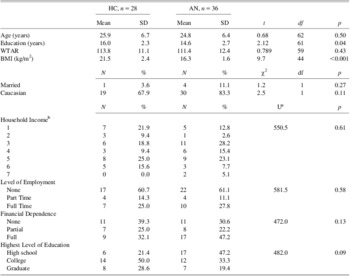
Recruitment consisted of 39 individuals with AN and 32 HC; all participants were female. Of these, 4 HC and 3 AN completed only part of the task (among HC, 2 were missing the Accelerate set and 2 were missing the Delay set; among AN, 2 were missing the Accelerate set and 1 was missing the Delay set). These individuals were not included in data analyses, thus the final sample included 36 AN and 28 HC. Clinical characteristics are described in Table 1. Six individuals were found to have a prior history of substance abuse, 3 with restricting subtype and 3 with binge-purge subtype. All participants scored within the normal range on the WTAR estimate of pre-morbid IQ. While there was no significant group difference on the WTAR standardized score, there was a significant difference between groups in years of education (see Table 1), with AN having on average fewer years of education. There was no association between years of education and discount factor in this sample (Accelerate: r(61) = 0.10; p = 0.44; Delay: r(61) = −0.01; p = 0.93). Age has been shown to be associated with discount rate (Steinberg et al., Reference Steinberg, Graham, O'Brien, Woolard, Cauffman and Banich2009), but in this sample there was no relationship between age and discount factor (Accelerate: r(62) = −0.19; p = .13; Delay: r(62) = −0.04; p = .78) and age did not differ between groups. Groups did not differ in household income, employment, financial dependence, or level of education.
Demographic and clinical characteristics of participants in a study of delay discounting in anorexia nervosa (AN) versus healthy controls (HC)

aMann Whitney U test.
bDefined as 1 = <$10,000; 2 = $10,000-19,999; 3 = $20,000-34,999; 4 = $35,000-49,999; 5 = $50,000-99,999; 6 = $100,000-199,999; and 7 = > $200,000.
Clinical and demographic characteristics were also compared across HC, AN-R and AN-BP. There were no significant differences between these three groups in age (F[2,61] = 0.73; p = .49), years of education (F[2,60] = 2.71; p = .08), or WTAR (F[2,58] = 2.97; p = .06). BMI differed significantly, as expected, (F[2,61] = 53.0; p < .001) but post hoc tests showed no difference in BMI between AN-R and AN-BP (LSD = 0.77; p = .49). Non-parametric tests showed no difference between groups in household income (χ2 = 3.1; p = .21), employment status (χ2 = 0.6; p = .74), financial dependence (χ2 = 2.1; p = .34), or level of education (χ2 = 4.8; p = .09).
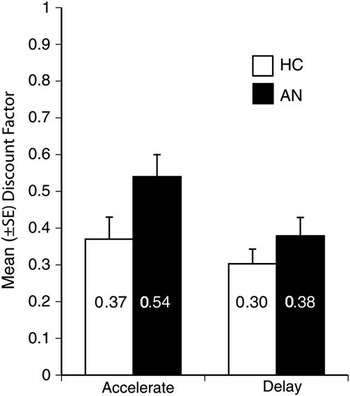
Mean discount factors are shown in Figures 1 and 2. The mean discount factor was significantly greater in AN compared to HC, indicating that the value of the reward remained closer to its numeric value for the AN group (F[1,61] = 5.03; p = .029), see Figure 1.
Individuals with anorexia nervosa (AN; n = 36) discount monetary reward less steeply than healthy comparison participants (HC; n = 28) in choices that allow them to accelerate receipt of money and in choices that allow them to delay receipt (F(1) = 5.03; p = .029). Mean discount factor was: Accelerate, HC = 0.37 ± 0.30 vs. AN = 0.54 ± 0.39; Delay, HC = 0.30 ± 0.21 vs. AN = 0.38 ± 0.30.

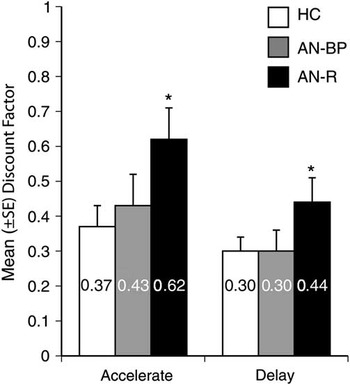
Comparing by subytpe, groups differ in delay discounting, F(2) = 3.62; p = .033. Individuals with AN, restricting subtype (AN-R; n = 21), discount the value of delayed reward significantly less than healthy controls (HC; n = 28). AN, binge purge subtype (AN-BP; n = 15) do not differ from the other groups. By subtype, mean discount factor was: Accelerate, HC = 0.37 ± 0.30 vs. AN-R = 0.62 ± 0.40 vs. AN-BP = 0.43 ± 0.36; Delay, HC = 0.30 ± 0.21 vs. AN-R = 0.44 ± 0.33 vs. AN-BP = 0.30 ± 0.24. *Significant difference between AN-R and HC (F[1,46] = 8.3; p = .006).

There was also a significant effect of framing (F[1,61] = 12.2; p = .001) and of history of substance abuse (F[1,61] = 4.40; p = .04). Delay (vs. Accelerate) framing and a history of substance abuse were each associated with greater discounting. There was no significant interaction between framing and either history of substance abuse (F[1,61] = 0.38; p = .54) or diagnosis (F[1,61] = 0.08; p = .13). A significant difference was also observed across HC, AN-R and AN-BP in mean discount factor, see Figure 2 (F[2,60] = 3.62; p = .033), with a significant effect of framing (F[1,60] = 13.6; p < .001) and no interaction effect between framing and subtype (F[2,60] = 1.22; p = 0.30) or substance abuse history (F[1,60] = 0.30; p = .59). Post hoc repeated measures ANCOVAs revealed a significant difference between AN-R and HC only (F[1,46] = 8.3; p = .006; HC v AN-BP: F[1,40] = 0.5; p = .51; AN-R v AN-BP: F[1,33] = 1.61; p = .21).
When individuals with a history of substance abuse are excluded from the sample, the significant effect of diagnosis persists (F[1,58] = 4.59; p = .04), as does the effect of subtype (F[2,57] = 3.8; p = .03).
In the full sample, there was no significant correlation between discount factor and BMI (Accelerate: r(62) = −0.07; p = .57; Delay r(62) = −0.02; p = .85). Among AN, there was a significant positive association between BMI and discount factor (Accelerate: r(34) = 0.46; p = .005; Delay r(34) = 0.43; p = .009), such that higher BMI was associated with greater tendency to choose larger-later reward.
Discussion
This study found that individuals with AN discount rewards in the future less than HC. Put simply, one dollar in 3 months was worth more for the AN group than it was for the HC group. To our knowledge, this is the first study to show less temporal discounting compared with HC in a psychiatric population. Unlike several other psychiatric populations, such as those with substance use disorders, patients with AN are prone to excessive self-control: they override the fundamental biological drive to eat and thereby maintain extremely, and dangerously, low body weights. The current results suggest that individuals with AN possess an abnormal ability to maintain the value of a reward over time, which can also be described as an ability to delay receipt of reward that may contribute to the hallmark persistent dieting behavior. While these results will require replication, this preliminary study suggests that the delay discounting construct has implications for psychopathology such that both ends of the spectrum (both impulsivity and excessive self-control) may contribute to psychiatric illness.
The significant difference in temporal discounting was largely attributable to individuals with the restricting subtype of AN. This secondary finding suggests that there may be a difference between AN subtypes such that delay of reward is a more prominent feature of restricting AN. Clinically, these individuals are often described as more “self-controlled.” Features of impulsivity, including behavior and cognitive functioning, are more commonly associated with the binge-purge subtype of AN (Waxman, Reference Waxman2009). Furthermore, rates of substance abuse are reported as more common among the binge-purge subtype, and, as noted, substance abuse is associated with greater discounting. Future studies may examine what aspects of AN-restricting subtype are most associated with this abnormal ability to delay reward.
In this sample BMI was positively correlated with discount factor among AN, such that individuals who presented with a lower BMI were more likely to have a smaller discount factor (i.e., greater devaluing of later reward). This finding is somewhat counterintuitive, both because, overall, a higher discount factor was found among AN, and because obesity has been associated with a lower discount factor (Ikeda, Kang, & Ohtake, Reference Ikeda, Kang and Ohtake2010; Weller, Cook, Avsar, & Cox, Reference Weller, Cook, Avsar and Cox2008). The relationship between BMI and discount factor among AN in this study suggests that starvation may impact temporal discounting. Among HC, temporal discounting is trait-like in that it remains generally stable over time and is associated with other phenomena (Mischel et al., Reference Mischel, Shoda and Rodriguez1989). Nonetheless, discounting is influenced by contextual factors (Peters & Buchel, Reference Peters and Buchel2011), as observed in the framing effect in this study (discussed below). As starvation is known to impact cognition among individuals with AN in other ways (Green, Elliman, Wakeling, & Rogers, Reference Green, Elliman, Wakeling and Rogers1996), and as blood glucose level has been shown to be associated with less discounting of a future reward among healthy controls (Wang & Dvorak, Reference Wang and Dvorak2010), it is possible that the acute state of starvation influences the discount factor. It may be that the individual with AN has a greater ability to delay reward—a capacity that may confer benefit in many areas of functioning. This trait is associated with dieting and low weight (Hare, Camerer, & Rangel, Reference Hare, Camerer and Rangel2009; Ikeda et al., Reference Ikeda, Kang and Ohtake2010), and may thereby contribute to illness. While underweight, starvation may influence decision making in the opposite direction, pulling the individual toward greater preference for more immediate rewards.
Framing the choices as Accelerate or Delay had a significant effect on discount factor for both groups, consistent with the findings of Weber et al. (Reference Weber, Johnson, Milch, Chang, Brodscholl and Goldstein2007), that individuals discount the future more when asked to delay the receipt of reward than when given the opportunity to accelerate the receipt of reward (Lowenstein, Reference Lowenstein1988). This phenomenon has been proposed to be mediated by the preponderance of thoughts about immediate consumption (Weber et al., Reference Weber, Johnson, Milch, Chang, Brodscholl and Goldstein2007). The presence of this finding in the AN population suggests that their general information processing is not aberrant, i.e., they show the same pattern of behavior as found in the general population. Asymmetric discounting has also been posited to reflect a difference in calculation of loss versus gain (Kahneman & Tversky, Reference Kahneman and Tversky1979). This possibility is worthy of further study in AN, and specifically AN, restricting subtype, where differences in sensitivity to loss and gain have been found in other neurocognitive studies (Wagner et al., Reference Wagner, Aizenstein, Venkatraman, Fudge, May, Mazurkewicz and Kaye2007). In the interest of obtaining a broad AN sample in this pilot study, we did not administer a full neurocognitive battery. It is, therefore, a limitation of the current study that we are not able to evaluate the presence of other cognitive deficits in this group that may have contributed to these findings. In future studies of temporal discounting, other cognitive domains will need to be assessed, as well.
In non-eating disordered populations, some probes of temporal discounting have used quantities of food as the reward, as food can be considered a “primary reward.” In general, these studies found that individuals discount food more steeply than money (McClure, Ericson, Laibson, Loewenstein, & Cohen, Reference McClure, Ericson, Laibson, Loewenstein and Cohen2007; Odum, Baumann, & Rimington, Reference Odum, Baumann and Rimington2006). One study has shown that higher percent body fat, among healthy individuals, predicts greater discounting of food (but not money) (Rasmussen, Lawyer, & Reilly, Reference Rasmussen, Lawyer and Reilly2010). Of interest, one study has demonstrated an ability to model delay discounting in food choices among self-reported dieters (Hare et al., Reference Hare, Camerer and Rangel2009). The reward properties of food in AN are likely to be very complex: among acutely ill patients it is not clear to what degree patients find food subjectively rewarding (Garfinkel, Moldofsky, & Garner, Reference Garfinkel, Moldofsky and Garner1979; Santel, Baving, Krauel, Munte, & Rotte, Reference Santel, Baving, Krauel, Munte and Rotte2006), and whether the value of food reward could be considered similar between patients and controls. Monetary delay discounting tasks are advantageous as a probe of reward functioning that measures the behavior of interest (self-control) yet bypasses the conundrum of food reward. While it is possible that individuals with AN do not assign money the same reward value as their healthy counterparts do, there is less reason for concern as the central pathology of the illness is not related to economics. The temporal discounting paradigm in this study has the advantage that choice preference does not involve learning processes, and, therefore, findings are not confounded by other cognitive abnormalities among individuals with AN (Green et al., Reference Green, Elliman, Wakeling and Rogers1996).
The investigation of delay discounting among acutely ill individuals seeking inpatient treatment is a limitation of this study. It is possible that temporal discounting was impacted by the expectation of starting treatment, and assumptions individuals may have about the utility of money received immediately versus later in the treatment process. This concern is mitigated by the finding that the restricting subtype differed from the binge-purge subtype and these groups were assessed in the same context. While there is no known association between mood and anxiety disorders and discount factor, an additional limitation is the possibility that comorbid diagnoses, which were not formally assessed among the AN group, may have contributed to the findings. Further evaluation of temporal discounting before and after treatment, or compared with other food-restricted populations, would be useful.
The current findings require replication and should be interpreted cautiously. If true, however, the increased self-control suggested by the finding of decreased temporal discounting in AN has potentially important implications. Neuroimaging studies have yielded insight into neurobiology underlying the process of decision making between immediate and delayed rewards. Converging evidence across several studies (e.g., Kable & Glimcher, Reference Kable and Glimcher2007; McClure et al., Reference McClure, Ericson, Laibson, Loewenstein and Cohen2007; McClure, Laibson, Loewenstein, & Cohen, Reference McClure, Laibson, Loewenstein and Cohen2004; for overviews, see Carter, Meyer, & Huettel, Reference Carter, Meyer and Huettel2010; Peters & Buchel, Reference Peters and Buchel2011) implicates neural structures involved in reward processing, including dopaminergic midbrain regions and their subcortical and cortical targets such as the ventral striatum and medial prefrontal cortex. In addition, brain regions commonly implicated in control processes such as the lateral prefrontal cortex have also been implicated in temporal discounting (e.g., Ballard & Knutson, Reference Ballard and Knutson2009). Most relevant to our study, a recent brain stimulation study found that transient disruption of lateral prefrontal cortex function in healthy adults resulted in reduced self-control, leading to increased choice of smaller-sooner rewards (Figner et al., Reference Figner, Knoch, Johnson, Krosch, Lisanby, Fehr and Weber2010) and thus causally implicating the lateral prefrontal cortex as crucial substrate for self-control in intertemporal choice. The behavioral finding that individuals with AN are prone to choosing the larger-later reward suggests that these individuals may have abnormal functioning in the lateral prefrontal cortex, with excessive activation of this area relative to the mesolimbic dopamine system. That this is particularly true for the patients whose pathology is limited to restrictive intake relative to caloric requirements (without binge eating or compensatory behaviors) suggests that there may be neurocognitive differences that differentiate AN by subtype. Recent studies suggest that the impulsivity characteristic of adolescence is related to the slower maturation of areas of the prefrontal cortex (that play a control role) relative to limbic sub-cortical structures (that play an emotional or motivational role) (Casey, Getz, & Galvan, Reference Casey, Getz and Galvan2008). Others have shown that impulsivity in adolescence and substance use share common mechanisms (Gladwin, Figner, Crone, & Wiers, Reference Gladwin, Figner, Crone and Wiers2011). Neuroimaging studies in AN provide support for the possibility that there is abnormal functioning in frontal regions, and hypotheses suggesting abnormal relative functioning between medial and dorsolateral frontal regions have been proposed (Kaye et al., Reference Kaye, Fudge and Paulus2009; Steinglass & Walsh, Reference Steinglass and Walsh2006). As AN commonly begins during adolescence, this neurobiological hypothesis is particularly intriguing.
Further studies of temporal discounting in AN are needed to evaluate the specificity of this finding in AN, neural systems abnormalities that may underlie the tendency to delay receipt of reward, and implications for treatment.
Acknowledgments
The authors thank Yaakov Stern, PhD, for his assistance with direction in this project and Larry Amsel, MD for his comments on the manuscript. This work was supported by the National Institute of Mental Health (JS, K23 MH076195), the United States National Science Foundation (EW, BF, SES–0922743), and the Swiss National Science Foundation (BF, PA001–15327). Dr. Walsh has received research support from AstraZeneca. Drs. Figner, Steinglass, and Weber and Staci Berkowitz report no biomedical financial interests or potential conflicts of interest. A preliminary report on these data was presented at the Annual Meeting of the Eating Disorders Research Society, Boston, MA, October 7–9, 2010.