Introduction
Access to adequate and nutritious food is a fundamental human right. According to Statistics Canada (2018: 4), ‘food insecurity exists within a household when one or more members do not have access to the variety or quantity of food that they need due to lack of money’. Recent statistics show that about 12.4 per cent of Canadian households were food insecure, an increase of 4.9 per cent since 2004 (Tarasuk et al., Reference Tarasuk, Li, Mitchell and Dachner2018). Prevalence of food insecurity is, however, not uniform across the different population sub-groups. For instance, about 3 per cent of older adult Canadians (people aged 65 and over) are food insecure (Leroux, Reference Leroux2018). In the context of these stark population-level statistics, it may be easy to overlook the food insecurity concerns of elderly people, who remain a rapidly increasing population group in Canada. In 2014, more than 6 million Canadians, representing about 16 per cent of the total population, were aged 65 or older (Statistics Canada, 2014). It is estimated that by 2040 – in about two decades – the number of seniors will increase to about 10.2 million, representing 25 per cent of the Canadian population (Statistics Canada, 2014). Life expectancy at birth for women and men is expected to increase to 86.2 and 82.9 years, respectively (Statistics Canada, 2014). The potential detrimental effects of food insecurity on health, especially for elderly people who are already vulnerable to age-related health conditions, reinforces the need to pay close attention to the food needs of elderly people. For instance, food insecurity increases the risk of obesity, stress, depression and anxiety which may further contribute to the incidence of disease (Gundersen and Ziliak, Reference Gundersen and Ziliak2015; Darling et al., Reference Darling, Fahrenkamp, Wilson, D'Auria and Sato2017; Kim et al., Reference Kim, Park and Kim2019; Tuthill et al., Reference Tuthill, Sheira, Palar, Frongillo, Wilson, Adedimeji, Merenstein, Cohen, Wentz and Adimora2019). Thus, despite being among the age cohorts with lower rates of food insecurity, older adults may be more vulnerable to the negative health effects of household food insecurity compared to other age cohorts.
Notwithstanding the implementation of dedicated national and provincial assistance programmes, food insecurity among older adults remains a major policy concern in Canada (McIntyre et al., Reference McIntyre, Dutton, Kwok and Emery2016; Leroux et al., Reference Leroux, Morrison and Rosenberg2018). Key among these government-administered plans are the Canadian Pension Plan (CPP), the Old Age Security Program (OASP) and the Guaranteed Income Supplement Program (GISP). Unlike the OASP and the GISP, the CPP is a contribution-based social programme that provides income to a contributor in the case of retirement, disability or death, such that the amount received is tied to one's contribution rate. Some researchers have argued that these programmes – which have largely maintained a poverty-alleviation approach, especially the GISP and OASP – may not be sufficient in reducing food insecurity among elderly people given that food security goes beyond purchasing power or mere availability of food to include the ability to access and utilise food effectively (Russell et al., Reference Russell, Flood, Yeatman and Mitchell2014; Ishikawa et al., Reference Ishikawa, Yokoyama, Nakaya, Fukuda, Takemi, Kusama, Yoshiike, Nozue, Yoshiba and Murayama2016; Park et al., Reference Park, Saint Ville, Schwinghamer and Melgar-Quiñonez2019). For instance, functional limitations, especially among frail older adults, may undermine their ability to either go grocery shopping and/or prepare meals even when they have the purchasing power (Ishikawa et al., Reference Ishikawa, Yokoyama, Nakaya, Fukuda, Takemi, Kusama, Yoshiike, Nozue, Yoshiba and Murayama2016). It is therefore likely that food insecurity among elderly people is a differentiated experience shaped by diverse socio-economic and demographic factors worth considering.
Previous studies have documented diverse risk factors of food insecurity among older adults. For instance, in Japan, shopping difficulty induced by physical activity restrictions was found to hinder older people's access to food (Ishikawa et al., Reference Ishikawa, Yokoyama, Nakaya, Fukuda, Takemi, Kusama, Yoshiike, Nozue, Yoshiba and Murayama2016). Russell et al. (Reference Russell, Flood, Yeatman and Mitchell2014) also found that age and gender significantly predicted food insecurity among older Australians. Women and younger seniors were more likely to be food insecure compared to men and the older old (Russell et al., Reference Russell, Flood, Yeatman and Mitchell2014). In a multi-national analysis of the determinants of food insecurity among the older population in 48 countries, Park et al. (Reference Park, Saint Ville, Schwinghamer and Melgar-Quiñonez2019) found age, living arrangement, marital status, social support and wellbeing to be significantly associated with food insecurity. In Canada, Leroux et al. (Reference Leroux, Morrison and Rosenberg2018) found strong associations between food insecurity and income, age and race. A study on the food access experiences of lone senior women in urban Nova Scotia, Canada also revealed mobility issues, physical health and availability of social networks as factors that dictate food access (Green-LaPierre et al., Reference Green-LaPierre, Williams, Glanville, Norris, Hunter and Watt2012).
Although seniors are among the age cohorts with the lowest reported rates of food insecurity in Canada, the projected increases in the older population of the country in the next few decades suggest that the number of food-insecure older adults could increase if more proactive measures are not taken. This process must begin with understanding the factors associated with food insecurity among older adults. .. Increasing scholarly attention has been paid to the prevalence and predictors of food insecurity among elderly people in Canada, including a recent analysis by Leroux et al. (Reference Leroux, Morrison and Rosenberg2018) who used the 2012 component of the Canadian Community Health Survey (CCHS). While these studies offer useful insights, the scope of determinants preclude important factors such as living arrangement, sense of community belonging, self-rated mental health and immigration status. Moreover, the phenomenon of food insecurity is not static but may evolve along with constantly evolving socio-economic and political conditions. Thus, it is only by using a current dataset and accounting for more contextual variables that we can continue to provide timely and comprehensive evidence to inform food policy. Building on previous studies, we draw data from the 2013–2014 CCHS to examine the correlates of food insecurity among elderly people.
Methods
Data
We used data from the 2013–2014 round of the CCHS. The CCHS is a nationally representative survey that uses three sampling frameworks (i.e. an area frame, a list frame and a random digit dialling frame) to obtain health information from Canadians aged 12 and older from ten provinces and three territories. The sampling frameworks excluded residents living on reserves, full-time members of the Canadian Forces and the institutionalised populations. In the 2013–2014 CCHS, the module on food insecurity was asked as an optional module at the provincial level, collecting random samples from individuals from six provinces, namely Prince Edward Island, Nova Scotia, New Brunswick, Ontario, Quebec and Alberta. Given our interest in elderly people, the sample was restricted to respondents aged 65 or older. Importantly, when we employed a listwise deletion technique, missing data accounted for more than 10 per cent. As a sensitivity analysis, we used the Markov Chain Monte Carlo method to address this concern. Based on Rubin's rules for scalar estimands (Rubin, Reference Rubin1987), we combined ten imputed datasets and averaged them to obtain mean model parameter estimates. Considering imputed results were largely consistent with results with missing data, we only showed the latter. Imputed estimates are available upon request. To this end, our sample includes 24,546 elderly people from Prince Edward Island, Nova Scotia, New Brunswick, Ontario, Quebec and Alberta. As a secondary analysis of the public use microdata from the CCHS, this study did not require any ethics review.
Dependent variable
Our dependent variable is ‘food insecurity status’. The CCHS measures food insecurity at three different levels – the household status, the adult status and the child status – using the Household Food Security Survey Module. This module assesses household food insecurity over the last 12 months based on 18 questions comprising ten adult-referenced questions (Adult Scale) and eight child-referenced questions (Child Scale) (if present). Given our focus on older adults, we used the Adult Scale. The CCHS measures adult food insecurity based on the following ten indicators: anxiety about food running out before the respondent gets money to buy more; food bought did not last and there was no money to get more; could not afford to eat balanced meals; ever cut size of meals or skipped meals; ever cut size of meals or skipped meals in three or more months; ever ate less than they felt they should; ever were hungry but did not eat; lost weight; ever did not eat for a whole day; ever did not eat for a whole day in three or more months. Based on responses to these questions, the CCHS generates three food security categories (food secure; moderately food insecure and severely food insecure). Adults are deemed ‘food secure’ if there was no or only one indication of difficulty with access to food due to insufficient income; moderately food insecure if there were two to four affirmative responses to the ten questions, an indication of compromise in the quality and/or quantity of food consumed; and severely food insecure if there were five or more affirmative responses to the ten questions for the Adult Scale, which is an indication of reduced food intake and interrupted eating patterns. While this food insecurity variable is originally ordinal in nature (i.e. severely food insecure, moderately food insecure and food secure), because the proportion of severely food-insecure old people is very small, analysing this variable with ordered logistic regression presents serious analytical challenges, especially with concomitant higher odds ratio (OR). As a result, we combined ‘severely food insecure’ and ‘moderately food insecure’ into ‘food insecure’ to generate a binary variable to capture food security status (0 = food secure; 1 = food insecure). As mentioned earlier, given our interest in understanding the food insecurity situation of older adults, we used the Adult Scale.
Independent variables
Following the literature (Russell et al., Reference Russell, Flood, Yeatman and Mitchell2014; Ishikawa et al., Reference Ishikawa, Yokoyama, Nakaya, Fukuda, Takemi, Kusama, Yoshiike, Nozue, Yoshiba and Murayama2016; Leroux et al., Reference Leroux, Morrison and Rosenberg2018; Park et al., Reference Park, Saint Ville, Schwinghamer and Melgar-Quiñonez2019), we included a range of relevant demographic, socio-economic and health-related variables. For demographic variables, we considered age of respondents (0 = 80 years or older; 1 = 75–79 years; 2 = 70–74 years; 3 = 65–69 years), visible minority status (0 = not visible minority; 1 = visible minority), immigration status (0 = native-born; 1 = immigrant), gender (0 = male; 1 = female) and province of residence (0 = Ontario; 1 = Prince Edward Island; 2 = New Brunswick; 3 = Quebec; 4 = Saskatchewan; 5 = Alberta). Socio-economic variables included level of education (0 = post-secondary education; 1 = some post-secondary education; 2 = secondary education; 3 = less than secondary education), household income (0 = Can $80,000 or more; 1 = $60,000–79,999; 2 = $40,000–59,999; 3 = $20,000–39,999; 4 = less than $20,000), employment status (0 = employed; 1 = unemployed), living arrangement (0 = spouse; 1 = alone; 2 = other), and sense of community belonging (0 = very strong; 1 = somewhat strong; 2 = somewhat weak; 3 = very weak). Finally, we included self-rated health and mental health (0 = good; 1 = poor) as two health variables.
Statistical analysis
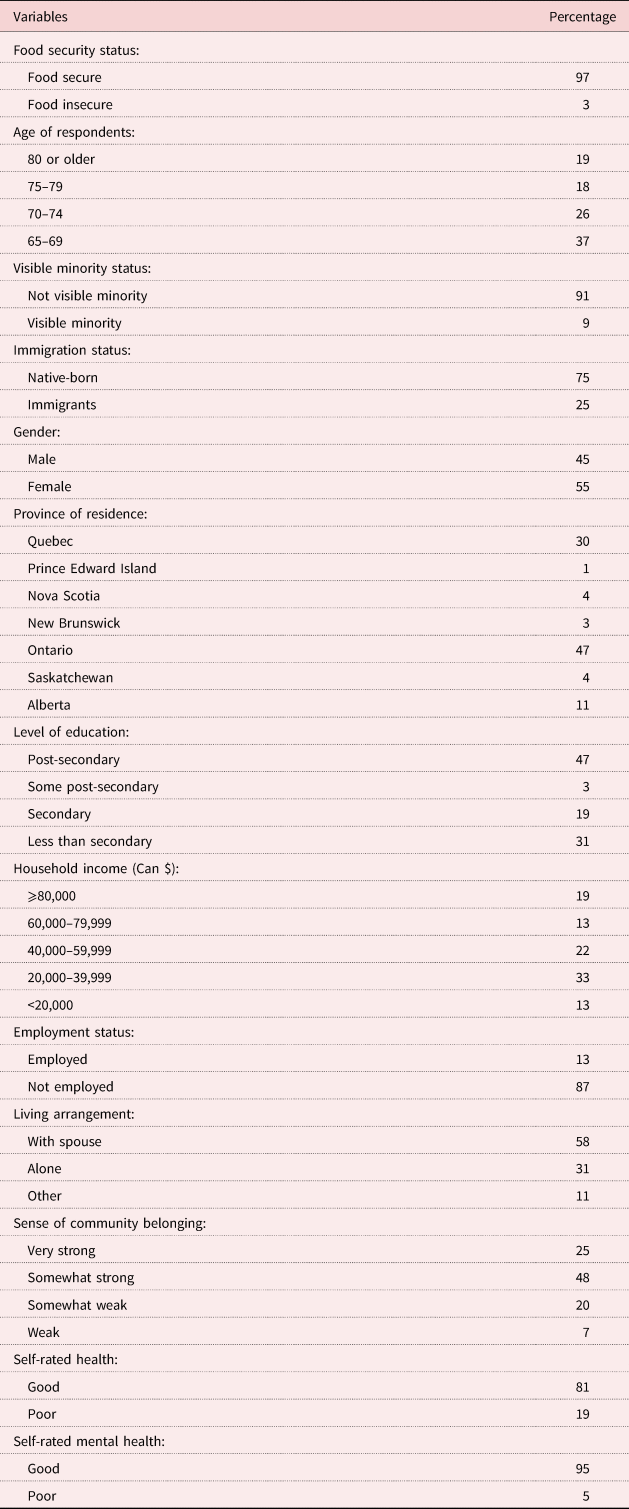
There are three separate analyses for this study. First, we employed univariate analysis to understand the characteristics of the study sample. Second, we employed bivariate analysis to understand the independent impacts of the covariates on household food insecurity. Finally, we conducted multivariate analysis to examine the net impacts of the independent variables on food insecurity status. For the bivariate and multivariate analyses, we used negative log-log regression. Although the dependent variable is dichotomous in nature, as shown in Table 1, the distribution of categories (i.e. yes and no) is skewed and not equally probable, given that 3 per cent of the respondents fall under the ‘yes’ category. In this case, the negative log-log link function is recommended since a simple logit model that assumes a symmetric distribution can generate biased estimates (Smith and McKenna, Reference Smith and McKenna2012). We also calculated the Akaike Information Criteria for three different models, namely negative log-log, complementary log-log and logit models, and found the lowest score for the negative log-log model, implying the best model fit. For the bivariate and multivariate analyses, findings are reported with ORs. ORs larger than 1 imply that respondents are more likely to be food insecure while those smaller than 1 indicate the lower odds of experiencing food insecurity.
Univariate analysis of the dependent and independent variables
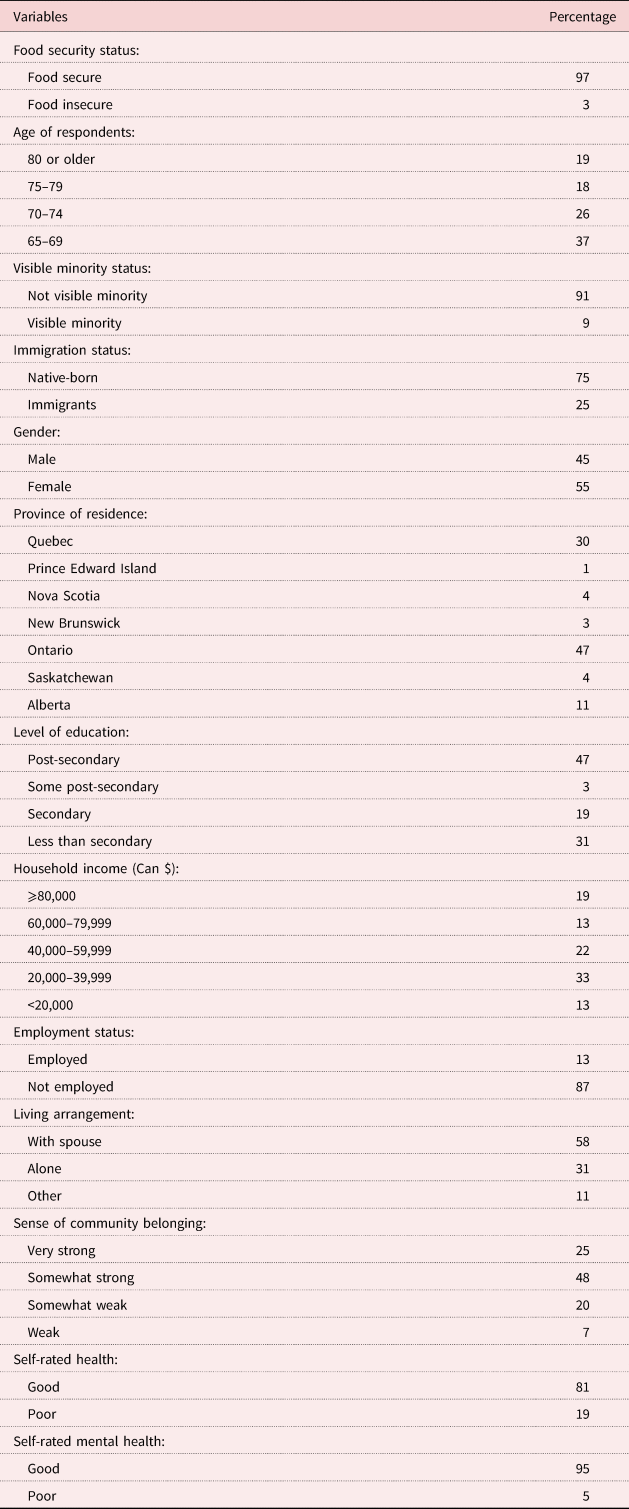
Note: N = 24,930.
Results
Table 1 shows the sample characteristics. We found that 3 per cent of Canadians older than 65 years experienced food insecurity. The majority of elderly people were native-born (75%), not employed (87%), had a strong sense of community belonging (73%) and good self-rated physical health (81%). It is also noteworthy that about half of older adults were female (55%), had secondary education or less (50%), received an income of Can $39,999 or less (46%) and lived with their spouse (58%). The largest proportion of older adults lived in Ontario (40%), followed by Quebec (30%), Alberta (11%), Nova Scotia (4%) and Saskatchewan (4%).
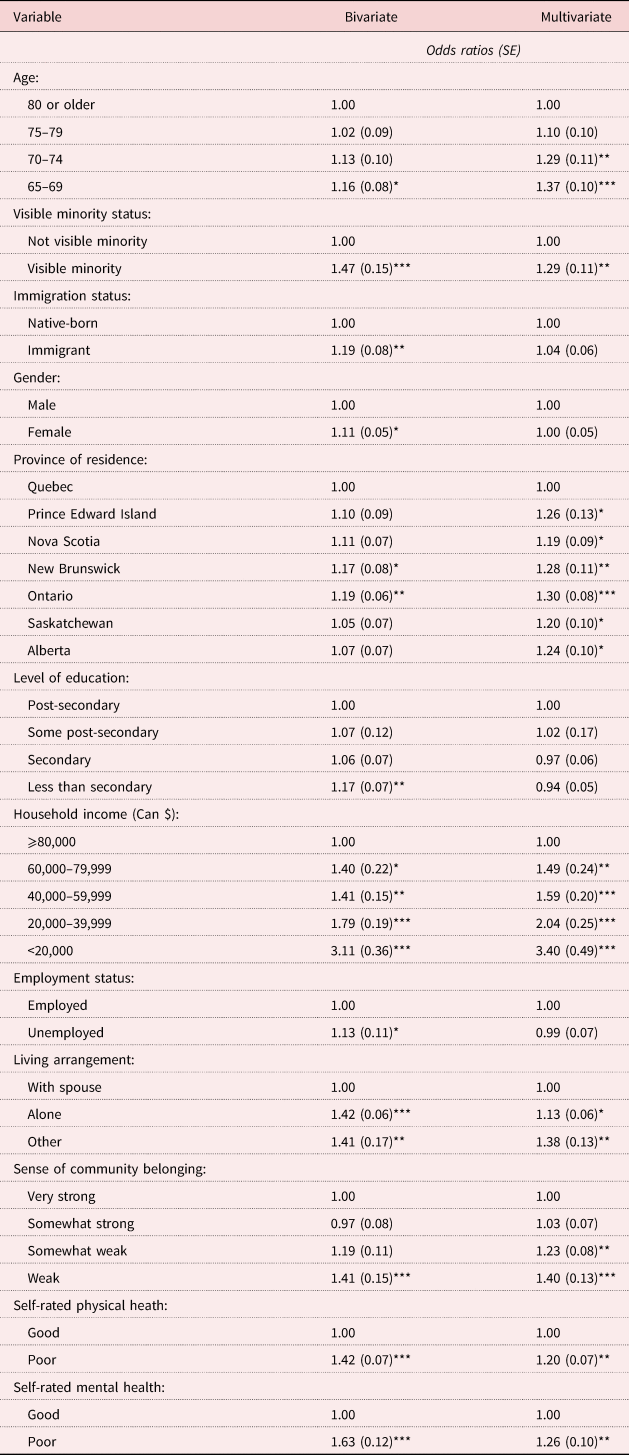
Table 2 presents bivariate and multivariate results from the regression analyses. At the bivariate level, several socio-economic and demographic factors emerged as significant predictors of food insecurity among elderly people. Elderly people in the youngest age category (65–69 years) were more likely to experience food insecurity (OR = 1.16, p < 0.05) compared to those in the oldest age group (80 years or older). Visible minorities (OR = 1.47, p < 0.001), immigrants (OR = 1.19, p < 0.01) and females(OR = 1.11, p < 0.01) were also more likely to experience food insecurity than their non-visible minority, native-born and male counterparts, respectively. Similarly, seniors with less than secondary education were more likely to experience food insecurity than those with post-secondary education (OR = 1.17, p < 0.01). Also, lower income generally predicted higher odds of experiencing food insecurity. It is also interesting that seniors in New Brunswick (OR = 1.17, p < 0.05) and Ontario (OR = 1.19, p < 0.01) were more likely to experience food insecurity than their counterparts in Quebec. Our findings further show that unemployed seniors (OR = 1.13, p < 0.05) were more likely to experience food insecurity than their employed counterparts. Also, living alone (OR = 1.42, p < 0.001) and having a very weak sense of community belonging (OR = 1.41, p < 0.001) were both associated with higher odds of experiencing food insecurity among elderly people. Finally, poor physical health (OR = 1.42, p < 0.001) and mental health (OR = 1.63, p < 0.001) were also both associated with higher odds of experiencing food insecurity.
Negative log-log model predicting food insecurity among elderly people
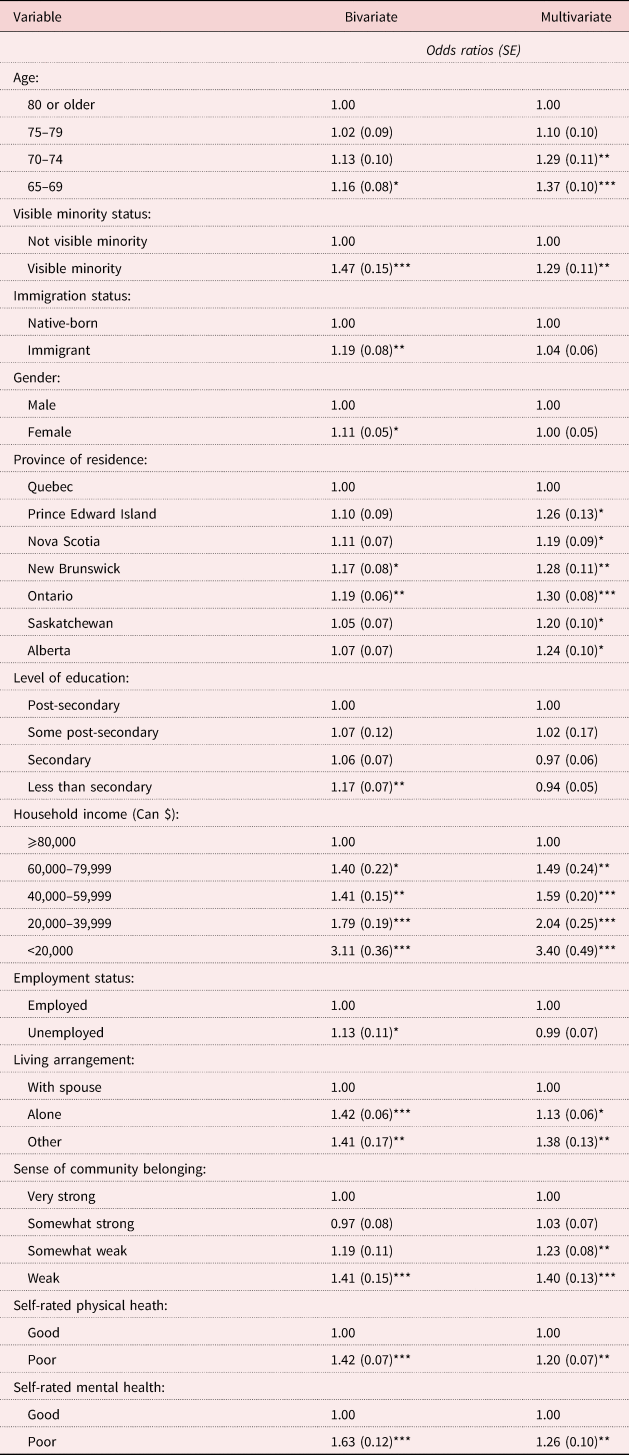
Note: SE: standard error.
Significance levels: * p < 0.05, ** p < 0.01, *** p < 0.001.
At the multivariate level, most significant predictors of food insecurity were largely consistent with the bivariate findings except immigration status, gender and education that became attenuated in the adjusted model. Seniors aged 65–69 were still more likely to experience food insecurity (OR = 1.37, p < 0.001) compared to those aged 80 or older. It is also worth noting that in the adjusted model, seniors aged 70–74 (OR = 1.29, p < 0.01) became significantly more likely to be food insecure compared to those in the oldest age category (80 years and older). The rate of food insecurity among seniors aged 65–69 increased by 19 percentage points while the rate for those aged 70–74 increased by 13 percentage points. Seniors who were visible minorities (OR = 1.29, p < 0.01), living alone (OR = 1.13, p < 0.05), had a weak sense of community belonging (OR = 1.40, p < 0.001), and those who reported being in poor physical health (OR = 1.20, p < 0.01) and mental health (OR = 1.26, p <0.01) were still significantly more likely to be food insecure. Consistent with the bivariate level, lower income predicted higher odds of experiencing food insecurity. Specifically, seniors from households in the income brackets of Can $60,000–79,999 (OR = 1.49, p < 0.01), $40,000–59,999 (OR = 1.59, p < 0.001), $20,000–39,999 (OR = 2.04, p < 0.001) and below $20,000 (OR = 3.40, p < 0.001) were all more likely to experience food insecurity compared with those from $800,000 and above income households. The significant associations observed for immigrant status (OR = 1.09, p < 0.05), gender (OR = 1.00, p < 0.05), employment status (OR = 0.99, p < 0.05) and level of education (OR = 0.94, p < 0.05) at the bivariate level was fully attenuated in the adjusted model. We also identify that seniors in Prince Edward Island (OR = 1.26, p < 0.05), Nova Scotia (OR = 1.19, p < 0.05), New Brunswick (OR = 1.28, p < 0.01), Ontario (OR = 1.30, p < 0.001), Saskatchewan (OR = 1.20, p < 0.05) and Alberta (OR = 1.24, p < 0.05) were all more likely to experience food insecurity than those in Quebec.
Discussion and conclusions
We examined the correlates of food insecurity among older people in Canada using data from the 2013–2014 CCHS. Generally, our findings show that seniors in lower age categories were more likely to be food insecure compared to those in higher age categories. Some socio-economic variables including age, visible minority status, province of residence, income, living arrangement, sense of community belonging, and self-rated physical and mental health were significant predictors of food insecurity among elderly people. These findings suggest that food insecurity among elderly people is complex and requires an in-depth appreciation of a range of socio-economic and demographic factors. Recent research on the population-level determinants of food insecurity in Canada revealed the important role of province of residence, income, housing tenure, education, Aboriginal status and household structure (see Tarasuk et al., Reference Tarasuk, St-Germain and Mitchell2019). While population-level factors such as income, province of residence and visible minority status are consistent determinants of food insecurity among older adults, this study also demonstrates that living arrangement, age cohort, sense of community belonging, and self-rated physical and mental health are uniquely associated with food insecurity among elderly people.
Generally, the literature on food insecurity demonstrates a link between old age and food insecurity across several contexts (Lee and Frongillo, Reference Lee and Frongillo2001; Temple, Reference Temple2006; Fernandes et al., Reference Fernandes, Rodrigues, Nunes, Santos, Gregório, de Sousa, Dias and Canhão2018). However, a key gap that remains less understood is how food insecurity may vary across age categories among elderly people. By disaggregating elderly people into sub-categories, our study contributes to the literature by demonstrating that seniors in lower age groups, i.e. between 64 and 75, were more likely to be food insecure compared to those in relatively higher age categories. Thus, our study builds on earlier evidence on the association between old age and food insecurity by demonstrating that even among elderly people, certain age categories may be more susceptible to food insecurity. This finding corroborates earlier findings that suggest a protective age-cohort effect in food insecurity among elderly people, whereby seniors in older age categories tend to receive better attention from the state, such as being prioritised in food-assistance initiatives (Duerr, Reference Duerr2007; Dean et al., Reference Dean, Sharkey and Johnson2011). Ensuring a holistic reduction in food insecurity would entail paying more attention to relatively younger seniors who are more likely to be at risk of food insecurity.
Regarding living arrangement, the finding that elderly persons living alone are more likely to be food insecure is consistent with existing literature (Woo, Reference Woo2000; Lee and Frongillo, Reference Lee and Frongillo2001; Temple, Reference Temple2006; Dean et al., Reference Dean, Sharkey and Johnson2011; Kim et al., Reference Kim, Park and Kim2019; Park et al., Reference Park, Saint Ville, Schwinghamer and Melgar-Quiñonez2019). Familial social capital plays a crucial role in food accessibility and utilisation among elderly people given that the presence of a spouse at home provides a safety net against food insecurity in several ways (Park et al., Reference Park, Saint Ville, Schwinghamer and Melgar-Quiñonez2019). Aside from providing daily assistance in grocery shopping and food preparation (Ishikawa et al., Reference Ishikawa, Yokoyama, Nakaya, Fukuda, Takemi, Kusama, Yoshiike, Nozue, Yoshiba and Murayama2016), spousal support has also been found to be crucial in improving access to resources for obtaining food in the right quantity and quality, and providing the companionship and emotional support necessary for regular eating (Wolfe et al. Reference Wolfe, Olson, Kendall and Frongillo1996; Dean et al., Reference Dean, Sharkey and Johnson2011). The buffering role of spousal support on food insecurity for elderly people is even pronounced in situations of functional impairment (Unger et al., Reference Unger, McAvay, Bruce, Berkman and Seeman1999).
Our finding that elderly people in lower-income categories are more likely to be food insecure is also consistent with existing literature (Lee and Frongillo, Reference Lee and Frongillo2001; Guthrie and Lin, Reference Guthrie and Lin2002; Russell et al., Reference Russell, Flood, Yeatman and Mitchell2014; McIntyre et al., Reference McIntyre, Dutton, Kwok and Emery2016; Fernandes et al., Reference Fernandes, Rodrigues, Nunes, Santos, Gregório, de Sousa, Dias and Canhão2018). Income plays a direct role in ensuring both the accessibility and utilisation of food. Apart from improving purchasing power, income sufficiency also affects the quality and desirability of food. Thus, seniors with sufficient income can choose between meals compared to those in lower-income categories who may have to eat low-cost meals or meals they do not desire (Guthrie and Lin, Reference Guthrie and Lin2002; Russell et al., Reference Russell, Flood, Yeatman and Mitchell2014; Park et al., Reference Park, Saint Ville, Schwinghamer and Melgar-Quiñonez2019). For instance, Guthrie and Lin (Reference Guthrie and Lin2002) find that in the United States of America (USA), lower-income elderly people tend to consume significantly fewer calories and servings from major Food Guide Pyramid food groups compared to elderly people in higher-income categories. Moreover, for elderly people who are living alone, those with sufficient income can employ someone to help in their general up-keep, including cooking. Closely related to income is the province of residence. Seniors in Prince Edward Island, Nova Scotia, New Brunswick, Ontario, Saskatchewan and Alberta had higher odds of being food insecure compared to their counterparts in Quebec. This finding may be explained by provincial differences in economic conditions and social support for seniors. As observed by previous studies, seniors living in Quebec may have lower odds of reporting food insecurity due to the relatively generous social programmes offered by the province (Tarasuk et al., Reference Tarasuk, St-Germain and Mitchell2019).
The association between having a weak sense of community belonging and food insecurity among elderly people is also supported by previous research (Locher et al., Reference Locher, Ritchie, Roth, Baker, Bodner and Allman2005; Ogg, Reference Ogg2005; Dean et al., Reference Dean, Sharkey and Johnson2011). Aside from familial social capital as expressed in living arrangement, the role of collective social functioning at the community level in providing fall back for elderly people who are food insecure has been acknowledged. For instance, Dean et al. (Reference Dean, Sharkey and Johnson2011) found that elderly people with low community social capital were more likely to report being severely food insecure compared to those with strong community ties. This highlights the importance of creating avenues for community-level engagement among elderly people.
Visible minority status was also found to be positively associated with food insecurity among elderly people. This finding is consistent with the literature on food insecurity (Sharkey and Haines, Reference Sharkey and Haines2001; Bengle et al., Reference Bengle, Sinnett, Johnson, Johnson, Brown and Lee2010; Leroux et al., Reference Leroux, Morrison and Rosenberg2018) and may be explained by experiences of discrimination, especially with food assistance programmes. Indeed, Locher et al. (Reference Locher, Ritchie, Roth, Baker, Bodner and Allman2005) found a significant relationship between experience of discrimination and food insecurity among older adults who were black. The association between food insecurity and visible minority status may also be explained by the relatively low-income status of most visible minorities in Canada (Maroto, Reference Maroto2016), given the role income plays in ensuring adequate access to food. In an analysis of black–white differences in nutritional risk in the USA, Sharkey and Haines (Reference Sidenvall, Nydahl and Fjellström2001) find that older adults who are black were four times more likely to be at the highest level of nutritional risk, with the odds increasing further when economic need was taken into consideration.
The association between self-rated physical and mental health and food insecurity is largely consistent with the literature (Choi et al., Reference Choi, Park, Kim and Jang2004; Quine and Morrell, Reference Quine and Morrell2006; Green-LaPierre et al., Reference Green-LaPierre, Williams, Glanville, Norris, Hunter and Watt2012). The role of physical health on food insecurity among older people may be explained by the limiting role of poor physical functioning on their food access and utilisation, particularly the ability to go grocery shopping and prepare appropriate meals, especiaqlly those living alone (Wylie et al. Reference Wylie, Copeman and Kirk1999; Sidenvall et al., Reference Sidenvall, Nydahl and Fjellström2001; Burns et al., Reference Burns, Bentley, Thornton and Kavanagh2011). For instance, in an assessment of the dietary intake of older adults, Wylie et al. (Reference Wylie, Copeman and Kirk1999) found that seniors living with restricted mobility consumed vegetables and cooked meals less frequently. Health care may compete with food budgets, especially for elderly people who are more prone to age-related health complications. However, using the 2012 round of the CCHS, Leroux et al. (Reference Leroux, Morrison and Rosenberg2018) found no significant association between self-rated health and food insecurity among older Canadians. This variation in our findings further reinforces the fact that food insecurity and its associated determinants are not static. This reinforces the need to explore continually the determinants of food insecurity among older populations. Further, it is argued that poor mental health conditions such as depression, cognitive decline and anxiety decrease people's ability to access and utilise food resources, and this is particularly important for older adults who are more at risk of poor mental health conditions (Pierce et al., Reference Pierce, Sheehan and Ferris2002; Brostow et al., Reference Brostow, Gunzburger, Abbate, Brenner and Thomas2019). In the USA, for instance, Brostow et al. (Reference Brostow, Gunzburger, Abbate, Brenner and Thomas2019) found that seniors with mental illness had higher odds of being food insecure compared to their counterparts with no mental health conditions. The relationship between health and food insecurity can also be bidirectional. Indeed, there is evidence that food insecurity can shape physical and mental health (Darling et al., Reference Darling, Fahrenkamp, Wilson, D'Auria and Sato2017; Tuthill et al., Reference Tuthill, Sheira, Palar, Frongillo, Wilson, Adedimeji, Merenstein, Cohen, Wentz and Adimora2019; Leung et al., Reference Leung, Kullgren, Malani, Singer, Kirch, Solway and Wolfson2020). In a recent study among older adults in the USA, Leung et al. (Reference Leung, Kullgren, Malani, Singer, Kirch, Solway and Wolfson2020) found that food insecurity was positively associated with multiple chronic conditions and lower self-reported health status.
Although these findings provide useful insights for understanding food insecurity among elderly people, there are some noteworthy limitations. The cross-sectional nature of the data limits our findings to associations, for which reason causal inferences cannot be made. Moreover, given that the experience of food security among elderly people may be temporal, a longitudinal analysis of food insecurity, particularly using a monthly interval, may be useful. Also, the experience of food insecurity is subjective. As a result, future research could benefit from using a qualitative approach to uncover the lived experiences of elderly people. The dataset for this analysis is not representative of all provinces in Canada, given that some provinces did not implement the module on food security in the 2013–2014 round of the CCHS. Moreover, although Canadians living on reservations tend to experience higher rates of food insecurity, they were not included in the CCHS. It is important to mention that some of the provinces that did not implement the food security module are known to have some of the highest food insecurity rates in Canada (Tarasuk et al., Reference Tarasuk, St-Germain and Mitchell2019)
Notwithstanding these limitations, this study provides useful insights for addressing food insecurity among elderly people in Canada and similar contexts. Our findings suggest that food insecurity among elderly people is associated with a multiplicity of factors. As a result, approaches that go beyond poverty alleviation should be prioritised. In Canada, and many other Global North countries, poverty reduction strategies have featured prominently in policy responses for reducing food insecurity among elderly people. Canada's main approach for ensuring the welfare of elderly people has largely been an income improvement approach through the income support programs such as the OASP and the CPP (Statistics Canada, 2014). While these strategies are timely, especially for low-income elderly people, our findings suggest a need to pay attention to other socio-economic factors, such as sense of belonging, age, minority status, state of physical health and living arrangement. Indeed, the impact of these income-related programmes can be enhanced if attention is paid to age-specific nuances and other socio-economic predictors of food insecurity.
Ethical standards
We used secondary data from the CCHS implemented by Statistics Canada. Hence, ethical approval was not required for this study.