Introduction
In recent days, as a result of the development of medical applications technology, wireless implanted devices (biomedical devices) have significant attention. Day after day, the demand for implanted medical devices (IMD) increases, as more than 3 million people around the world have these devices such as pacemakers [Reference Zada, Shah, Basir and Yoo1]. The need for IMD is increasing to improve the lifestyle of a chronic disease patient. The patient will not have to visit the doctor because he can monitor the patient's vital functions in real-time, even when the patient is at home [Reference Malik, Sant, Ajmal and Ur-Rehman2]. There are many applications for IMDs, such as cancer treatment using hyperthermia [Reference Lin and Wang3] and injecting the patient with his appropriate dose of drug remotely and monitoring his vital signs [Reference Ahmed, Ur-Rehman and Abbasi4].
In order for implanted devices to monitor the vital functions of the human body, such as blood pressure, temperature, etc., the devices need to be placed inside the human body to send the data to outer devices (base station), which is engaged with the patient to receive the information from IMD then take the proper action [Reference Rahmat-Samii and Kim5, Reference Manjulatha and Sri Kavya6] (Fig. 1).
Health care monitoring using IMDs.

There are many applications of IMD as monitor health caring that include pacemakers [Reference Wessels7], cochlear and retinal implants [Reference Buchegger, Oßberger, Reisenzahn, Hochmair, Stelzer and Springer8, Reference Gosalia, Lazzi and Humayun9], glucose sensors [Reference Shults, Rhodes, Updike, Gilligan and Reining10], diagnosis of the hypopnea syndrome [Reference Yang, Fan, Ren, Zhao, Shah, Alomainy, Ur-Rehman and Abbasi11], and chronic obstructive pulmonary disease warning [Reference Zhang, Haider, Wang, Shah, Yang and Abbasi12–Reference Scanlon, Evans and McCreesh14].
The IMD must support at least one of those frequency bands according to standard regulation [Reference Savci, Sula, Wang, Dogan and Arvas15–17]: 402.0–405.0, 420.0–450.0, 863.0–870.0, 902.0–928.0, 950.0–958.0, 2360.0–2400.0, and 2400.0–2483.5 MHz and WMTS bands (608–614 MHz, 1.395–1.400 GHz) and also ultra-wide band (UWB) IMDs, which implement low band (3494.4–4492.8 MHz) or high band (6489.6–9984.0 MHz) [Reference Kiourti, Psathas and Nikita18].
Therefore, designing implantable antennas has been received significant attention from scientific researchers nowadays for its wide usage in many medical applications. Some requirements must be taken into account when designing, such as patient safety, biocompatibility, miniaturization, and quality of communication with outer devices [Reference Kiourti and Nikita19]. Patch antenna receives major attention in implantable applications because its design is flexible and compatible with most applications [Reference Ali, Hamad, Bassiuny and Hamdallah20, Reference Zaki, Abouelnaga, Hamad and Elsadek21]. It allows for reducing antenna size easily and integrates it in the IMD [Reference Liu, Wu, Fan and Tentzeris22].
This work proposes a new miniaturized implantable antenna for biomedical applications resonating over the Industrial, Scientific, and Medical (ISM) band of 2.26–2.72 GHz. This paper is organized as follows: section “Antenna design and simulation” presents the proposed implantable antenna configuration and its simulation results. Section “Measurements” discusses the experimental results and their analysis. Finally, the conclusion is presented in section “Conclusions”.
Antenna design and simulation
Background
The compact size antennas have attracted the attention of many researchers due to their use in many essential applications [Reference Aboul-Dahab, Ghouz and Ahmed Zaki23]. Many miniaturization techniques are used recently, such as periodic structure [Reference Perhirin and Auffret24], split-ring resonator [Reference Zhang, Liu, Li and Guo25], high-permittivity dielectric (substrate/superstrate) [Reference Kiourti and Nikita19], increase current path length, and use short pins [Reference Faisal and Yoo26].
By comparing the antennas in the free space and those implanted inside the human body, the radiation characteristics have been found, such as gain of the implanted antenna is below zero because of losses happened due to surrounding human tissues. The human body is made of different layers (skin, fat, and muscle), with nonlinear electrical characteristics. The dielectric constant (ɛr) and conductivity (σ) of these layers of the human body at 2.45 GHz are listed in Table 1 [Reference Liu, Wu, Fan and Tentzeris22].
The dielectric properties of different layers of the human body at 2.45 GHz [Reference Liu, Wu, Fan and Tentzeris22]

Another constraint parameter that defines the amount of allowed power incident on the human body is the specific absorption rate (SAR) [Reference Ibraheem and Manteghi27]. The IEEE standard allowed the average SAR for a 1 g of cube-shaped tissue to be <1.6 W/kg, while the ICNIRP (International Commission on Non-Ionizing Radiation Protection) basic restrictions limit the SAR averaged over 10 g of contiguous tissue to <2 W/kg [Reference Ibraheem and Manteghi27, Reference Singh and Kaur28].
Antenna configurations
The implanted antenna should be as small as possible because the allowed space is limited to implant it easily inside the patient body. So, the implanted meandered compact patch (IMCP) antenna was designed on 0.13 mm-thick Roger RO3003 (ɛr = 3) as a substrate material to operate at the ISM band 2.4 GHz with an overall volume of 5 × 5 × 0.26 mm3 as illustrated in Fig. 2. The Optimized dimensions of the proposed IMCP antenna are tabulated in Table 2. The patch is covered with the same material of 0.13 mm superstrate to prevent short circuits and at the same time to reduce the parasitic coupling of electromagnetics with human tissues and to help in miniaturizing the antenna size by reducing the operating frequency to the lower side of the spectrum [Reference Kiourti and Nikita19].
The geometry of the IMCP proposed antenna, (a) patch, (b) ground, (c) side view.

Optimized dimensions of the proposed IMCP antenna

To maintain patient safety and prevent the short circuit, the antenna is covered with a biocompatible material. The antenna is covered with a thin layer of ceramic alumina (Al2O3) with a permittivity of 9.8 and 0.008 loss tangent with a thickness of 0.02 mm to protect the designed antenna.
The current path is extended over the surface of the patch by meandering the radiating patch; as a result, the ultra-compact size of the antenna is obtained. To attain the best matching impedance with 50 Ω coaxial cable, the excitation is placed at x = 1.75 mm and y = 1.75 mm from the center. Partial ground and various cuts were etched on the conventional square patch and are employed to improve the impedance matching to the 50 Ω feeding line.
Design steps
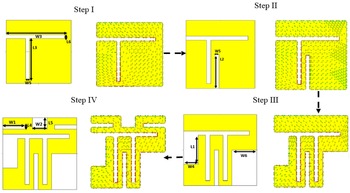
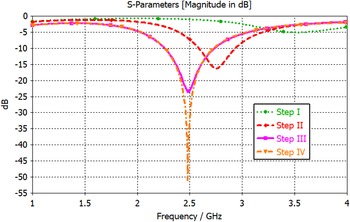
The proposed IMCP antenna was miniaturized in four steps, as shown in Fig. 3, and a comparison of the simulated S 11 of four steps using CST Microwave Studio is demonstrated in Fig. 4.
Miniaturization steps of the proposed IMCP antenna.

Comparison of the simulated S 11 of the miniaturization four steps proposed IMCP antenna using CST Microwave Studio.

Initially, the design was started by using a traditional square patch with two slots of widths W3 and W5. One resonance frequency was obtained at 3.5 GHz, as shown in Fig. 4, step I. Adding more slots to prolong the length of the current path, resulting in the frequency-shifted down to 2.7 GHz as shown in Fig. 4, step II. Adding two more slots are incorporated for more shift down of the resonance frequency to 2.5 GHz as shown in Fig. 4, step III. Adding further slots within the patch, in addition to creating a partial ground in order to improve the antenna gain and enhance the impedance matching up to −50 dB for the S 11 over a BW of about 420 MHz.
Simulation results
The design and simulations of the proposed IMCP antenna are carried out using CST Microwave Studio 2018 simulator. The implanted antenna was positioned at a depth of 2 mm from the skin surface, where the human tissue consists of three layers, which are skin, fat, and muscle [Reference Liu, Wu, Fan and Tentzeris22, Reference Singh and Kaur28–Reference Ketavath, Gopi and Rani30]. The simulation model of the human tissue built on CST with the implanted antenna is illustrated in Fig. 5. The thickness of each layer (skin–fat–muscle) is chosen as an average value because the thickness of the layers differs from one person to another and depends on where the antenna is implanted. The electrical properties of the human tissue are mentioned in Table 1.
Three-layer phantom constructed in CST Microwave Studio [Reference Liu, Wu, Fan and Tentzeris22].

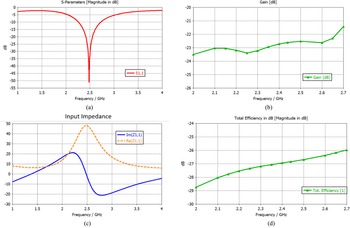
The simulated reflection coefficient S 11, gain, efficiency, and input impedance are illustrated in Fig. 6. As shown in Fig. 6(a), the proposed antenna has a good impedance bandwidth of about 19% (466 MHz) with excellent matching below −10 dB, allowing the antenna to operate properly in the whole ISM band.
Simulated (a) S 11, (b) gain, (c) Z in, (d) total efficiency of the IMCP proposed antenna.

The efficiency and gain against the frequency of the proposed antenna were obtained as shown in Figs 6(b) and 6(d). It is clear that the antenna has a peak gain of −22.5 dBi at 2.45 GHz, and it is a good result compared to literature relative to its size of 5 × 5 mm2 and the attenuation due to the surrounding human body.
Input impedance (real and imaginary) is observed as shown in Fig. 6(c); the real part is nearly 48 Ω, while the imaginary part is almost 0 Ω at resonant frequency; 2.45 GHz. The proposed antenna acts as a good candidate for implantable ISM range applications.
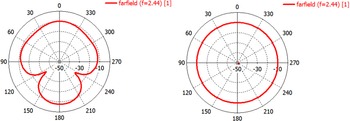
The simulated radiation pattern (E-plane and H-plane) of the IMCP antenna is illustrated in Fig. 7. The antenna is placed in the x-y plane. The proposed antenna has a bi-directional radiation pattern in E-plane with a 3 dB beam width of 60 degrees at 2.45 GHz with a side lobe level of −2.2 dB and a circle radiation pattern in the H-plane.
Radiation patterns of the proposed antenna, E- and H-plane, respectively, at 2.45 GHz.

SAR calculations
To reduce and exclude the harm that can be caused to the human body from exposure to the electromagnetic field due to placing implantable medical devices inside the body, the electromagnetic power should be reduced to a safe value. Because if the body tissue absorbs this electromagnetic power, it could raise the temperature of the tissue, which should not increase more than 1–2 °C [Reference Abbasi, Ur-Rehman, Qaraqe and Alomainy31]. So, various limits are taken to ensure patient safety
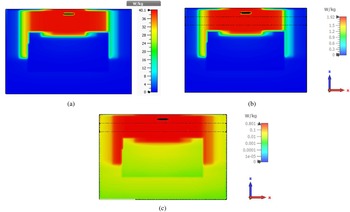
At 2.45 GHz, the maximum SAR of the proposed antenna is 40 W/kg over 10 g cubic tissue at an input power of 0.5 W delivered to the antenna. So that, to meet the SAR standard limits, the input power delivered to the proposed antenna must not be increased by more than 24 mW (13.8 dBm) [Reference Li and Xiao32–Reference Sun, Muneer, Li and Zhu34]. Average SAR distributions at 2.45 GHz over 10 g of human tissue at 500, 24, and 10 mW input power are illustrated in Fig. 8. The SAR is defined by [Reference Sun, Muneer, Li and Zhu34]

where σ is the conductivity of human tissue, E is the intensity of the electric field, and ρden is the density of human tissue. At present, there is no experimental method for measuring SAR. So, the CST studio as a 3D full-wave simulator has been used to determine the maximum power of the RF radiation to achieve safety standards.
Average SAR distributions at 2.45 GHz over 10 g of human tissue at (a) 500 mW input power, (b) 24 mW, (c) 10 mW.

Parametric studies
An intensive parametric analysis of the antenna parameters is carried out to determine the optimum dimensions for the proposed antenna and to explore the parameters that are mainly affecting its performance. It is found that some parameters are affecting the tuning of operating frequency and others affecting antenna matching.
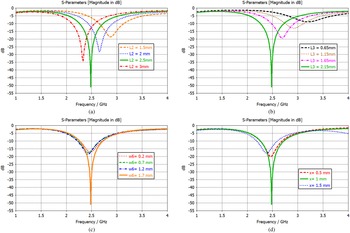
As shown in Figs 9(a) and 9(b), the slot length L2 varied from 1.5 to 3 mm, and the slot length L3 varied from 0.65 to 2.15 mm. It is observed that as lengths L2 and L3 increase, the resonant frequency shifted down toward a lower frequency (2.2–2.8 GHz) and vice versa. So, we can say that L2 and L3 can fully control the resonant frequency.
Effects of variation of (a) L 1, (b) L 3, (c) W 6, and (d) partial ground length.

In Figs 9(c) and 9(d), the width W6 varied from 0.2 to 1.7 mm, and X varied from 0.5 to 1.5 mm. It is observed that W6 and X have a significant impact on the antenna matching impedance, and both could be optimized for an acceptable reflection coefficient.
Link budget
Mainly, implanted devices are used to measure physiological signals inside the body and record them using reading devices. Recorded information is transmitted outside the body to the outer device (computer network) through a wireless link, so evaluating the communication link between IMD and the outer receiver should be taken into consideration.
The way to evaluate communication link performance is called link margin (LM) [Reference Bao, Guo and Mittra35]. LM is defined as the difference between actual received power and minimum received signal level. To ensure a good communication link performance, the LM should be >0 dB (+ve value) or equivalently; the LM must be positive. It is calculated as given in [Reference Xia, Saito, Takahashi and Ito36] as follow:


where Pt is the Tx power, L feed is the feeding loss, Gt is the gain of the transmitter's antenna, Lf is the free space propagation loss, La is the air propagation loss, Gr is the gain of receiver's antenna, No is the noise power density, Eb/No is the normalized signal-to-noise, Br is the bit rate, Gc is the coding gain, Gd is the fixing deterioration.
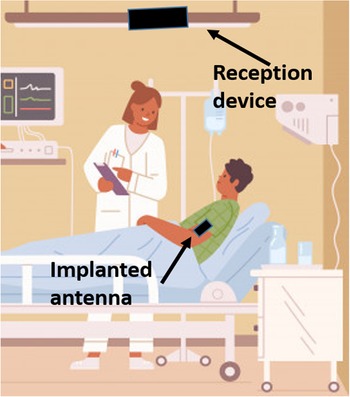
The proposed implanted antenna is assumed to be used in the hospital inpatient room, as demonstrated in Fig. 10. The Rx antenna is assumed to be at about 4–5 m far from the implanted antenna attached to the patient.
Proposed patient room.

The Rx antenna is assumed to be a linear polarized antenna with a gain of about 2.15 dBi, and the Tx antenna is also linearly polarized with a gain of about −22.5 dBi. So, polarization mismatching losses could be neglected for good alignment. Assume input power to implanted antenna is −43 dB to investigate patient safety. The other values used to evaluate LM in equations (2)–(4) are mentioned in Table 3 [Reference Xia, Saito, Takahashi and Ito36, Reference Yousaf, Mabrouk, Zada, Akram, Amin, Nedil and Yoo37].
LM parameters

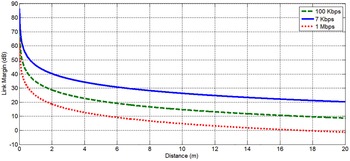
Three different bitrates were used for transmission data (7, 100 Kbps, and 1 Mbps). As shown in Fig. 11, the antenna can communicate up to 20 m at a bit rate of 7 and 100 Kbps and up to 16 m at a bit rate of 1 Mbps. It is clear that increasing or decreasing the data rate will change the range of data transmission.
Calculated link margin at a bitrate of 7, 100 Kbps, and 1 Mbps.

Measurements
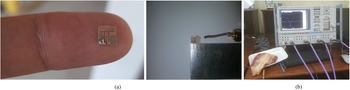
In order to validate the designed antenna and confirm the numerical calculations; a prototype of the proposed antenna is fabricated and measured. Due to the difficulty of experimenting with the proposed antenna on human tissues, the performance of the antenna is measured in fresh beef streaky meat with dielectric properties of muscle ɛr = 53.69 and fat ɛr = 3.6 at frequency 2.45 GHz [Reference Laird and Ferguson38–Reference Brunton, Lyng, Zhang and Jacquier40]. A piece of meat was selected as closely as possible to that used in the simulations in terms of skin, fat, and muscle. The dimensions of the piece of meat used are approximately 60 × 60 × 46 mm3 and it is implanted at about 2 mm from the skin surface. The prototype of the proposed antenna and the experimental setup images are displayed in Fig. 12.
Photos of the (a) prototypes fabricated antenna and (b) of the measurement setup.

Comparison between simulated and measured reflection coefficients of the proposed implanted antenna is illustrated in Fig. 13, which they are agreed together quite well. The slight frequency shifting could be caused by the unexpected fabrication tolerance and soldering roughness.
Simulated and measured reflection coefficient of the presented antenna.

Table 4 illustrates a comparison among the proposed antenna characteristics and the similar literature investigated designs. From Table 4, the merits of the proposed antenna design appear in compact volume and sensitivity of low power as well as lower SAR values.
Comparison of proposed antenna and prior studies in recent years

Conclusions
In this study, an ultra-compact implanted antenna with a size of 5 × 5 × 0.26 mm3 was designed to operate at 2.45 GHz to cover the ISM band. A satisfied gain of −22.5 dBi and a bandwidth of 466 MHz for the proposed antenna is obtained. To determine the main parameters affecting resonant frequency, an intensive parametric study was carried out on CST Microwave Studio. To determine the telemetry range between the ultra-wideband antenna system and the outside base station, the LMs were calculated for different bit rates. The results proved that the antenna could communicate up to 20 m. The SAR has been evaluated and compared with the human health safety standard (IEEE C95.1-1999 and ICNIRP safety regulations). To validate the designed antenna and confirm the calculated numerical results: the proposed antenna was fabricated and measured in a fresh meat box. A good agreement between simulation and measurement results of the implemented antenna has been achieved. The measured bandwidth is wide enough to cover the whole ISM band with a quite compact volume, making it a good candidate for biomedical applications.
 Ahmed Z. A. Zaki received the B.Sc. degree in electrical engineering (Electronics and Communications) from Modern Academy for Engineering and Technology, Cairo, Egypt in 2008 and the M.Sc. degree from Arab Academy for Science, Technology & Maritime Transport in 2016. From 2010 till now, he is a Teaching Assistant with Modern Academy for Engineering and Technology. He is currently working toward the Ph.D. degree in designing and optimizing implanted antennas for wireless medical applications at the Faculty of Engineering, Aswan University, Aswan, Egypt. His current research interests include antenna theory, antenna design, medical telemetry, and implantable antennas for bio-medical applications.
 Ehab K. I. Hamad received the B.Sc. and M.Sc. degrees in electrical engineering from Assiut University, Egypt in 1994 and 1999, respectively, and the Ph.D. degree in electrical engineering from Magdeburg University, Germany in 2006. From 1996 to 2001, he was a Teaching/Research Assistant with the Faculty of Engineering, South Valley University, Aswan, Egypt. From 2001 to 2006, he was a Research Assistant with the Chair of Microwave and Communication Engineering, University Magdeburg. From 2010 to 2011, he was with the School of Computing and Engineering, University of Huddersfield, UK as a Postdoctoral Research Assistant. He is currently a Full Professor for antenna engineering with the Faculty of Engineering, Aswan University, Aswan, Egypt. He has authored or coauthored over 60 technical peer-reviewed papers in international journals and conference proceedings. His current research interests include antenna design, MIMO antennas, mm-wave antennas, metamaterials, RF energy harvesting, and implanted antennas for bio-medical applications.
 Tamer Gaber Abouelnaga was born in November 1976. He received his B.Sc. degree (1994–1999, honors degree) in Electronics Engineering from Menofiya University, Egypt, M.Sc. degree (2002–2007), and Ph.D. degree (2007–2012) in Electrical Engineering (Electronics and Communications) from Ain Shams University. He works as a Researcher (2012–2017) and an Associate Professor (2018 till now) in Microstrip Circuits Department, Electronics Research Institute, Egypt. He works as Students Affairs Vice Dean (2018–2019) and Community Service and Environmental Development Vice Dean (2019 till now) – Higher Institute of Engineering and Technology – Kafr Elsheikh City. He had published 36 papers, 25 papers in peer-refereed journals, and 11 papers in international conferences in the area of RFID, horn, MIMO, 5G, and DRA antennas. His current research interests are in hyperthermia breast cancer therapy and human body implanted antennas.
 Hala A. Elsadek graduated from Ain Shams University, Egypt, in 1991. She received the Master's degree, Japan, in 1996, and the Ph.D. degree from the University of California, Irvine, USA, in 2002. She is currently a Professor and the Microstrip Department Head and the Technology Development Committee Director of the Electronics Research Institute. Her research interests include RF wireless communications, electromagnetic, and microstrip antenna. She has five books and holds six patents. She is also a single and coauthor in more than 150 articles. She was a recipient of several prizes as Women in Innovation Certificate from the Academy of Scientific Research and Technology, Egypt, 2018; Cambridge International College, Certificate of Recognition, December 2017, the Award for the First Best Researcher in Electronics Research Institutes, in 2019. She acts as a reviewer in many international societies such as the IEEE AP-S and MTT.