In August 2013 the Canadian government launched its largest search for the ships, relics, and records of the John Franklin expedition, which disappeared with all 129 hands lost searching for the Northwest Passage in 1845. Canada's latest search was its fifth in six years, one of dozens of search expeditions launched since 1848, in a well-known story of imperial hubris elevated to an international cause célèbre. Recent work in nineteenth-century literary and visual culture has shown the significant role that Franklin played in the Victorian popular imagination of the Arctic (see Spufford, Potter, David, Hill, Cavell, Williams, Savours, MacLaren). In panoramas, stereographs, paintings, plays, music, lantern shows, exhibitions, and popular and elite printed texts, record numbers of Britons could enjoy at their leisure the Arctic sublime in which Franklin's men perished. Alongside this work on how Europeans represented Arctic peoples and places, we also have a growing body of Inuit oral histories describing their encounters with nineteenth-century Arctic explorers. Drawing on these traditional histories of British exploration, visual culture, and literary imagination, and on postcolonial, anthropological and indigenous accounts that shift our attention away from the Eurocentrism of exploration historiography, and toward the “hidden histories of exploration,”Footnote 1 this essay uncovers an unexamined material dimension of these encounters – the “Franklin Relics” collected by voyagers searching for Franklin.
In contrast to the thousands of pages produced by Victorians about the Franklin “mystery,” the Franklin expedition itself produced only one official written document, the one-page “Victory Point Record” uncovered by searchers in 1859. This Admiralty document, annotated in two hands, included vital information about the Franklin expedition: their wintering in Beechey Island, the early death of Franklin in 1847, their abandonment of the ships and final route south.Footnote 2 But the expedition also produced a profusion of objects – broken tools, scraps of clothing, scientific instruments, skulls, bones, graves, illegible books. This overwhelming abundance of objects and virtual absence of legible texts frustrated Victorian searchers, who used the paucity of texts to justify further searches.
This essay concerns the three main sets of Franklin relics collected by: John Rae (1854), Francis McClintock (Reference McClintock1859), and Frederick Schwatka (1880). The published narrative of the second major effort – McClintock's The Voyage of the ‘Fox’ in the Arctic Seas – sold 7,000 copies in advance orders alone, outselling Darwin's Origin of Species, both published in the same year by John Murray.Footnote 3The Voyage of the ‘Fox’ appended a long annotated list of the debris and their locations, a catalogue of an eclectic archive comprised of religious, navigational, institutional, textual, and personal detritus, publicly referred to as “The Franklin Relics.” Displayed in prestigious institutions like the United Service Museum in Whitehall, the British Museum, and Sir Christopher Wren's Painted Hall at Greenwich Hospital, the Franklin disaster relics were initially collected within sites regulated by government authorities, but they quickly accumulated a range of unpredictable responses and recontextualizations ranging far beyond the intentions of their elite sponsors.
The collection, public display, and representation of the Franklin relics beginning in the 1850s were made possible by the Victorian “exhibitionary complex.” The Museum Bill of 1845 and the Great Exhibition of 1851 accelerated the growing interest in expanding cross-class accessibility in particular, so much so that the British Museum saw its number of visitors triple from 1850 to 1851, and from 1860 to 1900 the number of public museums in Britain quadrupled (Bennett, “Exhibitionary” 94). While the ideological work of this “democratizing” liberalism has been rigorously critiqued in earlier work by Tony Bennett and others, more recently scholars have explored a wider range of museums (regionally, thematically, and chronologically), and more diverse types of museum agents and spectators, moving “beyond the exhibitionary complex” and its focus on governmentality (Kriegel, “After” 684). Peter Hoffenberg, Lara Kriegel, Harriet Ritvo, Bruce Robertson, and Felix Driver among others have emphasized the unruly forces and multiple agents at work in a museum culture characterized less by the ideological certainties of the “imperial archive” and more by heterogeneous effects and agents.
If exhibitions “are displays of the artifacts of our disciplines” and “of those who make them” (Kirshenblatt-Gimblett 78), through which disciplines were the Franklin disaster objects understood and exhibited in the nineteenth century, and through which disciplinary lenses are they visible to us today? In focusing an inquiry on the Franklin relics – hundreds of heterogeneous objects, collected from dozens of sites or purchased from different Inuit groups, transformed by many hands, put to changing uses, over many decades – we must by necessity pose questions that no single twenty-first-century discipline is equipped to answer. For Victorians, the Franklin relics were both arresting and vexing, and confronted them with a constantly changing archive, one which required them to ask questions for which they often lacked clear precedents, categories, or univocal cultural vocabularies.
The earliest Franklin searchers referred to the objects as “traces” and “relics,” a language drawn from the culture of antiquarianism and more recently archaeology, both popular in mid-century Britain, when professionals and amateurs excavated graves, barrows, and grave-goods of early modern, Anglo-Saxon, or pagan Britons (see Levine). But neither antiquarianism, with its emphasis on the preservation of the past and the rescue from the “deluge of time” (Bacon 72) nor archaeology with its national focus on Britain's racial past, provided an appropriate scenario for the Franklin relics: these were mundane objects from the commercially degraded present, belonging to individuals known to some of the searchers.
The Franklin relics were initially exhibited and experienced by many as sacred relics, especially after 1859 when the death of Franklin was confirmed and his religious faith became a central feature of the displays. While modern Protestant Britain lacked a culture of saintly relics, these objects joined a broader continuum of relics of the celebrated, the notorious, and the beloved increasingly sought out by spectators: from the relics of military heroes like Nelson and Napoleon to those of murderers like Thurtell and Hunt, to the personal relics of geniuses like Burns and Scott. Indeed, after its longest story on the Franklin relics in 1859, the Illustrated London News launched a long-lived series on “Relics of the Past,” part of the secular “nineteenth-century resurgence in relic culture” that Deborah Lutz has recently explored (128).Footnote 4
Despite their widespread representation in print, the actual objects were usually displayed in naval exhibitions, and as a consequence have fallen beneath the threshold of interest in current work in art history and museum studies. Likewise, because they directed an intensely autoscopic gaze upon British subjects, they have not been considered within larger trajectories of nineteenth-century ethnology. In fact as we shall see, the closest analogs to these relic displays were the anthropological exhibitions of other cultures, and the commercial displays and advertisements coeval with the rise of department stores, trade exhibitions, and arcades. Neither of these exhibitionary cultures – the anthropological nor the commercial – had desirable associations as far as naval authorities were concerned. They would emphasize the relics’ affinities with the sacred and the scientific, but the relics would stubbornly maintain their unwelcome associations with commodities and exotic artifacts.
Designated as scientific, pietistic, and patriotic by their British collectors, these domestic and scientific objects accumulated indigenous Arctic owners, reauthored uses, and horrific narratives on their extraordinary journeys from and to Britain. The cumulative voyages, in space and time, of these heroic objects and their inscriptions are themselves worthy of study, for as Nicholas Thomas argues, “[t]he circulation of objects, especially across the edges of societies, civilizations, and trading regimes, is not merely a physical process but is also a movement and displacement of competing conceptions of things” (Entangled 123).Footnote 5 Traveling through the trading regimes of the Hudson's Bay Company, outside the boundaries of Britain's territorial empire, Franklin searchers followed fugitive objects into the heart of the Arctic archipelago, returning not with evidence of a primitive exotic past, but of a ruined future, their own. The voyagers and objects that circulated between these metropolitan centers and the long-inhabited places of the Arctic, allow us to ask the question, as posed by James Clifford, “To what extent is one group's core another's periphery?” (Routes 25). In the case of these relics, it is no longer clear which is which, certainly for the numerous objects transformed, repaired, and reappropriated by Inuit, objects whose “community of origin” (Routes 162) became indistinct and today remains difficult for curators to classify. And as we shall see, the movement is cyclical, circling a void that seems to be more compelling and more generative than either center or periphery. No longer tools and instruments, neither were these objects scientific evidence, ethnological specimens, or sacred relics – subject to ongoing decay and an alien temporality, the relics illustrate how objects “are not what they were made to be but what they have become” (Thomas, Entangled 4).
An Arctic Crystal Palace: Rae's Search
Naval searches for Franklin began in 1848 and started to collect material traces in 1850. But it was not until 1854 that Dr. John Rae of the Hudson's Bay Company encountered Inuit from Pelly Bay with oral accounts and artifacts of the Franklin expedition. The Inuit spoke of hearing accounts from another Inuit group about bodies discovered near the Great Fish River, with evidence of British cannibalism. British cannibalism had featured scandalously in popular theater and penny dreadfuls, but these had been testaments to the depravity of the urban poor, convicts, or shipwrecked sailors. By implicating naval officers in survivor cannibalism, Rae had violated a taboo that authorities and popular figures like DickensFootnote 6 worked hard to reinforce for decades.
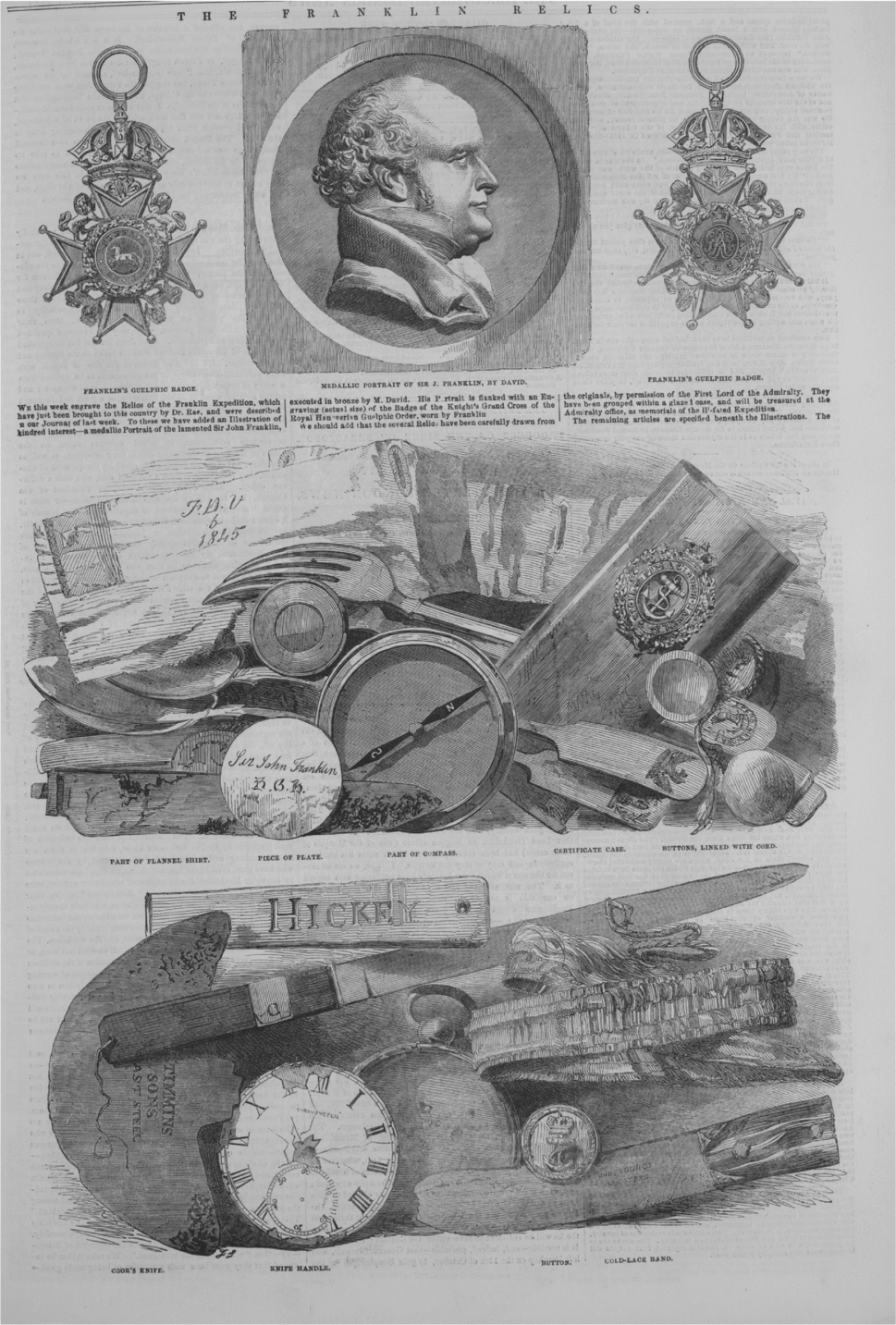
The full-page engravings of Rae's relics printed in the Illustrated London News, authorized by the Admiralty and Lady Jane Franklin, attempted to overwrite Rae's oral Inuit account of cannibalism with a visual counternarrative of patriotic, scientific, and Christian martyrdom (Figure 1). Crowned by a medallion portrait of Franklin (which was not among the relics) and flanked by his Badge of the Knight's Grand Cross of the Royal Hanoverian Guelphic Order, this ILN composition stressed the unassailable moral character of the lost expedition, as seen in the heraldic crests, naval insignia, and scientific instruments. The silver cutlery was inscribed with the heroes’ family crests (which featured in a separate ILN illustration), attesting to the nobility of the enterprise, and seeming to repudiate Rae's assertion that the British had resorted to cannibalism, perhaps with such examples of fine silver. In addition to signifying the class and social allegiances of the officers, and obscuring the other (functional) uses of silver, the numerous inscriptions visible on Rae's relics also signal these sacred relics’ double life as commodities, both before and after the disaster.
“The Franklin Relics,” Illustrated London News (4 Nov. 1854): 433. © Illustrated London News Ltd/Mary Evans Picture Library.

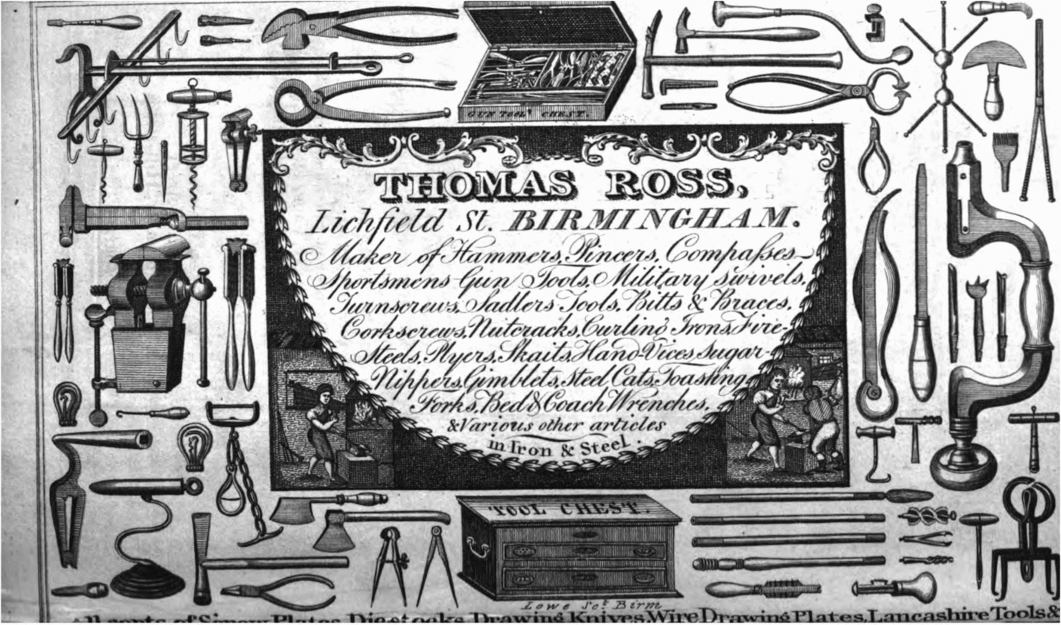
While they were composed in traditional funerary arrangements in several issues of the ILN, the 1854 relics were also painted by naval artist Walter May in a composition resembling that of contemporary trade catalogues and tool pattern books, “Franklin Relics Brought by Dr. Rae” (Figure 2). Some of the inscribed names visible both in the ILN engravings and in May's lithograph are heraldic (highlighted by May's use of gold), but many are commercial, for example “Wigfall” and “Timmins.” Wigfall was a well-known knife-maker (broken knife, bottom right), and Timmins (semilunar blade) a Birmingham toolmaker who in 1851 won a Prize Medal for his display at the Great Exhibition (Illustrated Exhibitor xxxiv). These manufacturers’ tool pattern books, advertisements (Figure 3), and commercial displays, like that of the Sheffield Court in the Great Exhibition, were the immediately recognizable analogues for these early relic representations.
Walter May, “Franklin Relics Brought by Dr. Rae,” Plate XIV, lithograph from A Series of Fourteen Sketches, made during the voyage up Wellington Channel in search of Sir J. Franklin (London, 1855). The British Library Board (1781.a.6).
Tool manufacturer advertisement, Wrightsman's New Triennial Catalogue of Birmingham (Birmingham, 1818). 111.
The Great Exhibition was never far from the minds of the early Franklin searchers, the “noble philanthropy” of the one “glorious success” adumbrating that of the other (Arctic Miscellanies xv). According to one Arctic shipboard newspaper, the searchers who set off in May 1850 “numbered the fear of not seeing the Great Exhibition amongst their other regrets” (Arctic Miscellanies xv-xvi). By 1852 searchers were sailing past “Crystal Palace Cliffs” in Greenland, and constructing their own Crystal Palace out of ice in Beechey Island in 1853, where they circulated a shipboard Illustrated Arctic News in an analog of London, “Victoria Town,” built entirely of ice.Footnote 7
If the Great Exhibition was “a shrine to manufactured things” (Black 10), then the 1854 Franklin relics were a shrine to the global circulation and mutability of these manufactured things: the objects left England's industrial cities as commodities and technology, reached beyond the furthest periphery of Britain's empire in disaster, and returned to the capital transformed, in part through Inuit agency. Thus the relics’ slow passage to and from the Arctic was circular in more than one respect, traveling between one metropolis and its Arctic analog (the ice “Crystal Palace” erected by searchers), momentarily reversing origin and destination.
May's “Franklin Relics” visualize the Great Exhibition in ruins: they witness both the dehumanizing effects of its mass industries when carried to the ends of the earth, and the fragility of “the museum effect” itself, since the relics began to appear dangerously like the useless, broken objects that they were (Alpers 26). In its visual echoes of trade catalogues, and its foregrounding of commercial brand names alongside the names of the lost heroes, May's lithograph also suggests what Norman Bryson has described as “still life's enduring insults to the humanist subject,” offering in its visions of “waste and debris,” “the most chilling, deadly, lethal kind of vision one may encounter in European painting” (229, 234–35). May's vision of the relics as a still life of broken objects had evoked the visual vocabulary of trade catalogues and simultaneously the dehumanizing potential of still life, creating an iconic image of the Franklin disaster that was at once reverential and potentially disconcerting.
The wastefulness of exploring the Arctic in particular was increasingly critiqued in diverse print accounts throughout the nineteenth century, as Janice Cavell has shown in Tracing the Connected Narrative. In fact, collecting curiosities was often singled out as the only tangible result of failed searches for the Northwest Passage, for example in Cruickshank's satirical print, “Landing the Treasures” (1819), ridiculing John Ross's enthusiasm for Arctic collecting in his abortive 1818 voyage. Ross's subsequent 1835 return after a four year disappearance with a “collection of an almost indefinite number of useless articles” generated lampoons that he was outfitting a London emporium and collecting props for his panorama (Huish 206). In fact, during the Franklin searches of Rae's day, officers carried shopping lists issued by Barrow, Jr. of the Admiralty: “I have your list always hanging up before me,” wrote Inglefield aboard the Isabel in 1854, “and so shall not readily forget what you want in the curiosity line.”Footnote 8 Collecting Franklin relics, Inuit curiosities, and natural history specimens simultaneously, Franklin searchers moved with ease across the fluid lines distinguishing search and salvage from field science.
Moreover, the Franklin relics were sometimes displayed in conjunction with ethnological collections of Inuit artifacts. In the subsequent exhibition of Rae's relics at the fashionable Royal Polytechnic in 1855, they joined John Barrow, Jr.'s own “Arctic Collection,” some of which had been collected to order by Franklin searchers.Footnote 9 The ILN illustrations of the relics kept the 1855 “Arctic Collection” of Inuit objects visually distinct from the “Franklin Relics,” running a separate story on the former featuring a traditional illustration of Inuit “Costumes” and “Arctic Implements.” But exhibition reviews described how the British and Inuit objects were displayed together at the Royal Polytechnic,Footnote 10 and in this respect they belonged to the “cross-cultural pairings of technologies” that would become a common feature of the “geopolitics of exploration,” as described by Michael Bravo (42). The ongoing slippage of the British objects – to and from technology, commodity, relic, ethnological specimen, waste – would in the end contribute to the unraveling of consensus on the course of Britain's Arctic enterprise in the latter half of the nineteenth century.
The waste and destruction that these “wounded artifacts” could speak to, even in sympathetic accounts like May's, amplified in subsequent searches (Greenblatt 22). Once Rae returned with these objects and the terrible tale they told, hope for survivors vanished, and the Admiralty officially stopped searching. As metonyms for the abandoned heroes, the objects and the promise of their restoration made possible the rescue fantasy that Franklin's allies continued to pursue privately for decades, going against the tide of public interest in new crises in the Crimea (1854–56) and India (1857). But increasingly British audiences would glimpse in the “relics of silver and gold” a warning about “the perishing things of time,” as one evangelical would later put it, part of the growing discontent with Arctic exploration's preoccupation with the relics of its disasters ([“S.T.C.”] 189).
From the manufacturing centers of Britain's north where they were made, to the baroque grandeur of Sir Christopher Wren's Painted Hall at Greenwich, and the fashionable Royal Polytechnic Institution in Regent Street where the 1854 relics were initially displayed, to the mass-produced pages of the Illustrated London News – these heroic commodities had completed their own slow voyage to the Arctic and back, testifying to the triumph of Victorian objects over their makers. Rae's collection of Franklin relics roughly coincided with the 1851 Great Exhibition and the Crystal Palace's 1854 reopening in South London, and in some cases the broken tools had been made by manufacturers who went on to exhibit and win prizes at the Great Exhibition. Through their accelerated deterioration, these early Franklin relics offered Victorians a glimpse of their own obsolescence and decay, and did so at the height of their public displays of industrial progress. Though the initial displays of the Franklin relics were curated by naval authorities with patriotic narratives in mind, they evoked a wide range of unpredictable effects, chief among these an accelerated sense of the “extreme temporal attenuation” that in the 1930s would draw Walter Benjamin to the “fossilized commodity remains” of the mid-nineteenth century Arcades (Buck-Morss 65, 66).Footnote 11 As ruins, the Franklin relics invited quiet contemplation and aestheticization of the pastness of the present, a unique instance of temporal displacement.
Dead Weight: McClintock's Search
In the next and most successful relic search, Frances McClintock's 1858–59 voyage aboard the Fox, searchers were overwhelmed by hundreds of tin cans, nails, bits of string, buttons, broken crockery, shattered timbers, shredded clothing – often interspersed with Inuit objects and human remains. McClintock was dismayed about the small mountains of “rubbish” that they discovered, especially that which surrounded the infamous Boat Place on King William Island containing scattered human remains and what he termed “dead weight”: “a quantity of articles of one description and another truly astonishing in variety, a mere accumulation of dead weight” (Voyage 296). As he prepared to display the relics privately to Jane Franklin in his hotel room shortly after his return, McClintock joked in a letter that he was planning to “exhibit my wares to Lady Franklin.”Footnote 12 In the unpublished expedition sledging journals, McClintock's crew documented their process of selection at numerous sites: they left behind large numbers of Inuit objects and British human remains, and brought back only what they considered objects fit for display. Including the details of how they purchased from the Inuit many of the objects (the exchange rate for one spoon was four needles), these commercial aspects were omitted from the Voyage of the ‘Fox.’Footnote 13
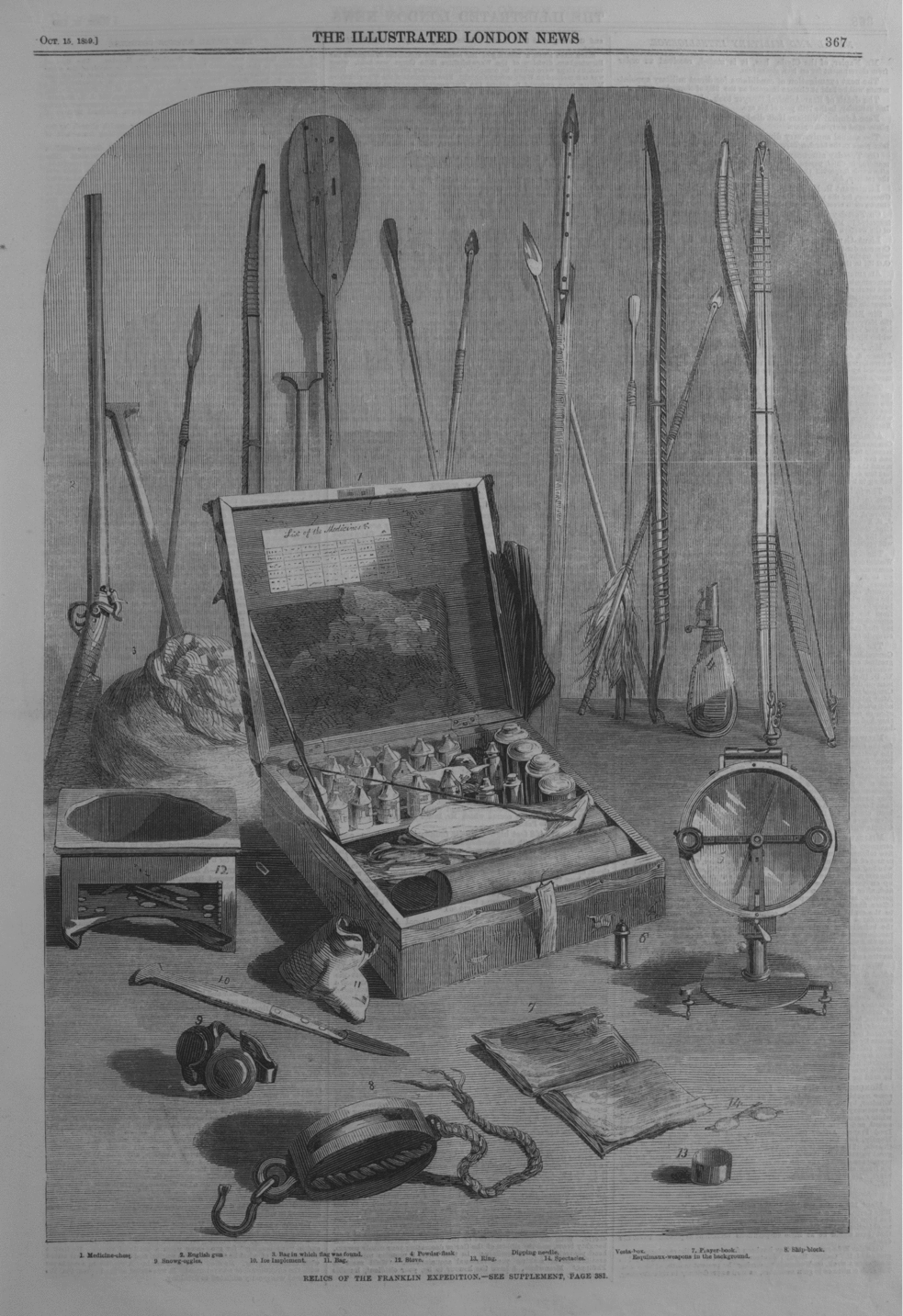
Sent by Lady Franklin with the purpose of collecting relics and records, McClintock repatriated more than one hundred objects, exhibited in a way initially classifying “Franklin's fate under the heading of ‘science'” (Potter 111). In the full page ILN “Relics” illustration of October 1859 (Figure 4), the central object is the medicine chest, with intact bottles, instruments, and chart, surrounded by other artifacts of British civilization: a rifle, dipping needle, spectacles, prayer book, stove, and one refabricated knife (“Ice Implement”). “Relics” assembled a synecdoche of Western modernity, and behind them a menacing row of “Esquimaux-weapons in the background,” many of them constructed from Franklin debris according to McClintock. Not all of these spears and bows appear to be Inuit made, nor are they all weapons.Footnote 14 But they provided an unspoken, alternative explanation for the failure of the British scientific endeavors, or at the very least, they suggested the more acceptable explanation for the evidence of cannibalism.
“Relics of the Franklin Expedition,” Illustrated London News (15 Oct. 1859): 387. © Illustrated London News Ltd/Mary Evans Picture Library.
The Inuit refabrication of broken tools and wreckage was visible in Rae's relics (in the gold band “repaired with piece of skin,” and knife handles repaired with “copper rivets” in May's captions), but seemed only to become the subject of discussion after 1859, when McClintock collected many refabricated objects (mostly spears, bows, knives, and leatherworking blades). Several examples of Timmins semilunar blades were collected on Franklin searches (including Rae's, McClintock's, and Hall's) and today modern museums have reclassified these as “ulus” (woman's knife in Inuktitut, the iconic Inuit tool) – the object as it stood at the point of collection, rather than of origin. Even when they lack the Inuit-made handles, the Timmins blades are all today redesignated ulus – a sign of the twenty-first century museum's commitment to acknowledging the interchange between European and indigenous technologies, but also of its reluctance to exhibit a British-made broken tool as such.Footnote 15
The hybrid “Ice Implement” in the 1859 “Relics” assemblage was also created by Inuit using salvaged wood, metal, and bone, one of nine such knives that McClintock collected. Classified by modern museums in Cambridge and Greenwich as “snow knives” (used for cutting snow blocks), these knives are described at length in Voyage of the ‘Fox’ as “made by the natives out of materials obtained from the last expedition” (369). Reviews lingered over these hybrid knives, evidently fascinated with Inuit craftsmanship that incorporated wooden and metal debris that was occasionally “thrust into a rude rib bone as a handle.”Footnote 16
Inuit recreation of British tools and debris contributed to the Franklin relics’ unique abilities to alienate British representations of Arctic exploration by estranging the quotidian objects that made up the majority of the relics. Refabricated objects embodied the transcultural entanglements (the infrastructure, routes, persons, materials) that made the relic collecting and exhibits possible, and materially bridged the “gap between primitive tools and the manufactured things of white men” usually starkly differentiated in Victorian colonial accounts (Thomas, Entangled 84). At a time when Victorian anthropology increasingly looked to material culture as evidence for the evolving stages of civilization, the Inuit recreation of these objects could potentially transpose the supposed apex of industrial arts from Birmingham or London to the Arctic shores of Repulse Bay or King William's Island.
As curated objects, the Inuit-made “Ice Implements” were never intended to be exhibited as specimens of material culture; but unlike most museum artifacts, these objects began their lives as British-made trade goods designed on one level to be exhibited and represented by their famous manufacturers. The relics’ commercial associations, which as we saw were coeval with the exhibitionary culture of the earliest searches, intensified as the relics grew in number and in remediations. Thus, when an unauthorized public exhibition catalogue appeared in 1860 for the McClintock relics at the United Services Institution, Jane Franklin was appalled: “It was a vulgar, catchpenny publication,” she wrote, “altogether worthy of Mr. Wyld's globe, or of some still lower exhibition, where the main object is to catch pence & sixpence.”Footnote 17 Wyld's four-story Great Globe in Leicester Square was precisely the mass entertainment merged with popular science that she dreaded. No one at the Admiralty or USI “foresaw that an infamous attempt to palm off a surreptitious article w[oul]d be attempted,” wrote Jane Franklin, shocked at the “mischievous tendency” of the catalogue's “Barnam style.”Footnote 18 Jane Franklin preferred that her husband be celebrated in a manner similar to Nelson or Wellington,Footnote 19 but the absence of Franklin's body meant that his death could never be commemorated like that of these military heroes, or like that of later explorers such as Livingstone, whose recovered body “was integral to his reputation as an explorer” (Driver, Geography 70; see also Livingstone). Jane Franklin had to settle instead for some of the relics sharing the same room as Nelson's coats.
Once they had entered public circulation, the Franklin relics became available to all levels of entrepreneurial proliferation. One Franklin search officer produced in 1860 a set of sixteen stereoscopic slides that middle-class Victorians could enjoy at home. Reviews commented on how Cheyne's stereographs served as material memorials to the undiscovered dead, and provided
records of the terrible close of life of so many gallant men, not the less terrible because there is scarce a fact to guide the imagination. These scraps of clothing, broken weapons, weather-stained, rusty nails, and – bleached bones, are all! The rest is but a sad brooding over manly patience, indomitable resolution, suffering, and death! As we pass them, one after another, through the stereoscope, what material we find for thought! (“Stereographs” 254)
Becoming material for thought was precisely the problem: “broken,” “stained,” and “rusty” artifacts could stray from the categories provided by McClintock's cases and Cheyne's neat box of images and take spectators on dangerous journeys of the imagination. The open ended nature of this disaster was so seductive to the errant thoughts of spectators, that the horrors – miserable deaths and cannibalism – the authorities tried to dispel with these heroic narratives defiantly appeared as apparitions in the midst of these objects, in the “bleached bones” glimpsed by the Art Journal above but not actually in the stereographs.
The desired response was a narrative closure befitting a national epic: the stereographs of “rusty iron, and torn fragments of clothes. . . suggest a whole epic of heroic suffering and endurance” wrote the Photographic Journal (April 16, 1860: 192); while another journal urged its readers to consider the display of the relics display near Nelson's coat as “the end of an Epic in Action” (Joven 246). “We have to thank our lucky stars that officiality does not intend to sell the Franklin relics as ‘old stores,’” grumbled this reviewer, grateful to avoid that alternative narrative conclusion that the salvaged objects could have told (Joven 246). As ordinary objects discarded in the present, the relics lacked the patina of temporal distance sought by antiquarian collectors, despite the golden aura May had bestowed on them. How such broken equipment could evoke an “epic of suffering” when they could have been sold for scrap, or associated with a Barnum exhibition, made the relics and their representations increasingly difficult for search sponsors to narrate.
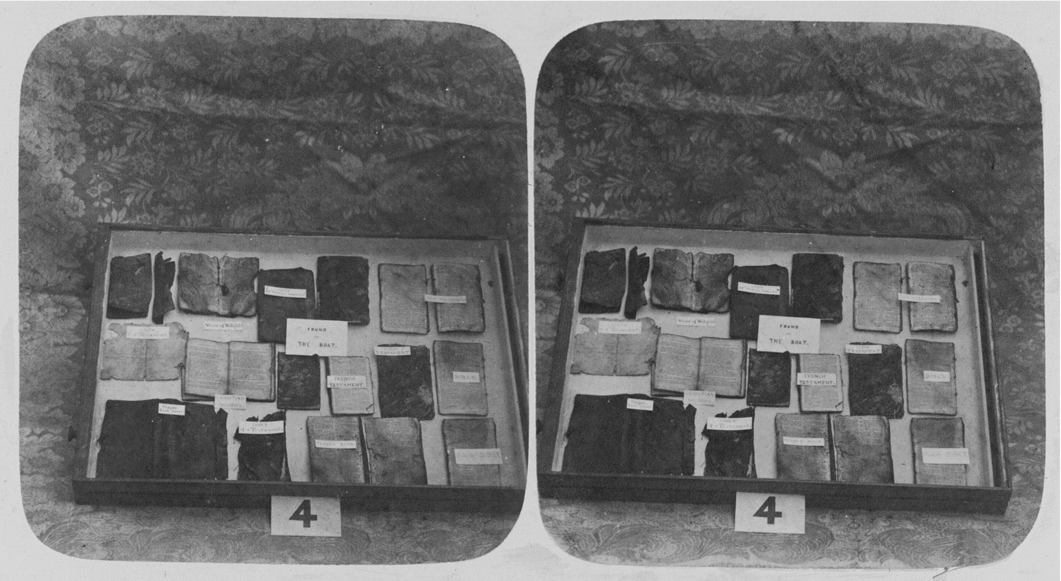
Franklin's allies put forward as the value of the disaster two, mutually-reinforcing, epic narratives of self-sacrifice – Christian and scientific – in which the lost men were “martyrs in a noble cause,” even a “holy cause” according to the head of the RGS.Footnote 20 According to a Religious Tract Society exhibition reviewer, Parry and Franklin deserved praise not for “promoting the progress of geographical discovery,” but for their active support of missionary evangelical Christianity in the Arctic (where British exploration and trade had historically lacked a significant missionary dimension).Footnote 21 Despite “the scientific apparatus forming a conspicuous portion of these interesting remains,” it was McClintock's Case IV (Figure 5), the religious books, that cheered this evangelical spectator: “The only errand that will justify men in again penetrating these inhospitable regions is that of the Christian missionary” (“Franklin Relics” 4, 6, 5). Unlike the “relics of silver and gold, and the perishing things of time,” agreed a Christian account of McClintock's search, it was the distressed and underlined Bible that alone “speaks comforting words to you and me” ([“S.T.C.”] 189). The ruined Bibles and prayer books remain today evocative memorials to fugitive suffering, but they are so damaged by their ordeal as to be largely illegible and unopenable. As unique examples of books as objects, their ability to speak comforting words is amplified by their physical disintegration, their distended leather bindings and bloated pages, synecdoches for the absent bodies of the dead crew.Footnote 22
John Cheyne, Case 4, Fourteen Stereoscopic Slides of the Franklin Relics (London, 1860). Reproduced with permission of the Scott Polar Research Institute, University of Cambridge.
Jane Franklin watched closely as the new visual medium of the stereoscope threatened to recommodify the relics, and wanted to restrict photographic access to McClintock's relics.Footnote 23 The USI where McClintock's relics were first displayed was a venerable military institution in Whitehall, where spectators paid for tickets and the objects were housed with all the solemnity befitting their public status as sacred relics. Cheyne's stereographs, on the other hand, were a new entertainment technology peaking in popularity in 1860, when an estimated 100,000 stereocards were in stock at the London Stereoscopic Company, and nearly one million stereoscopic viewers had sold. The most significant nineteenth-century visual form after photography, the stereograph was designed primarily with the effect of tangibility in mind according to Jonathan Crary: “the most intense experience of the stereoscopic image coincides with an object-filled space, with a material plenitude that bespeaks a nineteenth-century bourgeois horror of the void” (125). Tangibility produced the desirable effect of possession, so that objects seen in stereographs joined the cluttered interiors of fashionable Victorian drawing rooms, a bourgeois version of the opulence of earlier pronkstilleven. Cheyne's stereographs removed McClintock's objects from the narrative of heroic suffering carefully staged at the USI, and into middle-class homes, to be enjoyed or ignored like any other bric-à-brac.
Controlling the possession of the relics, whether optically via a stereograph, textually through a catalogue, or physically through relic hunting on a search, would prove increasingly vexing to Jane Franklin and her allies after 1859. Cheyne, alongside other Franklin entrepreneurs like William Parker Snow, Elisha Kent Kane, and Charles Francis Hall, represented the new species of professional “explorer” for whom costumed lecture tours (and relic displays) were critical to raising income.Footnote 24 Hall would raise this self-dramatization to a new level, returning from his first privately-funded Franklin search in 1862 with a cache of three-hundred-year old Martin Frobisher relics and an Inuit couple, Tookoolito and Ebierbing. Hall's popular lecture tours, displaying both Inuit and relics, included a stint with Barnum's American Museum, precisely the commercialized direction of relic display dreaded by Jane Franklin (see Potter 168–80).
On his next Franklin search, Hall returned from King William Island in 1868 with more Inuit accounts of cannibalism, as well as more relics and one set of human remains. But by then such revelations of scattered unburied remains, and verbal and material witnesses to the slow death of Franklin's men, exceeded any patriotic, affective, or fundraising purposes that the relics had served for Franklin's allies throughout the 1850s. Jane Franklin tried ceaselessly to “cross-examine” and censor the subsequent published revelations of Hall and others, confiding in her 1867 journal of her “dread of future heart rending revelations whether true or false.”Footnote 25 “Mystery” had been the watchword of the searchers in the 1850s, overtaken after 1859 by disaster. From both Jane Franklin's and the Admiralty's perspectives, the Franklin relics had proved so popular that the problem from now on would be how to control future searches, their agents and objects, not how to generate them.
Souvenirs of Death: The Absent Remains
One conspicuous absence from the Franklin relic collections, before Hall's repatriation of one skeleton in 1868, is that of human remains. While remains are largely ignored in public Victorian discussions of the relics and in modern scholarship, searchers from 1850 onwards examined and sometimes collected bones for later analysis (to determine whether they were Inuit, British, or nonhuman) and some of these bones joined the early relic displays. Interest in examining and collecting human bones was unremarkable, given that “[i]n Britain, collecting human bones was a kind of mid-Victorian mania, shared by amateurs and professionals alike,” eager to classify ancient British peoples, like exotic primitives, within the emerging racial sciences (MacDonald 96; see also Ruth Richardson). But displaying the human remains of esteemed British contemporaries in a secular, scientific, or entertainment context, would have posed unusual problems. A close comparison might be medical displays and dissections, but their subjects were tainted with criminality, destitution, or abnormality. Remains of Franklin's men were not specimens of medical anomalies or exotic cultures, understood to represent medical or ethnological knowledge. How then could bones that may have belonged to such heroic contemporaries be included as objects on display?
The McClintock expedition's discovery of the disordered “Boat Place” on King William's Island, where scattered bones were found belonging to men who had dragged hundreds of pounds of weight in the wrong direction, provided the sole instance of a breach of decorum in representing human remains, in a Harper's Weekly illustration showing two unburied skeletons (see Potter 149–67). But the hitherto unexamined field journals of the sledge parties that discovered the “Boat Place” are more distressing than the sensationalism of the Harper's illustration, or the reverential language of McClintock's Voyage, both of which remained within their respective aesthetic conventions. First on the scene was Lieut. Hobson, who described matter-of-factly the numerous disturbed bones within a larger survey of the boat's contents, telling how he used a pickaxe to remove the bones.Footnote 26 The violence of his excavation shredded the frozen clothing attached to the remains, he wrote, severing the stockings and gloves which still contained feet and hand bones. The public and the families were spared such painful details of the destructive work of re/searching, but everywhere the rescued relics went they evoked these broken and abandoned bodies with which they had been intertwined.
The subject of repatriation, interment, and exhibition of human remains in Franklin's context is unusual, as today we frame these questions in terms of indigenous remains and Western museums, with indigenous, curatorial, and scientific discourses differing starkly.Footnote 27 But in Franklin's context, these constituencies often referred to the same people – Franklin's crew, their collectors and exhibitors, were all part of the same naval culture of scientific exploration. Complicating matters was the entanglement of British remains and relics with Arctic people and places, so much so that metropolitan authorities had real difficulty in classifying not only objects but also their owners.Footnote 28
In their quest to identify Franklin relics and remains, British searchers systematically ransacked Inuit graves, inuksuit (complex stone markers), and homes, without verbalizing discomfort in their published accounts. They simultaneously lamented the disorder of the British human remains and the destruction of their relics, cairns (British stone markers), and papers, blaming Inuit “pillaging” and disrespect for the sacredness of the British dead. For the British, searching for disaster relics meant neither searching for artifacts from an exotic culture (though they collected these on the side), nor from their own culture's past: they encountered instead the troublesome intermingling of two contemporary sets of artifacts and remains, Inuit and British. These were parallel observations in many British search accounts – the British disturbance of Inuit sites and remains, and the presumed Inuit disturbance (and ubiquitous “pillaging”) of British sites and remains. The British did not speak to how these counterpoised actions, agents, objects may have reflected on, related to, or mirrored one another. The potential symmetries presented in their published accounts were greeted with silence.
The silence over the unprecedented problems faced in searching through British and Inuit human remains and artifacts, however, was incomplete and occasionally uncomfortable, a testament to the Franklin relics’ uniquely autoscopic dimension. The earliest Franklin objects retrieved – on or near Beechey Island from 1850 to 1854 – included bones thought at the time of collection possibly to be human, quietly brought back to London and sent to William Parry and John Richardson, to identify if they were Inuit, European, or animal (the latter, decided Richardson).Footnote 29 What we know is that in initial correspondence in 1850, these bones were assumed to be human, and were later identified in correspondence as hog, ox, sheep, walrus, caribou, and seal bones in Richardson's analysis, but their present whereabouts are unknown.Footnote 30 What became of these bones, which subsequently several officers and Jane Franklin tried to locate and reexamine as they circulated through Admiralty networks, remains today a mystery. As we shall see, the mystery is sharpened by the probability that some of these bones were put on display with the other Franklin relics in museums, labeled simply and suggestively as “bones.”Footnote 31
While the collection or repatriation of British bones was not a publicly sanctioned component of the early Franklin searches, it went on quietly at the same time as the ransacking of Inuit graves described above, and the momentous discovery, in 1850, of three graves of Franklin expedition members on Beechey Island. From that point on, Beechey Island in Lancaster Sound became the logistical center of the early Franklin searches (and their leisure center, the site of the ice Crystal Palace), because that is where a large Franklin expedition camp was discovered, including a seven-foot tall stack of tin cans, piles of discarded clothes, and three neat graves complete with inscribed headstones. One of the graves had been carefully decorated with seashells and nearby a garden plot of anemones was still visible, capturing the sentimental imagination of Britons back home. These graves contain the only remains found that had received a proper burial and whose identities are certain; they became the iconic image of the Franklin disaster in the nineteenth century, inspiring poetry and painting, and in the last few decades the graves have become a popular tourist pilgrimage site.Footnote 32 Recent touristic interest in Beechey Island is in large part due to a series of exhumations of the remains in the 1980s, led by Canadian forensic anthropologists seeking medical clues to help explain the deaths (lead poisoning was their hypothesis). Their results were popularized in Beattie and Geiger's Frozen in Time (1987), with its graphic photographs and cover showing the well-preserved corpses in the Beechey Island graves.
But in fact, in 1852 searchers had already attempted to exhume surreptitiously one of the Beechey Island graves to determine cause of death. After five hours of pick and shovel work in the frozen ground, Inglefield reached the coffin lid in one man's grave but was unable to open it, taking a piece of cloth and copper sheeting as souvenirs as “no relic had been laid with him”; Inglefield reported this confidentially to the Admiralty's Barrow, Jr., “as the prejudices of some people would deem this intended work of charity sacrilege.”Footnote 33 Inglefield's published account, A Summer Search for Sir John Franklin, did admit to searching “native graves” (51), but only in his unpublished letters did he confess to “disintering [sic] the dead & pulling down cairns without finding the slightest traces of Franklin.”Footnote 34 Barrow, Jr. provided the Franklin searchers with lists of Inuit and natural “curiosities” he wished collected, with Inglefield among his most determined collectors, as we saw earlier. Aboard the Intrepid in Greenland, this side trade in indigenous artifacts had taken a harrowing turn when the Inuk guide enlisted to help discovered that one of the graves ransacked belonged to his father: “The poor fellow began to make a terrible do, crying on,” wrote the commander in his private journal, and insisted that the British return the grave goods “very carefully by the side of his poor father.”Footnote 35 In rare examples such as these, of searchers sequestering painful details in the naval archives, the self-reflexive symmetries of these twin projects of collecting Inuit and British grave goods/relics, appear briefly visible to the Victorian searchers.
Such “sacrilege” may have extended to the uncontrolled circulation of Franklin disaster remains, which could have ended up displayed in museums and lecture tours. William Parker Snow, who had served aboard an 1850 Franklin search, published in 1858 an unofficial catalogue of all the Franklin relics concurrently displayed in three different institutions (British Museum, United Service Museum, Painted Hall), in anticipation of McClintock's imminent return. In his catalogue, Snow included bones in the objects displayed in the United Service Museum collection of “Arctic Relics”; while any other bones included in the ethnological sections are identified as belonging to animals and/or having specific uses (e.g., “bone implement”), these bones are only identified by their evocative location: “Bones found on Beechey Island.”Footnote 36 Placed in cases 1 and 2, “Bones found on Beechey Island” were obtained by expeditions led by Belcher, Kellett, Austin, and Pullen, who between them commanded eleven ships between 1850 and 1854 (Snow, Catalogue 26–27). Whatever the nature of these displayed “Bones found on Beechey Island” may have been, Snow's Catalogue cannily located their origin in the most sacred site associated with Franklin deaths.
Bones that might have belonged to heroic British contemporaries would have been taboo within Victorian exhibitions, yet here they were in the United Services Museum, collected years earlier, subjected to forensic inquiry, private discussions, and remaining on exhibit at least until 1858. The catalogued bones were not private mementoes acceptable within Victorian grief culture, which included hair and small personal effects like gloves and buttons, similar to many of Rae's relics. Neither were they comparable to the bones that visitors could have seen on a tour of the Waterloo battlefield, where they may have purchased fabricated relics and seen unburied bodies, as Scott and Byron famously did; or on a visit to what Robert Southey called “the most remarkable modern relic” of military heroism: Lord Uxbridge's amputated leg, buried beneath a tombstone in Waterloo and drawing scores of patriotic British tourists.Footnote 37 But how would they have compared to the objects (including bone implements) in the Inuit ethnological collections connected with the Franklin relic displays described in Snow's catalog, or more pointedly, to the indigenous remains featured in Victorian ethnological collections, the subjects of so much modern controversy?
Severed from their subjects and from any narratives of Christian or military sacrifice, these bones that Franklin searchers collected and apparently displayed, disappeared once McClintock returned to reveal that they were part of a much larger collection scattered across the Arctic. Bones collected in this particular way from the Franklin disaster sites (seemingly lacking in military, ethnological, antiquarian, or saintly signification, of unknown species and potentially belonging to unnamed subjects), would open up questions of what even constitutes an “object” in such a radical way, that one could understand the official silence over such forbidden Franklin relics from that point on, with virtually no public discussion of what was to be done with the abandoned remains.
When brought to England, “souvenirs of death” is what Snow's bones became, and as Susan Stewart argues, these modern objects inaugurate the curse: “In contrast to the restoration offered by such gestures as the return of saints’ relics, these souvenirs mark the end of sacred narrative and the interjection of the curse” (140). Lacking the power of saintly relics to revert from object to subject and back, such souvenirs of death disappeared from the textual and visual record because there was no epistemological, aesthetic, or exhibition space in which they could exist.
One victim of this curse was Snow himself, who would continue to eke out a living as a lecturer, displaying not native people, but relics he collected on Beechey Island and those he claimed (unreliably) to have obtained from the boat in King William Island.Footnote 38 Snow would tell increasingly wild conspiracy stories regarding government cover-ups, supernatural encounters, and abandoned survivors. Snow's dedication to spiritualism and increasing paranoia, gave his lifelong search for Franklin, and the objects and remains associated with this search, an unorthodox sacral dimension otherwise muted in the authorized Franklin exhibits. He formed his own abortive “People's Expedition” to find Franklin's journals, had lined up Bentley to be their publisher, and was an embarrassment to the Franklin circles. He began repeatedly an “Arctic Encyclopedia” on such a minute, Borgesian scale that though he filled entire notebooks he never completed the letter A, becoming visibly overwhelmed by entries on Abandonment, Accident, and Accursedness.Footnote 39 Snow's personal disorder differs only in degree from the acceptable responses solicited by the cult of the Franklin relics, a testament to the powers of these souvenirs of death.
Confronted with piles of garbage, broken equipment, exposed bones, and even excrement, all of it visually unrepresentable, McClintock and subsequent expeditions increasingly focused on representing their own textual markers and monuments, often by destroying Inuit stone structures and transforming them into familiar British stone monuments known as “cairns.” A widely reproduced illustration in the ILN, showing McClintock's crew opening the Franklin expedition cairn containing the Victory Point Record using pickaxes, assumed such significance because it had to stand in for the loss of a host of corporeal fragments impossible to identify, repatriate, or, most importantly, represent.Footnote 40 The Boat Place relics, frozen solid with human remains, had been similarly searched by pickaxe, as had many Inuit graves. But again the public focus was repeatedly redirected to the sole textual body (the Victory Point Record) and its violent liberation from the Arctic archive. This shift in focus from the profusion of material objects and remains, to textual bodies of inscription after 1859, began to transform the Arctic into a familiar kind of built environment, legible to future European visitors.
The Absent Records: Schwatka's Search
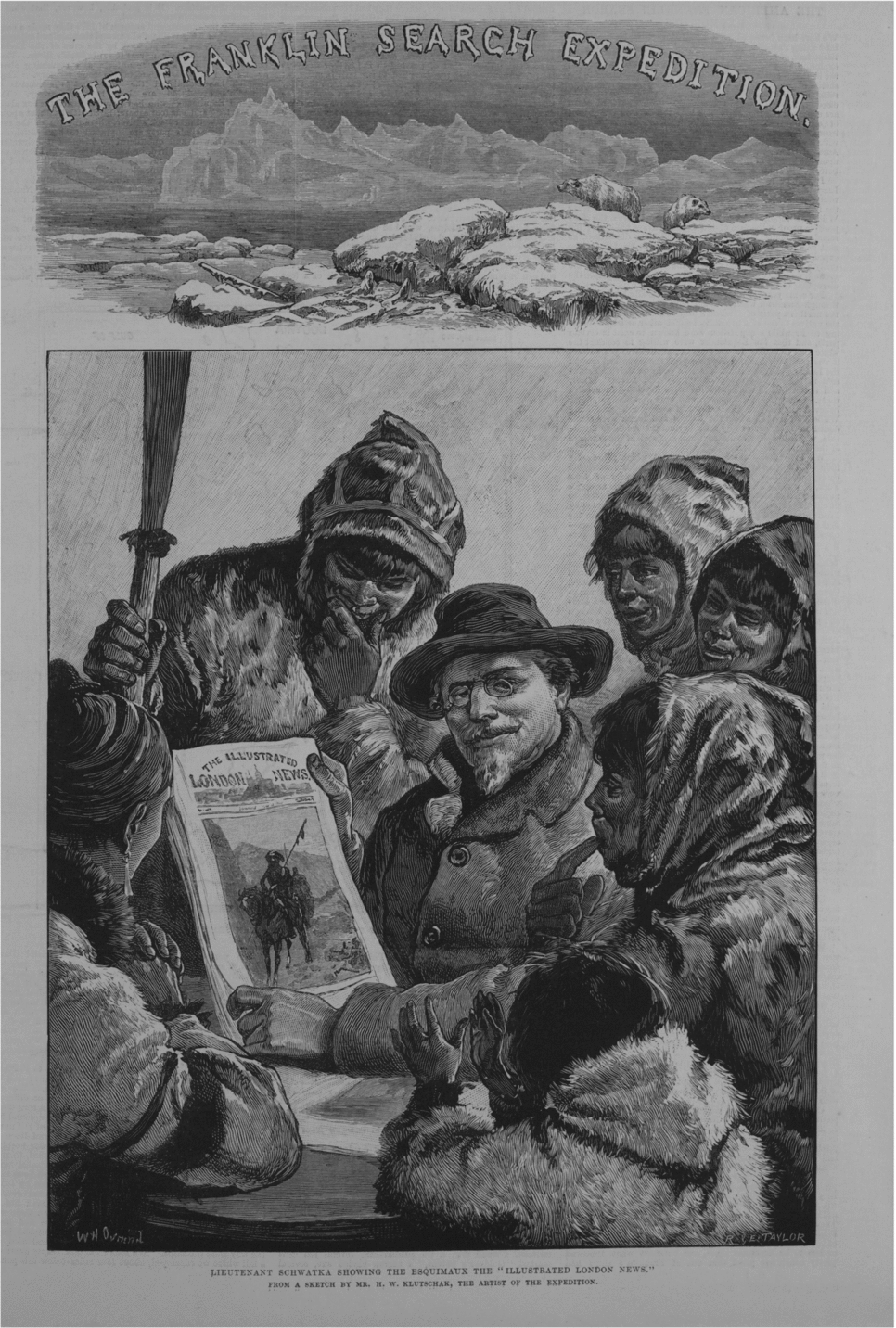
I turn now to one of the innumerable “final” searches for Franklin relics, the American Geographical Society expedition of 1878–80 sent specifically to find Franklin's journals. Led by Frederick Schwatka, this expedition included the New York Herald journalist William Gilder and the Bohemian artist Heinrich Klutschak, and was made possible by eleven Inuit from Repulse Bay. When they failed to find the Franklin papers, Schwatka's expedition achieved a new kind of negative discovery – not failing to find the Northwest Passage, the subject of most narratives of Arctic exploration, but failing to find the narrative of the explorers who failed to find the Passage. According to Gilder's authorized narrative, titled Schwatka's Search, theirs was “the first expedition which established beyond a doubt the loss of the Franklin records. McClintock recorded an opinion that they had perished: Schwatka recorded it as a fact” (xi). Arguably, Schwatka's real “first” had been establishing a greater degree of direct involvement between print media and exploration, as proudly displayed in the 1881 Illustrated London News’ meta-image of Schwatka showing Inuit a copy of the ILN (Figure 6). Describing their discovery as “recording” the absence of the Franklin records, while on the trail of absent men seeking an imaginary place (the Northwest Passage), actually elevates Schwatka's “discovery” to that of a third-order absence, a genuine achievement.
“Lieutenant Schwatka Showing the Esquimaux the Illustrated London News,” Illustrated London News (1 Jan. 1881): 17. © Illustrated London News Ltd/Mary Evans Picture Library.
One episode from Schwatka's Search in particular illustrates why written texts displaced corporeal bodies as the object of the Franklin searches by the end of the century. Searching for Franklin's papers, the Americans learned from an Inuk elder, Tuktutchiak, and her son, of how their family had earlier discovered a cache of books, papers, and bones. Gilder recounts the son's testimony:
he saw books at the boat place in a tin case, about two feet long and a foot square, which was fastened, but they broke it open. The case was full. Written and printed books were shown him, and he said they were like the printed ones. . . .He also saw bones from legs and arms that had appeared to have been sawed off. Inside the boat was a box filled with bones; the box was about the same size as the one with the books in it. . . .
Some of the books were taken home for the children to play with, and finally torn and lost, and others lay around among the rocks until carried away by the wind and lost or buried beneath the sand. (Gilder 106–07, 108)
Remarkably, all three written accounts of this search – Gilder's, Schwatka's and Klutschak's – (and many reviews) record only their interest in the box of books, not the box of limbs.Footnote 41 As Schwatka wrote, “We questioned her several times on the one fact which had claimed all our attention. Was there a box, containing books of white man's writing?” For Schwatka and Gilder the sawed off limbs were beneath the threshold of interest, so driven are they “to complete the annals of Arctic exploration” with Franklin's writings (Gilder vii).
Schwatka's search lingered over the disturbed remains and cannibalism evidence, and documented their extensive reinterment efforts and memorial building, even their repatriation of one set of human remains. In a private letter to Schwatka, McClintock had admitted the possibility of cannibalism, but urged Schwatka to suppress such public discussion because “its publication could not fail to cause very great pain to surviving relatives and might even do possible harm in similar cases of extreme privation.”Footnote 42 Even Schwatka's open dealings with the handling of remains, especially their repatriation, offended the British because this highlighted how many bodies remained unburied. “It would have been in much better taste if these Yankee ghouls had left the bones alone,” lamented Clements Markham, such disclosures being “garbage of the most disgusting kind.”Footnote 43 A mere “heterogeneous collection” is how McClintock dismissed Schwatka's relics, though the objects were indistinguishable from those he brought home twenty years earlier; “nauseating rubbish about every fragment of old stocking, or preserved meat tin that they found,”Footnote 44 agreed Markham. And reviewers now had to defend the public interest in Schwatka's “gathering of a large quantity of relics” from the charge of “morbid curiosity” (Arcturus 55). By 1880 the aura of the existing relics diminished each time more objects crossed the Arctic Circle, from London commodities, to Arctic rubbish, and onward to London artifacts.
While the piles of rubbish grew, the number of legible texts held steady at one, the Victory Point Record, the document annotated by Franklin officers and found by McClintock. The increasing rarity of this unique legible text in relation to the profusion of illegible objects explains why Franklin search narratives display a preoccupation with recovering writings of any kind and on any thing. Simultaneously, the searchers’ dismay over the Inuit disregard for such verbal inscriptions and interest in collecting only certain material objects (a source of dismay in many search narratives), hint at their growing awareness of the Franklin disaster's origins in British ethnocentrism and technological inadequacy. That is, given that the Inuit collected only certain material objects (knives, copper, iron, wood) and were indifferent to or discarded books and papers, perhaps the British were interested in the wrong sorts of objects and failed to understand the proper use of the right ones.
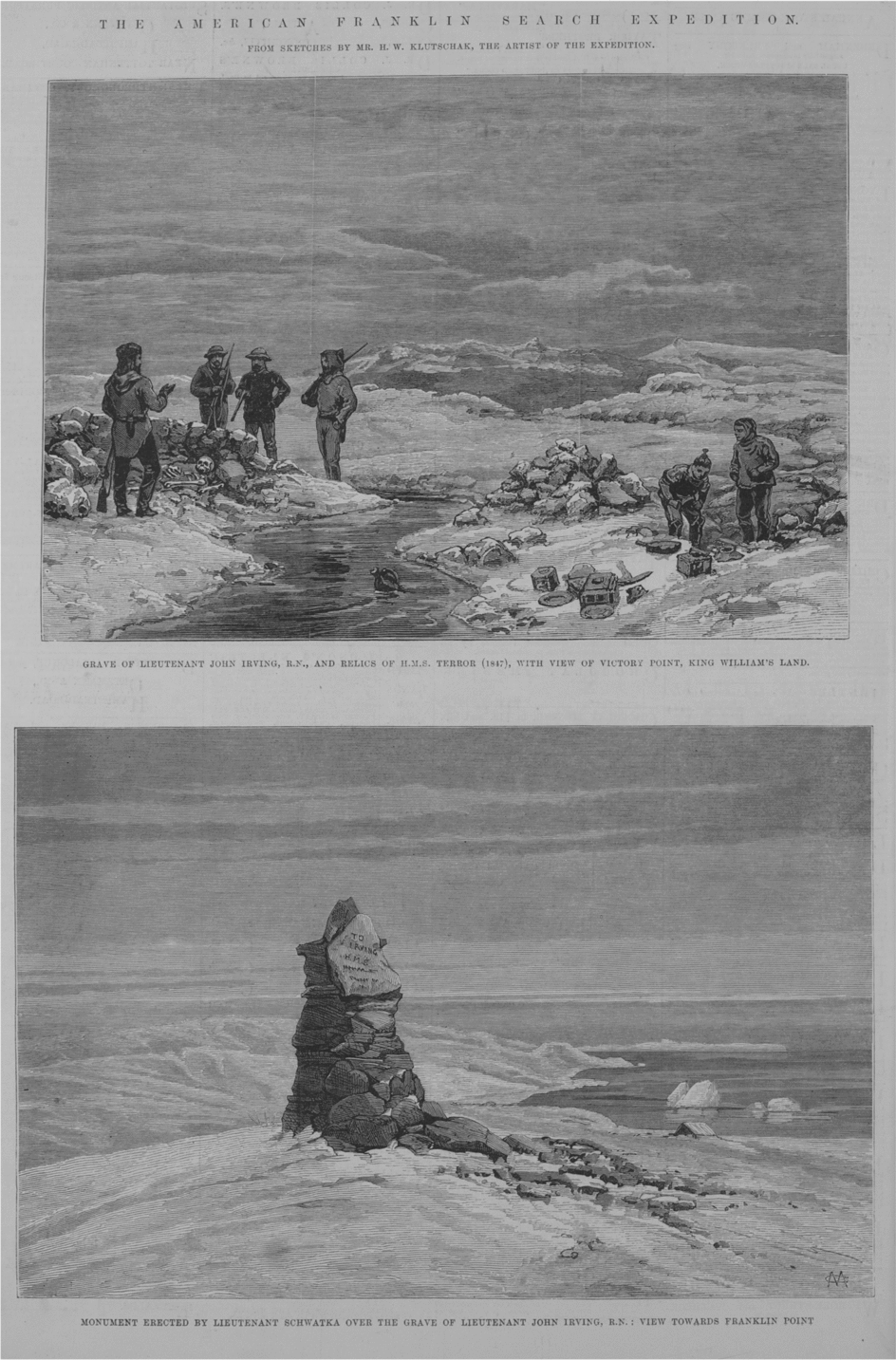
Here Klutschak's illustrations are valuable because he was exceptionally self-aware in his relationships with the Inuit. Klutschak's illustration engraved in the ILN showing the expedition discovering the remains of Lieut. Irving starkly differentiated Inuit and European collecting (Figure 7): we see the upright Europeans deliberating over the exposed remains and personal relics with potential for metropolitan audiences, while the Inuit look over the implements with practical uses in the Arctic, a version of the foundational colonial myth of “the fatal attraction of European goods” (Thomas, Entangled 85). But in separating these people, places, knowledges, and objects, Klutschak ironically visualized the main cause of European Arctic disasters. His own book (Als Eskimo Unter den Eskimos/As an Eskimo Among Eskimos, 1881) put forward one of the most influential cases for European voyagers adopting Inuit knowledge and technology. The engraving from Schwatka's Search pictured simultaneous but incommensurate discoveries in separate spheres, those of culture and nature. But the verbal narratives told of the near complete European dependence on their Inuit guides, who often found the most significant relics and sites, and shared with the Europeans the skills and knowledge for which Schwatka's expedition would become famous.
“Grave of Lieutenant John Irving, and Relics from HMS Terror”; “Monument Erected by Schwatka Over the Grave of Lieutenant Irving,” Illustrated London News (1 Jan. 1881): 24. © Illustrated London News Ltd/Mary Evans Picture Library.
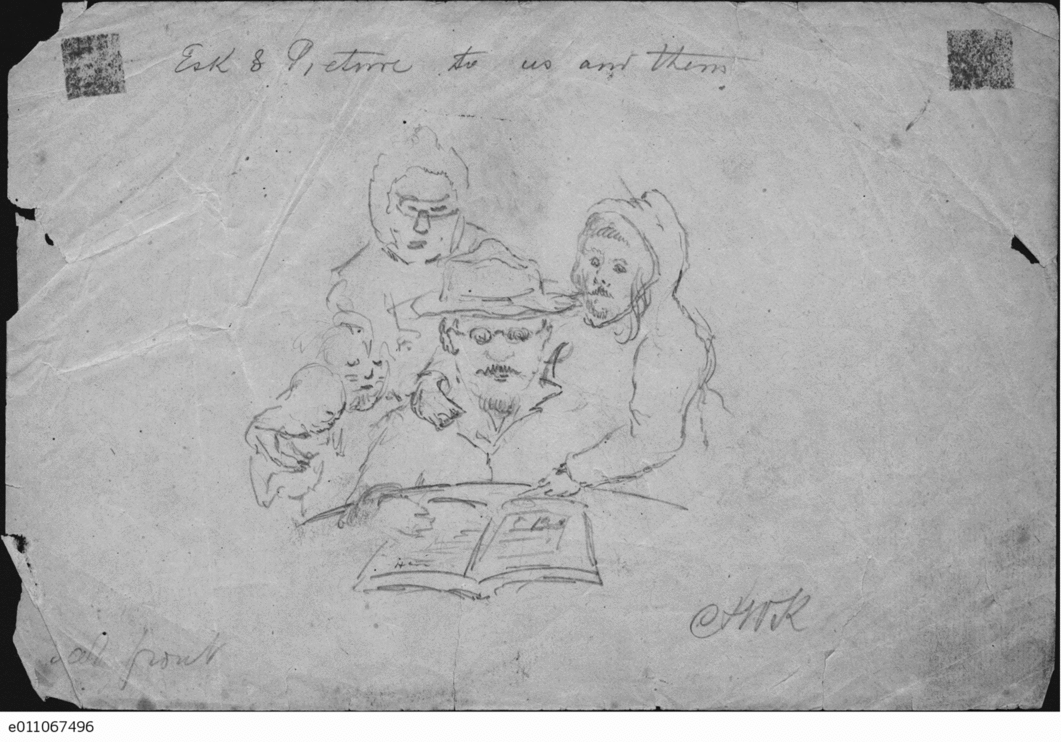
This Victorian elevation of the printed page to the most advanced and truly global technology takes a surprising turn if we look more carefully at the Schwatka metapicture in the ILN (1 Jan. 1881). The previously unidentified ILN issue with which Schwatka presents the Inuit is dated 28 Dec. 1878, featuring the British victory in the Battle of Ali Musjid on the Khyber Pass. The ILN “metapicture” presents an eloquent example of the arrogance driving Britain's global empire, but Klutschak's original sketch presented a strikingly different “dialogue of discourse and vision” regarding Schwatka's importance relative to the Inuit, and of the importance of print as bearer of civilization (Mitchell, Picture 70). His original sketch shows a sitting Schwatka, with downcast eyes, watching as a standing adult Inuk points to a document, his arm protectively around Schwatka's neck (Figure 8). Schwatka is a central figure as in the ILN, but he is at the same level as two Inuit children in the sketch, receiving instruction from two adult Inuit. The ILN metapicture reduced the encounter to a triumphalist lesson in Anglocentrism, losing the nuances of Klutschak's knowing demotion of his commanding officer's, and his culture's, privileged form of knowledge.
Heinrich Klutschak, pencil sketch. Courtesy of Library and Archives Canada (accession no. 1993-447-46).
Klutschak's careful observations extended to the diverse stone structures made by Inuit and their predecessors that featured prominently in nineteenth-century expedition accounts (to my knowledge his was the first European account to use Inuktitut names to distinguish between types of Inuit structures (24–25).Footnote 45 In Britain, a cairn (carn, in Gaelic) is a heap of stones associated chiefly with the Scottish Highlands, serving either as ancient grave marker, wayfinding landmark, or both (see the example in Figure 7, the lower image of the cairn erected as a gravemarker over the remains of Lieut. Irving). Since the eighteenth century a popular subject of antiquarian study and of the sentimental imagination, cairns are dynamic monumental forms that can be invested with significant affective power (Basu). Inuit stone structures are more varied than are cairns in the British isles, and included grave markers, food storage caches, and the more complex structures known as inuksuit (“acting in the capacity of a person,” in Inuktitut) that often incorporated spiritual and navigational significance, and were linked in networks spanning hundreds of miles (see Hallendy, Heyes). Inuksuit are specialized in form and function, including an anthropomorphic type (inunguaq, “in the image of a person”) that is today a globally familiar image of the Canadian Arctic and the Inuit thanks to its controversial adoption as the emblem of the 2010 Winter Olympics.
Europeans in the eastern Arctic had noted in their accounts the presence of inuksuit from the early modern era onwards, with interest growing in the nineteenth-century visual culture considered here. Franklin searchers described all Inuit stone structures uniformly as “cairns” and (with the exception of Klutschak) demonstrated no curiosity in their informational, navigational, spiritual, or aesthetic dimensions as they demolished, repurposed, or represented them. For our purposes here, the Anglo-British destruction and repurposing of Inuit structures (graves, food caches, and inuksuit) is significant in the ways they incorporated some of the Inuit aspects within their own cairns; they stored food and archived their written messages (like the Victory Point Record) within them, and often featured their own cairns as the subjects of their illustrations and topographical views.
Whereas in Africa and South America Europeans had used stone monuments as technologies of navigation and colonization, in the Arctic the British destroyed centuries-old networks of inuksuit in order to mark the landscape not with an eye towards colonial settlement, but disaster tourism. Akin to the commercialized plunder of the Waterloo battlefield, the “sight sacralization” (MacCannell) of the Franklin disaster sites was accomplished through a similar process of physical and textual inscription. This process razed a visible component (inuksuit) of Inuit Arctic occupancy that had been built over the course of centuries, while once again entangling Inuit technology into some of the most photogenic materials of European exploration culture.
Schwatka's search for Franklin's journals was unsuccessful, but it succeeded in popularizing the sport of Franklin relic hunting by describing in detail the profusion of bones, wreckage and inuksuit that they methodically re-landscaped into a vast Christian cemetery. Klutschak even provided a map of the disaster scene in his narrative, “Der Schauplatz der Franklinischen Katastrophe” (“The Scene of the Franklin Catastrophe”) (Figure 9), with inset picturesque topographical views that all feature newly erected cairns. England's dead transform the Arctic into a green and pleasant land, while conveniently mapping the sites of disaster for future relic hunters, complete with new European landmarks built from ruined inuksuit. In the topographical view for Victory Point (featured earlier in Klutschak's illustration of the incommensurate Inuit and European discoveries of exposed remains and relics of a Franklin crewman, Figure 7), Klutschak's “dreamwork” of catastrophe showed as a memento mori an exposed skull still peeking above ground in 1880, a solitary token of undiscovered souvenirs awaiting future disaster tourists in this Arctic Arcadia (Mitchell, “Imperial” 10).
Heinrich Klutschak, “Der Schauplatz der Franklinischen Katastrophe” (“The Scene of the Franklin Catastrophe”), in Klutschak, Als Eskimo unter den Eskimos (Leipzig, 1881). The British Library Board.
Conclusion
Since 1880, when Britain ceded the Arctic archipelago to Canada, the Canadian government has funded numerous searches for Franklin's relics, elevating searching for Franklin to “a major outdoor sport in Canada's North” (“Northern Highlights” 225). While Victorians had filled the void into which Franklin disappeared with a jumble of objects, today that void has outgrown the museum spaces that these objects can fill. In 1992 Canada added the unknown wreck site of Franklin's Erebus and Terror to their National Historic Sites register, the only such site without a location; in 1997 Canada and Britain signed a Memorandum of Understanding giving Canada the right to salvage and display the as-yet-unfound Franklin ships and relics. How to map this placeless place, manage its intangible relics, and present its heritage value to indigenous and Anglo-European communities, remains the subject of ongoing discussions within Canadian governmental and public circles.
In 2010 Canadian searchers located of one of the early Franklin search ships, McClure's Investigator, a discovery that the government described as “fundamental to Canadian sovereignty” in the Arctic. In 2012 the official Canadian search included six government agencies and embedded journalists aboard the icebreaker; they resumed their search in 2013 and are expected to do so again in 2014. The search for Franklin, and the sport of not finding Franklin, centers around a productive absence with so much dynamic significance, that it has propelled the Franklin disaster into new spheres of geopolitics (specifically, Franklin's ships may be relevant to questions regarding the Northwest Passage's status as historic internal waterway, and to its potential inscription as a UNESCO World Heritage Site; see Craciun, “Franklin Mystery”). In the ongoing searches for Erebus and Terror, Inuit searchers play high-profile roles, as do Inuit oral histories. As one prominent Inuk searcher, Louis Kamookak, says “My biggest feeling is that Franklin was left to be found. He's waiting to be found” (qtd. in Eber 135). Whether in the legendary burial “vault” of Franklin himself, which some believe contains his journals, or in the countless cairns, boats, and boxes found and lost since the 1850s, the idea of the Franklin relics and records as archived and awaiting rediscovery continues to play a significant role in a wide range of claims made upon, and voyages made in, the Arctic.