Introduction
Preeclampsia (PE), a pregnancy-specific diseases, is characterized by hypertension and proteinuria after 20 weeks (Tang et al., Reference Tang, Gui, Wu and Wu2019). To date, PE has become one of the leading causes of both maternal and neonatal morbidity and mortality (Mol et al., Reference Mol, Roberts, Thangaratinam, Magee, de Groot and Hofmeyr2016). Severe PE is associated with preterm birth, fetal distress, stillbirth and neonatal asphyxia (Zhong et al., Reference Zhong, Zhu and Ding2019). Despite extensive research, conventional therapeutics for PE are still not satisfactory and pathogenesis of the disease has still not been fully addressed (Zhong et al., Reference Zhong, Tuuli and Odibo2010). There is still a lack of adequate and accurate diagnostic approaches or biomarkers for PE (Dong et al., Reference Dong, Zhang, Ma, Gao, Tang, Jian and Ma2019), therefore, it is vital to develop early diagnosis markers and valid therapy for PE patients in clinical settings.
A substantial body of evidence has demonstrated that development of PE is a multifactorial process including abnormal angiogenesis, placental and endothelial dysfunction, increased apoptosis and impaired invasion of trophoblast cells (Xie et al., Reference Xie, Jia and Li2019). Dysfunction of trophoblast cells has emerged as a vital factor in PE pathogenesis (Fan et al., Reference Fan, Li, Gao, Dong, Xin, Chen, Qiu and Xu2019). EMT has been identified as playing a key role in the regulation of cell migration and invasion (Mao et al., Reference Mao, Xiao, Li, Zheng and Zhang2018). Accumulating evidence supports the idea that inadequate migration and invasion of cytotrophoblasts into the uterine artery can lead to placental ischaemia and reduce utero-placental perfusion (Redman and Sargent, Reference Redman and Sargent2005). Therefore, EMT is an important factor involved in underlying mechanisms of PE.
MicroRNAs (miRNAs) are a class of small noncoding RNAs of 20–22 nucleotides in length (Zhang et al., Reference Zhang, Li, Zheng and Huang2017). miRNAs negatively modulate gene expression through targeting the 3′-untranslated region (3′UTR) of their target mRNAs. Increasing evidence has supported the idea that miRNAs are associated with the metabolism and pathogenesis of many diseases (Bartel, Reference Bartel2018). In addition, multiple miRNAs in the placenta can regulate trophoblast cell proliferation, apoptosis, migration and invasion (Xiao et al., Reference Xiao, Tao, Yin, Zhao, Yang and Hu2017). More recently, work by Tong and colleagues suggested that miR-330-5p plays a vital role in human decidualization and the occurrence of PE (Tong et al., Reference Tong, Yang, Lv, Lv, Zhang and Chen2018). Upregulation of miR-330-5p could inhibit EMT processes and the capability for proliferation, invasion and migration (Liu et al., Reference Liu, Song, Liang, Hao, Zhang and Han2019). As hypothesized, miR-330-5p may participate in the pathological process of PE by regulating the proliferation, migration, invasion and EMT of trophoblast cells.
Long noncoding RNAs (lncRNAs), a subset of noncoding RNAs of more than 200 nucleotides in length, are involved in a large array of diseases including PE (Li et al., Reference Li, Zhang and Li2019a,b). A previous study has demonstrated that knockdown of lncRNA SNHG14 could significantly suppress cell proliferation, migration and invasion by regulating miR-206/YWHAZ (Ji et al., Reference Ji, Wang, Bao, Yan and Ji2019). However, lncRNA SNHG14 has not been identified to modulate the associated functions of trophoblast cells and PE development.
Collectively, the purpose of this study was to analyze and elucidate the effects of lncRNA SNHG14 and miR-330-5p in the regulation of trophoblast behaviour. This study will highlight the potential role and underlying mechanisms of SNHG14 and miR-330-5p in the development of PE, introducing novel targets for PE diagnosis and therapy.
Materials and methods
Clinical specimen collection
Patients diagnosed with PE were chosen for this study at Huai’an First People’s Hospital from 2018 to 2019. The present study was approved and authorized by the Ethic Committee of Huai’an First People’s Hospital. Blood samples were collected from 30 patients with preeclampsia and from 30 women with healthy pregnancies. Blood samples were immediately frozen and stored at −80°C for further study. All patients in the study submitted written informed consent forms and approved the study.
Cell culture and transfection
HTR-8/SVneo cells were obtained from the American Type Culture Collection (ATCC) (Manassas, VA, USA). Cells were cultured in RPMI 1640 medium (Gibco, NY, USA) supplemented with 10% fetal bovine serum (Cor., New York, NY, USA) and antibiotics (100 μg/ml streptomycin and 100 U/ml penicillin) in an incubator at 37°C in a 5% CO2 : 95% air atmosphere for regular maintenance. HTR8/SVneo cells were transfected with siRNAs purchased from Shanghai GenePharma, Co. Ltd (Shanghai, China) using Lipofectamine 2000 transfection reagent (Invitrogen, CA, USA) in line with the manufacturer’s instructions. Cells were then maintained for 48 h for further analysis.
Cell Counting Kit-8 (CCK-8) assay
Cell proliferation was assessed by CCK8 assay in line with the standard protocol. Here, 100 µl of cell suspension at a density of 5 × 10⁴/ml were incubated in a standard culture condition (37°C, 5% CO2 and 95% humidity) for 24 h, 48 h and 72 h. CCK-8 reagent (10 µl; Beyotime, Shanghai, China) was added into each well and applied to detect cell proliferation index. Absorbance at 450 nm was measured and read on a microplate reader (Hercules, CA, USA).
Cell-cycle assay
HTR-8/SVneo cells transfected with plasmids were collected and fixed with 75% ice-cold ethanol at −20°C overnight. Following washing with phosphate-buffered saline (PBS), the fixed cells were treated with propidium iodide (PI; Beyotime, Shanghai, China) at room temperature for 30 min. Then, cell samples were analyzed using a flow cytometer (BD Biosciences, CA, USA).
Wound-healing assay
Cell migratory ability was evaluated by wound-healing assay. For the migration assay, 1 × 10⁵ HTR-8/SVneo cells were seeded in six-well plates and cultured in a humidified incubator under 5% CO2 in air at 37˚C. Briefly, confluent monolayers of HTR-8/SVneo cells were mechanically wounded by dragging a 10-μl sterile plastic tip at the centre of the well. Cells were allowed to migrate for 24 h and the wounded images were photographed using a Leica microscope (Leica, Wetzlar, Germany) in the same position at 0 and 24 h after wounding.
Transwell invasion assay
Transwell assay was conducted using transwell chambers. The invasive ability of HTR-8/SVneo cells was evaluated based on the ability to cross the pores of migration chambers. Cells were cultured with fetal bovine serum (FBS)-free medium in the upper transwell chambers and the medium containing 10% FBS was added to the lower chamber as a chemoattractant. After incubation for 24 h, non-invaded cells in the upper chamber were removed using a cotton swab. Invaded cells in the bottom chamber were fixed in 4% paraformaldehyde and stained with 0.1% crystal violet. Cell invasive capacity was assessed by counting the number of invaded cells in five randomly selected microscopic fields under an inverted microscope.
RNA isolation and real-time quantitative PCR
Total RNA was isolated from HTR-8/SVneo cells using TRIzol reagent (Invitrogen, Carlsbad, CA, USA) and then reverse-transcribed using a PrimeScript™ reverse transcription reagent kit (TaKaRa Bio, Tokyo, Japan) in line with the manufacturer’s instructions. RT-qPCR was carried out using the ABI PRISM® 7300 real-time PCR system (Applied Biosystems, Foster City, CA, USA) in accordance with the standard instructions. The relative amount of lncRNA SNHG14 was normalized to glyceraldehyde 3-phosphate dehydrogenase (GAPDH) and the relative amount of miR-330-5p was normalized to U6 as internal controls. Gene expression data were calculated using the 2–ΔΔCt method (Livak and Schmittgen, Reference Livak and Schmittgen2001). Primer sequences were as follows: SNHG14-Forward: 5′-CAGGCTGAACTGAGGCAGGCAT-3′; SNHG14-Reverse: 5′-ACATCTCATTCTATAGTCAATGT-3′; miR-330-5p-Forward: 5′-TCTCTGGGCCTGTGTCTTAGGC-3′; miR-330-5p-Reverse: 5′-TTAATGGGGTGATTGGTGGT-3′; U6-Forward: 5′-CTCGCTTCGGCAGCACA-3′; U6-Reverse: 5′-AACGCTTCACGAATTTGCGT-3′; GAPDH-Forward: 5′-AAATCCCATCACCATCTTCCAG-3′; GAPDH-Reverse: 5′-TGATGACCCTTTTGGCTCCC-3′.
Western blot assay
After indicated treatments, HTR-8/SVneo cells were washed with ice-cold PBS and lysed in RIPA lysis buffer (Beyotime, Shanghai, China) supplemented with proteinase inhibitor. Total cellular proteins in the supernatants were determined by BCA assay, in accordance with the manufacturer’s instructions (Beyotime, Shanghai, China). Equal amounts of protein were loaded and separated by sodium dodecyl sulfate-polyacrylamide gel electrophoresis (SDS-PAGE) and transferred onto PVDF membranes. Membranes were blocked with 5% fat-free milk followed by an incubation at 4°C overnight with the following primary antibodies: CDK2 (Abcam, ab32147, 1:2000), P21 (Abcam, ab188224, 1:1000), cyclinD1 (Abcam, ab134175, 1:10,000), MMP2 (Abcam, ab181286, 1:1000), MMP9 (Abcam, ab228402, 1:1000), E-cadherin (Abcam, ab212059, 1:1000), vimentin (Abcam, ab137321, 1:3000), β-catenin (Abcam, ab6302, 1:4000) and GAPDH (Abcam, ab8245, 1:10,000). Membranes were washed and incubated with horseradish peroxidase-conjugated secondary antibodies (Abcam, ab205718, 1:20,000) at room temperature for 1 h. β-Catenin and GAPDH served as internal loading controls. Immunoreactive bands on PVDF membranes were visualized using a ECL detection kit (Beyotime, Shanghai, China) and protein intensity was measured with BandScan software.
Immunofluorescence staining
Transfected HTR-8/SVneo cells were rinsed with PBS and then fixed in 4% paraformaldehyde for 15 min at room temperature. Next, cells were treated for 30 min with PBS containing 0.25% Triton X-100 and 1% BSA and then blocked with 5% BSA for 1 h. Subsequently, cells were incubated with anti-E-cadherin (Abcam, ab231303, 1:1000) or anti-vimentin (Abcam, ab8978, 1:200) antibody overnight at 4°C. After washing three times in PBS, cells were incubated with fluorescence-conjugated secondary antibody (Abcam, ab150113, 1:1000) for 2 h in the dark. Finally, cells were stained with DAPI and analyzed under a fluorescence microscope.
Dual-luciferase reporter assay
The 3′UTR sequence of SNHG14 mRNA containing miR-330-5p binding sites and the corresponding mutated sequence were cloned into the pGL3 promoter vector (Realgene, Shanghai, China). HTR-8/SVneo cells were seeded in 24-well plates and cultured until 70% confluency. Afterwards, cells were co-transfected with miR-330-5p mimics and wild-type/mutant reporter plasmid vectors using Lipofectamine 2000 (Invitrogen, CA, USA). Following 48 h transfection, firefly luciferase activity was measured using a dual-luciferase reporter gene assay system (Promega, WI, USA) and normalized to the Renilla value.
Statistical analysis
All figures were performed using GraphPad Prism software (GraphPad Software, San Diego, CA, USA). All reactions were performed in triplicate and data were presented as mean ± standard deviation (SD). The statistical differences among groups were assessed by t-test or one-way analysis of variance (ANOVA) followed by Tukey’s post hoc test in SPSS 22.0 software. A P-value < 0.05 was considered to indicate statistically significant difference.
Results
lncRNA SNHG14 was downregulated in PE
To investigate the potential role of lncRNA SNHG14 in PE, expression of lncRNA SNHG14 in blood samples was determined by RT-qPCR. Results showed that the SNHG14 level in PE patients was visibly lower compared with that in blood from women with normal pregnancies (Fig. 1A).
lncRNA SNHG14 was downregulated in PE tissues. lncRNA SNHG14 expression determined by RT-qPCR. ***P < 0.001 versus normal pregnancies.

lncRNA SNHG14 was involved in sufficient trophoblast proliferation
To investigate whether lncRNA SNHG14 was involved in the regulation of trophoblast proliferation, HTR-8/SVneo cells were transfected with pcDNA SNHG14 and transfection efficiency was verified. lncRNA SNHG14 expression was greatly upregulated following transfection (Fig. 2A). Subsequent CCK-8 assay demonstrated that upregulation of SNHG14 markedly promoted cell proliferation in HTR-8/SVneo cells (Fig. 2B).
lncRNA SNHG14 was involved in sufficient trophoblast proliferation. (A) HTR-8/SVneo cells were transfected with pcDNA SNHG14 and RT-qPCR was applied to determine SNHG14 mRNA expression. (B) Cell proliferation detected by CCK-8 assay. **P < 0.01, ***P < 0.001 versus Control.

lncRNA SNHG14 regulated HTR-8/SVneo cell proliferation by G1/S transition
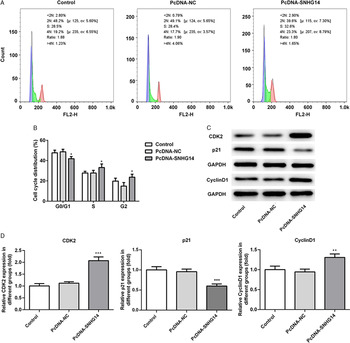
To determine whether lncRNA SNHG14 enhancement of the growth of HTR-8/SVneo cells was accompanied by an influence on the cell cycle, we assessed cycle distribution using flow cytometry. Compared with the control, the proportion of cells in S and G2 phases markedly increased and the proportion of cells in the G0/G1 phase dramatically reduced following SNHG14 overexpression (Fig. 3A, B). In addition, we explored the mechanism by which SNHG14 regulated cell proliferation by performing western blot analysis. SNHG14 overexpression caused a decrease in p21 level and an increase in cyclin D1 and CDK2 levels (Fig. 3C, D).
lncRNA SNHG14 regulated HTR-8/SVneo cell proliferation by G1/S transition. (A, B) Cycle distribution analyzed using flow cytometry assay. (C, D) CDK2, p21 and cyclin D1 levels measured by western blot assay. *P < 0.05, **P < 0.01, ***P < 0.001 versus Control.

lncRNA SNHG14 promoted HTR-8/SVneo cell migration and invasion
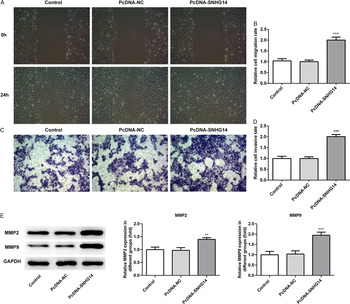
To evaluate the biological functions of lncRNA SNHG14 in cell migration and invasion, the migration activities and invasion capacities of HTR-8/SVneo cells were detected by wound-healing assay and transwell assay, respectively. Compared with the control, upregulation of SNHG14 could significantly enhance migration activities (Fig. 4A, B) and invasion capacities (Fig. 4C, D) of HTR-8/SVneo cells. Protein levels of MMP2 and MMP9 were also examined to further investigate the role of SNHG14 in cell migration and invasion. As expected, MMP2 and MMP9 expression levels were elevated drastically following SNHG14 overexpression in HTR-8/SVneo cells (Fig. 4E).
lncRNA SNHG14 promoted HTR-8/SVneo cells migration and invasion. (A, B) Wound-healing assay was performed to determine cell migration (×100). (C, D) Transwell assay was performed to determine cell invasion (×100). (E) MMP2 and MMP9 levels were measured by western blotting assay. **P < 0.01, ***P < 0.001 versus Control.

lncRNA SNHG14 regulated EMT in HTR-8/SVneo cells
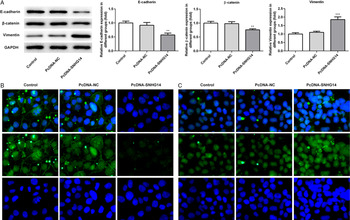
To investigate whether lncRNA SNHG14 could regulate EMT, levels of EMT-related proteins including E-cadherin, β-catenin and vimentin in HTR-8/SVneo cells were examined by western blot analysis. SNHG14 overexpression clearly enhanced vimentin expression, but reduced E-cadherin and β-catenin expression (Fig. 5A). Furthermore, immunofluorescence results indicated that E-cadherin expression was strikingly decreased (Fig. 5B) and vimentin expression (Fig. 5C) was greatly enhanced in the pcDNA-SNHG14 group. The above data suggested that SNHG14 may promote the migration and invasion of HTR-8/SVneo cells by enhancing EMT.
lncRNA SNHG14 regulated EMT in HTR-8/SVneo cells. (A) E-cadherin, β-catenin and vimentin levels were measured by western blotting assay. (B, C) E-cadherin and vimentin expression were detected by immunofluorescence assay (×200). **P < 0.01, ***P < 0.001 versus Control.

lncRNA SNHG14 directly targeted miR-330-5p
To further explore the relationship between lncRNA SNHG14 and miR-330-5p, we predicted miR-330-5p as the target of SNHG14. Bioinformatics analysis indicated that miR-330-5p possessed a potential binding site for SNHG14 (Fig. 6A). To verify the predicted direct binding interaction, we performed dual-luciferase assays. miR-330-5p mimics significantly suppressed the luciferase activity of the wild-type SNHG14 WT but had no effect on the luciferase activity of the mutant SNHG14 MUT (Fig. 6B). Moreover, miR-330-5p levels greatly decreased following SNHG14 overexpression in HTR-8/SVneo cells (Fig. 6C).
lncRNA SNHG14 directly targeted miR-330-5p. (A) Bioinformatics analysis predicted the binding site of lncRNA SNHG14 to miR-330-5p. (B) Luciferase reporter assay verified the binding relationship of lncRNA SNHG14 and miR-330-5p. (C) miR-330-5p level detected by RT-qPCR. **P < 0.01 versus miR-NC, ***P < 0.001 versus Control.

Downregulation of lncRNA SNHG14 suppressed cell proliferation and accelerated cell-cycle arrest by competitively binding to miR-330-5p
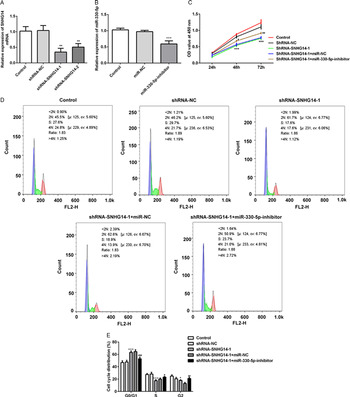
To further study the role of lncRNA SNHG14 and miR-330-5p in cell proliferation and the cell cycle, SNHG14 and miR-330-5p were downregulated by transfection with sh-SNHG14 and miR-330-5p inhibitor. SNHG14 and miR-330-5p mRNA levels decreased in the sh-SNHG14 group and the miR-330-5p inhibitor group, respectively (Fig. 7A, B). The inhibition effect of sh-SNHG14 on cell proliferation was clearly reversed by co-transfection with sh-SNHG14 and miR-330-5p inhibitor into HTR-8/SVneo cells (Fig. 7C). In addition, there was an increased cell number in G0/G1 phase and a decreased cell population in G2 and S phases in sh-SNHG14-transfected cells. Furthermore, downregulation of miR-330-5p partially reversed the effect of sh-SNHG14 on the cell cycle (Fig. 7D, E).
Downregulation of lncRNA SNHG14 suppressed proliferation and accelerated cell-cycle arrest by competitively binding to miR-330-5p. (A) SNHG14 expression determined by RT-qPCR. (B) miR-330-5p expression determined by RT-qPCR. (C) Cell proliferation detected by CCK-8 assay. (D) Percentage of cell population in G0/G1, S and G2 phases of the cell cycle was analyzed using flow cytometry assay. *P < 0.05, **P < 0.01, ***P < 0.001 versus Control, # P < 0.05, ## P < 0.01, ### P < 0.001 versus shRNA-SNHG14-1.

miR-330-5p was involved in the regulatory effects of lncRNA SNHG14 on migration and invasion in HTR-8/SVneo cells
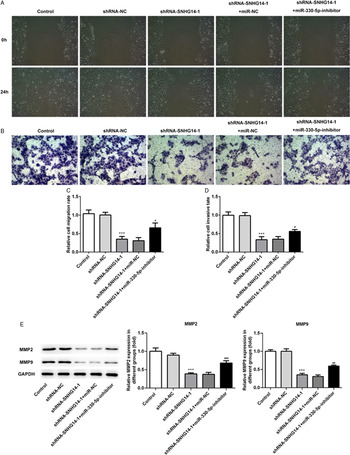
Here, we explored whether miR-330-5p was involved in sh-SNHG14-mediated effects on migration and invasion of HTR-8/SVneo cells. Downregulation of SNHG14 could significantly reduce migration activities (Fig. 8A, C) and invasion capacities (Fig. 8B, D) of HTR-8/SVneo cells, while downregulation of miR-495-3p partially reversed this effect. Similarly, protein levels of MMP2 and MMP9 were decreased in the sh-SNHG14 group, while miR-330-5p silencing significantly elevated MMP2 and MMP9 levels (Fig. 8E).
miR-330-5p was involved in the regulatory effects of SNHG14 on migration and invasion in HTR-8/SVneo cells. (A, C) Wound-healing assay was performed to determine cell migration (×100). (B, D) Transwell assay was performed to determine cell invasion (×100). (E) MMP2 and MMP9 levels were measured by western blotting assay. ***P < 0.001 versus Control, # P < 0.05, ## P < 0.01, ### P < 0.001 versus shRNA-SNHG14-1.

Downregulation of lncRNA SNHG14 suppressed EMT by enhancing miR-330-5p in HTR-8/SVneo cells
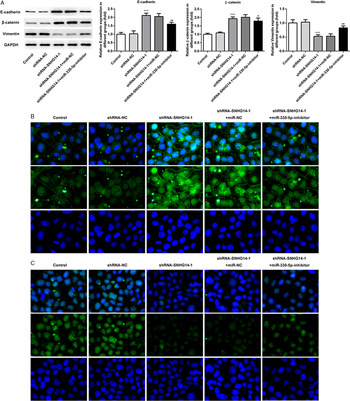
The effects of SNHG14 and miR-330-5p silencing on EMT were further determined. The relative expression levels of E-cadherin, β-catenin and vimentin were detected by western blot assay. Transfection with sh-SNHG14 enhanced E-cadherin and β-catenin levels but reduced the vimentin level. Furthermore, sh-SNHG14-induced effects on EMT were abolished following transfection with miR-330-5p inhibitor (Fig. 9A). In addition, immunofluorescence demonstrated that sh-SNHG14-induced upregulation in E-cadherin expression (Fig. 9B) and the downregulation in vimentin expression (Fig. 9C) were reversed after transfection with miR-330-5p inhibitor.
Downregulation of lncRNA SNHG14 suppressed EMT by enhancing miR-330-5p in HTR-8/SVneo cells. (A) E-cadherin, β-catenin and vimentin levels were determined by western blotting assay. (B, C) E-cadherin and vimentin expression were detected by immunofluorescence assay (×200). ***P < 0.001 versus Control, # P < 0.05, ## P < 0.01, versus shRNA-SNHG14-1.

Discussion
PE is a common disease in human pregnancy and its molecular mechanism is related to multiple factors (Xie et al., Reference Xie, Jia and Li2019). Abnormal trophoblastic proliferation and invasion serve indispensable roles in the development of PE (Wu et al., Reference Wu, Xu, Zou, Zuo, Huang, Wang, Lu, He, Wang, Wang and Sun2018). Identification of reliable molecular targets for diagnosis and therapy of PE have therefore remained the focus of research. In the present study, we explored the potential molecular mechanisms of lncRNA SNHG14, mainly based on HTR-8/SVneo cells.
Several studies have proved the involvement of multiple lncRNAs in PE development (Li et al., Reference Li, Zhang, Su, Guan, Mu, Yu, Ma and Yang2019b). However, the precise role of lncRNA SNHG14 in PE has still not been fully addressed. This current study confirmed that lncRNA SNHG14 was greatly downregulated in placentas of patients with PE compared with women who had normal placentas. Accumulating evidence on lncRNA SNHG14 has been mostly the investigation of its role in cancer (Ye et al., Reference Ye, Zhang, Wu, Yang, Wang, Huang and Tang2019). In addition, lncRNA SNHG14 could play important roles in cell proliferation, cell-cycle progression and migration (Li et al., Reference Li, Zhang and Li2019a). As expected, overexpression of lncRNA SNHG14 markedly promoted the proliferation and cell-cycle progression of HTR-8/SVneo cells. Furthermore, SNHG14 expression was positively associated with cell invasion, migration and EMT processes. miRNAs are also reported to be involved in trophoblast cell proliferation and invasion (Kumar et al., Reference Kumar, Luo, Tudela, Alexander and Mendelson2013). lncRNAs could function as a ‘sponge’, binding to miRNAs and participating in a large array of biological processes (Thomson and Dinger, Reference Thomson and Dinger2016). Consistent with those reports, bioinformatics analysis, luciferase reporter assay and RT-qPCR together demonstrated that lncRNA SNHG14 targeted miR-330-5p and negatively interacted with it. A recent study verified that miR-330-5p might play an essential role in human decidualization and the occurrence of PE (Tong et al., Reference Tong, Yang, Lv, Lv, Zhang and Chen2018). Based on the present statistical analysis, downregulation of miR-330-5p partly reversed the regulation effects of lncRNA SNHG14 on proliferation and cell-cycle progression in human trophoblasts. In general, silenced SNHG14 may suppress cell invasion, migration and EMT processes by enhancing miR-330-5p.
In conclusion, this study demonstrated that lncRNA SNHG14 was markedly downregulated in placental tissues from PE patients and was involved in the development of PE. Moreover, our results strongly support evidence that in PE lncRNA SNHG14 regulates trophoblast cell proliferation, migration, invasion and EMT by targeting miR-330-5p. Collectively, findings in the current research suggest that lncRNA SNHG14 could be a novel molecular target for early diagnosis and therapy of PE.
Conflict of interest
The authors report no conflicts of interest in this work.
Ethical standards
The present study was approved and authorized by Ethic Committee of Huai’an First People’s Hospital. All the patients in the study submitted the written informed consent and approved the study.