Brumfiel and Earle (Reference Brumfiel, Earle, Brumfiel and Earle1987) have opposed a commercial model of the emergence of social complexity with a political model. The political model emphasizes elite control over production and distribution, with a focus on control by elites for their own benefit (Brumfiel Reference Brumfiel and Harvey1991, Reference Brumfiel1996; Carrasco Reference Carrasco1999; Feinman Reference Feinman, Feinman and Nicholas2004; Hirth Reference Hirth1996). The commercial model, on the other hand, broadly expects greater individual autonomy of producers and activity in a generally market-driven economic organization (Berdan Reference Berdan1982, Reference Berdan and Plattner1989; Brumfiel and Earle Reference Brumfiel, Earle, Brumfiel and Earle1987; Hirth Reference Hirth1998, Reference Hirth and Hirth2006; Minc Reference Minc2006; Rathje Reference Rathje, Sabloff and Lamberg-Karlovsky1975; Rice 1981; West Reference West, Masson and Freidel2002). However, we need not see markets and political control as oppositional; rather, they are part of the continuum of multiple strategies used by elites to create the larger political economy of a state (Berdan Reference Berdan and Plattner1989; Feinman Reference Feinman, Feinman and Nicholas2004; Hirth Reference Hirth1996; Smith and Berdan Reference Smith, Berdan, Smith and Berdan2003). Markets can meet multiple needs for elites and seem to have existed under at least minimal elite oversight in Mesoamerica (Hassig Reference Hassig1982; Hirth Reference Hirth1998; Masson Reference Masson, Masson and Freidel2002), though they may not have begun that way (Blanton Reference Blanton and Ortiz1983). The elites in the Late Postclassic period Tarascan state used such a continuum of political and commercial strategies. Key commodities such as metal, obsidian, and agricultural surplus were all controlled to some degree by the political elite. However, the production and distribution of ceramics appears to have been organized more by market than political forces.
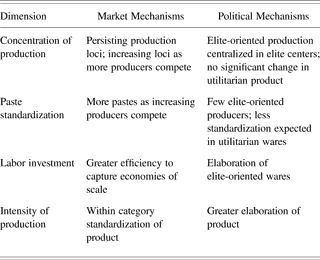
Ceramics are often treated as a universal proxy for craft production—and, thus, economic specialization—in our models of understanding the archaeological past (Balfet Reference Balfet and Matson1965; Blackman et al. Reference Blackman, Stein and Vandiver1993; Costin Reference Costin and Schiffer1991; Costin and Hagstrum Reference Costin and Hagstrum1995; Feinman Reference Feinman1980; Feinman et al. Reference Feinman, Upham and Lightfoot1981; Hagstrum Reference Hagstrum1985). Table 1 compares expectations for commercially driven ceramic production, where production is dispersed and persists in local contexts, and elite-controlled production, with centralized production and emphasis on value-added products. Part-time and household production, such as that discussed by Arnold (Reference Arnold III1991, Reference Arnold III and Chilton1999) and Feinman (Reference Feinman, Skibo and Feinman1999; Balkansky et al. Reference Balkansky, Feinman and Nicholas1997) could mimic full-time commercial production, with identifiable standardization of product, potentially more dispersion in the production locales, and an imperfect emphasis on economies of scale.
Dimensions of the organization of ceramic production in relationship to political- and market-economy expectations

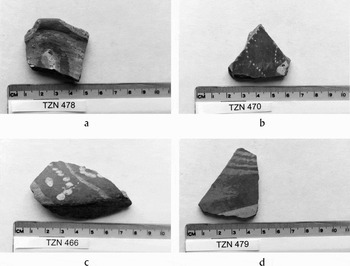
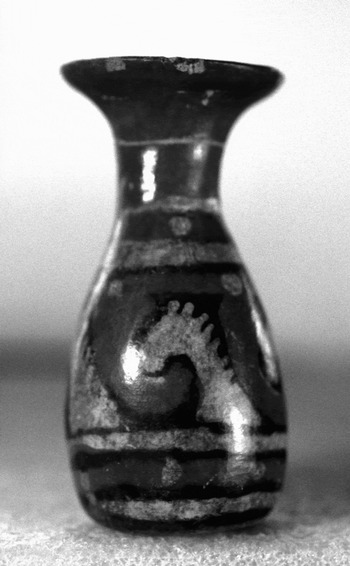
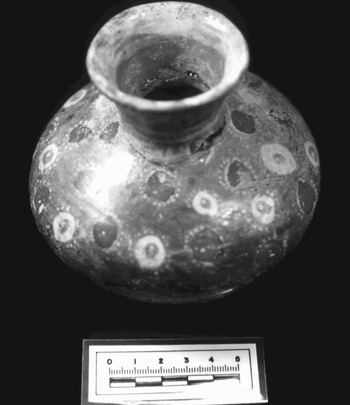
Late Postclassic period Tarascan state fine-ware ceramics from western Mexico are notable for their highly distinctive forms and decoration. Indeed, one motivation for early archaeological work at the Tarascan capital, Tzintzuntzan, was to provide collections of Tarascan pottery for the National Museum (Pollard Reference Pollard1993:19, citing Caso [Reference Caso1930] and Noguera [Reference Noguera1931]). In general, Tarascan state ceramics are well made, with an emphasis on cream, red, white, and negative resist surface decoration, resulting in polychromes with geometric designs. Forms include spouted vessels, stirrup handles, large tripods, and miniature vessels mimicking a range of full-size vessels (Figures 1–3) (Cabrera Castro Reference Cabrera Castro, Anna, Crespo and Carlos1996; Castro-Leal Reference Castro-Leal1986; Moguel Cos Reference Moguel Cos1987; Pollard Reference Pollard1972, Reference Pollard1993, Reference Pollard2000a, Reference Pollard2001). Ceramics associated with the Tarascan state present elaborate symbolism and form a distinct and highly identifiable ceramic corpus.
Late Postclassic Tariacuri-phase sherds: (a–b) Tariacuri Brown paste; (c–d) Yaguarato Cream paste.

Late Postclassic period Tariacuri-phase vessel with Tariacuri Brown paste (used by permission of Helen P. Pollard).

Late Postclassic period Tariacuri-phase vessel with Yaguarato Cream paste (used by permission of Helen P. Pollard).

Pollard and Cahue (Reference Pollard and Cahue1999) argue that the inclusion of Tarascan polychromes in mortuary assemblages after the formation of the state reflects part of a larger transition in elite status-building; a shift from a prior pattern in the Classic and Early Postclassic periods of acquiring exotic objects to a Late Postclassic period emphasis on local products. “[Tarascan elites] were buried with goods that reinforce the distinctiveness of Tarascan elite culture and the Tarascan state religion” (Pollard and Cahue Reference Pollard and Cahue1999:278). They further note that 15 of 21 individuals buried in the Late Postclassic period context at Urichu, a tertiary Tarascan administrative center within the Lake Patzcuaro Basin, the core of the Tarascan state, were buried with grave goods, including metal and obsidian from the Tarascan realm, in addition to ceramic beads and basin-made Tarascan polychrome vessels (Pollard and Cahue Reference Pollard and Cahue1999:274; Pollard 2008:Figure 3). The major ethnohistoric document for the Tarascan state, the Relación de Michoacán (1956 [1541], 1980 [1541]) describes overseers of pottery production as part of the Tarascan court. Given the important messaging properties of ceramics, and the significantly centralized nature of the Tarascan state with its strong tribute system (Gorenstein and Pollard Reference Gorenstein and Pollard1983; Pollard Reference Pollard1993, Reference Pollard, Smith and Berdan2003; Smith and Berdan Reference Smith, Berdan, Smith and Berdan2003), the production and distribution of Tarascan fine ware is likely to have occurred under direct political control. However, Tarascan-period ceramics as a whole also appear to occur at the end of a long, local ceramic tradition within the Lake Patzcuaro Basin; the colors and forms demonstrate cultural continuity throughout the 1,000 year sequence excavated at Urichu, a sequence spanning the Classic to Late Postclassic periods (Pollard Reference Pollard1993, Reference Pollard2000a, Reference Pollard, Smith and Berdan2003; Pollard and Cahue Reference Pollard and Cahue1999). Furthermore, results from analyses of the ceramic assemblage from Urichu, reflecting the multiple dimensions presented in Table 1, indicate that ceramic production and distribution were not under strong centralized political control. They were instead produced and distributed using the market mechanisms of the larger mixture of economic strategies on the part of the Tarascan political elite. These analyses involved both instrumental neutron-activation analysis (INAA) of sherds from Urichu and Tzintzuntzan to assess the centralization of production and standardization of fine-ware pastes, as well as the statistical evaluation of morphological and stylistic traits from the Urichu excavation assemblage to assess labor investment and the intensity of production.
THE TARASCAN CONTEXT
Ethnohistoric sources provide much of the background information for pre-Tarascan and Tarascan economic activities within the Lake Patzcuaro Basin (Gorenstein and Pollard Reference Gorenstein and Pollard1983; Pollard Reference Pollard1982a; Pollard and Gorenstein Reference Pollard and Gorenstein1980; Relación de Michoacán 1956 [1541], 1980 [1541]; Relaciones Geográficas Reference Alvaro and Gerardo1985). The economy of the basin prior to state formation most likely emphasized market exchange, though some exotic materials are noted in elite mortuary contexts (Gorenstein and Pollard Reference Gorenstein and Pollard1983; Pollard and Cahue Reference Pollard and Cahue1999). Most communities, with the exception of those on islands, had natural access to a range of resources between the shore and higher forested slopes that could be exploited by both communities and households (Toledo Reference Toledo, Oldfield and Alcorn1991; Van Zantwijk Reference Van Zantwijk1967; West Reference West1948). Though rich in resources, not all necessities were available; notably missing from the basin were salt, obsidian, lime, and cotton (Gorenstein and Pollard Reference Gorenstein and Pollard1983). The Relación de Michoacán (1956 [1541], 1980 [1541]), specifically notes three markets during the state: two within the basin at Pareo in the south and at Tzintzuntzan in the east, and one just to the north of the basin boundary at Asajo. Despite these mentions, we have little information about the structure or extent of Tarascan markets. However, in extreme circumstances, the political elite could close the markets, such as on the death of the king and the arrival of the Spanish (Relación de Michoacán 1956 [1541]:223, 246). Pollard has hypothesized that commoners, both before and after the emergence of the state, relied on the markets for non-basin staples, such as lime and salt, as well as to supplement maize shortfalls occurring within the basin especially in the Late Postclassic period (Gorenstein and Pollard Reference Gorenstein and Pollard1983; Pollard Reference Pollard1982b, Reference Pollard1993).
Better known from the ethnohistoric literature is the Tarascan state's tribute system (Beltrán Reference Beltrán1982; Caravajel Visita of 1523–1524, in Warren Reference Warren1985; Gorenstein and Pollard Reference Gorenstein and Pollard1983; Pollard Reference Pollard1982b, Reference Pollard1993; Pollard and Gorenstein Reference Pollard and Gorenstein1980; Relaciones Geográficas Reference Alvaro and Gerardo1985). A wide range of imported items is mentioned in these sources: various foodstuffs including maize, metal, obsidian, luxury items, cotton cloth and clothing, as well as services. Pollard (Reference Pollard, Smith and Berdan2003) describes the items as flowing into the capital at Tzintzuntzan and into storehouses under the direct control of the Tzintzuntzan elite. These stores were the basis of elite support and elite finance, as well as famine relief. Additional aspects of the political economy were elite-sponsored long-distance trade (Pollard Reference Pollard, Foster and Gorenstein2000b) and direct elite control over land and possibly copper mines (Pollard Reference Pollard, Smith and Berdan2003:84; Warren Reference Warren1968:47, 50).
Three goods categories—metal, obsidian, and agricultural products (maize)—provide an opportunity to look at the relationship between the political and market economies of the Tarascan state. These particular resources, reasonably well known archaeologically and representing raw materials both limited and dispersed in availability, correspond to both elite and non-elite controlled production and range from elite-associated goods (metal and obsidian) to economic staples (obsidian and agriculture). As such, they provide a useful comparative framework for understanding the organization of ceramic production.
Metal
Rooted in a South American technological tradition, metallurgy in western Mesoamerica dates to the Classic period, ca. a.d. 650 (Hosler and MacFarlane Reference Hosler and Macfarlane1996:1819). Metal goods in western Mexico were not the result of the application of new technology to old forms. Rather, the bulk of the metallurgical industry produced forms uniquely suited to metallic properties: for example, bells, sheet ornaments, tweezers, and rings (Hosler Reference Hosler1988a, Reference Hosler1994). Hosler (Reference Hosler1994) argues that from the beginning, metal goods were associated with the elite and ritual, a regional resource infused with western Mexican meaning.
Hosler identified two phases of pre-Hispanic metallurgical production (Hosler Reference Hosler1988a, Reference Hosler1994). The first phase dates from a.d. 800 to a.d. 1200–1300 (the Epiclassic to Early Postclassic periods), roughly corresponding to the period of regional elite reorganization prior to the emergence of the Tarascan state. Metal goods are not known from the Lake Patzcuaro Basin; indeed, they are rare in Michoacan as a whole during this period. Given the primacy of metal as a prestige symbol and its focus in trade networks, the paucity of metal artifacts also highlights the real lack of regional power these elites held prior to state emergence (Hosler Reference Hosler, Smith and Berdan2003). The second phase extends from a.d. 1200–1300 to a.d. 1520 and the arrival of the Spanish (Middle to Late Postclassic periods) (Hosler Reference Hosler1988a, Reference Hosler1994). This latter period also roughly corresponds to the emergence of the Tarascan state, ca. a.d. 1350. The metallurgical transformation marking this period occurred along two lines: (1) the introduction of new manufacturing techniques and copper alloys (and the production of silver and golden appearing objects); and (2) the introduction of morphologically innovative subtypes of previously made objects classes (e.g., tweezers, bells, etc.).
Products of this new phase of metallurgy are found all over Mesoamerica (Hosler Reference Hosler, Smith and Berdan2003). The few provenience studies (Hosler 1994; Hosler and MacFarlane 1996) and recovered archaeological indicators of mining and production (e.g., Kelly Reference Kelly1949) all indicate a number of different sources, all located away from the Tarascan political core, to the northwest and south. Hosler's (2003:165–166) overview of the archaeology of these sites indicates that no one ethnic affiliation is indicated by ceramics found at the sites. She also indicates that the objects found throughout western Mexico and Mesoamerica in the Late Postclassic period do not suggest any one dominant production or stylistic cannon. Instead, they represent a mix of a broader range of production techniques, such as lost-wax casting, open-mold casting, cold work, and annealing, than were present in the prior metallurgical period (Hosler Reference Hosler1988a). Only Tarascan-style tweezers have a distinct distribution limited to the Tarascan domain (Hosler Reference Hosler, Smith and Berdan2003). Ethnohistoric sources indicate that the Tarascan state positioned itself to control at least some aspects of the mining regions and the mining-and-smelting process early in its history through both tribute demands and direct control (Gorenstein and Pollard Reference Gorenstein and Pollard1983; Pollard Reference Pollard1987, Reference Pollard1993; Warren Reference Warren1968). Hosler (Reference Hosler, Smith and Berdan2003) indicates that complete control was impermissible due to the wide distribution of ores and the varied ethnic affiliation of specialized mining and smelting communities (compare with Maldonado Reference Maldonado2008). Despite the presence of metal objects in Tarascan ritual contexts, Tarascan state control over mining and smelting communities was not absolute throughout the larger mining and smelting region.
Obsidian
Obsidian was another resource found both within and beyond the Tarascan borders, to the northwest and northeast, but not within the Lake Patzcuaro Basin itself. Unlike finished metal products, finished products of black obsidian are well established in both commoner and elite contexts before and after the emergence of the Tarascan state.
INAA indicates that the bulk of black obsidian from pre-state contexts at Urichu came primarily from the Zinaparo-Varal sources, located to the northwest (Pollard et al. Reference Pollard, Glascock and Rizo1998). Most of these objects were small and utilitarian, a mix of prismatic blades, cores, and miscellaneous tools (Pollard Reference Pollard2000a; Pollard et al. Reference Pollard, Glascock and Rizo1998). This source remained important throughout the entire sequence at Urichu, even after state formation. However, with the emergence of the state in the Late Postclassic period, the Zinaparo-Varal source declined to the second most important source, while Zinapecuaro-Ucareo obsidian, from the northeast, became the dominant black obsidian at Urichu (Pollard et al. Reference Pollard, Glascock and Rizo1998). Previously, Ucareo obsidian was found only in small quantities and in elite contexts at Urichu. Prismatic blades also significantly increased in number in the overall Urichu assemblage as the Ucareo obsidian became more important, with a total count of 164 prismatic blades excavated from Classic to Middle Postclassic period contexts prior to state emergence and 680 prismatic blades from the Late Postclassic phase associated with the state (Pollard 2000a:273; Pollard et al. Reference Pollard, Glascock and Rizo1998).
Archaeological obsidian artifacts from Tzintzuntzan represent the Late Postclassic period. Using X-ray fluorescence analysis, Pollard determined the majority of the black obsidian came from the Zinapecuaro-Ucareo source to the north of the basin; the majority of these artifacts were prismatic blades (Pollard and Vogel 1994). Evidence for blade production occurs at both sites (compare Pollard and Vogel 1994; Pollard et al. Reference Pollard, Glascock and Rizo1998) and at the secondary center of Erongaricuaro (Rebnegger Reference Rebnegger2004, Reference Rebnegger2006). Ucareo obsidian is known from a number of sites throughout Mesoamerica, but that wider distribution seems to drop off in the Late Postclassic period as the source fell under the state's expanding political territory. More Ucareo obsidian moved into Tzintzuntzan and Urichu, but not to other sites surveyed within the basin (Pollard et al. Reference Pollard, Glascock and Rizo1998). The differential patterns of artifacts made from the Zinaparo-Varal or the Zinapecuaro-Ucareo obsidian sources highlighted a shift in economic strategy with the emergence of the Late Postclassic period Tarascan state. Pollard hypothesized that this new and differential distribution of Ucareo obsidian, increasing in quantity and in focus on prismatic blades during the state, was due to the control of Ucareo obsidian by the political elite in Tzintzuntzan (Pollard Reference Pollard, Smith and Berdan2003:231–232). This pattern contrasts with the persistent pattern of Zinaparo-Varal obsidian artifacts throughout the excavated sequence at Urichu (Pollard Reference Pollard, Smith and Berdan2003).
Agriculture
Unlike metal and obsidian, which were “point resources” removed from specific areas in the Tarascan political core, agricultural production was easily accomplished within the Lake Patzcuaro Basin. Both in pre-Hispanic times and today, the basin has sufficient rainfall and arable land for a range of agricultural products, including the dietary staple maize.
Buried canals in the southern portion of the Lake Patzcuaro Basin indicate intensification of agricultural production. These canals date from the Classic to Early Postclassic periods (Fisher et al. Reference Fisher, Pollard and Frederick1999). Fisher and colleagues (Reference Fisher, Pollard and Frederick1999) argue that these canals correspond not to demographic pressures upon maize production, but rather to the periods of increasing elite activity within the basin and are thus evidence of elite influence, if not control, over agricultural production.
With the emergence of the Tarascan state in the Late Postclassic period, agricultural production could not have kept pace with the estimated population (Pollard Reference Pollard1982a, Reference Pollard1982b, Reference Pollard1993). An additional canal feature dating from this period indicates additional elite intensification of agricultural production (Fisher et al. Reference Fisher, Pollard and Frederick1999). Documentary evidence suggests that at least some agricultural lands were considered the “king's land” and under the control of the centralized political structure in Tzintzuntzan (Relación de Michoacán 1956 [1541], 1980 [1541]). Documentary sources also indicate that during the state period, agricultural products, including maize, moved through both the market and the tribute system to augment local agricultural production (Gorenstein and Pollard Reference Gorenstein and Pollard1983; Paredes Reference Paredes, Paredes Martínez, Pinon Flores, Escovar Olmedo and Pulido Solis1984; Pollard Reference Pollard1982a). Cahue (Reference Cahue2001) used stable-isotope analysis to test the relative abundance of maize and animal protein in the diet of elite populations within and outside the basin. She found statistically significant differences in δ13N and δ15N signatures, signifying different levels of maize and meat consumption, respectively, between skeletons of elite populations from Tzintzuntzan and two lower-level elite centers within the basin, Urichu and Tocaro (located in the south and to the east of Urichu) (Cahue Reference Cahue2001). Tzintzuntzan elites enjoyed a strong maize and meat diet, while elites at the secondary and tertiary elite centers of Urichu and Tocaro, respectively, enjoyed less maize and meat in their diets (Cahue Reference Cahue2001). The δ13N signatures were also different between Urichu and Tocaro, while the δ15N signature were similar, indicating that while Urichu elites had greater access to maize, elites in both centers had similar access to meat, a hunted resource (Cahue Reference Cahue2001). Urichu held a slightly higher rank in the basin than Tocaro (Pollard Reference Pollard1993). While a comparative commoner sample was not available for analysis, Cahue (Reference Cahue2001) concluded that maize seemed to move through a tribute system to Tzintzuntzan, but not necessarily moving in bulk to the basin's secondary centers.
While elites, at least at Tzintzuntzan, increasingly used the tribute system to their advantage, Pollard (Reference Pollard1982a, Reference Pollard1982b) suggests that commoners instead turned increasingly to craft production (including ceramic production) to exchange finished goods for maize in a market context to supplement the insufficient maize production within the basin.
TARASCAN CERAMICS IN PRODUCTION AND CONSUMPTION CONTEXT
All three of the consumable-goods categories discussed above— whether luxury or staple commodities—fell under Tarascan elite control to varying degrees. Metal artifacts were strongly associated with elite ideology, but not all metallurgical production was under direct elite control. The Tarascan state apparatus apparently controlled the Zinapecuaro-Ucareo obsidian source and the distribution of Ucareo obsidian, but it did not control all obsidian sources or products. Both metal and obsidian are “point resources,” limited in their spatial distribution. Agricultural production was not restricted in this manner, nor do we have any overt indications that it was important to elite identity or state ritual as a “prestige good.” Rather, surplus agricultural production, especially maize, was important for the maintenance of the elite population, as elites associated with Tzintzuntzan seemed to have a stronger maize and meat diet than that of elites at other centers within the basin.
Ceramic resources (fuel, clay, and water) were also widely distributed and accessible within the Lake Patzcuaro Basin. Pottery production was long established, and turning to market-driven ceramic production to offset household staple shortfalls made sense (Gorenstein and Pollard Reference Gorenstein and Pollard1983). However, pottery is also malleable, and political elites who desired to control Tarascan cultural messaging and status would be expected to control the production of a prestige good. No direct evidence for the pre-Hispanic organization of ceramic production has been discovered within the basin. Following Costin (Reference Costin and Schiffer1991), indirect evidence should be able to provide us with reliable information on pottery organization.
The sherd assemblage from Urichu consisted of a sample of 37,301 sherds (from a total of over 170,000 ceramic artifacts) recovered from excavations from three areas at the site of Urichu, Michoacan, conducted under the direction of Helen Pollard and with the permission of the Consejo de Arqueología, Instituto Nacional de Antropología e Historia (Pollard Reference Pollard2000a, Reference Pollard2001). Excavations focused on three areas of the site and reflect changing cultural circumstances, including socially ranked residential, elite residential, elite ritual, and commoner residential contexts. The overall sequence extends from Loma Alta 3 (Early Classic period) to Late Urichu (Middle Postclassic period), which is the period before the emergence of the Tarascan state, and into the Tariacuri (Late Postclassic period). Area 1 of Urichu contained both a Loma Alta 3 (Early Classic period) residential complex and a Tariacuri phase (Late Postclassic period) elite ceremonial and residential precinct. Area 2 contained a Late Urichu to Tariacuri (Middle to Late Postclassic periods) commoner residential zone. Both Area 1 and 2 were situated on the hillside above the lakeshore. Commoner zones lacked distinctive state architecture and wealthy burials. Area 5 was a higher hillside zone occupied from the Jaracuaro to Early Urichu phases (Middle Classic to Early Postclassic periods) and consisted of residential and later socially ranked residential areas. Area 5 later became an elite ritual locale in the Tariacuri phase (Late Postclassic period). The overall sherd sample was sampled by total sherds per excavation unit; the units were chosen on the basis of their containing a robust ceramic sequence for the given area. The 37,301 sherds made up the sample for the ceramic analysis of labor investment and intensity of production. A small subset of sherds from Urichu, along with sherds from the survey of Tzintzuntzan, made up the sherd sample for the analysis of the concentration of production and standardization of pastes.
Concentration of Production and Standardization of Pastes
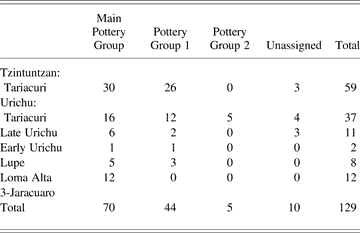
Initial research on ceramic production using INAA (Hirshman et al. Reference Hirshman, Pollard, Neff and Glascock1999; Pollard et al. Reference Pollard, Hirshman, Neff, Glascock, Dillon and Boxt2005), involved 70 sherds and 18 clay samples from the Lake Patzcuaro Basin. The sherds corresponded to six categories of fine-ware pastes, were selected from the three areas of excavation (Areas 1, 2, and 5), and represent every excavated temporal phase from the site of Urichu. The clay samples represent contemporary and easily accessible clay layers, such as brickmakers’ yards and erosion exposures, from separate locales around the entire basin. The samples for the initial research were run at the Missouri University Research Reactor (MURR), under the direction of Neff and Glascock (Reference Neff and Glascock1999). From the original work at MURR three compositional groups were identified: Main Pottery Group; Pottery Group 1; and Pottery Group 2. Two clay samples were included in the Main Pottery Group, indicating a southern—and, more likely, southwestern—provenience for the compositional group. While this finding could suggest Urichu as the original potting community, Erongaricuaro is more likely, as there is no direct evidence for ceramic production at Urichu while there is pre-Hispanic evidence for other crafts at Erongaricuaro (Pollard, personal communication 2003; Rebnegger Reference Rebnegger2004, Reference Rebnegger2006). Sherds from every temporal period at Urichu were included in the Main Pottery Group. One clay sample was included in Pottery Group 1, indicating a probable southeastern provenience. Sherds from nearly every temporal phase were also included in Pottery Group 1. Seven sherds and 15 clay samples were unassigned. Though three clay samples from Tzintzuntzan were included in the original analysis, none were assigned to a compositional group. Details from these analyses were previously reported, and Table 2 illustrates the sherd assignments (Hirshman et al. Reference Hirshman, Pollard, Neff and Glascock1999; Pollard et al. Reference Pollard, Hirshman, Neff, Glascock, Dillon and Boxt2005). Pottery Group 2 was not associated with a clay sample and therefore was not assigned a provenience. However, it chemically resembled Pottery Group 1, which therefore suggests a southern basin provenience.
Missouri University Research Reactor and Ford Nuclear Reactor assignments of Urichu and Tzintzuntzan sherds by period and compositional groups
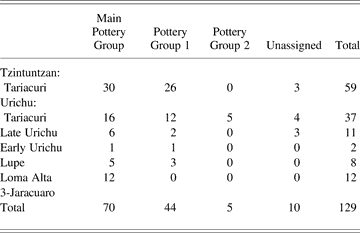
Some preliminary conclusions were drawn from this research: (1) through time, locally made (southwestern basin) ceramics decrease in percentage of overall ceramics at Urichu, from 100% during the Loma Alta 3-Jaracuaro phases (Classic period) to just 16 out of 37 sherds in the Late Postclassic period. The remaining sherds from the Late Postclassic period at Urichu are composed of five visually distinct wares (after Pollard Reference Pollard1972, Reference Pollard1993); (2) the smallest pottery group (Pottery Group 2) was constrained to a Tariacuri phase (Late Postclassic period) state ritual context and their original provenience is placed in the south or southeast portion of the basin. The decreasing frequency of locally made ceramics (Main Pottery Group) and the increasing numbers of ceramics from another part of the basin (Pottery Group 1, Pottery Group 2, and visually distinct but compositionally unassigned sherds) suggests greater Urichu access to more variety in pottery products. Market exchange, probably at the southern market of Pareo, is the most likely explanation for the movement of these varied fine wares to communities around Lake Patzcuaro (compare with Pollard et al. Reference Pollard, Hirshman, Neff, Glascock, Dillon and Boxt2005).
Under the direction of Dr. Leah Minc, I conducted additional INAA involving 59 survey sherds from the Tarascan capital Tzintzuntzan and six archaeological volcanic-ash samples from Urichu at the Phoenix Memorial Lab and Ford Nuclear Reactor (FNR), University of Michigan (Hirshman Reference Hirshman2003). These sherds, from a Tzintzuntzan survey by Pollard (Reference Pollard1972), are from the Tariacuri phase (Late Postclassic period) and represent three important categories of fine-ware paste. The samples were prepared, irradiated, and analyzed using standard INAA procedures (Glascock Reference Glascock and Neff1992; Neff and Glascock Reference Neff and Glascock1999). This second set of sherd samples was compared to the initial compositional groups (Table 2). Thirty of the Tzintzuntzan sherds were assigned to the Main Pottery Group, and 26 were assigned to pottery Group 1. None were assigned to Pottery Group 2, and three were unassigned. Of the six ash samples from Urichu, two were assigned to the Main Pottery Group, and four were unassigned. These results demonstrate the robustness of the original MURR compositional groups and strengthen the original conclusion that the Main Pottery Group is indicative of ceramic production at or near Urichu. Interestingly, none of the sherds were assigned a Tzintzuntzan provenience. Rather, the Tzintzuntzan sherd samples match the previously established compositional groups, falling predominantly in the Main Pottery Group and Pottery Group 1, which indicted these Tarascan fine wares were produced in the southern portion of the basin. As Tzintzuntzan was also a Tarascan market, the commercial movement of pottery from the southern portion of the basin into the capital is likely.
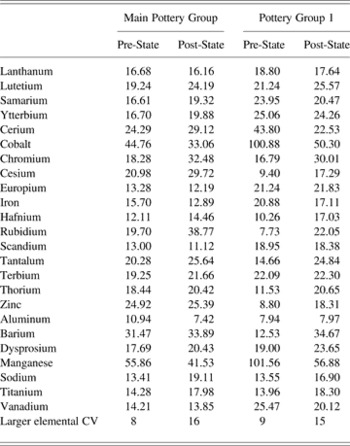
The Main Pottery Group and Pottery Group 1 represent sherds from every temporal phase from the Classic to the Late Postclassic periods and include sherds from both Urichu and Tzintzuntzan. While these compositional groups appear to be relatively stable over time, do they become increasingly standardized? There is no common test for the standardization of ceramic pastes, but it is useful to explore changes in elemental variability using the coefficient of variation statistic (CV), which is a measure of the variation between two data sets standardized by dividing the standard deviation by the mean. Due to their low frequency, the samples were consolidated into “pre-state” (Loma Alta 3, or Early Classic period, to Late Urichu, or Middle Postclassic period) and “post-state” (Tariacuri, or Late Postclassic period) groups. A higher CV indicates greater variation. Costin (Reference Costin and Schiffer1991; Foias Reference Foias, Masson and Freidel2002) suggests that what is actually measured is a greater or lesser number of groups of potters. With these fine wares, greater centralization of production should produce a smaller CV for each compositional group after state emergence. Table 3 provides the CV for each element for the Main Pottery Group and for Pottery Group 1. Sixteen of the 24 elements have a larger CV in the Main Pottery Group after the emergence of the state; 15 of 24 elements have a larger CV in Pottery Group 1 after to the emergence of the Tarascan state. Clearly, these are not highly standardized compositional groups in either temporal context. But the greater variation after the emergence of the state is striking compared to the temporally collapsed pre-state category. This test suggests less standardization in paste recipes and greater numbers of pottery producers over time, particularly with the emergence of the state (Hirshman Reference Hirshman2003).
Coefficient of variation for pre- and post-state elements in Main Pottery Group and Pottery Group 1

Labor Investment
The chemical analysis of fine wares indicated a lack of elite-centralized production and a lack of paste standardization. Inspection of labor investment and the intensity of production corroborated decentralized production in the larger sherd assemblage, including both fine and utilitarian wares.
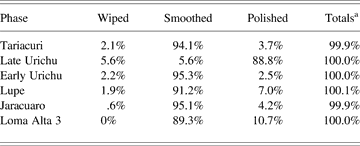
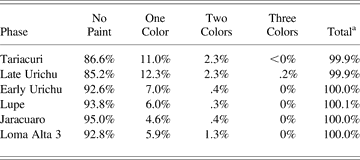
The sherd assemblage from Urichu was also assessed for labor investment, as measured through the relative efficiency or additive labor invested into the final ceramic product. Elite-oriented ceramics ought to express greater elaboration and status messaging, while those made for generalized exchange should demonstrate greater efficiency in manufacture and decoration indicative of attempts to simplify production and even to capture an economy of scale while increasing production for market exchange (Costin Reference Costin and Schiffer1991; Costin and Hagstrum Reference Costin and Hagstrum1995; Feinman Reference Feinman1980; Feinman et al. Reference Feinman, Upham and Lightfoot1981; Hagstrum Reference Hagstrum1985). Changes in labor investment, as measured by ordinal-scale variables such as the amount of finish, slip, paint, or resist a given sherd showed, was assessed through a series of Pearson chi-square comparisons. Separate Pearson chi-square tests analyzed slip (absence, presence, or self-slip), paint (absence, presence of one color, presence of multiple colors), extent of investment in final finish (simply wiped, smoothed, or polished/burnished), and the presence or absence of “negative,” or resist, which requires a secondary firing in a reducing context.
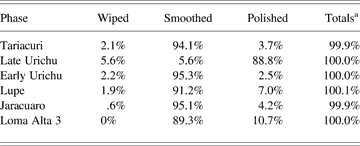
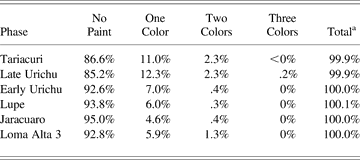
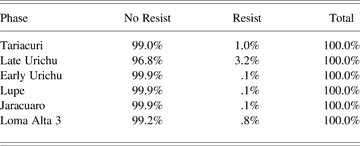
Every Pearson chi-square test indicated there was a significant difference in labor investment between the phases throughout the temporal sequence (p < .0001 for every variable) (Hirshman Reference Hirshman2003). These results are summarized in Tables 4–7. Labor-saving indicators included a decreased use of slip and an increased percentage of sherds that were finished merely by being wiped, not smoothed, particularly in contexts in the Late Urichu and Tariacuri phases (Middle and Late Postclassic periods), the phases just prior to and concurrent with the emergence of the state. These periods included both commoner and elite residential zones. While the trend toward less labor investment is stronger in the commoner area, both commoners and elites consumed more ceramics with fewer labor-input indicators. This trend points toward a generally increased and efficient production of plain vessels to meet greater consumer demand common to market contexts.
Percentage of slipped, unslipped, and self-slipped sherds by phase

a Discrepancies between percent total and 100% are due to rounding errors.
Percentage of wiped, smoothed, and polished sherds by phase
aDiscrepancies between percent total and 100% are due to rounding errors.
Percentage of painted and unpainted sherds by phase
aDiscrepancies between percent total and 100% are due to rounding errors.
Percentage of resist by phase
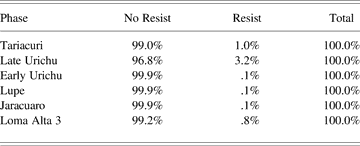
However, a labor-investment trend was also noted in the increased application of paint, resist, and polishing/burnishing during the Late Urichu and Tariacuri phases (Middle and Late Postclassic periods). While this labor-investing trend was noted for the elite residential zones, commoner areas during the Late Urichu and Tariacuri phases (Middle and Late Postclassic periods) were actually two of the three areas that showed resist most frequently, along with a Tariacuri-phase (Late Postclassic period) elite residential area. These commoner areas also contained a high proportion of polished and painted sherds, including all of the sherds with three colors. Commoner access to decorated, labor intensive, elite-messaging ceramics suggests access to Tarascan polychromes within a market context (Hirth Reference Hirth1998). In other words, the ceramic assemblage at Urichu demonstrated a general increase in labor-saving efficiency, while at the same time both elites and commoners were able to access labor-intensive ceramic vessels. The general availability of these decorated vessels indicates a production and distribution system responsive to a market context.
Intensity of Production
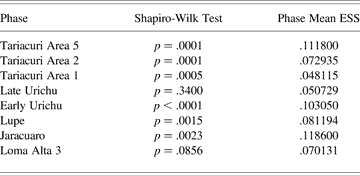
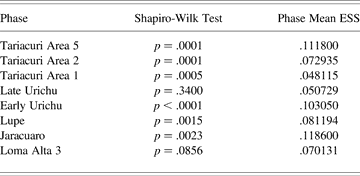
An application of the “standardization hypothesis” tested the final dimension of the organization of ceramic production: the intensity of production. This hypothesis argues that reorganization of ceramic production indicative of increased producer specialization should be reflected in an increasingly homogenous ceramic assemblage, as noted by increased alikeness within groups (Balfet Reference Balfet and Matson1965; Blackman et al. Reference Blackman, Stein and Vandiver1993; Costin Reference Costin and Schiffer1991; Arnold 1991 for an argument of standardization with part-time specialists). In other words, specialist producers should make more similar finished vessels within the same class. An application of cluster analysis clarified the underlying structure of the Urichu assemblage using a set of nominal variables. The variables included constriction, finish, slip, paint, resist, and modifications to the clay such as appliqué or engraving, as well as rim-sherd lip and rim form (Hirshman et al. Reference Hirshman, Lovis and Pollard2007). Cluster analysis is not a single statistical technique but, rather, a set of methods for generating groups within data (Aldenderfer and Blashfield Reference Aldenderfer and Blashfield1984; Clifford and Stephenson Reference Clifford and Stephenson1975; Everitt Reference Everitt1980). In this case, the hierarchical clustering algorithm applied was the Increase in Sum of Squares (details can be found in Hirshman et al. Reference Hirshman, Lovis and Pollard2007). The resultant clusters are capable of being defined and described by an exemplar case and have mathematical properties. The clusters are not emic ceramic categories; rather, they are mathematically testable surrogates for natural groups within the data (see Hirshman et al. Reference Hirshman, Lovis and Pollard2007). A significant mathematical property is the Within Cluster Error Sum of Squares (ESS) (Aldenderfer and Blashfield Reference Aldenderfer and Blashfield1984; Clifford and Stephenson Reference Clifford and Stephenson1975; Wishart Reference Wishart1999). The ESS is data-dependent and measures the dispersion of data points within each cluster, an indication of the dispersion or variation within each cluster. Changes in the mean ESS between each temporal phase were tracked and tested for significant difference over time using rim, support, and body sherds from the site of Urichu using a nonparametric analysis of variance (ANOVA).
The Shapiro-Wilk Test applied to the ESS results for rim sherds indicated a significant difference between the mean variations between the temporal phases (Table 8). A non-parametric Wilcoxon/Kruskal Wallis (p = .0204) and Brown-Forsythe Test (p < .0001) confirm these results. The overall trend was a general but uneven decrease in cluster variation from the Loma Alta 3 to the Late Urichu (Early Classic to Middle Postclassic periods). The average ESS for these five pre-state phases was .847408, and the average for the three areas representing the state in the Tariacuri phase (Late Postclassic period) was .077616. There was a slight decrease in variation with the emergence of the state. Variation in the Tariacuri phase (Late Postclassic period) differed by excavation area. The least variation occurred in Area 1 (elite ritual/residence); the most occurred in Area 5 (elite ritual) and a medium range occurred in Area 2 (commoner residential). The same analysis with support and body sherds did not indicate a statistically significant difference between the cluster ESS results between phases in the temporal sequence. However, they generally mimic the same trend of decreasing variation in pre-state phases until a slight rebound with the state in select areas during the Tariacuri phase (Late Postclassic period) (Hirshman et al. Reference Hirshman, Lovis and Pollard2007).
Cluster-analysis Within Cluster Error Sum of Squares (ESS) means and one-way ANOVA results for rim sherds (where α = 0.05)
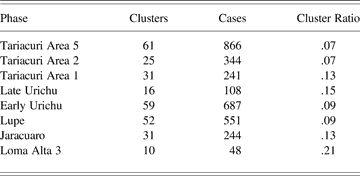
Another way to track potential changes in the organization of ceramic production is to track the change in the number of clusters (Hirshman et al. Reference Hirshman, Lovis and Pollard2007). The actual number of clusters in any given phase is dependent upon the number of cases and the number of variables in this study. Thus, the resulting raw number of clusters is not particularly helpful in determining whether or not there is an increase or decrease in the clusters relative to another phase. Dividing the number of clusters within a phase by the number of sherds controls the discrepancy in sample size between phases. The resultant ratio is a standardized measure over time and acts as a proxy for the consumer “choices” available during a phase. In a period of production expansion driven by market forces, choices are expected to increase, then level off (Rathje Reference Rathje, Sabloff and Lamberg-Karlovsky1975; Rice Reference Rice1981). Cluster formation for the rim sherds (Table 9) demonstrated a pattern of decreasing consumer options from the Loma Alta 3 to the Early Urichu (Early Classic to Early Postclassic periods), with an increase in the late Urichu phase (Middle Postclassic period), the phase just before state formation. With the emergence of the state, in the Tariacuri phase (Late Postclassic period), we see an overall but variable decline. Area 1 shows greater choice, while Areas 2 and 5 show fewer choices.
Ratio of clusters to sample size
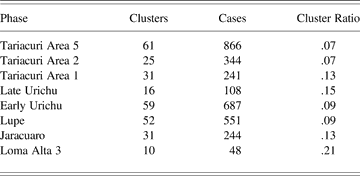
Coupled with the ESS standardization results, the changing cluster numbers provide a dynamic picture of the production of ceramics in the basin. During the Loma Alta 3 to Lupe phases (generally, the Classic period), the greatest variation and cluster numbers—that is, choice options—occur. This is also a period of early elite activity in the basin. Though not in lockstep, both variation and choices fall until the state emerges in the Tariacuri phase. With the state, Area 1 shows little variation within each cluster, but more clusters—that is, choices—are present. Area 5 has greater variation within clusters but fewer overall cluster options. With results in between these two elite areas is the commoner area, Area 2, which does not show quite as much variation as Area 5 within the clusters but has the same range of choice variation as Area 5. Differences between elite and commoner areas are expected. However, the overall picture is consistent with a market distribution system for ceramics. Area 2 demonstrates a mix of constrained consumer choices with variation within the available choices. This is consistent with a number of producers creating ceramics for a particular market. Area 1 indicates a suite of larger choices, possibly including important state-ritual ceramics, and Area 5 is a mixture of varied products and increased choice. Increased but variable standardization within categories is consistent with competing marketplace producers. Even with the growing population in the basin during the immediate pre-state and state phases, fewer available proxy choices is consistent with market distribution, as people come to expect uniform types of products to be available to them (Rathje Reference Rathje, Sabloff and Lamberg-Karlovsky1975; Rice Reference Rice1981).
CONCLUSIONS
Despite the political control the Tarascan political elite exerted over aspects of both staple and status goods in the overall economy, as shown by prior research on metal, obsidian, and maize, the organization of ceramic production does not seem to have fallen under direct elite control. Indeed, the ceramics from Urichu indicate instead a long, localized tradition from which the Tarascan ceramics emerged, building on local forms, colors, and motifs. The absence of direct evidence for pottery manufacture in the Lake Patzcuaro Basin requires reliance on indirect measures: concentration of production and paste standardization, using the chemical composition of fine-ware pastes, and labor investment and the intensity of production, using, morphological and stylistic data from the overall ceramic assemblage.
Compositional analysis indicated relative stability of pottery groups over time from the pre-state to state phases, including a persistence of localized production in the southern portion of the Lake Patzcuaro Basin. Notably, ceramic production did not seem to centralize under political control at the Tarascan capital, Tzintzuntzan, despite an ethnohistoric reference to ceramic overseers in the Tarascan court. Comparison of pre-state and post-state pastes in the two largest pottery groups suggests no increase in paste standardization with the emergence of the state. Persistence of local production, lack of political centralization, and a lack of paste standardization all point toward market mechanisms for ceramic production and distribution.
Labor-saving activities, designed to take advantage of economies of scale by potters increasingly reliant on extra-household production, indicated there was a trend over time, from pre-state phases to the state, toward decreasing labor input. This finding is consistent with production for a market context. This trend was strongest with utilitarian vessels found in commoner areas. At the same time, the opposite trend of greater input also occurred. However, these sherds were found in both elite and commoner contexts in the Late Urichu and Tariacuri phases, just before and during the state. Sherds with greater labor input in commoner contexts included the presence of resist decoration, which required a second firing. Commoners and elites alike had access to elaborated vessels carrying elite symbols, which is best explained by those ceramics moving through a market system.
Finally, intensity of production expects greater standardization within categories of ceramics, as potters’ habits become routine over time. Comparison of the mean variance in cluster solutions for rim sherds over time suggested that, while Tariacuri-phase ceramics contained less overall variation than in the pre-state phases, the standardization was still quite variable from area to area on the site, particularly between the two elite areas, Area 1 and Area 5. Taken together with cluster-rate data indicating a general consolidation of consumer choices with the emergence of the state, a picture of competing producers creating more similar output in a market context develops.
These indirect measures of ceramic production and distribution suggest long-term localized production, multiple producers, and a market mechanism for the movement of both utilitarian and elite ceramic vessels. While much is yet to be learned regarding the organization of ceramic production and distribution in the Tarascan state, the evidence thus far indicates a generally commercial, rather than political, organization for ceramic production and distribution in the Lake Patzcuaro Basin prior to and concurrent with the emergence of the Tarascan state. While the organization of the ceramic economy stands in contrast to the stronger political control of the metallurgical, obsidian, and agricultural economies, the contrast was but part of the mix of economic strategies used by the Tarascan political elite as they administered their Late Postclassic period state.
RESUMEN
Las investigaciones sobre el surgimiento de la complejidad social y las economias estatales tienden hacia un entendimiento de la economía política ó la economía de mercado como la forma económica privilegiada, con la especialización de producción surgiendo contemporáneamente con el Estado. Sin embargo, los mercados y el control político no necesariamente deben considerarse en oposición. Más bien, son partes de un contínuo de las múltiples estratégias usadas por la élite para crear la gran economía política del Estado.
El Estado tarasco del postclásico tardío está reconocido por sus fuertes tendencias centralizadoras. Las investigaciones previas indican la coordinación política de la producción de obsidiana y los objetos de metal y en la intensificación de la agricultura, aunque estas actividades no parecen haber estado bajo el control directo exclusivo de la élite. En cimbio, la producción de cerámica muestra un patrón muy distinto.
La comercialización de la obsidiana negra de Zinaparo-Varal existía tanto antes como después de la formación del Estado, mientras que la obsidiana de Ucareo llegó a ser importante solamente después de la formación del Estado. Durante el postclásico tardío, la obsidiana de Ucareo, usada principalmente para la manufactura de navajas prismáticas, representa casi toda la obsidiana encontrada en la capital tarasca y algunos centros secundarios. La producción de los objetos de metal parece haber estado bajo el control de la élite y su distribución como un bien de prestigio está limitada al territorio del Estado.
La intensificación de la producción agrícola está asociada con períodos de mayor actividad de la élite dentro de la cuenca del lago de Patzcuaro, o sea el núcleo del Estado tarasco, y la élite de la capital de Tzintzuntzan pudo obtener cantidades mayores de maíz y came en su dieta.
Las vasijas de cerámica a menudo son objetos de prestigio y las cerámicas del Estado tarasco son altamente distintivas en forma y decoración. La evidencia etnohistórica indica que fueron producidas bajo el control directo de la corte tarasca, pero no hay ninguna evidencia arqueológica para la producción de cerámica en el núcleo del Estado tarasco, o sea la cuenca del lago de Patzcuaro. Los resultados de un análisis de activación de neutrones de tiestos de lozas finas que fechan a las épocas antes y después de la formación del Estado sugieren la persistencia de la producción local durante el postclásico tardío, el auge del Estado tarasco, sin indicación de centralización en la capital.
Los mecanismos del mercado parecen apropiados para explicar la falta de una zona central de producción de Tzintzuntzan y la presencia de cerámicas producidas al sur de la zona nuclear. Un análisis de chi-cuadrado Pearson de la inversión de mano de obra en la producción de la cerámica del sitio de Urichu, Michoacan, indica un incremento en la eficiciencia de producción a través del tiempo. Por otro lado, un análisis de cluster demuestra un declive en la variación de tratamiento de la superficie y decoración a través del tiempo.
Se encuentran las lozas finas tarascas tanto en contextos de la élite como en los de la gente común. Mientras todavía hay mucho que aprender acerca de la organización de la producción de cerámica y su distribución dentro del territorio del Estado tarasco, las evidencias hasta ahora indican una demanda generalizada, más bien que una organización política de la producción y la distribución de la cerámica en la cuenca del lago de Patzcuaro antes y después del tiempo del surgimiento del Estado tarasco.
ACKNOWLEDGEMENTS
I thank Helen P. Pollard and William Lovis of the Department of Anthropology, Michigan State University; and Leah D. Minc, Oregon State University, formerly of the Phoenix Memorial Laboratory and the Ford Nuclear Reactor at the University of Michigan. Dr. Minc also provided the inspiration for the coefficient-of-variation test. Karin Rebnegger, also of the Department of Anthropology, Michigan State University, was my co-organizer for the Society for American Archaeology symposium in which this paper originated. I thank the anonymous individuals who reviewed this paper; your comments were exceedingly instructive and helpful. I am also grateful to William Fowler and the editorial staff of Ancient Mesoamerica for their hard work on behalf of this special section in general and my paper in particular. Eduardo Rodriguez of the Foreign Languages Department, West Virginia University, provided the translation of the resumen. The Division of Sociology and Anthropology, West Virginia University also deserves thanks for providing support for publication of the papers in this issue.