




No CrossRef data available.
The Northern Subject Rule in Ulster: How Scots, how English?
Published online by Cambridge University Press: 25 November 2003
Abstract
In diffusionist accounts of the Northern Subject Rule (NSR), this subject–verb concord system spread from Scotland via Ulster to North America and elsewhere. Thus, the NSR in Mid-Ulster English dialects of districts originally settled from England is attributed to diffusion from Ulster-Scots. But the NSR was also a feature of dialects of the North and North Midlands, the regions that contributed most of the English settlers to the Ulster Plantation. Since English and Scottish settlement patterns established in the seventeenth century have been reflected in Ulster dialect boundaries since then, the founder principle provides an alternative account of the persistence of the NSR in Northern Irish English. Usage in nineteenth-century emigrant letters indicates that the NSR was as strong in English-influenced dialects of Mid-Ulster as in Ulster-Scots and suggests that the NSR in Ulster may be a direct import from England as well as Scotland.The author thanks Anniken Telnes Iversen, Toril Swan, and Hilde Sollid for reading and commenting on various drafts of this article; Herbert Schendl, Graham Shorrocks, and Dieter Stein for providing references, questions, and answers; and Laura Wright and Lukas Pietsch for offering both kinds of help as well as furnishing copies of forthcoming work that proved interesting and useful. Thanks also to Jack Chambers for copies of his papers. I am also grateful to the anonymous referees for LVC. Their comments, objections, and suggestions have been accommodated as far as possible and the responses to them have, I hope, improved the result. In the usual way, responsibility for any remaining errors lies with me.
Information
- Type
- Research Article
- Information
- Copyright
- © 2003 Cambridge University Press
INTRODUCTION
In colonial situations of contact between speakers of different languages or dialects, founder populations exert an important influence on the development of new language varieties by setting linguistic patterns to which subsequent generations, new immigrants, and natives acquiring the colonial language adapt. This founder principle holds that the ethnographic make-up of a colony's founder population defines the pool of competing linguistic features, some of which will be selected and survive in an emerging creole or levelled dialect system (Mufwene, 1996:125). Although proposed to account for features of New World creoles and African American English (Mufwene, 1996, 2000), the founder principle may also account for the fact that present-day dialect boundaries in regions settled centuries ago from different parts of the British Isles continue to reflect features of the varieties of English spoken by the original migrants.
For example, the major dialect divisions of the United States can be mapped in terms of dialect features of the early settlers' regions of origin in Great Britain and Ireland. Areas settled mainly by Scots, Ulster-Scots from the North of Ireland (often Scotch-Irish in American usage), and English still differ in dialect lexicon and features of phonology, morphology, and syntax in ways that can be traced back to their regional roots across the Atlantic (see, e.g., Wolfram & Schilling-Estes, 1998:102–107). As shown in the map in Figure 1, the boundaries between the major varieties of Northern Irish English (NIE) reflect the linguistic influence of English and Scottish founder populations, in that relatively English (Mid-Ulster) and Scottish (Ulster-Scots) dialects are found in parts of the province settled in the seventeenth century from England and Scotland, respectively (Barry, 1981, 1982; Gregg, 1972, 1985; Harris, 1984, 1985; McCafferty, forthcoming).

Map of Ireland showing dialect and language areas and places named in the text. Adapted from Gregg (1985) and Harris (1985).
Over the last 400 years, dialect contact and diffusion in both directions have undoubtedly led to levelling of previously distinctive English and Scots features in Ulster. Hence, diachronic accounts of subject–verb concord in NIE (e.g., Montgomery, 1996, 1997a; Montgomery & Robinson, 1996, 2000) have assumed that diffusion from Ulster-Scots into Mid-Ulster English was the mechanism by which the latter acquired the Northern Subject Rule (NSR). Here, I suggest that this particular overlap between Ulster-Scots and Mid-Ulster English is unlikely to be the outcome of diffusion within Ireland, but rather reflects the fact that most English settlers came from the northern half of England and brought with them nonstandard varieties of English that shared the NSR with dialects imported from Scotland. My study uses nineteenth-century data from letters included in Fitzpatrick's (1994) study of Irish emigration to Australia to show that this concord system was a robust feature of both Mid-Ulster English and Ulster-Scots in areas that retained the English and Scottish identities of their founder populations.
The fact that Northern English and Scots shared the NSR is important in the Ulster context, and it may be worth investigating the likelihood of Northern English input in varieties of North American English as well. It is important in Ulster because a case has been made for the distinctiveness of Scots vis-à-vis English on the basis of, among other things, subject–verb concord (e.g., Montgomery, 1994:93–94), and linguistic findings have been used to argue for full official recognition of Ulster-Scots as a language. As noted by Kallen (1999a), the wider historical currency of usages identified as Scots or Ulster-Scots is often overlooked by proponents of full language status, and this applies to the NSR, which is the grammatical feature of NIE that has received most linguistic attention to date. For example, an account of concord in Ulster-Scots grammar presents the NSR as a feature that distinguishes between what are consistently dichotomised as the English and Ulster-Scots languages (Robinson, 1997:125–127).1
Critiques of this position are offered in reviews of Robinson's grammar by Kirk (1998a) and Kallen (1999a). Ulster-Scots has recently gained some measure of official recognition in both Northern Ireland and the Republic of Ireland under the European Charter for Regional and Minority Languages. For criticism of the English versus Scots or Ulster-Scots dichotomy and the language/dialect debate more generally, see McCafferty (1996a, 1996b), Montgomery (1997b, 1999a), Kirk (1998b, 2000), Kallen (1999b), and Görlach (2000). For discussion of developments from a range of perspectives, see papers in Kirk and Ó Baoill (2000, 2001a, 2001b). Kirk (2003) is a detailed account of events (see also the website of the Ulster-Scots Agency of the Government of Northern Ireland at http://www.ulsterscotsagency.com/).
However, the issue of the NSR's Scottishness also has wider relevance, in that accounts of NSR-type concord in North America (e.g., Wolfram & Schilling-Estes, 1998:98–99) have attributed this system in American dialects to diffusion from Scots via Ulster-Scots. Certainly, Ulster-Scots migrated across the Atlantic in large numbers in the eighteenth century. But the simultaneous westward expansion of the English language into both Ireland and North America also involved large numbers of Northern English settlers who would have had the NSR. Although the existence of the rule in England well south of the Scottish border is sometimes acknowledged by researchers (e.g., Montgomery 2001:146), the NSR is still discussed even there as an Ulster-Scots feature. The question of Northern English input, then, has not been addressed in studies of vernacular varieties on either side of the Atlantic. An account of the dual provenance of the NSR in American English is beyond the scope of the present article, but studies of the origins of settlers suggest that subject–verb concord patterns in America may be worth examining with Northern English influence in mind as well as Scots. For instance, Bailyn (1987:134–147) identified large groups of extended families from the North of England as one of two major categories of eighteenth-century English settlers in America (the others being young, single artisans). Like the Ulster-Scots, many Northern English travelled south and settled as frontier farmers in the Appalachians. Canny (1994:52) noted that there may have been more Scots in some areas than Bailyn allowed. It might be interesting to explore the origins and destinations of English settlers from regions with the NSR before concluding that Ulster-Scots is the sole origin of this feature in North American dialects.
First, I outline the workings of the NSR, its history in Scotland and Northern England, and its spread into Ulster. I then survey evidence from Late Middle and Early Modern English that the NSR was at least a marginal variant in varieties of Southern British English. Accounts of the origins of settlers in Ulster are used to make the demographic link between the province and parts of England where this type of concord was a robust feature by the period of settlement. The linguistic literature on NIE provides historical evidence for the NSR in Ulster-Scots and Mid-Ulster English from the seventeenth to the nineteenth century, when the emigrant letters that supply my own data were produced. A multivariate analysis of the language in the letters indicates the strength of the NSR in Ulster at that time, even in areas that had not seen heavy immigration from Scotland and lacked the customary cultural indicators of Scottishness (e.g., Scottish surnames and the Presbyterian religion). The results are interpreted as showing that this subject–verb agreement pattern arrived in Ulster from England as well as Scotland, and that its persistence in Mid-Ulster English is likely to be a case of retention from nonstandard Northern English dialects rather than diffusion from Ulster-Scots.2
The view that the NSR came from Scotland means that diffusion from the North is regarded as the best explanation for its use in Southern Irish English (e.g., Filppula 1999:158–159; Kallen 1991). A similar explanation was proposed by Montgomery (1997a) for the strength of the NSR in eighteenth-century letters from Indian traders born in Dublin and Armagh, areas of SIE and Mid-Ulster English dialects, respectively. However, accounts of English settlement suggest that the English in the rest of Ireland mainly migrated from the same areas of England as those who went to Ulster (i.e., the North, Northwest Midlands, and Southwest), and that migration to Ireland from the former two areas persisted longer due to regional economic difficulties and other social factors (Canny, 2001; Dunlop, 1888; MacCarthy-Morrogh, 1986a, 1986b; Quinn, 1966). Given this migration pattern, NSR in SIE may also be due to direct importation from England.
SUBJECT–VERB CONCORD IN VARIETIES OF ENGLISH
Whereas Modern Standard English uses verbal -s (and analogous has, does, is, and was) only with third singular subjects, one treatment of Irish English (IE) has remarked that “There is hardly any regional or social variety of English which would not exhibit some deviation or other from the St[andard] E[nglish] system of subject–verb concord” (Filppula, 1999:150). In many varieties, levelling has resulted in total absence of verbal -s or its use with all grammatical persons (Hughes & Trudgill, 1996:26–27). Generalized -s is quite widespread in Great Britain (e.g., Cheshire, 1978, 1982a, 1982b; Godfrey & Tagliamonte, 1999; Hughes & Trudgill, 1996:27; Parry, 1977, 1979; Penhallurick, 1991; Trudgill, 1990:94). Loss of -s, even with third singular subjects, is typical of East Anglia (Nevalainen, Raumolin-Brunberg, & Trudgill, 2001; Trudgill, 1974, 1996a, 1996b, 1998), but is also reported from dialects of Southwest England (Edwards, 1993; Wakelin, 1977:119–120) and the West Midlands (Orton, Sanderson, & Widdowson, 1996: Map M34). The nonstandard concord pattern studied here is often known as the Northern Subject Rule because it originated in dialects of Northern England and Scotland (e.g., Ihalainen, 1994; Klemola, 2000; Mustanoja, 1960; Visser, 1963–1973).3
The term “Northern present-tense rule” (e.g., King, 1997; Montgomery, 1994; Robinson, 1997) also points to the regional origins of this system. However, the NSR is, or has been, present in other regions too, so that some feel the need for a geographically neutral label. McIntosh (1989) used the term “personal pronoun rule,” and Wright (2002) called it the “they constraint.” Studies of Irish English (IE) refer to “singular concord” (e.g., Finlay, 1987; Henry, 1995; J. Milroy, 1981; Policansky, 1982; Wilson & Henry, 1998), “nonconcord” (Filppula, 1999), “nonconcordance” (Kallen, 1991), or “variable concord” (Corrigan, 1997; Policansky, 1976).
The NSR produces a distribution whereby verbal -s is used with third singular and third plural subjects. In the singular, of course, usage then coincides with Standard English. But classic NSR dialects diverge from the standard in using verbal -s in plural contexts, as exemplified in (1) through (4). In this system, lexical verbs with plural subjects take -s in the present indicative, as in (1). In (2) and (3) the analogous present tense forms of have (has) and be (is) are used in this way, whereas in (4) the equivalent past tense form of be (was) is similarly treated.4
The Ulster data provides no tokens of plural does in any context; there are just two tokens each of plural NP and adjacent they with do.

The use of -s with all persons is said to have once distinguished Northern British English from dialects spoken in the Midlands and South, where other endings were used (e.g., Lass, 1992:137). But the Northern paradigm does not appear to have had -s categorically with all persons (Stein, 1986:639–640). Rather, -s rates with all persons (with the exception of the first singular) vary, for example, in the tenth-century texts studied by Stein (1986:640). This variation might be due to the workings of the NSR: plural verbal -s in Northern dialects may have been conditioned from a very early date by the NSR constraints illustrated in (5) and (6).

The NP/PRO constraint “marks a verb with -s if its subject is anything but an adjacent personal pronoun, even if it is another type of pronoun” (Montgomery, 1994:86). This constraint permits is as the first verb in (5) because its subject is an NP, but the second verb must be were because it stands adjacent to the pronoun they. In (6) we see the effect of the subject proximity constraint (PC), which “marks with -s any verb having a personal pronoun subject not adjacent to the verb” (Montgomery, 1994:88). Hence, the adjacent first verb in (6) must be have, but the nonadjacent second verb may be is because several elements intervene between the pronoun subject and its verb; in practice, any sentence element, however short, may trigger application of the PC (Montgomery, 1994:89). According to Murray (1873:212), we can be certain that this system was in use “before the date of the earliest Northern writings of the 13th century,” whereas quantitative studies have confirmed that it was present in Scots by the fourteenth century (Montgomery, 1994), and that it was maintained, almost categorically, well into the sixteenth century (Meurman-Solin, 1992, 1993).
Most of what is known historically about subject–verb concord in NIE comes from North American studies concerned with tracing the roots of American dialect features to the British Isles, most notably, the pioneering work of Michael Montgomery (e.g., 1989). By now, the view that this type of subject–verb agreement diffused to the United States from Scotland via Ulster has become part of the story of American English (e.g., Montgomery, 2001:145–146; Wolfram & Schilling-Estes, 1998:98–99), and indeed, the evidence for this path seems conclusive.
Demographically, there is ample documentation of migrations from Scotland to Ulster in the seventeenth century (e.g., Perceval-Maxwell, 1990; Robinson, 1982, 1984; Smout, Landsman, & Devine, 1994) and from Ulster to America in the eighteenth century (e.g., Cullen, 1994; Dickson, 1987; Leyburn, 1962). Linguists often cite the figure of 250,000 migrants from Ulster to North America in the period 1718–1776 (e.g., Montgomery, 2001:91; Wolfram & Schilling-Estes, 1998:98), which represents about one-seventh of the population of the thirteen colonies by the American Revolution. These Ulster-Scots formed the culturally dominant group in the Upper South (North and South Carolina, Georgia, Tennessee, and Kentucky) by the 1750s.
Linguistically, the transatlantic link between Ulster and American English has largely been made in the diachronic studies of Montgomery (e.g., 1989, 1992, 1994, 1997b, 1997c), which drew comparisons with work on twentieth-century Appalachian dialects (Hackenberg, 1973; Hall, 1942; Wolfram & Christian, 1976). Other studies confirming the existence of NSR-like concord in America include work on Alabama (Feagin, 1979, 1986), the Ozarks (Christian, Wolfram, & Dube, 1988; Hazen, 1996), rural Texas (Bailey & Maynor, 1987; Bailey, Maynor, & Cukor-Avila, 1989), and Ocracoke, North Carolina (Wolfram, Hazen, & Tamburro, 1997). The pattern has also been found in the nineteenth-century African American English of freed slaves (Schneider, 1983; Montgomery, Fuller, & DeMarse, 1993) and the White American Vernacular English of plantation overseers of Ulster-Scots ancestry, whose occupation entailed contact with slaves (Montgomery & Fuller, 1996). And finally, NSR-like concord has been documented in African American diaspora vernaculars as far apart as Nova Scotia (Poplack & Tagliamonte, 1989, 1991, 2001), the Samaná peninsula of the Dominican Republic (Poplack & Tagliamonte, 1989), Liberia (Singler, 1997), and Sierra Leone (Montgomery, 1999b).
In present-day Britain and Ireland, this kind of concord is still current in dialects of Scotland and Northern England (e.g., Beal, 1993; Macafee, 1980:25–26; Miller, 1993:109), as well as varieties of IE.5
Reports of the NSR in present-day NIE include Corrigan (1997), Finlay (1987, 1994), Harris (1993), Henry (1994, 1995, 1997, 2002), J. Milroy (1981), L. Milroy (1987), Pietsch (2003), Policansky (1976, 1982), and Smith, Tagliamonte, and Lawrence (2002). In SIE, Kallen (1991:23–24) found the NP/PRO constraint to be categorical in present-day Dublin, whereas Filppula (1999:157–158, 2000) concluded that concord in SIE data from four parts of the South of Ireland mixes elements of the NSR and the generalized -s system.
Verbal -s in nineteenth-century NIE

Origins and development of the Northern Subject Rule
Precise details of how the NSR emerged remain unclear (King, 1997:176–177; Macafee, 1992–1993:21). Following Hamp (1975–1976), Klemola (2000) suggested that it might be the outcome of Celtic substrate influence on the Northern dialects because the system is remarkably similar to that of Welsh, the closest relative to the Brythonic Celtic once spoken in Northern England and Southern Scotland. In Welsh, plural and singular NPs use the third singular verb form, whereas verbs with pronoun subjects are inflected by person and number (Thomas, 1992:315–316; Watkins, 1993:335–336).
A language-internal origin has been suggested in the proposal that -s with non-third singular subjects may represent a vernacular primitive or universal (Chambers, 2002, 2003:266). The apparently spontaneous emergence of an NP/PRO constraint in the isolated variety of English spoken on the South Atlantic island of Tristan da Cunha has been seen as pointing in this direction (Chambers, 2002). Older speakers of Tristan English have categorical levelling to past tense was with all persons, but differentiation by subject type has emerged among younger speakers who have greater contact with the outside world and access to formal education (Schreier, 2002a, 2002b). In some respects, this might seem to parallel the kind of development that occurred in Northern British dialects to produce a shift from a system that used variable -s with all persons in the tenth century to the NSR by the thirteenth century. However, the two situations are strikingly different: the change in Tristan English was due to increased contact with a highly standardized language, and contact of this nature could hardly have played a part in developments in Northern Britain. Pursuing the issue of vernacular primitives any further would require empirical diachronic evidence that is beyond the scope of the present study.
What is clear on the basis of empirical data is that the NSR emerged in Northern Britain and operated almost categorically in written Scots from the thirteenth or fourteenth century until Anglicization began in the mid-sixteenth (Meurman-Solin, 1992, 1993:204–206) or mid-seventeenth century (Montgomery, 1994:83ff.).
Murray (1873) suggested that the NSR emerged in a three-stage process, and Montgomery's (1994) survey of Scots concord from the late fourteenth century to the late seventeenth century appeared to confirm this. Initially, only lexical verbs participated, while copula/auxiliary be remained unaffected (Murray, 1873:212). Stage 2 extended the NSR by analogy to be, first in the present and then in the past tense (Murray, 1873:213), producing a pattern in which verbal -s (or is/was) occurred with NPs and zero forms (or are/were) with PRO subjects. The analogy that brought about this stage must have been an internal development prior to Anglicization (Montgomery, 1994:84). Stage 2 progressed slowly: having begun by the late fourteenth century, it spread over the next 200 years but, unlike the development with lexical verbs, it never approached completion (Montgomery, 1994:92). Stage 3 saw this system erode under the pressure of Anglicization, following the Scottish Reformation of 1560 and the Union of the crowns in 1603. From the late sixteenth century on, the distinctive Northern British pattern in written Scots began converging on the Southern British English system based on person and number (Montgomery, 1994:84), giving the variable NSR system in (7):

This is the variable pattern that survives in Modern Scots (Macafee, 1980:25–26) and is found in Ulster and North American dialects influenced by Ulster-Scots. Stage 3 was just getting under way by Montgomery's cut-off point in the late seventeenth century (1994:93)—a dating supported by Meurman-Solin's (1993) diachronic statistics for plural verbal -s, which also indicated an erosion of the system (Table 2).
Plural verbal -s in Scots with plural NPs and relative pronouns with plural antecedents, 1450–1700

Using the multigenre Helsinki Corpus of Older Scots, Meurman-Solin found the Northern system solidly robust before the Scottish Reformation of 1560. Plural verbal -s was virtually categorical (98%–99%) with NPs and in relative clauses with plural antecedents until 1570. The rate declined in the period immediately after the Reformation and dropped further in the data for 1640–1700. By the seventeenth century, written Scots had begun converging on the Southern English pattern, so that Scots was undergoing this process throughout the period of Scottish settlement in Ulster from approximately 1608–1700 (see Perceval-Maxwell, 1990; Robinson, 1982, 1984; Smout, Landsman, & Devine, 1994).
The earliest written evidence from Ulster has confirmed that it was the variable system of (7) that was taken there. Letters between Scottish and Ulster branches of the Edmonstone of Duntreath family (Montgomery, 1992, 1997d; Montgomery & Robinson, 1996, 2000), dating from the early decades of the Ulster Plantation (1609–1631), used a system that had already shifted considerably towards Southern British English. Accounts of plural verbal -s in the letters have used various methods of quantification and counted different numbers of tokens. The version enumerating the greatest quantity of data and presenting statistics by subject type is Montgomery (1997d:129–131).6
See, for example, Montgomery (1997d:130), Montgomery and Gregg (1997:588), Montgomery and Robinson (1996:418, 2000:51).
Other accounts of the Duntreath data trace the steady erosion of the NSR as a result of contact with varieties of Southern English in Ulster in the early years of the Plantation (Montgomery, 1997d:130; Montgomery & Gregg, 1997:588). However, analysis of the same data in Montgomery (1992:60) does not show progressive development away from the NSR pattern.
Geographical distribution in Late Middle and Early Modern English
Murray (1873) and Middle English dialectologists (McIntosh, Samuels, & Benskin 1986) located the boundary for the NP/PRO constraint much further south than the English counties immediately adjacent to Scotland, where Montgomery (1996:415) and Robinson (2000:43) placed it. In a study of Late Middle English dialects (to approximately 1550), McIntosh (1989) put the southern boundary of the NSR at a line running from Chester in the west to the Wash on the east coast. North of this line, the NSR operated; just to the south was found the Midland system (McIntosh, 1989:117; for paradigms, see Lass, 1992:137). The NSR has also been documented in the Early Modern standard language, where it was regarded as a temporary analogical extension from the third singular (Stein, 1986). Lass (1999:166) noted that -s with third plural subjects was common in the sixteenth and seventeenth centuries and persisted into the eighteenth century as a minority form in variation with the verb stem. Studies of the NSR beyond Scotland in the Early Modern period have provided further confirmation of wider distribution, but at relatively low levels of incidence.
Bailey and Ross (1988) surveyed the language of British ships' logs and the papers of the Royal African Company from the sixteenth to the eighteenth century, though the earliest examples they cited of the NP/PRO constraint are dated 1661. For them, the texts provided evidence of Southwestern dialects because many of the sailors on British ships in the period came from the Southwest (Bailey & Ross, 1988:194–195), though strictly speaking the identities and origins of the record keepers were unknown. The study produced an inventory of possible retentions from Southwestern dialects in the Black and White vernaculars of the American South and Caribbean creoles. In “Ship English,” verbal -s “occurs occasionally with all verbs except second person ones” (Bailey & Ross, 1988:199). Although this clearly differentiated this variety from classic NSR dialects, Bailey and Ross also found the NP/PRO constraint at work: “Within the third plural, nouns favor the use of -s while pronouns disfavor it. Likewise, conjoined noun phrases followed by relative clauses favor -s while simple noun phrases disfavor it” (Bailey & Ross, 1988:199). Is and was are also both common with third plural NPs (Bailey & Ross, 1988:201, 205). Although Ship English is considered to be heavily influenced by the dialects of Southwest England, the presence of -s across the paradigm and the application of constraints in the third plural suggest that the concord system in these documents may be the outcome of dialect mixing resulting from contact between people of different regional origins in such transient communities as ships' crews (Bailey & Ross, 1988:205–206).
The earliest evidence of plural verbal -s in Southeast England comes from the Cely letters of the late fifteenth century (1472–1488). Bailey et al. (1989), a detailed variationist study of verbal -s with third singular and plural subjects in these letters, focused mainly on the NP/PRO constraint. They concluded that “the presence of an NP subject strongly favors the occurrence of both singular and plural -s and also plural is” (Bailey et al., 1989:285). There is a strong tendency for plural verbal -s to be associated with NPs and zero forms with PRO subjects, and the NP/PRO distinction is also a powerful constraint in relation to forms of be (Bailey et al., 1989:292–293), indicating that the constraint was present in the language of some residents of London in this period.
It is not certain, however, whether the Cely family were natives of London (Bailey et al., 1989:287). As Montgomery (1997d:137, fn.1) pointed out, Richard Cely Jr., the heaviest user of plural verbal -s in the family, was raised in Yorkshire, so that his usage was likely to have been influenced by Northern dialects. However, London had a large population turnover at the time and, over a period of several centuries, the North and North Midlands were major sources of in-migrants belonging to groups for whom documentation exists (Nevalainen & Raumolin-Brunberg, 1996, 2000), so there would have been many Northerners with the NSR in London. As Wright (2002) suggested, the Celys' usage might have been typical of merchants who had trading contacts with the North and these networks may have been one way in which plural verbal -s reached London.
If the Cely letters suggest how the NSR arrived in the English capital, Schendl's (1996) study of plural verbal -s reveals the strength it had in formal writing during the sixteenth century. Schendl's texts, drawn from 1590 to c.1633, are mainly dramas but also include a collection of letters, a biography, a philosophical treatise, and a book on witchcraft (1996:145). Overall rates of plural verbal -s range from 0% to 75% in individual texts, the highest score occurring in the verse passages of Queen Elizabeth's 1593 translation of Boethius (Schendl, 1996:145, Table 1).8
Laura Wright (personal communication) pointed out that this might represent the usage of Elizabeth's amanuenses.
Schendl (1996:150) reported that, of 160 or so tokens of plural verbal -s in Shakespeare, none involves they adjacent to a verb, so that even Shakespeare's language had traces of the constraints (see also Schendl, 2000).
Nonadjacent pronominal subjects generally occur quite infrequently in the data used for studies of the NSR.
Some corroboration of Schendl's account comes from a study by Nevalainen and Raumolin-Brunberg (2000), based on the Corpus of Early English Correspondence (see also Nevalainen & Raumolin-Brunberg, 1996). This study examined the NSR in letters from 65 individuals representing a broad spectrum of society in London, East Anglia, and the North (Nevalainen & Raumolin-Brunberg, 2000:311). Although the approach was not quantitative, the NSR was regionally stratified. It was most common among Northerners and least frequent in East Anglia, with London ranked between these two (Nevalainen & Raumolin-Brunberg, 2000:314–317, Tables 8 and 9). Traits of the Northern system can be observed throughout the period 1460–1680, though there were no consistent users of the Northern, Midland, or Southern paradigms (Nevalainen & Raumolin-Brunberg, 2000:318). Nevertheless, they found that “The proximity principle [PC] and character-of-subject condition [NP/PRO constraint] are met in practically all cases” (Nevalainen & Raumolin-Brunberg, 2000:319). Again, this was attributed to the influence of Northern migrants who retained some of their dialect features while accommodating to some extent to the usage of other Londoners (Nevalainen & Raumolin-Brunberg, 2000:319).
Further support for such findings comes from Wright's (2002) study of London English in the years 1562–1623. Her data was drawn from records of the trials of “vagrants and petty criminals.” The speech of the examinants was written down by the court recorder, but, as Wright (personal communication) pointed out, he was a Londoner too. The fact that the records were made immediately (and often verbatim) means that these records are about as close as we can get to the vernacular speech of the time. The major variant in London is the zero form with they and NPs alike, but -s also occurs at low frequencies with plural subjects (5/162, 3%). Wright studied only lexical verbs, but her examples also included is with plural NPs and nonadjacent they. Adjacent they never occurs with -s, whereas it occurs twice with nonadjacent they, so that the PC is present if not frequently attested. Thus, the NSR operated at low frequencies in colloquial London English of the late sixteenth and early seventeenth centuries; it may have come to London not only via immigration from more northerly regions of England but also via trading contacts with the North (Wright, 2002). From London, it may subsequently have been carried to North America by transportees sent to Virginia by the courts from the early 1700s.11
Kytö (1993:119) cited evidence of variation between plural -s and -th in Early Modern British and American English. However, there are few tokens (n = 45), and in Kytö's second American English period (1670–1720), most examples of plural -s/-th (10/19) are from the writing of one man, Henry Flynt, a tutor at Harvard College.
Although Clarke (1997a:234) did not find the NSR in present-day Newfoundland Vernacular English, some of the historical examples cited in Taverner (1995) provide incidental evidence for the constraints in Southwest England. Taverner was born in Newfoundland (Clarke, 1997b) into a merchant family that had connections with Poole, Dorset (Clarke, 1997a:237). Although Taverner's usage generally resembled present-day Standard English, -s was used with third plural subjects. In 60 relevant tokens, there are 13 -s forms (22%), mainly in existential there clauses, with conjoined NPs, or in relative clauses with third plural antecedents (Clarke, 1997a:237, 255). Again, this suggests that the NSR may have been at least a marginal presence in the Southwest of England.
In summary, the literature presented here demonstrates that NSR dialects were found not only in Scotland and neighboring parts of the far North of England, but also as far south as the Chester–Wash line and in parts of the Midlands during the Late Middle English period. It was also marginally present in London by the late fifteenth century and continued in use there in the sixteenth and seventeenth centuries (and perhaps even later). There is also evidence for the NP/PRO constraint and PC in Ship English, a mixed variety influenced by the dialects of Southwest England, and in eighteenth-century Dorset. The strength of NSR-like concord varies across these varieties, and the data analyzed is often limited; in addition the Southern varieties also have generalized -s. Nonetheless, it is significant for the history of Ulster dialects that plural verbal -s was robust in the areas that sent most English settlers to the North of Ireland and was at least present in other regions that contributed personnel to the English colony.
ENGLISH AND THE ENGLISH IN ULSTER
English involvement in Ireland dates from the Anglo-Norman invasion of 1169. However, until the final conquest of the island in 1607, English was a language generally spoken only in and around Dublin and the few other towns under English control (Kallen, 1994:150–156; Filppula, 1999:4–6). The only rural areas where it was used were Fingal (north of Dublin), the southeastern baronies of Forth and Bargy, County Wexford (Dolan & Ó Muirithe, 1996; Ó Muirithe, 1977), and rural parts of Southeast Ulster, between the urban strongholds of Carrickfergus and Newry (Corrigan, 1999).
Although there is continuity in the presence of the English language in Ireland from 1169 onwards, the colonization following the Tudor/Stuart conquest introduced large numbers of people who spoke English and Scots dialects. In the sixteenth century, English plantations (a euphemism for “colonization”) were undertaken in the South and Midlands, and Scots had gained a foothold in the northeastern counties of Antrim and Down by 1600 (Foster, 1988; Perceval-Maxwell, 1990). But from 1610, the newly united British state attempted a systematic plantation of most of Ulster with large numbers of Scots and English (Bardon, 1992, 1996; Perceval-Maxwell, 1990; Robinson, 1984). Further major waves of settlement followed the troubled 1640s and the war of 1688–1692, which coincided with economic decline in Scotland (Smout, Landsman, & Devine, 1994). With the influx of large numbers of speakers of nonstandard varieties of Scots and English, who achieved political and economic hegemony in Ireland within a couple of generations (Canny, 2001), Gaelic–English bilingualism spread in the following centuries, first in the Northeast and Southeast (centered approximately on Dublin and Belfast) and later in the South and West. This eventually brought about language shift from Irish to English, which was under way by about 1750 and was largely completed by 1900 (De Fréine, 1977; Fitzgerald, 1984; Hindley, 1990).
Scots and English settlers
Canny (1994:64) estimated that 180,000 English and Welsh settled in Ireland in the seventeenth century. Surveys of Scottish emigration estimated that 80,000 to 130,000 Scots crossed to Ireland in the same century (Perceval-Maxwell, 1990:289; Smout, Landsman, & Devine, 1994:85–90), almost all of them settling in Ulster. If the ratio of Scots to English was 2:1, as estimated by Petty (1672) and apparently regarded since as a fairly accurate ratio, the numbers of English settling in Ulster would have been in the range of 40,000 to 65,000.
Robinson's (1982, 1984) study of the Plantation distinguished areas of present-day Ulster that were originally settled from England or Scotland and that remain essentially English or Scottish in culture. The distinction is drawn on the basis of surnames, religious denomination and dialect evidence (Robinson, 1984:109). With London, the city of Chester was one of the two main ports serving the English colony, and the Northwest Midlands provided many settlers. Robinson (1984:124–125) showed that a large majority of the English came from the hinterlands of London and Chester and pointed to the continuing linguistic consequences: “If English landowners were introducing tenants, not only from their own lands in England but also from the hinterlands of major ports in England such as Chester, this would provide one explanation of the constant reference to Lancashire and Cheshire men on the English-owned land of mid and east Ulster, and of the association of the present Anglo-Ulster dialect of Mid-Ulster with that of the north-west midlands of England in the seventeenth century” (Robinson, 1984:125). With reference to distinctions made by dialectologists like Braidwood (1964) and Gregg (1972), Robinson outlined the relationship of Anglo-Ulster (or Mid-Ulster English) dialect to other Ulster dialects:“[T]here are three basic linguistic groups which contribute to present-day speech patterns in Ulster: Irish Gaelic, Ulster Scots and Ulster Anglo-Irish. The two primary English dialects of Ulster, called the north-eastern or Ulster Scots dialect and the mid-Ulster dialect, are considered to have originated from the seventeenth-century dialects of south-west Scotland and the north-west midlands of England respectively” (Robinson, 1984:109). Because Southwest Scotland and Northwest England were regions where the NSR was present when British settlement began, the rule would have been native to the majority of English and Scots settlers in Ulster. The persistence of the cultural patterns outlined here suggests that the founder effect (Mufwene, 1996)—rather than dialect contact and/or diffusion in Ireland—would account for the NSR in Mid-Ulster English and Ulster-Scots of the nineteenth and twentieth centuries.
Ulster-Scots and Mid-Ulster English
One of the most detailed and accessible surveys of the origins of British settlers in Ulster is Braidwood (1964), which surveyed each county, listing landowners and recording where they and their British tenants came from. Braidwood's survey enables us to establish the origins in Great Britain of the seventeenth-century settlers in each of the four districts represented in the Ulster-Australian emigrant letters. Throughout his account, the English regions mentioned most frequently are Cheshire, neighboring Lancashire (and Yorkshire), London, and Devon. The continuity of English or Scottish cultural and linguistic influence until the nineteenth century can be checked in the records of the Ordnance Survey of Ireland conducted in the 1830s, a decade before the earliest Ulster-Australian letters I examined. This survey not only sought to map the entire island but also gathered information on, among other things, social and cultural conditions, some of which are indicators of the relative Englishness or Scottishness of any given area at the time.
Scottish County Down
Of the four letter sequences studied, the one from County Down represents the vernacular of an area of Ulster-Scots speech. There is also another from Moira in the Northwest corner of the same county, an area of Mid-Ulster English.
The British population that settled in Down was predominantly Scottish. Greyabbey, the original home of the McCance family whose letters provide the Ulster-Scots data, is on the Ards Peninsula in the east of the county. This is the heart of the Scottish-settled area of Down (Perceval-Maxwell, 1990). It was part of the estates of Sir Hugh Montgomery, one of the most energetic and most successful Planters (i.e., landlords) in seventeenth-century Ulster (Perceval-Maxwell, 1990:49–60, 234–242; Robinson, 1984:52–55). Montgomery settled large numbers of Scots on his lands, which, with the adjacent estates of Sir James Hamilton, showed one of the densest concentrations of Scots in the North of Ireland; the names of tenants on these estates in the mid-seventeenth century were at least 75% to 80% Scottish (Perceval-Maxwell, 1990:244; see also Braidwood, 1964:17–18). The Ordnance Survey Memoirs for this part of County Down recorded that in the 1830s the religion of Greyabbey remained “almost exclusively Presbyterian” (Day & McWilliams, 1991:72), which is an indicator of Scottish ancestry. And in the mid-twentieth century, Gregg's (1972, 1985) survey of Ulster-Scots dialects placed the village at the heart of one of three core Ulster-Scots areas (see map in Figure 1).
The nine letters between members of the McCance family and friends were written between 1856 and 1863. John McCance, the main writer, was a Presbyterian with an evangelical bent who emigrated as a steerage passenger in 1853 as one of a party of 68 assisted emigrants from Down. Although from a farming background, McCance had had a fair education; indeed, the Presbyterians of Greyabbey had a high rate of literacy (nearly 68%) by mid-nineteenth-century Irish standards. In Australia, he worked as a gold digger in Victoria (Fitzpatrick, 1994:186–202).
English County Down
Although Scots dominated in much of County Down, there were also Yorkshiremen in North Down (Braidwood, 1964:14); people from Devon, Cheshire, and Lancashire settled in the northwest of the county and along the River Lagan (Braidwood, 1964:20), where we find Moira, another of our locations. Bordering on this area, in South Antrim, two of the biggest Plantation landlords, Lord Lieutenant (or Viceroy) Sir Arthur Chichester and Moses Hill, also introduced settlers from Devon, Cheshire, and Lancashire (Braidwood, 1964:11–12, 14). Moira, located midway between the towns of Lisburn and Lurgan, was settled by the English (Braidwood, 1964:21). The Englishness of this part of Ulster was still praised in the late eighteenth century, when Lurgan was known as “Little England,” according to one traveller (Luckombe, 1780). And of Lisburn, Hume (1878:8–9) commented that “Until the end of the last century there was a tradition in Ulster that pure English was spoken in the neighbourhood of Lisburn.” In the 1830s, Moira was mixed in religion, though local school registers indicate a predominance of Anglicans, a sign of Englishness (Day & McWilliams, 1992a:119–120). The dialect was, therefore, probably Mid-Ulster English.
The Moira data comes from seven letters (dated 1865–1876) between members of the Brennan and McKee families. Both families were poor farmers and weavers, a typical Ulster combination. The addressees of these letters, Joseph McKee and Mary Brennan, had married across the Catholic/Protestant divide and emigrated on assisted passages in 1863. In Australia, Joseph worked as a woodcarter until they saved enough to become farmers in Victoria (Fitzpatrick, 1994:390–403).
County Armagh
English settlers in Armagh, where they formed a majority of the British, came from a belt stretching across the Midlands from Staffordshire into East Anglia, with Stafford and Nottingham dominating (Braidwood, 1964:22). The Hammond family came from the parish of Seagoe, near Lurgan in Northeast Armagh. They were of Anglican religion and small farmers by occupation who supplemented their income by weaving (Fitzpatrick, 1994:361–373). This part of Armagh had a decidedly English character, having been granted to a Nottingham family in the Plantation who settled at Lurgan, built a town, and filled it with English families (Braidwood, 1964:21–22). Luckombe remarked that “the town of Lurgan from the similarity of its general figure, of the language, manners and dispositions of its inhabitants, to those of the English, had, for many years, acquired the name of Little England, and an Englishman at Lurgan indeed will think himself in his own country” (Luckombe, 1780:309). In the 1830s, the Englishness of Seagoe was still indicated by its predominantly Anglican character, which it shared with the neighboring parish of Shankhill that included Lurgan (Day & McWilliams, 1990:101–116). The dialect of the area, then, would also represent Mid-Ulster English. The eight letters of the Hammond sequence were written from Victoria between 1843 and 1864.
County Fermanagh
Of Fermanagh, Braidwood (1964:25) noted that “The plantation of Fermanagh … appears to have been far more purely English than that of any of the other counties,” though there were some Scots in the south of the county. The district around Ballinamallard was settled by an English landlord and had an English character (Braidwood, 1964:27; Day & McWilliams, 1992b:93). The Ordnance Survey Memoirs of the 1830s recorded that the district was 80% Protestant and many of these were Methodists (Day & McWilliams 1992b:98–99). On the other hand, Presbyterians were “so few as to be hardly worthy of consideration as a distinct class and they have no house of worship in the parish” (Day & McWilliams, 1992b:98). From this, we would assume that Scottish influence in Ballinamallard had been very slight indeed.
The 15 letters between members of the Fife family of Ballinamallard were written between 1860 and 1881. The Fifes were poor small farmers and fervent Methodists of originally Anglican background (indicating Englishness). After emigrating to Australia as assisted passengers, Nixon Fife first worked as a manual laborer and his sister Fathy as a domestic servant; eventually they became farmers. Most of the letters were written by William Fife, the father of the emigrants, who remained a small farmer in Ballinamallard all his life (Fitzpatrick, 1994:412–439). Here, too, we are dealing with a Mid-Ulster English dialect that, like the varieties spoken in Moira and Lurgan, might be assumed to have had little direct Scots influence, given the settlement history and population make-up of Ballinamallard.
In the nineteenth century, then, all four districts retained the Scottish or English character they had acquired in the Plantation era. Greyabbey remained culturally Scottish and linguistically Ulster-Scots, whereas the three districts settled from England remained English in character and Mid-Ulster English in dialect. Thus, a founder effect seems to have been present on a general level in the North of Ireland.
PLURAL VERBAL -S IN ULSTER
The survey presented here of historical work on concord in the North of Ireland is intended to show linguistic continuity from the Plantation era to the time of the nineteenth-century emigrant letters. I begin with studies of Ulster-Scots and Ulster English from the seventeenth to the nineteenth century before looking at a study of nineteenth-century literary dialect in the writing of an Ulster-born author. These testify to the robustness of the NSR in Ulster from the Plantation until the time of my own data.
Seventeenth- to nineteenth-century NIE concord
Montgomery and Robinson (1996) examined verbal -s in sets of data chosen to represent Scots and English in seventeenth- and eighteenth-century Ulster, whereas Montgomery (1997d) extended the time-scale to 1871. The results of the analyses are summarized in Table 3. Set I consists of the Duntreath letters; set II, the McClelland papers, represents Ulster-Scots in the earliest Plantation period; set III, the Templepatrick Session Book, provides evidence of second-generation Ulster-Scots from records of church meetings; set IV, the miscellaneous seventeenth-century Plantation Papers, are intended to provide a basis for comparison with Southern British English (Montgomery & Robinson, 1996:415); and set V, Ulster emigrant letters dating from 1736–1871, represents the language taken to America by Ulster-Scots emigrants. Published analyses of this material do not give a breakdown by more detailed subject types, though examples of various categories show that a range of NP types are represented (e.g., Montgomery, 1997d:130; Montgomery & Robinson, 1996:418–419, 2000:49–50). The conclusion is that the Plantation Papers, which are regarded as being written in English rather than Scots or Ulster-Scots,12
Montgomery and Robinson draw a firm line between English and Scots as distinct languages.
Subject–verb concord with -s/is by type of subject in third person plural contexts only

However, the high rate of is with plural NPs in the Plantation Papers (54%), although based on few tokens (7/13), does not indicate a sharp distinction between English and Scots. This rate is, in fact, exceeded by only one of the other data sets in Table 3 and is well beyond rates reported for be in Montgomery's (1994) historical survey of Scots. Use of is with third plural subjects represents a late stage in the development of the Scots system (Montgomery, 1994; Murray, 1873). If the Plantation Papers are typical of Southern British English, then the result might be read as evidence of the operation of the NSR in Southern Britain. Similarly, the rate of 33% -s with they (2/6) in the Templepatrick Session Book indicates a mixing of the NSR and generalized -s systems. As regards the PC, Montgomery and Robinson (1996:419–420) tentatively concluded that the Plantation Papers, where it is not applied (n = 3), contrast with the other data sets, where application ranges from 33% to 83% (n = 7–30 tokens) for the various data sets. This research thus might be taken to show the NSR to have been robust in Ulster from the early seventeenth to the late nineteenth century, and that its effects are discernible even in data said to represent Southern English. The NSR was certainly part of the language of a region that made one of the largest English-speaking contributions to the colonization of North America prior to the American Revolution. Montgomery and Robinson (2000:56–57) concluded that Ulster functioned as a linguistic bridge between Scotland and North America, but the situation was more complicated than this because Ulster also had this function between the North of England and America.
Northern Irish English in the eighteenth century
Further evidence of plural verbal -s in eighteenth-century NIE comes from Montgomery's (1996, 1997a) studies of letters written by two Irish-born Indian traders in the 1750s–1770s. Of the two, it is only George Galphin (1710–1780), who was born in North Armagh, that is of interest here. Galphin arrived in America in 1737 (Montgomery, 1997a:230–231) and traded in Georgia and Alabama (Montgomery, 1996:221).
Montgomery (1997a) is the most detailed analysis of this material, which consists of some of the most vernacular letters by Irish emigrants that have survived from eighteenth-century America. This version examines 16 of Galphin's letters (Montgomery, 1997a:231). Table 4 summarizes the findings for they versus NPs; the latter included conjoined nouns, indefinite pronouns, and relative pronouns (Montgomery, 1997a:235). More detailed subject type categories are not distinguished, but examples of various types are provided in both treatments (Montgomery, 1996:223; 1997a:234). In 104 adjacent they contexts, -s is categorically absent, whereas it is almost categorical with NP subjects (93–98%). The letters contain no nonadjacent third plural pronouns, but Montgomery suggested that he must have had the PC too, given the strength of the other constraint (Montgomery, 1997a:237).
Plural verbal -s/is/was in Galphin letters (1752–1755)

Montgomery (1997a:237) concluded that the NSR had diffused from Scottish-settled areas into Mid-Ulster English by the 1720s, and that plural verbal -s in Armagh was a result of contact between Scots and other communities (Montgomery, 1997a:249). Contact undoubtedly took place in the county. Armagh city itself was an area of mixed Irish, English, and Scottish population (Braidwood, 1964:22), and the presence of Scots in neighboring areas (Braidwood, 1964:23; Corrigan, 1999:62–63; Robinson, 1984:113) meant that the NSR would have come to County Armagh directly from Scotland. However, more significant in relation to Galphin is the fact that he was born in North Armagh, an area settled mainly from the Northwest Midlands (Corrigan, 1997:67, 70). Thus, his usage may point to direct importation of plural verbal -s from the northern regions of England.
Nineteenth-century Ulster literary dialect
Kallen (1991) studied plural verbal -s in nineteenth-century literary texts by four Irish authors. One writer whose literary dialect is examined is William Carleton from Clogher, County Tyrone, a short distance from Ballinamallard, County Fermanagh, where some of my emigrant letters originate. Carleton apparently knew the kinds of peasant communities portrayed in his works and was both sensitive and sympathetic towards them (Kallen, 1991:24). He came from a part of Tyrone that was settled by the English, an area of Mid-Ulster English. He is also regarded as having provided quite an accurate literary representation of NIE dialect (Filppula, 1999:104; Montgomery, 2000:256). Table 5 summarizes the results of Kallen's analysis of -s in one of Carleton's collections of short prose.
Plural verbal -s/is/was in Carleton's Tales and sketches illustrating the character of the Irish peasantry, 1845

Carleton's rates of is and -s across subject types range from 33% to 100% for NPs. Overall, however, he follows the NP/PRO constraint categorically, using neither -s nor is with they but having average rates of 64% is and 65% -s with NPs. Thus, the evidence of literary dialect by an Ulster writer from a non-Ulster-Scots background is that the NP/PRO constraint was robust in Mid-Ulster English in his time.13
Carleton not only applied the constraints on the use of -s with third plural subjects, but also reflected rather closely the rate of application in emigrant letters written by his contemporaries (1996, 2000). He therefore avoided the tendencies of literary authors representing dialect to overuse stereotypical markers and reduce variability (see, e.g., Rickford, 1998:159; Maynor, 1988:110–111; Schneider, 1989:46–47, 2002:79–81).
SURVEY OF PLURAL VERBAL -S IN NINETEENTH-CENTURY LETTERS
This survey of plural verbal -s in nineteenth-century NIE is based on the letters between Ulster emigrants and their families found in Fitzpatrick's (1994) study of Irish emigration to Australia. The selection discussed here consists of all 40 letters to and from natives of Ulster. The letters were written by 13 individuals. They date from the years 1843–1881 and were addressed to and from poor emigrants described as “steerage passengers, Catholics, poor Protestants, women, labourers, and people of rudimentary education” (Fitzpatrick, 1994:30). Of the language in these letters, Fitzpatrick remarks that they reflect the IE of their time and place of origin. “Almost every sequence [of letters] was written largely in the vernacular of the Irish region of origin, the idiomatic quality usually being enhanced by idiosyncrasies of spelling, grammar, syntax, and vocabulary. The dominant tone is thus unmistakably plebeian” (Fitzpatrick, 1994:30–31). Indeed, the letters contain orthography that reflects the spoken word and a large number of lexical, syntactic, phonological and morphological features of IE, so that the data meets the criteria for documents that may be accepted as showing the influence of the vernacular (Montgomery, 1999b:8). They might, therefore, be expected to represent with some accuracy the language of their writers' home regions, especially as regards such a frequent but unstigmatized feature as plural verbal -s (see also Schneider, 2002:75–77).
Data
The Ulster letters are a fairly rich source of plural verbal -s, yielding a total of 341 tokens of present indicative verbs with plural subjects. Of these, there are 105 PRO and 236 NP subjects. Given this amount of data, most of the categories typically taken into account in studies of plural verbal -s are well represented in the material. First I analyze the data in terms of the two broad categories of NP versus PRO subjects. I then present a more detailed goldvarb analysis (Rand & Sankoff, 1990) in terms of subject type, proximity (adjacency or not), verb type (lexical verbs, have, do, present- and past-tense be), and dialect area (Mid-Ulster English and Ulster-Scots). A second goldvarb run is discussed to add detail to the subject proximity and region factor groups.
The analysis of subject type uses the major categories encountered in studies of plural verbal -s.14
NPs with distal demonstrative pronouns—those in Standard English, more often thae or them in vernacular NIE—do not occur in this data.

Existential there with a plural NP logical subject is shown in many studies to be the context in which plural verbal -s is most frequent. The Survey of British Dialect Grammar found that is and was in existential there clauses with plural NPs was a very widespread phenomenon in present-day British English (Cheshire, Edwards, & Whittle, 1989:195, 199–200). Tagliamonte (1998) found was almost categorical in this context in York, and the Belfast data reported in Henry (2002) showed a similar situation. Clarke (1997a:237–238) reported its occurrence in spoken and written Standard North American English. Indeed, this usage has a long history in the language. Fischer (1992:367) provided examples from Middle English. Citing Breivik (1981) on the “signal” function of there, Fischer suggested that the plural NP is a subject complement, whereas the real subject of such sentences is there. These emigrant letters are no exception to the rule that existential there is a strong context for use of plural verbal -s. Existential there clauses with plural is/was/has been are listed in (11). In the material as a whole, existential there clauses have plural is/was/has been in 30/35 tokens (86%), the highest proportion for any subject type.

Two additional subject categories require comment because they sometimes occur with verbal -s in non-NSR varieties and could occur with singular or plural verb inflections in earlier periods of the language. These are conjoined and collective NPs, as represented in the emigrant letter data by examples such as those in (12) and (13), respectively. Both categories occur with -s in this nineteenth-century NIE data, as in other varieties of English where some kind of NP/PRO constraint has been identified. Subjects consisting of more than one NP conjoined with and could occur with singular verb forms in Old English (Traugott, 1992:179). Plural inflection is more common in Middle English, but depends on whether the NP is interpreted as a unity or not or whether the grammatical or “logical” subject is treated as the head of the NP (Fischer, 1992:366). There are 87 conjoined NPs in the material, of which 56 (64%) occur with -s. The ancient tendency to treat collective NPs as plurals becomes stronger in Late Middle English, but also depends on the noun used (Fischer, 1992:365). In the Ulster-Australian letters, 23/27 (85%) collective NPs have plural verbal -s, making this category as strong a context for plural verbal -s as existential there.

In view of the widespread use of verbal -s with conjoined NPs and collective NPs and in existential contexts in many varieties of English, including standard varieties, the question arises: might it be wiser to discount these categories in treatments of plural verbal -s? However, as shown in Table 1, these three subject types might seem to override the usual concord rules of other varieties of English to some extent, but in an NSR dialect such as nineteenth-century NIE they simply comply with the broad pattern by which -s is permitted with plural NPs but prohibited with adjacent they.
Finally, the category of Other NPs includes common NPs (14a–b) as well as NPs occurring with quantifiers (14c–d) and embedded questions with subject–verb inversion (14e).

Next, all the subject categories are analyzed in terms of two broad subject types (NP vs. PRO) to show the strength of that constraint in the Ulster data and illustrate the PC. Then I present a goldvarb analysis in terms of the subject type categories in (8) through (14), as well as proximity, verb type, and region.
The NSR in Ulster–Australian emigrant letters
Table 6 shows overall distribution of NP and PRO categories in the Ulster emigrant letters found in Fitzpatrick (1994). Plural verbal -s occurs with 51% (173/341) of all third plural subjects and 72% of all NPs, suggesting that the NP/PRO constraint is strong in nineteenth-century NIE. Although 4/105 tokens (4%) of they occur with plural verbal -s, the restriction on -s with adjacent PRO subjects is maintained categorically. The examples in (15) represent the cases in which the PC permits -s with a PRO subject; in each case the verb is separated from the PRO by at least one other sentence element. Of these, three are from writers born in areas of Mid-Ulster English dialect and one is from the Ulster-Scots district. There are 9 tokens of nonadjacent they in the data, so that -s occurs in 44% of tokens in this context.
Third plural verb forms in nineteenth-century Ulster-Australian letters


On this evidence, the PC could apply in the language of these letter writers, even among those with origins outside the Ulster-Scots areas. As we have seen earlier, the PC could still override the agreement pattern for other grammatical persons as well. However, as is typical in studies of this concord system, PRO subjects in nonadjacent context are infrequent in the material.
GOLDVARB analysis of plural verbal -s in Ulster emigrant letters
Using GOLDVARB, we can determine the salience of factors like subject type, subject proximity, verb type, and dialect area in relation to the use of plural verbal -s. The results of the goldvarb procedure are displayed in Table 7. On the first run, three of the four factor groups (subject type, subject proximity, and verb type) are significant; the fourth (dialect area) is not. That subject type should be the most salient factor in relation to use of plural verbal -s merely confirms what we would expect from reading the literature. Apart from the fact that PRO subjects are weighted very strongly against verbal -s use, the present analysis shows -s to be robust with all other types of third plural subject. Percentage scores for -s with the various NP categories range from 60% to 86%, and goldvarb weightings range from .673 to .892. The NP categories rank as in (16) in terms of the likelihood of plural verbal -s (from most to least likely).
GOLDVARB analysis of plural verbal -s in nineteenth-century Ulster emigrant letters


This hierarchy is broadly in agreement with that found by Corrigan (1997:178) in a study of the twentieth-century NIE dialect of South Armagh and with Pietsch's (2003) findings, based on twentieth-century dialect survey data from all over Northern Ireland. It is, however, at odds with the hierarchies found in studies of dialects that, while showing some tendency towards an NP/PRO distinction, do not prohibit -s with adjacent pronouns. Existential contexts are apparently always the most likely places for -s to appear with a plural NP in the latter kind of dialect. However, -s with other plural NPs tends to rank after plural pronominal subjects (see the hierarchies proposed by, e.g., Chapman, 1998:41–42; Eisikovits, 1991:251; Feagin, 1979:201), where it is simply not present in the classic NSR dialects, such as the NIE varieties studied here. If the ordering of such constraints is important in determining the roots of the NP/PRO distinction in a diffusionist account or in deciding between language contact and internal development as the origin of the NSR, then it seems much empirical work remains to be done in linking the kind of concord system found in nineteenth-century NIE with others that permit -s with more (or all) grammatical persons at the same time as showing signs of some kind of NP/PRO constraint.
Subject proximity also has a very strong effect overall. With nonadjacent subjects, there is a high likelihood of -s occurring with any type of plural subject. In the first run, the effect of subject proximity is significant for all plural subjects analyzed as a single class: Nonadjacency weights very strongly in favor of -s (.940). However, in contrast to Godfrey and Tagliamonte (1999:106), who found an adjacency effect with NPs but not with PRO subjects, refinement of the goldvarb analysis to measure the effect for PRO and NP subjects separately (second run) shows proximity to be a significant factor in relation to both subject types in Ulster. The strongest effect is, of course, that adjacent PRO subjects never occur with -s, so that this factor is a knockout. But the goldvarb weightings also indicate that adjacent plural NPs are almost as likely to occur with -s as without, whereas nonadjacent plural NPs, with a weighting of .639, are considerably more likely to occur with -s.
Verb type is also a significant factor in relation to plural verbal -s in nineteenth-century Ulster. The types included for analysis were present- and past-tense be, have/do (combined as a single class due to the infrequency of do in the letters), and lexical verbs.15
There are no occurrences of present-tense say, which is the other verb frequently given separate treatment.
Finally, the first run shows that dialect area has no effect on the likelihood of plural verbal -s occurring. The NSR is, therefore, not a diagnostic feature of Ulster-Scots as opposed to Mid-Ulster English in the nineteenth century and most likely never has been, given the demographic and linguistic history of the province.16
One of the most interesting findings of Pietsch (2003) is that the NSR is stronger in late twentieth-century Mid-Ulster English than in Ulster-Scots.
CONCLUSION
The NSR was a feature of nineteenth-century NIE both within and beyond districts originally settled from Scotland. Besides Scots, plural verbal -s was also current in dialects of the North and North Midlands of England in time to be exported from there to Ulster. Although not a strong presence, plural verbal -s was also found in London and other parts of the English South. The latter areas provided many English settlers in Ulster, but the majority came from the North of England and Northwest Midlands. There can be no doubt, therefore, that this type of concord came to Ulster from northern parts of England and Scotland rather than diffusing from Scottish areas into English-settled regions. Given the relative stability of English and Scottish cultural areas in the North of Ireland since the Plantation (Robinson, 1984), the founder principle (Mufwene, 1996) would account for the survival of the NSR in Mid-Ulster English as a retention of the concord system of the original English settlers. Contact between these settlers and Scottish immigrants (or between descendants of the two groups) would likely have led to mutual reinforcement of a shared concord system, ensuring its survival in the major regional dialects of Ulster.
This also has implications for accounts of plural verbal -s in North America. Some migration studies (e.g., Bailyn, 1987) have identified a strong element from the North of England among eighteenth-century transatlantic emigrants, some of whom, like the Ulster-Scots, settled as farmers in the Appalachians; these settlers might be another direct source of plural verbal -s in the American South, just as they were in Ulster. It would be premature to revise existing accounts of plural verbal -s in American dialects on the strength of one study of nineteenth-century NIE. Nevertheless, it might be timely for American dialectologists and sociohistorical linguists to consider whether the roots of this subject–verb agreement system might be traced back to immigration from regions of England where plural verbal -s was part of the vernacular by the time of the major English migrations to the New World.
References
REFERENCES
Bailey, Guy, &
Maynor, Natalie.
(1987).
Decreolization?
Language in Society
16:449–474.Google Scholar
Bailey, Guy,
Maynor, Natalie, &
Cukor-Avila, Patricia.
(1989).
Variation in subject–verb concord in Early Modern English.
Language Variation and Change
1:285–300.Google Scholar
Bailey, Guy, &
Ross, Garry.
(1988).
The shape of the superstrate: Morphosyntactic features of Ship
English.
English World-wide
9:193–212.Google Scholar
Bailyn, Bernard.
(1987).
Voyagers to the west: Emigration from Britain to America on the eve
of the American Revolution.
London:
Tauris.
Bardon, Jonathan.
(1992).
A history of Ulster.
Belfast:
Blackstaff.
Bardon, Jonathan.
(1996).
A shorter illustrated history of Ulster.
Belfast:
Blackstaff.
Barry, Michael V.
(1981).
The southern boundaries of Northern Hiberno-English speech. In
Michael V. Barry (ed.),
Aspects of English dialects in Ireland. Vol. 1: Papers arising from
the Tape-Recorded Survey of Hiberno-English Speech.
Belfast:
Institute of Irish Studies, The Queen's University of Belfast.
52–95.
Barry, Michael V.
(1982).
The English language in Ireland. In
Richard W. Bailey &
Manfred Görlach (eds.),
English as a world language.
Ann Arbor:
University of Michigan Press.
84–133.
Beal, Joan.
(1993).
The grammar of Tyneside and Northumbrian English. In
James Milroy &
Lesley Milroy (eds.),
Real English: The grammar of English dialects in the British Isles.
London:
Longman.
187–213.
Braidwood, John.
(1964).
Ulster and Elizabethan English. In
G. Brendan Adams (ed.),
Ulster dialects. An introductory symposium.
Cultra:
Ulster Folk and Transport Museum.
5–110.
Breivik, Leiv Egil.
(1981).
On the interpretation of existential there.
Language
57:1–25.Google Scholar
Brunner, Karl.
(1963).
An outline of Middle English grammar.
Oxford:
Blackwell.
Canny, Nicholas.
(1994).
English migration into and across the Atlantic during the
seventeenth and eighteenth centuries. In
Nicholas Canny (ed.),
Europeans on the move: Studies on European migration,
1580–1800.
Oxford:
Clarendon.
39–75.
Chambers, J.K.
(2002, August).
Dynamic typology and vernacular universals.
Paper presented at Methods XI:
Eleventh International Conference on Methods in Dialectology,
University of Joensuu.
Chambers, J.K.
(2003).
Sociolinguistic theory: Linguistic variation and its social
significance
(2nd ed.).
Oxford:
Blackwell.
Chapman, Carol.
(1998).
A subject–verb agreement hierarchy. Evidence from analogical
change in modern English dialects. In
Richard M. Hogg &
Linda van Bergen (eds.),
Historical linguistics 1995. Vol. 2: Germanic linguistics.
Amsterdam:
Benjamins.
35–44.
Cheshire, Jenny.
(1978).
Present tense verbs in Reading English. In
Peter Trudgill (ed.),
Sociolinguistic patterns in British English.
London:
Edward Arnold.
52–69.
Cheshire, Jenny.
(1982a).
Variation in an English dialect: A sociolinguistic study.
Cambridge:
Cambridge University Press.
Cheshire, Jenny.
(1982b).
Linguistic variation and social function. In
Suzanne Romaine (ed.),
Sociolinguistic variation in speech communities.
London:
Edward Arnold.
153–166.
Cheshire, Jenny,
Edwards, Viv, &
Whittle, Pamela.
(1989).
Urban British dialect grammar: The question of dialect levelling.
English World-wide
10:185–225.Google Scholar
Christian, Donna,
Wolfram, Walt, &
Dube, Nanjo.
(1988).
Variation and change in geographically isolated communities:
Appalachian English and Ozark English.
Tuscaloosa:
University of Alabama Press.
Clarke, Sandra.
(1997a).
English verbal -s revisited. The evidence from
Newfoundland.
American Speech
72:227–259.Google Scholar
Clarke, Sandra.
(1997b).
On establishing historical relationships between New and Old World
varieties. Habitual aspect and Newfoundland Vernacular English. In
Edgar W. Schneider (ed.),
Englishes around the world. Studies in honour of Manfred
Görlach. Vol. I: General studies, British Isles, North
America (Varieties of English around the World G18).
Amsterdam:
Benjamins.
277–293.
Corrigan, Karen P.
(1997).
The syntax of South Armagh English in its socio-historical
perspective.
Doctoral thesis,
National University of Ireland at University College, Dublin.
Corrigan, Karen P.
(1999).
Language contact and language shift in County Armagh,
1178–1659.
Ulster Folklife
45:54–69.Google Scholar
Cullen, L.M.
(1994).
The Irish diaspora of the seventeenth and eighteenth centuries. In
Nicholas Canny (ed.),
Europeans on the move: Studies on European migration,
1580–1800.
Oxford:
Clarendon.
113–149.CrossRef
Day, Angélique, &
McWilliams, Patrick (eds.).
(1990).
Ordnance survey memoirs of Ireland. Vol. 1: Parishes of County
Armagh. 1835–8.
Belfast:
Institute of Irish Studies, The Queen's University of Belfast.
Day, Angélique, &
McWilliams, Patrick (eds.).
(1991).
Ordnance survey memoirs of Ireland. Vol. 7: Parishes of County Down
II. 1832–4, 1837. North Down and the Ards.
Belfast:
Institute of Irish Studies, The Queen's University of Belfast.
Day, Angélique, &
McWilliams, Patrick (eds.).
(1992a).
Ordnance survey memoirs of Ireland. Vol. 12: Parishes of County
Down III. 1833–8. Mid-Down.
Belfast:
Institute of Irish Studies, The Queen's University of Belfast.
Day, Angélique, &
McWilliams, Patrick (eds.).
(1992b).
Ordnance survey memoirs of Ireland. Vol. 14: Parishes of County
Fermanagh II. 1834–5. Lower Lough Erne.
Belfast:
Institute of Irish Studies, The Queen's University of Belfast.
De Fréine, Seán.
(1977).
The dominance of the English language in the nineteenth century. In
Diarmaid Ó Muirithe (ed.),
The English language in Ireland.
Dublin:
Mercier.
71–87.
Dickson, R.J.
(1987).
Ulster emigration to colonial America 1718–1775
(2nd ed.).
Belfast:
Ulster Historical Foundation.
Dolan, T.P., &
Ó Muirithe, Diarmaid.
(1996).
The dialect of Forth and Bargy, Co. Wexford.
Dublin:
Four Courts.
Dunlop, Robert.
(1888).
The plantation of Munster, 1584–1589.
English Historical Review
3:250–269.Google Scholar
Edwards, Viv.
(1993).
The grammar of Southern British English. In
James Milroy &
Lesley Milroy (eds.),
Real English: The grammar of English dialects in the British Isles.
London:
Longman.
214–242.
Eisikovits, Edina.
(1991).
Variation in subject–verb agreement in Inner Sydney
English. In
Jenny Cheshire (ed.),
English around the world: Sociolinguistic perspectives.
Cambridge:
Cambridge University Press.
235–255.
Feagin, Crawford.
(1979).
Variation and change in Alabama English.
Washington, DC:
Georgetown University Press.
Feagin, Crawford.
(1986).
Competing norms in the White speech of Anniston, Alabama. In
Guy Bailey &
Michael B. Montgomery (eds.),
Language variety in the South: Perspectives in Black and White.
Tuscaloosa:
University of Alabama Press.
216–234.
Filppula, Markku.
(1999).
The grammar of Irish English: Language in Hibernian style.
London:
Routledge.
Filppula, Markku.
(2000).
The unbearable lightness of the ‘layer cake model’: A
variationist critique. In
Hildegard L. C. Tristram (ed.),
The Celtic Englishes II.
Heidelberg:
C. Winter.
314–322.
Finlay, Catherine.
(1987).
Syntactic variation in the speech of Belfast schoolchildren.
Doctoral thesis,
University of Ulster at Jordanstown.
Finlay, Catherine.
(1994).
Syntactic variation in Belfast English.
Belfast Working Papers in Language and Linguistics
12:69–97.Google Scholar
Fischer, Olga.
(1992).
Syntax. In
Norman Blake (ed.),
The Cambridge history of the English language. Vol. II:
1066–1476.
Cambridge:
Cambridge University Press.
207–408.
Fitzgerald, Garrett.
(1984).
Estimates for baronies of minimum level of Irish-speaking among
successive decennial cohorts, 1771–1781 to 1861–1871.
Proceedings of the Royal Irish Academy
84/C/3:117–155.Google Scholar
Fitzpatrick, David.
(1994).
Oceans of consolation: Personal accounts of Irish migration to
Australia.
Ithaca:
Cornell University Press.
Foster, Roy F.
(1988).
Modern Ireland 1600–1972.
Harmondsworth:
Penguin.
Godfrey, Elizabeth, &
Tagliamonte, Sali.
(1999).
Another piece for the verbal -s story: evidence from Devon
in southwest England.
Language Variation and Change
11:87–121.Google Scholar
Görlach, Manfred.
(2000).
Ulster Scots. A language? In
John M. Kirk &
Dónall P. Ó Baoill (eds.),
Language and politics: Northern Ireland, the Republic of Ireland,
and Scotland.
Belfast:
Cló Ollscoil na Banríona.
13–31.
Gregg, Robert J.
(1972).
The Scotch-Irish dialect boundaries in Ulster. In
Martyn F. Wakelin (ed.),
Patterns in the folk speech of the British Isles.
London:
Athlone.
109–139.
Gregg, Robert J.
(1985).
The Scotch–Irish dialect boundaries in the province of
Ulster.
Port Credit, Ontario:
Canadian Federation for the Humanities.
Hackenberg, Robert G.
(1973).
Appalachian English: A sociolinguistic study.
Doctoral thesis,
Georgetown University.
Hall, Joseph S.
(1942).
The phonetics of Great Smoky Mountain speech.
Doctoral thesis,
Columbia University.CrossRef
Hamp, Eric P.
(1975–1976).
Miscellanea Celtica I, II, III, IV.
Studia Celtica
10–11:54–73.Google Scholar
Harris, John.
(1984).
English in the North of Ireland. In
Peter Trudgill (ed.),
Language in the British Isles.
Cambridge:
Cambridge University Press.
115–134.
Harris, John.
(1985).
Phonological variation and change: Studies in Hiberno-English.
Cambridge:
Cambridge University Press.
Harris, John.
(1993).
The grammar of Irish English. In
James Milroy &
Lesley Milroy (eds.),
Real English: The grammar of English dialects in the British Isles.
London:
Longman.
139–186.
Hazen, Kirk.
(1996).
Dialect affinity and subject–verb concord. The
Appalachian–Outer Banks connection.
SECOL Review
19:25–53.Google Scholar
Henry, Alison.
(1994).
Singular concord in Belfast English.
Belfast Working Papers in Language and Linguistics
12:134–176.Google Scholar
Henry, Alison.
(1995).
Belfast English and Standard English: Dialect variation and
parameter setting.
Oxford:
Oxford University Press.
Henry, Alison.
(1997).
The syntax of Belfast English. In
Jeffrey Kallen (ed.),
Focus on Ireland (Varieties of English around the World G21).
Amsterdam:
Benjamins.
89–108.
Henry, Alison.
(2002).
Variation and syntactic theory. In
J. K. Chambers,
Peter Trudgill, &
Natalie Schilling-Estes (eds.),
The handbook of language variation and change.
Oxford:
Blackwell.
267–282.
Hindley, Reg.
(1990).
The death of the Irish language: A qualified obituary.
London:
Routledge.
Hughes, Arthur, &
Trudgill, Peter.
(1996).
English accents and dialects: An introduction
(3rd ed.).
London:
Edward Arnold.
Hume, A.
(1878).
Remarks on the Irish dialect of the English language.
Liverpool:
T. Brakell.
Ihalainen, Ossi.
(1994).
The dialects of England since 1776. In
Robert W. Burchfield (ed.),
The Cambridge history of the English language. Vol. V: English in
Britain and overseas. Origins and development.
Cambridge:
Cambridge University Press.
197–274.
Kallen, Jeffrey L.
(1991).
Intra-language transfer and plural subject concord in Irish and
Appalachian English.
Teanga
11:20–34.Google Scholar
Kallen, Jeffrey L.
(1994).
English in Ireland. In
Robert W. Burchfield (ed.),
The Cambridge history of the English language. Vol. V: English in
Britain and overseas. Origins and development.
Cambridge:
Cambridge University Press.
148–196.
Kallen, Jeffrey L.
(1999a).
Review of Ulster-Scots: A grammar of the traditional written
and spoken language.
English World-wide
20:157–162.Google Scholar
Kallen, Jeffrey L.
(1999b).
Irish English and the Ulster Scots controversy.
Ulster Folklife
45:70–85.Google Scholar
King, Anne.
(1997).
The inflectional morphology of Older Scots. In
Charles Jones (ed.),
The Edinburgh history of the Scots language.
Edinburgh:
Edinburgh University Press.
156–181.
Kirk, John M.
(1998a).
Review of Ulster-Scots: A grammar of the traditional written
and spoken language.
Ulster Folklife
44:127–130.Google Scholar
Kirk, John M.
(2000).
Two Ullans texts. In
John M. Kirk &
Dónall P. Ó Baoill (eds.),
Language and politics: Northern Ireland, the Republic of Ireland,
and Scotland.
Belfast:
Cló Ollscoil na Banríona.
33–44.
Kirk, John M.
(2003).
Archipelagic glotto-politics: The Scotstacht. In
Hildegard L. C. Tristram (ed.),
The Celtic Englishes III.
Heidelberg:
C. Winter.
Kirk, John M., &
Ó Baoill, Dónall P. (eds.)
(2000).
Language and politics: Northern Ireland, the Republic of Ireland,
and Scotland.
Belfast:
Cló Ollscoil na Banríona.
Kirk, John M., &
Ó Baoill, Dónall P. (eds.)
(2001a).
Language links: The languages of Scotland and Ireland.
Belfast:
Cló Ollscoil na Banríona.
Kirk, John M., &
Ó Baoill, Dónall P. (eds.)
(2001b).
Linguistic politics: Language policies for Northern Ireland, the
Republic of Ireland, and Scotland.
Belfast:
Cló Ollscoil na Banríona.
Klemola, Juhani.
(2000).
The origins of the northern subject rule. A case of early
contact? In
Hildegard L. C. Tristram (ed.),
The Celtic Englishes II.
Heidelberg:
C. Winter.
329–346.
Kytö, Merja.
(1993).
Third-person present singular verb inflection in early British and
American English.
Language Variation and Change
5:113–139.Google Scholar
Lass, Roger.
(1992).
Phonology and morphology. In
Norman Blake (ed.),
The Cambridge history of the English language. Vol. II:
1066–1476.
Cambridge:
Cambridge University Press.
23–155.
Lass, Roger.
(1999).
Phonology and morphology. In
Roger Lass (ed.),
The Cambridge history of the English language. Vol. III:
1476–1776.
Cambridge:
Cambridge University Press.
56–186.
Leyburn, James.
(1962).
The Scotch-Irish: A social history.
Chapel Hill:
University of North Carolina Press.
Luckombe, Philip.
(1780).
A tour through Ireland.
Dublin:
np.
Macafee, Caroline.
(1980).
Characteristics of non-standard English in Scotland.
Unpublished manuscript.
Macafee, Caroline.
(1992–1993).
A short grammar of Older Scots.
Scottish Language
11–12:10–36.Google Scholar
Maynor, Natalie.
(1988).
Written records of spoken language: How reliable are they? In
A. R. Thomas (ed.),
Methods in dialectology.
Clevedon:
Multilingual Matters.
109–120.
MacCarthy-Morrogh, Michael.
(1986a).
The English presence in early seventeenth century Munster. In
Ciaran Brady &
Raymond Gillespie (eds.),
Natives and newcomers: Essays on the making of Irish colonial
society, 1534–1641.
Dublin:
Irish Academic Press.
171–190.
MacCarthy-Morrogh, Michael.
(1986b).
The Munster plantation: English migration to southern Ireland,
1583–1641.
Oxford:
Oxford University Press.
McCafferty, Kevin.
(1996a).
Frae ‘wile norn aksints’ tae oor ain national leid?
Part 1.
Causeway
3:39–44.Google Scholar
McCafferty, Kevin.
(1996b).
Frae ‘wile norn aksints’ tae oor ain national leid?
Part 2.
Causeway 3/2,
Summer 1996:48–53.Google Scholar
McCafferty, Kevin.
(forthcoming).
English in the North of Ireland. In
David Britain (ed.),
Language in the British Isles.
Cambridge:
Cambridge University Press.
McIntosh, Angus.
(1989).
Present indicative plural forms in the later Middle English of the
North Midlands. In
Angus McIntosh &
Margaret Laing (ed.),
Middle English dialectology: Essays on some principles and problems.
Aberdeen:
Aberdeen University Press.
116–122.
McIntosh, Angus,
Samuels, M.L., &
Benskin, Michael.
(1986).
A linguistic atlas of Late Mediaeval English (4 Vols.).
Aberdeen:
Aberdeen University Press.
Meurman-Solin, Anneli.
(1992).
On the morphology of verbs in Middle Scots. Present and present
perfect indicative. In
Matti Rissanen,
Ossi Ihalainen,
Terttu Nevalainen, &
Irma Taavitsainen (eds.),
History of Englishes: New methods and interpretations in historical
linguistics.
Berlin:
Mouton de Gruyter.
611–623.
Meurman-Solin, Anneli.
(1993).
Variation and change in early Scottish prose: Studies based on the
Helsinki Corpus of Older Scots.
Helsinki:
Suomalainen Tiedeakatemia.
Miller, Jim.
(1993).
The grammar of Scottish English. In
James Milroy &
Lesley Milroy (eds.),
Real English: The grammar of English dialects in the British Isles.
London:
Longman.
99–138.
Milroy, James.
(1981).
Regional accents of English (Belfast).
Belfast:
Blackstaff.
Milroy, Lesley.
(1987).
Observing and analysing natural language.
Oxford:
Blackwell.
Montgomery, Michael B.
(1989).
Exploring the roots of Appalachian English.
English World-wide
10:227–278.Google Scholar
Montgomery, Michael B.
(1992).
The anglicization of Ulster Scots.
Studies in Scottish Literature
26:50–64.Google Scholar
Montgomery, Michael B.
(1994).
The evolution of verb concord in Scots. In
Alexander Fenton &
A. MacDonald (eds.),
Studies in Scots and Gaelic.
Edinburgh:
Canongate Academic.
81–95.
Montgomery, Michael B.
(1996).
Was colonial American English a koiné? In
Juhani Klemola,
Merja Kytö, &
Matti Rissanen (eds.),
Speech past and present: Studies in English dialectology in memory
of Ossi Ihalainen.
Frankfurt am Main:
Peter Lang.
213–235.
Montgomery, Michael B.
(1997a).
A tale of two Georges. The language of Irish Indian traders in
colonial North America. In
Jeffrey Kallen (ed.),
Focus on Ireland (Varieties of English around the World G21).
Amsterdam:
Benjamins.
227–254.
Montgomery, Michael B.
(1997b).
The rediscovery of the Ulster Scots language. In
Edgar W. Schneider (ed.),
Englishes around the world. Vol. 1: General studies, British Isles,
North America. Studies in honour of Manfred Görlach (Varieties of
English around the World G18).
Amsterdam:
Benjamins.
211–226.
Montgomery, Michael B.
(1997c).
The Scotch-Irish element in Appalachian English. How broad? How
deep? In
H. Tyler Blethen &
Curtis W. Wood (eds.),
Ulster and North America: Transatlantic perspectives on the
Scotch-Irish.
Tuscaloosa:
University of Alabama Press.
189–212.
Montgomery, Michael B.
(1997d).
Making transatlantic connections between varieties of English. The
case of plural verbal -s.
Journal of English Linguistics
25:122–141.Google Scholar
Montgomery, Michael B.
(1999a).
Eighteenth-century Sierra Leone English. Another exported variety
of African American English.
English World-wide
20:1–34.Google Scholar
Montgomery, Michael B.
(1999b).
The position of Ulster Scots.
Ulster Folklife
45:86–107.Google Scholar
Montgomery, Michael B.
(2000).
The Celtic Element in American English. In
Hildegard L. C. Tristram (ed.),
The Celtic Englishes II.
Heidelberg:
C. Winter.
231–264.
Montgomery, Michael B.
(2001).
British and Irish antecedents. In
John Algeo (ed.),
The Cambridge history of the English language. Vol. 6: American
English.
Cambridge:
Cambridge University Press.
86–153.
Montgomery, Michael B., &
Fuller, Janet M.
(1996).
What was verbal -s in 19th-century African American
English? In
Edgar W. Schneider (ed.),
Focus on the USA (Varieties of English around the World G16).
Amsterdam:
Benjamins.
211–230.
Montgomery, Michael B.,
Fuller, Janet M., &
DeMarse, Sharon.
(1993).
“The black men has wives and Sweet harts [and
third-person plural -s] Jest like the white men.”
Evidence for verbal -s from written documents on 19th-century
African American speech.
Language Variation and Change
5:335–357.Google Scholar
Montgomery, Michael B., &
Gregg, Robert J.
(1997).
The Scots language in Ulster. In
Charles Jones (ed.),
The Edinburgh history of the Scots language.
Edinburgh:
Edinburgh University Press.
569–622.
Montgomery, Michael B., &
Robinson, Philip.
(1996).
Ulster English as Janus. Language contact across the North
Atlantic and across the Irish Sea. In
P. Sture Ureland &
Iain Clarkson (eds.),
Language contact across the North Atlantic.
Tübingen:
Max Niemeyer.
411–426.
Montgomery, Michael B., &
Robinson, Philip.
(2000).
Ulster. A linguistic bridge to North America.
The Journal of Scotch-Irish Studies
1:40–60.Google Scholar
Mufwene, Salikoko S.
(1996).
The founder principle in creole genesis.
Diachronica
13:83–134.Google Scholar
Mufwene, Salikoko S.
(2000).
Some sociohistorical inferences about the development of African
American English. In
Shana Poplack (ed.),
The English history of African American English.
Oxford:
Blackwell.
233–263.
Murray, James A.H.
(1873).
The dialect of the southern counties of Scotland. Its
pronunciation, grammar, and historical relations.
London:
The Philological Society.
Mustanoja, T.
(1960).
A Middle English syntax. Part I: Parts of speech.
Helsinki:
Société Néophilologique.
Nevalainen, Terttu, &
Raumolin-Brunberg, Helena.
(1996).
Social stratification in Tudor English? In
Derek Britton (ed.),
English historical linguistics 1994: Papers from the 8th
International Conference on English Historical Linguistics
(8. ICEHL, Edinburgh, 19–23 September 1994).
Amsterdam:
Benjamins.
303–326.
Nevalainen, Terttu, &
Raumolin-Brunberg, Helena.
(2000).
The changing role of London on the linguistic map of Tudor and
Stuart England. In
Dieter Kastovsky &
Arthur Mettinger (eds.),
The history of English: A contribution to historical
sociolinguistics.
Berlin:
Mouton de Gruyter.
279–337.
Nevalainen, Terttu,
Raumolin-Brunberg, Helena, &
Trudgill, Peter.
(2001).
Chapters in the social history of East Anglian English. The case
of the third-person singular. In
Jacek Fisiak &
Peter Trudgill (eds.),
History of East Anglian English.
Woodbridge:
D. S. Brewer.
187–204.
Ó Muirithe, Diarmaid.
(1977).
The Anglo-Normans and their English dialect of south-east
Wexford. In
Diarmaid Ó Muirithe (ed.),
The English language in Ireland.
Dublin:
Mercier.
37–55.
Orton, Harold,
Sanderson, Stewart, &
Widdowson, John D.A.
(1996).
The linguistic atlas of England.
London:
Routledge.
Parry, D.
(1977).
The survey of Anglo-Welsh dialects. Vol. 1: The south-east.
Swansea:
D. Parry.
Parry, D.
(1979).
The survey of Anglo-Welsh dialects. Vol. 2: The south-west.
Swansea:
D. Parry.
Penhallurick, Robert.
(1991).
The grammar of northern Welsh English. Progressive verb phrases. In
Juhani Klemola,
Merja Kytö, &
Matti Rissanen (eds.),
Speech past and present: Studies in English dialectology in memory
of Ossi Ihalainen.
Frankfurt am Main:
Peter Lang.
308–342.
Perceval-Maxwell, M.
(1990).
The Scottish migration to Ulster in the reign of James I
(2nd ed.).
Belfast:
Ulster Historical Foundation.
Petty, Sir William.
(1672).
The political anatomy of Ireland.
London:
np.
Pietsch, Lukas.
(2003).
Subject–verb agreement in Northern dialects of English.
Doctoral dissertation,
University of Freiburg.
Poplack, Shana, &
Tagliamonte, Sali.
(1989).
There's no tense like the present. Verbal -s
inflection in Early Black English.
Language Variation and Change
1:47–84.Google Scholar
Poplack, Shana, &
Tagliamonte, Sali.
(1991).
African American English in the diaspora. The case of old-line Nova
Scotians.
Language Variation and Change
3:301–339.Google Scholar
Poplack, Shana, &
Tagliamonte, Sali.
(2001).
African American English in the diaspora: Tense and aspect.
Oxford:
Blackwell.
Policansky, Linda.
(1976).
Syntactic variation in Belfast English.
Belfast Working Papers in Language and Linguistics
5:217–231.Google Scholar
Policansky, Linda.
(1982).
Grammatical variation in Belfast English.
Belfast Working Papers in Language and Linguistics
6:37–66.Google Scholar
Quinn, David B.
(1966).
The Munster plantation: Problems and opportunities.
Journal of the Cork Historical and Archaeological Society
71:19–40.Google Scholar
Rand, David, &
Sankoff, David.
(1990).
goldvarb, version 2: A variable rule application for the Macintosh.
Montreal:
Centre de recherches mathématiques, Université de
Montréal.
Rickford, John.
(1998).
The creole origins of African-American Vernacular English.
Evidence from copula absence. In
Salikoko S. Mufwene,
John R. Rickford,
Guy Bailey, &
John Baugh (eds.),
African-American English: Structure, history and use.
London:
Routledge.
154–200.
Robinson, Philip.
(1982).
Plantation and colonisation. The historical background. In
Frederick W. Boal &
J. Neville H. Douglas (eds.),
Integration and division. Geographical perspectives on the Northern
Ireland problem.
London:
Academic.
19–47.
Robinson, Philip.
(1984).
The plantation of Ulster: British settlement in an Irish landscape
1600–1670
(2nd ed.).
Belfast:
Ulster Historical Foundation.
Robinson, Philip.
(1997).
Ulster-Scots: A grammar of the traditional written and spoken
language.
Belfast:
Ullans.
Schendl, Herbert.
(1996).
The 3rd plural present indicative in Early Modern
English—variation and linguistic contact. In
Derek Britton (ed.),
English historical linguistics 1994: Papers from the 8th
International Conference on English Historical Linguistics
(8. ICEHL, Edinburgh, 19–23 September 1994).
Amsterdam:
Benjamins.
143–160.
Schendl, Herbert.
(2000).
The third person present plural in Shakespeare's First Folio.
A case of interaction of morphology and syntax? In
Christiane Dalton-Puffer &
Nikolaus Ritt (eds.),
Words: Structure, meaning, function. A Festschrift for Dieter
Kastovsky.
Berlin:
Mouton de Gruyter.
263–276.
Schneider, Edgar W.
(1983).
The origin of the verbal -s in Black English.
American Speech
58:99–113.Google Scholar
Schneider, Edgar W.
(1989).
American Earlier Black English: Morphological and syntactic
variables.
Tuscaloosa:
University of Alabama Press.
Schneider, Edgar W.
(2002).
Investigating variation and change in written documents. In
J. K. Chambers,
Peter Trudgill, &
Natalie Schilling-Estes (eds.),
The handbook of language variation and change.
Oxford:
Blackwell.
67–96.
Schreier, Daniel.
(2002a).
Terra incognita in the anglophone world: Tristan da Cunha, South
Atlantic Ocean.
English World-wide
23:1–29.Google Scholar
Schreier, Daniel.
(2002b).
Past be in Tristan da Cunha: The rise and fall of
categoricality in language change.
American Speech
77:70–99.Google Scholar
Singler, John V.
(1997).
On the genesis, evolution, and diversity of African American
English: Evidence from verbal -s in the Liberian Settler English of
Sinoe.
Paper delivered at the Society for Pidgin and Creole Linguistics,
London.
Smith, Jennifer,
Tagliamonte, Sali, &
Lawrence, Helen.
(2002, August).
Disentangling the roots. The legacy of British dialects in
cross-variety perspective.
Paper delivered at Methods XI: Eleventh International Conference on
Methods in Dialectology, University of Joensuu.
Smout, T.C.,
Landsman, N.C., &
Devine, T.M.
(1994).
Scottish emigration in the seventeenth and eighteenth centuries. In
Nicholas Canny (ed.),
Europeans on the move: Studies on European migration,
1580–1800.
Oxford:
Clarendon.
76–112.CrossRef
Stein, Dieter.
(1986).
Old English Northumbrian verb inflection revisited. In
Dieter Kastovsky &
Aleksander Szwedek (eds.),
Linguistics across historical and geographical boundaries. In
Honour of Jacek Fisiak on the occasion of his fiftieth birthday. Vol.
1: Linguistic theory and historical linguistics.
Berlin:
Mouton de Gruyter.
637–650.
Tagliamonte, Sali.
(1998).
Was/were variation across the generations. View from
the city of York.
Language Variation and Change
10:153–191.Google Scholar
Taverner, William.
(1995).
Taverner's second survey (1718).
Newfoundland Quarterly
89:9–18.Google Scholar
Thomas, Alan R.
(1992).
The Welsh language. In
Donald Macaulay (ed.),
The Celtic languages.
Cambridge:
Cambridge University Press.
251–345.
Traugott, Elizabeth Closs.
(1992).
Syntax. In
Richard M. Hogg (ed.),
The Cambridge history of the English language. Vol. I: The
beginnings to 1066.
Cambridge:
Cambridge University Press.
168–289.
Trudgill, Peter.
(1974).
The social differentiation of English in Norwich.
Cambridge:
Cambridge University Press.
Trudgill, Peter.
(1990).
The dialects of England.
Oxford:
Blackwell.
Trudgill, Peter.
(1996a).
Dialect typology: Isolation, social network and phonological
structure. In
Gregory Guy,
Crawford Feagin,
Deborah Schiffrin, &
John Baugh (eds.),
Towards a social science of language. Papers in honor of William
Labov.
Amsterdam:
Benjamins.
3–22.
Trudgill, Peter.
(1996b).
Language contact and inherent variability. The absence of
hypercorrection in East Anglian present-tense verb forms. In
Juhani Klemola,
Merja Kytö, &
Matti Rissanen (eds.),
Speech past and present: Studies in English dialectology in memory
of Ossi Ihalainen.
Frankfurt am Main:
Peter Lang.
412–425.
Trudgill, Peter.
(1998).
Third-person singular zero. African American Vernacular English,
East Anglian dialects, and Spanish persecution in the Low
Countries.
Folia Linguistica Historica
18:139–148.Google Scholar
Visser, Frederikus Th.
(1963–1973).
An historical syntax of the English language (4 vols.)
Leiden:
Brill.
Wakelin, Martyn F.
(1977).
English dialects: An introduction.
London:
Athlone.
Watkins, T.Arwyn.
(1993).
Welsh. In
Martin J. Ball (ed.),
The Celtic languages.
London:
Routledge.
289–348.
Wilson, John, &
Henry, Alison.
(1998).
Parameter setting within a socially realistic linguistics.
Language in Society
27:1–21.Google Scholar
Wolfram, Walt, &
Christian, Donna.
(1976).
Appalachian speech.
Arlington, VA:
Center for Applied Linguistics.
Wolfram, Walt,
Hazen, Kirk, &
Tamburro, Jennifer Ruff.
(1997).
Isolation within isolation: A solitary century of African-American
Vernacular English.
Journal of Sociolinguistics
1:7–38.Google Scholar
Wolfram, Walt, &
Schilling-Estes, Natalie.
(1998).
American English: Dialects and variation.
Oxford:
Blackwell.
Wright, Laura.
(2002).
Third person plural present-tense markers in London prisoners'
depositions, 1562–1623.
American Speech
77:242–263.Google Scholar

Map of Ireland showing dialect and language areas and places named in the text. Adapted from Gregg (1985) and Harris (1985).

Verbal -s in nineteenth-century NIE

Plural verbal -s in Scots with plural NPs and relative pronouns with plural antecedents, 1450–1700

Subject–verb concord with -s/is by type of subject in third person plural contexts only

Plural verbal -s/is/was in Galphin letters (1752–1755)
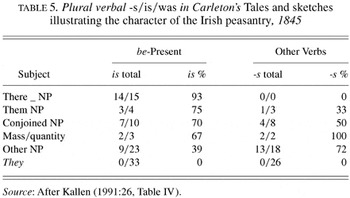
Plural verbal -s/is/was in Carleton's Tales and sketches illustrating the character of the Irish peasantry, 1845
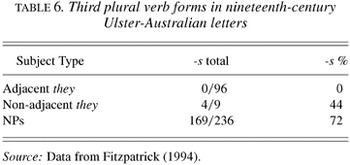
Third plural verb forms in nineteenth-century Ulster-Australian letters
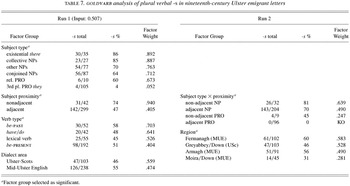
GOLDVARB analysis of plural verbal -s in nineteenth-century Ulster emigrant letters
 You have
Access
- 23
- Cited by