1. Introduction
Case studies in science are generally understood as one-off objects—studies that might be revealing, and generate knowledge, about that individual case researched but, because of the characteristic of singleness in the object, will offer few resources for generalization (see Morgan Reference Creager, Wise and Lunbeck2012). This research mode is also seen as lacking obvious and accepted recipes for transferring case-based knowledge for use even in specific sites elsewhere. Rather than attack this as a problem restricted to case study research, this paper argues that the problem of resituating knowledge is common to other more accepted modes of doing science and is thus a general problem faced by scientists.
In a broad sense, of course, it is a well-understood problem in philosophy of science: to characterize the process by which scientific knowledge becomes general knowledge, that is, to answer the question, how do bits of scientific knowledge become understood as general beyond the originating site?
The problem has two sources: first, that scientific knowledge is originally generated only as ‘specific’ chunks of knowledge (not as general knowledge), and second, that it is locally ‘situated’—generated in a particular time and place and developed by particular individuals or groups of scientists. The first interpretation raises the problem of moving from the specific chunks of knowledge to the general version of that knowledge, a problem attacked by philosophers of science, who have argued at length about justification, verification, confirmation, and the inference regimes that justify advancing the status of the knowledge gained from specific to general. By contrast, the second interpretation, overcoming the situatedness of knowledge, has been explored and treated at equal length by historians and sociologists of science. Leaving aside here the narrower question of tacit knowledge, such commentators have framed their analysis of this ubiquitous problem by studying how specific knowledge comes to be shared within a community and how it travels, or is transmitted across communities, so that it becomes generally accepted over time and space and among different scientists. These are clearly questions of social epistemology, but ones in which the social is at least an equal partner of the epistemological.
The broad epistemological problem of the situatedness of knowledge can be treated philosophically by supposing that the initial steps by which such locally situated pieces of specific knowledge travel toward more general acceptance are most usually ones in which the local knowledge is ‘resituated’ in one, few, and then more, new localities. That is, the path by which locally generated and specific knowledge becomes accepted more broadly is not local-general, but by a series of local-local, and then perhaps local-many, steps, in each one of which the originally situated knowledge has to be resituated at another local level. Interpreting the problem in this way, reasoning in this framework, and using evidence from a variety of examples suggest that scientists have a set of generic epistemic strategies for resituating local knowledge. This paper locates such common epistemic strategies and offers a typology of those strategies, rather than offering a critique or detailed discussion of any one strategy. Since, by repute, case study research findings are thought to face the hardest task in being resituated in other locales, the analysis is framed with these difficult cases in mind. But this paper shows how the problem and the strategies for its solution are shared ones to be found in other forms of scientific investigation such as field science, laboratory experiment, and so forth.
2. Three Generic Strategies for Resituating ‘Local’ Knowledge
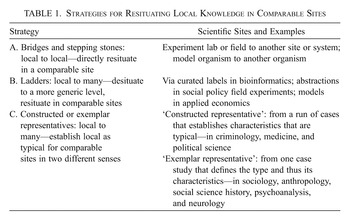
The problem then is that of resituating ‘local’ knowledge, that is, making knowledge initially characterized by its location in place and time relevant in new sites. Three strategies are defined that rely on different processes or forms of comparability for resituating knowledge from one site to another. They are described and labeled below and in table 1:
A. By establishing comparable sites where the local specific knowledge may apply directly. Here the idea is that either ‘bridges’ or ‘stepping stones’ offer means for directly transferring the knowledge gained in one site to another, and so the resituation of knowledge is a local-local transfer. The use of the term ‘direct’ does not imply that the task of transfer is easy or straightforward in either a scientific or analytical sense—as we will see. Rather, it implies that the links between the two local sites do not depend on making use of other levels or intermediaries that create an indirect route of transfer as in recipe B.
Table 1.Strategies for Resituating Local Knowledge in Comparable Sites
Strategy Scientific Sites and Examples A. Bridges and stepping stones: local to local—directly resituate in a comparable site Experiment lab or field to another site or system; model organism to another organism B. Ladders: local to many—desituate to a more generic level, resituate in comparable sites Via curated labels in bioinformatics; abstractions in social policy field experiments; models in applied economics C. Constructed or exemplar representatives: local to many—establish local as typical for comparable sites in two different senses ‘Constructed representative’: from a run of cases that establishes characteristics that are typical—in criminology, medicine, and political science
‘Exemplar representative’: from one case study that defines the type and thus its characteristics—in sociology, anthropology, social science history, psychoanalysis, and neurologyB. By extracting—desituating—some causal or conceptual knowledge from local findings that can then be resituated in comparable sites elsewhere. Here the most useful label is ‘ladders’ for the practice of some kind of abstraction that desituates local findings into a somewhat broader level (above local but less than general), which can then be available for resituation in another local level. The term ‘ladders’ is adopted from Cartwright (Reference Cartwright2012), but the claim here is that any individual ladder can be used in many locales and thus potentially offers local-many transfers. Again, there are difficulties (for the scientist and for the philosopher to note), particularly in coming back down the ladder to resituate the knowledge.
C. By establishing local knowledge as ‘typical’ and thence available to be used in many other comparable (or contrasting) sites. Practices differ here between different scientific modes that put limitations on, or guide preferences about, how this typicality is constructed and/or validated and how such typical elements are used for insight into comparable or contrasting locales. Again, this is a generic strategy, but its multiple versions do not come self-made, and they offer both problems and advantages.

As noted above, all these strategies are just that—strategies offering ways to do things, not techniques that can be applied according to a general rule or without specific attention to the sites involved, so they offer many practical problems for the scientist and thorny problems for the philosopher to grapple with. It is important to note that my purpose here is not to try to replace, or even challenge, the standard philosophical categories of analysis, such as ‘inference’, and certainly not to propose a new theory of inference. Rather, the aim is to construct an account of how scientists working with different modes of research can be understood to make locally generated specific knowledge relevant at other sites—formally and informally—as we can find in the evidence from everyday science examples that demonstrate or illustrate those strategies. So this analysis operates at a middle level in the sense that it picks out and characterizes strategies, rather than either arguing from general principles or picking out specific techniques. It also draws on and brings together a number of different recent contributions in philosophy of science that analyze one or other of these particular strategies, each with their own labels. Bringing these variously labeled processes under one umbrella inevitably involves some recasting of some others’ terms in order to show how they fall under one of the defined generic strategies.
3. Direct Resituating via Stepping Stones and Bridges
This strategy relies on establishing sufficient similarity of contexts, events, elements, and causal processes between two sites to allow the resituating of the findings directly from one domain to another. If the two sites are seen to be sufficiently comparable, the strategy is used by scientists to underwrite processes of local-local knowledge transfer.
Such local-local transfers are not easy to make, and the direct resituation of initial findings from one locale to another often does not look as if it follows any principled scientific procedure. Yet a local-local resituation strategy based on comparability checks is one way in which the making of inferences from individual lab or field experiments to equivalent or comparable sites has recently been understood and framed within philosophy of science. That is, inference from experiments is no longer seen as a local-general move, or even as a simple local-local induction. Rather, as philosophers of science have recently argued, the making of valid inferences in experimental science should be seen as a process of relying on careful comparison to establish the relevant similarities that justify the transfer of experimentally obtained knowledge between a specific experimental site and a relevant target site, be they lab or field experiments.
For examples, both Steel’s extrapolative and comparative process tracing account (Reference Steel2008) and Guala’s analogical account (Reference Guala2010) offer sophisticated accounts of what is involved, and, taken broadly, the epistemic strategies they outline characterize local-local processes of knowledge resituation for experimental findings. In their analyses, comparisons of an experimental system with a target system are pictured with chain diagrams showing how the elements of these two systems, denoted by nodes or squares, are linked with lines and arrows that denote the equivalences and causal influences. That is, their diagrams portray the extrapolative or analogical steps in a process chain where all (or a sufficient number of) the relevant links must hold to validate scientific inference from a specific experiment to a specified target system. The examples that Guala discusses include the resituation of knowledge about diseases from experiments using animal models to human diseases, and the process of transferring laboratory knowledge of auctions into the field design of auctions in the economic domain. Whether these arrows and links are present or absent is critical to whether inference can be made in any specific concrete case and thus whether the experimentally obtained knowledge can be resituated as valid at the target site. It is a local-local gap that must be bridged, but there is no one shared structure that covers the gap. Rather, everything depends on being able to get across the whole chain, step by step, without failing at points where relevant steps, nodes, or arrows in the chain of elements are missing—thus, I call this a ‘stepping-stone’ strategy for resituating knowledge.
A different local-local transfer strategy—a ‘bridge’ strategy—can be found in some other modes of science, for example, in the way model organism research findings are transferred from one organism to another. Ankeny (Reference Ankeny, Creager, Wise and Lunbeck2007), using case material on the worm C. elegans, has constructed such knowledge transfers either as a form of case-based reasoning, where the cases must have sufficient matching characteristics, or as analogical reasoning. In both, processes of local-local comparisons are critical to the resituation of knowledge. Yet something more than comparability appears to be at work here, for the resituation of knowledge often rests on an argument of specific sharing between organisms: for example, because they share some physiological processes in common, or because they have sufficient genetic material in common. Such arguments suggest stronger links than those offered in the experimental stepping-stone recipe for resituating findings, for these shared qualities offer a bridge for getting directly from one local site (or organism) to another local site (or organism). The shared qualities are taken to validate a direct resituation of local knowledge to another locale.
4. Desituating and Resituating via Ladders
The second strategy of transferring knowledge from one local to another local site relies on desituating the local knowledge in certain respects in order that it can be resituated more easily and effectively. Though establishing comparability is still part of the recipe, it does so via a process of first describing the specific knowledge in more abstract or general ways. This desituating strategy is described in Cartwright’s (Reference Cartwright2012) analysis of overcoming the problem of transferring to another locale the findings of poverty reduction programmes based on local field experiments funded by the World Bank. Her normative project is to outline what is required to make findings from one site work in another site, and she argues that the scientists involved need both “ladders” and “bridges.” Under the label “bridges,” Cartwright provides an account of the causal factor findings that need to be transported from site to site; her analysis looks—with its sequences of elements and causal arrows—much like the strategy that I labeled a ‘stepping-stone’ strategy above. Her “ladders,” by contrast, go from the first site up to more abstract or general terms and then back down to the new site. They desituate by abstraction and resituate from that more general level, but only to other local levels. Such ladders are not a strategy of immediate generalization, but a significant element of my argument here is to understand why they have a greater potential to prompt a more general relocation of the knowledge findings than stepping stones or bridges.
To see how ladders offer this more general means of knowledge relocation, some examples of the strategy help. In model organism work, Leonelli (Reference Leonelli2009, Reference Leonelli2011) explains how curators label research findings from scientific work, for example, experimental work on the plant Arabidopsis, with labels that characterize the findings in concept-based ways—she calls this “de-contextualizing” the findings. This labeling enables others working on the same plant, or perhaps on other organisms, to locate bits of local knowledge that might be useful for their own comparable research questions. This more abstract labeling thus enables those others to “recontextualize” the original research: to reuse the data, or make use of the findings in various ways in their own direction of work. This example demonstrates two important features of ladders. First, despite the fact that the original finding has been labeled with this more abstract label, the scientists involved do not take that as in any sense implying or validating any general finding—scientists do not interpret such curation as a general inference move or use the materials in such a manner. Second, although not a generalizing move, the desituating process has made the local knowledge potentially available to multiple different sites. Significantly, there is no restriction on the number of other scientists who can make use of these curated materials. Whereas stepping stones and bridges are only local-local strategies, ladders enable original local findings to travel via the abstraction to prompt comparable and comparative work in several sites. This may in turn lead to some generalization of findings, but only by virtue of many individual moves via ladders in which the finding is successfully resituated.
Despite their portability, ladders are not necessarily an easier route than stepping stones for resituating local knowledge. First, they have to be firmly grounded in the new site, which means that careful attention has to be paid to the comparability of context and problem description in new and old sites. Second, there has to be a way down from the abstraction involved. Even when the context and problem look similar, the local form of the relevant causal factors in the new site may be just sufficiently different that a simple reversal of the abstraction on the way down may be misguided. As Cartwright’s examples show (Reference Cartwright2012), the exact constitution of the causal factors that make an experiment work in the first site may well prove problematic at a second site because differences in culture are sufficient to alter the form or choice of relevant causal factors and their interactions. Under these conditions, a process in which knowledge is abstracted from one site and then simply reversed for action at another will likely prove unsuccessful.
Models can also offer the ladders that enable scientists the kind of middle-level abstraction that serves the purpose of desituating and resituating findings. This is well demonstrated in the reaction to Baden-Fuller’s (Reference Baden-Fuller1989) findings that firms did not necessarily exit an industry in the expected order, with the least profitable going first, but rather the opposite. This finding of ‘inefficiency’ in order of exit came from a case study at a specific site with strong local contextual features: the steel casting industry in the 1980s in the United Kingdom, and in the context of a strong depression in the industry. Yet, these findings were picked up and widely used for studies of firm exit at many other sites in other countries, other times, other industries, and many other contexts. These multiple resituations relied on the fact that the original study produced its own ladders—in the form of the models used to analyze the local site data (game theoretic models, financial models, causal models)—that offered a set of integrated explanations for these unexpected findings. Such models, because they could be understood in abstracted form, allowed the community of users to desituate those findings from the steel casting industry and easily resituate them at other sites. Using these ladders, findings from one local case study came to be resituated in many other local sites, but they did not generalize into a general claim that exit will always be inefficient, or even that it would be always so in similar contexts. Rather, they came to rest as a likely finding that had to be held in mind for they were found to apply to a number of situations and could be important for both applied economics and policy work.
Yet, even when the ladders are strong and can be well grounded in new sites of comparable problems and contexts, the abstraction into models made available from the analysis at the first site may not be simply reversible at the new site in the same form and order. This is especially true of abstract models in mathematical form, where philosophers of science have analyzed idealization as a mode of abstraction or desituating. There has been remarkably little interest in the processes needed for resituation, that is, the processes of de-idealization or reversing the original abstractions. Morgan and Knuuttila (Reference Morgan, Knuuttila and Mäki2012) have argued that there are six kinds of problems to be found when de-idealizing mathematical models in economics, and these may all be relevant when findings are to be resituated at new sites. One is associated with the mathematizing of the abstraction (tractability assumptions and mathematical molding); two are associated with the simplification of elements in the model (simplification of contained elements, and omission of minor or covarying elements); one is associated with ceteris paribus assumptions; one is associated with the alignment of different unit levels; and, finally, there are the abstract concepts that have been created. All these processes of idealization have to be reversed, and it is not at all clear that there is a straightforward reversal path of “concretization,” as Novak (Reference Novak1980) assumed in writing about this process.
Such problems of resituating knowledge in new sites are not just a feature of working with mathematical models. Thus, Ruzzene (Reference Ruzzene2012) showed how a rather abstract and general claim about the role of institutions in economic development can be consistent with a number of different mechanism types that, in a de-idealized form, may be used to explain the experience of different economies at different times and contexts.
The abstractions needed to make use of the ladder strategy can be located in many different aspects of the scientific materials of a specific study: they can be found in theoretical or conceptual terms, of course, but equally in taxonomic labels, models, generic causal processes or mechanisms, ideal types or exemplary narratives, and so forth. It is just because findings are expressed in these somewhat more general or abstract forms that they can be picked up and used or applied—resituated—in many other comparable sites. The role of ladders is widespread, which is why scientists give such very careful attention to creating usable ladders (e.g., the curating process in bioinformatics that needs to make labeling accurate and informative) and need to give equally careful attention to processes of getting back down the ladder, be it in model organism work, modeling work, or experimental work.
5. Claiming Representativeness to Resituate Knowledge
If research findings from a particular site can be constructed as representative in some way, they create a benchmark for other comparable (or indeed contrasting) sites/situations/events and causal processes. This strategy can be cashed out in two ways. One way to understand ‘representative’ is as typical of a population of similar things, a quasi-statistical sense of the notion of typical, which is labeled here as a ‘constructed representative’. An alternative way to understand ‘representative’ is as exemplifying a type or kind, that is, a particular local knowledge site or findings can be understood as exemplary of, or for, a particular class or kind of event: an ‘exemplar representative’. Both such representatives offer the possibilities of comparisons with many sites, some similar and some that might be in contrast, and so can offer insight, or be used to illuminate, both similar and different local specific sites.
5.1. Constructed Representatives
To ensure that any piece of research work offers something typical in a real statistical sense requires a lot of examples of comparable events to determine what is typical or representative of them. For example, within a given population distribution of, say, family sizes, a particular value—the mean, mode, or median—might be taken as representative. But this representative value might not even exist as a particular in the data set: for example, there is no family with 2.4 children, which is why such a mean can be labeled a ‘constructed representative’. Income is more or less lognormally distributed (the Pareto distribution). Such a claim rests on a lot of different data sets of income to produce such a statistically constructed representative, for once again, it is perfectly possible that no income data have an exactly lognormal distribution. Such constructed representatives are findings in their own right, but they also form benchmarks for comparable research work; they can be taken to new sites and compared with the findings there for insight because of either their similarities to or their differences from the benchmark. They enable scientists to determine whether, for example, a particular local community has a high or low family size or unusual distribution of income.
Other modes of doing science have evolved other forms of constructed representatives. Research findings that emerge from a set of ‘cases’, rather than from one case study, may produce constructed representatives and so offer materials for benchmarking and resituating local knowledge. Cases are somewhat thinner in details than case studies, and comparability is more easily obtained, so that a quasi-statistical notion of what is typical of a run of cases may be obtained from even a small number of cases. In medicine, for example, it is often feasible to establish a series of similar cases that enable scientists to define the typical characteristics of both the symptoms and patients for a disease. These characteristics establish what is taken to be typical of the population with that illness and are then used as a checklist for examining new potential cases. For example, Ankeny (Reference Creager, Wise, Lunbeck, Howlett and Morgan2011) shows how both the health diagnostics and personal characteristics of a relatively small number of patients were used to establish new diseases (e.g., HIV-AIDS, and a variant of toxic shock syndrome) and that those characteristics of what is typical then form the generic descriptor to diagnose further individual local cases. In another case, Ankeny (Reference Morgan2014) shows how finding the presence of massive caffeine ingestion as the only comparable factor in a few unexplainable cases of heart attacks in otherwise young fit patients created the basis for isolating and understanding a new diagnosis for cause of death, a cause that was then used to explain further deaths; caffeine is now under investigation by the Food and Drug Administration as a health hazard (see Kelly Reference Kelly2013). Such investigation of comparable personal and medical factors in a small number of cases leads to characterizations taken to be representative of a disease-and-patient type. Such constructed representatives may be resituated not only to frame and discuss similar cases but also to develop new local findings in the field.
A similar process can be found in social scientists’ use of a series of cases to establish a set of similar characteristics that define a typical phenomenon. In a salient example, Sutherland (Reference Sutherland1949) conceptualized the phenomenon ‘white collar crime’ by collecting a series of cases of fraud and similar crimes and used them to define the genre by the characteristics that were typical of those cases. In another example, the ‘barriers’ that maintained the glass ceiling on female employment possibilities were isolated by a series of case investigations of large American corporations (Morgan, forthcoming). The characteristics of these barriers formed a checklist that could be applied under a legal framework to assess the performance of other corporations.
In such runs of cases, it is not any particular case that is taken as the representative, but the characteristics typical of the set of cases: a constructed representative from a smaller or larger number of local findings, akin to the average family size for a population but without the benefit of statistical validity. Even so, once established, such a constructed representative can be resituated for use at many other local sites. These constructed representatives are typically not treated as ladders, as they lack the abstract qualities associated with that strategy of transfer; rather, they retain a strong empirical characterization, and it is this that enables them to be used in direct comparison with other such materials, and not just in one but in many such new locales.
5.2. Exemplar Representatives
An alternative version of this strategy involves finding (instead of constructing) a ‘representative’ X, that is, by establishing one locally in-depth investigated case as exemplifying X, it can then be used as a typical representative for x’s in other locales. This strategy at first sight offers another difficulty, of equal magnitude to that for the quasi-statistical sense. One might argue that only if the description of such a typical kind is already established can a particular new sample be classified as of that kind, and thence argue that its research findings have nonlocal relevance (as in the curated labeling discussed above for biology). An example of such a strategy in a social science case study comes in resituating the behavioral characteristics of black young males in an area of Washington, DC (Liebow Reference Liebow1967). The argument was that these young black men (one kind) behaved in certain ways not because they had some inherent black male cultural traits due to either nature or nurture but rather because they fitted into a differently constructed but already-known, wider class, namely, that of young men with little education in a world with few jobs for such men (another broader kind). That is, their behavior was prompted by economic circumstances, not race, class, creed, or culture, an argument that depended on resituating them in another particular class, with already well-known behavior.
Exemplary representatives more usually lean toward a typological than a taxonomic notion of typical. Case studies in the social sciences are more often taken to establish ‘a type of X’, rather than ‘a kind of X’, that is, they establish an x that is taken to be typical for a genre X, rather than an x that is typical of a kind X. In contrast, model organism findings can be interpreted under either label: fruit fly findings can be resituated to other fruit flies by virtue of their being of the same kind, that is, representative of (typical of); but they can also be resituated when they can be taken as representative for (typical for) a wider class of insects, or even of genetic processes (see Morgan Reference Morgan, Creager, Wise and Lunbeck2007). But since the notion of ‘type’ often makes more sense than that of ‘kind’ for social sciences, typologies tend to be more useful than taxonomies.
Similar to the constructed representatives, it is important that—for these purposes of resituating knowledge from one locally derived set of knowledge to another local site—the exemplar representative is not to be interpreted as an abstract ideal type but as a specific instance. The exemplar representative that is taken as establishing what is typical for other sites is richly described from empirical work and forms the basis for interpretative and analytical work on that genre. Examples may help again here. The Kula ring has been taken as the exemplar case for discussions of other ritual gift/trade exchanges. Ancient Athens has been taken as the exemplar case for discussing other democracies. They sit in strong contrast then to the well-known “ideal types” of Max Weber, which are quite abstract in content and where their mediating possibilities rely on their ideal conceptual status to inform both theorizing and empirical work. Similarly, the less well known “constructed types” found in the sociology of Becker and McKinney (see, e.g., McKinney Reference McKinney1950) are constructed from empirical work but are conceptual categories rather than empirical instances. Both their types, “ideal” and “constructed,” might well serve as ladders, for they have a much less concrete existence than the kinds of objects discussed here under the label of exemplar representatives. For examples of the latter, the Lynds’ Middletown (Lynd and Lynd Reference Lynd and Lynd1929) is surely the most well-known American urban case study of the twentieth century, whose many very detailed findings about religion, work, consumerism, education, home life, leisure activities, and so on, were quickly taken as representative for urban America. It was not a study of an already ideal defined type of sociological phenomena. Rather, its specific and detailed empirical findings came to exemplify and represent modern American towns of the period and created the materials for comparison with, and reflection on, other studies of urban life.
Research from a local case study or from a survey may well establish the ‘exemplar case X’, whose features offer materials against which other local cases may be usefully compared (or even contrasted). For example, Ford’s moving production line and Toyota’s total quality control system have both been taken as exemplary representatives for particular manufacturing technologies. Indeed, one can argue that each of these individual cases came to define those technologies and to determine the characteristics of what is taken to be typical of those technologies. These were local instances but set the standards, or the base cases, whose characteristics were taken to define what is typical, and could be resituated—to guide research and set the terms of description—in other comparable sites. Many of these exemplary instances in the social sciences emerge from case study work, though, of course, not all case studies produce such exemplar representatives. Indeed, some case studies gain exemplar status precisely because they are rare and atypical; they might form objects for useful comparisons, but they do not fulfill the function of representativeness, and so their resituating possibilities are more limited.
6. Conclusion
This account aimed to open up the analysis of the epistemic processes by which locally produced specific knowledge, situated in time and place, becomes resituated for use elsewhere by others as the first step in the process of becoming accepted as general knowledge. This paper discussed three broad generic strategies for achieving this process (perhaps five if both ‘stepping stones’ and ‘bridges’ and the two kinds of representatives are counted separately). Scientific practices, however, are always messier than such taxonomic analysis would like. Although these categories have been treated as separate, they may well overlap in practice, or be used in conjunction, to investigate a topic within a field. Thus, in a final example, Crasnow (Reference Crasnow2012) detailed how political science / international relations use indices of democracy and conflict constructed through coding cases in order to study the “democratic peace hypothesis,” namely, that democratic nations do not go to war with each other. These codings used ladders to access abstract notions to help with the coding. The researchers also produced a series of historical case study examples, offering detailed “process tracing” that could be interpreted as stepping-stone strategies, and they developed exemplar representative cases for comparisons (including the atypical Fashoda Incident). Such usage of multiple and overlapping strategies of resituating knowledge might indeed be the rule rather than the exception.
This account does not pretend to be exhaustive. There may well be more such generic strategies; there may well be more useful subcategories. All of these strategies rely on establishing, or making use of, some form of comparability to prompt the resituation of specific local knowledge either directly or indirectly via abstractions or representative cases. Nevertheless, it is perhaps significant that even a relatively sparse taxonomic framework (of table 1) has been effective in organizing and analyzing materials from such different scientific fields and from such different modes of doing science.