Introduction
The close relationship between sleep disturbances and depression has been known for a long time. Hippocrates considered ‘sleeplessness’ as a cardinal feature of melancholia. Kraepelin (Reference Kraepelin1909) in his own description of melancholia observed that ‘insomnia is an early and prominent symptom’ and that ‘a gradual improvement of sleep may be regarded as favourable sign’.
Ford & Kamerow (Reference Ford and Kamerow1989) in a study in the US general population reported an association between earlier sleep disturbances and the onset of depression 1 year after the baseline interview. They suggested that sleep disturbances, apart from being a symptom of the depressive syndrome, might act as a risk factor for the development of depression. A more careful look at the results of this study, however, leads to a different conclusion. The authors grouped insomnia into four groups: no symptoms, symptoms at baseline only, symptoms at follow-up only, and ‘persistent symptoms’. Insomnia at ‘baseline only’ was not associated with depression at follow-up but there was a very strong cross-sectional association at follow-up [odds ratio (OR) for insomnia at ‘follow-up only’ 35, 95% confidence interval (CI) 21–59]. In addition, ‘persistent’ insomnia was also significant with an OR very similar to the cross-sectional one (OR 39.8, 95% CI 19.8–80). Because persistent insomnia ‘includes’ the main effects of insomnia at baseline and insomnia at follow-up, the question of interest is whether there are any significant departures from the multiplicative relationship, that is an interaction. The authors did not report such a test but it is unlikely that this would have been significant given the figures provided. Therefore, the most robust finding of that study was the very strong cross-sectional association and not the longitudinal one. Several subsequent studies aimed to investigate the longitudinal relationship of sleep problems and depression (see Baglioni et al. Reference Baglioni, Spiegelhalder, Lombardo and Riemann2010 for a review of these studies), and although many studies confirmed the Ford & Kamerow findings, there are some that reached a different conclusion, for example the very large HUNT study from Norway (Neckelmann et al. Reference Neckelmann, Mykletun and Dahl2007) or the Zurich study in young adults (Vollrath et al. Reference Vollrath, Wicki and Angst1989).
Previous studies that provided evidence in favour of the association between sleep disturbances and subsequent onset of depression have sometimes equated statistical association with causation (Baglioni et al. Reference Baglioni, Battagliese, Feige, Spiegelhalder, Nissen, Voderholzer, Lombardo and Riemann2011). However, there are alternative explanations for this association that have not been recognized or taken into account. First, the temporal association is compatible with sleep disturbances being a prodromal symptom rather than a risk factor of depression. Symptom development in depression is rarely sudden or rapid in non-hospitalized patients. In the community, the norm is a gradual onset with a prodromal phase of weeks or months (Fava & Mangelli, Reference Fava and Mangelli2001). Empirical research has shown that the most common symptoms of the prodromal phase are (in descending order) generalized anxiety, irritability, gradual retirement from work and social activities and insomnia (Fava et al. Reference Fava, Grandi, Canestrari and Molnar1990). These symptoms appear earlier in the disease process before the full-blown depressive syndrome attracts clinical interest. However, although risk factors can also exert their action during the period of syndrome evolution, it is very likely that they may precede the onset of an episode several months or years in otherwise healthy individuals. Ignoring the impact of prodromal symptoms in depression may lead to longitudinal associations with a different meaning and implication. Second, depression is a symptom-based condition and all symptoms are strongly inter-correlated cross-sectionally. In addition, the most important predictor of current sleep disturbances is a previous history of the same problem (Buysse et al. Reference Buysse, Angst, Gamma, Ajdacic, Eich and Rossler2008) and this also applies to other common symptoms included in the depressive syndrome such as fatigue or concentration problems (Skapinakis et al. Reference Skapinakis, Lewis and Mavreas2004). Most studies have ignored the strong inter-correlation among the several depressive symptoms and a few have adjusted for the presence of other symptoms at baseline but not at follow-up, where the association might be even stronger. Third, several studies that used the diagnosis of depression as their outcome variable did not exclude sleep disturbances from the diagnostic criteria and an artificial overlapping is therefore expected. Fourth, the issue of bidirectionality is not very well studied, even though research has shown that depression is one of the most important predictors of future sleep problems (Morphy et al. Reference Morphy, Dunn, Lewis, Boardman and Croft2007; Jansson-Frojmark & Lindblom, Reference Jansson-Frojmark and Lindblom2008).
It is important to clarify the temporal relationship between sleep disturbances and depressive symptoms to reinforce prevention strategies for depression. The aim of the current study was to re-examine this issue while taking into account most of the limitations referred to above. First, we avoided artificial overlapping by using a definition of depression that excluded all other symptoms except depressive mood, loss of interest and depressive ideation (guilt, worthlessness, suicidal ideation). Second, we adjusted for all other symptoms that are included in the syndromal definition of depression both at baseline and at follow-up so as to take into account the confounding effect of these symptoms. Finally, we investigated the issue of bidirectionality using appropriate analytical approaches and statistical techniques.
Method
Description of the data set
The longitudinal study reported here was carried out in the UK by the Office for National Statistics (ONS). The 2000 Psychiatric Morbidity Survey aimed to estimate the prevalence of common mental disorders among adults aged 16 to 74 years living in private households in Great Britain (Singleton et al. Reference Singleton, Bumpstead, O'Brien, Lee and Meltzer2001). All subjects with a definite or subthreshold psychiatric disorder and a 20% random sample of those without a disorder were eligible for the follow-up study 18 months later (Singleton & Lewis, Reference Singleton and Lewis2003). Of the 3561 individuals eligible for follow-up, 2406 were successfully reinterviewed for a 68% response rate. Non-participants were slightly more likely to be younger and of lower socio-economic status but similar in terms of psychiatric symptoms. Ethical approval for the study was obtained from the Multi-centre Research Ethics Committees in England.
Measurement of sleep problems, depressive symptoms and other common psychological symptoms
The main instrument used to assess all psychological symptoms was the Revised Clinical Interview Schedule (CIS-R), a fully structured interview designed to be used by trained lay interviewers (Lewis et al. Reference Lewis, Pelosi, Araya and Dunn1992). The CIS-R assesses the presence and severity of 14 common psychological symptoms in the week preceding interviews.
Measurement of sleep disturbances
The ‘sleep disturbances’ section of the CIS-R covers questions on the presence and severity of sleep problems. All participants were first asked the insomnia screening question: ‘In the past month, have you been having problems with trying to get to sleep or with getting back to sleep if you woke up or were woken up?’ Those who responded positively were then asked about the presence of sleep problems during the past 7 nights. If the problems were present for at least 4 nights, the participants were asked additional questions on the severity of the sleep problems on the worst night (time spent trying to get to sleep) and on the number of nights they spent 3 or more hours trying to get to sleep.
Those who responded negatively to the insomnia screening question were asked a second screening question about hypersomnia: ‘Has sleeping more than you usually do been a problem for you in the past month?’ Those who responded positively were then asked questions similar to the insomnia questions.
The range of possible scores on the sleep disturbances section is 0 to 4, and in the present study we classified people as having clinically significant sleep problems during the past 7 days if they scored ⩾2 on this section (binary variable). Supplementary Fig. A1 in the online Appendix shows graphically the way we have defined sleep disturbances in the current study.
Measurement of depressive symptoms
There are two depression-related sections in the CIS-R: the first covers low mood and anhedonia or loss of interest. We refer to this section as ‘depressive mood’. The second covers cognitive aspects of depression such as thoughts of low self-esteem, guilt, hopelessness, and suicidal thoughts (‘depressive ideas’ section). We combined both these CIS-R sections to produce the outcome variable ‘depressive symptoms’. Participants had to have a score of ⩾2 on both sections to count as having ‘depressive symptoms’ (used as a binary variable), in other words they reported low mood and/or anhedonia and at least two items of depressive ideation. This definition of depressive symptoms can be considered as including all the core symptoms of the syndrome of depression but without the remaining symptoms usually included in the DSM-IV or ICD-10 classifications (fatigue, concentration/memory problems, sleep problems).
Measurement of other psychological symptoms
We have used the relevant sections of the CIS-R to define in a similar way (a score of ⩾2) the following symptoms: fatigue, concentration/memory problems, irritability, psychosomatic pain and anxiety (all binary variables). The choice of these particular symptoms was guided either by the diagnostic criteria of depression and the daytime consequences of sleep problems (for fatigue, concentration/memory and irritability) or by the known associations between depression and pain (Bair et al. Reference Bair, Robinson, Katon and Kroenke2003) or anxiety (Hamilton, 1989).
Other variables
We used information on the following variables: (a) age (continuous variable); (b) gender; (c) marital status (in five categories: married, separated, single, divorced, widowed); (d) educational qualifications (based on the highest level attained); (e) occupational social class (defined according to the UK Registrar General's classification and based on the participant's current or most recent occupation); (f) employment status (in three categories: working full-time or part-time, unemployed, economically inactive).
Statistical analysis
Correlation between symptoms at both times was examined using tetrachoric coefficients to take distributional problems associated with skewed dichotomous data into account (Holgado-Tello et al. Reference Holgado-Tello, Chacon-Moscoso, Barbero-Garcia and Vila-Abad2010).
We used two alternative analytical strategies: one based on logistic regression and the other based on path analysis. For the logistic regression analysis we used the ‘svy’ commands in Stata v. 10 (Stata Corporation, USA). We used probability weights in this analysis to take account of the stratified sampling procedure and non-response. We performed two separate logistic regression analyses using the presence of depressive symptoms or sleep disturbances at follow-up as the outcome variable respectively. We present two models: model 1 adjusted for all sociodemographic variables and model 2 additionally adjusted for the remaining psychological symptoms (pain, fatigue, concentration/memory problems, irritability, anxiety). All symptoms, including sleep disturbances and depressive symptoms, were categorized according to case status at both baseline and follow-up into four groups: no symptoms at all (reference group), symptoms at baseline (T1) but not at follow-up (T2), symptoms at follow-up (T2) but not at baseline (T1), and symptoms present at both times (persistent symptoms). Because the presence of symptoms at both times might involve an interaction between symptoms at T1 and T2, in the analysis we formally tested for significant departures from the multiplicative relationship between sleep disturbances and depressive symptoms using Wald tests and likelihood ratio (LR) tests. In the absence of a significant interaction it is the ‘main’ effect at baseline or follow-up that is of importance.
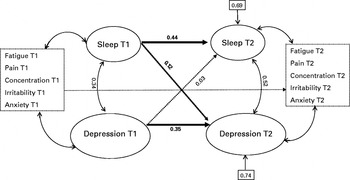
To further explore the possibility of a bidirectional association between sleep disturbances and depressive symptoms, we supplemented the ordinary regression analysis with path analysis, a specific form of structural equation modelling. Path analysis can be used when there is only a single directly observed measure of each theoretical variable (i.e. single-indicator measurement) and the researcher has a priori hypotheses about ‘causal’ relationships among these variables (Kline, Reference Kline2011). The advantage of path analysis over the simple regression model is that the latter can only specify one response variable at a time, whereas the path analysis estimates as many regression equations as are needed to relate all the proposed theoretical relationships. For this analysis we used LISREL 8.54 (Joreskog & Sorbom, Reference Joreskog and Sorbom1996). We first specified a stability model (model 0) without cross-lagged structural paths (Fig. 1). This is sometimes referred to as a first-order autoregressive model in which symptoms are represented as ‘causes’ of themselves over the two time points (Hertzog & Nesselroade, Reference Hertzog and Nesselroade1987). Then we compared this model with three more complex models with cross-lagged structural paths:
Path diagram of reciprocal effects between sleep disturbances (‘Sleep’) and depressive symptoms (‘Depression’) at two time points (T1, T2) 18 months apart in a general population sample of adults in the UK. Standardized path coefficients are calculated from the reciprocal model. Curved two-way arrows indicate covariation between variables. Numbers enclosed in rectangles with arrows pointing towards Sleep T2 or Depression T2 indicate unexplained variance.

• Model 1 (path from sleep disturbances at T1 to depressive symptoms at T2).
• Model 2 (path from depressive symptoms at T1 to sleep disturbances at T2).
• Model 3 (the reciprocal model with both cross-lagged paths).
We estimated all models using the diagonally weighted least squares method (Flora & Curran, Reference Flora and Curran2004). The nested models were compared by a χ2 difference test. To assess the general goodness of fit of each model, the following criteria were adopted for the fit indices: Comparative Fit Index (CFI) >0.950, Non-Normed Fit Index (NNFI) >0.900, standardized root mean squared residual (SRMR) <0.060, and root mean squared error of approximation (RMSEA) <0.050 (Hu & Bentler, Reference Hu and Bentler1998).
Results
Description of the sample
A table of the sociodemographic characteristics of the sample at baseline is given in the online Appendix (Supplementary Table A1). In brief, the mean age of the sample was 44.75 years (s.d. = 15.01), 58% of the sample were female, 51% were married, 73% had at least some educational qualifications and 60% were classified in social class III non-manual or higher (I/II).
Prevalence of the various symptoms at baseline and follow-up (Table 1)
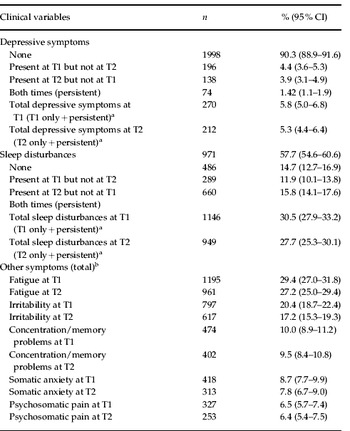
Table 1 presents the prevalence of the various symptoms at baseline and follow-up. Sleep disturbances were reported by 30.5% of the sample at baseline (men: 24.8%, women: 36.0%, p < 0.001) and 27.7% at follow-up. Depressive symptoms were reported by 5.8% of the sample at baseline (men: 5.6%, women: 6.0%, p = 0.62) and 5.3% at follow-up.
Clinical characteristics of the study sample (n = 2406) at baseline (T1) and at the 18-month follow-up (T2)

CI, Confidence interval.
a Derived by adding T1 and persistent (both times) symptoms or T2 and persistent symptoms respectively.
b These refer to total symptoms at T1 or T2 respectively.
Correlation between sleep disturbances and depressive symptoms
As expected, sleep disturbances and depressive symptoms were highly correlated with each other and with other common psychological symptoms at both times (p < 0.001 for all coefficients). For both symptoms, the highest correlation was found for the same type of symptom at baseline. Supplementary Table A2 in the online Appendix presents all the tetrachoric correlation coefficients and Supplementary Table A3 presents the prevalence of depressive symptoms at follow-up by the presence of sleep disturbances and vice versa.
Bidirectional association between sleep problems and depression with the use of logistic regression modelling (Tables 2 and 3)
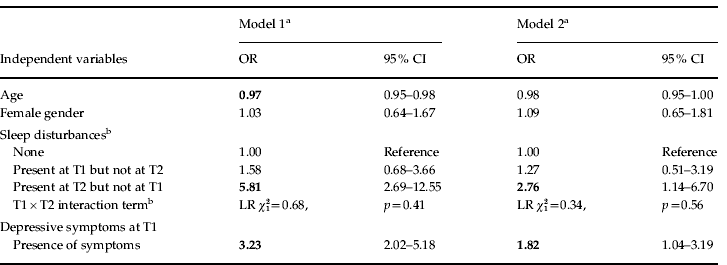
Table 2 shows the adjusted ORs for the association between depressive symptoms at time 2 (outcome) and sleep disturbances (as a risk factor), whereas the reverse is reported in Table 3. It can be seen from Table 2 that sleep disturbances at T1 (baseline) are not associated with depressive symptoms at T2 in either model 1 or model 2 (see Method section). However, there is a strong cross-sectional association between sleep disturbances at T2 and depressive symptoms at T2. The interaction term for T1 × T2 sleep disturbances was not significant (Wald test: F 1,221 = 0.02, p = 0.89, LR test: χ21 = 0.34, p = 0.56) and therefore there was no evidence for any multiplicative effect of persistent sleep disturbances on the likelihood of depressive symptoms. Table 2 also shows that previous (T1) depressive symptoms were significantly associated with future (T2) depressive symptoms in the fully adjusted model 2.
Association between depressive symptoms at follow-up (T2) and sleep disturbances at baseline (T1) or at the 18-month follow-up (T2) adjusted for sociodemographic variables and other psychological symptoms in a general population sample in the UK (n = 2406)
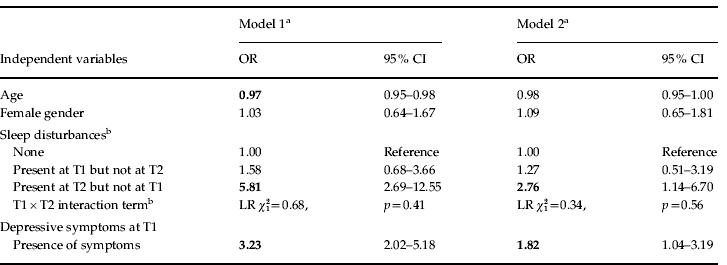
OR, Odds ratio; CI, confidence interval; LR, likelihood ratio test.
Bold values denote significance at p < 0.05.
a All ORs have been adjusted for age, gender, marital status, educational qualifications, occupational class, employment status (model 1) and additionally for other psychological symptoms (pain, fatigue, concentration/memory problems, irritability, anxiety) at T1 and T2 (model 2).
b The OR for persistent sleep disturbances (symptoms present at both times) is not reported because the interaction term (sleepT1 × sleepT2) was not significant.
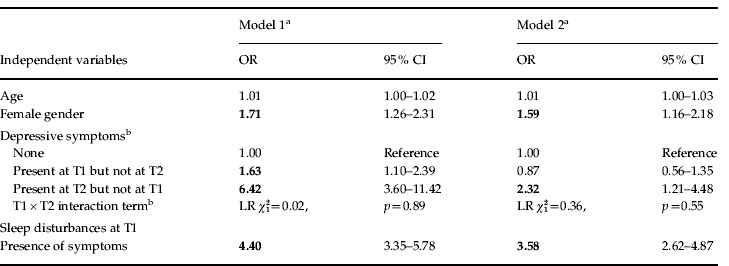
Association between sleep disturbances at follow-up (T2) and depressive symptoms at baseline (T1) or at the 18-month follow-up (T2) adjusted for sociodemographic variables and other psychological symptoms in a general population sample in the UK (N = 2406)
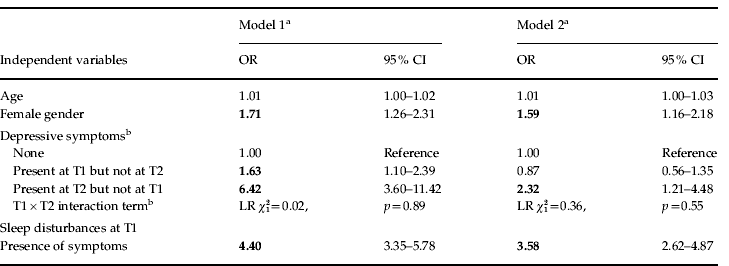
OR, Odds ratio; CI, confidence interval; LR, likelihood ratio test.
Bold values denote significance at p < 0.05.
a All ORs have been adjusted for age, gender, marital status, educational qualifications, occupational class, employment status (model 1) and additionally for other psychological symptoms (pain, fatigue, concentration/memory problems, irritability, anxiety) at T1 and T2 (model 2).
b The OR for persistent depressive symptoms (symptoms present at both times) is not reported because the interaction term (depressionT1 × depressionT2) was not significant.
Regarding sleep disturbances at T2 as the outcome, it can be seen from Table 3 that baseline depressive symptoms in model 1 are significantly associated with sleep disturbances at T2, but in the fully adjusted model 2, only the strong cross-sectional association at T2 remains significant. The interaction term for T1 × T2 depressive symptoms was not significant (Wald test: F 1,221 = 0.38, p = 0.54; LR test: χ21 = 0.36, p = 0.55) and, as before, there was no evidence for a multiplicative effect of persistent depressive symptoms on the likelihood of sleep disturbances. In the fully adjusted model, sleep disturbances at baseline (T1) were strongly associated with sleep disturbances at follow-up.
Additional analysis using path analysis
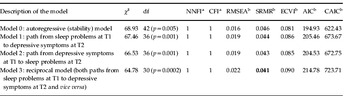
The previous regression analysis did not show evidence for a bidirectional association of T1 sleep disturbances with T2 depressive symptoms or vice versa and therefore we proceeded to explore further this relationship with the conceptually distinct approach of path analysis (see Method for details). Fig. 1 presents graphically the models tested and Table 4 presents an overview of the model comparisons. It can be seen from the table that all the models provided a good fit to the data but χ2 differences between the models were very small and not significant compared to the simpler stability model (model 0). Based on the remaining indices, the stability model 0 seems slightly better. The percentages of unexplained variance on sleep disturbances and depressive symptoms at T2 were 62% and 67% respectively (model 0). Regarding the paths from sleep disturbances to depressive symptoms and vice versa, it should be noted that in the reciprocal model 3 (which included both paths), the path from sleep disturbances at T1 to depressive symptoms at T2 had a coefficient of 0.12 with a standard error of 0.05 (i.e. this path was statistically significant) whereas the path from depressive symptoms at T1 to sleep disturbances at T2 had a coefficient of 0.03 with a standard error of 0.07 (i.e. this path was not significant). Exclusion of the path from sleep disturbances to depressive symptoms had a very small effect on the percentage of unexplained variance of depressive symptoms (approximately 1%).
Fit indices for four competing models of the association between depressive symptoms and sleep disturbances

df, Degrees of freedom; NNFI, Non-Normed Fit Index; CFI, Comparative Fit Index; RMSEA, root mean squared error of approximation; SRMR, standardized root mean squared residual; ECVI, Expected Cross-Validation Index; AIC, Akaike's Information Criterion; CAIC, consistent Akaike's Information Criterion.
Bold values denote significance at p < 0.05.
a Higher values indicate better model fit.
b Lower values indicate better model fit.
Discussion
Main findings
In this longitudinal study of a representative sample of the UK general population we studied the association between sleep disturbances and depressive symptoms. Our findings do not support the view that sleep disturbances at baseline may independently increase the risk of a new episode of depression once all potentially confounding variables have been controlled for. In the logistic regression analysis, sleep disturbances and depressive symptoms were very strongly associated cross-sectionally but not longitudinally. The results of the path analysis confirmed that, compared to the simple stability model (where each symptom predicts its own over time), the more complex models (including the reciprocal one) did not offer any better fit. However, the differences were very small and all tested models generally had a good fit. Taken together, these findings show that the association between sleep disturbances and depressive symptoms is more complex than previously implied and the notion that the former is an independent risk factor for the latter should be reconsidered.
Some limitations of this study should be considered. First, participants were only assessed at two time points 18 months apart and we did not have information concerning their mental health for the period between the two assessments. In addition, subjects were not assessed for past history of depression or sleep disturbances at baseline. It is also possible that some subjects either developed or recovered from symptoms during the 18-month period and then reverted to their original state by the end of the observation period. This imprecision may introduce some random error. If the duration of symptoms are a confounding factor, there is also the possibility of prevalence bias. Second, because of restrictions of the matched follow-up data set we were unable to distinguish between insomnia and hypersomnia and a small proportion of those with ‘sleep disturbances’ had hypersomnia without insomnia. Third, we only assessed the night-time symptoms of sleep disturbances and not the daytime consequences, as the sleep section of the CIS-R does not assess the latter symptoms. We note, however, that most of these symptoms are also symptoms of the depressive syndrome and therefore can potentially contribute to the artificial overlapping problem of co-morbidity, which our study aimed to eliminate. Fourth, our definition of sleep disturbances does not correspond to the Research Diagnostic Criteria (RDC) of insomnia ‘disorder’ (Edinger et al. Reference Edinger, Bonnet, Bootzin, Doghramji, Dorsey, Espie, Jamieson, McCall, Morin and Stepanski2004) because we aimed to examine the co-morbidity between the core depressive symptoms and the core sleep disturbances symptoms. However, in epidemiological settings this symptom-based approach may be more relevant. In addition, previous research has shown that even the night-time symptoms of sleep disturbances are associated with significant disability and therefore they should not be considered as mild and unimportant (Overland et al. Reference Overland, Glozier, Sivertsen, Stewart, Neckelmann, Krokstad and Mykletun2008). Finally, loss to follow-up was greatest among those in the lowest socio-economic groups, and although we used weights to take into account non-response factors, we cannot exclude the possibility of a systematic bias.
Comparison with previous studies
Previous longitudinal studies on the association between depression and sleep disturbances have been recently reviewed by Baglioni et al. (Reference Baglioni, Spiegelhalder, Lombardo and Riemann2010). The first study identified in this review was the Zurich study of young adults (Vollrath et al. Reference Vollrath, Wicki and Angst1989). Of note, in that study insomnia at the age of 21 was not predictive of the first onset of a depressive or anxiety disorder at the 2-year follow-up. The second study identified was that of Ford & Kamerow (Reference Ford and Kamerow1989). As mentioned earlier, insomnia at ‘baseline only’ was not associated with depression at follow-up and the strong association with ‘persistent’ insomnia was mainly due to the strong cross-sectional association at T2.
Breslau et al. (Reference Breslau, Roth, Rosenthal and Andreski1996) in their study in young adults avoided artificial overlapping by not including sleep disturbances in the diagnostic criteria for depression. They also adjusted for the number of other symptoms of the depression cluster at baseline. They reported a marginally significant result for insomnia (but not for hypersomnia) with an OR of 2.1 (95% CI 1.1–4.0). However, they did not adjust for the presence of insomnia at follow-up. A more recent study assessed a large representative sample of the general population in a Norwegian county (Neckelmann et al. Reference Neckelmann, Mykletun and Dahl2007) using the Hospital Anxiety and Depression Scale (HADS). This scale does not include somatic symptoms of anxiety and depression and therefore avoids artificial overlapping. The follow-up was fairly long at 11 years on average. In their adjusted analyses, despite using a sample of more than 25000 participants, insomnia at baseline was not associated with depressive symptoms at follow-up. Persistent insomnia was also not associated with depressive symptoms. As expected, there was a cross-sectional association between insomnia at follow-up and depressive symptoms at follow-up. Therefore, the results of this powerful study are very similar to our own findings.
Evidence for a bidirectional association
Although the issue of bidirectionality is important, studies have only recently started to explore it. Three such studies were published in the past 4 years (Morphy et al. Reference Morphy, Dunn, Lewis, Boardman and Croft2007; Buysse et al. Reference Buysse, Angst, Gamma, Ajdacic, Eich and Rossler2008; Jansson-Frojmark & Lindblom, Reference Jansson-Frojmark and Lindblom2008). Morphy et al. (Reference Morphy, Dunn, Lewis, Boardman and Croft2007) in the UK reported a bidirectional association between insomnia and depression. However, this was a non-specific finding because it was also reported for anxiety and pain symptoms. The second study was conducted in Sweden (Jansson-Frojmark & Lindblom, Reference Jansson-Frojmark and Lindblom2008) and also found evidence in favour of a bidirectional association between both anxiety and depression and insomnia. However, the authors had only adjusted for age and gender. The third study was from the Zurich study of young adults (Buysse et al. Reference Buysse, Angst, Gamma, Ajdacic, Eich and Rossler2008), which had the advantage of following up a (small) cohort with data from six interviews spanning a period of 20 years. The authors distinguished between pure insomnia or pure depression and co-morbid insomnia with depression to avoid artificial overlapping and also to investigate whether the co-morbid condition has its own liability factor that is distinct from the liabilities of the pure conditions. The results of their study showed that pure insomnia was not associated with pure depression (or vice versa) but only with subsequent pure insomnia. Insomnia predicted depression only in the co-morbid form. This study demonstrates the importance of controlling for other symptoms of the depression cluster.
Similar to the Zurich study, our own findings did not support the idea of a bidirectional longitudinal association. In our structural model, the simpler model (where each symptom predicts its own over time) was slightly superior to models with cross-lagged paths, including the model with both cross-lagged paths (model 3, Fig. 1). This confirms the results of the logistic regression analysis, where the most robust finding was the strong cross-sectional association between sleep disturbances and depressive symptoms, and not the longitudinal one. There was one contradicting finding from the structural equation modelling, namely that the path from sleep disturbances at baseline to depressive symptoms at follow-up was significant in the reciprocal model (model 3). However, it should be noted that this model did not have a better fit relative to the stability model and in fact explained less variance compared to the latter. The standardized coefficient of the path from sleep disturbances to depressive symptoms was small (0.12) and inclusion of this path to the model was associated with a minimal increase in the percentage of explained variance of depressive syndromes at T2 (∼1%). Therefore, the practical/clinical significance of this path is uncertain and is dependent on the model specification.
Interpretation: co-morbidity models
The findings of the present study and our interpretation of the literature point to a complex relationship between sleep disturbances and depression. This complexity has not been always taken into account by studies that have simplistically concluded that insomnia is a ‘risk factor’ of depression. Explaining the co-morbidity between psychiatric symptoms or conditions is a difficult task. Neale & Kendler (Reference Neale and Kendler1995), for example, have described more than 10 models to explain the co-morbidity between two conditions (in addition to the simple causal model). Staner (Reference Staner2010) has suggested four of these models as potentially relevant in explaining the co-morbidity between sleep disturbances and depression: (a) the alternate forms model (one underlying liability gives rise to both disorders), (b) the correlated liabilities model (the liability for insomnia is correlated with the liability for depression), (c) the multiformity model (the liabilities for the two conditions are not correlated but the liability for insomnia is also a risk factor for depression or vice versa) and (d) the independence model (assumes that the co-morbid condition has its own liability factor that is distinct from the liabilities of the pure conditions).
Our study was not designed to test specifically any of these co-morbidity models. From our analyses, however, we found little evidence in favour of a reciprocal association and this argues against the alternate forms model and the independence model (as these models would imply a bidirectional association). Our findings are more compatible with a correlated liabilities model. In more traditional epidemiological terms this model is compatible with common neurobiological factors leading to both depression and sleep problems. Such mechanisms might involve, for example, the cholinergic–aminergic imbalance in depression that promotes rapid eye movement (REM) sleep (Riemann, Reference Riemann2007) or the overactivation of the hypothalamic–pituitary–adrenal (HPA) axis, which can lead to both depression and sleep dysfunction (Gold & Chrousos Reference Gold and Chrousos2002; Benca & Peterson, Reference Benca and Peterson2008).
Implications
Clarifying whether sleep disturbances should be considered as a risk factor of depression is not of theoretical interest alone, because modification of risk factors provides the opportunity for primary prevention. A systematic review by Riemann (Reference Riemann2009) that aimed to examine whether effective management of sleep disorders could reduce the risk of subsequent depression did not identify any such study. The strong cross-sectional association, compared to the weak longitudinal one, implies that sleep disturbances develop in close (within months) temporal proximity to depressive symptoms. From a clinical perspective, when sleep disturbances appear earlier in the disease process (in the prodromal stage of the depressive syndrome), the possibility of early identification and treatment (secondary prevention) of the underlying disorder should be considered (Cuijpers et al. Reference Cuijpers, van Straten, Smit, Mihalopoulos and Beekman2008). There is also the possibility of tertiary prevention because persistence or recurrence of sleep dysfunction may signal relapse of depression (Perlis et al. Reference Perlis, Giles, Buysse, Tu and Kupfer1997). Specifically targeting insomnia co-morbid with depression might also be a useful practice because there is some limited evidence from one randomized controlled trial for the successful combination of antidepressants with hypnotics (Fava et al. Reference Fava, McCall, Krystal, Wessel, Rubens, Caron, Amato and Roth2006).
Focusing on the role of sleep disturbance in the prodromal stage of depression or on its impact in the course and prognosis of non-remitting depression could lead to a better understanding of the common neurobiological mechanisms involved in both conditions and to more practical interventions that will benefit patients with both depression and sleep problems.
Supplementary material
For supplementary material accompanying this paper visit http://dx.doi.org/10.1017/S0033291712001055.
Acknowledgements
The data collection of the original study was funded by the Department of Health and the Scottish Executive Health Department. The secondary analysis reported here was not funded from any source. We thank Dr H. Meltzer for initial design work on the survey and other Office for National Statistics staff who were involved in the fieldwork and data preparation.
Declaration of Interest
None