INTRODUCTION
The presence of magnetic field during the expansion of a laser-produced plasma may initiate several interesting physical phenomena, which include conversion of kinetic energy into plasma thermal energy, plume confinement (Fazio et al., Reference Fazio, Neri, Ossi, Santo and Trusso2009; Rafique et al., Reference Rafique, Khaleeq-Ur-Rahman, Riaz, Jalil and Farid2008), ion acceleration/deceleration (Flippo et al., Reference Flippo, Hegelich, Albright, Yin, Gautier, Letzring, Schollmeier, Schreiber, Schulze and Fernandez2007; Liu et al., Reference Liu, Xie, Huang, Liu and Yu2009; Torrisi et al., Reference Torrisi, Margarone, Gammino and Ando2007), emission enhancement, plasma instabilities (Bret et al., Reference Bret, Firpo and Deutsch2007; Rafique et al., Reference Rafique, Khaleeq-Ur-Rahman, Riaz, Jalil and Farid2008; Zvorykin et al., Reference Zvorykin, Berthe, Boustie, Levchenko and Ustinovskii2008), control of debris mitigation for extreme ultraviolet sources, increase in the detection sensitivity of the laser-induced breakdown spectroscopy (Fang & Ahmad, Reference Fang and Ahmad2007; Godwal et al., Reference Godwal, Taschuk, Lui, Tsui and Fedosejevs2008; Harilal et al., Reference Harilal, O'Shay and Tillack2005, Reference Harilal, Tillack, O'Shay, Bindhu and Najmabadi2004; Shen et al., Reference Shen, Lu, Gebre, Ling and Han2006; Li et al., Reference Li, Hu, Jiang and Li2009) etc. The physics of plasma flow across magnetic field lines is important in many laboratory, tokamak and space plasmas (Pospieszczyk et al., Reference Pospieszczyk, Aumyr, Hintz and Schweer1989; Huber et al., Reference Huber, Samm, Schweer and Mertens2005). Super-thermal neutral atomic beams (lithium and carbon), produced by laser induced forward transfer technique, better known as laser-blow-off (LBO) technique (Adrian et al., Reference Adrian, Bohandy, Kim, Jette and Thomson1987; Sunil et al., Reference Sunil, Kumar, Singh and Subramanian2008; Singh & Kumar, Reference Singh and Kumar2007a; Kumar et al., Reference Kumar, Singh, Prahlad and Joshi2008) are extensively used to measure the edge parameters of high temperature tokamak plasma. The presence of tokamak's magnetic field is expected to considerably affect the neutral and atomic ion beams.
The physical properties of the plasma change during its expansion across a magnetic field, which ultimately affects its emission characteristics. An enhancement in optical emission under the influence of a pulsed magnetic field has been reported in some earlier works (Harilal et al., Reference Harilal, O'Shay and Tillack2005, Reference Harilal, Tillack, O'Shay, Bindhu and Najmabadi2004; Shen et al., Reference Shen, Lu, Gebre, Ling and Han2006; Li et al., Reference Li, Hu, Jiang and Li2009; Pant et al., Reference Pant, Rai and Shukla1998; Neogi & Thareja, 1999; Rai et al., Reference Rai, Rai, Yueh, Fang and Singh2003). Optical emission spectroscopy and/or imaging techniques were used as diagnostics for studying the dynamics of these plasma plumes. Pant et al. (Reference Pant, Rai and Shukla1998) applied a uniform transverse magnetic field of 6000 Gauss (G) for studying X-ray emission from laser produced plasma and found enhancement in intensity, which was attributed to confinement and radiative recombination. Neogi and Thareja (Reference Neogi and Thareja1999) applied a magnetic field of 5000 G (non-uniform) along the direction of expansion in the carbon plasma and found enhancement in ionic as well as neutral lines. Optical emission spectroscopy was used to study the effect of fixed magnetic field on laser produced plasmas of Al, Mn, Cr, Cu, and Ti and found enhancement in emission, which they attributed to enhanced radiative recombination (Shen et al., Reference Shen, Lu, Gebre, Ling and Han2006; Li et al., Reference Li, Hu, Jiang and Li2009; Rai et al., Reference Rai, Rai, Yueh, Fang and Singh2003). Temporal evolution of Al plasma plumes traveling through a transverse magnetic field (6100 G) was studied by Harilal et al. (Reference Harilal, Tillack, O'Shay, Bindhu and Najmabadi2004). They found enhancement for Al2+ emission but a decrease in Al1+ and Al emissions. Moreover, emission profiles for neutral particles as well as ions exhibited distinct features, which were explained due to hydrodynamic instabilities (Pant et al., Reference Pant, Rai and Shukla1998) although in a recent work, the appearance of twin structure in the neutral profile has been attributed to the backflow of the particles toward the target on the collapse of the magnetic bubble (Harilal et al., Reference Harilal, Tillack, O'Shay, Bindhu and Najmabadi2004).
During the initial phase, plasma plume has a high beta (ratio of plasma pressure to magnetic pressure), and as the plasma expands the kinetic temperature reduces leading to a reduction in beta thereby resulting in confinement. The magnetic confinement as suggested in the earlier reports can only explain, qualitatively, the variation (enhancement) in neutral/ionic emission. But still, the role of atomic processes that affect the emission under the influence of a magnetic field has not been completely understood. To the best of our knowledge, a detailed study has not been conducted to identify the fundamental atomic processes viz. electron impact excitation, recombination etc. that produce these emissions.
Therefore, it is of interest to study the effect of a magnetic field on the optical emission of LBO plume by invoking the role of the possible atomic processes and correlating the photon emissivity (discussed latter) with the experimental observations. For this purpose, a systematic study of plume expansion under uniform magnetic fields of different strengths was undertaken to find out the role of atomic processes.
EXPERIMENTAL
The experimental technique of time of flight emission spectroscopy used in the present work has been described elsewhere (Kumar et al., Reference Kumar, Singh, Subramanian, Patel, Sunil and Prajapati2006, Reference Kumar, Chaudhari, Patel, George, Sunil, Singh and Singh2009a; Singh et al., Reference Singh, Kumar, Patel and Subramanian2007). Briefly, the plasma plume is generated inside a multi-port stainless steel chamber, which is evacuated to a base pressure better than 5×10⁻⁵ Torr. The target is composed of uniform layers of 0.5 µm thick carbon film and 0.05 µm of LiF film on a thick quartz substrate. The target is mounted on a motorized x-y translator stage so as to expose a fresh region of the target for every successive shot. An Nd: YAG laser (λ = 1.064 µm) having a pulse width of 8 ns was used to generate the plasma plume. The laser beam was focused on the target surface (angle of incidence ~ 6°). The spot size of the laser beam was set to about 1 mm diameter at the target to achieve an average power density of ~109 W/cm2. A pulsed power system consisting of a capacitor bank and a wire wound solenoid was used to produce a magnetic field, 400–2000 G (flat-top duration of the magnetic field profile is 40 µs; much larger than the plume duration) (Kumar et al., Reference Kumar, Chaudhari, Patel, George, Sunil, Singh and Singh2009a). For time and space resolved spectroscopy, the plasma plume is viewed normal to the direction of expansion and imaged at the entrance slit of a monochromator (Δλ = 12.5 Å). The monochromator with photomultiplier tube was mounted on a single-stage translator system, which enabled space-resolved scan of the plume along its expansion axis. The time resolution in the present experiment was about 4 ns. Overall maximum uncertainty in our measurement is less than 8%.
RESULTS AND DISCUSSION
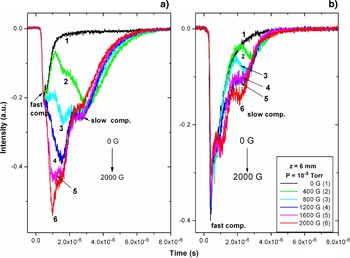
In the present study, two spectral lines of neutral lithium (670.8 and 610.3 nm) and two ionic lines (548.4 and 478.8 nm) were chosen to investigate the effect of magnetic field. Figure 1 shows the variation in the neutral emissions 670.8 nm and 610.3 nm for different magnetic fields in the range of 0–2000 G and observed at a distance of z = 6 mm from the target. There is a remarkable difference in the shapes of temporal profiles of neutrals obtained with and without magnetic field. Enhancement in the overall intensity (7.3 times) was observed for 670.8 nm line in the presence of magnetic field (for B = 2000 G and z = 6 mm). However, the enhancement in 610.3 nm line is comparatively less (1.6 times) under similar conditions. Moreover, the temporal profiles show multi-peak structures/components. Interestingly, the slower components (appearing at later times) show more enhancements in the intensity in the presence of magnetic field as compared to the faster one. The slower components start appearing even from 400 G but the peak intensity of the slowest component in case of 670.8 nm remains almost unchanged with further increase in field.
(Color online) Temporal profiles of Li I 670.8 nm line (a) and 610.3 nm (b) for various magnetic fields at z = 6 mm.

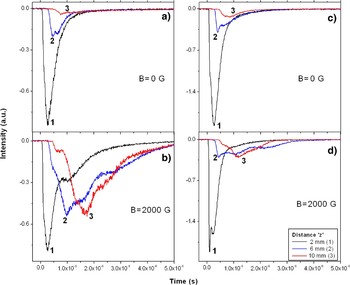
Figure 2 shows the variation in the neutral emissions 670.8 nm and 610.3 nm as a function of distance from the target (z = 2–10 mm) at a fixed magnetic field of 2000 G as well as in the absence of magnetic field. It is evident that enhancement in the intensity of slower components becomes more pronounced for longer distances from the target.
(Color online) Temporal profiles of Li I 670.8 nm (a) without field, (b) 2000 G; Li I 610.3 nm (c) without field, and (d) 2000 G for various distances.

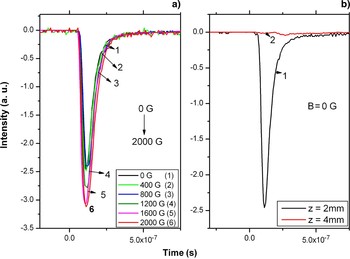
Here we would like to point out that the lines corresponding to Li II do not show up with significant intensity at longer distances (z > 4 mm) even in the absence of magnetic field. Moreover, for z = 2 mm they do not exhibit any substantial change with magnetic field (Fig. 3) although a small increase in intensity can be noticed for intermediate fields. The cause of this distinct behavior from ions will be discussed below.
(Color online) Temporal profiles of Li II 548.4 nm line; (a) with magnetic field for z = 2 mm and (b) with distance in the absence of field.

It can be seen that with an increase in distance, the intensity of the fast component decreases both in the absence and presence of the field. On the other hand, the intensity of slower components increases in the presence of magnetic field for all the distances taken in the study. Another noteworthy observation is considerably larger increase in the intensity of slower components for 670.8 nm as compared to that for the 610.3 nm line. As these components start appearing even from very short distances from the target, they cannot be ascribed to edge instabilities/fluctuations (Pant et al., Reference Pant, Rai and Shukla1998; Neogi et al., 1999). Moreover, the appearance of a multi-peak (> three) indicates that they are not caused by the back flow of particles on the collapse of the bubble, as only two structures are possible in that case (Harilal et al., Reference Harilal, Tillack, O'Shay, Bindhu and Najmabadi2004). Although an exact explanation for the presence of multi-peaks is not clear at present, it is likely that they represent different groups of neutrals (probably some of them originating due to neutralization from ions) and start appearing with the increase in the field (discussed below). However, we would like to mention that in our recent study, we had shown that the initial fast component in the field-free case originates from the charge exchange reaction (Singh et al., Reference Singh, Kumar, Prahlad and Joshi2008).
Therefore, it is worthwhile to investigate the processes, which are responsible for the enhancement in emission in the presence of the magnetic field. To identify this, we have computed photon emissivity coefficients (PEC) for electron impact excitation as well as recombination for both 610.3 nm and 670.8 nm lines using Atomic Data and Analysis Structure (ADAS) (http://adas.ac.uk; Loch et al., Reference Loch, Fontes, Koglan, Pindzola, Balance, Griffin, O'Mullane and Summers2004; Peacock et al., Reference Peacock, O'Mullane, Barnsley and Tarbutt2008). It can be noted that PEC (described below) can directly provide information about the photon emissivity or intensity of a particular line, which is populated by all the possible means as the PEC values consider the plasma parameters as well as the role of metastables. This can provide a more accurate estimate of intensity as compared to using of cross-sectional data for the transition between two states.
As mentioned earlier, the emissivity can be calculated using PEC from ADAS (http://adas.ac.uk; Loch et al., Reference Loch, Fontes, Koglan, Pindzola, Balance, Griffin, O'Mullane and Summers2004; Peacock et al., Reference Peacock, O'Mullane, Barnsley and Tarbutt2008). In ADAS, it is assumed that the collisional and radiative processes between all excited levels redistribute the populations, and the excited levels are in quasi-static equilibrium with the metastable ones. The emissivity of an individual line between states j and k for electron impact excitation is given by

and the emissivity of an individual line due to recombination is given by

where A j→k is the transition probability for the transition between j and k levels, F σex and F υrec are the effective contributions to the populations of the excited state from metastable ones of the atom σ and of the ion ν for electron impact excitation and recombination, respectively (electron density and temperature dependent), and N e, N ν, and N σ are electron density, density of ions in metastable ν and density of atoms in metastable σ states, respectively. Here it can be noted that recombination includes two-body, three-body as well as dielectronic contributions. The respective emissivity for electron impact excitation and recombination can be expressed in terms of PEC's

and

where PECexc and PECrec are photon emissivity coefficients for electron impact excitation and recombination respectively and N e, N i, and N a are electron density, density of ions and density of atoms, respectively.
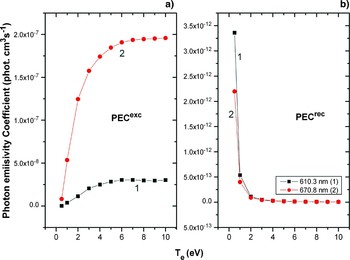
From these equations it is evident that the enhancement in intensity will depend on the increase in the parameters e.g., (1) electron density, (2) PEC, and (3) atom/ion density. Photon emissivity coefficients for both recombination as well as electron impact excitation as a function of temperature for estimated electron density of 1014 cm3 (average density) are shown in Figure 4. Here we would like to mention that the peak temperature (corresponding to the plume front) estimated from triple probe measurements (Kumar et al., Reference Kumar, Singh, Thomas and Sunil2009b) was 5–7 eV and the peak density was around 1015 cm3 at z = 10 mm.. However, the plume temperature and density corresponding to the trailing part of the plume should be much lower. It can be seen that there is no significant difference in the PECrec for 670.8 nm and 610.3 nm lines but for electron impact excitation, the PECexc is higher for 670.8 nm as compared to 610.3 nm, which increases with electron temperature and at further higher temperatures becomes almost constant. On the other hand, PECrec decreases with temperature for both the lines. In analogy with a recent report for a field value of 6100 G (Harilal et al., Reference Harilal, Tillack, O'Shay, Bindhu and Najmabadi2004), we assume that the density may not change much with magnetic field and the temperature may also not get affected much at shorter distances but can relatively increase for longer distances. The reason behind it is that the plasma starts cooling adiabatically while the expansion proceeds, but at the same time the presence of the magnetic field increases the temperature due to Joule heating and adiabatic compression. At short distances the heating should be less, but as the distance increases it may become more dominant. Of course, both temperature and density decrease with the distance in field-free case.
(Color online) Photon emissivity coefficients vs. electron temperature for electron impact excitation (a) and recombination (b) processes. The electron density is taken as 1014 cm−3.

Now we try to explain our observed results. From Figure 4, it is obvious that the possible mechanism for excitation should be electron impact, which increases with temperature. Recombination can be ruled out in this case as the intensity should go down with increase in the field (due to increase in temperature). Moreover, the possibility of recombination can also be ruled out from the fact that the observed enhancement in the emission for 670.8 nm is much larger than in case of 610.3 nm (Fig. 1). From Eq. (4) it is clear that we would have not observed such large difference if the recombination had been the source of populating the excited states as the intensity will only depend on PECre (Fig. 4) as electron as well ion density will be same for both these transitions. To confirm this we have also calculated PEC for higher density (1015 cm3) to see if there is any role of confinement (increased density). We find that PEC for radiative recombination is slightly higher for 610.3 nm for our experimental parameters but for electron impact it dominates for 670.8 nm. This again supports our view that excitation route is electron impact and not recombination as 670.8 nm line is relatively stronger than 610.3 nm in the presence of the field. This can also explain why we see more enhancements in the presence of the field as compared to field-free case for longer distances (Fig. 2). Here we would also like to point out that we could not notice any confinement of the plasma in the presence of magnetic field from imaging studies (Kumar et al., Reference Kumar, Chaudhari, Patel, George, Sunil, Singh and Singh2009a).
It is also worthwhile to mention here that in most of the earlier studies (Harilal et al., Reference Harilal, Tillack, O'Shay, Bindhu and Najmabadi2004; Shen et al., Reference Shen, Lu, Gebre, Ling and Han2006; Pant et al., Reference Pant, Rai and Shukla1998; Rai et al., Reference Rai, Rai, Yueh, Fang and Singh2003) radiative recombination was suggested to be responsible for enhancement in intensity in the presence of magnetic field except (Harilal et al., Reference Harilal, Tillack, O'Shay, Bindhu and Najmabadi2004) where they ruled out this mechanism for the enhancement in Al2+ emission as they could not detect any line emission from Al3+. However, our study demonstrates that mere absence of emission from the higher ionic species cannot be taken as proof for the absence of recombination. Atomic processes need to be considered individually to explore the role of various excitation mechanisms. Therefore, a careful study of the role of these processes is important to understand it.
As we stated earlier, the intensity of the lines corresponding to Li II is drastically decreased with distance even in the field-free case. The reason for this behavior should be due to much lower photon emissivity coefficient for electron impact excitation for Li+ (≈10−11 photon cm3 s−1) compared to the neutrals (≈10−7 photon cm3 s−1). Due to a very low abundance of Li2+ in the LBO plume (Singh & Kumar, Reference Singh, Kumar, Patel and Subramanian2007), we rule out the possibility of a recombination channel in populating the Li1+*. However, a small increase in the intensity for intermediate fields (800–1600 G) is probably due to increased ionization/excitation in the presence of the field.
CONCLUSION
Summarizing, in the present communication, we report the effect of variable magnetic field on the plasma plume in LBO study of LiF-C thin film target. In the presence of magnetic field, the temporal profiles of these lines show multi-peaks features with an enhancement in intensity. In the present case, we have demonstrated for the first time that the observed enhancement in emission from neutrals is largely due to increased electron impact excitation and not due to increase in radiative recombination as previously assumed for most of the other systems. We also show that atomic processes need to be explored carefully to find the cause of enhancement/decrease in emission and appearance of structures. More details regarding the origin of multi-peaks/structured emission is in progress.