Introduction
Peacebuilding without the keywords ‘local’ or ‘national’ combined with ‘ownership’ has almost become unthinkable nowadays, a situation exemplified by the discursive use of these concepts in United Nations peacebuilding since the 2000s.Footnote 1 For policymakers, ‘local ownership’ is more often than not used as a generic term, without further explanation or specific definition, implying that everyone knows what is meant by it.Footnote 2 Actually, far from being consensual, the concept of local ownership is at the very centre of current academic debates on peacebuilding. For one group of scholars, local ownership is considered as a necessary institutional response to recent difficulties experienced by peacebuilding missions, exemplified by faltering legitimacy of dominant peacebuilding institutions, provided that peacebuilders get the balance right between not enough and too much involvement.Footnote 3 But critical voices have problematised this observation, arguing that ownership has often come to remain superficial to only disguise the fact that power still remains in the hands of dominant and wealthy institutions, both national and international, while local agency is manipulated and instrumentalised for the purposes of the former.Footnote 4 In that sense, contemporary discussions of local ownership often end up either endorsing the concept or alternatively altogether critiquing it. To paraphrase Bruno Latour on a very different conversation (the social scientists’ discourse on objects), the debate becomes divided between two irreconcilable positions, considering the phenomenon as either ‘too weak or too strong’.Footnote 5 However, these monolithic accounts are not satisfactory. We aim to contribute to this literature, and possibly nuance the claims, by highlighting the multifaceted nature of ownership, and by breaking down the ‘social’ element of local ownership in different components, which, as we claim, are both normative and material in nature.
Looking at the material and normative dimensions of peacebuilding enables us to highlight specific, contemporary trends in the field of international peacebuilding, which may have been obscured in current debates. The starting point here is the liberal peacebuilding debates,Footnote 6 where the liberal peace refers to the idea that certain kinds of society will tend to be more peaceful, both in their domestic affairs and in their international relations, than ‘illiberal’ states. Liberal peace encompasses sociocultural norms associated with peacemaking, as well as the international and national structures instrumental in promoting it. Economic considerations are also central in the model, for liberal peacebuilding implies ‘the globalisation of a particular model of domestic governance – liberal market democracy – from the core to the periphery of the international system’.Footnote 7 The failure of many liberal peacebuilding attempts to produce a sustainable peace is often not a result of a lack of material ownership, which we see as having been successful in creating material connections between interveners and local elite. Instead, one could argue that despite strong attachments to the material aspects of peacebuilding, many societies have not developed strong attachments to the normative dimensions of international interventions and have thus been reluctant to take ownership of a version of peace that seems distant from the realities of everyday life at local level. This is perceived as being distant from ‘everyday social realities’, which, in many postconflict societies, include customary processes and institutions, indigenous forms of knowledge, traditional authorities, elders, chiefs, communities, tribes, and religious groups.Footnote 8 In that respect, discussing material and normative dimensions of peacebuilding enables us to look at different possible scenarios, including cases where social-material dimensions are strong but have created feeble social-normative attachment to peace or cases where deep social-normative attachment to peace is noticeable despite – or in spite of – superficial social-material ownership.
The lack of engagement with the different dimensions of the local ownership of peacebuilding has not only been obvious in peacebuilding practices, but also in the ways in which academic discourses have framed the concept of ownership. Such discourses have tended to assume a natural and almost depoliticised connection between material and normative attachment to peace. We will challenge the tendency to take for granted the link between social-material and social-normative attachments to peace and instead assume that the different intensities and logics of attachment to peace condition the relationship between societies and interveners. In that respect, the sustainability of peacebuilding must be viewed in its constituent components, both material and normative.
Our observations are based on our long-term engagement with a variety of postconflict contexts, but in this case will draw specifically from data collected during fieldwork in Bosnia-HerzegovinaFootnote 9 between 2008 and 2011. It struck us that there is disillusionment among international and local actors, in Bosnia and elsewhere, about how the abstract idea of local ownership can be implemented efficiently and meaningfully. It is interesting to observe that the academic literature seems to be in line with this trend, torn between the need to enhance the structure of local ownership and the utmost disillusionment with it. It is out of such observations that this article addresses the complex nature of local ownership, proposing a move away from a unified view on ownership as present or absent, and rather moving towards a multifaceted concept which addresses the different types of social attachments to peace. We will therefore first look at the notion of ‘attachment’, mainly, but not exclusively, drawing on Latour’s conceptualisation of attachment to use this as the basis for the development of a theoretical model of different scenarios of peacebuilding attachment, before illustrating this with the example of Bosnia. One general caveat needs to be introduced here. While we have found Latour’s discussion on attachment particularly fecund for our object of study, we have to specify that we consider ourselves to a certain extent sociologists of the social,Footnote 10 and hence we have to distance ourselves to a certain extent from Latour’s ontology of the collective. We do agree with Latour and the Latourians that the ‘social’ has to be more than an ‘established domain of reality’ to include ‘what is connected or associated’,Footnote 11 but we won’t engage with networks between human and non-human actors in this current piece. Nevertheless, we hope that the exploration of the social-material dimension of ownership – however partial and limited it will be – will open future perspectives for research on non-human actants Footnote 12 and their connections to the networks of peace.
Attachment
The concept of attachment has its roots in a body of literature prominent in psychology and mainly goes back to the work of John Bowlby.Footnote 13 In his studies leading to the development of the concept of ‘attachment’, Bowlby concluded that attachment was a bond to other people, developed in the early childhood stages of a person, framing their connectedness to other people in their environment. However, while being further developed in the discipline, the concept of ‘attachment’ transcended the field of psychology and came to be used in different fields. In the business literature, it is often cited in relation to commitment to work and as a trigger of motivation of workers.Footnote 14 We can therefore see a close connection between attachment and agency in this literature, given that the former seems to facilitate the latter. Where there is attachment, there is motivation and commitment to act. Agency traditionally reflects the human capacity to act, a capacity that manifests itself in a social world in which structures impact upon the opportunities and resources available in a constant interplay of practices and discourses.Footnote 15 In the light of attachment, we view agency in the variety of network strings an actor is embedded in, and the more connections an actor has, the higher their capacity to act. At the same time, we need to acknowledge that not all attachments carry to same meanings and strengths. For instance, in their study on social capital in neighbourhood circles in Iowa, R. Allen Hays and Alexandra Kogl distinguished between formal and informal attachments as well as the differing ways in which such attachments play out socially and materially.Footnote 16 In that respect, we can argue that attachments differ in their strength, but also in their quality, thus impacting upon the ways in which they materialise in any given society.
In the context of the sociopsychological functions of attachment, Peter Marris provides a set of roles that attachments can play.Footnote 17 He first argues that attachments serve as a way of dealing with as well as controlling the uncertainties that people face in their everyday lives. Secondly, attachments provide a sense of security and trust in society. Finally, Marris suggests that attachments give us a sense of how to understand power and control in larger terms. These observations are of high relevance in their reading of attachment as situated in the everyday and representing a way of dealing with its associated uncertainties. If we assume that (post)conflict societies are faced with a particularly high degree of sociopolitical as well as material instability, then the ways in which people find attachment in different regimes, norms or groups, can be considered particularly relevant to making sense of the socioeconomic underpinnings of peace and peacebuilding. Attachment then determines the extent to which societies will want to own peacebuilding in terms of taking control over its design in the long run. In that sense, this discussion has found an echo in the burgeoning literature on hybrid peace,Footnote 18 especially in terms of its ability to reflect on the cognitive and emotional links between the peace being created and those experiencing its everyday implications. In that vein, the different types of attachment that we outline in this article are a manifestation of hybridity, that is, the encounter of local and international power relations and their respective visions of and engagement with the peacebuilding process. The different types of attachment therefore point to different (hybrid) forms of peace, both as process and outcome of the nature of attachment.
But more than the psychological literature, we believe that Latour’s conceptualisation of attachment is particularly relevant to the understanding of the various attachments to peace. Pointing to our network-like connections in society, the key question he asks is ‘whether we are well or poorly bound’.Footnote 19 In that sense, attachment can be portrayed as essential bonds conditioning the social constellations we are situated in, while placing us in closer proximity to some rather than to others. At the same time, Latour emphasises that we need to move beyond the binary of attachment and detachment and instead move towards a conceptualisation that frames the strengths of attachments. We are therefore faced with societal constellations in which certain attachments are much stronger than others, because, echoing Marris’s preoccupations, they are better placed to respond to the uncertainties of everyday life. In that respect, the strength of our attachments in society is shaped by a number of factors emerging from our everyday lives. Resistance to certain forms of attachment is therefore not necessarily ‘detachment’, but a stronger degree of attachment to alternative agents or connectors. In this context, we note that Latour’s notion of attachment assumes that emancipation does not necessarily mean to be ‘“freed from bonds” but well-attached’.Footnote 20 As a result, agency emerges not from detachment, but from the embeddedness of the networked in multiple webs and connections. The more connected an agent is to diverse agents and mediators, the more agency (s)he has in the transformation of such webs. In that sense, suggesting that action is ‘overtaken or … other-taken’, Latour is mainly interested in seeing how the networks we are embedded in shape our activities and actions.Footnote 21 This certainly raises questions about the location of agency as, according to Latour, agency arises out of the multiplicity of connections we are embedded in, which can be employed to open up possibilities and opportunities. Against this background, the multiple connectors that the peacebuilding jigsaw offers (local, national, regional, international, and so forth) frames and channels agency through the diverse modalities of attachment to those.
At the same time, this also means that we can never be ‘unattached’, although we can substitute one attachment for another.Footnote 22 Attachment can thus be said to become a manifestation of agency in that people are most closely connected to the attachments which make most sense to respond to the challenges of their everyday lives. We may therefore ask: Which elements of social and political life do people become attached to and want to own, which ones do they feel are unnecessary or even a nuisance to them? Against the background that we view attachment as a manifestation of agency, we claim that attachment is a connection resulting from the challenges of everyday life, rather than simply oppression or force. It points to the agency of people to link with policies, actors, and norms they want to build strong bonds with, and which ones they feel should be kept at a safe distance, without implying a structural over-determination of attachments. This rather means that ‘the social’ becomes visible through ever-changing attachments to the peace being created in the complex politics of the peacebuilding landscape. Here, rather than suggesting a particular ontology of peace, we are interested in the ways in which local actors feel connected to the goals that peacebuilding agencies are working towards, in all their complexity. Do local actors approve of the general direction in which the peacebuilding project is going? How and to what extent do they associate with the project at stake? Latour indeed suggests that we can only perceive the social ‘when new associations are being made’.Footnote 23 Thus the continuously transforming peacebuilding landscape with its shifting discourses around who owns the politics of peace can be seen as a landscape of agency in which new attachments are constantly (re)created while others are being weakened and replaced in the light of their role in wider social networks.
The rise of the local ownership agenda
Before engaging with the question as to why certain contexts have produced stronger attachment to peace than others, we first need to introduce the recent development on local ownership in contemporary peacebuilding, as well as what we consider our contribution to these debates. This literature is based on a simple observation: after a decade of evolution toward more ‘integrated’, ‘multifaceted’, or simply stated more intrusive peace operations, with the high point being the United Nations administrations of Kosovo and Timor-Leste at the beginning of this century, the peacebuilding literature has started to take heed of the ‘unintended consequences’ agendaFootnote 24 to integrate in its analysis all facets of interventions and not only those accounted for traditionally by peacebuilding actors themselves. Debates around sovereignty and rules of engagement, which were so central in the first half of the 1990s,Footnote 25 gave way to discussions on authority and international administrations at the end of the 1990s.Footnote 26 However, the difficult experiences in Iraq, Timor-Leste, and Kosovo in turn led to new discussions on the means of intervention, and to a renewed interest in the concept of local ownership. In this context, local ownership is understood as a process where the solutions to a particular society’s needs are developed in concert with the people who are going to live with, and uphold, these solutions in the long run.Footnote 27 This renewed interest from the peacebuilding community draws heavily on conflict transformation,Footnote 28 security sector reform,Footnote 29 and development and aid literatures.Footnote 30
More specifically in the context of peace- and statebuilding, after having been a pre-eminent architect of the international administrations in KosovoFootnote 31 and Timor-Leste, Kofi Annan rediscovered the virtues of recognising local agency before passing the relay to Ban Ki-Moon. In 2002, national ownership became ‘the single most important determinant of the effectiveness of capacity-building programmes’,Footnote 32 while two years later, the UN recognised that no international initiative ‘imposed from the outside can hope to be successful or sustainable’.Footnote 33 This approach will be repeated in the opening session of the Peacebuilding Commission,Footnote 34 and pursued by Ban Ki-Moon,Footnote 35 reflecting to a certain extent his ‘do more with less’ approach.Footnote 36
The shift from intrusive, ‘top-down’ interventions to a renewed interest in ‘local ownership’ has been a central feature of the evolution of the international intervention in Bosnia. The international intervention first took the form of the General Framework Agreement for Peace in Bosnia and Herzegovina (1995), known as the Dayton Accord, which endorsed the establishment of a High Representative to ‘mobilize and, as appropriate, give guidance to, and coordinate the activities of the civilian organizations and agencies’Footnote 37 involved with the civilian aspects of the peace agreement. After a first period marked by a low-key approach by the Office of the High Representative (OHR), combined with a consolidation of Serb, Bosniak, and Croat hard-line position, and frustrated by the manifest lack of progress, the OHR saw its prerogatives considerably expanded after the Bonn Summit of the Peace Implementation Council of December 1997. In the words of the former High Representative Wolfgang Petritsch, the introduction of the so-called ‘Bonn Powers’ ‘shifted the equation of the international presence in favour of the civilian implementation efforts and brought Bosnia closer to a protectorate-like status’.Footnote 38 The OHR started to dismiss more and more public officials, from mayors up to members of the collective State Presidency for obstruction against the implementation of the Dayton Accord. Moreover, the OHR immediately started an integrationist legislation for state and society by decreeing laws on citizenship, the flag, the national anthem, the currency, ethnically neutral licence plates and passports: all laws the nationalist parties could not agree on in the Parliamentary Assembly.
After a period of heavy intervention into local politics under the High Representative Paddy Ashdown, the former High Representative Christian Schwarz-Schilling saw his role in his capacity ‘to oversee the transition from today’s quasi-protectorate to local ownership’.Footnote 39 In that respect, it could be observed that ownership increasingly became central to the European Union’s increasing engagement in the country. The need to close the Office of the High Representative as one of the conditions for EU membership made clear that the EU wanted to take less responsibility for the political fate of the country and to include a sovereign BiH as a member state. The issue of local ownership has been addressed and viewed as one of the main challenges for Bosnia’s reconstruction period by a number of international players.Footnote 40 At the same time, most agencies seem to explicitly state a lack of local ownership over the peacebuilding process. Particularly in interviews with World Bank, EU, and OHR representatives between 2008 and 2011, the lack of ownership was emphasised as one of the most pressing challenges of postconflict Bosnia. This problem was mainly ascribed to the nature of cooperation with local authorities, which were often viewed as complex or even problematic.Footnote 41 At the same time, the local population seems to be more divided about the need to strengthen ownership, or alternatively, whether to ask for even stronger degrees of intervention.Footnote 42
Interestingly enough, however, neither local nor international narratives tend to define the concrete meaning of ownership in the case of Bosnia, and a linkage between material and normative ownership is taken for granted. Instead, from an institutional perspective, local ownership is viewed as a political process, which is expected to spill over into diverse elements of society, both sociopolitical and economic. The EU understands ownership as the ‘attempt to make people responsible for their own decisions, ideally through passing on knowledge to people from the EU, that is, from EU practice to local partners’.Footnote 43 However, segments of the local civil society resent being perceived as ‘a subcontractor for the EU’ implementing its policies such as democratisation and reconciliation and in the process serving as a legitimating device for the EU to claim local legitimacy and ownership rather than imposition.
Opening up the local ownership discussion: Social-material and social-normative aspects of attachment to peace
This rise of the local ownership agenda – conceptualised as part of the ‘local turn’ in peacebuildingFootnote 44 – has been met with uneven reception in the peacebuilding literature. On the one hand, and if we accept the Coxian dichotomy of problem-solving and critical thinking,Footnote 45 the ‘problem solving’ literature welcomes the newfound interest in local ownership as a way to bolster the process of international institutional promotion of global norms of good governance and its legitimacy. An appropriate transfer of powers to legitimate local representatives allows external statebuilders more time for as sustainable completion of the mandate while enabling the host society ‘to develop the ground for a sound political and civic culture’.Footnote 46 In this regard, local ownership, as well as discussion on how to increase participation and consultation, is understood as integral to the ‘sequencing debate’.Footnote 47 Hence, ownership is seen as a decisive condition to increase the quality and accountability of interventions,Footnote 48 especially if the ownership extends beyond national government to include civil society and the broader public.Footnote 49 In contrast, the critical literature generally portrays the rise of the ‘local ownership agenda’ as a ‘rhetorical device’Footnote 50 or ‘rhetorical cover’,Footnote 51 more aspirational than concrete,Footnote 52 used to legitimise external control.Footnote 53 The statement ‘there is much talk of ownership, but often this is not much more than lip service’Footnote 54 seems to encapsulate the general argument made by this eclectic group of scholars – an argument generally supported by robust empirical data, one should add. Power redistribution – implied in the local ownership discourse – is considered marginal and does not involve a fundamental rethinking of the meaning and location of power.Footnote 55 Hence, the term ‘ownership’ is understood to imply ‘varying degrees of local control that are typically not realized’.Footnote 56 Of course, this raises problems with respect to the ownership of peace, not only in the tension between international and local actors, but also at a local level. This is particularly the case when local elites have to adopt a political arrangement or agenda drafted and conceived by international actors, likely in cooperation with selected civil society actors.Footnote 57 Such a situation is likely to lead to ‘confrontational peacebuilding’ between local elites and peacebuilders.Footnote 58 Hence, while the literature we have reviewed above indeed highlights the complexities of power asymmetries in the negotiations of ownership, it has rarely investigated the type of ownership that is being promoted.
Against this background, it appears fruitful to open up the debate by distinguishing two distinct dimensions of local ownership: what we will call social-normative and social-material. It is worth reminding that both dimensions are social in nature, and thus constitute two faces of the same social phenomenon – ownership of international peacebuilding in this case. Both dimensions however trace different forms of associations, and design different types of connections. By social-material, we denote the dimension shaped by an incentive system set in the framework of the wider peacebuilding operation, which is tied to particular gains, financial, political, or otherwise economic. The social-material dimension of peace includes socialisation by local actors in donor structures for instance. For analytical purposes, we distinguish this dimension from the social-normative dimension, which digs deeper into the underlying normative assumptions of the peacebuilding project and mirrors a value-based identification process of local actors with the peace project being promoted by locals or international actors. This dimension includes the current normative agenda promoting ‘good governance’, ‘reconciliation’ or ‘human security’ among other normative end-goals of international interventions. In a sense, the attachment to the social-material dimension of peacebuilding can be read as the willingness on the part of local actors to engage with international incentive structures and accept the social-material connections that bind international and local actors together, while attachment to the social-normative dimension reflects a degree of preparedness to own its normative underpinnings and contents, embracing the international peacebuilding normative agenda in terms of language and meanings.
Different peacebuilding scenarios
In effect, most of the literature on ownership focuses on normative aspects while marginalising material implications. By including social-material and social-normative dimensions of ownership, we suggest four ideal-typical situations.
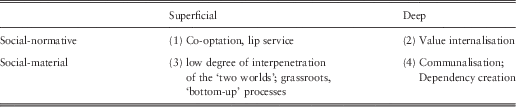
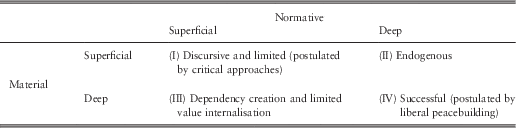
A shallow and superficial social-normative ownership (situation 1 in Table I below) encompasses logics of cooptation and discursive politics, aptly exposed by the critical literature. Social linkages between international and local structures are weak and tenuous, producing a situation that can easily be manipulated in turn by local political entrepreneurs to bolster a resistance agenda.Footnote 59 In contrast, deep social-normative ownership (situation 2 in Table 1) is marked by shared values and a successful process of norm diffusion and as such constitutes the ‘ideal’ endgame of a successful process of liberal peacebuilding. It is the logical extent of a successful local ownership process, as premised by the most enthusiastic proponents of liberal peacebuilding, but rarely happens in practice without meaningful distortions and reinterpretation of the values promoted in the first place.
Dimensions of ownership.

On the social-material axis, superficial social-material ownership (situation 3 in Table 1) describes situations marked by either feeble linkages between international and local structures exemplified by the instrumentalisation of funding sources by local actors (sometimes out of necessity) and by international actors (to legitimise a certain set of policies), or situations where material interactions between donors and recipients are simply not a driving force behind the peacebuilding process. It can be conceptualised from a critical perspective as a low-degree of interpenetration of the ‘two worlds’Footnote 60 marked by risk mitigation strategies and the proliferation of gated-communities,Footnote 61 or alternatively as processes that mirror the elusive grassroots, bottom-up, processes that are not relying, in theory, on external funding and external support to operate. Deep social-material ownership (situation 4 in Table 1) encompasses hybrid processes where there is socialisation of locals into donor structures as well as donors’ socialisation into specific local practices. Hence, the socialisation process in the material sphere is co-constituted by the liberal peacebuilding vision of what constitutes acceptable ‘civil society’ on the one hand (and which project and/or organisation should be funded), and local actors serving as ‘gatekeepers’ of their own communities on the other (through a process of understanding the ‘rules of the game’ to meet donors requirements). This process can be led by and lead to a ‘mushrooming’ of NGOs as donor instruments,Footnote 62 thriving in the ideal environment constituted by aid flows. At the same time, this situation can include a plurality of processes depending on the approach one takes to understand, ranging from the communalisation of interests – postulated by the problem-solving literature as the result of a successful locally-owned process – to outright dependency creation. Even if situations involving extensive aid flows will tend to be represented as a ‘deep social-material’ situation if only by the sheer amount of specific interactions between local and international actors in donor structures that aid processes entail, the social-material axis is not a proxy for a quantitative analysis of material aid flows but is rather specifically tied to the socialisation process linked to material structures.
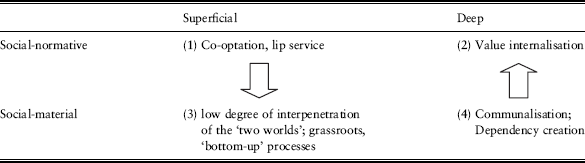
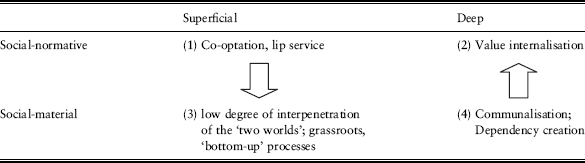
If we return to the literature on local ownership, critical scholars correctly point to the superficial social-normative nature of many ownership practices by underlining the co-optation at work and the lip service paid to local ownership (situation 1 in Table 1). Based on this observation, they tend to postulate an essentially shallow or discursive form of social-material attachment, centred on the instrumentalisation of funding sources and legitimisation discourses (situation 3 in Table 1; see also Table 2 below). Starting from the opposite side of the equation, problem-solvers apprehend the ownership debate from a social-material ownership perspective, looking at the process of socialisation into donor structures and rules that is an integral part of liberal peacebuilding (situation 4 in Table 1). From that premise, they postulate that local ownership of the material aspects of peacebuilding necessarily contributes to a stronger, deeper, and more meaningful process of norms diffusion into wider society, leading to a deeper form of international-local attachment (situation 2 in Table 1; see also Table 2). Both accounts starts from a valid starting point and are, to a certain extent, compatible; not unlike the elephant and blind men metaphor,Footnote 63 the local ownership debate depends on which part of the intervention architecture one stresses.
Assumptions of problem-solving and critical theory.
Instead of a debate revolving around the limited or unrestricted potential of local ownership for liberal peacebuilding, the inclusion of different dimensions of ownership enables us to present a more subtle account of peacebuilding processes, where ownership can at the same time be elusive and tangible, deep, and superficial. We therefore suggest taking the argument a step further by claiming that attachment to the peace being built is both cause and result of its ownership. As argued above, attachment varies in nature and strength, so a low level of attachment to the elements of peace is linked to superficial-discursive ownership, while stronger bonds of attachment to, and thus engagement with, peacebuilding is likely to lead to deeper forms of ownership of peace. Attachments reflect the ways in which people are connected with or disconnected from the politics of peace and therefore how they deal with the associated uncertainties present in the everyday challenges emerging in postconflict societies. This is in essence what Roger Mac Ginty alludes to when he states that ‘it does seem that many international peace-support actors are more comfortable thinking about and exercising material forms of power, while local communities in some settings tend to think about power in terms of legitimacy and moral standing’.Footnote 64 The question as to whether peace is owned on a superficial or deep level can be read as a manifestation of agency, in terms of the extent to which societal groups are attached to the peace being created. The depth of ownership must therefore not be viewed in isolation of the social underpinnings of peace, as the varying degrees of attachment to it reflect a sociopolitical landscape of competing narratives around peace and conflict.
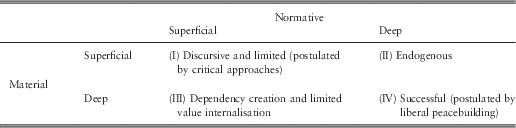
Three caveats need to be introduced. First, our argument does not imply a necessary outcome or route between the different situations described above. On the one hand, we outline connections between categories which are likely in the current binarisation of thinking of local ownership, that is, an assumed link between situation (4) and (2) by the problem-solving approach (situation number IV in Table 3 below), or the link between situation (3) and (1) for the critical scholarship (situation number I in Table 3). We also suggest that, in the cases we are familiar with, this binarisation has to be broken up to account for the transformation of deep social-material ownership into superficial social-normative ownership (situation number III in Table 3). However, while we postulate that this process is the most likely one in the context of heavy-footprint liberal peacebuilding interventions, this is not to suggest that this route or connection is automatic.
Possible ownership connections.
Second, when we look at the local ownership discussion in Bosnia to situate different projects and actors in the different scenarios, we also have to take into account the fact that no (post)conflict situation is ever stable or static. In contrast, we need to account for the fluid nature of transitions to peace and the development of diverse forms of local ownership. In that respect, we can only situate case study scenarios in that space if we also consider the time-dimension, that is, the particular stage any case may find itself in at any given moment. We therefore suggest that postconflict cases can always move from one to another form of attachments. Indeed, superficial social-normative ownership can deepen over time, or become weaker. Along similar lines, social-material ownership can become deeper or more superficial, depending on how the networks of actors involved in the peace- and statebuilding process construct their attachment to the peace being created.
Third, whereas the aggregate collective actions of external donors tend to lead to a peacebuilding process that can be described as either superficial or deep on the social-normative and social-material axes – leading to broad assessments such as ‘liberal peacebuilders have failed create a sustainable peace in Iraq, Kosovo or Timor-Leste’ – individual actors or programmes have logics of their own, creating their own attachment to peace. Certain dynamics on the ground can lead to a strong attachment to peace (whether social-normative or social-material) despite a general failure by international actors to connect the peace agenda to the everyday needs of the local population. The reverse can also be true. With this in mind, we suggest to disaggregate the different connections to peace in Bosnia, looking at each scenario in turn and with the hope of providing a more textured approach to the various possible attachments to peacebuilding.
Exploring ownership connections in peacebuilding in BiH
Situation (I): Superficial social-material and superficial social-normative attachment to peacebuilding
Not only in BiH, but also elsewhere, has the lack of attachment to liberal peacebuilding often been ascribed to the prevailing and ongoing dominance of ethnic identities. Ironically, in BiH this lack of attachment is not just a coincidence or result of ancient hatreds, but has instead been institutionalised by the Dayton Peace Agreement, which, despite its symbolic role as safeguard of the liberal peace in BiH, has institutionalised ethnic divisions through the ethnicisation of politics.Footnote 65 Sven Simonsen suggests that voters primarily kept voting for ethnic political parties,Footnote 66 even ten years after the end of violent conflict. This seems at odds with the EU’s efforts to de-ethnicise the country’s divided police force and political landscape, despite Dayton’s consociational arrangements. Indeed, the EU’s efforts to create a joined police force remained without much success and were unable to fully reform the Bosnian police into one unified force. Louis-Alexandre Berg suggests that this is not least a result of the fact that the underlying political landscape remains ethnically divided and thus the Bosnian police force not amenable to profound reform.Footnote 67 In that respect we can argue that the persistence of ethnically-orientated policies in BiH represents a serious obstacle to the extent to which liberal peacebuilding can operate. It puts into question the effort of the liberal peace to achieve cross-ethnic reunification and de-ethnicisation. In this context, policies such as Milorad Dodik’s questioning of a government report of Srebrenica,Footnote 68 Dragan Covic’s return to power despite past allegations of abuse of power against him or Bakir Izetbegovic’s ethnically-laden and controversial speech in OxfordFootnote 69 are all indicators of nationalistic policies rejecting the general framework of liberal peacebuilding.
At the same time, this is not to demonise a lack of attachment to peacebuilding as a necessarily nationalistic or ethnic practice, although resistance can take these forms. The lack of attachment to peacebuilding can also be a conscious choice for actors who feel the framework does not promote peace in an adequate way, but who still resist ethnic or nationalist sentiments. For instance, when taking a look at the role of artists and cultural actors in Bosnia, the decision of many artists to keep their attachment to peacebuilding at a low profile reflects a disagreement about what peacebuilding should look like.Footnote 70 The fact that, very generally speaking, artists in BiH seem to have a superficial social-material attachment to liberal peacebuilding can be said to be due to two aspects. On the one hand, there is a general mistrust of artists as far as internationally-sponsored projects are concerned. Ambrosia, an association of artists, for instance, have a stated goal of creating an alternative (social and arts) scene, not through (internationally-sponsored) NGO mechanisms, but just by acting as ‘crazy artists’.Footnote 71 In that respect, conditional funding can represent an obstacle to the work they do. On the other hand, Western donors often feel uncomfortable funding artists. As one official stated, cultural organisations do not tend to get funding as they do not have the capacity to comply with the funding guidelines.Footnote 72 Hence, cultural actors are not seen as capable of developing a social-material attachment to the peacebuilding project.
In terms of the social-normative attachment to peacebuilding, we argue that, rather than signifying that artists are not attached to peace, the disconnect between artists and international peacebuilders reflects a lack of attachment to international peacebuilding. In that sense, many artists feel attached to the complex and competing visions of peace to the development of which they contribute, whilst staying fairly disconnected from international (usually EU-driven) peacebuilding.
A similar point in case is the public protests that took place all over the country in 2014. The citizens’ movement that led to the protest was internally grown and not inspired through any international project funds. Citizens went onto the streets to protest against corruption, nepotism and for social justice. The movement then went on to create lasting structures, the so-called ‘plenums’. These citizen-based discussion for a were efficient in the sense that they created inclusive structures of citizen participation in politics, forced politicians to resign and to ask for more accountability. In that sense, one could think that this would be the ideal-type situation in terms of what the Dayton Peace Agreement for 1995 would have envisaged: a locally-owned, and internally-driven peace order in which the citizens feel they have a stake. It may therefore come as a surprise that the protests were greeted with suspicion at best among the international community present in BiH. Indeed, rather than endorsing the protests, High Representative Valentin Inzko traced the protests to a less active role of the Office of the High Representative, implying that the protests were linked to a need for more international intervention.Footnote 73 Wolfgang Petritsch, former High Representative in Bosnia-Herzegovina, similarly associated the protests with hopelessness of the Bosnian people and called for a more pro-active EU approach to intervention,Footnote 74 saying
[t]he EU High Representative for External and Security Affairs along with the Commission and the newly appointed Commissioner, Austrian ‘Gio’ Hahn … will have to put the European Union’s West Balkan policy on a ‘political’ and more assertive footing.Footnote 75
What this reflects is an interesting tension on the part of the international community, namely the, at least rhetorical, need to promote liberal values in BiH, while on the other hand showing a certain degree of suspicion as to whether local actors are even capable of promoting those values without international tutelage. On the part of local actors, this in turn means that they remain suspicious in terms of attaching their own peace work to the framework of the liberal peace, which often seems to fail to understand grassroots concerns.
These examples show that a superficial attachment to both the social-material and social-normative dimensions of peacebuilding cannot be read as detachment from peace or necessarily an alliance with ethno-national objectives (although this may be one possibility). What the examples of local artists or the 2014 protest movement suggests is, much in contrast, deficiencies within the peacebuilding project in its inability to connect to local imaginaries of peace.
Situation (II): Superficial social-material and deep social-normative attachment to peacebuilding
Situation two describes a situation in which the normative underpinnings of peacebuilding are locally endorsed, while their material nature remains fairly independent from international funders. One example to cite here is the recent developments in sports, and more specifically, football. This sport has long been a source of nationalism and ethnic division in Bosnia. This was particularly obvious when, in 2011, UEFA and FIFA suspended the country’s Football Association as the latter consisted of three, rather than one, presidents, to cater for the ethnic division of the country. Indeed, this intervention eventually led to institutional change – the election of one single president in 2012 – and can be considered a central step in countering the ethnic divisions, not only in BiH’s political, but also social and cultural landscape. Emily Vest suggests that overall, nationalistic sentiments in football have started to shift, while the BiH national team is increasingly supported (or at least not rejected) by the different ethnic groups.Footnote 76 This can be read as a result of an institutional and social reframing of the national team, which has been said to have been instrumental in bringing ethnic groups together rather than merely dividing them.Footnote 77 Ed Vulliamy even goes as far as arguing that ‘[t]hroughout, the Bosnian national side itself – and teams like FK Sarajevo – have on the pitch been the country’s only functioning multi-ethnic organisations.’Footnote 78 Such developments can be said to be in line with the long-term ambition of peacebuilders to unlock divided social structures and generate cross-ethnic collaboration. Although not representing peacebuilding actors in the narrow definition of the word, it seems that UEFA and FIFA have created an institutional incentive for cross-ethnic cooperation to take place in the sphere of football.
At the same time, the amount of international funding committed to peacebuilding-through-football has been limited. Although there have been a few internationally-funded NGO projects specifically dedicated to using football as a means of facilitating peace,Footnote 79 football has mainly been funded through local businesses, politicians and state/government funds.Footnote 80 Peacebuilding in this sphere has thus not been very costly for international peacebuilders, but has connected to its framework of cross-ethnic collaboration and institutionalisation.
This is somewhat similar to the work that numerous youth centres all over BiH are doing. Often without access to funding, they represent shared spaces in many divided or war-torn towns. Giulia Carabelli, for instance, casts light on the youth centre OKC Abrašević, located on the former front line in Mostar, citing the centre’s website:
The Youth Cultural Centre ABRAŠEVIĆ believes that a different Mostar is possible and wants to build an open society based on civic ethics. In fact Abrašević is seeking for and applying alternative formulae in the fields of culture, economy and politics as an answer to negative trends present in BiH society.Footnote 81
Carabelli suggests that the centre symbolises and stands for the values of justice and solidarity as well as reducing polarisation and creating ‘spaces of difference’.Footnote 82 A public lecture in the centre indeed suggests that it aims to be a ‘space of trust’ to the local youth in a divided city.Footnote 83 Similarly to what the 2014 protests had aimed to achieve, these values can be said to be fundamentally liberal ideas, that is, ideas that liberal peacebuilders would be expected to endorse as well. It is therefore striking that the youth centres are finding it hard to, or are sometimes not willing to, access international funds. The youth centre Alter Art in Travnik, for instance, was originally set up as an NGO, but the founder then changed his mind as he realised that he did not want to become an administrator, but instead spent his energy on providing a space in which people could express themselves freely.Footnote 84 This example reflects the extent to which attachment to the material underpinnings of peacebuilding can put actors at risk of losing energy they could instead spend on peace work itself. This is certainly not always the case – indeed, the youth centre in Srebrenica did receive EU monies for their work on activism and reconciliation.Footnote 85 What it reflects, however, is a potentially arising friction between the need to engage with the social-material conditions of peacebuilding on the one hand, and an attachment to its social-normative components on the other. The paradox lies in the fact that, at its origin, the reconciliation literature and approach presupposes predominantly an attachment to the ideational, perhaps even spiritual, components of peacebuilding.Footnote 86 However, this becomes increasingly difficult to achieve in the absence of funds, so actors who focus on the social-normative dimension of peacebuilding will often find it harder to implement their projects.
Situation (III): Deep social-material and superficial social-normative attachment to peacebuilding
This situation is, as we claim, the most common constellation in situations in which the transfer of international authority to local ownership has failed to produce deep social results and has mainly focused on the social-material aspects of the cooperation. In Bosnia-Herzegovina, we can observe a strong connection between international institutions and local actors on a social-material level, while those links hardly turn into long-term social-normative attachments to the peace that is being built. The aspect of international peacebuilding which seems to feed into local practice is therefore a socialisation into donor structures instead of joint agenda of hybrid peacebuilding, of which local actors would take ownership. Interviewees often mentioned the need to obtain better access to funding and to obtain training to improve their funding proposals.Footnote 87 In this context, it has been suggested that people are very clever in figuring out what donors want to hear,Footnote 88 while mutual engagement with the social-normative agenda between donors and recipients seems to remain limited. It can indeed be said that international donor money has created a peace industry in which peace has become a business, a platform on which jobs can be created, that is, a sphere heavily dominated by the market. An NGO worker in Bosnia, for instance, emphasised that, in most cases, projects are being implemented for the money, while the NGO sector has turned into a profit-sector.Footnote 89 Roberto Belloni described this situation during the course of which we can observe a mushrooming of NGO in the presence of international actors as a way of reinforcing dependence of local on international structures.Footnote 90 In a similar vein, Igor Pelliciari outlines how, after the war in BiH, a number of new organisations emerged, while organisations that had previously worked in a different field shifted their agenda to development and conflict work due to the availability of funds in this area.Footnote 91 While the mushrooming of NGOs in response to the war can certainly not be labelled as an illegitimate act, it describes a phenomenon during the course of which social-material attachment to peacebuilding happens very quickly, while not necessarily (but possibly) being accompanied by a social-normative attachment to the overall peacebuilding project.
Situation (IV): Deep social-material and deep social-normative attachment to peacebuilding
In terms of the desired sustainability of peacebuilding, an attachment to it based on both its social-material and social-normative underpinnings is the ideal-type situation from the perspective of the international peacebuilders. We notice that in BiH, peacebuilding remains fragile and somewhat disconnected from local structures due to the rare occurrence of this situation. Indeed, it is actually difficult to come up with case studies which illustrate this ideal type. One organisation that seems to come close to this scenario is Mozaik, an organisation based in Sarajevo and pursuing a variety of projects throughout the country. The NGO is well-funded by international grants and thus needs to concentrate a large part of its energy on the administrative aspects of its work. Staff emphasised their need to maintain a professionalised finance department as well as keeping good links to a variety of donors, including the World Bank, UNDP, and the EU.Footnote 92 While this describes an attachment to the social-material component of peacebuilding, the organisation also suggests an attachment to its social-normative components. Indeed, trigger words such as ‘social capital’, ‘social and economic development’, and ‘building trust’ are part and parcel of the organisation’s approach.Footnote 93 It becomes obvious that there is a connection between those terms and those used by the larger international donors represented in BiH. From the perspective of the EU, a frequent funder of the organisation, this represents an ideal situation in that its funds have led to a social-normative attachment to the international peacebuilding mission over time. Of course, what remains to be discussed here is the extent to which this strong attachment to peacebuilding results in the creation of sustainable peace or instead the perpetuation of (potentially illegitimate) structures of external dominance.
Conclusion
This article has attempted to explore the different configurations that attachment to international peacebuilding can take on the ground, and as such has attempted to go beyond the unsatisfactory representations offered by both the liberal peacebuilding scholarship and the critique of it. By breaking down the concept of local ownership into its social-normative and social-material dimensions, and by linking this discussion to the attachment literature, this article has suggested a theoretical framework that opens up the analysis of peace processes beyond success and failure and explores the various scenarios, crystallised around four ‘poles’ or ‘ideal-types’. The different scenarios have also been illustrated through the use of case studies from Bosnia-Herzegovina, looking at ways that attachments to peace have been translated into everyday coping mechanisms, which can range from rent-seeking behaviour to reconciliation practices for instance. The different case studies – which are not meant to be in-depth case studies but rather illustrations of the different ideal-typical poles – reflect the extent to which peacebuilding has varied in terms of who owns it and in what ways – normatively or materially. Therefore, the article suggests that discussions around the extent to which local ownership has been created (or not) have to be approached in a more nuanced way than what the existing literature has done. The link between social-material and social-normative ownership is therefore not natural as often assumed, but politicised and conditional on the nature of peace that is being promoted as well as the networks of actors that engage with it, or refuse to do so. It is not least due to this aspect that the success and failure of local ownership is deeply contested.
Acknowledgments
We would like to thank Isaline Bergamaschi, Annika Björkdahl, Jano Bourgeois, Laurence Cooley, Mattias Hjort, Elisa Lopez-Lucia, Philipp Lottholz, Roger Mac Ginty, Adam Quinn, Alpaslan Özerdem, Oliver Richmond, Gëzim Visoka, and seminar participants at the University of Bradford, University of Bath, Queen Mary University of London, the University of Quebec at Montreal, Dublin City University, and the University of Birmingham (International Relations and Security Theory Reading Group) for their comments on earlier versions of this article. An early draft of this article was presented at the International Studies Association’s Annual Conference in New Orleans (2015).